



Abstract
Recent developments have seen a significant increase in the deployment of service robots, which are increasingly replacing traditional manual labor in various sectors. In China, this has been exacerbated by the rapid development of artificial intelligence. Especially in the hotel industry, the integration of human-robot collaboration is becoming more prevalent to enhance productivity and elevate service quality. It evokes negative perceptions among hotel employees. This study aimed to explore how two types of work mode (human-robot vs. human-human) influence hotel employees’ work well-being. Study 1 was conducted with 106 juniors in a vocational college who were doing internships in a chain hotel in China. Study 2 was conducted by 342 frontline employees from six hotels in Chengdu, China. The results of one-way ANOVA revealed that human-robot collaboration is associated with lower well-being than human-human collaboration in juniors and experienced employees in two studies. Study 2 used AMOS 25.0 and SPSS Process version 22.0 to analyze workplace friendship and workplace loneliness mediate the relationship between work mode and work well-being. In addition, study 2 demonstrated that high quality employee-customer interaction weakens the relationship between workplace friendship and workplace loneliness. This paper not only enriches the literature on the negative impact of service robot utilization from the perspective of employees but also helps hotel managers better understand employees’ perceptions and improves their work well-being during employee-robot collaboration.
Keywords
Introduction
The service industry is currently at a turning point where service productivity is improving, and service delivery is becoming more standardized. Continuous advancements in technology have made services more convenient, fast, and intelligent (Murphy et al., 2017). An increasing number of businesses are not only utilizing intelligent service robots to assist employees, but also to replace employees’ involvement in service encounters (Collins, 2020). In the hotel industry, service robots can perform tasks such as reception, check-in, item delivery, and guiding guests (Cui et al., 2022; de Kervenoael et al., 2020; Deng et al., 2022). Although service robots can reduce operating costs and improve service quality (Seyitoğlu & Ivanov, 2020), their lack of social interaction and emotional intelligence makes it difficult to deliver service to customers without employee supervision (Ivanov et al., 2019). Therefore, instead of completely replacing human employees, service robots will work alongside them (Wang & Yao, 2022).
Previous studies have examined the positive outcomes associated with the application of service robots, which include reducing service costs, improving competitiveness (Ivanov & Webster, 2019), and enriching the customer experience (Qiu et al., 2020). However, the robots in the workplace can also pose a threat to jobs that are not mundane and repetitive (Smids et al., 2020). On the one hand, the use of service robots can make customers perceive a lack of service warmth, subsequently reducing their satisfaction with hotel services (Lv et al., 2021) and lead to negative service experience (Fusté-Forné, 2021). On the other hand, working with service robots can also increase employees’ concerns about being replaced by robots (Seyitoğlu et al., 2021), self-doubt regarding their own competence (Smids et al., 2020), and psychological discomfort about being unable to meet service robots’ qualifications (Seyitoğlu et al., 2023). Furthermore, since employees spend at least one-third of their day at work, negative emotions triggered in the workplace could have a detrimental effect on their job satisfaction (Tandler et al., 2020).
Work well-being refers to an individual’s perception of experiencing frequent positive emotions and infrequent negative emotions at work (Bakker & Oerlemans, 2011). Employees with higher job satisfaction tend to have better service performance and lower turnover rates (Tenney et al., 2016). Although service robots are increasingly used in service production, human-robot cooperation is likely to become the mainstream work mode in the service industry for the foreseeable future (Simon et al., 2020). Therefore, the service quality is not only influenced by the performance of service robots but also by the remaining employees. However, existing research focuses more on the direct impact of service robots on customers, while the negative impact of service robots on employees within a shared and collaborative workplace remain underexplored. To address this literature gap, this paper examines whether and how the adoption of service robots influences employees’ work well-being. The findings of this study could guide hospitality industry practitioners on how to use robot-human collaboration service mode and enhance employees’ well-being at work.
This paper expands the current research on service robots in the hospitality and tourism industry by examining the work well-being of hotel employees. It reveals that employees in human-robot collaboration exhibit a completely different psychological state compared to those in human-human collaboration. Furthermore, from the perspective of resources, it analyzes that the decline in employees’ work well-being is due to excessive depletion of resources, and it provides new solutions for this issue.
Literature Review and Hypotheses Development
Service Robots in the Hospitality Industry
With the fourth industrial revolution, service robots have substantially changed the way humans live (Syam & Sharma, 2018). Service robots are not only utilized in daily lives (Hollebeek et al., 2021), but also used as service providers in the hospitality industry (Zhong et al., 2020). Service robots can also be referred to as social robots (Tung & Law, 2017), which are automated machines capable of communicating and interacting with customers, as well as providing services to them (Lv et al., 2022; Wirtz et al., 2018). Although service robots can meet customers’ needs for social distancing (Wu et al., 2021) and respond to their service needs at any time (Paluch et al., 2020), they can also threaten customers’ identities (Mende et al., 2019) and lower their perceived control (Jörling et al., 2019). In addition, service robots’ lack of emotional intelligence indicates they cannot address customers’ emotional needs during service encounters (V. N. Lu et al., 2020). Therefore, human-robot cooperation service mode, as opposed to fully automated service mode, will become more prevalent in the hospitality industry in the coming years (Simon et al., 2020).
Human-robot collaboration refers to having employees and service robots working together to serve customers (Wang & Yao, 2022). In the process of human-robot cooperation, service robots are advantageous for conducting repetitive, dangerous, or dirty work tasks, while employees could provide personalized services to address customers’ emotional needs (Xiao & Kumar, 2021). Although human-robot cooperation service mode can combine the advantages of service robots and employees, providing customers with better quality and more convenient services, it could lead to negative perceptions of employees. For example, working with service robots can frustrated employees (Reis et al., 2020), threaten their identification with the organization (Savela et al., 2021), decreases their sense of belonging (Xu, 2020), reduce their work motivation (Mael & Ashforth, 1995) and service warmth (Lv, Shi et al., 2024). However, the underlying mechanism through which working with service robots could negatively influence employees’ perceptions remains unexplored. Therefore, there is a need to understand how the accumulation of negative emotions at work affects employees’ reactions.
Work Well-Being
Work well-being, which refers to an individual’s level of happiness at work (Fisher, 2010), is not only associated with job satisfaction but also employees’ positive attitudes toward work. Compared to overall well-being, work well-being can better reflect the complex cognitive and affective experiences of employees at work (Zheng et al., 2015). Work well-being is employee’s subjective perceptions, which is an affective evaluation of relevant events (Faragher et al., 2005).
Demerouti et al. (2001) categorized job characteristics into job demands and job resources, proposing the job demands-resources model (job demands-resources model). The model suggests that job demands can deplete employees’ energy and resources, thereby reducing work well-being; conversely, job resources can effectively provide employees with developmental resources and energy, enhancing work well-being. For example, when an organization values employees’ career development and offers more opportunities for growth, employees’ abilities are recognized, they feel valued, and their work well-being increases accordingly (Spreitzer et al., 2005). Nevertheless, even with the same job demands and resources, individual employees may encounter diverse psychological experiences (Bakker & Demerouti, 2017). Therefore, the personality traits and personal abilities of leaders and individual employees are also one of the key factors influencing employee work well-being. For instance, exploitative leadership, which is prone to appropriating work resources and impeding employee development (Schmid et al., 2019), and lower their work well-being. However, employees with a high level of proactivity can bring about high psychological capital (Luthans et al., 2006), which then leads to their active engagement in work, creating value and resources, and having a positive impact on work well-being. Gao et al. (2019) found that emotional intelligence helps to minimize the negative effects of emotional labor, improving the professional well-being of the nursing population and alleviating their negative emotions such as burnout. Furthermore, organizational culture and organizational climate also have an impact on work well-being. When the organizational climate is more inclusive, it provides employees with more opportunities for positive expression (Allan et al., 2021), leading to a fulfilling work experience and thus increasing their work well-being. Moreover, the inclusiveness of the organizational climate also implies a high accessibility to resources for employees (Nishii, 2013). Furthermore, Lv, Zhang et al. (2024) propose that monetary compensation and emotional support can effectively alleviate the decrease in work well-being experienced by employees due to work stigmatization.
In summary, existing research has revealed that factors such as employees’ own characteristics, work environment, and organizational support can influence employees’ work well-being. In the current hospitality industry, there is an increasing use of artificial intelligence robots to replace traditional human labor. For employees, the colleagues with whom they collaborate are transitioning from human to machine. Under this new trend, it is necessary to assess whether there will be a change in employees’ work well-being and to understand the psychological mechanisms behind any changes.
Work Mode and Work Well-Being
In the context of human-robot collaboration, service robots have been widely adopted across different industries due to their high efficiency and low labor costs. Unlike traditional industrial robots that were typically isolated from employees, service robots have been redefined over the last decade as “collaborators,”“co-explorers,” and “cohabitants.” With the rise of the team-based organizational structure, service robots and employees are less likely to complete relevant tasks independently (Grant & Parker, 2009). It is foreseeable that in the near future, humans-robots interaction will occur more frequently in the workplace, and employees will have to work collaboratively with robots in close proximity.
However, in traditional human-human collaboration work mode, emotional support from co-workers is an important resource for employees to cope with workplace pressures (Halbesleben, 2006). In the human-robot collaboration work mode, employees have fewer opportunities to communicate effectively with co-workers and have to work with robots that are unable to fully understand human emotions (McCartney & McCartney, 2020). This makes employees lose an important way to obtain emotional support. Moreover, working with service robots also cause employees to miss out on the opportunity to obtain tacit knowledge at work (Chen et al., 2015). Tacit knowledge is built on individual work experience, which is an autonomous learning process. However, most service robots are pre-programed and unable to perform autonomous learning (Paluch et al., 2020). This lack of tacit knowledge makes employees’ daily work more energy-consuming and increases the consumption of their own resources. Therefore, when working with service robots, employees not only lack external support, but also have to spend more of their own resources. According to the Conservation of Resources Theory, resources are usually valued, actively protected, and owned by individuals and serve as important prerequisites for promoting well-being (Halbesleben et al., 2009). In human-robot collaboration, employees experience a sustained loss of resources and are unable to receive timely responses, leading to a lower work well-being compared to human-human collaboration. Therefore, we propose the following hypothesis:
H1: Compared with human-human collaboration, human-robot collaboration is associated with lower work well-being for hotel employees.
Workplace Friendship and Workplace Loneliness
The Conservation of Resources Theory provide a framework that can analyze changes in employees’ well-being and the underlying psychological mechanisms by tracking the changes in their resources (loss and replenishment). Therefore, this paper takes this framework as a basis, comparing the changes in resources of employees under human-human collaboration with those under human-robot collaboration, and analyzing the psychological mechanisms involved.
Workplace friendships refer to interactive relationships voluntarily established between employees and their colleagues in the workplace (Yan et al., 2021). Unlike work relationships that are built on the requirement for daily work tasks, workplace friendships are formed through emotional connections among employees. They are informal and personal interactions that occur in the workplace, manifested as mutual appreciation, mutual dependence, mutual trust, and the sharing of values and interests (Berman et al., 2002). Workplace friendships not only create a relaxed and enjoyable atmosphere for interpersonal communications among employees, reducing their perceived work stress (L. Lu et al., 2011), but also help them acquire valuable work resources (e.g., work experience and skills) from their co-workers (Eva et al., 2019). However, workplace friendships are less likely to develop in the human-robot collaboration work mode compared to traditional work mode. Although service robots can replace human employees in completing repetitive and dangerous tasks, they cannot replace human employees due to their lack of emotional intelligence (Deng et al., 2022). Service robots have difficulty understanding complex emotions of humans, having emotional resonance with them, and establishing close emotional connections. Therefore, service robots are unable to establish workplace friendships with employees. The conditional resources loss brought about by employees’ lack of workplace friendships could make them expend additional energy and emotional resources to complete work tasks (Bakker, 2015). When the depleted resources are greater than the resources obtained, employees tend to experience negative emotions resulting from resource imbalance (Zhang & Bartol, 2010), further decreasing their work well-being. Therefore, the following hypothesis is proposed:
H2: Workplace friendship mediates the relationship between work mode and employees’ work well-being.
Workplace loneliness is a negative emotion caused by the discrepancy between employees’ expected and actual interpersonal relationships in the workplace (Ozcelik & Barsade, 2018). Negative emotions can have a detrimental impact on employee performance (Gu et al., 2019). Humans have an inherent desire to cultivate and maintain positive, reliable, and meaningful interpersonal relationships, that is, Need to Belong. These relationships are crucial to the mental, emotional, and physical health of humans (Baumeister & Leary, 1995). If the current state of human relationships fails to meet their inner needs, employees may experience a sense of loneliness (S. Wright & Silard, 2021). Interpersonal relationships often rely on emotional communication among individuals (Turner, 2009). However, with the increased utilization of service robots in hotels, the human-human collaboration work mode is being replaced by human-robot collaboration work mode. When cooperating with service robots, the communication among employees at a deeper level is reduced (V. N. Lu et al., 2020). As long as the individual’s social interaction needs cannot be satisfied, their sense of workplace loneliness is more likely to arise (Erdil & Ertosun, 2011). When the sense of workplace loneliness arises, employees need to spend a lot of cognitive resources to regulate their negative emotions, which will accelerate the depletion of their existing resources (Cacioppo et al., 2009). In the human-robot collaboration work mode, employees’ negative emotions are harder to be noticed by service robots that lack empathetic intelligence, and timely support from supervisors is not always available (R. Li & Ling, 2008). Given the continuous depletion of resources and inability to obtain timely compensation, employees will further experience emotional stress such as anxiety, tension, and dissatisfaction (Cole et al., 2012), which will have a negative impact on their work well-being. Therefore, it is proposed that:
H3: Workplace loneliness mediates the relationship between work mode and employees’ work well-being.
The workplace, where individuals spend more than half of their lives, is an important place to fulfill employees’ social needs (Kun & Gadanecz, 2022). Therefore, employees often establish friendships with co-workers to have emotional communication and satisfy their social needs (Badri et al., 2022). Workplace friendships can also provide social support to employees, enabling them to better achieve their work goals and manage work stress (Gupta, 2020). However, it is difficult for employees to establish friendships with service robots through intimate communication in human-robot collaboration work mode (Filieri et al., 2022). When individuals lack work resources in the workplace and fail to meet their social needs, they are more likely to experience workplace loneliness (Firoz & Chaudhary, 2022). Workplace loneliness, as a negative emotion, can lead to negative perceptions, such as a lack of organizational belongingness and identity (Mohapatra et al., 2023), perceived lower work value (S. Wright & Silard, 2021), and negative self-evaluation (Anand & Mishra, 2021), which, in turn, can reduce employees’ work well-being. Therefore, the following hypothesis is proposed:
H4: The relationship between work mode and employees’ work well-being is serially mediated by workplace friendships and workplace loneliness.
The Moderating Effect of Employee-Customer Interaction Quality
The hotel industry is a service-oriented sector where frequent interaction between employees and customers frequently occurs. Such interactions involve both verbal and nonverbal communication, which affect customer satisfaction and also influence employees’ emotions (Lv, Shi et al., 2024). Positive relationship established between customers and employees can create values for the hotel, especially when customers have close contact with employees (Prayag & Lee, 2019). However, the unprecedented development of human-robot collaboration has reduced the opportunities for human employees in the hotel industry to establish workplace friendships, further exacerbating the depletion of employee resources in the workplace. Prior studies have shown that high-quality employee-customer interaction, an important determinant of employees’ work well-being, can supplement employees’ emotional resources (Xie et al., 2023). Employees who have more high-quality interactions with customers also exhibit higher innovative capabilities (Nasifoglu Elidemir et al., 2020). Therefore, it is expected that the high level of interaction quality between employees and customers could alleviate employees’ workplace loneliness resulting from their need for interpersonal relationships and social interaction. Hence, the following hypothesis is proposed:
H5: Employee-customer interaction quality moderates the relationship between workplace friendship and workplace loneliness. Specifically, the effect of workplace friendships on workplace loneliness is weaker when the level of interaction quality between employees and customers is high.
The proposed model of this study is shown in Figure 1.

The proposed model of this study.
Overview of Studies
Two studies were conducted to tested the proposed hypotheses. Study 1 used a field study to examine the main effect of two types of work mode (human-human collaboration vs. human-robot collaboration) on work well-being with juniors in a vocational college who were doing internships in a chain hotel in China. Study 2 also used a scenario experiment to verify the main effect again with experienced hotel employees in six hotels in Chengdu, China. Study 2 also examined the chain-mediated effects of work friendship and work loneliness, and how employee-customer interaction quality influence the effects of workplace friendship on workplace loneliness.
Study 1
Study 1 investigated the main effect of two types of work mode (human-robot vs. human-human) on hotel employees’ work well-being by conducting a pilot study with a sample of juniors involved in hotel internships.
Methodology
Participants and Design
Study 1 was conducted with juniors major in hospitality management of a vocational college in China. The juniors were participating in the front-line service work for hotel internships at the first time. Therefore, their perception of hotel work mode may affect their work well-being with minimal exposure to other factors. The field study conducted in a chain hotel in China. The old stores in the chain hotel usually adopted traditional work mode with human-human collaboration to provide service. To improve customers staying experience, the newly stores were widely used human-robot collaboration work mode in different hotel scenarios. The experiment involved 106 students (43.4% female, Mage = 20.99, SD = .931) who were randomly assigned to one of two conditions in (human-human collaboration in old stores vs. human-robot collaboration in newly opened stores) between-subjects design.
Procedure
The participants were divided into two groups (human-human collaboration in old stores vs. human-robot collaboration in newly opened stores). The participants in the human-human collaboration group were told of working with two participants, with no mention of service robot. While human-robot collaboration group were informed of one participant collaborate with service robot. This study began to conduct in November 2024 in China.
After 1 week internship work, we distributed 106 questionnaires to measure participants’ work well-being. Work well-being was expressed in six items adapted from Zheng et al. (2015). All constructs were designed on a five-point scale (1 = strongly disagree, 5 = strongly agree). We have collected 95 responses (effective response rate = 89.6%, 45.3% female, Mage = 21.01, SD = .962).
Main Effect
A one-way ANOVA analysis was conducted on work well-being (α = .877) showed that the main effect of work mode was significant. The human-robot collaboration group had a significantly lower work well-being compared to the human-human collaboration group (MH-H = 3.59, SD = .504; MH-R = 3.04, SD = .459; F(1,93) = 29.962, p < .001, η2 = .244), therefore H1 was statistically supported.
Discussion
Study 1 used a field experiment to demonstrate that employees’ work well-being was lower in human-machine collaboration group compared to human-human collaboration group. But it should be noted that all the participants were juniors in vocational college without real-world hotel work experience. Since they have newly started their internship in hotel, their sense of work well-being was unstable. To address this limitation, Study 2 was conducted by using a group of experienced hotel employees to test hypothesis.
Study 2
Methodology
Participants and Design
In order to examine the main effect of two types of work mode (human-huamn collaboration vs. human-robot collaboration) on work well-being of experienced hotel employees. Study 2 was conducted in November 2022 in China. It was mainly carried out on front office employees of six 4-star hotels in Chengdu, China, where close cooperation among employees is required for their work. China’s AI and hospitality industries are growing rapidly and service robots are widely used in China’s hospitality industry. Chengdu is an inclusive and innovative city with a strong tourism and high-tech industry, and the hotel industry is one of the most developed in the country. As a result, hotel staff are able to understand and accept the service model of human-robot collaboration and express their views and opinions on it, thus making our findings more authentic and generalizable. That’s why we chose a hotel in Chengdu, China for our experiment. In order to minimize the discrepancies between the data, six hotels of the same four-star rating were selected after a site visit. There are strict criteria for rating star-rated hotels in China, so these six hotels are similar in size and they are currently adopting service robots to replace traditional manual labor. In this context, employees in many positions are compelled to work alongside robots. This situation aligns with our research requirements. At present, the use of hotel service robots is mostly at the level of customer service. Therefore, compared with back-office staff, front-line staff, including the hotel front desk and lobby, room service and catering departments have more contact with the work of service robots, and human-machine collaborative work mode occurs more frequently.
Procedure
The survey questionnaire consisted of five constructs: work mode, workplace friendship, workplace loneliness, work well-being, and employee-customer interaction quality. The respondents were asked to report whether they primarily collaborate with humans or service robots to complete tasks in their current work, which was used to determine the type of work mode (human-human collaboration or human-robot collaboration). Workplace friendship was measured using nine items adapted from previous studies (Nielsen et al., 2000) which considered friendship opportunity and friendship quality. Workplace loneliness was measured using nine items adapted from S. L. Wright (2005) and revised to fit the Chinese context. Work well-being was measured as the same as study 1. Employee-customer interaction quality was measured using seven items drawn from Bonner (2010) and Wood et al. (2008). Demographic data, such as age, gender, educational background, working years, and department, was collected in the second part of the questionnaire. All constructs were designed on a five-point scale (1 = strongly disagree, 5 = strongly agree).
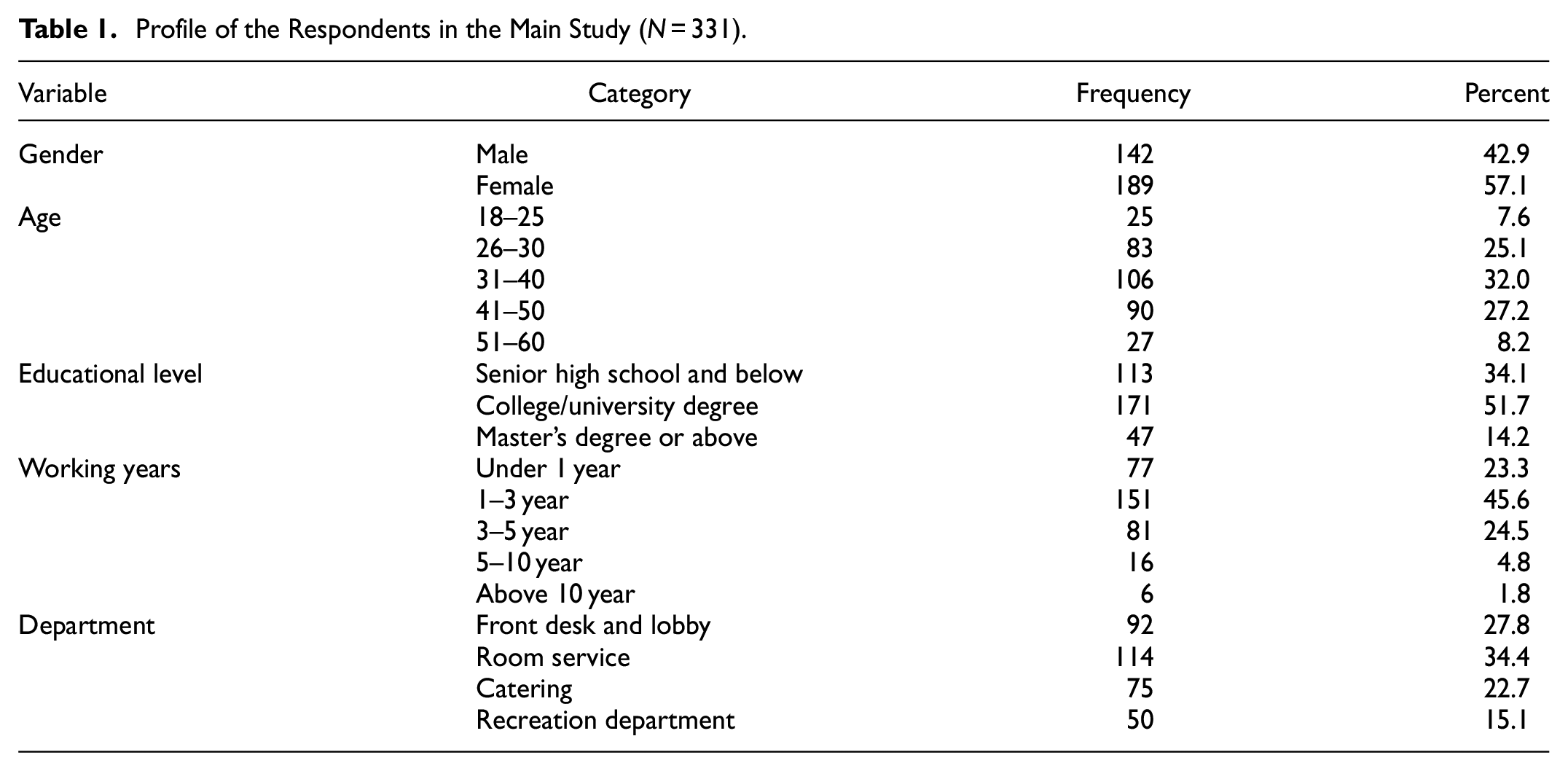
The research received support from the hotel human resources department. The questionnaire was collected online. After contacting the hotel human resources department, we distributed the questionnaire to the workgroup and invited frontline staff to complete it. Before the formal survey started, we explained study 2 and obtained the consent of the respondents. Additionally, each respondent has the right to terminate their participation at any time. The survey was conducted anonymously, with all responses used solely for statistical analysis. A total of 360 questionnaires were collected, but 22 were excluded as they were completed within 30 s, significant fluctuations in scoring or complete agreement, or the situational test questions were not answered correctly. Therefore, 331 valid questionnaires were retained for further analysis, resulting in a 91% response rate. The sociodemographic characteristics of the respondents are shown in Table 1. Most of the participants were females (57.1%), 32.0% were aged 31 to 40, 51.7% had a college/university degree, and 45.6% of the participants had worked for 1 to 3 years. Since this paper primarily discusses the impacts of service robots replacing humans in the hospitality industry, these service robots are primarily employed in front-line service positions. Therefore, study 2 did not consider back office employees. Among all the surveyed individuals, 27.8% worked in the front desk and lobby, 34.4% in room service, 22.7% in catering, and 15.1% in the recreation department.
Profile of the Respondents in the Main Study (N = 331).
Reliability and Validity
Study 2 first conducted a reliability test on the measurement items of each construct in the questionnaire. The internal consistency was satisfactory, with Cronbach’s alpha scores ranging from .900 to .918 (Hair et al., 2009). Second, study 2 used AMOS 25.0 to conduct confirmatory factor analysis (CFA). As shown in Table 2, all average variance extracted (AVE) values were above 0.5, indicating acceptable convergent validity (Fornell & Larcker, 1981). The composite reliabilities (CRs) all exceeded 0.887, also showing convergent validity. The square root of the AVE for each construct was higher than the correlation coefficient among the corresponding constructs, demonstrating adequate discriminant validity (Fornell & Larcker, 1981; Table 3). The model fit indices also supported the confirmatory factor model with RMSEA = 0.016, GFI = 0.919, CFI = 0.990, NFI = 0.926. All factor loadings for each item were greater than .65 (Bagozzi & Yi, 1988).
CFA of the Measurement Model (N = 342).

Correlations, Squared Root AVE, Mean, and Standard Deviations (N = 342).

Note. **p < .01, the bold diagonal elements are square roots of AVE for each construct. Below diagonal elements are the correlations between constructs. α = Cronbach’s alpha.
To check for common variance bias, Harman’s one-factor test was used, with factor analysis using an unrotated factor solution. The results showed that a single factor explained about 30.1% of the total variance, which did not exceed the threshold of 50%. Additionally, this value was also less than half of the total explained variance (62.8%), indicating that common method bias was not a serious issue in this study.
Results
We conducted a one-way ANOVA for the main effects. The results indicates significant lower work well-being of the human-robot collaboration group (M = 3.26, SD ;= 1.058) than the human-human collaboration group (M = 3.88, SD ;= 0.775; F(1,329) = 36.862, p < .001, η = .101). Hence, H1 was statistically supported.
SPSS Process version 22.0 was used to test the research hypotheses of study 2. Model 6 was employed to examine the significance of the mediation effects of workplace friendship and workplace loneliness in the relationship between work mode (0 = human-human collaboration, 1 = human-robot collaboration) and work well-being (Figure 2).

Results of mediation effect test.
There are significant mediating effects of work mode on work well-being through workplace friendship (indirect effect = 0.149, Boot SE ;= 0.042, 95% CI [0.074, 0.240], not included 0) and through workplace loneliness (indirect effect = 0.097, Boot SE ;= 0.035, 95% CI [0.036, 0.171], not included 0) were observed. This indicated that both workplace friendship and workplace loneliness play roles in mediating the relationship between work mode and work well-being, and thus H2 and H3 were supported.
Moreover, there were serial mediating effects of work mode on work well-being through workplace friendship and workplace loneliness (indirect effect = 0.055, Boot SE ;= 0.018, 95% CI [0.256, 0.094], not included 0), showing that work mode affect work loneliness by influencing work friendship, which in turn have an impact on work well-being, supporting H4.
SPSS Process version 22.0, Model 91, was used to examine the hypothesized moderating effects (Table 4). The moderating effect of employee-customer interaction quality was calculated through bootstrapping with 5,000 samples. The result showed a significant interaction effect of workplace friendship and employee-customer interaction quality on workplace loneliness (β = .219, SE ;= 0.061, 95% CI [0.099, 0.339], not included 0). The index of moderated mediation was significant (β = −.030, SE ;= 0.013, 95% CI [−0.061, 0.010], not included 0). Specifically, When the level of employee-customer interaction was low (Mean−1SD = 1.71), the serial mediation effect value was 0.076 (SE ;= 0.025, 95% CI [0.036, 0.132], not included 0). When the employee-customer interaction quality was medium (Mean = 2.71), the serial mediation effect value was 0.046 (SE ;= 0.015, 95% CI [0.021, 0.080], not included 0). When the employee-customer interaction quality was high (Mean + 1SD = 3.86), the serial mediating effect value was 0.012 (SE ;= 0.014, 95% CI [−0.015, 0.041], included 0). Overall, the level of employee-customer interaction quality negatively moderates the effect of work mode on work well-being. Thus, H5 was supported.
Moderated Effect of the Level of Employee-Customer Interaction.

Discussion
This study found that employees who work with service robots in service production experience lower work well-being compared to those who cooperate with human employees. Study 2 also found that workplace friendship and workplace loneliness play a mediating role between working with service robots and employees’ work well-being, with a continuous mediating effect on the relationship between the two constructs.
Study 2 showed that working with service robots results in employees’ workplace loneliness, hindering the development of workplace friendships and negatively affecting their work well-being. However, front-line employees must not only work with colleagues but also interact with customers (Bélanger & Edwards, 2013). Therefore, this study proposed a new approach to compensating employees’ lack of workplace friendships and verified its compensation effect.
In sum, the findings of the research demonstrated that the adoption of a two-way interaction with customers can effectively compensate for the workplace loneliness of employees due to the lack of workplace friendship. This provides an effective solution to avoid the reduction of employees’ work well-being in the context of human-robot collaboration.
Conclusions
Conclusion and Discussion
With the rapid development of the artificial intelligence industry, service robots are being widely adopted in the hospitality industry, to directly carry out the work of serving consumers, thus replacing a significant amount of traditional labor, especially frontline employees. The state of the front-line employees is crucial for businesses, so this study focuses on the changes in employee work well-being. Based on the Conservation of Resources Theory, this paper compares the effects of two different work models (human-human vs. human-robot) on employee well-being and explores the psychological mechanisms and boundary effects through study1 of juniors who doing hotel internships and study 2 of frontline employees in six hotels in Chengdu, China.
Firstly, the results of study 1 and 2 show that hotel employees working with service robots have lower work well-being compared to the model of working with human. Compared with the human-human model, the human-robot model, it is difficult for hotel employees to have emotional resonance with the service robots, the work pressure is not released and relieved, and the acquisition of knowledge is hindered. Therefore, from the perspective of conservation of resources, the emotional and cognitive resources of employees in the human-robot mode have been consumed, and the employees’ work well-being is lower when they work with service robots, which reflects that the emotional and psychological states of employees working with service robots are negatively affected.
Secondly, study 2 reveals the psychological mechanisms underlying employees’ reduced work well-being when collaborating with robots, from the two angles of the depletion and replenishment of their personal resources. Human are social beings and tend to form emotional connections and establish workplace friendships (Han et al., 2016). However, compared with the human-human cooperation mode, in the human-robot cooperation mode, it hinders the formation of workplace friendships, leading employees to be unable to obtain resource replenishment through positive interpersonal relationships with colleagues and needing to spend extra energy and emotional resources to complete tasks, and the negative emotions brought about by the imbalance of resources consequently reduces work well-being. On the other hand, it makes employees feel lonely in the workplace, as robots cannot interact in the same way humans do. This loneliness intensifies resource depletion during work and thus reduces work well-being. Therefore work friendship and work loneliness are important psychological mechanisms by which work styles affect work well-being.
Third, study 2 validated the chain-mediated effects of work friendship and work loneliness. Workplace friendship is an essential means for employees to meet their social needs and obtain supportive resources in the work environment (Yu et al., 2021). However, since service robots cannot carry out two-way emotional interaction with employees in the service environment of human-robot cooperation-working (Choi et al., 2020). The lack of communication and exchange between employees, the inability to establish work friendship to meet their needs and obtain resources, the lack of emotional resources and social needs, and the lack of a sense of belonging, which leads to a sense of loneliness in the workplace (Sahai et al., 2020). As a negative emotion, work loneliness, in the absence of attention, exacerbates the depletion of employees’ cognitive resources, which in turn affects their well-being at work. Finally, study 2 points that employee-customer interaction quality significantly weakens the effect of workplace friendship on workplace loneliness. The nature of employees’ work has an impact on workplace loneliness when they lack communication with colleagues (Lam & Lau, 2012). However, in the service process, front-line employees not only need to interact with colleagues but also with customers. Thus, interaction with customers is considered an important compensation approach to reduce the loneliness of employees in the workplace. High-quality interactions can supplement the emotional resources that employees need to, thereby preventing the decline in employees’ work well-being caused by working with service robots. The findings of this study demonstrate that high-quality interaction between employees and customers can effectively alleviate the loneliness caused by the absence of human colleagues, thereby enhancing work well-being.
Theoretical Contributions
Firstly, the paper expands the current research on service robots in the hospitality and tourism industry by examining the work well-being of hotel employees (Chia & Chu, 2016). While previous research has explored the work well-being of hotel employees, few studies have investigated this in the context of artificial intelligence and human-robot collaboration, especially for employees working with service robots. As robot technology continues to advance, hotels are increasingly turning to robots as assistants to reduce labor costs and enhance employee work efficiency (Hoc, 2001). Thus, this study identifies the impact of human-robot collaboration on the work well-being of hotel employees, enriching relevant research on employees in the context of such collaboration. Moreover, this study reveals that employees in human-robot collaboration experience a completely different psychological state compared to those in human-human collaboration. The new work mode has a multifaceted impact on employees. This discovery provides a potentially promising and highly significant research direction for future human resource studies in the hospitality industry.
Secondly, this paper considers service robots as members of the organization and examines their impact on employees’ work well-being. Prior research that treats service robots as independent and low-status individuals has not considered them as part of the workforce. However, with the continuous development of artificial intelligence technology, service robots have gradually become integral members of the workplace. Playing an increasingly significant role in service delivery. After significantly replacing traditional labor, human-robot collaboration has become a common work mode. In these collaborations, robots play a non-negligible role and hold a very high status. Therefore, this study regards them as members of the workplace and examines their effect on workplace friendships and employees’ work well-being. This provides a new foundational understanding of the role and relationship dynamics for service robot research. Future studies on hospitality industry employees and service robots should be grounded in this human-robot collaboration framework.
Third, this paper sheds light on the important role of employee-customer interaction quality in the workplace context, expanding the scope of research on employee loneliness. Previous research on moderating variables of workplace loneliness have mostly focused on individual or organizational factors (Lam & Lau, 2012). The hotel industry is a service industry that involves frequent service contacts between employees and customers (Jung & Yoon, 2011). Since frontline employees have closer interactions with customers (Mechinda & Patterson, 2011), their social needs can be fulfilled to some extent through customer communication. This paper shows that employee-customer interaction quality can effectively reduce employees’ workplace loneliness, offering a new approach for future research on mitigating employees’ workplace loneliness.
Fourth, the paper not only identifies that changes in employees’ resources within human-robot collaboration are a key reason for the decline in their well-being, but it also uncovers the underlying causes of the excessive depletion of these resources. By introducing the Conservation of Resources Theory into the study of human-robot collaboration, the research analyzes the decrease in employees’ work well-being from the perspective of resource depletion. This paper not only provides a new research angle and analytical clues for the study of human-robot relationships but also offers two analytical directions: the consumption of resources and the replenishment of resources. This provides a key variable for monitoring the status of employees in human-robot collaboration and a framework for analyzing their psychology and behavior.
Practical Implications
Hotel managers should take several measures to improve the work well-being of their employees in a human-robot collaboration working environment. Firstly, they should strengthen team building activities during non-working days to enhance the friendship between employees, thereby creating a positive organizational atmosphere. Managers should also be aware of the negative impact that the introduction of service robots can have on employees’ workplace friendships, and therefore, strive to increase opportunities for colleague communication, especially for those working in a human-robot collaboration-working environment. This could be achieved by emphasizing the importance of workplace friendship and ensuring increased opportunities for communication between employees. Regular attention should also be given to the psychological state of employees and their job satisfaction. Managers can organize team-building activities or social activities in various departments to create friendships among employees and improve their sense of belonging to the hotel.
Secondly, hotel should establish a “psychological room” that meets the psychological demands of employees. This study demonstrates that workplace loneliness increases when employees work in a human-robot collaboration-working environment, which may reduce their work well-being and be harmful to the development of the hotel. Therefore, hotels need to regularly conduct mental health assessments for employees and establish a psychological file for each employee to ensure that their psychological state and psychological endurance are taken into account. Managers should also attend to the emotional state of employees and take the initiative to understand their difficulties, providing emotional counseling to employees through empathy and heart-to-heart communication.
Finally, hotel managers need to pay attention to the rationality of post arrangements and control the use scenarios of robots. This study shows that the interaction between employees and customers weakens the influence of workplace friendship on workplace loneliness when humans and robots work together. Hence, managers can flexibly adjust the working places of the robots. They can use more robots in positions that involve frequent interactions with customers to reduce labor costs and improve the economic efficiency of the hotel, while minimize the use of robots in positions that involve less interaction with guests to avoid employee loneliness in the workplace.
Limitations and Future Research
However, the study also has some limitations. First, the research only focused on the impact factors that contribute to lower work well-being among hotel workers in the context of human-robot collaboration. It is necessary to further validate these impact factors using other samples and different contexts. Additionally, other factors such as occupational threats and job insecurity may have mediating functions in the proposed model and require further exploration. Moreover, there is a need to examine moderating variables, such as social class (Zhang & Wang, 2022), robot anthropomorphism (Huang et al., 2021) and personality traits (Seyitoğlu et al., 2023) to better understand the direction and strength of the relationships between the impact factors and employees’ work well-being. Moreover, various experimental approaches, such as experience sampling methods, should be conducted to validate the results of this study and collect employees’ emotional expressions when working with service robots at different time periods to comprehensively understand the impact on employees. Finally, this study has selected a sample of employees from high-end hotels. However, there are significant differences not only among the customers of different hotel levels (such as five-star hotels vs. budget hotels) but also among their employees. Therefore, future research should extend the investigation to different levels of hotels to test the hypotheses of this study. This would serve two purposes: first, it would enhance the robustness of the conclusions by examining them across a broader range of hotel types; second, it would explore whether the types of hotels have any effect on the findings.
Footnotes
Declaration of Conflicting Interests
The author(s) declared no potential conflicts of interest with respect to the research, authorship, and/or publication of this article.
Funding
This study was supported by the follwing projects: (1) Humanities and Social Science Fund of Ministry of Education of China (Grand Number: 23YJC790088); (2) National Natural Science Foundation of Sichuan Province (Grand Number: 2023NSFSC1043); (3) Soft Science Research Program of Zhejiang Province, People’s Republic of China (Project No. 2024C35067).
Ethics Statement (Including the Committee Approval Number) for Animal and Human Studies
The study involving human participants were reviewed and approved by the Faculty of Business Administration at Southwestern University of Finance and Economics (committee approval number: SWUFE20221115). The participants provide their written informed consent to participate in this study.

Data Availability Statement
The data supporting the findings of this study are available upon request from the corresponding author.