



Abstract
Extensive research links objective and subjective status to health, well-being, and distributive attitudes. This paper investigates how objective status (RSES) shapes perceived social equality (PSE) through two theoretically separable perceptions: perceived socio-economic status (PSES) and perceived social mobility (PSM). Using nationally representative CGSS 2021 data (N = 6,468), this paper estimates a parallel-mediation model via the PROCESS macro (Model 4) in SPSS, employing percentile bootstrap confidence intervals (5,000 resamples) to assess indirect effects. RSES is positively related to both PSES and upward PSM, and each perception is positively associated with PSE. After accounting for these perceptual channels, the direct path from RSES to PSE is negative, yielding an inconsistent-mediation (suppression) structure in which a negative direct path counteracts positive indirect effects. As a result, the total association between objective status and perceived equality is not positive once these countervailing direct and indirect effects are considered. The contribution is to jointly model objective position and two subjective channels within a parallel-mediation framework for an evaluative outcome in the Chinese context and to verify robustness using ordered logit and probit specifications, thereby explaining why bivariate status–fairness associations often appear weak or unstable.
Plain Language Summary
The article emphasizes the necessity of distinguishing between the measurement and analysis of subjective and objective status in empirical research. Overall, real socio-economic status is not correlated with perceived social equality due to the suppressing effect of subjective status.
Keywords
Introduction and Background
Research on socio-economic status links objective measurement paradigms with subjective perceptions—that is, individuals’ recognition of their own position. This paper focuses on two theoretically separable perceptions: perceived socio-economic status (PSES), captured by ladder-based self-placement that summarizes one’s current rank identity; and perceived social mobility (PSM), reflecting beliefs about directional movement and the openness of mobility pathways. We examine how these two forms of subjective perception mediate the relationship between real socio-economic status (RSES) and perceived social equality (PSE)—an overall evaluation of society’s level of fairness that has often been treated as part of class consciousness.
This configuration is especially salient in contemporary China. On the one hand, market reforms and legacy institutions (e.g., hukou, danwei) have reshaped stratification and mobility regimes during the reform era; on the other hand, empirical research documents systematic deviations of subjective self-placement from objective standing. Against this backdrop, we ask how RSES reaches PSE once subjective pathways are made explicit. Using nationally representative CGSS 2021 data (N = 6,468), we implement a parallel-mediation design in SPSS via the PROCESS macro (Model 4) and assess indirect effects with percentile bootstrap confidence intervals (5,000 resamples). The analysis indicates that higher RSES can indirectly raise PSE by elevating PSES and fostering more optimistic mobility beliefs (PSM). However, objective advantages also exhibit a direct association with PSE in the opposite direction. Consequently, this paper argues that aggregate statement about the RSES–PSE link is theoretically indeterminate unless the relationship is decomposed into indirect and direct paths.
Theoretical Framework: Why Parallel Mediation Fits the Status—Fairness Nexus
It is widely recognized that socio-economic position encompasses both an objective structural component and a subjective perceptual component. Objective status is typically indexed by education, income, and occupational standing, whereas subjective status is commonly measured with the MacArthur ladder asking respondents to locate themselves on the social hierarchy in terms of money, education, and occupation (Adler et al., 2000; Richter & Menold, 2024, pp. 3–4). Meta-analytic evidence shows only a moderate average correspondence between objective and subjective status (about r ≈ .30) and demonstrates that the correlation varies with context and measurement choices; recent studies therefore argue that subjective pathways should be modeled explicitly rather than treated as redundant with objective position (Y. Chen & Fan, 2015; Richter & Menold, 2024, pp. 3, 7). Methodological work on the ladder corroborates this view: objective and subjective SES capture partly different facets of standing, and subjective status frequently emerges as an independent predictor of outcomes, with established reliability/validity and noted concerns about reference-frame and scale-usage heterogeneity (Moss et al., 2023, pp. 2–3; M. Zhao et al., 2023, pp. 8–9). Consistent with long-standing findings in stratification research, Chinese surveys likewise reveal a persistent divergence between objective position and self-placement—“status discordance”—and trace its evolution over time, reinforcing the claim that PSES should be theorized alongside real socio-economic status (RSES) rather than collapsed into it (Y. Chen & Fan, 2015).
Subjective status (PSES) captures unique information about an individual’s social standing beyond what objective indicators alone can measure (Cundiff & Matthews, 2017). In fact, subjective status provides independent predictive value—for example, it remains associated with changes in outcomes like health even after accounting for objective SES—demonstrating that it adds information not contained in objective measures. Evidence from the Whitehall II cohort shows that both objective grade and ladder-based PSES predict health and, importantly, that PSES is a better predictor in health when both are entered simultaneously. (Singh-Manoux et al., 2005, pp. 858–860). Besides, PSES carries psychosocial information with independent predictive power: cohort and panel evidence indicates that PSES predicts health levels and change net of objective indicators, suggesting that perceived rank embodies internalized hierarchy, comparison processes, and control beliefs (Cundiff & Matthews, 2017; Demakakos et al., 2018; Singh-Manoux et al., 2005).
Consistent with recent evidence, lower subjective status (PSES) is associated with lower PSE and stronger support for redistribution (Melli & Azzollini, 2025). Likewise, individuals who judge existing inequality as unfair are more likely to endorse redistributive policies (Tejero-Peregrina et al., 2025). By contrast, members of higher objective-status groups (RSES) are more inclined to evaluate outcomes as fair, particularly when distributions are framed as process- or merit-based, and correspondingly exhibit less support for redistribution (Starmans et al., 2017). Taken together, these regularities motivate our analysis of how objective position and subjective perceptions jointly shape PSE. Moreover, cross-national evidence shows that when people believe upward mobility is attainable, they become less supportive of redistribution and more accepting of existing disparities—implying that stronger mobility beliefs can temper demands for equality (Alesina et al., 2018). Besides, perceiving greater mobility has been linked to diminished public desire for egalitarian interventions in education (Wen & Witteveen, 2021), underscoring the role of mobility perceptions in shaping attitudes about inequality. The theory of relative deprivation further implies that fairness judgments are comparative and can be nonlinear with respect to one’s own position and salient reference groups (Raudenbush & Bryk, 2002; Smith et al., 2012; Snijders & Bosker, 2011; Starmans, Sheskin, & Bloom, 2017).
Given these foundations, this paper treats RSES as a structural anchor that shapes two distinct perceptual channels—positional self-placement (PSES) and directional movement beliefs (PSM)—that, in turn, are expected to influence perceived fairness (Alesina et al., 2018; Hoebel & Lampert, 2020; Moss et al., 2023; Wen & Witteveen, 2021). In summary, prior studies suggest that objective socio-economic status may influence perceived fairness through two distinct perceptual pathways: one’s subjective status ranking (PSES) and one’s beliefs about social mobility (PSM). This paper therefore focus on how structural position and subjective perceptions jointly shape PSE, rather than assuming that higher socio-economic status will automatically translate into lower perceived unfairness. This approach keeps the argument aligned with our core concepts of status and fairness.
The Chinese case sharpens these issues. Since the late 1970s, market reforms interacting with legacy institutions such as hukou and danwei have reshaped stratification and mobility regimes, increasing heterogeneity across regions, sectors, and cohorts (Wu, 2019). Building on the above insights, we ask an open empirical question: Does higher objective status consistently heighten perceived fairness, or might higher status have mixed effects on PSE once we account for the indirect influences of PSES and PSM? In other words, could high RSES simultaneously elevate perceived fairness via these subjective pathways yet also engender perceptions that counteract that effect? This question sets the stage for our analysis.
Recent work further shows that status self-placement crystallizes early and forecasts later well-being even after accounting for family background, supporting the view that perceived rank operates through expectancies and self-evaluations that persist over the life course (Sweeting et al., 2011). Experimental and cross-cultural evidence also indicates that people moralize rank information—inferring deservingness and fairness from status cues—which ties PSES directly to evaluative judgments rather than treating it as a neutral readout of material position (Schubert et al., 2016). Complementing these findings, nationally representative Chinese data across 10 waves (CGSS/CSS, 2003–2012) show that large-scale evidence further shows that subjective placement frequently diverges from objective position—“status discordance”—and that perceived upward mobility is a key correlate of this divergence, directly tying PSM to how individuals construct PSES (Y. Chen & Fan, 2015). Education, income, and occupational prestige are each negatively associated with status discordance, while perceived upward mobility increases discordance; moreover, the strength and even the direction of these patterns differ between urban and rural populations (Y. Chen & Fan, 2015). These results substantiate that PSES and PSM encode distinct informational content beyond RSES and that their determinants and consequences are context sensitive, which is precisely the structure that a parallel-mediation approach is designed to capture (Y. Chen & Fan, 2015).
Methodologically, this paper adopts a parallel-mediation design to estimate the indirect effects from RSES to PSE via PSES and via PSM while allowing a residual direct path from RSES to PSE. Inference for indirect effects relies on percentile bootstrap confidence intervals (5,000 resamples), which are recommended for multiple-mediator models; moreover, tests of mediation do not require a significant total effect when indirect effects of opposite signs may exist (Preacher & Hayes, 2008, pp. 880–884; X. Zhao et al., 2010). This approach aligns with recent calls to treat subjective pathways as substantively meaningful constructs that can either transmit or counteract the influence of structural position on an evaluative outcome such as PSE (Richter & Menold, 2024, p 7, 9).
From Stratification to Perceived Equality: Research Hypothesis
In this paper, perceived social inequality is defined as the overall judgment of the equal degree of individuals’ possession of social resources and rights. This degree of equality (according to the scale of China’s general social survey) refers to the fact that people realize that society is unequal in the possession of resources. Higher scores indicate greater perceived fairness. Conceptually, perceptions of social (in)equality constitute a macro-level evaluative orientation that has long been theorized as an element of class consciousness within stratification research (Gurin et al., 1980, p. 30; Heaton, 1987, p. 611).
Real socio-economic status (RSES) denotes an objective structural position indexed by education, income, and occupational standing, which together approximate material resources and placement in stratified opportunity structures (Wu, 2019). Perceived socio-economic status (PSES) refers to a respondent’s self-placement on the social hierarchy, most commonly measured by the MacArthur ladder that explicitly frames status in terms of money, education, and occupation and has been widely validated across populations and settings (Hoebel & Lampert, 2020; Moss et al., 2023; M. Zhao et al., 2023). Perceived social mobility (PSM) captures a directional appraisal of movement and the perceived openness of mobility pathways, and it has been linked to redistributive preferences and evaluations of inequality in comparative research (Alesina et al., 2018; Wen & Witteveen, 2021).
Building on this logic, this paper first formulates hypotheses about how RSES relates to perceived status. A large literature shows that education, income, and occupational prestige serve as anchors for both one’s self-placement in the hierarchy and one’s beliefs about movement within it. Accordingly, Hypothesis 1 (Status Correspondence) states that higher objective status is associated with higher perceived status. We specify two components: H1a expects that higher RSES is associated with higher PSES, and H1b expects that higher RSES is associated with more upward PSM. This hypothesis reflects prior findings that socio-economic advantage tends to translate into elevated subjective status and optimism about mobility (Kraus et al., 2012; Singh-Manoux et al., 2005, p. 859; Wu, 2019).
Next, we link perceived status to PSE. By definition, PSE refers to evaluative judgments about the fairness of how resources and rights are distributed. Prior work demonstrates that subjective rank and mobility perceptions are closely tied to fairness evaluations and redistribution preferences across diverse contexts. On this basis, Hypothesis 2 (Perception → Equality) posits that higher perceived status is associated with higher perceived social equality. In particular, H2a holds that higher PSES is associated with higher PSE, and H2b holds that more upward PSM is associated with higher PSE. This expectation accords with evidence that those who see themselves as higher in status or on an upward trajectory tend to view societal arrangements more favorably, a pattern observed in studies of mobility beliefs and fairness both in China and elsewhere (Alesina et al., 2018; Kiatpongsan & Norton, 2014; Mijs, 2021; Whyte, 2010).
Finally, we consider the joint influence of objective and perceived status in shaping fairness evaluations. If H1 holds (RSES shapes PSES and PSM) and H2 holds (PSES and PSM shape PSE), then perceived status should transmit the effect of objective status to perceived equality. Because cross-sectional theory does not warrant imposing a universal causal order between PSES and PSM, a parallel-mediation framework is adopted here to allow indirect effects through both mediators. Theory remains agnostic about the sign of the residual direct path from RSES to PSE: depending on mechanisms such as heightened evaluative standards versus legitimating distributive norms, this direct association may be weak or even negative. Hypothesis 3 (Parallel Mediation) therefore states that PSES and PSM jointly mediate the association between RSES and PSE, with positive indirect effects via both mediators. In other words, we expect significant positive pathways “RSES → PSES → PSE” and “RSES → PSM → PSE,” potentially alongside a direct RSES → PSE path whose sign will be empirically determined (Hayes, 2022).
This paper tests H1–H3 using nationally representative data from the China General Social Survey 2021 (CGSS 2021), controlling for standard covariates such as gender, party membership, marital status, age, and other demographics. Given the cross-sectional design, we analyze perceived mobility (PSM) rather than attempting to construct objective mobility trajectories; future research with panel data or administrative records can extend the analysis of mobility dynamics over time. Survey documentation and English-language CGSS materials confirm that the 2021 wave covers the relevant status indicators and attitudinal measures needed for our analysis.
The parallel-mediation specification aligns with contemporary methodological guidance: multiple-mediator models should emphasize indirect effects estimated a parallel-mediation model via the PROCESS macro (Model 4) in SPSS, employing nonparametric percentile bootstrap confidence intervals with 5,000 resamples to assess indirect effects, and mediation does not require a significant total effect because opposing indirect paths can cancel (Hayes, 2013; Preacher & Hayes, 2008; X. Zhao et al., 2010).
A parallel-mediation architecture follows because PSES and PSM draw on different inputs and time frames—current rank identity versus anticipated change—so a universal causal order between them cannot be defended in cross-sectional data; medical and aging literatures reach a similar conclusion when distinguishing subjective rank from resource endowments evolving on different clocks (Cundiff & Matthews, 2017; Demakakos et al., 2018). In this architecture, RSES is allowed to affect PSE indirectly through PSES and PSM, while a residual direct path captures mechanisms tied to structural exposure—broader comparative horizons, awareness of segmentation and gatekeeping, and institutional knowledge—that elevate evaluative standards independently of one’s self-placement or momentum beliefs (Mijs, 2021; Wu, 2019).
Substantively, allowing for offsetting pathways is crucial in the status–fairness nexus. Upward self-placement and perceived mobility can legitimize differentiation by framing outcomes as deserved or temporary (Alesina et al., 2018; Starmans et al., 2017), whereas objective advantage can sharpen scrutiny of institutional frictions and thus lower PSE net of perceptions (Mijs, 2021; Wu, 2019).
Research Formulas and Data Sources
Model and Identification
We estimate a parallel-mediation model that decomposes the association between RSES and PSE into a direct path and two indirect paths operating through PSES and PSM. Let i index respondents and let
(1)
(2)y
(3)
(4)
The indirect effects are
Constructs and Codings
We operationalize the constructs as follows, using consistent terminology throughout. RSES (real socio-economic status) is a composite index formed by z-standardizing education, (logged) personal income, and occupational prestige and averaging these components in the main specification; as a robustness check, we substitute the first principal-component score for this composite. PSES (perceived socio-economic status) is measured as positional self-placement using the 10-rung MacArthur ladder, with higher values indicating higher perceived rank; wording and scoring follow the standard instrument. PSM (perceived social mobility) is a directional appraisal derived from the ordered difference between “current” and “past” self-placement on the ladder (range −4 to +4), with higher values indicating more upward perceived mobility; this coding is consistent with the perceived-mobility literature linking mobility beliefs to evaluative outcomes. PSE (perceived social equality) is measured on a 1–5 ordinal item capturing judgments about whether resources and rights are fairly distributed, with higher values indicating higher perceived equality.
Estimation Strategy and Reporting
We estimate the path equations by ordinary least squares (unweighted) to obtain the linear components required for PROCESS-style mediation and to report standardized effects. Because PSE is ordinal, we replicate core specifications using ordered logit and ordered probit models and assess the proportional-odds (parallel-lines) assumption; when diagnostics suggest violations, we consider generalized or partial proportional-odds models as robustness checks. Across ordered models, the signs of the key paths remain unchanged. The paper reports variable definitions in Table 1, descriptive statistics in Table 2, bivariate correlations in Table 3, and mediation estimates in Table 4; Figure 1 presents the conceptual framework, and Figure 1 plots the estimated direct and indirect paths and reports the corresponding coefficients. Methodological references for the ordered models and generalized/partial proportional-odds approach are provided by Williams (2006).
Variable Definitions and Codings (Main and Robustness).

Note. Main models: OLS; mediation via PROCESS with bootstrap 95% CIs; coefficients reported in standardized form where indicated. Robustness for the outcome: ordered probit/logit for PSE (Supplemental Tables B1–B2). RSES PCA details (loadings, variance explained) in Supplemental Tables A1–A2.
Descriptive Analysis of Variables.

Note. N = 6,468.
Pearson Correlations Among Variables (Lower Triangle).

Note. Pairwise N = 6,577–8,148.
p < .01. *p < .05 (two-tailed).
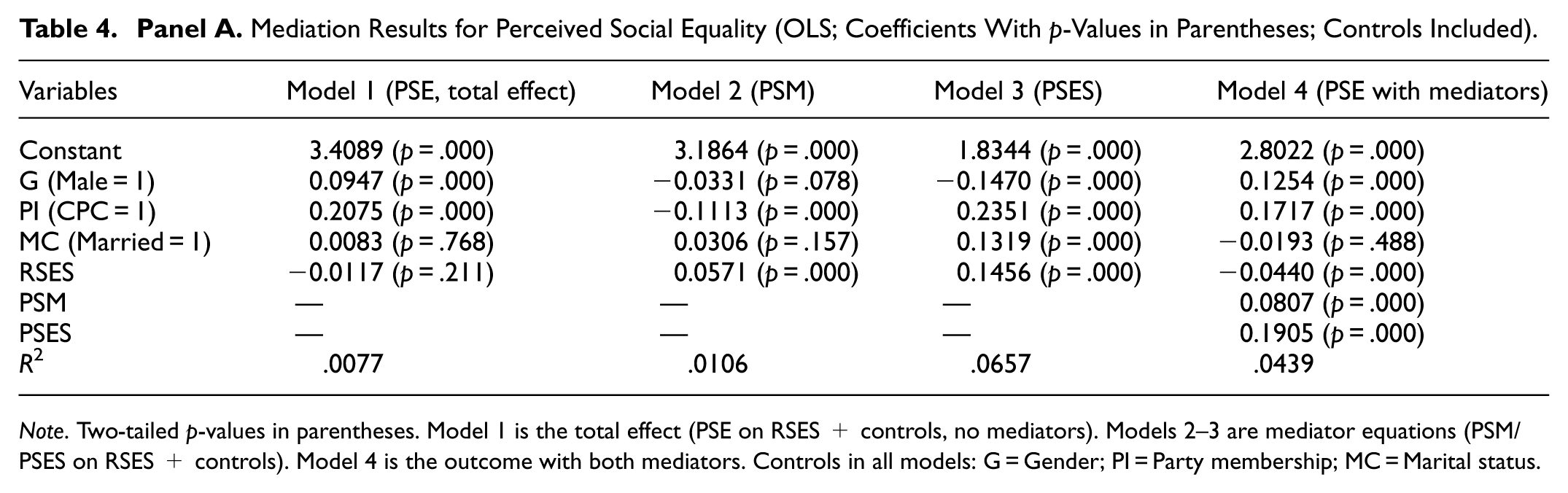
Note. Two-tailed p-values in parentheses. Model 1 is the total effect (PSE on RSES + controls, no mediators). Models 2–3 are mediator equations (PSM/PSES on RSES + controls). Model 4 is the outcome with both mediators. Controls in all models: G = Gender; PI = Party membership; MC = Marital status.

Note. Interpretation (one line). RSES has a non-significant total effect on PSE (Model 1), but once PSES and PSM are included, the direct effect turns negative and significant while indirect effects are positive, showing a suppression configuration consistent with the hypothesis.

The research finding on the mediating and suppressing effects.
Data
We analyze the China General Social Survey 2021 (CGSS 2021), a nationally representative survey designed to monitor social structure and quality of life in urban and rural China. Following standard cleaning procedures—removing ineligible cases and addressing item nonresponse consistent with our construct definitions—the analytic sample comprises
Coding and Analysis
The present section documents variable construction, coding rules, and the estimation and reporting practices used to produce comparable effects across specifications; alternative codings are reported in the Supplemental Table for robustness.
RSES (real socio-economic status): RSES is operationalized as a composite of education, (logged) personal income, and occupational prestige. Each component is z-standardized, and the main index is the arithmetic mean of the three z-scores. As a robustness alternative, the composite is replaced with the first principal-component score derived from the same indicators. Principal-components analysis supports a dominant one-factor solution for RSES (eigenvalue = 1.87; explained variance = 62.3%; loadings = 0.72–0.84; listwise N = 6,878; Supplemental Table A1), and substituting the factor score for the z-mean index does not change the substantive conclusions (Supplemental Table A2).
Education. The highest credential is recoded to a 5-level ordered scale (1 = primary or below … 5 = post-tertiary), as shown in Table 1. For sensitivity checks requiring a continuous proxy, years of schooling are derived from these credential categories following the study’s coding rubric.
Income. Self-reported annual individual income (reference year 2020) is classified into five ordered bands ranging from lowest to highest income. These bands are used directly (1–5) in the main specification. In sensitivity analyses that approximate a continuous metric, band midpoints are assigned and log-transformed.
Occupational prestige. Each respondent’s CGSS occupation code is linked to a 5-level prestige ranking (1 = lowest … 5 = highest) based on standard Chinese occupational-prestige scales. Where only coarse occupational categories are available, the finest mapping documented in CGSS is applied.
PSES (perceived socio-economic status): PSES is measured as positional self-placement on the 10-rung MacArthur ladder (1 = lowest, 10 = highest). Higher scores indicate higher perceived rank. The instrument’s wording and scoring follow the standard specification.
PSM (perceived social mobility): PSM captures directional appraisal of movement and is coded as the ordered difference between current and 10-years-earlier self-placement on the ladder. The measure ranges from 1 to 5, with higher values denoting more upward perceived mobility. This ordered-difference coding is used in all main analyses.
PSE (perceived social equality): PSE records evaluative judgments about whether resources and rights are fairly distributed. The item is coded on a 1–5 ordinal scale, with higher values indicating higher perceived equality. Because of the ordinal scale, linear specifications are complemented with ordered-response robustness checks in the Supplemental Table.
Controls: Standard covariates include Female (= 1), CCP member (= 1), and Married (= 1), together with age and other demographics as listed in Table 1. All indicator variables are coded so that 1 denotes the presence of the attribute.
Link to Estimation and Reporting
All main regressions are estimated by ordinary least squares without survey weights, and mediation is evaluated using the PROCESS routine with 5,000 bootstrap resamples. The paper reports standardized indirect effects together with 95% confidence intervals, as well as the corresponding direct and total effects. Ordered probit and ordered logit replications for PSE are provided in Supplemental Tables B1 to B2. Multicollinearity is assessed using variance-inflation factors, which do not indicate concerning levels. Tables 1 to 4 and Figure 1 organize variable definitions, descriptive statistics, correlations, and the mediation results.
Result and Findings
Table 2 presents descriptive statistics for all variables used in this paper. On a 1–5 response scale, respondents’ perceived social equality (PSE) has a mean of 3.46 (SD = 0.97; N = 8,090), indicating moderately positive evaluations of social fairness. Real socio-economic status (RSES), constructed on the same 1–5 scale, has a mean of 2.60 (SD = 1.35; N = 6,878). Perceived socio-economic status (PSES) averages 2.27 (SD = 0.90; N = 7,969), and perceived social mobility (PSM) averages 3.35 (SD = 0.74; N = 7,780). For binary covariates, 45% of respondents are male (mean = 0.45; SD = 0.50; N = 8,148), 12% report Chinese Communist Party (CPC) membership (mean = 0.12; SD = 0.32; N = 8,135), and 71% are married (mean = 0.71; SD = 0.45; N = 8,148). Because items exhibit differential missingness, this paper’s mediation analyses rely on a listwise-complete sample of N = 6,468.
Two features are noteworthy. First, the average PSES (2.27) is lower than the average RSES (2.60), indicating that respondents, on average, place themselves below their composite objective position. Second, dispersion is largest for RSES (variance = 1.82) relative to PSES (0.81) and PSM (0.55), implying greater heterogeneity in objective status than in subjective statuses or perceived mobility. These descriptive patterns foreshadow the multivariate results reported below: RSES is expected to be positively associated with both PSES and PSM, and the overall level of PSE (3.46) leaves ample scope for both upward and downward evaluations of social fairness across groups.
Table 3 reports Pearson pairwise correlations (lower triangle; pairwise N = 6,577–8,148). Perceived social equality (PSE) is positively associated with perceived socio-economic status (PSES; r = .163, p < .01) and perceived social mobility (PSM; r = .087, p < .01). Small positive correlations also appear with Gender (coded male = 1; r = .056, p < .01) and Party membership (Chinese Communist Party [CPC] coded = 1; r = .071, p < .01). By contrast, PSE shows essentially no association with real socio-economic status (RSES; r = .003, not significant) and a negligible correlation with marital status (Married coded = 1; r = −.002, not significant). Unless noted otherwise, p-values are two-tailed.
Consistent with expectations, objective and subjective status are related: RSES correlates moderately with PSES (r = .219, p < .01), and PSES correlates positively with PSM (r = .157, p < .01). RSES also correlates with Party membership (r = .255, p < .01) and Gender (r = .144, p < .01), and weakly negatively with being married (r = −.066, p < .01). Additional small negatives include Gender–PSES (r = −.033, p < .01) and Party–PSM (r = −.025, p < .05). All coefficients are below |0.30| (maximum = 0.255), indicating that multicollinearity is unlikely to compromise this paper’s regression models. Substantively, the pattern suggests that perceived equality tracks subjective rather than objective standing at the bivariate level, foreshadowing this paper’s mediation results in which the indirect paths via PSES and PSM are positive whereas the direct RSES → PSE association becomes negative, consistent with a suppression structure.
This paper first estimates a total-effect specification that regresses perceived social equality (PSE) on real socio-economic status (RSES), controlling for the standard covariates used throughout the analysis (Baron & Kenny, 1986; MacKinnon, 2012; Preacher & Hayes, 2008; X. Zhao et al., 2010). The coefficient on RSES is small and statistically indistinguishable from zero (b = −0.0117, SE = 0.0093, p = .211), with R2 = .0077. Among the controls, being male (b = 0.0947, p < .001) and holding Chinese Communist Party membership (CPC = 1; b = 0.2075, p < .001) are positively associated with PSE, whereas being married is not (p = .768).
This paper then models the two mediators. Higher RSES predicts both perceived social mobility (PSM; Model 2: b = 0.0571, SE = 0.0071, p < .001; R2 = .0106) and perceived socio-economic status (PSES; Model 3: b = 0.1456, SE = 0.0084, p < .001; R2 = .0657). These results indicate that objective standing is positively related to subjective self-placement and to upward mobility perceptions, in line with standard mediation logic (Baron & Kenny, 1986; MacKinnon, 2012; Preacher & Hayes, 2008).
When both mediators are included in the outcome equation (Model 4), the estimates exhibit a classical suppression structure. PSES (b = 0.1905, SE = 0.0137, p < .001) and PSM (b = 0.0807, SE = 0.0161, p < .001) are each positively related to PSE, yet the direct effect of RSES becomes negative and statistically significant (b = −0.0440, SE = 0.0094, p < .001; R2 = .0439). Bootstrap estimates with 5,000 resamples show a positive total indirect effect of RSES on PSE (0.0323, 95% CI [0.0269, 0.0380]), which decomposes into a larger PSES-mediated component (0.0277 [0.0229, 0.0330]) and a smaller PSM-mediated component (0.0046 [0.0026, 0.0068]; MacKinnon, 2012; Preacher & Hayes, 2008). The total indirect effect is approximately 73% of the absolute direct effect (0.0323/0.0440), and mediation via PSES accounts for roughly 86% of the overall mediation (0.0277/0.0323). In substantive terms, higher objective status raises subjective standing and perceived upward movement, which in turn elevate fairness evaluations; however, net of these subjective channels, objective status bears a negative direct association with perceived equality, yielding the near-zero total effect in Model 1 and the hallmark suppression configuration in Model 4 (Cohen et al., 2013; Conger, 1974; X. Zhao et al., 2010).
Taken together, the estimates indicate that RSES is positively linked to both PSES and PSM (Models 2–3), and that these perceived statuses are, in turn, positively associated with PSE (Model 4). Once PSES and PSM are conditioned upon, the remaining direct association of RSES with PSE turns negative, which explains the near-zero bivariate correlation between RSES and PSE and is consistent with a suppression mechanism (Conger, 1974; X. Zhao et al., 2010).
Robustness checks that treat PSE as an ordinal outcome yield the same signs and levels of significance under ordered probit and ordered logit specifications, reinforcing the stability of the findings (Long, 1997).
Interpretation and Discussion
This paper interprets the results within a framework that distinguishes objective position from two perceptual channels through which status shapes fairness judgments (See figure 1). Modeling real socio-economic status (RSES) alongside perceived socio-economic status (PSES) and perceived social mobility (PSM) within a single system allows the data to adjudicate among mechanisms rather than collapsing “status” into a single index. Descriptively, respondents locate themselves modestly on subjective ladders and report meaningful perceived mobility; at the bivariate level, the association between RSES and perceived social equality (PSE) is close to zero (Tables 2–3). The system of regressions in Table 4 clarifies why that pattern arises: once perceptions enter the outcome equation, the signs of the pathways diverge, revealing suppression rather than the absence of a relationship. This reading is consistent with the macro–micro distinction in the sociology of class whereby macro-level class consciousness (a generalized appraisal of societal stratification and fairness) is analytically distinct from micro-level class identification (a person’s placement and trajectory), implying that objective location and subjective placement can move evaluations in opposite directions (Gurin et al., 1980; Smith et al., 2012; Wright & Shin, 1988).
The first component is a status-correspondence mechanism. Individuals with higher RSES report higher subjective placement and greater perceived upward movement, consistent with longstanding evidence that structural resources anchor self-placement and mobility beliefs (Jackman & Jackman, 1973; Singh-Manoux et al., 2005). In the Chinese case, multiwave evidence that subjective placement often diverges from objective position—so-called status discordance—demonstrates that PSES and PSM encode information beyond RSES (Y. Chen & Fan, 2015). These links render perceptions theoretically meaningful: PSES and PSM are not free-floating sentiments but patterned reflections of structural location filtered through reference groups and opportunity narratives (Smith et al., 2012; Wu, 2019).
The second component is the independent role of subjective status in shaping fairness judgments. When entered jointly in the model, perceived rank and perceived mobility each predict higher PSE (Table 4). This shows that status beliefs and mobility narratives constitute an optimistic assessment of the degree of equality of Chinese societies. This pattern resonates with the classic “tunnel effect” intuition that experiencing or observing upward trajectories can lead people to view unequal outcomes as more legitimate—at least temporarily—on the assumption that progress is broadly possible (Alesina et al., 2018; Hirschman & Rothschild, 1973; Whyte, 2010). Laboratory and survey evidence from China further indicates that competitive authorization and merit-based frames raise acceptance of unequal outcomes, linking PSM-type expectations and PSES to greater tolerance for differentiation (J. C. Chen et al., 2019). In short, how people experience and narrate their socio-economic position exerts a distinct influence on fairness perceptions beyond where they objectively sit in the structure.
The apparent puzzle emerges when both channels are estimated together: conditional on PSES and PSM, the direct association between RSES and PSE becomes negative even though the zero-order correlation was near zero (see Tables 3–4). A coherent interpretation is that higher objective status conveys an information-and-standards effect—through education and occupational milieus, people acquire broader comparative horizons and greater awareness of societal inequalities, which raises the threshold for what they consider “fair” (Mijs, 2021; Wu, 2019). At the same time, a subjective-legitimacy process operates in the opposite direction: seeing oneself as higher in status or as moving upward tends to make one’s outlook more favorable, increasing perceived equality via a sense of earned advantage or optimistic bias (Alesina et al., 2018). The observed suppression pattern thus reflects offsetting pathways. From a macro–micro perspective, this approach matches the conceptual separation between class consciousness (macro fairness evaluation) and class identification (micro rank and trajectory), making it especially suited to Chinese contexts where hukou and danwei institutions intertwine structure and perception (Wright & Shin, 1988; Wu, 2019).
Conceptually, this paper motivates a parallel—rather than serial—mediation structure. Objective status plausibly informs two distinct subjective appraisals: a positional judgment about where one stands (PSES) and a process judgment about directional movement (PSM). These appraisals draw on different inputs and time frames (static rank vs. change), so neither should be forced downstream of the other in a cross-sectional analysis (Jackman & Jackman, 1973; Wen & Witteveen, 2021, p. 7). At the same time, both perceptions carry independent implications for fairness: higher subjective rank is associated with more favorable readings of unequal arrangements via identity-congruent interpretations of institutions, and upward-mobility narratives can legitimate inequality by framing asymmetries as temporary—the classic “tunnel effect” (Alesina et al., 2018; Hirschman & Rothschild, 1973; Kraus & Stephens, 2012). A parallel-mediation specification therefore encodes the theory that two perceptual channels transmit the influence of structure to judgment, while still allowing a direct structural path to persist (Hayes, 2022).
Empirically, the results calibrate the relative importance of position versus trajectory: in contemporary China, fairness evaluations appear to depend more on who people believe they are (their perceived rank) than on how fast they feel they are moving (their perceived mobility), even though a sense of momentum still matters. This asymmetry is consistent with comparative evidence on status beliefs and redistributive preferences and with Chinese findings that status discordance and mobility-linked perceptions are central to how individuals reconcile structural differentiation with fairness norms (Alesina et al., 2018; Y. Chen & Fan, 2015; Kraus & Stephens, 2012; Whyte, 2010). In post-reform China, where distributive norms have shifted from egalitarian leveling toward performance-sensitive differentiation and where elite cultural frames normalize hierarchy (e.g., revived Confucian justifications of ordered inequality), a pattern in which objective advancement raises critical standards while subjective advancement raises perceived legitimacy offers a portable explanation for the weak total links between structure and fairness attitudes observed across contexts (Bell, 2007; Guo, 2012; Mijs, 2021; Whyte, 2010; Wu, 2019).
Conclusion
This paper makes two contributions. First, it theorizes and estimates two parallel subjective status channels through which objective position can influence fairness judgments: one channel of positional self-placement (PSES) and another of perceived mobility (PSM). This theoretical perspective is consistent with empirical research showing that subjective beliefs—particularly perceptions of social mobility—significantly shape how people view inequality and fairness in society (Alesina et al., 2018). In other words, people’s standing in their own eyes and their perceived opportunities can alter their fairness norms and policy preferences. Second, it evaluates the possibility of inconsistent mediation (suppression), whereby positive indirect effects via PSES and PSM coexist with a negative direct association from RSES to PSE. Identifying this pattern helps to explain why the bivariate relationship between a composite “status” index and fairness judgments often appears weak or unstable once countervailing direct and indirect effects are considered (Richter & Menold, 2024).
This paper further interprets the retention of a direct RSES → PSE path as evidence of a distinct theoretical component: as education, occupational milieus, and social networks expand, individuals acquire broader comparative horizons and heightened sensitivity to segmentation, gatekeeping, and rent-seeking. These exposures can raise the standards by which “equality” is judged, yielding more critical assessments of fairness even as subjective standing and perceived mobility tilt evaluations in the opposite direction (Mijs, 2021; Wu, 2019). In short, objective advancement can sharpen scrutiny, while subjective advancement can bolster legitimacy. Only an analytic model that keeps structural positions and subjective perceptions separate is able to uncover this tension.
Several limitations must be acknowledged. The analysis is cross-sectional, which tempers causal claims about the pathways from RSES to PSE; future panel or experimental designs will be better able to establish temporal ordering and causality (Hayes, 2022). Status in this study is operationalized on continuous socio-economic scales rather than discrete class categories, a strategy that improves comparability across indicators but does not unpack potentially important class boundaries or group identities. Although this paper identifies a two-mediator suppression structure, it does not exhaust all plausible channels—such as perceptions of procedural justice, personal efficacy and control, or institutional trust—that might carry structural effects into fairness judgments (Lawler, 2001; Streib, 2018). These additional mechanisms merit investigation in further research.
The implications and future directions follow directly. Conceptually, perceived equality is likely a multidimensional construct. Distinguishing an “equality-as-sameness” orientation from a merit-sensitive distributive justice orientation would clarify how structural position relates to endorsement of strict egalitarianism versus acceptance of outcome differentiation by effort or ability (Karni & Safra, 2002). Substantively, China’s post-reform shift from egalitarian norms toward performance-based differentiation makes such heterogeneity in fairness ideals both theoretically and policy relevant (Bian, 2002; Wu, 2019). Mechanistically, extending the framework beyond PSES and PSM to incorporate class-cultural orientations, everyday “boundary work,” and institutional trust could yield a more complete account of how structure becomes judgment (Streib, 2018; Whyte, 2010). Methodologically, longitudinal studies, survey experiments that prime mobility or identity salience, and decomposition strategies suited for non-linear outcome models (e.g., the KHB method) can strengthen identification and probe the scope conditions of the patterns reported here (Karlson et al., 2012).
In conclusion, by explicitly separating and co-estimating objective positions and subjective perceptions, this paper shows that what often appears to be a weak total link between structure and fairness can mask countervailing pathways. Social structure reaches individual judgments through at least two perceptual routes—who people believe they are and how they feel they are moving—even as structural position itself fosters more exacting standards. Theoretical and policy debates should therefore track both where people are located in the stratification order and how they interpret their standing and trajectory, because it is through these subjective perceptions that structure becomes judgment (Erikson & Goldthorpe, 1992).
Supplemental Material
sj-docx-1-sgo-10.1177_21582440251403289 – Supplemental material for Objective Status and Perceived Equality in Contemporary China: Positive Indirect Channels and a Countervailing Direct Effect
Supplemental material, sj-docx-1-sgo-10.1177_21582440251403289 for Objective Status and Perceived Equality in Contemporary China: Positive Indirect Channels and a Countervailing Direct Effect by Zhang Hanting in SAGE Open
Footnotes

Funding
The author disclosed receipt of the following financial support for the research, authorship, and/or publication of this article: The author receives funding from Major social science projects in China: Research on the changes of social structure and social mobility mechanism in the process of Chinese style modernization (24&ZD152).
Declaration of Conflicting Interests
The author declared no potential conflicts of interest with respect to the research, authorship, and/or publication of this article.
Data Availability Statement
Supplemental Material
Supplemental material for this article is available online.
References
Supplementary Material
Please find the following supplemental material available below.
For Open Access articles published under a Creative Commons License, all supplemental material carries the same license as the article it is associated with.
For non-Open Access articles published, all supplemental material carries a non-exclusive license, and permission requests for re-use of supplemental material or any part of supplemental material shall be sent directly to the copyright owner as specified in the copyright notice associated with the article.
