




Abstract
This systematic review assessed the requirements and importance of intercultural communication competence (ICC) in human life in the 21st Century, focusing on its practical aspects and elements. The results reported in the current study are from a review of 45 papers published from 2000 to 2023 in 16 different Web of Science and SCOPUS-indexed journals. To record and select the related and required papers, an online search was done using two key terms, “intercultural competence” and “intercultural communication competence,” and through the use of WoS and SCOPUS databases. A total of 87 items were recorded from the online search, and after a quick review of all records, 45 papers were selected and reviewed thoroughly. Based on the results from the reviewed papers, ICC is one of the main requirements of human life in today’s globalized world, especially in modern education and international business. Findings indicate that the absence of ICC is a crucial reason for failure in many modern professionals. Based on the results, cultural awareness and intercultural sensitivity, language proficiency, empathy, flexibility, and some other traits and skills are among the main components of ICC. The results indicate that staying and studying in multicultural environments, participating in cultural programs, observing felling and emotions, flexibility, and other factors, discussed in the current work, help individuals improve their ICC.
Plain language summary
The article is a systematic review work.
Keywords
Introduction
Communication, as an essential and influential part and requirement of human life, enables individuals and communities to interact with one another, share their information, establish values, and perform their duties. Among other types and aspects of human communication, intercultural communication is modern, essential, and challenging. In the ever-growing diversified, multicultural environments and organizations, human beings have to interact with people of different backgrounds to pursue and perform their personal, social, and professional lives and duties. Stier (2006) argues that the central aspect of globalization is intercultural communication. Because of its importance, many researchers and scholars have worked on different aspects of intercultural communication. According to Sarwari and Abdul Wahab (2017), intercultural communication, as a relatively new discipline pioneered by Hall (1959) in the late 1950s, has been assessed and studied by various researchers and from various perspectives.
To conduct proper and helpful intercultural communication, people have to gain and improve intercultural communication competence (ICC). Nowadays, ICC is an essential requirement of modern life in all societies. ICC is a well-recognized aspect of modern life in local and global contexts, and in the 21st century, the improvement of ICC is an essential requirement of modern life (Arasaratnam & Doerfel, 2005; Griffith et al., 2016; Hammer et al., 2003). According to Pham and Pham (2022), intercultural competence plays a crucial role in the ever-growing globalized environments where people interact with individuals from other cultures and nationalities. Bennett and Bennett (2003) define ICC as the skill that enables people to communicate efficiently in multicultural environments and to understand and apply diverse cultural viewpoints. Kim (1992) believes that ICC is a general capacity facilitating interactions among people from various cultures. Moreover, intercultural competence can be defined as individuals’ capability to apply attitudes, knowledge, understanding, and skills in their performance when interacting with people from other cultural backgrounds to have helpful and pleasant communication (Huber & Reynolds, 2014).
Nowadays, people from diverse cultures are interdependent with one another and are familiar with intercultural communication terms. In the current globalized world, the need for global activities of people in different fields such as educational, economic, medical, religious, and military increased throughout the world, and ICC has become an essential requirement of human life (Gibson & Zhong, 2005; Hu & Fan, 2011; Redmond, 2000; Zhang & Zhou, 2019). According to Luo and Chan (2022), intercultural competence is essential in building harmonious and peaceful diversified communities in multicultural environments. As stated by Alaei and Nosrati (2018), ICC, one of the main requirements of life in today’s globalized world, has a relationship with some components of intercultural sensitivity, especially with interaction enjoyment and respecting different cultures. Moreover, in the era of globalization, ICC and English language proficiency are among the essential requirements for global and intercultural communication that help individuals succeed in their duties (Arasaratnam & Doerfel, 2005; Nameni, 2022; Sarwari & Abdul Wahab, 2017). Assessment of different theoretical and practical aspects of ICC may help researchers to add more helpful information to the literature. According to Koester and Lustig (2015), assessing intercultural communication competence needs to be focused on practical aspects related to theories.
However, intercultural communication is a challenging type of human communication and the lack of ICC, especially the lack of communication engagement, interpersonal skills, and team effectiveness are the main barriers to conducting helpful intercultural communication (Chen & Starosta, 2007; Sarwari & Abdul Wahab, 2017). Moreover, the lack of cultural awareness, intercultural sensitivity, the lack of language proficiency, and the lack of cognitive and affective abilities as essential elements and requirements of ICC affect the process of intercultural communication among different people negatively (Kim, 1991; Moradi & Ghabanchi, 2019; Redmond, 2000; Sarwari & Abdul Wahab, 2017).
Based on the above-cited researchers and scholars, ICC is an essential requirement of modern life in the 21st century, but the above-mentioned barriers may prevent individuals to conduct helpful interactions with people from different cultures. It may be helpful for both communicators and researchers to know and improve the main and essential requirements and elements of ICC in the current globalized world. Thus, this review assessed the primary requirement and importance of ICC in the current globalized world, focusing on practical aspects and elements.
Methods
To record and select the related and required papers for the current review work, an online search of the existing published literature using databases provided by the Web of Science (WoS) and SCOPUS and by the adaptation of steps from Moher et al. (2009), was applied. Using two key terms, “intercultural competence” and “intercultural communication competence,” the online search focused on published works from 2000 to 2023. A total number of 87 published papers were recorded from the WoS and SCOPUS databases. Of all 87 recorded items, 49 were from SCOPUS and 38 from WoS databases. After getting the mentioned records, a quick review of all recorded items was done to select the related works and exclude the duplicated and irrelevant items. Based on the quick review and title, abstract, and conclusion screening of all recorded items, 45 papers were selected for the complete review, and 42 duplicated, irrelevant, and published before 2000 were excluded. The inclusion/exclusion criteria were the aim and scope of the recorded item based on the above-mentioned vital terms, index of the journal, as only publications published in WoS and SCOPUS indexed/emerging indexed journals were considered, publication year, as the items published from 2000 to 2023 were considered for the review. The flowchart below in Figure 1 adapted from Moher et al. (2009) includes the mentioned procedure for online search, item selection/exclusion, and item review.

Flowchart of the online search, item selection/exclusion, and item review procedures.
After selecting 45 papers for the complete review, all items were grouped based on journals that published the mentioned items. The index of all journals that published the recorded items was checked through the WoS and SCOPUS journal lists. Based on the assessment, all 45 selected items were published in 16 WoS, and SCOPUS indexed/emerging indexed journals. Table 1 below indicates the names and indexes of journals and the number of items selected from each journal.
Name and Index of Journals With the Number of Selected Papers From Each Journal.

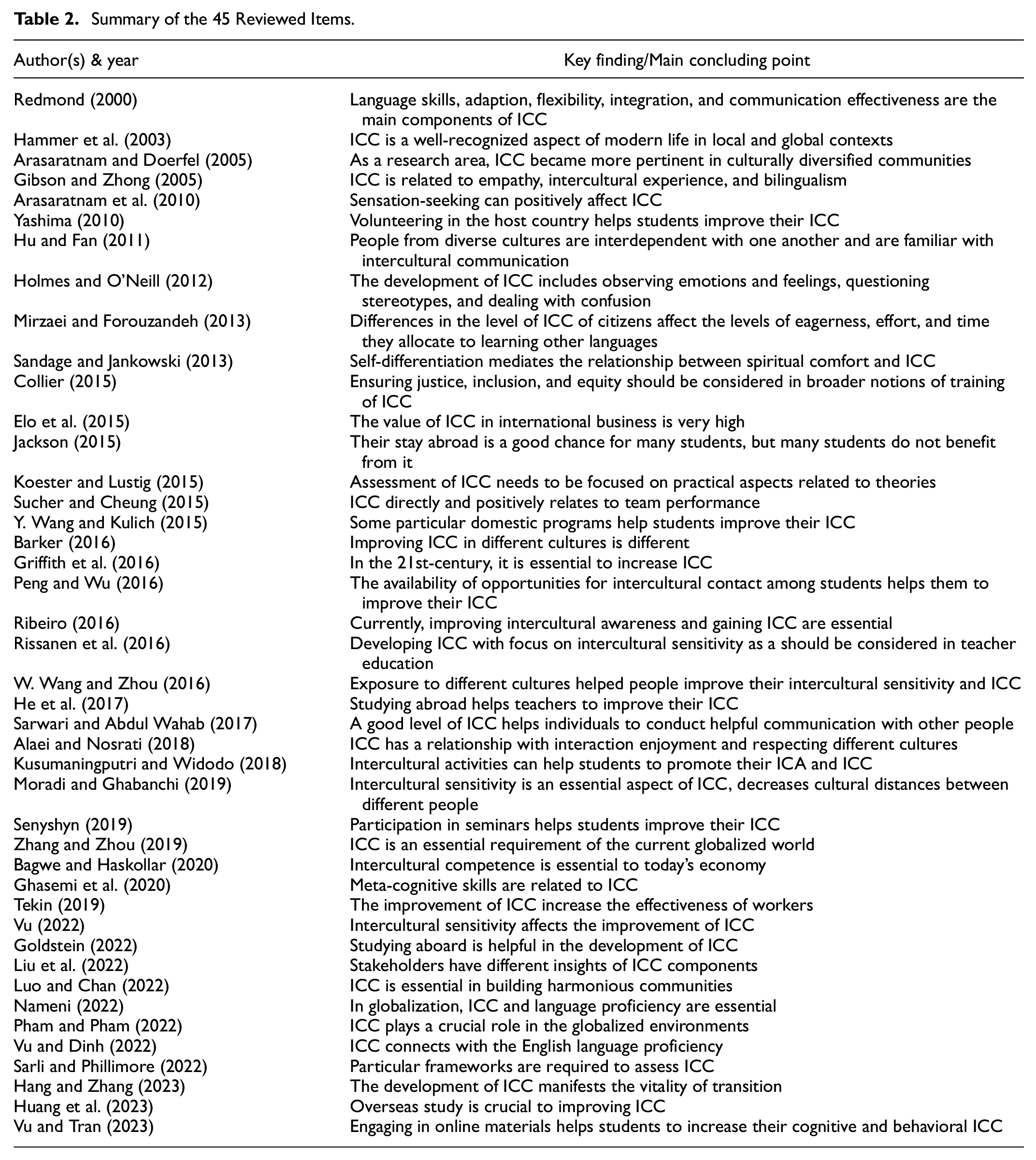
After the selection of 45 papers, all papers were reviewed entirely. The main findings and critical concluding points of the selected items were recorded for the findings section of the current review paper. Table 2 below includes a summary of the reviewed papers.
Summary of the 45 Reviewed Items.
Furthermore, all findings from a review of 45 papers were categorized under four themes: Requirements for assessment and improvement of ICC, The importance of ICC in different aspects of modern life, Main Components of ICC, and Factors influencing ICC. The results section below will report findings from the selected and reviewed papers under the related theme.
Results
The results of this work stand on findings from the review of 45 published manuscripts recorded and selected through an online search using databases provided by the Web of Science and SCOPUS. The findings from a review of all 45 papers are categorized under four themes: Requirements for assessment and improvement of ICC, The importance of ICC in different aspects of modern life, Main Components of ICC, and Factors influencing ICC. All results from the reviewed papers will be reported and discussed under the related theme.
Requirements for Assessment and Improvement of ICC
Based on the results from the reviewed papers, assessment of ICC through the use of particular and new methods, overseeing education, participation in some helpful programs, and acknowledging realities of human life help people to understand and improve ICC. As pointed out, the assessment of ICC needs to focus on practical aspects related to theories and through applying particular theories and methods (Koester & Lustig, 2015; Sarli & Phillimore, 2022). The development of ICC includes admitting unwillingness and fear, observing emotions and feelings, questioning stereotypes, dealing with confusion, and tackling complications (Holmes & O’Neill, 2012). According to Senyshyn (2019), participating in gatherings and seminars in the first year of their enrollment at international universities helps students improve their ICC. Goldstein (2022) argued that studying aboard, even for the short term, is helpful in the development of individuals’ intercultural competence.
The Importance of ICC in Different Aspects of Modern Life
Based on the results, ICC is an essential requirement of modern life in the 21st century. According to Griffith et al. (2016), it is essential to increase intercultural competence in 21st-century working environments and the ever-growing aspect of globalization. Nameni (2022) stated that in the era of globalization, ICC and English language proficiency are among the essential requirements for global and intercultural communication, and they help individuals to have more success in their duties. ICC is one of the main requirements of life in today’s globalized world, and the value of intercultural competence in international business is very high, and its absence is considered a key failure reason (Alaei & Nosrati, 2018; Elo et al., 2015). Moreover, a good level of ICC helps individuals to conduct helpful communication with people of different cultures (Sarwari & Abdul Wahab, 2017).
Main Components of ICC
Based on the reviewed works, Cultural awareness and intercultural sensitivity, language proficiency, empathy, flexibility, and some other traits and skills are among the components of ICC. Redmond (2000) states that language skills, adaption, communal flexibility, social integration, communication effectiveness, and host culture acknowledgment are the main components of ICC. As pointed out, the development of ICC with a focus on intercultural sensitivity as a central element should be considered in educational activities, and intercultural sensitivity, as an essential aspect of ICC, decreases cultural distances between people of different cultures (Moradi & Ghabanchi, 2019; Rissanen et al., 2016; Vu, 2022). Moreover, ICC is related to empathy, sensation-seeking, intercultural experience, and bilingualism (Arasaratnam et al., 2010; Gibson & Zhong, 2005; Vu & Dinh, 2022).
Factors Influencing ICC
Findings from the reviewed works indicate that some factors, such as overseas study, collegiate environments, engaging in available online materials, and the availability of interactions, enable individuals to improve their ICC (Hang & Zhang, 2023; Huang et al., 2023; Jackson, 2015; Vu & Tran, 2023). Based on Peng and Wu (2016), the availability of opportunities for intercultural contact among students helps them to improve their intercultural competence. Moreover, empathy, overseas study, and volunteering in the host country help students improve their intercultural competence (Gibson & Zhong, 2005; Huang et al., 2023; Yashima, 2010). W. Wang and Zhou (2016) believe that globalization and exposure to different cultures helped people improve their intercultural sensitivity and competence. Table 3 below includes the main findings from the reviewed articles.
Main Results From a Review of Selected Articles.

Discussion
This systematic review assessed the requirements and importance of intercultural communication competence (ICC) in human life in the 21st Century, focusing on its practical aspects and components. The results reported in the current manuscript are from a review of 45 papers published from 2000 to 2023 in 16 different Web of Science (WoS) and SCOPUS-indexed journals. An online search using WoS and SCOPUS databases was done to record the related items and collect the required data. A total of 87 items were recorded from the online search, and after a quick review of all records and based on the consideration of related issues to the current work, a total of 45 papers were selected and reviewed entirely and carefully.
Based on the results from the reviewed papers, cultural awareness and intercultural sensitivity, language proficiency, empathy, flexibility, and some other traits and skills are among the components of ICC, oversees study, participation, and stay in cultural and multicultural programs and environments, observing felling and emotions, flexibility, and some other factors, discussed below, help individuals to improve their ICC (Holmes & O’Neill, 2012; Redmond, 2000; Sarwari & Abdul Wahab, 2017). Based on results from the reviewed works, ICC is an essential and helpful requirement of modern life, especially in the fields of education, business, and environmental activities in the current ever-growing diversified communities (Alaei & Nosrati, 2018; Elo et al., 2015; Griffith et al., 2016; Nameni, 2022). The results from the reviewed papers are categorized under four themes: requirements for assessment and improvement of ICC, the importance of ICC in different aspects of modern life, main components of ICC, and factors influencing ICC.
According to the findings from the selected and reviewed works, assessment of ICC through the application of some particular and new methods, international education, participation in some helpful programs, and acknowledging realities of human life help people to understand and improve ICC. As pointed out, the assessment of ICC needs to focus on practical aspects related to theories and through applying particular theories and methods (Koester & Lustig, 2015; Sarli & Phillimore, 2022). The development of ICC includes admitting unwillingness and fear, observing emotions and feelings, questioning stereotypes, dealing with confusion, and tackling complications (Holmes & O’Neill, 2012). Studying abroad, even for the short term, and participating in gatherings and seminars in the first year of their enrollment at international universities helps students improve their ICC (Goldstein, 2022; Senyshyn, 2019). It means that stay and stay in other countries and participating in different educational and cultural programs help individuals to improve their ICC.
The results from the reviewed works indicate that ICC is an essential requirement of modern life in the 21st century. As pointed out, it is essential to increase ICC and language proficiency in 21st-century working environments and the ever-growing aspect of globalization (Griffith et al., 2016; Nameni, 2022). Moreover, the value of ICC, as one of the main requirements of life in the current globalized world, is very high in modern education and international business. Also, ICC enables people to conduct helpful interactions with different people, and its absence is a crucial reason for failure in modern professions (Alaei & Nosrati, 2018; Elo et al., 2015; Sarwari & Abdul Wahab, 2017). The results from the reviewed works ask people to know the importance of ICC in the current globalized world.
Based on the reviewed works, cultural awareness and intercultural sensitivity, language proficiency, empathy, flexibility, adaption, social integration, communication effectiveness, and host culture acknowledgment are among the components of ICC (Moradi & Ghabanchi, 2019; Redmond, 2000; Rissanen et al., 2016; Vu, 2022). The results from the reviewed works indicate that the lack of affective and cognitive abilities, the lack of lack proficiency and intercultural sensitivity, and the lack of interpersonal skills are among the barriers that affect intercultural interactions among different people negatively. Based on the results reported in the current manuscript, communication engagement, openness, respect for differences, participation in particular cultural and intercultural activities, involvement in technology-mediated interactions and learning processes, and also practical interaction with people of different cultures enable individuals to overcome the mentioned barriers and improve their ICC and language proficiency.
Moreover, findings from the reviewed works indicate that some factors, such as overseas study, collegiate environments, engaging in available online materials, and the availability of interactions enable individuals to improve their ICC (Hang & Zhang, 2023; Huang et al., 2023; Jackson, 2015; Vu & Tran, 2023). It means that the understanding and improvement of particular and practical aspects and elements of ICC indicated by the reviewed works enable people to improve their ICC and be more successful in their personal and professional lives. The results focus on the importance of ICC as an essential requirement of modern life in the current globalized world. The results from the current systematic review study may be helpful for people, especially researchers in the field of human communication, and may open new widows toward further helpful studies.
Conclusion
This review study assessed the requirements and importance of intercultural communication competence (ICC) in human life in the 21st Century. The results reported in the current manuscript are from a review of 45 papers published from 2000 to 2023 in 16 WoS and SCOPUS-indexed journals. An online search using WoS and SCOPUS databases was done to record the related items and collect the required data. A total of 87 items were recorded from the online search, and after a quick review of all records, 43 papers were selected and reviewed. The results from the reviewed papers are categorized under four themes: Requirements for assessment and improvement of ICC, The importance of ICC in different aspects of modern life, Main Components of ICC, and Factors influencing ICC.
According to the results from the review of 45 papers, assessment of the practical aspects of ICC, oversees stay and study, participation in some local international programs, empathy and flexibility, admitting unwillingness and fear, observing emotions and feelings, questioning stereotypes, dealing with confusion, and tackling complications help people to understand and improve their ICC. Based on the results, ICC is an essential requirement of different aspects of modern life in the 21st century, and its value is very high in modern education and international business. Based on the reviewed works, cultural awareness and intercultural sensitivity, language proficiency, adaption, flexibility, empathy, social integration, communication effectiveness, and host culture acknowledgment are among the main components of ICC in today’s globalized world. Based on the results from the reviewed works, the lack of affective and cognitive abilities, the lack of language proficiency and intercultural sensitivity, and the lack of communication engagement, interpersonal skills, and team effectiveness are among the main factors that undermine intercultural communication among different people. Based on the findings, some factors, such as international collegiate environments, engaging in available online materials and activities, and the availability of interactions among individuals from diverse backgrounds, enable individuals to improve their ICC.
Footnotes
Author Contributions
The corresponding author, Dr. Abdul Qahar Sarwari, did the review of all selected papers and developed the current manuscript. Other authors had some technical and linguistic contributions.
Declaration of Conflicting Interests
The author(s) declared no potential conflicts of interest with respect to the research, authorship, and/or publication of this article.
Funding
The author(s) received no financial support for the research, authorship, and/or publication of this article.
Research Ethics
For the research design, data collection procedures, data analysis, and data report, all research regulations and recognized ethical standards were considered and applied.

Data Availability Statement
Data sharing not applicable to this article as no datasets were generated or analyzed during the current study.