




Abstract
This study aims to fill the previous research gap by examining the relationship between job stress, work-family conflict (WFC), and job satisfaction. It also investigates the mediating effect of job burnout, through which job demands influence job satisfaction, and examines the moderating effect of emotional intelligence (EI) on these relationships through the lens of the job demands-resources (JD-R) model. The data for this study was collected from 279 respondents who were frontline employees in 14 banks in Palestine. A cross-sectional research approach was performed using a partial least squares path modeling approach. The study finds that job demands (job stress and WFC) increase job burnout. Contrary to expectations, job demands have a negative but not significant direct effect on job satisfaction. Further, job burnout reduces frontline bank employees’ job satisfaction. Regarding the mediating effect, job burnout fully mediates the relationship between job demands and job satisfaction. The findings suggest that the relationship between job stress and job burnout is stronger when EI is comparatively low. The study thus extends prior research by investigating the conditional indirect effect of job stress on job satisfaction when job burnout acts as a mediator and EI is the moderator. It contributes to the JD-R literature by providing support from the Palestinian banking sector.
Keywords
Introduction
The complex nature of working in the service sector (in this case banks) and the workload and time pressure on frontline personnel, in which employees interact directly with customers, may be sources of stress. Thus, banking sector managers should understand the workload of frontline employees in terms of delivering high-quality service, customer satisfaction, and time pressures when work-related responsibilities intervene in family roles (Karatepe et al., 2019; Lee & Han, 2020; Mehmood et al., 2020). Banking organizations must understand frontline employees’ perceptions and attitudes in terms of achieving the desired management goals (Kaur, 2015; Lee & Yoo, 2021). For this reason, an examination of frontline bank employees’ attitudes and behavior is crucial (e.g., Lee & Han, 2020; Mehmood et al., 2020; Yoo & Jung, 2019; Yoo et al., 2021), as is the attempt to manage and understand frontline bank employees’ job stress (Giao et al., 2020; Wu et al., 2021).
Scholars use the job demand-resource (JD-R) model to better clarify, explain, and predict occupational stress (Demerouti & Bakker, 2011; Raper et al., 2020); it is the dominant model used to assess frontline employees’ job stress (Bani-Melhem et al., 2020; Schaufeli & Taris, 2014). According to Lazarus and Folkman (1984), job stress can be described as “the stress produced during interaction between the individual and his work environment when the demands of work exceed the individual’s resources or abilities” (Chiang & Liu, 2017, p. 369). Thus, the comprehensiveness of the JD-R model is used to explain how job resources and demands have a multiplicative and unique impact on emotional exhaustion (Bakker & Demerouti, 2017) and job satisfaction (Han et al., 2020). According to Cho et al. (2020, p. 1522), the “job demands, and resources generate two independent processes—an energy-consuming stress process and a motivation-driven process.” Whereas job-related demands (e.g., job stress and work overload) promote the development of emotional exhaustion (i.e., a stressful process), while job demand promotes the development of work engagement (motivation process). Numerous studies (e.g., Cho et al., 2020; Crawford et al., 2010; Elrehail et al., 2021; Han et al., 2020; Hu et al., 2017; Lesener et al., 2019; Radic et al., 2020; Sarwar et al., 2021) have confirmed the double path to employee well-being proposed by the JD-R model. The current research focuses only on the job demand process (job stress and work-family conflict) that is responsible for the development of burnout during and after stressful work-related events.
Work-family conflict (WFC) is a subject that is thoroughly examined in organizational behavior and human resource research (e.g., Allen et al., 2020). According to role theory, Greenhaus and Beutell (1985) described WFC as “a form of inter-role conflict in which the role pressures from the work and family domains are mutually incompatible in some respect” (p. 77). Research has relied on two components of WFC: (1) family-to-work conflict (family-related responsibilities intervening with work roles) and (2) work-to-family conflict (work-related responsibilities intervening with family roles). In this research, we focused on work-to-family conflict. Despite agreement that WFC is associated with negative workplace consequences such as lower job performance and satisfaction (Eddleston et al., 2019; Kossek et al., 2021; Wang et al., 2021), the way in which WFC affects work-related outcomes (i.e., job satisfaction) requires more investigation, and empirical evidence is still scarce (Liao et al., 2019; Rahman et al., 2020; Zhang et al., 2019). In addition, the mechanisms that underlie this link remain unclear and more research is needed (e.g., Islam et al., 2020; Kossek & Lee, 2017; Rahman & Ali, 2021; Zhao et al., 2019). According to Kloutsiniotis and Mihail (2020, p. 567), “the inclusion of work-family conflict as an additional job demand is extremely crucial.” Nevertheless, it is essential to engage in further research to understand the relationship between WFC and job burnout alongside work-related outcomes (Chen & Chen, 2018; Kloutsiniotis & Mihail, 2020; McDowell et al., 2019; Simães et al., 2021; Wang et al., 2021).
Theoretically, this research extends the previous findings (e.g., Chen & Chen, 2018; Choi et al., 2019; Dodanwala & Shrestha, 2021; Lee & Han, 2020; Nauman et al., 2019; Park et al., 2020; Rahman & Ali, 2021; Wang et al., 2021) as follows. Our empirical analysis examines the question of whether the existence of emotionally intelligent employees is conducive to buffering the negative effects of job demands (i.e., job stress) perceived by frontline bank employees, and job burnout (i.e., emotional exhaustion), while improving and enhancing employees’ satisfaction with their jobs. While the related literature falls within the realm of the JD-R model (Bakker & Demerouti, 2007, 2017; Demerouti et al., 2001), this is an original contribution to research, contributing to knowledge in four ways. First, the role of job demands has been rarely mentioned, let alone investigated, in the context of the Palestinian banking sector; this study of this phenomenon and its effects therefore constitutes the first systematic attempt to understand how job demands (job stress and WFC) are impacting work-related outcomes (job satisfaction), if any, in new geographical, political, and cultural contexts (Allen et al., 2020; Davis, 2020; Rattrie et al., 2020).
Second, despite the agreement that “no construct in all of organizational research has been studied more than job satisfaction” (Miao et al., 2016, p. 13) and that job burnout is the central pathogenic health indicator within the JD-R model (Bakker & Demerouti, 2017; Bakker & de Vries, 2021; Crawford et al., 2010; Demerouti & Bakker, 2011; Demerouti et al., 2021), to the best of our knowledge researchers have not yet addressed the indirect effect of emotional exhaustion through which job stress and WFC influence job satisfaction (e.g., Dodanwala & Shrestha, 2021; Islam et al., 2020; Park et al., 2020; Rahman & Ali, 2021; Zhao et al., 2019). The present study contributes by considering the mediating role of job burnout (emotional exhaustion) that sits within the JD-R model to enlighten the relationship between job demands (i.e., job stress and WFC) and job satisfaction. Third, a similar approach is employed to probe any moderating effects of emotional intelligence (EI) on this relationship (Chakravorty & Singh, 2020; Dilawar et al., 2021; Huang et al., 2019; Miao et al., 2017; Ullah, 2021; Wen et al., 2019; Zheng et al., 2021). Fourth, we suggest that employees with a high level of EI can weaken the conditional indirect effects of job stress on job satisfaction via job burnout (e.g., Diehl et al., 2021; Nauman et al., 2019). Insights into this effect would provide scholarly support in explaining how frontline bank employees can regulate their own emotions and understand the emotions of other employees to reduce negative job characteristics while increasing job satisfaction. This element of the theoretical contribution brings EI, as a tool to manipulate this relationship, to interested researchers and practitioners.
Theoretical Framework and Hypothesis Development
JD-R Model
Demerouti et al. (2001) have presented a clear, formal Job Demands-Resources (JD-R) model (Bakker & Demerouti, 2017; Bakker et al., 2014). Bakker and Demerouti (2007) suggest that the job characteristics fall into two broad categories, namely, “job resource” and “job demand.” These work characteristics are associated with job burnout and job-related outcomes (e.g., job performance and job satisfaction). In this vein, job demand represents the conditions dispersed through physical, psychological, social, and organizational aspects of everyday work, covering all aspects requiring cognitive and continued physical effort that result in psychological-emotional symptoms such as sleep deprivation and fatigue, and physiological symptoms such as tachycardia, hormonal activity, and hypertension, finally placing a burden on working individuals (Bakker et al., 2014; Demerouti et al., 2001; Schaufeli & Bakker, 2004). Job demand thus requires additional energy from employees to handle, for example, stressful life events, job insecurity, role ambiguity, conflict, task complexity, work overload, and pressure (Bakker et al., 2014; Schaufeli, 2017; Schaufeli & Taris, 2014). Job resource is manifested through job conditions, the psychological, physical, and social organizational resources required to accomplish job-related goals; a decrease in job demands leads to the development of working individuals, learning, personal growth, and physiological costs, or correlated psychological symptoms (Bakker & Demerouti, 2007; Demerouti et al., 2001). Thus, job demands generally are the most important factors negatively influencing health, such as exhaustion, complaints, and psychosomatic health (e.g., Bakker, Demerouti, de Boer, et al., 2003; Bakker & Demerouti, 2014; Hakanen et al., 2006), whereas job resources seem to be the most important factors influencing motivational processes such as engagement, motivation, and enjoyment (Bakker & Demerouti, 2014; Bakker et al., 2007). In this study, two job demands are included as potential stressors on employees working in the banking sector in Palestine, namely, job stress and work-family conflict, that responsible for the development of job burnout.
Job Burnout
Job burnout is a subject that has attracted increasing attention in the psychology, human resource, education, organizational behavior, and physical literature (Li et al., 2019). Maslach and Jackson (1984) defined burnout as “a syndrome of emotional exhaustion, depersonalization, and reduced personal accomplishment that can occur among individuals who work with people in some capacity” (p. 134). Emotional exhaustion is the main concern of this research. According to Kroon et al. (2009, p. 511), the “emotional exhaustion component is the most central” of these three dimensions or symptoms characterizing burnout. This concept emphasizes the emotional-demands state and can be described as “the feeling of being emotionally overextended and exhausted by one’s work” (Maslach & Jackson, 1981, p. 101). Research into job burnout has demonstrated significant negative implications including lower job satisfaction, performance, and employee well-being, and higher turnover intention (Cannon & Herda, 2016; Lee & Ok, 2012). Based on the conservation of resources (COR) theory (Hobfoll, 1989) and JD-R model (Bakker & Demerouti, 2007), as depicted in Figure 1, we specified a linkage of the health impairment process (job burnout) through which job demands (job stress and WFC) influence job satisfaction. Accordingly, we suggest that EI may affect the indirect relationship between job demands (i.e., job stress) and job satisfaction via job burnout (i.e., emotional exhaustion) that sit within the COR theory and JD-R model.

Proposed mediated moderation model.
Emotional Intelligence
Employee emotional intelligence (EI) has garnered enormous attention over recent decades (Miao et al., 2017), from both practitioners and academics; among other reasons, this is because of its potential influence on employee workplace behavior (Brackett et al., 2011; O’Boyle et al., 2011; Schlaerth et al., 2013). Scholars have defined EI in a variety of ways in terms of psychological, organizational behavioral, human resource, and management research (e.g., O’Boyle et al., 2011; Wong & Law, 2002). EI refers to the extent to which the individual has the capability to manage self-emotions, empathy, motivation, and awareness (Goleman, 1995; Wong & Law, 2002). Individuals with a high level of EI are better at managing and understanding others’ emotions in addition to their self-emotions. Salovey and Mayer (1990) and Mayer and Salovey (1997) considered the main contributors to measure and conceptualize EI. For instance, Salovey and Mayer (1990) defined EI as “the subset of social intelligence that involves the ability to monitor one’s own and others’ feelings and emotions, to discriminate among them and to use this information to guide one’s thinking and actions” (p. 189). EI is a multidimensional construct including “(a) perceiving emotions, (b) using emotions to facilitate thought, (c) understanding emotions, and (d) managing emotions” (Mayer et al., 2003, p. 99). This research has adopted these four dimensions to investigate the moderator effect of EI. Thus, our secondary aim is to determine how EI moderates the relationship between job stress and two work-related criteria: job burnout and job satisfaction.
Job Stress and Job Burnout
According to Tsaur and Tang (2012), job stress refers to “an individual’s reaction to threats that are derived from the characteristics of his or her job” (p. 1039). Based on COR theory and the JD-R model, scholars can better clarify, explain, and predict risk factors in the work environment as job stress and job burnout. Employees who experience a high level of job stress, such as work overload, role ambiguity, and role conflict, sometimes suffer from an extreme need for recovery and experience a high level of emotional exhaustion (Babakus et al., 2008; de Croon et al., 2004; Jaramillo et al., 2006; Posig & Kickul, 2003; Sonnentag et al., 2010; Zapf et al., 2001). For example, job demands, events, and conditions (i.e., job stress) induce strain (i.e., burnout). Meanwhile, some previous research in service sectors found that when job demands (i.e., workload, time pressure) are high, employees are likely to experience a high level of burnout. This is because a lack of job resources (e.g., job variety, job recognition, and job control, which inspire individuals when performing their jobs) leads to high levels of job demands and causes burnout among employees; hence, job stress is positively related to job burnout (e.g., Choi et al., 2019; Sunny’Hu & Cheng, 2010). In the present study, we hypothesize that:
H1: Job stress exerts a positive influence on job burnout.
Work-family conflict and job burnout
WFC is “a form of inter-role conflict in which the role pressures from the work and family domains are mutually incompatible in some respect” (Greenhaus & Beutell, 1985, p. 77). Several previous studies have argued that a positive relationship exists between work-related stress (i.e., work-to-family conflict) and job burnout, which is one’s affective response to chronic stressful work-related events. By taking the above discussion into consideration, we expect job demands (i.e., WFC) to be positively associated with job burnout. Previous studies argued that WFC is positively related to job strain (Nohe et al., 2015). Allen et al. (2000), for example, found that employees spend more energy on the organization or the job when there are few resources available for use at home and this can cause a high level of emotional exhaustion. As Schaufeli and Bakker (2004) note, available organizational resources can encourage employees, energize their persistence, boost employee engagement, and make them more focused on their jobs. Netemeyer et al. (2005) argued that, when employees spend more resources (e.g., emotion, time, and energy) on their families, this will reduce the available resources for work. This also causes emotional exhaustion (e.g., Kloutsiniotis & Mihail, 2020; Wang et al., 2021; Zheng et al., 2021). For instance, in a study of Turkish frontline bank employees, Karatepe and Tekinkus (2006) found that WFC was strongly associated with job burnout (i.e., emotional exhaustion, beta = .26); a similar result was found in a more recent study by Wang et al. (2021), who found that WFC was predictive of emotional exhaustion (beta = .22; see also Kloutsiniotis & Mihail, 2020; Allen et al., 2000; Amstad et al., 2011; Byron, 2005; Michel et al., 2011). In the present study, we hypothesize that:
H2: WFC exerts a positive influence on job burnout.
Job Stress and Job Satisfaction
Job satisfaction is referred to as “a pleasurable or positive emotional state resulting from the appraisal of one’s job or job experiences” (Locke, 1976, p. 1304). Previous research indicates that the workplace environment in which job demands are high can effectively impact professionals’ well-being (e.g., Bakker, Demerouti, de Boer, et al., 2003; Hakanen et al., 2006). Specifically, job demands can be high in service-sector organizations, which may influence an employee’s well-being (Nauman et al., 2019). Prior studies demonstrated that a high level of job demands such as WFC, work overload, and time pressures promote the development of emotional exhaustion (e.g., Kloutsiniotis & Mihail, 2020), which in turn will lead to reduced job satisfaction (Alarcon, 2011; Bowling et al., 2015). High levels of job demand (e.g., workload) exhaust employees’ physical and psychological resources and lead to a health impairment process (job burnout) which in turn leads to decreased job satisfaction (Demerouti et al., 2001; Lee & Ashforth, 1996). This observation is in line with the job demand-control (JDC) model (Karasek’s, 1979), “which proposes that heavy job demands have harmful effects on employees, inducing exhaustion, stress, and job dissatisfaction” (Nauman et al., 2019, p. 1152). Over time, job stress is wearing, resulting in increased emotional exhaustion which eventually increases the likelihood of negative outcomes (Lambert et al., 2018). Previous studies have noted that job stress is negatively related to job satisfaction (e.g., Chau, 2019; Lambert et al., 2018). Through the lens of COR theory and the JD-R model, developed respectively by Hobfoll (1989) and Demerouti et al. (2001), we suggest that when frontline employees report high levels of job demand (e.g., job stress) and cannot adequately recover by replenishing their job resource pool, job demands will promote the development of the stressful process, resulting in energy exhaustion, and consequently decreased job satisfaction of frontline personnel. In the present study, we hypothesize that:
H3: Job stress exerts a negative influence on job satisfaction.
Mediating Effect of Job Burnout
Researchers suggest that job burnout is associated with adverse outcomes for individuals; for instance, burnout is associated with reduced self-esteem, anxiety, health problems, substance abuse, and depression (Maslach et al., 2001). Studies have also confirmed that job burnout poses an employment risk (Lu & Gursoy, 2016). It has been shown that work-related outcomes (i.e., performance, satisfaction, and engagement) are negatively affected by feelings of emotional exhaustion, cynicism, and lack of efficiency in the workplace (Cropanzano et al., 2003; Lizano & Mor Barak, 2015). Given the relationship between job demands (e.g., job stress and WFC) and burnout at work, previous studies have also shown that job burnout mediates the relationship between job-related demand factors (i.e., job stress) and work-related outcomes such as satisfaction, engagement, and performance (e.g., Goering et al., 2017; Rahim & Cosby, 2016). Cheng and O-Yang (2018), for example, suggest that job burnout could be an intermediate variable that links job crafting and job satisfaction.
Previous research has also confirmed that job burnout is negatively related to job satisfaction (Charoensukmongkol et al., 2016; Lu & Gursoy, 2016). Thus, a lack of efficacy in the workplace, cynicism, and feelings of emotional depletion negatively affect job satisfaction. Job burnout is considered to decrease job satisfaction (Lee & Ok, 2012). In the present study, we hypothesize that:
H4: Job burnout is negatively related to job satisfaction.
H5: Job burnout mediates the relationship between job stress and job satisfaction.
H6: Job burnout mediates the relationship between WFC and job satisfaction.
Moderating Role of Emotional Intelligence
The way EI is conceptualized in this research allows for different possibilities regarding the study of its effect on the theorized relationships between job stress, burnout, and job satisfaction. EI is defined as the ability to regulate a person’s own emotions and understand the emotions of others (Salovey & Mayer, 1990). For instance, a high level of EI articulates a preferred course of action to be followed by employees to achieve high job satisfaction. Employees with a high level of EI provide inspirational motivation by identifying feelings of stress and frustration, additionally regulating those emotions to reduce stress and develop strategies to deal with negative workplace feelings (Nauman et al., 2019; Sy et al., 2006). Researchers found that employees with a high level of EI decrease job demands (i.e., stress and workload), which ultimately increases job satisfaction (see, e.g., Nauman et al., 2019; Sy et al., 2006). On the other hand, employees with low EI are likely to be less able to cope with their emotions when facing difficult situations. This is because employees with a high level of EI can manage self-emotions and appraise other employees’ emotions (Sy et al., 2006). EI is, therefore, positively associated with job satisfaction (e.g., Jung & Yoon, 2016; Kafetsios & Zampetakis, 2008; Nauman et al., 2019; Ouyang et al., 2015; Schlaegel et al., 2020; Sy et al., 2006), although in a different context. In the present study, we hypothesize that:
H7: EI exerts a positive influence on job satisfaction.
H8: EI moderates the negative relationship between job stress and job satisfaction, such that the negative relationship between them is stronger (vs. weaker) in the case of low (vs. high) levels of EI.
Moreover, the literature asserts that employees with high levels of EI are less likely to experience job burnout (i.e., emotional exhaustion) or to quit as a result of such exhaustion. This is because “employees’ special ability contributes to adjusting their emotions in more flexible ways in the stressful situations” (Choi et al., 2019, p. 201). Likewise, employees with a high level of EI are less likely to experience job stress (see, e.g., Karimi et al., 2014). For example, Görgens-Ekermans and Brand (2012) investigated the relationships between job stress, EI, and burnout and found that higher EI among nurses is significantly correlated with less job stress and burnout. We expect that job burnout plays a vital intervening role in the relationship between job stress and job satisfaction. More specifically, job burnout is a more proximal outcome of job stress based on the JD-R and COR theories and a mediator that ultimately leads to positive or negative outcomes, for example, job satisfaction and performance (Nauman et al., 2019). In the present study, we hypothesize that:
H9: EI moderates the positive relationship between job stress and job burnout, such that the positive relationship between job stress and job burnout is stronger (versus weaker) in cases of low (vs. high) levels of EI.
A Mediated Moderation Effect of Job Burnout and Emotional Intelligence
Taking the earlier discussion into consideration, the JD-R theory suggested that there is a significant relationship between job demands, emotional exhaustion, and job satisfaction, and COR theory that emotional intelligence increases job satisfaction. Moreover, job demands significantly influence job satisfaction through job burnout. The JD-R model states that emotional exhaustion mediates the relationship between job demands and job-related outcomes (Bakker & Demerouti, 2017; Schaufeli & Taris, 2014). It ignores the vital role of EI in buffering the negative indirect effect of job demands on job satisfaction through job burnout (Cheung et al., 2016; Choi et al., 2019; Miao et al., 2017; Nauman et al., 2019; Wen et al., 2019). In particular, the previous studies revealed that job stress is positively related to job burnout (Choi et al., 2019; Viotti et al., 2017) and negatively associated with job satisfaction (Abdelmoteleb, 2019; Wu et al., 2021). Despite this, Lizano and Mor Barak (2015) asserted that job stress has an insignificant influence on emotional exhaustion and job satisfaction.
According to Karatepe et al. (2006) and Kim et al. (2009), inconsistent findings may occur because of cultural differences, and more effort should be made to investigate these constructs. Underlying this assertion is the notion that “the utility of purported stress buffers may depend on additional factors” (Fisher, 2014, p. 724). As findings on the relationship between job stress, emotional exhaustion, and job satisfaction are inconsistent, the addition of another variable is required. Our study used emotional intelligence as a moderator between job stress, job burnout, and job satisfaction. We believe that the ambiguous results of previous studies are due in part to the fact that they overlooked this mediated-moderation model of EI and emotional exhaustion (Figure 1). For example, Nauman et al. (2019) found that the relationship between job demands and employee well-being (job burnout and satisfaction) through surface acting is stronger when frontline employees exhibit a high level of EI. Although research results have been mixed, the following hypotheses coincide with common thinking about the moderating role of EI and the mediating effect of emotional exhaustion through which job stress influences job satisfaction. In the present study, we therefore hypothesize that:
H10: The indirect relationship between job stress and job satisfaction through job burnout is moderated by EI, such that the conditional indirect effect is stronger for employees who are low in EI.
Methodology
Sampling and Data Collection Procedures
This study employed a quantitative cross-sectional research approach to collect data from frontline bank employees in Palestine. The sample frame was drawn from the PMA (Palestine Monetary Authority, available at http://www.pma.ps) and data was collected using an online survey employing a questionnaire. The study population consisted of both local and foreign banks in Palestine. There are currently 14 banks operating in Palestinian territories. Data collection took place from October 2019 to January 2020. We randomly sent a survey attached to a cover letter to 500 frontline bank employees who were identified as the sampling frame, across five major cities: Ramallah, Bethlehem, Jenin, Nablus, and Hebron. Following two reminders about data collection, 284 surveys were returned. Five cases were excluded because of irrelevant and/or incomplete responses. The remaining 279 (resulting in a response rate of 55.8%) were used in our analysis to examine the study hypotheses.
In all, 175 respondents were male (62.7%) and 104 were female (37.3%). Overall, 226 respondents had university degrees (81.0%) and 51 had postgraduate degrees (18.3%); 2 respondents had other degrees (0.7%). Over half of the respondents—189 (67.6%)—were between the ages of 25-39, while 67 (24.0%) were 18 to 24 years old, and the rest over 40. Over 60% of the respondents (168) had job experience of fewer than five years, with 28% (77) job experience from 6 to 10 years, and the rest more than 11 years.
Our statistical analysis of the relationship between job demands, job burnout, and job satisfaction was conducted using 279 cases, comprising 130 (46.6%) from Ramallah, 51 (18.3%) from Nablus, 37 (13.3%) from Bethlehem, 31 (11.1%) from Hebron, and 30 (10.8%) from Jenin.
Measurements
The online survey was initially developed in English. However, Arabic is the mother tongue of the majority of bank employees in Palestine. Therefore, the questionnaire was translated from English to Arabic, and then back translated by second parties from Arabic to English; a comparison between the two versions was conducted to ensure the accuracy of the translation (McGorry, 2000). The respondents were invited to respond to each item considering various aspects of the JD-R model and COR theory. The operationalization of our scales was based on existing related research.
Job demands
In this study, there were two variables of job demands: job stress and WFC. To measure the concept of job stress, we adopted the global scale of Cohen et al. (1983), which consists of six items to capture the perceived stress of frontline bank employees. Sample items included “In the last month, how often have you been upset because of something that happened unexpectedly at work?” The items were assessed based on a five-point Likert scale ranging from 1 (“never”) to 5 (“very often”). Cronbach’s alpha for this scale was 0.76. The measure of WFC, composed of four items, was adopted from Netemeyer et al. (1996). Sample items included “The amount of time my job takes up makes it difficult to fulfill family responsibilities.” The items were assessed based on a five-point Likert scale ranging from 1 (“strongly disagree”) to 5 (“strongly agree”). Cronbach’s alpha for this scale was 0.82.
Job burnout
To assess job burnout, a 6-item Likert-type scale was adopted from Demerouti et al. (2001) to measure the concept of emotional exhaustion of frontline bank employees. Sample items included “After work, I tend to need more time than in the past to relax and feel better.” Cronbach’s alpha for this scale was .81.
Emotional intelligence
We measured the moderating effect of EI by using the 16-item scale adapted from Wong and Law (2002), which was operationalized by four perspectives (“self-emotion appraisal,” “others’ emotion appraisal,” “use of emotion,” and “regulation of emotion”). These four dimensions were averaged to capture EI. Sample items included “I always know whether or not I am happy,” “I am a good observer of others’ emotions,” “I always tell myself I am a competent person,” and “I am quite capable of controlling my own emotions.” The items were assessed based on a five-point Likert scale ranging from 1 (“strongly disagree”) to 5 (“strongly agree”). Cronbach’s alpha for this scale was .93.
Job satisfaction
A scale that measures job satisfaction, composed of three items, was adopted from Boshoff and Allen (2000). Sample items included “I am satisfied with my working conditions.” Frontline bank employees’ job satisfaction was rated on a 5-point Likert scale for each item, ranging from 1 (“strongly disagree”) to 5 (“strongly agree”). Cronbach’s alpha for this scale was .87.
Data Analysis and Results
We used the variance-based structural equation modeling (SEM) approach to examine the hypothesized constructs for several reasons. First, we used variance-based SEM as opposed to covariance-based SEM for its predictive superiority (Hair et al., 2019), its ability to handle smaller sample sizes (Chin & Newsted, 1999; Hair et al., 2011) and the fact that it is increasingly being embraced in organizational behavioral and human resource research (Ringle et al., 2020; Sosik et al., 2009). Following the standard variance-based PLS-SEM analytic approach, we examined the stability of the structural models and tested the significance of path coefficients and factor loading using bootstrapping resampling techniques (Hair et al., 2017). To conduct the analysis, we relied on the computational rigor of the SmartPLS 3.0 software package (Ringle et al., 2015).
Table 1 is a summary of the mean, standard deviation, and zero-order correlations of the main and control variables. Job stress correlates positively with job burnout (r = 0.566, p < .01) and negatively with job satisfaction (r = −0.228, p < .01). Similarly, WFC correlates positively with job burnout (r = 0.461, p < .01) and negatively with job satisfaction (r = −0.198, p < .01). Meanwhile, job burnout correlates negatively with job satisfaction (r = −0.380, p < .01). The correlations of the moderation variable of EI seem to be sufficiently varied to account for lurking variables when the relationships of interest are examined. The analysis was carried out in three stages: first, factor analysis was used to extract the study’s constructs. Second, a measurement model was estimated to determine if the extracted dimensions offered good reliability and validity measures (Fornell and Larcker’s test and the heterotrait-monotrait ratio). Third, the relationships hypothesized were tested through the SEM procedure
Descriptive Statistics and Correlations Analysis.
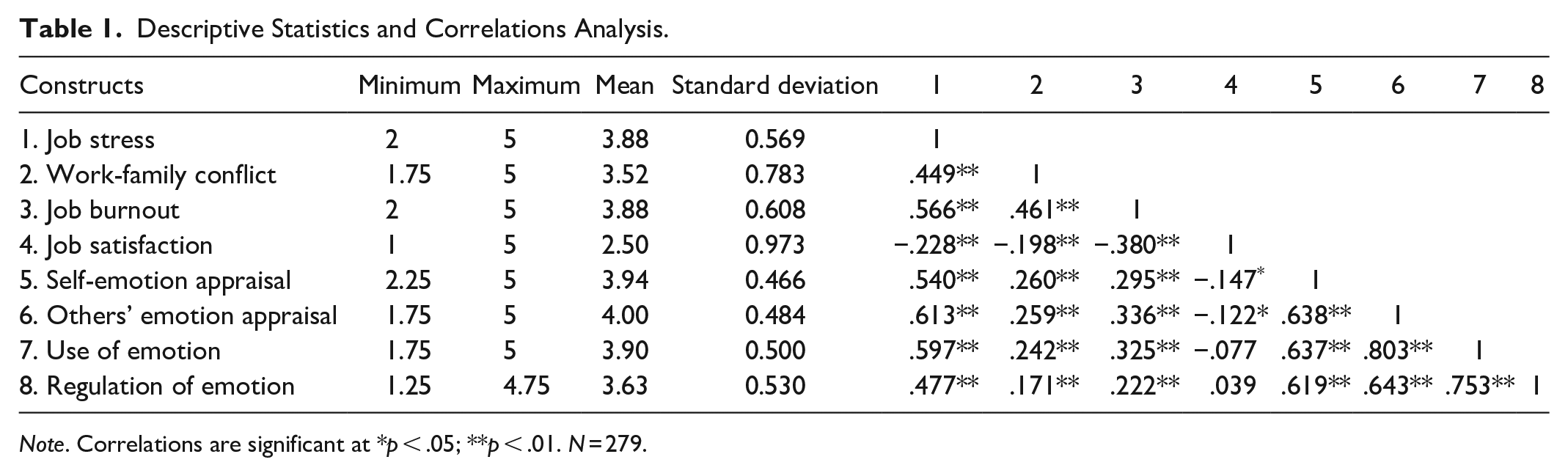
Note. Correlations are significant at *p < .05; **p < .01. N = 279.
Construct Validities
The variables’ psychometric properties were examined using SmartPLS 3.0. Reliability was assessed to determine the degree to which the scale demonstrates internal consistency. A few items were eliminated using 0.4 as a threshold for item reliability. Composite reliability (CR), average variance extracted (AVE), and Cronbach’s alpha met the required thresholds. According to Nunnally (1978), Cronbach’s alpha needs to be greater than .70 for a measure to be reliable. Also, as shown in Table 2, composite reliability values ranged from 0.84 to 0.95, confirming a satisfactory degree of internal consistency (Bagozzi & Yi, 1988; Fornell & Larcker, 1981). All these procedures have been used by Aljuhmani et al. (2021) in recent research conducted in the same field of organizational behavior.
Scales Measurement, Reliability, and Validity.

Note. Composite reliability (CR) Average variance extracted (AVE), * deleted items.
In addition, discriminant validity was evaluated by the Fornell and Larcker (1981) criteria as shown in Table 3, as extracted variance achieved higher values in comparison with constructs’ squared correlations. The correlations do not indicate multicollinearity issues. All correlation coefficients were well below the recommended thresholds; thus, no multicollinearity problems were indicated.
Discriminant Validity: Fornell–Larcker Criteria.

Note. Diagonals (in bold and italic) represent the square-root of AVE, while the lower triangle represents the shared variance (the squared correlations).
Similarly, Table 4 depicts the discriminant validity among the study constructs and different constructs’ criteria. More recently, a new technique for detecting the degree of discriminant validity emerged in the literature (Henseler et al., 2015), called the Heterotrait-Monotrait Ratio (HTMT) of correlations based on the multitrait-multimethod matrix applied in variance-based SEM. Therefore, this study also evaluated discriminant validity through HTMT; the results shown in Table 4 are represented in the lower triangle. The values of HTMT are all lower than the cut-off value of 0.85 (Henseler et al., 2015), confirming that discriminant validity has been achieved. That is, the constructs in this research have a good discriminant validity.
Discriminant Validity: Heterotrait–Monotrait Ratio.

Test of Hypotheses
Table 5 presents the proposed model’s estimated standardized path coefficients, t-values, and their corresponding confidence interval (CI) values for the main effect, indirect and hypothesized moderator effects. The mediating effect of job burnout was assessed using a bias-corrected bootstrapping percentile method based on 2,000 bootstrap samples at 2.5/97.5% confidence intervals (Hayes, 2009) to determine the significance of indirect effects. See also Figure 2.
Hypothesis Testing Results for the Direct, Indirect, and Interaction Effects.

Note. JS_X_EI: the interaction term between job stress and emotional intelligence; absolute values are applied to standardized path coefficients ***Statistically significant at p < .001; **Statistically significant at p < .010.

Direct effect model results.
We first hypothesized that job demands (job stress and WFC) are related to job burnout. As the results show, job stress is positively and significantly related to job burnout (β = .463, p < .001), thereby supporting H1. Similarly, there is a positive direct effect of WFC on job burnout (β = .247, p < .001), supporting H2. We observe that job stress is negatively but insignificantly related to job satisfaction (β = −.102, n.s.), so H3 is not supported. Job burnout is negatively and significantly associated with job satisfaction (β = −.360, p < .001), supporting H4. That is, hypotheses 1, 2, and 4 were corroborated (Figure 2).
Mediating Effect of Job Burnout
Next, we analyzed our mediation hypotheses, using Nitzl et al.’s (2016) mediation technique. Job burnout is hypothesized to act as a mediator effect. To test for H5 and H6, we obtained the indirect effect of job demands (job stress and WFC) on job satisfaction based on the bias-corrected bootstrapping in SmartPLS 3.0 (a bootstrap sample of 2,000 was employed). The results in Table 5 validating the mediation effect of job burnout, indicate that the indirect effect of job stress on job satisfaction via job burnout (β = −.166, p < .001, [CI −0.242: −0.101]) is negative and significant, therefore, supporting H5. Similarly, we observe that WFC is negatively and significantly related to job satisfaction through job burnout (β = −.089, p < .001, [CI −0.090: −0.001]), which supports H6. Taken together, these results suggest the presence of the mediation effect of job burnout through which job demands (job stress and WFC) influence job satisfaction.
Moderating Effect of EI
Regarding hypothesis 7, we find that EI is positively but not significantly associated with job satisfaction (β = .075, n.s.), so H7 is not supported. Finally, the secondary aim of this study is to investigate the moderating effects of EI on the relationship between job stress, job burnout, and job satisfaction. We therefore created an interaction term between job stress and EI (JS_X_EI) using the procedure set out in SmartPLS 3.0 (see Table 5). Then, bootstrapping was employed to examine the statistical significance of the moderating effect. The interaction is not significant (β = −.013, n.s.) for job satisfaction, which giving no support for H8. In contrast, the interaction for job burnout is significant (β = −.085, t-value = 2.623, p < .01), which supports H9. Furthermore, we plotted the moderating effect of EI as shown in Figure 3. Consistent with H9, when EI is low, job stress is positively and strongly related to job burnout; in contrast, when EI is high, job stress is not related to job burnout. Thus, a high level of EI buffers the positive direct effect of job stress on job burnout. Hence, H8 is rejected while H9 is accepted.

Interaction effects of job stress and EI.
Mediation-Moderation Analysis
Table 6 presents the results of the mediated moderation model. To test H10 concerning mediated moderation effect, we followed Hayes (2017) recommendations by using the procedure set out in Model 7 of the PROCESS macro to test the conditional indirect effect of job stress on job satisfaction when job burnout acts as mediator and EI is the moderator. PROCESS uses the bias-corrected bootstrapping percentile method to test for the conditional indirect effect significance based on 5,000 bootstrap samples at 95% (CI) (Edwards & Lambert, 2007). We note that the CI level of the mediated moderation model of job burnout through which job stress influences job satisfaction does not include zero when frontline employees exhibit a low level of EI (β = −.431, SE = 0.093, [LBCI = −0.626, UBCI = −0.255]); a similar result was found for a high level of EI (β = −.302, SE = 0.078, [LLCI = −0.473, ULCI = −0.164]). Furthermore, the conditional indirect effect index does not include zero (LLCI = 0.036, ULCI = 0.209). Thus, the conditional indirect effect of job stress on job satisfaction through job burnout is stronger when frontline employees exhibit a low level of EI. This supports H10. These results suggest that EI buffers the negative indirect effect of job stress on job satisfaction via job burnout.
Mediation Moderation Effect.

Discussion and Conclusion
This research was designed to investigate the mediating role of job burnout in the relationship between job demands (i.e., job stress and WFC) and job satisfaction. Our empirical study targeted frontline employees in the banking sector in Palestine. The results suggested that, as was expected, a high level of job demands is positively related to job burnout (emotional exhaustion); as Kloutsiniotis and Mihail (2020) observed, in the presence of a high level of job demands with limited job resources, employees are more likely to experience emotional exhaustion (Bakker, Demerouti, de Boer, et al., 2003). Surprisingly, we found that job stress was negatively but not significantly related to job satisfaction. In addition, job burnout is negatively related to employees’ satisfaction with their jobs. Interestingly, we observed that emotional exhaustion fully mediates the negative relationship between job demands and job satisfaction. Finally, our results showed that the relationship between job stress and job burnout is stronger when EI is low. Then, we investigated the mediated moderation mode, and found it to be supported by our results. From these findings, we extend the theoretical and practical implications as follows.
Theoretical Implications
First, our study examined the relationship between job demands and job burnout, and we found a positive direct relationship between job stress and job burnout. These findings are in line with those of previous studies (e.g., Choi et al., 2019; Jung & Yoon, 2014; Sunny’Hu & Cheng, 2010; Tsaur & Tang, 2012), although in a different context. Meanwhile, when employees face incompatible demands between work-related responsibilities and family roles, leading to increased emotional exhaustion, this reduces their level of satisfaction with their jobs (Amstad et al., 2011; Ford et al., 2007; Wang et al., 2021). In this respect, our results revealed a positive relationship between WFC and job burnout, which is in line with the results of earlier studies (e.g., Allen et al., 2000; Amstad et al., 2011; Byron, 2005; Kloutsiniotis & Mihail, 2020; Michel et al., 2011). This is because when work-related responsibilities intervene in family roles, employees will face high job demands and experience a high level of job burnout (i.e., emotional exhaustion), which in turn leads to negative work-related consequences (i.e., job dissatisfaction).
Second, the main aim of this research was to investigate the mediating effect of job burnout through which job demands influence job satisfaction. Scholars have illustrated that job demands (i.e., job stress and WFC) have a negative effect on employees and satisfaction with their jobs (e.g., Allen et al., 2000; Chau, 2019; Ernst Kossek & Ozeki, 1998; Grandey et al., 2005; Lambert et al., 2018; Namasivayam & Zhao, 2007). For example, Boles et al. (2001, p. 376) stated that “work-family conflict is related to a number of negative job attitudes and consequences including lower overall job satisfaction.” However, this relationship requires more investigation (Allen et al., 2000; Amstad et al., 2011; Grandey et al., 2005). Our study sought to address this limitation in order to deepen our understanding of the nature of the relationship between job stress, WFC, and job satisfaction. However, our initial findings show that the relationship between job demands and job satisfaction is not significant. One possible explanation is that the direct relationship between job demands (i.e., job stress and WFC) and job satisfaction is contingent upon the indirect effect of job burnout. Previous studies have agreed that job demands are positively related to job burnout (i.e., emotional exhaustion) (e.g., Kloutsiniotis & Mihail, 2020; Schaufeli & Bakker, 2004; Wang et al., 2021). Our analyses also revealed a positive relationship between the two.
However, our results add support to and extend these findings. Our findings indicated that job burnout fully mediates the relationship between job demands and job satisfaction. Specifically, the findings of this study highlighted the fact that the presence of emotionally exhausted frontline bank employees fully mediates the association between job demands (job stress and WFC) and job satisfaction, which is in line with the JD-R model applied in prior studies (e.g., Bakker & Demerouti, 2017; Cheng & Yi, 2018; Goering et al., 2017; Han et al., 2020; Korunka et al., 2009; Rahim & Cosby, 2016; Schaufeli & Bakker, 2004; Wayne et al., 2017). Our study extends their work by investigating the conditional indirect effect of job stress on job satisfaction when job burnout acts as a mediator and EI is the moderator. These results suggest that EI buffers the negative indirect effect of job stress on job satisfaction through job burnout. Furthermore, the indirect effect of job burnout is stronger for less emotionally intelligent employees (Table 6).
Third, using data collected from five cities in Palestine, the study findings illustrated that the relationship between EI and frontline bank employees’ job satisfaction is not significant. The only explanation for this unexpected result is that the relationship between these variables is not direct and could be contingent upon other factors “in the middle,” for example, employees’ personal accomplishments, job insecurity, organizational justice (Lee & Ok, 2012; Ouyang et al., 2015), and job resources (Miao et al., 2017). Thus, future research should validate this claim by investigating how job resources (e.g., employee autonomy, job responsibility, and job variety) indirectly affect the relationship between EI and job satisfaction.
In addition, the finding regarding the negative interaction effect of job stress × EI is explained in Figure 3, suggesting that employees with a low level of EI contribute to higher observed job burnout levels. Conversely, employees with higher levels of EI are associated with the lower effects of job stress on job burnout. That is, as we move from low levels of job stress to higher levels, employees with a high level of EI are associated with lower levels of job burnout (i.e., the effect of job stress on job burnout is stronger where lower levels of EI are reported). Past research has illustrated that employees can manage their work-related stress events and conditions through their ability to regulate their self-emotions and understand the emotions of others (Mayer & Salovey, 1997; Salovey & Mayer, 1990; Sy et al., 2006). Taken together, these results are in line with most of the previous studies focused on service industries, which have discovered that EI can reduce job burnout and stress while increasing job performance and satisfaction (e.g., Görgens-Ekermans & Brand, 2012; Jung & Yoon, 2016; Lee & Ok, 2012; Nauman et al., 2019).
In general, this research contributes to the body of literature in organizational behavior and human resources by highlighting the important role of health impairment processes (i.e., emotional exhaustion) through which job demands influence job satisfaction. In our analysis, we found no evidence to support our direct effect hypotheses regarding the relationship between job stress, WFC, and job satisfaction, although we did find a negative indirect effect of job burnout on these relationships. This study responds to the most recent calls to fill research gaps and enrich the literature by scrutinizing the JD-R model (e.g., Chen & Chen, 2018) to examine the impact of frontline employees’ WFC on job burnout. To fill this gap, this study empirically extends prior research by exploring the effect of both job stress and WFC on emotional exhaustion alongside job satisfaction. In addition, the strong relationship between job stress characteristics and emotional exhaustion is weaker in a case of high EI rather than low EI—specifically, how stressful work-related conditions and events reduce burnout when the role of EI is high. We contribute to the JD-R literature by showing that when frontline bank employees are better able to regulate their self-emotions and understand the emotions of others, the result is more job satisfaction among frontline employees.
Finally, most JD-R studies have been in other contexts, such as the West in general and Europe and the US in particular (Rattrie & Kittler, 2014). Nevertheless, populations from different contexts also experience serious job demands in terms of workload and time pressures when work-related responsibilities intervene with family roles and are responsible for the development of burnout and the reduction of employees’ job satisfaction (Brough et al., 2013; Jeffrey Hill et al., 2004; Spector et al., 2007). In this study, we constructed and tested a research model for how job demands (job stress and WFC) affect job satisfaction in the Palestinian banking sector, which supports the generalizability of the JD-R model developed in previous studies by providing evidence from different cultural backgrounds.
Practical Implications
Our findings have important implications for supervisors in service industry sectors such as banking. First, job demands are negative job characteristics for frontline bank employees who interact directly with customers. Supervisors and operational level managers in the Palestinian banking sector should train their frontline employees in how to be emotionally intelligent, and managers should anticipate the negative job characteristics experienced by frontline bank employees, such as work overload and time pressures. When work-related responsibilities intervene in family roles, the result is emotionally exhausted frontline employees who are less satisfied with their jobs. Thus, managers in the banking sector should promote positive work-related events and conditions by training frontline employees to be more emotionally intelligent in order to overcome the negative job characteristics (i.e., job stress and WFC) by regulating their own emotions and understanding the emotions of others. Such training programs could help frontline bank employees reduce emotional exhaustion and increase their job satisfaction when they are experiencing a high level of job demands. For example, HR managers should continuously assess frontline bank employees’ EI levels. If these employees fail to manage their own emotions, they will be less able to understand the emotions of their colleagues; hence, they will not be emotionally intelligent. Similarly, employees with a low level of EI may lead to a high level of job demands and emotional exhaustion, which, in turn, could lead the frontline bank employees to be less satisfied with their jobs. The results could be grave. Having such training programs in the bank (e.g., managing job demands and emotional exhaustion) is imperative for frontline employees (Karatepe & Aga, 2013).
Second, HR managers, during the process of recruiting frontline bank employees, should consider EI as the most important criterion for having a satisfied workforce (Miao et al., 2017, p. 286). HR managers should also ensure the appointed frontline employees are emotionally intelligent by reviewing candidates’ applications during the selection process, looking for qualities such as genuine care and a positive attitude (Choi et al., 2019).
Finally, job demands in general, and job stress in particular, are the most important predictors of frontline bank employees’ experiencing serious emotional exhaustion. Thus, HR managers should check their job stress levels continuously to prevent them from experiencing a high level of emotional exhaustion. The employees should understand the possible benefits of stressful situations (e.g., high levels of job responsibility, workload, and time pressure); if they meet them successfully their levels of emotional exhaustion will be reduced, resulting in greater job satisfaction through requiring them to be more emotionally intelligent.
Limitations and Directions for Future Research
This study makes a distinct contribution to the body of literature on organizational behavior and human resources by extending prior studies of the JD-R model and COR theory. However, like any other, it is not without limitations. The first limitation is the lack of support for our hypothesis regarding the direct effect of job demands (i.e., job stress and WFC) on job satisfaction. We call for future research to use a long attitudinal research design to capture the nature of the relationship between job demands and job satisfaction. Moreover, this study uses a narrow set of job demands as compared to previous studies using the JD-R model (e.g., Bakker & Demerouti, 2007). Future research should aim to incorporate other job-related characteristics such as workload or to integrate job resource characteristics such as employee autonomy, job responsibility, and job variety (e.g., Kloutsiniotis & Mihail, 2020) as an independent variable in measuring the entire cycle of the JD-R model as conceptualized by Demerouti et al. (2001).
Second, we have identified the moderating effect of EI in the relationship between job stress, emotional exhaustion, and job satisfaction paths. We did not probe any moderating effect of EI between WFC, burnout, and job satisfaction relationships due to the insignificant paths from WFC to satisfaction. A fruitful avenue for future research would be to investigate the interaction effect of EI and WFC in these relationships to examine mediated moderation models. Further studies, therefore, must build upon these limitations to provide further insights into the nature of the relationships between job demands, health impairment processes, and job satisfaction.
Footnotes
Declaration of Conflicting Interests
The author(s) declared no potential conflicts of interest with respect to the research, authorship, and/or publication of this article.
Funding
The author(s) received no financial support for the research, authorship, and/or publication of this article.
