




Abstract
Scholars suggest that not every student completely comprehends the content of a lecture in a foreign language as the medium of instruction, especially in the case of those with low language ability. To facilitate comprehension of lectures in a foreign language, learning content was presented to students in multiple modalities; that is, in addition to verbal (speech of the instructor) and visual (lecture slides) content, texts generated by speech-to-text recognition (STR) or speech-enabled language translation (SELT) were shown to the students. The goal was to compare how these two additional content modalities (i.e., STR-texts vs. SELT-texts) facilitate student comprehension of lecture content. Because processing multimodal content requires additional cognitive resources, another goal was to explore whether STR-texts versus SELT-texts impose any cognitive load on the students. To this end, two groups of students were recruited, where they attended two lectures at the intermediate and advanced levels. STR-texts were shown to a control group, and SELT-texts were shown to an experimental group. The posttest results and the cognitive load of the students in both groups after each lecture were compared. Four main findings were obtained: (a) The experimental group outperformed the control group on both posttests. However, when student language ability was considered, the difference was statistically significant for low ability students only; (b) there was not a significant between-group difference in cognitive load; however, if student language ability was considered, a significant between-group difference existed during the more difficult lecture; (c) between-group differences in self-efficacy were statistically insignificant; and (d) associations among some research variables were found. Based on these results, several implications were drawn for the teaching and research community.
Keywords
Introduction
Because modern society has become globalized, nowadays, it is usual that institutions host international academic events and participants interact in a commonly used foreign language (such as English) at the events. Li et al. (2018) argued that not every participant of such academic events fully understands the communicated content. This is especially the case for participants with low foreign language ability (Yang, 2019). Specifically, they must exert extra effort to achieve comprehension and some participants still experience difficulties to understand what is being communicated to them (Hegelheimer & Chapelle, 2000; Mohsen, 2016). Several technological solutions have been suggested to address this important problem. Arcon et al. (2017), for example, applied speech-to-text recognition (STR) technology. In foreign language as a medium of instruction (FLMI), it synchronously generates texts from speech that are then displayed to students (Rosell-Aguilar, 2017; Shadiev et al., 2014). Scholars claim that these texts are useful for students to understand content of communication better (Mirzaei et al., 2017). The reason is because texts by STR can be used to confirm what is being said (Rosell-Aguilar, 2017). However, it is possible that communication content at academic events can be hard to understand for some students (e.g., those with low foreign language ability) because speech and texts generated by STR are in a target foreign language. Therefore, this issue is addressed in the present study.
The approach used in the present study is intended to extend the STR process by using computer-aided translation (CAT) technology to make it a speech-enabled language translation (SELT) process (Shadiev & Yang, 2020). In other words, the CAT technology simultaneously translates STR-texts in a target foreign language into languages that the participants are able to understand, thus making academic content comprehensible (Shadiev et al., 2019). The feasibility of using SELT during lectures in an FLMI to facilitate comprehension of communication content and to manage the cognitive load of listeners was tested.
Literature Review
The cognitive theory of multimedia learning (CTML) was proposed in the literature (Mayer, 2019) and it helps understand how one processes content presented in different modalities. According to CTML, a learner processes verbal and visual content in different parts of the brain. That is, visual content is received and processed via the visual channel, whereas verbal content is received and processed via the verbal channel. A learner, when listening to speech, pays attention to a verbal message, and parses and segments it into words that are retained in the verbal working memory. These words are then transformed into verbal mental representations, and connections are mentally constructed to organize words into cause-and-effect chains. A learner, when looking at visual content (e.g., images), selects and holds it in the visual working memory. After that, the learner mentally builds connections that organize images into cause-and-effect chains. Finally, prior knowledge, the visual mental model, and the verbal mental model are merged and the referential connections are constructed among them.
Cognitive load theory can explain effects of learning content design on the amount of working memory resources used by students (Mayer & Moreno, 2003). Therefore, educators and researchers refer to this theory to design effective multimedia content (Paas et al., 2003). Three types of cognitive load, such as (a) intrinsic, (b) extraneous, and (c) germane, are listed by scholars (Brunken et al., 2003). Intrinsic load is caused by the inherent nature of information to be learned, learners’ expertise, and the interaction between them (i.e. the amount of information units that students need to hold in their working memory to understand learning content). Research suggests that intrinsic load is only affected by learning content, and therefore, instructors should adjust learning content to meet the level of expertise of students to avoid cognitive overload in terms of intrinsic load (Mayer & Moreno, 2003). Extraneous load results from the format and the manner in which learning content is presented to students. Therefore, improper instructional design may cause extraneous load. Scholars suggest organizing and presenting learning content appropriately to keep the extraneous load from becoming excessive (Paas et al., 2003). Students’ effort to process learning content causes germane load. According to scholars (Sweller et al., 1998), extraneous and germane load can be manipulated; to make the learning process more effective, instructors can limit extraneous load and promote germane load (Brunken et al., 2003).
Some scholars have had different opinions about presenting the same information in auditory and written forms. Sweller (2017) argued that when presenting auditory and visual information simultaneously, information becomes redundant and causes a split-attention effect. That is, learners become cognitively overloaded (Clark & Mayer, 2016). Sweller et al. (2011) warned that the redundancy effect is likely to take place during lectures when the instructor lectures, and transcripts are presented simultaneously. They suggested presenting less information as the redundancy effect may hinder learning (Sweller et al., 2011). On the contrary, Clark and Mayer (2016) claimed that multimedia is not only useful but also necessary in cases when lecture content is difficult to understand because it is in a foreign language. In such cases, information presented in visual and verbal modalities can be useful to complement each other.
Jiang et al. (2018) suggested the expertise reversal effect principle that mainly concerns how learning material can be effective for learning of learners who have different prior knowledge. Scholars claim that learning material that is useful for novice learners may not be useful for more knowledgeable learners (Kalyuga, 2014). In fields related to foreign languages, Sweller (2017) noted that expertise level can be considered to be a level of foreign language ability. Scholars suggested that translations are important for novice learners and so they should be integrated with learning content. On the contrary, translations should not be integrated with learning content of learners with higher levels of expertise. That is, “an instructional design that is suitable for novices gradually loses its effectiveness with increasing expertise and may become dysfunctional for more expert learners” (Sweller, 2017, p. 9).
Informed by the related literature, the instructors provided the students with lecture content in multiple modalities. It was assumed that such an approach would be useful for students attending lectures in FLMI by which to facilitate their comprehension of lecture content and to manage cognitive load. In addition, how the proposed approach would be beneficial for students who have different foreign language abilities (i.e., low ability or high ability) was investigated. For example, lecture content presented in multiple modalities could be beneficial to facilitate learner comprehension and to manage cognitive load for those at a low level of language proficiency. On the contrary, presenting content in multiple modalities could be redundant for learners at a high level of proficiency, as additional cognitive resources are necessary for processing multimodal content (Jiang et al., 2018).
In the field of education, self-efficacy is an important construct. Graham (2011) defined it as the belief in one’s ability to complete learning tasks successfully. Heidari et al. (2012) argued that self-efficacy affects learning outcomes mainly because of learners’ beliefs. High self-efficacy learners regard difficult tasks as something to be mastered rather than something to be avoided. As a consequence, learners with positive beliefs toward their learning performance are more willing to face challenges. Thus, high self-efficacy learners have tendency to study harder and attempt more difficult tasks. Related studies have found an association between learning ability and self-efficacy. Scholars revealed a positive relationship between learner ability and self-efficacy (Piran, 2014; Pouyamanesh, 2013). Graham (2011) and Heidari et al. (2012) explained this finding by the fact that high self-efficacy learners are engaged in the classroom more and have better learning achievement compared with their low self-efficacy peers. Piran (2014) added that most learners who have high self-efficacy are confident and prefer taking control over their learning. In contrast, according to Pouyamanesh (2013), diffident, low self-efficacy learners hesitated to participate in academic discussions.
Recent evidence suggests that STR technology is a useful tool to assist student learning (Arcon et al., 2017; Mirzaei et al., 2017; Ranchal et al., 2013; Rosell-Aguilar, 2017; Ryba et al., 2006; Shadiev et al., 2014; Shadiev & Sun, 2019; Shadiev & Yang, 2020; Wald, 2018). According to Shadiev and Sun (2019, p. 6), “STR technology synchronously transcribes text streams from a lecturer’s speech input, which are then shown to students.” Wald (2018) used STR technology to assist hearing-impaired students to learn, making it an opportunity for the students to attend and understand the lecture. Students in Ranchal et al. (2013) received transcriptions during and after lectures. In lectures, when lecture transcripts were available, they took few notes. Ranchal et al. (2013) noted that with STR, the students paid attention to the lecturer more. After lectures, the students studied the learning material and they also took notes and made comments using the lecture transcripts. In a study by Ryba et al. (2006), the students under consideration attended lectures in English as a medium of instruction. The students read STR-texts when they encountered unfamiliar vocabulary or were unable to understand certain parts of the lecture so as to facilitate their comprehension. Mirzaei et al. (2017) introduced different modes of transcription generated by speech-recognition technology (e.g., partial or full transcription) during lectures in English. It was found that all modes of transcription were equally useful.
Several studies related to CAT technology have been carried out. According to Niño (2009), the CAT helps translate information from one language into another. Rosell-Aguilar (2017) noted that CAT is useful for learning, for example, to assist second or foreign language learning. Lew and Szarowska (2017) focused on exploring how popular CAT technologies are adopted in language acquisition programs. Lee (2020) applied CAT to support EFL (English as Foreign Language) students’ writing. The students translated their writing in first language into second language without the help of CAT and then corrected their second language writing using CAT for comparison. The results revealed that CAT was beneficial in decreasing lexico-grammatical errors and improving student writings. Omar et al. (2012) introduced CAT to language learners to support their discussions in a foreign language. According to Omar et al. (2012), CAT can be used for checking spelling and grammar; it also helps construct sentences.
Method
The ethical issues relevant to the research and the restrictions under which the data were collected and reported were considered in the present research. The study followed the Institutional Ethical Guidelines, and no potential conflicts of interest in the work can be reported.
Participants and Procedure
Sixty-three students from a state university in Taiwan were recruited for the study. They were aged between 18 and 23 (M = 21.41, SD = 3.03) years and were native speakers of Mandarin Chinese. For them, English is a foreign language.
Written informed consent was obtained from the students at the beginning. The students also completed a questionnaire survey to collect their demographics (including EFL ability and self-efficacy). The students were randomly assigned to the control group (n = 30) and the experimental group (n = 33). They all attended two lectures given in FLMI (i.e., English). The lectures were on general topics; the first one was at the intermediate level, and the second one was at the advanced level. Two type of interventions were introduced: (a) STR to the control group—STR generated texts from the instructor’s speech input and displayed them to the participants; and (b) CAT to the experimental group—CAT translated the STR output (i.e., from English into Mandarin Chinese) and displayed them to the participants. After each lecture, a posttest and another questionnaire survey were administered to all the participants to measure their learning outcomes and levels of cognitive load. Finally, the researchers conducted one-on-one semi-structured interviews with the participants.
Data Collection and Analysis
Three different sources were used for the data collection: posttests, questionnaire surveys, and interviews. The EFL ability, that is, low English language ability (LELA) and high English language ability (HELA), of the participants was represented by scores on certificates of Test of English for International Communication (TOEIC). A self-efficacy questionnaire was adopted from Caprara et al. (2011). Participants’ self-efficacy in the current study was measured with 12 items. The participants used a 7-point Likert-type scale to score their perceived degree of self-efficacy. All participants responded to both parts of the questionnaire (i.e., the response rate was 100%).
The posttest was administered after lectures to measure learning outcomes and included (a) five items to measure lecture information recognition, (b) two open-ended questions that measured information recall, and (c) one open-ended question to measure participant understanding of the lecture. A correct answer to each information recognition item was scored as “1,” and an incorrect answer received a “0.” The researchers coded participants’ answers to the open-ended questions on a 5-point scale using a sentence as a coding unit. A participant could receive “20” as the maximum score for the posttest. Three raters participated in the scoring process. These raters resolved major differences in assessment, if there were any, through discussion. Cohen’s kappa was performed to evaluate the interrater reliability of the posttest assessment, and the analytical results indicated high reliability (>0.90).
A questionnaire survey was administered after the study to measure the cognitive load of the participants. The design of the cognitive load questionnaire was based on general recommendations from earlier related research (Sweller, 2017). That is, two items, “It was easy to learn the learning material” to measure cognitive load and “It did not require a lot of mental effort to learn the learning material” to measure mental effort, were included in the questionnaire. The students used a 5-point Likert-type scale with end points such as strongly agree (1) and strongly disagree (5) to respond to the items.
Finally, the researchers conducted semi-structured interviews with the participants. Every participant was interviewed by two researchers for approximately 30 min to explore their learning experiences while using STR- and SELT-texts. Researchers used an open-coding approach. That is, all interviews were audio-recorded first, and then the recorded content was fully transcribed for the purpose of the analysis. Researchers highlighted and coded those text segments that provided the best research information. They sorted codes with similar meanings into categories and then produced a framework within which to illustrate findings of the study.
Results and Discussion
Learning Outcomes
To compare the language ability and learning outcomes in two groups, the researchers conducted an independent-samples t test. According to Creswell (2017), t test is the most appropriate statistical tool to test for between-group differences in terms of one dependent variable.
The results are presented in Table 1. There were no differences between two groups in language ability, t = 0.466, p > .05. The result shows that language ability of the students in both groups was equal. There was a nearly significant difference between two groups in the Posttest 1 scores, t = −1.959, p = .055. That is, the experimental group scores on the Posttest 1 were higher than that of the control group. In addition, the results showed a significant difference between two groups on the Posttest 2 scores, t = −2.098, p < .05. This result shows that the experimental groups obtained higher scores on the Posttest 2 as compared with their counterparts.
The Results of the Language Ability, Learning Outcomes Assessment, and Independent-Samples t Test.
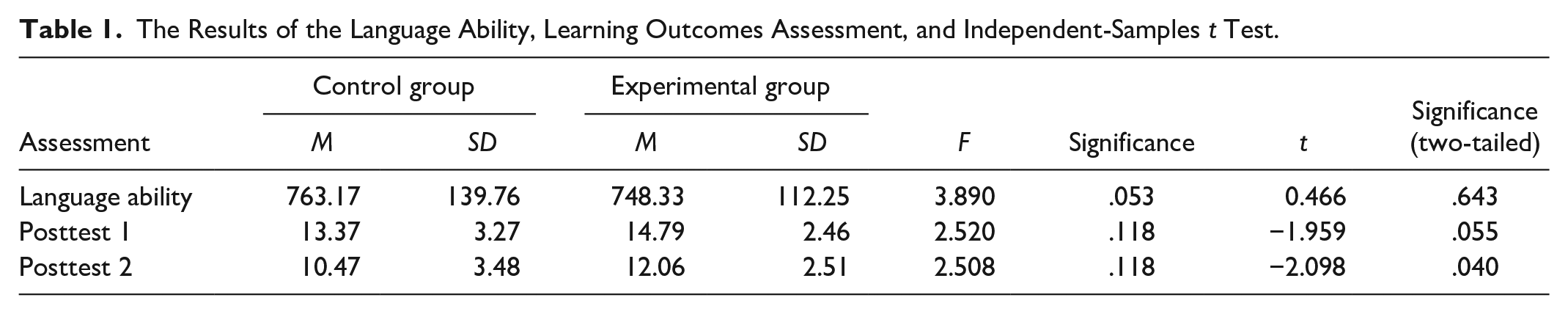
These results demonstrate that SELT-texts do have better effects on learning achievement than STR-texts. That is, when SELT-texts were presented to the students, they performed better on the posttest. However, SELT-texts had the different effect degree on learning outcomes in the two lectures, that is, the effect was stronger for the second lecture than for the first one. This finding is attributed to the lecture difficulty level, that is, the first lecture was at the intermediate level and the second lecture was at the advanced level.
When interviewing the students in the control group, they had different opinions regarding the usefulness of STR-texts for learning. For example, one group of students explained that their foreign language ability was not good enough and so STR-texts were useful during lectures in a foreign language. According to them, they listened to the instructor and simultaneously read texts generated by STR to enhance lecture comprehension. Another group of students said that their foreign language ability was very low, and thus, texts generated by STR were not useful at all. According to them, they could not understand the lecture both by listening to the verbal content and by reading the textual content. There was also one group of students who claimed that texts generated by STR distracted their attention when listening to the instructor. This group consisted mostly of HELA students, and so listening to the instructor was enough for these students to understand the lecture content. All of them perceived texts generated by STR as a distraction. When interviewing HELA experimental students, they had similar perceptions. HELA experimental students also claimed that texts generated by SELT were distracting in two lectures. However, experimental students with other foreign language abilities praised the SELT-texts and indicated that they felt that SELT-texts helped them understand the lecture content.
The advantages of both STR-texts and SELT-texts can be explained by CTML (Mayer, 2019). The CTML suggests that multimedia information is beneficial for learning because each media complements one another during the process of information-processing. However, the difference in the strength of STR and CAT effects on comprehension can be explained by the fact that the lectures were in FLMI. Because the student language ability was too low, and the lecture content was presented in FLMI, some students in the control group were not able to understand the lectures even when they were delivered in multimedia forms (i.e., lecturing of the instructor and STR-texts). On the contrary, because the SELT-texts were in the students’ native language, LELA students in the experimental group were able to understand the lecture content easily by reading the SELT-texts.
In the present study, the between-group differences in learning outcomes, cognitive load, mental effort, and self-efficacy in students with different EFL ability levels were also explored. The students in each group were divided into two subgroups based on their TOEIC scores. That is, HELA control group included the 15 highest ranking control students; LELA control group included the 15 lowest ranking participants; HELA experimental group included the 16 highest ranking experimental group students; and LELA experimental group included the 17 lowest ranking participants.
A Mann–Whitney U test, that is, nonparametric test, was conducted to reveal a difference in the language ability and learning outcomes among the students with different levels of language ability in two groups. The nonparametric test was employed because the sample size was small. Fraenkel et al. (2018) suggested using a nonparametric statistical technique in cases where there are few, if any, assumptions about the nature of the population from which the samples in the study were taken. Table 2 demonstrates the results of that analysis. The results indicated that there was no significant between-group difference, z = −0.265, p > .05, in terms of language ability in LELA students. That is, their language ability was equal. However, the results showed a significant difference between LELA students in the control and experimental groups in the scores on the first posttest (z = −2.290, p < .05) and the second posttest (z = −2.555, p < .05). That is, LELA students in the experimental group outperformed those in the control condition.
The Results of the Language Ability, Learning Outcomes Assessment, and Nonparametric Test for Low and High Language Ability Students.

With respect to HELA students, the results indicated that there was a significant between-group difference in language ability, z = −2.872, p < .05. That is, the language ability of HELA students in the control group was significantly better than that of HELA students in the experimental group. The results also showed that there was no significant between-group difference in the scores on Posttest 1 (z = −0.298, p > .05) and Posttest 2 (z = −0.577, p > .05) in the case of HELA students. That is, HELA students in both groups had equal scores on the two tests. One may doubt the results of the comparison because of a statistically significant difference in the language ability scores, z = −2.872, p < .05. Therefore, an analysis of covariance was also carried out to add strength to the findings. The analysis allowed a comparison of the differences in scores on the posttests between the two groups of HELA students while controlling for their language ability scores. The results of the analysis of covariance indicated that after controlling for the language ability scores, the between-group differences in the posttest scores were not significantly different for HELA students after Posttest 1 (F = 0.968, p > .05) and Posttest 2 (F = 0.553, p > .05).
These results suggest the following: First, compared with STR-texts, SELT-texts had a better effect on the learning outcomes in LELA students. Specifically, the results suggest that LELA students performed better on the test when they used the SELT-texts. Second, the effect of the SELT-texts increased as the lecture difficulty level increased. That is, the SELT-texts were more beneficial for LELA students when the lecture was at a higher level of difficulty. Third, there were not any comparative differences in the effect between the STR-texts and SELT-texts on the learning outcomes of HELA students. That is, regardless of what media (STR-texts or SELT-texts) was presented to HELA students, their learning outcomes did not differ significantly. Finally, the results suggested that the SELT-texts were more beneficial for LELA students than for HELA students.
These findings can be explained by the fact that the lectures were in FLMI. As it was mentioned earlier, because the language ability of the students was too low, and the lecture content was presented in FLMI, SELT-texts were more beneficial for learning because they were presented in the students’ native language. That is, LELA students in the experimental groups could easily understand the lecture content using SELT-texts. The expertise reversal effect (Jiang et al., 2018) may explain why high language ability students did not need either STR or SELT support. That is, STR or SELT was useful for LELA students but ineffective when used by HELA students (Kalyuga, 2014). Our results are in line with earlier related studies (Shadiev & Huang, 2020; Shadiev & Sun, 2019).
Cognitive Load
The researchers conducted an independent-samples t test to examine how different cognitive load is between two groups. The results of the test are reported in Table 3. The results indicated insignificant between-group differences in cognitive load after the first (t = 0.000, p > .05) and second (t = 0.670, p > .05) lectures. In addition, there were insignificant between-group differences in mental effort after the first (t = −0.120, p > .05) and second (t = 1.445, p > .05) lectures.
The Results of the Cognitive Load and Independent Samples t Test.

In the interviews, a majority of students in two groups mentioned that it was easy for them to learn the learning material. In addition, a majority of students in two groups said that it did not require a lot of mental effort for them to learn the learning material. According to Clark and Mayer (2016), multimedia content is useful for students when they attend lectures in a foreign language and it is not easy for them to understand the lecture content. Scholars suggested that, in the information-processing process, visual and verbal modalities complement each other and facilitate comprehension of the lecture content. For this reason, students in two groups well managed their cognitive load and mental effort.
The results may suggest that the effects of texts generated by SELT on cognitive load and mental effort are not better than those of STR-texts. That is, with either texts (i.e., generated by SELT or STR), cognitive load and mental effort levels will be the same. Furthermore, as the lecture difficulty level increases, the cognitive load and mental effort under both interventions (SELT or STR) increase as well.
Scholars warmed that working memory has limited cognitive capacity (Kalyuga, 2014). In the present study, cognitive load was influenced by the inherent nature of the learning material, expertise of the learners, and the interaction between these two (Sweller, 2017). In other words, because the learning content was delivered in FLMI, and students needing additional support relied on the STR-texts or SELT-texts, they perceived a lower cognitive load.
Although the results show that the students in two groups perceived equal cognitive load and mental effort, a significant difference between two groups was found in the test performance. That is, when the experimental group (i.e., those who used SELT-texts) outperformed their counterparts (i.e., those who used STR-texts) in terms of learning outcomes, one should expect some sort of difference in the level of the cognitive load, that is, in terms of intrinsic and extraneous load. Perhaps measuring students’ intrinsic and extraneous load level independently would provide a better understanding of the effects of learning content design and students’ expertise on the amount of working memory resources that are utilized under these conditions.
The researchers conducted a Mann–Whitney U test to evaluate how different cognitive load and mental effort after lectures are between LELA students in two groups. Table 4 presents the results. According to the results, after the second lecture, the difference between two groups in cognitive load was nearly significant (z = −1.892, p > .05), and in mental effort, it was significant (z = −2.510, p < .05). Having texts generated by SELT in lecture resulted in lower level of mental effort and cognitive load after the second lecture compared with having texts generated by STR. However, the difference between two groups in terms of cognitive load and mental effort after the first lecture was insignificant.
The Results of the Cognitive Load and Nonparametric Test for Low and High Language Ability Students.

When considering HELA students, the nonparametric test showed that, after each lecture, difference between two groups in cognitive load and mental effort was insignificant. In other words, the students in two groups had equal levels of cognitive load and mental effort.
In the interviews, LELA students who used STR-texts confirmed that, because of their ability, they perceived the learning material as difficult and they needed a lot of mental effort to study it when its difficulty level increased. On the contrary, LELA students who used SELT-texts admitted that the learning content was easy and did not require excessive effort because they were in their mother tongue.
The results may suggest that STR- or SELT-texts are beneficial for LELA students to manage cognitive load and mental effort in case the lecture content is not too difficult. When the difficulty level of the lecture increases, the cognitive load and mental effort increase when using STR-texts as compared with using SELT-texts. The results also suggest that, for HELA students, the effect of STR- or SELT-texts on cognitive load and mental effort is similar regardless of the lecture difficulty level.
Self-Efficacy
The researchers performed an independent-samples t test to compare the self-efficacy scores of students who used SELT- or STR-texts. The results are presented in Table 5. There were insignificant between-group differences in self-efficacy scores, t = 0.231, p > .05. The results indicate that both groups had similar levels of self-efficacy.
The Results of the Self-Efficacy and Independent Samples t-Test.

A Mann–Whitney U test was conducted to determine whether there was a between-group difference in the self-efficacy scores related to language ability. Table 6 shows the results of the test, which did not reveal a significant between-group difference in the self-efficacy scores for LELA control and LELA experimental groups, z = −0.364, p > .05. Similarly, there was not a significant difference in the self-efficacy scores between HELA control and HELA experimental groups, z = −0.606, p > .05. That is, LELA students in both groups had similar self-efficacy scores, and HELA students in both groups also had similar self-efficacy scores. These results can be explained by the fact that self-efficacy of the students in both groups was explored before the experiment only. It would be useful to measure how student self-efficacy could be changed after the experiment when STR-texts or SELT-texts are presented to the students.
The Results of the Self-Efficacy and Nonparametric Test for Low and High Language Ability Students.

The Relationships Among the Research Variables
The researchers computed a Pearson product-moment correlation coefficient to assess the relationships among the research variables of interest in the present study. The results are presented in Table 7. There was a correlation between the following pairs of research variables: language ability and cognitive load during Lecture 1 (r = .407, p < .05), language ability and mental effort during Lecture 1 (r = .497, p < .05), and language ability and self-efficacy (r = .362, p < .05).
Correlation Statistics of Research Variables.

Correlation is significant at the .05 level (two-tailed). **Correlation is significant at the .01 level (two-tailed).
These results suggest that HELA students had a higher cognitive load and exerted more mental effort and that, conversely, LELA students had a lower cognitive load. The following information may explain this interesting finding. During the interviews, most of the LELA students admitted that they read SELT-texts to better understand the lecture content, so cognitive load and mental effort during the lectures were manageable. On the contrary, most of the HELA students said that they preferred to listen to the instructor only. In fact, HELA students who were at the bottom of HELA student list still had difficulty understanding the content of Lecture 1 and they did not use SELT-texts. Therefore, these students had a higher cognitive load and exerted more mental effort during Lecture 1. Later, these students found the SELT-texts to be beneficial for learning and they utilized them during Lecture 2. SELT-texts helped HELA students manage their cognitive load and mental effort during Lecture 2. This is why there was not a significant correlation between language ability and cognitive load/mental effort during Lecture 2.
These findings can be explained by the expertise reversal principle (Jiang et al., 2018) and intrinsic and extraneous load (Brunken et al., 2003; Mayer & Moreno, 2003; Paas et al., 2003; Sweller et al., 1998). That is, the presented learning content that is highly effective for LELA students may not be effective for HELA students (i.e., the expertise reversal principle). LELA students experienced high intrinsic load because of the difficulty level of the lectures, and after SELT-texts were provided, their cognitive load became manageable. Because of their low language ability, LELA students need learning content presented in both visual and verbal forms to understand it better. On the contrary, HELA students experienced low intrinsic load because the lecture content was not difficult for them to understand, and after the SELT-texts were provided, they experienced high extraneous load and were exerting higher mental effort to process that load. Information presented to HELA students in two forms could bring negative consequences because additional cognitive resources were required to process it.
The results also suggest that HELA students had higher self-efficacy and that LELA students had lower self-efficacy. The association between self-efficacy and ability has been suggested in earlier studies (Graham, 2011; Heidari et al., 2012; Piran, 2014; Pouyamanesh, 2013; Sanchez-Castro & Strambi, 2017). Graham (2011), and Heidari et al. (2012) suggested that learners with high self-efficacy are more engaged in the classroom compared with their counterparts. In addition, learners with high self-efficacy are confident (Piran, 2014) and absorb lecture content more successfully (Sanchez-Castro & Strambi, 2017), whereas learners with low self-efficacy struggle and perform worse (Pouyamanesh, 2013). The results of the present study confirmed this association.
One interesting finding of the present study is that although self-efficacy was associated with language ability before the experiment, it was not found to be significantly correlated with learning outcomes. This finding may suggest that the intervention used in the present study could influence self-efficacy in positive or negative way. In line with expertise reversal effect, when SELT-texts were presented to LELA students during lectures that were difficult for them, their self-efficacy improved because they were able to understand the lecture content with the support of SELT-texts. On the contrary, when the SELT-texts were presented to HELA students, their self-efficacy decreased because they were able to understand the lecture content without SELT-texts, and the texts distracted them.
A significant correlation existed between the following pairs of research variables: cognitive load and mental effort after Lecture 1 (r = .807, p < .001), cognitive load after Lecture 1 and cognitive load after Lecture 2 (r = .681, p < .001), cognitive load after Lecture 1 and mental effort after Lecture 2 (r = .573, p < .001), mental effort after Lecture 1 and cognitive load after Lecture 2 (r = .736, p < .001), mental effort after Lecture 1 and Lecture 2 (r = .626, p < .001), and cognitive load and mental effort after Lecture 2 (r = .765, p < .001).
The statistically significant correlations between the two tests and among the cognitive load variables suggest an association among these variables. That is, if students perform better on one test, then they will do better on the other as well, or vice versa. Similarly, if the students experience high cognitive load/mental effort in one lecture, then their cognitive load/mental effort will be also high in the other lecture, or vice versa.
Conclusion
In the present study, STR- and SELT-texts were introduced to facilitate students’ learning in different difficulty-level lectures delivered in FLMI. The researchers obtained the following findings. The students who were exposed to SELT-texts outperformed their counterparts during both lectures. When the difference in learning outcomes across both groups was compared with respect to their language ability, the difference was statistically significant for LELA students only. Between-group difference in cognitive load and mental effort after both lectures was insignificant. On further investigation of the difference in cognitive load and mental effort of students in two groups with respect to their foreign language ability, a significant difference between the two low ability groups during Lecture 2 was found. Insignificant differences existed in self-efficacy between the two groups. There was not a significant between-group difference related to different language ability. Finally, several associations among the research variables were found, for example, language ability and cognitive load during Lecture 1, language ability and mental effort during Lecture 1, and language ability and self-efficacy. In additions, associations between the results of the two tests and between variables related to cognitive load were found.
Based on the results, it is suggested introducing SELT-texts during lectures that are delivered in a foreign language as SELT-texts can be useful and assist in facilitating student understanding of lecture content. SELT-texts were found to be beneficial for students who have LELA because of their limited language skills. SELT-texts become more useful when lecture difficulty level increases. In this case, both LELA and HELA students can use texts generated by SELT to complement their understanding of lecture content. Furthermore, SELT-texts can be beneficial for students to manage their cognitive load and mental effort well. However, when introducing SELT-texts during lectures in FLMI, students need to be instructed about strategies on how to use SELT-texts efficiently. Finally, students need to be allocated with enough time to get acquainted with the new intervention.
Several limitations of the present study should be noted. First, the self-efficacy of the students in both groups was explored before the experiment only, so future studies may consider measuring student self-efficacy after the experiment as well. In this case, it will be possible to find out whether self-efficacy changes from the beginning of the experiment to its end, and if it does, what the difference will be across different conditions, for example, STR-texts versus SELT-texts. Second, the study targeted only Mandarin Chinese students. Future studies may consider including students proficient in other languages to give more weight to the research. Third, cognitive load was measured in the present study as a whole construct. However, cognitive load includes intrinsic, extraneous, and germane loads. Understanding of the usefulness of STR-texts versus SELT-texts on cognitive load would be enhanced if future studies measure these types of cognitive load independently. Various scales have been proposed in the literature for measuring intrinsic, extraneous, and germane loads separately (Hadie & Yusoff, 2016). They can shed light on various relationships between cognitive load and characteristics of learning content, for example, between lecture difficulty level and level of intrinsic load or distraction based on STR-text level and level of extraneous load.
Furthermore, some learning techniques could be introduced during lectures in the future. For example, instructors could heterogeneously group students with varying abilities to use cooperative learning techniques (Kagan, 1994), for example, discuss their understanding of and allow them to reflect on lecture content using STR-texts versus SELT-texts to facilitate their understanding of lecture content.
Footnotes
Declaration of Conflicting Interests
The author(s) declared no potential conflicts of interest with respect to the research, authorship, and/or publication of this article.
Funding
The author(s) received no financial support for the research, authorship, and/or publication of this article.
