



Abstract
This exploratory study looks at how women work in Maharashtra’s manufacturing sector, particularly emphasizing how their workplace experiences are shaped by organizational support and gender dynamics. Grounded in Social Role Theory and complemented by Social Exchange Theory, the study explores how societal gender norms and views of organizational reciprocity affect women’s career satisfaction and advancement. We collected responses from 170 employees through semi-structured interviews, including 6 female employees, as part of a mixed-methods design. These responses were analyzed using qualitative and quantitative tools such as ATLAS.ti and SPSS 26. Findings reveal persistent barriers to women’s advancement despite progressive organizational policies, with concentration in lower-tier roles and concerns about pay equity and promotion opportunities. Structured managerial feedback emerged as a key factor in enhancing career attractiveness, while women with higher education levels demonstrated greater criticality toward structural and cultural barriers. Triangulated insights highlight the importance of hiring women and reforming organizational systems through transparent promotion pathways, skill-upgradation programs, inclusive leadership, and family-supportive policies such as childcare and transport facilities. The study contributes theoretically by integrating Social Role Theory with Social Exchange Theory to show how societal expectations and reciprocal organizational practices jointly shape women’s workplace experiences. Practically, it provides context-specific recommendations for Indian manufacturing firms to create more equitable and supportive environments.
Plain Language Summary
This study explores the work experiences of women in Maharashtra’s manufacturing sector, focusing on how workplace support and gender dynamics influence their careers. The research was conducted within a multinational company that promotes inclusivity, aiming to understand how women perceive organizational policies and their impact on job satisfaction, career growth, and work-life balance. Using a mixed-methods approach, the study gathered insights through both interviews and surveys. Semi-structured interviews with six female employees provided a detailed understanding of their personal experiences, analyzed using ATLAS.ti software. Additionally, a survey of 170 female employees was conducted to assess broader trends in job satisfaction, career opportunities, and work-life balance. The data from the survey were analyzed using SPSS 26. The study was guided by Social Role Theory, which explains how societal expectations around gender shape workplace interactions and opportunities. The findings revealed that while the company has progressive policies supporting women, challenges remain. The interviews showed that some women had positive career experiences, while others struggled with career advancement and balancing personal and professional responsibilities. Survey results indicated that most employees were generally satisfied with workplace support but expressed concerns about limited career growth and work-life balance pressures. These findings highlight the need for organizations to continue improving gender equity policies by refining support systems, creating better career opportunities, and addressing work-life balance challenges. Despite progress, cultural norms and male-dominated workplace structures still create barriers for women. The study emphasizes that sustained organizational efforts are essential to ensuring women’s full participation and success in the manufacturing sector.
Introduction
India’s corporate sector is undergoing a significant transformation, recognizing the importance of workforce diversity, especially as the country emerges as an essential global economic market. This transformation has led to adopting policies and support networks that foster an inclusive environment catering to the needs of a diverse workforce. Initiatives include flexible work arrangements, enhanced work-from-home infrastructure, extended maternity leave, improved workplace safety, and the implementation of mentoring and leadership programs (Patrick & Laschinger, 2006).
Despite these efforts, the manufacturing sector, a crucial part of the Indian economy contributing approximately 15% to the nation’s GDP and employing over 62.4 million individuals (World Bank, 2021), still sees a low representation of women. The India Economic Survey (Department of Economic Affairs, 2022) reports that women constitute only about 26% of the total workforce, roughly 160 million women, in this sector. Even within this limited representation, Muhammed and Zaim (2020) note that women’s participation in the Indian manufacturing sector ranges from 3% in core engineering roles to 12% in other technical and operational roles, indicating a wider yet constrained presence across diverse functions. Existing literature has primarily focused on diversity practices and women’s experiences in the service sector (Weber et al., 2011). There is a significant gap in research addressing women’s experiences in traditionally male-dominated sectors like manufacturing, which includes industries such as iron and steel, chemicals, electrical, mining, and construction (Gillet et al., 2016). The Indian Government’s “Make in India” program aims to bolster local manufacturing, highlighting the need for more inclusive policies to attract and retain female talent in this sector. The corporate sector’s active steps to enhance gender diversity and representation are crucial for the sector’s growth and competitiveness (Harlos et al., 2023).
Given the significant economic contribution of the manufacturing sector and the underrepresentation of women within it, there is a pressing need to explore the factors that influence women’s experiences and career satisfaction in this field. The need to study female employees in the manufacturing sector is underscored by persistent challenges such as gender bias, inadequate safety measures, and disparities in compensation, which significantly impact their career advancement and job satisfaction (Glick et al., 1988). This study is essential for identifying and addressing these issues, as it provides actionable insights into improving workplace conditions, healthcare facilities, and work-life balance tailored explicitly to female employees (Eagly & Carli, 2007). By focusing on these areas, the research aims to promote gender equality and enhance manufacturing organizations’ overall effectiveness and reputation (Benería & Roldán, 1987). Additionally, the findings are expected to support the implementation of targeted management practices, such as robust feedback systems and equitable compensation, thereby contributing to a more inclusive and supportive work environment (Agarwal & Nelson, 2023). Addressing these needs is crucial for fostering a fair and productive workplace, which aligns with broader objectives of organizational success and employee satisfaction (World Economic Forum, 2023).
This study leverages Social Role Theory, developed by Eagly and Wood (2012), to understand the complexities of women’s work environments in the manufacturing sector. This theoretical framework is instrumental in exploring how societal expectations and gender roles influence workplace experiences, policies, and career outcomes. Social Role Theory posits that traditional gender roles and societal norms shape the roles individuals are expected to fulfill, impacting their career progression and work experiences. This theory was considered particularly pertinent to understanding the experiences of women in the manufacturing sector, where traditional gender roles often influence career progression and work environments. The goal of a qualitative investigation is a holistic understanding of an attitude or behavior by exploring the experiences of individuals and the subjective meanings that make it up (Mondal & Samaddar, 2020). Hence, this research investigates the working environment of women in the manufacturing industry by employing a mixed-methods approach, combining qualitative and quantitative data collection techniques. Triangulation, a method used in research to cross-verify data from multiple sources, helps provide a more comprehensive understanding of the research problem. Initially, semi-structured interviews were conducted with six female employees to gather in-depth insights into their personal experiences and perceptions regarding the work environment, gender dynamics, and organizational support in the manufacturing sector in Maharashtra, India. Concurrently, we designed a comprehensive survey based on previous studies and administered it to 170 female employees to assess various factors, including job satisfaction, career advancement opportunities, and work-life balance. Qualitative data were analyzed using ATLAS TI, and Quantitative data were analyzed using SPSS 26. This mixed-methods approach allowed for a richer and enhanced reliability and validity of our findings. Further, we employed social role theory to understand how gender roles and organizational practices influence women’s work experiences and career satisfaction within multinational manufacturing organizations. Comparing and contrasting evocative findings from both methods enriched our understanding of the research question:
RQ: How Do Gender Dynamics and Organizational Support Influence the Work Experiences of Women in the Manufacturing Sector
Sub Research Questions:
Literature Review
Drivers Contributing to the Underrepresentation of Women in Manufacturing
The underrepresentation of women in manufacturing is a multifaceted issue driven by several factors rooted in traditional gender roles. Historically, manufacturing has been perceived as male-dominated due to its association with physically demanding labor, technical skills, and long hours. These perceptions perpetuate gender biases, discouraging women from pursuing careers in this sector (K. Y. Chen et al., 2025). Cultural norms often push women toward roles considered more “feminine,” such as caregiving and administrative positions, while societal expectations surrounding work-life balance further deter them from entering industries that demand inflexible schedules (Fouad & Santana, 2017).
A significant barrier is the lack of role models and mentors for women in manufacturing, creating a cycle of underrepresentation (Moss-Racusin et al., 2021). Additionally, workplace cultures in manufacturing environments may be unwelcoming or even hostile to women, with issues ranging from gender discrimination to limited access to career advancement opportunities (Israni & Kumar, 2021). These challenges are compounded by the gender pay gap and unequal access to training and development programs (Kutty et al., 2025).
To address these challenges, organizations must implement gender-inclusive policies that challenge traditional roles. Strategies like flexible working hours, mentorship programs, anti-discrimination policies, and proactive recruitment of women can help foster a more equitable environment. Companies must also invest in training and awareness programs that promote gender equality, ensuring long-term cultural change in the industry (Hing et al., 2023).
Drivers Influencing Career Attractiveness for Women in Manufacturing
The manufacturing sector has historically been male-dominated, but understanding factors that influence career attractiveness for women is crucial for fostering gender diversity. Organizational support plays a key role in shaping female employees’ career experiences. Critical aspects of organizational support include work-life balance policies, mentorship opportunities, and equitable career progression pathways (Heilman & Caleo, 2015). These supports are essential for women, who often face societal expectations regarding caregiving roles that can conflict with traditional manufacturing work environments (Eagly et al., 2004).
Research shows that female employees perceive organizational cultures promoting inclusivity and flexibility as more attractive, as they mitigate the pressure of conforming to traditional gender roles (Glick et al., 2000). Furthermore, mentorship and sponsorship programs can counteract the barriers created by societal gender norms, which often position men as the default leaders in technical fields (Ragins & Kram, 2008). These perceptions reflect broader societal influences, where traditional gender roles can limit women’s career choices in sectors like manufacturing, where long working hours and physical demands are stereotypically associated with masculinity (Rasool et al., 2021). Addressing these issues through robust organizational support is crucial to increasing career attractiveness for women in the manufacturing sector.
Demographic Influences on the Role Alignment in Manufacturing
García-Bernal et al. (2005) categorized job satisfaction into four dimensions: economic aspects, interpersonal relations, working conditions, and self-realization. H. Chen and Eyoun (2021) highlighted the influence of gender, age, and education on job satisfaction, noting that women generally report higher satisfaction, though this gender gap diminishes among younger and more educated individuals. Contradictory findings in the manufacturing sector suggest that age and experience significantly affect job satisfaction, with gender influencing the degree of impact across dimensions (García-Bernal et al., 2005; Yu et al., 2012).
Agha (2005) defined role alignment as using social cues to perform and reproduce identity figures such as gender, class, or authority. Although often conflated with belongingness, the two concepts are distinct (Aboramadan & Karatepe, 2021), and literature underscores the relevance of role alignment in entrepreneurship (Kim et al., 2013). Based on social support theory, family support strongly influences the balance between personal and professional roles (Aldrich & Cliff, 2003). Gender also plays a key role; women who use communal influence tactics often experience greater career advancement (Carr, 1996; Smith et al., 2013), whereas misalignment may lead to stagnation. Parida and Jovanovic (2022), studying 34 participants from global manufacturing firms, found that role alignment fosters value creation for front- and back-end employees, regardless of gender. However, the role alignment was more closely tied to engagement and burnout, with burnout showing a surprisingly positive correlation.
Impact of Education Level on Perception of Management Support
Perceived management support, or Perceived Organizational Support, is rooted in Social Role Theory and reflects employees’ belief that their organization values their contributions and well-being, fulfilling needs for approval, affiliation, and respect (Labrague & De Los Santos, 2020). Such support, often associated with fairness, rewards, and favorable job conditions, positively influences job satisfaction (Rhoades & Eisenberger, 2002).
While Rhoades and Eisenberger (2002) argue that education may not directly affect perceived support, other studies highlight its role in influencing organizational commitment (Nasution, 2021) and moderating perceptions of HR practices (Jiang et al., 2017). However, the impact of education on perceived support among women in male-dominated sectors like manufacturing remains underexplored (Kirrane et al., 2017). Women with higher education may assess support more critically due to greater awareness of norms, whereas those with less education may perceive it with more acceptance or gratitude.
Conceptual Framework and Hypotheses Development
This study is grounded in Social Role Theory (Eagly & Wood, 2012), which postulates that gendered expectations form individuals’ behavior and opportunities across professional and domestic spheres. In traditionally male-dominated sectors such as manufacturing, women often face structural and cultural barriers that imitate deeply rooted societal norms. These include expectations that women take on primary caregiving roles, leading to work-family conflicts, and mold that limit their access to leadership, recognition, and advancement. Although Social Role Theory describes how gendered expectations and societal norms shape women’s opportunities in manufacturing, it does not fully capture the social dynamics between employees and organizations. We combine Social Exchange Theory (SET) to fill this gap. According to Blau (1964, p. 91), “Social exchange theory refers to voluntary actions of individuals that are motivated by the returns they expect to bring and typically do bring from others.” This theory draws attention to the distinction between economic and social exchange, noting that in the former, the nature of the responsibilities involved is more likely to be left unclear, at least initially. The theory asserts that social exchange “involves the principle that one person does another a favor, and while there is a general expectation of some future return, its exact nature is not stipulated in advance” (Blau, 1986, p. 93). Integrating SET with Social Role Theory provides a more comprehensive framework: Social Role Theory explains the influence of societal norms, while SET explains how organizational practices and support shape women’s perceptions of career attractiveness, advancement opportunities, and satisfaction.
Within this dual framework, the conceptual model proposes that women’s perceptions of career attractiveness, organizational support, and participation barriers are shaped by their education level and the exchange dynamics embedded in managerial support and workplace culture.
Social Role Theory suggests that educated women resist traditional role restrictions, while Social Exchange Theory implies that when organizational reciprocity does not meet higher expectations, barriers are perceived more strongly, thus the hypothesis.
In line with SET, managerial support represents a favorable exchange that increases perceived career value. Social Role Theory further suggests that inclusive managerial practices challenge restrictive gender norms, making careers more appealing, thus the hypothesis
Social Role Theory explains that job functions are gendered, with sales/service perceived as more socially aligned with traditional roles. From an SET perspective, these roles may also involve more visible reciprocity (e.g., customer recognition, managerial feedback), increasing perceptions of attractiveness.
Theoretical Proposition
As education level increases, women develop a critical and perceptive understanding of structural and cultural barriers (SET) in the manufacturing environment. Observed trends in the qualitative data support this proposition and align with Social Role Theory, which proposes that individuals with greater access to education are more likely to challenge traditional role boundaries and recognize systemic limitations.
Thus, in addition to the formal hypotheses tested in this study, the following propositions were developed based on theoretical framing observed in the data:
This combined theoretical framing, as shown in Figure 1, allows us to study not only how societal gender norms influence women’s workplace experiences but also how organizational exchange, trust, and support play a critical role in determining perceptions of career attractiveness and advancement.

Conceptual framework: integration of social role theory & social exchange theory.
The hypotheses are operationalized through items on career attractiveness (e.g., compensation, job security, innovation), perceived barriers (e.g., management support, workplace environment), and demographics (education, job role). The analysis includes descriptive statistics, subgroup comparisons, and ANOVA analysis where appropriate.
Research Methodology
Study 1. Qualitative Study
Sampling and Data Collection
We conducted this exploratory research at a multinational manufacturing organization in Maharashtra, India, specializing in producing bedsheets and handkerchiefs. The organization’s names are withheld due to confidentiality norms. The companies, known for their progressive policies and commitment to gender neutrality, were chosen due to their comprehensive efforts to foster an inclusive work environment, as evidenced by their vision and mission statements, HR manuals, and employee handbooks. We collected data over 3 months from December 2023 to February 2024. The company was selected due to its exemplary policies promoting women’s leadership, preventing sexual harassment, managing work-life balance, and enhancing gender awareness, making it an ideal setting to explore gender dynamics and organizational support.
Further, the survey was administered verbally by trained facilitators. This approach allowed participants to hear each question and respond orally, ensuring that they could express their views without the barrier of reading or writing. We trained the facilitators to create a comfortable environment, encouraging open dialog, and clarifying any uncertainties about the questions. We interviewed six female employees to gain in-depth insights into their experiences, challenges, and perceptions of the workplace. They ranged in age from 20 to 50 years and held positions as quality service workers, shop and market sales workers, and craft and related trades workers. These respondents selected using convenience sampling, which allowed for the inclusion of readily available individuals who met the study’s criteria. This method was chosen to facilitate access to participants within the organization and to gather qualitative data efficiently. All participants were assured of the voluntary and confidential nature, encouraging them to respond honestly. An interview guide was developed to capture comprehensive insights from the employees. It included questions on demographic information, educational background, job role and tenure, perceptions of career advancement opportunities, experiences with work-life balance, organizational support systems, workplace challenges, gender discrimination, and overall job satisfaction. Pretesting was done to refine the guide and ensure it effectively addressed the relevant issues. Data collection followed a semi-structured interview approach, with visits to the two manufacturing units conducted intermittently over a month. Interviews were held at their workplaces, with each session lasting between 35 and 50 min. Conducting interviews within the organizational environment provided valuable insights into daily work practices, but somewhat limited participants’ willingness to share critical comments despite confidentiality assurances. We recorded the interviews by taking the participants’ consent to ensure transparency and accuracy, and detailed field notes were maintained during the interviews and organizational visits (Emerson et al., 2001).
Findings
We prepared the transcribed text verbatim to ensure the richness of the data and analyzed it using ATLAS.ti software to facilitate the management and analysis of qualitative data (Woods et al., 2016). We employed an inductive approach, guided by social role theory for coding frameworks, by providing sensitizing concepts. Following a structured three-phase coding process, initial coding was employed to uncover serendipitous insights. Firstly, individual interview excerpts were coded to develop numerous first-order categories. Examples of these initial codes include “gender bias in management support,”“lack of flexible work policies,”“mentorship opportunities,” and “job satisfaction” dimensions. This initial coding phase allowed for identifying themes directly from the data without preconceived categories. In the second phase, a “constant comparison” approach was utilized to identify similarities and differences within the data. This involved comparing different excerpts and codes to consolidate them into meaningful second-order themes. For instance, codes related to “gender bias in management support” and “lack of flexible work policies” were grouped under a broader theme of “organizational barriers.”“Finally, the categorized cross-interview excerpts were grouped into aggregate dimensions. These aggregate dimensions represent higher-level constructs that encapsulate the core themes identified in the interviews. Examples include “work environment challenges,”“organizational support,” and "career satisfaction items. "The coding process adhered to established qualitative research standards, as outlined by Strauss and Corbin (1998) and Miles and Huberman (1994). To ensure the validity of the findings, different categories, texts, and constructs were compared and validated through feedback from two additional experts in qualitative research. This iterative review process allowed for the refinement of codes and the identification of primary themes. Data saturation was attained when no new categories or themes emerged from the analysis, indicating that the collected data comprehensively covered the research questions. This thorough and systematic approach to coding ensured that the analysis was robust and reliable, providing deep insights into the work environments of women in the manufacturing sector.
The extracts of six female employees were captured when answering specific questions and presented in a matrix below. To ensure the validity and robustness of our findings, we triangulated the survey data with insights obtained from qualitative interviews. This approach allowed us to cross-verify the patterns and themes identified in both data sources, thereby strengthening the conclusions drawn from our research.
Table 1 presents the matrix showing survey findings and corresponding interview transcripts.
Interview Manuscript.

Essentially, by offering policy recommendations and action plans for luring and retaining more women in the manufacturing sector, qualitative research has demonstrated the essential findings of quantitative research, especially regarding the factors that make it challenging for women workers to adhere to the profession.
Study 2. Quantitative Study
Sampling and Data Collection
The questionnaire used in this study was self-developed based on insights gained from past studies on female employees in the Indian manufacturing sector (Ceda & Dhamija, 2023; Eisenberger et al., 2020; Mobin, 2024; Palashikar & Rajesh, 2021). The process followed best practices in questionnaire design, drawing from established research methodologies (Creswell, 2014; Gill et al., 2008; Patton, 2002). By contacting them in person outside the companies' premises, we administered the survey to the respondents using a convenience sample of 170 female workers, including quality service workers, shop and market sales workers, and craft and related trades workers. According to Cohen (1992), a sample size of 100 to 200 participants is generally adequate for achieving a power level of 0.80 in social science research, which is essential for detecting medium effect sizes. Additionally, using a sample size of 170 aligns with recommendations from Hair et al. (2010), who suggest that larger samples improve the stability and reliability of statistical estimates. Furthermore, the diversity within the sample, encompassing various roles and educational backgrounds, enhances the generalizability of the findings to the broader population of female employees in the Indian manufacturing sector. This comprehensive approach strengthens the validity of the study’s conclusions regarding the impact of organizational support and gender dynamics on women’s work experiences and career satisfaction.
The questionnaire included items on demographic information, perceptions of career advancement, work-life balance, organizational support, workplace challenges, gender discrimination, and job satisfaction, items contributing to women’s under-representation and the impact of discrimination (e.g., Which factor do you believe contributes most to women’s under-representation in manufacturing?), and compensation & rewards. The initial set of questions was validated through a pilot test with a small sample of participants, ensuring clarity and relevance. Feedback from the pilot helped refine the questions for better alignment with research objectives. The pilot test was conducted with a small group of non-target participants to assess the clarity and wording of the questionnaire. While this ensured fundamental comprehensibility, it did not fully capture women’s perspectives in the target manufacturing context, which we acknowledge as a limitation.
Findings
Descriptive statistics, cross-tabulations, and ANOVA were used for analysis. Statistical significance is only claimed where supported by formal tests; elsewhere, differences are described in terms of observed trends or mean score variations. We further assessed the reliability of the measurement scale using Cronbach’s alpha. The results provided insights into job satisfaction, management support, and other relevant constructs, addressing the research questions and testing the proposed hypotheses.
Sample Description
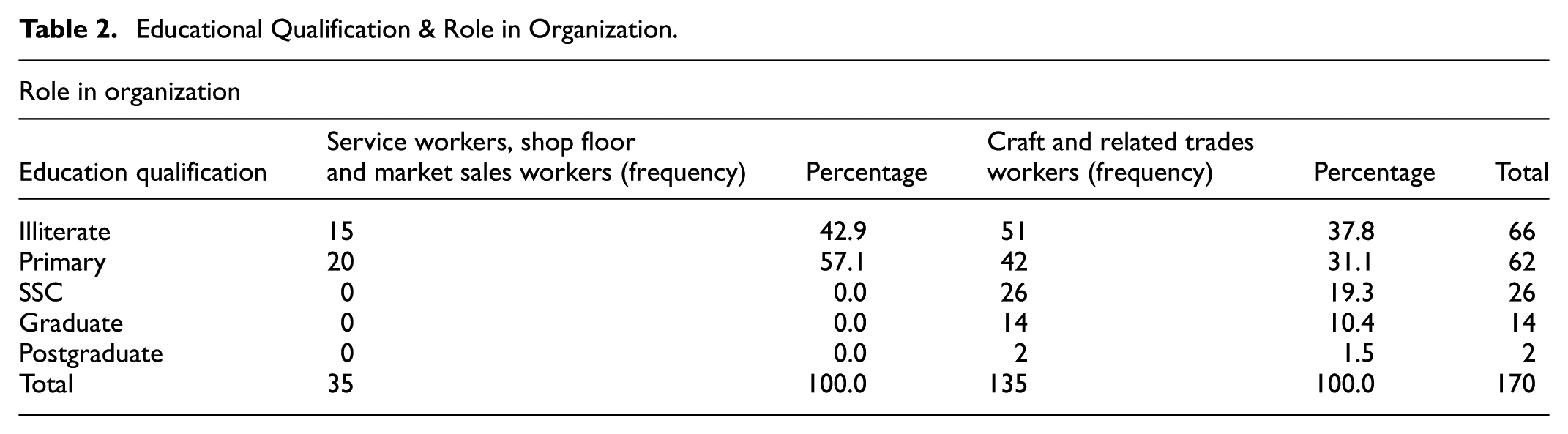
The data reveals a female workforce predominantly aged between 30 and 40 years (58.2%) with a significant number between 20 and 30 years (28.8%) and a smaller segment aged 40 to 50 years (12.9%). The majority are illiterate (38.8%) or have completed primary education (36.5%), with a smaller percentage holding secondary, graduate, or postgraduate qualifications. Employment is almost exclusively full-time (95.9%), with only a few in permanent roles (4.1%). In terms of roles within the organization, the vast majority are employed as craft and related trades workers (79.4%), while a smaller portion works in service or sales roles (20.6%). This distribution highlights a predominantly middle-aged workforce with low educational attainment and a focus on craft and trade positions.
The data on career-related variables indicate that most respondents view their career opportunities and environments relatively positively. Most employees feel that their jobs offer decent career advancement opportunities (51.2%) and an attractive work environment (51.8%). Job security is perceived positively by half of the respondents (50.0%), though there are concerns among some (11.2% rating it very poorly). The opportunities for innovation are seen as moderate (50.6% rating it as average), and a significant portion of employees view their work as challenging (58.2%). However, there is a notable concern about compensation, with only 1.8% feeling it is excellent, while most rate it as average (51.2%) or below average (15.3%). The global nature of the career is perceived positively by nearly half of the respondents (48.2%), but a smaller percentage find the physical location of their career appealing (55.3% rating it as average). While many aspects of their jobs are rated favorably, areas like compensation and physical location are viewed less positively.
The data reveals a mixed but generally moderate perception of workplace-related items among the respondents. The average scores across these variables are close to neutral, with means ranging from 2.65 to 3.02 on a scale of 1 to 5. The “Work environment” variable is predominantly rated around average (48.8% rated it a 3), with a smaller percentage rating it very poorly (15.3%) or very well (4.7%). Management support is seen as satisfactory by half of the respondents (50% rated it a 3), though a substantial portion still view it poorly (21.7% rated it 1 or 2). The “Relevant skills” shows a similar trend, with 39.4% rating it as average and a smaller percentage viewing it as very positive. Negative perceptions and lack of opportunity are the most concerning variables, with high percentages rating them negatively (57.1% for negative perception and 55.3% for lack of opportunity). Overall, while the average perceptions are neutral to slightly positive, there are notable concerns about management support, relevant skills, and opportunities for advancement.
Reliability
The reliability analysis of the self-developed questionnaire shows satisfactory internal consistency across its constructs with Cronbach’s alpha values of .740 for “items of attraction,” .759 for items of “Underrepresentation,” and .800 for “Rewards.” These values indicate that the items within each construct consistently measure their intended dimensions.
Due to high intercorrelation, we observed some redundancy across items even though the reliability analysis showed acceptable internal consistency. This was due to the exploratory nature and goal of documenting various work-related experiences. Further, this triangulation with qualitative results was made easier by keeping correlated items, which guaranteed thorough coverage of constructs. However, future research should consider item reduction strategies like exploratory or confirmatory factor analysis to improve the measurement model and lessen overlap.
To enhance workforce management and strategic planning in Indian manufacturing companies, it was essential to study the cross-tabulations of employee qualifications, age, and nature of employment regarding their roles within the organization. This analysis was undertaken to understand better how these factors intersect and impact job satisfaction, role alignment, and overall performance.
This distribution highlights how educational qualifications influence role allocation in the manufacturing sector (Refer to Table 2)
Educational Qualification & Role in Organization.
Age and Its Role in Organization
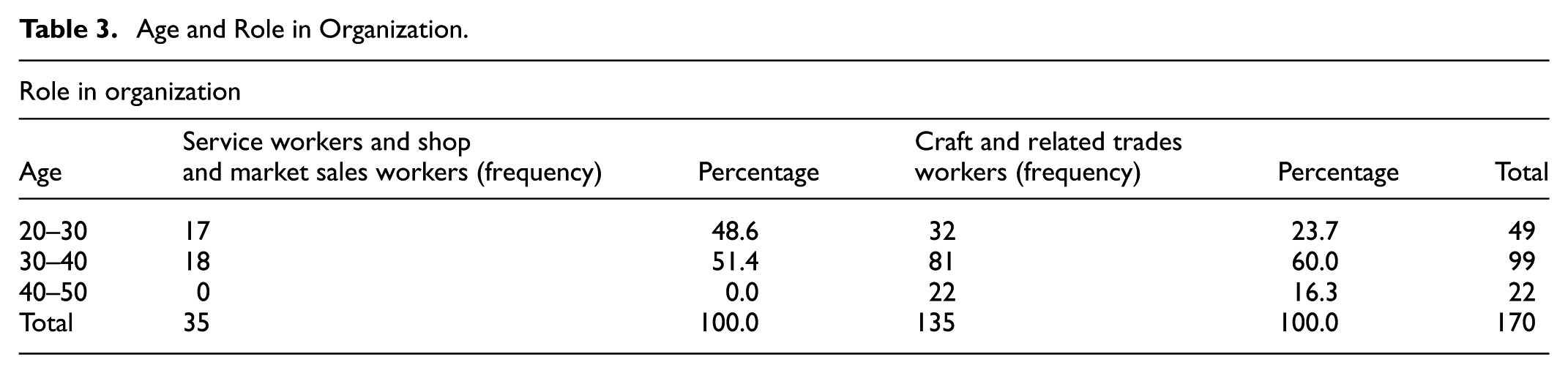
Younger workers (20–30 years) and mid-aged workers (30–40 years) are more evenly distributed between service and craft roles. They are split between Service Workers and Craft roles, suggesting they are versatile but may need clearer career pathways. However, the 30 to 40 age group is more concentrated in craft and related trades roles (81). Older workers (40–50 years) are exclusively in craft roles: their age and role in the organizations are presented in Table 3.
Age and Role in Organization.
Nature of employment & Role in Organization: The data (refer to Table 4) indicates that most employees in both service and craft roles are engaged in full-time jobs, with 163 out of 170 employees working full-time. This shows that full-time work is the predominant employment type within the organization.
Nature of Employment & Role in Organization.

The relationship between education level and perceptions of management support measures—such as trust, confidence, and feedback—among women in Indian manufacturing companies analyzed with cross tabulation (Refer Table 4).
Illiterate and Primary Education Levels: Most illiterate or primary respondents have trust and confidence in their direct manager (51 and 50, respectively).
SSC (Secondary School Certificate) Education Level: Most respondents with an SSC level of education reported that their direct manager provides clear and regular feedback on their performance (25 out of 26).
Graduate Education Level: Respondents with a graduate education are more evenly distributed, with some having trust and confidence in their manager (5) and a noteworthy number falling into the “Others” category (9).
Post Graduate Education Level: There are very few respondents with a postgraduate education (only 2), and they splited between having trust and confidence in their manager (0) and receiving clear and regular feedback (2).
To understand the variables that make a manufacturing career path attractive to women employees, we analyzed the mean scores of various aspects rated by the survey respondents. The mean scores provide insights into the relative importance of each driver. The mean scores for each variable are as follows: Career physical location: M = 3.10, Career opportunity advancement: M = 3.03, Career attractive environment: M = 2.96, Career job security: M = 2.98 Career innovation: M = 2.89, Career global nature: M = 2.82, career challenging: M = 2.83 Career compensation: M = 3.15. The data reveals that women in Indian manufacturing companies have moderate satisfaction across various career aspects. Compensation received the highest average satisfaction score, indicating that it is a relatively well-perceived aspect of their careers. On the other hand, the global nature of their careers had the lowest satisfaction score, suggesting that opportunities or perceptions of international engagement are lacking (Table 5).
Education Qualification Management Support.

Observed Trends in Career Attractiveness Across Education Groups
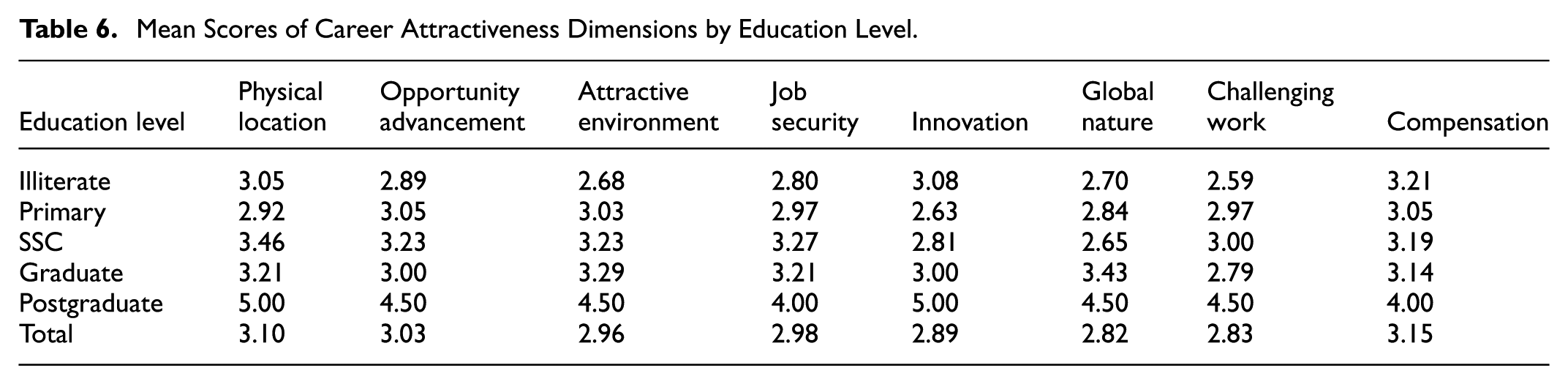
A comparison of career-related items by education level revealed meaningful trends (Table 6). Women with postgraduate education reported the highest satisfaction across all dimensions, especially in career innovation (M = 5.00), global nature (M = 4.50), and attractive environment (M = 4.50). However, their sample size was minimal (n = 2). A summary table for
Mean Scores of Career Attractiveness Dimensions by Education Level.
Observed Trends in Career Attractiveness Across Job Roles
Table 7 presents the mean scores of career attractiveness based on job role. Service and shop/sales employees consistently rated career attractiveness higher across most dimensions than craft and related trades workers. The most prominent differences were observed in perceptions of challenging work (M = 3.09 vs. 2.76), attractive environment (M = 3.17 vs. 2.91), and career opportunity advancement (M = 3.17 vs. 2.99), indicating that those in sales or service positions may perceive greater developmental potential or support. Interestingly, craft workers reported higher scores for career innovation (M = 2.98 vs. 2.54) and global nature (M = 2.88 vs. 2.60), possibly reflecting their more technical exposure or product-focused roles. These role-based differences suggest that job function significantly shapes women’s perceptions of their career trajectories within the manufacturing sector.
Mean Scores of Career Attractiveness Dimensions by Job Role.

Perceived Career Attractiveness by Type of Management Support (H2)
To test
Mean Scores of Career Attractiveness by Type of Management Support.

ANOVA Table.

Note. Analysis of Variance (ANOVA) for perceived career attractiveness based on managerial support category.
Results indicated a statistically significant difference between groups: F (2, 167) = 10.615, p < .001. Participants who reported receiving clear and regular feedback from their managers (M = 3.13) and those who selected “other” support (M = 3.38) rated manufacturing careers as more attractive than those who only expressed general trust in their managers (M = 2.83). These findings support
The data (Refer to Tables 10 and 11) reveals a mixed but generally moderate perception of work aspects among the respondents. The average scores across the reasons are close to neutral, with means ranging from 2.65 to 3.02 on a scale of 1–5. The “Work environment” dimension is predominantly rated around average (48.8% rated it a 3), with a smaller percentage rating it very poorly (15.3%) or very well (4.7%). Management support is seen as satisfactory by half of the respondents (50% rated it a 3), though a significant portion still view it poorly (21.7% rated it 1 or 2). The “Relevant skills” variable shows a similar trend, with 39.4% rating it as average and a smaller percentage viewing it as very positive. Negative perceptions and lack of opportunity are the most concerning factors, with high percentages rating them negatively (57.1% for negative perception and 55.3% for lack of opportunity). Overall, while the average perceptions are neutral to slightly positive, there are notable concerns about management support, relevant skills, and opportunities for advancement.
Factors for low participation of women.

Mean Scores of Perceived Workplace Barriers by Education Level.

Perceived Barriers to Participation by Education Level
Differences in mean scores were observed across education groups. Analysis of underrepresentation by education level shows that perceptions vary with educational attainment (Table 9). While illiterate women rated work environment and opportunity lower (M = 2.76 and 2.71, respectively), their perceptions of management support were also relatively low (M = 2.80). Interestingly, women with primary education rated management support and lack of opportunity higher (M = 3.10 and 3.11, respectively), suggesting rising expectations or more exposure to organizational limitations (Table 12).
Mean Scores of Perceived Workplace Barriers by Job Role.

SSC and graduate-educated women perceived higher levels of negative perceptions and opportunity barriers, indicating growing criticality with education. Graduates rated negative perceptions highest (M = 3.36), perhaps reflecting greater awareness of systemic issues. Postgraduates rated all variables very high (M = 5.00), though their small sample (n = 2) limits generalizability.
Overall, the results suggest that women become more critical and perceptive of structural and cultural barriers within manufacturing environments as education level increases.
Perceived Barriers to Participation by Job Role
Table 12 presents how perceptions of barriers to participation differ by job role. Service workers and shop/sales employees rated the work environment lower (M = 2.17) than craft workers (M = 2.78), suggesting greater dissatisfaction or possibly less control over physical or organizational conditions. Service/sales workers also reported slightly lower perceptions of management support and relevant skills, though the difference was modest. Interestingly, perceptions of negative gender-related stereotypes and lack of opportunity were nearly identical across both roles, indicating that some systemic issues are consistently experienced across the workforce. These findings highlight that job roles can influence how workplace challenges are perceived, particularly regarding the environment and support structures.
We performed the formal statistical tests (e.g., ANOVA) and found that the relationship was statistically significant. All other findings are based on descriptive data and presented as observed trends or differences in mean scores, without implying inferential significance.
Discussion
This study distinguishes between directly measured variables (e.g., age, education, job role) and broader theoretical concepts (e.g., societal gender norms and reciprocity in organizational relationships). Although gender norms were not quantitatively measured, the interpretation of results draws on Social Role Theory to explain how women navigate male-dominated settings. Additionally, Social Exchange Theory explains how perceptions of organizational support and reciprocity influence women’s workplace experiences.
The results reveal that structural constraints in the Indian manufacturing sector limit women’s employment. Despite higher education levels, women remain concentrated in lower-tier roles, reflecting systemic barriers beyond individual capabilities. This pattern underscores the continued influence of socially constructed gender opportunities—consistent with Social Role Theory—which portray women as less suited for technical or leadership positions. Such mismatches between qualifications and job roles indicate underutilization of women’s skills and the inability of organizational systems to reward their potential.
Another significant finding is the positive link between structured managerial feedback and perceived career attractiveness. Women who received consistent and transparent feedback were significantly more likely to perceive manufacturing as a path, emphasizing the role of managerial recognition in countering gender-based barriers. Theoretically, this supports both Social Role Theory—where inclusive managerial practices challenge restrictive role expectations—and Social Exchange Theory, as supportive exchanges enhance employee commitment and satisfaction.
Education emerged as an essential differentiator. For example, women with higher qualifications were more critical of cultural and structural barriers. Further, education not only enhances skill development but also heightens awareness of inequalities. In line with both theoretical perspectives, higher education empowers women to challenge traditional role boundaries and recognize inequitable organizational exchanges.
The findings highlight that merely increasing women’s representation is insufficient. Systemic reforms are essential, including structured feedback mechanisms, transparent career advancement pathways, inclusive leadership representation, and supportive work-life balance policies. Interviews highlighted the importance of mentorship, childcare facilities, and family-friendly arrangements, revealing that women’s career progression depends on both individual merit and organizational responsiveness to social contexts.
The mixed-methods approach offered a comprehensive understanding of these dynamics. Triangulating survey results with interview insights enhanced reliability and demonstrated that gender, education, and managerial practices intersect to shape women’s career paths. This integration extends Social Role Theory by showing how organizational practices can reinforce or challenge societal norms, and broadens Social Exchange Theory by illustrating how reciprocal managerial support shapes career perceptions.
Theoretical Implications
This study extends Social Role Theory by proving how gender roles and organizational practices shape women’s career experiences in the male-dominated manufacturing sector. It confirms that traditional gender roles and societal expectations significantly impact women’s job satisfaction and progression. However, the findings contest the supposition that higher educational qualifications directly lead to career advancement. Instead, the research highlights that organizational culture and gender biases also play crucial roles in shaping career paths. By demonstrating that educational qualifications do not always correlate with higher roles, the study emphasizes the need for gender-inclusive policies that address the unique challenges faced by women in manufacturing.
This research also enriches social role theory by contributing a more nuanced understanding of how workplace dynamics influence women’s outcomes, encouraging a broader perspective incorporating organizational support and cultural context (Eagly & Wood, 2012). In addition to career-related outcomes, Social Role Theory provides a valuable lens for interpreting women’s experiences of work–life conflict. The study theorizes that women are traditionally expected to prioritize caregiving and domestic responsibilities, which creates strain when organizational structures are inflexible or unaccommodating. Several participants expressed frustration with inflexible working hours, limited childcare support, and a lack of managerial understanding of family obligations. These findings reinforce the theory’s premise that societal expectations shape women’s roles at home and their treatment at work. Integrating Social Role Theory with insights from Social Exchange Theory underscores the need for gender-sensitive workplace policies that recognize women’s dual roles and promote flexibility, organizational support, and inclusive management practices.
Practical/Managerial Implications
For companies operating in the Indian manufacturing sector, this study provides several valuable insights. First, this study emphasized personalized management support for the educational backgrounds of staff members. While more educated women await organized feedback and prospects for career advancement, less educated women might gain more from relationship-based trust-building.
Second, organizations should create clear promotion pathways, skill-upgradation programs, and gender-sensitive mentorship systems to prepare women for technical and leadership roles, as many participants held craft and trade jobs with little opportunity for career progression.
Third, to address persistent work–life balance anxieties, firms should match flexible hours with workplace childcare, safe transport services, and family-supportive policies, particularly in units outside urban centers.
Finally, training managers in inclusive leadership—emphasizing empathy, communication, and active listening—can help build reciprocal trust (as per Social Exchange Theory) and challenge restrictive gender norms (as per Social Role Theory). By adopting these targeted strategies, organizations can attract, retain, and empower women in manufacturing, thereby enhancing both equity and productivity. Understanding the opportunities and difficulties women encounter in this field would be further enhanced by extending research across various organizations and contexts.
Limitations and Future Research Direction
While the current study offers several theoretical and practical contributions, it suffers from several limitations that provide guidelines for future studies has certain limitations that open avenues for future inquiry. For instance, the pilot testing was conducted with non-target participants, which improved clarity and flow helped refine wording and survey structure but may not have fully captured female manufacturing workers’ dialectical and contextual nuances. Future research should conduct pilot testing directly with the target population to improve contextual validity and ensure linguistic and experiential alignment.
The study is also limited by its cross-sectional design, reliance on self-reported data, and modest sample size, which constraining constrain generalizability. In addition, redundancy was observed among some highly correlated measurement items some overlap was observed among correlated items. Although this overlap was acceptable in an exploratory design and contributed to reliability, future studies should apply psychometric refinement techniques (e.g., exploratory or confirmatory factor analysis) to streamline and validate measurement items.
Furthermore, while triangulation and reliability testing offered theoretical justification strengthened internal consistency, the absence of formal model fit diagnostics (e.g., Confirmatory Factor Analysis [CFA], Structural Equation Modeling [SEM]) remains a limitation. Future research should test the proposed framework empirically using these methods across larger and more diverse samples to enhance external validity. Additionally, incorporating at least one statistical robustness test—such as a split-sample validation, bootstrapping, or resampling—would improve empirical defense and confirm the model’s stability across subgroups.
Finally, some theoretical propositions were supported primarily by descriptive trends rather than inferential modeling, and hence should be interpreted with caution. Future research should aim to use predictive and causal modeling techniques to substantiate these theoretical linkages more rigorously.
In sum, this study contributes by integrating Social Role Theory and Social Exchange Theory to explain women’s workplace experiences in manufacturing. It demonstrates how societal gender norms and organizational reciprocity jointly shape career perceptions and satisfaction. By situating these insights within the Indian manufacturing context, the study provides both theoretical enrichment and practical pathways for organizations to advance gender equity and inclusive workplace design.
Conclusion
This study studied the career experiences of women in India’s manufacturing sector, highlighting how gender, education, and organizational practices shape workplace perceptions and opportunities. By integrating Social Role Theory with Social Exchange Theory, the research demonstrates that societal expectations and the quality of shared exchanges with organizations and managers influence women’s career outcomes.
The findings indicate persistent barriers: women remain concentrated in lower-tier roles despite higher qualifications, career advancement is often constrained by cultural bias, and work–life balance pressures remain inadequately addressed. At the same time, structured managerial feedback, transparent advancement pathways, and inclusive leadership practices have significantly augmented women’s perceptions of career appeal. Education emerged as a critical factor, equipping women to recognize and challenge unfair structures.
The study offers context-specific insights for Indian manufacturing organizations. Practical measures such as skill-upgradation for craft and trade workers, apparent promotion criteria, childcare and transport support, and differentiated managerial support based on education levels can improve equity and productivity. These recommendations directly address the systemic and cultural barriers highlighted in the findings.
In conclusion, this study contributes to theory by extending Social Role Theory through its integration with Social Exchange Theory, offering a richer description of how societal and organizational dynamics intersect to shape women’s workplace experiences. Practically, it identifies actionable strategies for creating more gender-equitable workplaces in the Indian manufacturing sector. By addressing structural barriers and reinforcing supportive exchanges, organizations can foster inclusivity and unlock women’s full potential in this critical industry.
Footnotes

Funding
The authors received no financial support for the research, authorship, and/or publication of this article.
Declaration of Conflicting Interests
The authors declared no potential conflicts of interest with respect to the research, authorship, and/or publication of this article.
Data Availability Statement
Data will be available on request.