



Abstract
This study examines the predictive roles of organizational support, leadership support, and colleague support in shaping teaching efficacy among lecturers at private universities in Qingdao, China. The research adopts a quantitative, cross-sectional design and utilizes a structured questionnaire to gather data from 334 full-time faculty members across five private universities. Descriptive analysis indicated that lecturers reported high levels of teaching efficacy (M = 3.75) and institutional support, with colleague support receiving the highest mean score (M = 4.04), followed by leadership (M = 3.87) and organizational support (M = 3.86). Pearson correlation, ANOVA, and multiple regression were employed to assess the relationships among the variables. The results indicate that all three forms of institutional support are significantly and positively associated with teaching efficacy, with organizational support showing the strongest correlation (r = .482, p < .01). Differences in perceived support and efficacy were observed across age and professional title, particularly in leadership and colleague support. Regression analysis revealed that organizational, leadership, and colleague support collectively explained 25.8% of the variance in teaching efficacy (R2 = .258), with organizational support emerging as the most influential predictor (β = .395, p < .001). These findings contribute to the growing literature on academic development in non-public higher education contexts and underscore the importance of supportive institutional environments. The study provides evidence-based recommendations for educational leaders and policymakers seeking to strengthen faculty performance through strategic investments in organizational culture, leadership practices, and peer collaboration.
Plain Language Summary
This study looks at how different types of support help university teachers feel more confident in their teaching abilities. We focused on teachers working in private universities in Qingdao, China. The support came from three main sources: the university as an organization, the leaders or managers at the university, and the teachers’ colleagues. We found that when teachers feel supported by their university—such as through clear policies, fair evaluations, and resources—they are more likely to feel effective in their teaching. Support from leaders, like encouragement or guidance, also helps, as does support from co-workers, like sharing teaching experiences or offering help. Among the three types, support from the university itself had the strongest impact. We also noticed that younger teachers and those with lower academic ranks felt differently about the support they received compared to older or higher-ranked staff. This suggests that support programs should be designed with teachers’ backgrounds in mind. Our results show that creating a supportive environment is key to helping teachers grow and do well. This is especially important in private universities, which may not have as many resources as public ones. The findings can help university leaders and policymakers improve teacher development by offering the right kind of support at the right time.
Keywords
Introduction
Teaching efficacy, rooted in Bandura’s (1997) self-efficacy theory, is a foundational concept for understanding teachers’ motivation, instructional quality, and professional resilience. Defined as a teacher’s belief in their ability to organize and execute effective teaching strategies, teaching efficacy has been shown to influence classroom behavior, student engagement, and instructional persistence (Tschannen-Moran & Hoy, 2001). In recent years, teaching efficacy has gained prominence as a key indicator of institutional effectiveness and faculty development across global higher education (Ilie et al., 2020).
In the context of China’s evolving education system, private universities have expanded rapidly to meet rising demands for diversified learning opportunities. According to the Ministry of Education of the People's Republic of China (2024), private institutions now account for over 25% of higher education enrollments in China. However, these universities often face structural limitations—including constrained funding, high teaching loads, and restricted access to research resources—which can impair faculty well-being and teaching quality (Qi, 2022). Notably, private university lecturers often experience lower teaching efficacy, due to limited institutional resources and professional development opportunities. M. Zhang et al. (2021) found that faculty in Chinese private universities are disadvantaged in academic research and teaching competency compared to public-sector counterparts, suggesting constraints on self-efficacy. Similarly, Scott et al. (2023) reported that while institutional support significantly enhances professional development, instructor self-efficacy remains weakly influenced in Chinese higher education contexts. Under such conditions, fostering strong teaching efficacy among faculty becomes both a practical necessity and a strategic priority.
Despite its growing significance, empirical research on teaching efficacy has largely focused on K–12 educators or public universities, with relatively little attention paid to faculty in private institutions (Xiong, 2023). Moreover, few studies have examined the combined influence of institutional support factors—such as organizational, leadership, and colleague support—on teaching efficacy in resource-constrained environments. This multidimensional support system is particularly relevant in private universities, where formal structures are often less robust, and faculty may rely more heavily on relational or informal support mechanisms (Y. Zhang, 2022).
To address this research gap, the present study investigates the predictive roles of organizational support, leadership support, and colleague support in shaping teaching efficacy among lecturers at private universities in Qingdao, a coastal city with a concentration of newly developed private institutions. Anchored in Bandura’s (1997) self-efficacy theory and enriched by the theoretical frameworks of Eisenberger et al. (1986) and House (1981), this study contributes to understanding how academic environments shape instructional confidence.
This research aims to provide both theoretical insights and practical strategies by answering the following questions:
Literature Review
Teaching Efficacy
Recent international scholarship continues to emphasize the pivotal role of teaching efficacy in shaping educational outcomes across diverse contexts. For instance, Ilie et al. (2020) conducted a meta-analysis of instructional development programs and found that faculty efficacy significantly mediates the success of pedagogical interventions in higher education. Similarly, Bikar et al. (2022) demonstrated that integrating geographic information systems into teaching strategies enhanced underperforming students’ intrinsic motivation, reinforcing the link between teachers’ self-efficacy and innovative instructional methods. In a structural equation modeling study, Wang (2024) confirmed that organizational support and work engagement significantly predict psychological well-being and teaching efficacy among faculty in East Asian institutions. These recent studies underscore that teaching efficacy remains a dynamic construct influenced by institutional environments, professional development, and technological integration.
Teaching efficacy is widely regarded as a crucial psychological construct influencing teacher behavior, persistence, classroom management, and student achievement (Tschannen-Moran & Hoy, 2001). It has been frequently categorized into two subdimensions: general teaching efficacy (GTE), which reflects beliefs about the power of education and instructional practices at large, and personal teaching efficacy (PTE), which relates to one’s self-assessed ability to teach effectively under specific conditions (Webb & Ashton, 1986). A large body of empirical research supports the positive relationship between teaching efficacy and student outcomes, instructional innovation, and teacher well-being (Klassen & Tze, 2014). Teachers with high efficacy are more likely to adopt adaptive teaching behaviors, persist in the face of difficulties, and create supportive learning environments (Milner & Hoy, 2003). Teaching efficacy also influences teachers’ resilience and long-term professional engagement, particularly in high-pressure contexts such as performance-driven education systems (Hoy et al., 2006).
Although teacher experience, academic background, and institutional environment all affect efficacy beliefs, findings have been mixed. For instance, Yu and Luo (2000) found that teaching efficacy tends to increase with experience, but may plateau or decline at later stages. Similarly, higher qualifications sometimes correlate with greater efficacy, although this is not always consistent (Judge et al., 2007). Importantly, school-level environmental factors such as leadership, organizational support, and peer collaboration have been shown to significantly shape teachers’ efficacy beliefs (Goddard et al., 2000). These institutional variables not only provide resources and reinforcement but also influence emotional and motivational dimensions of teaching. In particular, supportive professional cultures and consistent institutional feedback are critical for nurturing both novice and experienced educators’ self-beliefs (Guo et al., 2022).
Organizational Support
Recent international research highlights the increasingly central role of organizational support in influencing faculty performance and well-being. For example, Wang (2024) employed a structural equation modeling approach to show that perceived organizational support significantly enhances teachers’ psychological well-being and instructional confidence across East Asian institutions. Similarly, Ilie et al. (2020) found that faculty engagement with institutional support structures mediates the success of instructional development programs, reinforcing the long-term benefits of organizational investment. These findings align with the broader consensus that emotional recognition and resource provision are foundational to professional satisfaction and teaching efficacy.
Organizational support refers to the extent to which faculty perceive their institution values their contributions and cares about their well-being (Eisenberger et al., 1986). In the context of higher education, perceived organizational support encompasses both emotional affirmation and material resources provided to academic staff. Emotional support typically includes institutional recognition, respect, and inclusion in decision-making, while material support refers to resources such as professional development opportunities, fair workload policies, and access to instructional tools (Rhoades & Eisenberger, 2002).
Research has consistently shown that organizational support positively influences work commitment, job satisfaction, and teaching motivation (Y. Zhang, 2022). In academic settings, institutions that provide clear guidance, adequate infrastructure, and responsive administrative systems enable teachers to feel empowered in their professional roles. Guo et al. (2022) found that organizational support significantly predicted faculty engagement and indirectly improved student learning outcomes through increased teacher efficacy.
Furthermore, organizational support has been identified as a contextual factor that strengthens teachers’ self-beliefs. According to Xiong (2023), organizational backing serves as a buffer against occupational stress and enhances faculty members’ willingness to innovate in teaching. In resource-constrained environments like private universities, where structural support may be uneven, perceived organizational support can become a decisive factor in determining whether teachers maintain high teaching efficacy and remain committed to their academic duties.
In addition to tangible resources and psychological reassurance, organizational support also plays a pivotal role in cultivating long-term institutional trust and professional identification. This broader effect can be understood through the lens of social exchange theory, which posits that when individuals perceive consistent support and recognition from their institutions, they develop stronger reciprocal commitments and engagement behaviors. Emotional validation from administrators and colleagues fosters intrinsic motivation, reduces emotional exhaustion, and strengthens professional identity (Eisenberger et al., 2001).
In light of recent contextual challenges, the COVID-19 pandemic and the rapid shift to hybrid teaching environments have further underscored the critical role of organizational support. Faculty members were confronted with abrupt changes in workload, technology adaptation, and student engagement strategies, often without sufficient institutional preparedness. As highlighted by Trinidad (2021), organizational support—including clear communication, access to training resources, and emotional well-being initiatives—plays a pivotal role in mitigating stress and enhancing teacher satisfaction during such crises. This is especially relevant in the context of private universities, where resource constraints often heighten the importance of perceived organizational responsiveness in sustaining faculty morale, retention, and instructional quality.
Leadership Support
Globally, leadership support is increasingly recognized as a key component of institutional effectiveness. A review by Groenewald et al. (2024) emphasized that participatory and transformational leadership styles are more likely to foster teacher motivation and trust, especially in private and resource-limited settings. Morales (2022) further demonstrated that relational leadership, including mentoring and emotional validation, directly contributes to higher levels of organizational commitment and teaching engagement. These insights underscore that leadership support, when authentic and pedagogically oriented, serves as a critical mechanism for nurturing faculty efficacy.
Leadership support refers to the emotional, instructional, and administrative assistance provided by academic leaders such as department heads, deans, or senior faculty. According to House’s (1981) path-goal theory, effective leadership facilitates goal attainment by clarifying expectations, reducing barriers, and increasing motivational resources. In university settings, transformational leadership has been shown to be particularly effective in enhancing faculty morale and instructional confidence (Liu & Kong, 2020).
Supportive leaders not only provide direction but also serve as role models who validate teaching efforts, mentor junior faculty, and advocate for fair institutional practices. Empirical studies indicate that leadership support plays a key role in fostering trust, collaboration, and a shared sense of academic purpose among teaching staff (Goddard & Goddard, 2001). Transformational leaders who emphasize individualized consideration and intellectual stimulation are more likely to build teaching efficacy across diverse faculty groups (Zhou, 2018).
However, the impact of leadership support may vary depending on organizational culture and institutional constraints. In private universities, where administrative structures may emphasize performance metrics over pedagogy, leadership support risks becoming symbolic rather than functional (L. Zhang & Fang, 2025). This highlights the importance of fostering leadership practices that align with faculty needs—especially those that prioritize mentorship, autonomy, and teaching quality (Morales, 2022).
Colleague Support
Contemporary studies continue to affirm the value of colleague support in academic settings. Ismayilova and Klassen (2019) identified a strong association between peer support and job satisfaction among university faculty in cross-national contexts. Zheng (2022) explored emotional labor among Chinese university teachers, highlighting how informal peer interactions significantly alleviate teaching-related anxiety. Such findings suggest that colleague support functions not only as a buffer against occupational stress but also as a catalyst for professional resilience and teaching innovation. In environments with limited formal infrastructure—such as many private universities—peer collaboration becomes an indispensable pillar of support.
Colleague support involves the emotional encouragement, informational exchange, and practical assistance shared among peers within an academic unit. LaRocco and Jones (1978) describe colleague support as a key buffer against occupational stress, particularly in high-demand professional environments. In universities, such support manifests through peer mentoring, co-teaching, shared lesson planning, and informal networks of emotional encouragement.
Research shows that collegiality significantly enhances job satisfaction, reduces burnout, and promotes professional growth (Ismayilova & Klassen, 2019). Teachers who receive support from peers tend to be more engaged, confident, and willing to experiment with instructional methods (Fang, 2011). According to Wang and Jia (2012), emotional support from colleagues contributes not only to psychological well-being but also to a stronger professional identity.
Zheng (2022) found that informal peer interactions can regulate emotional labor, reduce teaching-related anxiety, and reinforce positive perceptions of teaching ability. In institutions where formal support structures are weak—such as many private universities—colleague support often becomes the most immediate and accessible source of affirmation. Therefore, fostering a culture of collaboration and mutual respect is essential for sustaining teaching efficacy in these contexts.
Notably, the importance of peer and institutional support extends beyond faculty to students as well. Although this study centers on teaching staff, insights from student-focused research offer additional perspective on the systemic role of supportive environments in higher education. For instance, Zhu et al. (2024) found that student self-efficacy and psychological well-being significantly contribute to academic engagement, while anxiety has the opposite effect. Similarly, Pan et al. (2023) highlighted how affective scaffolding from language teachers enhances students’ emotional balance and academic involvement. These parallels suggest that emotional and collaborative support mechanisms are vital at all levels of the academic ecosystem, reinforcing the broader relevance of faculty support systems examined in this study.
Conceptual Framework
Based on the literature, this study proposes a conceptual model integrating three dimensions of institutional support—organizational, leadership, and colleague support—to examine their collective and individual influence on teaching efficacy. The framework draws from Bandura’s (1997) self-efficacy theory and is supplemented by support theories from Eisenberger et al. (1986), House (1981), and LaRocco and Jones (1978).
This model posits that perceived institutional support directly influences lecturers’ teaching efficacy by shaping professional confidence and motivation. Demographic factors such as professional title and age are also included to account for variance in support perceptions. These relationships are visually summarized in Figure 1.

Conceptual framework.
Based on this framework, the study proposes the following null hypotheses:
These hypotheses guide the subsequent statistical analyses using correlation, ANOVA, and multiple regression methods.
Research Methods and Procedures
Research Design
This study adopted a quantitative, cross-sectional survey design to examine how institutional support predicts teaching efficacy among lecturers in private universities in Qingdao. Data were collected using a structured, self-administered questionnaire. This design enabled the collection of standardized data from a diverse faculty sample, facilitating generalizable findings. Quantitative methods were chosen for their suitability in hypothesis testing and their established reliability and analytical rigor in educational research (Kinash et al., 2014).
Sample
A stratified random sampling strategy was employed to enhance the representativeness of the data. The sample consisted of 334 full-time faculty members drawn from five private undergraduate universities located in urban Qingdao. Stratification was based on two key demographic factors: academic discipline and professional title. This approach ensured adequate coverage of diverse subject areas and academic ranks.
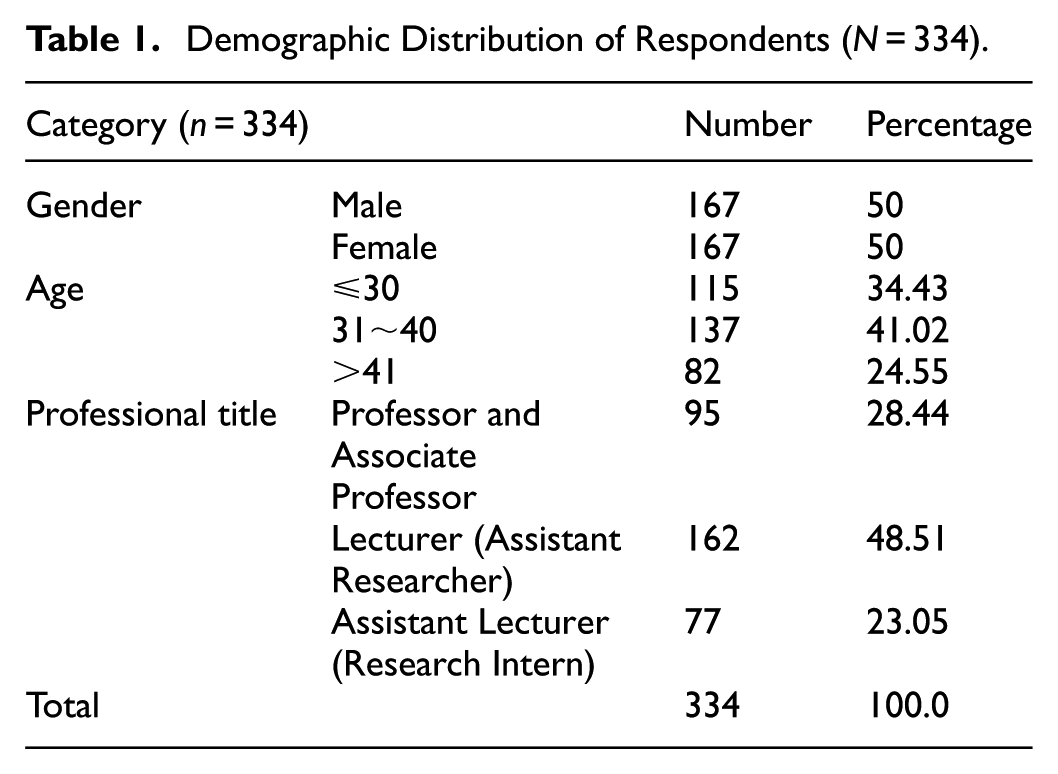
The final sample comprised a balanced distribution of participants across gender (50% male and 50% female), and covered a wide range of age groups and professional titles. Table 1 presents a summary of the demographic profile of the respondents.
Demographic Distribution of Respondents (N = 334).
Instrument
Data were collected using a structured questionnaire comprising five sections: demographic information and four main constructs—teaching efficacy, organizational support, leadership support, and colleague support (Table 2). All items were rated on a 5-point Likert scale ranging from 1 (Strongly Disagree) to 5 (Strongly Agree).
Questionnaire Structure and Sources.

Teaching Efficacy: Adapted from Gibson and Dembo (1984), Adapted from Gibson and Dembo (1984), this section included 14 items assessing instructional planning, classroom management, and student engagement.
Organizational Support: Derived from Eisenberger et al.’s (1986) Survey of Perceived Organizational Support (SPOS), modified by Chen and Liao (2006), this 12-item scale measured institutional recognition, development support, and policy fairness.
Leadership Support: Based on the framework by Kottke and Sharafinski (1988), this 10-item scale assessed emotional, instructional, and administrative support from academic leaders.
Colleague Support: Adapted from Ladd and Henry (2000), with modifications by Shao and Fan (2013), this 10-item scale captured emotional encouragement, informational exchange, and peer assistance.
The questionnaire was reviewed by three academic experts for content validity and was pilot-tested with 54 faculty members for clarity and cultural relevance. Minor linguistic adjustments were made based on feedback (Bikar et al., 2021). Final reliability and validity statistics are reported in the following section.
Data Analysis
Preliminary analyses were conducted to test reliability and validity. Construct validity was assessed using the Kaiser-Meyer-Olkin (KMO) measure and Bartlett’s Test of Sphericity (Bikar et al., 2023). Internal consistency was verified using Cronbach’s alpha, with all constructs exceeding the .70 threshold. Table 3 summarizes the reliability and validity statistics. All analyses were conducted using IBM SPSS Statistics version 26.0.
Reliability and Validity Statistics.

Normality was assessed using skewness and kurtosis values, all of which fell within the acceptable range of ±2, indicating approximate normal distributions. Multicollinearity was assessed using variance inflation factor (VIF) values, all below 2.0, suggesting no multicollinearity issues. Detailed results are presented in Table 4.
Skewness, Kurtosis, and VIF Values of Key Variables (N = 334).

Ethical Considerations
Ethical approval for this study was obtained from the Ethics Committee of the author’s affiliated university and the respective administrative offices of five private universities in eastern China. All participants were informed of the study’s purpose, procedures, and their rights, and provided written informed consent prior to participation. Participation was entirely voluntary, and respondents could withdraw at any time without penalty. No personally identifiable information was collected, and all responses were anonymized and stored securely. The study adhered to institutional research ethics guidelines and ensured the protection of participants’ rights and welfare throughout the research process.
Results
Descriptive Statistics
To address the first research question concerning the overall levels of teaching efficacy and perceived institutional support, descriptive statistics were calculated for the four principal variables: Teaching Efficacy (TE), Organizational Support (OS), Leadership Support (LS), and Colleague Support (CS). As summarized in Table 5, the mean scores for all four variables fall within the “high” category (M > 3.67), based on the 5-point Likert scale classification established by Cohen (2013).
Descriptive Statistics for Main Variables (N = 334).

Overall, respondents reported consistently high perceptions across all measured domains. Among the three institutional support dimensions, colleague support received the highest mean score (M = 4.04), indicating that faculty members experienced strong emotional and collaborative interactions with their peers. Leadership support (M = 3.87) and organizational support (M = 3.86) followed closely, suggesting a generally favorable perception of managerial and structural backing within the sampled institutions.
Teaching efficacy also achieved a high average (M = 3.75), reflecting a solid level of self-reported confidence among lecturers in their instructional capabilities. The relatively low standard deviation for CS (SD = 0.46) suggests a more uniform perception among faculty in this dimension, whereas greater variability was observed in perceptions of teaching efficacy and institutional structures. These findings provide a preliminary indication that faculty in private universities perceive their teaching competence and institutional environment positively, thereby laying the groundwork for further inferential analysis in the following sections.
Correlation Analysis
To examine the second research question regarding the relationships between institutional support and teaching efficacy, Pearson correlation analysis was conducted among the four main study variables. Table 6 presents the bivariate correlation coefficients for teaching efficacy (TE), organizational support (OS), leadership support (LS), and colleague support (CS).
Pearson Correlation Matrix for Teaching Efficacy and Support Variables (N = 334).

Correlation is significant at the 0.01 level (2-tailed). Significance at level p < .05.
The results indicate that teaching efficacy is significantly and positively associated with all three forms of institutional support. Among them, organizational support (r = .482, p < .01) shows the strongest correlation with teaching efficacy, followed by leadership support (r = .375, p < .01) and colleague support (r = .259, p < .01). These coefficients suggest that lecturers who perceive greater levels of institutional recognition, managerial encouragement, and collegial interaction tend to report higher teaching confidence.
In addition to these primary relationships, the inter-correlations among the three types of support reveal a moderately cohesive support structure. The most substantial association was found between organizational and leadership support (r = .516, p < .01), indicating that institutional structures and administrative leadership often co-exist as interconnected influences in shaping faculty perceptions. A similarly strong link emerged between leadership and colleague support (r = .453, p < .01), suggesting that formal and informal support systems may align within departmental or team contexts. Meanwhile, the weaker but still significant correlation between organizational and colleague support (r = .223, p < .01) may reflect the comparatively distinct roles these support sources play in daily academic life.
Taken together, these findings highlight two critical implications: first, that all three support types are positively related to teaching efficacy, with organizational backing showing the strongest effect; second, that the institutional support system is structurally integrated, with interrelated forms of support reinforcing one another. These correlational insights lay a foundational basis for the regression analyses that follow.
Differences by Professional Title
To investigate whether perceptions of teaching efficacy and institutional support differ by professional title, a series of one-way ANOVA tests were conducted. The results are displayed in Table 7.
ANOVA Results of Teaching Efficacy and Institutional Support by Professional Title.

As shown in Table 7, significant differences across professional were found in teaching efficacy and leadership support. Teaching efficacy varied notably by professional title, F(2, 331) = 28.542, p < .001, suggesting that faculty members’ self-evaluations of their instructional competence are influenced by their professional stage. Likewise, significant differences were found for leadership support (F = 7.853, p < .001), indicating that faculty members at different professional levels experience varying degrees of managerial guidance.
In contrast, no significant differences were found for organizational support (F = 0.102, p = .903) or colleague support (F = 0.489, p = .613), implying that institutional frameworks and collegial relationships are perceived more uniformly across academic ranks after merging the top two titles..
These findings suggest that while faculty members’ efficacy beliefs and leadership interactions remain sensitive to their professional status, perceptions of institutional structures and peer support appear more consistent when broader academic groupings are considered. These findings highlight the importance of tailoring leadership engagement strategies by rank, while also reinforcing the value of equitable support practices across faculty tiers.
Differences by Age Group
In addition to professional title, age-related differences were examined to explore generational variations in perceptions of teaching efficacy and institutional support. ANOVA results for age groups are summarized in Table 8.
ANOVA Results of Teaching Efficacy and Institutional Support by Age Group.

The results indicate that significant age-related differences were observed in three of the four variables. Teaching efficacy showed a strong variation between the two age groups, F(2, 331) = 23.685, p < .001, suggesting that older faculty members (>40 years) tend to report higher instructional confidence than their younger counterparts. Statistically significant differences were also found in perceptions of leadership support (F = 3.397, p = .035) and colleague support (F = 3.805, p = .023), indicating that age may influence how faculty members engage with managerial leadership and peer collaboration.
In contrast, organizational support did not differ significantly by age group (F = 0.942, p = .391), implying a stable institutional support structure that is perceived consistently regardless of age. These results reinforce the notion that while structural support systems are broadly uniform, relational and experiential elements of support are shaped by age-related professional development and institutional tenure.
Multiple Regression Analysis
To identify the final research question, a multiple linear regression analysis was conducted with organizational support (OS), leadership support (LS), and colleague support (CS) as independent variables, and teaching efficacy (TE) as the dependent variable.
As presented in Table 9, the overall regression model was statistically significant, F(3, 330) = 39.662, p < .001, with an adjusted R2 of .258. This indicates that approximately 25.8% of the variance in teaching efficacy can be explained by the combined effects of organizational, leadership, and colleague support. The Durbin-Watson statistic of 1.879 suggests no significant autocorrelation among residuals, meeting the assumption of independence.
Model Summary for Predicting Teaching Efficacy a .

Dependent Variable: Teaching Efficacy.
Predictors: (Constant), Colleague Support, Organization Support, Leadership Support.
The results of the ANOVA in Table 10 further confirm the model’s robustness, with a highly significant F-value (p < .001), thereby validating the inclusion of the three predictors in accounting for variability in teaching efficacy.
ANOVA for the Regression Model a .

Dependent Variable: Teaching Efficacy.
Predictors: (Constant), Colleague Support, Organization Support, Leadership Support.
Table 11 presents the regression coefficients for the model. Among the three predictors, organizational support (OS) showed the strongest and most statistically significant association with teaching efficacy (β = .395, p < .001). This suggests that higher levels of perceived organizational support tend to correspond with higher levels of teaching efficacy, underscoring the strategic importance of institutional structures and policies.
Regression Coefficients Predicting Teaching Efficacy a .

Dependent Variable: Teaching Efficacy.
Colleague support (CS) also showed a significant positive relationship with teaching efficacy (β = .118, p = .027), highlighting the relevance of peer collaboration and informal professional exchange in relation to instructional confidence. Leadership support (LS), while approaching significance (β = .118, p = .051), did not meet the conventional threshold (p < .05), indicating a comparatively weaker statistical linkage with teaching efficacy within the current model.
The standardized beta values indicate a descending order of association—organizational support being most strongly related to teaching efficacy, followed by colleague support and leadership support. These patterns reflect differentiated pathways through which institutional support structures correspond to faculty perceptions of their teaching capabilities.
Importantly, collinearity statistics (Tolerance > 0.3; VIF < 2.0 for all predictors) confirm that multicollinearity is not a concern, lending credibility to the stability and interpretability of the regression results.
In summary, the regression analysis revealed that teaching efficacy was significantly related to institutional support factors, underscoring the close linkage between administrative infrastructure, resource provision and effective teaching in private university contexts.
Discussion
This study offers both empirical evidence and theoretical insight into how institutional support systems are associated with teaching efficacy among faculty in private universities in China. Grounded in Bandura’s (1997) self-efficacy theory and extended by institutional support models (Eisenberger et al., 1986), the findings suggest that teaching efficacy is not formed in isolation but is closely associated with the multifaceted roles of organizational, leadership, and colleague support—especially within environments constrained by limited resources.
Lecturers in this study reported moderately high levels of teaching efficacy, and all three support dimensions exhibited significant positive associations with efficacy beliefs. Organizational support emerged as the most influential correlate, reinforcing the critical role of institutional structures in relation to educators’ professional confidence. This aligns with Eisenberger et al. (1986), who assert that perceived institutional commitment fosters a psychological contract that enhances motivation and engagement. Our findings resonate with Liu and Xu (2023), who emphasized that recognition, resource availability, and professional development opportunities build faculty confidence and instructional commitment.
Leadership support, though positively correlated with teaching efficacy, demonstrated a weaker associational effect. This marginal influence may reflect both institutional constraints and deeper cultural dynamics in Chinese private universities. On the institutional side, Groenewald et al. (2024) observed that academic leadership in private institutions often emphasizes compliance and accountability over pedagogical development, leading to predominantly transactional rather than inspirational relationships. As Liu and Kong (2020) critique, managerialist leadership styles prevalent in Asian higher education may hinder the development of trust-based faculty–leader relationships. From a cultural perspective, Confucian hierarchical norms, which emphasize obedience, deference to authority, and respect for seniority, may further inhibit faculty from seeking leadership support or perceiving it as personally meaningful (Yang, 2007). These values, coupled with what Hofstede (2011) terms a high power distance orientation, create a leadership environment where top-down communication is the norm and participatory practices are limited. This dual influence—administrative formalism and cultural hierarchy—may jointly account for the limited predictive power of leadership support in this study.
Colleague support, while showing the smallest effect size, still maintained a significant positive relationship with teaching efficacy. It serves as an informal safety net fostering professional solidarity and emotional resilience—particularly in under-resourced environments. Drawing on LaRocco and Jones’ (1978) stress-buffering model, peer networks provide psychological and pedagogical relief from workload-related pressures. In line with this, Fang (2011) and Xiong (2023) emphasized that collegiality plays a foundational role in fostering collaborative academic environments, which in turn nurture teaching innovation and professional engagement. In the context of private universities where formal support may be limited, peer relationships often serve as the most immediate and accessible source of affirmation and guidance, thereby reinforcing faculty members’ confidence in their instructional roles.
Notable demographic differences were observed in the perceived levels of teaching efficacy and institutional support. Senior faculty members and older lecturers consistently reported higher teaching efficacy, a trend likely attributable to their accumulated professional experience and deeper familiarity with institutional routines. These findings are consistent with the results of Zhou (2018) and Xiong (2023), who emphasized the role of experiential learning in shaping faculty confidence.
Furthermore, variations in perceptions of leadership and colleague support across professional titles highlight structural asymmetries in access to support mechanisms. As noted by Gerhardt and Karsan (2022), senior faculty in private universities often occupy administrative positions, granting them greater access to institutional resources and decision-making channels. In contrast, junior academics may face limited visibility and support, contributing to disparities in professional development opportunities. Ross-Hellauer et al. (2022) similarly reported that resource distribution systems in higher education frequently favor seniority, reinforcing a stratified ecosystem that disproportionately benefits more established faculty.
Moreover, while each form of support demonstrates distinct associational patterns, it is plausible that these mechanisms interact in reinforcing ways. For instance, organizational support may indirectly enhance teaching efficacy by strengthening lecturers’ perceptions of leadership support or facilitating more collaborative peer environments. Future studies could examine such mediating or moderating pathways to better understand the dynamic interplay among institutional support dimensions.
While organizational support was perceived consistently across demographic groups, the divergence in leadership and colleague support perceptions reveals deeper institutional asymmetries. This stratification, though subtle, may contribute to early-career faculty burnout and stagnation in teaching innovation.
Taken together, these results call for reimagining institutional support not as a monolithic system but as a differentiated ecosystem. Organizational scaffolding—such as resource decentralization and performance-linked development programs—should be prioritized. Leadership recalibration is also needed, emphasizing mentorship and pedagogical stewardship. Finally, collegial support can be engineered through formalized mentorship structures and teaching circles to promote equitable access to tacit knowledge and emotional resilience.
Conclusion
This study suggests that teaching efficacy among lecturers in China’s private universities is not merely an individual attribute but a systemic construct shaped by institutional conditions. Through empirical analysis of 334 faculty responses, it shows that organizational, leadership, and colleague support are jointly related to instructional confidence, albeit with varied intensities and implications.
Three core conclusions emerge:
Organizational support appears foundational. It forms the material and symbolic infrastructure that sustains faculty efficacy, particularly in resource-constrained environments. Institutions that offer professional development resources, transparent evaluation systems, and consistent recognition tend to foster more confident and motivated educators.
Leadership support remains under-leveraged. While positively correlated with teaching efficacy, its associational strength was relatively weak. This may reflect hierarchical and compliance-based leadership models that limit trust-building and pedagogical mentorship. Unlocking its potential may require a shift toward developmental leadership focused on faculty empowerment and shared decision-making.
Support equity is a hidden concern. Variations in support perceptions across academic ranks suggest the existence of stratified ecosystems within institutions. Junior faculty—often lacking access to resources, guidance, or visibility—face a higher risk of burnout and disengagement. Ensuring equitable access to support is essential for sustainable faculty development.
Strategic Imperatives for Universities
To translate these insights into actionable strategies, institutional leaders should consider the following directions:
From Uniformity to Differentiation: Develop tiered support frameworks aligned with faculty career stages: For early-career faculty: Offer structured mentoring programs, seed grants for teaching innovation, reduced teaching loads in the first 2 years, and onboarding workshops on curriculum design and assessment; For mid-career faculty: Provide funding for pedagogical research, peer-led teaching circles, and access to national or international fellowships; For senior faculty: Enable sabbaticals focused on curricular renewal, inter-university teaching collaborations, or academic leadership training.
From Compliance to Co-Creation: Foster participatory support systems by institutionalizing inclusive governance: Universities should engage faculty in participatory governance to co-design institutional support systems. For instance, establish faculty advisory committees to co-design support policies; set up teaching efficacy task forces that collect feedback, pilot interventions, and track faculty development outcomes; implement annual instructional climate surveys to inform targeted support improvements.
From Silos to Synergies: Integrate support responsibilities across administrative, academic, and student affairs units: consider linking leadership performance reviews to faculty development outcomes (e.g., growth in teaching efficacy, mentoring satisfaction); encourage cross-functional teams that align HR, academic affairs, and faculty development offices to ensure holistic support delivery; create shared digital platforms where faculty can access resources, book consultations, and contribute to support system design.
These strategies not only enhance institutional responsiveness but also cultivate a culture of mutual accountability and pedagogical stewardship.
Limitations and Future Research Directions
This study has several limitations that should be acknowledged. First, data were obtained through self-reported questionnaires, which may introduce personal bias or social desirability effects. Second, as the research employed a cross-sectional design, it can only reveal statistical associations rather than causal relationships. While the regression models indicate significant links between institutional support and teaching efficacy, these results should be interpreted as correlational rather than causal. Third, although stratified sampling was employed, the sample was relatively small and limited in scope.
To address these limitations, future research could adopt mixed methods or incorporate third-party evaluations (e.g., administrative or peer reports) to improve objectivity. In particular, research designs that enable causal inference are strongly recommended. Longitudinal or experimental approaches—such as time-lagged surveys, intervention-based training programs, or multi-wave panel studies—would be more suitable to examine how institutional support mechanisms actually shape changes in teaching efficacy over time. Moreover, expanding the geographic and institutional diversity of the sample will be crucial for enhancing the generalizability and policy relevance of the findings.
In addition, future studies may explore the mediating or moderating mechanisms underlying the relationship between support systems and teaching efficacy. For instance, leadership support may exert an indirect effect through organizational identification, while colleague support may play a stronger role in low-resource environments. Rather than relying solely on broad dimensions such as emotional or material support, future research should examine more specific elements—such as resource accessibility, incentive structures, collaborative teaching practices, and feedback mechanisms—to identify more targeted and effective support strategies.
Footnotes

Funding
The authors received no financial support for the research, authorship, and/or publication of this article.
Declaration of Conflicting Interests
The authors declared no potential conflicts of interest with respect to the research, authorship, and/or publication of this article.
Data Availability Statement
The data that support the findings of this study are available from the corresponding author upon reasonable request.