




Abstract
This study develops an integrated theoretical framework grounded in technology empowerment theory, resource-based view, and industrial convergence theory. It examines the hierarchical structure and development trajectory of the big audiovisual industry, and analyzes how AIGC drives its competitiveness. This paper constructs an evaluation system for assessing the competitiveness of the AIGC-driven big audiovisual industry. This system comprises three distinct layers: technology-driven layer, core industry layer and layer of the extended industry. Using panel data from 29 Chinese provinces during 2019 to 2023, this research applies the entropy-weighted TOPSIS method with robustness tests. The empirical analysis measures competitiveness levels, spatial and temporal evolution, and regional characteristics. Findings reveal that China’s big audiovisual industry competitiveness demonstrates a distinct tiered distribution pattern with prominent spatial heterogeneity and periodic leapfrogging trends. Government, market participants, and enterprises can leverage three pathways to drive comprehensive energy level upgrading of industrial competitiveness: AIGC technology empowerment, core format innovation, and cross-boundary integration. The evaluation system established in this study exhibits both theoretical generality and contextual adaptability. It provides a basis for differentiated strategy formulation across Chinese provinces, while also offering methodological reference for other countries and regions evaluating technology-driven big audiovisual industry competitiveness.
Introduction
With continuous breakthroughs in artificial intelligence technologies, particularly the growing maturity of deep learning and natural language processing, Artificial Intelligence Generated Content (AIGC) has become a key driver for innovation and development in the digital cultural industry (Sedkaoui & Benaichouba, 2024). As an integrated emerging format in this field, the big audiovisual industry demonstrates strong growth potential. It excels not only in traditional areas such as broadcasting programs and media advertising but also shows continuous optimization in integrated innovations with cultural resources, tourism projects, and performance activities. In August 2019, the National Radio and Television Administration issued the “Opinions on Promoting High-Quality Development of the Broadcasting, Television and Online Audiovisual Industries,” proposing to establish a “new-era Big Audiovisual market development pattern characterized by cross-sector linkage and integrated development.” This policy initiative introduced the concept of “Big Audiovisual” to academia. The big audiovisual industry refers to a broad industrial system driven by audiovisual activities. Its core layer focuses on broadcasting, television, and online audiovisual industries, covering content production, media advertising, program copyrights, cable network operations, smart broadcasting, integrated services, and industrial base development. The extension layer comprises derivative sectors enabled by digital and new media technologies, involving integrated development across culture, tourism, performing arts, and wellness (Duan & Chen, 2024). However, as the big audiovisual industry and AIGC move toward deeper integration, current academic discussions on their relationship remain largely qualitative. For instance, conceptual models for big audiovisual industry development under AIGC integration are underexplored (Sengar et al., 2024). Research on the spatial and temporal evolution of big audiovisual industry competitiveness from an AIGC embedding perspective remains limited (Quan et al., 2023). Furthermore, sustainable development strategies based on empirical findings from comprehensive industry evaluations require deeper investigation (Uddin et al., 2024). Therefore, constructing a comprehensive evaluation system for AIGC-driven big audiovisual industry competitiveness and conducting empirical research is necessary, urgent, and practically significant.
This study makes three main contributions. First, it develops an evaluation framework specifically designed to measure the competitiveness of the AIGC-driven big audiovisual industry within China’s artificial intelligence technology and industrial context. Second, it reveals the spatial and temporal evolution patterns of China’s big audiovisual industry competitiveness through cross-regional empirical analysis. Finally, the study provides strategy recommendations for policymakers, corporate decision-makers, and industry stakeholders from both domestic and international perspectives to facilitate energy level upgrading and sustainable development. While the empirical analysis focuses on Chinese regions, the conceptual framework and evaluation methodology offer valuable references for other countries and regions assessing the competitiveness of their audiovisual or cultural industries embedded with emerging technologies. Researchers can adapt this evaluation approach by adjusting specific indicators and weights according to local data availability and industrial characteristics, thus establishing customized models suitable for their respective contexts.
Literature Review
Theoretical Foundation: An Integrated Theoretical Framework
This study employs an integrated theoretical framework to comprehensively understand the multi-level mechanisms through which AIGC drives the competitiveness of the big audiovisual industry. This framework incorporates technology empowerment theory, industrial convergence theory, resource-based view, dynamic capability theory, and regional innovation theory. Together, these theories provide a solid foundation for constructing the evaluation system, selecting indicators, and interpreting the results. The core theoretical foundations of this study are technology empowerment theory and industrial convergence theory. Major technological innovations disrupt existing economic structures and spawn new business formats. As a cutting-edge digital technology, AIGC fundamentally transforms the industrial landscape by empowering the entire chain of traditional audiovisual content production, distribution, and consumption (Foo et al., 2025). Simultaneously, AIGC blurs the boundaries between industries such as broadcasting, streaming media, social short videos, and even cultural tourism and performances, driving the formation of the integrated new format known as the big audiovisual industry (Jin et al., 2025). The evaluation model in this study operationalizes this process of convergence and empowerment. Furthermore, the resource-based view and dynamic capability theory interpret the competitiveness of the big audiovisual industry from static and dynamic capability perspectives. The impact of AIGC leads to significant regional disparities in industrial development performance. The resource-based view posits that a firm’s unique resources and capabilities are the source of competitive advantage (El Nemar et al., 2025). When applied at the industrial level, the competitiveness of a region’s big audiovisual industry depends on the effective allocation of AIGC-related key resources, such as AI talent, patents, computing power, policies, and environment. Beyond static resources, dynamic capability theory emphasizes that clusters or regions capable of sensing AIGC opportunities, seizing them for investment and transformation, and continuously reconfiguring their resources and processes can achieve sustained competitive advantage (L. Li et al., 2025). Consequently, several indicators in the evaluation system also measure the dynamic capabilities of the regional big audiovisual industry, such as revenue and copyright quantity in the core industry layer, and revenue and cultural-tourism vitality in the extension layer. Simultaneously, regional innovation theory offers a perspective for explaining the evolution of the big audiovisual industry’s competitiveness under AIGC and its spatial heterogeneity. This theory suggests that innovation results from interactions among stakeholders within a specific institutional environment (Hu et al., 2024). Regions with strong competitiveness often possess denser networks of innovators, more active knowledge spillovers, better institutional policies, and stronger human capital, enabling them to absorb and develop AIGC technology more rapidly. Conversely, regions with weak innovation systems tend to fall behind in technological revolutions.
Related Concepts, Systems, and Methods for Evaluating the Competitiveness of the Big Audiovisual Industry
The big audiovisual industry encompasses an integrated industrial system focused on the creation, production, distribution, and consumption of audiovisual content. It involves not only cultural creativity and artistic expression but also includes technological development, marketing, and supply chain management (B. Zhang & Xu, 2025). Its core layer centers on broadcasting, television, and online audiovisual industries, covering key areas such as content production, cable television network operations, smart broadcasting, and integrated services. The extension layer comprises derivative industries driven by digital and new media technologies, involving the integrated development of digital audiovisual content with sectors like culture, technology, and tourism (M. S. Kim & Kim, 2024). The industry has undergone two primary developmental stages: traditional and digital. During the digital phase, the emergence of AIGC leads to simultaneous quantitative growth and qualitative improvement in content output, user scale, and application scenarios. Conceptual innovation, technological integration, and support from internet companies create numerous development opportunities for media organizations in the new digital era (Ghobakhloo et al., 2024). Research on evaluating the big audiovisual industry involves dimensions such as technology drive, industrial innovation, and extended integration. Existing studies generally focus on incorporating the impact of technological change into traditional industrial assessment frameworks. With the rapid development of digital technologies like AIGC, the connotation of industrial competitiveness has expanded from purely economic output to multidimensional capabilities including technological innovation, format integration, and sustainable development (X. Chen et al., 2024). This shift requires evaluation systems to not only cover the operational efficiency of traditional audiovisual formats but also reflect new characteristics of industry transformation driven by technology. Regarding the technological dimension, existing literature emphasizes the core role of digital technology infrastructure and innovation capability in industrial upgrading. For example, R&D manpower investment and patent output are key indicators for measuring regional technological competitiveness (Woźnicki & Gawlik, 2024). In the AI era, computing power and data become new factors of production supporting technological application (Gu, 2024). These studies provide a theoretical basis for constructing the technology dimension from both “intellectual drive” and “environmental drive” perspectives. For the core industry layer, scholars continue to focus on market performance and content output but increasingly emphasize reinterpretation based on digital progression. Indicators such as operating revenue and copyright metrics remain widely used (Mehta & Amit-Danhi, 2024). The effectiveness of new media business transformation and the digital development of traditional cultural resources also receive attention (Gioltzidou et al., 2024). These outcomes inform the selection of evaluation indicators for the core industry layer by incorporating a perspective that values both continuity and innovation. Regarding the extended industry layer, industrial convergence and cross-boundary innovation become new focal points for competitiveness research. Studies explore models and pathways for integrating traditional audiovisual industries with sectors like culture, tourism, and wellness from a convergence competitiveness perspective (Jiang et al., 2025).
Evaluating industrial competitiveness is a complex and dynamic process. Scholars have explored various methods and tools for this purpose. Traditional evaluation approaches, such as the porter diamond model (Min, 2025), value chain analysis (Safavi & Ghazinoory, 2024), factor analysis, and cluster analysis (M. Wang & Huang, 2024), are widely used to identify key determinants of competitiveness and to classify and compare industries or regions. Although these methods significantly contribute to revealing the structure and sources of competitiveness, they often struggle to handle the comprehensive integration of multi-dimensional and multi-indicator data simultaneously. Furthermore, they frequently rely on subjective assignments for determining indicator weights. Against this backdrop, the Technique for Order Preference by Similarity to Ideal Solution (TOPSIS) has emerged as a classic method for comprehensive evaluation. As a multi-criteria decision-making technique, TOPSIS is recognized for its clear principles and strong applicability. This method ranks evaluation objects by measuring their relative distance to both the positive and negative ideal solutions. It effectively minimizes subjective interference and provides good comparability across cases (Yang & Zhao, 2024). Additionally, to address the issue of indicator weights in traditional TOPSIS often depending on expert scoring, scholars have introduced the Entropy Weight Method for objective weighting. This enhancement makes the evaluation results more robust and convincing (Tang et al., 2025). The AIGC-driven big audiovisual industry constitutes a complex system. It is technology-intensive, features convergent formats, and exhibits significant regional heterogeneity. Consequently, the integrated entropy-weighted TOPSIS method is particularly suitable for its analysis. This approach systematically integrates multi-dimensional indicators. It also leverages an objective weighting mechanism, which effectively avoids subjective bias. This approach provides solid methodological support for the dynamic evaluation and cross-regional comparison of industrial Competitiveness.
Application, Development, and Impact of AIGC in the Big Audiovisual Industry: International and Domestic Contexts
The interaction between digital technology and the cultural industry presents a dynamically evolving and complex relationship, significantly influencing industrial innovation (Amankwah-Amoah et al., 2024). As a key digital technology, AIGC utilizes big data and algorithmic models to automatically generate audiovisual content that aligns with user needs. This capability provides the big audiovisual industry with novel tools for creation and dissemination (Uddin et al., 2024). AIGC not only restructures content production processes but also demonstrates significant potential in enhancing industrial competitiveness. From an international perspective, the application of AIGC in developed regions such as Europe and America primarily focuses on creativity enhancement and user experience optimization (X. Wang et al., 2025). For instance, companies like Netflix and Disney widely employ AIGC for tasks including script evaluation, character generation, and visual effects production. These applications substantially improve content quality while reducing production costs (F. Li et al., 2024). Furthermore, the use of AIGC in digitalizing cultural heritage and cross-media narrative enhances cultural diversity and the social value of innovative communication (Lian & Xie, 2024). Within the Chinese context, the development of AIGC exhibits distinct characteristics of being both practice-oriented and market-driven. For example, traditional Chinese media outlets utilize AIGC to batch-generate short news videos, significantly increasing the timeliness and diversity of political and current affairs reporting (Liu et al., 2025). Leading platforms, such as Tencent, leverage AIGC algorithms for precise user profiling and personalized recommendations. This strategy effectively strengthens user engagement and commercial monetization capabilities (He et al., 2024). In the realm of cross-boundary integration, combinations like “AIGC + VR” enable high-fidelity restoration and immersive display of cultural artifacts like murals (Lei et al., 2025). Consequently, China’s big audiovisual industry is rapidly transitioning from traditional models toward intelligent and integrated operations, forming a rich and diverse landscape of application practices.
Literature Comprehensive Evaluation
Despite valuable research conducted by scholars globally on AIGC and the audiovisual industry, several limitations persist. First, existing studies often focus on case descriptions of specific technology applications and analyses of localized benefits. There is a lack of exploration into the macro-level performance of AIGC-driven big audiovisual industry competitiveness, and evaluation research remains scarce. This study seeks to integrate AIGC technology application with industrial competitiveness evaluation. Second, there is room for methodological advancement. Most research relies on qualitative analysis and lacks large-sample empirical support covering multiple regions and time periods. Furthermore, comprehensive analytical frameworks capable of simultaneously handling multi-dimensional indicators, objective weighting, and spatiotemporal evolution are rare. This leads to conclusions that often lack generalizability and comparability, making it difficult to reveal the dynamic and heterogeneous nature of AIGC-enabled industrial development. Finally, existing literature does not sufficiently integrate technology empowerment theory, resource-based view, and regional innovation systems theory to construct a cross-level evaluation system. It also lacks dialog between international theoretical frontiers and China’s domestic industrial practices. Consequently, the theoretical contributions and practical guidance rooted in the Chinese industrial context are insufficient. There is also limited provision of referential frameworks from Chinese cases for global industrial competitiveness evaluation. Therefore, this study aims to achieve the following innovations. First, it constructs a multi-dimensional evaluation system integrating the “technology driver layer, industry core layer, and industry extension layer.” This incorporates AIGC as a permeating factor into the industrial competitiveness analysis framework, addressing the shortcomings of traditional research that overemphasizes segments and neglects systemic linkages. Second, it adopts the entropy-weighted TOPSIS method to integrate objective weighting with multi-attribute decision analysis. Utilizing Chinese provincial panel data for dynamic and spatial assessment enhances the study’s rigor and empirical foundation methodologically. Third, it combines international theoretical perspectives with China’s policy context and industrial practice. This expands the regional dimension of AIGC and audiovisual industry research, while also providing new references and insights from the Chinese context for the global digital creative industries.
The Construction Ideas for the Evaluation System of Competitiveness in the Big Audiovisual Industry Driven by AIGC
The development of the big audiovisual industry under AIGC driving is grounded in a multi-dimensional theoretical framework. The conceptual model proposed in this study draws on technology embedding theory, resource-based view, and industrial convergence theory. These theories collectively justify the three core layers as the main structural dimensions of the model. These layers are namely the technology-driven layer, the industry core layer, and the industry extension layer. Simultaneously, dynamic capability theory provides a key perspective for explaining how the industry builds and sustains sustainable competitive advantage under AIGC driving. Regional innovation theory offers important guidance for interpreting the regional imbalances in big audiovisual industry competitiveness and their underlying drivers.
In the technology-driven layer, the evaluation dimension is constructed mainly based on the resource-based view and technology embedding theory. It aims to systematically measure the underlying resource support and enabling conditions that AIGC provides as a general-purpose technology for the competitiveness of the big audiovisual industry. According to the resource-based view, heterogeneous and valuable strategic resources are the fundamental source of competitive advantage. These strategic resources specifically include talent and knowledge reserves centered on AI intelligence driven, as well as infrastructure and institutional support underpinned by AI environment driven (Yu et al., 2024). Among these, indicators such as AI talent driver and AI patent driver emphasize strategic resources and capabilities as the foundation of competitive advantage. Indicators including AI computing power driver, AI policy driver, and AI data driver reflect the enabling conditions emphasized by technology embedding theory. These resources collectively form the empowerment foundation for AIGC’s integration into industrial development, determining the breadth, depth, and sustainability of technological application. The indicator design for the technology-driven layer systematically constructs an evaluation framework from the two dimensions of AI intelligence driven and AI environment driven. This framework accurately addresses the key sub-question of the cornerstones and composition of competitive elements in the technology-driven layer.
In the core industry layer, traditional formats such as broadcasting, television, and online audiovisual content form the main components. The design of its evaluation dimension is based on the resource-based view, emphasizing the identification of the industry’s core competitive elements. First, from the perspective of value creation, this layer aims to capture the most fundamental economic activities and output forms of the big audiovisual industry. This approach not only continues the emphasis on core business segments in traditional audiovisual industry analysis (Baños & Díaz-Cintas, 2024), but also highlights the continuity and evolution of the industry’s value generation mechanism in the context of AIGC technology. Furthermore, indicator construction needs to reflect both the industry’s stable capabilities and its potential for dynamic evolution. Therefore, the broadcasting programs dimension includes metrics that measure the revenue from traditional broadcast television and cable television networks. This reflects the enduring value of established business models (M. S. Kim & Kim, 2024). Simultaneously, it incorporates the emerging variable of new media business revenue. This indicator directly responds to the reality of channel convergence and business model innovation driven by technologies like AIGC. It aims to measure the dynamic capability of the industrial system to embrace change and explore new value sources (De-Lima-Santos et al., 2024). Additionally, the media advertising dimension maintains its status as a key commercialization path for the audiovisual industry. These indicators not only measure the scale of traditional traffic monetization but also, against the backdrop of AIGC-enabled precision marketing, serve as a critical window for observing how technology enhances the efficiency of resource allocation within the industry (T. Chen et al., 2024). Finally, the introduction of the number of audiovisual copyright dimension is a forward-looking consideration based on the resource-based view. Copyright can be regarded as a strategic resource for building long-term competitive advantage in the AIGC-driven big audiovisual industry. In the AIGC era, the realization of content asset value increasingly depends on the clarity of ownership and tradability. Using the number of audiovisual copyrights as a core indicator aims to assess the industry’s ability to transform creative output into sustainable intellectual property assets (Ghiurău & Popescu, 2024). Therefore, the various dimensions and indicators within the core industry layer form a system with rigorous internal logic. This system systematically addresses the key sub-question regarding the composition and evolution of competitiveness in the core industry layer.
The design of the layer of the extended industry is based on industrial convergence theory. This layer aims to evaluate how AIGC enables the big audiovisual industry to transcend traditional boundaries. It focuses on the industry’s deep integration capabilities with sectors such as culture, tourism, education, and health. It also measures the value creation level of the new formats emerging from these integrations. The indicators in this layer concentrate on observing the industry’s competitiveness in achieving value spillover and model innovation through cross-boundary convergence.
According to industrial convergence theory, the generality and permeability of digital technologies blur industrial boundaries and catalyze convergent growth points. Consequently, this layer moves beyond measuring the value of audiovisual content itself. Instead, it focuses on the derivative value activated by audiovisual content as a key enabling element within broader socio-economic domains. For example, the indicator local cultural tourism vitality measures the actual effect of audiovisual technologies on enhancing tourism experiences and stimulating consumption (J. J. Zhang et al., 2024). The indicator performing arts revenue level monitors the incremental market generated by integrating offline performances with new forms like online livestreaming and virtual concerts (Khan et al., 2025). These indicators collectively reflect the “breadth” of market expansion achieved through convergence. With AIGC empowerment, value is no longer created by firms alone. It is generated through interactions among platforms, users, technology, and other actors. Therefore, indicators such as health care basic market aim to assess the service domains into which audiovisual content and intelligent technology can integrate, along with the associated social and economic value (Shi et al., 2025). This measures the depth of new value creation through deep integration. Furthermore, the introduction of the traditional cultural resources indicator is based on the resource-based view. It considers unique cultural resources as sources of differentiated competitive advantage (Siliutina et al., 2024). Empowered by AIGC, traditional cultural resources can be activated as innovation factors through digitalization, visualization, and IP development. This indicator assesses the industry’s ability to explore and transform extended cultural value. Thus, the indicator design for the layer of the extended industry follows a coherent logic. It systematically observes the value spillover level generated by the convergence of the Big Audiovisual Industry with other sectors via AIGC.
In summary, the mechanism through which AIGC fosters the high-quality development of the audio-visual industry can be articulated as follows. With the help of AI intelligence-driven and AI environment-driven, AIGC continuously releases the enabling role of AI talents, patents, knowledge, policies, and environment, systematically transforms and infiltrates the core and epitaxial layers of the big audiovisual industry, continuously improves the overall competitiveness of the big audiovisual industry, optimizes the development paradigm, and improves the development efficiency. In this mechanism of action and driving model, the scope and depth of AIGC embedded within the big audiovisual industry continue to expand, significantly enhancing the industry’s competitiveness. Further strengthening the driving role of AIGC will offer new methods and opportunities for advancing the capability level and intelligent development of the big audiovisual industry, as well as providing new momentum for the green development of the regional economy and society. Considering the various driving forces of AIGC and the hierarchical structure of the big audiovisual industry, we establish a competitiveness evaluation system for this industry, driven by AIGC, based on three primary dimensions: the technology-driven layer, the industrial core layer, and the industrial epitaxial layer, as illustrated in Figure 1.

Conceptual model of AIGC embedded in the development of the audio-visual industry.
Methodology
The Technique for Order Preference by Similarity to Ideal Solution (TOPSIS) method is a ranking approach predicated on the proximity of evaluation entities to both the optimal and worst solutions. This method efficiently utilizes raw data to conduct multi-objective comprehensive evaluations, deriving positive and negative ideal solutions through cosine similarity calculations. Consequently, it accurately gages the relative disparities between entities based on their proximity to the positive ideal solution (Kaya & Kahraman, 2011). The fundamental principle underlying the TOPSIS method is that an evaluation object is considered optimal if it is closest to the optimal solution and farthest from the worst solution; otherwise, it is not optimal. Here, the indicators of the optimal solution attain their respective optimal values, whereas those of the worst solution reach their nadir across all evaluation indices. However, in the context of multi-objective evaluation using TOPSIS, the determination of evaluation indicator weights significantly impacts the final evaluation outcomes. Hence, to minimize subjective bias in the confirmation process, this study employs entropy weight TOPSIS to gage the competitiveness of the AIGC-driven big audiovisual industry.
(1) To determine the weights of the indicators, the entropy weighting method is employed, with the following steps:
① Let
② Normalize the data, “intervalizing” the data if negative numbers or zeros are present.

③ Calculate the percentage of characteristics of the i province under the j indicator, denoted as

④ Compute the information entropy

⑤ Determine the weight of the evaluation index

(2) Multi-criteria evaluation using the TOPSIS method. The steps are as follows:
① Let
② The reverse indicators are transformed into positive indicators, and for the sake of simplicity,

③ Construct the vector normalization matrix

The resulting normalization matrix

④ Determine the positive and negative ideal solutions corresponding to each evaluation index.
The positive ideal solution is:

The negative ideal solution is:

⑤ Calculate the Euclidean distance from each province to the positive and negative ideal solutions:


where
⑥ Calculate the closeness of the combined results of each province to the positive ideal solution:

where
Data
As the world’s second-largest economy, China’s commitment to sustainable and high-quality development in the big audiovisual industry significantly influences the global digital economy landscape. Its regional characteristics also make it a representative case for study. A quantitative evaluation of the Competitiveness of China’s big audiovisual industry is crucial for systematically understanding the growth opportunities within this emerging format and for identifying the unique industrial characteristics and growth potential of different provinces. This study selects the period from 2019 to 2023 as the research timeframe based on three primary considerations. First, 2019 marks the inaugural year of China’s “Big Audiovisual” industrial policy. Using this as a starting point allows for effective observation of the industry’s evolution path following policy implementation. Second, this period covers a significant portion of the “14th Five-Year Plan” implementation phase. It can reflect the strategic adjustments and capability accumulation of the Big Audiovisual Industry under the new development paradigm. Due to severe data gaps for some core indicators in Tibet and Qinghai, this study ultimately uses panel data from 29 Chinese provinces (autonomous regions, and municipalities directly under the central government) from 2019 to 2023. This ensures the rigor of the empirical analysis and the validity of the model. The data selection process adheres to the principles of scientific rigor, systematicity, and availability, guaranteeing credibility, rigor, and representativeness. All data are sourced from authoritative national statistical publications such as the China Statistical Yearbook and the Statistical Yearbook of Chinese Culture and Related Industries, ensuring high public trust. Based on the layered structure of the big audiovisual industry, the indicator system for the core industry layer includes traditional metrics like broadcast television program sales revenue and cable TV network revenue. It specially incorporates the key indicator new media business revenue to measure the development of emerging formats like online audiovisual content, short videos, and live streaming. This ensures comprehensive coverage of both traditional and emerging sectors. In the layer of the extended industry, indicators such as traditional cultural resources, local cultural tourism vitality, performing arts revenue level, and health care basic market effectively measure the integrated development between the audiovisual industry and sectors including cultural heritage, culture and tourism, performing arts, and wellness. These indicators fully reflect the cross-boundary integration characteristic of “big audiovisual+.” This design maintains continuity with traditional statistical systems while extensively expanding coverage to include emerging formats and integrated development. It ensures the representativeness of the research data. The final evaluation system encompasses 3 first-level indicators, 9 second-level indicators, and 14 third-level indicators. All indicators and their data sources are detailed in Table 1 to ensure transparency, replicability, and scientific rigor in the data collection process.
Evaluation System and Data Sources for Assessing the Competitiveness of the Audio-Visual Industry.
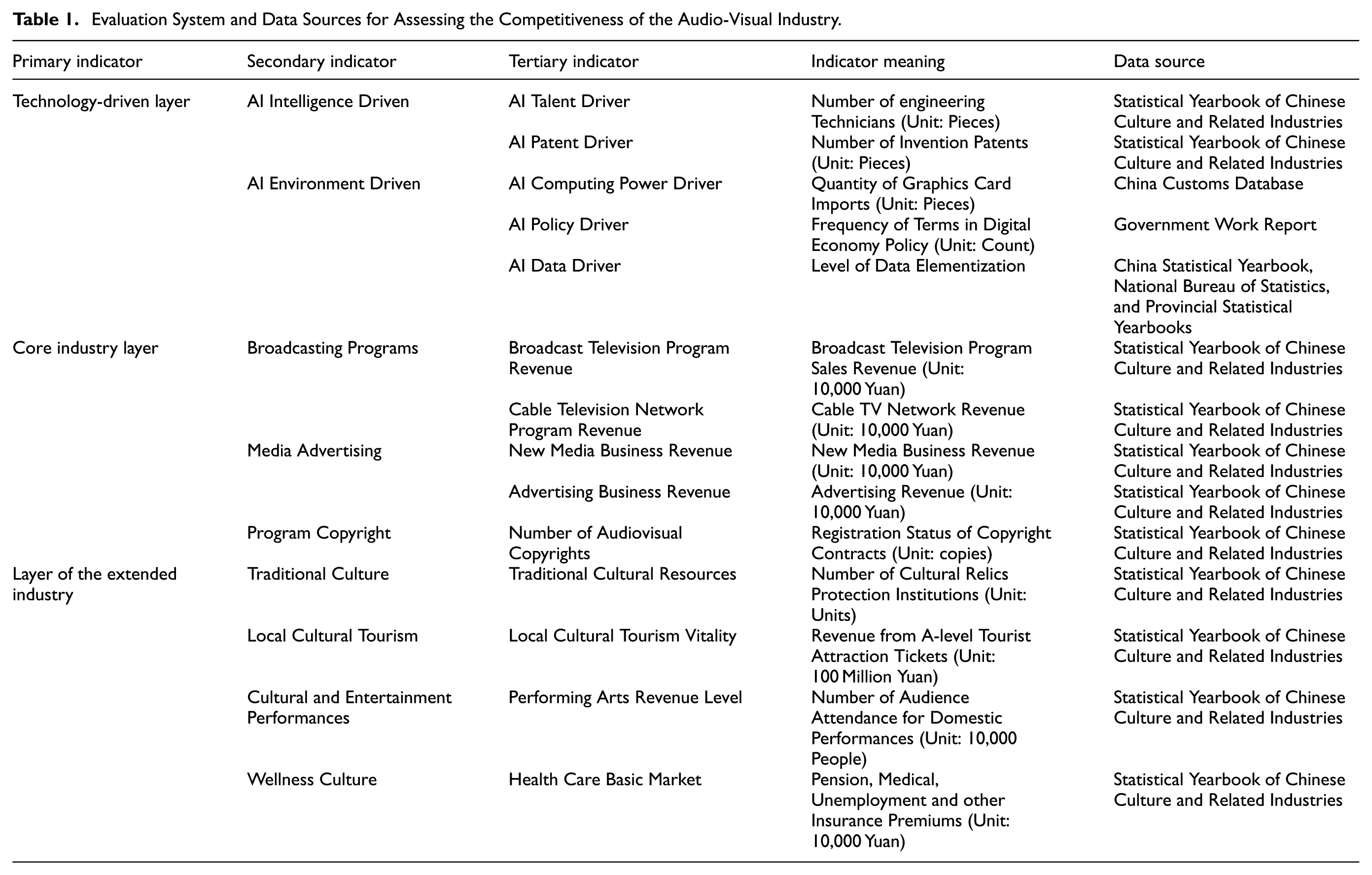
The technology-driven layer includes two secondary indicators: AI intelligence-driven and AI environment-driven. The AI intelligence-driven approach is employed to assess the integrated performance of AI talent, knowledge, technology, and other related factors. The three selected indicators for this assessment are AI talent driver, AI patent driver, and AI computing power driver. The driving force of AI talent is interpreted by the number of engineering technicians (Jelenćić et al., 2024). The driving force of AI patents is reflected in the number of invention patents (Son et al., 2022). The driving force of AI computing power is interpreted by the quantity of graphics card imports (Handelman et al., 2019). The AI environment drive is the foundational policy framework and data resources necessary for industrial digitalization or the digital economy. The selected tertiary indicators include the AI policy driver and the AI data driver. The driving force of AI policy is reflected in the frequency of terms used in digital economy policy (Erkkilä, 2023). The relevant data is obtained from the work reports of various provincial governments. The data-driven power of AI is interpreted by the level of data elementalization (Zha et al., 2025).
The core industry layer includes three secondary indicators: broadcasting programs, media advertising, and program copyrights. The term “broadcasting and television programs” refers to the basic units and content organization forms broadcasted by radio and television, with the selected tertiary indicators being the revenue from broadcasting and television programs and the revenue from cable television network programs. The revenue of radio and television programs is interpreted by broadcast television program revenue (Mellado et al., 2024). The revenue from cable television programs is interpreted by the cable television network program revenue (Souyris et al., 2023). Media advertising refers to commercial promotional information disseminated through various media platforms, including television, radio, and online channels. Its primary purpose is to promote products or services and capture consumer attention. The chosen tertiary indicators for analysis are new media business revenue and advertising business revenue. The revenue from new media business is interpreted by the revenue from new media business (Marchand et al., 2021). The revenue from the advertising business is explained by advertising income (Rakshit et al., 2022). The copyright of a program provides legal protection for audiovisual works and their creation processes. This protection is manifested through the prohibition of unauthorized reproduction, distribution, and broadcasting, ensuring that the rights of creators are upheld. The chosen tertiary indicator is the quantity of audiovisual copyrights, which is determined by the registration status of copyright contracts (Hou et al., 2024). The relevant data is obtained from the Statistical Yearbook of Chinese Culture and Related Industries.
The layer of the extended industry comprises four secondary indicators: traditional culture, local cultural tourism, cultural entertainment performances, and health and wellness culture. Traditional culture represents a cultural heritage that has been accumulated over generations, created and transmitted by specific groups. It is manifested in rich customs, folk arts, historical narratives, religious beliefs, and festival activities. The chosen tertiary indicator is traditional cultural resources, which is measured by the number of institutions dedicated to the protection of cultural relics (Grover et al., 2022). Local cultural tourism is a tourism industry based on local cultural resources, manifested in cultural tourism projects, with the selected tertiary indicator being the vitality of local cultural tourism, which is interpreted by the ticket revenue of A-level tourist attractions (Cerisola & Panzera, 2021). The entertainment and performance mainly refer to performance activities such as concerts, dances, and dramas, with the selected tertiary indicator being the level of performance revenue, which is interpreted by the number of domestic performance audiences (Lu, 2022). The culture of health and wellness primarily refers to the cultural resources derived from the medical industry, which aim to enhance quality of life and promote physical and mental well-being. The selected tertiary indicator is the basic market for health and wellness, which is interpreted by insurance premiums for elderly care, medical care, unemployment, and other aspects (Saraswat et al., 2022). The relevant data is obtained from the Statistical Yearbook of Chinese Culture and Related Industries.
Analysis
Analysis of Empirical Results
Considering that there are a small number of missing values in the indicator data, this study first employs linear interpolation to fill in the data, ensuring the completeness of the panel data. Considering that all data has no zero values and is all in a positive trend, the entropy weight method is directly used to calculate the weights, and the data is weighted to obtain new data, which is then analyzed using the TOPSIS method. Among them, the relative proximity indicates the degree to which the evaluation object approaches the optimal state; the larger this value, the closer it is to the optimal state. The annual calculation results are sorted according to this value, as detailed in Table 2 and Figure 2.
Calculation Results of the Entropy Weight-TOPSIS for the Competitiveness of the Audio-Visual Industry.


Distribution of the ranking changes in the entropy weight evaluation results of the audiovisual industry in various provinces from 2019 to 2023.
Robustness Analysis
To verify the stability of the entropy-weighted TOPSIS method, this study employs the equally weighted TOPSIS method to reanalyze the dataset using an alternative model and compares the differences in results. Policy-driven indicators often exhibit strong exogeneity and annual volatility. Their effects may be indirectly reflected in other technical indicators, such as patents and computing power. Removing this indicator tests the model’s stability under a “weak policy signal” scenario. Furthermore, the “audiovisual + wellness” integration remains in its early development stage. The maturity of its business models may be relatively weak. Removing this indicator tests the consistency of the model’s results under a “conservative format scope.” Consequently, these two indicators are removed from the original indicator system, retaining 12 indicators for the robustness check. The detailed calculation results are presented in Table 3 and Figure 3.
Calculation Results of the Alternative Model for Big Audiovisual Industry Competitiveness.


Ranking change distribution of the comprehensive index in the alternative model for the big audiovisual industry.
From the above, it can be concluded that the ranking basis of the empirical results of the entropy weight TOPSIS method and the equal weight TOPSIS method is the relative proximity. The entropy weight TOPSIS method focuses on the realistic characteristics of the competitiveness of the big audiovisual industry and the impact of information entropy. The equal-weight TOPSIS method is characterized by its balanced approach, assigning identical weights to all indicators when analyzing comparative datasets. A comparison reveals that although the empirical results of the two evaluation methods differ, there are slight adjustments in the rankings of a few provinces, but the overall layout is converging. This indicates that the evaluation results of the entropy weight TOPSIS method possess relative stability and have passed robustness testing.
Result Description
This study conducts a comprehensive evaluation of the big audiovisual industry competitiveness across 29 Chinese provinces using the entropy-weighted TOPSIS model. To deeply analyze regional disparities and distribution patterns, the provinces are categorized into tiers based on the mean of their relative closeness scores. During the classification process, the quantile classification method is initially applied for a preliminary grouping. This reveals that the threshold values between the high, medium, and low competitiveness groups are approximately near 0.20 and 0.01. To ensure simplicity of the threshold values and facilitate cross-period comparison, rounded values close to these approximations are ultimately adopted as the grading standard (see Table 4). The setting of these thresholds follows the natural breaks principle, aiming to minimize within-group variance and maximize between-group variance based on the data’s inherent distribution. This approach objectively reveals the essential hierarchical differentiation in regional competitiveness. Specifically, high-competitiveness provinces ([0.2, 1)) demonstrate systematic advantages in technology drive, format innovation, and cross-boundary integration. Medium-competitiveness provinces ([0.01, 0.2)) show potential for improvement in one or multiple dimensions. Low-competitiveness provinces ([0, 0.01)) generally face multiple developmental constraints. This classification outcome not only reveals the spatial imbalance in industrial development, providing an empirical basis for subsequent differentiated policy recommendations, but also serves as a practical validation of the three-dimensional evaluation model constructed in this study. It particularly highlights the disparities in resource allocation and integration capabilities within the regional big audiovisual industry competitiveness under AIGC driving.
Distribution of Competitiveness Hierarchy in the Big Audiovisual Industry.

The provinces with high competitiveness in the first echelon include Guangdong, Shanghai, Jiangsu, Beijing, and Yunnan. In recent years, Beijing has vigorously promoted the sustainable development of the cultural industry, strengthening support for the audiovisual industries such as film, animation, and gaming. Beijing has accelerated the integration and development of cultural and creative industries with new technologies such as big data and artificial intelligence, and created a series of cultural brands with international influence. Shanghai has provided strong support for the innovative development of the audiovisual industry by creating distinctive cultural and creative industry parks. As a frontier of reform and opening up, Guangdong has continuously optimized the business environment in recent years, actively transformed government functions, fully stimulated market vitality, accelerated digital technology innovation, and upgraded digital infrastructure. The above provinces have solidified their endowments of artificial intelligence resources, injecting strong momentum into the integration of the “audio-visual industry+” and AIGC.
The competitive provinces in the second echelon include Chongqing, Fujian, Sichuan, Jiangxi, Anhui, Zhejiang, Hunan, Shandong, Hubei, Guangxi, and Tianjin. Among them, provinces such as Tianjin, Zhejiang, and Anhui have a relatively high competitiveness in the audio-visual industry. As an important northern port city and manufacturing base, Tianjin has nurtured core industries of the digital economy, establishing new competitive advantages for the orderly development of the big audiovisual industry and steadily achieving deep integration of the digital economy and the big audiovisual economy. Although Zhejiang is weaker than Beijing and Shanghai in terms of cutting-edge technology, patents, and knowledge, it holds a leading position domestically in areas such as digital governance and e-commerce economy. Zhejiang promotes the integration of culture and technology, encouraging audiovisual enterprises to utilize new technologies such as artificial intelligence and big data for content innovation, model innovation, and product innovation, thereby stimulating the innovative vitality of corporate groups. The competitiveness of the audiovisual industry in Anhui has increased from 2019 to 2022, which is closely related to its efforts in strengthening the development of the cultural industry and promoting the inheritance and innovation of national culture.
The third tier is at a low level of competitiveness. Provinces in the central and western regions such as Xinjiang and Shanxi, as well as northeastern provinces like Liaoning, Jilin, and Heilongjiang, are underdeveloped due to multiple factors including economic foundation, industrial structure, and policy support. With the vigorous development of the tourism industry in the western region, Xinjiang is leveraging its advantages in cultural tourism and the display of ethnic customs to embrace vast market opportunities in the audio-visual industry. Shanxi has initiated the “14th Five-Year” cultural and tourism exhibition plan, injecting new vitality into the big audiovisual industry by utilizing the digitization of intangible cultural heritage and traditional cultural resources. This tier of provinces demonstrates a potential “catching-up effect,” leveraging their distinctive cultural resource endowment.
The tiered classification not only reveals significant spatial heterogeneity in the development of China’s big audiovisual industry but also validates the effectiveness of our evaluation model in identifying regional development shortcomings and dynamic mechanisms. Although constructed based on China’s specific policy context and developmental realities, the model’s three-dimensional framework offers a transferable analytical paradigm. This framework comprises the technology-driven layer, core industry layer, and layer of the extended industry. Its indicator design methodology can also be adapted by other countries and regions. Researchers can adapt specific indicators and weights according to local data conditions and industrial development stages to meet competitiveness evaluation needs in different contexts. Therefore, it is necessary to clarify the tasks for enhancing the competitiveness of each tier in the big audiovisual industry, effectively integrate the digital technology chain and the big audiovisual industry chain, promote the flow of high-quality resources from high-competitiveness tiers to low-competitiveness tiers, and fully address the issues of imbalanced and insufficient material and cultural development.
Conclusion and Discussion
Conclusion
This study develops an evaluation model for the competitiveness of the AIGC-driven big audiovisual industry based on technology embedding theory, the resource-based view, and industrial convergence theory. It employs the entropy-weighted TOPSIS method and robustness checks to conduct an empirical analysis of data from 29 Chinese provinces from 2019 to 2023. The main conclusions are as follows.
First, the competitiveness of China’s big audiovisual industry exhibits a clear tiered distribution pattern, indicating significant regional disparity. High-competitiveness provinces are concentrated in the Yangtze River Delta, the Guangdong-Hong Kong-Macao Greater Bay Area, the Bohai Rim region, and Yunnan. Their advantages are manifested not only in traditional audiovisual revenue indicators but also in systemic strengths in AIGC technology adoption and cross-boundary integration. In contrast, provinces in central, western, and northeastern China generally demonstrate lower competitiveness, constrained by limitations in digital infrastructure, technological accumulation, and format innovation.
Second, government bodies, market participants, and corporate stakeholders can foster an overall energy level upgrading of the industry’s competitiveness through three pathways: technological empowerment, format innovation, and value chain expansion. The evaluation model proposed in this study effectively identifies provincial variations in the depth of technology embedding, the speed of format adaptation, and the breadth of industrial integration. It not only reveals the current state of competitiveness but also provides a mechanistic explanation for the observed regional gaps.
Third, the model is grounded in China’s specific policy context and statistical system. Nonetheless, its three-dimensional framework demonstrates theoretical transferability and contextual adaptability. This framework comprises the technology-driven layer, the core industry layer, and the layer of the extended industry. Its methodological design also possesses these strengths. Other countries and regions can adapt the overall approach of this study by modifying specific indicators and weights according to their local industrial characteristics and data availability. This provides a viable method for assessing the competitiveness of cultural industries empowered by emerging technologies globally.
Discussion and Implications
This study pursues two main objectives. First, it aims to construct a theoretically grounded and operable evaluation system to systematically assess the Competitiveness of the Big Audiovisual Industry under AIGC driving. Second, it applies this system to conduct empirical measurement and problem diagnosis at China’s provincial level, providing a basis for differentiated regional development strategies.
Based on the findings and successful domestic and international cases, we propose the following strategic directions for Chinese provinces across different competitiveness tiers. Government, market participants, and enterprises can drive an overall energy level upgrading of the Big Audiovisual Industry’s Competitiveness through pathways such as AIGC technology empowerment, core format innovation, and cross-boundary integration.
High-competitiveness provinces should focus on technological leadership and ecosystem building. They need to strengthen core AIGC technology research, attract global innovation resources, and promote deep integration applications and international development. A relevant example is the collaboration between “Yun Shan Hui,” LokaLocal, and the UK Tourism Authority on a digital AI restoration project. This approach can accelerate the digital scanning and AI restoration of cultural resources and establish intelligent data platforms for cultural tourism operations. It enhances tourist behavior analysis and personalized recommendations, using audiovisual technologies and products to seamlessly connect local cultural resources with the international market. Consequently, these provinces should strive to attract high-quality global innovation resources, including technology, talent, and patents. They need to facilitate the high-standard transformation and international export of technological achievements. The ultimate goal is to build a globally influential innovation ecosystem for the Big Audiovisual Industry.
Medium-competitiveness provinces need to emphasize technology introduction and distinctive innovation. They should accelerate efforts to bridge gaps in technology application and integration, drive the digital transformation of traditional formats, and develop regionally characteristic clusters. For instance, South Korea’s CJ ENM Group invested in virtual production studios, while India’s film industry utilizes motion capture technology to create epic war scenes, effectively addressing their own shortcomings in technology application and integration. In China, the Hunan Broadcasting Group built the “Mango TV” integrated media platform and uses AIGC technology to adapt traditional TV programs into short videos for personalized distribution. This has effectively promoted the digital transformation of distinctive branded programing. Provinces in this tier should leverage technological innovation and the advantages of streaming platforms to further enhance the local characteristics of traditional formats and narrow production gaps. They can develop regional characteristic industrial clusters based on local cultural features. For example, Anhui Province could utilize resources like Huangshan Mountain and Huizhou culture to create a demonstration zone for “audiovisual + culture and tourism” integration.
Low-competitiveness provinces should prioritize consolidating digital infrastructure. They need to explore differentiated development paths leveraging local cultural resources and actively introduce external technology and creative resources through collaboration platforms. Firstly, deploying 5G and gigabit optical networks provides the foundational support for AIGC technology application. Secondly, efforts should focus on intensive development in areas of local advantage to avoid homogenization. For example, Gansu Province collaborates with technology companies to conduct high-precision digital collection of cultural relics and immersive VR display projects based on the cultural heritage resources of the Dunhuang Grottoes. It uses AIGC to restore Dunhuang patterns and apply them in digital cultural tourism. Furthermore, building AIGC-enhanced smart scenic spots that integrate virtual-real guided tours and consumption scenarios is recommended. Simultaneously, promoting AIGC remote collaboration platforms can connect creators in remote areas with professional teams to jointly develop high-quality audiovisual products, achieving technology empowerment and resource complementarity. These provinces should actively utilize mechanisms like the “East-West Collaboration Digital Platform” to introduce technology and creative resources from eastern provinces, realizing asymmetric development.
This study also offers general implications for the high-quality development of the global Big Audiovisual Industry. The results indicate that in the context of disruptive technologies like AIGC reshaping industrial structures, constructing a multidimensional evaluation system that balances technological foundation, format vitality, and integration potential is crucial for accurately assessing regional industrial Competitiveness and identifying development gaps. Technologically less-advanced regions need not completely replicate the paths of leading areas. Instead, they can leverage local cultural resource endowments and adopt a strategy of embedding in distinctive fields with gradual integration to achieve heterogeneous innovation development. Furthermore, governments should establish institutional environments conducive to technology diffusion, creative transformation, and resource mobility, fostering synergistic industry ecosystems where technology, culture, and market interact positively.
The model proposed in this study provides a scalable analytical framework for evaluating Big Audiovisual Industry Competitiveness. Its dimensional construction and indicator selection methodology offer reference value for research in other countries and related industries. Future studies could further explore the model’s applicability and adaptation mechanisms across different national and technological contexts to enhance its theoretical generalizability and practical relevance.
This study has several limitations. First, Tibet and Qinghai have been excluded from the analysis due to data availability constraints, which may affect the comprehensiveness of the regional assessment. Second, more operational implementation plans tailored to different technological needs still require development. Additionally, cross-regional cultural contexts deserve deeper consideration. Future research could further optimize the evaluation indicator system, conduct focused studies on specific regions or homogeneous enterprise groups, and strengthen cross-regional, cross-cultural international research from a global perspective. These efforts will contribute new insights to both industry-specific evaluations and global macro-level assessments.
Footnotes
Acknowledgements
We acknowledge the resource support provided by National social science foundation of China youth project of education throughout the research process.
Author Note
Ziyang Li (1989-), male, Yanzhou, Shandong, PhD, associate professor, Master’s degree supervisor, research interests are in digital cultural industry management and innovation, intelligence analysis and new media big-data management, and innovation evaluation.
Yingfan Cui (2001-), female, Xinzhou, Shanxi, graduate student, research interests are media management, innovation management.

Ethical Considerations
Not applicable. This study utilized exclusively publicly available, aggregated statistical data and did not involve human participants, animal subjects, or personal identifiable information. Therefore, ethical approval and informed consent were not required for this research.
Consent to Participate
Not applicable. This study did not involve any human participants, and therefore informed consent was not required.
Author Contributions
Conceptualization, Ziyang Li; methodology, Ziyang Li; validation, Ziyang Li; formal analysis, Zi-yang Li; investigation, Ziyang Li and Yingfan Cui; data curation, Yingfan Cui; writing—original draft preparation, Ziyang Li and Yingfan Cui; writing—review & editing, Zi-yang Li; visualization, Yingfan Cui; supervision, Ziyang Li; project administration, Ziyang Li; funding acquisition, Ziyang Li.
Funding
The authors disclosed receipt of the following financial support for the research, authorship, and/or publication of this article: National social science foundation of China youth project of education “Research on evaluation of innovation curation capability of universities under the perspective of artificial intelligence education” (CGA210242).
Declaration of Conflicting Interests
The authors declared no potential conflicts of interest with respect to the research, authorship, and/or publication of this article.
Data Availability Statement
The data and fig that support the findings of this study are available from the first author, upon reasonable request.