




Abstract
Short videos have contributed to the rapid advancement of the tourism industry and have benefited destinations due to travel recommendations. Taking potential tourists watching short travel videos as the research object, with the help of narrative transportation theory, this study explored the influence mechanism of story attributes (i.e., authenticity and educability) of short travel videos on impulsive travel intention. Consequently, educability positively influences concentration and impulsive travel intention. Concentration has a partial mediating effect between authenticity or educability and impulsive travel intention. Public health risk perception moderates the effect of authenticity on concentration. The study contributes to how tourism destinations can utilize tourism short videos to stimulate potential tourists’ impulsive travel intentions.
Keywords
Introduction
Short video apps, such as TikTok, have brought about significant changes in the tourism industry, becoming a practical means for consumers to gather travel information, customize travel arrangements, and exchange travel tales (Wang, Cui, et al., 2022; H. Zhou et al., 2024). Short videos have boosted the rapid development of tourism: Chongqing and Chengdu have become “online celebrity cities” (Yang et al., 2022). Potential tourists can get words and pictures presented remotely from the short videos (Liao et al., 2020). Thus, potential tourists are stimulated by the proximity of short videos to the real world to shape the destination image and change their behavior (Du et al., 2020), which greatly affects their travel intention (Adeloye et al., 2021) and the impulse to mimic (Le & Hancer, 2021). Short travel videos have attracted increasing attention due to their appeal to potential tourists’ travel intentions (Y. Zhou & Jiao, 2024).
How to make short travel videos stand out to attract potential tourists and promote their travel intention, with the rapid advancement of tourism, is worth studying. Story marketing emerges as the predominant strategy for delivering prosocial messages (E. Kim et al., 2024), demonstrating notably positive effects on tourism engagement and behavioral intentions (Li, 2014). Storytelling is conducive to conveying destination identity, attributes, and other relevant information, which is convenient for maintaining tourist satisfaction and loyalty (Ben Youssef et al., 2018), and significantly affects consumer psychology (e.g., subjective well-being (Su et al., 2023)) and marketing (Woodside et al., 2008). Studies have found that storytelling in travel writing can arouse readers’ empathy and behavioral intention (Akgün et al., 2015), which can also become a powerful co-creative behavior in tourism (Pera, 2014). Short travel videos mostly tell tourists about destinations in a storytelling way, attracting many potential tourists and improving their travel intentions (Han et al., 2022; Wang, Cui, et al., 2022; Zhou, Liu, et al., 2022).
One significant kind of travel intention is impulsive travel intention, which describes visitors’ sudden, intense, instantaneous, and compulsive aspirations to travel (Yao et al., 2021). The story marketing of short travel videos may influence impulsive travel intention positively. Intention is necessary and sufficient for behavior. Labti and Belkadi (2022) ascertained that the purchase intention of online travel agencies is a prerequisite for purchase behavior; Sun and Guo (2022) disclosed that use intention could be transformed into the use behavior of a digital museum. Thus, impulsive travel intention may be a requirement for tourists’ travel behavior. Unfortunately, despite the importance of impulsive travel intention, little research has been done on encouraging impulsive travel intention from the story attributes of short travel videos.
Specifically, little research has revealed the process by which storytelling induces impulsive travel intention. Authenticity and educability hold paramount significance in the realm of storytelling, authenticity given that narratives ought to be firmly anchored in authentic historical and cultural milieus (Luo et al., 2023), and educability comprises destination comprehension, knowledge need satisfaction, and social cultural connotation deciphering (Jo et al., 2022). S. H. Kim et al. (2020) claimed that stories can be discussed from two perspectives: authenticity and educability in medical tourism, and positively impact medical tourists’ trust. Subsequently, it has been re-validated in tourism fields: Luo et al. (2023) found that authenticity and educability of tourism storytelling positively influence tourists’ sense of place and their support behavior for tourism. Therefore, this study focuses on the influence process of short travel videos’ story attributes, including authenticity and educability, on impulsive travel intention.
To unpack the psychological mechanisms through which story attributes of short travel videos influence impulsive travel intention, we introduce one key mediator: concentration, and one key moderator: public health risk perception. Flow experience serves as a pivotal foundational element in the psychological response to tourism (Zhang et al., 2025). Concentration is an important component of flow theory (Koufaris, 2002) and a fundamental and indispensable trait of the flow experience, which is characterized by a profound state of immersion (Lu et al., 2022). Given that flow experience has mediated the effect of mental activity on belonging (Hsu, 2020), the mediating role of concentration is further explored in this study. Additionally, public concern and terror have arisen from public health risks (Luo & Lam, 2020), causing individuals to exercise caution when going out (Liu, Cao, et al., 2022). The majority of individuals engage with short travel videos as a means to satiate their innate desire to “explore the vast expanse of the world.” Consequently, the information included in short travel videos for potential tourists is crucial to comprehending the high-quality travel experience of video blogs (He et al., 2021). Considering the devastating consequences of the public health risk (Surina et al., 2021), and perceived risk moderated the effect of physical crowding on destination attractiveness (Yin et al., 2020). This study further probed the moderating effect of public health risk on the relationship between authenticity, educability, and concentration.
Literature Review and Hypotheses
Narrative Transportation Theory
Green and Brock (2000) proposed narrative transportation theory, emphasizing that when individuals are drawn in by a story or are immersed in a narrative world, they may partially or fully demonstrate how stories have influenced their worldview of the real world. Individuals who enter the state of “narrative transportation” will not touch on some information of the real world, as they experience the virtual world described by the story. When individuals emerge from the “transportation state” and revert to the real world, their genuine attitudes and beliefs have been changed (Gerrig, 1993). Narrative transportation theory has been mostly employed in marketing (Cao et al., 2021; Razzaq et al., 2024; Tzeng et al., 2023) and is beginning to be studied in the tourism field. C. S. Zhu et al. (2024) disclosed why vividness, narrative transportation, and sense of presence can affect visiting other AR destinations in heritage tourism using narrative transportation and presence theory. C. Zhu et al. (2023) explained the interaction between authenticity, narrative transportation, and tourist behaviors in AR tourism. Irimias et al. (2021) examined how media consumption influences the desire to escape, immerse oneself in a new environment, and travel.
Building upon this foundation, the efficacy of a story in inducing narrative transportation is contingent upon its specific attributes. For travel narratives in particular, which often aim to provide a credible preview and deep understanding of a destination, authenticity and educability emerge as two critically persuasive dimensions. Authenticity and educability hold paramount significance in the realm of storytelling, authenticity given that narratives ought to be firmly anchored in authentic historical and cultural milieus (Luo et al., 2023), and educability comprises destination comprehension, knowledge need satisfaction, and social cultural connotation deciphering (Jo et al., 2022). Together, these dimensions are theorized to powerfully facilitate the state of narrative transportation in the context of short-form travel media. Thus, this study adopts the story attributes (i.e., authenticity and educability) of short travel videos as the media expression because this can induce tourists’ state and intention change.
Impulsive Travel Intention
There is much research on travel intentions, particularly studies on the influences of travel motivation (Wang, Lin, et al., 2020; Zhang et al., 2020), travel risk (Shekari & Azizi, 2022), and travel restriction (Wang, Lai, et al., 2022) on travel intention. Research on travel intention is relatively common, but a few scholars have studied impulsive travel intention. The number of tourists who travel on impulse is increasing, and any information about a trip, such as a television program or an enticing package of services, can drive impulsive decisions (Zalatan, 2016). They want to enjoy a spontaneous travel experience, so that they may make only a basic plan in advance or even no plan at all (Kah & Lee, 2014). Impulsive travel intention can lead to impulsive buying, which can increase corporate profits and enhance the consumption experience (Chang et al., 2014). Consequently, it is necessary to study tourists’ impulsive travel intentions.
The Relationship Between Authenticity and Concentration, Impulsive Travel Intention
The idea of authenticity in the context of tourism was articulated by MacCannell (1973), which is the source or essence of an object and can be used as a sensation (Yi et al., 2018), and has gradually emerged as a focal concern within the tourism sector (Jiang & Fan, 2026; Yi et al., 2025; Zheng et al., 2026). In particular, authenticity is a key attribute of a story (S. H. Kim et al., 2020) and the key to telling a powerful story (Faber, 2014), which is linked to positive emotions and pleasant behavior (Smallenbroek et al., 2016). Authenticity also constitutes a critical dimension in short travel videos marketing, significantly influencing individuals’ attitudinal responses (e.g., concentration; Yin, Qu, et al., 2023) toward such content (Wu & Lai, 2024). Concentration is when one’s attention is concentrated on something, and other things are not recognized as occurring, which is an important part of flow theory (Koufaris, 2002). Authenticity contributes to the pleasant experiences of tourists (Özdemir & Seyitoğlu, 2017), which can directly enhance the flow experience (Wei et al., 2021). Chong et al. (2025) ascertained that destination brand authenticity positively affects audience flow states by watching short travel videos. Zhang et al. (2021) explained that authenticity can create flow experiences in live-action performances. Dilek and Kulakoglu Dilek (2018) disclosed that authenticity is as important as flow in escaping the secret room game. Consequently, we hypothesize that the authenticity of the story in short travel videos might positively affect an individual’s concentration on them. Considering narrative transportation theory, the absorption and transportation of stories require the concentration of images, emotions, and attention. The authenticity of short travel videos is the transportation of stories, and concentration is a manifestation of attention. Thus, this study contends that the authenticity of short travel videos can increase potential tourists’ concentration. The study proposes the following hypotheses:
Sudden, strong, immediate, and irresistible desires to travel are called impulsive travel intention (Yao et al., 2021), which belongs to the behavioral intention. Studies have indicated that authenticity has a positive influence on behavioral intention. Zhang et al. (2024) demonstrated that perceived authenticity significantly influences real-world pro-environmental behavior. Sinha et al. (2024) explained that authenticity is impacting behavior intention prominently. Ouyang et al. (2024) indicated that authenticity positively influences tourists’ revisiting intention. C. Zhu et al. (2022) disclosed that the object and existence authenticity of the tourist destination influence travel intention. As a pivotal dimension of short travel videos marketing, authenticity significantly shapes tourists’ attitudinal responses (e.g., eWOM; Yin, Qu, et al., 2023) toward destinations (Wu & Lai, 2024). Considering narrative transportation theory, when individuals return from the story world to the real world, their attitudes and beliefs have changed. The authenticity of short travel videos is the transportation of stories, and the impulsive travel intention is the change in individuals’ attitudes. This study assumes that the authenticity of short travel videos can enhance the potential tourists’ impulsive travel intention. Thus, this study draws the following hypotheses:
The Relationship Between Educability and Concentration, Impulsive Travel Intention
Educability is often mentioned in the education realm (S. H. Kim et al., 2020), but it is rarely discussed in the tourism field. Educability is defined as viewers gaining knowledge, information, and facts by watching short videos in this study. Lin et al. (2024) discovered that the flow experience is positively impacted by the educability of dark tourism storytelling. Kirchgasler (2018) disclosed that the educability of individual quality can improve students’ performance. Stone and Petrick (2013) emphasized the educational benefits of domestic tourism. Considering narrative transportation theory, the absorption and transportation of stories require the concentration of images, emotions, and attention. The educability of short travel videos is the transportation of stories, and the concentration is a manifestation of attention. This study assumes that the educability of short travel videos can increase potential tourists’ concentration. Thus, this study raises the following hypothesis:
Educability refers to the benefits obtained by the viewer, which can bring value for potential tourists and can be used to support ongoing action (Ruhanen & Bowles, 2019), while the perceived value will increase impulsive buying behavior (Um et al., 2022). Considering narrative transportation theory, when individuals return from the story world to the real world, their attitudes and beliefs have changed. The educability of short travel videos is the transportation of stories, and the impulsive travel intention is the change in individuals’ attitudes. This study assumes that the educability of short travel videos can enhance the potential tourists’ impulsive travel intention. Hence, this study proposes the following hypothesis:
The Relationship Between Concentration and Impulsive Travel Intention
Concentration refers to the degree of attention potential tourists pay when watching short travel videos (Koufaris, 2002). Concentration positively changes consumer behavior in an online environment (Morales-Solana et al., 2022). Yin, Huang, et al. (2023) disclosed that concentration positively influences consumers’ purchase intentions in livestream shopping. Concentration is a fundamental and indispensable trait of the flow experience (Lu et al., 2022). Flow experiences can enhance the willingness of members of an online travel community to engage in transactions (Wu & Chang, 2005) or directly increase their repurchase intention (Liu et al., 2015). Tsai (2020) affirmed that the flow experience has positive influences on tourists’ intentions and behavior. Jeon et al. (2018) discovered that the flow experience of homestay websites significantly improves customers’ return visits or purchase intentions. Considering narrative transportation theory, when individual attention is fully gathered in the story, the scene of the story produces an immersive mental representation; when the individual from the story world returns to the real world, the individual’s attitudes and beliefs have changed. Concentration is a form of attention focusing, and impulsive travel intention is a change in individual attitude. This study assumes that concentration can improve the potential tourists’ impulsive travel intention. Consequently, this study’s drawing hypothesis is as follows:
The Mediating Effect of Concentration
Authenticity can positively affect behavioral intention through the mediating effect (Girish & Lee, 2019). Specifically, authenticity can also influence tourists’ revisiting intentions directly or indirectly via memory tourism experience and place attachment (Zhou, Chen, et al., 2022). Additionally, the Flow experience has had a mediating effect (Liu & Sun, 2024; Liu, Zhang, et al., 2022). For example, flow experience (i.e., concentration) once played a mediating role between tourists’ memory and behavioral intention (Ding & Hung, 2021) and also between psychological activities and a sense of belonging (Hsu, 2020). This study speculates that concentration mediates the effect of authenticity on impulsive travel intention. Considering narrative transportation theory, individuals are attracted to the story or into a narrative world, which is likely to show that the story affects individuals’ perceptions of the real world. The authenticity of short travel videos is the performance of story transportation, the concentration is the attention to the narrative world, and the impulsive travel intention is changing the individuals’ attitude. The study suggests that the authenticity of short travel videos can improve potential tourists’ concentration and promote their impulsive travel intention. Consequently, this study proposes the following hypothesis:
Lin et al. (2024) ascertained the mediating effect of flow experience between educability and behavioral intentions. Considering narrative transportation theory, individuals are attracted to the story or into a narrative world, which is likely to show that the story affects individuals’ perceptions of the real world. The educability of short travel videos is the performance of story transportation, the concentration is the attention to the narrative world, and the impulsive travel intention is changing the individuals’ attitude. The study suggests that the educability of short travel videos can improve potential tourists’ concentration and promote their impulsive travel intention. Consequently, this study proposes the following hypothesis:
The Moderating Effect of Public Health Risk Perception
Risk perception is defined as the public’s cognitive and psychological reaction to circumstances in which they feel endangered (Setbon et al., 2005). Individuals’ physical and mental health has been seriously impacted by public health risk (Surina et al., 2021). The health belief model posits that individuals are more likely to engage in preventive behaviors when they perceive a high likelihood of contracting a disease (perceived susceptibility) and anticipate severe negative consequences from the disease (perceived severity; Huang et al., 2020). Risk perception and preventive behavior are positively connected (C. W. Kim & Song, 2017), which is the basic principle of behavior change (Morowatishaifabad et al., 2015). The impact of perceived risk on user behavior has been empirically validated across diverse online environments (D. J. Kim et al., 2008). Due to the large number of deaths caused by public health risks, the perceived risk of public health negatively affects travel intention (Wang, Xue, et al., 2020). Consequently, when individuals perceive a relatively high level of public health risk, they may not devote as much attention to the short travel videos they come across. Perceived risk has been proven to play a moderating role between physical crowding and destination attractiveness (Yin et al., 2020). This study posits that the efficacy of short travel videos in capturing viewer attention diminishes when potential tourists perceive elevated public health risk, leading to a consequent reduction in concentration. Thus, this study proposes the following hypotheses:
Summarily, we have constructed a structural framework for the five variables’ relationships based on the nine hypothetical relationships in the previous section, as shown in Figure 1. Under the framework, the core of this study focuses on: (a) how the story attributes (i.e., authenticity and educability) of short travel videos affect impulsive travel intention in virtual tourism scenarios; (b) the impact of public health risk perception moderates the effect of story attributes (i.e., authenticity and educability) on concentration.

Theoretical model.
Method
Research Objects
This study focuses on potential tourists within China who are aged 18 or above and have viewed tourism-related content in the form of short videos on TikTok. TikTok, launched by ByteDance on September 20, 2016, is a short video community platform that has become one of the most popular social media networks in China (Zulli & Zulli, 2022). Short video-sharing platforms such as TikTok serve as important channels for users to obtain tourism information and share travel experiences (Basch et al., 2021; Tan et al., 2021). Moreover, exposure to travel short videos can increase destination attractiveness and trigger travel intentions (Lu & Lu, 2019). Consequently, taking viewers of short tourism videos on TikTok as the research subjects enables a direct examination of the influence mechanism of authenticity and educability of short videos on impulsive travel intention.
To mitigate potential bias inherent in single-video analyses (Fang et al., 2023; Wu & Lai, 2024), two short travel videos were selected, which respectively depicted urban landscapes and natural landscapes, thereby ensuring contextual diversity. Four tourism scholars were engaged as expert evaluators to review a pool of short travel videos, from which they selected two suitable for the research objectives. The two chosen videos are the Wuhan urban-landscape video and the Zizhu Mountain natural-landscape video created by Fang Qi Kiki, a leading Douyin travel content creator with over 20 million followers (Wu & Lai, 2025). The Wuhan video is 62 s long that garnering 132,000 likes and 7,000 shares; the Zizhu Mountain video is 61 s long with 495,000 likes and 39,000 shares.
Measurement
This study used a self-report questionnaire for data collection, which was designed using a 7-point Likert scale, ranging from 1 (strongly disagree) to 7 (strongly agree) to represent different strengths of agreement, respectively. Additionally, the back-translation procedure was referred to during the design process to ensure the validity and reliability of the questionnaire (Jia et al., 2024). The questionnaire had two main parts: the measurement items on the five variables and the demographic information measures. The authenticity and educability of the variable were referenced from the scale of S. H. Kim et al. (2020), with four and three questions, respectively. Concentration was referenced to the scale of Moon and Kim (2001), consisting of three items; impulsive travel intention was referenced to the scale of Beatty and Elizabeth Ferrell (1998), also with three items; and public health risk perception was referenced to the scale of Lin and Lagoe (2013), consisting of three items. The measurement approach has undergone redevelopment and refinement, aligning with current research. The question items for all variables are reported in detail in Table 2.
To guarantee the content validity of the survey, a preliminary study was carried out on June 3, 2022, preceding the formal data collection phase. During this pilot phase, four tourism specialists were enlisted to evaluate the survey questions. Their input led to several revisions of the questionnaire items. The pilot test involved 30 tourists who had viewed short travel videos on TikTok; they expressed no concerns or questions about the questionnaire, thereby affirming its clarity and ease of understanding. Consequently, the pilot study effectively verified the survey’s validity and its appropriateness for the intended respondent group (Lai & Hitchcock, 2015).
Data Collection
This study employed a sampling approach that combines purposive sampling with convenience sampling to obtain the research samples. This study distributed the questionnaire through the Wenjuanxing platform (https://www.wjx.cn/; Yin & Ni, 2021), a well-known survey internet platform founded in 2006 (Ning et al., 2020). Additionally, questionnaire links were disseminated via QQ, WeChat, Sina Weibo, and other channels from June 9 to July 15, 2022. The online questionnaire’s introductory page featured a short travel video produced by the prominent travel influencer Fang Qi Kiki. This study screened viewers of short travel videos who were over the age of 18 to guarantee the quality of the online questionnaire. The collected questionnaires were carefully reviewed, and this study counted questionnaires from the same IP address only once. Moreover, completing the questionnaire repeatedly or for an extended time (e.g., more than 30 min or less than 3 min) was viewed as invalid to enhance questionnaire quality and eliminate abnormal behavior. 329 validly completed questionnaires were then collected for this investigation. Table 1 contains the sample’s demographic profile.
Sample Demographics (N = 329).

Results, Findings, and Analysis
Good quality of data guarantees the credibility of results. Thus, a series of checks was conducted in this study. The first was checking the integrity and normal distribution of the data using SPSS 23.0 software. The analysis revealed that the dataset had no outliers or missing data; the kurtosis and skewness indicators were within the range suggested by scholars, initially indicating the data to be of good quality.
Common Method Variance
Common method variance discloses artificial covariance between predictor and effector variables due to factors such as a shared data source or evaluator, the same measurement environment, the item context, and the characteristics of the items (Williams & Brown, 1994). Therefore, we employed the single-factor test to examine the common method bias. Exploratory factor analysis in SPSS 23.0, using principal component analysis and selecting unrotated factor analysis, yielded a cumulative explained variance of 42.411% for the first factor of this study, which is below the 50% criterion (Podsakoff et al., 2003), indicating that the common method bias is still within acceptable limits.
Measurement Model
Reliability Analysis
The reliability of each dataset dimension is assessed using SPSS 23.0 to guarantee excellent internal consistency in each dimension. After testing, Cronbach’s alpha in each dimension ranged from .783 to .842 (Table 2), and the Corrected Item-Total Correlation was more than .5. Consequently, the data dependability can be deemed to be good, allowing for analysis of the subsequent phase.
The Result of Confirmatory Factor Analysis (N = 329).

Note. CR = construct reliability; AVE = average variance extracted. The T-values for the first item of each construct are missing because they were fixed as reference indicators for scale setting in the CFA model.
Validity Analysis
This study used Amos 24.0 to validate the quality of the dataset and tested the reliability and validity of each variable through confirmatory factor analysis (CFA). All indicators were found to be at a satisfactory level. First, the model fit of the measurement models all met the standard (Table 3-CFA). Second, the CR of the variables all exceeded 0.7, and the AVE of the variables was all greater than 0.5, which also met the standard (Horng et al., 2013). Third, the factor loading of the items for each variable reached 0.7 (except for one item of authenticity, which was 0.694, slightly below 0.7), which met the standard (Table 2).
Results of the Model Fit Measures.

This study adopted the discriminant validity validation method, indicating that the square root of AVE of each variable exceeded its correlation coefficient with the other variables (Diamantopoulos, 1994). As can be seen from Table 4, the discriminant validity was satisfactory.
The Discriminant Validity.
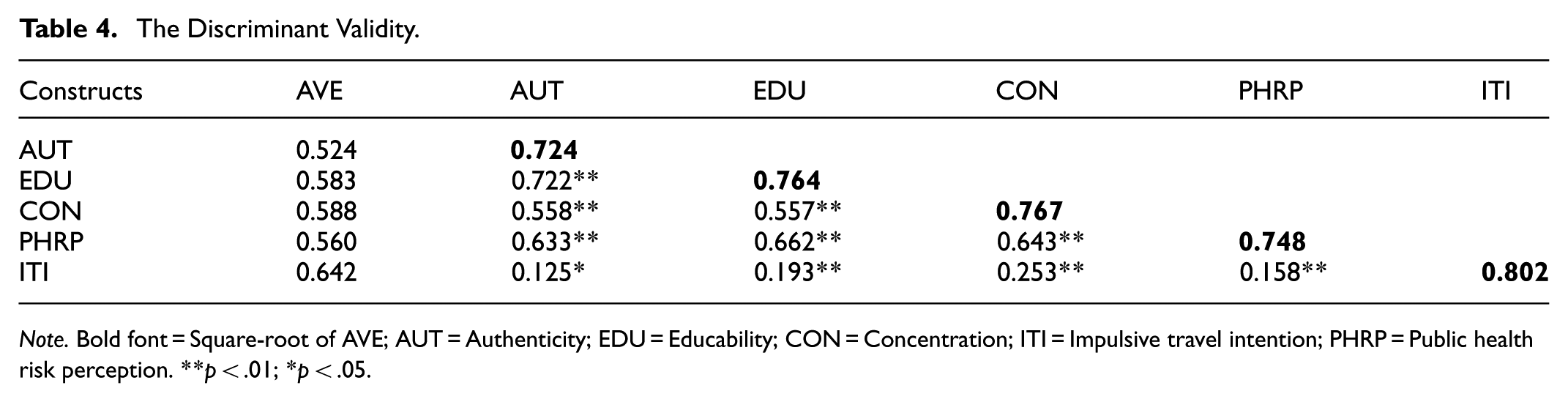
Note. Bold font = Square-root of AVE; AUT = Authenticity; EDU = Educability; CON = Concentration; ITI = Impulsive travel intention; PHRP = Public health risk perception. **p < .01; *p < .05.
Structural Equation Model
The maximum likelihood method of Amos 24.0 was used to test the hypothesis. The model fit of this study largely met the standards (Table 3-structural model). As shown in Table 5 and Figure 2, authenticity positively influencing concentration or impulsive travel intention wasn’t significant, rejecting H1a and H1b; educability had significant and positive effects on concentration and impulsive travel intention, proving H2a and H2b; concentration positively and significantly impacted impulsive travel intention, supporting H3.
Structure Parameter Estimates.

Note. AUT = Authenticity; EDU = Educability; CON = Concentration; ITI = Impulsive travel intention.
p < .001.

Results.
The Mediating Effect of Concentration
The bootstrap method (bootstrap = 5,000) was used to measure the mediating effects of concentration on authenticity and impulsive travel intention, as well as on educability and impulsive travel intention. If the 95% confidence interval of the indirect effect does not include 0, it indicates a significant mediating effect. This method, which does not rely on the significance of path coefficients, is currently the recommended approach for testing mediating effects (Hayes, 2018). The results indicated that concentration mediated the effect of authenticity on impulsive travel intention, as well as the effect of educability on impulsive travel intention. Thus, H4a and H4b were supported (Table 6).
Mediating Effect.

Note. AUT = Authenticity; EDU = Educability; CON = Concentration; ITI = Impulsive travel intention.
The Moderating Effect of Public Health Risk Perception
The process was used to test the moderating effect of public health risk perception on the effect of authenticity or educability on concentration. The results (Table 7) demonstrated that public health risk perception significantly and negatively moderates the effect of authenticity on concentration (Model 2-AUT × PHRP, |t| = |−2.420| > 1.96), whereas public health risk perception hasn’t significantly moderated the effect of educability on concentration (Model 4-EDU × PHRP, |t| = |−1.023| < 1.96). Thus, H5a was supported, and H5b was rejected. Following the procedure described by Aiken and West (1991), this study plotted the slope of H5a (Figure 3), from which it is known that the authenticity of short travel videos has a greater positive correlation with their concentration when public health risk perceptions are lower rather than higher.
Moderating Effect.


Moderating effect of public health risk perception.
Conclusion Remarks
Conclusion and Discussion
With the help of narrative transmission theory, this study focused on the theoretical model of story attributes (i.e., authenticity and educability), concentration, impulsive travel intention, and public health risk perception. Consequently, we have drawn the following research conclusions.
First, we indicated that authenticity insignificantly influences concentration and impulsive travel intention (i.e., rejecting H1a and H1b). The positive relationship between authenticity (C. Zhu et al., 2022) and travel intention has been previously confirmed. This may be because while potential tourists are aware of authenticity when watching short travel videos, the reality is not necessarily attractive (Q. Zhou et al., 2018). This perception of authenticity is often overshadowed by the platform’s entertainment value and editing techniques, thereby weakening its effect on enhancing potential tourists’ concentration and impulsive travel intention. Thus, authenticity has no significant positive impact on concentration and impulsive travel intention.
Second, educability significantly and positively influences concentration and impulsive travel intention (i.e., supporting H2a and H2b). This conclusion is analogous to the findings of Jo et al. (2022) that educability exerts a significant positive impact on brand value. When potential tourists perceive the video content as having educational value, they will proactively allocate more attention to ensure accurate capture of the information. Educability can also enhance the potential tourists’ cognitive depth regarding the destination, prompting them to develop an immediate urge to “experience it firsthand” within a short period.
Third, concentration significantly and positively influences impulsive travel intention (i.e., supporting H3). When potential tourists are highly engaged with the video content, information regarding the attractiveness and uniqueness of the tourist destination may undergo deeper cognitive processing, thereby triggering an immediate urge to “experience it right away” (Hyde, 2008).
Fourth, authenticity or educability influences impulsive travel intention by mediating the effect of concentration (i.e., supporting H4a and H4b). This finding didn’t align with Girish and Lee (2019), in which authenticity was found to directly influence tourists’ travel intentions, and this might be because concentration is an important mediating variable. This study focuses on TikTok short videos (≤60 s), where information is presented in a highly fragmented manner and the potential tourists’ attentional resources are limited. Consequently, concentration becomes a critical threshold determining whether information is adequately processed. When potential tourists exhibit sufficient concentration with the videos, can authentic or educable information be better internalized, thereby influencing impulsive travel intention.
Finally, public health risk perception moderates the effect of authenticity on concentration, but it does not moderate the effect of educability on concentration (i.e., supporting H5a and rejecting H5b). The difference in these results may stem from the fact that authenticity is more emotionally driven and thus exhibits greater volatility, whereas educability is more cognitively driven and relatively stable. When tourists’ public health risk perception is lower, their authenticity has a stronger influence on concentration, but the effect of educability on concentration is not affected. This finding confirmed that short travel videos are more appealing to those with low public health risk perception because they are less worried about public health risks.
Theoretical Contribution
First, narrative transportation theory is frequently employed in the media industries of news advertising (Shen et al., 2014), health education (Murphy et al., 2013), and entertainment (Glaser et al., 2012). This research innovatively applies narrative transportation theory in the tourism field, which will expand the application field of narrative transportation theory and provide a new research perspective.
Second, the application scope of the above theoretical conclusions in the context of new media tourism marketing will be expanded. The narrative transportation theory connects the virtual scene of short travel videos with the travel intention in the real world and further explores the impact of virtual scenes on the real world.
Third, this study indicated that the story attributes of short travel videos (i.e., authenticity and educability) can influence impulsive travel intention both directly and indirectly through the mediating effect of concentration. This will help clarify the black box of story attributes of short travel videos influencing impulsive travel intention and promoting the advancement of tourism destinations.
Practical Implications
First, authenticity refers to whether the content of short travel videos is real. Although it has no direct impact on concentration or impulsive travel intention, it has a significant impact on concentration under the moderation of public health risk perception. This may be because the public pays more attention to the authenticity of tourist destinations under the influence of the public health risk perception. Thus, tourist attractions should pay special attention to the publicity of public health risk prevention measures. Authenticity also has an impact on impulsive travel intention through the mediating effect of concentration. Consequently, short travel videos should be sufficiently attractive to tourists to make them focus on the short travel videos, thus generating impulsive travel intention.
Second, educability significantly and positively impacts concentration and impulsive travel intention, and educability affects impulsive travel intention through concentration. Thus, if tourism enterprises want to promote tourism destinations with the help of short travel videos, they should try their best to ensure the educational value of the content narrated by bloggers in short travel videos.
Limitations and Future Study Research
This study explored the influence mechanism of story attributes (i.e., authenticity and educability) of short travel videos on impulsive travel intention. Because storytelling has two properties, story and tell, but this study probed only the two dimensions of the story attribute (i.e., authenticity and educability), the future can be further explored on the three dimensions of the tell attribute: descriptive, emotionality, and interesting. Furthermore, this study only probed the moderating effects of public health risk perception on authenticity or educability and concentration, so the moderating effect of authenticity or educability and impulsive travel intention, as well as other moderating factors, can be further explored in the future. Additionally, this study has certain limitations in sample selection. In the future, a combination of online and offline data could be employed to cover potential tourists from a wider range of video platforms, and more attention should be paid to achieving gender balance. These measures are expected to enhance the generalizability of the research results.
Footnotes

Funding
The authors disclosed receipt of the following financial support for the research, authorship, and/or publication of this article: This research was supported by Education Research in the Humanities and Social Sciences Youth Fund Projects in China (Grant No. 21YJCZH052) and from the Research and Innovation Platform of Liming Vocational University (LMPT202105).
Declaration of Conflicting Interests
The authors declared no potential conflicts of interest with respect to the research, authorship, and/or publication of this article.
Data Availability Statement
The data supporting this study's findings will be made available upon reasonable request to the corresponding author.