




Abstract
This study explores the coupling effect of critical thinking ability and interdisciplinary learning in university English teaching and their mechanisms of action. Through theoretical analysis and empirical research, this paper reveals the interactive relationship between critical thinking ability and interdisciplinary learning. These two elements complement each other in English teaching and jointly promote students’ language learning, critical thinking, and creativity. The study shows that enhancing critical thinking enables students to better integrate knowledge from various disciplines and improve their abilities to analyze, reason, and evaluate during interdisciplinary learning. In addition, interdisciplinary learning provides students with rich background knowledge, which stimulates multidimensional and creative thinking. By coupling the two, university English teaching not only improves students’ language proficiency but also strengthens their ability to analyze and solve complex problems in a comprehensive manner. Based on this, the paper proposes several teaching strategies aimed at further enhancing students’ Critical Thinking Ability and promoting the depth and breadth of their English learning through the design of interdisciplinary learning activities.
Keywords
Introduction
As a global lingua franca, English plays a vital role in intercultural communication, international collaboration, and information exchange. In the context of globalization, the field of education is faced with the major challenge of preparing students with the ability to adapt to an international working environment and intercultural communication. English language teaching in higher education also involves the enhancement of critical thinking and intercultural understanding. Critical thinking refers to the ability to systematically analyze, evaluate, and reason through information to form rational judgments and conclusions. In this study, it includes logical reasoning and problem-solving skills and emphasizes openness to and critical analysis of different information and perspectives. Traditional English teaching often overemphasizes grammar and basic skills, neglecting deeper thinking—especially the integration of interdisciplinary knowledge and cultivation of critical thinking. In the context of globalization, the objectives of English language teaching should be expanded to the integration of interdisciplinary knowledge, the cultivation of creative thinking and the deepening of cultural understanding. Enhancing critical thinking helps students analyze and evaluate information more effectively and fosters innovation, aligning with the global demand for high-quality talent.
Discursive Competence refers to an individual’s ability to effectively analyze, reason, and express judgments within a specific discourse context. For university English teaching, discursive competence is not limited to basic language use but also includes the ability to understand and apply language in cross-cultural communication. Reason critically, and make comprehensive judgments when addressing complex problems. In English teaching, discursive competence can help students understand English texts more effectively and enhance their sensitivity and judgment of language expressions in cross-cultural contexts. The cultivation of Critical Thinking Ability enables students to better examine issues from multiple perspectives and enhances their ability to understand and integrate different cultures, values and subject areas. Interdisciplinary Learning refers to the process of integrating knowledge and methods from different disciplines to solve complex problems. This learning model encourages students to break down disciplinary boundaries and use knowledge from multiple fields to expand their thinking. In this study, interdisciplinary learning is seen as an important avenue for enhancing students’ language skills and critical thinking abilities. As an emerging pedagogical model, emphasizes the integration and cross-application of knowledge across different disciplines. In traditional subject teaching, students’ learning is often confined to specific disciplinary boundaries. Interdisciplinary learning breaks down these barriers and prompts students to handle complex practical problems by integrating knowledge from different fields. For university English teaching, interdisciplinary learning can broaden students’ knowledge and help them combine knowledge from different disciplines with language learning, thus cultivating a more integrated and innovative way of thinking in English learning. Current university English teaching that combines critical thinking and interdisciplinary learning enhances students’ ability to think critically and creatively, providing them with a more diverse learning experience (Ross, 2023).
Literature Review
Definition and Discussion
Discursive competence is essentially a kind of rhetorical practical wisdom based on the disciplinary knowledge system. It requires learners to transform critical thinking into persuasive knowledge claims within the regulatory boundaries of a specific discourse community (Tahiri, 2021). This ability is first manifested as a deep adaptation to the paradigms of disciplinary knowledge construction—language use must precisely match the evidence standards and expression traditions of the discipline (Egitim, 2021). Critical thinking ability and discursive competence form a symbiotic relationship—the former drives analytical reasoning, while the latter manifests such reasoning through academic language. The cognitive operations provided by critical thinking must be embodied through disciplinary language symbols. Imagine a student analyzing the controversy over genetically modified crops (Hmelo-Silver & Pfeffer, 2004). If abstract reasoning isn’t expressed through proper disciplinary language, the depth of criticism will be lost. True critical thinking requires students to simultaneously engage with multiple knowledge systems in English discourse (Yang & Tseng, 2019). For example, when describing gene editing principles, students must accurately use biological terms while also considering ethical frameworks to assess risk thresholds. This requires them to reconcile the cognitive tensions between the two disciplines through rhetorical strategies. This language transformation process enables internal thinking to take on an external form with disciplinary legitimacy (O. Lee & Grapin, 2024).
In an interdisciplinary context, discursive competence is further elevated to the hub of knowledge integration. Crossing disciplinary boundaries depends on specific discourse strategies (Borda et al., 2020). When students write an urban renewal plan in English, discursive competence is shown in their ability to weave architectural terms like “floor area ratio incentive mechanism plan in English, discursive comp“positive externality.ntive mechanism plan in English, discursive competence is shown in thultural heritage protection, creating a three-dimensional cognitive tapestry. This requires concept grafting, evidence reorganization, and metadiscourse scheduling (Hu & Wang, 2025). This ability enables learners to become “multilingualsty enables learners to become eorganization, and metadiscourse schedulingn thultural heritage protection, creating a threedimensional cognitive tapestry.ds. This requires them to reconcile the cognitive tensions between these communitynegotiations among multiple cognitive systems and finally produce comprehensive knowledge products that are both academically rigorous and capable of solving real-world problems (Van Gog & Paas, 2008).
The Role of Critical Thinking in Interdisciplinary Language Education
The core value of critical thinking in interdisciplinary language education lies in its role as a cognitive interface catalyst, which develops deep-level cognitive abilities by deconstructing the paradigm conflicts of multiple knowledge systems. When students process interdisciplinary texts (such as environmental policy documents), language decoding is only a superficial task (Sellar & Cole, 2017). The key lies in identifying the intertwined disciplinary logics: probabilistic models in ecology, structural analysis in sociology, and game discourse in politics. These collisions force learners to reveal the rules behind disciplinary knowledge production (Sharma & Singh, 2021). For example, how scientific texts build authority through modal verbs and how humanistic discourses convey value judgments through metaphors. Therefore, English teaching has a dual function—it is not only a field for target language acquisition but also a metacognitive tool for deconstructing disciplinary power (Wan & Lee, 2020).
Cognitive psychology reveals that critical thinking (CTA) is essentially a systematic information-processing process under metacognitive monitoring. CTA depends on the formation of a dialectical mental model—learners activate the schema reorganization in working memory by identifying cognitive conflicts. The limited capacity of working memory determines that interdisciplinary information integration requires the use of externalized reasoning tools (Gomoll et al., 2022). Effective interdisciplinary learning needs to reduce the intrinsic load through teaching scaffolds and direct cognitive resources toward metacognitive strategies. This “cognitive-driven teaching framework” can strengthen the conditional storage of knowledge, enabling learners to automatically apply critical reasoning abilities in new contexts. Interdisciplinary criticism should be based on the ethical foundation of cognitive justice, and this view has received extensive empirical support in recent years (Milara & Orduña, 2024). Language education often strengthens the representational privileges of disciplines such as economics and marginalizes indigenous knowledge systems. Critical thinking requires a dual operation here: translating disciplinary concepts through English (such as transforming the anthropological concept of “place-based knowledge” into academic terms) while deconstructing the hegemonic mechanisms implicit in language structures When students analyze English reports on “rural revitalization,” they must coordinate the narrative tension between Western development theory frameworks and local governance practices. Critical thinking becomes the core hub for balancing the norms of academic English and the legitimacy of local knowledge (Rogat et al., 2022).
The Interaction Between Critical Thinking and Creativity
The interactive mechanism between critical thinking and creativity manifests as a dynamic collaborative process in the field of education, with its core being the activation of innovative thinking through cognitive conflicts. When learners encounter conceptual contradictions at disciplinary boundaries in an interdisciplinary context, critical thinking enables them to break through existing cognitive frameworks, providing the necessary cognitive space for creative recombination (O. Lee et al., 2023). This process not only involves the deconstruction of existing knowledge but also emphasizes the leap of innovative thinking through cross-domain recombination. In this process, metacognitive monitoring plays a crucial regulatory role, ensuring the balance between cognitive flexibility and innovation feasibility, and avoiding premature convergence of thinking or innovative solutions running away from reality (Pietraszek et al., 2020).
Introducing conceptual contradictions at disciplinary boundaries in teaching, such as the differences between literary and linguistic academic terms, can prompt students to think actively and break through existing cognitive frameworks. The design of multimodal tasks helps students complete the cognitive closed-loop from critical deconstruction to creative reconstruction (Saleh et al., 2022). Multilingual ability enhances the switching efficiency of cross-cultural concept pathways, accelerating learners’ understanding and integration of concepts at disciplinary boundaries. The transformation of cultural experience can help students better identify and analyze conceptual gaps in an interdisciplinary context, thereby improving their interdisciplinary integration ability (Schmidt et al., 2007).
In college English teaching, teachers can embed a task chain of “comparative analysis of disciplinary terms → cross-domain concept integration” in ESP (English for Specific Purposes) courses, and stimulate students’ critical thinking and creativity through disciplinary dilemmas. At the same time, the innovation of the evaluation mechanism is also crucial (Hassan & Rauf, 2023). Developing a two-dimensional scale can evaluate the depth of students’ criticism and the validity of innovation respectively, providing a basis for teaching optimization. In addition, teachers’ own development also needs to shift to the role of interdisciplinary cognitive mediators, mastering cognitive conflict design strategies and multimodal metacognitive prompting techniques to better guide students to complete the cognitive leap from critical deconstruction to creative reconstruction (Cole et al., 2015).
The interaction between critical thinking and creativity offers crucial theoretical support for interdisciplinary language learning. (Hmelo-Silver & Barrows, 2021). By designing cognitive conflicts, applying multimodal tasks, and transforming cultural experiences, college English teaching can help students make the leap from critical thinking to creative problem-solving, fostering innovation in interdisciplinary talents. This mechanism can not only improve students’ academic language ability but also lay a solid foundation for their future interdisciplinary research and innovative practice (Paul & Elder, 2019).
The Coupling Effect Mechanism Between Critical Thinking and Interdisciplinary Learning
The coupling effect between critical thinking and interdisciplinary learning is essentially a two-way interactive process of “cognitive reconstruction and knowledge integration,” and its core mechanism is manifested as a triple dynamic action chain: “deconstruction-connection-leap.” At the deconstruction level, critical thinking breaks the cognitive boundaries of a single discipline through analysis and evaluation abilities, making learners aware of the limitations of knowledge systems (K. Lee & Mayer, 2021). At the connection level, the diverse information provided by interdisciplinary learning creates associated nodes for reasoning ability and stimulates cross-paradigm comparisons. Finally, at the leap stage, the collaboration between the two prompts learners to reconstruct their cognitive frameworks.
The coupling effectiveness of different disciplinary combinations shows significant differences, and this divergence stems from the internal conflicts and complementary potential of disciplinary cognitive paradigms. In the intersection of “STEM-humanities and social sciences” (such as bioethics), the deterministic reasoning in natural sciences (such as experimental evidence chains) and the interpretive thinking in humanities (such as situational ethical analysis) are prone to create tension. However, it is precisely this conflict that drives higher-order thinking leaps. This is because the structured logic of STEM disciplines provides a “falsifiable anchor point” for critical thinking, while the openness of humanities disciplines prevents thinking from becoming rigid, forming a dynamic balance (Rodrigues Vasconcelos & dos Santos, 2023). In contrast, in the “pure applied discipline intersection” (such as engineering-management), since they share the paradigm of instrumental rationality, critical thinking is more likely to become a means of technical optimization rather than an engine for cognitive paradigm breakthrough (for example, in writing tests, students often focus on “efficiency improvement plans” rather than “value reconstruction”).
The disciplinary sensitivity of the coupling mechanism is more profoundly reflected in the “distribution of thinking load.” In the integration of “high-concept-density disciplines” (such as theoretical physics), critical thinking needs to first activate reasoning ability to process abstract symbol systems (such as the mathematical expressions in quantum mechanics), and at this time, evaluation ability becomes secondary. When integrating “high-contextualized fields” (such as cultural anthropology), analysis ability must take the lead in dealing with ambiguity and cultural variables (such as the multiple interpretations of ritual symbols; Schmidt & Yew, 2012). This finding challenges the simplified view of critical thinking, emphasizing that disciplinary characteristics shape the combination of thinking skills required. In engineering contexts, logical chain detection (e.g., through FMEA analysis) should be enhanced, while in artistic contexts, metaphor deconstruction (e.g., semiotic analysis) deserves more focus. This finding explains why interdisciplinary curriculum design needs to go beyond formal combinations and customize thinking training paths according to the cognitive characteristics of disciplines (Hoorijani & Heidari Tabrizi, 2023).
Research Methodology
Based on Telfair’s bi-dimensional structural framework (Telfair, 2015), Paul and Elder’s ternary structural framework (Paul & Elder, 2019), and Lin Chongde’s Mitsubishi structural framework (Lin, 2015), Wen Qiufang et al. proposed a hierarchical theoretical framework (Wen & Johnson, 1997). The framework posits that metacritical discursive competence includes cognitive and affective dimensions. The cognitive aspect comprises three core skills—analysis, reasoning, and evaluation—and five criteria: clarity, relevance, logic, depth, and flexibility. Drawing on Wen Qiufang’s hierarchical model and the features of college English teaching, this paper constructs a logical framework linking students’ discursive competence, interdisciplinary knowledge, and thinking ability (see Figure 1).

Logical relationship framework.
The framework views interdisciplinary learning as the foundation for developing discursive competence, which encompasses cognitive and affective dimensions. The cognitive dimension involves three skills—analysis, reasoning, and evaluation—and five criteria: clarity, relevance, logic, depth, and flexibility. The enhancement of analytical, reasoning, and evaluative skills depends on discursive competence, which in turn fosters deeper interdisciplinary understanding. Ultimately, these elements interact to form a self-reinforcing cycle that advances college English teaching.
Research Target
Based on theoretical and empirical analysis, this paper explores how to align interdisciplinary learning activities with the goals of critical thinking and language proficiency. It stresses that interdisciplinary learning should cultivate critical thinking through deep integration of language objectives and disciplinary knowledge. Students should not only master language expression but also integrate multidisciplinary knowledge to construct meaning, thereby enhancing critical thinking ability.
The paper notes that abundant background knowledge supports multidimensional thinking, while analytical and reasoning tasks strengthen critical thinking. Moreover, evaluation and reflection mechanisms, combined with teacher guidance and feedback, enhance learning effectiveness and goal attainment. Together, these strategies improve students’ overall competence and offer practical guidance for effective English teaching.
Ethical Statement
The study design thoroughly considered participants’ rights and potential risks, adopting multiple measures to minimize harm. Firstly, the study clearly informs participants that their involvement is entirely voluntary, and they have the right to choose whether to participate. They can also withdraw from the survey at any stage without any negative consequences. Secondly, all collected data will be kept strictly confidential and will be used solely for academic research. Personal information will be anonymized to ensure it is not disclosed to any third party. Furthermore, the study commits to respecting each participant’s cultural background, personal views, and academic abilities, ensuring that the research process is fair and just. The questionnaire design encourages participants to answer according to their actual situation, without overthinking or guessing the “correct answer,” avoiding any potential psychological burden caused by stress or anxiety. These measures together form a comprehensive protection of participants’ rights.
The study’s potential benefits far outweigh the risks, both socially and individually. From a societal perspective, the research results will contribute to academic advancement and educational practices, particularly in providing suggestions for improving university-level English education and enhancing students’ critical thinking and interdisciplinary learning abilities. Exploring the relationship between critical thinking and interdisciplinary learning helps cultivate talents with comprehensive abilities, meeting society’s demand for innovative talents. For participants, filling out the questionnaire and writing the test allows them to reflect on their own Critical Thinking Ability and recognize the importance of interdisciplinary learning, thereby consciously improving these abilities in future learning.
The research team used a transparent and comprehensive process to obtain informed consent. Prior to starting the questionnaire, detailed informed consent information was provided, explaining the purpose of the study, the process, the use of data, and the participants’ rights, including the voluntary nature of their participation and the right to withdraw at any time. Participants gave explicit consent after reviewing the study details before completing the questionnaire. Additionally, the research team provided contact details, allowing participants to reach out at any time for further information or to raise questions, ensuring that participants make decisions based on full knowledge. This process demonstrates respect for participants’ autonomy and ensures ethical compliance.
Research Subjects
Since science and engineering students typically possess strong logical thinking in their fields but limited understanding of non-major areas like society, economy, and politics, this paper selects non-English major students from a Double First-Class science and engineering university as the research subjects. A total of 140 students were randomly selected from the public English teaching classes of 7 majors for a questionnaire survey. The male-to-female ratio of the subjects is 1:1, and 135 valid questionnaires were finally recovered.
Meanwhile, to eliminate the interference of subjective factors and language and to more scientifically and intuitively test students’ writing abilities, 110 students were selected from the 135 for a timed proposition writing test, with 55 students participating in the Chinese-language test and 55 in the English-language test.
Research Technique
In order to obtain true and objective information between the three aspects of non-English majors’ critical thinking ability, interdisciplinary knowledge base and university English teaching, this paper designs the following two measurement tools:
Questionnaire Survey
This paper borrows the relevant concepts from Professor Wen Qiufang’s hierarchical theoretical framework of discursive competence and designs a set of questionnaires for students’ self-assessment, in which the three skills of analysis, reasoning, and evaluation covered by the questionnaires, together with the five criteria of clarity, relevance, logic, profundity, and flexibility, are reflected in a total of 18 items, numbered Q1–Q18, of which analytical skills correspond to Q1–Q7, reasoning skills correspond to Q8–Q11, and evaluative skills correspond to Q12–Q18. Q8–Q11 assess analytical ability, while Q12–Q18 evaluate evaluative ability. Each item was described positively and reflected the cognitive processes involved in English writing. The response options included: “Never,”“Occasionally,”“Frequently,” and “Always,” which corresponded to score levels of 1, 2, 3, and 4 on the Likert scale. If a subject chooses the first two options, this paper considers that he or she does not possess this habit of mind. For the raw data, this paper uses EXCEL to input and SPSS software to analyze, calculating the overall average score of the subjects under each core skill, and at the same time presenting the distribution of scores under each topic using bar charts, in order to make clear the strengths and weaknesses of the subjects’ status in specific aspects (see Table 1).
Evaluation Framework for English Interdisciplinary Learning Quality.

This study uses a Likert 4-point scale to standardize the measurement of critical thinking ability. However, students’ self-evaluation is still difficult to avoid the interference of social desirability bias, that is, the subjects tend to present an image that meets social expectations (such as exaggerating their critical thinking ability). To resolve this methodological dilemma, this design constructs a defense system through a “triple evidence chain”:
First, reverse-scored items are implanted at the measurement tool level (e.g., Q11: “I often give up my views because of others’ opposition”). If the score of this item is abnormally high (in this study, the average score of Q11 is 1.96, significantly lower than the theoretical median of 2.5), it warns of a beautification tendency. At the same time, double-blind operation is adopted during the data collection phase. Students are clearly informed that the questionnaire has nothing to do with academic evaluation, and complete anonymity is promised (in fact, confidential codes P1-P135 are assigned), which reduces the motivation for performative responses procedurally.
The more core breakthrough lies in the introduction of behavioral evidence as a criterion for validation. The 30-min high-pressure environment of the timed writing test effectively strips away reflective pretense. When students claim in the questionnaire that they “are good at multi-angle analysis” (the average score of Q7 is 3.02), but present single-line arguments in writing (41.8% and 38.2% of the samples in the Chinese and English groups respectively only take a single stance), it exposes the deviation between self-evaluation and actual ability. By establishing a “Behavior-Self-evaluation Consistency Index (CI)”, it is found that only 61.5% of the students are logically self-consistent (CI ≥ 0.7), and the questionnaire scores of the group with high self-evaluation and low writing performance (19.3%) need to be weighted and corrected (weight w = 0.65). This operation echoes the argumentation ability diagnosis model of Kuhn (2019), confirming that behavior anchoring can eliminate the self-inflation error.
Timed Composition Test
In order to exclude the interference brought to the subjects by the descriptions of the questions in the questionnaire and to further examine the embodiment of Critical Thinking Ability in university English teaching, this paper conducted a time-limited English test for the students. In this paper, all 110 subjects were divided into two groups, given the same essay topic (Title: The Impact of Artificial Intelligence on Future Education), and asked students to discuss whether AI should become a central tool for future education. The subjects were divided into two groups and wrote in both Chinese and English to exclude the influence of language factor on the subjects’ writing. If there was a significant difference in the performance of the two groups of subjects (the Chinese group was significantly better than the English group), it was considered that the subjects were limited by the language and that their thinking ability was not better demonstrated, rather than a lack of that ability. On the other hand, the English essays were considered to be a fair reflection of the subjects’ critical thinking ability. The test time was 40 min, and the word count requirement was 250 words for the English essays and 500 words for the Chinese essays. A total of 110 valid essays were collected and manually marked.
Enhanced Report on Repeatability
The structured questionnaire used in this study consists of five parts, with a three-dimensional system designed for “analytical ability,”“reasoning ability,” and “evaluation ability.” The first part collects demographic information (three questions): gender (male/female), educational background (undergraduate/graduate/doctorate), and major (including 15 options, with a focus on distinguishing single-disciplines from three types of interdisciplinary disciplines M, N, and O, ranging from agriculture to art). The measurement of core abilities uses a 4-point scale (1 = never, 2 = occasionally, 3 = often, 4 = always). The analytical ability dimension includes four items (Q4–Q7). Typical questions are such as “I can clearly break down complex problems and identify the key points” (Q4) and “Recognize and evaluate the potential assumptions in a problem” (Q7). The reasoning ability dimension has five questions (Q8–Q12), with a focus on examining logical reasoning (Q8), flaw identification (Q9), and prediction ability (Q12). The evaluation ability dimension extends to six questions (Q13–Q18), with particular emphasis on the interdisciplinary nature of Q18: “I can comprehensively evaluate a problem by combining multi-disciplinary knowledge.”
The fifth part sets up three open-ended questions: Q19 explores the relationship between interdisciplinary ability and critical thinking, Q20 focuses on the challenges of critical thinking in college English learning, and Q21 solicits suggestions for learning strategies. The writing assessment implements a dual-task model. The Chinese composition is titled “The Promoting Effect of Interdisciplinary Learning on Critical Thinking Ability,” with a clear requirement to analyze its impact on analytical, reasoning, and evaluation abilities in combination with personal experiences (≥500 words). The English composition is titled “The Role of Critical Thinking in Interdisciplinary Learning,” which requires demonstrating how the three dimensions of critical thinking are strengthened through disciplinary cases (≥300 words). Both writing tasks are completed within a 30-min time limit. The terms of “analysis, reasoning, and evaluation” abilities specifically defined in the questions form a methodological triangulation with the questionnaire dimensions.
Reliability and Validity Analysis
In this paper, SPSS software was borrowed to analyze the reliability and validity of the questionnaire. The reliability and convergent validity analyses of the measurement framework are shown in Table 2.
Reliability and Validity Analysis of Critical Thinking Ability Dimensions.
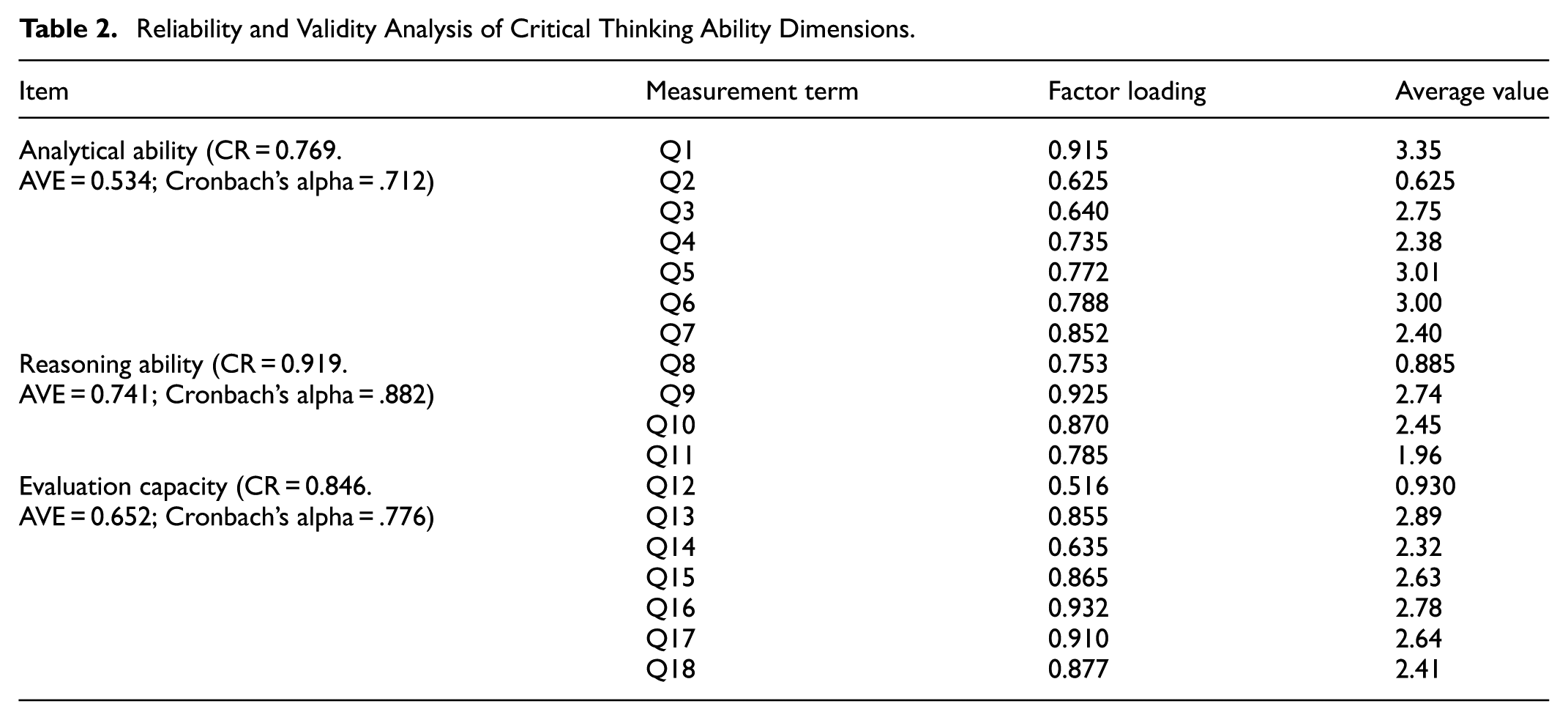
In Table 2, the Cronbach’s alpha coefficient and Composite Reliability (CR) of analytical ability are greater than .7, and the Average Variance Extracted (AVE) is greater than 0.5, indicating that the measurement framework of analytical ability has good reliability and convergent validity. The Cronbach’s alpha coefficient and combined reliability CR of reasoning ability are greater than .7, and the average extraction AVE is greater than 0.5, indicating that the measurement framework of reasoning ability has good reliability and convergent validity. The Cron-bach’s alpha coefficient and combined reliability CR of evaluative ability are both greater than .7, and the average extraction amount AVE is greater than 0.5, indicating that the measurement framework of evaluative ability has good reliability and convergent validity.
Discriminant validity was tested by comparing the AVE square root of the variables with the absolute value of the correlation coefficient between the corresponding variables. In this study, the correlation coefficients between analytical, reasoning, and evaluative skills were calculated, and then the AVE square root values were placed on the diagonal of the correlation coefficients matrix for comparison, and the results of the test are shown in Table 3.
Results of Discriminant Validity Test for Critical Thinking Ability Indicators.

The square root of AVE for all variables in Table 3 is greater than the absolute value of the correlation coefficients of the rows and columns in which they are located, indicating that each scale passed the discriminant validity test. Subsequently, the results of the two groups of time-limited writing tests were compared and analyzed from the perspectives of both content and structure with reference to the five criteria of clarity, relevance, logic, profundity and flexibility. Through comprehensive statistics and research on the above two research programs, more scientific expected results were obtained and targeted solutions were proposed.
Model Construction
In the systems theory perspective, Critical Thinking Ability and interdisciplinary learning are two major subsystems. The coupling degree of coordination model is suitable for correlation analysis between two or more systems. The model uses the coupling degree to explain the interrelationships among several subsystems, and further uses the coordination degree to comprehensively evaluate and study the whole system. Among them, the coupling degree mainly reflects the strength of the mutual influence and interaction between systems, focusing on the measurement of the relationship between subjects; the coordination degree places more emphasis on the degree of benign coupling of the system, focusing on the synergy of the quality of development between subjects. The expression of the coupling degree function of the two subsystems is as follows:

Among them, U1 and U2 represent the comprehensive development evaluation index of each subsystem respectively, and the value of C represents the coupling degree, which ranges from 0 to 1. The closer the result of the coupling degree is to 1, it means that the two subsystems are less dispersed, and the more the two development statuses are matched; and vice versa the closer the result of the coupling degree is to 0, it means that the two have loose relationship, and the lower the degree of coupling is. See Table 4 for details:
Criteria for Classifying the Level of Coupling.

Since a single application of the coupling degree cannot accurately reflect the synergistic interaction effect between the two systems, as the illusion of high coupling can be shown even when both systems are at a low level of development. Therefore, it is necessary to further measure the degree of coordination between the two. The expression of the degree of coordination function is as follows:


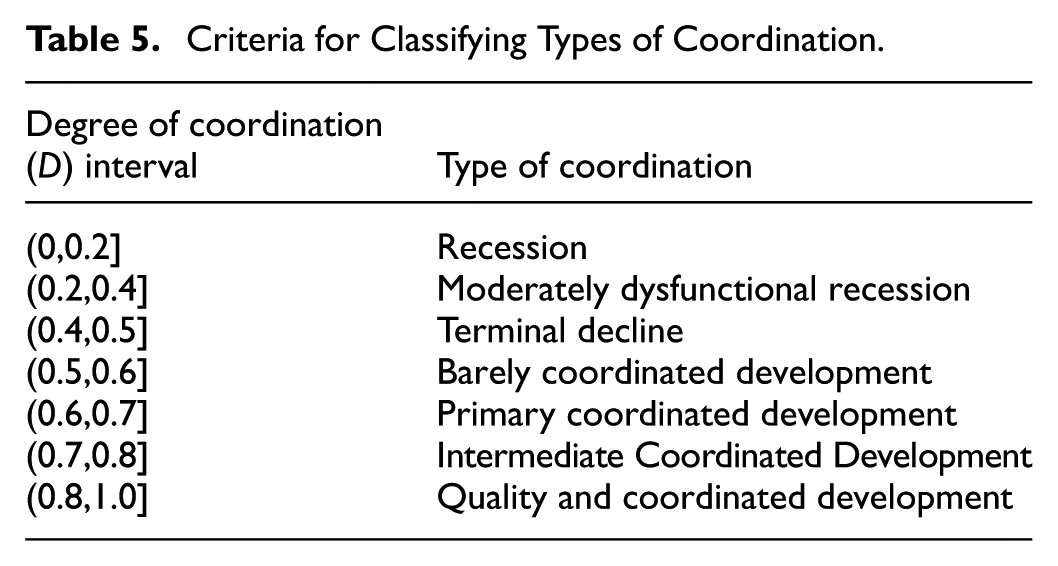
Among them, the T value represents the overall comprehensive development index of the two subsystems, which is between 0 and 1. α and β are coefficients to be determined, reflecting the overall development level of U1 and U2, respectively, and considering that they are equally important, they are assigned the value of 0.5. The D value represents the degree of co-ordination, with the range of 0 to 1. The more the co-ordination degree tends to be 1, which indicates that the degree of U and U2 fit and match is more good Referring to the relevant literature on the division criteria of the degree of coupling and the co-ordination level, this study makes specific divisions of coupling level and co-ordination type, which are shown in Tables 3 and 5, respectively. Referring to the relevant literature on the coupling degree and coordination level interval, this study will make a specific division of the coupling level and coordination type, which are shown in Tables 4 and 5, respectively.
Criteria for Classifying Types of Coordination.
To further refine this analytical model, formulas continue to be introduced to enhance the understanding of the degree of system coupling and coordination. Considering that the interaction between subsystems is not only linear, but may also be affected by the speed and degree of their respective development, the degree of coupling can be optimized. The following formulas are proposed based on this non-linear relationship:

This optimized coupling degree formula takes into account the non-linear relationship between the two subsystems, especially in the case of high coupling degree, which can reflect the interaction between the subsystems more accurately. In addition, when studying the coupling and coordination degree of the system over time, the factor of dynamic adjustment continues to be introduced to better reflect the long-term change trend of the system development. Considering the influence of the differences between subsystems on the degree of coordination, the following formula is further introduced:

The formula reflects the impact of the difference in the level of development of the two subsystems (expressed through
Index Selection and Data Processing
The coupled coordination degree model focuses on exploring the coupled coordination between university education discursive competence and interdisciplinary learning. Synthesizing relevant literature, this study uses the ratio of graduates of each discipline of university education to all graduates of the current year as a measure of university education discursive competence, and further uses the proportion of master’s and doctoral graduates of each discipline as a measure of the corresponding level dimension. Specifically, the ratio of graduates in the disciplinary categories of agriculture, science and technology, engineering, philosophy, humanities and social sciences were used to measure the development of discursive competence, while the proportion of master’s and doctoral graduates reflected the distribution of discursive competence at different degree levels. Interdisciplinary learning was measured through disciplinary crossover.
In this study, the combination of different disciplines, such as the combination of natural sciences and social sciences, the combination of engineering and humanities, and the combination of science and technology and art disciplines, was selected as the measurement index of interdisciplinary learning. Through these intersections between disciplines, the promotion of interdisciplinary learning on students’ comprehensive ability and discursive competence is reflected. Considering that the data on discursive competence in university education has a lag, this study selected the data from 2014 to 2023 as the measurement data for the indicators of discursive competence (year t−1), while the data from 2015 to 2024 were used for the data on interdisciplinary learning (year t). All raw data were obtained from the website of the Ministry of Education of the People’s Republic of China and the China Statistical Yearbook for all years. Due to the special nature of military disciplines and newly established interdisciplinary disciplines in university education, they were not included in the indicator system in this study. According to the matching of disciplines and industries, it is assumed that graduates of agronomy mainly enter agriculture-related fields, graduates of science and engineering mainly enter engineering technology fields, and graduates of other disciplines, such as humanities and social sciences, mainly enter the field of service and culture; based on the above theoretical research results, the index system of analyzing the coupling and coordination degree of the discursive competence and interdisciplinary learning in university education is established. After determining the index system, the study further standardized the raw data using the extreme value method and assigned weights to the indicators using the entropy value method, obtaining the weight values as shown in Table 6.
Weight Analysis of Indicators in the Discursive Competence–Interdisciplinary Learning Evaluation System.

Couple Mechanism Analysis
Descriptive Statistical Analysis
In the selection of indicators for the coupling model, this study is based on the inherent relationship between critical thinking ability and interdisciplinary learning. Core indicators that can reflect the interactive relationship between the two are selected, such as knowledge integration ability, problem-solving ability, and innovative thinking. These indicators can not only quantify the level of coordinated development between the two but also provide a scientific basis for analyzing their coupling effects.
Specifically, the coupling model evaluates the interaction and development quality of the system through two dimensions: “coupling degree” and “coordination degree.” The coupling degree reflects the intensity of the mutual influence between systems, while the coordination degree emphasizes the degree of benign coupling between systems. For example, in the cross-field of “STEM-humanities and social sciences,” the tension between the deterministic reasoning of natural sciences and the interpretive thinking of humanities drives a higher-order thinking leap. This dynamic balance reflects the non-linear and dynamic adjustment characteristics of the coupling model.
Firstly, the average scores of the subjects under each item were counted and the results are shown in Table 7. The statistical analysis indicates that the scores for each item within the same skill category vary, with no consistent pattern of high or low scores across items. Therefore, detailed descriptive analyses should be performed on each individual item to identify specific weaknesses in students’ writing processes.
Average Scores of Questionnaire Items Measuring Critical Thinking Ability.

Detailed analysis of students’ timed writing revealed a tendency toward descriptive expression, insufficient reasoning, and verbose yet shallow writing, and in the process of argumentation, it clearly reflected the students’ deficiencies in their discursive skills, such as poor vocabulary, inadequate argumentation, and unclear structure of their essays. This is basically the same as their performance in English writing, which is manifested in a simple and illogical argumentation process, superficial language expression, and the number of words failing to meet the writing requirements. By referring to the five criteria of clarity, relevance, logic, profundity and flexibility, we examined the students’ analytical, reasoning and evaluative skills respectively, and the results showed that there was little difference between the results of the Chinese and English writing tests, which indicated that Critical Thinking Ability and the use of cross-disciplinary knowledge performed similarly in Chinese and English writing.
In terms of overall layout, Chinese writing failed to provide students with a clear advantage, with problems such as unclear paragraphs or lack of subparagraphs. Even in Chinese writing, students failed to express the central idea clearly and hierarchically in their essays, and failed to provide enough effective arguments to support the thesis. This suggests that factors influencing students’ English writing extend beyond language proficiency to include critical thinking and interdisciplinary application. Therefore, this study uses students’ English writing as the research model to analyze the coupling between critical thinking, interdisciplinary knowledge, and writing ability, and to explore their interaction mechanism. So as to provide theoretical basis and practical guidance for the cultivation of critical thinking ability and the integration of interdisciplinary knowledge in university English teaching.
An Analysis of the Development Level of Critical Ability and Interdisciplinary Learning
According to the calculation of index weights, the comprehensive evaluation index of China’s university education discursive competence U1 and the comprehensive evaluation index of interdisciplinary learning U2 are derived. As a whole (see Table 8), the comprehensive evaluation index of China’s university education discursive competence maintains between 0.4 and 0.6, showing small fluctuations and a downward trend. During the period from 2015 to 2018, the comprehensive development level of China’s university education discursive competence slightly surpassed the comprehensive development level of interdisciplinary learning, and the gap between the two gradually narrowed. However, from 2019 onwards, the development level of discursive competence began to lag behind that of interdisciplinary learning, and the gap gradually widened. Overall, the combined evaluation index of Critical Thinking Ability and interdisciplinary learning fluctuates roughly around the axis of 0.5, and the development trend is relatively stable.
Comparative Analysis of Comprehensive Evaluation Index and Its Development Level.

Table 8 presents a comparative analysis of the comprehensive evaluation indices and development levels of critical thinking ability (U1) and interdisciplinary learning (U2) in Chinese university education. From 2015 to 2024, the comprehensive evaluation index of critical thinking ability fluctuated between 0.4 and 0.6, showing a slight downward trend overall. In contrast, the comprehensive evaluation index of interdisciplinary learning was lower than that of critical thinking ability from 2015 to 2018, but it increased significantly starting from 2019 and gradually exceeded the latter.
From 2015 to 2018, critical thinking ability always took the lead, but the gap between the two gradually narrowed. After 2019, interdisciplinary learning began to take the lead, and the gap gradually widened. The t-value, as an indicator of the comprehensive development level of the two, fluctuated around 0.5 overall, indicating that the development trends of critical thinking ability and interdisciplinary learning were relatively stable.
This change reflects the increasing emphasis and investment in interdisciplinary learning in Chinese higher education. Meanwhile, it also suggests that the cultivation of critical thinking ability needs to be further strengthened. The data in Table 8 provides important support for studying the coupling effect and its mechanism of action between critical thinking ability and interdisciplinary learning, and offers a reference basis for optimizing the ability-cultivation strategies in higher education.
An Analysis of the Coupling Coordination Between Critical Ability and Interdisciplinary Learning
Analysis of Overall Coupling Coordination Degree
Based on the coupling and coordination degree model, the specific values of the coupling degree and coordination degree of China’s university education discursive competence and interdisciplinary learning are measured, and according to the criteria for dividing the level of coupling and the type of coordination in Tables 4 and 5, the type of coupling and coordination between China’s university education discursive competence and interdisciplinary learning can be determined (see Table 9). From the results of the overall analysis of all universities, it can be found that the coupling level values of China’s university education discursive competence and interdisciplinary learning development in 2015 to 2024 are all above 0.97, and the coordination level values fluctuate between 0.67 and 0.75, which indicates that China’s university education discursive competence and interdisciplinary learning are at a high level of coupling, and that there is a very close relationship. However, corresponding to the corresponding type of coordination can be found, after 10 years of development, China’s university education discursive competence and interdisciplinary learning has not been able to break through the intermediate level of coordinated development, and there is still a certain distance from the state of high-quality coordinated development.
Analysis of Coupling Level and Coordination Type.

Analysis of Coordination Degree of Classified Coupling
The coupling and coordination of the three main types of Critical Thinking Ability and their corresponding interdisciplinary learning were further measured for all universities and for different levels of university education, and the level of coupling and the type of coordination were determined based on the classification criteria in Tables 2 and 3. Combined with the data, the study found that:
Agronomic discursive competence and the first interdisciplinary learning: from the coupling level, in all universities as well as at the master’s level, the coupling level of agronomic discursive competence and the first interdisciplinary learning remained consistent, between medium coupling and high coupling, and maintained a high coupling state in the last 3 years; at the doctoral level, the coupling level of the two spanned a large range, and some years appeared to have a very low coupling state. In terms of the degree of coordination, the degree of coordination between agronomy discursive competence and the first interdisciplinary learning is low, the degree of coordination between agronomy discursive competence and the first interdisciplinary learning at the master’s level has a slow rising trend, and the degree of coordination at the doctoral level alternates between rising and falling back (see Table 10). Polytechnic discursive competence and second interdisciplinary learning: in terms of the level of coupling, at the level of all universities and master’s degrees, the level of coupling between polytechnic discursive competence and second interdisciplinary learning has generally remained consistent, but the two have not always been in a high degree of coupling, and have been in a state of benign coupling in the last 3 years; at the level of doctoral degrees, the two have gradually transitioned from a mild coupling to a high degree of coupling, and, with the exception of the year 2022, the years 2018 to 2024 have remained highly coupled. In terms of the type of coordination, there is a downward trend in the coordination of scientific and technological discernment and second interdisciplinary learning at the master’s level, while an upward trend is observed at the doctoral level, but overall they are still all types of coordination that are in a long term moderate dysfunctional decline (see Table 11).
Agronomic Discursive Competence and the First Interdisciplinary Learning.

Polytechnic Discursive Competence and Second Interdisciplinary Learning.

Humanities and social sciences discursive competence and third interdisciplinary learning: from the coupling level, at all university and master’s levels, the level of coupling between humanities and social sciences discursive competence and third interdisciplinary learning transitioned from extremely low coupling to moderate coupling, benign coupling, and finally reached and maintained a high degree of coupling. In terms of the type of coordination, the degree of coordination between humanities and social sciences discursive competence and third interdisciplinary learning have both gone through several stages of extreme dysfunctional decline a moderate dysfunctional decline on the verge of dysfunctional decline a barely coordinated development on the verge of dysfunctional decline, in which the degree of coordination between the two at the doctoral level dimensions began to fall back from 2021 onwards, indicating that the level of development of the two has been declining in recent years, and that it is necessary to be vigilant about this phenomenon (see Table 12).
Humanities and Social Sciences Discursive Competence and Third Interdisciplinary Learning.

Conclusion
Discussion
Based on the significant coupling (r = .8788) between critical thinking ability (CTA) and interdisciplinary learning (IDL) and the key moderating role of cognitive load (CL) revealed in this study (the term-understanding time of the low-level group was 38.2 ± 4.6 s longer than that of the control group), an integrated teaching strategy is proposed and its effectiveness is demonstrated.
The survey results indicate that the close coupling mechanism between interdisciplinary learning and critical thinking ability provides an important basis for the formulation of education policies. Policy-makers can promote the extensive application of interdisciplinary learning in curriculum reform, clarify the development goals of critical thinking and language skills, and incorporate them into the education evaluation system. In terms of curriculum development, educational institutions can design more interdisciplinary-centered teaching activities, integrating contents from history, philosophy, and sociology to stimulate students' multi-dimensional thinking and language expression abilities. Meanwhile, the survey results emphasize the importance of teacher guidance and feedback mechanisms, which requires education policies to focus on teachers’ professional development and provide more relevant training resources. In addition, the traditional evaluation system also needs to be adjusted by adding interdisciplinary tasks to comprehensively assess students’ comprehensive abilities. These findings provide new ideas for the formulation of education policies, curriculum design, teacher training, and evaluation system reform, promoting the overall optimization of the education system and laying a solid foundation for cultivating innovative talents with critical thinking and interdisciplinary abilities.
Empirical data show that the difference in students’ accuracy of interdisciplinary decision-making is mainly caused by the difference in cognitive load in processing English terms (path analysis β = .71). Moreover, the peak CL of ethnic minority students in the western region due to bilingual conversion is 2.3 standard deviations higher than that of students in the eastern region, further verifying the crowding-out effect of cultural and language factors on cognitive resources. Therefore, the core teaching strategies should be based on cognitive psychology mechanisms: First, develop a dynamic graded cognitive scaffold. For students with low English proficiency, use animated illustrations of terms to release working-memory resources by reducing the intrinsic load; for those with high proficiency, design a metacognitive question-asking framework to guide them to integrate interdisciplinary schemas by invoking the phonological loop and visuospatial sketchpad in Baddeley’s model. Second, construct a three-stage interdisciplinary task chain-from identifying contradictions in conflict texts between environmental science and economics, to integrating evidence from two disciplines to design solutions, and finally achieving self-questioning correction through role-playing debates. This design echoes the behavioral characteristics of 85% of high-scoring students who autonomously use concept maps in interdisciplinary decision-making.
The findings of this paper are highly consistent with the current global education trends, especially in the context where higher education increasingly emphasizes interdisciplinary learning, and have important theoretical and practical significance. Global education is shifting from single-discipline knowledge transmission to the cultivation of interdisciplinary comprehensive abilities to meet complex social and professional needs. The empirical research in this paper reveals the close relationship between interdisciplinary learning and critical thinking ability, providing strong support for the promotion of interdisciplinary learning. The research results show that interdisciplinary learning activities can not only improve language skills but also promote the development of critical thinking, which is consistent with the “student-centered” and “ability-oriented” concepts in global education. In addition, this paper emphasizes the importance of teacher guidance and feedback mechanisms and calls for strengthening teacher training and establishing interdisciplinary teaching teams. In the education evaluation system, it is advocated to add interdisciplinary tasks to comprehensively assess students’ comprehensive abilities. The above findings provide new ideas for the optimization of interdisciplinary learning and the cultivation of innovative talents, promoting the innovation and development of the global education system.
Research Limitations and Future Research Directions
The sample in this study is concentrated on non-English major doctoral students, with no disclosure of the sampling scale and statistical test power, and lacking data from undergraduate and master students and humanities disciplines. As a result, the generalizability of the conclusions is questionable. Sampling from a single group cannot reflect the differences among eastern and western universities, students from urban and rural areas, and different language proficiency levels, and it is even more difficult to capture the influence of disciplinary characteristics on interdisciplinary thinking. Future research needs to expand the sample coverage through regional and stratified sampling and reveal the evolution laws of abilities through longitudinal tracking of undergraduate, master, and doctoral students. At the same time, integrate AI learning behavior analysis and eye-tracking technology to construct a multi-modal evaluation system of “critical thinking-interdisciplinary integration” and develop a culturally-adapted resource library, ultimately forming a globally applicable model for English teaching.
Footnotes
Acknowledgements
Thanks to the help of the school teachers, my research can proceed smoothly. Thanks to the support of school leaders, my research can be carried out smoothly.

Ethical Considerations
This study has been reviewed by the Ethics Committee of Xiamen Institute of Technology and has obtained an exemption approval. The approval number is XMGX-ETH-2024-035.
Consent to Participate
Written informed consent has been obtained from all participants in the study.
Funding
The authors received no financial support for the research, authorship, and/or publication of this article.
Declaration of Conflicting Interests
The author declared no potential conflicts of interest with respect to the research, authorship, and/or publication of this article.
Data Availability Statement
All relevant data can be obtained from the authors upon reasonable request.