




Abstract
This study aims to investigate to what extent critical thinking is manifested in the Indonesian language textbooks used by senior high school students in Indonesia. Content analysis has been adopted to determine whether the tasks in the textbooks encourage and promote students’ critical thinking skills. Ilyas’s critical thinking framework, which was the result of evaluating, examining, and synthesizing 21 critical thinking programs, strategies, tests, and taxonomies, was used for the analytic categories. The findings showed that the textbooks did not contain many tasks promoting critical thinking. Besides this, tasks potentially encouraging students’ critical thinking were not varied. The findings suggest that as critical thinking has been included as one of the education objectives in this country, textbook writers need to create more tasks promoting critical thinking; moreover, Indonesian language teachers need to be taught how to modify tasks that can promote critical thinking skills among students.
Keywords
Introduction
Critical thinking has long been part of Western education, first gaining attention during the Enlightenment era in which science and technology developed very quickly and freedom of speech and expression started (Lawton & Gordon, 2002). In the modern world, critical thinking has spread to non-Western countries. Academics in non-Western countries have voiced their support for the inclusion of critical thinking in education. Some non-Western countries such as Malaysia (Salih, 2010), Singapore (Matthews & Lally, 2010), and Taiwan (S. C. Yang & Chung, 2009) have even officially declared the integration of critical thinking into their education system.
With critical thinking gaining popularity in non-Western countries, many studies on critical thinking have been conducted in those nations, for instance, Iran (Fahim & Nasrollahi-Mouziraji, 2013), Vietnam (Ha, 2004), Jordan (Jawarneh, Iyadat, Al-Shudaifat, & Khasawneh, 2008), Turkey (Korkmaz & Karakus, 2009), Nigeria (Saalu, Abraham, & Aina, 2010), South Korea (Shin, Lee, & Ha, 2006), Oman (Tuzlukova, Al Busaidi, & Burns, 2017), and Taiwan (Y. C. Yang, 2008). The studies show that non-Western students’ critical thinking skills can be improved and the teaching of critical thinking in those countries is possible, contesting the notion that teaching critical thinking in non-Western countries could be problematic since they are culturally different (Atkinson, 1997).
The studies mentioned previously, though showing that critical thinking could be successful in non-Western countries, do not explain to what extent critical thinking has been adopted in non-Western education, especially the adoption of critical thinking in school textbooks. Studies on this matter are still rare; to date, there have only been two studies (Birjandi & Alizadeh, 2013; Ilyas, 2015) investigating how critical thinking is represented in the textbooks. These two studies, however, investigated critical thinking in English textbooks in the context of EFL (English as a Foreign Language). There has been little discussion about the incorporation of critical thinking into language textbooks used by the native speakers of the language, especially in non-Western education settings. This study, therefore, is interested in investigating to what extent the elements of critical thinking have been incorporated in Indonesian (“Indonesian” herein refers to the Indonesian language) textbooks used by senior secondary school students in Indonesia.
Literature Review
Approaches to Teaching Critical Thinking
In education, critical thinking may help promote more in-depth learning. This happens since students are encouraged to not only accept information as it is but also question it. Besides this, critical thinking needs to be taught to students in order “that they will be equipped to compete effectively for educational opportunities, jobs, recognition, and rewards in today’s world” (Nickerson, 1987, p. 30). There are many proponents of the inclusion of critical thinking in education (e.g., Brookfield, 1987; Cottrell, 2011; Elder & Paul, 2009; Fisher, 2008; Frangenheim, 2005; Glevey, 2006; Halpern, 2014) due to its highly positive contribution to students’ success in study and beyond study.
The literature has established three approaches to teaching critical thinking. According to Ennis (1992), they include the general approach, the infusion and immersion approach, and the mixed approach. He states that the general approach means teaching critical thinking to students “using non-school-subject contexts” (p. 22). The infusion and immersion approach, according to Swartz et al. (as cited in McGregor, 2007), involves infusing critical thinking skills into school-subject content, while the mixed approach is a combination of the other two approaches.
Among the authors who defend the general approach is Feuerstein. Feuerstein (as cited in McGregor, 2007) argues that thinking is a skill, and since it is a skill, it can be taught and learned. Another supporter of this approach is Edward De Bono; in the 1960s, he designed a program named De Bono’s CoRT program to teach thinking skills in school due to his belief that thinking is a skill that can be learned (McGregor, 2007). On the contrary, McPeck (1981) supports the second approach and states it should be taught “as an integral part of other subjects” (p. 18), and he is supported by McGregor (2007).
Studies regarding the three approaches show different results. A study by Solon (as cited in Davies, 2006), for example, prefers the general approach. In the study, three groups of psychology students were taught using only one approach for each group: the general approach, the infusion approach, and no approach. The results showed that the most effective approach was the general approach, followed by infusion and no approach. Conversely, a study by Angeli and Valanides (2009) supports the second approach. This study also consisted of three groups with each group being taught only using the infusion approach, the immersion approach, and the general approach. The results demonstrated that students’ critical thinking in the three groups improved; however, the best result came from the infusion group followed by the immersion and general groups.
The studies concerning approaches to teaching critical thinking show an almost identical result: the general, and infusion and immersion approaches are effective in terms of teaching critical thinking. It can, therefore, be inferred that the combination of these two methods—the mixed approach—can also be effective. Since the infusion approach is effective, one way of adopting this approach is through infusing critical thinking into school subjects. Therefore, incorporating critical thinking to textbooks should be possible.
The Elements of Critical Thinking in English Textbooks
Very few studies have investigated the infusion of critical thinking in school textbooks. To date, the literature has informed two studies (Birjandi & Alizadeh, 2013; Ilyas, 2015) that have examined critical thinking in school textbooks. Birjandi and Alizadeh (2013), for example, conducted a study to determine the manifestation of critical thinking in three Iranian English textbooks; they adopted Bloom’s taxonomy to provide analytic categories, combined with some other critical thinking elements, which in their view made the categories more comprehensive. The categories included were “comprehension, application, analysis, synthesis, evaluation, deduction, induction, building community of thinkers, balanced-thinking, multiple perspective-taking, creative thinking, and knowledge” (Birjandi & Alizadeh, 2013, p. 32). The study, however, did not mention the reasons for including categories outside Bloom’s taxonomy, or the reason why only particular categories were included.
This study, according to Birjandi and Alizadeh (2013), revealed that all categories were found in the three textbooks. The most frequently identified categories were comprehension, application, community thinkers, and knowledge skills, followed by such categories as analysis, creative thinking, synthesis, and deduction skills. The least frequent categories were perspective-taking and balanced thinking. Unfortunately, this study did not provide examples for each category.
Bloom’s taxonomy has long been regarded as a set of categories that could encourage higher order thinking, a closely related concept to critical thinking. It comprises six categories ranging from “knowledge” as the lowest stage to “evaluation” as the highest stage. Each category needs the skill from the lowest category. However, Bloom’s taxonomy lacks specific information about activities connected to each category. The words “analysis” and “evaluation,” for example, are difficult to differentiate as when one analyzes a thing, it also needs to be evaluated, while evaluation is considered higher than analysis. That is why Ormell (as cited in Moseley, Baumfield, Elliot, Gregson, Higgins, Miller, & Newton, 2015) states that “the idea of a cumulative hierarchy between categories should be abandoned and replaced by a set of six parallel taxonomic categories” (p. 53). The study conducted by Birjandi and Alizadeh (2013) should have contributed questions or activities with regard to each category in Bloom’s taxonomy, thus providing more specific examples of the different categories.
Another study that investigated the manifestation of critical thinking in EFL textbooks was conducted by Ilyas (2015). Unlike the previous study, this investigation—part of a doctoral thesis at the University of York—did not purely adopt Bloom’s taxonomy. Instead, the study synthesized 21 critical thinking theories, which consisted of two critical thinking taxonomies (Freeman and Bloom), six empirical studies on critical thinking in English Language Teaching (Dantas-Whitney, 2002; Daud & Husin, 2004; Davidson & Dunham, 1997; Park, 2011; Shahini & Riazi, 2011; Yang & Gamble, 2013), nine critical thinking programs created by critical thinking authorities (Philosophy for Children, Taxonomy of Socratic Questions, Cognitive Acceleration, Feuerstein’s Instrumental Enrichment, Top Ten Thinking Tactics, De Bono’s CoRT program, Swartz and Park’s Thinking Skills Taxonomy, Six Thinking Hats and Fisher’s Story-Based Activities), and four critical thinking tests (Watson-Glaser Critical Thinking Appraisal, the Ennis-Weir Critical Thinking Essay Test, the California Critical Thinking Disposition Inventory, and the California Critical Thinking Skills Test). Table 1 lists the categories synthesized by Ilyas (2015) with examples of each category:
Ilyas’s Framework of Critical Thinking.

Based on these categories, Ilyas (2015) found that Indonesian English textbooks used by senior secondary school students contained less than 15% of critical thinking activities. Interestingly, in this study, he found that literary texts in the textbooks mostly provided critical thinking questions and activities, proving that critical thinking can be taught through literature (Lazar, 1993).
The difference between the two studies relates to the analytic categories. Birjandi and Alizadeh (2013) only adopt Bloom’s taxonomy as the criteria of selection, while Ilyas’s (2015) analytic categories are the synthesized result of several critical thinking strategies and taxonomies, including Bloom’s taxonomy. Ilyas (2015) identifies common categories shared by the 21 critical thinking theories mentioned earlier. Thus, his categories seem to be more robust and are, therefore, used in this study.
Method
This study adopted content analysis to investigate to what extent tasks (questions, instructions, etc.) in Indonesian textbooks used by senior secondary school students contained the elements of critical thinking. This content analysis focused more on qualitative approach, so the data generated were mostly qualitative. The quantitative data generated, however, was only used to see the percentage of tasks encouraging students’ critical thinking skills.
Some research methodology authors (e.g., Bryman, 2012; Denscombe, 2010; Grbich, 2007) state that texts provide information and have intentions, and revealing the meaning of the texts can be effective and transparent. To identify the elements of critical thinking in the textbooks through the content analysis approach, analytic categories are necessary (Krippendorff, 2004). The categories are used to differentiate between critical and noncritical tasks. To this end, the study adopted Ilyas’s (2015) framework of critical thinking for the analytic categories. As mentioned, the framework was the result of examining, evaluating, criticizing, and synthesizing 21 critical thinking theories: taxonomies, programs, strategies, and tests; therefore, the framework is robust enough for the analytic categories. This study could have adopted Bloom’s taxonomy; however, it has received some criticisms. As mentioned, it does not provide specific examples of each category, which could be strong enough for the analytic categories.
Ilyas’s framework of critical thinking was used to explore three different Indonesian textbooks used in every grade of senior secondary education. In the Indonesian education system, there is elementary education lasting for 6 years (Grades 1-6), followed by 3 years of junior secondary school (Grades 7-9), and 3 further years of senior secondary school (Grades 10-12). This study only focused on the textbooks used by students sitting at Grades 10 to 12. For each grade, three books were analyzed. The Indonesian textbooks for Grades 10 to 12 were divided into several lessons. Each lesson had activities, and each activity had several tasks. The tasks in this research referred to instructions that students needed to carry out. The tasks could be in reading, writing, speaking, and so on, and included a variety of questions or instructions. This study focused on tasks and investigated whether the tasks encouraged students to think critically.
This study involved several stages. First, after the analytic categories were determined, the study decided the unit of analysis. As mentioned, the unit of analysis covered all kinds of questions or instructions found in all 12 lessons in the Indonesian textbooks. Second, the coding was conducted, and this study adopted hypothesis coding (Saldana, 2009). Third, potential categories were reviewed, and finally the results were analyzed. The analyzing process was conducted by presenting all instructions/questions found in all units and tasks. The instructions were then transcribed and connected to the determined analytic categories; they were critically matched, while the author was open to possible new different categories.
Results and Discussion
In total, there were more than 1,000 tasks within the Indonesian textbooks used by senior secondary school students. However, out of 1,000 tasks, only 165 (less than 17%) had potential to encourage students’ critical thinking skills. Becuase the government document has not mentioned the critical thinking percentages or kinds of critical thinking that should be included in the textbooks, it could be interpreted that the textbooks lacked critical thinking activities. Furthermore, the elements (categories) of critical thinking contained in the Indonesian language textbooks were not varied as not all the categories of Ilyas’s framework of critical thinking (or other emerging categories possibly promoting critical thinking) were evident.
With regard to the categories, only 10 emerged from the textbooks. They were clarification, reason and evidence, viewpoint or perspective, consequence and alternative, agreement and disagreement, and summary and conclusion, with viewpoint or perspective categories dominating the tasks, as can be seen in Table 2:
Critical Thinking Categories Found in the Indonesian Textbooks.
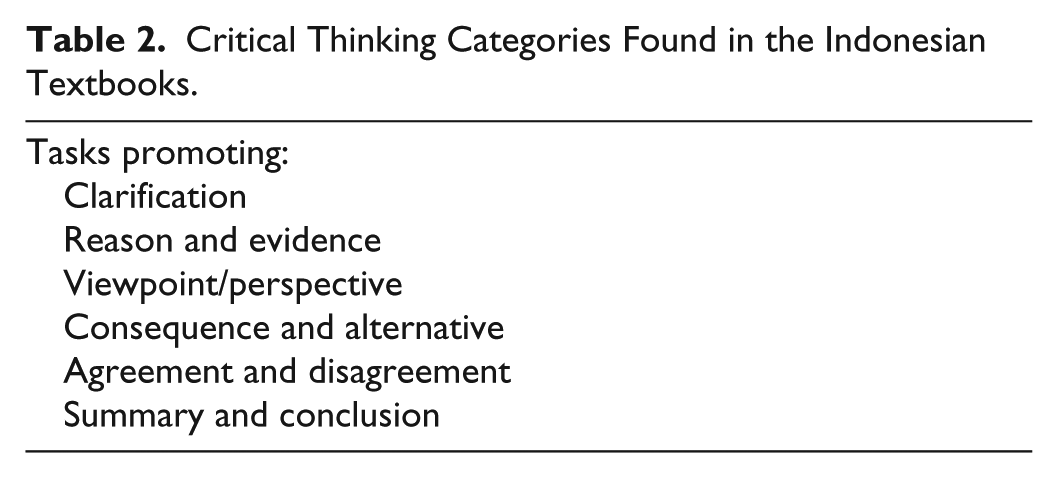
The first category contained in the textbooks was “clarification.” The percentage of tasks promoting this element of critical thinking was small at about 2%. This seems inadequate considering that the textbooks contain a lot of tasks. Many authors (e.g., Elder & Paul, 2009; Ennis, 1996) stress the importance of clarification, arguing that one of the characteristics of critical thinkers is that they can express their ideas (oral and written) clearly. Besides this, most critical thinking taxonomies, programs, and strategies list clarification (clarity) as an important element of critical thinking. This can be understood because clarity may be the result of clear thought, and “real” critical thinkers think clearly (Ruggiero, 2012).
The examples of tasks in the Indonesian language textbooks relating to clarification that encourage critical thinking can be categorized into several types; the examples herein have been translated into English. The first type includes tasks that ask students to clarify the meaning of words, as shown in the excerpt below.
What does it mean by carbon? What does “I” mean in this poem?
Regardless of their simplicity, these two tasks ask students to clarify words. The former is a question taken from a text in one of the textbooks, while the latter is a question following a poem. Even though to some extent these two tasks require students to think, they may not really promote deep thinking if students are not asked to elaborate on their answers or if students already know the meaning of the words. Teachers, therefore, need to expand these clarification tasks so as to encourage students’ interpretations, thus encouraging their reasoning, a concept that also belongs to the critical thinking categories.
Other clarification tasks that can promote greater critical thinking compared with the word clarification can be categorized as “term” clarifications. The term term herein refers to a phrase or sentence. For example, a task in one of the textbooks asks students to clarify a term as can be seen below: Living things are grouped into two, namely plant and animal. There is a view stating that a human is a thinking animal. What does the term mean?
The task asking what “human is a thinking animal” means could be a bit more difficult than the previous task as students need to explain their responses. However, like the word clarification task, the term clarification task may not enhance students’ critical thinking skills if students do not explain their responses in depth. To accommodate this, teachers can provide more clarification tasks by asking more questions asking the meaning of students’ responses or asking them to clarify their responses, thus combining two critical thinking categories: clarification and reason.
Another type of clarification task is textual clarification. This type of task asks students to clarify the whole text. Textual clarification may promote students’ critical thinking skills more effectively compared with the other two as students need to read the whole text and interpret it more deeply. The examples of textual clarification found in the textbooks are as follows: What is the meaning and messages of the text? This text contains a satire. To whom does it refer to?
These two tasks require students to read the whole text. In the second task, even though it only asks for the reference of the satire, it actually asks students to read the whole text to clarify who the satire refers to.
The second critical thinking category found in the textbooks is “reason.” Reasoning has been included as a critical thinking skill in almost all critical thinking taxonomies, programs, strategies, and tests since it is the skill that requires people to have deep thinking before reasoning. Two examples of tasks asking students to reason are as follows: From the text, which point is the procedure? Give the reason. Identify points supporting economic and political side of workers, and give the reason.
In the first task, students are asked to read a text and identify points in the text that belong to procedure. Then they are asked to give reasons why. However, this does not really encourage critical thinking as a trigger to help students learn to reason. The type of task promoting reasoning can be enhanced by the second task asking students to give reasons for their opinions. This kind of task can be expanded by teachers to different topics.
Tasks promoting reasoning can really encourage critical thinking when students are asked to present evidence, or students are asked to present the evidence proposed by the text writer that supports his or her main proposition or claim. However, tasks asking students to give evidence as a part of strategies to encourage reasoning are rare. This category needs to be promoted by the language teachers. For example, regarding the task “Identify points supporting economic and political side of workers, and give the reason” earlier, students are not only encouraged to give reasons but also asked to give evidence supporting their reasons since reason and evidence are two related aspects.
With regard to “viewpoint or perspective,” another category of critical thinking, the textbooks predominantly demonstrate this category compared with the others. This may be because asking for someone’s opinion is relatively easy even though the writers of the textbooks might not intentionally include this category as a task to promote critical thinking. For the writers, this inclusion might be for the variation of tasks because there is no information in the books about critical thinking tasks.
This category of critical thinking falls into several types. As shown in the excerpts below, the first type is a viewpoint related to literary works: What is the purpose of this poem? What do you feel when reading it? What message do you get from the poem? What is the relationship of the poem to our lesson?
These four tasks ask students to give perspectives regarding the poem. The answers could be different, and there is no right or wrong answer as long as they are able to explain their responses. This, however, can build students’ confidence in expressing themselves and help them to become independent students (thinkers). As mentioned, thinking independently is one of the criteria of critical thinkers (Ruggiero, 2012). Furthermore, Indonesian teachers need to expand the tasks to not only poems but also other literary works such as short stories or drama.
Another type of viewpoint tasks is those asking for students’ perspectives on the content of the text. For example, there is a text about carbon dioxide for which the tasks following the text ask student to give comments, as cited in the following: Why is carbon dioxide used as a fire extinguisher? Explain your answer, not only based on the content in the text. Is carbon good or bad for us? What harm can carbon cause?
These tasks can in fact be explored by teachers. For instance, they ask from not only students’ perspectives but also writers’ perspectives or environmental experts’ perspectives. This may be difficult but could also act as a trigger for encouraging critical thinking skills. Besides this, the second task mentioned can be combined with reasoning because the task cannot encourage students’ critical thinking skills if the answer is only “yes” or “no.” Teachers themselves, therefore, must be creative (or even critical) when dealing with uncritical tasks.
The next category of critical thinking that appears in the textbooks is “consequence and alternative.” This kind of task asks students to propose alternatives and mention consequences, as can be seen in the two excerpts below: How many alternatives are there if a driver breaks the traffic rule? What are the consequences if one or all of the steps are not conducted?
This kind of task can trigger students to think. When used appropriately by teachers, this task can promote students’ critical thinking because students can think more deeply. These tasks can also be combined with the viewpoint task; for example, students can be asked to give opinions regarding their proposing alternatives.
Another type of task that belongs to the category of critical thinking and has the potential to promote students’ critical thinking skills is “agreement and disagreement.” Agreement and disagreement tasks can promote critical thinking since students need to explain why they agree or disagree. Thus, this task is closely related to the viewpoint or perspective category. As has been mentioned, teachers need to be creative and critical when dealing with tasks that have the potential to promote critical thinking. Without a “why” question following the agreement and disagreement category, this task may not encourage deep thinking. Examples of this type of task that need to be expanded with a “why” question can be seen in the following: Do you agree that the recent education system in this country gives students a chance to opine? Do you agree that expository text is a text to express one’s opinion?
Finally, the last category is “summary and conclusion.” Few tasks that belong to this category have been found in the textbooks. Several critical thinking taxonomies, programs, and strategies include summary and conclusion as critical thinking activities. This may be because summarizing and concluding require students to read, analyze, and evaluate, and they need to present their summary and conclusion clearly, which also requires clear thinking. Most of the tasks found in the textbooks merely ask students to summarize the text, as shown below: Make a summary of the text. Make a summary of the text in one paragraph only.
Altogether, the critical thinking tasks identified in the Indonesian textbooks are rare. Besides this, not all categories are found in the textbooks. Among the categories not contained in the textbooks are “assumption” and “question.” These two categories are important for students because an “assumption,” for instance, will influence human life. Communication among humans or perceptions of life are mostly built based on assumptions. When the wrong assumption is adopted, it could harm the communication process that could lead to misunderstanding. Tasks dealing with assumption, therefore, need to be promoted at school.
The Indonesian textbooks also contain a limited variety of critical thinking tasks. This might be due to several factors. First, textbook writers lack creativity in designing tasks that promote critical thinking skills because of unclear conceptions of critical thinking suitable for the Indonesian setting even though the government has included critical thinking as an educational objective. Second, the concept of critical thinking itself is elusive, so a lack of knowledge in this regard influences the education product (i.e., textbooks). Therefore, teachers themselves need to be creative in modifying tasks provided by textbooks.
The findings of this study are not markedly different from previous studies investigating critical thinking in English textbooks. With regard to Ilyas’s (2015) study, investigating Indonesian English textbooks for senior secondary students, the findings of this study confirm that school textbooks used in Indonesia need more activities that can encourage students’ critical thinking. Activities promoting critical thinking need to be included in the textbooks at all levels of education. Besides this, such activities potentially encouraging students’ critical thinking should be added.
Conclusion
This study has ascertained that the elements of critical thinking are found in the Indonesian language textbooks. However, the number is not significant. The findings of this study may urge textbook writers to include more tasks promoting critical thinking skills. Finally, the educational authority in this country needs to seriously promote critical thinking by including it in textbooks and determining the objectives of teaching it. Further studies exploring critical thinking and course materials need to be conducted to examine the elements of critical thinking in nonlanguage textbooks. When new elements are found, they could contribute to language learning. This will enrich the strategies teachers can employ when modifying activities from the textbooks. Such a study can also be adopted by textbook writers as an idea to consciously incorporate critical thinking skills into teaching materials.
There are some possible contributions this study may offer. With regard to the Indonesian context, critical thinking has been included in the educational objectives. The Regulation of the Republic of Indonesia Number 17 Year 2010 Article 77 number b states that “secondary education aims to produce graduates who are knowledgeable, critical, creative, and innovative” (The Ministry of Education and Culture). The appendix of the regulation informs that the word “critical” means critical thinking. However, there is no specific information as to the percentage of critical thinking components or kind of critical thinking that should be taught. Since critical thinking is already part of educational objectives, Indonesian textbooks can play an important role in promoting students’ critical thinking skills. The findings of this study in terms of the extent to which critical thinking has been incorporated in the textbooks can provide an insight for policymakers or textbook writers to seriously take critical thinking into account.
Footnotes
Declaration of Conflicting Interests
The author(s) declared no potential conflicts of interest with respect to the research, authorship, and/or publication of this article.
Funding
The author(s) received no financial support for the research, authorship, and/or publication of this article.