



Abstract
The wide reliance of the tourism industry on the natural environment, local facilities, and transportation require to be catered through sustainable tourism indicators. However, the literature lacks in the careful assessment of sustainability indicators. In light of this, the present study aims to develop and validate the sustainable tourism indicators, particularly by introducing two novel dimensions of sustainable tourism, that is, infrastructural and technological sustainability, alongside the traditional dimensions. Methodologically, the Delphi method is used to reduce the initial list of indicators as a qualitative method, and the survey method is used to collect data for the selected cities of Pakistan as a quantitative method, with 450 responses. Subsequently, different methods including Confirmatory Factor Analysis (CFA) and Structural Equation Modeling (SEM) are used to assess the validity and reliability. Based on the broad-based participation of key stakeholders, out of 192 indicators, only 56 robust indicators, free from multicolleanirity, good internal consistency, convergent validity, and discriminant validity are retained. Results of the study highlight that comprehensively developed and validated indicators have improved the explanatory power of sustainability measurement, necessary for sustainable tourism development and monitoring of destinations. Theoretically, this study contributes to the literature by developing and validating sustainability indicators by expanding sustainable tourism dimensions. Practically, the verified and validated sustainability indicators are robust for policymakers and destination managers of the developing countries to formulate strategies and monitor the development of sustainable tourism.
Introduction
The dynamic tourism industry is complex along with symbiotic relationships. Until the COVID-19 outbreak, the tourism industry showed substantial growth by receiving 1.5 billion international tourist arrivals in 2019 (UNWTO, 2020), while international tourist arrivals achieved 97% of the pre-pandemic levels (UNWTO, 2024). Such an increase resulted in several positive impacts related to employment opportunities, residents’ income, better transportation opportunities, and cultural heritage preservation (Wang et al., 2020). Globally, the tourism industry supports 10% of jobs, and international tourism receipts were $1.55 trillion in 2019 (World Bank, 2020). Hence, many emerging economies emphasize the development of the tourism industry to reap financial benefits (Lee & Jan, 2019; Mohamadi et al., 2022; Wang et al., 2020). In this regard, protecting reefs and beaches, taking care of forests, and creating wildlife parks are some of the positive impacts of tourism (Fletcher et al., 2017).
At the same time, the adverse impacts related to the natural environment, economic and socio-cultural concerns got considerable attention (Asmelash & Kumar, 2019; Lee et al., 2021; Rasoolimanesh et al., 2023). In this vein, the lack of benefits to the local communities and residents, higher level of real-estate prices, and promotion of the prostitution industry, increased noise level, reduced water quality, electricity needs, and poor air quality due to carbon emissions, over-tourism, social tension due to wealthy tourists and tax burden are some of the adverse impacts (Jia et al., 2023; Lee, 2013; Seraphin & Chaney, 2023). Such adverse global impacts of this industry are the central point of debate among academicians and its stakeholders. The role of stakeholders is vital for sustainable tourism development, such as empowering residents proved essential for supporting sustainable tourism development (Gautam & Bhalla, 2024). Hence, the concept of sustainable tourism emerged during the 1980s, and sustainability in the tourism industry has been widely discussed (Agyeiwaah et al., 2017; Lee, 2013; Lee & Jan, 2019). Likewise, several researchers and institutions (Asmelash & Kumar, 2019; Bell & Morse, 2012; Dupeyras & MacCallum, 2013; European Commission, 2009; Ko, 2005; Miller, 2001; UNWTO, 2004), among others have attempted to address such adverse impacts for the sustainability of tourism industry. Traditionally, three dimensions of sustainable tourism are considered related to environmental, economic, and socio-cultural sustainability (Lee & Hsieh, 2016).
In the vein of sustainable tourism, the importance of better infrastructure and technology is undeniable. Therefore, along with the three traditional dimensions, sustainable tourism should include some additional dimensions, particularly infrastructural and technological sustainability (Asmelash & Kumar, 2019). Despite this recommendation, the existing literature on sustainable tourism remains undeveloped. In addition, literatrure is evident that the use of indicators to monitore tourism sustainability is reliable, simple, flexible, and suitable for both quantitative and qualitative data (Schianetz et al., 2007). While majority of studies overlooked their careful assessment and evaluation for higher validity and reliability to ensure their robustness (Blancas et al., 2010; Lee & Hsieh, 2016; Rebollo & Baidal, 2003; Reihanian et al., 2015). Moreover, the inclusion of Deriving forces-Pressure-State-Impact-Response (DPSIR) is uncommon to consider (Choi & Sirakaya, 2005; Eriksson et al., 2006; Miller, 2001; UNWTO, 2004). The issues related to assessment could be tackled through the application of Structural Equation Modeling (SEM), particularly related to validity and reliability.
Thus, this study is valuable in fulfilling the research gaps mentioned above by investigating two novel dimensions of sustainable tourism, including infrastructural and technological sustainability, and attempting to provide a comprehensive set of indicators related to the three traditional and two novel dimensions. In this vein, infrastructural and technological dimensions are not only complementary factors but also essential enablers of tourism development. Important infrastructural services, such as roads, transportation networks, and power supplies, are essential requirements for smooth operations and necessary for tourism sustainability (Boers & Cottrell, 2007; Javed & Tučková, 2020; Johnston & Tyrrell, 2005; Munir et al., 2025). In an analogous vein, digital connectivity and technological sustainability is essential for tourism in the contemporary era (Rantala et al., 2018; Rasoolimanesh et al., 2025; Shafiee et al., 2023). Therefore, this study explicitly includes these two dimensions in tourism sustainability, which are not only enabling conditions as a foundation for tourism growth but also provide avenues for long-term viability.
Moreover, by taking into account criteria such as multicolleanirity, good internal consistency, convergent validity, and discriminant validity, the assessment will give validated indicators. Hence, the study gives original contributions by explicitly introducing two novel dimensions of sustainability, the carefully assessed and validated indicators, by including the relevant stakeholders in the indicators development procedure. Such developed indicators will be robust and helpful for assessing and measuring tourism sustainability at the destination level.
Literature Review
The concept of sustainable tourism has been conceptually discussed immensely (Butler, 1999; Hunter, 1997). This discourse led toward the development of indicators, particularly for the operationalization and measurement of sustainability (Ko, 2005; Miller, 2001). Earlier frameworks of sustainability measurement and indicators development focused more the environmental and economic dimensions, while overlooked socio-cultural and political factors (Torres-Delgado & Palomeque, 2014). However, over the years, researchers attempted to reconcile the dimensions of sustainable tourism (Asmelash & Kumar, 2019; Miller & Torres-Delgado, 2023; Rasoolimanesh et al., 2025; Torres-Delgado et al., 2023). However, the academic community is continues to disagree on the conceptualization and measurability.
During the last three decades, several issues of tourism and sustainability discussed in the literature have been in the limelight due to their environmental, economic, and socio-cultural impacts (Lee & Hsieh, 2016). It creates copious reasons to evaluate tourism performance and impacts consistently (Cernat & Gourdon, 2012). The concept of sustainability in the tourism industry is still immature due to its immeasurability and achievability (Ko, 2005). Therefore, sustainability is only doable through sturdy monitoring and necessary corrective measures to tackle the related adverse impacts (Dimoska & Petrevska, 2012; UNEP, 2009). Sustainability in the tourism industry requires good indicators for assessing and measurability of tourism impacts. Sustainable tourism is not merely the physical environment, which is focused in the literature (Nguyen & Su, 2021). However, different dimensions requires inclusion (Bramwell & Lane, 2008; Holden, 2003). Therefore, indicators are considered to be a necessary tool of measurability and are being used in practice to get essential information related to sustainability (Castellani & Sala, 2010).
Since the Earth Summit of United Nations in 1992, the use of indicators has increased for assessing sustainability and consequently different organizations recommended different indicators (Vera & Ivars, 2003). Initially, in 1994, the International Federation of Tour Operators developed sustainability indicators in the vein of the European Community Models of Sustainable Tourism project (Hughes, 1994). Besides, the comprehensive guidelines by the World Tourism Organization (WTO) in the year 1995 and then the updated version in the year 2004 are regarded to be a beneficial guidebook for policymakers, researchers, and relevant stakeholders (Manning, 1996; UNWTO, 2004). Besides, the German Federal Environmental Agency (2001) also developed indicators, national sustainable tourism indicators of 2002 by the English Tourism Council (2002), and indicators suggested by the French Institute for Environment (Rechatin & Dubois, 2000) are pretty prominent in the literature. Hence, these indicators and such indicators developed by other researchers are helpful to measure and monitor sustainability in the tourism industry. At the same time, indicators must be efficient, user-friendly, and fulfill the needs of the stakeholders, which is lacking in the literature.
In the recent literature, two main trends have emerged. Firstly, the context-specific indicators have become more important due to the localized pursuits and institutional capabilities (Rasoolimanesh et al., 2025; Torres-Delgado et al., 2023). Secondly, the academic debates and discussions are continure on the universal and customized architectures. Importantly, the frameworks provided by the Global Sustainable Tourism Council (GSTC) and European Tourism Indicator System (ETIS) offer comparisons but developing destinations have different realities and face diverse challenges (Blancas et al., 2010; Choi & Sirakaya, 2005). From the recent years, increasingly scholars are proposing an exhaustive and comprehensive framework of the sustainable tourism in the developing countries, particularly toward the dimensions of infrastructure and technology (Kürüm Varolgüneş et al., 2025; Rasoolimanesh et al., 2025; Shafiee et al., 2023).
Despite the developments mentioned above, issues related to sustainability lack consensus, particularly its exact meaning and components (Bell & Morse, 2012; Dimoska & Petrevska, 2012; Javed & Tučková, 2018; Weaver et al., 1999). Ko (2005) considers sustainability as an unachievable aim and immeasurable target, so higher validity and reliability require logical assessment of methodologies to enhance confidence in the results due to the unpredictable and dynamic nature of the tourism industry (Asmelash & Kumar, 2019). Moreover, all the aspects of the tourism industry need to be considered for long-term sustainability (Sedai, 2006), while the tools developed for the assessment of impacts are somehow inadequate (Asmelash & Kumar, 2019), which creates difficulty in the practical assessment of sustainability (Choi & Sirakaya, 2005; Ko, 2001, 2005). Although there are many indicators in the literature, a few have been practically implicated and evaluated (Lee & Hsieh, 2016; Reihanian et al., 2015).
Likewise, the practical use of sustainability often hampers due to the conceptual and technical difficulties (Miller & Torres-Delgado, 2023; Samancioglu et al., 2024; Torres-Delgado & Saarinen, 2013; Vilà et al., 2010), as well as less consensus of scholars over identical use of indicators (Cernat & Gourdon, 2012). Such circumstances require careful assessment for higher validity and reliability, while the majority of studies overlooked these criteria (Reihanian et al., 2015), and the application of structural equation modeling (SEM) is recommended to address such issues (Ap & Crompton, 1998; Choi & Sirakaya, 2005). Hence, this research considers such matters to ensure the robustness of results by using SEM.
Furthermore, total variance explained (TVE) is often up to the moderate level, as 49.008% in the study by Asmelash and Kumar (2019). Therefore, they suggested to include additional dimensions of sustainability, particularly dimensions related to infrastructural and technological sustainability. Such focus will pay explicit attention to the suggested dimensions along with their indicators, covering the issues of better roads, water, electricity, public transport, availability of Wi-Fi, online ticketing system and the option to use payment cards (credit/debit cards), which are overlooked aspects in the context of tourism sustainability.
In the recent literature, the complexity of monitoring sustainability prevails, and the infrastructural and technological importance has grown in achieving sustainability. In this vein, Rasoolimanesh et al. (2025) aligned the sustainable tourism indicators with sustainable development goals (SDGs) and introduced some additional dimensions of sustainable tourism, such as technological sustainability, along with others, for the specific context of developing regions. Likewise, the indicators should cater needs of different stakeholders, such as the involvement of residents in tourism activities and their empowerment provides support for sustainable tourism development (Gautam & Bhalla, 2024). Moreover, the importance of technological innovations and infrastructural development is reiterated by Samancioglu et al. (2024) and Kürüm Varolgüneş et al. (2025), by highlighting their role in resource efficiency and improving tourist experiences. In a similar vein, Bekele & Raj (2025) and Schönherr et al. (2023) argued the crucial role of digital transformation in sustainability strategies for tourism destinations of the developing economies. Hence, the recent literature clearly highlights the need and rationale of this research by including infrastructural and technological dimensions of sustainability.
Therefore, the research gap related to the new dimensions of sustainability, particularly infrastructural and technological sustainability for improving total variance explained (Asmelash & Kumar, 2019; Miller & Torres-Delgado, 2023; Torres-Delgado et al., 2023), until now, prior studies have not concentrated on this gap so far. Similarly, most of the previous studies focus on the developed countries, while the emprircal evidence from the developing countries, such as Pakistan, lacks. In addition, a few studies employed mixed-method approach for developing and validating the sustainability indicators. Hence, the present study attempts to fill this gap by introducing two new dimensions of sustainability by focusing on the robust assessment criteria such as free from multicolleanirity, good internal consistency, convergent validity, and discriminant validity, thus giving original contributions to the existing literature. Moreover, the developing country context and the employed mixed-method approach further strengths the contributions of this study.
Research Methodology
Research Design
This research study exploits a sequential mixed-methods approach for the fulfillment of research gaps and to achieve the objectives of developing and validating the sustainable tourism indicators by including two novel dimensions (see Figure 1). As compared to a qualitative or quantitative method, a mixed-method is preferable due to the better understanding of complex issues in a comprehensive fashion (Creswell & Creswell, 2017). Similarly, a mixed-method approach also helps to improve the validity and reliability of any study (Bell et al., 2022). In this study, the qualitative approach was employed to carry out the Delphi method for refining and achieving consensus. Besides, the quantitative approach was chosen to statistically verify and reliability and validity. Thus, this research design is compatible with the objectives of this research study and provides a comprehensive understanding (Creswell & Creswell, 2017).
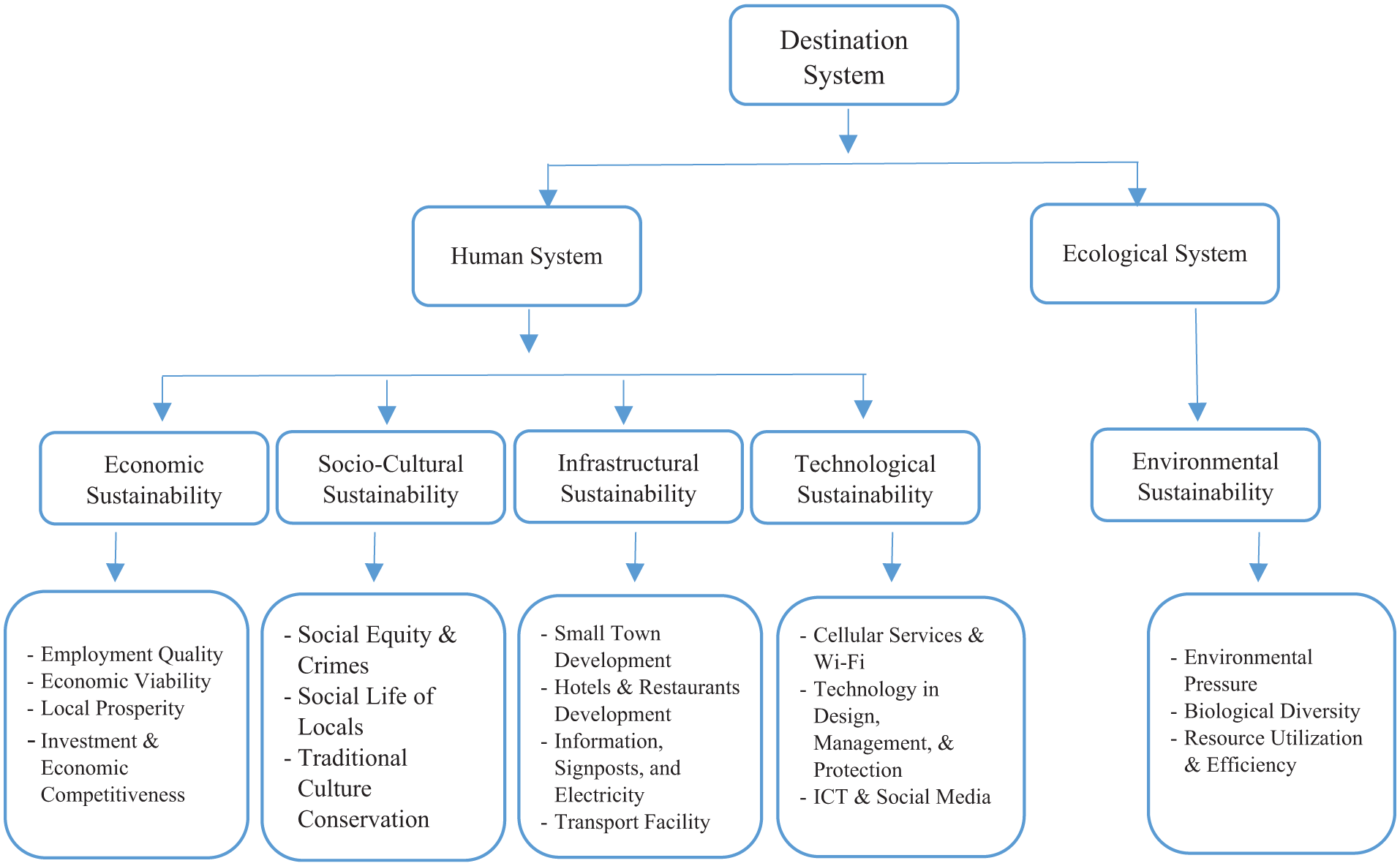
Destination system and assessment of sustainable tourism.
Study 1 (Qualitative Study)
In the vein of qualitative analysis, under the pragmatic approach of philosophical assumptions of eminent philosopher John Dewey, the Delphi method was employed, which relates the research in social sciences with practice and decision-making (Kirk & Reid, 2002). Further, in the context of qualitative inquiry, the use of the Delphi method is lacking in the literature (Brady, 2015). Hence, the present study has used the Delphi method as a qualitative analysis tool to get consensus-based indicators through expert opinions. In the first phase, two rounds of the Delphi method were carried out from October 2019 to December 2019, which allowed the experts sufficient time to provide feedback about the sustainability indicators.
Study 2 (Quantitative Study)
In the vein of quantitative analysis, a survey method has been employed. As argued by Creswell (2003), a survey method falls within the paradigm of positivism. This paradigm is a deductive approach in the methodological context (Saunders et al., 2009). Using the survey method and quota sampling, the data have been collected from three cities in Pakistan with 450 respondents, by including local tourists, domestic tourists, and international tourists. In this phase, data were collected through a structured questionnaire from January 2020 to March 2020. In this vein, a closed-ended questionnaire was used, which consisted of 61 indicators. Close-ended questionnaire provided detailed information to the respondents about the purpose of the research, assurance about their anonymity, and the free will of participation. All indicators were measured by using a five-point Likert scale, which ranges from 5 “Strongly Agree” to 1 “Strongly Disagree.”
Procedure of Indicators Development
The previous literature related to the development of the indicators is worthwhile, while certain aspects were overlooked in the indicators development procedure, such as the participation of key stakeholders. This study follows the appropriate approach to include additional indicators lacking in the literature (Ap & Crompton, 1998; Choi & Sirakaya, 2005; Miller, 2001). Notably, the study also ensures the participation of key stakeholders such as local residents, tourists, and experts from the selected destinations of Pakistan.
The initial stage of the indicator collection process turned out with 192 indicators from the literature. These indicators were identified from existing sustainable tourism frameworks and international guidelines, as well as peer-reviewed published research. More precisely, this study included indicators from the Global Sustainable Tourism Council (GSTC, 2013), European Tourism Indicator System of the European Commission (2016), and the guidebook of UNWTO (2004). Moreover, previously published studies by Asmelash and Kumar (2019), Agyeiwaah et al. (2017), Muresan et al. (2016), Blancas et al. (2010), Nicholas and Thapa (2010), Byrd et al. (2009), Shen and Cottrell (2008), Ko (2005), Choi and Sirakaya (2005), and Miller (2001). Collectively, a pool of 192 indicators was yielded.
Based on the fact that the number of indicators needed for assessing sustainability is obscure in the literature (Cernat & Gourdon, 2012). UNWTO (2004) suggested that 12 to 24 indicators are enough for sustainability monitoring and assessment. Another author recommended that 20 to 50 indicators are quite enough (Sors, 2001). In light of this, the indicators should be within reasonable limits, as more than 100 will be impractical. In line with these recommendations, this study uses the Delphi method to get consensus-based indicators and reduce them in number, as this method was previously adopted by Choi and Sirakaya (2005), Miller (2001), and Ap and Crompton (1998).
Based on the 5-point Likert Scale, which is suitable to reach the level of agreement and consensus (Giannarou & Zervas, 2014), experts have been selected from the relevant field. Such experts included faculty members of universities (12 experts), personnel from the local government (6 experts), and tourism organizations (4 experts). More precisely, experts were experienced professionals in their fields, faculty members were actively involved in research and peer-reviewed publication activities, local government representatives for tourism development, and non-governmental organizations involved in tourism. Further, experts were required to have a minimum of 5 years of professional experience. Hence, 22 professionals with their diverse understanding and tourism knowledge were selected from three destinations of Pakistan, namely Islamabad, Lahore, and Faisalabad. This selection criterion provides a balanced perspective with enhanced credibility and validity for the consensus and indicators development procedure.
Subsequently, the study used the two-round Delphi method to get indicators based on consensus. The first-round Delphi method invited 22 respondents by sending questionnaires to evaluate. While only 15 respondents returned the filled questionnaires, so response rate remained 68.18%. In the first round of the Delphi method, we obtained 40 consensus-based indicators. Then, in the second round of the Delphi method, a further 28 indicators reached consensus. Collectively, the two rounds of the Delphi method resulted in 68 consensus-based indicators (see Table 1).
Development of Indicators and Validation Phases.

Importantly, internationally accepted criteria for sustainability indicators were also provided to reduce subjectivity. These criteria included; the relevance of the selected indicator to tourism issues in the region (European Commission, 2009; Miller, 2001; UNWTO, 2004), clarity and ease of understanding among users (European Commission, 2009; UNWTO, 2004), the feasibility of obtaining and analyzing the information required (European Commission, 2009; UNWTO, 2004), the credibility of the information and reliability for users of the data (UNWTO, 2004), comparability over time and across regions (Tanguay et al., 2013; UNWTO, 2004), limited in number, broad coverage of each indicator (European Commission, 2009). At the same time, the respondents of the Delphi method were also requested to recommend any additional indicators not included in the list.
The second round of the Delphi method included 18 respondents, less than the first round to reduce subjectivity (Choi & Sirakaya, 2005). Out of these 18 respondents, 13 participants returned filled questionnaires (72.22% response rate).
Purification of the Indicator Development
A pilot study is considered vital to obtain clarity and the validity of key elements (Cohen et al., 2017). In this way, ambiguities related to research instruments can be minimized (Choi & Sirakaya, 2005). Isaac and Michael (1995) recommended that a sample size between 10 and 30 is enough, as easy calculation, simplicity, and hypotheses testing are some of the advantageous aspects of such a sample size. Likewise, Johanson and Brooks (2010) argued 30 participants as a reasonable number, however, recommended to include a few more participants as a better option.
In light of the above guidelines, the questionnaires were distributed to 50 respondents, by including key stakeholders such as residents, tourists, and experts, through a convenient sampling method, to rate the indicators on the Likert Scale (anchored as, 1 = strongly disagree, 2 = disagree, 3 = neutral, 4 = agree, and 5 = strongly agree). Out of the 50 distributed questionnaires, only 37 (i.e., 74%) were usable and valid.
The study employed corrected item-total correlations (CITC) to analyze reliability, as Choi and Sirakaya (2005) recommended that instruments with higher correlations are better. Several studies used item-total correlation for the purification process. For example, Wolfinbarger and Gilly (2003) suggested its use with a cut-off point of 0.5 or higher as a purification criterion of items. Hence, unnecessary items with lower correlations can be discarded through this process. While, Krishnaveni (2008) indicated that the corrected item-total correlation (CITC) is good enough to explain the share and contribution of each item for internal consistency. The only difference between these two is the exclusion of the relevant item from the scale score (Nunnally & Bernstein, 1994). Therefore, the items with a CITC coefficient below 0.5 have been discarded in the purification process vein and improve the overall reliability (Asmelash & Kumar, 2019; Krishnaveni, 2008).
Research Context and Sampling
This study intentionally selected the tourism destinations of Pakistan based on the fact that the improved security and better law and order situation is enticing tourists with impressive growth over the past decade. Therefore, the number of tourists is continuously rising; the 300% increase in international tourist arrivals is a shred of clear evidence (PTDC, 2018). The Pakistani tourism industry has immense potential due to its diverse heritage, landscape, diversity, adventure, and history. A recent study by Rehman et al. (2020) also demonstrated the positive impact of tourism on economic growth in Pakistan. However, the studies often fail to discuss tourism and sustainability in the Pakistani context. Therefore, this study took the case of Pakistan and its selected destinations from three cities to develop validated sustainability indicators (see Figure 2).

Tourism destinations and attractions.
The selected cities of Pakistan are Islamabad, Lahore, and Faisalabad, due to certain reasons. Firstly, these cities are peaceful, and the security situation is well-maintained. Secondly, the offices for tourism development are active in these cities with specific programs for promoting tourism, especially enticing tourists from foreign countries. Thirdly, these three cities are not impacted by seasonal variations and receive tourists throughout the year. More particularly, Islamabad is the capital city of Pakistan, is a planned urban destination with modern infrastructure, adventurous Margalla hills, and multiple cultural sites, which makes this destination as an emerging tourist destination. Lahore is the provincial capital of the province, Punjab, considered the cultural and heritage center of Pakistan. In this tourism destination, the developed tourism infrastructure, tourist management, and cultural sustainability are the hallmark for tourism potential. Faisalabad is the commercial and industrial hub of the country, which is an emerging urban tourism destination. This destination has a rich history with developed infrastructure and technological readiness. Overall, these three destinations have tourism development, geographic representation, accessibility, and policy relevance.
The sample consists of data from the above three destinations. During the data collection, five attractions were selected with a usable sample of 150 respondents from each destination. The attractions chosen from the city of Islamabad are the Pakistan Monument, Faisal Mosque, Saidpur Village, Lakeview Park, and Daman-e-Koh. Similarly, the selected attractions from Lahore city are Lahore Fort, Badshahi Mosque, Shalimar Garden, Minar-e-Pakistan, and Masjid Wazir Khan. Likewise, the selected attractions of Faisalabad city are the Lyallpur Museum, Jinnah Garden, Fun Dunya Amusement Park, Chenab Club, and Clock Tower. Hence, the sample from three destinations consists of 450 respondents from the three cities, including local tourists (45.33%), domestic tourists (48.67%), and foreign tourists (6%). In this research, local tourists are the residents of the same city who visit different tourist attractions within the same destination for the purpose of leisure and recreation. Contrary to the local tourists, domestic tourists are tourists from other regions or cities visiting these destinations.
It is essential to mention that the sample size is large enough to apply Factor Analysis and Structural Equation Modeling (SEM). In this vein, several authors suggested that a sample size of at least 200 is appropriate for Structural Equation Modeling or similar statistical tests (Byrne, 2016; Kline, 2000; Iacobucci, 2010). Therefore, the present study fulfills the requirement of sample size quite adequately.
Data Analysis and Main Results
The research study employed the software IBM SPSS 25.0, and IBM AMOS 25.0 for the data analysis to achieve the objectives of this study.
Delphi Method and Indicators Selection Through Experts’ Consensus
As mentioned earlier, a questionnaire was prepared and sent to the experts. The questionnaire comprised 192 indicators including traditional sustainability dimensions and two newly proposed (i.e., infrastructural and technological sustainability). As Table 1 indicates that in the first round of the Delphi method, 22 experts participated, while only 15 experts (68.18%) returned questionnaires. The consensus was achieved by following two criteria that at least 51% should rate indicators either close to agree or strongly agree (Hackett et al., 2006) and the interquartile range to be at most 1 (Raskin, 1994; Rayens & Hahn, 2000). Therefore, all the indicators that fulfilled the above criteria were retained.
During the first round of the Delphi method, 40 indicators got consensus and the indicators of economic sustainability got consensus are, “number of local people/residents employment in tourism,” total fee collected by the community for access/use of community attractions” and “tourism development increased the community’s quality of life” are among the consensus-based indicators. Likewise, the indicators achieved consensus for other dimensions related to environmental, socio-cultural, infrastructural, and technological aspects.
During the second round of the Delphi method, a questionnaire consisting of 152 indicators was sent to 18 experts, while only 13 returned (72.22%). In round 2, the indicators such as “ratio of tourism employment to total employment,”“average tourism wage in community,” and “tourism creates new markets for our local products” are among the consensus-based indicators of economic sustainability. Similarly, consensus-based indicators were achieved for other dimensions, including traditional and two novel dimensions (see Table 1).
Pilot Study and Purification of Indicators
A pilot study is regarded as an essential part in the vein of the purification process of indicators. As mentioned in the research methodology section, the corrected item-total-score correlations (CITC) were calculated using the software IBM SPSS 25.0, and indicators with coefficient values below 0.5 were discarded. In this phase, 68 indicators were analyzed, and 61 indicators were retained by excluding 7 indicators (see Table 1).
Demographic and Descriptive Characteristics of Respondents
Descriptive statistics are regarded as very important to highlight the characteristics of the selected research sample, as descriptive statistics provide a better understanding of the sample through the measure of central tendency, dispersion, variability, and related demographic features. The statistics of the research sample from the selected cities of Pakistan, namely Islamabad, Lahore, and Faisalabad are based on specific categories such as local tourists, domestic tourists, and foreign tourists, gender, marital status, age, occupation status, and respondents’ level of education are important ones in this context. Table 2 shows the detailed demographic characteristics of the respondents along with their frequencies and percentages.
Demographic Characteristics of the Respondents.

Some important demographic characteristics depict that almost 60% of respondents were male and 40% were female, which indicates a balanced distribution. Age distribution indicates that the majority (37%) are between the age group of 21 to 35 years, followed by 34% between the age group of 36 to 45 years. Such an age distribution implies that mostly economically active tourists are dominant in tourism. In terms of education, 48% of the respondents were very educated and held master’s or bachelor’s degrees. Importantly, 45.33% respondents were local tourists, 48.67% respondents were domestic tourists, followed by 6% foreign tourists. The low percentage of foreign tourists is compatible with the actual tourism composition at the selected tourism destinations. In this vein, the report of the Pakistan Tourism Development Corporation (PTDC, 2023) indicates that domestic and local tourists account for over 90% of tourist arrivals at the selected destinations of Islamabad, Lahore, and Faisalabad. The proportion of international tourist arrivals is still limited compared to domestic and local visitations. Hence, the demographic structure of the sample aligns with the population’s parameters.
Verification of the Indicator Development
During this verification phase, a principal component analysis (PCA) was carried out on 61 indicators for the dimensionality determination related to the five sustainability dimensions proposed in this research study. The total variance explained (TVE) for the research sample is 68.842% for the five factors, adequate for behavioral and social sciences studies, as the loss of information is only 31.158%. Importantly, this total variance explained is better than the study of Asmelash and Kumar (2019), where TVE was only 49%. In addition, the overall value of Cronbach’s Alpha is .806, which satisfies the benchmark of .6, recommended by Nunnally and Bernstein (1994). Besides this, Kaiser-Meyer-Olkin (KMO) is a reasonable estimate of sample adequacy. In this context, Field (2017) and Hair et al. (2006) gave a classification of the KMO sample adequacy ratio in three categories; mediocre adequacy (0.5–0.7), good adequacy (0.7–0.8), great adequacy (0.8–0.9), and superb (above 0.9). Hence, this research study fulfills the requirement of a good adequacy ratio with a KMO value of 0.79.
Moreover, the Bartlett test of Sphericity is widely used to test the original correlation matrix. According to Field (2017), a significant value means that the correlation matrix is not an identity matrix. Hence, the significant Bartlett’s test suggests that the correlation among the indicators is adequate to apply PCA (Hair et al., 2006). In this study, the Chi-Square value for Bartlett’s test of Sphericity (Chi-Square = 3421.618) is significant and suggests that factor analysis is quite appropriate and suitable. Consequently, five indicators were excluded at this stage, and the indicators were reduced from 61 to 56. The indicators, “percentage increase in expenditure (groceries, transportations, and leisure, etc.),”“number of tourism businesses in ownership of the local community,”“smoke emission by vehicles and open burning affect the health and environment,”“poor air quality impacts the tourism activities,” and “my community overcrowded due to of tourism development” are the excluded ones.
Assessment of Multivariate Normality and Multicollinearity
The normality of the dataset was assessed through the skewness and kurtosis values (see Appendix A1), which were not exceeding +2 and −2, as recommended by Garson (2012). Besides, the Q-Q plot was used through SPSS software, which indicates the observed and expected alongside the straight line, thus providing sufficient evidence that the dataset is normally distributed (see Appendix A2). Similarly, the value of the Determinant for this study is 9.46E-04 (0.0009464), which is above the necessary value of 0.00001, indicating no multicollinearity problem. Therefore, these assessments of the multivariate normality and multicollinearity provide adequate justification to proceed with the inferential techniques, such as confirmatory factor analysis (CFA) and structural equation modeling (SEM).
Validation of the Indicator Development
Assessing Reliability and Validity
Reliability refers to the overall consistency of any used measure (Trochim & Donnelly, 2001) that consistently measures the corresponding construct (Field, 2017). In the vein of reliability assessment, the internal reliability, composite reliability (CR), and average variance extracted (AVE) should be satisfied by the measurement model. The value of Cronbach’s Alpha measures the internal reliability that underpins the strength of measuring items to measure the respective construct, with the recommended value of Cronbach’s Alpha greater than .7 to achieve internal reliability and consistency (Hair et al., 2006; Kline, 2000). While, composite reliability refers to the internal consistency and reliability of a latent construct, with the required value of CR to be 0.5 or higher (Holmes-Smith, 2001). Likewise, average variance explained (AVE) indicates the average percentage of variation explained by the items used for the measurement of a latent construct, the value of AVE is recommended to be 0.5 or more (Fornell & Larcker, 1981). Table 3 indicates that the corresponding values of internal reliability, composite reliability, and average variance explained (AVE) almost fulfilled the recommended level of reliability assessment.
Construct Reliability.

Source. Author’s own extraction from Amos output.
Proceeding ahead, the validity of the dimensions was analyzed through confirmatory factor analysis (CFA), which included the validity analysis, including the convergent, discriminant, and content assessment, based on the threshold values mentioned above. Notably, composite variables were formulated as their sub-dimensions in the vein of reliability and validity assessment, as suggested by Asmelash and Kumar (2019). Many authors explained the procedure and recommended the use of composite variables based on the convenience and situation at hand (Hair et al., 2006; Stylidis et al., 2014; Walkey, 1997). Consequently, CFA was exploited to assess the validity of the corresponding dimensions (see Figure 3).

Confirmatory factor analysis for the validity examination.
In the vein to confirm convergent validity, the standardized regression weight (SRW) and composite reliability (CR) are required to be 0.7 or greater, while the average variance explained (AVE) needs to be 0.5 or more (Fornell & Larcker, 1981; Hair et al., 2006). In light of this, the study fully achieved the convergent validity for sustainability dimensions related to economic, environmental, and technological aspects (see Table 4). However, the values are close to the threshold level for the socio-cultural and infrastructural dimensions, indicating that this validity is almost achieved.
Convergent Validity.
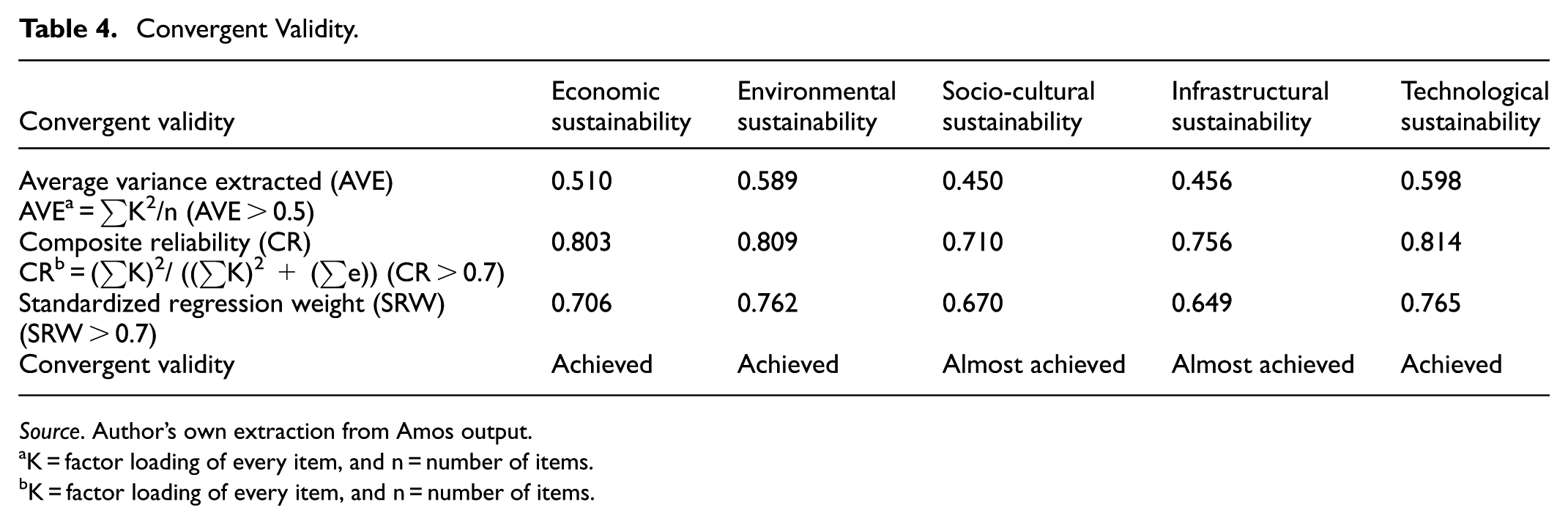
Source. Author’s own extraction from Amos output.
K = factor loading of every item, and n = number of items.
K = factor loading of every item, and n = number of items.
Similarly, another measure of validity, which is discriminant validity, represents that a measure of a construct is unique in representing the phenomena of interest more than any other measures (Hair et al., 2006). Precisely, to confirm discriminant validity, the AVEs of each construct need to be greater than the squared correlations of other constructs within the model. In this regard, Table 5 shows that the discriminant validity is achieved for almost all the constructs except for one combination, which is also close to achieving the required threshold level.
Discriminant Validity.

Source. Author’s own extraction from Amos output.
Discussion and Conclusion
During the last three decades, the widespread growth in international tourist arrivals linked with the easiness of traveling has had favorable and unfavorable impacts at the global, regional, and domestic levels. The positive and negative impacts of tourism development have been discussed in the literature, particularly related to the economic, environmental, and socio-cultural sustainability dimensions. Apart from these traditional dimensions, the literature discussed infrastructure and technology issues; however, these aspects are discussed implicitly in the vein of sustainability, particularly for the tourism industry, and have not been regarded as dimensions of sustainability yet.
In light of this, the present study incorporated two new dimensions of sustainability: infrastructural sustainability and technological sustainability, and attempted to assess the development and validation of sustainable tourism indicators. Consequently, the resulting set of robust indicators is helpful in the monitoring of tourism-related activities along with their impacts. The literature also recommends assessing and validating sustainability indicators, such as strongly suggested by Cernat and Gourdon (2012) and Ko (2005), yet its implication is overlooked in real cases. Moreover, the stress on the DPSIR framework by Eriksson et al. (2006), Choi and Sirakaya (2005), UNWTO (2004), and Miller (2001) for the rational utilization of natural resources and environmental conservation through the broad-based participation of the stakeholder. In actuality, such issues are in their initial stages of development. Keeping in view, this study fills the lacuna by adopting a participatory approach for the development of indicators and their validation in obtaining a comprehensive set of indicators for the measurement and monitoring of sustainable tourism.
Notably, the measurement of sustainable tourism is not possible in a direct way, and the breakdown of relevant issues in the form of indicators is required to monitor sustainability (Asmelash & Kumar, 2019). Likewise, the same indicators are not suitable for all tourism destinations (Cernat & Gourdon, 2012), and the issue of sustainable tourism is much more debatable in the literature (Ko, 2005). Logically, the issue of sustainability, its assessment, and the use of scientific methods should be at the forefront of countries’ priorities, while, the progress toward this end is little (Fernández & Rivero, 2009).
Considering the state of affairs and to achieve the objectives of this research study, a comprehensive set of sustainability indicators was obtained from the literature and experts. The study carried out two round-round Delphi method to get the consensus-based indicators, as the approach adopted in other studies (Ap & Crompton, 1998; Choi & Sirakaya, 2005; Miller, 2001). After two rounds of the Delphi method, out of 192 indicators, 68 indicators were obtained based on the consensus of experts in connection to the sustainability dimensions of environmental, economic, socio-cultural, infrastructural, and technological aspects. The purification phase was based on the pilot study also decreased the number of indicators from 68 to 61.
The collected data was from three destinations in Pakistan, precisely Islamabad, Lahore, and Faisalabad. The broad-based participation was ascertained to obtain a diverse opinion by including local residents, domestic tourists, and international tourists in the sample. The consensus-based and validated indicators for the economic dimension are partly akin to those of Asmelash and Kumar (2019), including similar indicators such as the “employment of local people/local residents,” and “level of economic diversification.” Similarly, UNWTO (2004) and Shen and Cottrell (2008) suggested indicators “number of local residents’ employment in tourism” compatible with this study. Such compatibility is also visible through the developed indicator “ratio of tourism employment to total employment” (Blancas et al., 2010; UNWTO, 2004), and “tourism generates substantial tax for the local government” (Choi & Sirakaya, 2005).
Similarly, the developed environmental sustainability indicators have a likeness to other researchers’ suggested indicators. The indicator “tourists cause pollution of the environment (water, air, and soil)” belongs to the sub-dimension and is akin to the indicators developed by Shen and Cottrell (2008) and Byrd et al. (2009). Likewise, the indicator “number of visitors results in the disturbance of plants and animals” is also mentioned in the studies of Nicholas and Thapa (2010) and Shen and Cottrell (2008). Similar compatibilities can be found for indicators of “increased exhaustion of water and energy resources due to tourist activities” (Blancas et al., 2010; Shen & Cottrell, 2008), “tourism activities contribute to the compiling of solid waste at the site” (Ramdas & Mohamed, 2014), “tourism development needs to be in harmony with natural environment” (Choi & Sirakaya, 2005; Streimikiene et al., 2021).
The developed indicators for socio-cultural sustainability in this research study are also akin to the work of other researchers. In this regard, the indicators of the sub-dimensions, “social equity and crimes,”“social living of locals,” and “traditional culture conservation” have compatibilities in the literature (Choi & Sirakaya, 2005; Nicholas & Thapa, 2010; Shen & Cottrell, 2008; Twining-Ward, 2003). However, such similarities are partly because certain destinations and geographical features have specific needs.
Importantly, the indicators developed for the novel dimensions of sustainable tourism, namely infrastructural sustainability, and technological sustainability are of great worth to Pakistan and similar destinations. In the literature, some authors implicitly discussed the issues related to infrastructural and technological sustainability as Shen and Cottrell (2008) stressed better infrastructure (water, electricity, roads, and public transport) for tourism development. UNWTO (2004) indicators concerning road construction and better accommodation facilities are related to infrastructure. Moreover, the indicators, availability of well-cooked food, comfy bars and cafes, and frequently available public transport were discussed by Munir et al. (2025). Therefore, this lacuna is filled by the present study by introducing these dimensions quite explicitly and developing their indicators.
The applicability of developed indicators in this study is worthwhile for developing regions, such as Pakistan. While, these indicators are also beneficial for other tourism destinations depending on their features and attributes. Importantly, geographical regions sharing socio-cultural aspects, particularly South Asian countries, such as Bangladesh, India, and Nepal, can benefit from these indicators. These indicators are also applicable at the global level, such as developed countries of Europe and America, but cautiously as some indicators appropriate in the developing countries’ context are not very relevant for developed states. In this vein, some indicators “availability of cellular services with good signals,”“free facility of Wi-Fi,”“online facility to buy tickets, and option to use credit/debit cards,” and “uninterrupted availability of electricity” lack significance within the framework of advance nations. In addition, the recommended way of developing, evaluating, and validating indicators for measurement and monitoring sustainability is quite helpful to replicate and get indicators based on consensus for the advancement of the tourism sector.
Theoretical Contributions
This study has important original contributions. Theoretically, the broad-based participation of related stakeholders, such as experts, local residents, and domestic and international tourists is often overlooked in the sustainability indicators development procedure (Ap & Crompton, 1998; Choi & Sirakaya, 2005; Miller, 2001; OECD, 1994). The present study addressed this issue by involving stakeholders in developing the indicators. It is uncommon to consider the framework of DPSIR (i.e., Driving forces-Pressure-State-Impact-Response; Eriksson et al., 2006), and very few researchers have considered this criterion (Amiryan, 2013; Asmelash & Kumar, 2019). Therefore, this study developed indicators related to driving forces, pressure, state, impact, and response in a balanced number.
This study departed from conventional aspects of sustainable tourism was evident by the addition of two new dimensions, infrastructural sustainability and technological sustainability. These new dimensions offer a comprehensive and expanded perspective toward the theory of sustainability. Importantly, these new dimensions have a dual role, which enables tourism development and sustainable tourism assessment. From the vein of infrastructure and technology, basic prerequisites such as roads, transportation, hotels, and power supplies, digital connectivity, online bookings, and ICT support provide the enablers of tourism in the initial stages (Javed & Tučková, 2020). After successful establishment in the initial stages, indicators confirm that tourism continues to grow by maintaining a healthy balance between ecology, culture, and the local community. In this vein, infrastructural development and technological progress are essential links for sustainable tourism development.
The aforementioned argument clarifies that the two new novel dimensions not only measure the tourism development but also capture sustainability through the efficient and responsible management of tourism. Particularly, the sustainability aspect comes to the forefront through resource efficiency, equitable access, and improved resilience. In this regard, a few indicators, such as “availability of uninterrupted electricity,”“efficient public transport,” and “use of ICT and smart technologies in tourism management” show the growth and development aspects but also sustainability perspectives by reducing emissions, minimizing waste, and improving the quality of life of tourists and residents.
Interestingly, the inclusion of two new dimensions in the sustainable tourism assessment, also improved the total variance explained (TVE) adequately (i.e., 68.84%), which was 49% in the study of Asmelash and Kumar (2019). In addition, the logical assessment of developed indicators is firmly recommended to ensure higher validity and reliability due to the changing and unpredictable tourism industry. Hence, the study’s contribution also includes the assessment approach to examine unidimensionality, normality, multicollinearity, reliability, as well as convergent and discriminant validity through CFA.
Practical Contributions
Practically, the study has strong implications for the tourism destinations, particularly facing limitations of resources, infrastructural, and technological constraints, which are common in the developing regions.
The developed sustainability indicators through verification and validation will help the destination managers, urban administrators, and policymakers to choose robust indicators for sustainable tourism development. For instance, such robust indicators are helpful for policymakers to make informed decisions, which is often hard to implement due to the unavailability of carefully developed indicators (Cernat & Gourdon, 2012). Again, developing countries often face underdeveloped infrastructure and technology, and carefully developed robust indicators will help to identify certain weaknesses, such as roads, transportation, hotels, power supplies, and digital connectivity, online tickets and booking systems, and Wi-Fi accessibility. In such a scenario, policymakers will get clearer directions to prioritize investment in infrastructure, advancement of technology, and initiatives to ensure sustainability. Hence, these indicators will identify critical areas that require real action, which is cumbersome and hard to identify.
Often, practitioners rely on conventional indicators such as Gross Domestic Product (GDP), Human Development Index (HDI), the number of tourist arrivals, and their spending (Bell & Morse, 2012). However, robust and validated indicators are helpful for destination managers to take needed actions and avoid wastage of resources. The robustly developed and validated indicators of this study will bridge such gaps and help developing countries in order to ensure sustainability and maintain a competitive edge in tourism development. Importantly, these indicators help to assess the progress toward sustainable development goals (SDGs), such as SDG 9 (innovation & infrastructure), and SDG 11 (sustainable cities and communities). Hence, the robust and carefully developed indicators of this study contribute to balanced growth and sustainability in developing regions.
Limitations, and Future Research Directions
Despite making substantial contributions, this study has certain limitations that provide opportunities and avenues for future studies. The selected destinations included in this study are from one province of Pakistan. In light of this, the indicators that were developed are better suited for similar destinations. However, tourist destinations in the northern areas of the country might not require a few indicators covering the issues of overcrowding and land prices. Hence, destinations with similar features and attributes are potential beneficiaries of these indicators.
Similarly, the developed indicators could be applied to the other regions’ destinations including countries of Europe and America. However, caution must be observed, as a few indicators are more relevant to the developing countries’ context and less suitable for the developed countries. Precisely, some indicators related to the availability of cellular services with good signals, a free facility of Wi-Fi, an online facility to buy tickets and an option to use credit/debit cards, and the uninterrupted availability of electricity are some examples of such indicators. The facility of free Wi-Fi is also provided in almost all tourist destinations in advanced nations. Similarly, the continuous availability of electricity is also not relevant for developed countries. Therefore, enthusiastic researchers can adopt and follow the proposed way of developing and validating sustainability indicators to obtain consensus-based indicators for popular destinations in Europe. Moreover, a comparative study of destinations can provide interesting insights for policymakers.
This study included only subjective indicators, which are based on the five-point Likert Scale. Monitoring sustainability through subjective indicators is somewhat difficult based on the five-point Likert Scale; therefore, the idea to include a 10-point Likert Scale is of great worth for better monitoring of sustainability and capturing a difference with clarity. Moreover, such subjective indicators vary from one destination to another, and the inclusion of objective indicators in future studies could provide valuable contributions to monitoring sustainability.
Footnotes
Appendix
Mean, Standard Deviation, Factor Loading, and Percent of Variance Explained of Constructs and Their Indicators.
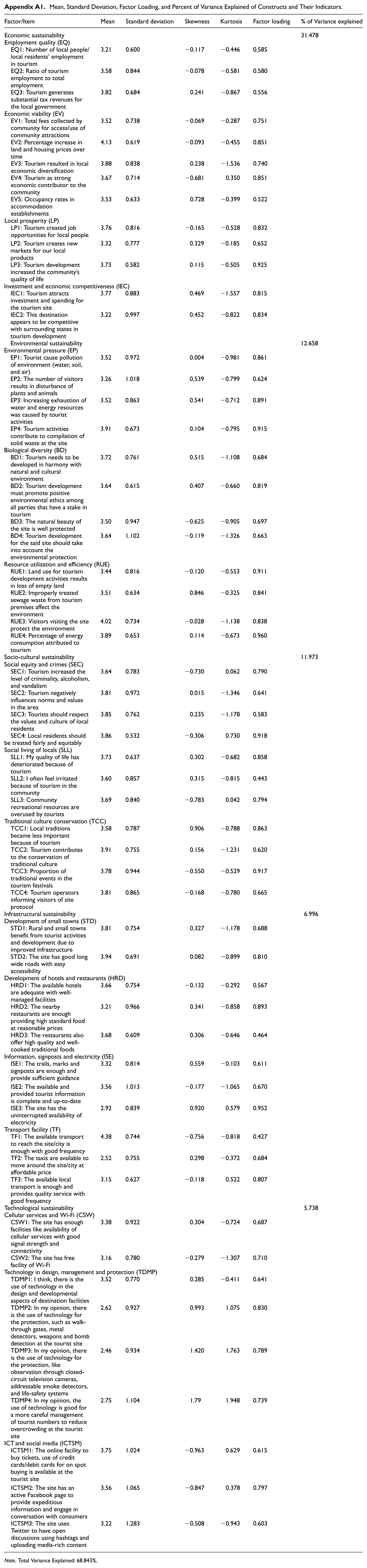
| Factor/Item | Mean | Standard deviation | Skewness | Kurtosis | Factor loading | % of Variance explained |
|---|---|---|---|---|---|---|
| Economic sustainability | 31.478 | |||||
| Employment quality (EQ) | ||||||
| EQ1: Number of local people/local residents’ employment in tourism | 3.21 | 0.600 | −0.117 | −0.446 | 0.585 | |
| EQ2: Ratio of tourism employment to total employment | 3.58 | 0.844 | −0.078 | −0.581 | 0.580 | |
| EQ3: Tourism generates substantial tax revenues for the local government | 3.82 | 0.684 | 0.241 | −0.867 | 0.556 | |
| Economic viability (EV) | ||||||
| EV1: Total fees collected by community for access/use of community attractions | 3.52 | 0.738 | −0.069 | −0.287 | 0.751 | |
| EV2: Percentage increase in land and housing prices over time | 4.13 | 0.619 | −0.093 | −0.455 | 0.851 | |
| EV3: Tourism resulted in local economic diversification | 3.88 | 0.838 | 0.238 | −1.536 | 0.740 | |
| EV4: Tourism as strong economic contributor to the community | 3.67 | 0.714 | −0.681 | 0.350 | 0.851 | |
| EV5: Occupancy rates in accommodation establishments | 3.53 | 0.633 | 0.728 | −0.399 | 0.522 | |
| Local prosperity (LP) | ||||||
| LP1: Tourism created job opportunities for local people | 3.76 | 0.816 | −0.165 | −0.528 | 0.832 | |
| LP2: Tourism creates new markets for our local products | 3.32 | 0.777 | 0.329 | −0.185 | 0.652 | |
| LP3: Tourism development increased the community’s quality of life | 3.73 | 0.582 | 0.115 | −0.505 | 0.925 | |
| Investment and economic competitiveness (IEC) | ||||||
| IEC1: Tourism attracts investment and spending for the tourism site | 3.77 | 0.883 | 0.469 | −1.557 | 0.815 | |
| IEC2: This destination appears to be competitive with surrounding states in tourism development | 3.22 | 0.997 | 0.452 | −0.822 | 0.834 | |
| Environmental sustainability | 12.658 | |||||
| Environmental pressure (EP) | ||||||
| EP1: Tourist cause pollution of environment (water, soil, and air) | 3.52 | 0.972 | 0.004 | −0.981 | 0.861 | |
| EP2: The number of visitors results in disturbance of plants and animals | 3.26 | 1.018 | 0.539 | −0.799 | 0.624 | |
| EP3: Increasing exhaustion of water and energy resources was caused by tourist activities | 3.52 | 0.863 | 0.541 | −0.712 | 0.891 | |
| EP4: Tourism activities contribute to compilation of solid waste at the site | 3.91 | 0.673 | 0.104 | −0.795 | 0.915 | |
| Biological diversity (BD) | ||||||
| BD1: Tourism needs to be developed in harmony with natural and cultural environment | 3.72 | 0.761 | 0.515 | −1.108 | 0.684 | |
| BD2: Tourism development must promote positive environmental ethics among all parties that have a stake in tourism | 3.64 | 0.615 | 0.407 | −0.660 | 0.819 | |
| BD3: The natural beauty of the site is well protected | 3.50 | 0.947 | −0.625 | −0.905 | 0.697 | |
| BD4: Tourism development for the said site should take into account the environmental protection | 3.64 | 1.102 | −0.119 | −1.326 | 0.663 | |
| Resource utilization and efficiency (RUE) | ||||||
| RUE1: Land use for tourism development activities results in loss of empty land | 3.44 | 0.816 | −0.120 | −0.553 | 0.911 | |
| RUE2: Improperly treated sewage waste from tourism premises affect the environment | 3.51 | 0.634 | 0.846 | −0.325 | 0.841 | |
| RUE3: Visitors visiting the site protect the environment | 4.02 | 0.734 | −0.028 | −1.138 | 0.838 | |
| RUE4: Percentage of energy consumption attributed to tourism | 3.89 | 0.653 | 0.114 | −0.673 | 0.960 | |
| Socio-cultural sustainability | 11.973 | |||||
| Social equity and crimes (SEC) | ||||||
| SEC1: Tourism increased the level of criminality, alcoholism, and vandalism | 3.64 | 0.783 | −0.730 | 0.062 | 0.790 | |
| SEC2: Tourism negatively influences norms and values in the area | 3.81 | 0.972 | 0.015 | −1.346 | 0.641 | |
| SEC3: Tourists should respect the values and culture of local residents | 3.85 | 0.762 | 0.235 | −1.178 | 0.583 | |
| SEC4: Local residents should be treated fairly and equitably | 3.86 | 0.532 | −0.306 | 0.730 | 0.918 | |
| Social living of locals (SLL) | ||||||
| SLL1: My quality of life has deteriorated because of tourism | 3.73 | 0.637 | 0.302 | −0.682 | 0.858 | |
| SLL2: I often feel irritated because of tourism in the community | 3.60 | 0.857 | 0.315 | −0.815 | 0.443 | |
| SLL3: Community recreational resources are overused by tourists | 3.69 | 0.840 | −0.783 | 0.042 | 0.794 | |
| Traditional culture conservation (TCC) | ||||||
| TCC1: Local traditions became less important because of tourism | 3.58 | 0.787 | 0.906 | −0.788 | 0.863 | |
| TCC2: Tourism contributes to the conservation of traditional culture | 3.91 | 0.755 | 0.156 | −1.231 | 0.620 | |
| TCC3: Proportion of traditional events in the tourism festivals | 3.78 | 0.944 | −0.550 | −0.529 | 0.917 | |
| TCC4: Tourism operators informing visitors of site protocol | 3.81 | 0.865 | −0.168 | −0.780 | 0.665 | |
| Infrastructural sustainability | 6.996 | |||||
| Development of small towns (STD) | ||||||
| STD1: Rural and small towns benefit from tourist activities and development due to improved infrastructure | 3.81 | 0.754 | 0.327 | −1.178 | 0.688 | |
| STD2: The site has good long wide roads with easy accessibility | 3.94 | 0.691 | 0.082 | −0.899 | 0.810 | |
| Development of hotels and restaurants (HRD) | ||||||
| HRD1: The available hotels are adequate with well-managed facilities | 3.66 | 0.754 | −0.132 | −0.292 | 0.567 | |
| HRD2: The nearby restaurants are enough providing high standard food at reasonable prices | 3.21 | 0.966 | 0.341 | −0.858 | 0.893 | |
| HRD3: The restaurants also offer high quality and well-cooked traditional foods | 3.68 | 0.609 | 0.306 | −0.646 | 0.464 | |
| Information, signposts and electricity (ISE) | ||||||
| ISE1: The trails, marks and signposts are enough and provide sufficient guidance | 3.32 | 0.814 | 0.559 | −0.103 | 0.611 | |
| ISE2: The available and provided tourist information is complete and up-to-date | 3.56 | 1.013 | −0.177 | −1.065 | 0.670 | |
| ISE3: The site has the uninterrupted availability of electricity | 2.92 | 0.839 | 0.920 | 0.579 | 0.952 | |
| Transport facility (TF) | ||||||
| TF1: The available transport to reach the site/city is enough with good frequency | 4.38 | 0.744 | −0.756 | −0.818 | 0.427 | |
| TF2: The taxis are available to move around the site/city at affordable price | 2.52 | 0.755 | 0.298 | −0.372 | 0.684 | |
| TF3: The available local transport is enough and provides quality service with good frequency | 3.15 | 0.627 | −0.118 | 0.522 | 0.807 | |
| Technological sustainability | 5.738 | |||||
| Cellular services and Wi-Fi (CSW) | ||||||
| CSW1: The site has enough facilities like availability of cellular services with good signal strength and connectivity | 3.38 | 0.922 | 0.304 | −0.724 | 0.687 | |
| CSW2: The site has free facility of Wi-Fi | 3.16 | 0.780 | −0.279 | −1.307 | 0.710 | |
| Technology in design, management and protection (TDMP) | ||||||
| TDMP1: I think, there is the use of technology in the design and developmental aspects of destination facilities | 3.52 | 0.770 | 0.285 | −0.411 | 0.641 | |
| TDMP2: In my opinion, there is the use of technology for the protection, such as walk-through gates, metal detectors, weapons and bomb detection at the tourist site | 2.62 | 0.927 | 0.993 | 1.075 | 0.830 | |
| TDMP3: In my opinion, there is the use of technology for the protection, like observation through closed-circuit television cameras, addressable smoke detectors, and life-safety systems | 2.46 | 0.934 | 1.420 | 1.763 | 0.789 | |
| TDMP4: In my opinion, the use of technology is good for a more careful management of tourist numbers to reduce overcrowding at the tourist site | 2.75 | 1.104 | 1.79 | 1.948 | 0.739 | |
| ICT and social media (ICTSM) | ||||||
| ICTSM1: The online facility to buy tickets, use of credit cards/debit cards for on spot buying is available at the tourist site | 3.75 | 1.024 | −0.963 | 0.629 | 0.615 | |
| ICTSM2: The site has an active Facebook page to provide expeditious information and engage in conversation with consumers | 3.56 | 1.065 | −0.847 | 0.378 | 0.797 | |
| ICTSM3: The site uses Twitter to have open discussions using hashtags and uploading media-rich content | 3.22 | 1.283 | −0.508 | −0.943 | 0.603 | |
Note. Total Variance Explained: 68.843%.

Ethical Considerations
This study involved human participants and was carefully designed to avoid any potential harm. The involvement of the experts and the survey respondents was voluntary. Participants were informed of their right to decline or withdraw from the study at any time. All responses were processed on an anonymous basis, and no personal and sensitive information was collected. The potential benefits of this study, such as the use of the sustainability indicators for the sustainable development of the tourism destinations, outweigh any minimal risks.
Consent to Participate
All participants provided written informed consent prior to their participation in this study, and their anonymity and confidentiality were strictly maintained throughout this research. Participants were informed about the objectives of this research, their right to refuse participation or withdraw at any stage.
Author Contributions
M.J. and Z.T. contributed to the conceptualization, methodology, software, validation, formal analysis, and original draft writing. M.J. was responsible for the investigation and visualization. Resources were provided by Z.T., while data curation was carried out by M.J. Supervision was provided by Z.T. All authors have read and approved the final version of the manuscript.
Funding
The authors disclosed receipt of the following financial support for the research, authorship, and/or publication of this article: This research was funded by the Tomas Bata University in Zlin, under the IGA project no. IGA/FaME/2023/017, and the RVO project no. RO/FaME/2024/07.
Declaration of Conflicting Interests
The authors declared no potential conflicts of interest with respect to the research, authorship, and/or publication of this article.
Data Availability Statement
Data will be available upon reasonable request