




Abstract
This paper meta-synthesizes educational action research projects grounded in the philosophy of Gilles Deleuze and Felix Guattari’s rhizomatic thinking. Utilizing Hoon’s theory-building protocol, we address the rhizo-researching educators’ varying results in the replicability and scalability of these projects, arguing that the digital divide is a key influencing factor. We introduce a novel redefinition of the Digital Divide as “(un)scalability and (ir)replicability of educational projects,” proposing that online technologies can significantly enhance their implementation, leading to more successful replication and scalability. Furthermore, in recognition of the French origins of rhizomatic philosophy, we propose “Écolent” as an esoteric concept, literally meaning “educational lens.” This term encapsulates the cognitive framework employed by educational planners, determining the overall, future reflection of the educational process. Our meta-synthesis identifies three distinct types of Écolent; Convex (Traditional), Boundary-Restricted Concave (Learner-oriented), and Glassy-Restricted Concave (Society-oriented), each reflecting varying degrees of interaction with the societal environment and influencing the quality of educational outcomes. As a concrete application, Écolent provides a comprehensive framework for Project-Based Learning (PjBL) methodologies, introducing “type of Écolent” as a seventh hallmark of PjBL alongside Krajcik and Shin’s established six. This new hallmark crucially reflects educational planners’ perspectives on intended outcomes and the extent of interaction with the societal environment, distinguishing levels of PjBL from traditional to fully society-oriented approaches. Finally, we categorize and compare rhizomatic projects against teacher-centered structures, highlighting how embracing societal-impacting, problem-oriented approaches can gradually diminish educational boundaries, fostering deeper engagement with real-world problems and enhancing learning utility and quality.
Plain Language Summary
MetaSynthesis of Educational Action Research Projects Practiced based on Rhizomatic Thinking explores the global expansion of Deleuze and Guattari’s post-modern philosophy in education. The study identifies learner-oriented and society-oriented as two types of rhizomatic projects and examines the varying results of these projects, with a focus on the key factor of the digital divide. The authors also introduce the concept of Ecolent, which refers to the way educational planners see their learners, society and the positions which future men and women are going to fulfill. The study found that open-access, online technologies can enhance the design and implementation of rhizomatic projects, but the digital divide can limit their scalability and replicability. The authors conclude that rhizomatic projects have the potential to transform traditional educational structures to a more actor-inclusive projects and promote more inclusive and democratic learning environments. Due to the few number of rhizomatic based educational projects conducted by rhizo-researching educators, this metasysnthesis may reduce the range of interpretations of the phenomenon. Despite this limitation, the results of the meta-synthesis offer valuable contributions to educational action research projects based on rhizomatic thinking.
Keywords
Introduction
Since the introduction of Gilles Deleuze and Felix Guattari’s Rhizomatic Philosophy (1987) the field of Deleuzian scholarship in education has experienced a gradual yet consistent growth (Semetsky, 2007). This expansion was notably encouraged by Mary Leach and Megan Boler in 1998, who advocated for the exploration of Gilles Deleuze’s work to investigate the potential for alternative perspectives in public and scholarly debates on educational theory and practice (Leach & Boler, 1998, p. 150).
Deleuze and Guattari adapted the biological concept of the rhizome, which refers to a horizontally growing plant structure with nodes that can produce new shoots, such as ferns and ginger (Schuh & Cunningham, 2004). They redefined it to describe a decentralized, dynamic network of interconnected elements that diverges in multiple directions, fostering unpredictable connections (Chia, 1999; Linstead & Thanem, 2007). This rhizomatic approach rejects linear knowledge accumulation (Deleuze, 1995) and serves as a method for creating connections and fostering innovative thinking (Grossberg, 1997; Semetsky, 2007). Teaching based on rhizomatic principles encourages curiosity and discovery, allowing students to engage with their learning through personal experiences and perspectives, contrasting with traditional structured curricula (Charney, 2017).
According to Walia (2019), the concept of robustness corresponds to the fourth element of creativity, emphasizing the ability to perceive problems with sensitivity and adapt to the environmental context. This factor can be likened to the behavior of a rhizome, which seeks to thrive despite challenging environmental conditions by adapting its growth trajectory to avoid obstacles. Similarly, the learning process in the rhizomatic perspective develops step-by-step in a continuously evolving path to pursue the learning objective while avoiding the obstacles it encounters. Rhizomatic learning provides a dynamic, open, personalized learning network created by learners themselves that meets their perceived and real needs (Lian & Pineda, 2014). While such an approach has been adopted in music (Buchanan & Swiboda, 2004), dancing (Markula, 2006), mathematics (de Freitas, 2013), entrepreneurship (Biffi et al., 2017) and other different educational fields, according to Bissola et al. (2017) embracing the rhizomatic approach entails fostering a shared understanding and collaborative approach to innovation.
The purpose of this study is to address the varying differences between the findings of rhizo-researching educators by meta-synthesizing educational action research projects based on lived experiences and practical findings, focusing on the implementation and outcomes of these projects. In addition, although many studies have addressed the distinctions between rhizomatic and traditional educational designs in a descriptive manner, there lacks a comprehensive framework or theory to suitably interpret these educational contexts. The study aims to fill these gaps in the research literature by specifically excluding epistemological, post-project, and rhizo-analysis studies, and instead focusing on educational action research projects conducted by educators who have implemented rhizomatic thinking in their teaching practices. Rhizomatic educational studies which have been conducted based on interviews, focus group discussions, in-depth interviews, filling questionnaires with such projects’ participants after concluding the projects, i.e. post-study, were excluded from this meta-synthesis. This exclusion highlights the need for a comprehensive synthesis of practical experiences and findings from these projects to provide insights into the effectiveness and impact of in-practice rhizomatic approaches in educational settings.
Method
Meta-syntheses are “systematic reviews of qualitative research” (Booth, 2001). Researchers engage in meta-synthesis to enrich the academic landscape by integrating the nuanced and comprehensive insights from qualitative studies, thereby providing a novel perspective on a research question (Sandelowski et al., 1997). The Process of meta-synthesis involves “peeling away the surface layers of studies to find their hearts and souls in a way that does the least damage to them” (Sandelowski et al., 1997, p. 370).
In recent years, scholars have increasingly acknowledged the presence of various approaches to conducting qualitative research synthesis. Several factors affect the selection of a synthesis method, such as the purpose of generating or validating theory and whether the review aims for aggregation or interpretation (Thorne et al., 2004) the “thick description” of data from included studies (Noyes & Popay, 2007, p. 230), the role of the reviewer (Dixon-Woods et al., 2006), and whether the focus is on identifying commonalities (as with thematic synthesis) or on investigating differences (as for realist synthesis).
In order to do a realist synthesis when addressing the research question, this article focuses on investigating analytical gaps or paradoxes in the context of education practiced based on rhizomatic thinking and reported by the educational planners. We try to address and solve the gaps by generating theories and by using interpretive approach of meta-synthesis. For this, theory-building protocol of meta-synthesis has been applied as the methodological approach in this paper. This protocol, first introduced by Hoon in 2013, has since garnered significant academic recognition, as evidenced by its approximately 700 citations, underscoring its methodological soundness and widespread value among researchers. Unlike traditional quantitative methods, which often seek to simplify and reduce complex phenomena into easily digestible data points, Hoon’s approach places a significant emphasis on the richness and depth of lived experiences. This allows researchers to capture a wide array of nuanced perspectives, thereby facilitating a more holistic understanding of how knowledge is constructed within diverse educational contexts. Moreover, Hoon’s protocol actively supports the process of theory-building. It encourages researchers to synthesize findings across various projects, which in turn aids in the development of coherent theoretical frameworks that can inform and enhance educational practice. By engaging deeply with subjectivity, Hoon’s methodology not only validates personal reflections and insights but also fosters inclusivity in research, allowing for a broader range of voices and experiences to be represented. The iterative nature of this framework aligns seamlessly with the cyclical process inherent in action research, enabling continuous adaptation and refinement based on emerging insights and findings. This dynamic interplay between theory and practice is essential for addressing the complexities of educational environments. Bringing together “individual pocket[s] of knowledge of a phenomenon,” this approach aims to “create a new, deeper and broader understanding” (Aguirre & Bolton, 2014, p. 283).
Step 1: Framing the Research Questions
In order to organize meta-synthesis, our first step was to study the existing literature in the work of different researchers on Gill Deleuze and Felix Guattari’s post-modern philosophy of rhizomatic thinking in its broad sense. Taxonomically, three types of rhizo-based studies appeared under the umbrella of such post-modern philosophy:
Epistemological studies
Rhizoanalysis of processes
Educational and organizational action research projects
We narrowed our view to the field of education and among a myriad of epistemological, analytical, theoretical and empirical studies, we decided to focus our research on the studies whose researchers were practically inclined and considered designing and running a project or case study, even in a small scale, while having rhizomatic philosophy on their minds; i.e. researchers who were advancing the understanding of rhizomatic thinking in educational fields in action nomenclaturally as rhizo-researching educators. We also concentrated on addressing this research question:
What are the distinctions between rhizomatic and traditional educational designs?
We also noticed some ambiguities among rhizo-based educational studies, we decided to put a step further and formulated the second question of this paper referring to the probable issues, conflicts or paradoxes invisible to the naked eyes:
What are the paradoxes within the findings of rhizome-based educational action research projects and how they are interpreted?
And finally, applying Hoon’s theory-building protocol of meta-synthesis:
What theories this study is able to contribute to the field of educational science?
The formulation of our research questions was a direct outcome of a systematic theoretical analysis of existing literature on rhizomatic thinking and its practical application in educational settings.
Step 2: Locating Relevant Research
In order to achieve comprehensive synthesis, it is desirable to include the highest possible number of relevant primary sources by ensuring the selection of all eligible studies (Aytug et al., 2012; Kisamore & Brannick, 2008). We concentrated our research approach on peer-reviewed articles, conference papers and book sections while excluding either unpublished studies or dissertations. However, relying solely on published literature carries some risks, as it may lead to publication bias if a thorough search is not conducted (Kepes et al., 2012; McDaniel et al., 2006). By exploring a diverse selection of scholarly publications, we were able to integrate academic contributions from low to top-tier venues across multiple fields germane to research on rhizo-based, educational projects. Moreover, utilizing hybridized techniques of digital and manual searching safeguarded against omissions stemming from indexing shortcomings or disciplinary biases embedded within curated databases.
A systematic literature search was conducted through electronic database including SAGE, Science Direct, Emerald, Springer, Google Scholar, SCOPUS and Web of Science through applying the root of “rhizo” (rhizo*: rhizomatic, rhizomatics, rhizome, rhizomic, rhizoanalysis) in combination with the terms “innovation,”“education” OR “educational,”“action research,”“pedagogue” OR “pedagogical” resulting in an initial sample of 193 studies. Additionally, we employed complementary search methods such as reference tracking to compensate for any potential gaps in our initial search. Furthermore, we reached out to the authors of the studies we have included to ensure that no relevant studies were inadvertently overlooked. We imposed no temporal limitations on our study selection; however, we confined our analysis to studies published in English. Overall, a sample of 201 studies was identified.
We reached out to the corresponding author/s of all potentially applicable studies directly if articles were accessible electronically. After a first screening of the titles, 75 articles were excluded (n = 126). This followed by abstract screening and resulted in other 25 article exclusion (n = 97). In the last stage of screening, 86 articles were not able to pass our criterion of action research methodology (n = 10). We discovered a total of ten publications that fulfilled our criteria as three of these publications were dissertations (n = 7). It is noteworthy to state that two papers were written on the same action research project however both papers were included in this meta-synthesis for deeper understanding of the matter. Despite the small sample size of seven papers, the systematic approach employed in our search suggests that it encompasses the majority of global research on this subject within the context of rhizomatic educational action research projects. Additionally, it is worth mentioning that the chosen publications cover a diverse range of geographical locations. Figure 1 provides an overview of the systematic search in this meta-synthesis.
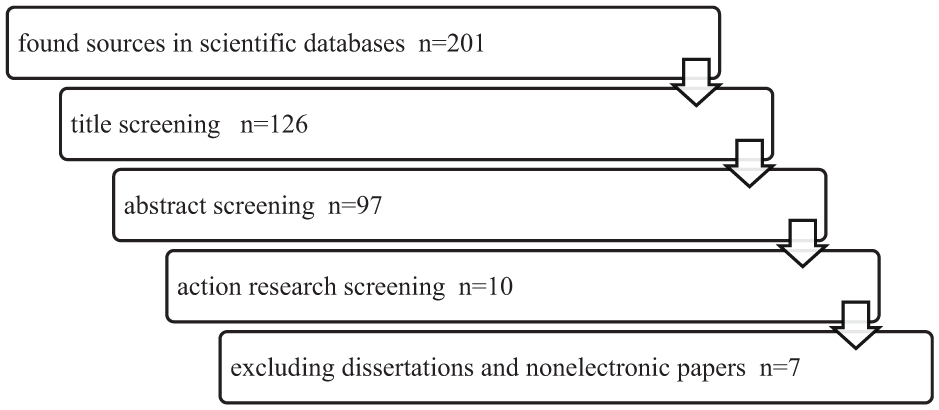
Flowchart of study selection and search outcomes.
Step 3: Inclusion/Exclusion Criteria
In accordance with our research questions, we have outlined the specific inclusion/exclusion criteria in Table 1. Based on these criteria, quantitative, organizational action research projects based on rhizomatic thinking, epistemological/theoretical studies on rhizomatic philosophy or post-rhizoanalysis of educational studies in character as well as unavailable online articles were excluded (Table 2).
Exclusion / Inclusion Criteria.

List of Articles, Conference Papers and Book Chapters on Rhizomatic, Educational Action Research Projects.

In total, 24 articles (12% of the total 201 impacts were significant) were thoroughly reviewed, and 7 of these articles met the criteria for inclusion in the meta-synthesis. These seven studies were conducted between 2008 and 2022 in various countries. All of these studies were analyzed within Zeichner’s (2007) proposed analytical framework, known as the “Dimensions of Variation in Action Research.”
Step 4: Extracting and Coding Data
Rather than relying on the raw data from primary studies, meta-synthesists utilize the refined interpretations and conclusions drawn by the researchers as the foundational “data” for their synthesis (Hoon, 2013). Henceforth, the subsequent phase involves meticulously extracting, systematically coding, and thoughtfully categorizing the evidence derived from the synthesized studies (Noblit et al., 1988).
To obtain the data necessary for our meta-synthesis, first, a coding form was developed according to the question of interest (Duriau et al., 2007). To establish a coding framework, in cooperation with a co-researcher who possesses expertise in educational action research, we generated a preliminary set of coding items. For this, “Dimensions of Variation in Action Research,” developed by Ken Zeichner (2007) is our source of the analytic framework of educational action research projects. In addition, we conducted a thorough examination of three randomly chosen studies to discover additional coding elements that are pertinent, continuously enhancing and adjusting the coding template. Moreover, the coding template includes open-ended inquiries and empty sections to capture unique perspectives as expressed by the original researcher. The coding template, consisting of 49 coding elements, is presented in Appendix A.
We examined all aspects of each project related to educational design, settings, learner and educator characteristics, and performance appraisal, ensuring no detail was overlooked, including philosophies on authority in education (Somekh & Zeichner, 2009). By understanding the full scope of rhizomatic educational design and its outcomes, we created a comprehensive list of factors intrinsic to action research projects based on rhizomatic thinking. We also identified key distinctions from traditional educational design and converted these elements into measurable variables, while documenting contextual factors such as situational, societal, environmental, and platform-specific influences. As a critical decision in research, synthesis entails what features to code (Aytug et al., 2012; Kisamore & Brannick, 2008), The extraction and coding of data were meticulously steered by a coding form renowned for its reliability and validity (see Appendix A). To maintain consistency among reviewers during the coding process, any inconsistencies that surfaced were recorded in the coding form. These were then addressed through detailed discussions and additional reviews of the original studies. The emergent codes were subsequently fed into the coding form (Hoon, 2013). In summary, employing a duo of synthesizers – serving as both reviewers and annotators – proves advantageous in minimizing errors during data documentation and ensuring no pertinent information is overlooked (Miles & Huberman, 1994).
Step 5: Analyzing on a Case-Specific Level
To analyze the studies included in the synthesis, it is essential to employ a method that facilitates case-specific analysis while also being suitable for addressing the overarching meta-synthesis research questions and objectives (Hoon, 2013). While techniques such as processual or causal maps, chronological displays, or a processual matrix may be feasible depending on interests, goals and a specific research question of meta-synthesis for analyzing primary qualitative evidence a causal-processual network was chosen. We examined each case study by considering the variables that have a logical influence on one another, the likelihood of certain variables co-occurring or not, and the necessary sequencing of variables for subsequent events to occur (Miles & Huberman, 1994). In addition, the stages of education in tandem were carefully observed.
This methodology facilitated the identification of the fundamental themes and patterns inherent in the data. Consequently, we were able to establish seven causal-processual networks, each specific to a case, that successfully could establish a connection among every variable, their inter-relationships and the entire stages of the educational process. This logical and consistent representation highlights the interrelatedness of these variables, providing valuable insights into the cause-and-effect relationships between them.
To establish the authenticity of the causal-processual relationships in our study, we created each of the displays independently. Any disagreement regarding variables, their potential relationships and the stages of the educational process were identified, documented, and resolved to capture essential interpretation points accurately. Our research validates that utilization of causal-processual networks was advantageous as it facilitated reflection on contextual properties of the cases and culminated specific scenarios for dynamic capability development into an overall pattern.
Step 6: Synthesis on a Cross-Study Level
The case-specific causal networks provide the foundation to further explore how the studies under synthesis are related or dissonant through a compare and contrast exercise at a cross-case study level (Miles & Huberman, 1994). In order to transition from an individual case analysis to a broader, cross-study examination, the sequences of variables and identified stages within each case’s causal-processual network were combined to create a meta-causal-processual network. This meta-causal network allows for the emergence of mechanisms, causal relationships, and outcomes across multiple studies, going beyond the scope of individual research projects. We compared and matched causal-processual networks of each case separately. The outcome was the emergence of a meta-causal-processual network including a meaningful pattern of stages and variables; “educational structure”, “settings”, “target”, “participants”, “interactions”, “challenges”, “how challenges are managed”, “reflections” and “boundary” (see Figure 2).

Meta-casual-processual network.
The “boundary” variable which is not mentioned directly in our network has been shown by a circular line separating internal and external environments. This variable, on which the “target” variable is located, together with the variable “how challenges are managed” appeared central for explaining the pattern through which the distinction between traditional and rhizomatic education was explained.
We examined the diversity in goals set by the educational system, obstacles encountered and strategies employed, and the ultimate impact/insights of the overall process in each of the research projects, in order to strengthen the credibility of the emerging trends (Miles & Huberman, 1994). Based on this, meta-causal-processual network and the variables list in Table 3 indicate that Educational Structure is the frame which imposes the guideline or policy through which the entire process of education flows. This structure is formed by the project designers who play the role of initial educational decision makers. Within this structure, type of participants, type of educational targets, the setting components, and the way challenges are addressed and managed are all determined. Furthermore, this is the educational structure which determines whether the educational project is allowed to interact with the external environment and benefits from the outside actors for the favor of educational targets.
Variables and Their Ratings.

This interaction with the outer environment is influenced by the type of target towards which the entire educational process is heading. This meta-synthesis shows that all the action research projects based on rhizomatic thinking have been designed over two types of educational targets:
Learner-Oriented policy; in such projects, the aim is to improve the learners’ productivity. This policy highlights Learner-Centered Education (LCE) approaches to teaching and learning (Gravani, 2019).
Societal-Impacting, Problem-oriented policy; in such projects, solving a problem is the main intention of the educational design. Improvement in learner’s productivity plays a secondary target.
Step 7: Building Theory from Meta-Synthesis
This finding represents an important response to our initial research question as “What are the distinctions between rhizomatic and traditional educational designs?” The more rhizomatic, societal-oriented the educational design is, the more it is felt to have interactions with the actors in the environment of society.
The subsequent discussion addresses the third research question as “What theories this study is able to contribute to the field of educational science, especially practiced based on rhizomatic thinking?”
Lens is a transparent material designed to refract light beams and, depending on the type, converge them towards or diverge them from a specific point. Within an educational system, the interaction between its components can be compared to the behavior of light beams as they diffract through the lens. Just as the scattering of light through a lens produces reflections, the way educational challenges are addressed are also the quality and quantity of reflections/outcomes out of the educational system as a whole. Therefore, the concept of écolent is introduced as a means to determine the overall, future reflection of the educational process. By functioning like a lens, écolent offers an approach to visualize and interpret the diverse factors that shape educational outcomes and generate feedback to improve the educational effectiveness. The metaphor of a lens worn on an educational system highlights the thinking approach of the educational planners. Based on this, the whole educational system is wearing a lens through which the impacts of everything that happens within the educational structure is future-reflected into the environment of society. Whatever the students as mature men and women will do in the society after leaving the educational system can be a perfect reflection of its planners’ way of thinking. The ecolent worn by the educational system is different for any educational systems. The type of ecolent demonstrates what is happening in the educational structure, how its planners are thinking and how they see their learners and environment of society.
The focal point of a lens, i.e. where the future outcomes of the educational process come from, is a delicate reason why we should use the term ecolent with care. In a traditional educational structure, students’ efforts, interactions, and challenges are geared towards achieving predetermined goals imposed by teachers who prioritize hierarchical educational policies. In other words, the entire educational process interactions are managed with the intention of leading students towards structured, focused reflections. This is where the educational system is wearing a convex ecolent (Figure 3).
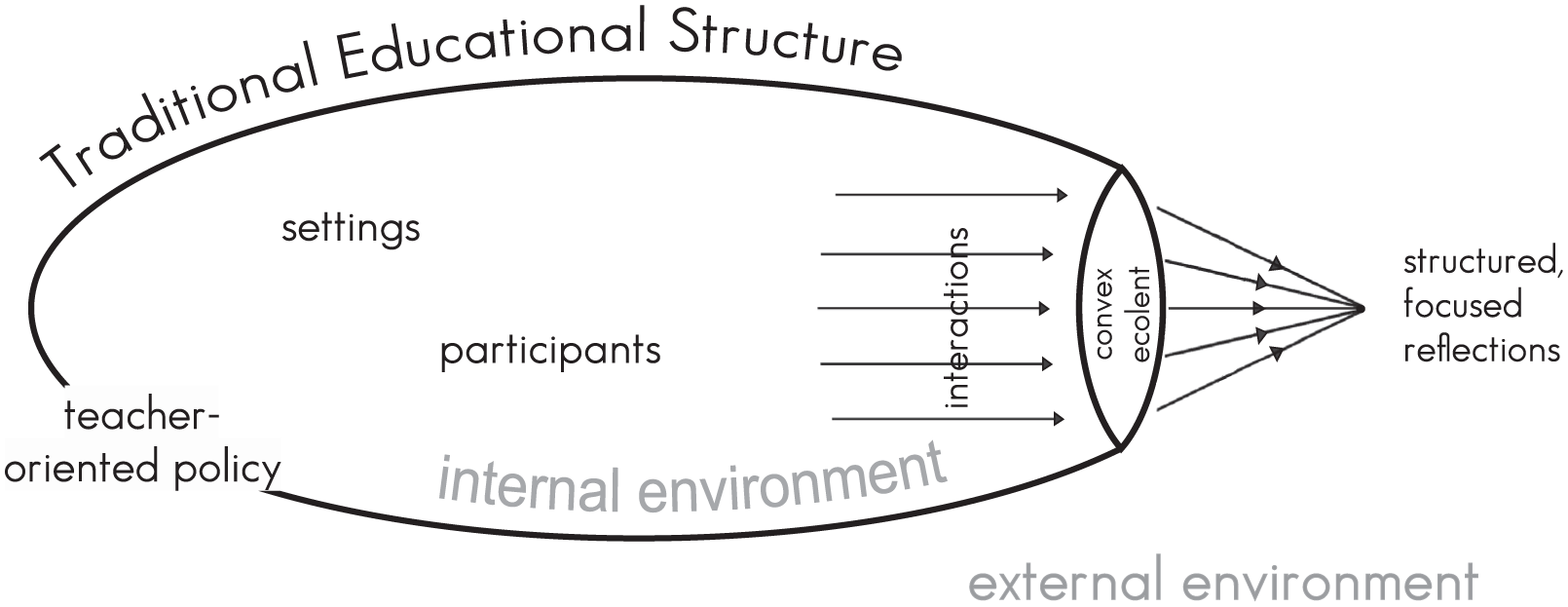
Traditional educational structure.
According to our meta-synthesis, managing challenges within a rhizomatic structure provides a richer learning experience than traditional educational structures. Our study illustrates that well-regulated policies that utilize democratic tools, encourage learner cooperation over competition, embrace diverse viewpoints, and support innovation, pluralism, and confrontation can lead to enhanced management of challenges within such a structure, as demonstrated by concave écolent. The reason why this educational policy seems to wear a concave lens lies in the fact that it enlightens various positions, opportunities and skills in the society where the future men and women can best fulfill, opposite the traditional, convex lens through which only some special, predetermined prospects are going to be met. In a concave lens, the light rays are scattered widely which resembles assigning wider horizon for learners’ future objectives and skills. On that note, in a Learner-Oriented, Rhizomatic Educational Structure, the ultimate goal based on our meta-synthesis is improved productivity in learners, where the teacher presents innovative, problem-solving projects and exercises as de Vries et al. (2023) did in their Creativity Workshop (Figure 4).

Learner-oriented rhizomatic educational structure.
Despite the wider reflections of the learner-oriented rhizomatic educational structure as compared to traditional education, there remains an almost thick boundary between internal and external environments (Figure 4). While such projects seek to enhance learners’ productivity, they often dismiss the importance of interacting with the external world. However, in Societal-Impacting, Problem-Oriented, Rhizomatic Educational Structure, there exists a need to embrace innovative approaches to solve real, within-society problems, leading to a gradual erosion of this boundary between internal and external environments (Figure 5). This educational approach is not only focused on problems that impact society but also aims to have a positive impact on society.
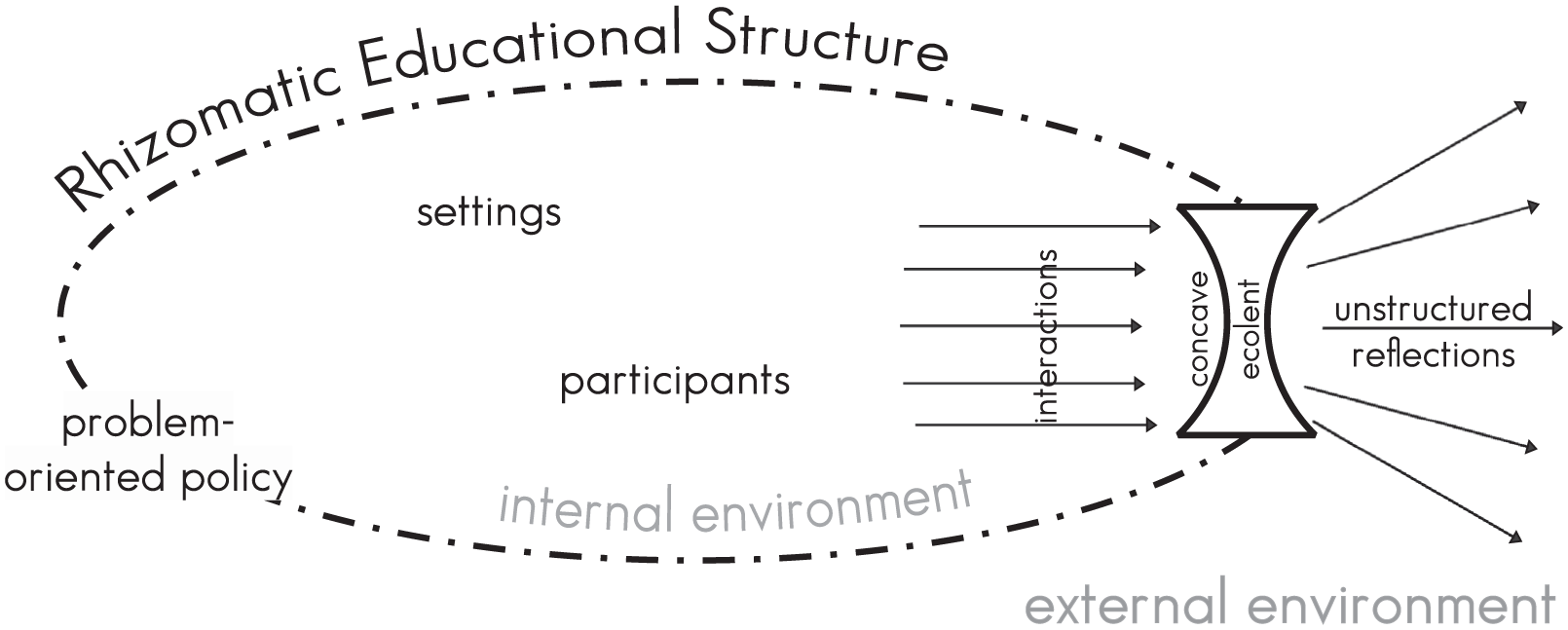
Society-oriented rhizomatic educational structure.
The reason for the erosion of the educational boundary in the societal-impacting, problem-oriented, rhizomatic educational structures lies in their focus on centering within-society problems. This approach was exemplified in the works of Bissola et al. (2017) and Maffei et al. (2010) in ProSIT and CityLab, respectively. The central idea of this educational process is to generate innovative ideas around a given problem, much like a brainstorming session. All ideas, even those that may seem trivial, are respected and treated as a rhizome that can sprout in any direction. For this, not only is it impossible to predetermine the quantity of knowledge and innovative ideas produced, but their quality is also unpredictable, leading to unstructured, multi-directed reflections while maintaining interaction with the outer-world’s actors who are already engaged with the real problems in the society.
Framework for Educational Design and Quality (A Concrete Application of Écolent)
In recent years, higher education institutions have sought to equip students with a comprehensive skill, encompassing both cognitive knowledge and professional skills (hard skills) as well as problem-solving and teamwork abilities (soft skills). However, the attainment of these skill-related objectives is hindered by the prevailing traditional learning paradigm, wherein instructors assume the role of knowledge transmitters and students are relegated to passive information receptors. Furthermore, research-intensive universities tend to prioritize the development of research skills over professional and transferable skills, resulting in a disconnect between academic learning and workplace requirements. To address these issues, it is proposed that students be afforded opportunities to engage in authentic, problem-solving, and knowledge construction experiences within real-world professional contexts. One promising approach to achieving this goal is through the implementation of project-based learning (PjBL) methodologies (Guo et al., 2020). Project-based learning (PjBL) is an inquiry-based instructional approach that facilitates learner engagement in knowledge construction through the development of meaningful projects and real-world products.
As a concrete application of our newly-termed concept of Écolent, we think that this idea may provide valuable insights into project and problem-based learnings. Before delving into this, we should consider that these learning techniques are similar and there is still debate about their effects on students (Guo et al., 2020). Based on this, we refer to project and problem-based learning techniques as one single technique. Based on our meta-synthesis, Écolent categorizes the diverse cognitive perspectives of educational planners, which consequently shape the educational structure into three primary types, each with distinct implications for educational design and the quality of interaction with society:
Convex Écolent (Traditional Écolent): This represents an educational design where the planners’ cognitive framework directs views towards specific, pre-defined targets within society, such as acquiring particular skills for established societal roles. In this design, the interaction between learners and societal actors is minimal, reflecting a focus on knowledge transmission rather than genuine societal engagement. While projects might be included, their primary intention remains “knowledge transmission” to learners. The educational system, wearing a convex Écolent, leads students towards structured, focused reflections, thereby limiting the scope and quality of real-world engagement.
Boundary-Restricted Concave Écolent (Learner-oriented Écolent): Here, the educational planners’ cognitive focus is centered on enhancing learners’ skills and productivity, leading to outcomes that diverge towards semi-specific to unspecific points in society. These outcomes can be linked to various professional positions, though less rigidly defined than in the traditional approach. This design increases learner interaction with real-world problems presented as projects, moving beyond the minimum of the Traditional Écolent. However, the boundary between the educational structure and the societal environment remains largely thick, limiting extensive interaction with external societal actors, though planners can enrich this by engaging some. This concave Écolent enlightens a wider horizon of opportunities for learners, offering a moderated level of quality in real-world application.
Glassy-Restricted Concave Écolent (Society-oriented Écolent): This type signifies an educational design where planners’ cognitive framework broadly diverges towards unspecific societal areas, particularly those related to entrepreneurship, innovation, and emergent societal challenges that are inherently difficult to structure or pre-define. In this design, interaction between learners and societal phenomena is maximized, significantly richer than in the Learner-oriented counterpart. Learners actively engage with real, within-society problems. Crucially, the boundary between the educational structure and the societal environment becomes narrow or “glassy,” facilitating extensive interaction with external societal actors who are already involved with these real problems. This approach not only aims to solve societal problems but also implicitly improves students’ skills and productivity as a secondary goal, representing the highest quality of engagement and societal impact.
Project-Based Learning (PjBL) inherently revolves around addressing a central question or problem. Écolent elucidates the distinctions within PjBL implementation by evaluating the depth of societal engagement and the nature of objectives set by educational planners. We propose that Écolent serves as the underlying framework that determines how PjBL is structured across three levels: Traditional, Learner-oriented, and Society-oriented approaches. Building upon Krajcik and Shin’s (2014) six established hallmarks of PjBL as a driving question, emphasis on learning goals, active participation, student collaboration, use of scaffolding technologies, and production of tangible artefacts, we propose the addition of a seventh hallmark: “type of Écolent.” This new hallmark crucially reflects the educational planners’ perspective on intended educational outcomes and, by extension, assesses the extent of interaction between the educational framework and the societal environment.
Under this comprehensive framework, a traditional approach to learning can still apply PjBL, satisfying all established criteria and facilitating the creation of tangible artifacts; however, its primary focus remains on knowledge transfer from societal actors and instructors to students. An Écolent type may prioritize the enhancement of learners’ skills and productivity, aligning with what we define as a Learner-oriented approach to PjBL. Ultimately, a fully realized and high-quality PjBL experience is exemplified in the Society-oriented approach, wherein all six requisites outlined by Krajcik and Shin (2014) are maintained, and the seventh hallmark – characterized by interaction with the societal environment – is dynamically fulfilled. The concept of “Écolent type” thus serves as the primary differentiator across various levels of PjBL, directly reflecting the cognitive frameworks of educational planners and influencing the degree of societal interaction. Our meta-synthesis leads to the following hypotheses regarding these design choices:
This allows us to categorize PjBL into three distinct levels: 1. Traditional, representing a foundational approach to PjBL; 2. Learner-Oriented, which denotes a more dynamic iteration of PjBL; and 3. Society-Oriented, characterized as a comprehensive PjBL approach. Écolent as a tool or framework enabled us to categorize different levels of PjBL as a concrete example to clarify the way how to apply this term in the educational science. What we are emphasizing is the defining feature across these levels which is the Écolent type, encapsulating the educational planners’ perceptions of learners and their relationship with societal contexts, as reflected in the targeted objectives of the educational framework.
Scalability, Replicability and Digital Divide:
Our meta-synthesis addresses the second research question, which explores the paradoxes within the findings of rhizome-based educational action research projects and their interpretations. A key observation is the disagreement among rhizo-researching educators regarding the capacity of their projects to be repeated (replicability) and to be changed in size or scale (scalability). While some projects encounter significant difficulties, others achieve notable success. This section clarifies the factors accounting for these divergent outcomes, particularly through the lens of digital integration within educational structures. The effectiveness of rhizomatic educational projects is closely correlated with their structural design, which can be understood along an Optimal Digital Inclusion vs. Extreme Digital Exclusion Continuum. This continuum describes the spectrum of reliance on digital technologies, ranging from purely physical, traditional settings to fully online, open-access environments.
At one end of this continuum lies Extreme Digital Exclusion, as exemplified by the ProSIT project (Bissola et al., 2017). Implemented in a “traditional brick-and-mortar setting” and notably “lacked online access,” ProSIT faced inherent challenges. The unpredictability of its education plan and the unfeasibility of predefining the agenda meant that “almost none of the activities can be formalized in advance.” This lack of formalization directly implied great difficulty in scaling and replicating the success of such initiatives (Bissola et al., 2017). Furthermore, our meta-synthesis reveals that the Digital Divide significantly impacted ProSIT’s socioeconomic group, hindering its replicability and scalability.
Moving along the continuum towards greater digital integration, we observe the impact of hybrid approaches. The CityLab project (Maffei et al., 2010), for instance, incorporated a hybrid methodology of both physical and online platforms. This strategic use of virtual, open-access platforms was explicitly attributed to its success in achieving higher scalability and replicability compared to ProSIT.
At the other end of the continuum, representing Optimal Digital Inclusion, the TURN project, as reported by Dearmon (2018), demonstrates the full potential of an all-digital, open-access framework. This fully online structure, by not relying on physical premises, fosters more inclusive and accessible learning opportunities and promotes more sustainable and flexible growth models, significantly enhancing the replicability and scalability of rhizomatic educational initiatives.
The Digital Divide, which we propose to redefine as the “(un)scalability and (ir)replicability of educational projects,” plays a crucial role across this continuum. In essence, where lack of access to technology exists within a socioeconomic group while increasingly disadvantaging and hindering people from participating fully in contemporary society (Black & Atkinson, 2007; Chen & Wellman, 2004), the scalability and replicability of the educational project fail. This is because digital exclusion profoundly impacts several core aspects of rhizomatic projects:
Recruitment Processes: Traditional, physical recruitment methods increase initial costs and directly hinder scalability. Conversely, the utilization of an open-access online platform facilitates recruitment by broadening the applicant pool even across long distances, thereby enhancing scalability and replicability.
Information Dissemination: Without online platforms, the dissemination of project information relies on physical action taken by project actors, which is inherently limited in speed and increases costs. The presence of an open-access online platform leads to faster dissemination and reduced costs through online forums and communities and lower advertising expenses.
Web Network and Rhizomic Agents: The web network surrounding the project (McIntyre, 2015) is a main factor for scalability and replicability. This network comprises rhizomic agents who help educators understand the relationship between codified and practical knowledge, validating and sharing information within their networks. A significant negative impact on the creation of the web network results in lower scalability and replicability of rhizomatic educational projects.
Figure 6 further illustrates this Optimal Digital Inclusion vs. Extreme Digital Exclusion Continuum. The diagram portrays a negative correlation between the proximity of the educational structure to the physical, institutional schooling structure and the scalability and replicability of rhizomatic projects. This means that as a project moves towards Extreme Digital Exclusion (operating in isolation without any connection to the open-access, online world), its scalability and replicability diminish, ultimately reaching zero. Conversely, when the educational structure embraces online connectivity and moves away from the traditional brick-and-mortar model, representing a shift towards Optimal Digital Inclusion, scalability and replicability of rhizomatic structures increase significantly. This observation manifests a direct relationship between the degree of “deschooling” and the scalability-replicability of the rhizomatic educational project.
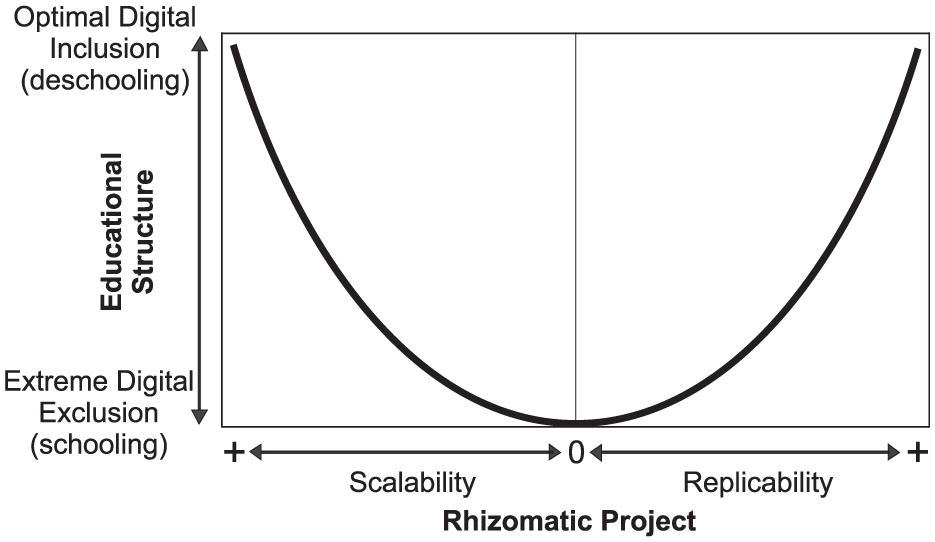
The impact of educational structure’s online-offline mode (optimal digital inclusion vs. extreme digital exclusion continuum) on the success of rhizomatic projects’ scalability and replicability.
In conclusion, our findings strongly suggest that by adding an extra pinch of online availability to the educational project, or reducing the digital gap by using online technologies, rhizo-researching educators can mitigate the high costs of conducting such projects in a brick-and-mortar mode. The integration of digital technologies not only has the potential to absorb a myriad of enthusiastic actors but also to facilitate far-reaching solutions to the problems through analytical algorithms on a data recording platform, ultimately ensuring that scalability and replicability of such projects will be no longer an issue. By enhancing access to online platforms, educational planners can effectively bridge the gap between education and society, fostering relationships that align with entrepreneurship and innovation and thereby significantly increasing the potential for educational projects to be scaled and replicated cost-effectively.

Results and reflections of an educational structure strategy in relation with the students’ degree of will in choosing a topic.
Rhizomatic educational action research projects and rhizo-based post-study of educational projects (including Jamaludin & Hung, 2016) share the same obligatory learning strategy for educational prerequisites. The aim of mandatory learning is to sensitize learners with a better experience in the rhizomatic process of education. Traditional educational structures define free learning as an extracurricular activity, and learners must still act within the dictated framework. Our meta-synthesis findings suggest that learner-oriented as well as society-oriented policies in the form of projects can only be designed in a rhizomatic, educational structure. This approach helps stakeholders to tackle problems centered at the society-oriented policy. In other sense, making activities that involve real-world problems can help students develop creativity and entrepreneurship (Weng et al., 2022).
Two key aspects of a rhizomatic structure are its dynamic cooperation between internal actors and between internal and external actors. Rhizomatic structures prioritize flexible collaborative relationships among participating actors, allowing for greater adaptability to changing environments and increased innovation potential. Type 3 Encounter in Steinberg’s Knowledge Dynamics Matrix is where societal constructionist and rhizomic dynamics are well intertwined and continuously disrupting each other meaning that there are central shared meanings that are continuously re-negotiated and represented in a community, but they are flexible in that they are open to change and can adapt easily to novelty and challenge (Steinberg, 2008). This shows that “free learning” as a reflection or condition of high Dynamics of Societal Construction in a Rhizomatic Educational Structure can be strategically adopted for creating new concepts as to fulfill innovative reflections.
Strategic adoption of various forms of learning, whether compulsory or voluntary, within a rhizomatic process can serve as a viable alternative when prerequisites or higher-level reflections are required.
Step 8: Discussion
This article presents a comprehensive meta-synthesis of qualitative case studies focused on educational projects rooted in rhizomatic thinking, rigorously applying Hoon’s theory-building protocol to discern causal relationships among variables. Through a systematic search of peer-reviewed databases and stringent inclusion/exclusion criteria, seven relevant papers on six distinct educational action research projects were selected for in-depth analysis. Key data were meticulously extracted, coded, and analyzed to construct a comprehensive variable table and a meta-causal-processual network, providing a robust foundation for our theoretical contributions.
Our findings reveal a significant influence of educational planners’ cognitive frameworks on the design and implementation of educational systems, with direct implications for project outcomes and societal engagement. To conceptualize this influence, we introduce the term
Based on our meta-synthesis, three distinct types of Écolent emerge, each corresponding to a specific educational target type and reflecting varying degrees of interaction with the societal environment:
Convex Écolent (Traditional): Characterized by educational planners’ views converging on predetermined, specific points in society, primarily focusing on knowledge transmission and acquiring skills for defined societal positions. In this approach, interaction with societal actors is minimal, and projects, if included, are largely for knowledge transfer. This limits the utility in solving real-world problems and constrains the quality of broad, innovative reflections.
Boundary-Restricted Concave Écolent (Learner-oriented): Here, planners center on learners’ skills and productivity, diverging to semi-specific societal points, enabling contact with real-world problems presented as projects. While offering wider reflections than traditional approaches, the boundary with the external environment remains almost thick, and interaction with societal actors is limited. This offers improved usability for learners by allowing more varied engagement, but still limits the depth of utility in direct societal problem-solving.
Glassy-Restricted Concave Écolent (Society-oriented): This represents the educational planners’ views diverging to unstructured and often unpredictable societal spaces associated with entrepreneurship and innovation. In this design, the interaction between learners and societal phenomena is at its maximum level, leading to a narrow boundary between the educational structure and the societal environment. This approach fosters unstructured, multi-directed reflections while actively engaging with outer-world’s actors who are already engaged with the real problems in the society. This maximizes the utility of education in solving real, within-society problems and ensures a higher quality of engagement and more relevant learning outcomes.
Écolent provides a concrete framework for understanding and enhancing Project-Based Learning (PjBL) methodologies. We propose the “type of Écolent” as the seventh hallmark of PjBL, in addition to Krajcik and Shin’s (2014) six established hallmarks. This new hallmark assesses the extent of interaction between the educational framework and the societal environment, thereby delineating various levels of PjBL across different learning approaches. A fully realized PjBL experience is exemplified in the Society-oriented approach, where all six requisites are met, and the seventh hallmark, characterized by dynamic interaction with the societal environment, is dynamically fulfilled. This framework practically enables educators to design PjBL projects that significantly enhance utility and quality by aligning with real-world problems. Furthermore, the “Learners’ Free Will to Choose their Courses” in rhizomatic structures directly aligns with learners’ needs and real-world problems, fostering innovative reflections, creativity, and entrepreneurship, thereby enhancing the relevance and quality of the learning experience.
Our meta-synthesis also addresses the varying capacity of rhizomatic educational action research projects to be repeated (replicability) and scaled (scalability). We argue that the digital divide is a key factor influencing the success of scalability and replicability. Although this concept has explored meanings such as disadvantaged and developed, participating fully in contemporary society (Black & Atkinson, 2007; Chen & Wellman, 2004), the gap between the haves and the have-nots (Wresch, 1996), the cans and can-nots (McIntyre, 2015), crucially, we redefine the Digital Divide as the “(un)scalability and (ir)replicability of educational projects.” This new definition transforms the Digital Divide from merely a technology access issue into an operational problem with direct implications for the availability and sustainability of educational initiatives. In another meaning, the Digital Divide is the distinction between a scalable-replicable educational project and an unscalable-irreplicable educational project.
We present the Optimal Digital Inclusion vs. Extreme Digital Exclusion Continuum as a practical model for enhancing scalability and replicability. Our findings strongly suggest that integrating digital technologies offers practical solutions for improved availability, access, and cost-effectiveness in rhizomatic educational projects:
Mitigating High Costs and Enhancing Availability: By adding an extra pinch of online availability to the educational project, or reducing the digital gap by using online technologies, rhizo-researching educators can mitigate the high costs of conducting projects in traditional brick-and-mortar modes. This directly improves the availability of such educational experiences.
Improving Recruitment Processes and Broadening Access: Traditional, physical recruitment methods increase initial costs and hinder scalability. Conversely, utilizing an open-access online platform facilitates recruitment by broadening the applicant pool across long distances, thereby significantly enhancing access and scalability.
Enabling Faster Information Dissemination and Usability: Online platforms accelerate the dissemination of project information, reducing costs through online forums and communities. This not only improves availability of information but also enhances the usability of the educational project’s ecosystem.
Facilitating Web Networks and Rhizomic Agents for Utility: The creation of a robust web network of rhizomic agents is crucial for scalability and replicability. Online platforms facilitate this network, allowing educators to understand and leverage codified and practical knowledge, validating and sharing information within their networks. This enhances the overall utility and dynamism of the educational ecosystem.
In essence, the integration of digital technologies not only has the potential to absorb a myriad of enthusiastic actors but also to facilitate far-reaching solutions to the problems through analytical algorithms on a data recording platform, ultimately ensuring that scalability and replicability of such projects will be no longer an issue. By enhancing access to online platforms, educational planners can effectively bridge the gap between education and society, fostering relationships that align with entrepreneurship and innovation, and thereby significantly increasing the potential for educational projects to be scaled and replicated cost-effectively.
Limitations
While we adopted a rigorous research technique, a number of restrictions were identified, including limiting the study to only six action research projects out of the available ten. Additionally, only two of the educational projects aimed at solving a problem, which could potentially limit the variety of explanations for the phenomenon.
Moreover, methodologically speaking, the application of metasynthesis may face limitations stemming from the specific context and population characteristics of the synthesized theories. These limitations could hinder the ability to generalize the findings to a broader range of settings and populations, thus potentially limiting their practical relevance. To solve this, Hoon’s theory-building protocol of metasynthesis includes strategies such as complex, double coding and development of causal-processual diagrams followed by construction of meta-causal-processual network to address these challenges and enhance the generalizability of the resulting theory. While quite effective, the procedures have been noted to be somewhat laborious and generate intricate details that may appear disjointed and unrelated to a naked, untrained eye. However, the endeavors can lead to the emergence of innovative ideas in the form of theory, ultimately outweighing initial frustrations. Nevertheless, given the subjective nature of metasynthesis, it is crucial for researchers to validate the generalizability of resulting theories through further research, particularly confirmatory quantitative studies conducted within the relevant field.
Another limitation identified in this study is that, while Hoon’s methodology effectively facilitates the identification of fundamental themes and patterns within the data, it appears to lack the necessary steps to promote theory-building skill among novice researchers. Consequently, this protocol for metasynthesis remains predominantly functional for trained and educated researchers.
Crucially, it is important to acknowledge that the rhizomatic educational projects analyzed in this study were all carried out in developed countries. Consequently, the theories and framework we have developed do not consider what happens within developing or undeveloped countries. This constitutes a significant aspect of the broader educational context that our study does not directly address within its scope.
However, rather than solely a limitation, this presents a vital avenue for future research and practical application. The frameworks and theories we have developed, including Écolent and the redefined Digital Divide, offer foundational insights that can inform and guide future investigations. We encourage researchers in developing regions to implement modern or post-modern educational approaches in their settings to assess the adaptability, scalability, and replicability of such projects, specifically considering factors such as the digital divide in their unique contexts. This proactive stance underscores the potential for our findings to serve as a springboard for exploring how these concepts of usability, availability, utility, access, and quality can be adapted and implemented in diverse global educational landscapes, addressing the distinct challenges of integrating post-modern approaches into less advanced educational systems. The responsibility to address whether all educational systems should strive for standards set by developed countries ultimately rests with educators willing to explore various paradigms within their own contexts.
In conclusion, our meta-synthesis not only contributes significantly to the discourse on rhizomatic education and project-based learning but also offers practical strategies for enhancing scalability and replicability through thoughtful digital integration. By understanding and applying the concept of Écolent, particularly the societal-oriented approach, educational planners can design projects that foster deeper engagement with real-world problems, thereby enhancing both the utility and quality of learning experiences and promoting effective societal interaction.
Conclusion
This paper meta-synthesizes various educational action research projects grounded in the philosophy of Gill Deleuze and Felix Guattari, particularly focusing on rhizomatic thinking. Utilizing Hoon’s eight-step theory-building protocol, we introduced the concept of écolent; the educational lens that facilitates understanding the complex interactions shaping educational outcomes. Our findings indicate that educational structures can be categorized into teacher-oriented, learner-oriented, and society-oriented designs, each influencing different levels of interaction with external environments through the projects defined within each educational approach as levels of PjBL.
The study reveals that embracing innovative, societal-impacting, problem-oriented approaches within rhizomatic frameworks – and probably in a broader sense within any type of educational settings – can gradually diminish the boundaries between internal and external educational environments. Furthermore, the integration of digital technologies emerges as a vital strategy for enhancing scalability and replicability in educational projects. This work not only contributes to the discourse on rhizomatic education as well as project-based learning (PjBL) but also opens avenues for further research into how these structures can be effectively implemented and expanded in diverse contexts.
As rhizomatic action research projects have been implemented by educators in order to address societal issues and enhance entrepreneurial skills, our meta-synthesis suggests that utilizing a glassy-restricted rhizomatic educational structure or incorporating a societal-oriented Écolent can be beneficial for educational settings looking to improve their connection with the community and engage actors in specific fields. Additionally, enhancing online presence can help in replicating and scaling educational projects. It is essential for educational planners to adhere to the principles and key steps of rhizomatic thinking in order to avoid potential negative outcomes or chaos within the educational environment.
Footnotes
Appendix A
Coding Form Template.

| Case study ID | |||||||
|---|---|---|---|---|---|---|---|
| Item no. | Details of the study | Coder I | Coder II | Agreement/ |
Reconciled codes | ||
| Coded as | Page no. | Coded as | Page no. | Yes / No | |||
| 1 | Authors | ||||||
| 2 | Title | ||||||
| 3 | Source of publication | ||||||
| 4 | Date | ||||||
| 5 | Type of study | ||||||
|
|
|||||||
| 6 | Broader aim of the study | ||||||
| 7 | Form of inquiry (single or multiple action research question(s)) * | ||||||
| 8 | Intended contribution | ||||||
|
|
|||||||
| 9 | The philosophy toward teachers and their learning (e.g., hierarchical patterns of authority, rejection of typical authority patterns) * | ||||||
| 10 | How is the study informed by/linked to rhizomatic thinking research? | ||||||
| 11 | How is the study informed by/linked to educational action research? | ||||||
| 12 | Concept/understanding of rhizomatic thinking used | ||||||
| 13 | Concept/understanding of educational action research used | ||||||
|
|
|||||||
| 14 | Country | ||||||
| 15 | University, school | ||||||
| 16 | Research context (e.g., educators vs. learners, education field) | ||||||
| 17 | Research site selected (private vs. public sector) | ||||||
| 18 | Research setting (e.g., lab, school, department, offline, online) | ||||||
| 19 | Sponsors of the action research (e.g., educators themselves, private foundations, university) * | ||||||
| 20 | Incentives for doing action research (e.g., paid time during school day, conference participation) * | ||||||
|
|
|||||||
| 21 | Research design (e.g., theory-building case study, action research) | ||||||
| 22 | Approach (e.g., theory building, theory elaboration, analogy) | ||||||
| 23 | Relationship of action research to other research (starting point, consulting resource, standalone) * | ||||||
| 24 | Unit of analysis; focal process | ||||||
| 25 | Number of participants included in each project | ||||||
| 26 | Sampling strategy (e.g., purposive, theoretical) | ||||||
| 27 | Recruitment criteria | ||||||
|
|
|||||||
| 28 | Timing and sequencing of data collection (e.g., retrospective, real time) | ||||||
| 29 | Data collection techniques used by the original researcher (e.g., on-site meetings, in-field action research) | ||||||
| 30 | Data sources (e.g., field notes, transcripts) | ||||||
| 31 | Period of in-field action research project (e.g., one-day project, a semester) | ||||||
| 32 | Data management techniques (e.g., case history) | ||||||
|
|
|||||||
| 33 | Methods of data analysis (e.g., coding scheme, constant comparison, pattern matching) | ||||||
| 34 | Analysis techniques (e.g., data matrix, visual display, conceptual model) | ||||||
|
|
|||||||
| 35 | Key findings as summarized by the original researcher(s) in abstract / introduction / conclusion section (verbatim paraphrased) | ||||||
| 36 | Events, factors or patterns in rhizomatic educational action research projects as portrayed by the original author(s) (verbatim paraphrased) | ||||||
| 37 | Effects of rhizomatic thinking on adjusting the educational design and its distinction from traditional education portrayed by original author(s) | ||||||
| 38 | Environmental conditions | ||||||
| 39 | Visualization of conceptual model or framework as provided by the original author(s) | ||||||
|
|
|||||||
| 40 | Contributions as stated by the original researcher(s) | ||||||
| 41 | Contribution to the field of education | ||||||
| 42 | Contribution to the application of rhizomatic philosophy in education | ||||||
| 43 | Contribution to other fields (e.g., entrepreneurship, innovation management) | ||||||
| 44 | Limitations, defects and challenges as discussed by the author(s) | ||||||
| 45 | Ways of representing action research to others (e.g., oral presentations at conferences, written research reports, video) * | ||||||
|
|
|||||||
| 46 | How relevant is the study to the underlying questions? | ||||||
| 47 | How reliable/convincing is the study? | ||||||
| 48 | Missing information, logical inconsistencies, paradoxes? | ||||||
| 49 | Further comments | ||||||
Zeichner’s “Dimensions of Variation in Action Research” analytic framework.

Author Contributions
Ehsan M. Rasched in cooperation with Nader Naderi and Yousef Mohammadifar carried out all the process.
Funding
The authors received no financial support for the research, authorship, and/or publication of this article.
Declaration of Conflicting Interests
The authors declared no potential conflicts of interest with respect to the research, authorship, and/or publication of this article.
Data Availability Statement
Data sharing not applicable to this article as no datasets were generated or analyzed during the current study.