




Abstract
Glamping has recently become increasingly popular, and the competition in glamping market is more and more intense. The key for glamping business to enhance customer experience and obtain competitive advantages is to investigate glampsite characteristics that influence customers’ booking decisions under various external settings. This paper examines the moderating effects of COVID-19 and weather as external environmental factors on the relationship between negative rates of glampsite attributes and bookings. First, basic data about these glampsites and online reviews on the Qunar platform are collected. Second, glampsite attributes are mined from online reviews through BERTopic, and customers’ attention is subsequently calculated. Third, SnowNLP is utilized to determine the attribute sentiment score, and the negative rate of each attribute is subsequently calculated by combining the attention and sentiment scores. Finally, an ordered logistic regression model is built to investigate the effects of the negative rate of each attribute on glampsite bookings and the moderating effect of external environment perception. The findings indicate that: (1) Customers are interested in service, cleanliness, leisure activities, natural scenery, facilities, location, food, and cost performance ratio when choosing a glampsite. Bookings are significantly affected by negative rates of low cleanliness, bad natural scenery, unfavorable location, limited leisure activities, and inadequate facilities, all of which have a cascading negative impact. Customers are also more likely to choose glampsites with cleanliness, natural scenery, and leisure activities that meet their needs, rather than focusing on the location and facilities, when the demand for alternative glampsites is moderate. (2) The impact of location, leisure activities, and cleanliness negative review rates on reservations can be influenced by the customer’s perception of the external environment. Specifically, the customers’ perception of COVID-19 and weather both enhance the negative impact of leisure activity negative rates on bookings. COVID-19 perception amplifies the adverse effect of location negative rates on bookings, while weather perception mitigates the negative impact of cleanliness negative rates on bookings.
Plain Language Summary
This study considers COVID-19 perception and weather perception as indicators of external environmental perception. It focuses on glampsites in China as a case study and uses research methods on sales or bookings in other fields. With the assistance of text mining technology, we can fully utilize information from online travel agencies (OTAs) to extract the glampsite attributes that customers prefer from online reviews and establish a model with moderators to explore the intricate relationship between text information and bookings.
Introduction
Due to the Corona Virus Disease 2019 (COVID-19) pandemic, the global economy, especially the hotel industry, has pounded. The American Hotel & Lodging Association (AHLA) reported that the hotel occupancy rate in the United States was less than 25% in April 2020 when the disease initially started to spread. Although it increased to 63.8% in 2023, it was still lower than the 65.9% recorded in 2019. The restricted movement of individuals is responsible for the significant financial impact of COVID-19 on the hospitality industry. Although the glamping market has been affected by the pandemic, it is also experiencing a highly competitive scenario, unlike the hotel sector as a whole. According to the North American Glamping Report 2022 released by Kampgrounds of America (KOA), the largest chain of glampsites in North America, approximately 17 million households participated in glamping in 2021, an increase of 155% compared to 2019. Besides the booming international glamping market, glamping in China is also developing rapidly. Glamping is a new trend in outdoor tourism, consisting of luxury and camping. It includes the characteristics of natural tourism, leisure tourism, and eco-tourism. Compared with traditional camping, which is usually free and requiring self-prepared equipment, glamping enhances participant comfort through improved services, facilities, and accommodation, along with recreational activities. It provides unique outdoor experiences by integrating natural landscapes with leisure offerings that are often absent in commercial-area hotels. Therefore, the popularity of glamping may be due to the fact that it combines traditional camping’s outdoor nature with hotel comfort, coupled with low professional knowledge requirements and participation thresholds. However, the surge in demand has also brought challenges to glampsites. Namely, most glampsites have not fully explored customer interests and behaviors, making it difficult to provide customers with a sustainable and enjoyable experience. As a result, they struggle to gain an advantage in fierce market competition. In addition, considering the outdoor characteristics of glamping, external environmental factors cannot be ignored. Improving certain attributes (such as facilities, food, and service) in a dynamic environment is one way for glampsites to gain a competitive advantage. Therefore, studying the situation and bookings of glampsites under different external environments can not only enrich the application of consumer behavior theories in the field of glamping, but also provide data support and decision-making basis for glampsite managers to improve service quality and operational efficiency, and promote the sound development of glamping. This has significant theoretical and practical significance.
Currently, while glamping is popular worldwide, it has received limited attention from academics, and related research has several shortcomings, including the absence of a unified conceptuale, underdevelopment of a solid theoretical foundation, and a general neglect of emerging areas such as the influence of social media content on consumer behavior (Craig, 2025). At present, the research on the concept of glamping mainly focuses on comparing it with other tourism models. The majority of other scholarship focus on the behavioral research of glamping customers, although these empirical studies exhibit several limitations. For instance, Chai and Yang (2023) utilized high-frequency words, semantic networks, and topic models to analyze online travelogues, and mined the attributes of glampsites that customers paid attention to. However, they failed to conduct a more in-depth quantitative analysis of social media content, nor did they establish a quantitative connection between the identified attributes and customers’ actual purchasing decisions. From the perspective of customers’ willingness to pay, S. O. Lyu et al. (2020) utilized data obtained from questionnaires and experiments to establish a statistical model aimed at identifying the factors that influence customers’ choice of glampsites. However, the research design failed to incorporate data sources and insights from emerging fields such as social media, despite evidence suggesting that social media dissemination has played a key role in fueling the booming glamping market (Zhu, 2022). Furthermore, the modeling approach adopted by S. O. Lyu et al. (2020) explored the direct relationship between glampsite attributes and bookings through regression techniques, ignoring the complex relationships that might be hidden within. In fact, by combining the Goal System Theory with consumer behavior, Kopetz et al. (2012) discussed the causes of unstable consumer behaviors such as preference change and impulse buying. They noted that diverse environmental features could trigger a wide variety of goals, consequently influencing customers’ judgments, attitudes, and behaviors without conscious awareness. For example, the smell of restaurant food might prompt weight-loss customers to choose high-calorie foods rather than light meals. Similarly, in glamping bookings, a dynamic external environment may trigger new customer goals, shifting their focus toward different glampsite attributes and influencing their final choice. Given the rapid growth of glamping during the COVID-19 and its outdoor characteristics, this paper believes that COVID-19 and weather are the most worthy external environmental factors. COVID-19 has changed the mode of leisure tourism and promoted the development of glamping; Weather is an emergent condition closely related to outdoor activities and natural scenery experiences. Although weather forecasts allow customers to make their travel plans, sudden bad weather during a trip still requires customers to adapt (Q. Zhang et al., 2023). It can be inferred that customers who are highly concerned about weather conditions may not only rely on forecasts but also seek information about glampsite performance under varying weather scenarios, ultimately selecting accommodations that align with their preferences to avoid potential dissatisfaction.
According to the above analysis, in empirical research on the influencing factors of glampers’ experiences or booking behaviors, few scholars have used online review information as a data source to mine key information in reviews and quantitatively analyze the relationship between such information and bookings. Moreover, few scholars have studied the impact of reviews on bookings in different external environments (T. Chen et al., 2025). In addition, existing studies in the field of camping or tourism have focused mostly on the relationships between emergency public health events (Craig, 2021) and weather (Dubois et al., 2016) and between the travel distance of customers and the duration of their stay. These studies have not incorporated external environmental factors into glampsite/campsite attributes. In light of this, our study considers COVID-19 perception and weather perception as indicators of external environmental perception. It focuses on glampsites in China as a case study and uses research methods on sales or bookings in other fields. With the assistance of text mining technology, we can fully utilize information from online travel agencies (OTAs) to extract the glampsite attributes that customers prefer from online reviews and establish a model with moderators to explore the intricate relationship between text information and bookings.
Literature Review
This section discusses the literature related to the influencing factors of glampsite/campsite selection, the impact of online reviews on product or service sales, and the moderating effect of external environmental factors.
Influencing Factors of Glampsite Selection
At present, most research on glamping has focused on customer preferences, including the attributes that glampers pay attention to and the factors that affect their intentions or experiences. On this topic, scholars have obtained and analyzed the attributes of preferred glampsites through questionnaires, interviews, and experiments. For example, Lee et al. (2019) carried out choice experiments and used a mixed logistic regression model to determine the factors affecting glampsite selection and their importance. Their results suggested that the factors influencing the choice of glampsite were safety, congestion, cleanliness, and price in order of influence degree, while environmental factors were not significant. However, as information technology has advanced rapidly, traditional data acquisition methods often have drawbacks, such as small sample sizes and challenging data collection processes. To address the aforementioned issues, several scholars have utilized online reviews as an additional data source. These reviews have been combined with traditional research methods, such as interviews and questionnaires, to examine the attributes that influence the glamping experience. The achievements in this research field are mainly represented by Brochado and Brochado (2019), who used Leximancer software to mine 11 customer preference attributes from TripAdvisor’s positive reviews, including experience, hotel, learning, host, camping, nature, food, ingredients, uniqueness, ecology, and yoga/surfing. The specific contents of the relevant literature are shown in Table 1.
Research on the Influencing Factors of Glamping Site Selection.

As shown in Table 1, the factors that influence the selection of glampsites include the surrounding environment, facilities, service attitude, price, and activities. Traditional methods, including questionnaires, interviews, and experiments have been used for data acquisition. In fact, there are certain deviations in these data acquisition methods, making it difficult to understand the overall situation. Considering this, some scholars (Brochado, 2019; Brochado and Brochado, 2019; Lu et al., 2021; Sun & Huang, 2023) have combined the content posted by customers on social media with the aforementioned data. However, their focus is primarily on qualitative research, such as content analysis. In addition, few quantitative studies have provided an intuitive explanation of the impact of key information in online reviews on glamping bookings.
The Influence of Online Reviews on Product or Service Sales
In the exploration of the quantitative relationship between unstructured data and product or service sales, many scholars have achieved rich results in multiple fields such as automobile (Singh et al., 2022; C. Zhang et al., 2022), electronic product (Li et al., 2019; Liu et al., 2023), and hotel accommodation (Phillips et al., 2017; Sim et al., 2021). Additionally, since emotions in texts have been proven to reflect product or service quality and thus influence customer consumption decisions (Wang et al., 2020), the above scholars mainly use topic mining and sentiment analysis to quantify unstructured data. Finally a panel data regression model was used to explore the negative relationship between attribute negative sentiment tendencies and sales volume. Liu et al. (2023) first used Latent Dirichlet Allocation (LDA) to extract attributes from online reviews of four mobile phones. Next, the sentiment score for each attribute was calculated based on the sentiment lexicon and Long Short-term Memory (LSTM) was used to map the attributes to the Kano model. Finally, the Generalized Method of Moments (GMM) model was established to explore the relationship between Kano’s five attributes and sales level. The results showed that excitement (such as sound and brand) and performance quality characteristics (such as battery and memory) had significant impacts on product sales, while must (such as delivery), indifferent (such as appearance and price), and reverse quality characteristics (such as operator and application) had no significant impact on product sales. The specific contents of the involved studied are shown in Table 2.
Research on the Influence of Online Reviews’ Attribute Sentiment on Product Sales.

In the field of service products such as hotels or tourism, there have been few studies on mining information from reviews for sales analysis. The more representative studies are mainly as follows: Sim et al. (2021) constructed two spatial statistical models for 1,256 hotels’ reservation data to illustrate the impact of online reviews and emotional polarity on hotel reservation intentions. Specifically, they first used LDA to mine topics from reviews and subsequently applied Convolutional Neural Networks (CNNs) to classify the sentiments of reviews into positive and negative categories, obtaining the corresponding emotional polarity for each topic. Then, Multiple Correspondence Analysis (MCA) was used to reduce the dimensionality of 53 categorical variables related to hotel services and facilities, for which 4 control variables were obtained that measured convenience services, room services, leisure facilities, and international services. The results indicated that positive reviews on atmosphere, cost-performance, transportation accessibility, service, front desk, accessibility of surrounding facilities, and room layout had a significant positive impact on booking intention, with atmosphere having the greatest impact, while room facilities and quality had no significant impact. In addition, negative reviews on the accessibility of services, front desks, and surrounding facilities had a significant negative impact on bookings, with the greatest impact being on the accessibility of surrounding facilities. For the remaining factors influencing hotel sales, most of the studies use rating information on OTAs. The specific literature contents are shown in Table 3.
Research on the Influencing Factors of Online Reviews on Hotel Bookings.
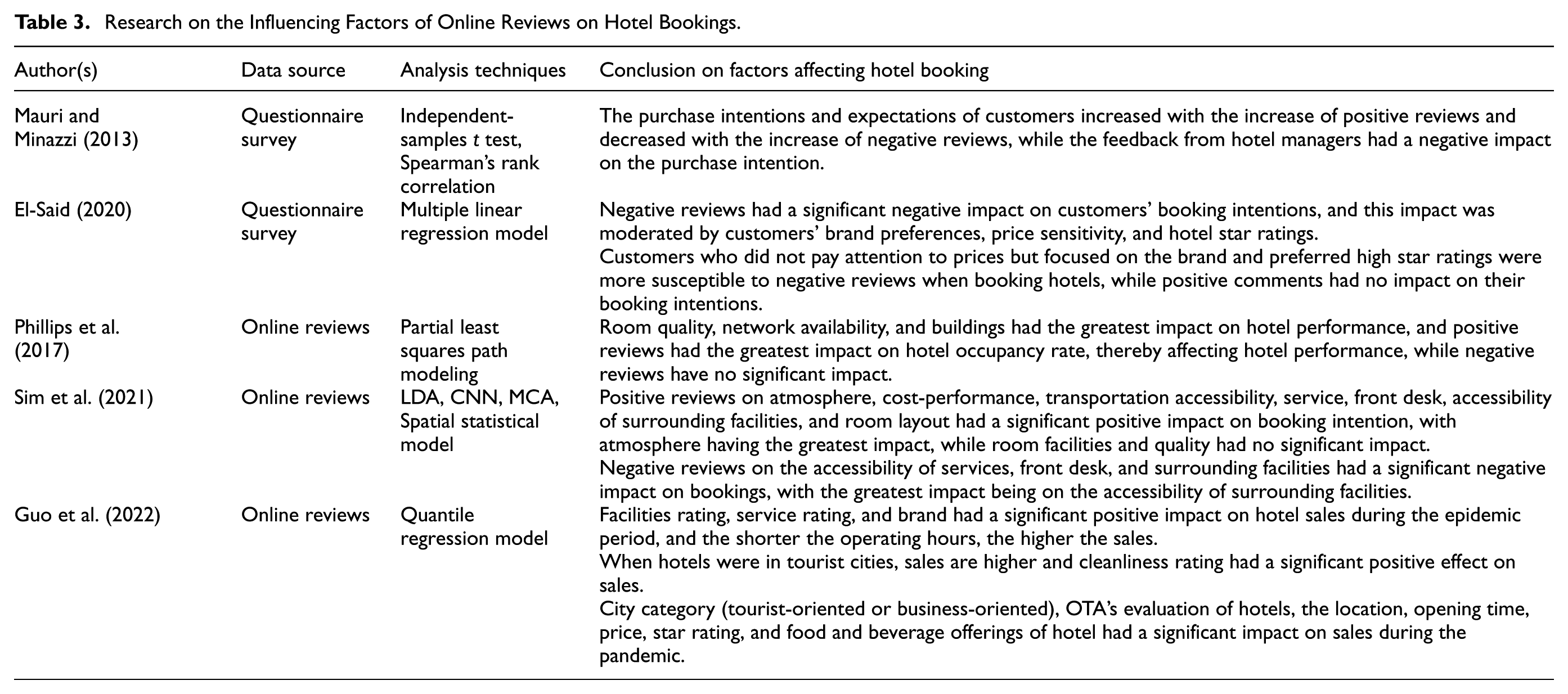
The above analysis reveals that the key information in online reviews can impact the sales of products or services, and most of them focus on tangible products rather than intangible services. Topic models, word frequency statistics, and other methods have been used to extract product attributes. The sentiment lexicon, machine learning, and deep learning techniques have been used to perform attribute sentiment analysis. Subsequently, the influence of these attributes on sales have been investigated. However, in the tourism and hotel industry, the utilization of this analytical framework is relatively limited. Most analyses of factors affecting sales or bookings rely solely on the total rating and attribute rating data on OTAs, disregarding the valuable information contained within the text.
Moderating Effect of External Environmental Factors
Currently, studies on external environmental factors, mainly COVID-19 and weather, have been rare. The former explores glamping motivations from the perspectives of risk perception, risk avoidance, and stimulus seeking (Zorlu et al., 2023); the latter categorizes glamping as natural tourism and studies the impact of weather on sales (Craig & Ma, 2022). Therefore, this section analyses the literature on hotel bookings.
Before and after the COVID-19 outbreak, the order of importance of various hotel attributes changed when customers chose a hotel. From the perspective of hotel health images, Atadil and Lu (2021) suggested that the outbreak of COVID-19 has made hotel health control an important factor affecting customers’ booking decisions. In addition to cleanliness, the importance of other hotel attributes has also changed. Spoerr and Pitsoulis (2023) analyzed the results of desk surveys, interviews, and questionnaires, and found that the importance of hotel attributes related to service and brand familiarity increased, while the importance of price decreased. Raedts et al. (2023) analyzed the content of online reviews and reported that the importance of attributes such as security measures and employee service increased, while the importance of attributes such as breakfast, facilities and design decreased.
In addition to COVID-19, weather has become one of the external environmental factors of concern for the tourism and hospitality sector. Under different weather conditions, customers may change their travel plans or choose different hotels to stay in. After studying 184 studies related to weather, outdoor leisure, and natural tourism, Verbos et al. (2018) found that individuals’ participation in natural tourism, skiing, community activities, and related activities that constituted experiences were influenced by weather. Mun and Park (2022) noted that customers preferred hotels with better services and facilities in poor weather conditions such as rain. C. Chen and Lin (2014) found that weather played a moderating role in the impact of price on hotel room reservations. Specifically, in severe weather conditions such as typhoons, team accommodations were more susceptible to price influences when choosing a hotel, while on sunny days with higher temperatures, personal accommodations were not sensitive to the impact of price.
The aforementioned papers offer potential explanations for the moderating impact of external environmental factors on the correlation between glampsite attributes and bookings. However, they objectively measure external environmental indicators, such as the number of confirmed cases of COVID-19, without considering individual subjective experiences. In fact, Dubois et al. (2016) noted that there were differences between actual meteorological parameters and customer-perceived weather conditions and that different participants had different for weather requirements.
In summary, the shortcomings of glamping research include (1) insufficient mining of text information in online reviews, and failure to explore its quantitative impact on glamping bookings and (2) neglecting the moderating effect of external environmental perceptions such as COVID-19 and weather. In response to the aforementioned shortcomings, this paper takes Chinese glampsites as samples, uses site information and customer comments from OTAs as data sources, combines topic mining and sentiment analysis techniques, and incorporates basic information about glampsites and their cities as control variables. Additionally, customer perceptions of COVID-19 and weather are considered moderators for establishing a model that analyzes the correlation between the percentage of negative attributes and bookings reflected in online reviews about glamping. This paper attempts to answer the following questions through the above practices: (1) what attributes of glampsites do customers pay attention to? (2) Which attribute negative rates affect glamping bookings? How significant is the impact? (3) Does the impact of attribute negative rates on bookings depend on external environmental perception? How to adjust? The de tailed research framework of the paper is depicted in Figure 1.
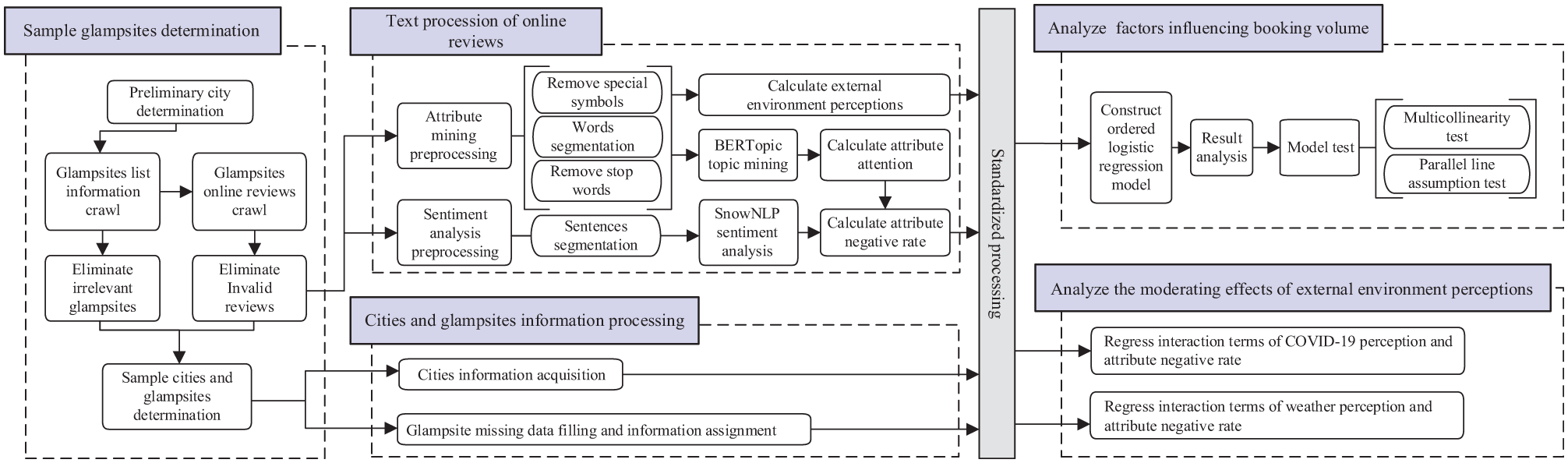
Research framework.
Data Collection and Processing
This section explains the data sources and processing methods involved. The chosen data is informed by previous studies and guided by practical considerations regarding data availability.
Data Collection
The first step involves selecting sample cities and glampsites. Following Guo et al. (2022), this study initially identifies the 15 Chinese cities with the highest number of hotels. Cities lacking glampsites or with insufficient reviews are excluded, and popular camping destinations are added. Finally, 28 cities are selected that span 20 provinces, including municipalities directly under the Central Government. As shown in Figure 2, where darker shading indicates a higher density of glampsites, the selected cities are geographically diverse, ensuring data representativeness. Provinces with the most glampsites include Gansu (47), Zhejiang (37), Beijing (24), Jiangsu (16), Guangdong (16), and Sichuan (14).
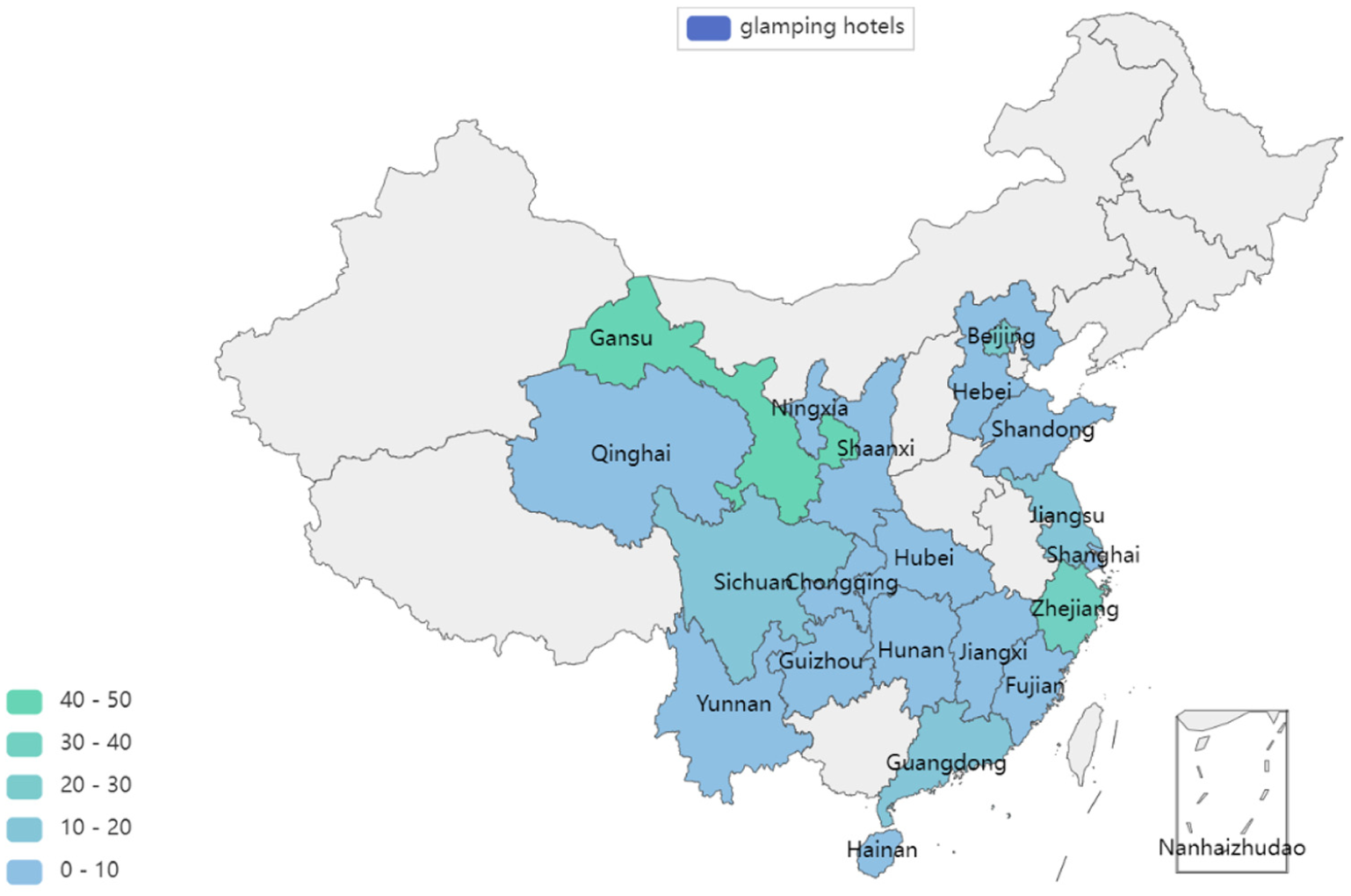
The quantity of spatial distribution of glampsites.
The second step is to obtain city data. The city GDP data are obtained from the 2021 statistical yearbook of each city. The urban camping rank refers to the 2021 rankings of urban camping and tourism released by “Mafengwo,”“Ctrip,” and “Jiemian.” The urban epidemic data, covering January 11, 2020, to December 12, 2022, are obtained from “ThePaper.cn Meishu Class,” with information derived from the National Health Commission, local health authorities, and official media.
The third step is to obtain glampsite data, which was sourced from Qunar, a leading online travel platform in China known for its broad user base and accessible data. Established in 2005, Qunar provides search and booking services for a wide range of travel products, including air tickets, hotels, and vacation packages. With over 600 million registered users, the platform offers comprehensive information on various tourism products, including glampsites, as well as a large volume of authentic user reviews. The timeliness, diversity, and representativeness of Qunar’s data provide reliable support for this study, enhancing the accuracy and market relevance of the analysis. Specifically, Python scripts are employed to crawl all glampsite IDs and extract the content presented in Figures 3 and 4 from the Qunar platform.

The list information of glampsites.
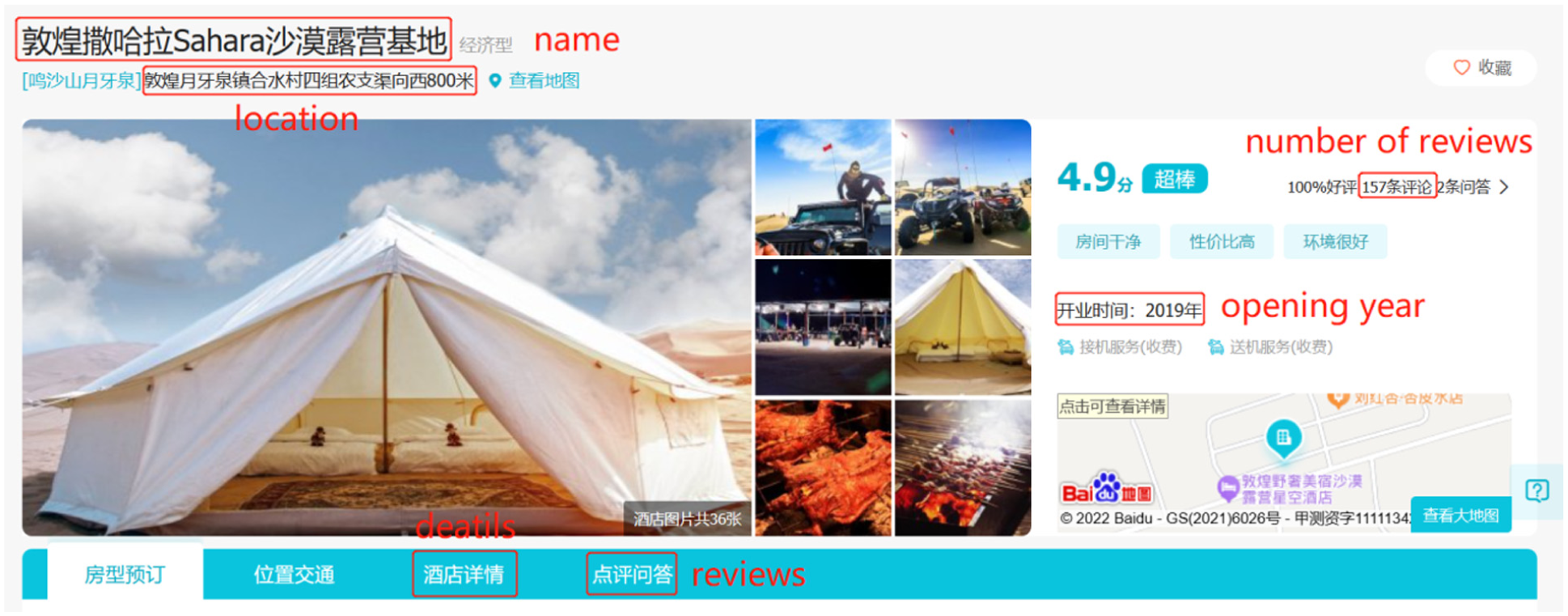
Glampsite details on Qunar.
As a result, a total of 67,557 comments and 262 glampsites are obtained. Some comments are shown in Table 4.
Display of Glampsite Online Reviews.

Data Processing
Preprocessing
Pre-processing consisted of four steps. The first step is to delete unrelated glampsites. Since Qunar does not have a separate glamping reservation page, and the distinction between camping and glamping in the Chinese market is relatively blurred, this article first conducts a keyword search for “camping” on the hotel reservation page, and then manually eliminates some hostel-style hotels that do not provide glamping services or only provide simple tent rental services. The second step is to delete irrelevant comments, which include deleting non-Chinese comments, duplicate comments, and short comments (comments with a length of less than 10 characters). These two steps have reduced the number of glampsites from 262 to 210 and the number of comments from 67,557 to 21,821. The third step is to process the missing price information for the 210 reserved glampsites. The reason for the missing price data is that some glampsites have been fully booked on the day of crawling and the price information have been hidden. To minimize sample reduction and align with the actual situation, this paper adopts a processing method of using prices from other platforms (such as Ctrip and Dianping) to fill these missing values. The fourth step is to preprocess the comment text, including removing special symbols and segmenting words and clauses. In the preprocessing stage before attribute extraction, this paper utilizes the accurate mode of the Python software Jieba library to segment words and remove stop words. The Jieba library is an excellent third-party library for Chinese word segmentation, and its accurate mode of word segmentation has the best effect. To accelerate word segmentation, we incorporate four widely used stop word vocabularies: “Chinese Stop Word Vocabulary,”“Harbin Institute of Technology Stop Word Vocabulary,”“Baidu Stop Word Vocabulary,” and “Sichuan University Machine Intelligence Laboratory Stop Word Vocabulary” to remove unintended words and to promptly modify custom words based on the word segmentation results, thereby minimizing word segmentation errors. In the preprocessing stage before performing sentiment analysis, we utilizes the Sentence Splitter function in the Pyltp library to divide each complete comment into multiple independent sentences.
Mining Glampsite Attributes
BERTopic Topic Mining
Online reviews contain valuable information, and the current methods for mining potential semantics, such as customer preferences, primarily rely on topic models. Latent Dirichlet Allocation (LDA) is currently one of the most popular topic models and is widely used in the field of tourism. However, for short texts such as online reviews, LDA is not optimal due to the slight lack of topic coherence and diversity. Many scholars (Sánchez-Franco & Rey-Moreno, 2022; Zankadi et al., 2022) have confirmed that Bidirectional Encoder Representations from Transformers-based topic modeling (BERTopic) performed better than other topic models such as LDA and Probabilistic Latent Semantic Analysis (PLSA) in several fields. Based on the above analysis, this paper selects BERTopic as a topic mining tool to mine the attributes of glampsites to which customers pay attention.
BERTopic comprises four main steps: (1) Text embedding using the multilingual Sentence Transformers model paraphrase-multilingual-MiniLM-L12-v2; (2) Dimensionality reduction through Uniform Manifold Approximation and Projection (UMAP), with parameters set to n_neighbors = 25 and n_components = 10; (3) Clustering using Hierarchical Density-Based Spatial Clustering of Applications with Noise (HDBSCAN), with min_cluster_size = 30 and Euclidean distance metric; and (4) Keyword extraction based on c-TF-IDF scores. This approach enables a robust identification of customer-attended features derived from online reviews.
Through BERTopic topic mining, 33 topics and the top 10 keywords with the highest importance scores (c-TF-IDF values) within each topic are obtained. Here, six topics are selected as examples, and the results are shown in Table 5. The visualization results of all the topics are shown in Figure 5, with different colors indicating different topics. For the obtained topic and keyword results, each topic has a strong explanatory ability but the number of topics is quite large. Moreover, there are still some cross-cutting topics in Figure 5. Therefore, the obtained topics are merged and named with reference to the sub-item ratings from OTA reviews and previous studies (Ai et al., 2019; Brochado and Brochado, 2019). In addition, to avoid missing synonyms or similar words, it is necessary to expand the keywords. That is, our experiment first utilizes the Word to Vector (Word2Vec) model in the Gensim library to train the word vector matrix. Then, it employs cosine similarity to identify other words that are similar to the existing keywords and subsequently integrates them into the keyword list. The final topic and keyword results obtained are shown in Table 6. These results indicate that the attributes of glampsites that customers pay attention to are location, service, cleanliness, facilities, the cost-performance ratio, food, natural scenery, and leisure activities.
Example of BERTopic Results.

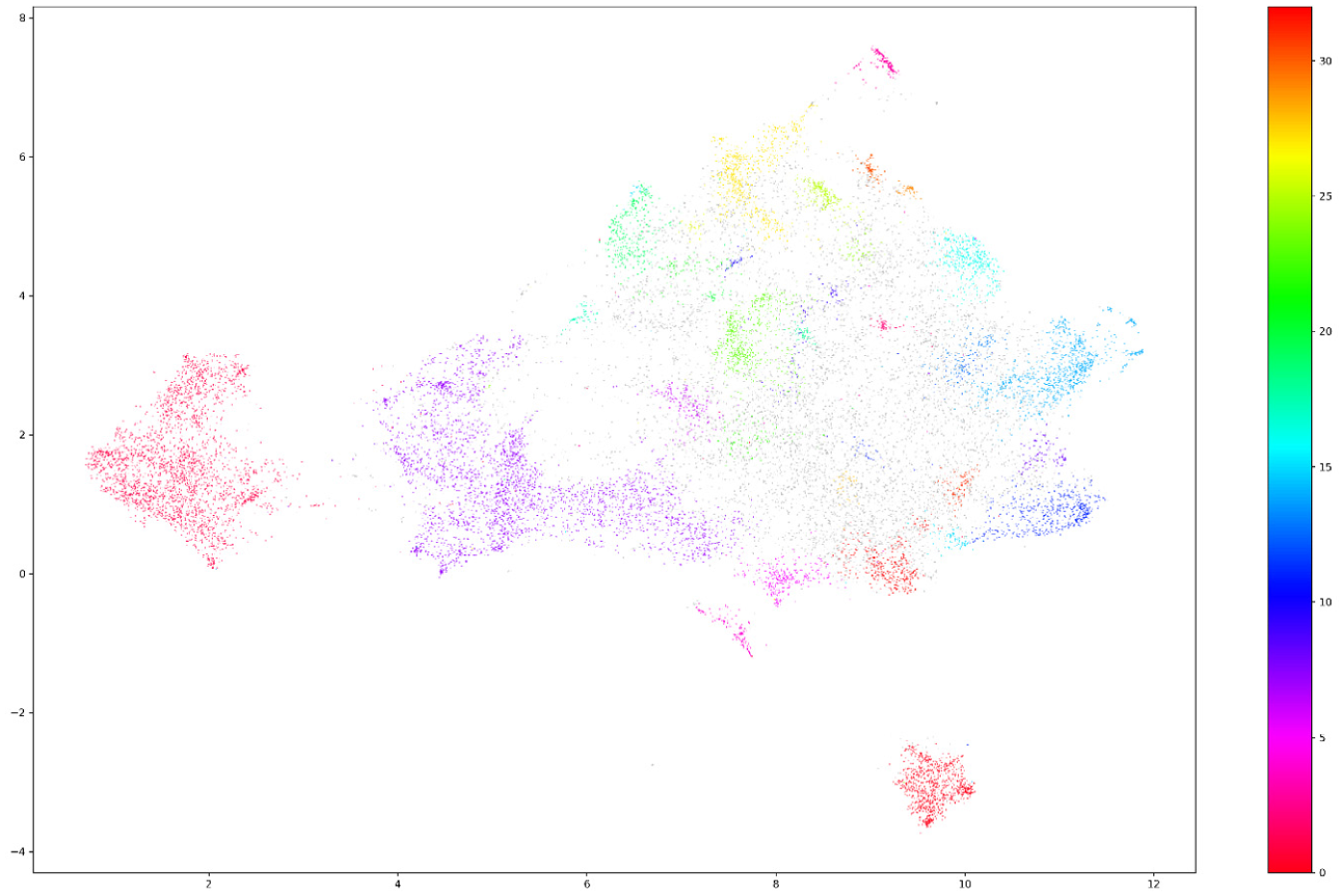
Visualization of topics.
Topics and Keywords.

Calculate Attribute Attention
To avoid the situation in which the attribute attention is not objective enough due to the excessive number of comments on glampsites or the large number of attributes mentioned in a single comment, this section calculates attribute attention with reference to the Local Global Normalization Measure (LGNM) proposed by Rai (2012). This method considers both the frequencies of local and global attributes, avoiding the influence of comment length and the number of comments. Since this paper calculates attribute attention for each glampsite, there may be a situation where an attribute is not mentioned and its frequency equals 0. To account for this, the initial value of the frequency of each attribute is set to 1. Based on the attributes obtained above, regular expression is used to calculate the frequency of each attribute keyword in the comments of every glampsite. The attention of given to each attribute at every glampsite site is calculated according to Formulas (1) to (4).


where LGNMji represents the attention given to the jth attribute of glampsite i, Mi represents the total number of comments after preprocessing glampsite i, and Gji measures the overall distribution of attribute j on glampsite i. A smaller value indicates that item j only appears in a few comments. fjki represents the frequency of attribute j in the kth comment on glampsite i. Fji represents the total frequency of attribute j in the comment on glampsite i. Ljki measures the local distribution of attribute j on glampsite i, that is, the frequency of attribute j in the kth comment. Nki is equivalent to a normalization factor that corrects for bias caused by comment length.
Attribute Sentiment Analysis
Sentiment analysis is typically based on machine learning, deep learning, or sentiment lexicon. This paper employs SnowNLP, a machine learning-based tool tailored for Chinese text processing, to attribute sentiment analysis. Its high computational efficiency, strong adaptability to online reviews, and a pre-trained dictionary focused on platform product consumption make it particularly suitable for analyzing large-scale Chinese textual data and identifying customers’ post-purchase sentiments.
Following Zhao et al. (2022), each review clause is assumed to mention at most one or two attributes, with the clause’s sentiment score assigned to those attributes. To reflect the stronger influence of negative sentiment on booking behavior (Mauri & Minazzi, 2013), the proportion of negative sentiment tendencies is used to replace sentiment scores. Sentiment scores calculated by SnowNLP are classified as follows: below 0.5 indicates negative, above 0.5 indicates positive, and exactly 0.5 is neutral. The frequency of negative tendencies for each attribute is calculated, and the proportion of negative emotions for each attribute is calculated based on Formula (5).

where Sji represents the proportion of negative emotions for attribute j on glampsite i, Negji represents the frequency of negative tendencies for attribute j on glampsite i, and the meaning of Fji is the same as in Formula (2).
The final attribute negative rate, derived using the method of Zhao et al. (2022), combines attribute-specific negative emotion prevalence and attribute attention data. The specific calculation formula is as follows:

where ASji represents the negative rate of attribute j on glampsite i, Sji represents the proportion of negative emotional tendencies of attribute j on glampsite i, and ω represents an arbitrarily small value (0.1 is used in this paper) to avoid the situation when the value is 0. The LGNM ji value is obtained using Formula (1).
Factors Influencing the Booking Volume of Glampsites
Through the above data collection and processing, the attribute negative rates that may affect glamping bookings are derived. However, the second and third research questions outlined in Section Moderating Effect of External Environmental Factors remain unanswered. To address the aforementioned issues, this section utilizes an ordered logistic regression model to analyze the factors that influence and adjust the impact.
Influencing Factor Analysis
Construction of the Basic Model
This paper aims to explore the factors that affect glampsite bookings, with glampsite bookings as the dependent variable. However, like OTAs, Qunar does not publish glampsite bookings. In response to this problem, most scholars (Ai et al., 2019; Guo et al., 2022) have confirmed that there is a positive relationship between the number of online comments and bookings, and that the number of comments can be used as a substitute for bookings. In addition, since the number of glampsite comments is a nonnegative integer and falls within the range of [1, 5,002] and exhibits a highly skewed distribution, it is not appropriate to utilize counting models such as Poisson regression and negative binomial regression. In this paper. Given these data characteristics, although categorization may lead to some information loss, with reference to Q. Zhang (2020), bookings are divided into three categories based on percentiles: low, medium, and high bookings. Since the bookings are ordered and the distances are inconsistent (the distance between the low bookings and the medium bookings is less than the distance between the medium bookings and the high bookings), ordered logistic regression is suitable for analysis.
The impact of OTA information on customer travel behavior usually has certain commonalities, so this paper preliminarily selects the following variables as control variables with reference to the literature (Guo et al., 2022): GDP ranking, camping ranking, number of confirmed cases of COVID-19 in the city where the glampsite is located, lowest price of the glampsite, years of operation, and rating. Considering that the impact of ratings on bookings may be nonlinear (Chakraborty, 2019), the quadratic term of ratings is further used as a control variable. Before conducting regression analysis, all variables are normalized, except for the dependent variable, using z-scores, in order to eliminate the influence of different units and ensure that the coefficient results are comparable. However, due to the large number of control variables involved and the complexity of the model, a stepwise backward regression control variable selection is adopted, and the control variables with coefficients corresponding to p values greater than .1 are excluded. Finally, all the variables involved in this paper are shown in Table 7.
Model Variable Description.

Based on the above processing, the basic ordered logistic regression model constructed in this paper is as follows:

where c (c = 1, 2,…, C − 1) are the levels of the ordinal bookings category variable Y, C (C = 3 in this paper) represents the number of categories of Y, P (Y ≤ c) is the cumulative probability of Y being less than or equal to a particular category c, α c is the intercept, β is the regression coefficient corresponding to each X, and X is the independent variable and control variable in Table 7. Note that P (Y ≤ 3) = 1.
Analysis of the Basic Regression Results
This section uses Stata 16.0 software to analyze the basic model constructed in the previous section, and the regression results are shown in Table 8.
Result of Basic Regression.

Note. Cut1 and cut2 represent estimated cut points, which are used for booking category prediction. When the predicted latent bookings is less than or equal to the cut1 value (−1.129), it is classified as low bookings; When the predicted potential booking volume is greater than or equal to the cut2 value (3.273), it is classified as high bookings; Otherwise, it will be a medium bookings.
p < .1. **p < .05. ***p < .01.
As shown in Table 8, although the McFadden pseudo-R2 is small (.439), the chi-square statistic is significant at the 1% level. According to the regression results for their respective variables, all the coefficients, except for the negative coefficient of the cost-performance ratio, food, and service, are significant at the 10% level. The influence of the independent variables is as follows: negative rates of cleanliness, natural scenery, location, leisure activities, and facilities. Analysis from the perspective of odds ratios (ORs, which measure the effect of independent variables on the relative advantage between different classification levels): when other conditions remain unchanged, for each unit standard deviation increase in the negative rate of cleanliness, the odds probability of bookings in a higher classification (i.e., if the current bookings level is low, the higher level is medium; if the current bookings level is medium, the higher level is high) will decrease by 95.8% (p = .001 < .01). When the negative rate of natural scenery increases by a unit standard deviation, the odds of bookings in a higher classification decreases by 68.8% (p = .011 < .05). When the negative rate of location increases by a unit standard deviation, the odds of bookings in a higher classification decreases by 66.4% (p = .051 < .1). When the negative rate of leisure activities increases by a unit standard deviation, the odds of bookings with a higher classification decrease by 49.2% (p = .038 < .05). When the negative rate of facilities increases by a unit standard deviation, the odds of bookings with a higher classification decrease by 49.2% (p = .088 < .1). However, the impacts of food, the cost-performance ratio, and service negative rates on bookings are not significant; the reasons are discussed in Section Factors Influencing Glampsite Bookings.
In addition, the average marginal effect is further calculated to visually illustrate the average impact of the independent variable on the dependent variable within a specific bookings category, from a probability perspective. The results for the significant independent variables are shown in Table 9. Assuming that the other conditions remain constant, when the negative rate of cleanliness increases by a unit standard deviation, the probabilities of bookings occurring at low and medium levels increase by 23.1% and 13.4%, respectively, while the probability of bookings occurring at high levels decreases by 36.5%. When the negative rate of natural scenery increases by a unit standard deviation, the probabilities of bookings at low and medium levels increase by 8.4% and 4.9%, respectively, while the probability of bookings at high levels decreases by 13.3%. When the negative rate of location increases by 1 standard deviation, the probability of bookings occurring at a low level increases by 8%, the probability of bookings occurring at a high level decreases by 12.6%, and the probability of bookings occurring at a medium level remains unchanged. When the negative rate of leisure activities increases by a unit standard deviation, the probabilities of bookings occurring at low and medium levels increase by 4.9% and 2.9%, respectively, while the probability of bookings occurring at a high level decreases by 7.8%. When the negative rate of facilities increases by 1 standard deviation, the probability of bookings occurring at a low level increases by 4.9%, the probability of bookings occurring at a high level decreases by 7.8%, and the probability of bookings occurring at a medium level remains unchanged.
Average Marginal Effect of Basic Regression.

Note. The number 1 represents low bookings, 2 represents medium bookings, and 3 represents high bookings.
p < .1. **p < .05. ***p < .01.
Model Test
Table 9 shows that the Variance Inflation Factors (VIFs) of each variable are less than 5, indicating that the model does not exhibit multicollinearity. In addition to the multicollinearity test, the use of ordered logistic regression needs to satisfy the assumption of parallelism (Wu et al., 2019). The parallelism assumption holds that when the dependent variable is classified into different categories, the slopes corresponding to the independent variables remain the same, and the relationships between the independent variables and the dependent variable are not affected by the group. That is, each unit increase in the independent variables has an equal influence on the dependent variable moving to the next adjacent category. In this paper, a parallelism test is conducted to compare an ordered logistic regression model with a generalized ordered logistic regression model that relaxes the assumption of parallelism. The test results show that the Wald statistic has a value of 17.59, corresponding to a p value of .226 > .05, and the model cannot reject the initial hypothesis of parallelism. This means that ordered logistic regression can be used for analysis.
Moderating Effects of External Environment Perceptions on Attribute Negative Rate
Based on the discussion in Section Moderating Effect of External Environmental Factors regarding the association between the COVID-19 pandemic, weather factors, and glamping, combined with an analysis of Goal System Theory, it can be inferred that consumers’ multiple goals in the context of glamping may be triggered by their perceived environment. This, in turn, likely influences their glampsite choice decisions. Therefore, this section examines the moderating effect of customers’ perceptions of COVID-19 and weather on the relationship between attribute negative rates and bookings. Specifically, interaction regression analyses of COVID-19 perception, weather perception, and attribute negative rates are performed. External environmental perception is used here instead of actual measurement data because individuals have different psychological reactions in the same physical environment. Using perception can better describe the impact of the external environment on individuals. COVID-19 perception and weather perception are calculated from the average frequency of keywords appearing in comments, and keyword acquisition and expansion use word vector matrix training and cosine similarity calculation methods similar to those in Section BERTopic Topic Mining. The keywords related to COVID-19 perception include: epidemic, leaving Shanghai, going far, off-peak, out of town, leaving Beijing, leaving the province, repeated, peripheral travel, nucleic acid, detection, rejection, etc. The keywords related to weather perception include: weather, heatstroke prevention, summer, rain, cool wind, cloudy, sunny, autumn, bright, rainy, breathable, cool, hot, spring rain, high temperature, steamer, dry, rain sound, and strong wind. Prior to conducting the regression analysis, the independent and moderating variables were decentralized, and the interactions were subsequently constructed. The purpose of this approach is to eliminate collinearity, improve model interpretability, and enhance convergence.
Analysis of the Regression Interaction Terms of COVID-19 Perception
To further explore the difference in the impact of attribute negative rates on glamping bookings under COVID-19 perception, this section constructs an interaction regression analysis between COVID-19 perception and the attribute negative rates (with a significant coefficient in the basic model) in sequence, and the results are displayed in Table 10.
Result of COVID-19 Perception Interaction Item Regression.

Note. Loccov represents the interaction term between negative rate of location and COVID-19 perception, while actcov represents the interaction term between negative rate of leisure activity and COVID-19 perception. Cut1 and cut2 represent estimated cut points, which are used for booking category prediction. When the predicted latent bookings is less than or equal to the cut1 value (−1.080), it is classified as low bookings; When the predicted potential bookings is greater than or equal to the cut2 value (3.361), it is classified as high bookings; Otherwise, it will be medium bookings.
p < .1. **p < .05. ***p < .01.
As shown in Table 10, both regression equations are significant at the 1% level. The interaction coefficients of COVID-19 perception and negative correlation with location are significantly positive (.430 > 0, p < .1). This finding suggests that negative attitude toward of location has a greater impact on bookings related to high levels of COVID-19 than on booking related to low levels of COVID-19. The degree of model fit improves compared to that of the basic model; namely, the AIC decreases from 279.224 to 278.637, and the McFadden pseudo-R2 increases from .439 to .449. The interaction coefficient between COVID-19 perception and the negative rate of leisure activity is significantly positive (.626 > 0, p < .05), indicating that the negative rate of leisure activity has a greater impact on bookings related to high COVID-19 perception than on those related to low COVID-19 perception. The degree of model fit improves compared to that of the basic model; namely, the AIC decreases from 279.224 to 275.045, and the McFadden pseudo-R2 increases from .439 to .457.
Analysis of the Regression Interaction Terms of Weather Perception
To further explore the difference in the impact of attribute negative rates on glamping bookings under weather perception, this section constructs an interaction regression o analysis between weather perception and the attribute negative rates (with a significant coefficient in the basic model) in sequence, and the results are shown in Table 11.
Result of Weather Perception Interaction Item Regression.

Note. Clewea represents the interaction term between negative rate of location and COVID-19 perception, while actwea represents the interaction term between negative rate of leisure activity and COVID-19 perception. Cut1 and cut2 represent estimated cut points, which are used for booking category prediction. When the predicted latent bookings is less than or equal to the cut1 value (−0.959), it is classified as low bookings; When the predicted potential bookings is greater than or equal to the cut2 value (3.523), it is classified as high bookings; Otherwise, it will be a medium bookings.
p < .1. **p < .05. ***p < .01.
As shown in Table 11, the two regression equations are significant at the 1% significance level. The interaction coefficient between weather perception and the negative rate of cleanliness is significantly negative (−2.036 < 0, p < .1). This finding suggests that the impact of the negative rate of cleanliness on bookings is smaller under high weather perception than under low weather perception. The degree of model fit improves compared to that of the basic model; namely, the AIC decreases from 279.224 to 277.961, and the McFadden pseudo-R2 increases from .439 to .451. The interaction coefficient between weather perception and the negative rate of leisure activities is significantly positive (0.871 > 0, p < .05), indicating that the negative rate of leisure activities has a stronger influence on bookings under high weather perception than under low weather perception. The degree of model fit improves compared to that of the basic model; namely, the AIC decreases from 279.224 to 276.677, and the McFadden pseudo-R2 increases from .439 to .454.
Discussion
This section analyzes and discusses the aforementioned results from two perspectives: the factors that influence bookings and the moderating effect of external environment perception. In addition, considering that the literature on the selection of glampsites is less related to COVID-19 and weather, while glamping and hotels have certain similarities, some conclusions related to hotel booking are introduced here for comparison.
Factors Influencing Glampsite Bookings
By establishing an ordered logistic regression model, this paper finds that the negative rates of attributes such as cleanliness, natural scenery, location, leisure activities, and facilities in online reviews have a significantly negative impact on bookings. However, the negative rates of attributes such as food, service, and the cost-performance ratio insignificantly affect bookings.
(1) The cleanliness of the glampsite is the most significant factor affecting its bookings. This result is consistent with the findings of the hotel studies of Lee et al. (2019) and Mikulić et al. (2017). In fact, during the COVID-19 pandemic, customers are afraid of virus infection; thus they have higher and more comprehensive requirements on the cleanliness and cleanliness status of public areas (Jiang & Wen, 2020).
(2) The natural scenery of the glampsite and its surroundings is the second most significant factor affecting its bookings. This finding is consistent with the conclusions of Brooker and Joppe (2013) and Filipe et al. (2018). After a certain period of lockdown, customers are eager to escape real life through contact with nature.
(3) The location of a glampsite can affect its bookings. This finding is consistent with the conclusion of Milohnić et al. (2017). The convenient location of the glampsite can help customers avoid unnecessary travel troubles, so that they can better immerse themselves in a good journey.
(4) The quality of leisure activities on a glampsite can affect its bookings. This finding is consistent with the results of the literature (Brochado and Brochado, 2019). Leisure activities are among the most attractive factors for glamping. Participating in leisure activities can help customers relax physically and mentally and enhance the connections between peers (Morris & Orton-Johnson, 2022).
(5) The facility quality of a glampsite can affect its bookings. This finding is consistent with the research conclusion of S. O. Lyu et al. (2020), who noted that the room and leisure facilities of glampsites affect glampers’ booking choices.
(6) The food served by the glampsite insignificantly impacts its bookings. This result is inconsistent with the conclusion of Brochado and Brochado (2019), who stated that original food with local characteristics could provide a good experience for glampers. The majority of high-frequency words associated with food are related to barbecue and self-service, as evidenced by the comment data in this paper. This means that the food provided by glampsites is homogeneous and lacks local characteristics, making it challenging to transform them into factors that could attract glampers. In addition, Mikuli et al. (2017) noted that food supply was not a decisive factor in the choice of campsite.
(7) The service of the glampsite insignificantly impacts its bookings. This result differs from the conclusions of most related studies (Brochado and Brochado, 2019; Lopes et al., 2021), which suggested that the friendliness and interactivity of glampsite staff were important factors affecting customers’ choice or experience of glampsites. The reason is that the data collected in this paper are collected after the outbreak of the epidemic. Customers want to minimize their contact with others to reduce the risk of infection, which may lead to the negligible influence of services on booking decisions.
(8) The cost-performance ratio of the glampsite insignificantly impacts its bookings. This result is consistent with the conclusions of previous studies (Brooker & Joppe, 2013; Lopes et al., 2021). All the authors noted that the price did not reduce the attractiveness of glamping and was not one of the motivations for customers to choose glamping. In addition, Kim and Han (2022) noted that after the outbreak of the epidemic, the cost-performance ratio was not a factor that customers valued in hotel selection, and its importance ranking decreased. This paper proposes that after entering normalization management during an epidemic, customers have opportunities to go out for glamping, during which they will make compensatory consumption (Craig et al., 2021); thus, they take less consideration of price-related factors.
(9) The location and facilities of the glampsite insignificantly impact its bookings. This finding is partially consistent with the quantile regression results of Guo et al. (2022), that is, at the 0.4 quantile of hotel sales, the influence of hotel location and facilities on sales was not significant. The authors analyzed the reasons for the reduced demand for public transportation among customers and the different types of cities where hotels were located (commercial-oriented city or tourist-oriented city). This paper argues that compared to glampsites with low or high bookings, those with medium bookings encounter more intense competition, and customers have more choices in similar geographic locations. For instance, there are more glampsites located near the Yueya Spring in Jiuquan city in China. In this case, customers may have lower location requirements and place more emphasis on other attributes. In addition, compared with customers of glampsites with high bookings, those of glampsites with medium bookings may prioritize attributes associated with camping experiences, such as appreciating natural beauty and engaging in outdoor activities, over the comfort of room facilities.
Moderating Effects of External Environment Perceptions
Based on Goal System Theory, this paper verifies the moderating effect of external environment perception on some attributes and bookings. This phenomenon can be attributed to differences in the priority of attributes within customers’ goal systems, as well as the influence of external environmental perception on the activation level of these goals. This section discusses the moderation of COVID-19 perception and weather perception separately.
Moderating Effects of COVID-19 Perception
COVID-19 perception has a positive moderating effect on the impact of location and leisure activities on bookings, while the moderating effect on cleanliness, natural scenery, and facilities is not significant.
(1) Increased COVID-19 perception exacerbates the negative impact of negative location on bookings. Specifically, when a glampsite is located in an undesirable area or lacks convenient transportation access, customers with high COVID-19 perception demonstrate weaker booking intentions compared to those with low perception. Drawing on Goal System Theory, it can be inferred that COVID-19 perception activates the core goal priority of location convenience among consumers, prompting them to prioritize controllability in travel decisions—such as minimizing exposure risks and reducing unnecessary movement. It is worth noting that although during the pandemic, the shift from public transportation to private vehicles was perceived as a reduced emphasis on location convenience (Xi & Sang, 2022), accessibility to nucleic acid testing remains a critical factor, as it serves as a prerequisite for entering any public space. Therefore, under heightened COVID-19 perception, location convenience becomes a key decision variable in glampsite selection.
(2) Improvements in COVID-19 perception exacerbates the negative impact of a negative rate of leisure activities on bookings. That is, when the quality of leisure activities provided by glampsites is poor, the booking intentions of customers who perceive a high risk of COVID-19 are weaker than those of customers who perceive a low risk. This suggests that COVID-19 perception elevates the priority of customers’ goal to seek recreation and leisure, prompting them to pay closer attention to activity quality in their decision-making process, in hopes of effectively alleviating anxiety during this exceptional period. During the lockdown imposed due to the epidemic, the public yearns for leisure activities, which are one of the defining features of glampsites. Srivastava and Kumar (2021) noted that customers placed significantly greater emphasis on leisure activities than during non-epidemic periods. It can be inferred that once the actual quality of an event cannot meet expectations, the customer’s booking intention will significantly decrease.
(3) Not all the impacts of the negative rate of attributes on bookings are moderated by COVID-19 perception. The interactions among cleanliness, natural scenery, facilities, and COVID-19 perception are nonsignificant. In other words, the level of COVID-19 perception does not affect the strength of the negative impact of these negative ratings of attributes on bookings. The comments of customers who perceive a high risk of COVID-19 are mainly about interprovincial travel, nucleic acid testing, off-peak travel, and check-in waiting in their comments. These concerns are not closely related to the room facilities provided by the glampsite. Since the outbreak of the epidemic, since its inception, the hospitality and tourism industries have taken strict admission and prevention measures to clean and disinfect regularly, ensuring high quality and quantity and reducing customers’ risk perception. In this case, the impact of cleanliness on bookings may not change under different COVID-19 perceptions. Mul et al. (2022) noted that under the restrictions of the epidemic, visitors preferred to have access to nature, but this phenomenon was not obvious among domestic visitors who had greater adaptability to the epidemic. This paper does not strictly distinguish customer sources; therefore, the moderating role of COVID-19 perception may be affected by the impact of natural scenery on bookings.
Moderating Effects of Weather Perception
Weather perception has a negative moderating effect on the impact of cleanliness on bookings and a positive moderating effect on the impact of leisure activities on bookings. However, the moderating effect of weather perception is not significant for the effects of location, natural scenery or facilities on bookings.
(1) Improvements in weather perception mitigate the negative impact of a negative rating of cleanliness on bookings. In the reviews, good weather conditions are most frequently mentioned. Under such conditions, the activation of alternative goals may reduce customers’ emphasis on cleanliness. Additionally, in a few comments about severe weather, glampsite managers make adjustments to compensate for the lack of cleaning, which can somewhat mitigate the impact of cleanliness on bookings.
(2) Improvements in weather perception intensify the negative impact of the negative rate of leisure activities on bookings. Generally, leisure activities on glampsites are mostly outdoor activities that are closely related to weather conditions. Customers with high weather perception may prioritize participation in outdoor recreational activities more highly, and once this need is not met, they are more likely to alter their booking decisions.
(3) The interactions among location, facility, natural scenery, and weather perception are not significant. In other words, the level of weather perception does not affect the negative effect of negative rates of attributes on bookings. Regardless of weather perception, the impact of location convenience on booking volumes remains consistently strong. This suggests that location convenience may represent a foundational goal in glamping decisions, with its priority being relatively insensitive to changes in weather perception. Regarding facility, the result contradicts the conclusions of Mun and Park (2022) who suggested that customers were more willing to stay in fully equipped hotels under abnormal heavy rain. Weather perception might change the effect of customer facility satisfaction on bookings. In fact, the results of this paper are the opposite. The likely reason is that there are no extreme weather conditions involved in the comments here; rather, they only slightly deviate from expectations, and therefore does not trigger activation of the goal related to facility completeness. The results for the natural scenery are unexpected. Like in leisure activities, the impact of natural scenery satisfaction on bookings should vary under different weather perception. However, there is the same. One possible reason is that after customers learn about natural experiences under different weather conditions, they think that the most important factor influencing their choice of glampsite is escaping from their existing life (Morris & Orton-Johnson, 2022) and obtaining a different experience rather than enjoying natural scenery under optimal weather conditions. Another possible reason is that natural beauty in different weather conditions also has a certain appreciation value, and customers adjust their perception according to the weather conditions they are experiencing at the time so that the experience is still good (Q. Zhang et al., 2023). Therefore, the moderating effect of weather on natural scenery is not obvious.
Conclusions and Prospects
Conclusions
By collecting OTA data for glamping, conducting topic mining and sentiment analysis, and incorporating other factors discussed in previous research, this paper develops an ordered logistic regression model grounded in Goal System Theory. The model includes COVID-19 perception and weather perception as moderating variables. The study examines the relationship between attribute sentiment and bookings for glamping. This paper draws the following conclusions:
(1) Glampers focus on glampsite services, cleanliness, leisure activities, natural scenery, facilities, location, food, and the cost-performance ratio.
(2) The negative rates of several attributes of online reviews have a significant impact on bookings. These aspects, ran ked in descending order of impact, include cleanliness, natural scenery, location, leisure activities, and facilities. Conversely, service, the cost-performance ratio, and food consumption do not have significant influences on bookings. In comparison to location and facilities, customers who opt for medium-booked glampsites are more concerned about the cleanliness, natural scenery, and leisure activities offered at the glampsite.
(3) Based on Goal System Theory, this study finds that external environmental perceptions dynamically alter customers’ decision weights on glamping attributes by activating specific goals. Empirical results show that COVID-19 perception and weather perception trigger distinct goal priorities, selectively moderating the impact of negative rates of specific attributes on bookings. Specifically, COVID-19 perception elevates the priority of location convenience and recreational activities, thereby increasing their influence on glampsite selection. Similarly, weather perception enhances the importance of recreational activities while reducing the weight of cleanliness—a non-core attribute—in booking decisions. The decision weights of other attributes, however, remain stable across different levels of COVID-19 perception and weather perception, indicating that their prioritization in the glamping booking process is not significantly influenced by these two environmental perceptions.
Theoretical Implications
From a theoretical perspective, this paper aims to verify and enrich the research on the factors affecting glampsite bookings considering the external environment, which is shown as follows:
(1) The impact of textual information on glampsite bookings is quantitatively explored through text mining and statistical modeling techniques. For the camping industry, this approach not only compensates for the absence of comprehensive and objective analysis through traditional data collection methods, but also addresses the lack of quantitative connection between textual information and the selection or reservation of campsites. Furthermore, this research demonstrates how natural language processing (NLP) techniques can be used to extract key insights from customer feedback and translate them into actionable managerial recommendations. This provides a feasible research framework and technical roadmap for future studies with similar objectives.
(2) Goal System Theory provides a new perspective for studying campsite bookings or tourist destination selection. This paper proposes a bookings influencing factor model containing moderating variables, using external environmental perception as a moderating variable. The study reveals that customers’ perceptions of external environmental factors (e.g., weather, pandemics) can trigger different goal-directed behaviors, thereby altering their attitudes toward specific glamping attributes and ultimately influencing their booking decisions. Moreover, the findings show that under varying contextual conditions, certain previously important secondary goals may become less salient, while core goals gain greater prominence. This insight offers a deeper understanding of consumer behavior and provides new perspectives for research on destination choice in the tourism industry.
Practical Implications
From a practical perspective, the research conclusions of the paper can provide suggestions for the future management and development of glamping, which can be demonstrated from the perspectives of both the government and glampsite managers.
(1) Preserve the natural environment of the glampsites. It is imperative to prioritize the protection of natural scenery, as it serves as a defining characteristic and plays a significant role in customers’ decision-making process. The responsibility for maintaining the cleanliness of the glampsites and their surrounding areas lies with both the government and the glampsite managers. The government should establish environmental management policies specific to different geographical environments, including deserts, coastal areas, and mountain forests. These policies should be accompanied by robust monitoring and supervision mechanisms to ensure compliance. For example, in forested areas, daily visitor caps can be imposed to protect vegetation, while in coastal zones, stricter regulations on wastewater disposal should be enforced to safeguard marine ecosystems. Additionally, certification systems could be established to recognize environmentally responsible campsites, with tax incentives or policy subsidies offered to encourage industry-wide transitions toward eco-friendly practices. Glampsite managers should prioritize the protection of the natural scenery surrounding their sites, minimize the adverse impact of human activities on the natural environment, and endeavor to provide customers with visually appealing and clean glampsites. By adhering to these principles, the number of customer bookings is likely to increase.
(2) Optimize the facilities in the glamping rooms and enhance the capacity to host leisure activities. Additionally, it is important to focus on effectively managing negative comments. First, glampsite managers need to pay attention to facility quality during glampers’ stay. This can be achieved through regular inspections and timely updates to ensure that facilities are well-maintained over time. Moreover, managers need to ensure glampers’ access to leisure activities. For instance, providing indoor activities that reflect local characteristics may be an appropriate option. For example, alternative indoor activities that reflect local culture can be prepared in advance—such as forest rain tea ceremonies on rainy days or stargazing workshops on clear nights—turning weather conditions into unique experiential elements. This approach is important for preventing sudden weather changes from causing psychological gaps among glampers. Regarding negative reviews, managers should regularly identify and address recurring issues raised by customers. The resolution process and outcomes can be made publicly available to demonstrate transparency and accountability. Such actions can help rebuild consumer trust and improve overall service quality.
(3) Managers need to pay attention to shifts in consumer goals during crisis situations and respond by addressing diverse customer needs through targeted strategies. During extraordinary periods such as the COVID-19 pandemic, consumers’ goal structures often undergo significant changes. To stay competitive in the market, managers should meet customers’ basic needs, such as convenient location or personalized services during a specific period. Additionally, they should respond promptly to emerging needs, such as leisure and entertainment activities, to gain an advantage in market competition. In the process of translating emerging needs into universal needs, managers should develop the unique characteristics of their glampsites rather than blindly conforming to trends. For example, glampsites located in mountain forests can offer locally sourced seasonal food as an alternative to generic barbecues to attract customers.
Limitations and Future Research
This paper has the following limitations, which need to be further improved:
(1) The data source is single. This approach has certain limitations because it relies solely on one platform’s data for analysis, although there is no special large-scale glamping booking website in China and that Qunar has a large market share compared to other platforms. In addition, only glampsites in China are analyzed, ignoring other forms that already have existed in the glamping market, such as camping-themed restaurants. In the future, data can be obtained from multiple platforms for comparative analysis across different cultures. Additionally, other forms of glamping can be explored to conduct more comprehensive business analysis.
(2) Although existing studies have demonstrated a positive relationship between the volume of online reviews and actual booking levels, using review count as a proxy for booking demand still has certain limitations. Future research could seek to obtain real booking data through industry channels or platform partnerships to enhance the accuracy and validity of findings.
(3) The objectivity and automation level of mining attributes from online reviews need to be improved. Firstly, when using BERTopic for topic extraction in this paper, the parameter settings mostly refer to the number of topics extracted in previous literature to control the computational efficiency, which is rather subjective. Secondly, after using BERTopic to obtain the initial topics, this paper manually adjusts the topics to achieve a more effective topic mining. However, this approach is less efficient when processing a large number of topics. In the future, methods such as grid search and cross-validation can be selected for parameter optimization, or other topic models and algorithms can be used to improve the efficiency of topic mining.
(4) This paper quantifies customer attitudes toward glampsite attributes by merely analyzing the thematic emotions expressed in sentence-level online reviews. Although this approach has certain empirical merits, it also presents several limitations that warrant further improvement in future research. First, while online review data offer advantages such as large sample size and rapid collection, they are subject to selection bias. Not all customers leave reviews, meaning the findings primarily reflect the preferences of those who are inclined to comment, rather than representing the broader customer population. Future studies could combine traditional data collection methods, such as surveys, with online review analysis to cross-validate findings and enhance the generalizability and robustness of the conclusions. Second, this study uses sentence-level sentiment as a proxy for attribute-level sentiment. Although similar approaches have been adopted in prior literature, this method overlooks the complexity of semantic structures within review sentences, potentially affecting the accuracy of sentiment identification. Future research could incorporate more sophisticated text analysis techniques, such as dependency parsing or event extraction, to improve the precision of attribute-specific sentiment detection. In addition, given the large volume of online reviews, this study employes SnowNLP for sentiment analysis due to its efficiency and suitability for processing large-scale textual data. However, SnowNLP has limitations in handling complex linguistic phenomena such as sarcasm and ambiguous expressions. Future research may consider applying deep learning-based sentiment analysis models to achieve higher-quality sentiment recognition and more accurate attribute association.
(5) Other external factors are not taken into consideration. Since the outbreak of the epidemic, governments across China have introduced corresponding policies to contribute to the recovery of the tourism industry. However, this paper does not take these policies into account in the model. In the future, incentive policies can be introduced to further analyze the factors affecting glamping bookings.
Footnotes

Ethical Considerations
This article does not contain any studies with human participants performed by any of the authors.
Funding
The authors disclosed receipt of the following financial support for the research, authorship, and/or publication of this article: This research is supported by the Zhejiang Provincial Natural Science Foundation of China (Grant No. LY22G010004) as well as the special project research results of the Zhejiang Provincial Key Research Base for Philosophy and Social Sciences, the China Intelligent Management Institute of Zhejiang Gongshang University (Grant No. 25IM003).
Declaration of Conflicting Interests
The authors declared no potential conflicts of interest with respect to the research, authorship, and/or publication of this article.