



Abstract
The primary objective of this research is to examine the behavioral characteristics of tourists engaging in drug tourism, which is defined here as traveling to destinations where drug use is legal. Specifically, this study investigates the relationships among packaging, anti-drug information, attitudes, and behavioral intentions within the context of drug tourism. Anti-drug information is introduced as a moderating variable. Data were collected via an online survey on the Clickworker platform, yielding 200 valid responses for statistical analysis. To test the proposed hypotheses, Hayes’ Process Macro Model 7 was employed. This work also performed a median split analysis to investigate the moderating effect of anti-drug information further. The findings indicate that perceptions of drug packaging positively influence both tourists' attitudes and their behavioral intentions. Furthermore, anti-drug information significantly moderates the relationship between packaging and attitude. Attitudes were found to have a positive effect on behavioral intentions. This study contributes to the literature by providing insights into the behavioral patterns of drug tourists, with a focus on four key attributes. The practical implications of these findings are also discussed.
Plain Language Summary
The aim of this research is to scrutinize the behavioral characteristics of tourists who engage in drug tourism.
Introduction
According to the United Nations Office on Drugs and Crime (2019), the number of individuals affected by drug-related victimization increased by approximately 100 million between 2008 and 2017, underscoring the growing global challenge of illegal drug use. Prior research stated that tourism destinations often serve as sites of initial exposure to illegal drugs, largely due to variations in local culture, regulatory environments, and social norms (Hoffmann, 2014; Uriely & Belhassen, 2005). This implies that drug tourism may play a critical role in the onset of drug-related victimization. Drug tourism is generally defined as travel to destinations where access to illegal drugs is permitted due to more lenient or differing legal frameworks (Pereira & de Paula, 2016; Wen et al., 2021). Wen et al. (2021) noted that the global prevalence of drug tourism has increased in recent years, partly driven by improved economic conditions that enable more people to travel. At the same time, scholars raised concerns about the social consequences of drug tourism, particularly the risk of individuals developing drug dependencies and continuing to pursue illicit drug use both at home and abroad (Daley & Feit, 2013; Hagemans et al., 2024; Wen et al., 2021). Wen et al. (2021) focused on cannabis in their exploration of drug tourism, given that the legal status of cannabis varies significantly across countries. As this study aims to explore perceptions of drug tourism with a specific focus on international travel, it centers on cannabis as the focal substance, given its relevance and varying legal status across destinations. Given the increasing scale and complexity of this issue, it is essential to examine traveler behavior within the context of drug tourism. In this study, drug tourism is defined as travel to countries where illegal drugs are accessible under legal regulation.
This study investigates tourist behavior in the context of drug tourism by focusing on three key constructs: packaging, attitude, and anti-drug information. These constructs are conceptually linked to explain how external stimuli influence tourists' behavioral intentions regarding drug tourism.
First, packaging is examined as a primary external cue that shapes consumer perceptions and decisions. Prior research has shown that packaging plays a critical role in forming first impressions, capturing attention, and influencing purchase behavior (Ares et al., 2010; Escario et al., 2020; Song et al., 2023). In the context of harmful products such as tobacco, studies have demonstrated that appealing packaging can reduce the perceived risks and enhance consumer receptiveness (Macy et al., 2016; Fallo et al., 2023; Hwang & Cho, 2020). Given the parallels between tobacco, alcohol, and illegal drugs in terms of health risks, scholars have emphasized that packaging similarly influences consumer responses to these substances (Cholewa-Wójcik et al., 2024; Fathelrahman et al., 2009; Kotnowski & Hammond, 2013). However, despite its significance, the role of packaging has received limited empirical attention in the context of drug tourism, identifying a critical gap that this study aims to address.
Second, the construct of attitude is introduced as a mediating variable that connects packaging to behavioral outcomes. Attitudes are defined as enduring evaluations that consistently guide individuals’ judgments and behaviors (Fu, 2021; Liao et al., 2023; Moon et al., 2022). Given their predictive strength, attitudes have been widely used in studies of both consumer and tourism behavior. Furthermore, recent literature has highlighted the mediating role of attitude, suggesting that it is shaped by external cues—such as marketing messages or informational content—and subsequently influences behavioral intentions (Moon et al., 2022; L. H. Wang et al., 2022). Drawing on this theoretical perspective, this study conceptualizes attitude as a mechanism through which packaging exerts its influence on tourists’ behavioral intentions.
Next, behavioral intention serves as the dependent variable. Recognized as a reliable predictor of actual behavior, behavioral intention has been frequently employed in tourism research to forecast future actions (Ho et al., 2020; Jung et al., 2020; Muangmee et al., 2021). Numerous studies have confirmed a strong link between attitude and behavioral intention, thereby reinforcing the proposed mediating framework (Fu, 2021; Huang, 2023; Liao et al., 2023; Moon et al., 2022; Wong et al., 2024; Yang et al., 2021).
An additional focal point is anti-drug information, which is incorporated into the model as a moderating variable. Governments worldwide continue to invest in public health campaigns aimed at reducing drug use through education and warning messages (Hornik et al., 2008; Worden & Slater, 2004). The influence of such information can be interpreted through the lens of risk aversion and social norm theory. Individuals generally seek to avoid risk (Im et al., 2021; Zhang et al., 2022), and behavior that deviates from social norms is often perceived as inherently risky or socially undesirable (Kantorowicz-Reznichenko & Kantorowicz, 2021; Roethlisberger et al., 2023). In this regard, product warnings—commonly used for tobacco and alcohol—have been shown to deter harmful consumption (Cholewa-Wójcik et al., 2024; Fathelrahman et al., 2009; Kotnowski & Hammond, 2013). However, the effectiveness of anti-drug campaigns remains inconclusive, particularly in tourism settings. Thus, this study investigates whether anti-drug information moderates the relationship between packaging and tourists’ attitudes.
Based on these premises, the objectives of this work are twofold. The first is to examine the effects of packaging on attitudes and behavioral intentions related to drug tourism, and to assess the mediating role of attitude in this relationship. The second is to explore the moderating effect of anti-drug information on the link between packaging and attitude. By addressing these objectives, the study contributes to the growing body of literature on consumer behavior in risky tourism contexts. In detail, this research advances understanding of how packaging and educational messaging interact to shape attitudes and intentions. The findings offer practical insights for policymakers and tourism stakeholders seeking to mitigate the social and health-related challenges of drug tourism through targeted interventions in product design and communication strategies.
Review of the Literature and Hypothesis Development
Packaging
Packaging serves not only as the physical exterior of a product but also as a key representation of the product's identity while fulfilling essential protective functions (Underwood & Klein, 2002; Wambugu, 2014). As Wambugu (2014) emphasized, packaging plays a crucial role in shaping consumers’ first impressions, which can significantly influence their subsequent evaluations and purchase decisions. Beyond aesthetics and protection, packaging is also instrumental in conveying information. Scholars noted that it functions as a medium for delivering product-related messages, including usage instructions, ingredient lists, and sustainability cues (Boz et al., 2020; Theben et al., 2020). Underwood and Klein (2002) further asserted that packaging serves as a strategic branding tool, as consumers frequently form perceptions of a product based on its external appearance, which typically includes visual elements such as brand logos and names. Numerous scholars reinforced the importance of packaging in shaping consumer perceptions across various domains. For instance, Escursell et al. (2021) investigated how packaging influences consumer behavior in online shopping contexts in the area of eco-friendly marketing, while Seo et al. (2016) explored consumer evaluations of packaging within the food industry, focusing on sustainability. In a similar vein, Nguyen et al. (2020) linked packaging to broader environmental concerns of consumer by examining its implications for waste generation and sustainability. Taken together, these studies underscore the multifaceted role of packaging—not only as a practical necessity but also as a powerful marketing and communicative tool that shapes consumer attitudes and behaviors across different sectors.
Attitude
Attitude, broadly understood as an individual’s evaluative judgment shaped by sustained observation and experience (Fu, 2021; Liao et al., 2023; Moon et al., 2022), has long served as a cornerstone in explaining human behavior. As a central psychological construct, it has been widely adopted across disciplines due to its strong predictive power. In the realm of digital technology, for example, Alfadda and Mahdi (2021) examined user engagement on Zoom, identifying attitude as a key factor influencing platform use. Similarly, Song et al. (2021) explored how consumer attitudes shape perceptions and behaviors in the context of food delivery applications. The significance of attitude extends into tourism research as well. L. H. Wang et al. (2022) investigated tourist attitudes to gain insight into travel decision-making processes, while Fu (2021) and Liao et al. (2023) both focused on attitudes toward green travel as a means of understanding environmentally conscious tourist behavior. Beyond these domains, the construct has been effectively applied in studies addressing broader societal issues. Wong et al. (2024), for instance, explored market responses to renewable energy adoption, identifying attitude as a central explanatory variable. Boubker (2024), drawing on the Theory of Planned Behavior (TPB), analyzed students’ attitudes toward Muslim culture, further demonstrating the variable’s versatility. All in all, these studies underscore the widespread application and theoretical robustness of attitude as a critical construct across various fields of research.
Behavioral Intention
Behavioral intention refers to an individual’s willingness or readiness to engage with specific products, services, or behaviors (Ho et al., 2020; Jung et al., 2020; Muangmee et al., 2021). It has been frequently employed as a dependent variable across a range of research fields, particularly due to its implications for business performance and sales growth (Jung et al., 2020; Mailizar et al., 2021). For example, Ratnasari et al. (2021) examined behavioral intentions to understand decision-making in halal tourism, while Cao et al. (2021) analyzed behavioral intentions among users of artificial intelligence systems. Similarly, Jung et al. (2020) explored this construct in the apparel industry, and C. Wang et al. (2024) used the TPB to investigate college students’ intentions to adopt AI technology. These studies collectively demonstrate the broad applicability of behavioral intention as a dependent variable across diverse contexts. The TPB offers a well-established theoretical framework to explain behavioral intention, proposing that it is directly influenced by attitudes, which themselves are shaped by external stimuli (Tama et al., 2021; Gansser et al., 2023; Sun & Moon, 2024). This theoretical underpinning supports the inclusion of attitude as a mediating variable and external factors—such as packaging and anti-drug information—as antecedents, thereby justifying the conceptual structure of the present study.
Hypotheses Development
Extant literature highlights the significant role of packaging in shaping consumer attitudes. To be specific, Escario et al. (2020) emphasized packaging as a critical influence on attitude formation. Ares et al. (2010) showed that attractive packaging fosters favorable attitudes among milk consumers, while Ben et al. (2020) similarly demonstrated a positive relationship between packaging and consumer attitudes. Likewise, Seo et al. (2016) found that food packaging strongly influences consumer perceptions and contributes to the development of positive attitudes. Through this, it can be inferred that consumers may form positive attitudes toward a particular target through well-packaged products, and this tendency may also be observed in the context of drug tourism. Hence, the present study proposes the following research hypothesis:
Numerous works emphasized the role of packaging in influencing behavioral intentions. Theben et al. (2020) identified packaging as a key determinant of purchase intention as a sort of behavioral intention. Ares et al. (2010) similarly found that the perception of food packaging exerted a positive and significant influence on their decision-making in the case of milk consumers. Muslim et al. (2020) reported that packaging positively influenced behavioral intentions among younger consumers. Recent studies by Delistavrou et al. (2023) and Song et al. (2023) demonstrated that eco-friendly packaging significantly contributes to consumers’ intention to purchase. Based on this, it can be inferred that packaging may influence consumers’ behavioral intentions. In the context of drug tourism, this suggests that the attractiveness of certain products could increase individuals’ intentions to engage in related behaviors. Therefore, the current work proposes the research hypothesis as follows:
Attitude was shown to exert a strong positive effect on behavioral intention. Mailizar et al. (2021) found that positive attitudes enhanced the behavioral intentions of online learning users. Yang et al. (2021) observed a similar relationship in the context of self-service technologies, and Huang (2023) confirmed this linkage in the field of virtual reality. Gansser and Reich (2023) also documented the influence of attitude on behavioral intention in the environmental product market. Wong et al. (2024) disclosed a positive association between attitude and behavioral intention in the domain of energy saving behavior. Sun and Moon (2024) adopted the case of bee products, and the results demonstrated a positive association between attitude and behavioral intention. Given the review of the literature, it can be inferred that attitude is likely to affect the behavioral intention of drug tourism. This study thus proposes the following research hypotheses:
The moderating effect of anti-drug information based on social norms and risk aversion
Anti-drug information refers to knowledge about the harmful effects of illegal drug use and is primarily disseminated to prevent drug-related victimization (Hornik & Yanovitzky, 2003; Lee, 2014; Lorch et al., 1994). By raising awareness of the risks associated with drug consumption, such information promotes vigilance and risk-averse behavior among the public (Hornik et al., 2008; Worden & Slater, 2004). Previous studies have demonstrated that exposure to anti-drug messages can shape individual perceptions and reduce the likelihood of engaging in illicit drug use (Hornik et al., 2008; Longshore et al., 2006). This research draws on the concept of risk aversion to explain the moderating effect of anti-drug information. Risk aversion is defined as the tendency to avoid uncertain or potentially harmful outcomes by favoring safer, more predictable choices (Im et al., 2021; Zhang et al., 2022). Risk-averse individuals are generally more inclined to conform to socially accepted behaviors to avoid adverse social or personal consequences (Kantorowicz-Reznichenko & Kantorowicz, 2021; Roethlisberger et al., 2023; Tomova et al., 2021). In the context of anti-drug campaigns, warning messages are strategically crafted to highlight the potential costs of drug use, ranging from health-related harms to reputational damage and legal consequences (Hwang & Cho, 2020; Macy et al., 2016).
A vast body of literature on anti-smoking campaigns, for example, has shown that warning labels on packaging significantly influence perceptions and reduce the appeal of smoking products (Fallo et al., 2023; Hwang & Cho, 2020; Macy et al., 2016). Similarly, individuals who are exposed to anti-drug information are more likely to recognize the broader negative consequences of drug use, which may include not only addiction and health deterioration but also social disapproval and impaired prospects. These heightened perceptions of risk discourage engagement in such behaviors. Importantly, anti-drug information may moderate the influence of packaging by reducing the likelihood that visually appealing packaging will lead to positive attitudes toward drug-related products. Prior exposure to anti-drug messages can counteract the persuasive power of attractive packaging by reinforcing the negative implications of drug use. In this regard, individuals with higher awareness of drug-related risks are less susceptible to packaging-induced misperceptions and, consequently, less likely to form favorable attitudes or intentions toward drug use. Based on the literature review, the following research hypothesis is proposed:
Method
Research Model and Data Collection
Figure 1 depicts the research model. Packaging is an independent variable, attitude is a mediator, and behavioral intention is a dependent variable. Also, anti-drug information is a moderator. Packaging positively affects both attitudes and behavioral intentions. Attitude also positively impacts behavioral intention. Anti-drug information significantly moderates the relationship between packaging and attitude.

Research model.
Data for this study were collected through an online survey administered via the Google Survey platform, using Clickworker (https://www.clickworker.com/) as the participant recruitment tool. Clickworker has been employed in numerous peer-reviewed studies to support robust statistical inference (e.g., Garaus & Hudáková, 2022; Kremer et al., 2022; Racat & Plotkina, 2023), attesting to its reliability in generating valid research data. This research collected survey responses randomly to enhance the objectivity of the sample. In addition, this study employed an online survey method, based on the rationale that respondents are less constrained by time and location, which may increase their ability to focus and provide more thoughtful responses. To collect survey responses, this research informed participants that the survey sought their opinions on drug tourism, which was explicitly defined as traveling to regions where drug use is legally permitted. The statement emphasized that the study merely aimed to gather general perceptions, to minimize participants’ discomfort or hesitation in responding. Participants were clearly informed at the beginning of the questionnaire that their participation was voluntary and that they could withdraw from the survey at any time if they did not wish to continue. Furthermore, no personally identifiable information was included in the questionnaire, as a measure to ensure the protection of respondents’ privacy.
The initial dataset comprised 317 survey responses. This study employed online random sampling, as travel to destinations where drug use is legal is theoretically accessible to a broad population. The random sampling in this study reflects the characteristic that tourist destinations where drugs are legal are accessible to anyone. The data were collected online from survey participants residing in the United States. This approach was based on the consideration that, overall, U.S. participants are more likely to have greater economic freedom to travel abroad. At the beginning of the questionnaire, respondents were asked whether they had engaged in drug tourism, defined in this study as travel to destinations where drug use—such as cannabis consumption—is legally permitted. It was explicitly noted that the study did not examine actual drug consumption. A total of 117 respondents indicated no experience with drug tourism. It was therefore excluded, as the study focused exclusively on individuals with relevant experience to accurately capture their perceptions of packaging in this context. Consequently, the final sample consisted of 200 valid cases, yielding a usable response rate of 63.07%. To ensure statistical adequacy, the study followed the guidelines proposed by Hair et al. (2010), which recommend a minimum of 10 observations per measurement item. With 16 measurement items employed in the analysis, the final sample size was considered sufficient for robust statistical evaluation. Data were collected over 4 days, from January 17 to January 20, 2024.
Measurement Items
Table 1 presents the information on the measurement items. This research derived measurement items referencing the extant literature on packaging (Muslim et al., 2020; Theben et al., 2020), attitudes (Moon et al., 2022; Liao et al., 2023), and behavioral intentions (Jung et al., 2020; Mailizar et al., 2021). Most items were measured by a five-point Likert scale (1 = strongly disagree, 5 = strongly agree), whereas this study measured attitudes using a semantically different scale (1 = bad, 5 = good). Moreover, the measurement items for anti-drug information were developed through consultation with experts in the tourism research domain. In detail, this study aimed to develop measurement items for quantitative research through two rounds of consultation with three experts in the field of tourism research. The criterion of the experts’ selection was whether they have researched for more than 5 years in the tourism domain and have experience with quantitative research for social science citation index journals. Each consultation was conducted with individual experts for 1 hr. During the process of developing the measurement items, the experts focused on discussing ways to ensure that the content would be conveyed intuitively to the survey participants. Through this process, four measurement items were derived for the measurement of the anti-drug information. The definition of packaging is how individuals assess the packaging of drug products in tourism destinations. The definition of anti-drug information is how an individual possesses knowledge about the risks of an illegal drug. Also, this study defined attitude as the evaluation of drug tourism from the perspective of survey participants. In addition, behavioral intention is defined as how willing participants are to travel to a drug tourism destination.
Illustration of the Measurement Items.

Data Analysis
This study utilized frequency analysis to derive demographic information from the survey participants. Then, this research implemented an exploratory factor analysis to validate the measurement items reviewed by the experts. The analysis was based on an eigenvalue threshold of 1 and factor loadings of 0.5 or higher (Hair et al., 2010). The Kaiser-Meyer-Olkin (KMO) measure was set at a minimum of 0.6, and Bartlett's test of sphericity was applied using a 95% confidence level (Hair et al., 2010). To assess convergent validity, confirmatory factor analysis was conducted following established criteria: factor loadings greater than 0.5, average variance extracted (AVE) greater than 0.5, and construct reliability (CR) greater than 0.7 (Fornell & Larcker, 1981; Hoyle, 1995). Previous research (Hair et al., 2010; Hoyle, 1995) indicates that the goodness of fit for CFA is considered acceptable when the following fit indices meet the recommended thresholds: goodness-of-fit index (GFI), normed fit index (NFI), relative fit index (RFI), incremental fit index (IFI), Tucker-Lewis index (TLI), and comparative fit index (CFI) greater than 0.8, and root mean square error of approximation (RMSEA) less than 0.1. Then, this study computed the mean values and standard deviations (SDs) for each construct. To examine discriminant validity, a correlation matrix was analyzed, with the rule that the square root of the AVE should exceed the correlation coefficients between constructs (Fornell & Larcker, 1981; Hair et al., 2010; Hoyle, 1995).
Next, the relationships between variables were assessed using Process Macro Model 7 (Hayes, 2012, 2017), which is based on ordinary least squares regression for path analysis and designed to analyze conditional indirect effects in a mediated moderation model. This model employed bias-corrected adopting 95% confidence intervals for the conditional indirect effects, with 5,000 bootstrap samples (Hayes, 2012, 2017). An interaction variable (packaging × anti-drug information) was created to explore the moderating effect. Hayes (2017) highlighted that the Process Macro Model is less constrained by assumptions of sample normality, making it a robust tool for statistical estimation and valid inference. Additionally, a median split analysis was performed to further examine the moderating effect. The mean value for each group was computed, resulting in four categories: 1) high packaging × high anti-drug information, 2) high packaging × low anti-drug information, 3) low packaging × high anti-drug information, and 4) low packaging × low anti-drug information, with attitude as the dependent variable.
Results
Profile of Survey Participants
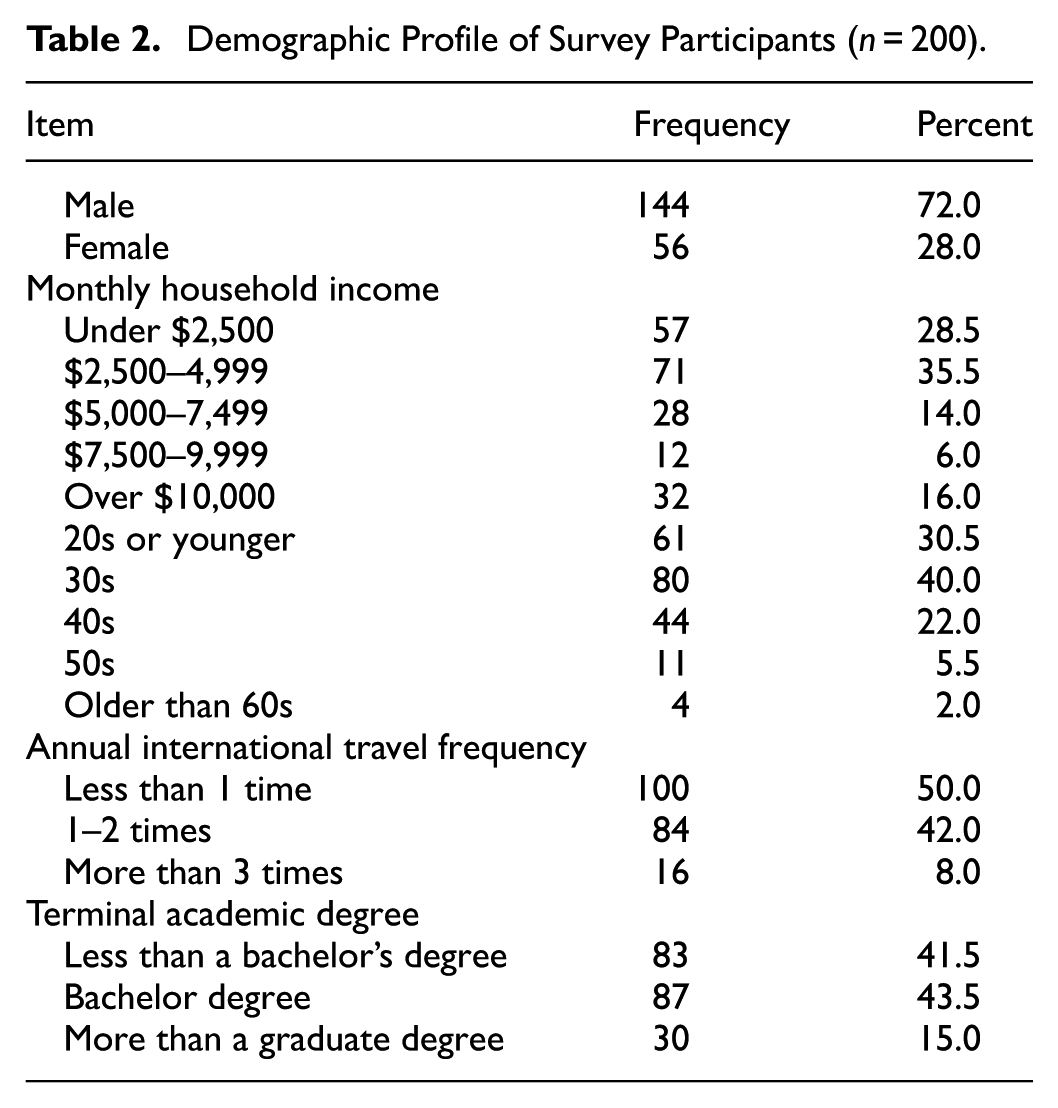
Table 2 provides a summary of the survey participants’ demographic characteristics. Among the participants, 144 were male and 56 were female. In terms of income distribution, 57 participants earned less than $2,500, 71 earned between $2,500 and $4,999, 28 earned between $5,000 and $7,499, 12 earned between $7,500 and $9,999, and 32 earned more than $10,000. The age distribution of participants was as follows: 61 were in their 20s or younger, 80 were in their 30s, 44 were in their 40s, 11 were in their 50s, and 4 were older than 60. Regarding international travel frequency, 50.0% of participants traveled internationally fewer than once per year, 42.0% traveled 1-2 times per year, and 8.0% traveled more than three times per year. Finally, participants’ academic qualifications were distributed as follows: 41.5% had less than a bachelor’s degree, 43.5% held a bachelor’s degree, and 15% had obtained a graduate degree or higher.
Demographic Profile of Survey Participants (n = 200).
Results for Convergent Validity
Table 3 presents the results of exploratory factor analysis. KMO statistics are greater than 0.6 for all attributes, and all factor loadings are greater than 0.5. Moreover, the eigenvalue is greater than 1. Bartlett’s χ2 values are significant, focusing on the p-value (p < .05).
Exploratory Factor Analysis Results.

p < .05.
Table 4 shows the results of the confirmatory factor analysis. Considering the goodness of fit indices (χ2 = 214.650, df = 98, χ2/df = 2.190, GFI = 0.889, NFI = 0.935, RFI = 0.920, IFI = 0.964, TLI = 0.955, CFI = 0.963, and RMSEA = 0.077), the results are statistically significant. Table 3 presents the construct information: packaging (mean = 3.263, SD = 1.190), anti-drug information (mean = 3.382, SD = 0.985), attitude (mean = 3.468, SD = 1.288), and behavioral intention (mean = 3.340, SD = 1.323). All factor loadings and AVEs are greater than 0.5. Moreover, the CR values are greater than 0.7. The results confirmed the convergent validity of the scale.
Confirmatory Factor Analysis Results.

Note. SD stands for standard deviation; goodness of fit indices: χ2 = 214.650, df = 98, χ2/df = 2.190, GFI = 0.889, NFI = 0.935, RFI = 0.920, IFI = 0.964, TLI = 0.955, CFI = 0.963, RMSEA = 0.077; CR stands for construct reliability; AVE is average variance extracted.
Results for Discriminant Validity
Table 5 is the correlation matrix. No off-diagonal values are greater than diagonal values, which suggests that discriminant validity was ensured. Regarding the discriminant validity, the bias caused by collinearity is likely to be lowered. Behavioral intention positively correlated with attitude (r = .818, p < .05), packaging (r = .695, p < .05), and anti-drug information (r = .446, p < .05). Attitude positively correlated with packaging (r = .747, p < .05) and anti-drug information (r = .449, p < .05). Packaging positively correlated with anti-drug information (r = .497, p < .05).
Correlation Matrix Results for Discriminant Validity.

Note. Diagonal is the square root of the average variance extracted (AVE).
p < .05.
Results for Hypothesis Testing
Table 6 displays the results of the hypotheses tested. Both models were statistically significant, as indicated by the F-values (p < .05). The dependent variables of model 1 and model 2 are attitude and behavioral intention, respectively. Packaging had a positive impact on consumers' attitudes (β = 1.083, p < .05) in model 1. In contrast, the interaction between packaging and anti-drug information exerted a negative effect on attitudes (β = −.098, p < .05) in model 1. Additionally, behavioral intention was positively influenced by both packaging (β = .210, p < .05) and attitude (β = .694, p < .05) in model 2. These results indicate that all the proposed hypotheses are supported. The index of mediated moderation was also found to be significant. In terms of conditional effects, the group with low anti-drug information exhibited the strongest impact of packaging on attitude (β = .833, p < .05). The middle group showed a weaker effect compared to the low anti-drug information group (β = .763, p < .05). Finally, the high anti-drug information group demonstrated the weakest effect of packaging on attitude (β = .639, p < .05).
Results of Hypothesis Testing.

p < .05, Interaction: Packaging × Anti-drug information (Test of indirect interaction: F = 4.66*), Explained variables of model and model 2 are attitude and behavioral intention, respectively.
Table 7 and Figure 2 describe the results of the median split analysis. There are mean values of four groups: mean high packaging × high anti-drug information = 4.277, mean high packaging × low anti-drug information = 4.120, mean low packaging × high anti-drug information = 3.226, and mean low packaging × low anti-drug information = 2.630. Therefore, more anti-drug messaging cases more strongly deter from the effect of packaging than the low anti-drug messaging cases.
Means of Attitudes by Median Split.

Note. Explained variable: Attitude.
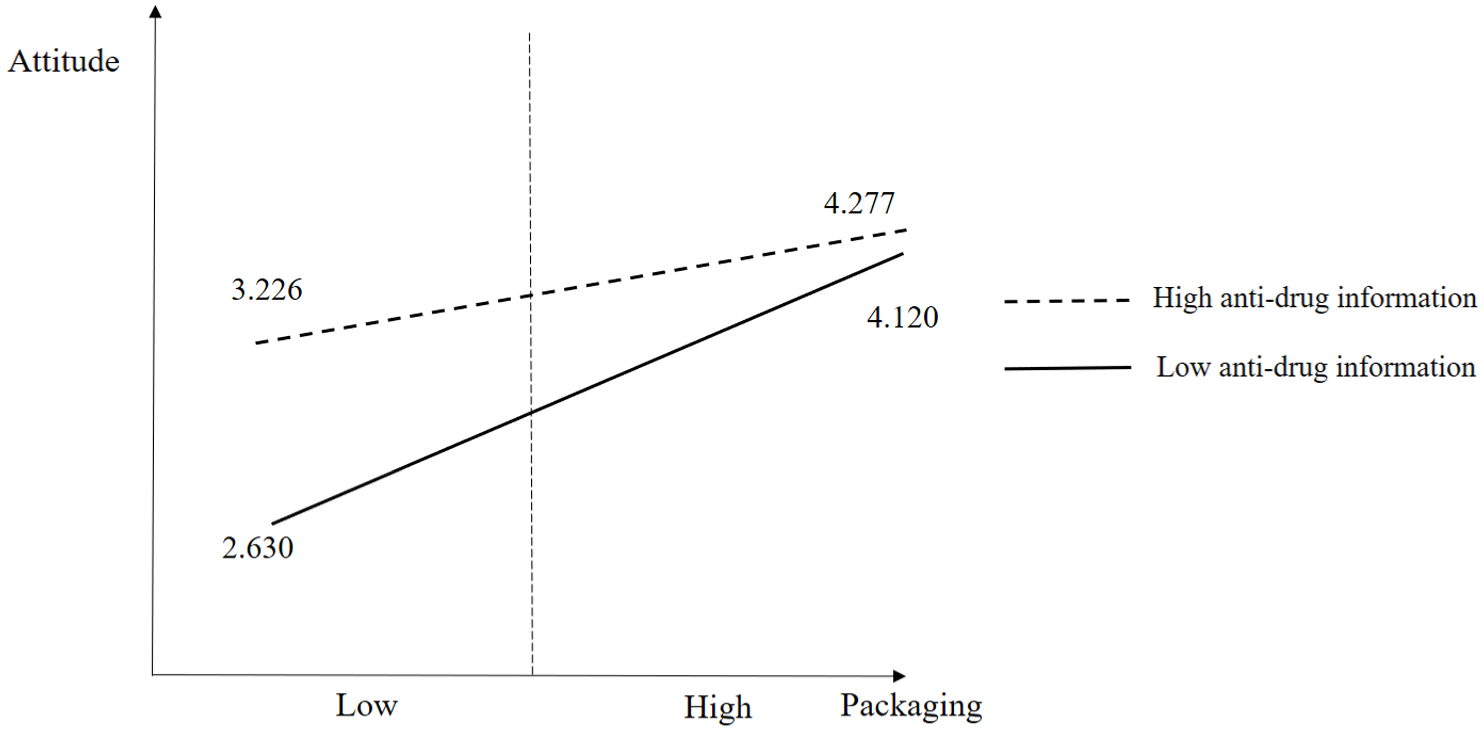
Results of the median split analysis.
Discussion
This research examined the impact of packaging in the context of drug tourism. To investigate drug tourism behavior, four key attributes were considered: packaging, attitude, behavioral intention, and anti-drug information. An online survey was conducted, yielding 200 valid observations for data analysis. The survey participants were experienced with traveling to destinations where illegal drugs are available both legally and commercially. Hayes' Process Macro Model 7 was employed to test the proposed hypotheses. The mean values indicated that the survey participants were somewhat neutral about the packaging, attitude, behavioral intention, and anti-drug information.
Theoretical Implications
This study offers a substantive contribution to the extant body of literature by delineating the interrelationships among packaging, attitudinal responses, behavioral intentions, and anti-drug informational cues within the domain of drug tourism. While the impact of packaging on consumer decision-making has been extensively examined across a range of consumption contexts—including food, pharmaceuticals, and other health-related commodities (Ares et al., 2010; Muslim et al., 2020; Seo et al., 2016; Theben et al., 2020)—its implications within the sphere of drug-related tourism remain insufficiently theorized and empirically validated. In response to this lacuna, the present investigation undertakes a rigorous empirical inquiry, yielding statistically significant results that advance the understanding of consumption behavior in high-risk, deviance-associated tourism contexts. Specifically, this study enhances the theoretical discourse by foregrounding the role of packaging as a critical extrinsic cue that influences tourist behavior in illicit or morally ambiguous consumption settings. Although prior scholarship, such as Wen et al. (2018), explored drug tourism behavior, the omission of packaging as a determinant variable limits the explanatory power of such research. Notably, the literature on sin goods—such as tobacco and alcohol—has emphasized the strategic use of aesthetically compelling packaging to stimulate consumer appeal and facilitate consumption (Cholewa-Wójcik et al., 2024; Fathelrahman et al., 2009; Kotnowski & Hammond, 2013). By integrating insights from these disparate yet thematically adjacent literatures, the present study introduces novel empirical evidence that substantiates the influence of packaging on behavioral tendencies within the context of drug tourism, thereby contributing to the refinement and extension of consumer behavior theories in ethically contentious domains.
Next, the current work elucidates the moderating function of anti-drug information in the nexus between packaging and consumer attitudes. Grounded in the conceptual framework of risk aversion, the findings reveal that individuals’ dispositional sensitivity to perceived risk modulates their cognitive and affective evaluations of drug-related stimuli, including packaging cues and informational interventions. This suggests that risk aversion plays a pivotal mediating role in attenuating or amplifying the persuasive efficacy of packaging in shaping consumer attitudes. Accordingly, this study advances theoretical developments in the field by embedding risk perception into models of deviant consumption behavior. While drug-related tourism, akin to the consumption of tobacco products, is widely acknowledged to be associated with adverse health outcomes and addictive tendencies (Fallo et al., 2023; Hwang & Cho, 2020; Macy et al., 2016), extant research has largely neglected the consumer-side psychological mechanisms that underpin such behaviors. Although substantial scholarly attention has been devoted to smoking deterrence and harm-reduction strategies, analogous investigations into tourist attitudes toward drug consumption and the role of marketing stimuli therein remain scarce. By addressing this empirical and theoretical gap, the present study offers important implications for both academic inquiry and the development of evidence-based interventions targeting high-risk tourism behaviors.
Practical and Policy Implications
This work has managerial and policy implications. First, governments may need to allocate a greater portion of their budget to developing and disseminating anti-drug information, as such content appears to mitigate the influence of packaging on attitudes toward drug tourism. Such an effort might decrease victimization in tourism destinations where illegal drugs are permitted. Moreover, a government allowing drug tourism might need to establish a policy that prohibits the import of illegal drug products from other countries to receive warning information. Such an effort might become part of destination social responsibility marketing, which results in promoting tourism destinations. Additionally, government policies may need to place greater emphasis on restricting the use of attractive packaging for drug-related products or establishments, as this could help reduce the appeal of drug tourism. Specifically, policies such as cigarette packaging regulations that feature graphic images depicting the negative consequences of smoking could serve as a valuable benchmark for addressing the victimization associated with drug tourism.
Tourism administrators in destinations known for drug tourism may consider investing in the development of alternative tourist attractions, as favorable attitudes toward a destination can significantly influence tourists’ intentions to visit. Such strategic efforts could help reposition these destinations to avoid negative or hedonistic associations with drug tourism, thereby broadening their appeal to a wider market. Enhancing perceptions of safety by shifting focus away from drug-related activities may further improve tourists’ attitudes, which in turn could positively affect their behavioral intentions, given the well-established link between attitude and intention. In line with destination marketing strategies, the findings indicate that attractively packaging products or tourism resources associated with a destination can positively shape tourists’ perceptions and intentions. Therefore, identifying alternative souvenir items—beyond drug-related products—and directing corporate efforts toward the creative development of appealing packaging may serve as a practical approach to encourage increased tourist spending. Ultimately, cultivating a safer and more diverse tourism environment could support the sustainable development of such destinations.
Limitations
This research has limitations. First, the case of this work was limited to America. Future research might be able to consider various geographical cases because tourists’ behaviors are likely to vary depending on culture. Moreover, this research was limited to overall anti-drug information. It might be valuable for scholars to study how to develop content that maximizes the efficiency of anti-drug perception for the public. Furthermore, this study was limited in its sample selection because information on actual drug consumption at tourism destinations was not collected. Scholars might be able to obtain more valuable results if they consider a more rigid sample selection process.
Conclusion
The results indicated that packaging had a positive effect on both consumer attitudes and behavioral intentions. In detail, attractive packaging was found to promote favorable attitudes toward and intentions regarding drug tourism, defined as traveling to locations where drugs are legally available for commercial use. Additionally, the findings highlighted the crucial role of attitudes in shaping behavioral intentions related to drug tourism. While attitudes toward drug tourism may not fully capture perceptions of the drug itself—given that drug tourism destinations are often accompanied by appealing attractions (e.g., lodging, resorts, sightseeing opportunities, and food)—a positive attitude was found to increase the likelihood of tourists deciding to engage in drug tourism. The findings are aligned with the findings of the packaging effect on both attitude (Ares et al., 2010; Ben et al., 2020) and behavioral intention (Muslim et al., 2020; Theben et al., 2020). It can be inferred that packaging is essential for consumer behavior. Furthermore, the results of this work have a sort of external validity with extant literature in terms of the influence of attitude on behavioral intention (Huang, 2023; Yang et al., 2021).
Next, the research identified that anti-drug information significantly moderated the relationship between packaging and attitudes, with risk aversion serving as the theoretical foundation. Specifically, the findings indicate that greater exposure to anti-drug information weakens the positive influence of drug packaging on tourists’ favorable attitudes toward drug tourism destinations. Among the three groups, those with low exposure to anti-drug information demonstrated the strongest impact of packaging on attitude, compared to the moderate and high exposure groups. This outcome indicated that anti-drug information is particularly effective in diminishing the persuasive power of packaging. In other words, tourists who were more strongly exposed to anti-drug information were less likely to be influenced by the appealing presentation of drugs in the context of tourism.
Footnotes

Ethical Considerations
According to the exemption standard of Kangwon National University, ethical review and approval were waived for this study due to this research not collecting any personal information (https://irb.kangwon.ac.kr:461/02_board/board03.htm?Item=board3&mode=view&No=103, accessed on 25 July 2024).
Consent to Participate
Informed consent was obtained from all the subjects involved in the study.
Author Contributions
The authors have created the entire article and is solely responsible for the main text, discussion, conclusion, data analysis, and analytical evaluation of the results obtained.
Funding
The authors disclosed receipt of the following financial support for the research, authorship, and/or publication of this article: This work was supported by the Ministry of Education of the Republic of Korea and the National Research Foundation of Korea (NRF-2023S1A5A2A03087280)
Declaration of Conflicting Interests
The authors declared no potential conflicts of interest with respect to the research, authorship, and/or publication of this article.
Data Availability Statement
The data presented in this study are available upon request from the corresponding author. The data are not publicly available due to privacy concerns.