



Abstract
The purpose of this study was to examine the combinations of factors driving the digital economy and their configurational pathways, based on the Technology–Organization–Environment (TOE) framework. Using data on 31 Chinese provinces, the study integrated the TOE framework with Fuzzy-set Qualitative Comparative Analysis (fsQCA) to examine the digital economy. The results indicate that (a) firms’ digital competence is a necessary condition for the development of the digital economy; (b) four pathways drive high levels of digital economic development and three pathways lead to low levels of digital economic development; and (c) these pathways indicate asymmetry between high and low levels of digital economic development. The findings enhance understanding of the complex interactions of multiple factors driving the digital economy. They also yield policy recommendations for the development of the digital economy.
Introduction
The digital economy is an emerging phenomenon boosting sustainable national economic growth around the world (Watanabe et al., 2018). China, the world’s largest developing country, attaches great importance to its national digital economy strategy. At the 2016 G20 Hangzhou Summit, President Xi Jinping first proposed the digital economy as China’s main development path. The 19th National Congress of the Communist Party of China in 2017 emphasized the need to promote the digital economy to cultivate new driving forces for China’s development. Subsequently, the central and local governments issued a series of policies to promote the development of the digital economy (CAICT, 2018). At present, China is experiencing a dramatic change in its digital economic development (CAICT, 2019a). According to a Chinese government report, the growth rate of China’s digital economy has significantly exceeded that of its gross domestic product (GDP) in recent years, and the digital economy accounted for more than a third of China’s GDP (34.8%) in 2018 (CAICT, 2019b).
Although China’s digital economy is entering a new stage of rapid development, it still faces severe challenges, as China is a developing country. First, China’s digital economic development is unbalanced across provinces due to the unevenness of provincial conditions (CAICT, 2018). Second, compared with those of developed countries, China’s digital foundation and technological capacity are weak (CAICT, 2019b). However, studies of the digital economy have focused mainly on its impact (Banalieva & Dhanaraj, 2019; Bukht & Heeks, 2018; Hinings et al., 2018; Ting & Gray, 2019); very few have studied the drivers of this economy (Heeks, 2016, 2017). Verhoef et al. (2021) emphasized that researchers need a better understanding of the contextual factors influencing digital economic development. To help fill this gap and enhance understanding of the cross-regional contextual differences in China’s digital economic development, this study sought to determine which factors have the greatest influence on China’s cross-provincial digital economy and how they combine to drive its development.
The digital economy involves the application of digital technologies in the organizational context (Bukht & Heeks, 2018). Regarding the adoption of technology, Tornatzky and Fleischer (1990) proposed the TOE framework to understand the combined influences of technological, organizational, and environmental factors. The TOE framework has been widely used in recent research to study the influence of emerging technologies, especially digital technologies (Awa et al., 2017; Chandra & Kumar, 2018; Chen et al., 2019; Jia et al., 2017). The framework offers a meaningful lens through which to examine combined influences and research the development of the digital economy with the adoption of emerging digital technologies.
Based on the TOE framework, this study explored configurations of the drivers of China’s digital economic development and the core conditions of these pathways at the provincial level. Specifically, the study built a configurational model of the drivers of the digital economy to analyze the combined effects of these driving factors across China’s 31 provincial regions using the TOE framework. It used fsQCA method (Ragin, 2009), to disentangle the complex interdependencies underlying the development of the digital economy within the TOE framework.
The study contributes to the literature in two main ways. First, it fills a gap in the literature on the digital economy by examining cross-regional contextual influences on the digital economy (Verhoef et al., 2021). It thus helps to explain the causes of cross-regional gaps in the digital economy and identify appropriate developmental pathways for local conditions. Second, using a configurational approach, the study extends the literature by identifying the technological, organizational, and environmental conditions linked with high and low levels of digital economic development, based on fsQCA (Chandra & Kumar, 2018).
Theoretical Background
The Digital Economy
Narrowly defined, the digital economy is economic activity in the information and communications technology (ICT) sector. Defined more broadly, it is the combined value of ICT production and digital input to the rest of the economy (Chen, 2020). By definition, the essence of the digital economy lies in digitalization; that is, the adoption of emerging digital technologies such as mobile devices, the “cloud,” “big data” analytics, and artificial intelligence (Banalieva & Dhanaraj, 2019; Bukht & Heeks, 2018). Digitalization not only drives digital transformation (Verhoef et al., 2021) but also creates the foundation for a digital economy (Gebauer et al., 2020). Pergelova et al. (2019) proposed that with the full penetration of digital technology into various fields, digital economy has become the main melody and new engine of today’s economic and social development, and countries all over the world will raise the development of digital economy as a national development strategy.
With the advent of the digital economy, many studies have focused on its impact on economic activities or business processes, such as transforming the foundations of economic growth or providing a competitive advantage (Bukht & Heeks, 2018), restructuring economic policies (Ting & Gray, 2019), changing business processes or activities (Levine, 2019; Weill & Woerner, 2013), and altering the nature of strategic resources (Banalieva & Dhanaraj, 2019). Other studies have emphasized the effects of the digital economy on business outcomes, such as supercharging business value and profitability (Bahl, 2016) and delivering inclusive and sustainable growth (Dahlman et al., 2016). In addition, with the rise of the digital economy, some traditional theories have been challenged. For example, Teece (2018) reviewed the challenges of profiting from an innovation (PFI) framework from the industrial age to the digital economic age.
While many studies have investigated the effects of the digital economy, only a few have explored the wider driving factors behind its emergence. Heeks (2016, 2017) argued that the digital economy in the context of the environment has roots in digital technologies with the functions of datafication, digitization, virtualization, and generativity. Bukht and Heeks (2018) proposed that the digital economy is shaped by wider forces that include not only economic and political but also technological innovation. Verhoef et al. (2021) proposed that the digital economy comprises technology, business, and institutions, and is thus driven by a combination of these influences. Li and Liu (2021) explored the impact of input factors, technological progress and institutional changes on the driving model of the digital economy. Through literature review, it is found that related research on the digital economy explains the role of different driving factors from the technical, organizational and environmental levels, but lacks a comprehensive framework that integrates different factors and cannot provide more comprehensive insights for driving the development of regional digital economy.
The TOE Framework
Tornatzky and Fleischer (1990) proposed the TOE framework to understand the adoption of emerging technologies. The TOE framework outlines the main factors, technological, organizational, and environmental, influencing the adoption of emerging technologies. The TOE framework has been utilized to explain the uptake of emerging technologies not only by firms (Jia et al., 2017; Tsou & Hsu, 2015; Wang et al., 2016) but also by governments (Chen et al., 2019; Wang et al., 2016). Studies have also applied the TOE framework to analyze the introduction of digital technologies (Awa et al., 2017; Chandra & Kumar, 2018; Chen et al., 2019; Jia et al., 2017). As discussed above, the TOE framework is useful for studying and explaining digital technology uptake behavior.
The TOE framework is very useful for explaining digital technology adoption, as it outlines the main influencing factors (Jia et al., 2017). First, the framework emphasizes technological factors, such as technological infrastructure or availability (Chen et al., 2019; Pan & Jang, 2008), perceived technical usefulness or value (Awa et al., 2017; Jia et al., 2017), and technological compatibility or relative advantage (Awa et al., 2017; Wang et al., 2016). Second, the framework lists organizational influences, with an emphasis on organizational profile characteristics (Chen et al., 2019; Wang et al., 2016). Third, it lists external environmental factors, such as competitive intensity or normative pressure (Awa et al., 2017) and government regulation (Chen et al., 2019). So far, the TOE framework has gained robust empirical and theoretical support.
A Configurational Model of the Factors Driving the Digital Economy
The essence of the digital economy is the adoption of digital technologies. Based on the TOE framework, this study constructed a model to study the driving factors of the digital economy in three contexts: technological, organizational, and environmental. Figure 1 outlines the research model.

Configurational model of digital economy with TOE.
Technological Context
The technological context comprises the technical resources and capacity required for the successful introduction of emerging technologies. Following the literature (Li, 2009; Oliveira & Martins, 2011), the constructs of digital infrastructure and tech-innovation capacity were used in this study to capture the technological context.
Digital infrastructure
Digital infrastructure, a technological factor, is a vital technical resource for the uptake of emerging technologies and provides the basis of and support for the digital economy (Oliveira & Martins, 2011). Sufficient technical resources facilitate the implementation of successful emerging technology systems.
Tech-innovation capacity
As described by Li (2009), tech-innovation capacity represents technological capability. Some studies have identified technological capability as critical for the adoption of emerging technologies (Wang et al., 2016).
Organizational Context
The organizational context emphasizes the necessity for organizational competence and support for the successful introduction of emerging technologies. In China, firms are not the only organizational actors in the digital economy; the central and local governments have the greatest influence, providing guidance via governmental plans for digital economic development (CAICT, 2018). Thus, in the Chinese digital economy, dual organizational actors have to be considered. Based on previous studies (Li, 2009; Wang et al., 2016), this study used firm digital competence and governmental policy support to measure the organizational context of the digital economy.
Firm digital competence
Firm digital competence refers to the capacity of firms to achieve digital transformation or digital innovation. Firms with greater digital competence are in a better position to adopt digital technologies (Wang et al., 2016).
Government policy support
Organizational support is positively related to the introduction of emerging technologies (Wang et al., 2016). As a latecomer economy seeking to catch up with the rest of the world, China not only formulates important policies to promote its digital economy, but also guides and allocates resources to specific industries where the adoption and diffusion of digital technologies are regarded as critical (CAICT, 2020a). Thus, governmental policy support contributes to the digital economy in China.
Environmental Context
The environmental context emphasizes the influence of environmental pressures and characteristics on the adoption of emerging technologies. Consistent with the literature (Wang et al., 2016; Zhu et al., 2003), this study used competitive pressure and digital consumption readiness to represent the environmental context of the digital economy.
Competitive pressure
Competitive pressure has been identified as an important environmental factor, as organizations may introduce emerging technologies to avoid a competitive disadvantage (Wang et al., 2016). Therefore, competitive pressure influences the digital economy.
Digital consumption readiness
Digital consumption readiness is a vital factor that decision-makers need to consider when adopting emerging technologies, because it reflects the degree and scale of market demand and thus the extent to which the introduction of digital technologies can be translated into profit (Zhu et al., 2003). Yue et al. (2019) found that consumption readiness accounts for a large proportion in the development of digital economy. Greater consumption readiness is likely to promote the digital economy.
Methodology and Data
FsQCA aims to identify sufficient or necessary subset relations (Ragin, 2009). Specifically, attributes are considered sufficient if they produce the outcome by themselves and necessary if they must be present for the outcome to occur (Greckhamer, 2016). Unlike conventional statistical analysis, fsQCA is premised on identifying causal combinations—the configurations of key attributes associated with the outcome of interest (Fiss et al., 2013). Moreover, fsQCA can embrace the complexity of case analysis, combining the advantages of quantitative and qualitative analysis with case studies of small or large samples.
The steps taken in the fsQCA analysis to explore the factors driving the Chinese digital economy were as follows. First, calibration was undertaken using a direct method to turn the qualitative conditions into quantitative values ranging from 0.0 to 1.0. Second, it was necessary to test one by one whether each conditional variable was a necessary condition of the result variable. Finally, each configuration was interpreted as associated with either a high or a low outcome, facilitating the consideration of two divergent outcomes and the alternative pathways to these outcomes. Thus, this study used fsQCA to identify the configurations of the technological, organizational, and environmental factors contributing to the digital economic development of 31 Chinese provinces, and explored several equivalent pathways for developing a high-level digital economy in China’s provinces.
Selection of Cases
This study selected 31 provinces on the Chinese mainland as study cases. Although China has the largest digital economy of all emerging economies and has reached the forefront of the global digital economy (CAICT, 2020b), it shows significant cross-provincial imbalances in digital economic development (CAICT, 2018). The sampled provinces provided suitable cases for studying differences in the factors driving regional digital economic development and their pathways.
Data Collection
The data for the outcome variable and conditional variables were obtained from public and government research reports, governmental statistical yearbooks, and government websites. This study constructed a 1-year cross-sectional dataset describing 31 Chinese provinces in 2018.
Outcome Variable
Digital economy
This study measured the digital economy according to the index of digital economic development for each province in China. The data were collected from the White Book of the 2019 China Digital Economy Development Index released by the China Information Industry Development Center, which is part of the Ministry of Industry and Information Technology.
Conditional Variables
As Figure 1 shows, conditional variables include the following six factors.
Digital infrastructure
Following (Vinciguerra et al., 2010), this study used Internet access, that is, the number of Internet ports per capita, as a proxy for digital infrastructure in each province. The data were obtained from the 2019 China Statistical Yearbook.
Tech-innovation capacity
Following (Chen, 2011), the tech-innovation capacity of each province was measured in terms of regional innovation resources, innovation efficiency, and innovation output. The data were obtained from a series of reports on the National Innovation Survey System in 2019.
Government policy support
In recent years, the digital economy has become an important national development strategy for sustainable growth in China (CAICT, 2020b). Since the 2016 G20 Hangzhou summit, local governments in China have issued a series of digital economic development policies to promote sustainable local growth (CAICT, 2018). Thus, this study used the number of policies or documents on the digital economy released by each province from the date of the G20 Hangzhou summit to December 31, 2018 as a proxy for government policy support in each province. The data were collected from the government websites of each province.
Firm digital competence
Following (Wang et al., 2016), this study used data from the index of digital development as a proxy for firm digital competence. The data were obtained from the China Digital Economy Index released jointly by Caixin Media Company Limited and Business Big Data in 2019.
Competitive pressure
Competitive pressure in this context refers to Chinese provincial governments’ perception of pressure to develop their digital economy due to the effective level of digital economic development of neighboring provinces. In China, digital economic development is an important index of officials’ performance. Thus, this paper measured competitive pressure by the sum of the differences between the province’s digital economic development ranking and that of its neighboring provinces. The data on competitive pressure were obtained from the 2019 Digital China Index Report released by the Tencent Research Institute.
Digital consumption readiness
Following (Zhu et al., 2003), this study measured digital consumption readiness by the annual digital consumption expenditure of the province’s residents. The data were obtained from the China Statistical Yearbook 2019.
Table 1 summarized the measures of all of the variables.
Description of Variables.

Analytical Procedures
Calibration
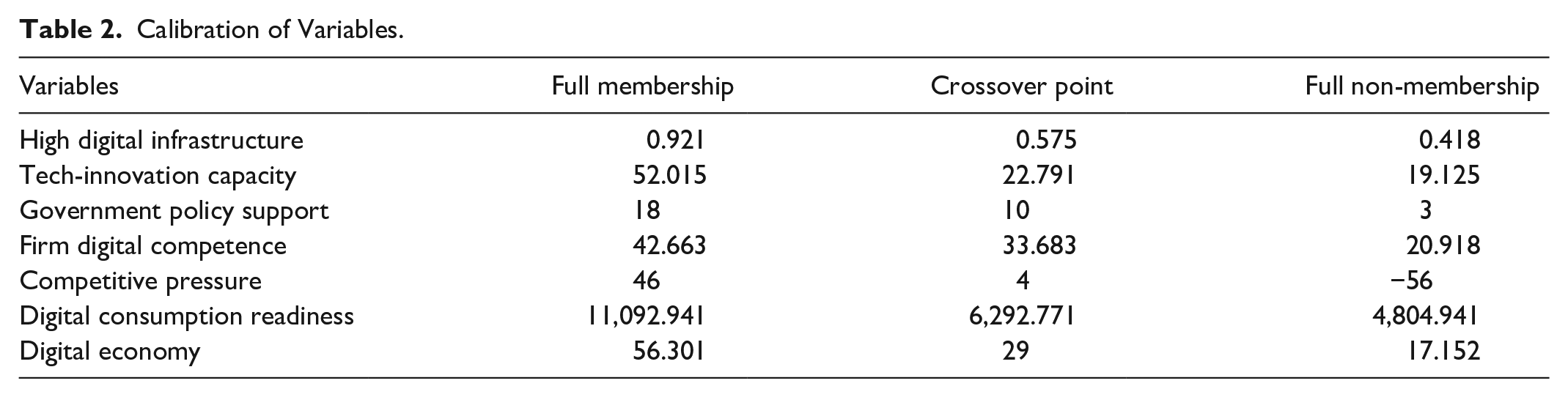
Calibration is a process of assigning the degree of membership to cases (Schneider & Wagemann, 2012). This study applied a direct method of calibration, utilizing three thresholds based on theoretical and/or empirical knowledge of the regional digital economy to rescale interval variables into fuzzy sets: full membership (1), non-full membership (0), and a crossover point of maximum membership ambiguity (0.5). Furthermore, this study calibrated the set of conditional and outcome variables with descriptions of high/strong, medium, and low/weak cases. Thus, this study chose 95% for full membership in the set of regions with strong/high level provinces of each variable, 5% for full non-membership, and 50% as a cross-over point for nuanced set membership. Table 2 presents the calibration results for all of the variables.
Calibration of Variables.
Analysis of necessity
By analyzing necessity via fsQCA, the causal configuration of the conditions associated with an outcome can be determined (Ragin, 2009). This study first undertook necessity analysis of all attributes and their negation to identify some variables as prerequisites for the occurrence of any of the outcomes, applying the recommended consistency value threshold of over 0.9 (Cebotari & Vink, 2013; Schneider & Wagemann, 2012). As Table 3 shows, the presence of firm digital competence was found to be a necessary condition for high levels of digital economic development (consistency = 0.944). The absence of tech-innovation capacity was shown to be a necessary condition for low levels of digital economic development (consistency = 0.900). Thus, these results show the complexity of digital economic development. Technological, organizational, and environmental conditions combine in various ways to affect the development of the digital economy.
Full Details of the Necessity Analyses Undertaken.

Results
Table 4 shows an alternative causal combination of conditions linked to the outcomes of high and low levels of digital economic development. Before further describing the results, we interpret the intermediate solution produced by the fsQCA software (Dwivedi et al., 2018), and denote the presence and absence of attributes as follows: core conditions are represented by • (present) and ⊗ (absent), while peripheral conditions are denoted by • (present) and ⊗ (absent). Core conditions are decisively sufficient given that they depend on the existing data, whereas peripheral conditions come from counterfactual analysis (Ragin, 2009).
Configurations for Digital Economy Development.
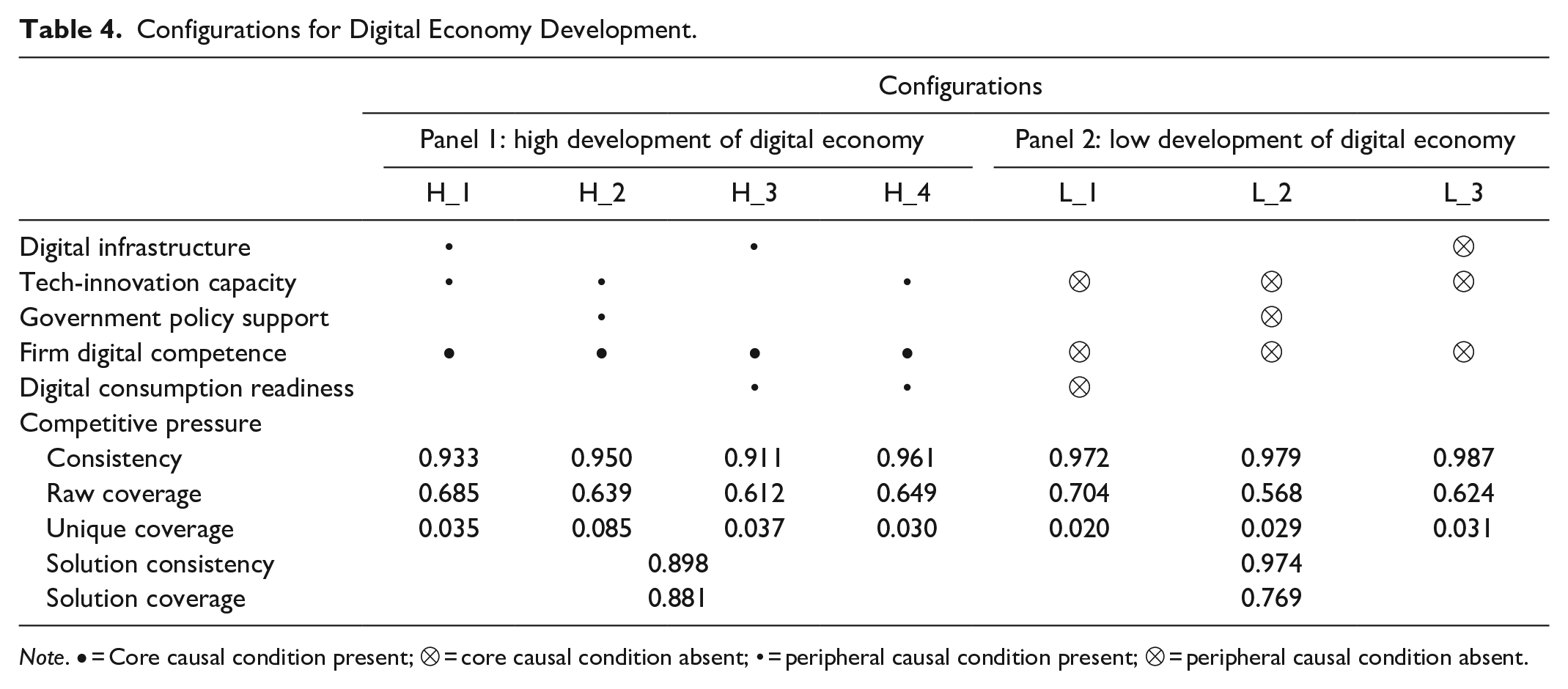
Note. • = Core causal condition present; ⊗ = core causal condition absent; • = peripheral causal condition present; ⊗ = peripheral causal condition absent.
Configurations for High Levels of Digital Economic Development
Panel 1 of Table 4 presents the results of this analysis. As shown, four configurational pathways, H_1, H_2, H_3, and H_4, were found to drive high levels of digital economic development. Firm digital competence was a core condition for all four pathways, indicating that firm digital competence is indispensable for high levels of digital economic development. Necessity analysis found a high level of firm digital competence to be an empirically relevant and necessary condition for a high level of digital economic development (consistency = 0.898, coverage = 0.881).
Furthermore, comparing H_1 and H_2 with H_4 for high levels of digital economy development, when high levels of both firm digital competence and tech-innovation capability are present, digital infrastructure (technology), government policy support (organization), and digital consumption readiness (environment) can substitute for each other. Moreover, a comparison of H_1 with H_3 shows that to achieve high levels of digital economic development in the presence of high levels of firm digital competence and digital infrastructure, tech-innovation capacity (technology) and digital consumption readiness (environment) can replace each other.
Configuration H_1
The configuration H_1 suggests that the digital economy can develop well if digital infrastructure, tech-innovation capacity, and firm digital competence are strong, regardless of the level of government policy support, digital consumption readiness, or competitive pressure. H_1 leads to a consistency of 0.933, covers 68.5% of all cases, and alone explains 3.5% of the outcome. As Figure 2 shows, H_1 is concentrated in provinces in China’s eastern seaboard, such as Guangdong, Zhejiang, Shanghai, Jiangsu, and Fujian.

Cases of configuration H_1.
Configuration H_2
The configuration H_2 indicates that the digital economy in a province develops well in the presence of strong tech-innovation capacity, government policy support, and firm digital competence, regardless of the level of digital infrastructure, competitive pressure, or digital consumption readiness. H_2 leads to a consistency of 0.950, covers 63.9% of cases, and alone explains 8.5% of the outcome. As shown in Figure 3, the cases in H_2 include provinces not only in the eastern coastal areas of Jiangsu, Guangdong, Fujian, and Shandong, but also in central regions such as Hubei, Henan, and Anhui.

Cases of configuration H_2.
Configuration H_3
The configuration H_3 shows that regardless of the levels of government policy support, competitive pressure, and tech-innovation capacity in the province, if there is strong firm digital competence, digital consumption readiness, and digital infrastructure, the province’s digital economy will develop well. H_3 leads to a consistency of 0.911, covers 61.2% of the cases, and alone explains 3.7% of the outcome. The cases in H_3 are mainly in the eastern coastal provinces of Guangdong, Beijing, Jiangsu, Shandong, Zhejiang, Shanghai, Liaoning, and Fujian (see Figure 4).
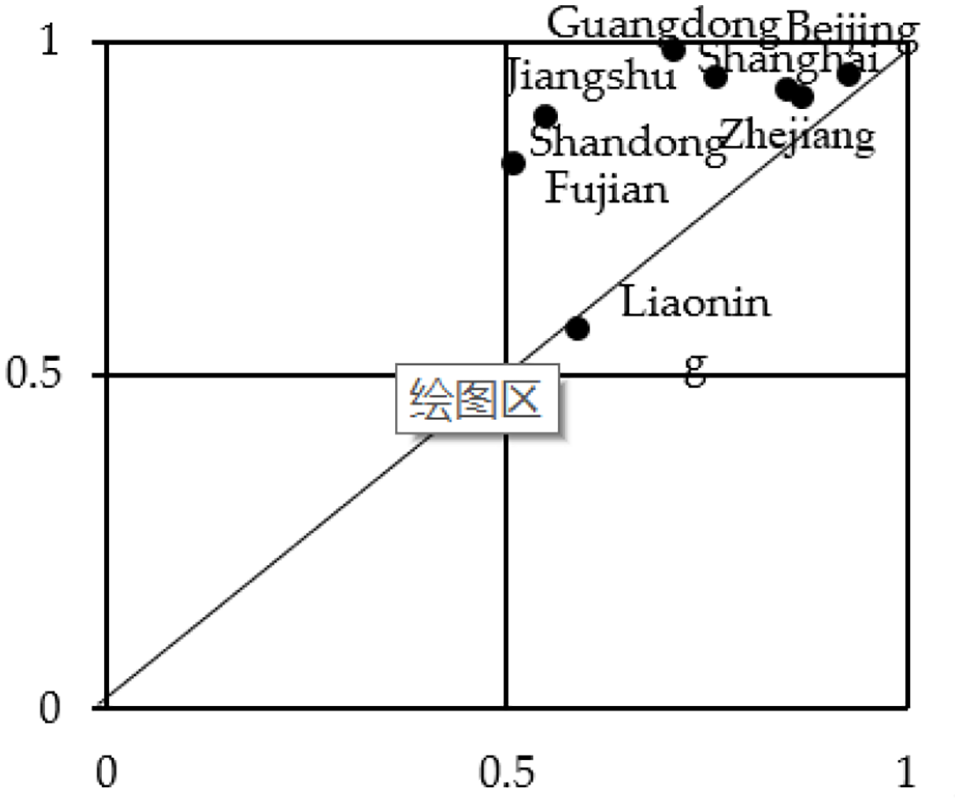
Cases of configuration H_3.
Configuration H_4
The configuration H_4 indicates that high levels of digital economic development are associated with high levels of tech-innovation capacity (TIC), firm digital competence (FDC), and digital consumption readiness (DCR). H_4 leads to a consistency of 0.961, covers 64.9% of the cases, and alone explains 3.0% of the outcome. The cases for this configuration are concentrated mainly in the economically developed provinces of Guangdong, Beijing, Jiangsu, Shandong, Zhejiang, Shanghai, Fujian, Hubei, and Hunan (see Figure 5).

Cases of configuration H_4.
Configurations for Low Levels of Digital Economic Development
Panel 2 of Table 4 presents the results of this analysis. As shown, three pathways are consistently linked to low levels of digital economic development, and each includes two core conditions, low tech-innovation capacity and low firm digital competence. Necessity analysis identified low levels of both tech-innovation capacity (consistency = 0.900, coverage = 0.898) and firm digital competence (consistency = 0.855, coverage = 0.947) as necessary conditions for low digital economic development (see Table 3). This finding shows that asymmetry in tech-innovation capacity plays a limited role in configurations linked to a strong digital economy.
Configuration L_1
The configuration of L_1 suggests that low levels of digital economic development only occur in the absence of tech-innovation capacity, firm digital competence, and digital consumption readiness, regardless of the level of digital infrastructure, government policy support, or competitive pressure. L_1 leads to a consistency of 0.972, covers 70.4% of the cases, and alone explains 1.6% of the outcome. In this dataset, three provinces—Tibet, Yunnan, and Xinjiang—exhibit this configuration.
Configuration L_2
The configuration of L_2 shows that in the absence of tech-innovation capacity, government policy support, and firm digital competence, the level of digital economic development is low, regardless of the level of digital infrastructure, competitive pressure, or digital consumption readiness. L_2 leads to a consistency of 0.979, covers 56.8% of the cases, and alone explains 2.9% of the outcome. In the dataset, three western Chinese provinces, Tibet, Ningxia, and Gansu, demonstrate L_2 configurations.
Configuration L_3
The configuration of L_3 indicates that weak digital infrastructure and low tech-innovation capacity coupled with firm digital competence are associated with low levels of digital economic development, regardless of government policy support, digital consumption readiness, and competitive pressure. The consistency score of L_3 is 0.987. L_3 covers 62.4% of the cases and alone explains 3.1% of the outcome. The three cases of this configuration are found in the undeveloped areas of Inner Mongolia, Tibet, and Jilin Province.
Discussion
Conclusions
Verhoef et al. (2021) emphasized the need for a better understanding of the contextual influences on digital economic development. To answer this call, this study focused on how the technological, organizational, and environmental contexts jointly create pathways that enable digital economic development. Using data on digital economic development in 31 Chinese provinces, this study applied the fsQCA method and the TOE framework to explore the multiple concurrent driving factors and complex causal mechanisms underlying developmental differences in China’s provincial digital economy.
The results yield the following conclusions. (1) Four pathways drive high levels of digital economic development. The core condition of firm digital competence is a component of all four pathways. (2) The four pathways driving high levels of digital economic development are substitutable. Specifically, to drive high levels of digital economic development where there are high levels of firm digital competence and tech-innovation capability, digital infrastructure, government policy support, and digital consumption readiness can be substituted for each other. To achieve high levels of digital economic development where levels of firm digital competence and digital infrastructure are high, digital consumption readiness and tech-innovation capacity can replace each other. (3) Three pathways lead to low levels of digital economic development, all of which have an asymmetrical relationship with the pathways to high levels of digital economic development.
Theoretical Contributions
This study makes several theoretical contributions. First, it explored cross-regional digital economic development using contextual conditional variables to address a gap identified in the literature (Verhoef et al., 2021). Most previous studies have considered only the effects of the digital economy (Banalieva & Dhanaraj, 2019; Bukht & Heeks, 2018; Hinings et al., 2018; Ting & Gray, 2019); few have investigated the factors that drive the digital economy. For example, Heeks (2017) focused on the factors that drive the digital economy, and Sukhodolov et al. (2019) used cognitive modeling to test the conceptual model of the factors driving digital economic growth. In fact, these researches tend to focus on the isolated effects of a single factor. However, our study reveals that digital economic development is determined not by a single factor but by various configurations of multi-contextual conditional variables, including technological, organizational, and environmental factors. Thus, it provides a comprehensive perspective to better understand the driving factors of the regional digital economy.
Second, this study extends the literature by juxtaposing technological, organizational, and environmental conditions using the QCA method to discover their substitutability and complementarity based on the TOE framework (Chandra & Kumar, 2018). Most of the existing studies start from a certain perspective and can’t clarify the complex relationship between the driving factors of digital economy. For example, Vilken et al. (2019) found that the development of regional digital economy is based on the active use of communication technology to exchange information from a technical perspective. And Kuznetsova et al. (2019) emphasized the importance of human capital to the development of digital economy. Based on the previous researches, this study uses the TOE framework to construct an integrated framework of factors that drive the regional digital economy from the perspective of technology adoption. Furthermore, it provides a comprehensive framework to better understand the interaction of various factors, thereby contributing to clarifying the substitution and complementarity between different driving factors. Thus, this study fully reflects the advantages of QCA in explaining the relationships between various drivers using a configurational approach, providing a methodological reference for future exploration of the complex digital economy.
Policy Implications
The findings of this study have important implications for regional policymakers. First, the configurations of the TOE framework indicate that firm digital competence may lead to high levels of digital economic development. Policymakers therefore need to pay particular attention to improving firm digital competence. Second, in regions with low levels of digital economic development, when government funding is limited, governments should prioritize tech-innovation capacity or firm digital competence. Finally, when firm digital competence is strong, regional decision-makers can apply any of the following three solutions. The first is to focus on the technological element by developing digital infrastructure and tech-innovation capacity. The second solution is to improve tech-innovation capacity while the government provides more policy support or improves digital consumption demand. The third solution is to promote digital infrastructure to increase digital consumption readiness as quickly as possible.
Limitations and Future Research
This study has some limitations that future research could address. First, the purpose of this study was to analyze the complex interaction mechanisms that affect digital economic development through multi-case comparison. Unlike regression analysis, fsQCA can provide in-depth case analysis. However, it cannot answer the research questions of “why” and “how,” unlike a longitudinal case study. Therefore, future research should conduct in-depth interviews to more deeply explore the dynamic mechanisms between the factors influencing the development of the digital economy. Second, the study only analyzed cross-sectional data on Chinese provinces for a single year, which limits the generalizability of the findings. Future research could use panel data to enhance the explanatory power by adding the time dimension.
Footnotes
Declaration of Conflicting Interests
The author(s) declared no potential conflicts of interest with respect to the research, authorship, and/or publication of this article.
Funding
The author(s) disclosed receipt of the following financial support for the research, authorship, and/or publication of this article: This work was funded by the National Natural Science Foundation of China (No. 71672020; 72072020).
