




Abstract
In recent years, the expansion of the digital economy has reshaped the provision of public services, with a more pronounced influence in less-developed counties than in urban areas. In response, China has introduced a series of initiatives to integrate digital technologies into public service systems, accelerating their digital transition. Focusing on the interplay between these two domains, this study constructs an evaluation framework for “digital economy–public services,” in which indicator weights are derived via the entropy method. The degree of coupling and coordination between the two systems is then measured, and their influence on the quality of county-level public services is examined using a GMM approach. Empirical evidence from Shaanxi counties suggests that although both systems are improving steadily, the digital economy is advancing more rapidly, resulting in a growing disparity. Over time, their relationship has evolved from initial friction to a stage of coordination, yet it has not reached full integration. Findings also indicate that stronger coordination is associated with higher-quality public service outcomes. These results offer an evidence-based reference for policy design and contribute to extending welfare and regional economics perspectives in the Chinese setting.
Plain Language Summary
This study offers a practical framework for integrating the digital economy with public services to enhance service quality in underdeveloped counties. By analyzing the coupling coordination between these domains, it highlights the need to bridge development gaps and align digital transformation with public service improvements. Policymakers can leverage these findings to design targeted strategies that optimize resource allocation, promote balanced regional development. The results provide actionable insights for accelerating digital integration while ensuring equitable access to high-quality public services, offering a replicable model for other regions.
Introduction
Currently, China’s county-level public service system faces a range of practical challenges, including weak fiscal capacity, imbalanced resource allocation, insufficient service capabilities, and pronounced regional development disparities (Huang et al., 2025a). In sectors including education, healthcare, elderly support, and cultural programs, numerous counties face difficulties in keeping pace with rising public needs, constrained by inadequate funding and insufficient infrastructure development. Disparities in public service provision between urban and rural communities, and among various regions, have intensified challenges related to social fairness and the overall standard of development (Li et al., 2020). As the primary administrative tier for delivering public services, counties hold a crucial position in promoting the modernization of China’s governance framework and its governing capacity. It is also crucial for achieving equal access to public services. Compared to studies focused on provincial or prefectural levels, emphasizing the county level offers a more accurate reflection of the operational shortcomings at the grassroots level and provides a stronger foundation for targeted and differentiated policy design.
Against this backdrop, governments at all levels in China have prioritized digitally empowered public service reform, promoting basic public services that are equitable, widely accessible, and user-friendly, and calling for these services to extend deeper into counties and rural areas (Jiang, 2024). As society enters the digital era, the widespread adoption of information and intelligent technologies is reshaping how social systems operate and how resources are distributed, ushering in a new wave of digital transformation in public service delivery (Kumar et al., 2024). Against this backdrop, the swift expansion of the digital economy offers a critical opportunity to tackle structural issues in county-level public service provision. Accordingly, this study investigates approaches for fostering the in-depth integration of the digital economy with public services, with the goal of enhancing regional coordination, reducing disparities between counties and cities, and advancing high-quality development.
With data increasingly incorporated into the allocation of production factors, advanced technologies—such as big data, cloud computing, the Internet of Things, blockchain, artificial intelligence, and 5G communications—are being extensively applied in public service delivery, laying the groundwork for a comprehensive enhancement of public service quality in China. Digital technology has strong capabilities for resource integration, dynamic feedback, and data mining and sharing, which helps to promote the intelligent, refined, and inclusive development of public services, thereby improving the quality of public services (Hossin et al., 2023). At the same time, the application of digital technologies can lower the expenses associated with delivering public services by government agencies. For instance, smart e-government systems not only cut costs but also enhance the efficiency of such service provision. However, this is only the surface transformation brought about by digitalization. In response to the trend of diversification of subjects, decentralization of power, and networked relationships in public services, digital technology and its high social connectivity help to promote deep digital transformation of public services. The digital economy and public services promote and interact with each other. The digital economy contributes digital resources, digital productive capacity, and digital production relationships that underpin the advancement of public services, forming a key basis for strengthening county-level public service systems; while public services provide digital elements, digital technology application scenarios, and carriers for the digital economy, which are ways to achieve digital empowerment.
This study aims to examine the pathways and obstacles to achieving synergistic development between the digital economy and county-level public services, as well as to elucidate the ways in which their coupling and coordination influence the quality of public services. To this end, drawing on county-level panel data for Shaanxi Province, China, covering the years 2015 to 2022, this research develops an evaluation index framework for the “digital economy–public service” nexus, designed to capture features distinctive to the Chinese context. By measuring the development levels of both systems, the study calculates their degree of coupling coordination and identifies three stages in their integration: antagonism, coordination, and adaptation. In addition, the coupling coordination model is combined with the Generalized Method of Moments (GMM) to analyze how the two systems interact and evolve over time, thereby uncovering the dynamic mechanisms through which coupling coordination influences public service quality and contributing to the theoretical discourse on their integrated development.
Compared to prior studies, this article employs county-level panel data—offering a finer spatial resolution than the provincial or prefectural analyses commonly used. The evaluation index system and the stage classification fully reflect China’s specific context, rendering the assessment method better suited to local realities. Introducing the “antagonism–coordination–adaptation” framework into the study of digital economy–public service integration is a relatively rare attempt in the literature. Moreover, by applying the GMM to analyze dynamic relationships, the authors introduce a novel methodological perspective.
In theoretical terms, this article expands the research framework on digital economy–public service integration by clarifying its evolutionary logic and internal mechanisms, and the authors extend the applications of welfare economics and innovation diffusion theory to regional public governance. In practical terms, the findings provide local governments with evidence-based guidance for designing targeted digitalization strategies and public service enhancement policies. Moreover, the methodology—constructing a context-sensitive indicator system combined with dynamic coupling analysis—and the derived insights offer a valuable reference for other developing regions and countries. By demonstrating how to tailor indicator frameworks to local conditions and employ dynamic coupling models, this article supports the exploration of coordinated digital economy and public service development, thereby promoting a digitally driven, sustainable path to regional growth.
Literature Review
Recent research underscores the pivotal role of the digital economy in enhancing public services. It is evident that the digital economy boosts public service efficiency through technological advancements and increased human capital (Pan et al., 2022). Studies reveal significant regional disparities in this impact, with positive spatial spillovers enhancing service quality in neighboring areas. Evidence points to an inverted U-shaped association between the advancement of the digital economy and the delivery of basic public services, suggesting that the impacts differ among cities (Tang et al., 2022; Tian et al., 2024; Zhou et al., 2023). Digital transformation has been shown to drive public service innovation by fostering more inclusive governance structures and improving responsiveness and transparency (Jonathan et al., 2024). However, challenges such as insufficient digital strategies and resource constraints in rural areas persist, scholars suggest creating a supportive digital ecosystem to address these issues (Wen et al., 2021; Xie et al., 2021).
The expansion of the digital economy is strongly associated with improvements in public services. Effective infrastructure and skilled personnel are crucial, and models like “`Internet & public government services”' significantly advance digital economy development. Key factors such as data openness and information infrastructure play a vital role in this process (Li et al., 2019; Xu et al., 2023). Although there is evidence supporting the existence of coordination and coupling between the digital economy and public services, direct studies on this relationship remain limited. Most research integrates public services into broader frameworks such as regional development and urban-rural integration. Notable contributions include analyses of regional development dimensions and urban-rural integration, along with empirical assessments of coupling coordination among related systems (Hu et al., 2021; Sun et al., 2023; Yao et al., 2023).
Despite the growing body of literature on the digital economy and public services, research gaps remain. First, most existing studies examine the one-way influence of the digital economy on public services, overlooking the two-way, synergistic mechanisms that shape their co-evolution. Second, research overwhelmingly centers on large cities, leaving the county level largely unexplored, where resource constraints, governance capacity, and development challenges differ sharply. Third, the two domains are often studied in isolation, without a unified analytical framework to reveal their interdependence. Finally, conventional methods such as simple regression fail to capture the dynamic and non-linear interactions between these systems, calling for more sophisticated approaches like coupling coordination analysis and GMM estimation.
Addressing these gaps, this article takes county-level panel data from Shaanxi Province to construct an integrated “digital economy—public services” evaluation system with Chinese contextual characteristics. This article measures the relative development levels of both systems, calculate their coupling coordination degree to assess mutual influence and interaction, and examine spatial heterogeneity across counties. Furthermore, this article investigates how coupling coordination shapes public service quality, offering empirical evidence and theoretical enrichment to the study of integrated digital economy-public service development.
Mechanism Analysis of the Digital Economy—Public Services Relationship
Coupling Coordination Mechanism of the Digital Economy and Public Services
Ensuring common prosperity for the entire population and achieving high-quality public service provision have been identified as core objectives of Chinese-style modernization, as outlined at the 20th National Congress of the Communist Party of China. Advancing fairness, accessibility, and balanced regional growth in public services constitutes a key mission in building a socialist modern country. Within this process, the development of the digital economy serves as a critical driver for enhancing public service quality, particularly in domains such as digital inclusive finance, digital infrastructure, and the online economy. Likewise, the pursuit of high-quality public services is central to the realization of common prosperity, with priorities encompassing compulsory education, healthcare and welfare, environmental sustainability, municipal facilities, and transportation systems.
At the county level, fostering the digital economy enables the integration of digital resources into public service development. In theory, the digital economy and public services are interconnected in a coupling relationship, in which each system can both reinforce and constrain the other. The concept of coupling coordination between these two systems reflects the synergistic amplification effect generated through their mutual interaction and linkage, whereby the coordinated influence of subsystems exceeds the sum of their separate contributions. Drawing on welfare economics, this study proposes a “digital economy–public service” coupling coordination framework, illustrated in Figure 1.

Coupling coordination mechanism of digital economy and public services.
The Digital Economy Promotes the Development of Public Services
The digital economy significantly enhances the quality of public services by transforming various sectors through advanced technologies and innovative solutions.
The digital economy boosts the quality of public services across multiple domains. In compulsory education, it enhances resource sharing, personalized learning, and distance education, while also improving educational assessment and stimulating pedagogical innovation. For medical and health services, digital tools like electronic records and telemedicine improve service efficiency, personalize healthcare, and optimize resource allocation. In social welfare, digital solutions enhance the precision and effectiveness of assistance programs.
The ecological environment benefits from digital technologies through improved monitoring and management, optimized resource use, and increased environmental awareness. The digital economy also advances municipal infrastructure by enhancing management efficiency, enabling smart city solutions, and providing new funding sources, while improving infrastructure adaptability. Lastly, in road transportation, digital technologies enhance traffic management, support smart transportation systems, and provide intelligent services that improve travel experience and safety.
Public Services Serve as the Practical Foundation for the Diffusion of the Digital Economy in County-level Areas
The advancement of the digital economy in county-level areas fundamentally depends on the enhancement of public service infrastructure. Central to this is the development of digital infrastructure. High-quality broadband networks, Internet of Things (IoT) technologies, and cloud computing are crucial for achieving comprehensive digitalization of public services. Investment in these areas ensures that county-level regions can effectively integrate digital tools and platforms, laying a foundation for broader economic and social development.
Moreover, educational public services are essential for cultivating high-quality talent in digital economy-related fields. County-level governments must collaborate with educational institutions, businesses, and training organizations to focus on digital talent development. Cultivating and recruiting professionals in the digital sector will provide the necessary human resources for counties to effectively leverage digital technologies. This will enhance local economic vitality and competitiveness, driving sustained economic growth and improvements in public services.
In general, enhancing public services in priority fields such as digital infrastructure and human capital cultivation establishes a solid foundation for the growth of the digital economy in county regions. Tackling these underlying constraints enables counties to more effectively leverage digital technologies, fostering economic progress and elevating residents’ living standards.
Materials and Methods
This study adopts a multi-stage methodological framework to ensure the reliability and interpretability of results. First, an index system is constructed to quantify both the digital economy and public service quality at the county level. Second, a coupling coordination model is employed to measure the degree of interaction between the two subsystems and to classify their development stages. Finally, a dynamic panel system GMM model is used to empirically examine the causal effect of coupling coordination on public service quality, while controlling for potential endogeneity. The following subsections present these procedures in detail.
Indicator System Construction
Digital Economy and Public Service Indicators
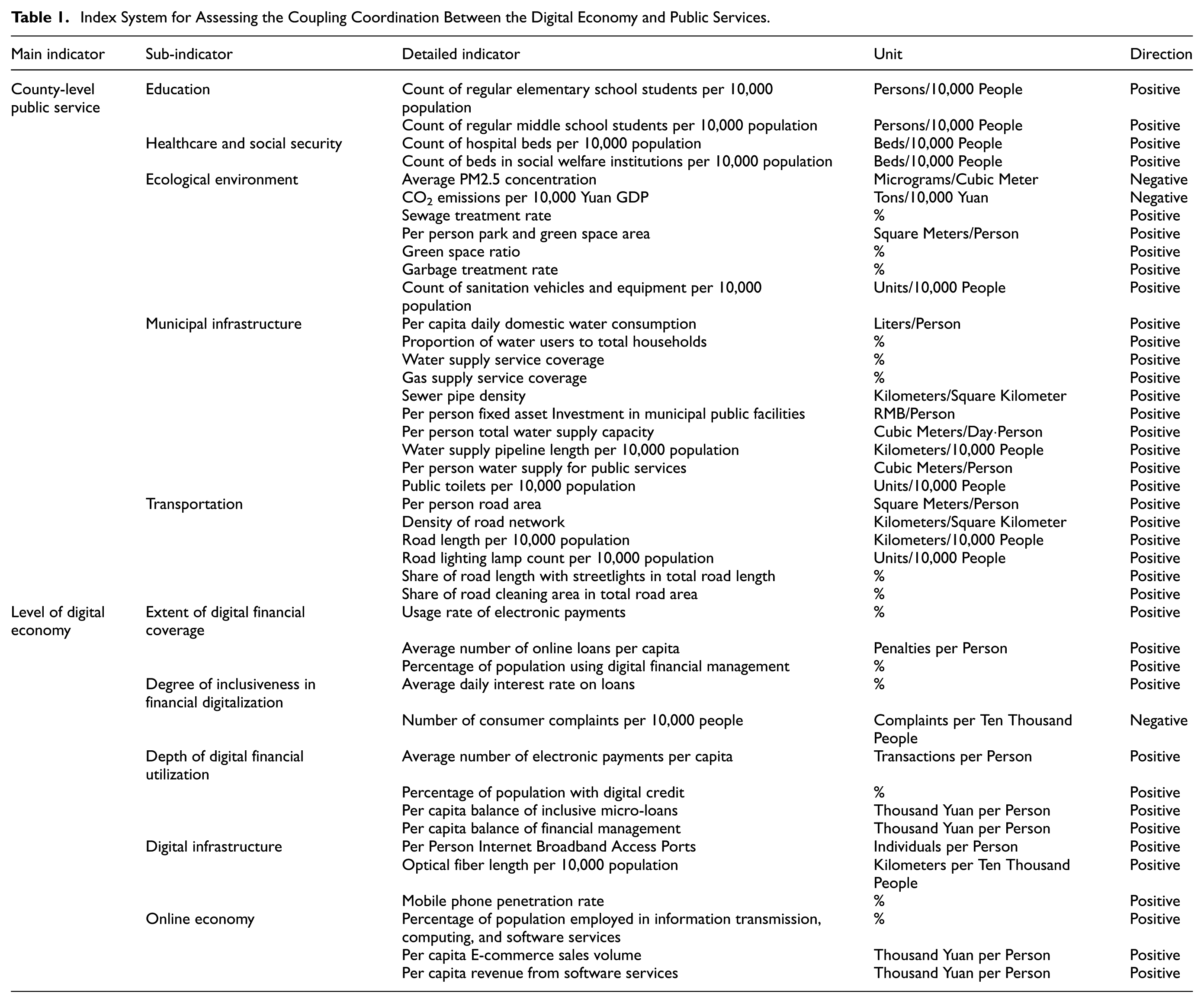
Building on the methodological approaches of Li (2022) and Hui et al. (2023), this study develops a county-level public service quality assessment framework encompassing dimensions such as education, healthcare, social security, environmental quality, infrastructure, and transportation. As direct statistical data for county-level digital economy indicators are currently unavailable, the selection of relevant indicators primarily draws on the findings of Guo et al. (2021) and Xie et al. (2021). In addition, reference is made to the China Digital Inclusive Finance Index published by the Digital Finance Research Center of Peking University and the China County-level Digital Inclusive Finance Index Report issued by the Rural Development Research Institute of the Chinese Academy of Social Sciences. Based on these sources, a digital inclusive finance evaluation framework is established, incorporating indicators such as the breadth of digital financial coverage, the degree of digitalization in inclusive finance, and the depth of digital financial usage. Meanwhile, indicators such as final consumer expenditure of residents in counties on communication equipment, computers, and other electronic devices, as well as software business income, were added (Guo et al., 2021; Xu et al., 2022). After comprehensive consideration, a total of 42 indicators were selected to construct the “Digital Economy-Public Service” coupling coordination evaluation index system, as shown in Table 1.
Index System for Assessing the Coupling Coordination Between the Digital Economy and Public Services.
Control Variable Selection
This article referenced relevant research by Zhang et al. (2021), as well as Su and Li (2023), in selecting control variables. To eliminate the correlation and multicollinearity among control variables, a set of control variables was chosen from the macroeconomic and social levels. Firstly, Pearson correlation analysis was conducted using SPSS software to remove indicators with an R value exceeding 0.6 in each dimension. A multicollinearity diagnostic was then conducted, revealing that the highest Variance Inflation Factor (VIF) value was 2.95 and the average was 1.98, both well below the threshold of 10. This indicates that there was no multicollinearity issue among the control variables. Finally, 11 control variables were selected, detailed in Table 2.
Control Variables.

This article selects control variables according to their proven influence on public service quality and adapts them to the county context as follows. First, to account for regional economic conditions, per-capita GDP and per-capita retail sales of consumer goods serve as proxies for macroeconomic strength and household consumption capacity. Second, to reflect how industrial structure shapes both fiscal revenue and service demand, the shares of secondary and tertiary industry employment are included. Third, county-level financial support is captured by per-capita financial loan balances and per-capita general budget revenue. Fourth, recognizing that population and land use affect service coverage and efficiency, population density and per-capita construction land area are controlled. Fifth, to address the distinct demands of more agriculture-oriented counties, per-capita cultivated land area and per-capita output value of primary industries are added. Finally, given the potential impact of environmental conditions on service delivery, an air circulation coefficient is introduced. By covering economic, social, industrial, financial, demographic, land-use, and natural dimensions—and tailoring each variable to the county-level sample—this article ensures multidimensional controls that strengthen the validity of subsequent causal tests between coupling coordination and public service quality.
Data Sources and Sample Selection
Once the indicator framework was established, relevant county-level data were collected from authoritative statistical and research sources to ensure consistency and comparability across years. This article selected 71 counties in Shaanxi Province from 2015 to 2022 as typical samples to ensure the availability and continuity of data. As the starting province of China’s Belt and Road Initiative, Shaanxi Province holds a significant position. The conclusions drawn from this article are not only instructive for Shaanxi Province itself but also have reference value for the county-level research of underdeveloped provinces in other western regions of the new era. These conclusions can provide empirical references for formulating policies to improve the efficiency of public services using digital technology in underdeveloped areas such as Shaanxi Province.
The dataset is primarily drawn from multiple sources, including the Statistical Bulletins of National Economic and Social Development for counties in Shaanxi Province, the China County Statistical Yearbook, the China County Construction Statistical Yearbook, county-level Pm2.5 concentration panel data compiled by Washington University in St. Louis, the Peking University Digital Financial Inclusion Index for Counties (PKU-DFIIC), the China Real Estate Statistical Yearbook, the County Digital Rural Index jointly issued by the Peking University Rural Development Institute and Ali Research Institute, and nighttime light data obtained from the Wind Database of China. Missing values were supplemented through linear interpolation.
For the processing of economic indicators, the GDP deflator index of Shaanxi Province for 2015 was adopted as the base year, and all relevant economic variables were adjusted accordingly. The indicators were then standardized, and their respective weights determined using the entropy weighting method. By aggregating these weighted indicators, the study derived composite measures of both public service provision and digital economy development for Shaanxi’s counties over the period 2015 to 2022. A statistical summary of the variables is provided in Table 3.
Descriptive Statistics of Standardized Variables.

Coupling Coordination Measurement
With standardized and weighted indices for both subsystems obtained, the next step is to assess how closely the digital economy and public services interact. The coupling coordination model provides a quantitative basis for this assessment, producing a comprehensive metric that can later serve as the core explanatory variable in the dynamic panel analysis.
Relative Development Model
By establishing an integrated index framework for the digital economy and public services, deriving their respective development indices, and subsequently computing the coupling coordination degree, this study seeks to capture the level of interaction between the two systems and the extent to which they reinforce one another. The relative development model evaluates the balance between the composite indices of the digital economy and public services, with the calculation expressed as follows:

This formulation allows for a direct comparison of subsystem performance levels, thereby capturing whether development is balanced or skewed toward one side. In Equation 1, E represents the relative development degree, which denotes the relative development progress of the two subsystems: the digital economy and public services.
Coupling Degree and Coordination Degree Calculation
The degree of coupling coordination indicates how strongly the two subsystems interact and influence one another. Both the coupling effect and the level of coordination serve as key determinants in the evolution and transformation of the overall coupled system. The coupling coordination model for the digital economy and public services developed in this study captures the complex nonlinear interrelationships between the two subsystems, which can be expressed as follows:


In Equations 2 to 4, D represents the coupling coordination degree between the digital economy and public services, C denotes the coupling degree of the two subsystems,
The coupling coordination degree D reflects the strength of the interaction coupling between the two subsystems, with a range generally from 0 to 1. A higher value indicates a stronger coupling coordination relationship between the two systems. When
Stage Classification Criteria
This article refers to the relevant research by Ren and Du (2021) on the division of coupling coordination stages, categorizing the coupling coordination of the digital economy and public services into three major development stages and nine types. Building on this framework, the authors retained the overall structure of three stages and nine categories, but made appropriate adjustments to the threshold values based on the actual conditions of the county-level data used in this study. These modifications ensure that the classification more accurately captures the practical patterns of integration between the digital economy and public services at the county level, thereby improving the interpretability and applicability of the stage-based evaluation.
Specifically, the coupling coordination degree is classified into three stages and nine types based on the range of 0 to 0.4, 0.4 to 0.7, and 0.7 to 1.0. Within the range of 0 to 0.4, it is classified as the antagonistic stage, indicating poor coordination between the digital economy and public services, with almost no ability to develop coupling coordination. Within the range of 0.4 to 0.7, it is classified as the adaptation stage, indicating a transition from inability to coordinate to being able to coordinate between the digital economy and public services. Finally, within the range of 0.7 to 1.0, it is classified as the coordinated stage, indicating that the digital economy and public services have reached a state of coupling coordination, with strong mutual promotion and influence between them. Within these three broad ranges, based on different relative development degrees, they are further divided into three small ranges of 0 to 1, 1 to 3, and above 3, representing different categories of system decline or system optimization in the three coupling coordination stages of antagonism, adaptation, and coordination, respectively.
Dynamic Panel Model
After quantifying the coupling coordination degree between the digital economy and public services, it is necessary to assess its impact on public service quality over time, while accounting for the dynamic nature and potential persistence of service levels. This article employs a system GMM approach to construct a dynamic panel regression model, aiming to examine the impact of the coupling coordination between the digital economy and public services on the quality of county-level public services. The choice of this model is primarily based on the cumulative and dynamic nature of public service development. In practice, public service quality often exhibits strong persistence and path dependence, with the previous period’s service level influencing that of the current period. If the analysis were to focus solely on the contemporaneous effects of the coupling coordination, it could overlook the intrinsic dynamics of the service system, leading to biased estimation results. Therefore, this article adopts the system GMM method to capture dynamic relationships more accurately. This approach not only mitigates potential endogeneity issues but is also well-suited to the characteristics of this study’s relatively short, balanced panel dataset (Abdelkawy, 2024).
Public service development is a dynamic and cumulative process in which the quality achieved in the preceding period often influences the quality observed in the current period. Consequently, focusing solely on the contemporaneous effect of coupling coordination on public service quality may introduce bias into the analysis. To address this, the model incorporates a one-period lag of public service quality as an explanatory variable, and a system GMM dynamic panel model is specified as follows:

Here,
Results
Relative Development Levels of Digital Economy and Public Services
The digital economy and public services in county-level areas of Shaanxi Province are both steadily improving, but they have different development rates. The development rate of the digital economy is generally higher than that of public services, leading to an increasing disparity in their relative development levels. In some county-level areas such as Jia County, Qian County, and Ningqiang County, the comprehensive quality of public services is much lower than their comprehensive level of the digital economy, indicating that in these areas where the digital economy is emphasized, its development rate exceeds that of public services, resulting in these counties consistently being in a non-coordinated stage between the digital economy and public services, leading the coupled system to decline, which is not conducive to the simultaneous development of both. However, it should also be noted that the average comprehensive indices of the digital economy and public services in Shaanxi Province in 2022 were 0.868 and 0.279 respectively, indicating that an excessively large relative development level is not necessarily due to a high comprehensive level index of the digital economy, but rather more because the overall comprehensive quality index of public services is low and growing slowly.
As illustrated in Figure 2, notable regional disparities exist in the relative development levels of the digital economy and public services. County-level areas in northern Shaanxi exhibit substantially higher relative development values than those in other regions, largely because of the comparatively low overall quality of public services in that area. In contrast, counties in central and southern Shaanxi generally maintain relative development levels between 2 and 4, which appears more balanced. In these regions, local governments not only prioritize the growth of the digital economy but also invest considerable effort in advancing public service provision—forming a sharp contrast with the slower pace of public service improvement observed in most northern Shaanxi counties. These findings suggest that variations in the concurrent development of the digital economy and public service subsystems stem from differences in the emphasis placed on digital economy expansion and disparities in the underlying conditions for public service provision across regions.

Relative development degree in Shaanxi Province, China.
During the study period, the comprehensive level of the digital economy in various county-level areas of Shaanxi Province gradually increased, especially since 2016, showing a clear upward trend, but there were significant differences in growth rates among different county-level areas, as shown in Figure 3. In 2015, the starting level of the digital economy in most county-level areas was generally low, with most county-level areas except Liuba County, Zichang County, Ziyang County, Huangling County, Fugu County, Linyou County, Foping County, and Zizhou County having comprehensive level indices mostly below 0.5. Among them, Liuba County, Zichang County, and Ziyang County ranked the top three with indices of 0.630, 0.611, and 0.597 respectively, while the indices of Jia County, Shanyang County, and Chunhua County were only 0.01, 0.156589955, and 0.189 respectively, indicating significant differences in the digital economy among different county-level areas. By 2022, the comprehensive level indices of the digital economy in all county-level areas of Shaanxi Province exceeded 0.8, but the gap between counties gradually narrowed, with a difference of only 1.24 times between Fengxiang County, ranked first, and Zizhou County, ranked last.

Geographical distribution of digital economy in Shaanxi Province, China.
At the same time, the comprehensive quality index of public services also showed certain regional differences, as shown in Figure 4. In 2015, some county-level areas performed well in terms of digital economy development but were at a relatively low level in terms of public services, with indices generally around 0.2. Foping County, Ningshan County, Jingbian County, and other county-level areas performed well in public services, ranking the top three with indices of 0.386, 0.366, and 0.361 respectively, while the indices of Zizhou County, Qingjian County, and Jia County were only 0.109, 0.122, and 0.124 respectively. By 2022, although the quality of public services in some county-level areas had improved, there was still a significant gap. Foping County, Liuba County, and Huanglong County ranked the top three with indices of 0.548, 0.537, and 0.482 respectively, while the indices of Zizhou County, Jia County, and Qingjian County were only 0.138, 0.155, and 0.165 respectively. This indicates that the gap in the development of public services among various county-level areas of Shaanxi Province remains significant.

Geographical distribution of public services in Shaanxi Province, China.
From 2015 to 2022, the overall development of the digital economy across county-level regions in Shaanxi Province showed a consistent upward trend, accompanied by a gradual reduction in disparities among these counties. However, notable differences remain in the overall quality of public services, highlighting the distinctive regional features inherent to various subsystems throughout their development.
Coupling Coordination Degree between Digital Economy and Public Services
By assessing the overall development levels of the digital economy and public services across county-level regions in Shaanxi Province, this article derived the coupling coordination degree for these areas and their subdivisions. In 2015, the average coupling coordination degree between the digital economy and public services stood at 0.516, rising to 0.696 by 2022. This trend suggests that the interaction between these two systems remained relatively stable throughout the period, exhibiting a gradual improvement from an initial adjustment phase toward greater coordination. Generally, the coupling coordination degree at the county level in Shaanxi Province can be considered moderate, yet significant potential for advancement remains. Notably, the magnitude of this coupling coordination degree is closely tied to the comprehensive indices of the involved subsystems, whereby a lower subsystem development level tends to correspond with a reduced coupling coordination value.
Analyzing from a sub-regional perspective, the average coupling coordination degree between the digital economy and public services in northern Shaanxi’s county-level areas increased from 0.530 in 2015 to 0.699 in 2022. During the same timeframe, central Shaanxi counties exhibited mean values of 0.501 and 0.682, respectively. Meanwhile, southern Shaanxi’s county-level regions saw an increase from 0.523 in 2015 to 0.711 in 2022. County-level areas in these three regions are all in a transitional stage from run-in to coordination, with county-level areas in southern Shaanxi having the highest mean coupling coordination degree, followed by those in northern Shaanxi, while those in central Shaanxi have relatively lower mean coupling coordination degrees.
Based on the relative development level, further division of the coupling coordination stage between the digital economy and public services, this article selected representative county-level areas ranking first and last in coupling coordination degree in 2022 from northern Shaanxi, central Shaanxi, and southern Shaanxi for analysis. Specifically, Huanglong County and Zizhou County represent northern Shaanxi, Taibai County and Xunyi County represent central Shaanxi, and Foping County and Luonan County represent southern Shaanxi. The analysis indicates that from 2015 to 2022, Huanglong County’s coupling coordination degree evolved from an initial adjustment phase into a coordinated stage, with the digital economy and public services developing in tandem and the overall system showing signs of improvement. In contrast, Zizhou County remained in the adjustment phase throughout this period, where the digital economy progressed faster than public services, resulting in an increasing disparity between the two and a tendency toward system deterioration. The coupling coordination degree of Taibai County transitioned from the run-in stage to the coordination stage, with highly coordinated development of the digital economy and public services, and the system tending toward optimization; while the coupling coordination degree of Xunyi County, although always in the run-in stage, saw the digital economy growing significantly faster than public services, leading the system to transition from synchronized development to the digital economy advancing ahead, putting the system in a declining stage. Foping County’s coupling coordination degree is in the coordination stage, with the development of the digital economy and public services always remaining synchronized, and the system tending toward optimization, setting a good example for other county-level areas; while Luonan County’s coupling coordination degree transitioned from approaching antagonism to the run-in stage, although the digital economy grew rapidly, the widening gap with the level of public services led the system to transition from synchronized development to the digital economy advancing ahead, which is unfavorable for system optimization and requires attention.
During the study period, most counties in Shaanxi Province were primarily in the coordination phase. However, Fuping County and Huanglong County reached a coordinated state starting from 2016, and the number of counties entering into a coordinated state gradually increased from 2017 onwards. This indicates that some counties, as their digital economy develops year by year, are beginning to enter into a better-coordinated state with public services, providing more effective impetus for the high-quality development of public services. Throughout the entire study period, there were hardly any counties where the digital economy and public services were in an antagonistic state, except for Jia County in 2015. At the same time, there were also relatively few counties in the stage of coordination, but where the digital economy lagged behind public services, such as Qianyang County, Shanyang County, and Ningshan County in 2015. Although most counties were in the coordination phase, in recent years, some counties have gradually shifted from being synchronous with public services to being ahead of public services in terms of digital economy development. This indicates that the digital economy in Shaanxi Province’s counties is developing rapidly, but when the digital economy advances ahead of public services, it will not be conducive to the coordinated development of the two, a situation that deserves attention. Hence, it is advisable for government authorities to emphasize enhancing public services alongside advancing the digital economy. Furthermore, counties like Fuping and Huanglong demonstrate not only a coordinated relationship between their digital economy and public services but also exhibit synchronization between these two elements, contributing to overall system improvement. These counties may be regarded as model examples.
As illustrated in Figure 5 for the year 2022, counties exhibiting lower coupling coordination degrees are predominantly located in northern and central Shaanxi, including Qingjian, Jia, Zizhou, Qian, and Xunyi counties. Conversely, higher coupling coordination levels are mainly found in southern Shaanxi counties such as Fuping, Liuba, and Ningshan. This spatial distribution reveals a distinct “higher in the south, lower in the north” pattern in the coordination between the digital economy and public services, reflecting uneven regional development. Although the overall coupling coordination between these two subsystems in Shaanxi’s counties has gradually improved over the study period, only a limited number of counties have achieved a well-coordinated and high-quality state, with the general coupling coordination level remaining moderate. The quality of coupling coordination relies heavily on the balanced progress of both subsystems, making it crucial to prevent deficiencies in either to avoid scenarios of strong coupling paired with poor coordination.

Coupling coordination level in Shaanxi Province, China.
Impact of Coupling Coordination on Public Service Quality
Table 4 displays the results of the dynamic regression analysis examining the relationship between coupling coordination and the quality of county-level public services. Taking into account the persistence of public service development, this study adopts a dynamic framework to assess how the interaction between the digital economy and public services affects service quality. To address potential endogeneity concerns and mitigate weak instrument issues in the first-difference estimation, the System Generalized Method of Moments (SYS-GMM) technique is utilized. This approach employs multiple lagged terms of the coupling coordination variable as instrumental variables for the dynamic regression. According to the Wald test, the explanatory variables significantly impact the dependent variable, with p-values below the 1% threshold. Moreover, the AR(1) test shows a p-value under 10%, whereas the AR(2) test’s p-value exceeds 10%, indicating no second-order autocorrelation in the residuals. The Hansen test yields a p-value ranging between 10% and 25%, confirming the validity of the instrumental variables without over-identification issues.
System GMM Dynamic Regression Results.
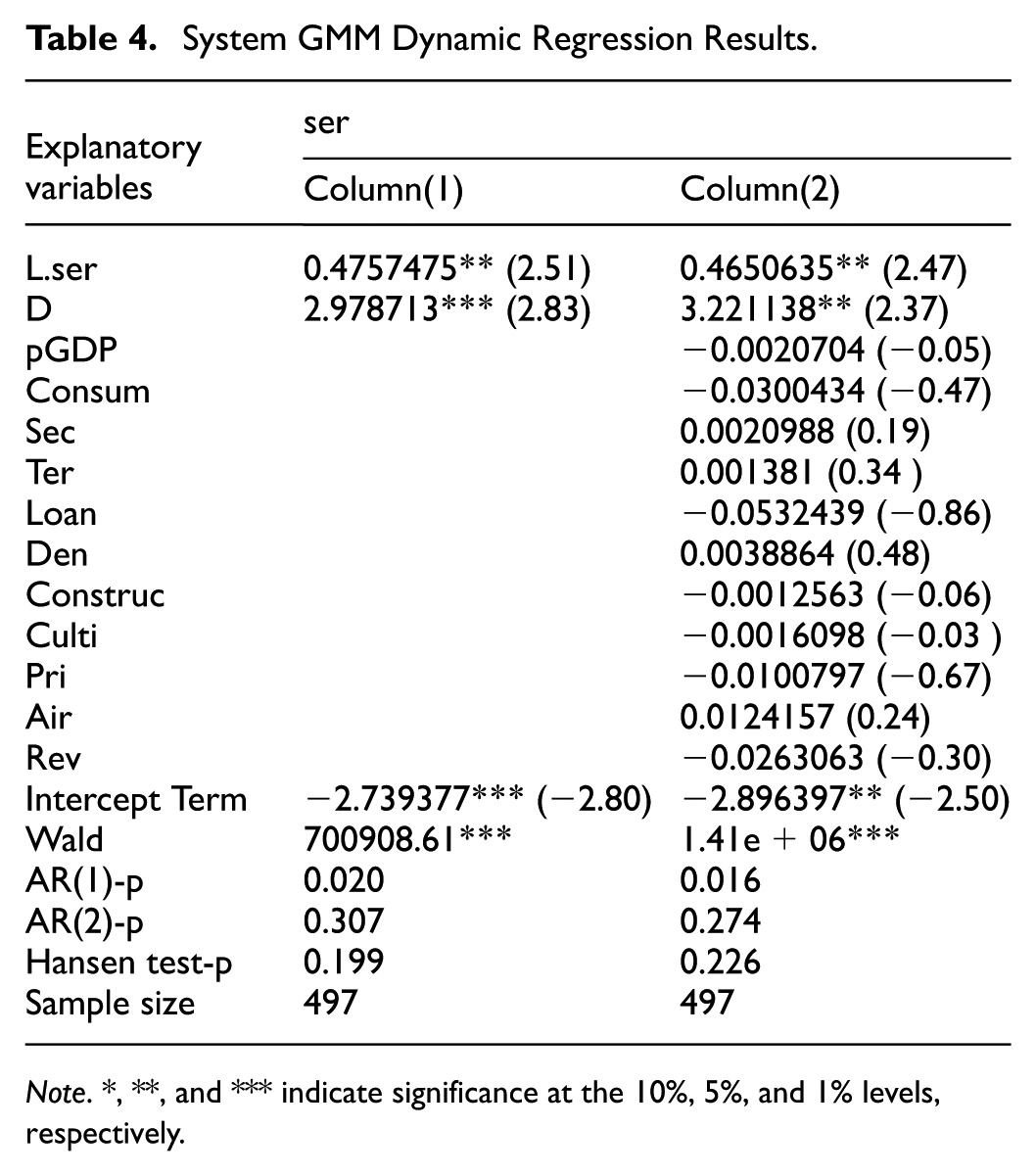
Note. *, **, and *** indicate significance at the 10%, 5%, and 1% levels, respectively.
The dynamic regression results reveal that the coupling coordination between the digital economy and public services has a significantly positive impact on the quality of county-level public services, maintaining statistical significance at the 5% level even after controlling for other factors. This suggests that a higher coupling coordination degree is conducive to the high-quality advancement of public services at the county level. Furthermore, the positive and significant coefficients of the lagged public service quality variable indicate strong temporal persistence, whereby the quality of public services in the preceding period positively influences the current period’s service quality.
Although some control variables do not reach statistical significance in the regression models, they exhibit clear theoretical and empirical relevance to county-level public service development and therefore must be retained. For example, economic development and fiscal revenue variables reflect counties’ economic strength and financial capacity, forming the basis for public service provision. Industrial structure variables capture structural transformation within local economies, while population density and construction intensity indicate demographic pressures on service demand, variables such as financial loan levels and social consumption measure financial accessibility and consumption activity, which indirectly influence public service supply and demand (Huang et al., 2025b; Su & Li, 2023; Zhang et al., 2021). Although the coefficients of these variables may not be statistically significant, excluding them could result in omitted-variable bias; hence, they are retained to maintain the validity of the model specification and the robustness of the estimated results.
Robustness test
To verify the robustness of the regression findings, this study performs several tests, with the outcomes summarized in Table 5.
(1) Replacement of Control Variables: The control variable “'Financial Loan Amount”' is replaced with “Per Capita Deposit Amount(Depo).” The core explanatory variables still maintain a significant positive impact, indicating robustness in the results.
(2) Trimming of Outliers: To eliminate the influence of outliers, the county-level panel data is subjected to double-sided trimming at the 1% level, followed by regression analysis. The findings indicate that after trimming, the direction and significance of the core explanatory variables’ coefficients remain consistent with those observed in the baseline regression.
In conclusion, the estimation outcomes for the core explanatory variables exhibit strong robustness across different methodologies.
Robustness Test.

, **, and *** denote significance levels of 10%, 5%, and 1%, respectively. The figures enclosed in parentheses represent the corresponding t-statistics.
Discussion and Conclusion
From 2015 to 2022, county-level digital economies in Shaanxi Province expanded rapidly and converged, while public-service provision, although improving, remained relatively underdeveloped and slow-growing, with pronounced regional disparities. The digital economy has generally outpaced public services, underscoring the need for simultaneous investment—especially in underserved areas—to foster balanced development. Over the same period, the coupling coordination degree between the digital economy and public services rose steadily from 0.516 to 0.696, shifting from a “run-in” phase toward “coordination,” yet still dwelling at a moderate level with higher values in the south (e.g., Fuping, Liuba, Ningshan) and weaker performance in central and northern counties (e.g., Pucheng, Zizhou, Qian). Employing a SYS-GMM dynamic panel model, the authors identify a statistically significant positive impact of coupling coordination on the quality of county-level public services at the 5% significance level. Additionally, public service quality demonstrates notable temporal persistence. The robustness and reliability of these results are supported by successful Wald, AR(2), and Hansen tests.
This article offers the following recommendations based on its findings: in northern counties with low coupling coordination and weak public services, the authors urge accelerating investment in public service provision—via dedicated funding and talent development programs—to expand and enhance basic education, healthcare, and digital public platforms. Simultaneously, they recommend reinforcing the linkage between the digital economy and public services by embedding both service and digitalization metrics into project approval, budget allocation, and performance evaluations to ensure parallel progress. Moreover, the authors propose leveraging high-coordination demonstration counties such as Fuping and Huanglong for intergovernmental exchanges, training sessions, and site visits to disseminate best practices in integrating digital initiatives with service delivery. Finally, they advise establishing a dynamic monitoring system—regularly applying SYS-GMM and similar models to track coupling coordination and conducting real-time assessments of major digital or service projects—to enable timely strategy adjustment and optimization.
This article’s coupling-coordination framework concurrently addresses the digital economy and public service subsystems. Its methodology is broadly applicable, offering a diagnostic tool for regional governance in developing and transition economies and—through dynamic evaluation models—enabling the optimization of synergistic development pathways between digital initiatives and public services.
Limitations
Despite its theoretical and practical significance, this study has several limitations.
The empirical analysis is based on county-level data from Shaanxi Province, which, although partly representative of western China, may limit the generalizability of the findings to other provinces. Given the substantial differences across regions in terms of economic development, digital infrastructure, and public service governance, the coupling relationship between the digital economy and public services may exhibit heterogeneity under different institutional and environmental contexts.
In addition, the construction of the indicator system is inevitably constrained by both data availability and the boundaries of the theoretical framework. Although the entropy method was employed to reduce subjectivity in weight assignment, judgments on dimension division and indicator selection still relied on existing literature and data feasibility. Such trade-offs may influence the measurement outcomes to some extent. Future research could incorporate more comprehensive datasets and dynamic indicators to develop a multi-level and comparable evaluation framework, thereby enhancing the comprehensiveness and robustness of the results.
Footnotes
Acknowledgements
The authors sincerely thank the editor and anonymous reviewers for their valuable comments and constructive suggestions, which have greatly improved the quality of this article.

Ethical Considerations
The authors report that ethical approval was not required, the research did not involve humans or animals.
Consent to Participate
The authors report that consent to participate or publication is not applicable.
Author Contributions
Funding
The authors disclosed receipt of the following financial support for the research, authorship, and/or publication of this article: This work was supported by the [National Natural Science Foundation of China] under Grant [number 72174162].
Declaration of Conflicting Interests
The authors declared no potential conflicts of interest with respect to the research, authorship, and/or publication of this article.
Data Availability Statement
The data underlying this article are not publicly available at this time, as they will be utilized in the authors’ forthcoming research projects. To protect the integrity and confidentiality of the ongoing studies, access to the dataset is temporarily restricted. An anonymized version of the dataset, along with relevant metadata, will be deposited in Figshare upon the completion of the subsequent research, in accordance with the journal’s data sharing policy.