




Abstract
This study aims to improve users’ usage intention to engage with digital museums by providing practical insights for practitioners and new theoretical perspectives for academic researchers. Extending the technology acceptance model (TAM), the study incorporates level challenge as a new factor influencing digital museum usage. Data were collected through questionnaires and analyzed using structural equation modeling (SEM). In addition, the study conducted semi-structured interviews to qualitatively triangulate the SEM findings. The results show that perceived usefulness, perceived ease of use, perceived playfulness, and level challenge are significant factors affecting digital museum usage behavior. Perceived usefulness and perceived ease of use strongly impact users’ usage intention, while perceived playfulness and levels and challenges enhance user engagement and participation. Furthermore, usage intention plays a crucial mediating role in actual usage behavior. This study contributes to TAM by integrating user experience factors specific to digital museums, providing a broader understanding of the determinants of digital museum usage. For museum administrators, the findings suggest that enhancing the platform’s perceived usefulness, perceived ease of use, and perceived playfulness while incorporating levels and challenges, can significantly improve user engagement and retention.
Plain Language Summary
This study looks at what makes people want to use digital museums and how to keep them engaged. It uses a well-known model called the Technology Acceptance Model (TAM) but adds a new idea called “levels and challenges.” The researchers asked people to fill out surveys and analyzed the answers. They found that people are more likely to use digital museums if they find them useful, easy to use, fun, and if the platform includes challenges or levels to keep it interesting. The study also shows that wanting to use the platform leads to actually using it. For museum managers, this means improving usefulness, making things simple, adding fun features, and including levels and challenges can help attract and keep users.
Introduction
In addition to being providers of information, museums are also inventors of knowledge as well as communicators of material (Garlandini, 2021). Museums serve as memory institutions and knowledge repositories, generating and disseminating new information (Cipullo, 2021). With the accelerated global digital transformation, digital museums have emerged as a novel form of exhibition that breaks the constraints of time and space, bringing revolutionary changes to museums in terms of education, cultural dissemination, and the enhancement of visitor experiences. Museums often combine local history, art and social context to create thematic exhibitions with local characteristics. This not only augments tourists’ sense of engagement but also facilitates the propagation of local culture. Museums can improve the competitiveness of the tourism industry, can contribute to city branding, draw attention to the city and attract tourists (Zeybek & Öztürk, 2022). In addition, physical museums can also organize various cultural activities, such as lectures, workshops and art performances, to enable visitors to gain a deeper understanding and experience of local culture during their visits, thereby enhancing the overall attractiveness of the tourism industry. Meanwhile, the rise of digital museums has brought new opportunities for the tourism industry. New digital technologies improve the museum visiting experience, and technological advancements have resulted in a thriving sector of digital museum solutions and offerings (Hijazi & Baharin, 2022). Digital museums, in the form of virtual exhibitions, online education platforms and mobile apps, break the limitations of time and space, allowing users around the world to easily access and experience museum resources. Explore the wide variety of upsides and advances that digital technology may bring to museums in regards to audience involvement, recognizing the venue as a digital “interactive platform” that can help to promote the growth of the tourism sector and add value (Massari et al., 2024). This digital experience not only broadens the museum’s audience base, but also provides opportunities for participation for those who cannot visit in person for geographical or economic reasons. Digitization in both direct and indirect ways enhances the appeal of physical visitors through supplying them with online services that fulfill the demands of virtual visitors and increase the cultural service offerings (Palumbo, 2022). The interactive and customizable features of digital museums can provide personalized cultural experiences based on users’ interests and needs. Blockchain technology allows digital museums to personalize information interaction for guests of various ages, increase connection among visitors of various ages, draw an increasing amount of visitors by offering virtual visits, and improve the cultural distribution and financial success of digital museums (Hu et al., 2023). Through the promotion of social media and online platforms, digital museums can quickly disseminate information and attract potential visitors, thus forming an online and offline integrated tourism model that further promotes the dissemination of local culture and the development of the tourism industry.
In recent years, digital transformation has become a central theme in the museum community, and researchers have come to realize that information technology is not just a tool, but also a force for change in the traditional mode of museum operation. Some scholars have blended magical realism literature alongside the rise of augmented reality applications for phones to create an open learning culture that empowers youngsters in digital museums (Arrigoni et al., 2020). Some researchers are integrating historical aerial pictures with mobile applications that use AR to bring museum gear into the countryside (Stichelbaut et al., 2021). Scholars who use three-dimensional digital display technologies have discovered that virtual museums are more engaged with visitors when compared to traditional museums (Navarrete, 2019). The digital museum, as an emerging form of exhibition, has facilitated academic inquiry into museum education and audience engagement. Researchers have begun to focus on the impact of digitization on the visitor experience and how digital technology can be used to enhance education, thus promoting interdisciplinary research. Yet the success of digital museums also depends on public acceptance of digitized cultural content. Factors that influence audience acceptance of digital technologies include the usability of the technology, its user-friendliness, and its relevance to the content of the exhibition. These factors directly affect the audience’s willingness to participate and satisfaction with the experience. Some researchers believe that users can access high fidelity, multi-dimensional information in real time in digital museums, which in turn generates an immersive experience, and that solidly obtaining a high level of sense of presence and realism is increasingly becoming a user experience goal and evaluation index in the design and development of digital museums (Gabellone, 2023). However, current research on user engagement in digital museums mainly focuses on technology applications and user experience, while there is a noticeable gap in the investigation of the intrinsic mechanisms for enhancing user engagement in the areas of management, business, and economics. Consequently, this study focuses on addressing the following questions:
What factors affect the intention to use and the actual usage behavior of digital museums?
How can a conceptual model be constructed, based on the Technology Acceptance Model (TAM), to explain the usage behavior of digital museums?
What is the theoretical and practical significance of these influencing factors for the development of digital museums?
This research aims to identify and analyze both the internal and external factors that influence user engagement in digital museums, thereby enriching the existing theoretical framework on digital museum user behavior and providing practical managerial insights for museum practitioners. Ultimately, it seeks to promote the application of digital museums in enhancing visitor experiences and disseminating cultural content. The following sections of this paper will review the relevant literature, provide a detailed account of the research design and data analysis methods, discuss the main research findings, and conclude with a summary of conclusions along with directions for future research. This study contributes by: (1) extending TAM with levels and challenges (LC) tailored to digital museums; (2) employing an explanatory sequential mixed-methods design to triangulate SEM findings with interview evidence.
Literature Review
Digital Museum
As an emerging mode of cultural dissemination and education, digital museums have attracted widespread attention in academic research and practice. It is rich in connotation and involves a number of disciplinary fields, including information science, cultural heritage preservation, educational technology and media research. Some scholars’ studies have pointed out that, according to the distinction between virtual and real space, one kind of museum is a digital museum, and the other is the digitization of museums. The former is completely built in the virtual space, using virtual collections and organizing virtual exhibitions; the latter is built on the basis of physical museums and physical collections, and is the extension of physical space in virtual space, or with the help of virtual technology to strengthen and expand the reality, and enhance the audience’s experience. This paper explores the latter concept. Leisure activities have evolved to encompass online texting, browsing, and socializing in newly established venues, like digital museums (Henderson, 2008). Exploring a digital museum serves as a soothing method for individuals to relax. In reproducing culture, digital museums reflect the characteristics of the original artifacts while incorporating contemporary perspectives and technologies. Multimedia technology is employed to digitize all facets of museum content, encompassing the museum’s historical evolution, history, and cultural activities; digital technology offers visitors diverse interactive experiences (Taher et al., 2022). The characteristics of digital media make the audience not only a receiver of information, but also a participant. The appearance design of a digital museum is essentially an interface design. From the perspective of previous user experience, it can be seen that any element and design of the interface will affect the audience’s intuitive experience of the digital museum, therefore, the digital museum can understand the audience’s preferences through data mining and user behavior analysis, so as to optimize the display and content layout, and to stimulate the audience’s willingness to visit the digital museum.
The Palace Museum in China has actively promoted its digitalization plan since 2010, using digital technologies to better preserve and display its rich collection of cultural relics. To date, the Museum has completed high-definition digitization of over 100,000 artifacts, which are made available to global audiences through its official website and the “Digital Palace Museum” mini-program. These artifacts cover a wide range of fields, including jade, bronzeware, paintings, and ceramics, allowing visitors to explore their cultural value through high-definition images and virtual exhibitions. To enhance user experience, the Palace Museum collaborated with Tencent to launch the “Digital Palace Museum” mini program, which offers online tours, virtual guides, and voice explanations, enabling visitors to explore and learn about the stories behind the artifacts anytime and anywhere. Furthermore, the Palace Museum has used virtual reality and 3D modeling technologies to reconstruct multiple historical scenes, providing an immersive cultural experience. To promote technological innovation, the Palace Museum and Tencent jointly established the “Palace Museum-Tencent Joint Innovation Laboratory,” which focuses on research and innovation in the digital collection and display of cultural relics. This laboratory will further advance the process of digital preservation and display of cultural relics, especially as the number of digitized artifacts continues to grow in the coming years. The digitalization efforts of the Palace Museum not only improve the preservation of its collections but also provide global audiences with convenient cultural experiences, facilitating the digital dissemination and international exhibition of Chinese traditional culture. One of the most popular exhibits in the “Digital Palace Museum” mini-program is the high-definition digital image display of the Palace Museum’s collections, especially those with deep historical, cultural, and artistic value, such as “Along the River During the Qingming Festival,” imperial artifacts of Emperor Qianlong, and imperial court paintings. The popularity of these exhibits is largely attributed to the application of high-definition digitization technology, which presents the details of the artifacts in extraordinary clarity, allowing viewers to see the intricate designs, craftsmanship, and materials of each item. Moreover, the rich historical and cultural stories behind these artifacts, such as the depiction of urban life during the Song Dynasty in “Along the River During the Qingming Festival,” allow viewers to not only appreciate the beauty of the art but also gain a deeper understanding of the historical and cultural context. Through interactive features provided by the mini program, such as virtual guides, online commentary, and artifact background introductions, visitors can enjoy a convenient online tour while gaining a more comprehensive understanding and appreciation of the cultural value of these objects. This convenient and immersive way of visiting breaks geographical limitations, enabling global audiences to experience the cultural charm of the Palace Museum anytime, anywhere. As a result, these exhibits have become the most popular sections of the mini program.
Similarly, the digitalization project of the South Australian Museum in Australia focuses on the preservation and dissemination of local historical and cultural heritage, with a particular emphasis on the digital archiving of Indigenous Australian culture. The museum employs high-resolution photography, optical scanning, and database management systems to systematically archive a vast collection of Indigenous artifacts, historical manuscripts, and oral history records, providing global users with remote access through an online platform. This approach not only minimizes the risk of damage to physical artifacts due to exhibition and storage conditions but also offers high-quality primary data for academic research. Meanwhile, the South Australian Museum utilizes virtual reality technology to create immersive exhibitions, integrating historical documents, audio-visual materials, and interactive storytelling to allow visitors to experience Indigenous Australian cultural traditions and historical transformations first hand.
The digital museum initiatives discussed above demonstrate that advanced digital technologies can not only enhance the preservation and management of cultural heritage but also facilitate remote access and interactive experiences, overcoming geographical limitations and enabling a wider global audience to gain deeper insights into their respective histories and cultures. This, in turn, fosters greater cultural exchange and knowledge sharing.
Factors Influencing Users’ Use of Digital Museums
Both academic and practical fields have extensively explored the influencing factors of digital museums, with a particular focus on the internal mechanisms and external driving factors that affect user engagement. Among these studies (Palumbo, 2022), emphasizes that the user experience in digital museums often depends on the intuitiveness of interface design and the ease of operation. Effective interactivity, achieved through a simple and cognitively logical interface design, can significantly enhance user engagement. Regarding to the importance of multimedia technology in digital presentations, the integration of high-definition images, videos, audio, and animated effects not only allows artifacts or exhibits to be presented with higher precision and detail but also enriches the sensory experience of users, thereby increasing their intention to engage (Taher, 2020). Some scholars found through empirical research that the quality of information content and the richness of its presentation are directly related to user interaction (Wu et al., 2022). The integration of data, innovative presentation of content, and the expression of information in multiple forms in digital museums have all been proven to stimulate users’ interest and curiosity. In terms of technological applications (Aziz et al., 2024), explored the use of emerging technologies such as blockchain and virtual reality (VR) in digital museums. They believe that these technologies not only provide support in terms of security and data management but also play an active role in enhancing interactivity and deepening users’ immersive experiences. By using VR and AR technologies to construct virtual scenes and interactive models, users can experience history and culture in a comprehensive virtual environment, and the enhanced sense of immersion directly drives higher user engagement (Lee et al., 2020). In addition, the museum’s online community and discussion forums allowed participants to express different perspectives on the same exhibit and to listen to each other, and that users felt more committed to participating in future online communities (Chen et al., 2021). It has been argued that in digital museums, connecting the displayed artifacts to their socio-historical context and personalizing suggestions and exhibition tours, visualization in 3D/VR technologies for the Web, as well as, immersive navigation and interaction are important influences on users’ visits to museums (Zidianakis et al., 2021). Digital museums were analyzed through three different models; site content and user identity differences affect site quality, user attitudes, and user intentions, and rich contextual information contributes to the user’s experience of digital museums (Meng et al., 2022). These comprehensive factors not only provide a solid foundation for theoretical research on digital museums but also offer valuable insights for optimizing platform design and enhancing user engagement in practical applications. However, the academic community has not previously considered the challenge of gamified levels in digital museum interactions as a key variable for investigation. Therefore, this paper introduces the factor of challenge levels to explore its impact on the usage of digital museums.
Levels and Challenges Design in Digital Museums
Digital museum design and applications can draw on a variety of theoretical frameworks. In the discussion of the TAM model for digital museums, in addition to the exploration of immersion theory, the design of levels and challenges may open up a new line of research. Gamification theory emphasizes increasing user engagement and motivation by applying game elements to non-game environments, for example, through point and badge systems (Kutun et al., 2021), in digital museums, users can enhance their engagement and interest by accumulating relevant points through gameplay. Experiential learning theory suggests that learning should be realized through actual experience and reflection (Dernova, 2015), and the design of the levels and challenges in the digital museum provides users with the opportunity to practice and learn in a virtual environment. According to constructivist learning theory, learning is an active process in which knowledge develops, and the design of levels and challenges encourages exploration and collaboration, allowing learners to build understanding through interaction (Mishra, 2023; Mohammed & Kınyo, 2020). Human motivation theory focuses on intrinsic and extrinsic motivation (Gove, 1994; Maslow, 1943), and digital museums can stimulate users’ intrinsic motivation through interesting task design. Goal-setting theory proposes that distinct, difficult goals boost performance and motivation (Locke & Latham, 2006), and the digital museum’s level challenges are designed to motivate users to work hard to complete the task with clear task goals. Together, these theories provide a solid foundation for the design of levels and challenges, which can effectively enhance the learning effect of the exhibition and the users’ usage intention of viewing the digital museum. For example, the Natural History Museum in London launched the “Explorer” app, which provides an interactive adventure experience through augmented reality technology. Users scan specific exhibits in the museum through their cell phones to complete related tasks and challenges. Using both real and virtual features, the design is based on the idea of immersive learning (Dede, 2009). The task design aligns with constructivist learning theory, which posits that learners acquire knowledge through active involvement and practice, while also emphasizing user exploration and discovery. The Smithsonian Institution’s Virtual Adventure Platform allows users to explore different exhibits and complete a series of levels and challenges from the comfort of their own home through virtual reality. Virtual reality can enhance user engagement and learning by combining levels and challenges to encourage active exploration and learning, reflecting the theory of self-directed learning (Wang & Cranton, 2014), in which learners play an active role in the learning process . The Louvre Museum in France has set up a “virtual treasure hunt” activity, in which users need to search for specific artworks in the museum’s virtual exhibition and answer questions related to them. Introducing game elements to increase user engagement and motivation. Research shows that gamification can effectively stimulate learners’ intrinsic motivation and encourage them to participate more actively in the learning process. In addition, the design of the treasure hunt encourages users to engage in critical thinking and information retrieval, and these cases demonstrate the diversity and innovation of level and challenge design in digital museums. In summary, it can be inferred that the application of level and challenge design has a certain positive influence on user information interaction behavior in digital museums.
Technology Acceptance Model
Davis (1989) proposed the Technology Acceptance Model (TAM; Noviaristanti, 2020). The TAM’s basic premise is that if consumers have a favorable attitude toward how they use technology, their desire to utilize the technology expands, and so the technology’s acceptability grows. The TAM assumes that the use of the system is determined by behavioral intention, which is jointly determined by attitude toward using and perceived usefulness and perceived ease of use (Lin et al., 2024), attitude toward using is jointly determined by perceived usefulness and ease of use, perceived usefulness is jointly determined by perceived ease of use and external variables (Davis, 1989). The technology acceptance model (TAM) has played a significant role in exploring users’ acceptance behavior toward technologies. However, it has certain limitations. Subsequent models, namely the Unified Theory of Acceptance and Use of Technology (UTAUT), UTAUT2, and the Mind sponge model, have demonstrated different characteristics when compared with TAM (Venkatesh et al., 2003, 2012; Vuong & Napier, 2015). TAM primarily explains users’ acceptance of new technologies based on perceived usefulness and perceived ease of use. Nevertheless, in practical application scenarios, the explanatory power of this model is somewhat insufficient. UTAUT integrates factors such as performance expectancy, effort expectancy, social influence, and facilitating conditions. Compared with TAM, it provides a more comprehensive explanation of technology acceptance behavior. In the research on the utilization of open science resources (Trinh et al., 2024), it has been found that UTAUT can analyze the factors influencing users’ utilization of resources from multiple dimensions. In contrast, TAM only considers perceived factors and fails to comprehensively cover these complex influencing factors. UTAUT2 based on UTAUT, adds variables such as hedonic motivation, price value, and habit, further enhancing the explanatory ability regarding consumers’ technology acceptance behavior, especially in scenarios where consumers use technologies voluntarily. The Mind sponge model offers a new perspective for understanding technology acceptance from the aspects of information filtering and value integration. When researching the acceptance of emotion recognition technology (Mantello et al., 2023), the Mind sponge model takes into account the influence of personal core values and environmental factors, which is lacking in TAM. When explaining technology acceptance behavior, TAM rarely involves the influence of deep-level factors such as culture and values.
Despite its limitations, as a classic model in this field, TAM has irreplaceable advantages. TAM is simple and straightforward, clearly revealing the relationship between perceived usefulness, perceived ease of use, and technology acceptance, laying a solid foundation for subsequent research. In scenarios where the influencing factors are relatively simple and singular, TAM can still effectively explain and predict users’ technology acceptance behavior, possessing high application value. Therefore, this paper still adopts the classic TAM for exploration.
A Short Summary of How Digital Museums Interact
Digital museums significantly enhance the experience of audience participation through a variety of interactive methods. These technical means not only provide viewers with an immersive and personalized cultural experience, but also foster shared knowledge and cultural reproduction (Jiang et al., 2023). Through analysis and summarization, the main interaction methods adopted by digital museums at this stage are as follows: (1) virtual reality (VR) technology (Masnadi et al., 2023), which provides an immersive experience that enables users to explore virtual exhibitions immersively, move around and observe details of the exhibits at will; (2) augmented reality (AR; Cárdenas Gasca et al., 2022; Khor & Mubin, 2024), which uses cell phones or tablet devices to superimpose virtual information over the real environment to show the historical background and detailed descriptions of the exhibits. In addition, interactive display screens utilize touch technology to allow users to click for more information, watch videos or participate in mini-quizzes. (3) 360° Panoramic View Exhibition (Li et al., 2022). Users view the exhibition space or a specific exhibit in its entirety through mouse or gesture operation. (4) Multimedia content (e.g., video and audio tours). Users are guided through multimedia for in-depth interpretation, and social media interactions such as Facebook, Instagram encourage viewers to share experiences, comments and discussions, creating community interaction (Shi, 2024). (5) Gamification elements. Tasks and challenges add a sense of engagement, and a personalized recommendation system provides customized exhibit suggestions based on the user’s browsing history to further enhance interest. There is growing interest in incorporating digital games into a range of services for museum education in heritage settings (Catherine Beavis & Thompson, 2021). (6) Online lectures and seminars (Yow, 2022). The platform provides users with real-time interactive opportunities to promote communication with experts.
Research Hypotheses on Factors Influencing the Use of Digital Museums
Perceived Usefulness and Perceived Ease of Use
Perceived usefulness reflects the extent to which users perceive that the use of a particular information system improves their work performance (Davis, 1989). Improving perceived usefulness can increase the actual utilization of digital museums.
Perceived Ease of Use
Perceived ease of use reflects the audience’s subjective perception of how easy it is to use a digital museum technology platform. Intuitive and user-friendly user interface design significantly reduces users’ learning costs and facilitates access to information. The multi-device accessibility of digital museums allows users to participate anytime, anywhere, further enhancing flexibility of use. For example, digital exhibitions in British museums allow users to seamlessly switch between devices, enhancing the convenience of the experience. Simplified operational processes are also an important aspect of perceived ease of use, while the presence of online help and support mechanisms, such as frequently asked questions (FAQs) and online customer service, provide timely answers to user queries and enhance user confidence and satisfaction. Together, these factors enhance the perceived ease of use of digital museums in the minds of users and promote their widespread participation and use. Therefore, this paper proposes the following hypotheses:
Perceived Playfulness
Taking conceived playfulness as an important index of display design will make the audience get a better visiting experience and promote the healthy development of the museum itself while enhancing the attractiveness of the audience. The interactive and participatory behavior of the audience to enhance the learning efficiency and increase the conceived playfulness and interest of the tour experience is an important way to optimize the audience’s museum experience, and it is an important link for the museum to move from the “collection-oriented” professional appreciation to the “people-oriented” public experience. It is an important way for museums to move from “collection-oriented” professional appreciation to “people-oriented” public experience. Digital museums are characterized by immersion, interactivity, and intuitiveness, which increase the interest of visitors. Different from the traditional way of viewing exhibitions, digital museums can generate more positive interests and stimulate users’ usage intentions. Therefore, this paper proposes the following hypotheses:
Levels and Challenges
Levels and challenges in digital museums are effective in stimulating user engagement, largely due to the concept of increased interactivity and goal-oriented design. “Gamification” is an effective way for museums to interact with visitors, and gamification can provide visitors with a meaningful museum experience (Çetin & Erbay, 2021). Levels and challenges transform users from passive recipients of information to active explorers by introducing interactive elements. This shift not only increases user engagement, but also promotes a deeper learning experience. For example, users are required to interact with exhibits to deepen their understanding of cultural and historical content as they complete specific tasks. In addition, this interactivity captures users’ attention and enhances their interest in digital museums, which in turn increases the frequency and depth of their engagement.
Goal-oriented design can significantly increase user motivation. Museums that follow a gamification approach (i.e., using game elements in non-game environments), provide visitors with collaborative and entertaining learning experiences, embed learning in a reward system, and promote engagement and collaboration among visitors by creating a sense of ownership and designing diverse goals can enhance cultural learning (Nofal et al., 2020). When digital museums set clear goals and challenges, users often experience a sense of accomplishment and satisfaction as they strive to complete these tasks. This built-in incentive motivates users to keep exploring more exhibitions and content. In addition, elements of social interaction, such as mechanisms for competing or cooperating with others, can further enhance users’ willingness to participate and develop a sense of community belonging. Studies have shown that social interactions and competitive activities can enhance users’ engagement and enable them to complete challenges while building connections with other users, thus promoting continuous engagement and interaction. Levels and challenges in digital museums not only enhance users’ engagement experience, but also create rich learning opportunities for them. Therefore, this paper proposes the following hypotheses:
Key constructs in this study are defined as follows:
Usage intention: The willingness or motivation of users to use digital museums. This is a core variable in our model and refers only to the intention, not to actual engagement or subjective experience.
Usage behavior: Actual actions taken on digital museum platforms, such as visiting, interacting with, or recommending. This variable refers only to observable behavior, not to subjective feelings or emotional responses.
As shown in Figure 1, this study proposes five research hypotheses regarding users' engagement with digital museums:

Conceptual model of factors influencing the use of digital museums.
Research Methodology
Mechanisms for Matching Digital Museums to TAM
This study adopts a positivist philosophy and a quantitative research approach, selecting users of the “I Repair Cultural Relics in the Cloud” online game at the Jinhua Museum as the sample. During a 3-month data collection period, data on users’ basic information, digital museum usage behaviors, and all relevant research variables were gathered through online questionnaires and then organized. Subsequently, the AMOS software was used to construct a structural equation model, and model fit tests along with path coefficient analyses were performed to validate hypotheses H1 to H5, thereby constructing a model for the factors influencing digital museum visitors’ usage behaviors. The overall research process comprised the following steps: determining the research topic and constructing the TAM theoretical framework, sample selection and questionnaire design, data collection, data processing and analysis, and finally, drawing conclusions. In the classic TAM, perceived ease of use is hypothesized to directly affect perceived usefulness. However, in this study, the model focuses on the direct effects of perceived ease of use and perceived usefulness on usage intention and does not include the path from perceived ease of use to perceived usefulness. Future research could further explore this relationship. Based on the TAM, this paper puts forward perceived usefulness and perceived ease of use as hypotheses H1 and H2, and introduces the hypothesis of perceived playfulness proposed by Kim and Lee H3, based on which we introduce the levels and challenges factors and put forward the hypothesis H4 . In addition, this study explicitly hypothesizes that usage intention positively influences actual usage behavior H5. By analyzing the usage intention of digital museum users to visit exhibitions, we construct a model of the influencing factors of the exhibition viewing behavior of digital museum users. Taking the audience’s perceived usefulness, perceived ease of use, perceived playfulness, levels and challenges as exogenous variables, digital museum usage intention as mediating variables, and digital museum usage behavior as potential variables, the model of influencing factors of digital museum users’ usage behavior is constructed. Following an explanatory sequential mixed-methods design, we conducted semi-structured interviews with n = 18 survey respondents selected via maximum variation sampling (usage intention: high vs. low). Each interview lasted approximately 35–45 min and was audio-recorded and transcribed. Two coders conducted thematic analysis; inter-coder agreement was assessed (Cohen’s κ = .80), and discrepancies were resolved by discussion.
In this study, a mobile game of “I Repair Cultural Relics in the Cloud” online museum series, which is launched by Jinhua Museum with the main theme of Everyone Can Restore, is selected. This game includes paintings and calligraphies, bronze mirrors, porcelain, bronzes, etc., to provide a diverse restoration experience for the audience. After selecting the cultural relics, the restoration process is analyzed for each representative type of cultural relics and adjusted according to the audience’s practical needs, and the digital construction is gradually carried out after the basic cultural relics’ mutilation mode and restoration process are determined.
In order to construct the model of influencing factors, this paper sets up a questionnaire on the influencing factors of digital museum usage behavior with reference to the research scales of relevant scholars at home and abroad. Specifically as shown in Table 1. The questionnaire includes the basic information of users, the usage behavior of digital museums and question item variables, as well as the respondents’ opinions and suggestions on the construction of digital museums. Each variable is designed with 5 questions totaling 30 question items, and the question items are in the form of Likert 5-level scale, each variable consists of a set of declarative sentences.
Questionnaire Items and Corresponding Reference in the Literature.
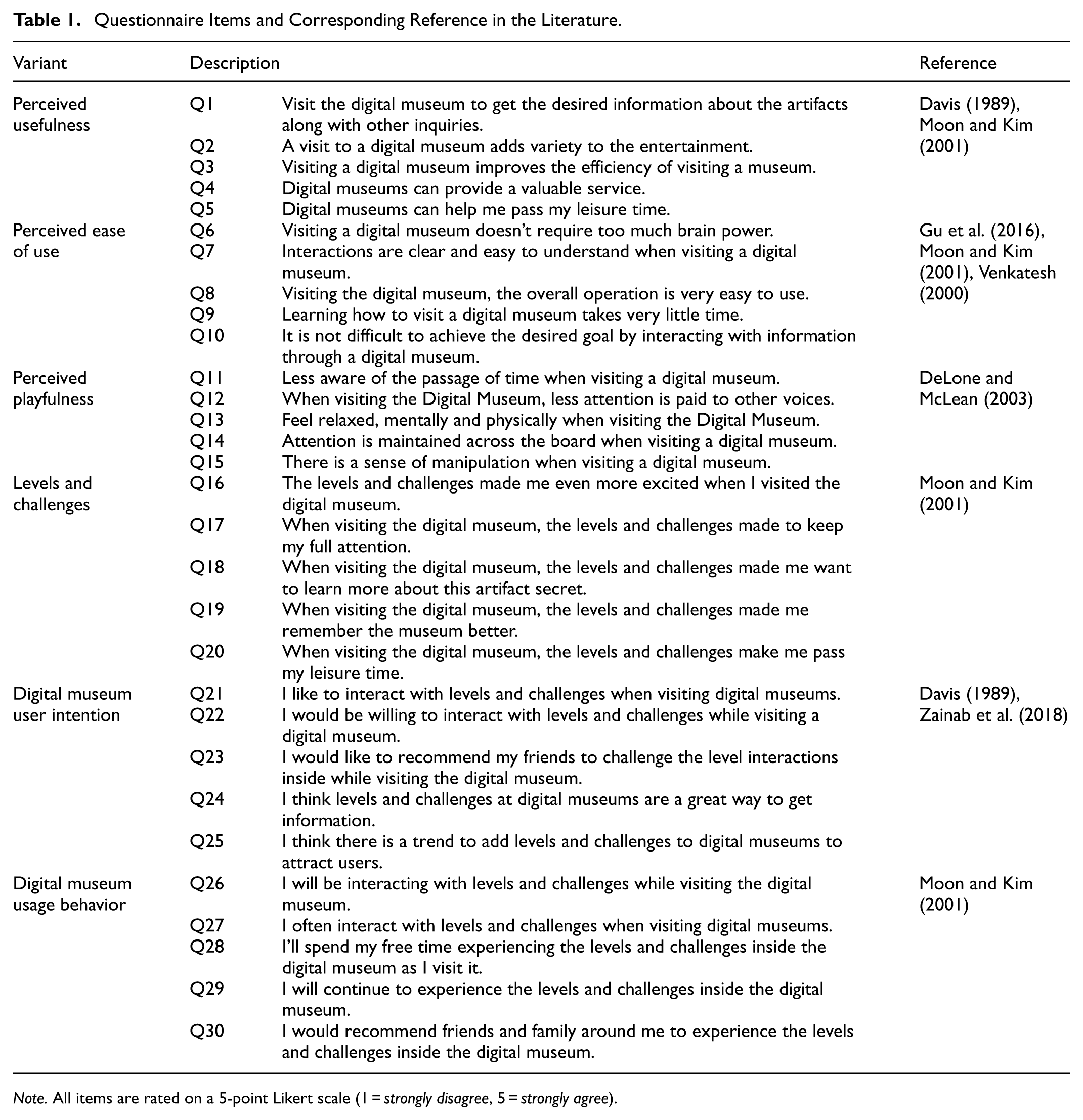
Note. All items are rated on a 5-point Likert scale (1 = strongly disagree, 5 = strongly agree).
Data Analysis and Hypothesis Testing
Sample Selection
Respondents for this study came from all over China, and the questionnaires were distributed online from June to September 2024, and each IP address could only answer one questionnaire. A total of 472 questionnaires were returned, of which 446 were valid, and after deleting invalid questionnaires and duplicate answers, the effective response rate was 94.5%. As can be seen from Table 2, there is little difference in the ratio of men and women. Users of digital museums are mainly young and middle-aged people (26–50 years old, accounting for 65.92%) who are interested in museum culture or engaged in professional studies.
Results of Frequency Analysis.

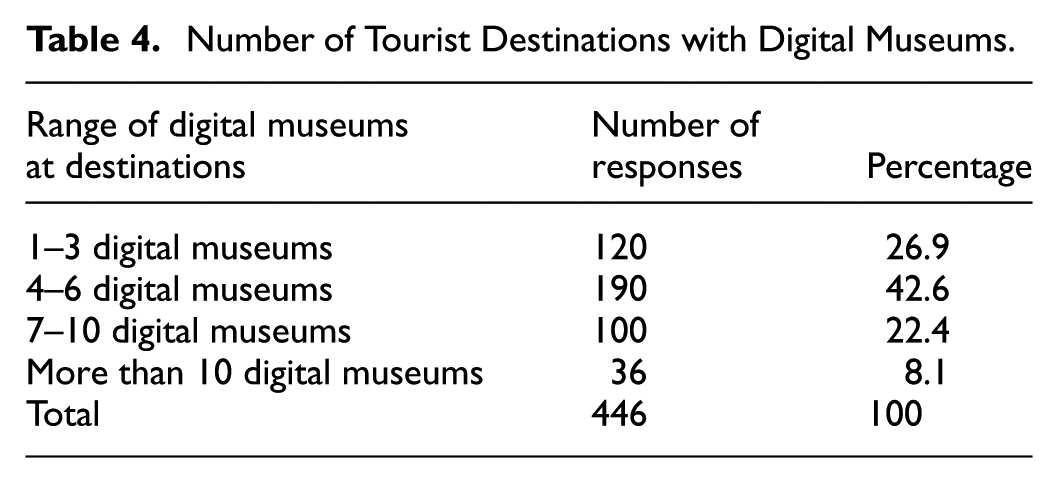
Based on data from 446 questionnaire surveys and in-depth interviews, this study conducted a comprehensive analysis of the frequency of visitors’ visits to digital museums, visits for tourism purposes, and the core perspectives expressed in the interviews. The data (Tables 3–5) indicate that approximately 40% of visitors choose to visit a digital museum once per year, 30% on a quarterly basis, and 10% monthly, while nearly 20% of visitors report that they visit only occasionally or not at all. Furthermore, there is considerable variation in the number of digital museums available at tourist destinations; 42.6% of respondents indicated that their destination hosts four to six digital museums, suggesting that this type of cultural facility has become relatively common in some areas. The interview records further reveal that many visitors hold positive views regarding the digital museum’s interactive experience, technological applications, and immersive displays, believing that these features bring a new dimension to traditional museum experiences. However, some visitors also pointed out issues such as inconvenient navigation, insufficient content depth, and technical details that need improvement. In summary, while digital museums play a positive role in enhancing the tourism experience and disseminating cultural history, continuous improvements in technology and content are essential to better meet the diverse needs of different visitor groups.
Frequency of Visiting the Digital Museum.

Number of Tourist Destinations with Digital Museums.
Interview Records of Visitors’ Perceptions of the Digital Museum.

Reliability and Validity Tests
The study analyzed the reliability and validity of the survey results with SPSS software 26.0 (IBM Corp., Armonk, NY, USA). Table 6 indicates a KMO value of 0.937 exceeding the threshold of 0.8, while Bartlett’s p-value is below .05. Therefore, the data is appropriate for factor analysis and shows superior reliability for information extraction. A total of 6 factors and 30 analysis items were the subject of this verified factor analysis (CFA). The sample size was moderate, with an effective sample size of 446, which was 10 times larger than the total number of objects assessed. The internal consistency reliability analysis for each variable was performed by computing the Cronbach’s alpha coefficients. Table 7 demonstrates that the Cronbach’s alpha coefficients for each dimension above .8, signifying internal consistency and good reliability. There is a certain degree of correlation and differentiation between the individual variables, as indicated by the results of the discriminant validity analysis of the research data, which is shown in Table 8. The absolute values of the coefficients that correlate between the individual variables are less than the square root of their corresponding AVEs. Consequently, the research data exhibit strong discriminant validity.
KMO and Bartlett’s Test of Sphericity – Approximate Chi-Square.

Reliability Test.

Correlation Matrix and AVE.

Note. Bolded diagonal numbers are AVE square root values.
As shown in Table 9, it is generally accepted that in validated factor analysis, when the standardized factor loadings are >0.5, AVE >0.5, and CR >0.7, it indicates that the study data have good convergent validity. The research data’s convergent validity analysis revealed that all six components had AVE values higher than 0.5 and all CR values higher than 0.7, suggesting that the data had good convergent validity. The standardized factor loading coefficients for each observed variable exceeded 0.7, demonstrating strong reliability.
Validation Factor Analysis.

Structural Modeling and Testing
IBM SPSS AMOS 23.0 (IBM Corp., Armonk, NY, USA) was used to construct the structural equations and verify the relationship between the variables. According to the assumptions of this study, based on the proposed TAM. To verify the structural equation model, the software was employed to construct the entire model, and all data were substituted to produce the model depicted in Figure 2. The Structural Equation Model (SEM) in Figure 2 illustrates the relationships between various latent variables:
Perceived usefulness, measured by Q1–Q5 and influenced by external error terms (e1–e5), directly impacts usage intention with a path coefficient of .18.
Perceived ease of use, assessed by Q6–Q10 and influenced by external error terms (e6–e10), affects perceived usefulness with a path coefficient of 0.31 and Usage intention with a coefficient of .49.
Perceived playfulness, evaluated by Q11–Q15 with error terms (e11–e15), influences usage intention with a path coefficient of 0.51 and indirectly affects usage behavior.
Level challenge, measured by Q16–Q20 and influenced by external error terms (e16–e20), has a significant positive effect on Perceived Playfulness, with a path coefficient of 0.78. Usage intention, measured by Q21–Q25 and moderated by error terms (e21–e25), directly drives usage behavior with a path coefficient of .48.
Usage behavior, measured by Q26–Q30 and influenced by external error terms (e26–e30), is directly affected by usage intention with a path coefficient of .48 and indirectly by other latent variables.
Each arrow in the model represents hypothesized relationships between these constructs, with the numbers indicating path coefficients or loadings. The error terms account for unexplained variance in the observed variables. The proposed model was examined using IBM SPSS AMOS 23.0 (IBM Corp., Armonk, NY, USA), and as shown in Table 10, the overall model fit indexes were chi-square degrees of freedom ratio = 1.735 < 2, RMSEA = 0.04 < 0.05, and the values of GFI, AGFI, CFI, IFI, TLI, and NFI were all greater than 0.9, which all satisfied the model fit criterion. In conclusion, the model exhibits more statistical significance and fulfills the research goals.
Structural Equation Model Fitness Test Table.


The influence between variables in the structural model.
Table 11 illustrates that the conceptual model of elements affecting the usage behavior of digital museums is effectively tailored. Perceived usefulness (β = .182, p < .001), perceived ease of use (β = .31, p < .001), perceived playfulness (β = .178, p = .002), and levels and challenges (β = .147, p = .012) significantly positively influence usage intention of utilizing digital museums, validating hypotheses H1, H2, H3, and H4. Furthermore, usage intention of digital museums significantly positively impacts their actual usage behavior (β = .482, p < .001), confirming hypothesis H5.
Hypothesis Testing.

Represents p < .05; ** represents p < .01; *** represents p < .001.
Discussion and Implications
Summarizing the results of the empirical analysis, all five hypotheses were supported by the data. Among the influencing factors, the most influential is perceived ease of use (standardized estimate of 0.31), followed by perceived usefulness (standardized estimate of 0.182), followed by perceived playfulness (standardized estimate of 0.178) and finally levels and challenges (standardized estimate of 0.147). Among them, usage intention of digital museums plays the role of mediating variable. Perceived usefulness: Mean = 3.85 (SD = 0.62), indicating that the majority of users believe that digital museums offer resources with high informational value and practical utility. Perceived ease of use: Mean = 3.92 (SD = 0.58), suggesting that users generally consider the platform as intuitive and user-friendly, which helps to reduce the learning cost. Perceived playfulness: Mean = 3.74 (SD = 0.65), reflecting that the unique interactive experience of digital museums somewhat increases users’ engagement and interest. Levels and challenges: Mean = 3.68 (SD = 0.70), demonstrating that the gamification elements integrated into the challenge design have a positive effect in stimulating users’ desire to explore and actively participate. Crucially, usage intention was found to have a strong and significant positive effect on actual usage behavior (standardized estimate = 0.482, p < .001, mean = 3.87, SD = 0.61), confirming hypothesis 5 (H5). The details are discussed below:
Perceived Usefulness Positively Influences Usage Intention
The validation results for H1 show that perceived usefulness is a significant factor influencing usage intention in digital museums (consistent with Davis, 1989; see also Chao, 2019). When users believe the platform provides effective informational support and satisfies their academic or interest needs, they are more inclined to engage with exhibitions. Our statistics indicate that most users positively evaluate the platform’s informational services, and intention increases notably when the platform supports research, facilitates learning, or offers credible cultural background information. Over time, positive attitudes may consolidate into usage habits, increasing visit frequency. Actionable implication: implement a two-layer content design for key exhibits (“3 key facts + 1 further reading + 1 interactive question”) and a “search → browse → save → review” loop to translate perceived usefulness into repeat usage. Qualitative evidence corroborates this effect. Interview support: “The technology is innovative, but at times it felt overwhelming for someone not used to digital systems.” (ID-05) “Some information seemed overly simplified.” (ID-06)
Perceived Ease of Use Positively Influences Usage Intention
The significant influence of perceived ease of use (H2) (with a standardized path coefficient of 0.31) confirms the critical role of user interface design, smooth navigation, and cross-device compatibility in digital museums. Users’ feedback on ease of learning and timely system responses reduces their cognitive burdens, thereby enhancing their usage intention. In comparison with prior research on system usability (e.g., Venkatesh, 2000), this study obtains similar conclusions in the context of digital museums. Therefore, digital museums should focus on the integration of interface design, user experience, and social features to enhance perceived ease of use in order to promote active participation and continued use. Qualitative evidence corroborates this effect. Interview support: “The layout is modern, but I struggled to navigate all the digital interfaces smoothly.” (ID-02) “I encountered technical difficulties with the audio guides, which detracted from the experience.” (ID-10)
Perceived Playfulness Positively Influences Usage Intention
The results for perceived playfulness (H3) indicate that the interactive and entertaining design elements of digital museums effectively attract user participation. By leveraging multimedia presentations, interactive operations, and gamification elements, the platform achieves an effective integration of learning and entertainment. The relatively high scores on the “playfulness” dimension suggest that perceived playfulness is an important determinant for enhancing user satisfaction and repeat visitation. This outcome aligns with the research of Hamari et al. (2016) regarding the effective role of gamified experiences in promoting user engagement. When users are confronted with rich cultural and historical content during the use of digital museums, their usage intention and motivation to learn will be significantly increased if they are able to have an enjoyable experience through perceived playfulness design. This phenomenon can be explained by the “flow theory” in psychology, which suggests that deep immersion occurs when users find a balance between perceived playfulness and challenge. Perceived playfulness can also play a role in the use of digital museums by enhancing users’ exploratory psychology and creative thinking. By enhancing perceived playfulness, digital museums can increase usage intention of them and further expand their impact. Qualitative evidence corroborates this effect. Interview support: “The digital presentation was immersive and emotionally engaging, like a story unfolding.” (ID-08) “The dynamic lighting and sound effects occasionally overpowered the exhibits, making it hard to focus.” (ID-13)
Levels and Challenges Positively Influence Usage Intention
This study is the first to introduce levels and challenges as a variable influencing the usage intention of digital museums. The findings demonstrate that levels and challenges can stimulate users’ desire to explore and learn, shifting them from passive recipients to active participants (thus verifying H4). In contrast to traditional TAM studies that consider only perceived usefulness and perceived ease of use, the addition of levels and challenges extends the explanatory power of the model. The descriptive statistics indicate that this variable scores at a relatively balanced level, suggesting that users find the interactive challenges acceptable and that these challenges can generate a positive motivational effect. This discovery presents a new theoretical basis and practical direction for digital museum content innovation. The field of emotional psychology emphasizes the importance of emotional connection in user experience (Scherer, 2005). Digital museums create an emotional connection with the content through storytelling and immersive level design that allows the audience to participate in the process. For example, setting a contextual task about a historical event and allowing users to “experience” the event in a virtual environment, this immersive experience can stimulate users’ emotional resonance, thus increasing their interest and engagement in the museum content. This emotional connection not only enhances users’ curiosity, but also promotes their continued interest and in-depth exploration of the digital museum.
Meanwhile, feedback mechanisms play a key role in user experience. According to Bandura’s self-efficacy theory, an individual’s belief in his or her ability to complete a task directly affects his or her behavior. And as early as 1990, scholars have shown that appropriate challenge and skill balance can stimulate learning motivation (Csikszentmihalyi, 1990) The levels and challenges set in digital museums can show users their progress and achievements in tasks through a timely feedback mechanism. This positive feedback loop makes users more willing to continue using the digital museum, thus increasing their overall willingness to use it. Therefore, by combining learning content through levels and challenges, the learning process is transformed into an interesting gaming experience, which enhances users’ overall evaluation of the museum. Qualitative evidence corroborates this effect. Interview support: “I loved the augmented reality features; they offered a fresh perspective on classic exhibits.” (ID-03) “There’s sometimes a disconnect between the digital narration and the artifacts; more context is needed.” (ID-04)
Usage Intention Positively Influences Digital Museum Usage Behavior
The usage intention of digital museums has a significant positive effect on actual usage behavior, with a standardized estimate of 0.482 and a p-value less than .001. Usage intention digital museums plays the role of a mediating variable between perceived usefulness, perceived ease of use perceived playfulness, levels and challenges and digital museum usage behavior. Furthermore, usage intention mediates the relationship between the perceived variables and actual behavior (H5). Even when all perceived indicators show significant positive relationships, the ultimate conversion to actual viewing behavior depends on users’ intrinsic motivation and experiential feedback. This result echoes the perspective of the theory of planned behavior (TPB), which posits that behavioral intention is a primary determinant of actual behavior. It further emphasizes the importance of continuously optimizing user experience for the long-term development of the platform.
When usage intention increases, they are more likely to put it into practice and make actual use. Strong usage intention usually means that users have a positive attitude toward the technology and are psychologically ready to try and incorporate the new technology. This psychological readiness leads to higher frequency and persistence of use. The theory of planned conduct (TPB) posits that behavioral intention is a primary predictor of actual conduct (Hajiha & Hajihashemi, 2008). Users’ views and subjective norms influence their behavioral intentions, which ultimately affect actual usage behavior. There is a dynamic feedback loop between intention and usage behavior; once users start using a digital museum and have a positive usage experience (e.g., successfully completing a level or gaining knowledge), this positive feedback enhances their intention to use. For example, after successfully completing a challenge, users may feel a sense of accomplishment and thus be more willing to use the platform again. And over time, continued usage behavior may form habits, further solidifying usage intention. According to habit formation theory, the repetition of a behavior leads to the gradual automation of that behavior.
Conclusion
Hereafter we use abbreviations: PEOU (perceived ease of use), PU (perceived usefulness), PP (perceived playfulness), LC (levels and challenges), UI (usage intention), and UB (usage behavior).
Theoretical Implications
At the theoretical level, this study explicitly incorporates levels and challenges (LC) into the core TAM pathway (PU, PEOU → UI → UB), addressing the traditional model’s limitations in accounting for goal-directed interaction and gamification mechanisms, and thereby enhancing its explanatory power in cultural and educational contexts. It further integrates self-efficacy and social identity to elucidate how LC strengthens usage intention (UI) and sustained exploration through competence beliefs and a sense of belonging, while triangulating SEM results with interviews to reinforce external validity. Given the cultural sensitivity of digital museums, a modest ethical insight can be incorporated without altering the model’s structure: emphasizing historical authenticity and information transparency can bolster users’ trust and perceived legitimacy, thereby indirectly enhancing PU and PEOU; likewise, when level narratives are perceived as respectful of facts and diverse perspectives, the LC-to-UI conversion is more likely to be strengthened. Collectively, these conclusions offer an actionable framework for interface and content optimization, gamified design and evaluation in digital museums, and delineate a clear trajectory for TAM’s evolution in interactive cultural settings.
Practical Implications
Practically, design and operations should focus on four levers, with concise ethical presentation as a baseline. First, prioritize ease of use: streamline information architecture (≤5 primary menu items on the homepage; ≤3 steps for key tasks), ensure first-screen load ≤2 s, provide a 30-s onboarding and in-situ help, and maintain cross-device consistency. Second, make utility the core: adopt a content template of “3 key facts + 1 further reading + 1 interactive question,” and build a “search → browse → save → review” usage loop. Third, pursue lightweight immersion: use a micro-interaction chain (detail zoom → contextual audio → short quiz) to balance engagement and cognitive load, supported by one-tap mute and a minimal mode. Fourth, contextualize levels and challenges: implement tiered difficulty (“novice → advanced”), low-friction incentives (knowledge badges/collection cards, optional leaderboards), and tightly anchor tasks to exhibit contexts to translate challenge into learning gains. Meanwhile, brief disclosure of sources and processing, together with modest pluralistic presentation of contested content, can enhance user trust and acceptance without overshadowing core experiences. For evaluation, run 2 to 4 week A/B tests (n ≥ 3,000); primary KPIs include 7-/30-day return, session duration, and task completion, with bookmarks/shares/recommendations as secondary metrics. Use AMOS BCa bootstrap to report 95% confidence intervals and prioritize interventions whose UI-effect CI lower bound exceeds 0.10. This roadmap targets the empirically strongest levers (PEOU, PU).
Footnotes
Acknowledgements
The authors of this paper are very grateful for the help provided by the following experts and people: associate professor Yongjun. He provided theoretical guidance and questionnaire instruction. Teachers at the Suan Sunandha Rajabhat University provided valuable comments, which are gratefully acknowledged.
Author Note
The first author is a doctoral candidate whose main research interests include visual art design. The second author is an associate professor and master’s degree supervisor at the Nanjing University of the Arts whose main research interests are museum theory and practice.

Consent to Participate
Respondents who participated in the questionnaire survey participated in the study after reading and signing the informed consent form.
Author Contributions
Yongjun He led the organization and curation of a substantial dataset, ensuring its accuracy and completeness. Ying Liu was responsible for the empirical work, including designing the instruments, conducting semi-structured interviews, administering the questionnaire survey, and overseeing data collection and preliminary analysis.
Funding
The authors received no financial support for the research, authorship, and/or publication of this article.
Declaration of Conflicting Interests
The authors declared no potential conflicts of interest with respect to the research, authorship, and/or publication of this article.
Data Availability Statement
Data sharing not applicable to this article as no datasets were generated or analyzed during the current study.