



Abstract
Universities in many countries, including China, have implemented the tenure track system as a management tool for excellence. In a tenure context, teacher commitment to faculty service, albeit underexplored, is subject to evaluation. The relationship between teacher professional agency, professional identity and faculty service remains an under-explored area in research on tenure-track teachers in the Chinese context. This study investigated tenure-track teachers’ professional agency with regard to faculty service, as manifested in influencing at work, developing work practices and negotiating professional identity. Data were elicited from tenure policy documents, questionnaires, and semi-structured interviews. The findings suggest an expansion of faculty service, encompassing six domains, namely, ‘discipline establishment’, ‘extracurricular contribution’, ‘scholarly participation’, ‘student affairs’, ‘performance appraisal’, and ‘publicity service’. In undertaking the faculty service, the ambiguous workload documents, combined with the top-down management style, the shifting power structure, and the public mythology, constitute structural constraints and system-wide maneuvering space that could impact teacher professional agency. In such circumstances, three identities, ‘a leadership investor’, ‘a dutiful scholar’, and ‘an indifferent employee’, are in fluid negotiation. This reveals a liquid commitment to faculty service, in which ‘stepping up’ or ‘walking away’ strategies emerge. Implications of the findings are also provided.
Plain Language Summary
This research looked at how teachers on the tenure track in China manage their service roles and responsibilities. It specifically explored how much control or choice these teachers feel they have, how this connects to their sense of professional identity, and how they handle the often unclear demands of service work. Researchers analyzed official tenure policies, sent out surveys, and conducted in-depth interviews with tenure-track teachers. The study identified that faculty service includes six major areas. Facing the expansion of faculty service, teachers often feel squeezed. The research unravels factors that limit their ability to choose how and how much they engage in service. Faced with these constraints, teachers’ dedication to service work isn't fixed. Depending on the situation, their identity, and the constraints, they either take on more responsibility when they see an opportunity or feel they must or actively avoid or minimize service tasks when possible. The study shows that the heavy and often poorly defined burden of service work significantly impacts how Chinese tenure-track teachers feel about their jobs, their ability to control their workload, and even their sense of professional self. Understanding these pressures and how teachers adapt is crucial for universities to create fairer and more supportive tenure policies.
Keywords
Introduction
Service is a core component of faculty responsibilities in higher education. Teachers’ commitment to faculty service has traditionally been driven by self-interest and intrinsic motivation. However, as many facets of the academic role are reshaped by managerial culture, faculty service becomes a core aspect of performance appraisal (Erickson et al., 2021). In such circumstances, teachers must undertake faculty service to prove their accountability. This is indeed the case in many tenure-track contexts where teacher commitment to faculty service is subject to quantitative measurement (Pietilä, 2015). Whereas the tenure-promotion process in most academic settings requires a satisfactory record of commitment to service, such as committee work and mentoring, the criteria for defining ‘satisfactory’ in the application to move to a professoriate rank are not always clear and distinct. Less is known about whether a suggested service workload is provided, whether work beyond the suggestions is optional, or whether teachers can choose what faculty service to undertake, and whether variations in choices yield potential disparity in career advancement. In turn, the decision to commit to faculty service is one that can be negotiated by the individual teacher. At the same time, a teacher’s choices are often shaped by the tenure context in which he or she is situated. In other words, a pre-tenure teacher may decide when and if to undertake faculty service, which may often be influenced by external cues nested within the tenure context about his or her probability of excelling in competing for tenure. In this way, teacher professional agency plays a predominant role. In relation to teachers and teaching, professional agency has been described as ‘the power to act, to affect matters, to make decisions and choices, and take stances, for example, in relation to their work and professional identities’ (Vähäsantanen, 2015, p. 1). It is broadly recognised that teacher professional agency cannot be discussed without reference to work settings. On the one hand, the tenure structure shapes individuals’ opportunities, constraints, and experiences by, for example, institutionalizing workload formulae such as 40% research, 40% teaching, and 20% faculty service in Australia (Miller, 2019). On the other hand, despite the prevalence of control technologies in the tenure context, teachers should have some degree of agency when it comes to work priority and time allocation, particularly faculty service, where its value and metrics are often relatively ill-defined. Yet, the extant literature differs on the extent to which teachers are able to make responsible judgements about the worth of their intentions when undertaking faculty service. In this study, we asked what role faculty service plays in applying for promotion and what role professional agency plays in navigating faculty service in a tenure context. It seeks to shed light on the dynamic and multi-level interactions between policy, agency, and practice in teachers’ lived experience and contribute to recent discussions on managerialism, workload allocation, and teacher agency.
Tenure Track Teachers
Tenure-track teachers are a vulnerable academic group because they are in low positions in the academic hierarchy and because their path to tenure is fraught with uncertainties (Mu & Hatch, 2021). Research shows that efforts to motivate tenure-track teachers have recently intensified at many HEIs, with issues of performativity garnering increased scholarly attention (Deem, 2020; Si, 2024; Wang & Jones, 2024). There are ample reasons to believe that escalating job demands have become a characteristic mark of tenure-track positions (Larson et al., 2019).
The existing research has also pointed to an involuted climate, untransparent review processes, and exploitative policymaking as issues that tenure-track teachers may encounter (Lawrence et al., 2014). Many tenure-track teachers may find themselves in situations where divergent responsibilities are competing with each other. At the same time, workload documents fail to cover the full range of activities as well as the actual time needed (Wang & Jones, 2021). Part of the reason is an intensification and extension of work in the rise of academic tournaments (Gu & Levin, 2021). To excel in incessant performance competition and ranking, teachers must work longer than stipulated for a better chance of tenure. The other reason is that not all teacher work can be easily recognized and evaluated (Kenny & Fluck, 2023). This is particularly true for faculty service, which is usually time-consuming but hardly has quantifiable outcomes.
Additionally, time pressure does not arise solely from having too little time to grapple with too much work but also from the extent to which time allocation meets individual aspirations. The former relates to chronic exhaustion and work-life balance, while the latter is more linked to unfulfilling and unrewarding experiences (Fetherston et al., 2021). In a time when more and more HEIs endeavor to reshape institutional missions into a more substantial research focus, tenure-track teachers are tempted to prioritize their research agenda (Tian & Lu, 2017; Yang et al., 2024).
The extant literature has lamented longer working hours and intensified workload through the lens of structural characteristics of managerialism. However, such a lens neglects the relevance of the teacher agency in coping with managerial behaviors. As a result, little knowledge exists of the agency of tenure-track teachers. In addition, one recurring theme in existing scholarship about tenure-track teachers is the difficulty in addressing the conflict between teaching and research. What is unclear is the influence of faculty service to account for teacher experience and their professional identity. This research addresses this lacuna by documenting teacher agency in engaging in faculty service.
Professional Agency Among Academic Staff
The professional agency has been of interest to international researchers in the field of education. From a sociocultural viewpoint, agency is exercised and manifested within a given context where teachers negotiate and construct their career choices and life courses (Campbell & O’Meara, 2014). There is empirical evidence that professional agency is positively connected to students’ learning outcomes, the development of HEIs, teachers’ work commitments, and their professional well-being (Hinostroza, 2020). All this underlines the necessity of understanding professional agency in higher education and the significance of seeking to enhance it.
In the case of educational contexts, professional agency manifests in the contents of workload, individual ways of working, and collective work practice and culture (Stillman & Anderson, 2015; van der Heijden, 2017). It may include applying new ideas, performing new pedagogies, and making choices on one’s own way of teaching in the classroom (Heikonen et al., 2020). In this sense, professional agency represents active involvement in designing and managing educational practices. Professional agency is also seen as mediated capacities to (re)construct working conditions at both individual and collective levels. The mediated capacities manifest in proposing new ways of working, raising and intervening in problematic issues, or participating in institutional matters (Englund & Price, 2018; Spinrad & Relles, 2022). Conversely, a feeling of being dispossessed of these capacities gives rise to a lack of agency. For example, Drake et al. (2019) reported a limited sense of professional agency among non-tenure-track faculty due to their failure to participate meaningfully as full campus community members in a culture of structural personnel inequality. Clavert et al. (2015) used the term ‘change agency’ to conceptualize teachers’ initiatives to challenge dominant ways of doing and thinking.
Prior research has uncovered factors that could either resource or constrain teacher professional agency. Forces include collegial relationships, professional networks, career stage, gender identity, ethnic status, disciplinary nature, university type, leadership practice, and educational policy (Lau et al., 2022; Oolbekkink-Marchand et al., 2017). Despite intensive research on professional agency in education contexts, there is a lack of a fully elaborated understanding of the professional agency of tenure-track teachers. To date, only a few studies have addressed the professional agency of academic faculty and its pivotal role in dealing with changing work conditions (e.g. Englund & Price, 2018). Moreover, these studies have mostly centered on the ability of academic staff to negotiate the contents and conditions of research and teaching workload (Vähäsantanen et al., 2020). Professional agency regarding faculty service is relatively unexplored. This study, focusing on faculty service in conjunction with the tenure track system, contributes to a comprehensive understanding of professional agency in tenure contexts in higher education.
Theoretical Framework
In this research, teacher professional agency is taken as an emergent phenomenon, with which a teacher is ‘not only responsible for what he does, for the degree to which he acts in line with his evaluations, but also as responsible in some sense for these evaluations’ (Taylor, 1997, p. 118). Our analysis has adopted a subject-centered socio-cultural approach to conceptualize agency. It recognizes individuals as being embedded in and bounded by peculiarities of social-cultural contexts and capable of transforming their socio-cultural conditions. The subject-centered socio-cultural approach gives rise to the importance of individual subjects and deems agentic actions as a social genesis. It also integrates an ecological underpinning and adds a temporal dimension. An ecological consideration acknowledges agency as an outcome of the interplay of an individual’s past experiences, present conditions, and future goals emergent from an iterative relationship in performing intentionality and subjectivity (Priestley et al., 2015).
In line with a subject-centered socio-cultural approach, we adopted a validated tri-dimensional theoretical model of professional agency proposed by Vähäsantanen et al. (2019). The three dimensions are Influencing at work, Developing work practices, and Negotiating professional identity. Like Vähäsantanen (2015), we consider manifestations of the three dimensions falling on a continuum between two extremes (See Figure 1). Specifically, teacher agency may move from weak to strong in relation to Influencing at work, from reserved to progressive in terms of Developing work practices, from maintainable to transformative with regard to Negotiating professional identity. This study thus assumes that professional agency might be manifested and practiced in forms of both maintenance and transformation.

Three dimensions of professional agency.
Research Design
Research Context
This study investigated teacher professional agency in navigating faculty service, the perceived resources and constraints in China’s higher education. Although notions of ‘iron rice bowl’ or permanent job security have guided personnel policy in education for decades, China is by no means immune to global trends in neoliberal managerialism. In conjunction with low satisfaction with the inefficiency of the ‘bianzhi’ system, many Chinese HEIs have introduced tenure track as a new governance model. The tenure system, as a replacement for ‘bianzhi’, attempts to disrupt job security to foster competition and promote efficiency. Tenure-track teachers in this study refer to pre-tenured faculty who are expected to demonstrate individual excellence in meeting the pre-defined criteria and competing for tenure in the first or second probationary phase. Otherwise, they might be eliminated due to the up-or-out approach implemented by the tenure system. The ‘bianzhi’ (quota) is a nationally coordinated system that supports permanent job security and endows teachers with the quasi-status of government officials. That is to say, teachers, no matter junior or senior, all have tenure if were hired with ‘bianzhi’. One intrinsically linked notion to the concept of ‘bianzhi’ is ‘danwei’ (work unit). ‘Danwei’, as the organizational manifestation of the ‘bianzhi’ system constitutes a community defined by collective survival and prestige. Due to the ‘danwei’ legacy (Wang & Jones, 2021), high commitment to faculty service has been conventionally regarded in societal and cultural perception as embodying collective-mindedness, a spirit of dedication and sacrifice, and an ethos of helpfulness. All are highly valued in defining good teachers in the Chinese context and beyond. However, the emphasis on measurable achievements and progress in the tenure system seems to be in stark contrast with blue-sky and disinterested investment in the collective good. Under such circumstances, little is known about whether the tenure system, while prioritizing research outcomes, continues to necessitate significant investment in faculty service and, if so, whether the tenure policy primarily provides resources or imposes constraints for faculty to navigate their service obligations. Furthermore, much less is known about the dialectical relationship between policy, person, and practice that emerges through teachers’ navigation of faculty service. To address the above gaps, this study aims to answer the following questions:
What faculty service is undertaken by tenure-track teachers?
How is professional agency manifested with regard to faculty service?
Participants
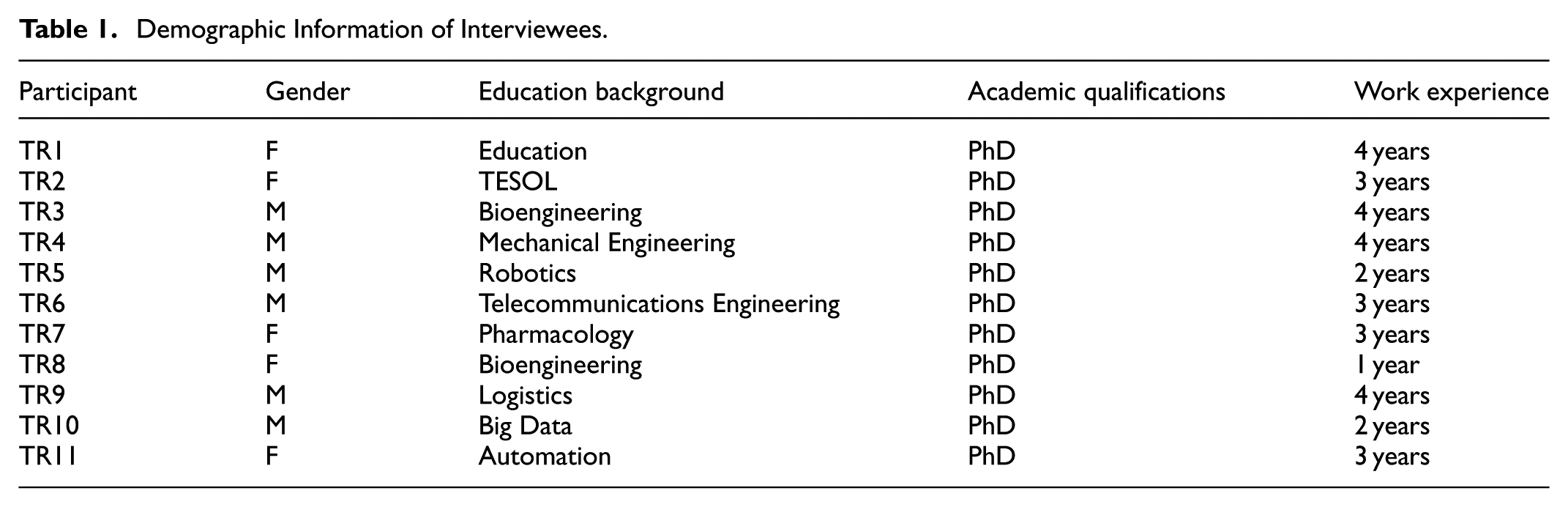
At the 6 case universities, tenure track reforms have been initiated for more than 8 years. All participating teachers commenced their employment following the initiation of the reform and had not yet attained tenure at the time of data collection. Given the authors’ connection with the case universities, convenience sampling and snowball sampling strategies were adopted. With the help of social media platforms, the questionnaire survey was administered to 53 invited participants, yielding 46 complete responses. Questionnaire participants were labeled from TQ1 to TQ46 according to the sequence of survey submission. Then, we contacted teachers who were willing to participate in semi-structured interviews. Considering time availability, eventually eleven teachers were chosen and interviewed either in person or by instant communication applications. The interviewees in this study were designated as TR1 to TR11 according to the chronological sequence of interviews. Adhering to the principle of maximum variation (Merriam & Tisdell, 2016), the sampling also represents diverse professional backgrounds, educational trajectories, and working experiences. Demographic characteristics of pseudonymized participant profiles are detailed in Table 1. Prior to interviews, the corresponding author engaged in preliminary self-disclosure about faculty service in a tenure-track context. This is to build researcher-participant trust and rapport so that they are comfortable sharing personal and sometimes sensitive experiences and reflections (Mesch & Beker, 2010). The research was performed in accordance with the ethical regulations in the context. All participants were invited to provide voluntary informed consent and were informed that they retained the right to withdraw at any point. They were further guaranteed rigorous maintenance of participant anonymity and data confidentiality throughout the study.
Demographic Information of Interviewees.
Data Collection
This study utilizes a qualitative approach and elicits evidence from workload documents, open-ended questionnaires, and follow-up interviews. We first collected workload documents in relation to faculty service for the following purposes: (1) to obtain information about faculty service workload; (2) to understand discursive constructions of teachers’ agency, identity, goals, and professional development.
Following an analysis of workload documents, an open-ended questionnaire was administered in the six case universities. The open-ended questionnaire consists of five question clusters to elicit teachers’ sense of professional agency in undertaking faculty service (See Table 2). The first question cluster explores their overall sense of agency. The second invites a recollection of faculty service workload and their experiences. The third to fifth question clusters correspond to the three dimensions of teacher professional agency, namely, influencing at work, developing work practices, and negotiating professional identity.
The Questionnaire Survey.

Then, follow-up semi-structured interviews were conducted with eleven participants to elicit further self-reflections concerning their choices of undertaking faculty service and how they perceived the manifestation of their professional agency in making choices. Each interview lasted from 60 to 90 min. Both questionnaire and interview participants were encouraged to employ Mandarin while answering questions or communicating with the researchers. The selected excerpts that were used in this article were translated into English by the first author. The researchers also compiled detailed field notes concerning teacher identity, emotion, and interesting narratives.
Data Analysis
Data were analyzed following the guidelines of the six-phase reflexive thematic analysis proposed by Braun and Clarke (2022). In the first analysis phase, researchers familiarize themselves with the dataset by reading and re-reading the data or by immersion. Altogether, 34 initial codes that appeared meaningful for the research question were identified. Then, researchers collate the initial codes into potential themes and gather all the data relevant to each candidate theme. The codes were subsequently organized into eight themes. Through closely examining the candidate themes, their fitness, and demarcation, relationships between different levels of themes were sorted out. Accordingly, an overarching theme of ‘a long list of faculty service’– three manifestations of professional agency, clustered around – was generated. The thematic map in Figure 2 clarifies the relationship among the themes. To ensure reliability, the first and second authors independently coded the data, identifying semantic and latent meanings about teaching professional agency. We each developed candidate themes, attending to the lived experiences provided by the participants. We then compared and discussed the candidate themes and decided on the final themes before producing the paper. The participants were also invited to comment on the candidate themes, which contributes to the finalization of data analysis.
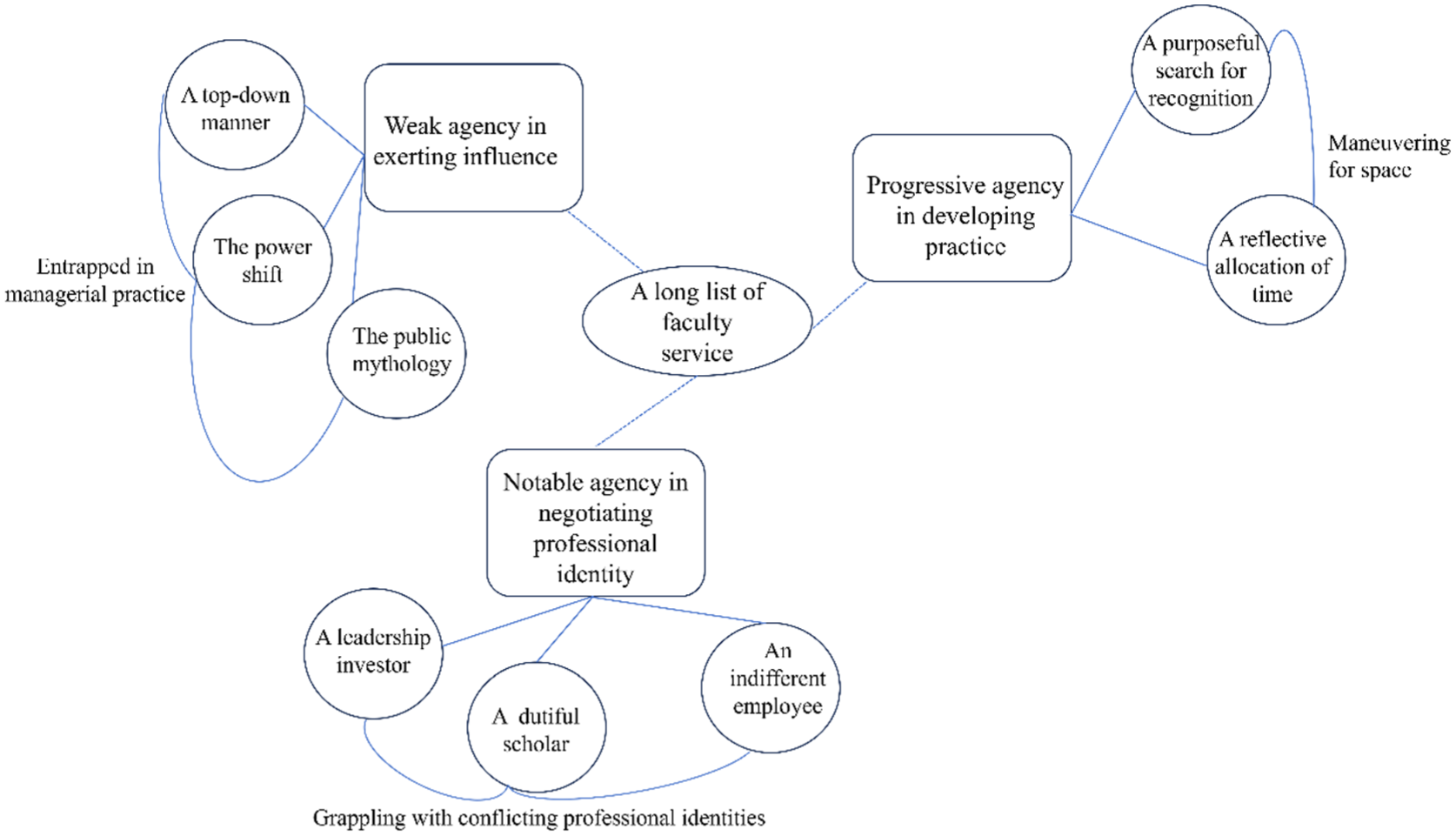
The thematic map.
Findings
Faculty Service: A Long List
A thematic analysis of teachers’ narratives indicates a long list of faculty service, which can be loosely categorized into six domains, namely ‘discipline establishment’, ‘extracurricular contribution’, ‘scholarly participation’, ‘student affairs’, ‘performance appraisal’, and ‘publicity service’ (See Figure 3).

Six domains of faculty Service.
Specifically, ‘discipline establishment’ includes curriculum and program development, faculty recruitment and mentoring, participating in various educational reform efforts, and contributing to developing a professional community. These duties are indeed daily routines of higher education teachers, before faculty service is of appraisal interest. However, ‘discipline establishment’ here is no longer solely dependent upon professional expertise or interests, but rather has become an integral component of the evaluation framework.
‘Extracurricular contribution’ refers to organizing an extracurricular activity, including planning a budget, building a team, booking a venue, and branding the event. Basically, it means weighty forms that take time to fill in and massive emails that constantly disrupt teaching preparation and research progress. It involves seeking assistance and negotiating resources.
Likewise, ‘scholarly participation’, such as organizing a workshop, coordinating a conference, convening a seminar, or chairing a panel, is believed to be largely administrative. This entails a series of applications, reviews, allocations, and overall coordination pertaining to venues, personnel, and funding. Responsibilities that address student concerns fall within the purview of ‘student affairs’. This encompasses a wide spectrum of student management, ranging from facilitating career planning to administering procedural requirements for medical absences. In general, it expects teachers to act as middlemen between professional staff and students so as to identify and manage misbehaviors, dropout risks, and psychological disorders.
As demands on performance escalate, so does the workload on performance appraisal, which exacerbates the need for teachers to evidence their performance and to serve on various appraisal committees. Thus, ‘performance appraisal’ involves bustling around form filling, report writing, report reading, appraisal meetings, regular inspections, and annual reviews. It underlies an inveterate desire to encourage self-monitoring and surveillance, which drives teachers moving back and forth between reviewing others and being reviewed.
Furthermore, teachers are expected to assist with publicity campaigns for undergraduate and postgraduate enrolment. Within this, the main foci are to visit secondary schools, livestream recruitment policy, and join university open days. In order to boost institutional visibility, it also encapsulates building positive individual and institutional images by forwarding digital newsletters on social media, promoting teaching and research outcomes, and enhancing the institutional image as capable, innovative, and reliable. A scrutiny of workload documents across the case universities reveals that the demands for undertaking faculty service all conclude with a similar statement. For instance,
Apart from the above-mentioned faculty service, faculty members should be cooperative in fulfilling additional demands emerging from departmental and institutional needs.
The catch-all of ‘taking other duties as required’ or ‘assisting in departmental and institutional needs when necessary’ suggests the necessity of being active members of the broadly conceived organizational collective. However, such a catch-all leaves space for a hypertrophy of faculty service and consequently, all teachers reported a long list of faculty service. Despite variations in numbers and commitment, all participating teachers claimed that their faculty service workload encompassed the aforementioned six domains.
Faculty Service: Professional Agency in Navigating
Weak Agency in Exerting Influence, Particularly at the Faculty Level
Overall, tenure-track teachers see themselves as subordinates in determining the allocation of faculty service. In many cases, faculty service duties are informed in a top-down manner. Teachers pointed out that they can hardly decide what faculty service should be carried out, as they are continually informed of what they need to do, and the tasks assigned are neither fixed nor repetitive, with new tasks constantly appearing. As the following narrative indicates:
Well, I know undertaking some faculty service is part of the expectation for tenure-track teachers. However, this seems way too wild. It is never-ending, constant, and multifarious. There is always one thing on top of another. I can influence this to a rather restricted extent. To some extent, I can pick which task I want to take. However, I do not have much influence on the status quo of overwork. (TQ13)
The top-down manner seems to fabricate a sense of compulsion, impermanence, and arbitrariness, which is considered to pose an impediment to the exercise of influence. Also, when the top-down manner allows for ad hoc workload designation, teachers find it difficult to refuse faculty service duties that are even deemed highly transient or too capricious. Due to weak agency in exerting influence on how faculty service workload is designated, there is a wide agreement on over-stretching. Not surprisingly, teachers attribute the weak agency and over-stretching to the ambiguity of workload documents and the ascendancy of administrative mentality.
One factor correlated with the top-down manner is the shifting power structure. A wide belief emerges that much faculty service is outsourced to teachers as the tenure track system affords administrators and leaders at the faculty level with increasing power. As a result, there is a lack of work boundaries between teachers, administrators, and professional staff, which largely undermines teacher professional agency. As TR3 commented, I feel I cannot draw a clear-cut line. Quite often, I feel that administrators or professional staff should do what I am doing, for instance, by phoning potential industrial partners or pitching undergraduate programs on orientation day. It is not my expertise, and I do not have to contribute. My colleagues feel exactly the same. We once raised this issue at the faculty meeting, but nothing has changed. It is exploitative.
Teachers use words like ‘exploitative’, ‘overwhelming’, ‘relentless’, ‘ridiculous’, and ‘terrible’ when describing the lack of clarity about the role split. It appears that the power structure pressures them to complete their faculty service to satisfy various performance appraisals on time (which usually suits the administrative system instead of the teacher’s agenda). However, they also have to keep abreast of tasks outside traditional academic borders. In this way, the traditional distinction between academic and non-academic roles becomes blurred. As the changes stress out teachers but may facilitate administrative processes and management-related issues, a sense of unfairness takes ascendancy. Despite some attempted interventions, no constructive steps follow. Although teachers may question the habituated actions, the possibility of subsequent transformation of ingrained habitus is deemed low.
Others mention a higher expectation of tenure-track teachers in the frame of a slanted public mythology. Although tenure-track teachers often confront insurmountable workloads, there remains a prevalent belief that tenure-track teachers have it good when compared to those on teaching-focused positions (more teaching hours) or contingent contracts (less job security). This belief somehow gives legitimacy to overwork regardless of its rationality. It embodies a disjuncture between subjective experiences and expectations of the field of practice. As pointed out in the excerpt, the disjuncture restricts exercising agency.
One thing that you cannot influence or change is this public misconception. My workload blows out. I experience burnout. Others may say you have fewer teaching hours and are often absent from the university campus. No need to be in the office from nine to five and have higher remuneration and benefits. With all these privileges, you have to show compliance. When you question too much faculty service, you are a spoiled employee. I feel like being shackled (TQ26).
It is as if tenure-track teachers have been shackled by the myths of ‘higher pay, better conditions’, unable to convey to broader cohorts that their faculty service is inappropriate; their work demands are high and even injurious to their well-being. As such, the misunderstanding shows their agency to act upon the problematization of overwork in the workplace.
Progressive Agency in Developing Practices at Work, Notably at the Individual Level
The findings indicate that teachers have substantial agency in developing ways to cope with faculty service. This is manifested in the purposeful reflection on thoughts and practices, which allows for a critical qustioning of how such duties are performed. All the teachers in the study embrace this intentional thoughtfulness. They deliberated on what they did, should, or should not have done, or what they might go on or discontinue. One teacher stressed:
I take a rather detailed record of my faculty service. This is for a performance appraisal, of course. More importantly, as time passes, I know how to adapt myself to the context of tenure. Faculty service is highly time-consuming. This is a way of knowing what I am comfortable with or whether my faculty service workload meets tenure policy. This also lets me determine whether my workload is in the lead or left behind. I can pursue the ones that I am happy with. I can say no to the leaders if it is too much.
Against tenure expectations and personal experiences, teachers enact their reflective abilities to engage in an ongoing reviewing cycle through which faculty service workload is examined, time allocation is secured, emotional experience is assessed, outcomes are inspected, wrongdoings are amended, and new ideas are generated. According to the teachers, percipient deliberation enacts self-managing ability, which increases the agency experience in the light of making informed choices and initiating changes. It may facilitate teachers to act as critical performers who can become adaptive professionals in consistently reassessing priorities, policies, and practices over time.
Apart from attentive reflection, teachers are also actively searching for recognition. The responsive tactics include ‘investing in high-value duties’, ‘prioritizing high-stakes tasks’, ‘publicizing tangible outcomes’, and ‘striving for a fair appraisal system’. These proactive actions might be easily anticipated in that teachers are well-positioned to work towards tenure standards. Asked about the connection between tenure policy, recognition, and agency, one teacher reflected:
You cannot get away from faculty service. You have to ensure that the administrative duty you are undertaking is known to the management and is valued in the tenure review. Every point counts. I voluntarily acted as a program convenor last semester, as I believe it adds weight to the tenure review. Then, you feel you have control over faculty service and, more importantly, the career path.
As this excerpt shows, the interaction between recognition and agency is reciprocal. On the one hand, recognition enhances agency. Teachers who satisfactorily get recognition for their commitment to faculty service are more likely to be able to engage in the duties that they have reason to value. On the other hand, agency boosts recognition. The opportunities of selecting, rejecting, and valorizing duties create a space for teachers to creatively engage with institutional policies and regulations, with which they can confidently design their tenure trajectories.
Although highlighting the importance of obtaining recognition, teachers give faculty service a low priority in time allocation. Many claim they only devote themselves to faculty service when they lose teaching preparation and research productivity. This is to avoid being pulled away from ‘constructive time’ (TQ 17). Others report coping with multitasking simultaneously to offset a significant loss of time. Examples include writing a press release draft during a staff meeting, filling out travel forms during a visit to industry partners, or liaising with student affairs in briefings on graduate outcomes. As TQ 35 put it, ‘You can do as you please when presence means everything’. To strike a balance between teaching, research, and faculty service, planning commitment is sometimes recognized as much more critical than being wholeheartedly committed.
Notable Agency in Negotiating Professional Identity
The data demonstrated that the process of engaging in faculty service brings about conflict in the identity formation of tenure-track teachers. Overall, teachers have opportunities to focus on things that benefit their performance appraisal in tenure reviews and facilitate the realization of career goals. Their career goals start with getting tenure and may extend to leadership positions. Without a doubt, commitment to faculty service is considered to pave the way for leadership knowledge and resources. Teachers who envision themselves with leadership potential recognize the career benefit of committing to faculty service.
Faculty service is time-consuming and burdensome. It takes time from research and teaching. If I have choices, I do not want to do too much. But I may develop a granular understanding of how the system works. Such experiences may be beneficial in transitioning into leadership trajectories. Meanwhile, my commitment may receive positive feedback from colleagues and leaders. This may subsequently enhance prospects for tenure attainment. (TR5).
Seemingly, as teachers construct an understanding of who they are going to be within a tenure context, they may commit to faculty service in a way that they believe aligns with that construction. Those actions and the positive reception from colleagues and leaders feed back into the ongoing identity construction process. There is professional agency, but the options available are shaped by career goals, tenure prospects, and larger interpersonal relations. Therefore, participants in this study sometimes talked contradictorily about disliking faculty service but also feeling professionally validated when their commitment is well-received and recognized.
It is also observed that a surge of faculty service and an expansion of faculty service may trigger an aversion to some aspects of governance and motivate teachers to step away from leadership positions.
I firmly believe that I am a researcher. I enjoy researching and teaching. I have always felt that I am not an administrator or a para-academic who simultaneously takes administrative and research responsibilities. Faculty service is a nuisance. So, I carry out faculty service not for administrative titles but for more research freedom. Once I get tenure, I will be a real academic and be able to focus on my teaching and research interests (TR8).
In the ascendancy of managerial behaviors, the professional goals and interests of having academic freedom are particularly valued. Paradoxically, the tenure prospect defines faculty service’s attraction and repulsion. When faculty managers and leaders have come to exercise more managerial behaviors, teachers may voluntarily abdicate their power. As a result of the power shift, steering faculty service for career advancement is taken as a pragmatic option to defend professional integrity and academic freedom. Two professional identities are shaped in the process. One is a dutiful scholar, and the other is an indifferent employee. For example, TQ23 recognized the importance of faculty service and philosophically opposed perfunctory effort. However, she felt compelled to undertake less faculty service and sometimes avoided being a conscientious member. Otherwise, her struggle to demonstrate excellence would be further exacerbated.
I know undertaking some faculty service is my duty. It is what a scholar in higher education should do. However, I cannot guarantee uncompromising diligence. I have an important agenda to demonstrate that I am a capable scholar who is qualified for tenure.
Importantly, all of the teachers in this present study reported stepping up as a leadership investor and dutiful scholar at one point and as an indifferent employee at another. When professional identity fits well within the demands of faculty service, teachers are inclined to take ‘stepping up strategies’. However, when there is a disconnect between perceived roles and workload, teachers may choose ‘walking away strategies’. For the participants in this study, they report notable capacity to undertake faculty service as the kind of teacher they wanted to be, which formed the backbone of how their identities responded to the increased emphasis on accountability in a tenure context. Apparently, strategies that teachers take feed back into their identity; if those actions are constrained by accountability policies in the tenure context, this has the potential to shift identities.
Discussion
In this study, tenure-track teachers perceived that they are undertaking much faculty service and that the work is more complex than expected. The faculty service can be categorized into a set of six domains depicting teachers engaging in faculty service in particular and distinct ways. It is important to note that not all faculty service duties fit neatly into these domains. That is to say, one faculty service duty may fall under several domains. For instance, ‘organizing a workshop for students’ might involve ‘extracurricular contribution’, ‘scholarly participation’, and ‘publicity service’. The overlap is further indicative of the complication of faculty service workload. In many cases, tenure-track teachers have to be ready to deal with multiple service duties at any moment to ‘keep their institutions afloat’ (Hill, 2012, p.192) and balance escalating expectations. This provides a novel hermeneutic lens for understanding the lived experiences of tenure-track teachers. Previous research on tenure-track teachers establishes consistency in the conflict between teaching and research roles (Pietilä, 2015; Si, 2023; Tian & Lu, 2017). Nevertheless, this conflict does not fully represent daily drudgery. A compelling finding is that the tenure track system in the Chinese context, although prioritizing research excellence (Yang et al., 2024), does not exempt teachers from faculty service obligations. Instead, the ambiguous workload document and the managerial mentality may have expanded faculty service workload. In addition to the ‘danwei’ legacy (Wang & Jones, 2021), commitment to faculty service is to some extent recognized as a commitment to the collective good in the Chinese context. As a consequence, the emphasis on research outcomes in the tenure context does not necessarily mean a structural guarantee of uninterrupted research time. This is particularly important in understanding time fragmentation and time competing inherent in teacher work (Miller, 2019).
The fact that faculty service is designated in a top-down manner renders tenure-track teachers entrapped in managerial practice in terms of workload allocation. In such circumstances, the tenure-track teachers reported limited agency in determining their faculty service workload or changing the status quo. This corroborates that in the absence of effective participation, the agency of teachers is restricted (Vähäsantanen, 2015). Consistent with recent higher education scholarship on workload and performativity (Kenny & Fluck, 2023), work allocation under study fails to account for the full range of faculty service, which limits teacher agency. Also, this study found that the blurred boundary between academic and non-academic roles constrains teachers from acting as change agents in exerting influence at work. The diminished power of academics regarding workload allocation makes teachers feel disempowered when it comes to the imposition of faculty service. Tensions can thus arise in a perceived expansion of faculty service duties. As such, an institutional culture that encourages collaborative working relations and facilitates an organizational synthesis seems delusional. In addition, with the growing neoliberal policy in higher education and a subsequent increase of contingent faculty (Spinrad & Relles, 2022), tenure-track positions often become highly attractive and thus carry greater institutional and sociocultural expectations. Due to this cultural acquiescence between higher pay and a more intense workload, tenure-track teachers could not primarily activate their agency to negotiate faculty service workload.
The findings also suggest that to combat challenges resulting from managerial practices with regard to faculty service designation and evaluation, the role of deliberative and progressive agency in recognizing, situating, and addressing such challenges should not be overlooked. Although teachers are highly vulnerable to workload allocation, they do not merely passively adhere to what is imposed on them. On the contrary, they actively reflect on their commitment to faculty service and decide how to involve themselves with recognition, similar to Vähäsantanen’s (2015) findings regarding teacher agency in educational change. This leaves teachers space to maneuver for faculty service workload. Also, an awareness of agency in developing work practices enables teachers to have a commensurate understanding of their behaviors, solve issues that arise, and reflect the influences of their behaviors on their paths to tenure (Priestley et al., 2015). With self-awareness of the need for critical reflection, teachers progressively realize continuities and transformations in light of their experiences and career goals (Stillman & Anderson, 2015). As Drake et al. (2019) pointed out, such agentic perception and reflection afford teachers greater agency. We found that most teachers under study try out a balancing act that involves active engagement with faculty service that is easily counted and recognized in performance appraisal, but also phases of passive accommodation to those that are out of managerial calculation or deemed unimportant. This points to the issue of whether a top-down management style in a hierarchical work culture leaves enough space for teachers’ agency (Lau et al., 2022). The finding in this study is in line with the idea of job crafting (Berg et al., 2013), which refers to what teachers do in order to restructure or redesign their work for the purpose of indicating their engagement, competence, and performance. In the case of this study, job crafting governs teachers’ strategic selection of faculty service and their corresponding attitudes, or at least makes a concurrence of several faculty service duties easier to manage. As the analysis shows, teacher professional identity and agency are shaped by policy and career prospects in complex ways (Sherman & Teemant, 2021). The tenure policy, workload document, and managerial mentality may advance and limit teachers’ professional agency at the same time. As exemplified in previous studies (e.g. Kenny & Fluck, 2023), a well-organized workload and promotion policy were critical in granting the professional space to reinforce teachers’ engagement in and contribution to the workplace. In this study, the ambiguity of workload documents renders an expansion of faculty service, but at the same time allows for individualistic planning or as symbolic compliance (Coburn & Woulfin, 2012). In the course of such a paradoxical situation, teachers have to grapple with three identities, ‘a leadership investor’, ‘a dutiful scholar’, and ‘an indifferent employee’. The three identities are in fluid negotiation, accommodation, and transposition, indicating liquid commitment to faculty service. As a consequence, two strategies, ‘stepping up’ and ‘walking away’ may intermittently emerge, impacting the construction and reconstruction of professional identity.
Conclusion
The relationship between teacher professional agency, professional identity, and faculty service remains an under-explored area in research on tenure-track teachers in the Chinese context. The present study conceptualizes how tenure-track teachers perceive their agency in exerting influence, respond to constraints, adopt agentic behaviors, and negotiate identities. Data analysis revealed that the ambiguous workload documents, in addition to the top-down management style, the shifting power structure, and the public mythology, constitute structural constraints and system-wide maneuvering space that could impact teacher professional agency. In such circumstances, teachers negotiated their identities by implementing ‘stepping up’ or ‘walking away’ strategies. Insights gained from this study can enhance existing knowledge related to the complexities of the affordances that tenure-track teachers are exposed to (Gu & Levin, 2021). It substantiates that professional agency is related to individual resources, including reflective competence, agentic perception, career goals, and social values (Vähäsantanen, 2015). Allied with this, the professional agency may emerge through an ongoing circle of attentive reflection and agentic transformation in a seemingly rather challenging working context (Stillman & Anderson, 2015). The findings could also function as a point of reference for an elaborated understanding of the lived experience of teachers, their faculty service, and professional identity in a tenure context.
Implications can be derived for the improvement of working conditions for tenure-track teachers. First, findings revealed that system-wide structures, excessive top-down control, and the potential unsupportive working culture hindered tenure track teachers’ cognitive awareness in becoming a responsible and caring member. This subtle, yet sensitive, power relation between tenure-track teachers and the working community members (e.g. professional staff) in the perceived expansion of faculty service warrants increased attention. The top-down policy in China and the unequal power relations between tenure track teachers and the evaluative stakeholders can lead to tensions regarding workload designation and teachers’ confusion regarding their identity as a leadership investor, a dutiful scholar, or an indifferent employee. It is essential for policymakers to attend to teachers’ emotional experiences in the course.
Second, findings in the present study suggest the necessity of reflective competence and intentional thoughtfulness in helping tenure-track teachers take control of faulty service workload. It is therefore important for tenure track teachers to construct, generate, and extend their knowledge in learning to work, through which they manage various emotions and conduct critical reflection on hidden rules in the tenure context, which seems essential. At the same time, the job crafting in the tenure context appears to be primarily affected by the managerial mentality. This runs the risk of developing symbolic compliance. Hence, policymakers and faculty leaders should be mindful of bridging the gap between intensified workload and symbolic compliance so that teachers will feel more committed and more rewarded.
Third, in line with the research findings, a clear and consistent conceptualization of faculty service in a tenure context is in need to help tenure track teachers construct coherent professional identities that sustain their development as effective beings in higher education. System-wide practical and reflective initiatives that instigate deeper reflection on undertaking faculty service and being and becoming a tenure-track teacher may be a worthwhile pursuit.
Although this study provides valuable insights into teachers’ professional agency in navigating faculty service and their lived experience in a tenure-track context, it has certain limitations that warrant acknowledgement. The findings of this study were based on the Chinese context. Despite the manifestations of professional agency associated with tenure-track teachers’ navigation to faculty service not being unique to the Chinese context, similar studies in different higher education contexts could provide profound insights into the factors that shape tenure-track policy, define faculty service, and afford professional agency. In addition, this study focuses on pre-tenure teachers. It remains crucial to understand how teachers, varying in professional titles and intellectual backgrounds, reinvent their identities to reconcile internal interests and external demands in a tenure context. Future studies could use a longitudinal design to track changes in teachers’ perceptions and commitment to faculty service, and unravel how these changes affect professional agency and identity.
Footnotes

Ethical Considerations
The School of Foreign Languages Ethics Review Committee at Shenzhen Technology University approved our interviews (approval: E-2023-01) on August, 2023. Respondents gave written consent for review and signature before starting interviews.
Author Contributions
Jinghui Si: Conducting data collection, formal analysis, writing original draft, editing
Maoxia Yang: Managing project, reviewing and editing.
Funding
The authors disclosed receipt of the following financial support for the research, authorship, and/or publication of this article: This work was supported by the National Educational Science Foundation of China under grant EIA230493.
Declaration of Conflicting Interests
The authors declared no potential conflicts of interest with respect to the research, authorship, and/or publication of this article.
Data Availability Statement
The data that support the findings of this study is confidential.