




Abstract
While an expanding body of evidence emerged recommending that teachers stay engaged with the professional learning communities (PLCs) to enhance career development, scant attention has been given to exploring the relationship between teacher agency and their professional commitment to PLCs. To bridge this gap, the current study aims to uncover teachers’ views on community practices and the enabling and restraining factors that influenced their enactment of professional agency in a sample of 10 Chinese university language teachers. Thematic analysis was applied to scrutinize the data collected from semi-structured interviews, community observation, reflective diary, and discussion minutes in PLCs. The results of teachers’ reported experience showed the significant effect of PLCs in constructing language teachers’ professional developmental trajectories, facilitated by the reciprocal relations between teacher agency and commitment. An inquiry into teacher engagement reported that the participants proactively exercised their agency through the dynamic interplay of teacher identity, professional learning knowledge, teacher trust, and school culture in the community context. In addition, teacher commitment to PLCs was shaped by community identity, learning demands, exercised efforts, and teacher turnover. Some important theoretical and practical implications of this study were discussed.
Introduction
International literature has explored a multilevel analysis of the professional learning communities (PLCs) in teachers’ professional development (Mydin et al., 2024; Zheng et al., 2021). As an essential factor for meaningful learning and sustained professional development, PLCs are known as a special kind of learning group with some pivotal characteristics, such as shared aspirations and collective engagement, where members engage in professional learning, exercise the professional knowledge base to justify their decision-making, and develop their professional agency and identity (Admiraal et al., 2021; Brodie, 2021; Darling-Hammond & Sykes, 1999). More precisely, as community members, teachers under joint supportive leadership are, of necessity, required to not only engage in systems of inquiry-based learning rounds but also call for strong motivation for regular reflection and collective sustainability based on their prior practices (Chauraya & Brodie, 2017; Katz & Earl, 2010; Stoll & Louis, 2007). This requirement echoed as a response to teacher education reforms in Chinese universities, with aims to promote teacher professional agency and construct cooperative learning communities for professional development (Lai et al., 2016).
While the majority of previous literature scrutinized agency from the perspective of exerting influence and impact on educational changes as an innate construct, the other researchers took a complex and dynamic stance on the enactment of professional agency which was exhibited by the interactions between teachers as agents and environmental enablers and constraints as external factors (M. H. Hsieh et al., 2022; Mercer, 2011). Moreover, previous studies identified professional agency as a constructive and progressive force in educational reform (Lai et al., 2016), shaping individual professional knowledge and teacher identities in workplace practices. Such notions were challenged in recent literature, which calls for an ecological review of how teachers’ professional agency is shaped by social conditions and realities (Biesta & Tedder, 2007; Jiang et al., 2022). In other words, teachers’ exercise of professional agency is subject to both individual resources (i.e., personal experience, identities, and engagement; Billett, 2006) and social suggestions (i.e., social structures, power relations, cultural norms; Lai et al., 2016). Given that professional agency is facilitated and restrained in the construction and reconstruction of teacher commitment and identity in their workplace for their career development (Ruohotie-Lyhty & Moate, 2016; Teng, 2019), more research is required to scrutinize the context-specific manifestations of professional agency for supporting teachers’ professional learning in certain learning community. To this end, the study reported on the professional experiences of 10 university teachers in the learning community to examine the relations between teacher agency, professional learning, and teacher commitment. As a critical role in sustaining teachers’ professional learning, the inquiry of professional agency drew on the ecological approach (Eteläpelto et al., 2014) to address teachers’ learning trajectory in the course of teacher commitment to PLCs.
Literature Review
Professional Teacher Agency and Development
The concept of agency was examined as an individual’s capacity to react to the surroundings with strong wills and definite purposes, intentionally manifested by means of making choices and taking control (Eteläpelto et al., 2013). Specifically, to be an agent is to consciously make decisions on target objectives by actions (Bandura, 2001; Ruan et al., 2020). An expanding body of studies relating to teacher learning noticed the ecological turn, which underscored the agentic interaction between individuals and their learning contexts (for instance, Biesta & Tedder, 2007; Charteris, 2016; Jiang et al., 2022; van Lier, 2010). Based on the social science perspective on agency, known as a social structural facilitator, there is a growing consensus on theorizing agency: (1) implementing actions in decision-making is the central role in agentic development (Robinson, 2012; Tao & Gao, 2017); (2) the exercise of agency is involved in active interaction with constrained social context, such as flexibility of time, peer pressure, and complexity of task (Mercer, 2011); (3) past experience, present conditions and futural aspirations provide opportunities to enable or restrict the enactment of agency (Biesta & Tedder, 2007).
In the educational domain, teacher agency is a context-confined construct, manifested in professional teaching activities which include a multitude of intentional projects, precisely, to make choices, perform actions, maintain control, and bring about changes (Pu & Xu, 2022). As such, teachers are responsible for selecting, organizing, and implementing the contents of the course in accordance with practical methods for classroom instruction. To be more specific, teacher agency can be conceived as teachers’ actional competence to provoke favorable or discouraging pedagogical responses in the specific school climate. These instructional responses are intertwined with teachers’ beliefs, values, and resilience in line with their knowledge construction (including language, practical, cultural, and conditional knowledge) and career development (Gao et al., 2022; Y. Wang et al., 2022). Therefore, the need to take the ecological understanding of professional agency into account stands out, because the exercise of agency is not only influenced by situational contexts but also mediated by teachers’ prior experience throughout decision-making (Tao & Gao, 2021). Based on the ecological perspective, teacher agency is affected by professional histories, psychological conditions with values and beliefs, and sociocultural structural and material factors (Priestley et al., 2015). In addition, teachers exercise agency in learning activities through the dynamic interplay of affordances and constraints (Imants & Van der Wal, 2019), and with proactive, reactive, and passive manners (Jenkins, 2019). In response to pedagogical challenges (i.e., technology use and educational policy), teachers might enact passive agency with the unwillingness to adapt themselves to required changes. On the contrary, the proactive agency would be exercised if teachers feel obliged to take stances and impose influence on their decisive actions (Huang & Yip, 2021).
In response to the call for unveiling agentic responses on L2 achievement, a substantial body of research has gradually shed light on the link between teacher agency and professional development (Brodie, 2021; Tao & Gao, 2017). Regarding this association, there is a paucity of studies in this realm and the scrutiny could be narrowed down to several facets: (1) identifying the paramount constructs of identity commitment (i.e., teachers’ professional interest and aspirations; Vähäsantanen, 2015); (2) exploring the interaction of teacher agency and identity commitment in the midst of curriculum reform or changing teaching landscape (Rosenfeld et al., 2022); (3) elucidating the prospect of compromise in agentic choices and actions (Tao & Gao, 2017); (4) confirming differential forms of teacher agency in professional learning community (Brodie, 2021); (5) and the argument of stabilizing or transforming professional practices and engagement with professional learning opportunities (Shavard, 2022). It is, therefore, of general agreement to address that the exercise of teacher agency facilitates greater professional development through a string of learning activities of decision-making, which demonstrates three characteristics of teacher agency (resistance, obedience, and negotiation; Robinson, 2012; Tao & Gao, 2017). In addition, much research suggests that teachers’ learning process is stimulated in regular, systematic learning communities where teachers with proactive beliefs and constructed identities utilize their knowledge bases to justify decisions (Brodie, 2021). While the existing literature laid a sound foundation for educational practices, the construct of teacher agency in learning communities remains underappreciated, which shows limited studies exploring the merit of PLCs in teacher learning. Given this significance, the findings of the current study will contribute to the line of inquiry by unveiling how teachers enact their professional agency in PLCs.
PLCs, Professional Agency, and Teacher Commitment
Growing attention has been paid to the relationship between teacher agency and PLCs, as different forms of PLCs are conceptualized as vehicles for professional learning (Philpott & Oates, 2017). As the pertinent literature underscored, the quality of PLCs is a significant variable in achieving robust professional development. Accordingly, PLCs have been known as an affordance for the individual or collective enactment of teacher agency in instructional actions. The exercise of teacher agency in the community offers teachers more positive opportunities to participate in ongoing, reflective, and collaborative learning activities, and proactively take control of their learning journal (Brodie, 2021; Shal et al., 2024). This reciprocal relationship within PLCs fosters a cooperative and friendly environment, where professional learning thrives. Notably, the expanding evidence for the significant impact of PLCs within the existing studies is manifested by a group of highlighted characteristics: collective and supportive leadership, joint values and beliefs, formal or informal learning and drill, and auxiliary constructs (including cultural, structural, and material aspects) in practices (Gander & McInnes, 2021; Hipp & Brazouski, 2017).
Extant research on PLCs has assessed and examined the broader implications of the teaching practices, and dominant themes emerged from the discussion, which are (1) examining characteristics of targeted PLCs (Goodyear et al., 2019; Yoon & Armour, 2016); (2) estimating the principal effects of networked communities (Prenger et al., 2019); and (3) justifying differential relationships among student learning, teachers’ motivational beliefs, motivational regulation, and learning engagement et al. (Luyten & Bazo, 2019; Y. Wang et al., 2022; Zhang & Liu, 2019; Zheng et al., 2019). Those extensive evidence-based studies analyzed and categorized several groups of PLCs, for instance, Parker et al. (2012) suggested “three broad types: collections of authentic teachers, established groups, and communities of practice.” In addition, the analysis demonstrated that instructional leadership impacted and mediated the subcategories of PLCs, collaborative activity, focus on student learning, reflective interaction, and teacher self-efficacy (Zheng et al., 2019). Results from prior literature presented positive effects of networked professional learning communities on teacher attitude, knowledge base, and received satisfaction; and the application of PLCs was considered a constructive method for professional learning (Prenger et al., 2019). In this context, the success of PLCs relied on many variables and conditions, including shared leadership, supportive learning, community climate, effective dialog, and interaction (Wahlstrom & Louis, 2008). While some of these studies contributed to the influential effects and impacts of PLCs on teacher practice and student learning (Vescio et al., 2008; Yu & Chao, 2023), few studies investigated teacher community commitment and explained why some teacher members remain engaged while others result in sudden dropout. In addition to commitment which refers to “the individual intention to exert efforts to maintain a social relationship” (Garbarino & Johnson, 1999; Kuo & Feng, 2013), we identify teacher commitment to community as participants’ desire to construct and maintain their relationship in PLCs in response to teaching effectiveness and career development. Therefore, this study follows this line of inquiry to articulate teachers’ professional experience and reflection on their career development, to understand the association between teacher agency and professional development, and to determine what factors in PLCs affect teachers’ agentic actions and commitment.
Theoretical Framing
In this study, a critical subject-centered ecology theory was utilized to investigate what influenced teachers’ agentic practices and shaped their professional trajectories in PLCs (Biesta & Tedder, 2007; Priestley et al., 2012, 2015). To date, existing approaches (details in Table 1) on teacher agency could be sorted into three perspectives, individual, social interaction, and temporality respectively with their manifestations and emphasis arguments. Built on prior theoretical justifications of agency, this study was conceptualized from an ecological viewpoint of teachers’ agentic choices and actions with three pivot strands. First, the iteration dimension constitutes teachers’ professional and personal attributes through their educational and learning development. Second, agents’ life experiences and learning activities assist to shape their decision-making and to understand how teachers respond to various opportunities in their environment, which demonstrates the temporal commitment to the learning community through cultural, material, and structural spheres (practical-evaluative dimension; Biesta & Tedder, 2007; Li & Ruppar, 2021; Priestley et al., 2015). Third, the projective dimension relates to teachers’ aspirations in response to their futural professional career and capacity to materialize futural practices which are subject to previous working experience (Bovill et al., 2021). In this sense, teacher agency is exercised and manifested within certain context-driven socio-cultural constraints and affordances in order to construct career developmental trajectories and life courses.
Research Approaches to Professional Agency.

Moreover, Figure 1 demonstrates a conceptual framework for the interrelatedness of teacher agency, teacher commitment, and PLCs. With the requirements and expectations from educational reform, teachers might negotiate and develop their identity positions at work based on structural, cultural, and material affordances and challenges. Fortunately, PLCs provide teachers with professional learning cycles that empower them to materialize developmental trajectories and realize career growth (Philpott & Oates, 2017). However, teachers may respond to these learning opportunities variously, showing the extent to which their commitments influence agentic exercises during life course construction and career attainment.

A conceptual framework for the relationships among teacher professional agency, teacher commitment, and PLCs. Adapted from Priestley et al. (2015).
Based on the above discussion, this study addressed two following research questions:
(1) What enables and constrains teachers’ enactment of professional agency in professional learning communities?
(2) How does teacher commitment contribute to teachers’ professional development in professional learning communities?
Methodology
Research Context and Participants
The study was situated in the Chinese Mainland, where national professional requirements of “New liberal arts construction” (Dai et al., 2020) called for teachers’ sustainable learning to challenge innovative pedagogies for transforming teaching education (Opfer & Pedder, 2011). For the construction of “new liberal arts,” efforts have been made to expand the boundaries between disciplines, so as to identify new research paradigms in the humanities and social sciences. This profound project in foreign language or second language teaching practices combined the usage of smart classrooms, online learning platforms, and other digital technology, issued on behalf of the smart learning community with innovative pedagogy and teaching methodology (Cai & Lin, 2022). In the guidance of top-down initiatives and suggestions for teachers’ learning, colleges of foreign languages in China recently have closely cooperated to build a competitive but harmonious learning community with shared principles in which language teachers are professional agents responsible for self-guided learning and development (Brodie, 2021). At the local level, this study was situated in Shanghai, one of the largest cities in the Chinese mainland. Taking advantage of the developed metropolis and geographic location, this city has led the trailblazing scientific research in educational policy reform and implementation. In such a context, Shanghai encouraged more funding and awards for a range of professional learning activities in the form of research projects at the university or municipal level. Thus, university teachers in Shanghai have more autonomy to take the initiative in benefiting from the professional learning community for professional development.
Following the established ethical guidelines, the survey covered 10 foreign language teachers in PLCs after receiving informed consent. The participants were Chinese EFL teachers from colleges of foreign languages in Shanghai, who possessed characteristic learning and teaching experiences, educational background, and professional titles (details in Table 2). The study did not focalize one target university as the same working environment is prone to affect and confine the diversity of teachers’ agentic responses in their commitments to the professional learning community. Certain criteria were adopted in the recruitment of research objectives. First, participants had to be language teachers in university with English-as-a-Foreign-Language (EFL) teaching experience. Second, language teachers had to engage in regular professional learning communities (same university or cross-workplace; online or offline), in other words, their commitments to this kind of community. Third, teachers were willing to discuss and share their stories in self-development and pedagogical contribution (as the application of learning expertise is a reflection of teacher agentic actions). After the consideration of volunteer consent, 10 university language teachers assented to the terms this study proposed (details in Table 2).
Characteristics of Interview Participants.

Data Collection
Supporting research data were collected online and offline through semi-structured interviews, classroom observations, and reflective diaries from 10 local English department teachers (Table 3). To ensure this study was theoretically reliable and plausible in results, two research cycles were involved in the teacher investigation, which entails teachers’ planning, engaging in learning communities, exercising teacher agency in decision-making, providing constructive feedback in student learning, and more principally, stimulating sustainable development. This span of 1 year (two semesters) from 2021 to 2022 commenced with the year-level university teaching plans.
Descriptive Analysis of Different Data Collection.

The whole interview process contained two rounds at the midterm or the end of the semester, which significantly focused on informal interaction to elicit a comprehensive description of lived teaching experience before, during, and after their engagement with the professional learning community (see appendix 1). After consent approval and experimental field preparation, the need to extract data stands out. With regard to critical and reflective analysis, we listened to audio-typed data three times, simultaneously checked the interview guide to prepare the professional transcripts of the interviewing type, and wrote down some notes and reflections based on the observation (main information source) and nonverbal cues (supplementary information). In addition, we translated the received data from Chinese to English, with the help of online translating tools. Once, the transcripts were prepared, some notes were kept on the margin while verifying the recording to provide the amendment (if any), thoughts, or reflection. All these steps were prepared for further triangulation and member checking (Cypress, 2018).
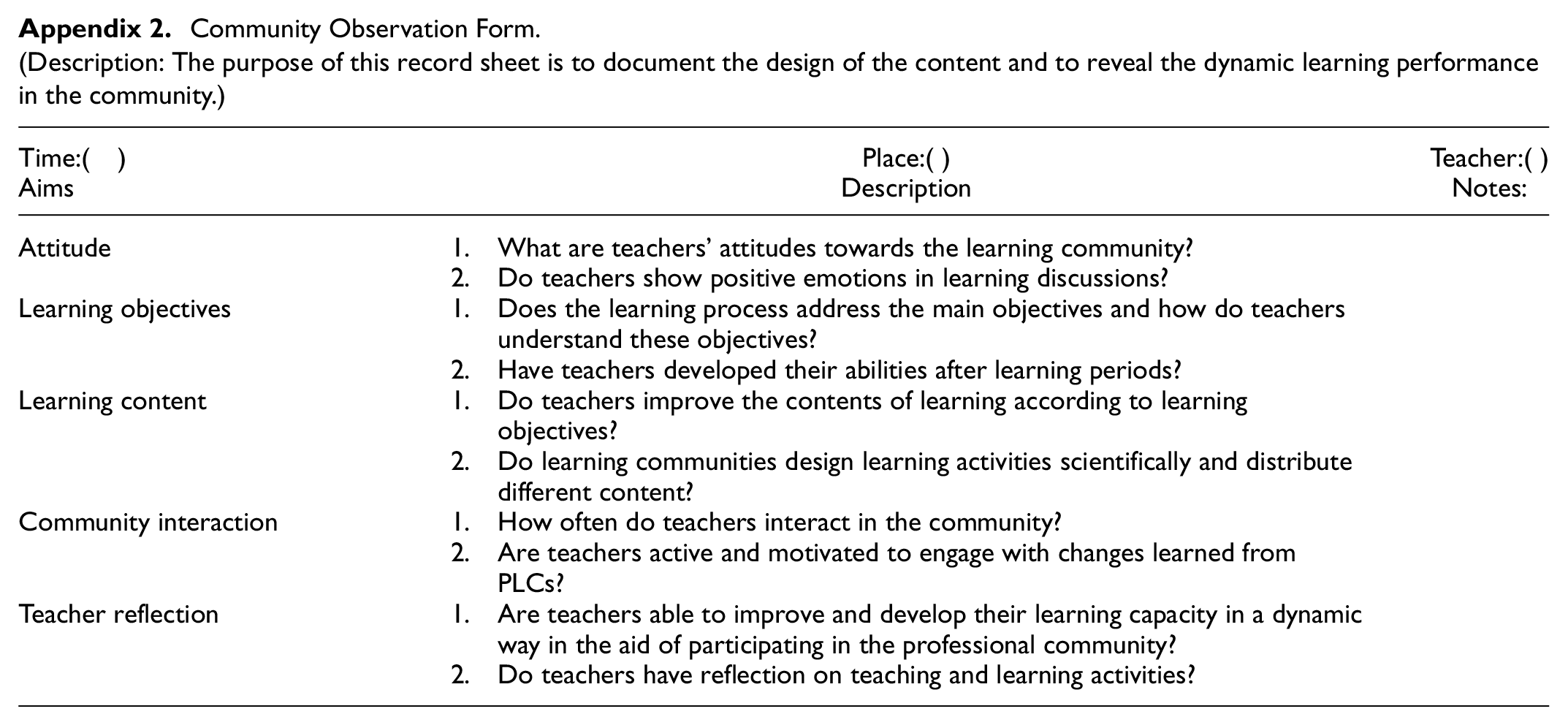
In this study, one of the authors followed teachers to collect their learning community performance data with consent, which lasted 2 hr per week and 12 weeks per semester. With the guidance of the community observation form (see Appendix 2), the analytical data of teacher attitudes, learning objectives and content, community interaction, and reflection were collected. Further, all the collected data were detailed and what had been recorded in the community was verified with the interview data. In addition, as supplementary sources of research data, reflective diary and discussion minutes in PLCs were collected at the end of the study. In this regard, some inquiries about how teachers enacted their agency in learning communities from the perspective of teachers’ actions and how this process facilitates teacher improvement were announced.
Data Analysis
The thematic analysis (TA) approach was conducted to output the research result (Xu & Zammit, 2020) by identifying, analyzing, and unscrambling the patterns of interpretation. More basically, the process of data analysis identified what the main themes disclose in learning activities and how those sub-themes justify the analysis of the research results. With regard to thematic analysis, we followed the standard procedure which entailed identifying initial themes through text segmentation and (both software and manual) coding, initial coding and reviewing, and finalizing analytical themes and sub-themes concerning teacher learning in PLCs.
Built on the proposed thematic analysis guidelines and ecological design, four major themes were identified, professional development in affected agency, professional development in internal agency, professional development in constrained agency, and professional development in sustaining engagement with PLCs, under the superior theme “educational development for English language teacher.” These themes were justified by tracing back teachers’ prior experiences, observations reflective diaries, discussion minutes, and their commitment to PLCs in agentic actions and choices.
Findings
This section reported teachers’ professional agency enacted by the 10 English language teachers and the influential factors in the community of professional learning. Previous research has shown that PLCs might guide “improvements in teachers’ professional knowledge and practices” (Dogan et al., 2015). In this regard, the analysis of influencing factors in PLCs is essential for teachers to rethink their pedagogical knowledge and improve their learning practices (RQ 1), since PLCs provide teachers with more spaces for self-learning and professional development (Carmi et al., 2022). In addition, given that successful communities require long-term and systematic inquiry (Brodie, 2021), limited resources for sustained learning may challenge teachers’ commitment and induce rejection. The sustained engagement with PLCs (RQ 2) needs to be examined in line with teachers’ professional agency which steers their professional trajectories, “as teachers take agentic choices and action to simultaneously construct and experience the community” (Prenger et al., 2019).
Teacher Agency and Influencing Factors in PLCs: Affected Agency
Affirmatively, 10 of 10 participants agreed that their decision-making was affected by various resources, physically or mentally, from different courses of teaching life, and none of them conceived the engagement with learning activities as “unalterable or determined.” The analysis of the research data showed that both individual and contextual influential factors affected teachers’ agentic construction and reconstruction of their commitment to the learning community. The former (individual variables) referred to teachers past professional knowledge (iterational dimension), teacher trust (social structure of practical-evaluative dimension), and teacher identity (projective dimension), while the latter (Contextual variables) consisted of school culture, separately researching and pedagogical resources and leadership support (culture and material of practical-evaluative dimension, Biesta & Tedder, 2007; Emirbayer & Mische, 1998; Priestley et al., 2012, 2015).
Individual Teacher Factors: Internal and “Bottom-Up” Agency
Teachers’ experiences reported in the interview, reflective diary, and discussion minutes demonstrated the first distinctive characteristic of individual agents, that is, professional knowledge. As an iterational factor in enacting professional agency, teachers with less experience in teaching and learning in the community may have more passion to participate in professional learning activities in the mutual community. For instance, Mao used the word “eagerly” to describe how he engaged in his research project with colleagues. Evidence from the reflective diary also details his positive psychology considering his lack of previous experience.
Most universities in Shanghai have high levels of recruitment…. if one does not meet the requirements of the target school, then he will lose his job…. so I, probably will face more challenges, giving new teachers will have lots of skills to prepare…. Hence, I am very eager to succeed in the first period of assessment and eager to learn and participate in any learning community. (Mao, 4 years)
The other individual factor concerning how teachers exercise their professional agency in PLCs is teacher trust. Being a mediating factor, teacher trust could enable or constrain the flourishing of professional learning through the enactment of professional agency in decision-making on whether to participate in or reject professional learning communities (Yin et al., 2019). University educators might not conduct group discussions or reports in the community as often as middle school teachers, but teacher trust still functions significantly as a facilitator in professional learning. When inquired why they chose to spend time engaging in the professional learning community, 8 of 10 teachers reported positively that they could have opportunities to learn and cultivate different realms while interacting with other community members. Teng observed that “optimistically speaking, we are a group of agentic actors with similar goals and often perform learning activities with collective beliefs, which can count on the availability of other colleagues’ competence and performance.” In addition, this positive trust also facilitated their sense of willingness to exercise their agency to impose influence on other negative agents with distrust and reinforce their beliefs on community engagement.
To start with, it would make me feel nervous to cooperate with unfamiliar colleagues…. in this stage, I would not dare to voice my opinions, even though I know it is a constructive one. As my confidence and ability in teaching and research start to advance, I embark on a positive change and occupy myself with professional learning from collective practices. In this stage, I feel a sense of belonging because I can rely on and turn to my colleagues for help when I hit career dilemmas. (Zhu, 13 years) I think this progress may be attributed to our learning group’s positive atmosphere. When I heard so many suggestions on either teaching pedagogy or researching…. their life stories certainly motivated me to trust and engage with their contribution. (Zhu, 13 years)
In addition to teachers’ previous learning experience and trust in the learning community, teachers’ identity is another component involving the exercise of professional agency, which provides or challenges teachers with opportunities to share their learning practices in PLCs and in turn, their commitment to teacher identity shapes their enactment of agency (Tao & Gao, 2017; Tran & Taylor-Leech, 2022; Vähäsantanen, 2015). Almost all participants reported that how they “place and identify” themselves in different stages (novice, mid-career, and veteran stages) shaped their engagement with community activities, and Liu felt that this commitment may affect and even alter the whole decision-making while interacting with colleagues or students in the classroom. In her stance, the identity, reconstructive and negotiated, generated “the chain reaction” both in her classroom teaching practices and learning activities in the community. For instance, Teng, a new teacher in the foreign languages college, recognized himself as a newcomer and pointed himself as the only language teacher. This identification resulted in the opportunity of learning community as an “additional burden,” as he commented that his main task in the classroom was to guide students to know “what.” To understand deeper, Li, having 30 years’ experience in language teaching, detailed in her reflections: “The development from an outsider teacher to a researcher, and to a contributor, witness the willingness and passion on the engagement with learning, teaching and researching. University teachers are not mere language teachers to teach knowledge bases, but more significantly, this career is in sore need of ‘identifying,’ teachers as contributors on language teaching and learning and offering students scaffolding to explore why and how.” Analyzing the reasons behind this requirement for novice teachers, Li depicted his career path in line with identity commitment: The Chinese minister of education has implemented the policy of “New liberal arts construction,” calling upon university teachers to promote the construction of cross-discipline and integration. So, it is a pastime for teachers to focus on teaching content knowledge, and we need to follow the trends. (Li, 30 years) I suppose the most important factor is individual identity. I remember one saying, the greatest enemy is not others, but ourselves. If we teachers do not feel the responsibility to grow as teacher-and-researcher contributors, it makes no meaning for others to push us……we need to have clear, principal, and long-term objectives as agentic contributors that may guide our current decisive actions. In addition, it might be a good chance for novice teachers, especially those in preservice teachers, to participate in learning groups or communities, to learn from excellent professors……to cultivate how they succeed, what they did to develop themselves, and why they become contributors. (Li, 30 years)
To summarize, participants’ professional knowledge, teacher trust, and the process of diagnosing, negotiating, and constructing teachers’ identity and their commitment may facilitate or constrain the enactment of agency in response to engagement with learning activities. These factors intertwined and functioned as challenges or opportunities, which affected teachers’ willingness or indifference to engage in, abstain, or withdraw from the professional learning community.
Contextual Factors: Constrained and “Top-Down” Agency
Observing teachers’ responses and inclinations toward the sustainability of PLCs, that is, positive participation or directive rejection, we concluded that 10 participants had reported limited agency at the pedagogical or research level under the influence of institutional power. In Zhu’s reflective diary, she expressed: “Even if the teaching practice and assessment in the preservice training fostered the knowledge of teaching pedagogy, I had limited chances to cooperate with other professors in this field (DaLao) after I took charge of college courses.” This restrained opportunity may also reflect in their engagement of learning communities. Sun, possessing 4 years of teaching and project experience, accounted for why he sometimes became reluctant to participate in community activities and felt time-limited and challenged to balance teaching, research projects, and school assessment. He voiced in the interview that “adequate resources for teaching and researching, physical environment or implicit support, could accelerate his professional development by means of preparing teachers for spare time to exploit regular reflections which could help summarize his weakness and inadequateness at the project application or annual appraisal level.” Exploring the reasons behind this limited agency through the lens of contextual conceptualization, the participants’ decision-making was significantly influenced by two school-shaped contextual factors: research and pedagogical resources, and leadership support.
All the participants took a restrained stance toward their exercises of agentic power on the engagement of the community, and their confidence to achieve self-learning and development also had been discouraged in the context of limited resources. Liu attributed her powerlessness and lower agency to unbalanced relationships between teaching and research projects. She shared her teaching story in her previous institution: “Although university teachers have more alternatives and freedom to choose what and how to teach compared with middle school teachers who commonly carry out teaching activities on designed steps within the limited time, this teaching autonomy sacrificed more time and energy for teachers to exercise an excellent course……if pre-service training is insufficient to maintain collegial interaction and collaborative peer impact……especially for novice teachers who may not have internalized the varied strategies and pedagogies….. this dissatisfaction finally resulted in resignation.” On the contrary, the opportunities to engage in a learning group with professors possessing specialist expertise in the realm of foreign curriculum and language teaching encouraged novice teachers (Wang, Teng, Mao, and Sun) to switch over to a new self-directed learning channel and facilitated them to adopt strategical efforts for professional development. Furthermore, Wang explained her interests in the inquiry-based community: Globalization has speeded up English as a lingua Franca…. resulting in the context of interdisciplinary research. For instance, the advance of bibliometric research and meta-analysis has already been brought into the field of foreign linguistics and applied linguistics. For teachers at foreign languages college, it would be challenging to upgrade and learn new technology, especially for English teachers who teach literature. So, institutional support and the opportunities to join a learning community in which other colleagues may share specialist knowledge about information science are certainly necessary. (Wang, 4 years)
Thus, the participants took a limited agency to institutional resources, and Sun concluded that their enactment of agency to involve in the learning community might be influenced by pedagogical resources (i.e., flexible time in teaching and technology-assisted support in the classroom) and research resources (i.e., the opportunities for cross-institutional consultation and sufficient repertoires for inter-disciplinary interaction).
Teachers’ limited agency in shaping their commitment could also be influenced by leadership support. Mao, possessing a 1-year visiting scholar trip, disclosed that school administrators and principals should explore every avenue to reform and develop schools at both academic and instructional levels: “Universities stick to the main principle of combining the support from school and the culture of professional learning to promote teachers’ self-efficacy and wellbeing.” This transition of the traditional top-down approach positioned teachers’ voices as the top prime and prioritized teachers’ sense of commitment to professional learning activities in the manifestation of interaction with colleagues, and pedagogical practices. As she pointed out, pedagogical challenges and limited leadership support provoked her disbelief in collegial interaction and discouraged her previous career trajectory from professional development. Yao, 10 years of teaching English literature, her responses to the significance of support while in career dilemmas echoed: “Sufficient time and monetary investment in teacher’s professional development could manifest teachers’ agentic participation with professional learning activities.” At the preparation and commitment stage of career development, learning opportunities, and funding investment were the two greatest facilitators for me. I was expected to perform my professional identity as a university teacher and financial investment may be a good support for me. In this stance, I would have more motivation and zeal to participate in professional learning activities and projects…. At the retention stage of career development, I managed to seek the support and opportunity to share my professional knowledge and pedagogical expertise by means of presenting lectures…. this may become my strongest interest because I want my academic findings well-known and acknowledged. (Yao, 10 years)
This account disclosed that Yao not only had a clear aspiration for professional development but also highlighted the importance of leadership support for learning opportunities, funding and awards for research projects, and publicity for academic publications.
In short, teachers’ internal factors (i.e., past professional knowledge, teacher trust, and professional identity) and limited factors (i.e., school resources and support) jointly influenced the exercise of professional agency to engage in self-directed learning and development by means of PLCs. The research data revealed that limited agency shaped their willingness and performance in professional learning activities, and their commitment to the learning community functioned as a mediated factor that they seized the opportunities to enhance professional practices in virtue of interaction with professional expertise. In other words, teacher commitment as a relational phenomenon is shaped by the interaction between individual teachers and the social context in which they exercise their agency to promote student achievement, teaching effectiveness, and school improvement (Park, 2005; Zheng et al., 2021)
Teacher Commitment and Sustaining Engagement With PLCs: Committed Agency
While the majority of the participants reported promotion challenges in seeking professional development, their stances on engagement with the learning community indicated a strong exercise of agency that is manifested in varied levels of teacher commitment to satisfy their demands for learning opportunities at the pedagogical and researching level and strengthening professional relationships.
Deconstructing the reasons behind the agentic choices for learning opportunities, teachers concluded that they underwent certain degrees of career anxiety because tertiary institutions demanded high-quality publishment and funding investment at the district or national level. The interview, discussion, and reflection responses pointed out that novice teachers (Wang, Teng, Mao, and Sun) confronted career dilemmas in which they “embarrassingly” altered to other institutions or changed research foci after 3 years of assessment, and three out of four novice teachers, with one exception of teacher who had succeed in enlisting professional cooperation with his doctoral supervisor in running an national project that largely enriched his professional expertise, had changed their learning foci for a research-based way to conceive and launch projects. Compared to novice teachers’ pressure, mid-career and veteran teachers (Li, Yao, Zhu, Cheng, Zhao, and Liu) also reported their research endeavors which closely combined with teacher commitment, as they showed high career aspirations for scientific learning and teaching performance. In the discussion meeting, Cheng talked about young teachers should behave in “involution (NeiJuan in Chinese, a strong motivation to compete in an aggressive way to succeed)” and this anti-“goblin mode (TangPing in Chinese, a type of behavior which is unapologetically lazy and self-indulgent, having no passion to engage in activities)” not suggests teachers blindly consume their energies to meet social norms and expectations, instead teachers shall form researching habits……frame research questions from daily interaction with colleagues or students and apply reflective thinking on pedagogical innovation and self-development. He recalled his experience in participating in other community colleagues’ research projects and demonstrated a strong sense of exercising agency to support teacher commitment.
It was a good opportunity for me, a rookie, to understand and implement scientific research. While I would spare time to google how to write and apply national projects through attending a series of analytical lectures, there still exist gaps between addressers and addressees which lacks deep communication and restrains my engagement. That period of novice time challenged my commitment to the teaching profession, professional institution, colleagues, and students. (Cheng, 9 years) Now, you have published a series of articles in golden journals and two monographs concerning teaching education in your research realm, and also chaired one national research project. How did you break the ice and steer your professional development to research commitment? (Interviewer) To begin with, I have to admit that poor and limited research experience surely jeopardizes the chances of initiating and completing the national or ministerial projects that are necessary for professional promotion. With leadership support and interaction with other colleagues, my research ideas were materialized and contextualized in teaching innovative curricula. My research was focused on peer feedback and student performance, which prioritize student engagement in classroom interaction. So, the opportunity to interact with my “research mate” in the same project teaches me how to collect data from classroom teaching, how to design a research protocol, how to design a feasible model for teaching practices, and how to use feedback to modify classroom teaching……It is lucky for me to engage in this project with opportunities to learn from colleagues. I will also follow this tradition to help novice teachers to pull through. (Cheng, 9 years)
This research-based approach to understanding university teachers’ career trajectories demonstrated teachers’ varied levels of identity in the learning community to adopt strategic efforts to facilitate their professional development. Cheng positioned himself as a learning community beneficiary and committed himself to exercising effort on behalf of the community for colleagues’ professional development, which is manifested in teachers’ strong intention to remain with the community. Liu also showed her identification with the values and goals of the learning community and committed herself to exert effort in response to professional development: “In my opinion, institutional support should make available for facilitating teachers’ learning opportunities……and it is a good chance not only for new teacher, not also for those who have expertise experience to collaborate and communicate, since both receiving and giving part may broadly conceive original ideas for research through professional interaction.” Liu’ s appeal for mutually satisfactory cooperation was further echoed in most teachers’ responses: “Past experience told us to introduce innovative contributions to planning for projects or publishing results concerning research methodology or theoretical foundation. Learning community surely satisfies our professional needs for locating research centers.”
In addition to professional identification of and exerted efforts for the professional learning community, participants’ concern over limited resources also represented their community retention, as manifested in the sense of commitment to stay in the community. Almost all participants declared that the chances of institutional support for professional development activities were rarely provided, and instead the self-learning-guided discussion in the community offered more freedom for members to engage in research-directed learning, in which their agentic choices and commitments performed a mediated role for sustained development. This limited learning opportunity and self-directed professional trajectory encouraged teachers to exercise agency to sustainably engage in professional learning activities in the community, so as to enhance their teaching effectiveness, researching capacity, and learning expertise (Glazer & Hannafin, 2006). Wang and Mao disclosed that empowering their professional relationship in the community and giving them opportunities to share effective learning strategies enhanced their willingness to engage and exercise agency in exerting efforts on behalf of the learning community. As Mao recalled in his diary, he chose to “confidently participate in learning community through a project focus, and his colleagues built some “team-work” trust and collaboration in ways that supported their learning and development.” Bearing in mind that community members were project-bound and support-shared, Mao became more optimistic about his capacity to exert influence on other colleagues and chose to stay in the community.
In short, the participants reported mounting concern about career promotion and publishment that involved pedagogical and research challenges, and their responses also demonstrated a strong committed learning desire for professional development, especially for those novice teachers who were confronted with job retention. In this regard, they took agentic choices and actions (Tao & Gao, 2017) to make their requests granted by means of engaging in community activities for not only fulfilling research tasks but also acquiring learning strategies to improve their professions. In addition, individual participant’s exercised agency to innovatively promote their professional learning and teaching performance could be manifested in their commitments to the values and goals of the community, exercised efforts to perform learning activities, as well as teachers’ learning demands and retention, which may be institutionally identified as the constitutions of PLCs (Mowday et al., 1982; Yahaya & Ebrahim, 2016). Their commitment to PLCs bolstered a strong sense of confidence and willingness to broaden their research and teaching experience, improve institutional conditions, and realize futural aspiration that was sustained by their agentic choices to engage in professional learning (Biesta et al., 2015; Calvert, 2016).
Discussion
Driven by 10 foreign languages college teachers’ narratives, as well as critical reflections and performance in engaging the professional learning community, this study discovered the relatedness of university English teachers’ professional agency and development which was subjected to teacher commitment to PLCs. Participants enacted varied exercises of professional agency in relation to teachers’ commitment subject to individual and context factors, as manifested in community identity, learning demands, exercised efforts, and teacher retention (Mowday et al., 1982; Yahaya & Ebrahim, 2016). In line with existing research findings concerning learning opportunities and constraints on PLCs, this study situated teacher agency in teachers’ developmental trajectory from the ecological perspective (Daly et al., 2020; Priestley et al., 2015; shown in Figure 2).

Enactment of professional agency in relation to teacher commitment and professional development.
All participants in this study made their affirmative resolutions to narrow the research and teaching gap for improving their professional expertise and teaching performance and some teachers like Zhu identified themselves as devoted learners who had submitted a complaint for ample learning opportunities at the institutional level. This corroborative evidence for learning opportunities boosted teachers’ agency to commit to PLCs in which interactive experiences between colleagues arise as vital learning resources that they could utilize to enhance their professional activities. In this regard, teachers’ greater agency was shaped by individual identity and contextual resources, received as opportunities and constraints (Lai et al., 2016). Rich and similar researching experience, teachers’ acknowledgment of the learning community and professional identity as community contributors shaped their agency to engage with learning activities, while limited school resources and external support would constrain their agency to construct a researcher identity and to exercise efforts on behalf of professional learning community demonstrated in the participants’ retrospective responses. In addition to influential factors in the declining exercise of teacher agency, existing literature argued the effectiveness of PLCs and described efforts to construct learning communities to enhance teachers’ learning (Carmi et al., 2022; Cifuentes et al., 2011; Ning et al., 2016) with the exploration of relationships among teacher agency, community engagement (Zhang & Liu, 2019), and school leadership. As such, these suggestions enhanced the understanding of PLCs in teachers’ development and promoted institutional administrators and educational policymakers to provide more opportunities to facilitate teachers’ professional agency and realize teacher retention in communities. While institutional support made a great contribution to enhancing teacher engagement, more attention should be paid to individual teacher’s career expectations, identification, and retention in relation to the exercise of professional agency.
Therefore, combing with the existing literature of this study, we suggested more research work to build cordial relations and structures among learning communities as a means to boost teachers’ professional agency and engagement in PLCs. (1) As a psychological construct, the teacher commitment factor presented how to conceive, develop and orientate teaching and career choices (G. Wang et al., 2021), which is embedded in social and interpersonal contexts. Teacher commitment anchored and steered their professional agency in how they identify the community and position themselves (Lai et al., 2016) and their actions which might contribute to rejective intention in community engagement. Hence, school and institutional support as a vital role in predicting and influencing the teacher community should be available to create more learning and collaborative opportunities to encourage teacher engagement and sustain teacher commitment. In addition, school administrators should realize the importance of decentralization, giving more autonomy to lower organizations at collegial and community levels so as to offer teachers more confidence and power to build self-learning groups through academic discussion and project involvement. (2) At the school and community administrators’ level, more attention is required to teachers’ expectations for professional learning, identity, and their beliefs in collaborative learning opportunities to enhance their exercises of professional agency in teaching and research learning. (3) Teachers’ professional relations, aligning with teachers’ development in the context of collegial personal friendships, leadership, and admiration for colleagues’ professionalism, witnessed the burgeoning development under the needs of the co-construction of the learning community for better conceptualizing the holistic approach to institutional academic contribution. Our findings demonstrated that teachers’ professional agency was enacted in relation to choices on whom to collaborate with, and how to promote the circumstance for collegial relations. Further evidence suggested that harmonious and competitive relations in the learning community sustained their professional learning activities which might navigate their professional trajectories for active involvement and mutual improvement.
Conclusion
Anchored on the ecological approach, this study displayed an empirical example of university language teachers’ experience in PLCs. The current study provided a learning vehicle to understand language teachers’ agentic actions and commitment in the context of professional learning for sustaining development in China. In the ecological stance, the results demonstrated that teacher professional agency might be a meaningful mechanism to crystallize their professional trajectory in PLCs, which is mirrored in their agentic choices to engage in learning practices and teacher commitment to community activities. In addition, the study disclosed that professional development in the context of PLCs depended crucially on teachers’ professional agency to participate with collaborative participation with colleagues and exercise efforts on behalf of the community. This commitment is subject to the interaction between individual teacher’s resources including teacher trust and community identity which is shaped by teachers’ past professional learning and research experience and futural aspiration for contributing to their peers, and school culture, including community resources and leadership support which might challenge their confidence and willingness as active participants in PLCs. Teachers in PLCs who had nerve-racking learning experiences, the free learning conditions with supportive leadership and lofty career aspirations to satisfy the learning community’s wants exercised strong professional agency and developed a new sense of identity in line with the collaborative, positive, and informal relationship in the collegial contexts which built on trust, accountability, and honesty among colleagues. In this regard, material, cultural, and structural considerations in company with prior learning experience and futural career goals (Leijen et al., 2022; Priestley et al., 2015) in PLCs are defined as stimuli in the culture of collaboration, ones well-known to those who witnessed the power of activating teachers’ self-regulated learning and collaborating for school improvement to preserve their commitment identity and promote learners’ professional development.
The findings of this study make several contributions to this realm. Accordingly, this study investigated the relatedness of English language teachers’ professional agency and development in the community-based, self-directed, and research-centered informal context, a setting that has not been sufficiently explored so far. (Brodie, 2021; Philpott & Oates, 2017). In addition, the understanding of professional agency from the lens of ecological theory supported the “iterational, projective and practical-evaluative model” (Biesta et al., 2015; Priestley et al., 2015) as a feasible framework for exploring teachers’ agentic engagement and choices, which has not been studied comprehensively in the realm of PLCs. More significantly, the discussion of the relationship between professional agency and learning further highlighted teachers’ commitment and sustainability in the community shaped by their professional identity and engagement.
Accordingly, the findings of this study also provide practical implications for enhancing English teachers’ professional agency and development in community-based learning from both individual teacher and institutional stances. The dynamics of PLCs in different conditions were embedded in constructive interactions under sustainable school development contexts. School reform policies were adapted to facilitate teachers’ involvement and positive emotional stimuli in learning activities, for instance, their psychological engagement, motivation, and autonomy should be considered in pre-service and in-service teaching training projects. In response to the challenges in constructing and reconstructing teacher agency in the professional community, school development demands teachers’ agentic engagement and decision-making in professional communities to adjust the current school conditions to a more meaningful and cooperative teaching and learning environment in which teachers adopt self-regulated learning strategies to materialize the practices of the professional community from adaptive behavior to active contributor (Pyhältö et al., 2015). In addition, teachers’ confidence to receive and offer exercised support in PLCs seems to be a pivotal concern in school development, hence institutions are suggested to tailor occupational strategies as well as rewarding mechanisms to meet collective and individual requirements for simultaneously facilitating teachers’ motivation, commitment, and confidence in building professional community. Based on teachers’ voices, the findings call for teachers’ commitment to a learning community in which collective and supportive collaboration is emphasized to facilitate teacher learning in teaching practices, manifested in not only teachers’ motivation to participate in the learning community but also their beliefs about exercised efforts of knowledge and skills. Taking up this stance, material constraints in workplaces and preconditions for teachers’ occupational well-being need to be balanced, which suggests that it is of significance to create a sense of collaborative and trusty learning environment for building a supportive and co-regulative community in virtue of teachers’ agentic engagement.
However, the study has some limitations. First, the small sample and retrospective inquiry generated limited perspectives on the development of teachers’ agentic engagement and learning community. Engaging with PLCs for a long time enables teachers to develop a stronger sense of agency, which might improve professional learning and research outcomes. It is advisable to concentrate on longitudinal research on the influence of PLCs to disclose the impacts on school improvement and individual development, as the learning community can be a vital vehicle for teacher learning and occupational identity. Second, the current study explored several variables in PLCs, but it failed to present quantitative relations between professional agency, teacher commitment, and community identity. Future research should enrich the understanding of professional agency and PLCs from this aspect.
Footnotes
Appendices
Community Observation Form.
(Description: The purpose of this record sheet is to document the design of the content and to reveal the dynamic learning performance in the community.)
| Time:( ) | Place:( ) | Teacher:( ) |
|---|---|---|
| Aims | Description | Notes: |
| Attitude | 1. What are teachers’ attitudes towards the learning community? | |
| 2. Do teachers show positive emotions in learning discussions? | ||
| Learning objectives | 1. Does the learning process address the main objectives and how do teachers understand these objectives? | |
| 2. Have teachers developed their abilities after learning periods? | ||
| Learning content | 1. Do teachers improve the contents of learning according to learning objectives? | |
| 2. Do learning communities design learning activities scientifically and distribute different content? | ||
| Community interaction | 1. How often do teachers interact in the community? | |
| 2. Are teachers active and motivated to engage with changes learned from PLCs? | ||
| Teacher reflection | 1. Are teachers able to improve and develop their learning capacity in a dynamic way in the aid of participating in the professional community? | |
| 2. Do teachers have reflection on teaching and learning activities? |
Acknowledgements
We acknowledge the efforts of the editors and each reviewer for their meticulous attention and continuous support. Moreover, we would like to express our sincere appreciation to all the participants who generously contributed their time, insights, and experiences to this study.
Author Contributions
Fan Yuan: Methodology, Investigation, Project administration, Funding acquisition, Software, Writing-Review & Editing; Jia Li: Conceptualization, Validation, Supervision, Writing-Original Draft, Funding acquisition; Yan Mao: Investigation, Resources.
Declaration of Conflicting Interests
The author(s) declared no potential conflicts of interest with respect to the research, authorship, and/or publication of this article.
Funding
The author(s) disclosed receipt of the following financial support for the research, authorship, and/or publication of this article: This work was supported by the research project Shanghai Municipal Higher Education Young Faculty Development Funding Program “Design and Implementation of Information Literacy General Education Course Teaching Infused with Ideological and Political Elements in Academic Language” (ZZ202315027), which was sponsored by Shanghai Municipal Education Commission, and the research project “Exploring student engagement with peer feedback in EFL writing: the mediating effect of writing enjoyment and anxiety” (ECNUFOE2023KY080), which was sponsored by Faculty of Education of East China Normal University.
Informed Consent
All participants participated voluntarily and provided their written informed consent to participate in this study. In addition, all participants in this study were informed of the purpose of the study and how data will be used.

Data Availability Statement
Data sharing not applicable to this article as no datasets were generated or analyzed during the current study.