




Abstract
The study explored employees’ experience and adjustment of working during the COVID-19 pandemic. The study followed a qualitative research approach and used a convenience sampling method. The sample contained 12 employees (women = 6; men = 6; working from home = 6; working from the office = 1; hybrid workers = 5; median age = 36; Mage = 39). Data was collected through semi-structured interviews that occurred virtually on Microsoft teams. Data were analyzed using the Braun and Clarke’s thematic analysis. Six themes were established: The study found that work content increased, employees had to work remotely and use online platforms to communicate and deliver work, received adequate support from the organization, achieved positive work-life balance, and faced personal challenges in grief and emotional distress. In fulfilling the goals and objectives of the study, HR and management can be better placed to recognize the effect of the pandemic on workers and the role they need to play in supporting these workers throughout this time.
Introduction
The novel coronavirus (COVID-19) pandemic, caused by the severe acute respiratory syndrome coronavirus 2 (SARS-CoV-2), has become a global problem. The COVID-19 outbreak disrupted individual lives and upended the world of work (Herbert & Rukundo, 2020). Lockdown measures were introduced as a preventive in various countries to curb the virus’s spread. It resulted in several implications such as retrenchment, lay-offs, adjusting to working remotely for various industries, and impacting how organizations function (Venkatesh, 2020). Governments introduced differing lockdown and quarantine measures worldwide to mitigate the spread of the virus (Guan et al., 2020).
Human resource departments were tasked to adjust to a new way of work aligned with the demands brought by COVID-19, such as social distancing, resulting in many employees working from home (Venkatesh, 2020). Organizations have taken on an employee-first approach by delivering a seamless employee experience (Prajapati & Pandey, 2020), which brought upon changes to work structures to cope with the implications presented (Afshari et al., 2022).
The employee experience of working during the COVID-19 pandemic, according to Aitken-Fox et al. (2020), is mainly reliant on workers’ interactions with others and the physical setting where work is performed and the work itself.
Work changed to accommodate the conditions brought upon by the novel coronavirus. For the first time, workers globally were forced to work from home by the government, and as such, are facing technological challenges they have not prepared for (Carillo et al., 2021; Hayes et al., 2021). This change was from working within the organization’s physical premises to working at home—virtually. Working professionals faced different challenges caused by the pandemic, resulting in employees experiencing various psychological effects, such as high-stress levels, mental breakdowns, and depression (Chen, 2020; Sarfraz et al., 2022). Employees who managed to keep their jobs were faced with no other option but to adjust to working remotely (Carnevale & Hatak, 2020). Remote working refers to when an organization’s employees perform the activities and tasks in any other environment that excludes the employer’s workplace (Möhring et al., 2020).
The study aims to explore employee work experience during the COVID-19 pandemic. The research explores how employees adjusted in terms of work practices set out by the organization. More so, the study contributes toward providing a narrative on the employee experience and their adjustment at a state-owned-enterprise. It comes an opportune time, and provide key insight and act as a point of departure for organizations in South Africa that are on the precipice of return to work.
The following section presents the current landscape for employees concerning work from home, technology, and virtual work practices.
Work From Home
The coronavirus has accelerated the phrase “work from home” (Savić, 2020). Savić (2020) adds that the phrase refers to employees working outside the workplace and is characterized by an individual employed by or is a member of the organization and performs specific tasks outside the workplace. This employee also uses telecommunication to communicate with the employer. According to Waizenegger et al. (2020), work from home impacts the employee’s well-being because of various stress factors they encounter due to the changes brought by COVID-19. Studies have shown that employees require a realistic preview of work from home demands (Manroop & Petrovski, 2022) as it is advocated that a negative impact has resulted in employees experiencing a decline in performance due to increased stress because of poor infrastructure and interaction with other employees in the physical environment, impractical expectations about performance, and the challenge of initiating trust with colleagues (Narayanamurthy & Tortorella, 2021).
Technology and Virtual Work Practices
Wang et al. (2021) define remote working as arrangements that allow employees to work in locations external to the office environment, and the employees have no personal contact with other employees, but employees can only communicate virtually using technology. Wolor et al. (2020), in support of this, indicated that virtual work has become critical in the new world of work as it is currently affected by the COVID-19 virus.
The COVID-19 pandemic has forced employees and employers to find new ways of conducting business using technology (Hodder, 2020) and has required organizations to use new technology in response to the changes brought by COVID-19 (Hodder, 2020). Grant and Russell (2020) emphasize that digital technology enables the communication of information through high speed and makes it widely accessible on devices; as we are currently living in a digital era, there is an increase in the utilization of technology. Hayes et al. (2021) employees experience significant challenges with technology, and collaborating online.
Challenges Faced by Employees
The following section will discuss the challenges faced by employees because of the COVID-19.
Work-Life Integration
Mostafa (2021) describes this concept as an individual’s understanding of the relationship between concepts of work, family, individual self-demands, and time. In times before the pandemic, the margins separating work from non-work roles represented areas where several people would experience tensions in their lives (Allen & Martin, 2017; Kossek, 2016). During the pandemic, societal shifts occurred, resulting in the margin between work and non-work roles being restructured (Rudolph et al., 2021).
The restructured work-home margins motivate considering the concept of work-home integration as a potential facilitator of counteracting forces (Dicu et al., 2022; Schieman et al., 2021). As a result of an increased segmentation, work has to be performed away from home; spatial and temporal boundaries that exist become tested with work and home roles often having conflicting expectations and duties. The likelihood that an increased work-home integration will intensify these counteracting forces, such as children at home and working during the pandemic, increases (Schieman et al., 2021). Another notable effect of the increase in work-home integration is employees’ inability to differentiate between their dual roles, especially regarding the locality and scheduling of work and domestic roles (Schieman et al., 2021).
Organizations’ decision to operate remotely caused the line that separated work from personal life to blur (Mostafa, 2021). An argument is that in the case of employees who work remotely, what results is a process called work-life spillover, where such employees cannot “switch off from their work roles at the end of the workday” (Mostafa, 2021). The pandemic has resulted in home and work life becoming forces that consistently clash with each other, and this has caused employees to work for more hours than what they usually do and perceive their work as becoming more intense (Mostafa, 2021). The blurred line between home and work life has also resulted in the need for employees to be readily available, work late, and do work during their free time (Mostafa, 2021).
Employee Well-Being
During the pandemic, concepts such as energy, strain, time, and cognitive play a part in one’s life and whether that individual has a family not (Como et al., 2021). Tuzovic and Kabadayi (2020) assert that an employee’s well-being entails having a positive emotional and physical health state. An individual whose abilities are realized, who can cope with the everyday stresses of life while contributing to their community, is in a state of well-being (Tuzovic & Kabadayi, 2020).
The COVID-19 pandemic has resulted in a shift in work behaviors, family experiences, and, more importantly, every individual’s well-being (Blahopoulou et al., 2022). COVID-19 health anxiety, abbreviated as CovH anxiety, is defined as feelings of fear and uneasiness about having or contracting COVID-19, which negatively impacts crucial work, home, and personal health outcomes for employees (Trougakos et al., 2020). CovH anxiety causes individuals who experience it to suppress their emotions, which acts as a barrier that prevents them from fulfilling their psychological needs (Trougakos et al., 2020). Trougakos et al. (2020) state that this lack of psychological need fulfilment impedes their ability to work effectively, engage with their family, and experience a heightened sense of well-being. Decreased psychological need fulfilment is critical in influencing the effectiveness of an individual’s work, home experience, and health outcomes.
Research Design
The study adopted generic qualitative research design. The characteristics of qualitative research will enable this study’s research objectives to be met, and it is for this reason, this approach has been selected. This approach enables the researcher to understand the phenomenon under study (Percy et al., 2015). In this case, the phenomenon on how employees experience COVID-19 and its influence on their perceived workplace experience. Qualitative research accepts that meaning will develop from data as collected, allowing for patterns to be identified for theory development (Saunders et al., 2019). This study will seek to determine employees’ experience during COVID-19 and how they adjusted to various changes resulting from the pandemic.
Entrée and Establishing Researcher Roles
Approval was obtained from the university to conduct the research. The co-authors assisted with the data collection, whilst the first author was consulted as the experienced researcher throughout the data collection and analysis process. This ensured that the study’s rigor and data were presented in an accurate form. Gatekeeper permissions were obtained from the organization’s human resources department and access to participants at a most convenient and suitable time.
Population and Sample
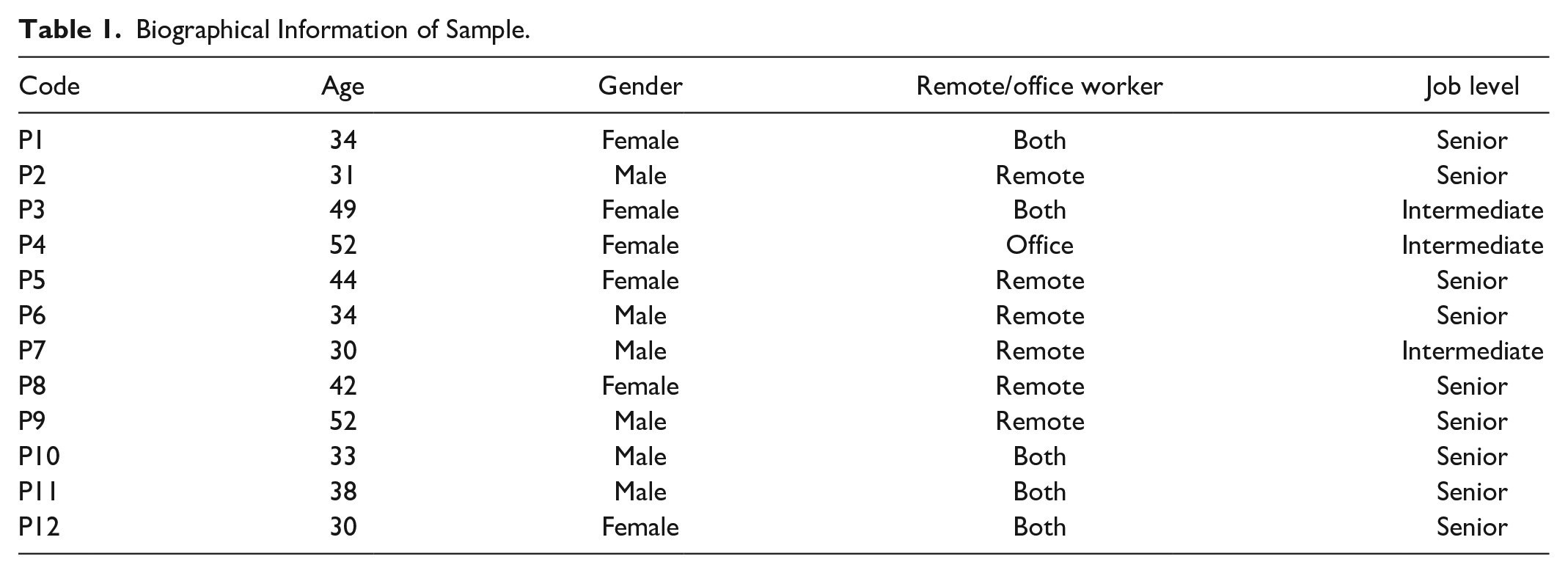
The target population of the study included employees employed at a state-owned enterprise. A convenience sampling approach was used. The inclusion criteria set out were employees to have been employed for a year since the start of COVID-19 and lockdown measures which have been in place in South Africa since 26th March 2020. This ensured that employees had the experience of working during the pandemic. A sample size of 12 participants was interviewed and reached saturation at the 12th interview. Research states that data saturation is reached when no more themes transpire during data collection and the sample size is considered suitable according to the criteria set out by Braun and Clarke (2012). Data were collected from employees within a state-owned enterprise in South Africa. An even distribution between gender was noted (six men and six women); the average age equalled 39 years of age (Table 1).
Biographical Information of Sample.
Data Collection and Instrument
Data were collected through semi-structured interviews. This primary data will be collected by interviewing participants from an organization located in the Gauteng province of South Africa. The interviews were conducted over 3 weeks and were approximately 45 to 60 minutes. An email was circulated by human resources requesting participation. Interviews took place virtually on Microsoft teams at the participant’s convenience. Data gathering techniques included a voice recording and taking down notes.
Data Analysis and Interpretation
The study used Braun and Clarke’s (2012) thematic analysis approach. Identifying themes and patterns in the data gathered is the primary purpose of the thematic analysis. The researcher identifies codes for the qualitative data collected and identifies themes and patterns for further analysis (Saunders et al., 2019). This analysis is systematic and flexible and can be used to make sense of a substantial amount of data, identify key patterns for further exploration, and the researcher can develop and test explanations and theories in thematic patterns (Braun & Clarke, 2012).
Ensuring Quality in Data
Lincoln and Guaba’s (1985) credibility, transferability, dependability, and confirmability will be applied to ensure trustworthiness in the study. To achieve credibility, the researcher ensured that the information gathered from participants was reflected in the findings (Esterberg, 2002). Detailed data descriptions will ensure that the researcher achieves transferability (Bowen, 2005). Dependability implies that consistent results will be obtained if other researchers use the same analysis processes or data collection instruments (Saunders et al., 2019). To ensure that there is confirmability within the findings, the researcher will ensure that the interpretation of the participant’s words is avoided by the researcher and by ensuring that no words are narrated to suit the researcher’s objectives.
Ethical Considerations
The appropriate application of ethical principles is crucial to protect human rights in any research study (Arifin, 2018). Prior to data collection, ethical clearance was granted by the Department of Industrial Psychology and People Management at the University of Johannesburg– ethical clearance number [IPPM-2021-533(H)]. Participation in the study was voluntary, and the participants were educated about any risks and benefits that may result from participation in this study. The participants were briefed about the objective of the research and how the selection of participants took place. Participants were assured that they would be kept anonymous for their protection. It can be noted from the above that the participants were given sufficient knowledge regarding the purpose of the study.
Findings
The primary objective of this study was to explore employees’ experience and adjustment to working during the COVID-19 pandemic. This study further aimed to uncover how employees adjusted to changes in their work and to what extent the organization that employs them played a role in this adjustment. Through thematic analysis, six core themes and corresponding subthemes were identified through the use of thematic analysis. The main themes are as follows: changes in work, technological assistance, remote work strategy, employee remote work experience, organizational support initiatives, and work and personal challenges (Table 2).
Themes and Subthemes.

Themes
Changes in Work
The theme changes in work include four sub-themes: work content, remote work, online platform, and interaction with colleagues.
Work Content
This sub-theme explains the changes that participants experienced in their actual work. About 7 of the 12 participants acknowledged that they experienced changes in their work content. Participants felt that there had been an increase in overall workload and more so online meetings “I have a lot of meetings now on teams, and my workload is increased. . .sometimes I face technical challenges, especially when attending meetings, so I would miss certain things that are being discussed.” (P12, Female,30, Remote worker, Senior). Other particpants acknowledged that the actual workload has increased and are unable to review the progress of their work. “The challenge is I am not able to see progress or the things that I need to report on.”(P2, Male, Remote worker, Senior). “The workload is increased, you know, with the job.” (P7, Male, 30, Office worker, Intermediate).
Remote Work
This sub-theme explains working arrangements that allow employees to work from a remote location outside the organization. Half of the participants cited that they have embarked on remote work. Participants stated that the content of their work has shifted to remote work “My work has changed by means of having to work remotely.” (P10, Male, 33, Remote worker, Senior). “Significantly because most of the time I’m working from home can only engage colleagues to virtual. . .through email.” (P5, Female, 44, Remote worker, Senior).
Online Platform
This sub-theme explains the shift from physically performing tasks to completing tasks on online platforms. Less than half of the respondents noted that their work has moved to an online platform, more specifically relating to having to meet online “Whereas now because everything is literally moved to an online platform you know you review documents online, you comment online. You sit with things online. You basically work in a paperless environment.” (P1, Female,34, Remote worker, Senior). “For information and progress, secondly, there’s been an increase in the number of meetings.” (P2, Male, Remote worker, Senior). “I have a lot of meetings now on teams and my workload has increased as employees are facing technical issues daily and they need to be attended to very quickly to ensure that they also complete their work.” (P10, Male,33, Remote worker, Senior).
Interaction With Colleagues
This sub-theme explains the interpersonal relationships between colleagues. Three of the respondents referred to limited interaction with colleagues. Participants perceived limited interaction with their colleagues from an interpersonal perspective. “The fact that I don’t meet my team, I have to change my management style. I have to make sure that as much as we all work in most of us, we are working from home.” (P8, Female, 38, Remote worker, Senior). Social distancing was also seen as a hindrance to interaction. “Work remotely which has made it impossible to interact with my colleagues face to face due to social distancing.” (P12, Female, 30, Hybrid worker, Senior).
Technological assistance
The theme of technology assistance includes two sub-themes: delivery of work and efficiency.
Delivery of Work
This sub-theme explains how technology has enabled participants in meeting their deliverables. Technological assistance helped in the delivery of work by increasing collaboration “I could say it has helped me with collaborating with my colleagues online, attending meetings and other essentials we need to do virtually. Overall, technology has improved my work because I can multi-task while in a meeting; I can also attend to employees IT related problems so it has helped because being in a meeting which required physical presence didn’t allow me to multi-task and complete tasks on time.” (P10, Male,33, Hybrid, Senior). It also helped in working from any location and driving work engagements “You can work wherever you are at. . .you can work from the mall, at your home wherever and you can still deliver.” (P6, Male,34, Remote worker, Senior). “If we need clarity amongst ourselves as a team so it teams has helped us a lot in terms of engagements and also meeting our deadlines and our deliverables.” (P5, Female, 44, Remote worker, Senior).
Efficiency
This sub-theme relates to how technology has assisted participants to achieve maximum productivity by making their work easier. Participants perceived that the use of technology increased their efficiency and made work much easier “But technologies really helped, I mean using teams and having meetings and stuff was made it so much easier.”(P6, Male, 34, Remote worker, Senior, and also fostered and created collaboration of work leading to efficiencies “We are able to quickly share information both visually and through audio. I think those are the most significant ones for me it has just been a matter of being able to communicate effectively and record effectively.” (P2, Male, 31, Remote worker, Senior). “Technology has really assisted me greatly, as it has made collaboration with employees very easy, so we would have meetings using Microsoft Teams and I can do a lot of things at the same time.”(P12, Female,30, Hybrid worker, Senior).
Remote-Work Strategy
This theme describes the remote-work strategy that the organization implemented. Participants were generally aware of the practices associated with the remote work strategy linked to working from home and measure implemented “So, it was tough in the beginning, but I feel where my organisation will really progressive was how quickly they learned from their mistakes and how quickly they’ve been able to put in systems in place. For example, they’ve put together a covid taskforce.” (P2, Male,31, Remote worker, Senior). “They have also implemented policies for remote working and working from home as well. So, I would say we are actually endorsing it.” (P12, Female,30, Remote worker, Senior). “The way that they have allowed us to work from home, you know without being present at the office, you know. . . they have given us freedom to conduct our work at our own comfort. And we must also be faithful on that and provide what is expected of us.”(P7, Male, 30, Office worker, Intermediate).
Remote Work: Employee Experience
The results attached to employees’ experience regarding remote work merged the following subthemes: positive experiences, work-life balance, and the challenging aspect.
Positive experiences
This subtheme describes the extent to which employees found working an overall positive experience remotely. It was perceived that employees were comfortable with working remotely “So, I can say working remotely for me is not a problem. It’s actually something that I would encourage because it also, especially with the new generation. . .the generation that believes in flexibility, there’s no need to go to an office.” (P5, Female, 44, Remote worker, Senior). They also found that it brought about balance “And a balanced life. And the fact that I’m working from home doesn’t mean that I’m always turned on to work, so I have to focus on family as well” (P8, Female, Unavailable, Remote worker, Senior). “I’m not getting distracted at all, maybe because I don’t have too many kids maybe?” (P11, male, 38, hybrid worker, Senior).
Work-Life Balance
This subtheme describes the extent to which employees were able to strike a balance between their work and personal life. Participants perceived that they were able to spend time with their families, and focus on work which integrated well. “However, it has given me enough time to spend with my family because I used to commute to work and that’s JHB to PTA so you can imagine the hours spent in traffic” (P10, Male,33, Hybrid, Senior). “I can work until late because I at the same time I can spend time with my family” (P8, Female, 38, Remote worker, Senior). “My experience of remote working has been really good as it makes it possible for me to do multiple things at home and also spend time with family. . . remote work or working from home has reduced my commute time and that time I can invest in preparing for work and attend meetings on time at the comfort of my home” (P12, Female,30, Remote worker, Senior).
Challenging
This subtheme describes the extent to which employees found remote working challenging. On the other hand, some participants found working from home challenging as they lose focus “I don’t like working from home. I feel I need to have a balanced life. If I’m at home, I want to do things that I do at home. If I’m at work, I’m focused on work. Remote working doesn’t work for me. I’m not focused at home in a way that I am at work” (P4, Female, 52, Office worker, Intermediate). It also impacted the duration at which they worked leading to increased work hours “My experience of remote working is a bit tricky or challenging should I say because I work longer hours now and I don’t take lunch breaks like before. While you are trying to take a break, you would get a call from a colleague requiring my assistance so I basically have lunch and breakfast on my workstation” (P10, Male,33, Hybrid, Senior). Participants also felt isolated in their work. “You know, with a remote working is that. The only bad thing that I see about it is that people they are confined to one space the whole day” (P7, Male, 30, Office worker, Intermediate).
Support Initiatives
The results attached to support initiatives merged the following subthemes: Organizational support, well-being and safety, HR support, and line manager support as well as operational support.
Organizational Support
This subtheme explains the level of support the employees received from their organization. Employees perceived that the organization provided support through the provision of resources in ensuring they are able to work remotely. “We have dedicated cell phones that they have allocated to us and from last year they have increased the data for us so that we are able to work remotely and also” (P7, Male, 30, Office worker, Intermediate). “Just ensuring that there are resources for everybody. . . I think it’s a big initiative and the turn around there is commendable and just ensuring that people who can still work from home, work from home. They’ve got all the tools and all the necessary things that they need and the support that they get from the organisation. I think there’s a commendable thing that I would say the organisation has done.” (P5, Female, 44, Remote worker, Senior).
Well-Being and Safety
This sub-theme explains the extent that employees felt that their well-being and safety was not compromised. The participants had expressed views of experiencing anxiety and adjusting to what the pandemic has brought upon “I had experienced anxiety which was created by the changes brought by the pandemic. This resulted in higher stress levels as I was trying to adjust to the new norm of working in life and in general. So, I would basically say my well-being was affected in that way” (P12, Female,30, Remote worker, Senior). Support such as counseling services were rendered to employees as part of organizational support “If you maybe you need some counselling. They do also arrange for that” (P11, male, 38, hybrid worker, Senior). “The organisation has provided me with support especially with the COVID-19 task force and ICAS, both these services have been of great help especially after losing my sister due to the virus, so these services have been assisting me quite a lot in terms of dealing with my situation” (P10, Male,33, Hybrid, Senior).
HR Support
This subtheme explains the level of support the employees received from their HR department. Employees also perceived that they received support from human resources. Human resources provided support through training and awareness campaigns concerning remote work. The participants had the following views: “HR is driving policies that are actually talking to what is happening now” (P5, Female, 44, Remote worker, Senior). “I can say most probably they have assisted us with organising training programmes that have helped us to adjust to the new norm and remain as productive as possible” (P10, Male,33, Hybrid, Senior). “Is to improve the tools that improve the training to improve the awareness of line managers of how to manage in a remote working environment which is predominantly output based banks” (P2, Male, Remote worker, Senior).
Line Manager Support
This subtheme explains the support that employees receive from their line managers. The participants held the view that line managers provided support and concern, showing empathy. “I was getting quite stressed about everything and she was very understanding about it and explain to her. She told me no. Just take it one day at a time and she was always there for me. If I needed to talk and stuff. So, she’s been very supportive” (P3, Female, Remote worker, Intermediate). “The manager yes, she is supportive and even when. In our unit, some of us had the covid. At least we did get the calls and that support. So yeah, the support has been there” (P6, Male,34, Remote worker, Senior). “My line manager has been really supportive with regards to ensuring that we submit all the required documents that permits remote work and also checks up on the team to ensure that we are well since we live in difficult times” (P10, Male, 33, Hybrid worker, Senior).
Operational Support
This subtheme explains the level of support they received from the organization. Participants held the view that operational support was available concerning tools and technology to enable work “So, the measures that they have put in place are good measures. You know working from home policy they make sure that people have the technology, but then also there are people that don’t have the technology to work from home.” (P4, Female, Office worker, Intermediate).
Operational support was also offered by the development of a taskforce (COVID) and the identification of risks and controls “The organisation developed a COVID-19 task force which always reminds us ways to stay safe and ways to mitigate risks of contracting the virus.” (P10, Male, 33, Remote worker, Senior). “So immediately what they did is that as I said, ESCO came together, they identify all risks they can identify they came up with all controls that they can put in place. At that time, they identified they came up with.” (P9, Male, Remote worker, Senior).
Work and Personal Challenges
The findings related to work and personal challenges incorporated four sub-themes, namely: emotional distress, work life integration, employee well-being, and adjustment.
Emotional Distress
This sub-theme explains the mental anguish that employees experienced due to various reasons. The impact of COVID-19 led to participants experiencing emotional distress which resulted in anxiety “I’m walking around with anxiety medications because, like literally, at any time I feel, overwhelmed, it physically affects me. So, I think the health challenges and that is specifically from having covid it has kind of impacted both on a work level and on a personal level.” (P12, Female, 30, Hybrid worker, Senior). Other participants had to deal with grief and the effects of having COVID-19 “I think the main challenges that probably came about what was off my long-term side effects from having covid.” (P1, Female, Hybrid worker, Senior). “It’s been the harshest, I lost my mom this year due to COVID.” (P2,Male, Remote worker, Senior).
Work Life Integration
This sub-theme explains how employees blended both work and personal life into one entity. Employees perceived that working remotely enabled them to integrated their work with their personal life, more specifically, spending time with their families “However, this pandemic has allowed me to work remotely which enables me to spend time with my family while working, so I can manage my time and fetch my kid at school and so forth. It has given me a lot of time and now I can do multiple things while working as well.” (P10, Male, Hybrid worker, Senior). That helped us to grow better and to love each other more and appreciate each other more (P8, Female, 38, Remote worker, Senior).
Employee Well-Being
This sub-theme explains the challenges employees encountered with their well-being. The participants responded that overall well-being was impacted, and experienced forms of anxiety and depression “In terms of the experience and just overall mental health and just anxiety around your safety of yourself and your loved ones” (P2, Male, Remote worker, Senior). “I would also work from home, but now because I was confined to one environment, you know, like I guess it brought depression and then also. You know my weight because I’m basically in one room like the whole day and I don’t get to get to go out” (P7, male, 30 Office worker, Intermediate).
Adjustment
This sub-theme explains how employees adjusted to the changes in their work brought by COVID-19. The participants felt they need to adjust to working from home “It was just adjusting to learn to doing work stuff at home and changing the work a home environment into like a work kind of like a work environment” (P3,49, Female, Remote worker, Intermediate). Employees had to also adjust with not having the same work interface as in person work “It just has its own type of therapy. I don’t know if you guys experienced it as well, but just chatting to somebody or talking. So, for example, you had a bad time at home and you come to work. You just forget about it. You can switch off because his people here around you, you start chatting. You start painting. You’re letting go. And then there’s always somebody that listens” (P4, Female, 52, Office worker, Intermediate) whereas, other participants embraced working from home “I think it is positive of working remotely. It works for me. I know that I’m not that young, but I know it also works for the young people mostly, but I can consider myself that working remotely is one thing that I think I needed in my life for” (P5, Female, 44, Remote worker, Senior).
Discussion
Extant literature has placed emphasis on the focus of COVID-19 and its influence of on the management of organizations, and it business operations. Linked to this, is the need to have employees operational and productive. The current study aimed to explore employee work experiences and understand how employees adjusted to the organization’s new work practices during the COVID-19 pandemic. The findings provide essential insights into the employee experience during COVID-19 and the way in which they adjusted based on initiatives and resources provided by their organization. The findings of the study established that employees have experienced vast changes in their work, more so with work from home. The findings revealed that COVID-19 abruptly changed employees’ daily routines (Kniffin et al., 2021).
Our results stress the need to remain cognisant of the employee experience and its implications on work from home, hybrid work practices, and the support provided by the organization and line managers. Further it is essential to place emphasis on the adjustment process of employees during this time and our study sheds light on the implications of this, along with insight into employee well-being.
Changes in work practices meant that employees had to move to online platforms, resulting in challenges such as procrastination, network interruptions, and spatial arrangements (Kniffin et al., 2021). The shift to working from home allowed employees to spend time with family decreased the amount of time spent commuting to work. This has resulted in an increase in employee productivity (Garg & van der Rijst, 2015). Working from home was previously an option of preference for employees; however, with the rise in COVID-19 cases, it became mandatory for employees to complete their professional tasks at home (Kniffin et al., 2021; Venkatesh, 2020. The findings further indicated that employees faced some challenges because of fundamental issues such as not having appropriate working conditions, increased workload, and limited interaction with team members. Sanhokwe et al. (2022) confirmed an increased work load brought upon telework. Employees often cross the boundaries between non-work and work activities, making it challenging to work from home (Fisher et al., 2020; Ramarajan & Reid, 2013). The need to work from home presented the need for efficient technology to ensure operations remain sustainable.
It is known that COVID-19 accelerated the use of technology. This saw organizations migrating to an online working environment (Singe et al., 2020). The study revealed that technology for work delivery was preferred amongst employees because of its flexible nature. The use of technology has been leveraged by employees in various ways, such as employees being able to allocate time for leisure time, videoconferencing colleagues and family members, home workouts, spending more time with family. Technology has left employees with time to engage in activities that have been essential in coping with COVID-19 (Lades et al., 2020). It was established that employees perceived the use of technologies increase their work-life balance and also significantly decreased commuting, leading them to focus more on work.
Organizations were tasked to implement a remote work strategy. According to Gómez et al. (2020), remote work is crucial during and post-pandemic to ensure that employees’ performance and productivity are not affected, thus enabling business continuity. De Smet and Mysore (2020) indicated that many organizations are designing a new model amalgamation of both remote and on-site working, also referred to as the hybrid virtual model. The purpose of this model is to improve productivity for individuals, reduce cost, provide more flexibility, and enhance employee experiences (De Smet & Mysore, 2020). The findings demonstrated that remote working is endorsed, and policies for remote work have been implemented.
With the implementation of a remote work strategy, some employees found working remotely to be a positive experience as it provided flexibility and more time with their families, while others found it challenging in the sense that they worked longer hours, were confined to one space for hours at a time and that their work and home life were intertwined, creating a disruption. Working remotely made employees feel safer at home, which is recognized as a positive therapeutic factor (McBeath et al., 2020). Remote working employees also experience increased positive effects such as higher engagement and improved well-being (Emmett et al., 2020).
The onset of COVID-19 meant that employees required various support from their organization from an operational perspective to support that ensures their well-being. It was found that employees needed technological assistance such as data and laptops, counseling services, and training programs that enabled them to adjust to the new norm. Accommodating work culture is critical to keeping employees resilient in a crisis like COVID-19 (Dewey et al., 2020). They might undergo traumatic experiences. They will need to discover ways to address complexity, adapt to the new reality of work, and want emotional and interpersonal support (Dirani et al., 2020).
The findings reveal that employees faced challenges in their personal and work lives because of the pandemic’s changes. The sub-themes related to work and personal challenges were emotional distress, work-life integration, employee well-being, and adjustment. Emotional distress, also referred to as psychological distress, can be defined as a condition of suffering emotionally characterized by an indication of anxiety and depression (Drapeau et al., 2012). The findings reveal that employees experienced emotional distress due to the changes brought by the pandemic, and it resulted in the employee’s well-being and adjustment being negatively affected. Safety, risk of virus, segregation, financial loss, and job insecurity were the main reason for employees’ stress and decline in performance in organizations (Hamid et al., 2020). Work-life integration was another sub-theme, referring to creating a synergy between work and personal life (Irawanto et al., 2021). The study revealed that employees managed to blend in both work and personal life. Employees managed to spend time with their families while working, which enabled them to do multiple things. Kaushik and Guleria (2020) indicated that time saved in commuting to and from the office is one of the benefits of working from home, which enables time to be managed effectively, thus promoting work balance agility.
Recommendations for Future Research
There are limited studies on employees’ experiences and adjustments during the COVID-19 pandemic within the South African context. It is recommended that future researchers embark on investigating these concepts through several designs, including quantitative studies. It would be interesting to measure employees’ experiences and adjustments over time through panel studies. The study should be deployed using various samples in different industries. The use of quantitative research methods may be appropriate for future studies to substantiate the current research findings, which in the South African context can be used as a point of departure. With the return of work and hybrid workforce being implemented, it would be essential to have a narrative on employees return to work during this next phase of the pandemic.
Limitations
The current study provided a narrative in a state-owned company, and findings needed to be interpreted with caution, as the results could not be generalized to other industries. Limitations were evident in all forms of the research. The research was conducted during the COVID-19 pandemic with government restrictions imposed. The COVID-19 pandemic and government restrictions in South Africa created challenges with the conducting of interviews. Thus, interviews for our study were conducted virtually, which limited human interaction in a physical setting. As a result, technological challenges and human interaction were considered a limitation. Some of the challenges that ensued during data collection included connectivity issues, Some of the employees of the SOE were not available during the research study. Subsequently, it resulted in a limited sample.
Contribution of the Study
This study highlights the need to understand how employees experienced and adjusted to new work practices implemented by organizations during the COVID-19 outbreak. It provides a social science-based narrative for ongoing research on employee experiences and their adjustments to the new world of work and assists HR in understanding how the pandemic affected employees’ well-being and performance. It contributes to both theory and practice in terms of people management and will enable HR to redesign the nature of work to accommodate changes brought by the pandemic. In satisfying the aims and objectives of the study, HR and management will be better positioned to understand the impact of the pandemic on employees and the role they need to play in supporting employees during this time.
Implications for Management
The findings presented herein will assist line managers to know the type of support they need to offer employees working during the pandemic. Firstly, is ensuring that employees have the necessary technology that will allow them to deliver their work on time and remain efficient. These findings can also assist managers design appropriate and effective remote-work strategies and policies. For example, a systematic strategy in these findings is forming a Covid task force that employees find beneficial. Managers can also use these findings to gain insight into approaching employees who find working remotely challenging. Employees reported having to work extended hours and being confined to one space for long periods at a time. These findings will allow managers to be mindful of these issues and therefore able to counteract them. Working remotely also took an emotional toll on employees. Many employees experienced stress, anxiety, and the grief of losing a loved one. This particular organization supported these employees through counseling services. The findings also highlight the need for managers to be empathetic and supportive, as employees often needed this from their managers. Ultimately, these findings will let managers know where improvements must be made at a personal and organizational level. Sun et al. (2020) asserts that emotional experiences necessitate psychological well-being and hence a need to understand the role of emotional experiences for well-being during the COVID-19 pandemic. Based on Figure 1, recommendations are made, which can enhance the employee experience and adjustment during and ahead of the pandemic when implemented.

Model illustrating six themes.
Conclusion
The COVID-19 pandemic has created different experiences for employees, leading to employees finding ways to adjust to the changes brought by the pandemic. The study demonstrated that employees’ experiences and adjustment during the COVID-19 pandemic provided positive and negative outcomes through qualitative research methods. Therefore, this research study contributes to theory and practice for employees’ experiences and adjustment during the COVID-19 pandemic and informs organizations how to provide relevant support to employees. Furthermore, the study suggests that there should be more research around the experiences and adjustments of employees during the COVID-19 pandemic to provide critical support for employees to ensure performance improvements.
Footnotes
Data Availability Statement
The data for the study is not available due to restrictions from the organization.
Declaration of Conflicting Interests
The author(s) declared no potential conflicts of interest with respect to the research, authorship, and/or publication of this article.
Funding
The author(s) received no financial support for the research, authorship, and/or publication of this article.
Ethical Approval
Ethical clearance was granted by the Department of Industrial Psychology and People Management ethics committee at the University of Johannesburg—IPPM-2021-533(H).
