




Abstract
This study modelled the Mediating Role of Work-Life Balance on the Relationship between Work Arrangement and Employee Performance in Higher Education. The explanatory research design was adopted for this study, and a sample of 316 was drawn from a study population of 2,045 administrative staff of a public university in Ghana. A questionnaire was used for the data collection, and data gathered were analyzed with Partial Least Square-Structural Equation Modelling. The study found that flexible work arrangements and wellness programs are individually and significantly related to employee performance and work-life balance. Also, family responsibilities significantly influenced employee performance but had a non-significant relationship with work-life balance. It can also be concluded that work-life balance significantly mediated the relationship between flexible work arrangements and employee performance as well as wellness programs and employee performance. It is recommended that human resource managers in academia should take specific action to enhance work-life balance among their administrative staff to elicit higher performance from them.
Introduction
Employee performance is vital to every organization since it is directly related to organizational performance and economic growth (Mensah et al., 2023; Tenakwah, 2015). Organizational performance ultimately depends on employee performance, which in turn depends on a variety of factors, including work arrangement and workers’ families, hobbies, or other personal demands (Markwei, 2019; Rajesh & Nishant, 2014). How workers manage their personal life and work demands, usually termed as work-life balance, can influence their performance (Hammond et al., 2023; Shaffer et al., 2016). Orogbu et al. (2015) contend that because each person is a vital component of their family and society as a whole, work-life balance is a significant issue that affects both private and public sector organizations. The concept of Work-life Balance has been viewed as crucial to both organizations and people, and it has indeed been found to greatly contribute to the improvement of productivity of employees and organizational performance (Boakye et al., 2021; Murthy & Guthrie, 2012; Segbenya et al., 2018).
Employees’ work and life balance is linked to workers’ physical and mental well-being. For instance, it has been noted that individuals who are satisfied with their work are more likely to feel less stressed out at work and home, which substantially impacts both their health and the organization (Boakye et al., 2021; Koubova & Buchko, 2013). Sustenance of an employee’s basic health in conjunction with work-life balance raises the need for organizations to design and maintain an employee wellness program that is functional, thereby motivating individuals to be content with life at work and beyond (Darko-Asumadu et al., 2018; Dorociak et al., 2017). Chimote and Srivastava (2013) state that work-life balance leads to better employee performance. When employees are unable to adjust their work and family lives appropriately, they find it difficult to manage tasks in the workplace, which reduces overall performance levels (Asumadu, 2019; Boakye et al., 2021; Gamor et al., 2014). One of the several methods organizations and human resource managers can use to enhance work and life balance among workers is work arrangements or job design.
Human resource managers can enhance the work and life balance of their workers with flexible work arrangements such as flextime, compressed workweek and job sharing (Segbenya et al., 2018). Another work arrangement used to ensure work-life balance among workers includes wellness programs such as adequate rest periods and regular employee health /counselling programs (Eshun, 2023). Apart from organizational factors such as work arrangement and wellness programs by organization, it is also important to note that workers’ personal family responsibilities also influence work and life balance among workers (Asumadu, 2019). Thus, a worker who is a parent, spouse, family head, religious member or leader, or community leader, among others, will have higher demands on his/her time used for work and personal life as compared to counterparts without such roles/demands (Boakye et al., 2021). Work and life balance among workers could significantly influence employee performance. Meanwhile, the potential and ability of work and life balance to influence employee performance could depend on flexible work arrangements, wellness programs and family responsibilities.
Existing studies on work and life balance (Chimote & Srivastava, 2013; Fatima & Sahibzada, 2012; Kamau et al., 2013; Malik et al., 2010; Muli, 2014; Uddin et al., 2023) have focused on sectors such as banking, telecommunication, and hotels among others. Other studies on work and life balance in Ghana (Akuoko & Ansong, 2012; Aryeetey et al., 2012; Asiedu-Appiah et al., 2015; Boakye et al., 2021; Darko-Asumadu et al., 2018; Hammond et al., 2023; Markwei, 2019; Mensah et al., 2023; Segbenya et al., 2018) have centered on a work-life balance among female workers, WLB and turnover or retention, commitment, job satisfaction, and social support. The existing studies did not consider the mediating role of work-life balance on the relationship between work arrangement and employee performance, suggesting a conceptual gap. Thus, the need for studies on the mediating role of the WLB on the relationship between work arrangement and employee performance is very important, especially during the post-COVID-19 pandemic. This is because additional work arrangements, including teleworking, among others, were introduced to the existing ones during the COVID-19 pandemic. Despite the COVID-19 pandemic being over, most of these work arrangements are still in place. These new work arrangements with the existing ones could have impacted work and life balance and, subsequently, the performance of employees even during and after the COVID-19 pandemic. Additionally, existing studies used analytical tools other than Partial Least Square Structural Equation Modelling (PLS-SEM) for their analysis, creating an analytical gap. Meanwhile, the PL-SEM is one of the recent powerful analytical tools for testing theories and the causal relationships between constructs with multiple measurement items (Hair et al., 2017). PLS-SEM is a second generation of multivariate analysis techniques that combines various techniques available in the first generation of multivariate analysis (factor analysis, regression, and correlation (Hair et al., 2017). PLS-SEM is preferred over SPSS because of its robustness for testing all variables simultaneously and is more flexible to either large or small sample sizes. This is why this study modelled the mediating role of work-life balance on the relationship between work arrangement and employee performance using the PLS-SEM analytical tool.
Literature Review
This section of the paper focuses on the theoretical review and conceptual review of the relationship between the study’s variables leading to the hypotheses guiding the study and the study’s conceptual framework. This study is guided by the spillover theory. The spillover theory is one of the first theories on the work-family interface to promote a relationship between the work and family domains (Staines, 1980). According to the spillover theory, this connection between work and family can be explained by a mechanism known as “spillover” (Staines, 1980). Bell et al. (2012) claim that people typically experience spillover at work because they are juggling work and personal lives. Positive and negative spillover can be divided into numerous categories, according to Xu (2009). Positive spillover describes how success and happiness can influence the same feelings in both the business and one’s home life. Negative spillover, on the other hand, describes the connection of issues and hopelessness in both work and personal life.
Spillover may have either favorable or unfavorable impacts (Bell et al., 2012). The spillover process, in accordance with Edwards and Rothbard (2000), fosters connections and similarities between work and family life. Unfavorable work-to-family spillover happens when someone simply transfers unfavorable emotions and feelings, including fatigue, from one domain to another. Positive work-to-family spillover happens when these emotions draw connections between these two spheres of existence. The spillover theory is used in this study to explain how work arrangements such as flexible work arrangements, family responsibilities, and wellness programs could relate to work-life balance and employee performance. The theory is further used to explain how work-life balance mediates the relationship between work arrangements and employee performance.
Hypothesis Development and Theoretical Framework
This section is used to review related existing literature on the relationship between the dependent variable and the independent variables of the study. The review starts with a review of flexible work arrangements and employee performance mediated by work-life balance.
Work-Life Balance
Due to the emphasis on people as assets, it has become more crucial for organizations to put in place work- and family-friendly policies. Work-life balance is defined as an individual’s capacity to simultaneously fulfil the needs and obligations of their personal and professional lives to minimize conflict between the two (Gurney, 2010). Building and maintaining supportive and healthy work environments that enable employees to manage work, family, and personal duties is what work-life balance is all about. WLB strengthens employee loyalty and productivity.
The value of work-life balance has increased along with technological development and incorporation into many business organizations, including the commercial and academic research sectors. Numerous academic disciplines, such as sociology, cognitive science, human resource management, organizational behavior science, and other sciences, have subsequently made significant strides (Kluczyk, 2013). Thus, according to Shobha and Kala (2015), the work-life balance concept encourages a more encompassing attitude because it takes into account time, participation, and pleasure.
Flexible Work Arrangement, Work-Life Balance and Employee Performance
Employees with job flexibility can choose when and how much they work. As an alternative to the traditional work schedules, flexible work arrangements give employees the freedom to select when and where they work, as long as they still meet their duties to the company. Employees can alter their start and end times of their work schedules using this strategy as long as they work a specified number of hours, allowing for flexible work scheduling. Working flexible hours and paying more attention to their individual demands can help employees fulfil their family and personal duties. Most people view flexible work arrangements as having different working hours than the traditional employee shift of 8:00 am to 5:00 pm, though this view may vary depending on the firm and industry laws (Towers & Burnes, 2016).
According to Wisely (2017), having a flexible work schedule greatly benefits many people and improves their productivity at work. Flexible office hours will increase productivity, lessen stress, and encourage loyalty to the company while also boosting staff retention, employee engagement, and travel time. The degree of control and flexibility that people have is one of the most crucial variables in reducing work-family conflict, according to Galinsky et al. (2008). Improved mental health, reduced stress, burnout, turnover, and absenteeism, as well as increased retention, loyalty, job satisfaction, innovation, creativity, and productivity, are all advantages of flexible work arrangements for those who use them. Flexible work arrangements could therefore grant more time to workers to be able to attend to other aspects of life such as parental, marital or conjugal, religious and social responsibilities. This means that flexible work arrangement is related to work-life balance and employee performance. It is for this reason that it is hypothesized for this study that:
H0: 1a. Flexible work arrangement significantly relates to employee performance in higher education.
H0: 1b. Flexible work arrangement significantly relate to work-life balance in higher education.
H0: 1c. Work-life balance significantly mediates the relationship between flexible work arrangement and employee performance in higher education.
Wellness Programs, Work-Life Balance and Employee Performance
Taylor and Don (2010) contend that wellness initiatives and programs place more emphasis on preserving excellent and enhancing health of workers. Wellness programs consist of efforts for intellectual and spiritual development, social meetings, and fitness programs. These affect businesses and can significantly affect overall productivity (Naydeck & Pearson, 2009). Physical health and well-being are components of one’s overall well-being. Employee well-being has a direct impact on work performance and productivity, organizational commitment, job happiness, and work-life balance, according to research by Rantanen et al. (2011). Organizations’ wellness programs typically include health promotion, physical activity, advice on life-threatening illnesses, care for persons with impairments, and counselling for stressful situations that affect employees. Apart from wellness programs contributing to employee performance, work-life balance could also have a role to play. That is, employees who participate in wellness programs could have better chances of increasing their work-life balance. Alternatively, workers not participating in wellness programs could also experience higher work-life conflict. Thus, work-life balance could influence both wellness programs and employee performance. Thus this study hypothesized that:
H0: 2a. Wellness programs for workers significantly relate to employee performance in higher education.
H0: 2b. Wellness programs for workers significantly relate to work-life balance in higher Education.
H0: 2c. Work-life balance significantly mediates the relationship between wellness programs and employee performance in higher education.
Family Responsibilities, Work-Life Balance, and Employee Performance
Responsibility to watch out for those who are either formally recognized as family members or not is known as a family responsibility. Married couples in organizations are more likely than single persons to be in charge of their families, claims Olorunfemi (2009). Unmarried women are free to choose how they spend their time and how they move about. For example, married women tend to their husbands and children and rarely stay late at work. Poor management methods that ignore the diverse family demands of the employees lead to decreased motivation and performance (Agha et al., 2017).
The ability to manage work and family life is influenced by factors such as marriage, having children, and caring for elderly relatives at home. Occasionally, those who must take care of youngsters or the elderly may be required to sacrifice their professions by reducing their working hours, which produces stress for them (Lowe, 2005). Again, parenting experiences—a family responsibility—greatly impact how people ultimately balance work and family, with differing effects for men and women (Blair-Loy, 2001). Other than their immediate family, persons may have responsibilities for dependent children, elderly parents, grandchildren, siblings, children of siblings, spouses, and in-laws. So it’s important to take into account the variety of family commitments. This suggests that work-life balance could be contingent on the family responsibilities of the worker. Therefore, as much as family responsibilities could directly influence employee performance, there is the possibility that this effect could influence how individuals in question can balance their family responsibilities and work responsibilities. It is the reason for which this study conjectured that:
H0: 3a. Family responsibilities among workers significantly relate to employee performance in higher education.
H0: 3b. Family responsibilities among workers significantly relate to the work-life balance of workers in higher education.
H0: 3c. Work-life balance significantly mediates the relationship between family responsibilities and employee performance in higher education.
H0: 4. Work-life balance significantly relates to employee performance in higher education.
Based on the aforementioned review and the spillover theory, a theoretical framework was carved to guide this study as presented in Figure 1.

Theoretical framework of the study.
Methodology
The positivist philosophy and quantitative approach guided the study. Specifically, the explanatory research design was used for the study due to the need to explain the relationship between the dependent and independent variables of the study. Yamane’s formula for sample determination was used to sample 316 from a study population of 2,045 administrative workers in a public university in Ghana. The sample comprised senior administrative and principal administrative assistants (SAA and PAA). Data for the study was collected with the assistance of a questionnaire measured on a four-point scale where 1 = strong disagreement, 2 = disagreement, 3 = agree, and 4 = strong agreement. The questionnaire had two sections addressing the demographic characteristics and hypotheses issues guiding the study. The reliability and validity of the instrument were checked, and values obtained for each variable of the study were above the minimum threshold of .70 (Hair et al., 2017), and these results are presented in Table 1.
Reliability and Validity of the Instrument.

Source. Field Survey (2023).
All ethical considerations, including anonymity, confidentiality, respondents’ free consent, and freedom to withdraw even if the participant had begun the process, among others, were ensured. Partial Least Square-Structural Equation Modelling (PLS-SEM) was used for the analysis of the hypotheses that guided the study. The reason for using PLS-SEM was that PLS-SEM is a second generation of multivariate analysis techniques which combines various techniques available in the first generation of multivariate analysis (factor analysis, regression and correlation (Hair et al., 2017). PLS-SEM is preferred over SPSS because of its robustness for testing all variables simultaneously, and is more flexible to either large or small sample sizes. Ethical clearance was granted by the
Normality and Outlier Checks
Before the main data was migrated from SPSS to PLS-SEM using the comma-separated version-CSV format, there was analysis to determine the normality and outliers as recommended by Sarstedt et al. (2022). The threshold for determining the normality of the data was when mode, mean, and median were approximately the same and when the skewness values were between ∓2 and Kurtosis values between ∓3.3, according to Collier (2020). The results in Table 2 clearly show that all the values obtained for the mean, median and mode for the four independent variables (flexible work arrangement, wellness programs, family responsibility, and work-life balance) and the dependent variable (Employee Performance) were around 3.00. This means that these variables of the study attained normality status and could be used for inferential analysis. The results in Table 3 further show that skewness values ranged between −0.271 and 0.734, which were all below the −2 and +2 maximum thresholds according to the recommendation by Collier (2020). Additionally, the Kurtosis values obtained were below the maximum threshold of 3.30. These results of Kurtosis and Skewness also further confirmed that the data and its associated variables of the study pass the normality test and could be used for inferential analysis.
Normality Check.

Source. Field Data (2023).
Demographic Characteristics of Respondents.

Source. Field Data (2023).
Checks for outliers were also further performed using the PLOT in SPSS, and the results are presented in Appendix A. There are five PLOTs representing the five variables of the study. The interpretation was based on the suggestion of Collier (2020) that values lying under or top of the PLOT suggest outliers, but exceptional outliers to reject are denoted with an asterisk (*) against the values lying under or above. Thus, PLOTS for the first three variables of the study—flexible work arrangement, family responsibility and Employee Performance shown in Appendix A were without any values under or above the PLOTs, suggesting that there were no outliers with these three variables of the study. The PLOTs for the last two variables of the study (wellness programs, and work-life balance) shown in Appendix A also revealed that there were values below and above the PLOTs. However, these values were not denoted with an asterisk (*), suggesting that these cases or values lying above and beneath the PLOTs were not significant outliers.
Analysis and Findings
The presentation of the findings of this study is done in three main parts. These are the demographic characteristics of respondents, preliminary analysis and main results for the hypotheses guiding the study. The results for the demographic characteristics of respondents are therefore presented in Table 3. The results revealed that most of the respondents were male respondents (54.1%), were aged 31 to 40 years (43.7%), were single (70.3%) and had worked in the university for about 2 to 5 years (40.2%). Additionally, the findings in Table 3 revealed that most of the respondents had undergraduate (First degree) qualifications (69.9%), were at the middle-level management positions (80.0%), assigned to the College of Distance Education (50.0%), and were Principal Administrative Assistants (42.4%).
Preliminary Analysis of the PLS-SEM Model Used
The first preliminary analysis conducted was to check the loadings of the items used to measure each study variable; the results are presented in Figure 2. The results revealed all the items retained in Figure 2 loaded with a minimum value of .60 and above for all variables. The values obtained were acceptable based on the recommendation of Segbenya et al. (2022) and Hair et al. (2017) of a minimum threshold of .60.

CFA algorithm of the variables of the study.
The second preliminary analysis conducted was to check the reliability and validity of the model, and the results to this effect is presented in Table 4. The main indices used were Cronbach’s Alpha, rho_A, Composite Reliability and Average Variance Extracted (AVE). The acceptable threshold for accepting the results for the first three indices was a minimum value of .70 suggested by Segbenya et al. (2022). The acceptable threshold used for the last indicator was .50, according to the suggestion by Hair et al. (2017). The results as presented in Table 4 revealed that values obtained were between .801 and .886 for the Cronbach’s alpha, .828 and .951 for rho_A and .879 and .922 for Composite Reliability. All these values reported for the first indices were above the minimum threshold of .70, suggesting that the five variables of the study attained the reliability status required of the PLS-SEM model. The results also revealed that values obtained for Average Variance Extracted (AVE) were between .647 and .798, above the minimum threshold of .50. Thus the PLS-SEM model used met the reliability and validity requirement and further higher analysis study.
Construct Reliability and Validity.

Source. Field Data (2023).
Discriminant Validity
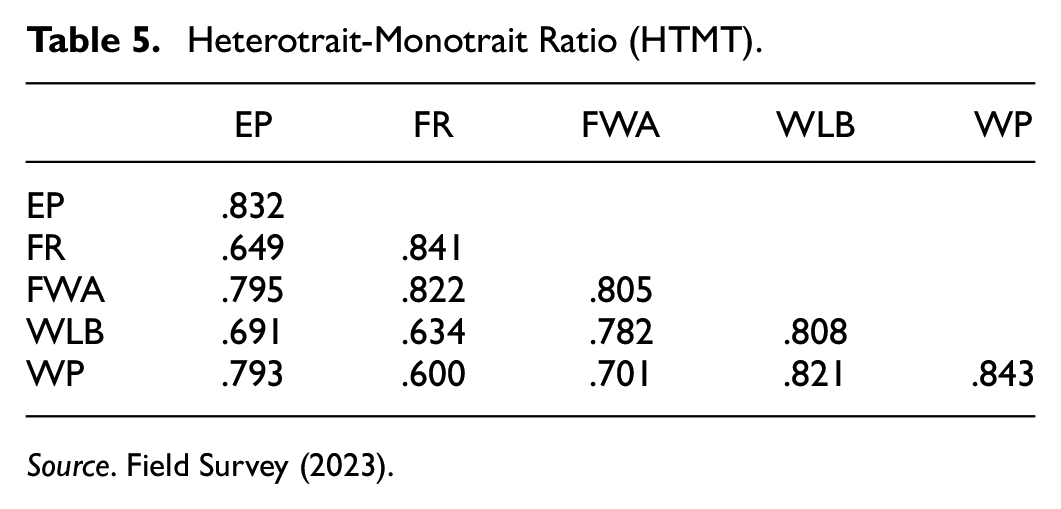
The third preliminary analysis conducted was discriminant analysis with Heterotrait-Monotrait Ratio (HTMT), and the results are presented in Table 5. The results were judged based on the suggestion of Segbenya and Anokye (2022) and Segbenya et al. (2023) of a maximum threshold of .850. The results as presented in Table 5, revealed that values obtained were between .649 and .842, which were below the maximum threshold of .850, suggesting that the model used attained the discriminant validity required.
Heterotrait-Monotrait Ratio (HTMT).
Source. Field Survey (2023).
Multicollinearity Checks
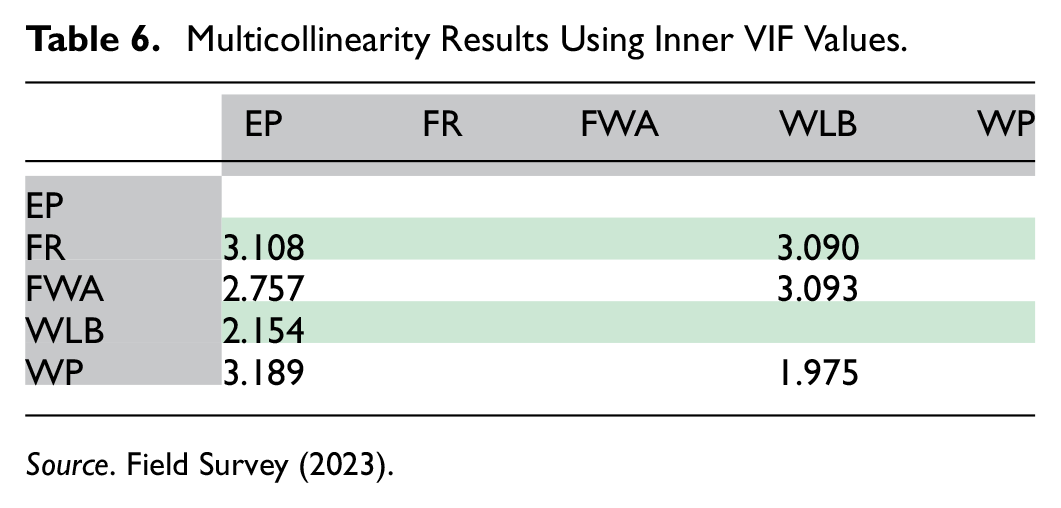
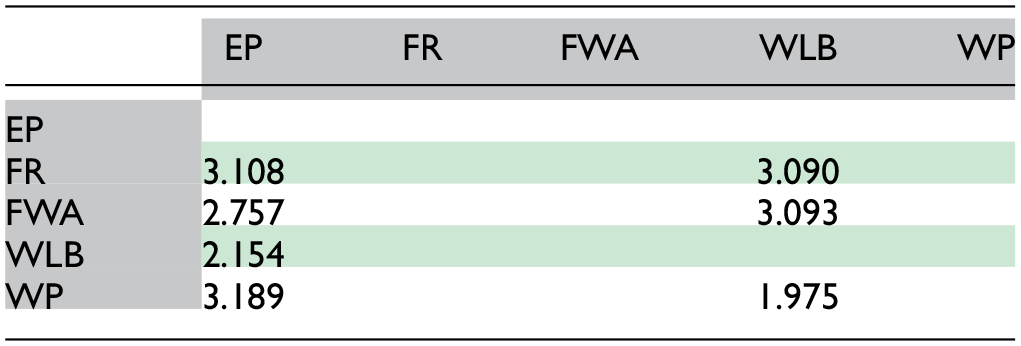
The next preliminary analysis conducted was the check for the presence of multicollinearity, which could influence the path relationship to be established. A threshold of 3.30, suggested by Segbenya and Minadzi (2022) was used to judge the results presented in Table 6. The results revealed that vales obtained were all below the maximum threshold, suggesting that the model used for this study was without the presence of multicollinearity and, therefore could be used to run inferential analysis.
Multicollinearity Results Using Inner VIF Values.
Source. Field Survey (2023).
Path Analysis for Testing Hypotheses of the Study
The results for path relationship between the variables of the study are presented in Table 7, which are used to test the 10 hypotheses guiding the study. These hypotheses are divided into hypotheses establishing a direct relationships (first seven) and those establishing an indirect relationships (last three). The results revealed that the first hypothesis that flexible work arrangement (FWA) significantly relates to employee performance was accepted at (β = .619, t = 18.148, p = .000). The second hypothesis of the study was also validated because there was a significant relationship between flexible work arrangement (FWA) and work-life balance (WLB) at (β = .456, t = 9.189, p = .000). The next hypothesis (2a) was also accepted since there was a significant relationship between wellness program (WP) and employee performance (EP) at (β = .594, t = 7.725, p = .000); and Hypothesis 2b which established that wellness programs (WP) significantly influence work-life balance (WLB) at (β = .541, t = 20.499, p = .000). It is also important to report that hypothesis 3a was also validated because there was a significant relationship between family responsibilities (FR) and employee performance (EP) at (β = −.065, t = 2.075, p = .038). Meanwhile, family responsibilities (FR) were found to have a non-significant relationship with work-life balance (WLB) at (β = −.065, t = 1.484, p = .139). The last direct hypothesis (hypothesis 4) was also accepted because it established that work-life balance was significantly related to employee performance at (β = −.240, t = 3.593, p = .000).
Path Coefficients.

Source. Field Data (2023).
p < .05 and **p < .000 supported.
Results for the hypotheses establishing an indirect relationship (hypotheses 1c, 2c and 3c) are also presented in Table 7. The analysis was based on the suggestion of using the explicit procedures focus on the significance test of the indirect effect according to Rasoolimanesh et al. (2021). Two out of the three hypotheses were sustained, whiles one was refuted because of significant and non-significant relationships established. That is, hypothesis 1c was accepted because it established that work-life balance (WLB) significantly mediated the relationship between flexible work arrangements (FWA) and employee performance (EP) at (β = .109, t = 3.866, p = .000). Work-life balance (WLB) again attained a significant mediation effect on the relationship between wellness programs (WP) and employee performance (EP) at (β = .130, t = 3.372, p = .001) for hypothesis 2c. The last hypothesis (Hypothesis 3c) presented in Table 7 was not validated because work-life balance (WLB) attained a non-significant mediation effect on the relationship between family responsibilities (FR) and employee performance (EP) at (β = .016, t = 1.482, p = .139).
It is also important to note that the total variance explained by the model was denoted by R2 supported by adjusted R2, as presented in Table 7. The results revealed that the PLS-SEM explained approximately 76% variance in employee performance (EP) and approximately 76% in the variance of work-life balance (WLB) among workers. The significance of the variables of the study in terms of the effect sizes was also examined, and the results show that there were minor and moderate effects, as indicated by the F2 statistic. Effect values of .02, .15, and .35 above imply minor, medium, and large significant effects, according to Cohen (1988), referenced in Segbenya et al. (2022). According to the findings, this study’s impact size (F2) varied from .019 to .210. The confidence intervals recorded in terms of lower and upper border values at a 95% confidence level, which indicate no false effect of the prediction of the significance achieved for study variable variables, served as additional confirmation of this.
Pictorial Presentation of the Path Relationship
It is important to note that the results on path relation presented in Table 7 if further supported by the results reported in Figure 3. The arrows and their directions as well as values shown in the pictorial view of the path relationship in Figure 3, further support that some hypotheses attained significant relationship and others did not. The results, notably called the bootstrapping of path relationship, were based on Hair et al. (2017) suggestion of using 5000 sample.

Bootstrapping confirmation of the path analysis.
Discussion of the Results
Further explanation is provided for the findings of the first hypothesis that established that there was a significant relationship between flexible work arrangements and employee performance. The results mean that any percentage increase in flexible work arrangements for workers will result in the same percent increase in employee performance at public universities. That is, flexible work arrangements such as flexitime and compressed work weeks, among others, are able to elicit higher performance from workers. Meanwhile, the results also suggest that rigid work arrangements could lead to poor employee performance in public universities. This study’s findings agree with earlier findings by Wisely (2017) that flexible work arrangement significantly influences employee performance.
The study’s second hypothesis that established a significant relationship between flexible work arrangements and work-life balance also needs to be explained further. The results are suggestive that flexible work arrangements such as flexitime and compressed work weeks, among others, do not only lead to higher employee performance. Rather it also leads to work-life balance. This means that workers are able to get extra time to attend to their personal, family, social, and religious demands if employers of such workers introduce flexible work arrangements for them. The results further mean that any percentage increase in flexible work arrangements will lead to the same percentage increase in work-life balance among workers in public universities in developing economies. Thus, the findings of Towers and Burnes (2016) that flexible work arrangement influences work-life balance is corroborated by the findings of this study.
The findings that wellness programs are significantly related to employee performance for the third hypothesis means that if employers introduce wellness programs for their workers in universities, the performance of their workers will be enhanced. Thus, workers who benefit from appropriate rest, spiritual development, social meetings, and fitness programs stand a chance to increase their performance on the job. This means that employees are able to rejuvenate their systems and reinvigorate their energy for work after wellness programs, hence the higher performance. The findings of this study further support the findings of Rantanen et al. (2011 that wellness programs significantly influence higher performance among workers.
Moreso, the potency of wellness programs was not limited to employee performance but also extended to work-life balance as found for the fourth hypothesis guiding the study. The results mean that as workers get more balanced between their mental and spiritual states, they are more focused on attending to both the demands of work and the family. The results mean that wellness programs enable workers to be active and accomplish their jobs on time to give them more time for other social, religious, and personal demands in their lives. Thus, the findings of Taylor and Don (2010) that wellness programs influence work-life balance is supported by this study.
Family responsibilities were found to have a significant negative relationship with employee performance. The results mean that an increase in family responsibilities on the part of workers has an inverse relationship with employee performance. That is, more demands on the workers’ time due to family responsibilities could lead to poor performance of a worker. Meanwhile, such workers could maintain their performance if support systems from Nannies and family members are in place to ensure that family demands do not negatively impact their job performance. The results also mean that fewer family responsibilities could lead to higher employee performance. Therefore, the findings agree with the findings of Agha et al. (2017) that family responsibility influences employee performance.
The findings that family responsibilities do not lead to work-life balance among administrative staff in academia established for hypothesis six can be explained further. The results mean that family responsibilities was not adequate to predict work-life balance among the respondents. This could be explained by the marital responsibilities of the respondents. It is obvious from the demographic characteristic Table that the majority of the respondents were single and could have fewer family responsibilities. Thus, to this respondent, family responsibilities were not enough to predict or relate to their work-life balance. That means that the category of respondents for this study suggests that their family responsibilities were not adequate to affect their work-life balance. The results, however, disagree with the findings of Agha et al. (2017) who found that family responsibilities are significantly related to work-life balance. The disparities could be coming from the category of respondents and contextual differences.
Additionally, further explanation is also provided for the seven hypotheses that concluded that work-life balance significantly influenced employee performance among administrative staff in academia. The results mean that this category of workers can enhance their job performance when there is a balance between their work and family demands. This suggests that workers could be focused on their jobs and produce more for their organizations if they are able to address other family-related challenges adequately. Thus, performance could suffer if there is work-life conflict among these workers due to either the work or family taking more time than required. The findings of this study agree with the findings of Agha et al. (2017) that work-life balance significantly influenced employee performance.
The last three hypotheses, which border on the contribution of this study to existing knowledge, are focused on the indirect effect or the mediating power of work-life balance on the remaining variables of the study. The findings show that work-life balance significantly mediates the relationship between flexible work arrangements and employee performance. This means that flexible work arrangement and employee performance among administrative staff in academia share their prediction with work-life balance. That is, employer stands to enhance the relationship between flexible work arrangement and employee performance if they pay more attention to work-life balance. This finding of the study could not be found in existing literature from Ghana on the subject (Boakye et al., 2021; Darko-Asumadu et al., 2018; Hammond et al., 2023; Markwei, 2019; Mensah et al., 2023; Segbenya et al., 2018) hence served ad contribution to existing knowledge on work-life balance.
The next indirect hypothesis that established that work-life balance significantly mediated the relationship between wellness programs and employee performance among administrative staff in academia has several implications. The finding means that the relationship between wellness programs and employee performance is further enhanced when there is a work-life balance between academic and administrative staff. Thus, the relationship between wellness programs and employee performance can be enhanced if more attention is given to work-life balance among workers. Alternatively, the relationship can suffer if work-life balance is taken for granted. The results, therefore, served as an additional contribution to existing knowledge on work-life balance since existing literature from Ghana (Boakye et al., 2021; Darko-Asumadu et al., 2018; Hammond et al., 2023; Markwei, 2019; Mensah et al., 2023; Segbenya et al., 2018) on the concept failed to address this.
The last hypothesis of the study revealed that work-life balance had a non-significant mediation effect on the relationship between family responsibilities and employee performance can also be explained further. The result means that the relationship between family responsibilities and employee performance does not depend on work-life balance for this category of respondents considered in this study. This has been explained that the majority of the respondents were single and did not think their family responsibilities were adequate to affect their work-life balance. Thus, in an attempt to improve the relationship between family responsibilities and employee performance among administrative staff whose marital status is single, work-life balance alone will not be an adequate variable or factor to consider. This finding remains another contribution to existing knowledge on work-life balance from the developing economy, especially during the post-COVID-19 pandemic.
Theoretical and Practical Implications
The findings of this study have several theoretical and practical implications. The theoretical implications for the spillover theory used is that when responsibilities or demands of work extend (spillover) beyond the demands of life, family or personal life, workers suffer work-life conflict, and that affects their performance. Thus the findings of this study in relation to flexible work arrangements, wellness programs and family responsibilities validated the position of the theory. Meanwhile, the findings of this study contributed to the spillover theory by suggesting that the marital status of respondents could make a difference as to whether family responsibilities can influence work-life balance.
The practical implications of the findings of this study are also important to consider. That is, employer and human resource managers in academia could enhance administrative staff performance is attention is paid to work-life balance of these workers. Work-life balance has been found to have predictive power with flexible work arrangements, wellness programs and employee performance. Thus, human resource managers in academia could enhance work-life balance among their workers by incorporating flexitime, compressed workweek and job sharing.
Conclusion and Recommendation
This paper modelled the mediating role of work-life balance on the relationship between work arrangements and employee performance in higher education. It can be concluded that flexible work arrangements and wellness programs are individually and significantly related to employee performance and work-life balance. Also, family responsibilities significantly influenced employee performance but had a non-significant relationship with work-life balance. It can also be concluded that work-life balance significantly mediated the relationship between flexible work arrangements and employee performance and wellness programs and employee performance. Based on the conclusions, it is recommended that human resource managers in academia should take specific action to enhance work-life balance among their staff to elicit higher performance from them.
It is therefore recommended that human resource managers consider redesigning jobs to incorporate flexitime, which allows staff to decide their own starting and ending times without reducing the total number of hours they are to work. This will enable workers to have more time to attend to their social, academic, personal, and family responsibilities. Furthermore, human resource managers in academia can also enhance work-life balance among their workers by instituting a compressed workweek where instead of five (5) working days within the working week, they are compressed into four (4) days or less. This means that workers could work more than 8 hr a day so that they could get 1 day off in addition to their rest periods to be able to adequately attend to their families and other demands.
Human resource managers are further recommended to consider redesigning jobs to incorporate job sharing where two (2) administrative staff could do the same job—one worker works from the morning till afternoon and the other continues till evening. This will not only help the institutions make some savings in terms of salaries while benefiting from the expertise of the employees but also contribute to the work-life balance of workers in academia.
Limitations and Suggestions for Further Studies
This study has been limited to administrative staff in academia and adopted the quantitative approach. Further studies could consider a comparative study between the various categories of employees in academia. The overall contribution of all four variables of the study (flexible work arrangement, wellness programs, family responsibilities and work-life balance) to employee performance in this study was 76%. Further studies could also consider introducing other variables that could help explain the remaining 24% variance in employee performance and work-life balance in academia. Qualitative or mixed-method approaches on the same topic could also be explored by further studies.
Footnotes
Appendix A
Acknowledgements
We acknowledge the support received from all respondents who took time off their busy schedules to respond to this study.
Declaration of Conflicting Interests
The author(s) declared no potential conflicts of interest with respect to the research, authorship, and/or publication of this article.
Funding
The author(s) received no financial support for the research, authorship, and/or publication of this article.
Ethical Approval
Removed for review purposes.
Informed Consent
All respondents of this study participated in this study with the clear consent to participate in this study.

Data Availability Statement
The datasets for this study are available from the corresponding author on reasonable request.