




Abstract
There exists an uncertain effect of digital technology-related demands on employees’ innovative behaviors because of stress paradox caused by these demands. Drawing upon the theory of stress paradox, this research investigates how career resilience mediates this relationship, with perceived organizational support moderating the effect of digital technology-related demands on career resilience. Based on a survey of 241 respondents, the results of hierarchical regression and path analyses reveal that digital technology-related demands positively influence employees’ innovative behavior through the mediating role of career resilience. Furthermore, perceived organizational support strengthens the positive impact of digital technology-related demands on career resilience, thereby enhancing the indirect effect of these demands on innovative behavior. This study extends existing literature on the drivers of employee innovation and highlights the critical role of career resilience and organizational support for firms navigating digital transformation.
Keywords
Introduction
The rapid adoption of digital technologies, such as artificial intelligence, big data, block-chain and cloud computing, is fundamentally transforming employees’ work environments, processes, job requirements, cognitive patterns, and behavioral responses (L. Jiang et al., 2022; Roos & Shroff, 2017; Wang et al., 2008, 2024). This digital transformation simultaneously presents significant challenges for workforce adaptation, as employees should develop competencies to effectively master and implement these emerging technologies (hereafter termed “digital technology-related demands”) within their professional practice (Kotter & Cohen, 2012). However, the impact of digital technology-related demands on employees’ innovative behavior appears paradoxical due to stress paradox caused by these demands. On one hand, employees’ limited digital-related competencies may create feelings of insecurity, increased workload, and role ambiguity when facing these demands, ultimately generating substantial work-related stress (Atanasoff & Venable, 2017). The stress stemming from the gap between employees’ existing skills and new digital competency requirements (Marsh et al., 2021) may diminish job engagement (Tu et al., 2023) and thus innovative behaviors. Conversely, the stress caused by digital technology-related demands has simultaneously created opportunities for innovation, as stress may be eustress (Selye, 1975) and thus enhances motivation. Given digital technology-related demands can function as both challenge stressors and empowering motivators for employees (Tu et al., 2023), they create an uncertain effect on employees’ innovative behavior. However, the mechanisms for reconciling these paradoxical effects remain underexplored in the literature.
Interestingly, this uncertainty not only points to unexplored mediating factors in the relationship between digital technology and innovation, but also suggests that such demands may foster innovation when employees effectively channel stress into motivation. However, the adaptive capacity about stress-to-motivation transformation is grounded in the principle of career resilience, a core component of psychological capital that enables individuals to recover from conflicts, adversity, and setbacks (Ferrari et al., 2017). As career resilience helps employees navigate workplace uncertainty, reduce burnout, and enhance digital competence, it may serve as a critical buffer against technology-related stress while fostering positive work behaviors and performance outcomes (Li & Wang, 2012; Rossier et al., 2017). This raises two questions:
(1) Does career resilience mediate the relationship between digital technology-related demands and employees’ innovative behavior?
(2) What contextual factors might strengthen or weaken this mediating effect?
Thus, drawing upon the theory of stress paradox, this study examines whether and how career resilience mediates the relationship between digital technology-related demands and innovative behaviors, as well as how perceived organizational support acts as a boundary condition that moderates the influence of such demands on career resilience. Specifically, digital technology-related demands may bring about stress paradox, but career resilience—defined as an individual’s positive psychological capacity to recover and adapt in adverse situations (London, 1983)—enables employees to navigate workplace challenges. Thus, career resilience can serve as a potential mechanism linking digital technology demands to innovative behavior. Beyond individual psychological resources, perceived organizational support, reflecting employees’ subjective assessment of whether the organization values their contributions and cares about their well-being (Eisenberger et al., 2020; Yu & Frenkel, 2013), plays a crucial role in shaping their attitudes and behaviors. As perceived organizational support can enhance employees’ adaptability (Prayag et al., 2024), it may amplify career resilience. Thus, integrating perceived organizational support with career resilience provides deeper theoretical insights into how digital technology-related demands influence employees’ innovative behaviors. However, empirical research examining these dynamics remains scarce.
This study makes several key contributions to the literature. First, it advances research on the relationship between digital technology-related demands and innovative behaviors. While prior studies have predominantly examined either the “dark side” (e.g., technostress) or “enabling effects” (e.g., enhanced motivation) of these demands (Ragu-Nathan et al., 2008; Singh et al., 2022, Tarafdar et al., 2019), our work extends this discourse by investigating the mediating role of career resilience in translating digital demands into innovative behaviors. Additionally, we identify perceived organizational support as a critical moderator that shapes the impact of digital demands on career resilience. Second, drawing upon the theory of stress paradox, this study enriches the career resilience literature by demonstrating its role in converting stress into motivation—a mechanism previously underexplored in contexts where employees face the adverse effects of digital technology adoption. Although existing research highlights the stressors associated with digital demands (e.g., role ambiguity, skill gaps), the psychological processes through which these stressors may be harnessed as motivational drivers remain unclear. We address this gap by theorizing career resilience—a core psychological resource for navigating workplace adversity (London, 1983)—as a catalyst for stress-to-motivation transformation. Third, we offer novel insights into perceived organizational support by examining its moderating influence on the digital demands–resilience linkage. Despite perceived organizational support being well-established as a contextual factor affecting employee attitudes and behaviors (Eisenberger et al., 1986), its role in moderating the effects of digital demands on career resilience has been overlooked. Our findings thus unveil boundary conditions for resilience activation in digital work environments.
Theoretical Background and Hypotheses Development
Stress Paradox
Stress exerts paradoxical effects (Selye,1975). On one hand, when it is chronic or uncontrollable, it becomes distress which leads to burnout and impaired functioning. On the other hand, when it is acute and optimally managed, it becomes eustress which fuels growth and enhances motivation. Recent work on stress suggests that the appraisal of stressors - rather than their mere presence - determines behavioral outcomes (Crum et al., 2013; McGonigal, 2015). Moreover, individuals respond to stress through two main processes, namely, cognitive appraisal and coping (F. Jiang & Wang, 2022; Lazarus & Folkman, 1987). When stress is perceived as an opportunity for growth, individuals appraise it as beneficial or a challenge, thus adopting active coping strategies, such as adaptation, acceptance, and seeking support, to strive for the potential benefits of stress. Conversely, when stress is perceived as a threat, individuals adopt passive, avoidant, and defensive coping strategies, such as reduced action and escaping from difficulties (Lepine et al., 2005). However, the stress paradox highlights that stress, long regarded as harmful to well-being and performance, can—under specific conditions—produce adaptive or even enhancing effects.
In the following parts, we treat digital technology-related demands as a stress, which may bring about a paradox effect on employees’ innovative behaviors. However, we argue that the stress of digital technology-related demands may increase career resilience, which in turn promotes employees’ innovative behaviors, as resilient employees may reframe digital technology-related demands as eustress to realize digital skill-building. Moreover, perceived organizational support as a boundary condition can promote the mediation by transforming stress into motivation.
Hypotheses Development
Digital Technology-Related Demands and Employees’ Innovative Behaviors
Digital technology-related demands refer to the need for employees to adopt new ways of thinking, methods, and skills to address digital technology challenges in the workplace, and particularly to leverage digital technologies to engage in innovation, process improvement, and service enhancement (Hötte et al., 2023; Wang et al., 2020). However, these demands bring about stress for employees. Given stress has a paradoxical effect on behaviors, digital technology-related demands have a contradictory effect on innovative behaviors. Specifically, on one hand, digital technology-related demands may have a positive effect on innovative behaviors through motivation enhancement. Reasonable technological demands encourage employees to proactively acquire digital-related resources, fostering a learning goal orientation, which in turn promotes the exploration of new work methods and positively influences innovative behavior. This stimulates innovative thinking and provides a motivation for enhancing employees’ innovation capabilities (Lusch & Nambisan, 2015; Wisskirchen et al., 2017; Wu & Kane, 2021), leading to more innovative behaviors (Vom Brocke et al., 2018).
On the other hand, the stress caused by these demands stems from the pressure on employees to master and apply digital technologies, which can lead to burnout and reduced performance (Bockermann & Ilmakunnas, 2009; Demerouti et al., 2001). Employees are expected to continuously learn emerging technologies, but this process is time-consuming and requires significant effort (Noe, 2017; Tziner & Vardi, 1987). Many struggle to keep up, often experiencing failure in the process. This pressure can trigger negative emotions—such as anxiety, frustration, and discomfort—ultimately diminishing work motivation and stifling innovation (Judge et al., 2001; Lazarus & Folkman, 1984). Despite these challenges, we argue that the benefits may outweigh the drawbacks. In most workplaces that adopt new technologies, employees typically receive organizational support, training, and encouragement to develop the necessary skills. This structured learning environment helps alleviate fear while increasing employees’ motivation to learn and implement these technologies effectively.Thus, we propose:
Mediating Role of Career Resilience
Career resilience is a type of individuals’ capacity to adapt to environmental changes and swiftly respond to and recover from setbacks in the workplace (Carson & Bedeian, 1994; London, 1983; London & Noe, 1997). It reflects proactive psychological adaptability, explaining various employee behaviors in response to challenges in the workplace (Ahmad et al., 2019).
As previously discussed, digital technology-related demands function as a form of “challenge stressor,” generating more eustress than distress. We therefore propose that these demands can enhance career resilience in three facets. Firstly, digital technology-related demands strengthen an organization’s capacity to adapt to digital transformation, thereby boosting employees’ career resilience. When employees successfully master and apply emerging technologies, they contribute to organizational growth and environmental adaptation. This, in turn, enhances their career resilience by facilitating access to organizational resources and support. Secondly, such demands can motivate employees to learn new technologies. Given that digitalization is a critical driver of business development (Duan et al., 2019), employees’ intrinsic career resilience mechanisms are more likely to be activated in response to these demands. Once employees recognize their responsibility to adopt and utilize digital tools—such as operating new software or analyzing data—they must confront and overcome challenges during the learning process. This necessity fosters skill acquisition and practical application of digital technologies, further reinforcing their career resilience. Thirdly, digital technology-related demands encourage employees to proactively develop digital competencies and innovate their work methods, framing these demands as opportunities for professional growth rather than threats. Consequently, by enhancing employees’ ability to leverage developmental opportunities, these demands ultimately increase their career resilience. Based on the above, we suppose:
Career resilience encompasses qualities such as positive emotions, initiative, adaptability to changing environments or stressors, and a strong drive for learning and exploration (Caverley, 2005); Y. Liu, Dong, & Wei, 2020; Y. X. Liu, Chen, et al., 2020; Han et al., 2021; Jo & Hong, 2022). As these traits of career resilience help transform stress into eustress, it is closely linked to innovative behaviors—such as experimenting with new methods and implementing groundbreaking ideas—for two reasons. First, the positive emotional state inherent in career resilience can reduce distress caused by digital technology-related demands, encouraging employees to pursue change and thus innovative behaviors (Potgieter et al., 2020). Second, employees with greater career resilience exhibit proactive problem-solving tendencies (Klerk, 2005), particularly in complex or adverse work conditions. This proactivity enables them to take stress as motivation, which contributes to innovative behaviors. Since innovation is with high costs and risks, strong motivation to change is critical for driving innovative behaviors (Guo et al., 2023). Moreover, highly resilient employees sustain intrinsic motivation throughout the innovation process (Deci & Ryan, 2000). They view challenges as opportunities for growth (competence development), thereby exploring new approaches and generating creative solutions (Gagné & Deci, 2005; Potgieter et al., 2020). Thus, this study proposes the following hypothesis:
Moreover, given digital technology-related demands stimulate employees’ career resilience (H2) and career resilience increases employees’ innovative behaviors (H3), this study further proposes:
Moderating Effect of Perceived Organizational Support
Perceived organizational support refers to employees’ beliefs regarding the extent to which their organization values their contributions and cares about their well-being (Kurtessis et al., 2017). It fulfills employees’ socioemotional needs and signals the organization’s commitment to rewarding and supporting them when necessary (Levinson,1965). Perceived organizational support is manifested through organizational practices such as performance feedback, job rotations, training opportunities, rewards, and involvement in decision-making (Peng et al., 2023; Rhoades & Eisenberger, 2002).
Given that perceived organizational support can either motivate employees to adapt to digitalization or mitigate the distress caused by it, we propose that perceived organizational support moderates the positive relationship between digital technology-related demands and employees’ career resilience. This moderation operates through three key mechanisms. First, perceived organizational support reflects employees’ perceptions of organizational endorsement, shaping their motivation and initiative to align with organizational goals. Employees who perceive stronger support are more likely to convert digitalization-induced stress into motivation, thereby enhancing their career resilience. Second, while adapting to new technological demands can be stressful, perceived organizational support buffers the adverse effects of these challenges (Canboy et al., 2023; Yang & Zhou, 2022), enabling employees to navigate and implement digital technologies more effectively. Third, employees with high levels of perceived organizational support exhibit greater confidence and motivation when confronting technological challenges, further strengthening their career resilience (Bonaiuto et al., 2022; Eisenberger & Stinglhamber, 2011). In summary, high levels of perceived organizational support enhance employees’ motivation to adopt digital technologies while reducing stress from digital demands (Al-Taie & Khattak, 2024; Hollands et al., 2024), ultimately fostering greater career resilience (Prayag et al., 2024). Thus, we propose:
Moreover, given perceived organizational support increases the positive effect of digital technology-related demands on employees’ career resilience (H5) and career resilience mediates the effect of digital technology-related demands on employees’ innovative behaviors (H4), this study further proposes:
Following this analysis and the perspective of career resilience, this study developed a moderated mediation model depicting the effects of firms’ digital technology-related demands on employees’ innovative behaviors via career resilience, with perceived organizational support moderating the effect of digital technology-related demands on career resilience (see Figure 1).

The conceptual model of this study.
Variable Measurement and Sample Selection
Variable Measurement
Our main variables include Digital Technology-Related Demands, Career Resilience, Perceived Organizational Support and Employees’ Innovative Behavior. These variables were measured using a 5-point Likert scale (1 = strongly disagree, 5 = strongly agree). The items used for measuring above variables are shown in Table 1.
Variable Measurement Scales.

Source. Author’s own creation.
Digital Technology-Related Demands
Digital Technology-Related Demands refer to the requirements for employees to adopt new digital technologies, methods, and skills to address workplace challenges during organizational digital transformation (Burgess & Connell, 2020; Wang et al., 2020). These demands encompass the need to master technologies such as big data and artificial intelligence, identify digital opportunities, and cope with enterprise digital transformation processes. They are both a kind of pressure and an enabling driving force (Fu et al., 2021; Hötte et al., 2023). In this study, the scale of digital technology-related demands was adapted from Zhou and Wu (2010) and Khin and Ho (2020), including five items that mainly measure employees’ perception of the demands on mastering and implementing digital technologies within their professional practice.
Career Resilience
Career Resilience is defined as an individual’s positive psychological capacity to adapt to environmental changes, recover from workplace setbacks, and maintain effective work performance (Ahmad et al., 2019; Carson & Bedeian, 1994; London, 1983). It includes qualities such as adapting to change, proactive learning, and maintaining positive expectations amid difficulties. In this study, the Career Resilience Scale was adapted from London (1993), consisting of five items.
Perceived Organizational Support
Perceived organizational support refers to the level of support that employees perceive from the organization (Kurtessis et al., 2017), representing the extent to which the organization is willing to pay for employees’ work and provide support when employees need help (Levinson, 1965). In this study, the Perceived Organizational Support Scale was adapted from Eisenberger et al. (1986), Eisenberger et al. (2001), and Lamm et al. (2015), containing six items.
Employees’ Innovative Behavior
Employees’ innovative behavior refers to the process through which employees identify problems, generate novel ideas, and seek support to implement these ideas (Stashevsky et al., 2006). In this study, the Employees’ Innovative Behavior Scale was adapted from Scott and Bruce (1994) and Janssen (2000), consisting of five items.
Control Variables
Employees’ innovative behaviors can be influenced by demographic variables (Madsen et al., 2005). Referring to Kim et al.(2015) and Shao et al.(2019), we took gender, age, education level, management level, work nature, and years of service with the current employer as control variables.
Samples
This study employs non-probability convenience sampling to collect data, recruiting participants via WJX.cn (Wenjuanxing), a leading Chinese online survey platform (Martínez-López et al., 2022; Lin et al., 2024). Given our focus on employees experiencing digital transformation, this method allowed efficient access to a targeted yet geographically dispersed workforce. To ensure respondents had relevant digital transformation experience, we implemented a two-question screening process: (1) “Is your company currently using digital technologies (e.g., AI, big data, cloud computing, blockchain, or IoT) in your workplace?”, and (2) “Has your company launched initiatives to encourage employees to adopt or master these technologies?” Only respondents answering “Yes” to both questions proceeded to the full questionnaire, ensuring participants were actively engaged in digital transformation.
The questionnaire distribution took place between April and August 2023, yielding a total of 270 responses. After excluding invalid submissions, 241 valid questionnaires remained, resulting in an effective response rate of 89.26%. The sample primarily comprises enterprises located in China’s Yangtze River Delta region, including cities such as Ningbo, Hangzhou, Jinhua, Jiaxing, Wenzhou, Suzhou, and Changzhou. Detailed participant characteristics are presented in Table 2.
Participant Characteristics.

Source. Author’s own creation.
Data Analysis and Results
Common Method Bias
Since the questionnaires were completed by respondents individually, there may be a problem of common method bias (CMB) (Podsakoff et al., 2003). We assessed the CMB by two methods. First, Harman’s single-factor test was employed. The results of exploratory factor analysis (EFA) suggested the variance of the first factor was 33.913% of the variance among variables, which was less than 40% (Podsakoff & Organ, 1986; Xiong et al., 2012). This indicates that there is no serious CMB. Second, confirmatory factor analysis (CFA) was conducted (in Table 3). Given the fitting indices of the single-factor model (Model 4 in Table 3) (χ2/df = 8.106, CFI = 0.506, TLI = 0.451, RMSEA = 0.172, SRMR = 0.167) all failed to meet the criteria, we further drew no serious CMB in this study.
Common Method Bias Analysis.

Source: Author’s own creation.
Reliability and Validity Tests
This study evaluated the fit of the measurement model containing four constructs and the discriminant validity of the constructs through confirmatory factor analysis (CFA). The results showed that the model fits well (χ2 = 239.867, df = 185, IFI = 0.98, CFI = 0.98, RMSEA = 0.035, SRMR = 0.045), as detailed in Model 1 of Table 3. Moreover, we built three competitive models by combining the correlated factors into one. By employing χ2 tests to assess the differences between the 4-factor model (Model 1) and each competitive model (Models 2–4) in Table 3, we drew that the 4-factor model showed a better fit than other models.
This study assessed scale reliability using Cronbach’s α coefficient and Corrected Item-Total Correlation (CITC) values, while confirmatory factor analysis (CFA) was employed to evaluate construct validity. The results are presented in Table 4. All constructs demonstrated high reliability, with Cronbach’s α values ranging from 0.871 to 0.907, and all CITC values exceeded 0.5, meeting the threshold for good internal consistency (Bernstein & Nunnally, 1994). Furthermore, the CFA results confirmed strong construct validity. Factor loadings ranged from 0.664 to 0.852, with most above the recommended 0.7 threshold. Composite reliability (CR) for each construct exceeded 0.7, and average variance extracted (AVE) values were all above 0.5, supporting convergent validity (Fornell & Larcker, 1981; Bagozzi & Yi, 1988).The overall model fit indices also indicated a well-fitting measurement model.
Reliability and Validity Analysis of Scales.

Source. Author’s own creation.
Correlation Analysis
This study used Pearson correlation analysis to examine the correlations between variables, and the results are shown in Table 5. The results indicate that digital technology-related demands are significantly correlated with career resilience (r = .489, p < .01) and employees ’ innovative behaviors (r = .511, p < .01); career resilience is also significantly correlated with employees’ innovative behaviors (r = .553, p < .01). These findings suggest that there are correlations among the key variables involved in this study, and the research model has certain scientific rationality.
Mean, Standard Deviation, and Correlation Coefficient of Variables.

, ** indicate statistical significance at the 5% and 1% levels, respectively.
Source: Author’s own creation.
Main Effect Test
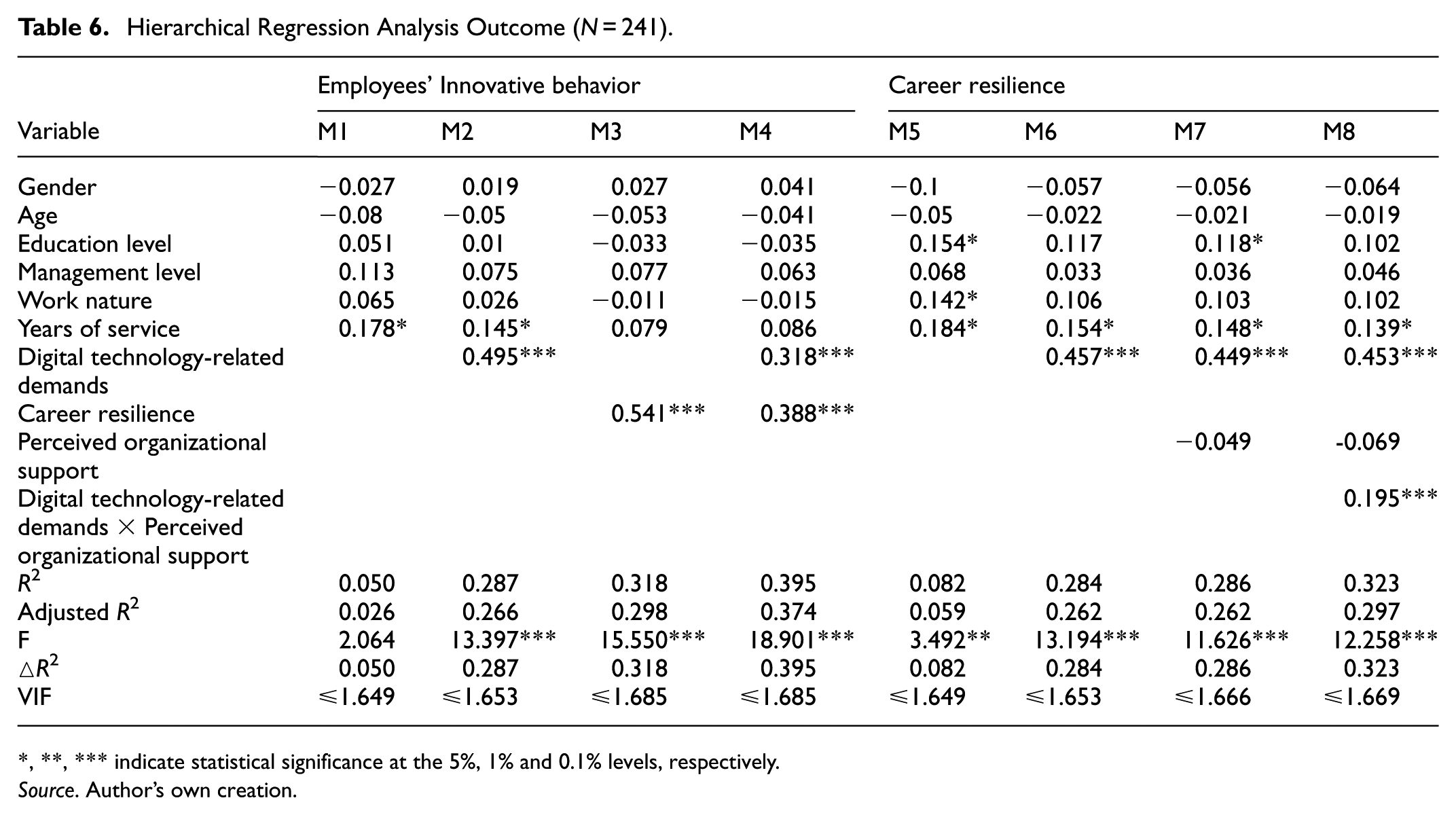
This study conducts hierarchical regression analysis to test hypotheses, and the test results are shown in Table 6. As indicated by M2, digital technology-related demands have a significant positive impact on employees ’ innovative behaviors (β = .495, p < .001). Hence, H1 was validated.
Hierarchical Regression Analysis Outcome (N = 241).
, **, *** indicate statistical significance at the 5%, 1% and 0.1% levels, respectively.
Source. Author’s own creation.
Test for Mediation
Drawing on Baron and Kenny’s (1986) mediation method, this study tested the mediating effect of career resilience using 241 valid sample data through the following steps: First, as presented in M2 in Table 6, digital technology-related demands were found to significantly and positively affect employees’ innovative behaviors (β = .495, p < .001). Second, as presented in M6, digital technology-related demands were found to significantly and positively influence career resilience (β = .457, p < .001), thus substantiating H2. Third, as presented in M3, career resilience (β = .541, p < .001) was found to significantly and positively influence employees’ innovative behaviors, thus validating H3. Fourth, by comparing M4 and M2, it was found that the effect of digital technology-related demands on employees’ innovative behaviors decreased from 0.495 in M2 to 0.318 in M4 and remained significant after career resilience was introduced. This signified that career resilience partially mediates the relationship between digital technology-related demands and employees’ innovative behaviors, supporting H4. In addition, to enhance the rigor of the study, we conducted the Variance Inflation Factor (VIF) analysis to detect multicollinearity in each regression model (Ma, 2002). The results indicated all VIF values in the regression models were less than 5, suggesting no serious multicollinearity issue in our models (in Table 6).
Test for Moderation
The interaction term between digital technology-related demands and perceived organizational support (β = .195, p < .001) has a significant positive impact on career resilience (in M8 of Table 6), indicating that perceived organizational support plays a positive moderating role in the effect of digital technology-related demands on career resilience. Thus, Hypothesis H5 is supported. As illustrated in Figure 2, the positive relationship between digital technology-related demands and career resilience is strengthened by higher levels of perceived organizational support, while weaker support diminishes this effect. These findings provide further support for Hypothesis H5.

The moderating effect of perceived organizational support.
Test for Moderated Mediation
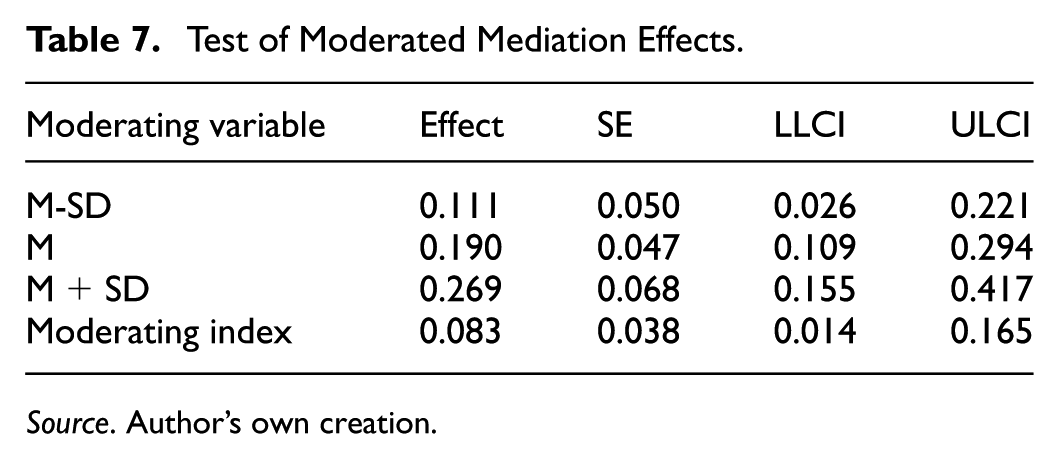
Table 7 presents the results of the moderated mediation analysis by using Model 7 of the PROCESS Macro (v4.2) in SPSS 26.0 with 5,000 bootstrap samples at a 95% confidence interval (CI). The 95% CIs for all mediating effects excluded zero across different levels of the moderating variable, indicating significant mediating effects. Meanwhile, the 95% CI for the index of moderation also excluded zero. This demonstrated that perceived organizational support positively moderates the mediating effect of career resilience on the relationship between digital technology-related demands and employees’ innovative behaviors, validating H6.
Test of Moderated Mediation Effects.
Source. Author’s own creation.
Conclusions and Contributions
Conclusions
Drawing upon the theory of stress paradox, this study explores the mechanism through which digital technology-related demands influence employees’ innovative behaviors via career resilience, with the moderating role of perceived organizational support in the effect of digital technology-related demands on career resilience. Based on the analysis of 241samples, our key findings are as follows:
First, digital technology-related demands exert a significant positive impact on employees’ innovative behaviors. This result highlights that when digital technology-related demands are perceived as “challenge stressors” rather than mere threats, they can motivate employees to proactively acquire digital skills, explore new work methods, and ultimately enhance their innovative behaviors—consistent with the argument that such demands can function as empowering motivators (Tu et al., 2023).
Second, career resilience partially mediates the relationship between digital technology-related demands and employees’ innovative behaviors. Digital technology-related demands stimulate employees’ career resilience by prompting them to adapt to digital transformation, engage in continuous learning of new technologies, and reframe challenges as growth opportunities. In turn, career resilience—characterized by positive emotions, proactive problem-solving, and adaptability—facilitates the conversion of stress into motivation, thereby promoting innovative behaviors.
Third, perceived organizational support positively moderates the relationship between digital technology-related demands and career resilience. Employees with higher levels of perceived organizational support are more likely to interpret digital demands as manageable challenges, as organizational backing (e.g., training, feedback, and resource provision) alleviates distress, enhances confidence, and strengthens their capacity to develop career resilience in response to technological pressures. Moreover, perceived organizational support strengthens the indirect effect of digital technology-related demands on employees’ innovative behaviors through career resilience. This indicates that the mediating role of career resilience is more pronounced when employees perceive strong organizational support, as such support amplifies the positive impact of digital demands on resilience, thereby reinforcing the overall pathway from digital technology-related demands to innovative behaviors.
Theoretical Contributions
We draw some important theoretical contributions. First, this study extends research on the effects of digital technology-related demands by examining their influence on employee innovative behavior. While prior literature has predominantly emphasized the “dark side” of these demands—particularly their role in inducing technostress and negative psychological outcomes such as tension, anxiety, and fear (Ragu-Nathan et al., 2008; Tarafdar et al., 2019)—their potential enabling effects on employee innovation remain underexplored. Consequently, there remains limited understanding of individual adaptive mechanisms in organizational digital transformation contexts (Singh et al., 2022). Drawing on the stress paradox theory, this study empirically confirms that digital technology-related demands positively promote employees’ innovative behaviors, demonstrating that such demands can be transformed into innovative motivation through challenge-oriented coping strategies. This finding balances the academic focus on the “negative impacts” and “positive potentials” of digital technology-related demands, offering a more comprehensive theoretical lens for understanding the complexity of employee behaviors in the digital context.
Second, this study advances the career resilience literature by exploring its mediating role in the effect of digital technology-related demands on employee innovative behaviors. While prior research has not explicitly examined how digital technology pressures catalyze innovative drive through resilience (Lazarus & Folkman, 1987), we identify career resilience as a critical psychological mechanism that channels these demands into positive behavioral outcomes. Our findings empirically validate the sequential pathway of “challenging work pressure → enhanced resilience → innovative behaviors,” demonstrating that digital demands, when perceived as challenges, can foster adaptability and creativity. By doing so, this study not only elucidates the transformative potential of digital stressors but also offers new insights into harnessing them for innovation.
Third, this study contributes to the perceived organizational support literature by revealing its moderating role in the relationship between digital technology-related demands and career resilience. While prior research has established perceived organizational support as a critical factor shaping employee attitudes and behaviors (Eisenberger et al., 1986; Kurtessis et al., 2017), its contingent influence on how digital demands affect career resilience remains unexplored. Grounded in the theoretical premise that perceived organizational support fosters resilience by providing psychological resources to overcome challenges (Gutierrez & Kieffer, 2019; Huang et al., 2021), we propose that perceived organizational support amplifies the positive effect of digital technology-related demands on career resilience. Our findings confirm this hypothesis, demonstrating that perceived organizational support not only strengthens the direct impact of digital demands on resilience but also enhances the mediating role of resilience in fostering innovative behavior. These results advance theory by illuminating how organizational support systems can transform digital stressors into catalysts for innovation through psychological resource augmentation.
Management Implications
The findings of this study offer actionable insights for organizations navigating digital transformation, particularly in fostering employees ’ innovative behaviors amid evolving technological demands. By emphasizing the roles of career resilience and perceived organizational support, firms can strategically convert digital technology-related demands into drivers of innovation, thereby enhancing organizational competitiveness.
First, organizations should proactively frame digital technology-related demands as “challenging stressors” and invest in cultivating employees’ career resilience. Given that career resilience mediates the positive impact of digital demands on innovation, firms should design systematic training programs focused on digital skill development—such as workshops on big data analytics, artificial intelligence applications, and digital tool operation. These initiatives not only equip employees with the technical competencies to meet digital demands but also reinforce their adaptive capacity to reframe challenges as growth opportunities. Additionally, managers should encourage a learning-oriented culture that values experimentation and knowledge sharing, as such an environment strengthens employees’ proactive problem-solving tendencies and emotional resilience when facing technological uncertainties (Ferrari et al., 2017; London, 1983).
Second, organizations must prioritize enhancing employees’ perceived organizational support to amplify the positive effects of digital demands on career resilience. Practical measures include providing timely resources (e.g., access to digital learning platforms, dedicated mentorship for technology adoption) and establishing clear feedback mechanisms to address employees’ concerns about digital transformation. For instance, regular communication sessions where managers acknowledge employees’ efforts in adapting to new technologies and involve them in decision-making processes related to digital initiatives can foster a sense of organizational care and recognition (Eisenberger et al., 1986; Rhoades & Eisenberger, 2002). Such support not only alleviates distress associated with technological pressures but also boosts employees’ confidence in navigating digital challenges, thereby strengthening their career resilience.
Third, managers should adopt a context-aware approach to employee development, tailoring support to individuals’ varying levels of digital competence and resilience. For employees struggling with digital demands, targeted interventions—such as one-on-one coaching or peer learning groups—can help bridge skill gaps and reduce anxiety. For those with higher resilience, organizations can assign more complex digital tasks to further stimulate innovation, paired with incentives that recognize creative applications of digital technologies. This differentiated strategy ensures that digital demands are matched with appropriate support, maximizing the conversion of stress into innovative motivation.
Finally, organizations should integrate career resilience and perceived organizational support into their broader digital transformation strategies. This involves aligning HR policies (e.g., performance evaluation, training budgets) with the goal of nurturing resilience, as well as embedding a culture of support where employees feel empowered to take risks and innovate using digital tools. By treating career resilience as a core organizational capability and perceived support as a critical enabler, firms can create a sustainable cycle where digital transformation drives innovation, and innovation, in turn, accelerates successful digital adoption.
Limitations and Directions for Future Research
This study explores the influence mechanism of digital technology-related demands on employees’ innovative behavior, but there are several limitations for improvement in the future. First, the sample was selected using non-probability convenience sampling and primarily drawn from enterprises in specific regions of China. Although the study focused on employees with digital transformation experience, the relatively concentrated geographical distribution has not adequately covered different economic regions and diverse industry types, which may affect the representativeness of the sample and the generalizability of the conclusions. To address this, in the future multi-stage stratified sampling could be adopted to appropriately expand the geographical coverage of the sample and extend the research context to more industry types. Second, the study relies on cross-sectional data for analysis. While it can preliminarily reveal correlations between variables, it falls short of dynamically capturing the evolutionary process among digital technology-related demands, career resilience, perceived organizational support, and employees’ innovative behavior and thus could not clearly define the causal sequence between these variables. Therefore, future research could employ longitudinal surveys to collect panel data, enabling dynamic analysis of long-term relationships among variables. Third, the measurement of core variables primarily depends on employee self-reported questionnaires. Although methods such as Harman’s single-factor test were used to control for common method bias, employees’ subjective cognitive biases may still exist. Thus, future studies could consider introducing approaches where different respondents answer different questions (to avoid a single respondent answering all questions) or integrate subjective questionnaires with objective data to construct a mixed measurement system. Fourth, the measurement of dependent variables lacks consideration of objective indicators, leaving room for improvement in the objectivity of the measurement results. Future research could incorporate objective measures of employee innovation output, such as the number of new product developments and patent outputs. Finally, future research could examine alternative organizational-level moderators, such as leadership styles and organizational climate, and adopt a cross-level perspective to investigate their interactive effects.
Footnotes
Acknowledgements
We would like to express our deepest gratitude to all those who have provided support and guidance throughout the process of completing this work. At the same time, we sincerely thank the reviewers and editors for their valuable comments, which have greatly helped us improve the quality of this research.

Author Contributions
Conceptualization: Xiaoping Wang and Ming Lin; Methods: Xiaoping Wang, Yifang Wang and Haiyan Zhou; Data collection: Ming Lin, Yifang Wang and Liping Qiu; Writing—original draft preparation:Xiaoping Wang and Liping Qiu; Writing—review and editing: Xiaoping Wang, Feng Hu and Hao Hu.
Funding
The authors disclosed receipt of the following financial support for the research, authorship, and/or publication of this article: This research was supported by the Special Project of Zhejiang Provincial Social Science Planning on “Research and Interpretation of the Spirit of the Third Plenary Session of the 20th Central Committee of the Communist Party of China and the Fifth Plenary Session of the 15th Zhejiang Provincial Party Committee” (Pre-approved research project), Zhejiang Federation of Humanities and Social Sciences Research Project (Grant No.2025N071), the General Program of the National Social Science Foundation of China (Grant No.72373135), the Humanity and Social Science Foundation of the Ministry of Education of China (Grant No.22YJAZH027), National Social Science Fund of China (Grant No.22BGL290), Zhejiang Provincial Intellectual Property Soft Science Research Project (Grant No.ZI202410) and Ningbo Philosophy and Social Science Research Base project (Grant No.JD6-037).
Declaration of Conflicting Interests
The authors declared no potential conflicts of interest with respect to the research, authorship, and/or publication of this article.
Data Availability Statement
Data will be made available on request.