




Abstract
In today’s digital era, the constant engagement with social networks and video games by minors has raised concerns about their well-being and safety online. This study systematizes evidence on policies, guidelines and other measures relating to the use of social media and video games by minors. This study is based on the PRISMA protocol and the criteria of the Joanna Briggs Institute, which results in a selection of 22 articles from databases such as Scopus, EBSCO, and Web of Science, for which inclusion criteria were applied that considered studies published since 2010 and that specifically address regulations and practices focused on the protection of minors. The results suggest that, although several countries have regulations regarding minors’ engagement with social networks and video games, the implementation of effective policies remains a challenge. In addition, there are disagreements over the effectiveness of age restrictions and parental supervision. Additionally, gaps in the literature persist, particularly regarding best practices for regulating online interaction and exposure to inappropriate content. Based on these findings, we propose recommendations to enhance current policies and highlight key areas for future research to promote the safe and responsible use of social networks and video games by minors.
Plain Language Summary
Children and adolescents spend large amounts of time on social media and video games, which can be both beneficial and risky. This study reviews research from 22 scientific articles published between 2010 and 2024 on policies, laws, and guidelines designed to manage minors’ use of these digital platforms. Instead of asking how teenagers are being protected, our review focuses on what kinds of rules and practices exist, how they are applied, and how effective they are. We found many different approaches. In China and South Korea, time-limit policies on online gaming aim to reduce addiction, while in the UK and Australia, schools have restricted smartphone use during class to improve behaviour and well-being. In the United States, parental consent rules such as the Children’s Online Privacy Protection Act (COPPA) require companies to limit data collection from children, and ratings like the ESRB guide parents on video game content. UNICEF and ITU have issued international guidelines for industry, and OECD reports call for “safety by design” features and age-appropriate verification. Despite these efforts, evidence on effectiveness is mixed. Some policies reduce screen time but prompt teenagers to switch to other online activities, such as short videos. Strict parental restrictions can even backfire, leading to more conflict at home. Across countries, very few policies are regularly evaluated or adapted to new technologies. This review highlights the need for evidence-based, coordinated action between governments, schools, platforms, and families. Moving some of the more detailed data tables to supplementary materials and improving reference formatting will help readers follow the narrative. By showing real-world examples, we aim to help decision-makers design more practical and child-centred rules for safe and healthy digital experiences.
Introduction
In the 21st century, according to Yildirim Demirdöğen et al. (2024), the increase in internet use has sparked public health problems, the most prevalent ones being related to the use of social networks and video games. Engagement with social networks and video games among adolescents and children has raised a growing interest in the political and social sphere due to its possible impact on the development and behavior of these groups. Although the risks of intensive use are widely recognized, existing policies and regulations have evolved without addressing key areas of regulation identified by empirical evidence and, furthermore, have not been rigorously analyzed (Jordan & Natarajan, 2024). This contrast reveals a disconnect between scientific evidence (Sánchez Casado & Benítez Sánchez, 2022) and policy decisions, highlighting the need for a more integrated and evidence-based approach, as well as being inclusive, tailored to development and focused on vulnerable groups (Boniel-Nissim et al., 2024).
The existing literature on video games usually focuses on the effects they produce in minors. These are presented as potentially harmful and with mechanisms that entail the risk of leading to problematic behavior (Lischer et al., 2022). In turn, social networks are known for being highly popular among children and adolescents and they potential for fostering communication and creativity, but they are also associated with anxiety and online bullying (Haston, 2019).
Evidence shows that video games and social media are interconnected digital phenomena whose intensive use can lead to addictive behaviors in adolescents, conceptualized as internet gaming disorder (IGD) and social media disorder (SMD), with adverse effects on psychological well-being and social competence, although moderate use can promote social skills (Van Den Eijnden et al., 2018). IGD and problematic social media use (PSMU) have low comorbidity but a strong association and shared correlates such as depression and family dysfunction (Wartberg et al., 2020). Excessive use, intensified during the pandemic, increases psychosocial risks, especially on social media (Ghali et al., 2023; Holtz & Appel, 2011; Nilsson et al., 2022). Therefore, analyzing them together allows us to identify transferable guidelines and integrated policies.
Other studies examine the effects of social networks on health and the influence of video games on specific population groups. For Purba et al. (2023), there are connections, mostly negative, between the use of social networks and risk behaviors in adolescents, such as the intake of alcohol, drugs, unhealthy eating habits, gambling, antisocial behavior, among others. On the other hand, the works of Loyola-Alvarez et al. (2021), Diaz-Sipiran et al. (2023), Iglesias-Deza et al. (2023), and Miguel-Monzón et al. (2023), focused on the impact of video games on learning, education, mental health, and school performance, respectively. The negative consequences are evident; however, there is a lack of analysis of the policies, guidelines and other measures taken by different governments, companies, and parents to regulate and/or restrict the engagement with social networks and video games by minors.
In light of this, this article aims to review the advances on policies and guidelines and other measures related to the engagement with social networks and video games by minors. Thus, its contribution is to synthesize the existing information, as well as identifying areas of consensus and discrepancy among the research. In addition, recommendations based on the evidence gathered are proposed, in order to propose areas for future research where gaps in knowledge have been generated (Diaz-Sipiran et al., 2023; Haston, 2019; Iglesias-Deza et al., 2023; Jordan & Natarajan, 2024; Lischer et al., 2022; Loyola-Alvarez et al., 2021; Miguel-Monzón et al., 2023; Purba et al., 2023; Yildirim Demirdöğen et al., 2024).
The research question guiding the review was: What policies, regulations, guidelines, and other measures related to the use of social networks and video games in children and adolescents have been addressed in the scientific literature?
Methods
In order to achieve the purpose of the research, a systematic review was carried out according to the PRISMA (Preferred Reporting Items for Systematic Reviews and Meta-Analysis) protocol, developed by Page et al. (2021). In addition, to ensure quality, transparency and, where possible, generalizability of the results, we used the Joanna Briggs Institute criteria for evaluating articles for systematic reviews (Lockwood et al., 2015). Specialized archives were searched extensively for previous reviews on this topic, but no relevant literature was found, making this study the first systematic review in this area.
Operational Definitions
Minors: persons under the age of 18, including school-age children and adolescents, but excluding university students.
Effective policy: regulation, guideline, or measure (legislative, school or platform) that, according to empirical evaluation or monitoring reports, produces a documented improvement in at least one of the following outcomes: (a) measurable reduction in problematic use; (b) decrease in reported incidents; (c) improvement in well-being indicators measured before and after.
Guidelines: non-binding documents that recommend practices to target groups (governments, schools, platforms) and include implementation and monitoring criteria.
Digital platforms: services (including social media and video games) that enable users to create, share or consume content and/or interact with each other, and which operate on digital infrastructure accessible via the internet or devices.
Search Strategy
The Scopus, EBSCO and Web of Science databases were used in the review. It includes articles published in international scientific journals from January 2010 to August 2024.
To ensure terminological consistency, the UNESCO Thesaurus (ISO 25964) was used, which allows synonyms and hierarchical relationships between descriptors to be established and improves document retrieval in different databases. Terms such as “security,”“legislation,”“guide,”“government policy,”“social media,”“video game,”“youth,”“child,”“student,” and “school” were selected.
Based on the identified descriptors, a common search strategy was designed for all databases, adapting only the syntax of the Boolean operators according to the specific requirements of each platform: TITLE([restrict* OR amendment OR “online safety” OR law OR act OR act OR guideline OR regulatory OR polic* OR “government regulation”] AND [facebook OR “social media” OR “video game*” OR gaming] AND [“youth” OR “adolescen*” OR “teenage*” OR child* OR student OR school] AND NOT [university OR college OR graduate]).
In Scopus, the syntax was adjusted to the platform’s own format on the use of Boolean operators, while in EBSCO and Web of Science the specific guidelines of each were implemented, maintaining the conceptual coherence of the search.
To supplement the information, a search was conducted on search engines to identify gray literature, and in order to guarantee the quality of these documents, they were selected using the AACODS checklist. However, to avoid bias and ensure academic rigor, they were included only for discussion in contrast to the articles selected using the PRISMAmethod. Given that five main documents were selected as the most representative of the subject matter, these were produced by various organizations such as Digital Cooperation Organization (2024), Institute for Strategic Dialogue (Jacobs et al., 2024), Lancaster School District (n.d.), UNICEF and ITU (2015), and OECD (2024).
Inclusion and Exclusion Criteria
Document Selection Procedure
To write this article, key articles were carefully selected and evaluated in several stages as shown in Figure 1, based on the criteria in Table 1. In the first stage, 457 articles were retrieved from the databases, of which 331 were eliminated as duplicates. In the second stage, accessibility and age criteria were applied, reducing the number of articles to 111. Finally, in the third stage, the articles were checked for relevance to the review topic and 22 of them met these criteria. Two reviewers independently screened titles and abstracts; full texts were assessed by both reviewers and discrepancies were resolved by consensus.

PRISMA protocol flowchart.
Table of Criteria.

Data Analysis
As more detailed information was required for this review, a comparative table was prepared that documented the year of publication, source of the study, theoretical framework, type of study, instruments used, perspectives, population studies, objectives, conclusions, and language of publication of the text.
Results
Using the search string, the databases used, and the results obtained are shown in Table 2.
Search Results According to Search Equation and Data Base.

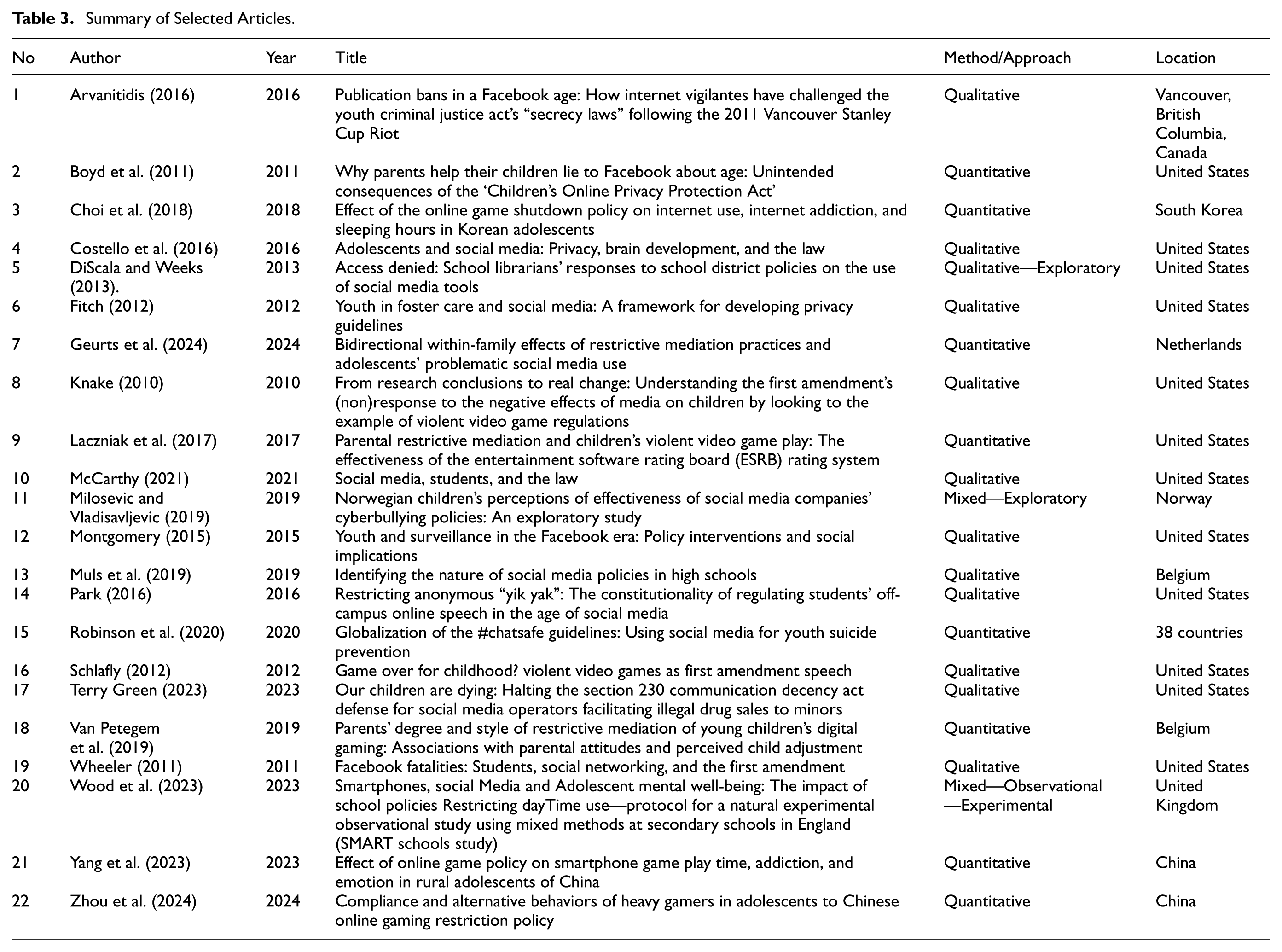
Then, the defined inclusion and exclusion criteria were used, as shown in the flow chart, to finally obtain a sample of 22 articles. Subsequently, these 22 articles were summarized and covered the following aspects: author, year, research focus, and location. Accordingly, Table 3 is presented below:
Summary of Selected Articles.
Description of the Publications Included
After applying the inclusion and exclusion criteria, 22 publications were selected. There are 94 articles in the Scopus databases, 107 in Web of Science, and 256 articles in EBSCO. In terms of language, 22 articles were published in English.
Regarding the location of the study, the studies were from the United States (12), China (2), and Belgium (2). There was also one article from Canada, South Korea, the Netherlands, Norway, the United Kingdom, and one with representatives from 38 countries. According to the year of publication, the studies are divided as follows: 2023 (3), 2019 (3), 2016 (3), 2024 (2), 2012 (2), 2011 (2), and the years 2021, 2020, 2018, 2017, 2015, 2013, and 2010, each with one article. A review of the above 22 articles revealed similarities among them, which led to classifying the objectives into the following three categories:
(1) Policies and Regulations on Minors’ Digital Engagement: Arvanitidis (2016), Choi et al. (2018), Costello et al. (2016), Knake (2010), Schlafly (2012), Wheeler (2011), Yang et al. (2023), Park (2016), and Zhou et al. (2024) focus on policies and regulations related to minors’ access to social networks and video games. These studies examine the effectiveness of such regulations in preventing inappropriate access, limiting use, and protecting minors from potential harm in the digital environment. In addition, they examine how current policies respond to contemporary technological and social challenges and what adjustments may be needed to increase their effectiveness.
(2) Psychological and Social Impacts of Social Networks and Video Games on Minors: Fitch (2012), Montgomery (2015), Milosevic and Vladisavljevic (2019), Robinson et al. (2020), Wood et al. (2023), McCarthy (2021), Geurts et al. (2024), and Boyd et al. (2011) investigate how the use of these platforms affect the mental health, social skills, and behavior of minors. The research looked at issues such as social network addiction, exposure to cyberbullying, minors’ perceptions of digital protection policies, and the impact on physical and mental health. The aim of these studies is to better understand the consequences of digital interactions and how these experiences affect minors from different social and family groups.
(3) Parental and Educational Mediation for Responsible Digital Use: Discala and Weeks (2013), Muls et al. (2019), Van Petegem et al. (2019), Laczniak et al. (2017), and Terry Green (2023) focus on the mediation and monitoring practices of parents and educational institutions to regulate the engagement with social networks and video games. These studies analyze different techniques, such as direct restrictions, digital skills training, and emotional support, and how each strategy affects minors’ digital behavior. They also evaluate the effectiveness of these practices in reducing risk and promoting a safe and productive environment for adolescents and children.
Regarding the methodological approach, 12 qualitative, 8 quantitative, and 2 mixed articles were found. Due to the review criterion of only considering minors, most of the articles took these age groups as the population and/or sample. However, we also took into account those articles that took as a sample parent with minor children, adults with some relationship with minors, and others that analyzed laws and court cases focused on minors.
Supplemental Appendix A contains a table summarizing the research instruments.
Cross-Cutting Thematic Issues
The analysis of the selected literature allowed us to identify key patterns and trends related to the topic of this article. Therefore, in this section, we present the main themes that emerged from the review process, which not only structure an evidence-based conceptual framework but also provide a clearer view of the current state of knowledge on the subject.
Use of the Internet and Social Networks by Minors
Parental Consent
In the context of the United States, there is the Children’s Online Privacy Protection Act (COPPA), which limits access to social networking websites for children under the age of 12 (DiScala & Weeks, 2013). Similarly, it specifies that website operators must obtain “verifiable parental consent” before collecting information from children. COPPA also introduces a “sliding scale” of consent requirements that adjusts the level of verification based on the intended use of personal information. This temporary approach was introduced in the hope that technological advances would provide a more secure and cost-effective method of online age verification, although it proved to be overly optimistic (Matecki, 2010 cited in Boyd et al., 2011). Current industries have not developed the necessary mechanisms to obtain such consent.
Consequently, to avoid the financial costs, social problems, and technical challenges of obtaining consent, as well as to manage minors’ personal data and avoid severe fines and public backlash for non-compliance, many websites choose to restrict their services to users aged 13 and older (Boyd et al., 2011).
Privacy and Anonymity on the Internet
First, privacy is about controlling our personal information, rather than simply hiding it. It is about deciding what we share, with whom and in what way. Although some studies have considered privacy as concealment, the real purpose lies in the management and control of the information itself (Fitch, 2012).
Second, anonymity is a tool to safeguard privacy. It should be added that there is a common perception that ordinary people would not see the need to use anonymity, while those who prefer to communicate anonymously might have something to hide (Wehmhoener, 2010 cited in Arvanitidis, 2016).
For Arvanitidis (2016), the ease of anonymity available online has facilitated anti-normative, aggressive, and criminal behavior. This author also mentions that anonymous comments on the Internet tend to be more uncivil and are associated with a higher risk of cyberbullying and aggression online.
Cybervigilantism
According to Arvanitidis (2016), vigilantism is characterized by planning and premeditation, the voluntary participation of private citizens, and the use or threat of force in response to the transgression of established norms. It also seeks to provide security guarantees to participants and society, acting in a context where the established order is threatened.
Currently, it can be seen in the digital domain. In addition, a particularly troubling aspect is that of “naming and shaming,” where suspected offenders are identified and subjected to shaming or harassment rather than physical punishment. This form of vigilantism can create significant risks, such as disproportionate punishment, interference with the formal justice system, or harming the wrong people, since Internet vigilantes are often not affiliated with the official justice system.
Addiction to the Internet, Electronic Devices, and Video Games
Following Choi et al. (2018), there is ample evidence indicating that Internet addiction can pose a significant risk to physical and mental health. Excessive Internet use, including online gaming, is linked to reduced health perception and lower quality of life, both subjectively and objectively. Particularly in adolescents, Internet addiction is associated with elevated levels of anxiety, depression, and aggressive behaviors. Other factors such as gender, academic performance and physical activity are also associated with Internet addiction, and spending several hours playing online games has been found to have a negative relationship with academic performance and exercise level.
In line with the above, Yang et al. (2023) argue that excessive use of electronic devices and gaming-related disorders have significant consequences for adolescents. Prolonged use of smartphones and other devices can cause physical discomfort such as eye pain and musculoskeletal problems, as well as obesity, lack of sleep and insufficient physical activity. Also, gaming disorders are associated with serious mental health problems such as those discussed by Choi et al. (2018).
Parental Restrictions
Geurts et al. (2024) cite protective motivation theory (PMT), which offers an explanation of how parents adopt protective behaviors based on two cognitive processes: threat assessment and coping appraisal. Threat appraisal refers to how parents perceive the severity and likelihood of a problem, whereas coping appraisal involves the assessment of the effectiveness of actions to manage that threat. Thus, when adolescents show symptoms of problematic use of social networks, parents may consider this as a significant threat and react by setting stricter rules.
In addition, they go on to cite the psychological reactance theory. This suggests that adolescents may see parental restrictions as a threat to their freedom, which triggers an emotional reaction to regain that freedom. This phenomenon may make social networks even more attractive to them. On the other hand, frequent parental interference in their children’s Internet use may deprive adolescents of opportunities to learn self-regulation, which could lead to more problematic use of social networks.
He then proposes the transactional model, one that highlights the reciprocal nature of the influence between parental and adolescent behavior, creating a continuous feedback loop. In this context, parental restraints may intensify symptoms of problematic social network use in adolescents, thus exacerbating the conflict. According to parental mediation theory, parents attempt to mitigate the negative effects of media use through a variety of strategies, such as setting specific rules about Internet use in terms of time, place, time of day, and content. However, these rules often face resistance from adolescents, who may actively oppose the established expectations and act against them.
Thus, restrictive mediation involves parents regulating children’s use of digital media by implementing rules and supervision. Setting clear limits is important to avoid a permissive environment, but restrictions can become counterproductive if children perceive them as invasive or if the content becomes more attractive as it is considered forbidden. In fact, strict rules may even increase problematic behavior, a phenomenon that has been observed in studies on the prohibition of certain foods in young children (Van Petegem et al., 2019).
Van Petegem et al. (2019) argue that, to understand when parent-imposed rules and restrictions are effective, Self-Determination Theory (SDT) highlights the importance of not only the quantity of rules, but also their quality and communication style. This theory suggests that an approach that supports child autonomy, characterized by empathy, the offer of choices and clear explanations promotes psychosocial development and the internalization of rules. In contrast, a controlling style, which imposes obedience through punishment and threats, can lead to rule resistance and adjustment problems.
Along these lines, the establishment of specific Internet rules by parents, regulating children’s access in terms of time, place, time of day and type of content, often faces the challenge of resistance from adolescents, who tend to oppose these rules and act contrary to established expectations (Van Petegem et al., 2019).
However, it should also be noted that those adolescents with a strong motivation for gaming may seek ways to circumvent the limitations and turn to alternative online activities, such as watching short videos. These videos are becoming an addictive medium, providing novel and personalized content according to the user’s preferences, making them an attractive option for adolescents seeking to satisfy their need for online entertainment (Zhou et al., 2024).
Influence of Social Networks on the Development of Minors
Adolescent Psychological Development
Costello et al. (2016) argue that adolescent judgment and decision making differ markedly from those of adults in several respects. Adolescents have more difficulty controlling their impulses, assessing risks and rewards, and foreseeing the consequences of their actions. Although older adolescents may develop cognitive skills similar to those of adults, they still have deficits in social and emotional maturity. Psychosocial maturity, which includes skills such as risk perception and resistance to peer influence, develops more slowly than general cognitive skills.
He explains that adolescents, especially up to the age of 16, are more prone to make impulsive decisions under emotional or social pressure, and their ability to self-regulate is limited. Brain maturation continues until the mid-20s, affecting the development of the prefrontal cortex and emotional regulation. These differences in cognitive and psychosocial maturity are crucial to understanding how adolescents make decisions in online environments. Adolescents often accept terms of service on websites without adequate reflection, demonstrating a lack of maturity compared to adults.
In relation to marketing, Montgomery (2015) warns that although minors have the skills to manage social networks, they lack the critical skills needed to effectively deal with marketing and data collection in these environments. Social networks, which address adolescents’ needs for identity, relationships, and autonomy, also expose them to manipulative marketing techniques. The part of the brain that controls inhibitions does not fully develop until late adolescence or early adulthood, causing adolescents to act impulsively and without considering the consequences of their actions, even in the face of significant risks. Also, their increased susceptibility to peer pressure and emotional instability makes them more vulnerable to marketing tactics such as real-time offers, geolocation targeting and personalized ads that exploit their vulnerabilities.
For all of the above, social networks play a fundamental role in the exploration and construction of adolescents’ identity, allowing them to experiment with different aspects of themselves and establish their online presence. Through what is known as “identity performance,” adolescents show who they are by sharing personal information, which is related to popularity and self-expression. Similarly, these platforms foster constant social connection and redefine the dynamics of friendship, transforming digital relationships into an essential part of adolescents’ lives and creating an always-connected community that influences how minors interact and relate to their peers (Montgomery, 2015).
Cyberbullying and Mental Well-Being
Muls et al. (2019) develop the idea in which children and adolescents can be understood through three main discourses: innocence, evil, and rights. The innocence discourse perceives children as pure and defenseless, in need of constant protection from external dangers, which motivates adults to restrict their access to uncontrolled spaces, including online environments such as social networks. In contrast, the discourse of evil presents children as inherently risky, justifying strict disciplinary measures to protect society from their potential misconduct, such as cyberbullying. On the other hand, the discourse of rights sees children as active agents with rights and interests of their own, capable of participating in decisions that affect them, as reflected in their participation in student councils. This approach fosters autonomy, but it can also expose children to vulnerabilities in a capitalist society that emphasizes individual responsibility. Although the dominant perspective on children may change depending on the social context, in the debate about social networks, discourses of innocence, evil, and rights are intertwined, reflecting concerns about protection, discipline, and child autonomy.
In this regard, McCarthy (2021) defines cyberbullying, or online harassment, as intentional and repeated harassing behavior through electronic media, which can be physical, mental, or social. This type of harassment can manifest itself in harmful posts on social networks, negative comments in online games, or websites dedicated to threatening or embarrassing victims. The most common tools for cyberbullying include Facebook, Snapchat, Instagram and other similar platforms, and the frequency of cyberbullying is linked to the extent of use of social networks. Recent cases show how cyberbullies can take extreme measures, such as hacking into school accounts and systems. Victims of cyberbullying can suffer serious psychological effects, including anxiety, depression, and in extreme cases, suicide.
He adds that marginalized adolescents and those belonging to sexual, social, or economic minorities are particularly vulnerable. Common cyberbullying strategies include name-calling, spreading rumors, and distributing unsolicited explicit images. Unlike physical harassment, cyberbullying can reach a wider audience and is more difficult to escape, as attacks can be constant and persistent. Electronic communication allows bullies to act with fewer inhibitions, exacerbating the negative impact on victims.
Considering the above, it is important to counteract cyberbullying and improve the mental well-being of students. Consider that half of mental health disorders begin before the age of 14 and, if left unaddressed, can persist into adulthood. These problems negatively affect various aspects of adolescents’ lives, including cognitive, social, and physical behaviors. For example, poor mental well-being is linked to higher rates of disruptive behavior, school absenteeism, and reduced educational achievement (Wood et al., 2023).
School Policies on the Use of Social Networks
School-based interventions can have a positive impact on adolescent mental well-being and related aspects such as sleep, physical activity, and classroom behavior. Comprehensive school-based approaches, which address both physical and social influences on health and align with effective school policies, values, and practices, appear to be more effective than individual approaches focused on knowledge and beliefs. One example of an effective intervention is the implementation of policies that limit the use of smartphones and other media during school hours. In countries such as the United Kingdom, Australia, Sweden, and the Czech Republic, many schools have adopted such policies to minimize disruptive behavior and cyberbullying and improve school performance (Wood et al., 2023).
Other policies have been implemented in the United States, with many school districts blocking the use of social networking sites. Some allow limited collaborative tools, such as blogs and wikis, but most restrict access to these platforms for safety reasons, to protect students from online bullying and inappropriate material. To comply with the Children’s Internet Protection Act, some districts have implemented acceptable use policies (AUPs), but often these policies are outdated and do not adequately address modern social networking tools (DiScala & Weeks, 2013). Also, other school districts have implemented bans that prevent students and teachers from maintaining relationships on social networks to ensure that interactions remain professional. In contrast, in Flanders, Belgium, there are no specific government regulations on the use of social networks in the school setting, allowing schools to set their own rules. The only guideline available in Flanders refers to discretion in the handling of student data by teachers (Muls et al., 2019).
Video Games and Associated Behaviors in Minors
Violence in Video Games
According to Laczniak et al. (2017), violence in video games is defined as the content in these games that shows intentional attempts to cause harm to other characters. This harm is directed at individuals within the game who attempt to avoid it. A detailed explanation of how exposure to violence in video games can lead to aggression is explained by the General Aggression Model (GAM). According to this model, repeated exposure to violence in video games can cause children to develop aggressive thoughts and cognitive structures that reinforce their ideas about aggression. Over time, these thoughts can lead to aggressive behaviors; and the negative effects of violent video games can be both immediate and long-lasting.
On the other hand, exposure to violence in entertainment media can increase aggressive attitudes, values, and behaviors, especially in children. Research has consistently shown a causal connection between media violence and aggressive behavior (Knake, 2010). Of concern is that the industry does not appear to be self-regulating, due to the fact that more violent games generate more profits for the industry (Wirt, 2012 cited in Schlafly, 2012).
Gambling Disorder and Risk Factors
Excessive gambling in children refers to the occurrence of behaviors that resemble those of addiction. These behaviors include lack of control, internal conflicts, and conflicts with others due to gambling, and withdrawal symptoms when the child is forced to stop gambling (Van Petegem et al., 2019).
For Yang et al. (2023), the problem of online gaming addiction among adolescents has become a serious public health problem. However, the exact cause of the gaming disorder is not fully understood. Some studies suggest that the prevalence of addictive behaviors in adolescents may be related to their cognitive immaturity and brain development. On the other hand, several protective and risk factors have been identified in association with this disorder. Among the protective factors are self-control, good parent-child relationships, and a strong sense of belonging to the school. Conversely, impulsivity, maladaptive beliefs and motivations, hostility, association with deviant peers, family conflicts, and bullying are positively related to gambling disorder.
Politics and Law in the Digital Environment
Right to Be Forgotten
On the right to be forgotten, in a European context, Park (2016) indicates that search engines, such as Google, are obliged to remove links containing personal information from their search results when requested by the user. This means that users have the “right to be forgotten,” which allows them to request the removal of links to web pages after a period of time, unless there is a legitimate government reason to keep them.
Also, as a result of the teenage tendency to act impulsively, some social networks, such as Facebook and Twitter, allow users to delete their posts. For example, California legislation, known as the “delete button” law, expands this option and makes it mandatory for all websites that target minors. The law requires websites to allow individuals under the age of 18 to remove their records and provides clear instructions on how to do so. Similar to the Children’s Online Privacy Protection Act (COPPA), “erasure button” laws apply to operators of websites or apps that target minors or that know that minors are using their platform (Costello et al., 2016).
Freedom of Expression and Digital Protection
In the United States, the Supreme Court has ruled that free speech on the Internet should receive the same level of protection as any other type of speech, emphasizing that digital content should not be subject to less scrutiny under the First Amendment. This principle ensures that anonymous speech on the web can thrive, providing users with some protection from potential social and governmental consequences. However, the protection of online anonymity can also encourage anti-social behavior, such as harassment, threats, and hate speech, especially in “off-campus” spaces of educational institutions. Therefore, as schools and universities must adapt quickly to new technologies that facilitate more channels of communication and greater anonymity, the challenge of balancing freedom of expression with the need to protect individuals from digital harm arises (Park, 2016).
Exemption From Liability
Despite recent calls to regulate platform responses to cyberbullying, Milosevic and Vladisavljevic (2019) note that many social networking companies remain exempt from liability for such content in several countries. This is due to legislation such as Section 230 of the U.S. Communications Decency Act and the safe harbor provisions of the European Union’s E-Commerce Directive, which consider them mere “intermediaries” and not content creators. However, some companies have adopted self- or co-regulatory measures, including tools for reporting abuse and mechanisms for reporting harmful content, as required by the revised Audiovisual Media Services Directive in Europe.
It adds that, despite these initiatives, there is still a considerable lack of transparency about how platforms handle cases of harassment. Companies often do not disclose their specific policies on harassment, nor do they provide clear data on the effectiveness of their protection mechanisms.
Proactive Policies for User Protection
Instagram, Twitter, and Facebook have developed “advanced policies” to protect users from bullying. These policies include sections on the companies’ websites, such as “safety centers” or “help centers,” that provide information and educational resources so that children know how to act in the face of bullying and protect themselves. Facebook’s “social reporting” feature, which allows users to send pre-determined messages to other users who have posted offensive content, asking them to remove it, is an example of this. This method, which was developed by neuroscientists to promote empathy, allows users to manage the problem directly among themselves, without involving the platform or its moderators; in this way, the responsibility lies with the users (Milosevic & Vladisavljevic, 2019).
Although platforms receive numerous reports of bullying, they are often unable to confirm that these individuals violated their policies. To determine whether these tools are useful to fight bullying, it is essential to know whether children use them, and they find them useful in bullying situations.
Integrative Conceptual Framework
Based on the emerging teams and the theories mentioned above, a framework was developed:
See Figure 2, on the left side are regulatory inputs (laws, public policies, and school policies) and moderating theories (Self-Determination Theory and Protective Motivation Theory), which influence how platforms are designed and how educational and parenting practices are established. The central box labeled ‘Platform design’ shows features such as monetization and algorithms, which are the main targets of the regulations; while ‘Educational and parenting practices’ reflects how families and schools mediate the use of these technologies.

Integrative conceptual framework on regulation, digital platforms, and psychological development of minors.
On the right are the exposure and content available to minors, which would be influenced by platform designs as well as parental and school rules. Ultimately, this would lead to changes in the cognitive and emotional processes described by the General Aggression Model and psychological development. The arrows indicate the causal and conditional relationships between these components, and the dotted lines indicate areas that require further research, such as the influence of parents and schools on policy-making or industry self-regulation.
Discussion
The review of the literature on policies and other regulations on the engagement with social networks and video games by minors has produced a series of important findings that offer a comprehensive view of this problem. The analysis shows, firstly, there is a consensus on the relevance of regulation in the protection of adolescents in the digital environment, highlighting the importance of establishing clear and effective guidelines to mitigate the risks associated with the use of these technologies (Boyd et al., 2011; Fitch, 2012; Milosevic & Vladisavljevic, 2019).
In addition, prolonged exposure to digital content and excessive use of video games can have adverse effects on the psychological and emotional well-being of minors. Uncontrolled use of social networks can contribute to mental health problems, such as anxiety and depression, as with video game addiction, highlighting a common concern about the negative effects of the digital environment on adolescent development (Choi et al., 2018; Muls et al., 2019; Van Petegem et al., 2019; Wood et al., 2023; Yang et al., 2023).
The evaluation of policy effectiveness yielded divergent conclusions across studies. On the one hand, Yang et al. (2023) and Zhou et al. (2024) agree that restrictive policies achieved their goal of reducing and limiting access to games at certain hours; whereas Choi et al. (2018) consider that they did not achieve the expected results.
Another disputed issue is the mediation strategies used by parents. Restrictive mediation does not seem to be effective in controlling the use and other problems derived from the Internet; and rather worsens the relationship between parents and children (Geurts et al., 2024; Van Petegem et al., 2019). On the other hand, the use of guidelines based on ESRB ratings contributes to the reduction of negative behaviors in minors (Laczniak et al., 2017).
In the educational sector, there are opposing positions on the regulation of Internet and social networks use. Prohibitions limit the opportunities and advantages that technology provides to teaching and learning (DiScala & Weeks, 2013), but their effective regulation can reduce the cases of cyberbullying, and maintain the traditional authority of schools (McCarthy, 2021; Muls et al., 2019; Park, 2016).
Following the discussion, Table 4 presents a comparison:
Comparison of Identified Policies.

The findings of this review are reinforced by the gray literature analyzed, which provides a practical and multi-scale perspective. The Guidelines for Industry on Child Online Protection (UNICEF & ITU, 2015) provide an international framework for ICT companies to systematically integrate safety, privacy and child participation into their policies and operations, while the Online Safety Guide for Parents (Lancaster School District, n.d.) translates these principles into specific household guidelines. Together, both documents complement the evidence reviewed by emphasizing that the effectiveness of formal policies depends on their articulation with consistent educational and family practices.
Similarly, the OECD report (2024), the study by the Institute for Strategic Dialogue (Jacobs et al., 2024) and that of the Digital Cooperation Organization (2024) agree on the need to integrate child protection “by design” and promote multi-stakeholder cooperation. These texts propose risk-proportionate age verification mechanisms, proactive harm detection systems, robust regulatory frameworks for video games, data transparency, and digital literacy. Such recommendations complement the gaps identified in the 22 studies reviewed, which rarely combine design, implementation, and evaluation, and reinforce the idea that the mere label ‘not suitable for children’ is insufficient without effective coordination between governments, industry, educators, families, and children themselves.
Although the studies reviewed made important contributions, there are still areas in need of further research. Among them, the adaptation of policies to new technologies such as artificial intelligence, its impact on education and its use by minors. Also, there was a brief mention of the new trend of short videos (Zhou et al., 2024), which are an alternative to the restriction of video games.
Conclusion
The literature reviewed on policies, guidelines and other measures related to the engagement with social networks and video games by minors reveals a wide variety of approaches and results. The studies reviewed show that although there are several strategies that have been developed to reduce the risks associated with the use of these media, their effectiveness varies significantly. Regulations that include time restrictions and promotion of appropriate content have been shown to improve overall well-being and reduce problematic behaviors. However, implementing and adapting these policies to specific sociocultural contexts limit their effectiveness. The evidence indicates that policies must be regularly adapted to the changing needs of minors in a rapidly evolving digital environment.
Similarly, there is a significant gap in the existing literature on policy adjustment and ongoing evaluation. The lack of a unified framework and monitoring mechanisms prevents a comprehensive evaluation of long-term outcomes, despite the fact that some guidelines offer effective preventive and educational strategies. It is essential to foster collaboration between researchers, policy makers and educational communities to develop more comprehensive and evidence-based approaches to improve the effectiveness of the measures adopted. To ensure that measures are appropriate and effective in protecting and promoting the healthy development of minors in the digital environment, future research should focus on practical implementation and continuous adjustment of policies.
Meanwhile, based on the findings of this study, we recommend that policies and regulations related to the engagement with social networks and video games in minors be regularly updated to reflect technological advances and changes in behavioral patterns. It is crucial that policies be evidence-based, integrate multidisciplinary perspectives, and promote a balance between protecting children’s well-being and promoting healthy development in digital environments.
Some actions and indicators to be taken into account by policymakers could be the following. First, measure the percentage of platforms that publish transparency reports with specific metrics on minors, with a suggested frequency of quarterly. Second, consider the average response time to complaints related to minors and digital platforms, setting a goal of responding in less than seven days. Third, in the school environment, it is proposed to annually evaluate the percentage of educational centers with updated and revised acceptable use policies for technology, reviewed by school districts. Fourth, evaluate the reduction in reports of cyberbullying over an annual period, seeking at least a 20% decrease.
Finally, although this systematic review article compiles and analyses the existing literature in a comprehensive manner, it has several limitations that should be considered. First, it was limited to policies and other regulations of minors, which left out those articles that evaluated measures taken in universities or with adults. Second, another restriction was the databases chosen, because there may be articles related to the topic of the present research that are not indexed in these sources but are relevant to the general discussion. Third, the search was restricted to articles in English and Spanish, which may omit evidence in other languages. Fourth, methodological heterogeneity prevented a quantitative meta-analysis from being performed. Fifth, the geographical representation of the studies is uneven, with little data from Africa and Latin America; and finally, some of the policies identified lack longitudinal evaluations, limiting inferences about their long-term effectiveness.
Supplemental Material
sj-docx-1-sgo-10.1177_21582440251393158 – Supplemental material for Advances in Policies and Guidelines, and Other Measures Related to Social Networking and Video Game Use in Minors: A Systematic Review of the Literature
Supplemental material, sj-docx-1-sgo-10.1177_21582440251393158 for Advances in Policies and Guidelines, and Other Measures Related to Social Networking and Video Game Use in Minors: A Systematic Review of the Literature by Obed Vargas-Salas, Juan Carlos Alcazar-Gonzales, Óscar Francis Calle-Vera, Fredy Nicolás Molina-Rodríguez, Fernando Alberto Fernández-Fernández and Marleny Lucy Carcausto-Zea in SAGE Open
Footnotes
Acknowledgements
The authors have no additional acknowledgments.
ORCID iDs

Ethical Considerations
Ethical approval was not required due to the nature of a systematic review.
Author Contributions
Juan Carlos Alcazar-Gonzales: Conceptualization, Methodology, Writing—original draft. Obed Vargas-Salas: Data curation, Formal analysis, Writing—review & editing, Project administration. Fredy Nicolás Molina-Rodríguez: Investigation, Validation. Fernando Alberto Fernández-Fernández: Resources, Writing—review & editing. Marleny Lucy Carcausto-Zea: Supervision, Methodology. Óscar Francis Calle-Vera: Literature search, Data curation.
Funding
The authors received no financial support for the research, authorship, and/or publication of this article.
Declaration of Conflicting Interests
The authors declared no potential conflicts of interest with respect to the research, authorship, and/or publication of this article.
Data Availability Statement
Data sharing not applicable to this article as no datasets were generated or analyzed during the current study.
Supplemental Material
Supplemental material for this article is available online.
References
Supplementary Material
Please find the following supplemental material available below.
For Open Access articles published under a Creative Commons License, all supplemental material carries the same license as the article it is associated with.
For non-Open Access articles published, all supplemental material carries a non-exclusive license, and permission requests for re-use of supplemental material or any part of supplemental material shall be sent directly to the copyright owner as specified in the copyright notice associated with the article.
