




Abstract
This study investigates the corporate social responsibility (CSR) discourse on community and environment by Indian metal and mining (extractive) sector. Specifically, we examine the change in internal governance and external implementation mechanisms in response to affirmative CSR policy actions. Applying text network analysis technique on CSR related expenditures provided in the annual reports and CSR annexures (2014–2018), our study reveals that CSR discourse of extractive firms improved significantly and became more focused after the introduction of post-affirmative policy. CSR initiatives in the extractive sector are primarily focused toward local social development, with little emphasis on the environmental sustainability. Furthermore, companies have adopted two-tier governance structures for managing CSR. The top tier comprises board members who formulate the CSR programs, while the second tier has executives responsible for the implementation. Another tier of governance involving local domain experts is emerging. The three-tier implementation mechanisms give firms a tighter control on spending and enhance the effectiveness of initiatives. We present the results visually in the form of network graphs.
Keywords
Introduction
This paper focuses on community and environmental discourse of metal and mining sector (extractive sector) of India. Firms in the extractive industry use CSR (Corporate Social Responsibility) programs to engage with local communities and deal with environmental impacts (Porter & Kramer, 2011; Rodrigues & Mendes, 2018). Ignoring CSR and indulging in socially irresponsible behavior (e.g., pollution, faulty or dangerous products resulting into consumer injuries, worker accidents due to poor safety conditions) can have dire consequences (Campbell, 2007). At the same time, socially responsible investments enhance cohesion between corporate and communities (Ozuem et al., 2014). By using carefully crafted social strategies, firms take actions to maintain the complex relationships with shareholders, employees, clients and the community (Husted & Allen, 2007). Relationship with stakeholders is essential for social performance and gaining legitimacy in local contexts (Rodrigues & Mendes, 2018).
Firms align CSR activities to suit local community (Porter & Kramer, 2011) and industrial contexts (Apaydin et al., 2021). For instance, chemical companies focus initiatives on environment, information technology companies contribute to extending technology education (Van Zile, 2012), extractive sector firms seek to reduce risks for those living close to mining and plant areas (Frederiksen, 2018) and sustain environment. Miners typically allocate 1% of pretax profits (Bice, 2017) to local community programs in the four key areas: environmental protection, health and safety, employee relations and community development (Yakovleva, 2017). However, lately, metal and mining companies have come under intense public scrutiny because of poor environmental practices. In one such instance in India, Sterlite Copper’s 400,000 tons per annum plant was shut down for polluting groundwater, soil and air (“As Sterlite Plant Expands, a City Erupts in Protest,” 2018).
Inherently, CSR philosophy is guided and defined by legacy, mission and beliefs (Jammulamadaka, 2016). For Indian firms, service to others is more valuable than the enhancement of shareholder value (Cappelli et al., 2010). They engage in voluntary CSR to build their image in the eyes of stakeholders and to increase their visibility to new age consumers. Despite CSR being voluntary, the Indian Government took an inclusive social view to combine social objectives with corporate outcomes and legislated that firms be legally accountable to implement CSR (Van Zile, 2012). The progressive changes, which took effect in 2014, specified a wide range of CSR themes—rural development, education, gender diversity and empowerment, poverty eradication, malnutrition, environmental sustainability, sports, technology incubation with universities, preservation of national heritage and disaster relief. Firms can choose themes and design initiatives relevant to its context. Policy changes removed two major barriers—financial resources and implementation skills—for undertaking CSR initiatives in the Indian context (Goyal & Kumar, 2017).
Growing concerns about the credibility of CSR (Rodrigues & Mendes, 2018) necessitate measuring the effectiveness of CSR practices as mandated by government policy and driven primarily by the caring model of the Indian society. Extant literature is deficient at understanding the linkage of CSR initiatives with outcomes (Aguinis & Glavas, 2012) with fewer studies stressing on the idea of organizing and implementation of CSR (Elembilassery & Gurunathan, 2018). Accordingly, this paper explores the realms of social responsibility among metal and mining firms to analyze the CSR initiatives since the introduction of policy changes in year 2014. Specifically, we investigate two research questions. First, what implementable initiatives companies undertake for their local communities and contexts? Governance mechanisms that a firm follows under the social strategy impact the actions, practices and monitoring (Elembilassery & Gurunathan, 2018), hence our second research question is, what governance structure firms use to manage their CSR program effectively? As a result, this paper contributes to the literature by identifying the initiatives, themes and discourse (Nambiar & Chitty, 2014) reflected in CSR spends of Indian extractive sector to achieve the government-mandated CSR policy framework. We also strengthen the stream of literature on CSR governance and implementation by various scholars (Aguinis & Glavas, 2012; Husted, 2003; King, 2007; Rodrigues & Mendes, 2018; Singh et al., 2018).
For theoretical arguments, this paper examines CSR practices and accompanying governance mechanisms using the extant literature on transaction cost economics and social network theory. Our empirical context is the metal and mining industry in India. The extractive industry is the industry of choice for empirical analysis because of the centrality of CSR concerns to its operations, impacts thereof on the local communities, and a ripe context for involving external partners in the inclusive growth.
For empirical analysis, we use text network analysis, a potentially useful socio-cognitive, qualitative analysis technique. This technique uses graph theory and network analysis (Pokorny et al., 2018) to reveal the hidden meaning and relationship among texts, as well as the shared understanding of themes among the stakeholders (Singh et al., 2018). We believe that the rich interpretation and meanings emerging from the analysis are critically significant in context of the constructivist nature of CSR discourse in the mindsets of managers (Nambiar & Chitty, 2014). The findings based on text network analysis are more generalizable and robust than would have been by using a purely qualitative firm level approach. Accordingly, this study analyses the itemized CSR expenditure as reported in the annual disclosures and submitted to CSR portal of the federal government. Transparent reporting of CSR spending reflects the seriousness of companies toward CSR and is the vital information for analysis. In the process, the paper provides a valuable understanding of the CSR narrative perceived and constructed by Indian firms. We reveal that social development forms a significant part of the CSR, while the environment sustainability sees little traction.
The paper is structured as follows. First, it establishes a theoretical framework for undertaking CSR. Second, it uses two widely established theories—transaction cost economics and social network theory to put forth hypotheses. Finally, the paper concludes by advocating the development of external networks to support social and environmental responsibilities for creating shared value for both society and the firm.
Theory and Literature
In literature, CSR strategies have been linked to various firm level outcomes such as improvements in operational performance (Hategan & Curea-Pitorac, 2017; Lau et al., 2018), corporate brand credibility and reputation (Hur et al., 2014), credit ratings (Jiraporn et al., 2014), customer choice and perceptions (Luo & Bhattacharya, 2006; Saeidi et al., 2015), and shared value creation (Porter & Kramer, 2011). Scholars examined CSR through the lens of stakeholder theory, resource-dependence theory, agency theory (cf., Aguinis & Glavas, 2012), institutional theory (Bice, 2017; Campbell, 2007), and transaction cost perspective (King, 2007). Despite broad theoretical underpinnings, the CSR field still lacks a unifying theory of CSR and stakeholder theory remains a widely applied lens (Frynas & Yamahaki, 2016). Stakeholder theory predicts that corporate actions are direct result of pressure from different stakeholders. Identifying the important stakeholder interests is a salient requirement of extractive sector.
For the paper, we adopt the definition of CSR as a framework and practices in which companies have a responsibility for their impact on the society and natural environment (cf., Rodrigues & Mendes, 2018). Hence, community and environment are two critical stakeholder dimensions of CSR in the mining industry (Frederiksen, 2018; Rodrigues & Mendes, 2018). CSR scholarship has highlighted considerable challenges in understanding on-ground CSR activities (Bice, 2017) to meet the requirements of these dimensions.
Relationship with stakeholders is important for social performance and acquiring legitimacy, credibility from nearby communities (Rodrigues & Mendes, 2018). Aligning CSR practices to meet the legitimate interests of local community and wider societal expectations create a reputation among stakeholders that attracts more resources, enhances future performance, and builds competitive advantage for the firm (Fombrun et al., 2000). Adoption of good social practices addresses stakeholders’ trust (Lamberti & Lettieri, 2009) and builds social capital that pays off in adverse times (Lins et al., 2017). Gradually, social responsibility becomes an irreversible and robust part of corporate actions. During the periods of confidence crises, firms with high CSR ratings tend to outperform than low CSR firms. When managed effectively, CSR practices can bring significant benefits in terms of reputation, returns, motivation and loyalty of employees (Huber & Schormair, 2021).
Governments, being significant stakeholders, have increasingly directed CSR through affirmative actions and policies (Huber & Schormair, 2021). The policy shift by the Indian government in 2014 was one such action aimed at tackling the social issues of unemployment, health care, sanitation, illiteracy by involving private sector companies. However, materialization of these initiatives depends upon fine tuning a network of external stakeholders, governance (Husted, 2003), and monitoring (Elembilassery & Gurunathan, 2018).
Governance and monitoring are key underlying mechanisms for the successful implementation of CSR-outcome relationship at the firm level (Aguinis & Glavas, 2012). This paper uses transaction cost economics to support its arguments about the governing structures (Williamson, 1991), and social network perspective (Zaheer et al., 2010) for administering and monitoring the social strategy (Husted, 2003; King, 2007). Scholars have applied transaction cost economics lens to explain a wide range of strategic and organizational issues of vertical integration, international entry mode choices, organizational restructuring, strategic alliances, optimum financial structure, internal incentive systems, and distribution strategy (e.g., Ghoshal & Moran, 1996). As resources embedded in inter-firm networks facilitate exchange through social mechanisms (Gulati, 1999), we argue that inter-firm partnership networks bring resource and knowledge, besides, serving as a platform for administering the CSR initiatives (Valente et al., 2015). In the following sections, we look at governance mechanisms and administration of CSR programs in extractive industry leading to hypotheses.
CSR Governance Mechanisms
CSR actions and policies affect internal and external stakeholders. With such actions firms seek to build intangible firm resources such as employee commitment and improved stakeholder relationships (Husted & Allen, 2007). For creating shared value (Porter & Kramer, 2011), firms develop appropriate underlying mechanisms to handle and govern interactions with key stakeholders.
CSR transactions are complex and occur in a variety of contexts as firms interact with divergent stakeholders, including environmental groups, employees, semi-government bodies, and local ethnic groups. Transaction cost perspective advocates that markets and firms are alternative governance modes for completing a related set of transactions with specialist stakeholder partners. Various modes of governance are possible between the two extremes of market and hierarchy for handling CSR transactions. These modes are ‘communities’, ‘outsourcing to associations’, ‘partnering’ or ‘hybrid’ forms (Husted, 2003). Firms can select the appropriate governance structure according to centrality and specificity of the CSR activity and associated costs of identifying and negotiating with partners and monitoring (King, 2007). Some stakeholder groups are more vocal and well-informed, there is a possible information asymmetry among target groups. So, CSR initiatives (transactions) can be executed across markets or within the hierarchy (firm), depending on the relative efficiency of the governance mode. For better efficiency, an internal organization may arise, and governance mechanisms may change depending upon the degree of uncertainty and information asymmetry. Internal organization, being efficient, is advantageous for recurrent market exchanges and minimizes the uncertainties generated when inter-dependent parties take independent decisions (Williamson, 1991).
One way to reduce conflict with stakeholders is binding them into agreements on pre-agreed terms (Dorobantu & Odziemkowska, 2017). Such contractual agreements are mechanisms for governing the relationships with local communities who might obstruct a firm’s access to mining resources through strong property rights or by organizing protests (Dorobantu & Odziemkowska, 2017). While bounded rationality and uncertainty pose problems for long-term contracts, opportunism and small numbers pose problems for short-term contracts. Further, there are ex-post costs of handling external stakeholder groups when such groups expropriate and are interested in private returns to the transactions (King, 2007).
Indian firms, primarily, use two governance modes for CSR implementation: in-house and separate entity (Elembilassery & Gurunathan, 2018). The choice of mode depends upon whether the focal firm aims to scale up initiatives now or later. Separate entity enhances the effectiveness of implementation but requires an organization set up while firm-owned or initiated structure of CSR governance gives control over CSR transactions when initiatives assume strategic importance. Firms can control the communication of CSR policy to stakeholders and keep the transaction costs to minimal. Poor understanding of local communities or social context can lead mining companies to cause significant damage in the developing world (Frederiksen, 2018). Therefore, involvement of top management keeps local concerns more visible and amenable to intervention. Higher the commitment given by the top management, greater is the contribution of the corporation to CSR activities (Yusliza et al., 2019). Therefore, given the complex nature of society related projects, internalization of CSR transactions is crucial. Based on the above discussion, we put forth the following hypothesis.
CSR as Social Network
Implementation of CSR initiatives encounters barriers of availability of CSR skill for engaging with target (Elembilassery & Gurunathan, 2018; Goyal & Kumar, 2017). Using internal employees means cost of training and other associated costs of shifting from other jobs. So, we anticipate that firms will develop a network of specialist partners for implementing the CSR strategy.
In contrast to the approach taken by neoclassical economists, wherein a firm is considered an autonomous entity striving to use its resources to compete with other similar entities, the social network approach posits that firms access resources and capabilities from inter-firm linkages (Gulati, 1999). Social relationships have a broader meaning than the concept of economic transactions between faceless actors. The embeddedness of the firm in a network of inter-organizational relationships sheds additional light on how and why firms act and perform the way they do (Zaheer et al., 2010). The social network perspective is useful for monitoring or evaluating implementation of programs and practices designed for social settings (Valente et al., 2015). Applying the social network perspective to inter-organizational contexts, Zaheer et al. (2010) found that the pattern and strength of ties among organizations have a significant bearing on firm behavior and outcomes.
Social networks may vary in size and heterogeneity. Traditional local work groups and village level communities are small and homogeneous. Such networks are considered suitable for conserving existing resources and useful in services intended to improve the local community both socially and economically. Large social networks are heterogeneous in terms of member characteristics and structural complexity (Lea et al., 2006).
CSR initiatives often work best when implemented in conjunction with specialist partners, local bodies or non-governmental organizations (Elembilassery & Gurunathan, 2018). In the mining sector, local community stakeholders are valuable partners. Actions operationalised as community relationships, philanthropy, multi-sector collaborations, or volunteering maximise the impact of social contributions while advancing broader strategic goals. Based on social network analysis, Fieseler et al. (2010) observed that stakeholder engagement is a valuable practice for building relational capital useful in establishing legitimacy, reputation and identity (Huber & Schormair, 2021).
Though social capital and the traditional role of business in society are essential considerations to implement CSR, multi-stakeholder approach is perceived to be more effective (Murillo & Lozano, 2009) for inclusive governance. Progressive companies are the potential development agents for advancing the CSR agenda in partnership with the government and other civil society groups (Hamann & Acutt, 2003). The government encourages the involvement of private firms in the areas where institutional capacity is a constraint, and public services are lacking. Through affirmative policies, initiatives and actions, governments in developing countries drive the corporate social responsibility agendas. The Indian government has proactively engaged public listed firms to contribute to its schemes such as sanitation, safe drinking water, disaster relief.
CSR initiatives for health care, education, local infrastructure, self-help groups, training, and agroforestry have attracted the attention of the extractive industry. Each of these sectors has a salient skill requirement, institutional, and regulatory environment also differ across them. The environmental heterogeneity necessitates the use of specialized social agents in them. Specialized actors have substantial influence in a specific geography and target segment. Therefore, to make a CSR program successful, a governing structure will need linkages and functionality that social actors (government or NGO) can provide. Necessarily, we expect that firms will seek help from external specialized agencies in implementing the CSR programs.
Our complete research model, as shown below (Figure 1), shows the impact of governance and implementation dimensions on linkage between CSR activities and CSR spending.

Research model.
Data
Our sampling frame comprises 21 metal and mining firms included in the Nifty 500 index maintained by the National Stock Exchange of India. These firms have 3.89% weight in the index. From the sampling frame, we excluded companies whose primary activities were in the secondary metal sector. The final sample consisted of seventeen (17) large and medium-sized, private and public enterprises (see Appendix for the list of firms). The market capitalization of the sample is $113 billion (US $1 = INR65.08) as on March 31, 2018. The CSR expenditure of the sample at $0.12 billion represents 1.77% of net profits and 0.2% of revenues in the year 2018. Overall, listed Indian companies spent $2 billion on CSR-related activities during 2016 (National CSR Portal, 2018).
The annexures in annual reports form our source of information on corporate social responsibility. Since 2014, listed companies are mandated to contribute 2% of net profits on CSR initiatives and report the spending in a separate annexure in the annual reports. Item wise expenses are also shared with the national CSR portal. The choice of analyzing the spending heads and descriptions is in line with observations of researchers (Jammulamadaka, 2016; Leoni, 2017) that firms focus on the social issues crucial to the local contexts and develop bottom-up initiatives. We take 2014 as the reference year when new policy came into existence and compare it with the year 2018, the latest year for which data is available.
Methods
For empirical analysis, we considered a qualitative interpretative approach as being more appropriate. The qualitative methods are considered more holistic in understanding relationships in the complex real-life phenomenon (Nambiar & Chitty, 2014). A stream of management researchers (Dhanesh, 2015; Nambiar & Chitty, 2014; Singh et al., 2018) used qualitative interpretative tools to extract meanings from narratives and business discourses.
We use text network analysis (TNA), a qualitative technique that can extract salient information from the text, describe relationships among the concepts, visualize the underlying hidden meanings, and quantitatively explore knowledge structures in the text using graph theory and network analysis (Pokorny et al., 2018). The unit of analysis in TNA is words (nodes) that are concurrent in the sentences. Network analysis presents the qualitative information graphically as a network of interconnected nodes (words). It identifies the structural properties, central concepts and pathways for the meaningful interpretation of the text (Paranyushkin, 2019). TNA develops a better insight into the text (Pokorny et al., 2018) and pushes toward a better understanding of overall patterns and narrative on CSR matters (Singh et al., 2018). In the past, scholars have increasingly used computational technique operationalised on the graph network principles to perform analysis of the mission statements (Grbic et al., 2013), sustainability (Singh et al., 2018), and public policy (Shim et al., 2015).
In addition to network analysis, discourse polysingularity (Paranyushkin, 2011) is employed to visualize and understand the narrative based on the structure of the graph. Polysingularity is of four types: sparse, diversified, focused, and biased. Sparse discourse is a fragmented discourse, a diversified discourse has with a high level of the plurality, while a focused discourse prioritizes few topics and the biased discourse pushes forward a specific agenda.
Text networks are assessed on four measures: network density, average degree, modularity, centrality. Of four, average degree and modularity are node level measures. Network density denotes the number of ties (connections) in the network divided by the total possible number of ties present (Faust, 1997). Network density of 1.0 indicates that all nodes are connected. Modularity measures community structure in networks (Blondel et al., 2008). Community is a group of inter-connected network nodes that are more densely connected than the rest of the network within a large network (Blondel et al., 2008). A large network may have multiple communities. Nodes within each community may have similar properties and serve a similar function. The modularity of 0.4 or higher shows the presence of prominent communities within the text. The average degree of the nodes is a ratio of the total number of edges (links between the words) and the total number of nodes (words). It highlights how many connections each word has to other words in the text. Higher the degree, more densely connected is the text (which means that nodes are spread equally across the whole text). Centrality measures the importance of a node to the flow of information in the network.
Text Network Analysis is implemented using the following three steps. In the first step, CSR annexures were extracted from the annual reports of sample companies and converted into one raw text file for further processing. In the second step, the text file was preprocessed with the help of AutoMap 3.0.10, a text mining tool (Carley et al., 2013). Preprocessing removes extra spaces, converts British to American spellings, fixes common typos, resolves pronouns and removes noise words such as articles, prepositions, conjunctions, auxiliary verbs, and punctuations. After that, the authors created a (delete) list of common words and other words that had little relevance to main themes or had a frequency of less than four (Griffin & Hayler, 2016). AutoMap generates a concept list that shows all words along with their frequencies. From the concept list, it is easier to identify noise words that are not important for further analysis. As a third step, the clean text file was imported into InfraNodus, a text network visualization tool from Nodus Labs (Paranyushkin, 2019), to produce graph data in gexf (graph exchange XML) format and community of words. For modularity statistics and graphical visualization (Paranyushkin, 2011; Shim et al., 2015), the graph data file was imported into GEPHI 0.9.2, an open source application (Bastian et al., 2009).
Results and Analysis
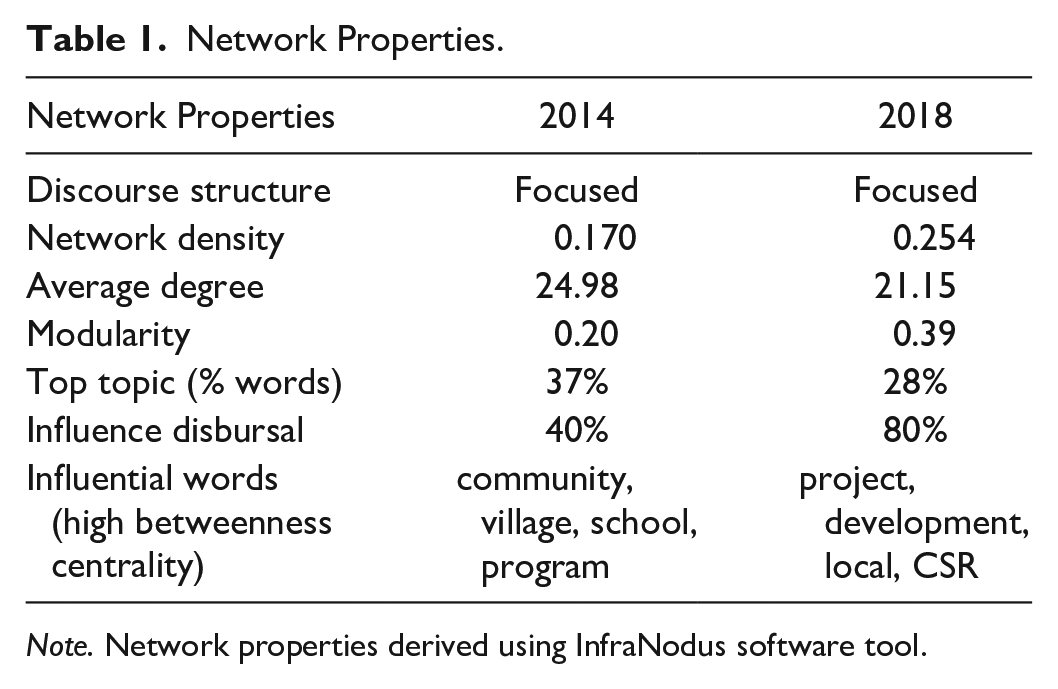
We present network properties for the years 2014 and 2018 in the Table 1. The Network density in two samples at 0.17 and 0.254, respectively, is within the acceptable range. A lower density of 0 to 0.5 achieves similar meaning in the large network because of the presence of closely-knit sub-groups (Friedkin, 1981). The average degree at more than 20 means that each node (word) on average is connected to 20 or more nodes. The thickness of lines represents the strength of connections between nodes. It is important to note that ties (lines) are undirected as they are based on co-occurrence of words and do not imply flow or causality.
Network Properties.
Note. Network properties derived using InfraNodus software tool.
Based on betweenness centrality, the most influential nodes in the year 2018 are “project”, “development”, “local” and “csr”. Betweenness centrality measures how often a node appears on the shortest path between any two random nodes in the network. A higher value indicates that a node acts as a junction for communication within the network. These nodes are responsible for meaning circulation across various communities of words. This analysis, in a way, confirms that with the advent of affirmative policy action, firms have become more focused on their CSR approach. While the current emphasis of extractive industry on social development and growth, surprisingly, environmental sustainability is not a priority.
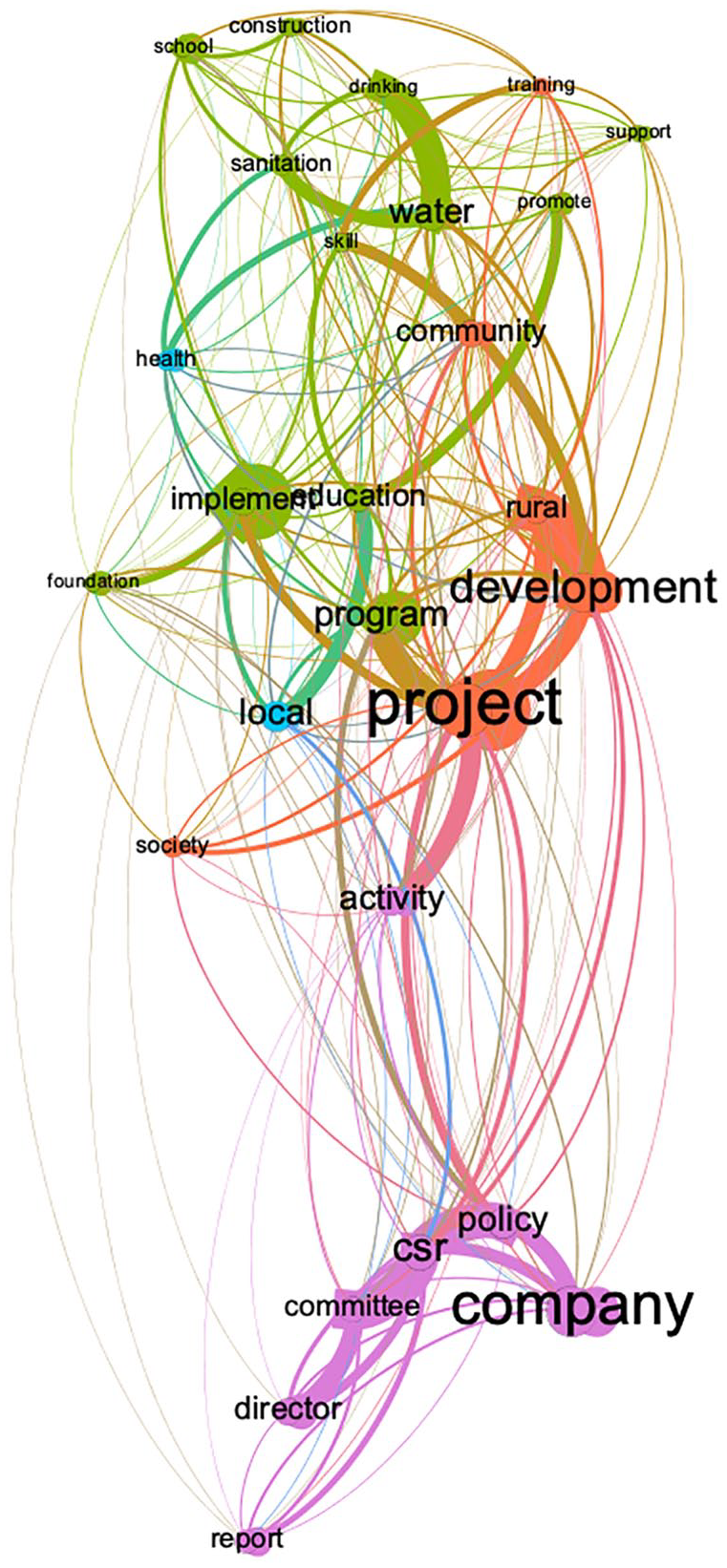
Figures 2 and 3 present the visualization of the text network using GEPHI software tool. Both graphs show color-coded grouping (community) of nodes based on modularity (Paranyushkin, 2011). Graphs use the Force Atlas Layout methodology for identification of community structure. This method propels the most connected nodes to the periphery in the graph, aligning the remaining nodes connected to them. A dense network reflects higher cohesion between nodes. Density depends upon the size of the network, and in our analysis, the size is restricted to 200 distinct words out of 8500 plus words in the raw text.

Community structure for the year 2014.
Community structure for the year 2018.
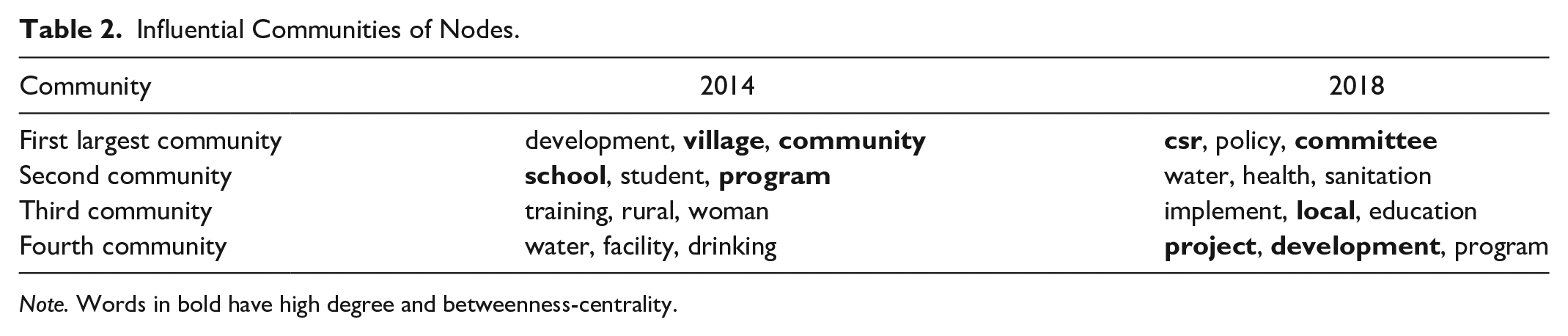
High level of modularity at 0.39 across the text in the year 2018 (Figure 3) indicates the partitioning of network in five tightly-knit communities that have dense connections within communities and light connections between communities. In contrast, the graph for the year 2014 (Figure 2) has a modularity of 0.20 and does not show distinct clusters or communities. A summary of prominent nodes is shown as bold in Table 2. The bold and more prominent nodes on both graphs have highest betweenness-centrality. High between-centrality nodes bridge communities to reveal the central and influential role of CSR as a developmental program. These nodes in the Figure 2 are: ‘community’, ‘village’, ‘school’, ‘program’. In the Figure 3, such nodes are: ‘project’, ‘development’, ‘local’, ‘csr’, and ‘committee’. The results are very different from a multi-sector sample by Singh et al. (2018), wherein they found that the lack of cohesive approach to CSR. Prominent words in their study were ‘positive’, ‘impact’, ‘socio-economic’, and ‘development’.
Influential Communities of Nodes.
Note. Words in bold have high degree and betweenness-centrality.
Based on Table 2, we can interpret the meaning of four largest influential communities of words. The top community in 2018 can be summarized as “Board appointed CSR committee”. This community is shown in the pink color code in Figure 3. The second largest community (light green color in Figure 3) is described as “health, water, sanitation” and when read in conjunction with the third community, it reveals the dominant theme of CSR, that is, improving quality of people through water and sanitation initiatives, by promoting education and health. Existence of the board-nominated CSR committee validates the Hypothesis-I that companies monitor CSR programs with in-house governance mechanism for better effectiveness and control. The number of members in the committee varies from 3 to 7 depending upon the quantum of CSR spends and size of board. In comparison, meaning in the communities for the year 2014 is the development at the local level through education, with no clarity on governance mechanism.
A comparison of essential concepts or nodes (Table 3) reveals that, over the years, mining and metal companies have focused their CSR programs on local communities. Previously, the CSR program was concentrated on training rural population for jobs, but lately, there is a definite shift toward health, sanitation as per the government agenda. This evidence means Indian mining companies construct the CSR discourse as a notion of responsibility toward society as well as national building.
Comparison of Influential Concepts.

Note. Company Law was amended effective March, 2014.
In the sample, eigenvector centrality (a measure of the influence of a node in the network) of (nodes) ‘direct’, ‘trust’, and ‘foundation’ that link to external networks is 0.48, 0.527, and 0.64, respectively. High centrality of these nodes supports the Hypothesis II that CSR program is implemented directly or through a privately held Trust or Foundation. Foundation is a non-profit body managed by representatives of the parent business firm (Elembilassery & Gurunathan, 2018) and has a proper organization structure and professional team competent to do social developmental work. Such external mechanisms lower the transaction cost of CSR because of the legitimacy they enjoy in the civil society and consequent freedom to involve outside experts.
Discussion and Conclusion
Though core sectors of energy, mining, forestry, oil and gas have a long history of voluntary CSR activities, but CSR engagements continue to suffer. Mining companies have potential to cause great damage if CSR engagements are done with poor understanding of local communities (Frederiksen, 2018). Weak community engagements and low investments by focal firms lead to operational and reputation risk (Frederiksen, 2018). In this context, Indian government proactively amended the Company Law to mandate CSR expenditure at 2% of profits. The affirmative action directed CSR to identified sectors, besides, bringing in significant private funds for social development. Disclosure of CSR expenditure was also mandated to close gaps between societal expectations and business practices. While generating significant revenues for shareholders, metal and mining companies continue to face challenges in social and environmental performance, thereby not achieving the desired outcomes of the CSR policy. There is a pressure from local communities who often question the legitimacy of firms toward local issues and environment protection. Winning the support along these two critical dimensions is expected to enhance the economic sustainability of firms.
Taking a multi-theoretic view, we used transaction cost economics and social network lens to evaluate CSR engagements and practices within the specific context of the extractive sector. We demonstrate how firms cover gaps in implementation and monitoring. Explicitly, we contribute to literature in two ways. First, we identify initiatives, themes and discourse as reflected in the CSR spending. Second, we strengthen the debate on CSR governance and implementation initiated by CSR scholarship.
Extractive sector uses vast land resources and emit toxic pollutants, so firms need a well-oiled CSR machinery to minimize the harmful impacts of operations on the society and the environment. From a myriad of initiatives, firms seek to rationalize CSR initiatives by working in tandem with local stakeholders such as consumers, regulators, employees and communities to decide and implement initiatives, thereby earning a reputation for themselves. In the Indian context, business groups and public sector enterprises help local community settlements near their manufacturing locations. Given the investment requirements and non-availability of skills for CSR implementation (Goyal & Kumar, 2017), firms took a multi-level view of CSR (Aguinis & Glavas, 2012) and developed a strong network of functionaries to implement their CSR policies effectively.
We used text network analysis, a qualitative analysis technique, to view the CSR projects and programs where companies spent their funds. Results depicted as network visualization graphs show that local social development occupies significant space in the CSR agenda, while environment sustainability gets little attention even after affirmative government policy advocated about it. Metal and mining companies undertake CSR for locals near manufacturing facilities. These local projects support essential services of water, health, education and sanitation. Another aspect of CSR is providing training to youth for skills up-gradation and income generation.
Against our hypothesized relationship about the presence of firm-dominated in-house governance structure for CSR initiatives, our findings also suggest that most companies in the sample have chosen to work with local private or municipal bodies in addition to working directly. Some CSR areas (such as water, health, sanitation) continue to be in the domain of civic bodies, their involvement is essential to deliver services as they understand the target better. Implementation through external organizations (community bodies or government or privately held trust) sets the need for more partnerships. Growing traction in CSR network partnerships attracts skilled professionals and other social actors (for example, Philanthropic Foundations, NGO) who have critical resources to influence implementation because of their network centrality about local social issues. Goyal and Kumar (2017) highlighted lack of skill and money as major barriers for CSR implementation. Professionals and social agents fill that gap between the local community and the firm. While, the business entity provides necessary funds, sets objectives, and creates a governing structure, the implementation is being done by social agents. Such inter-organizational networks enhance implementation efficiency by generating trust among recipients and act as a third tier in implementation governance. First and second tier being intra-organizational mechanisms of board and executive level committees, respectively.
Involvement of private parties alongside civic bodies yields better results for communities and businesses situated near to mines or metal smelting plants. From the local body perspective, the partnership is beneficial because firms provide funds to be harnessed for developmental purposes to root out social problems such as unemployment, health care, sanitation, illiteracy. For mining companies, infrastructure created in remote areas contributes significantly to the delivery of essential services of electricity and water to local settlements. By contributing CSR funds to local contextual issues, mining and metal companies expect to avoid the negative image of the industry being inimical to local villages and environment. As the cumulative flow of private sector CSR funds increases, firms will make CSR governing structure more productive by moving from direct mode to involvement of third parties or even local government bodies. However, the process of establishing and maintaining a robust social network is a time-consuming and effort intensive.
In conclusion, by being compliant to the local community, firms create shared value and views themselves as co-responsible actors seeking solutions to CSR challenges faced by the government. Engagement with affected parties (CSR recipients) generates social and relational capital. The relational capital built will make the firm “a corporation that cares” in the eyes of society, which will sustain the business in the long-term and provide competitive advantages.
Limitations and Future Directions
Our study is not free from limitations, which also suggest room for further research in this area. While the analysis covers and provides insights on a single industry from India, the experience from under-investigated contexts of CSR implementation may generate new and different understanding of CSR practices around the globe. Given the limitation of data linking local area engagement to overall social development, it is difficult to determine the success of specific CSR initiatives in bringing about social change. Mandated spending may also lead to suboptimal CSR decision or inefficient allocation of available resources. Nevertheless, the current study takes advantage of text network analysis to reveal hidden meanings in secondary reports. Impact of CSR on target segments is expected to become more visible as firms use technology (social media, websites) to reach and propagate their philosophies and mold CSR discourse in their favor.
In addition, adopting life cycle approach can be helpful in examining the changing CSR preferences among metal and mining firms, possible bias in the spending patterns. However, these are subjects for future research. Further research can also explore the relationship between various subcomponents of CSR in influencing sustainable regional development. Combining private sector spending with government spending and linking it to the overall development of locale of the extractive industry can measure the effectiveness of different modes of CSR implementation. Researchers can also investigate this relationship across other industrial sectors.
Footnotes
Appendix
List of Companies in the Sample.

| Company | Sub-industry |
|---|---|
| Coal India Ltd. | Mining and minerals |
| Gujarat Mineral Development Corporation | Mining and minerals |
| Hindustan Zinc Ltd. | Non-ferrous metals |
| Hindustan Copper Ltd. | Non-ferrous metals |
| Hindalco Industries Ltd. | Aluminum |
| Jindal Stainless (Hisar) Ltd. | Steel |
| Jindal Stainless Ltd. | Steel |
| Jindal Steel & Power Ltd. | Steel—sponge iron |
| JSW Steel Ltd. | Steel |
| KIOCL Ltd. | Steel—sponge iron |
| MOIL Ltd. | Mining and minerals |
| National Aluminum Company Ltd. | Aluminum |
| NMDC Ltd. | Mining and minerals |
| Steel Authority of India Ltd. | Steel |
| Tata Sponge Iron Ltd. | Steel—sponge iron |
| Tata Steel Ltd. | Steel |
| Vedanta Ltd. | Mining and minerals |
Acknowledgements
The author is gratefully thankful to anonymous reviewers who contributed significantly in improving the paper.
Declaration of Conflicting Interests
The author(s) declared no potential conflicts of interest with respect to the research, authorship, and/or publication of this article.
Funding
The author(s) received no financial support for the research, authorship, and/or publication of this article.
