




Abstract
The literature provides some evidence that the use of violent video games increases the risk for young people to develop aggressive cognitions and even behaviors. We aimed to verify whether exposure to violent video games is linked to problems of aggression in a sample of Italian children. Four questionnaires were administered to 346 children between 7 and 14 years of age, attending primary and secondary schools in Northern Italy. Variables measured were externalization, quality of interpersonal relationships, aggression, quality of coping strategies, and parental stress. Participants who preferred violent games showed higher scores for externalization and aggression. The use of violent video games and age were linked to higher levels of aggression, coping strategies, and the habitual video game weekly consumption of participants. Our data confirm the role of violent video games as risk factors for problems of aggressive behavior and of externalization in childhood and early adolescence.
Introduction
Video games (VGs) are among the most popular recreational activities of children and adolescents. More than two thirds of 6- to 17-year-old Italians (AESVI-ISPO, 2010) and of 16- to 19-year-old Europeans regularly use them (Interactive Software Federation of Europe, 2010). VG contents are often violent, requiring the player to overtly injure or kill “enemies” to progress in the game. These contents are often displayed with a very high degree of realism, due to the fast and constant technological evolution of consoles and personal computers.
As Gentile and Gentile (2008) point out, VGs are “exemplary teachers” and are among the most effective learning tools available to youth. Thus, the possibility of realistically mimicking aggressive behaviors could lead the player to learn and practice violent scripts. Regarding the outcomes of this “training,” short- and long-term effects of interaction with violent VGs were studied in the literature as early as the 1980s. Early results from the 1980s’ and 1990s’ research highlighted that exposure to violent VGs could encourage aggressive cognitions and behaviors in young players (cf. Adachi & Willoughby, 2011; Anderson et al., 2003; Kirsh, 2006).
From the 2000s, this field of study flourished, including experimental, cross-sectional, and longitudinal research as well as meta-analyses. A substantial body of research of various types—cross-sectional (Anderson & Dill, 2000; Anderson, Gentile, & Buckley, 2007; Funk, Baldacci, Pasold, & Baumgardner, 2004; Gentile, Lynch, Linder, & Walsh, 2004; Kirsh, 2006; Krahé & Möller, 2004), longitudinal (Anderson et al., 2007; Anderson et al., 2008; Gentile, Coyne, & Walsh, 2010; Hofferth, 2010; Ihori, Sakamoto, Kobayashi, & Kimura, 2003; Möller & Krahé, 2009), and experimental (Anderson & Carnagey, 2009; Anderson & Dill, 2000; Carnagey, Anderson, & Bushman, 2007; Greitemeyer, 2014; Hasan, Bègue, & Bushman, 2013; Kim & Sundar, 2013; Kirsh, 1998; Lee, Peng, & Klein, 2010; Saleem, Anderson, & Gentile, 2012; Sestir & Bartholow, 2010; Uhlmann & Swanson, 2004; Ybarra, Huesmann, Korchmaros, & Reisner, 2014)—show a very likely causal relationship between the habitual use of violent VGs and the presence of aggressive thoughts and behaviors in children and adolescents. Violent VG playing is correlated not only with those measures of aggression usually implemented in experimental studies (e.g., administering loud noises to other participants) but also with more serious forms of aggression such as antisocial and delinquent behavior (cf. DeLisi, Vaughn, Gentile, Anderson, & Shook, 2013). Also, recent research shows that the preference for violent VGs is associated with measures of sadism in everyday life (Greitemeyer, 2015). Finally, meta-analyses confirm these findings: Anderson et al. (2010) considered 136 different studies (total N = 130,534) and verified that exposure to violence in VGs is, on the whole, positively associated with aggressive behavior, aggressive cognitions, and physiological arousal, and negatively associated with empathy and prosocial behavior. A recent meta-analysis by Greitemeyer and Mügge (2014) confirmed these results, and showed that violent VGs increase aggression and decrease prosocial behaviors, while prosocial VGs promote prosocial outcomes.
The interplay between use of violent media—and specifically violent VGs—and the consequences on children and adults was analyzed according to a number of theories such as Cognitive Association Theory, Social Learning Theory, and Script Theory (for a review, see Anderson & Bushman, 2002). More recently, the General Aggression Model (GAM; Anderson & Bushman, 2002; Anderson & Carnagey, 2004; Anderson et al., 2007; De Wall & Anderson, 2011) has been established as one of the most influential models in explaining the effects of exposure to violent media on human aggressiveness. The model discriminates between distal factors (which influence behavior in the long term) and proximal factors (which influence behavior in the short term: Violent VG use is an example of a proximal factor). The model stresses an individual’s dispositional variables (e.g., personality), biological/physiological variables, and environmental variables. These variables are taken to assume the role of a “background” on which proximal processes occur, both influencing the actual behavior and engaging as feedback on the distal processes. In the long term, these factors affect the personality, the physiological processes, and the environment of the person. According to GAM, the reiteration of aggressive conduct will influence future social behavior, modifying both the individual and his or her context. On the whole, GAM is considered an empirically validated model that integrates the effects of violent VGs on aggression into a comprehensive theoretical framework.
A Risk and Resilience Framework for VG Use
Research has recently proposed a risk-resilience framework with regard to the effects of violent VG on aggression. As Gentile and Bushman (2012) point out, using violent media could be seen as just one among various risk factors for subsequent aggressive behavior, such as hostile attribution bias, prior involvement in a physical fight, gender, and prior physical victimization. Thus, being exposed to violent VGs is not the only factor that potentially predicts aggression. This exposure—to exert detectable effects on the user—must link with other risk factors with a reciprocal exacerbating down-spiral effect (cf. Slater, Henry, Swaim, & Anderson, 2003). In this view, the fact that most children never commit an act of overt aggression despite having possibly consumed a lot of media and VG violence is explained by the existence of protective factors, such as parental involvement in the use of media and VGs (Gentile, Reimer, Nathanson, Walsh, & Eisenmann, 2014).
The degree of violence of VGs is not the only variable taken into account as a risk factor. Also, the amount of VG playing seems to be correlated with measures of aggression in childhood and adolescence. As Kuntsche (2004) and Wallenius, Punamäki, and Rimpelä (2007) point out, more hours per week of VG playing were correlated with measures of aggression. Usually, children who prefer violent VGs are likely to play with VGs for more hours than children who play non-violent VGs (cf. Olson et al., 2007).
With reference to the interplay between age and use of violent VGs, von Salisch, Vogelgesang, Kristen, and Oppl (2011) point out that there seem to be some differences between primary school children and early teenagers. In primary school, the preference for VGs rises from 42% of first graders to 86% of sixth graders (cf. Feierabend & Rathgeb, 2009), signaling an emerging interest in VGs, including violent ones. Not surprisingly, von Salisch et al. found that in this age group, it seems that the selection hypothesis (e.g., more aggressive children tend to choose more violent VGs) prevails over the socialization hypothesis (e.g., using more violent VG puts children at risk of developing aggression problems). This is due to a progression of preference formation: Children first experiment with different types of VGs, then they differentiate and refine their preference for specific types of electronic games. Literature has not yet completely addressed other potential risk and protective factors in the association between use of violent VGs and increase in violent behaviors. At the moment, at least three dimensions that are highly relevant from a developmental point of view have been overlooked in the literature: quality of interpersonal relations, emotional and cognitive coping strategies, and parent–child relationship. To date, the literature has not yet assessed the possible correlation between violent VG use and interpersonal relations (cf. Homer, Hayward, Frye, & Plass, 2012).
Likewise, the relation between coping strategies and interaction with violent VGs has received little attention in the literature. A notable exception is the work from Reinecke (2009), which highlights that using VGs for recovering from stress and pain is linked with emotion-focused coping strategies. On a broader perspective, video gaming seems to present some cognitive and emotional overlapping with those coping strategies considered less adaptive, such as avoidance and distraction. However, to our knowledge to date, no research has specifically addressed video gaming as a coping strategy. Olson (2010) pointed out that children often report using VGs as a means to regulate their feelings, but the precise nature of coping strategy could not be determined because results were derived from a survey and not from a standardized coping measure.
Finally, with regard to the third point of interest, we could hypothesize an interaction between the use of violent VGs and difficulties in the parent–child relationship. We could think that a parent who has to deal with an aggressive child could feel stuck and immobilized into a stressful relationship with his or her son/daughter. The opposite could also hold true: A child whose parent is lacking responsivity due to a high level of stress could use violent VGs—which are often the most thrilling and immersive—as a means to momentarily escape from this difficult relationship. To date, to our knowledge, no research has addressed this issue, nor tested this hypothesis.
Aims of the Research
The research has the general aim of verifying in an Italian sample whether the preference for violent VGs is linked to problems of aggressive behavior, of externalization, of interpersonal relations, to worse coping strategies, and to parental stress. More specifically, it is hypothesized that,
Method
Participants
Questionnaire packets were delivered to 471 children attending primary and secondary schools in Northern Italy. Of these, 125 (26.53%) questionnaire packets were discarded because one or more of the questionnaires were not completely answered. The 346 remaining participants were between 7 and 14 years old (M = 11.64; SD = 1.17). The participants were evenly divided by gender, with 170 male participants (49.1%; mean age = 11.66; SD = 1.16) and 176 female participants (50.9%; mean age = 11.63; SD = 1.17). Participants were from the middle class (data assumed via a demographic questionnaire). All participants were of Caucasian ethnicity.
Procedure
Heads of the schools approved the school’s participation in the research project, agreed to the collection of data, and informed the parents about the research. Researchers then explained the research to the students and gave them an envelope to be handed over to their parents. The envelope included a document that described in detail the methodology, aims of the research, and the contact information of the experimenter in charge of the research; a consent form to be signed by both parents prior to the administration of the instruments; and Child Behavior Checklist (CBCL) and Parenting Stress Index (PSI) questionnaires (cf. below) to be compiled together by both parents if they agreed to participate in the research. The following day, experimenters presented the research to the classrooms involved in the data collection, collected the signed consent forms and the compiled questionnaires, and collectively administered the questionnaires to the children whose parents granted consent. Participants were made aware that they could withdraw from the research at any moment.
Measures Administered to Children
Interpersonal relations
TRI (Test delle relazioni interpersonali [Test of Interpersonal Relations]; Bracken, 1993; Italian version: Ianes, 1996) is composed of 105 items on a 1 to 4 Likert-type scale and measures the quality of interpersonal relationships (example of an item: “I am treated fairly by my mother”). The scale assesses the overall quality of relationships and the quality of relations in specific domains: with parents, with peers, and with teachers. Only the overall score of interpersonal relations was considered for this study. Cronbach’s alpha was .96 for the overall score.
Coping strategies
CCSC-R1 (Children’s Coping Strategies Checklist–Revised 1; Ayers & Sandler, 2009; Italian version: Camisasca, Caravita, Milani, & Di Blasio, 2012). The instrument measures the preferential cognitive strategies used by children and adolescents to cope with situations perceived as problematic or stressful. It consists of 54 items on a 1 to 4 Likert-type scale (example of an item: “When I have a problem, I listen to music”). The instrument provides four scales for the following coping strategies: Active, Support Seeking, Avoidance, and Distraction. The highest score of the four scales indicates the subject’s preferred coping strategy. Cronbach’s alphas were .81 for the Active scale, .79 for the Support Seeking scale, .77 for the Avoidance scale, and .79 for the Distraction scale.
Aggression
AFV (Indicatori della capacità di adattamento sociale in età evolutiva–Aggressività Fisica e Verbale [Indicators of Physical and Verbal Aggression]; Caprara, Pastorelli, Barbaranelli, & Vallone, 1992). The instrument measures the tendency to commit aggressive physical and verbal acts by means of 15 items on a 1 to 3 Likert-type scale (example of an item: “I happen to have the impulse to hit someone”). 1 It provides a single overall score of aggressive behavior. Cronbach’s alpha was .84.
Ad hoc questionnaire for VG habits
Instrument comprised of 13 items: 7 open questions and 6 questions on a 1 to 10 Likert-type scale. The questionnaire was developed to investigate habits in the use of VGs, including the level of violence of the preferred VGs and the amount of VG use. For this research, two factors were taken into consideration: the preferential use of violent VGs and the frequency of use of VGs per week (independently of their content). Participants were requested to specify their three preferred VG titles in the last year. Subsequently, VG titles were categorized as “violent” or “non-violent” by two independent double-blind raters, who are expert 2 in VGs (Cohen’s k = .830). Participants who mentioned at least two violent VGs were categorized as violent VG users. The rating of VGs was coherent with the Pan European Game Information (PEGI) rating for all VGs (cf. Milani, Camisasca, Caravita, & Di Blasio, 2012). Moreover, the degree of violence in the VGs used by each participant was computed by multiplying the violent content and the weekly time spent on VGs (similarly to Gentile et al., 2014).
Measures Administered to Parents
Externalization
CBCL (Child Behavior Checklist; Achenbach, 1991; Italian version: Frigerio, 2001). The instrument measures adjustment problems in children and adolescents and is comprised of 112 items on a 1 to 3 Likert-type scale, requiring parents to rate how often each applies for his or her child (example of an item: “Can’t concentrate, can’t pay attention for long”). It consists of eight syndromic scales and two general scales of Internalization and Externalization. This article is concerned with scores more relevant to behavioral problems: Externalization, Aggressive behavior, and Delinquent behavior. Cronbach’s alphas were as follows: for Externalization .87, for Aggressive behavior .82, and for Delinquent behavior .84.
Parenting stress
PSI (Parenting Stress Index; Abidin, 1995; Italian version: Guarino, Di Blasio, D’Alessio, Camisasca, & Serantoni, 2008). The instrument measures the degree of stress experienced by a parent while exercising his or her parental role. The measure consists of 36 items on a 1 to 5 Likert-type scale and provides a general score of parental stress (example of an item: “I feel trapped by my responsibilities as a parent”). Cronbach’s alpha was .81.
Results
Data Analysis Strategy
Data were analyzed following a three-step strategy. First, descriptive analyses were performed on the sample. Second, two sets of student’s t tests and chi square tests were performed to assess gender differences and differences between users and non-users of violent VGs. Third, two sets of three-step hierarchical regressions were performed to verify the association of violent VG use with externalization (CBCL) and aggression (AFV). Hierarchical regressions were performed to highlight the contribution of each single potential predictor of externalization and aggression. In particular, we decided to adopt a three-step approach to single out the relative contribution to variance of the following subsets of variables: (a) the habitual use of violent VGs; (b) demographic variables such as age and gender; and (c) other potential predictors of problems of aggression such as coping strategies (CCSC-R1), parental stress (PSI), and quality of relationships (TRI).
Descriptive Statistics
All the participants (100.0%) played VGs (97.7% owned a specific VG machine; that is, personal computer and/or VG console) for an average of 6.84 hr per week (SD = 7.24; range = 0-42). One third (33.5%) of participants (N = 116) habitually used violent VGs, and the degree of violence in the VGs used by the participants ranged from 0 to 84 (M = 10.25). The mean score for aggression (AFV) was 15.99 (SD = 3.68). This score is comparable to that of the general population (cf. Caprara et al., 1992).The CBCL Externalization mean score was 9.20 (SD = 6.48); 88.6% of participants were in the non-clinical range. These distributions also are in line with those of the general population (cf. Frigerio, 2001). The prevalent coping strategy was Distraction (37.9%), followed by Active (24.6%), Support Seeking (20.8%), and Avoidance (16.8%). The mean score for parenting stress (PSI) was 68.42 (SD = 17.31), and also this score is in line with that of the general population (cf. Guarino et al., 2008).
Gender Differences
Boys obtained higher aggression scores than girls in the AFV (16.87 vs. 15.14; t = 4.47; p < .001) and in the number of hours per week spent using VG (8.42 vs. 5.31; t = 4.07; p < .001). Boys also used more frequently violent games than girls (54.1% vs. 13.63%), χ2 (1) = 65.58, p < .001, and their score of violence in VGs was higher (14.12 vs. 6.44), t = 5.81, p < .001. These differences were expected and are coherent with the literature (Caprara et al., 1992; Olson et al., 2007). No gender differences emerged concerning the quality of relationships (TRI), coping strategies (CCSC-R1), and parenting stress (PSI).
Differences Between Users and Non-Users of Violent VGs
As shown in Table 1, the participants in our sample who use violent VGs showed higher scores on externalization (CBCL), aggression (AFV scale), and on avoidance coping (CCSC-R1). They also used VGs for more hours per week, and are older. No significant differences were found regarding the quality of interpersonal relations (TRI), the three remaining coping strategies (CCSC-R1), or the distribution of frequency for the coping strategy preferentially used, χ2 (3) = 2.42, p > .05. Data are presented in Table 1.
Comparisons Between Users and Non-Users of Violent VG in Terms of Age, Weekly Hours of VG Use, Externalization, Quality of Relationships, Aggression, Coping, Parenting Stress (t Tests and χ2).
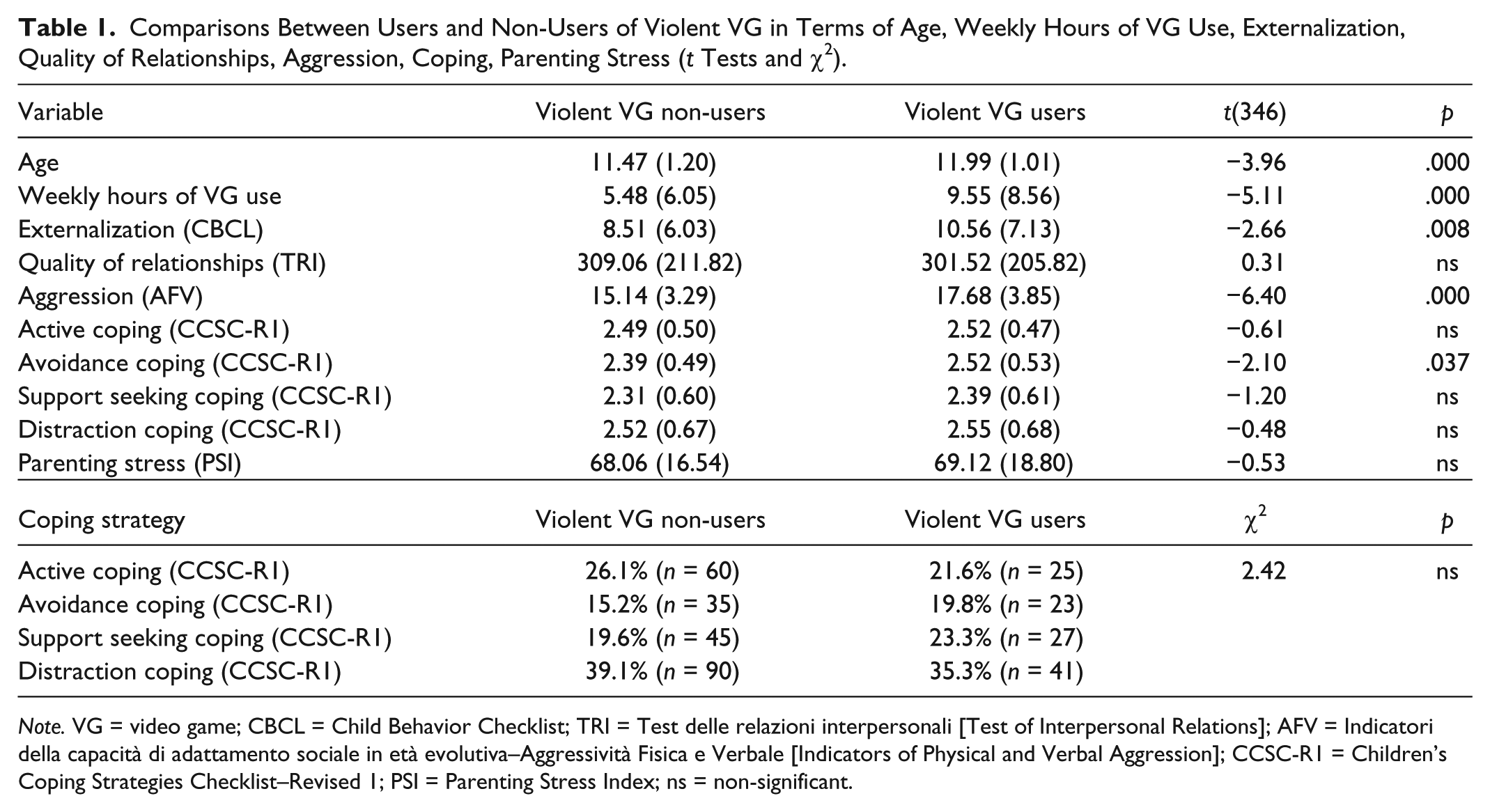
Note. VG = video game; CBCL = Child Behavior Checklist; TRI = Test delle relazioni interpersonali [Test of Interpersonal Relations]; AFV = Indicatori della capacità di adattamento sociale in età evolutiva–Aggressività Fisica e Verbale [Indicators of Physical and Verbal Aggression]; CCSC-R1 = Children’s Coping Strategies Checklist–Revised 1; PSI = Parenting Stress Index; ns = non-significant.
Regression Analyses
To further test the four hypotheses, two sets of three-step hierarchical regressions were performed. In the first regression model, the aggression score (AFV) was inserted as criterion variable, and the following variables were inserted as predictors: preferential use of violent VGs [Step 1], age and gender [Step 2], coping strategies (four CCSC-R1 scores), quality of relationships (TRI), and parental stress (PSI) [Step 3]. In the second regression model, the externalization score (CBCL) was inserted as criterion variable, and the following variables were inserted as predictors: preferential use of violent VGs [Step 1], age and gender [Step 2], coping strategies (four CCSC-R1 scores), quality of relationships (TRI), and parental stress (PSI) [Step 3]. As can be seen in Table 2, preferential use of violent VGs remains a significant predictor of problems of aggression in all three steps. Even when other potential risk factors for aggression such as parental stress, dysfunctional coping strategies, and interpersonal relations are inserted in the model, the preferential use of violent VGs remains the more relevant predictor of aggressive problems. Moreover, the increase in R2 is non-significant from Step 2 to Step 3: Inserting the other potential risk factors do not enhance the model, ΔR2 = .19, F(6, 342) = 1.34, p > .05. On the contrary, as shown in Table 3, with regard to externalization, the preferential use of violent VGs is a significant predictor in Steps 1 and 2 but not in Step 3. In Step 3, the predictive weight of parental stress and interpersonal relationships overshadows the use of violent VGs. Moreover, the increase in R2 from Step 2 to Step 3 is very significant, ΔR2 = .33, F(6, 342) = 30.87, p < .001.
First Hierarchical Regression Model.

Note. Criterion variable: aggression score (AFV). Predictors: preferential use of violent VGs [Step 1], age and gender [Step 2], coping strategies (four CCSC-R1 scores), quality of relationships (TRI), and parental stress (PSI) [Step 3]. VGs = video games; TRI = Test delle relazioni interpersonali [Test of Interpersonal Relations]; CCSC-R1 = Children’s Coping Strategies Checklist–Revised 1; PSI = Parenting Stress Index.
p < .05. **p < .01. ***p < .001.
Second Hierarchical Regression Model.
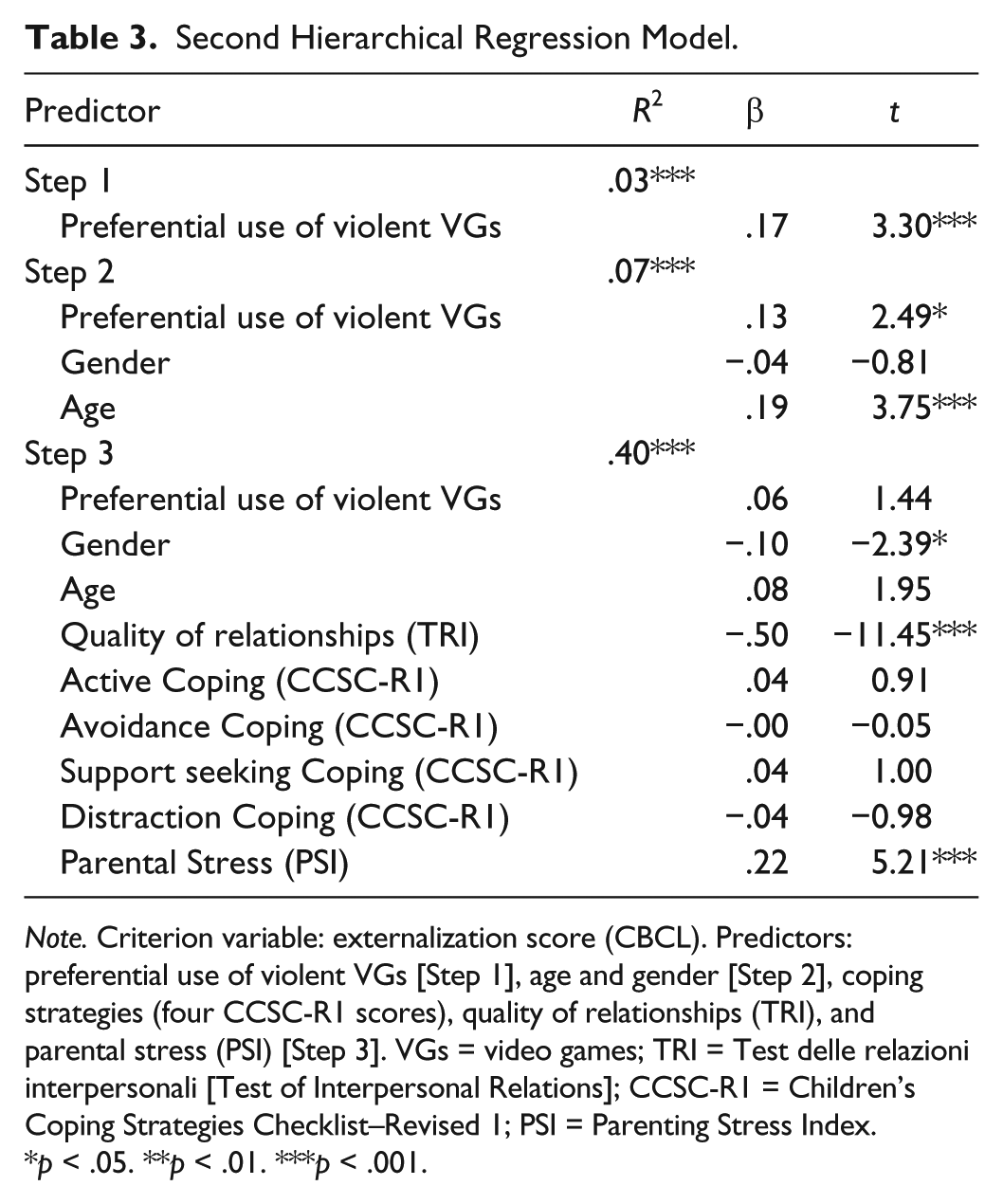
Note. Criterion variable: externalization score (CBCL). Predictors: preferential use of violent VGs [Step 1], age and gender [Step 2], coping strategies (four CCSC-R1 scores), quality of relationships (TRI), and parental stress (PSI) [Step 3]. VGs = video games; TRI = Test delle relazioni interpersonali [Test of Interpersonal Relations]; CCSC-R1 = Children’s Coping Strategies Checklist–Revised 1; PSI = Parenting Stress Index.
p < .05. **p < .01. ***p < .001.
Discussion
The results of this study support acceptance of Hypotheses 1 and 3 and rejection of Hypotheses 2 and 4.
In particular, participants who use violent VGs show more externalizing problems, more aggression, and more avoidant coping strategies compared with participants who do not use violent VGs. They also tend to use VGs for more hours per week compared with participants who do not use violent VGs. Also, users of violent VGs are older than users of non-violent VGs. This result seems to support von Salisch et al.’s (2011) “progression” in the development of a preference for violent VGs: Younger children tend to experiment with different types of VGs, and the more aggressive of them choose violent VGs over non-violent ones in keeping with the “selection hypothesis.”
On the whole, the results allow us to draw some conclusions. First, there is an association between the preferential use of VGs with violent content and problems of aggression. Our data show that the users of violent games obtained higher scores on all the scales related to problems of aggressiveness, namely, AFV and CBCL externalization. This result seems to be solid, as it has not only been found by contrasting via t tests the two populations of users and non-users of violent VGs but also been confirmed in the two models of regression analysis.
However, with regard, more specifically, to problems of externalization, the habitual use of violent VGs seems to be less relevant as a predictor than other—more significant—risk factors such as parental stress and interpersonal relations. Using violent VGs seems to put minors at risk of developing externalizing problems only in the presence of other more significant risk factors. This result seems to be quite in line with the literature, as shown by Gentile and Bushman (2012): Violent media exposure is not the most important risk factor for developmental problems, when other more contextual risk factors are taken into account. Moreover, the construct of externalization itself is an overarching developmental outcome that encompasses different problems and not just those of aggression (i.e., attention problems, defiant and rule-breaking behavior). Thus, it seems understandable that the association of a rather proximal and limited risk factor such as violent VG exposure with externalization ceases to be detectable when more contextual factors enter into play. Nonetheless, our data seem to confirm the role of violent VGs as a potential risk factor for problems of aggressive behavior and of externalization. Again, as the literature points out, it is unlikely that using violent VGs alone could be a necessary or sufficient cause for an increase in aggression or externalizing behavior. Rather, it is the combination of multiple risk factors that increases the risk of aggression or externalizing behavior (cf. Gentile & Bushman, 2012).
The outcomes of our research, of course, can hardly be considered definitive as we could not control the effect of other potential mediating variables such as the general attitude toward aggressiveness witnessed by the child in his or her family and proximal environment, the degree of involvement of parents in children’s play with VGs, the level of cognitive development of the child or preadolescent, or—more generally—the child’s temperament and personality traits. However, as longitudinal research on the topic points out, the effects of violent VGs upon aggressive behavior and cognitions seem to be more relevant than the effects of violent behavior and cognitions upon the choice of VGs. In other words, the socialization hypothesis is more relevant than the selection hypothesis (cf. Möller & Krahé, 2009), at least for older children and early teenagers. Moreover, as the “downward spiral” effect suggests (cf. Slater et al., 2003; von Salisch et al., 2011), the more a child chooses violent VGs, the more he or she will be reinforced in aggressive thoughts and representations, which in turn will lead him or her to opt for violent VGs. Moving from these assumptions, it is likely that also in our sample, the correlation between the use of violent VGs can be ascribed to the socialization hypothesis: Children who spend more time playing more violent VGs are at risk of developing problems of aggression.
With regard to coping strategies, a significant difference emerged between users and non-users of violent VGs. Participants who use violent VGs have higher scores in the Avoidance Coping as measured by the CCSC-R1. From a cognitive point of view, this result suggests that there could be an overlap between the decision of playing a violent VG and the efforts to avoid disturbing thoughts. Given the fact that violent video games are often the most enthralling from a perceptive point of view, this result is not surprising. The work from Reinecke (2009) seems to support this hypothesis.
Unfortunately, with regard to coping strategies, at the moment, our data do not allow us to assess whether playing VGs puts youth at risk of being more aggressive or whether it is used as a means to canalize troubling thoughts and impulses. Both explications could hold true at the same time: A child who habitually chooses to play violent VGs becomes slightly more prone to aggressive thoughts and cognitions. In turn, when troubled by something, this child could resort more easily to violent VGs as a means to cope with the situation, possibly due to more violent game-related cognitions and also to the availability of more violent game titles in his or her gaming library. Indeed, sometimes children use VGs also as a mean to regulate feelings (cf. Olson, 2010). What remains still unclear is whether children specifically choose violent VGs over non-violent VGs as a coping strategy, particularly when they need to deal with aggressive thoughts. Some results from Olson et al. (2007) seem to support this view, but more research is needed about this issue.
Contrary to our expectations, neither parenting stress nor the quality of interpersonal relations added a significant contribution to the model. With regard to the first, it could be argued that parenting stress is quite a distal factor in the interplay between familial relational and emotional climate and children’s management of free-time activities. Of course, parental stress has a great impact upon the overall family climate, but it is difficult to single out a clear significant effect of parenting stress upon the children’s media choice. Ferguson, San Miguel, and Hartley (2009), in fact, showed that although the family climate—in terms of negative relations with adults and family conflict—was a potential predictor of aggression, it was not specifically correlated with the use of violent VGs. More research is needed on this topic to clarify the impact of family climate—and particularly of parental stress—upon the media choice of children.
With regard to interpersonal relations, Goldstein (1999) argues that—at least for boys—violent VGs (and violent media in general) could actually be a means for bonding relationships with peers. Jansz (2005), in fact, remarks that male adolescents in particular could decide for a violent VG over a non-violent VG also due to their potential for socializing with peers’ negative emotions such as anger, fear, and disgust, and for sharing insecurities related with the acquisition of a more adult identity. Olson, Kutner, and Warner (2008) found similar results in a series of focus groups with young video gamers. Olson et al. (2007) found that the use of violent or M-rated VGs in childhood and preadolescence is linked with social play with friends, rather than with solitary activities. Olson et al. (2009), finally, speculate that the use of M-rated VGs could be seen as normative, at least for boys, in preadolescence. Thus, we could conclude that, from this point of view, the use of violent VGs could be expected and even be highly regarded by peers, especially by male teenagers.
Limitations and Future Directions
The research presents some limitations. First, the questionnaires administered—although being appropriate for the measurement of variables of interest—are self-report. While our study included multiple informants (children and parents), it would be appropriate to include measures from more sources (e.g., teachers).
Second, the instrument on Coping was not specifically designed to assess the use of VGs as a specific coping strategy. Thus, data about coping strategies need to be considered conservatively as participants were not specifically asked if they used VGs as a means to deal with stress or difficulties.
Third, the most evident limitation of the research is its correlational methodology. The presence of simple relations of co-presence between the use of violent VGs and problems of aggressiveness does not allow us to draw any conclusion in terms of causality. Future longitudinal studies will allow the amending of these limitations and consolidate these preliminary results.
To conclude, this research seems to confirm the general results of the international literature also in the Italian setting. The connection between the use of violent VGs and problems of aggressiveness in children and preadolescents seems to be quite solid.
Footnotes
Acknowledgements
The authors wish to acknowledge Chiara Altamura, Giulia Cerboni, Federica Forte, Arianna Gianotti, Massimiliano Magri, and Simona Tafuri for the collection of questionnaires and for the data entry. We also wish to thank Alessio Comassi for the rating of VG titles’ level of violence.
Declaration of Conflicting Interests
The author(s) declared no potential conflicts of interest with respect to the research, authorship, and/or publication of this article.
Funding
The author(s) received no financial support for the research and/or authorship of this article.