




Abstract
This research study aims at contrasting a structural model of the associations between the alcohol consumption, tobacco dependence, and the problematic use of video games with motivational climate toward sport depending on the category of sports practiced in a sample of Physical Education university students. The sample consisted of 775 university students from the Autonomous Community of Andalusia (Spain), aged between 21 and 35 (22.22 ± 3.76) years. The instruments used were the Perceived Motivational Climate in Sport Questionnaire (PMCSQ-2), the Alcohol Use Disorders Identification Test (AUDIT), the Fagerström Test for Nicotine Dependence (FTND), and the Questionnaire of Experiences Related to Video Games (QERV) questionnaires. A path model that fitted properly in the multigroup analysis for both categories of sports was used, χ2 = 19.843; gl = 8; p = .011; comparative fit index (CFI) = 0.911; normed fit index (NFI) = 0.903; incremental fit index (IFI) = 0.912; root mean square error approximation (RMSEA) = 0.085. An inverse association was shown between task climate and tobacco consumption in individual sports, being weaker in collective sports. This association is not significant for collective sports, but it is for individual sports for ego climate. However, a positive association was found between ego climate and the use of video games in individual sports, not being significant in the case of collective sports. The importance of promoting motivational climates oriented toward tasks that are based on the practice of collective sports is established, because they could act as protective factors against the development of addictive behavior in university students.
Introduction
The use of harmful substances is popular among university students, encouraged by the influence of peer groups, absence of parental control, and contextual and cognitive changes produced during this period (Kellam et al., 2014). Alcohol intake is favored by the fact that it becomes a means of socialization, because its consumption creates a feeling of euphoria being also an emotional facilitator (Mays, DePadilla, Thompson, Kushner, & Windle, 2010). In the case of tobacco, it is a psychoactive drug that alters emotions and its consumption produces high levels of addiction (Khan et al., 2012; Sønderlund et al., 2014). We must not forget the problematic use of screen digital leisure amoung young people, which usually goes unnoticed and is linked to serious health problems such as eye diseases and diseases related to overweight such as diabetes, cholesterol, joint problems, or obesity (Chacón et al., 2017a; Chamarro et al., 2014). Likewise, alcohol and tobacco consumption produce more than 4 million annual deaths worldwide, creating other conditions such as COPD (Chronic Obstructive Pulmonary Disease) or heart diseases (Gupta et al., 2014). Thus, it becomes essential to treat the abuse of harmful substances in young people, as well as to promote its prevention by several sections of society (Khan et al., 2012).
Multiple studies have demonstrated how physical activity and sport can constitute a way of solving unhealthy habits, specially connected to digital sedentary leisure, the consumption of substances as alcohol and tobacco, or even other addictive and pathological behaviors (Ferriz, González-Cutre, Sicilia, & Hagger, 2015; Khan et al., 2012). In this sense, it is interesting to study motivational aspects in sports, with the objective of analyzing their relation with consumption of this kind of substances, especially at a stage in life when they are widely used as is the period at university (Chacón et al., 2017a). The reason is that Clark, Camiré, Wade, and Cairney (2015) and Atkins, Johnson, Force, and Petrie (2015) have demonstrated how the habit of practising sports and being physically active have a double perspective facing these problems, because depending on its features, sport could be a protective factor in some risk behaviors regarding harmful habits.
The Achievement Goal Theory developed by Newton and Duda (1993) represents the main theoretical framework used in the explanation of motivational factors associated with sport practice (Castro-Sánchez, Zurita-Ortega, & Chacón-Cuberos, 2019a; Moreno et al., 2011). This theory establishes that a person’s motivation in sports will be determined by goal orientation or established targets (Jõesaar & Hagger, 2012). Achievement goals can create two differentiated motivational climates, which are task-oriented and ego climates (Méndez-Giménez, Fernández-Río, & Cecchini-Estrada, 2014; Reinboth & Duda, 2006). The first one refers to those individuals whose motivations are defined by intrinsic, more self-determined motivations, such as the practice of sport just because of the satisfaction and amusement perceived, the social component inherent to sport, and the effort to improve abilities (Curran, Hill, Hall, & Jowett, 2015). On the other side, goals oriented toward ego are defined by extrinsic motivations, which are usually associated with competitiveness, the achievement of a better performance, and recognition of rivals or even punishment for mistakes (Erturan-Ilker, Yu, Alemdaroğlu, & Köklü, 2018; Méndez-Giménez et al., 2014).
Based on the aforementioned, various authors have studied existing relations between motivational climate oriented toward sports and specific physical-healthy habits. Chan et al. (2015) analyze how self-determined motivations are connected with anti-doping behavior in athletes, coming to the conclusion that those intrinsic motivations can prevent behavior associated with doping. Clark et al. (2015) reveal how the practice of sport is associated with psychosocial factors that help predict substance abuse in youth, finding that self-determined motivations are linked to high levels of self-esteem, self-regulation, and prosocial behavior, acting these as protective factors against alcohol and tobacco consumption.
Finally, Castro-Sánchez et al. (2015) and Chacón et al. (2017b) demonstrated a direct connection between motivational climate in sport and alcohol and tobacco consumption in teenagers, as well as the use of video games in emerging adulthood, coming to the conclusion that goals oriented toward ego were associated with harmful habits. However, no studies have been found analyzing existing fluctuations in relations between motivational climate in sport and harmful habits regarding kind of sport practiced, leaving a fertile field of study that will help in the setting of patterns and definition of features leading to these kinds of habits.
Therefore, this research study pursues these main objectives: (a) analyze relations between motivational climate toward sport and variables associated with addictive behavior such as consumption of tobacco, alcohol consumption, and problematic use of video games; (b) to contrast a structural model that gives explanations of the addictive behavior based on motivational climate toward sport in Physical Education university students; (c) analyze differences between the variables studied regarding the category of sports practiced by means of a multigroup analysis in the path model.
Material and Method
Design and Participants
A nonexperimental research study was carried out, being ex post facto, descriptive, and with a single measurement in a single group. The sample consisted of 775 university students from the eight provinces in the Autonomous Community of Andalusia (Spain), with a representation regarding gender of 58.7% (n = 455) men and 41.3% (n = 320) women and aged between 21 and 35 (22.22 ± 3.76) years. It is important to note that, within the selected sample, 52.6% (n = 408) practiced individual sports, whereas 47.4% (n = 367) practiced collective sports. Moreover, as selection criteria of the sample, it was required to be a student of Physical Education in the Degree in Primary Education in any of the eight provinces in Andalusia. A total of 1167 students were enrolled in the school year 2016/2017. From this population, a sample of 775 students was selected using random sampling (sampling error of 0.05; IC = 95.5%).
Measures
The first scale used for data collection was the Perceived Motivational Climate in Sport Questionnaire (PMCSQ-2) created by Newton and Duda (1993) and validated into Spanish by Balaguer, Castillo, and Duda (2003). This scale is composed of 33 items that are rated by a 5-point Likert-type scale (e.g., Each student contributes in an important way), which ranges from Strongly disagree to Strongly agree. Motivational climate creates two factors with three categories each. Task climate includes Cooperative Learning (items 11, 21, 31, and 33), effort/improvement (items 1, 8, 14, 16, 20, 25, 28, and 30), and Important Role (items 4, 5, 10, 19, and 32). Ego climate includes Punishment for Mistakes (items 2, 7, 9, 15, 18, and 27), Unequal Recognition (items 3, 13, 17, 22, 24, 26, and 29) and Member Rivalry (items 6, 12, and 23). This instrument obtained a reliability of α = .821, which is acceptable.
In addition, the Questionnaire of Experiences Related to Video Games (QERV) was used to assess the problematic use of video games. This scale was validated in teenagers by Chamarro et al. (2014). The instrument is made up of 17 negatively worded items, which are rated by means of a Likert-type scale with four options (1 = Hardly ever; 2 = Sometimes; 3 = Several times; 4 = Almost always). Internal consistency of the instrument was α = .942, upper than the value obtained by Chamarro et al. (2014) in the original research (α = .870).
The consumption of harmful substances was considered including the consumption of alcohol and tobacco was considered. The Fagerström Test for Nicotine Dependence was used for tobacco consumption. This scale was validated by Heatherton, Kozlowski, Frecker, and Fagerström (1991) and translated into Spanish by the research developed by Villareal-González (2009). This scale enables the measuring of the quantity of cigarettes smoked by the teenager, his craving for smoking, and nicotine dependence. It is made up of six items, four of them dichotomous (0 = No and 1 = Yes), whereas the other two are rated by means of a Likert-type scale with three options of response. The reliability of this scale was α = .958, which was similar to the value showed by Villareal-González (2009) in the original research study (α = .970). Moreover, the Alcohol Use Disorders Identification Test (AUDIT), which was created by Saunders, Aasland, Babor, De la Fuente, and Grant (1993) and translated into Spanish by Rubio (1998), was used for the assessment of alcohol consumption. This scale is made up of 10 items, the eight first rated by a 5-point Likert-type scale, where 0 is Never and 5 is Daily. Moreover, the last two items are rated using a 3-point Likert-type scale, which is scored with 0, 2, and 4 points. Thus, this instrument is rated by means of a summarize ranging from 0 to 40 points. Rubio (1998) obtained α = .800 in the original study, whereas the current research study obtained α = .746.
Finally, an ad hoc questionnaire was used to know the sociodemographic variables related to sport practice. This included three questions considering gender, age, and type of sport practiced.
Procedure
Collaboration of the participants was requested by an informative letter drafted in the Corporal Expression Area of the University of Granada, and provided to university students studying Physical Education in the degree in Primary Education in the eight provinces of Andalusia by teaching staff in the Department of Didactics of Musical, Plastic and Corporal Expression and of Physical Education and Sports of the different universities. The letter detailed the nature and aims of the research study, besides requesting their informed consent to participate in this research study.
Subsequently, data were gathered. A total of 839 university students took part in the study, 64 questionnaires were invalidated because they were incorrectly filled, so the final sample was made up of 775 participants. The instruments were completed during classes in the different universities of the eight provinces in Andalusia with no incidents. In addition, researchers were present to guarantee a correct application of the instruments.
Anonymity of all students was guaranteed, and they participated voluntarily, having their informed consent and observing the ethical principles of the Declaration of Helsinki.
Data Analysis
Statistical software IBM SPSS® 22.0 and IBM AMOS® 23.0 were used for statistical analysis. Two structural models were developed to verify the associations between the variables involved in the structural equation, using a multigroup analysis to compare the relationships according to the type of sports practiced: individual or collective. Thus, path models are created using nine observable variables and two latent variables with the aim of establishing indicators (Figure 1). In addition, measurement errors are set in the observable variables to control them directly.

Theoretical model.
Task climate (TC) and ego climate (EC) represent the exogenous variables. Moreover, these two variables are inferred by three indicators. These are Cooperative Learning (CL), Effort/Improvement (EI), and Important Role (IR) for task climate. However, Unequal Recognition (UR), Punishment for Mistakes (PM), and Member Rivalry (MR) are the indicators for ego climate. Finally, alcohol intake (ALCOHOL), problematic use of video games (VIDEOGAMES), and tobacco consumption (TOBACCO) represent the endogenous variables of the model that receive the direct effect of task climate (TC) and Ego climate (EC).
Results
The path model suggested shows an acceptable fit in all assessment indices. A statistically significant value of p (χ2 = 273.266; gl = 42; p < .001) is showed. Nevertheless, this index should not be understood in a standardized way due to the problem of its sensitivity to sample size (Marsh, 2007). Therefore, other fit indices are employed with less sensibility. Comparative fit index (CFI) obtains a value of 0.911, being acceptable. The normed fit index (NFI) obtained a value of 0.903, and the incremental fit index (IFI) obtained a value of 0.912, being appropriate. The root mean square error of approximation (RMSEA) showed a value of 0.085, being acceptable.
First, Figure 2 and Table 1 reveal the regression weights of the path model for university students who practice individual sports. Significant relationships were shown at level p < .005 for the different indicators of motivational climate, which were directly associated with its dimensions. In addition, the association between task and ego dimensions was negative (r = −0.650) and significant at level p < .005. Moreover, significant relationships (p < .005) were showed for ego climate and the problematic use of Video Games—being positively related (r = 0.327)—and alcohol intake and video games—being positively associated (r = 0.161). Finally, significant associations also appear at level p < .05 for task climate and tobacco consumption (r = −0.157) and ego climate and tobacco consumption (r = −0.154), both negative and indirect.
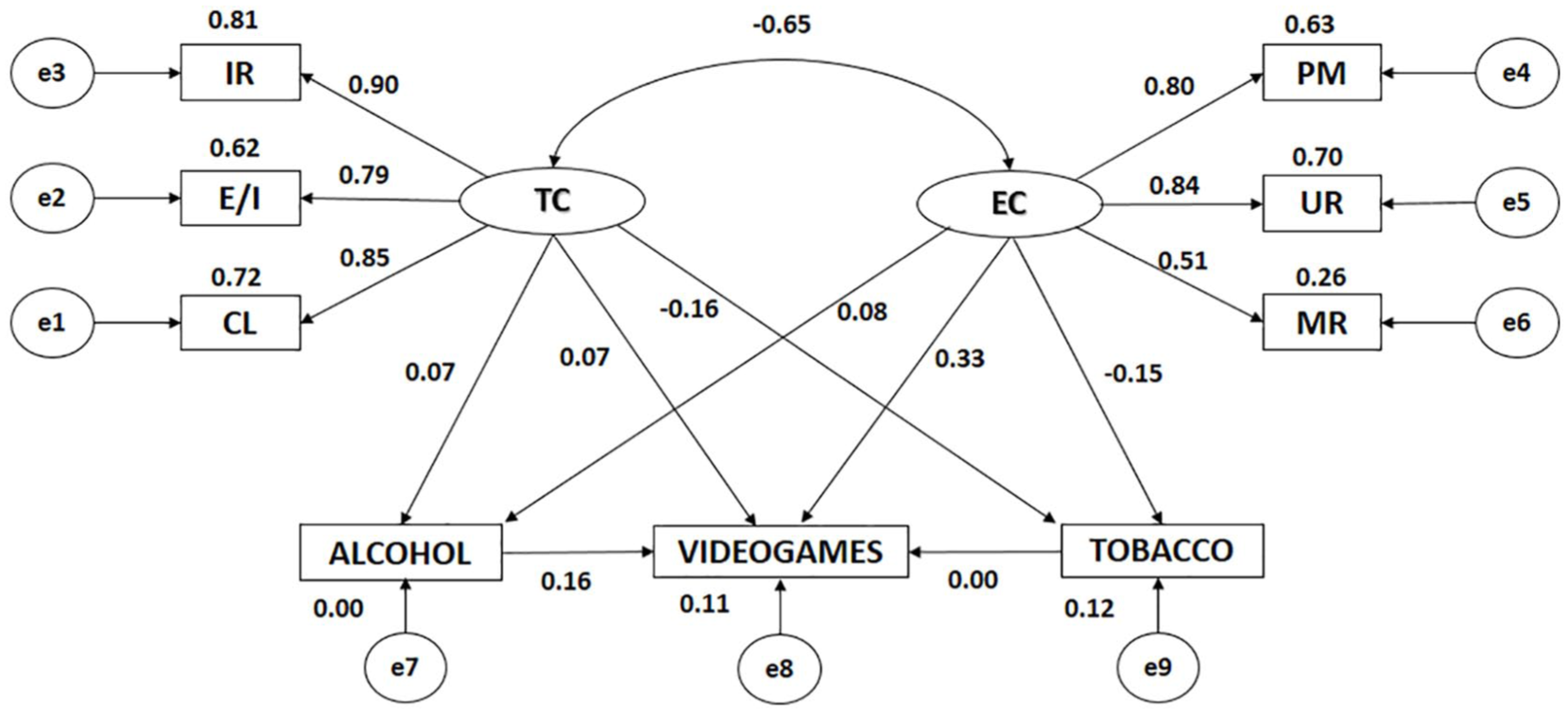
Structural equation model for individual sports.
Structural Model for Individual Sports.

Note. TC = task climate; CL = Cooperative Learning; E/I = Effort/Improvement; IR = Important Role; EC = ego climate; MR = Member Rivalry; PM = Punishment for Mistakes; UR = Unequal Recognition; VIDEOGAMES = problematic use of video games; ALCOHOL = alcohol intake; TOBACCO = tobacco consumption; RW = regression weights; SRW = standardized regression weights; EE = error estimation; CR = critical ratio.
Relation between statistically significant variables in level .05. ***Relation between statistically significant variables in level .005.
Second, Figure 3 and Table 2 reveal the regression weights for the path model for university students who practice collective sports. Significant associations were observed at level p < .005 for each category of motivational climate with the two dimensions of this variable, being directly related. Furthermore, the association between task climate and ego climate was inverse (r = −0.233; p < .005). For collective sports, only one more significant relation in level p < .05 is observed, which is established by task climate and tobacco consumption. In this case, the association is negative and indirect (r = −0.124).

Structural equation model for collective sports.
Structural Model for Collective Sports.

Note. TC = task climate; CL = Cooperative Learning; E/I = Effort/Improvement; IR = Important Role; EC = ego climate; MR = Member Rivalry; PM = Punishment for Mistakes; UR = Unequal Recognition; VIDEOGAMES = problematic use of video games; ALCOHOL = alcohol intake; TOBACCO = tobacco consumption; RW = regression weights; SRW = standardized regression weights; EE = error estimation; CR = critical ratio.
Relation between statistically significant variables in level .05. ***Relation between statistically significant variables in level .005.
Discussion
This study performs a multigroup analysis with the aim of revealing the relationships between goals in sports, use of harmful substances, and the problematic use of video games according to the category of sports that is practiced by university students. The path model acquires good fit, creating a good explanation of the associations between addictive behavior and motivational aspects related to the practice of sports in young university students, as diverse other studies have done in the national and international context (Castro-Sánchez et al., 2015; Chacón et al., 2017a; Chacón-Cuberos, Castro-Sánchez, González-Campos, & Zurita-Ortega, 2018; Clark et al., 2015; Khang, Kim, & Kim, 2013; Mays et al., 2010).
Analyzing tobacco consumption, the structural model proposed shows a negative association with task climate in nonteam sports, whereas in collective sports, this association shows lesser strength. It is evident that the consumption of this substance and a motivational orientation toward task are inversely related, because it has been widely demonstrated that the practice of sports oriented toward task acts as a protective factor against maladaptive behaviors such as alcohol intake and tobacco consumption (Castro-Sánchez et al., 2015; Sønderlund et al., 2014). This is due to the fact that task climate is related to intrinsic motivation associated with hedonism and the satisfaction produced by the practice of sports, preventing stressful or depressing situations usually generated when the practice of sports is oriented toward ego and which can result in harmful behavior (Hodge, Hargreaves, Gerrard, & Lonsdale, 2013). Likewise, it could be thought that collective sports would lead to an indirect relation of greater strength with tobacco consumption, because its nature is more related to task climate (Castro-Sánchez et al., 2015; Jõesaar & Hagger, 2012). However, the influence of peer groups plays an important role in university years (Yang, Schaninger, & Laroche, 2013), this being one of the reasons of the lesser strength of this negative association.
In a similar way, ego climate was negatively associated with tobacco consumption for university students who practiced nonteam sports, whereas for collective sports, this association was not statistically significant. Based on these findings, we can see how the practice of individual sports specially oriented toward ego climate is associated with a reduction in tobacco consumption. This is due to the fact that athletes whose goals are oriented toward ego pursue an unequal recognition compared with other athletes by a higher performance in sports (Jõesaar & Hagger, 2012; Reinboth & Duda, 2006). In this sense, ingestion of harmful substances such as tobacco could worsen performance, because it affects cardiopulmonary capacity, among other physiological negative effects (Curran et al., 2015; Ferriz et al., 2015). Therefore, a competitive practice of sports could also act in a precautionary way, because diet is watched and, especially, the intake of harmful substances is avoided.
The use of video games represents another addictive behavior connected to motivational climate in sports. In this case, we could see that a problematic use of these devices and ego climate were positively related in students who practiced individual sports. In this case, we can see an inverse tendency regarding tobacco consumption, because although ego climate is a protective factor for tobacco consumption in young people who practice individual sports (Castro-Sánchez, Zurita-Ortega and Chacón-Cuberos, 2019b; Wade-Mdivanian et al., 2016), this motivational orientation could be a risk factor in the pathologic use of electronic games. Among the reasons, Chacón et al. (2017b) highlight the competitive component inherent to ego goal orientation, which appears in the same way in most video games, in a way that even physically active young people have medium levels of digital leisure, forming the well-known technological-active profile in teenagers and university students (Beltrán- et al., 2011). Likewise, the use of video games enables the achievement of different competence needs such as the achievement of new challenges, the feeling of efficiency, or personal satisfaction, many of them connected to ego climate and which consolidate this association (Chacón et al., 2017b; Clark et al., 2015; Henchoz et al., 2016).
In the same way, it is verified that alcohol intake and a high use of these devices are directly associated in young who practice individual sports, whereas this relation does not exist in students who practice collective sports. In case of defeat, the practice of individual sports is associated with a greater extent with maladaptive behavior to accept frustration and stress (Besharat & Pourbohlool, 2011). In addition, motivational climate oriented toward ego, more present in this category, has been on occasion connected to greater alcohol intake and use of video games (Castro-Sánchez et al., 2015; Mays et al., 2010). Therefore, it is proved how the practice of individual sports can form a nexus between these maladaptive and harmful behaviors, which could be originated due to pathological psychosocial factors such as low self-esteem, anxiety, frustration, or social avoidance behavior (Khang et al., 2013; Moreno-Murcia, Hellín, González-Cutre, & Martínez-Galindo, 2011).
Finally, and regarding configuration of the categories of motivational climate dimensions, it can be observed that in the case of individual sports, the category Important Role has a greater presence, whereas in collective sports, Effort/Improvement offers greater correlation strength. Likewise, in the case of ego climate, both Unequal Recognition and Member Rivalry reflect a relationship with higher regression weight in collective sports. Thus, these discoveries are proved using premises by Lenor, Lenten, and McKenzie (2016) and Tyler and Cobbs (2017), who highlight the internal rivalry or group rivalry existent between members of the same team aimed at the achievement of greater prominence inside the group. Nevertheless, opposed to what has been set out, it has been observed that the association between task-oriented motivational climate and ego climate has an inverse relationship, showing greater strength in the case of individual sports due to the features of task climate, such as cooperative learning in collective sports, which acts as a differentiator of both dimensions (Almagro, Sáenz-López, González-Cutre & Moreno-Murcia, 2011; Moreno et al., 2011).
It is interesting to highlight the main limitations of this study. The first one is related to its methodological design, which is descriptive, cross-sectional, and with a single measurement in a single group. Therefore, it does not enable the setting of causal relationships between the studied variables, although it stands out by virtue of its ease of diagnosing the state of an issue in a population. In addition, there are some strange variables that are not considered in the study, such as the modulating effect of gender of the participants or their place of residence. In the same way, it would be interesting to carry out a longitudinal study to follow the evolution of the relations between the variables during the student’s academic years studying the degree in Physical Education, with the aim of observing whether their training favors the promotion of physical activity and healthy habits.
As future perspectives, it is interesting to point out some practical implications derived from the findings obtained. It has been observed how task-oriented motivational climates are inversely related to addictive behaviors such as smoking or the use of video games, or how the ego climate is directly linked to these habits. For this reason, it can be established that the interest of carrying out a sport practice in the university stage associated with intrinsic motivational, favoring socialization, hedonism and the effort to learn new skills. In addition, this sport practice should be especially linked to collective sports in which competition does not prevail, because this generates extrinsic motivations whose nonachievement could produce nonadaptive behaviors, such as the consumption of substances or the pathological use of video games.
Conclusion
As main conclusions, a negative relationship was observed between task climate and tobacco consumption in sports that are individually practiced, whereas this association was weaker for collective sports. Furthermore, this association is not significant in collective sports, but it is in individual sports for ego climate. However, a direct relation was found for problematic use of video games and ego climate in the case of university students who practiced individual sports, being nonsignificant in the case of collective sports. In addition, students who practiced team-sports showed a positive relationship between the consumption of alcohol and the use of video games, whereas this association does not exist in students who practice collective sports. Finally, it has been observed that the association between motivational climate oriented toward task and ego climate presents an inverse relationship, showing greater strength in the case of individual sports. In this sense, new discoveries reveal how young university students who practice individual sports follow a motivational climate oriented toward ego, which is in a greater extent associated with the consumption of harmful substances and a problematic use of video games. Thus, the importance of promoting motivational climates based on task-orientations through the practice of collective sports is observed, because they act as a preventive factor against the development of addictive behavior during university years by means of the development of more self-determined motivations toward physical activity and healthy habits.
Footnotes
Declaration of Conflicting Interests
The author(s) declared no potential conflicts of interest with respect to the research, authorship, and/or publication of this article.
Funding
The author(s) disclosed receipt of the following financial support for the research, authorship, and/or publication of this article: This research study has been supported by the Education Innovation Project PID 16-45, named “Implementation of digital resources in the classroom for the development of psychosocial and motivational factors in students of the degree in Primary Education with the speciality in Physical Education,” funded by the University of Granada. Education Innovation Project PIBD Advanced 470, named “Program of teaching intervention in students of the degree in primary education and early childhood education through the use of new technologies for the improvement of the psychosocial factors of the students,” funded by the University of Granada. Project I+D+I “DISPERSA,” with code number TIN2015-67149-C3-R, named “Design of Pervasive Games Based on Learning Experiences Sensitive to Context” funded by the Ministry of Economy and Competitiveness. Precompetitive Research Projects for Young Researchers (PPJI_B-05); Self-plan Research of the University of Granada.
