




Abstract
This study explores how a telecollaborative project involving student teachers from four countries fosters intercultural communicative competence (ICC) through collaborative tasks centered on the United Nations’ Sustainable Development Goals (SDGs). The overarching goal is to nurture intercultural communicative competence and promote global awareness among learners. Telecollaboration emerges as a particularly apt vehicle for realizing this aim, given its capacity to unite learners from disparate geographical locations via online platforms, enabling collaborative engagement on shared tasks aimed at achieving collective objectives. The primary objective of this 8-week telecollaborative study was to examine the extent to which participation in a telecollaborative project focusing on the theme of global citizenship education contributes to the promotion of Intercultural Communicative Competence (ICC) among 42 student teachers of English from Turkey, Germany, Israel, and Brazil. The study contributes to the growing body of research on virtual exchange and SDG-based pedagogies and suggests practical implications for curriculum development in teacher training. Limitations include the reliance on self-reported data and a limited number of interview participants. Future research should examine long-term impacts of telecollaborative projects and explore mixed-methods approaches to enrich findings.
Introduction
Global challenges such as climate change, forced migration, digital inequalities, and the rise of xenophobia have made it essential for educators to equip future teachers with intercultural awareness and global responsibility. English language teachers in particular play a key role in promoting mutual understanding, respect, and critical global engagement. Virtual exchange (VE), also referred to as telecollaboration, has emerged as a powerful tool in this effort, enabling meaningful intercultural learning through technology-mediated dialogue. These online intercultural encounters allow student teachers to reflect on their values, assumptions, and positionalities while engaging with diverse global perspectives.
At the same time, there is a growing need to connect language education with broader global frameworks, notably the United Nations’ Sustainable Development Goals (SDGs). These 17 goals promote peace, equality, education, and environmental protection, aligning closely with the aims of global citizenship education (UNESCO, 2015). Yet, despite this synergy, the SDGs are still underexplored in English language teacher education (ELTE), especially in the context of telecollaboration. This study addresses this gap by examining how student teachers’ participation in an online intercultural project focused on SDGs contributes to their development of intercultural communicative competence (ICC), using Byram’s (1997) framework as a theoretical lens.
Telecollaboration brings together learners from distant locations with diverse social, cultural, educational, and linguistic backgrounds and allows them to collaborate on pedagogical tasks and activities (Helm, 2016; O’Dowd, 2018). Rienties et al. (2022, p. 2) defined telecollaborative practices as: “a process of engaging students in online intercultural collaboration projects with partner classes within their programs of study and under the guidance of teachers or trained facilitators.”Vinagre (2017) put forward that telecollaboration practices are amongst the most practical and economic ways of promoting ICC among language learners. Telecollaboration offers other considerable merits such as improving language skills and ICC (O’Dowd, 2019), critical cultural awareness (O’Dowd, 2011), and learner autonomy (Fuchs et al., 2012).
Byram’s ICC model emphasizes five key components—attitudes, knowledge, skills of interpreting and relating, skills of discovery and interaction, and critical cultural awareness—which provide a structured approach to assessing intercultural learning. Grounded in this framework, the present study investigates the intercultural growth of student teachers from Turkey, Germany, Israel, and Brazil who participated in an eight-week telecollaborative project on SDGs. The study contributes to literature by combining critical telecollaboration with SDG-focused content and multinational student engagement. It offers insights for ELTE programs seeking to integrate global citizenship education and intercultural learning through innovative digital pedagogies. Moreover, telecollaborative studies integrating SDGs into English teacher education are rare (Bruun, 2018; Lenkaitis, 2022). This study examines how SDG-focused telecollaboration fosters ICC among student teachers across four countries, framed by Byram’s (1997) model. It contributes by integrating ICC, SDGs, and VE within pre-service teacher education.
Literature Review
In today’s increasingly interconnected world, the cultivation of intercultural competence is essential for future educators. Teacher education must go beyond linguistic skills and foster awareness of global challenges and ethical responsibilities. One promising way to integrate these dimensions into ELTE programs is through structured telecollaboration projects guided by frameworks of intercultural communicative competence (ICC) and global citizenship education (GCE).
This literature review synthesizes the foundational concepts of ICC, the educational role of the SDG, and the implementation of telecollaboration in ELTE contexts, with an emphasis on recent developments.
Intercultural Communicative Competence
Although a clear definition of ICC has not been offered because of its multidimensionality, it emphasizes the indivisibility of language and culture to make learners intercultural speakers who can communicate across cultures appropriately (Piątkowska, 2015). Fantini (2006) argued that ICC refers to “complex of abilities needed to perform effectively and appropriately when interacting with others who are linguistically and culturally different from oneself” (p. 9). ICC has become a crucial area of research in the field of applied linguistics since societies became increasingly diverse and interconnected, and the ability to navigate and effectively communicate with people from different cultural, social, and linguistic backgrounds became extremely essential (Walinski, 2013).
ICC, as proposed by Byram (1997), encompasses five key dimensions: attitudes (openness and curiosity), knowledge (of social groups and practices), skills of interpreting and relating, skills of discovery and interaction, and critical cultural awareness. These components allow learners not only to communicate across cultural boundaries but also to engage critically with cultural norms and assumptions. It has been argued that fostering ICC should be embedded in broader frameworks of global responsibility and justice (Glimäng, 2022). Traditional ICC models for insufficiently addressing power dynamics and socio-political realities in intercultural communication. More critical and context-sensitive approaches to ICC that is closely aligned with sustainability, equity, and decolonial perspectives need to be advocated. This aligns with the aims of this study, which integrates ICC development with engagement on the SDGs.
Telecollaboration and Virtual Exchange in Teacher Education
Telecollaboration or virtual exchange (VE) has been defined by O’Dowd (2019) as “a well-known pedagogical approach in foreign language (FL) education which involves engaging classes in online intercultural collaboration projects with international partners as an integrated part of their educational programs” (p. 1). Through telecollaboration projects, researchers aim to develop “both language skills and intercultural communicative competence through structured tasks” (Guth & Helm, 2010, p. 14).
Most telecollaborative projects and practices are conducted with participants from North America and Europe (Godwin-Jones, 2019) but projects involving participants from Middle East and South America are still rare. However, in recent years, researchers in eastern countries have shown an increased interest in telecollaboration (Lewis & O’Dowd, 2016). Different models have been used for implementing telecollaborative studies such as e-tandem and blended intercultural model (Chun, 2015). In these traditional models, participants of telecollaborative studies come from different language backgrounds and they usually try to learn their interlocutors’ L1. However, in recent years, the trend in telecollaborative studies is using a common lingua franca, which is English in most cases (Helm, 2015). In such telecollaborative studies, the researchers usually focus on improving intercultural communicative abilities and enculturation of participants rather than improving linguistic skills (Godwin-Jones, 2019).
A more recent trend in telecollaborative studies is integrating it into pre-service teacher training programs (Lewis, 2017). Bringing pre-service teachers from geographically dispersed locations and diverse cultural backgrounds greatly contributes to the ideal of bringing up international teachers. Moreover, telecollaborative projects give pre-service teachers the opportunity to bridge theory and practice in an intercultural environment (Godwin-Jones, 2019; Lenkaitis, 2022) and increase their intercultural sensitivity (Villar-Onrubia & Rajpal, 2016).
In intercultural groups that are formed in telecollaborative projects, pre-service teachers not only discover their partners’ culture and cultural practices in a tolerant way, but also discuss pedagogical issues in English teaching and learn different teaching methods and approaches (Öztürk, 2022). Hauck and Müller-Hartmann (2020) demonstrated that virtual exchanges can shift teacher candidates’ perspectives from ethnocentric to more relativistic and critical positions.
Linking ICC, SDGs, and Telecollaboration
Despite the individual growth of these three fields—intercultural competence, global education via the SDGs, and telecollaboration, few studies have attempted to integrate all three into a unified pedagogical experience. By combining Byram’s (1997) framework with a task-based telecollaboration project centered on SDGs, the present study contributes to the growing body of research advocating for more critical and global approaches to teacher education (Glimäng, 2022). It also provides empirical insights into how intercultural attitudes and awareness can be fostered through sustained cross-cultural interaction with socially relevant content.
United Nations’ Sustainable Development Goals
Sustainable Development Goals (SDGs) were introduced by the United Nations (UN) in 2015 as part of the 2030 Agenda for Sustainable Development. UN describes SDGs as “a shared blueprint for peace and prosperity for people and the planet, now and into the future” (United Nations, 2020). These 17 goals concern all countries and people in the world to address various social, economic, and environmental challenges, and they can be achieved in a global partnership. Because of the vitality of these goals for the world’s problems, integrating them into telecollaborative practices and projects would be beneficial and meaningful (Lenkaitis, 2022). Moreover, student teachers of English cannot find ample opportunities to talk about such critical issues during their training. It is suggested that bringing up English learners with intercultural awareness heavily depends on training student teachers of English to become intercultural speakers (Nguyen, 2021).
Studies integrating SDGs into telecollaborative practices are limited (Garcia-Esteban, 2020), however since SDGs can be considered as a logical and constructive theme for such practices, several studies have been published (Bruun, 2018; Fors & Lennerfors, 2020; Lenkaitis, 2022; Öztürk, 2022). Telecollaboration offers a unique opportunity for English teacher education to integrate the principles of sustainable development and promote global citizenship in the following ways: promoting intercultural communicative competence, addressing quality language education all around the world, global environmental awareness, digital literacy and access to technology, gender equality, and community engagement and partnerships. By incorporating the SDGs into telecollaborative studies and projects, educators can empower future generations of teachers and learners to become active global citizens and contribute to a more sustainable and inclusive world.
Telecollaborative Task Design and Procedure
Task-Based Language Teaching (TBLT) is considered an indispensable part of language classrooms (Long, 2015) and tasks are the central units for telecollaborative and VE practices (Dooly, 2017). The tasks that the participants completed in the current study were designed according to the “Progressive Exchange Model” (O’Dowd & Ware, 2009). The model breaks down telecollaborative and VE tasks into three phases: icebreaker phase, comparison and analysis phase, and collaboration phase.
During the icebreaker phase, the participants engage in both synchronous and asynchronous activities to foster familiarity and establish positive relationships. They use this opportunity to learn about each other’s cultural backgrounds and practices. In comparison and analysis phase, the participants explore various cultural elements, such as documents, products, and practices, enabling them to gain insights into the values of their partners’ cultures. The participants of the current study performed two main tasks in this phase. Firstly, they interacted and examined their respective school systems, education policies, teaching philosophies, and methods. Secondly, they had discussions about one or two of the United Nations’ Sustainable Development Goals (SDGs) that have a local impact on their communities. Through deliberation, they collectively selected one SDG to work on as a group. In the collaboration phase, the participants collaborate closely to design lessons, activities, and materials together.
The current telecollaborative study had three kinds of settings: local classrooms (LC), joint classrooms (JC), and team exchanges (TEs). LCs occur between local instructors and student teachers either in a face-to-face setting or online. These interactions involve participants from the same country engaging in educational activities and discussions. JCs are conducted entirely online, bringing together all the instructors and student teachers from the four participating countries. Participants collaborate and engage in joint educational experiences across borders via Zoom breakout rooms. TEs involve student teachers forming transnational teams and arranging a suitable timeframe for their interactions.
The participants were sent weekly tasks via email and had them posted on the Moodle platform, along with explicit instructions. Using these assigned and explained tasks as a basis, student teachers within each group organized a meeting on Zoom (TE) where they collaborated, discussed, and worked together to complete the tasks. Each TE session was recorded on Zoom. In the last JC, each team presented their final products, and the project was finalized.
As summarized in Table 1, weekly tasks were structured across asynchronous (Padlet/Moodle/Docs) and synchronous (Zoom) modes and explicitly aligned with the SDGs selected by each team. Each task was designed to target specific ICC dimensions (Byram, 1997), and artifacts generated (e.g., journals, TE transcripts) served as primary data sources for analysis. This revision responds to reviewers’ requests for clearer task—ICC alignment and table clarity.
Weekly Tasks Designed According to O’Dowd and Ware (2009).

Research Questions
The following research questions will be answered in the current study:
Methodology
Participants
Participants were 42 pre-service English language teachers from four countries: Turkey, Germany, Israel, and Brazil. These countries were selected based on geographic diversity, cultural variety, and institutional availability for international collaboration. The selection of participants was purposive, focusing on student teachers enrolled in relevant courses and willing to take part in a structured telecollaboration project. Although the sample size is relatively small, it allowed for in-depth exploration and comparative insights into intercultural engagement across diverse contexts. The demographic composition included a mix of genders, ages (primarily 20–25), and cultural-linguistic backgrounds. Participation was voluntary, and all students gave informed consent prior to the study.
Data Collection Tools
In this qualitative telecollaborative study, the data were collected through the participants’ weekly team exchanges (TEs) in their transnational groups, their weekly reflective journals, their posts on Moodle discussion forum and Padlet wall, and end-of-the-study semi-structured interviews. As mentioned, the telecollaborative study lasted for 8 weeks and the researchers wanted to monitor the change in the participants’ ICC abilities in depth by collecting and analyzing qualitative data through different tools. Table 2 shows the data collection tools and their corresponding research questions.
Data Collection Tools and Corresponding Research Questions.

Weekly Team Exchanges
Throughout the project, the participants in each group came together on a Zoom every week and collaborated on assigned tasks for 8 weeks. Duration of these TEs varied from 45 min to 3 hr. It was realized that the variations regarding the duration of meetings were caused by individual differences in each group. Extrovert members in a group might dominate the talking time. Another reason is that during the icebreaker phase, participants tend to engage in more communication. This is because the activities in this phase are designed to foster positive relationships among participants and enhance their intercultural communication abilities. However, in the comparison & analysis and collaboration phases, there was less interaction among participants regarding “community-building” matters. This reduced interaction can be attributed to their primary focus on completing the final product of the English teaching lesson plan, based on their chosen Sustainable Development Goal (SDG).
The present study involved the collection of a substantial amount of qualitative data, primarily gathered during weekly TEs. These TEs played a crucial role in monitoring the development of participating student teachers’ compositional Intercultural Communicative Competence (ICC). To prevent any loss of data during this stage, the researchers conducted regular meetings with the group of participants every weekend after the TEs. During these meetings, each participant had the opportunity to share their experiences, thoughts, and challenges related to their respective TE. Additionally, the researchers clarified the tasks and responsibilities for the upcoming week, ensuring that the participants could collaborate smoothly with their team members on the assigned tasks.
Online Platforms for Asynchronous Tasks: Padlet and Moodle
The project team decided to use Padlet and Moodle for asynchronous tasks and activities throughout the project. Padlet is a practical tool that allows users to share pictures, texts, videos, and more. It serves as a collaborative online platform, enabling individuals to create and organize virtual bulletin boards. Before commencing the project with the first joint classroom (JC), the project team sent an email to all participants. The email requested their contributions to a Padlet wall named “Introduce Yourself.” Participants were encouraged to introduce themselves on the Padlet wall, sharing information about their hobbies, interests, future plans, and briefly expressing their expectations from the telecollaborative project. Additionally, they were asked to include their pictures and engage with other participants’ posts by leaving comments. This allowed them to become acquainted with one another before the project officially began.
Following the first joint classroom and team exchanges, the project team created another Padlet wall. This time, participants were requested to share two SDGs they believed significantly impacted their local community. They were also asked to provide reasons for selecting those specific SDGs, emphasizing their relevance to both their local community and the global community. These SDGs were referred to as “glocal issues” within the project context.
All participants from different teams actively shared their chosen SDGs and their respective reasons on the Padlet wall. This provided a valuable opportunity for everyone involved in the project, including the instructors, to gain insights into the local issues prevailing in each society and understand their potential impact on a global scale. Furthermore, the participants were encouraged to interact with each other’s posts by leaving comments. This interaction aimed to foster appropriate communication skills among participants from diverse countries and cultures, enabling them to learn and engage respectfully with one another. The top three SDGs chosen by the participants were “Gender Equality,”“Climate Action,” and “No Poverty.”Figure 1 shows the participants’ posts on the asynchronous task of writing on the Padlet Wall.

Participants’ posts on the Padlet wall.
Reflective Journals
Through reflective journals, participants record their thoughts, feelings, and tendencies regarding the issue under investigation (Rose, 2019). In the current study, the researchers utilized weekly reflective journals to delve into the participants’ thoughts, emotions, telecollaborative experiences, and intercultural interactions. This approach was adopted to complement the insights gained from the weekly team exchanges, ensuring a more comprehensive understanding of the participants’ perspectives. To construct these reflective journals, the researcher formulated nine questions. Six of these questions were based on the objectives and dimensions of Byram’s (1997) ICC framework, while the remaining three questions focused on the participants’ viewpoints concerning the telecollaboration method, SDGs, their influence on their teaching philosophy, and their experiences in intercultural interactions. To ensure the appropriateness and effectiveness of the journal questions, the researcher sought guidance from an expert in intercultural communication and made necessary revisions based on the feedback received.
Semi-Structured Interviews
In the present study, the researchers conducted semi-structured interviews with 12 student teachers upon the project’s conclusion. The purpose of these interviews was to gain a deeper understanding of the participants’ telecollaborative experiences and intercultural interactions. The decision to employ the semi-structured interview type was made after consulting with an expert in the field. This interview format allows for a more organized compilation of data obtained from the interviewees.
The researchers, with the guidance of an expert, formulated nine questions for the semi-structured interviews. These questions were derived from Byram’s (1997) Intercultural Communicative Competence (ICC) framework and sought the participants’ perspectives on their telecollaborative experiences. To ensure the appropriateness and effectiveness of the interview questions, a draft version of the questions was piloted, and necessary revisions were made based on the piloting phase.
Data Analysis
The data in this qualitative study were coded and analyzed according to the principles of directed qualitative content analysis (Hsieh & Shannon, 2005). In this type of content analysis, the researcher analyzes the data “with a theory and/or relevant research findings as guidance for initial codes” (Selvi, 2019, p. 443). The dimensions of Byram’s (1997) ICC framework served as the main theoretical basis to guide the coding process. Throughout the study, these themes were employed as a guiding framework to analyze the data and explore the development of ICC among the student teachers. Emerging sub-themes were also inductively coded. To ensure trustworthiness, the coding process was conducted independently by two researchers and refined through inter-rater comparison. Divergent interpretations were discussed until consensus was reached. Triangulation of journals, interviews, and TE transcriptions strengthened the validity of the analysis. Quotes from participants were selected to reflect the richness and diversity of the data. The researchers transcribed the recordings of all TEs and semi-structured interviews. Moreover, the participants’ written weekly reflective journals were also included in the data analysis process. The steps of qualitative data analysis introduced by Maxwell (2013) were followed by the researchers to analyze the substantial body of qualitative data. All data were uploaded into NVivo 12 for systematic coding. Qualitative design was chosen to capture the complex, contextual, and subjective nature of intercultural growth during online exchanges. The study relied on multiple data sources, allowing for methodological triangulation to enhance the credibility and richness of the findings.
Ethical Considerations
This study adhered to ethical guidelines for conducting research involving human participants. Prior to the commencement of data collection, ethical approval was obtained from the Research Ethics Committee at the university, where the corresponding author was working. Participation was entirely voluntary. All participants were provided with an informed consent form, which clearly explained the aims of the study, the data collection procedures, participants’ rights (including the right to withdraw at any time), and measures taken to ensure confidentiality. Informed consent was obtained in written form, and participants were assured that their data would be anonymized and used solely for research purposes.
To protect participant privacy, all identifying details were removed or pseudonymized during transcription and analysis. The data was securely stored on password-protected devices, accessible only to the researchers. Given that the study posed minimal risk and offered potential educational benefits to participants, it was considered ethically sound. This approach is consistent with the principles outlined in Section 8.05 of the APA Ethical Principles of Psychologists and Code of Conduct, which states that informed consent may be adapted for minimal risk educational research involving adults.
Findings
ICC Development
Byram specified certain objectives for each dimension of his ICC framework to guide the developmental process of intercultural communication. The researchers in the current study coded and analyzed the data according to the objectives of each dimension. The following tables and figures were generated from the NVivo coding outputs of participants’ reflective journals. Each parent node corresponds to one of the five dimensions of Byram’s framework. The child nodes under each dimension represent more specific sub-categories defined by Byram’s descriptors. The column labeled “References” in the tables indicates the total number of coding references associated with each node, meaning how many times that theme or descriptor appeared across the dataset. The column labeled “%” represents the relative weight of each code within its dimension, showing its prevalence proportionally to the other codes in the same category
Attitude Dimension
Byram (1997) underscored following objectives for the attitude dimension: “interest in discovering other perspectives…, willingness to question the values and presuppositions in cultural practices…, willingness to seek out or take up opportunities to engage with otherness …” (p. 50). The distribution of codes under the attitude dimension is presented in Table 3 and illustrated in Figure 2.
Frequency and Percentage of Codes in the Attitude Dimension.


Distribution of codes in the attitude dimension.
The chart illustrates that the predominant code associated with the attitude dimension is “interest in discovering other perspectives,” closely followed by “curiosity and openness.” This finding indicates that the participating student teachers who took part in the study displayed a willingness to engage with individuals from different cultural backgrounds through an ethnographer’s lens. Put differently, the participants exhibited readiness to embrace the perspectives and cultural customs of their intercultural counterparts without harboring any biases or preconceived notions. As explained by Byram (1997), since the attitude is the first dimension in the framework, the expected level of intercultural communicative competence can only be achieved if learners have a right attitude toward other cultures and cultural practices. Table 3 shows the participants’ statements regarding the attitude dimension collected by qualitative sources.
The statements in Table 4 provided by the participants above indicate their endeavor to investigate the viewpoints of their partners from different countries within the context of relationship of equality, characterized by a curious and open-minded attitude. It can be deduced that the participants demonstrated a proactive inclination and readiness to engage in substantive interactions with their intercultural counterparts from the outset of the study.
Examples of the Participants’ Statements Regarding the Attitude Dimension.

Knowledge Dimension
This dimension encompasses individuals’ understanding of their own as well as their intercultural interlocutors’ social and cultural practices. Additionally, it entails familiarity with the norms governing appropriate and meaningful interactions with individuals from diverse cultural backgrounds. Byram (1997) affiliated the following objectives with the knowledge dimension: “knowledge of social groups and their products and practices in one’s own and in one’s interlocutor’s country, knowledge of historical and contemporary relationships, knowledge of the means of achieving contact with interlocutors from another country” (p. 51).
Table 5 and Figure 3 reveal that the most frequent code for this dimension is social groups, their products, and practices. The national definition of geographical space comes last. This finding is intricately linked to the prevalent findings within the attitude dimension. It underscores that the participants’ positive attitude toward individuals from other countries and cultures served as a driving force for them to seek avenues for engaging with their transnational partners. In essence, they actively sought opportunities to engage meaningfully with their partners and exhibited a readiness to explore their cultures and cultural practices through these telecollaborative interactions. This situation also serves as evidence that the participants chosen for this virtual exchange study were motivated and eager to enhance their intercultural communication competencies and were committed to contributing to the tasks to the best of their abilities.
Frequency and Percentage of Codes in the Knowledge Dimension.


Distribution of codes in the knowledge dimension.
These statements in Table 6 show that the participants engaged in authentic interactions aimed at delving into each other’s perspectives, ways of life, countries, cultures, and cultural practices. It is evident that despite cultural and linguistic differences, the communication flow remained intact, with participants continuously learning about one another and each other’s cultural practices.
Examples of the Participants’ Statements Regarding the Knowledge Dimension.

Skills of Interpreting and Relating Dimension
This dimension pertains to an individual’s capacity to identify problematic areas and issues in intercultural interactions, and to adeptly employ appropriate strategies to mitigate misunderstandings and communication breakdowns. The following objectives were associated with this dimension by Byram (1997): identify ethnocentric perspectives in a document or event, identify areas of misunderstanding and dysfunction in an interaction, and mediate between conflicting interpretations of phenomena (p. 52).
Table 7 and Figure 4 display that identifying ethnocentric perspectives is the most frequent code in the data. Interpreting documents/events from another culture comes second while identifying misunderstandings/dysfunctions comes third. A limited number of responses and statements of participants pertain to the skills of interpreting and relating dimension. This phenomenon may stem from the observation that relatively few conflicting situations arose during the project within the transnational teams, as evidenced by participants’ interactions, reflections in their journals, and semi-structured interviews conducted at the project’s conclusion. Predominantly, participants succeeded in cultivating positive relationships with their transnational counterparts, thereby fostering a favorable environment for interaction and communication.
Frequency and Percentage of Codes in the Skills of Interpreting and Relating Dimension.


Distribution of codes in the skills of interpreting and relating dimension.
The statements in Table 8 elucidate significant insights pertaining to the essence of intercultural communication. These observations underscore the influence of individual expression on intercultural interactions, a dynamic that can vary across cultures. Furthermore, the statements suggest that participants were able to establish common ground despite cultural differences and occasional misunderstandings or dysfunction. It becomes apparent that robust and authentic relationships among transnational partners serve to mitigate misunderstandings, and when they do occur, they are swiftly addressed in a mutually understanding manner.
Examples of the Participants’ Statements Regarding Skills of Interpreting and Relating Dimension.

Skills of Discovery and Interaction Dimension
The skills in this dimension refer to abilities of individuals to discover the characteristics of new cultural environments and engage with individuals from diverse cultures with the approach akin to that of an ethnographer entering a new field. It is anticipated that participants will enhance their competence in discovery and interaction through participation in a telecollaborative study. Byram (1997) identifies the following objectives for this dimension: ability to acquire new knowledge of a culture and cultural practices, elicit from an interlocutor the concepts and values of documents or events, identify significant references within and across cultures, identify similar and dissimilar processes of interaction (p. 53).
Figure 5 shows distribution of the participants’ statements according to objectives. Moreover, their statements associated with this dimension can be seen in Table 9.

Distribution of codes in the skills of discovery and interaction dimension.
Examples of the Participants’ Statements Regarding Skills of Discovery and Interaction Dimension.
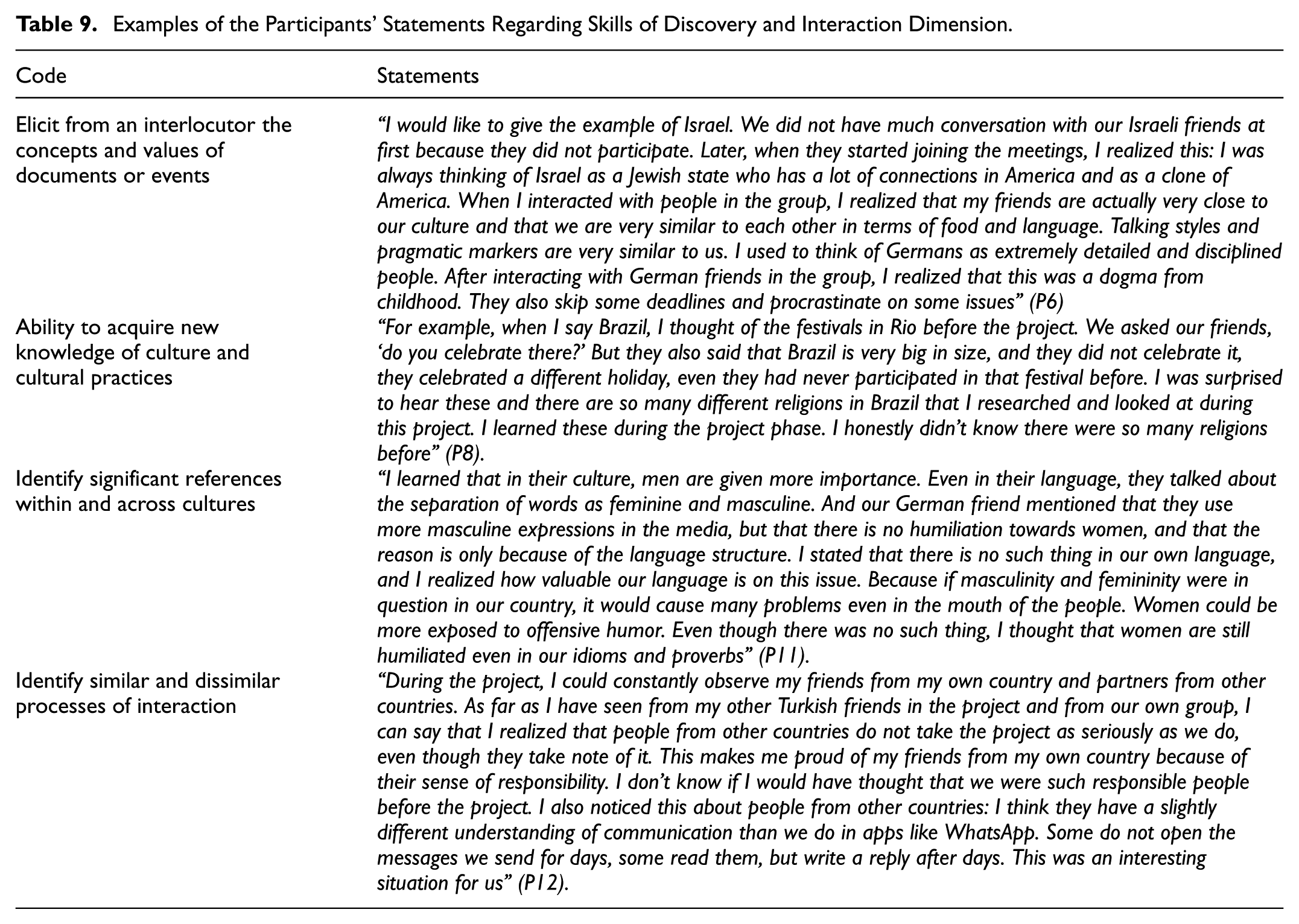
The statements in Table 9 reveal that the participants meaningfully interacted with each other throughout the project and tried to discover their interlocutors’ culture and cultural practices at a deeper level. The most provocative point to emphasize is that they unlearned stereotypical beliefs about other people and their cultures, and they replaced those beliefs with informed knowledge and accurate intercultural communication skills.
Critical Cultural Awareness Dimension
The final dimension outlined in Byram’s framework is critical cultural awareness, which holds particular significance as individuals are required to have already acquired proficiency in the preceding dimensions to attain this level. In essence, individuals utilize their attitude, knowledge, and skills to discerningly assess intercultural interactions and adapt their approach to other cultures and cultural practices accordingly. Byram (1997) posited that individuals operating within this dimension draw upon their life experiences and understanding of diverse cultures to develop a reasoned, logical, and judicious perspective for critically evaluating intercultural interactions and relationships. The following objectives were defined by Byram (1997) for this dimension: identify and interpret explicit or implicit values in documents and events in one’s own and other cultures, make an evaluative analysis of the documents and events, interact and mediate in intercultural exchanges in accordance with explicit criteria (p. 53).
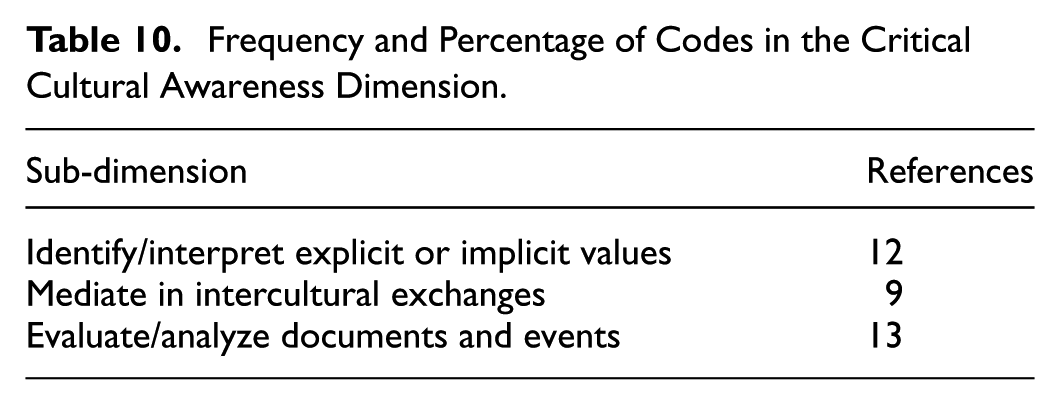
Table 10 and Figure 6 illustrate that critical cultural awareness emerges as the predominant dimension within Byram’s framework, exhibiting a higher frequency of coding compared to other dimensions. The primary source of coding within this dimension came from interactions among transnational participants, predominantly occurred during weekly team exchanges on Zoom. This reveals that the participants have employed their positive attitude, informed knowledge, and skills to interact meaningfully with the perspective of an ethnographer in their intercultural interactions with student teachers from other countries.
Frequency and Percentage of Codes in the Critical Cultural Awareness Dimension.

Distribution of codes in the critical cultural awareness dimension.
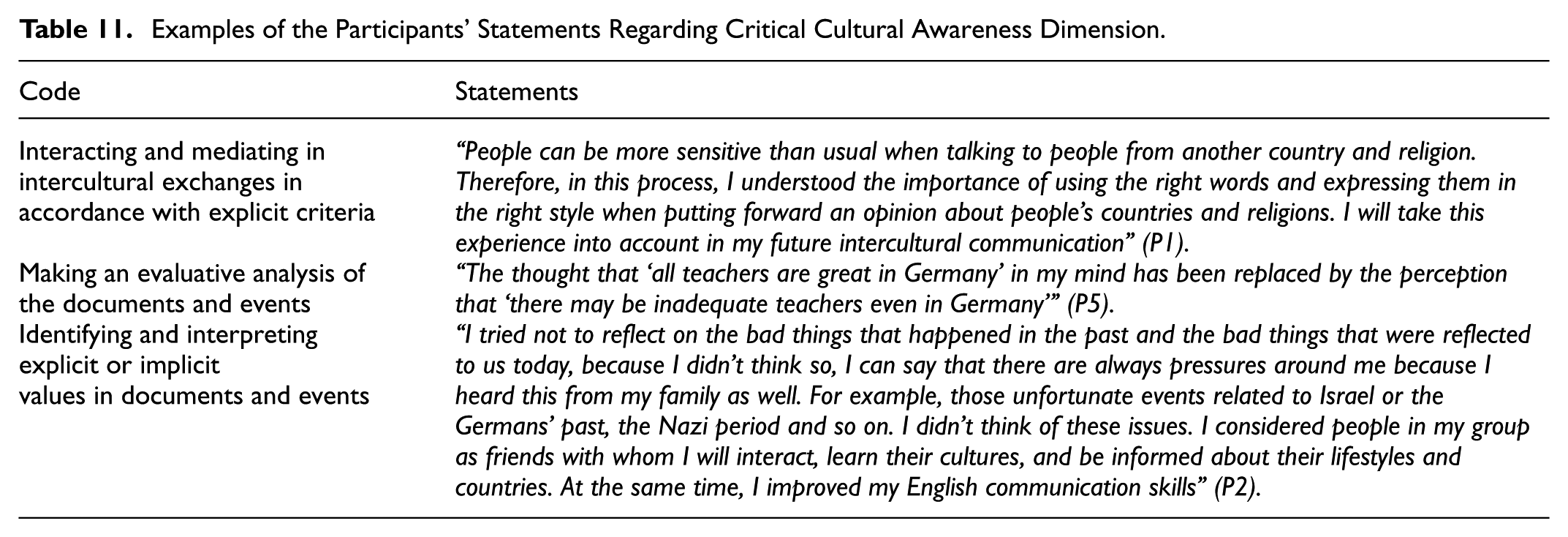
Below are examples of pertinent interactions and participant responses concerning the dimension of critical cultural awareness:
The interactions in Table 11 show that the participants have acquired heightened sensitivity, tolerance, and acceptance regarding the selection of suitable language when engaging with individuals from varied cultural, linguistic, national, and religious backgrounds. Moreover, all participants emphasized the paramount importance of fostering religious and cultural tolerance, underscoring its relevance not solely within intercultural engagements but also in every walk of life.
Examples of the Participants’ Statements Regarding Critical Cultural Awareness Dimension.
Participants’ Views on the Telecollaborative Study
As a cutting-edge and emergent method within the realm of applied linguistics and the pedagogy of foreign language instruction, it was imperative to investigate and delve into the perspectives of participating student teachers regarding the utilization of telecollaboration and its incorporation into English as a Foreign Language (EFL) classroom, as well as English Language Teaching (ELT) teacher education curricula. The participants of the present study did not participate in a telecollaborative study before. The data for exploring the participants’ views regarding the method of telecollaboration were collected through weekly reflective journals and semi-structured interviews conducted at the end of the study.
Examples of the participants’ views regarding the method of telecollaboration and its integration into EFL classrooms and ELT programs can be seen below:
P9: “The biggest advantage is, of course, the ease of work. So, we can meet each other from the comfort of our home, and this is a great motivation for the participants to complete tasks and engage in cultural interaction with each other.”
P5: “I really liked it. What I want to do most is to provide international experience to my students, and I care about this very much. I have learned a lot from international experiences myself and I believe that it has changed my tolerance and interest in intercultural interactions.”
P6: “I think it should be part of them [EFL classrooms and ELT curriculum] because it provides the opportunity to meet with real people. Thus, it strengthens authentic interaction, real communication, and intercultural interaction. In this respect, I would really recommend it because you cannot learn about other cultures and people by only reading books or materials on the internet.”
P11: “Having common ideas with people from different cultures increased my motivation to integrate global education into English teaching. Seeing that we face similar problems no matter how different we are from each other, and as a solution to these, I concluded that global teaching competences and global citizenship education are necessary in English teaching.”
P8: “The biggest reason for my participation in the project was to improve both my intercultural communication skills and my English communication skills. I think the project is an incredibly good opportunity for all of these.”
P3: “After we decided on a subject with our friends, we brainstormed to think about different activities on this subject. In this process, we thought about which tools and methods we could use to make a global issue richer and more effective. I think that this has positive returns for me in terms of knowledge and strategy in my teaching career.”
P1: “When we discuss global problems this week, I think that these problems can be solved largely with mass awareness. Raising students’ awareness about the threats of plastic waste in a lesson means raising awareness not only of students but also of their parents, and this is a very important step in reducing waste. Realizing this increased my motivation to adapt a global problem to my course in the future.”
The statements above reveal that all the participants perceive telecollaboration and global citizenship education as progressive, contemporary, and engaging methodologies conducive to English teaching and the enhancement of English language teacher education initiatives. All the participants were satisfied to be a part of the study driven by multifaceted motivations spanning personal, social, cultural, intercultural, and pedagogical dimensions.
Discussion
This study explored how telecollaboration projects built around Sustainable Development Goals (SDGs) influenced the development of Intercultural Communicative Competence (ICC) among student teachers of English from four culturally diverse contexts. The findings reveal multidimensional growth in all domains of Byram’s (1997) ICC framework, with particularly significant gains in critical cultural awareness. In this section, the results are discussed considering previous research, theoretical implications, and contextual relevance.
Over the course of an 8-week telecollaborative endeavor, comprising 42 student teachers of English distributed across 8 teams, participants convened to deliberate on SDGs and collaboratively develop an English lesson plan centered around their selected SDG. Through weekly team exchanges, reflective journal entries, collaborative assignments, and semi-structured interviews, the researchers obtained insights crucial for addressing the research questions. The present study was designed according to the principles and steps of Progressive Exchange Model (O’Dowd & Ware, 2009) and the Transnational Model of Virtual Exchange for Global Citizenship Education (O’Dowd, 2019).
One of the study’s key innovations is the integration of SDGs into telecollaborative tasks. This focus elevated discussions beyond cultural trivia and fostered deeper engagement with global challenges. Unlike earlier virtual exchange studies which often emphasized surface-level cultural comparison (O’Dowd, 2015), the present study encouraged critical reflection on issues such as gender equality, environmental justice, and educational disparities. This aligns with Glimäng’s (2022) proposition that critical virtual exchanges grounded in real-world problems can foster both intercultural and civic competences. Moreover, tasks organized around SDGs supported action-oriented communication, allowing students to approach global topics not just as observers but as future educators and problem-solvers. This contrasts with more traditional telecollaboration projects that lacked such pedagogical grounding (Hauck & Youngs, 2008).
The strongest impact was observed in participants’ development of critical cultural awareness, reflecting a shift from mere cultural appreciation to ethical engagement. Participants not only learned about cultural differences but also questioned their own societal assumptions and considered the transformative role of education. Moreover, the participants demonstrated acquisition of well-informed knowledge concerning their interlocutors’ cultures, countries, and associated cultural practices. This finding is also echoed in recent studies that emphasize criticality and global citizenship in teacher education (Andreotti, 2014; Porto & Zembylas, 2022). However, the current study extends these contributions by providing empirical evidence of such development in a telecollaborative setting, a relatively underexplored area. Ultimately, the participants cultivated a rational and interculturally adept standpoint, enabling them to critically assess intercultural interactions and relationships with discernment, which are in line with the findings of other studies in literature (Fuchs, 2019; Lee & Markey, 2014; Porto, 2014; Uzum et al., 2022).
The current telecollaborative study unveiled compelling insights concerning the cultivation of ICC among student teachers of English. Notably, certain participants disclosed engaging in internet research to ensure accurate representation of their own culture and to avoid misinterpretation of their interlocutors’ cultural and religious nuances throughout the project. This point seems particularly essential when discussing sensitive topics pertinent to their partners’ cultures and religious beliefs. Such actions underscore the participants’ successful acquisition of the attitude, knowledge, and skills dimensions delineated within the ICC framework. Moreover, they demonstrate the capacity to assess their intercultural interactions critically and analytically, thereby adeptly accommodating diverse perspectives.
Analyzing the interactions among transnational partners concerning global issues and conflicts in Israel reveals a collective inclination toward adopting an analytical approach in problem-solving. Particularly noteworthy is a German participant’s assertive stance, who critically commented on conflicts in Israel and worldwide, expressing disillusionment with humanity's failure to learn from historical events, particularly in relation to attacks, oppression, conflicts, and wars. This sentiment garnered support from her transnational partners, including Turkish student teachers, indicating a shared development of an analytical and critical perspective across the transnational teams in addressing global challenges. These dialogues underscore the positive impact of discussing such global issues with intercultural partners, leading to enhancements in participants’ ICC and fostering critical cultural awareness.
The participants in the current telecollaborative study expressed their perspectives regarding their experiences with telecollaboration and global citizenship education, which seems necessary in such studies (Çiftçi & Savaş, 2018) considering the lack of research that focuses on telecollaboration and student teachers of English. In the realm of combining telecollaboration and global citizenship education with student teacher participants, literature indicates a comparatively restricted number of existing studies. The perspectives shared by participating student teachers underscored the significant advantage of convenience afforded by the telecollaboration method. In telecollaborative endeavors, participants engage and cooperate with individuals situated in geographically distant locations from the comfort of their own homes. This convenience stands as one of the most prominent benefits of telecollaboration and technology, facilitating the convergence of individuals from diverse cultural backgrounds and offering them intercultural experiences not readily accessible within a traditional classroom setting.
The participants expressed satisfaction with the sense of responsibility demonstrated by their transnational partners. Several participants noted that their partners, particularly those from Israel, made concerted efforts to engage in tasks and discussions despite facing significant obstacles. This heightened level of commitment from the Israeli partners served to instill a sense of responsibility among some of the participants themselves. This finding aligns with previous studies in literature, which have highlighted the importance of active participation and engagement in telecollaborative settings. Contrary to some telecollaborative studies where lack of responsiveness or participation from certain individuals can lead to demotivation among other participants, the present study has witnessed the opposite effect, with increased motivation stemming from the diligent efforts of all involved parties.
The participants perceived telecollaboration as conducive to fostering ICC, attributing this to the prolonged interaction with their transnational partners over a two-month period aimed at achieving a shared objective. Throughout this engagement, they gained insights into various facets of their partners’ countries, encompassing social structures, lifestyles, cultural values, norms, beliefs, practices, educational systems, teaching philosophies, and diverse cultural elements. Concurrently, while exploring these dimensions of their partners’ cultures and countries, participants noted a parallel opportunity for deeper self-reflection and enhanced understanding of their own cultures, beliefs, and values. This reciprocal process of cultural discovery was facilitated by project tasks intentionally designed to promote mutual exploration and understanding of diverse cultural practices and perspectives.
The study not only developed intercultural skills but also prompted students to rethink their teacher identities. Many began to see themselves not merely as language instructors but as agents of global awareness. Previous work (Helm, 2015; Müller-Hartmann & Hauck, 2022) has hinted at this link, but this study foregrounds how task design and sustained engagement are essential for this transformation to occur. This transformation was particularly salient when students engaged with culturally controversial or emotionally charged topics. Rather than avoid conflict, students often reflected deeply on their own values and responsibilities—an outcome that is rarely achieved through conventional teacher training.
While many studies have explored ICC development through telecollaboration, most have not incorporated SDG-related content or examined multinational collaboration involving four countries simultaneously. This broader context provided a richer interplay of perspectives, leading to more complex reflection and interaction. In contrast to studies with bilateral exchanges, where cultural dichotomies can become rigid, the multiparty setup in this project disrupted simplistic cultural binaries and encouraged more flexible, intersectional understandings of identity and values.
As delineated in the findings section of the present study, unanimous satisfaction was expressed by all participants regarding their engagement in the telecollaborative study focusing on the theme of global citizenship education. They underscored the method of telecollaboration as a highly effective tool for enhancing language learners’ global awareness, intercultural sensitivity, and language proficiency. Moreover, all participants ardently advocated for the integration of telecollaboration and global citizenship education into their respective classrooms, expressing their willingness to incorporate these methodologies provided they have the opportunity and requisite network support.
Conclusion and Implications
This study offers significant insights into how telecollaboration projects anchored in SDGs can effectively foster ICC among English language student teachers. The findings show that meaningful intercultural growth can be achieved when learners engage in globally relevant, problem-oriented tasks that demand ethical reflection and collaborative meaning-making. It shows that telecollaborative experiences—when intentionally framed—can serve as powerful tools not only for developing ICC, but also for cultivating global citizenship and civic responsibility among future educators. The use of Byram’s (1997) ICC framework alongside critical perspectives on global education (Glimäng, 2022) helped reveal both the depth and complexity of participants’ growth.
The research affirms the continued relevance of Byram’s (1997) ICC model while also supporting calls for a more critical, action-oriented pedagogy in virtual exchange. By connecting intercultural learning to global issues, the study contributes to a shift from “competence” as static knowledge to competence as critical engagement and reflective practice—a perspective aligned with emerging views in global citizenship education.
For teacher educators, the findings offer actionable guidance on integrating SDGs into intercultural curricula. Designing structured, thematically coherent tasks that connect language learning with global concerns can motivate learners, foster deeper reflection, and challenge stereotypes. Telecollaborative platforms should not merely facilitate contact but should be used strategically to create spaces of critical dialogue and mutual transformation.
Limitations and Recommendations for Future Research
While this study offers important insights into the integration of intercultural communicative competence (ICC) and Sustainable Development Goals (SDGs) through telecollaboration, several limitations must be acknowledged. First, the study relied heavily on self-reported data from reflective journals, transcriptions, and interviews. Such data, although rich in personal insight, are susceptible to subjectivity and social desirability bias. Second, while the participant pool was culturally diverse, the sample size was relatively small (n = 42), limiting the generalizability of the findings across broader contexts. The lack of a control group or a comparison cohort also restricts the ability to make causal claims about the impact of the telecollaboration experience on ICC development.
In addition, potential power imbalances and participation inequalities in the virtual exchange groups could have influenced the quality of intercultural engagement, but these factors were not explored in detail. Similarly, asynchronous communication, while convenient, may not always lead to genuine or spontaneous intercultural interaction. Lastly, while NVivo 12 was used for data management, the study did not include an inter-rater reliability check during the coding process, which may have introduced interpretation bias. These limitations highlight the need for more robust, mixed methods designs in future research.
The following points can be recommended for future research:
Longitudinal studies are needed to assess how such intercultural gains are sustained and integrated into participants’ future teaching practices.
Combining qualitative insights with quantitative measures could offer a more comprehensive understanding of development.
Exploring similar telecollaborative projects in different geopolitical and institutional contexts would help assess transferability and scalability.
Footnotes

Ethical Considerations
This study was conducted in accordance with the principles of the Declaration of Helsinki and was reviewed and approved by the Gazi University Ethical Commission at Gazi University, Ankara, Türkiye (Approval No. E-77082166-302.08.01-67656); Date: April 6, 2021).
Consent to Participate
All participants provided their written informed consent before participating in the study. Participants were informed of the study objectives, procedures, voluntary nature of participation, data confidentiality, and their right to withdraw at any time without any negative consequences. No personal identifying information was retained in the manuscript.
Funding
The authors received no financial support for the research, authorship, and/or publication of this article.
Declaration of Conflicting Interests
The authors declared no potential conflicts of interest with respect to the research, authorship, and/or publication of this article.
Data Availability Statement
The data that support the findings of this study are available from the corresponding author upon reasonable request.