




Abstract
This article presents a critical policy overview of inclusive education and global citizenship education (GCED) and offers two innovative childhood education practices that support inclusion of children with disabilities through dimensions of physical and conceptual access, both noted implementation barriers to inclusive education across the globe. The first section summarizes global human rights and education initiatives that support GCED through access for children with disabilities in education and in societies. This section addresses questions of how inclusion plays a central role to the advancement of GCED, summarizing major global policy advances to inclusion, and highlighting how advancement of inclusive childhood education supports GCED. This article concludes with two innovative childhood education practices, global competence and critical literacy, which offer critical potential to contribute to GCED through conceptual and physical dimensions of access, and ultimately promote inclusive education.
Introduction
Global citizenship education (GSED) has gained prominence among education, human rights, and public policy stakeholders, as evident from its place among the three priorities of the United Nations Global Education First Initiative (UNESCO, 2014). Concern about inclusion of children with disabilities, among all children in childhood education and in societies has been central to the United Nations’ development of its global agenda in 2015. This agenda is reflected in the Sustainable Development Goals (SDGs), in which more than 190 nations’ leaders have committed to 17 global initiatives to achieve by 2030 (UNESCO, 2017b).
In the past two decades, global policies and treatises reflect commitments to educational inclusion for children with disabilities through conceptual (attitudes, belief systems, values) and physical (environmental) dimensions of access to childhood education services, programs, practices, as well as to societies (see Lane & Anderson, 2017 for a policy review). Despite these global policy advancements, the status of inclusive education for children with disabilities remains relatively bleak due to varied implementation challenges among many countries and governments (Schuelka & Johnstone, 2012).
Currently, school or other community-based education programs exclude an estimated 100 million children with disabilities, who face disproportionately high levels of poverty, discrimination, and inequities as the largest marginalized population across the globe (UNESCO, 2017a). The number of individuals with disabilities who are excluded from participation within their communities results in significant barriers to activity and participation in global and local governance processes and exacerbates their marginalization. In other words, exclusion in education and in societies beginning in early childhood perpetuates a cycle of poverty and discrimination for individuals with disabilities that is difficult to escape.
Concern about inclusion of children with disabilities, among all children in childhood education and in societies has been central to the United Nations’ development of its global agenda in 2015, as well as in global education development partnerships between the United States and other countries. For example, recent United States legislation in support of global education development for children with disabilities has been enacted through the passage of the Reinforcing Education Accountability in Development Act (READ Act, H.R. 115, 2017). This legislation has been crafted in with 50 partner countries to provide basic educational access for “marginalized and vulnerable children,” in which children with disabilities are named. The implemented legislation is intended to accelerate the impact of basic education programs around the world to improve access to education for more than 263 million out-of-school children and youth (Brennan, 2017).
Critical Theory and Access
In considering how global policies are truly inclusive in a critical and meaningful manner, it is important to consider critical conceptions of access. Access has been defined as a way of bringing life to consciousness; as a form of oriented social action, and a way of relating to people and places (Weber, 1947). Theoretically, global education policies that identify measurable points of access and specific human rights should be necessarily connected to innovative childhood education practices to address conceptual and physical barriers that children and families may experience in education. However, the definition of access itself must be critically considered for its relation to conceptual and physical dimensions. For instance, access can be framed as a way that individuals make meaning for themselves in their environment, in which they question their place or orientation, as well as action about the relationships between individuals and the social space (Titchkosky, 2011). Access as embodied interpretation through orientation to self, others, and spaces highlights its role as much more than a measurable entity and underscores its conceptual dimensions and its relationship to the social and physical environment (Titchkosky, 2011, p. 3).
Critical Theory and Disability
Another critical theoretical underpinning for examining conceptual and physical dimensions of access through policies and practices intended to support inclusive childhood education is the conception of disability. Critical disability theory places disability as a construct based on an individual’s interaction with and through their social and physical environment, as well as through the “social production of knowledge,” in which disability is too often identified as a problem to be fixed (Titchkosky, 2000, p. 198). These lenses position for critical examination of policies and practices as they engage discourse about what is truly inclusive and how is it operationalized in the next section.
UNESCO’s Sustainable Development Goal (SDG) 4
The UNESCO SDG 4 policy goal in education is intended to ensure inclusive and quality education for all and to promote lifelong learning, emphasizing the need to operationalize inclusive education practice through conceptual and physical dimensions of access across diverse contexts for children with disabilities. There are approximately 93 million children with disabilities worldwide, 80% of whom reportedly live in Global South regions. Worldwide, individuals with disabilities comprise 15% of the total population, with disproportional numbers excluded from education (UNESCO estimates that children with disabilities account for 30% of children worldwide excluded from education; UNESCO, 2017a). Due to this exclusion, children with disabilities lack access to high quality or innovative programs such as those that promote global citizenship, since they represent a disproportionate placement in “specialty” settings, with disproportionate numbers of children with reported behavioral and intellectual disabilities (UNESCO, 2017a). The global status of inclusion practice reflects operational challenges to access, both conceptually and physically, given the diversity of contexts (e.g., local, regional, cultural, economic; Boon, 2015; Kang & Plunkett, 2015; Ntuli & Traore, 2013).
History of Global Human Rights Policies Supporting Inclusion Through Access
Current global childhood education policy (e.g., SDG 4, READ) is intended to support inclusion of children with disabilities through access (conceptual and physical dimensions), reflecting previous developments, in which the United Nations increasingly has specified inclusion through conceptual and physical dimensions of access, progress, and participation for children with disabilities in education and social programs; however, these procedures do not address the critical inquiry that education and schools must engage the community in to meaningfully engage and build shared and equitable understandings and relationships.
Convention on the Rights of the Child (CRC)
The CRC (2002), developed by the Office of the United Nations High Commissioner for Human Rights, outlined conceptual and physical dimensions of access for children with disabilities as the following:
(recognizing) that a mentally or physically disabled child should enjoy a full and decent life, in conditions which ensure dignity, promote self-reliance and facilitate the child’s active participation in the community;
(recognizing) the right of the disabled child to special care and shall encourage and ensure the extension, subject to available resources, to the eligible child and those responsible for his or her care, of assistance for which application is made and which is appropriate to the child’s condition and to the circumstances of the parents or others caring for the child.
Recognizing the special needs of a disabled child, assistance extended in accordance with paragraph 2 of the present article shall be provided free of charge, whenever possible, taking into account the financial resources of the parents or others caring for the child, and shall be designed to ensure that the disabled child has effective access to and receives education, training, health care services, rehabilitation services, preparation for employment, and recreation opportunities in a manner conducive to the child’s achieving the fullest possible social integration and individual development, including his or her cultural and spiritual development; and
(promoting) in the spirit of international cooperation, the exchange of appropriate information in the field of preventive health care and of medical, psychological, and functional treatment of disabled children, including dissemination of and access to information concerning methods of rehabilitation, education and vocational services, with the aim of enabling States Parties to improve their capabilities and skills and to widen their experience in these areas. In this regard, particular account shall be taken of the needs of developing countries (CRC, 2002, Article 23).
United Nations Millennium Development Goals (MDGs)
Similar to the development of the CRC, the MDGs aimed to address inclusion through conceptual and physical dimensions of access for children with disabilities in education and communities. Developed in 2000, the MDGs represented a new global partnership to reduce extreme poverty and to include children with disabilities through increased access to education and to societies, identifying time-bound targets (UN Millenium Project, 2006; World Health Organization, 2015). By 2015, many countries significantly had reduced their poverty rates; however, the MDGs did not eradicate global poverty nor address conceptual or physical dimensions of access for children with disabilities, among marginalized communities in need of access to education and social services (UNESCO, 2017a).
Convention on the Rights of Persons With Disabilities (CRPD)
Another global policy that has aimed to influence inclusive education through conceptual and physical dimensions of access is the CRPD, named the first human rights treaty of the 21st century (United Nations, 2007). The CRPD set the benchmark for national, regional, and local policies to include individuals with disabilities in governing processes (UNESCO, 2009), with Article 7 having implications on inclusion of individuals with disabilities through physical and conceptual dimensions of access insofar as the following:
Parties shall take all necessary measures to ensure the full enjoyment by children with disabilities of all human rights and fundamental freedoms on an equal basis with other children.
In all actions concerning children with disabilities, the best interests of the child shall be a primary consideration.
Parties shall ensure that children with disabilities have the right to express their views freely on all matters affecting them, their views being given due weight in accordance with their age and maturity, on an equal basis with other children, and to be provided with disability and age-appropriate assistance to realize that right.
Sustainable Development Goals (SDGs)
UNESCO’s development of the SDGs has continued the vision of the MDGs in ensuring access to universal primary education for all. The SDGs specify societal inequities faced by individuals with disabilities and outline 17 global goals that participating members should achieve by 2030. Broadly, the SDGs aim to eradicate extreme poverty and inequality, and to address sustainability issues worldwide. The SDG 4 focuses on inclusive education, calling for nations to “Ensure inclusive and equitable quality education and promote lifelong learning opportunities for all” (UNESCO, 2009, 2017a, 2017b). SDG 4 aims to promote global citizenry and reflects previous goals for inclusion of children with disabilities in education and in societies.
Summary
The past two decades of global policy advancements have emphasized the goal of inclusive education for children with disabilities, among all individuals, extending from childhood to adulthood, through conceptual (attitudes, rights, belief systems) and physical (proximity, geographic location, availability of services/supports) dimensions of access. The challenge across global communities remains in implementation; and recent research demonstrates clear links between diverse community contexts and dimensions of access as key factors in implementing inclusive practices (e.g., Kang & Plunkett, 2015; Ntuli & Traore, 2013; Pearson, 2015; Sukumaran & Loveridge, 2015). Most recent global disability scholarship features a shift in the conceptualization of disability from the medical model to the social model, citing historical, social, and political influences (Grech & Soldatic, 2016). It is in this shift that global citizenship education (GCED) contributes to a social model of disability, consistent with critical disability theory, in which inclusion of children and families in education and in society are valued through engagement, awareness, and shared understandings.
Global Citizenship Education, Global Competence, and Educational Diplomacy
Global citizenship education has the potential to advance inclusive education and to improve education more broadly, through recent initiatives in global competence and educational diplomacy (UNESCO, 2014). In tandem with the global policy initiatives of the past decades aimed at addressing conceptual and physical dimensions of access to promote inclusion of children with disabilities in education and in societies, GCED initiatives in global competence and in educational diplomacy contribute to operationalizing inclusive education for individuals with disabilities across the lifespan through awareness, appreciation, and value of diversity across the human spectrum.
How Does Global Competence Support GCED and Improve Access?
Global competence has been at the forefront of 21st century education initiatives over the past decade (Mansilla & Jackson, 2011; UNESCO, 2014). Global competence is both a process and a set of outcomes spanning early childhood to secondary education, with particular importance to early childhood inclusion (Mansilla, 2017). Four elements of the basic definition of global competence include international awareness, appreciation for cultural diversity, linguistic proficiency, and competitive skills (National Education Association [NEA], 2010). Specific emphases are placed on acquiring in-depth knowledge and understanding of international issues, appreciation of and ability to learn and work with people from diverse linguistic and cultural backgrounds, foreign language proficiency, and skills to function productively in an interdependent world community (NEA, 2010). Teaching for global competence occurs through disciplinary and interdisciplinary educational contexts; however, it has predominated at the secondary-age level (Mansilla & Jackson, 2011). Global citizenship education is sufficiently broad to accommodate conceptualization of interconnected and overlapping factors involved in a model of inclusive childhood education that addresses conceptual and physical dimensions of access.
Global competence shares features of inclusive early childhood education programs such as socio-cultural understanding and acceptance through the use of eco-cultural approaches with children who have disabilities and their families and caregivers (Blanchett, Klingner, & Harry, 2009; Kalyanpur & Harry, 2012). The application of global competence frameworks to inclusive early childhood education practice is relatively new (Mansilla, 2017; Organisation for Economic Co-operation and Development [OECD], 2016). Although new terrain may sometimes seem questionable for governmental bodies, it is important to recognize the ways in which global competence can assist in the operationalization of inclusion through conceptual and physical access through actions (e.g., policies, initiatives, educational tools, and technologies).
Educational Diplomacy
Educational diplomacy is an approach that addresses inclusion of children with disabilities though the use of diplomatic skills to promote and advance education through conceptual and practical bridge building within education and among disciplines (Center for Educational Diplomacy, 2018). Education diplomacy results in highly productive and dynamic relationships both within education communities and with other sectors and disciplines (e.g., business, finance, health, social services, technology), all of which play a role in promoting inclusion through conceptual and physical dimensions of access. For example, new relationships lead to innovative and better ways of promoting, designing, and delivering education and to advancing critical issues in education, such as workforce development, 21st century skills, global citizenship, early childhood education, access to education, quality of education (Center for Educational Diplomacy, 2018). Inclusive early childhood education programs share features of educational diplomacy in emphasizing collaborative and interdisciplinary approaches with professionals to include children who have disabilities and their families and caregivers in early education (Friend, 2000; Odom et al., 1996).
In this view, Anderson and Wise (2017) investigated how educational diplomacy skills (e.g., partnering, collaborating, and coalition building) promoted inclusive early childhood education programs in a local U.S. urban community, providing examples of community and university partnerships and program outcomes that supported conceptual and physical dimensions of access for children with disabilities and their caregivers. These authors explored core skills of education diplomacy, such as engaging in effective relationships, building partnerships, and finding innovative solutions to education challenges for the specific purpose of including young children with disabilities in a high-quality early childhood education program. The findings indicated that partnerships among caregivers, teachers, therapists, and university personnel enhanced both physical and conceptual dimensions of access for children with disabilities (and their caregivers) to local educational programming.
Educational diplomacy efforts have brought together professionals to promote shared understandings around global inclusive education implementation issues. For instance, at the 2017 Longview Foundation institute, scholars, researchers, and practitioners shared global perspectives on inclusion strategies, teacher education, leadership, and culturally responsive practices. Of the 40 presentations at this 3-day institute, only two addressed early childhood inclusion in global education contexts (Lane & Anderson, 2017; Mansilla, 2017). Mansilla’s (2017) presentation summarized the importance of global competence to inclusive education efforts. Lane and Anderson (2017) presented a global comparative analysis of inclusive early childhood education programs across regions of the global north and global south, citing challenges to inclusion stemming from systemic, cultural, and physical barriers. Moreover, the relative underrepresentation of early childhood programming among global perspectives on inclusion reflects the need for more information on innovative practices that promote global citizenry, as well as a reflection of the status of inclusion worldwide. The current status of early childhood inclusion underscores its need for a place in the discussion of and vitality to promoting a lifelong global citizenry.
Summary
Global human rights policy development shapes GCED through current initiatives such as global competence and educational diplomacy. Further consideration is warranted on how to operationalize access, both conceptually and physically, to improve conditions for children with disabilities in childhood education programs and in societies globally, as conditions and resources vary across regions, cultures, and countries (Schuelka & Johnstone, 2012).
Considering the status of inclusion (to education and to societies) for children with disabilities, among all children, and its relationship to GCED, a direction for growth is in the development of bidirectional and shared understanding among children, caregivers, teachers, families, and policy makers. This growth has potential to address conceptual and physical dimensions of access in inclusive childhood education, which are barriers to implementation in countries, regions, and communities with diverse and unique needs (Pearson, 2015).
Global Competence and Critical Literacy
Global competence and critical literacy are two innovative childhood education practices that support GCED and promote inclusion through conceptual and physical dimensions of access. These practices provide teachers, caregivers, and children tools to discover uniqueness and shared understandings, which underpin conceptual inclusion and influence practice (i.e., physical and conceptual dimensions of access, which potentially can facilitate inclusion or create barriers to inclusion).
Developing Global Competence Through Shared Understandings
There are multiple approaches to global competence (OECD, 2016). OECD identifies 15 components of global competence through the lifespan. Definitions of global competence differ according to regions of the world in the sense that less focus is directed toward the individual as a central component of perspectives and understandings. Rather than on the individual as central to the definition, interrelationships among individuals, families, communities, and societies are emphasized to promote shared understandings (Deardorff, 2011). Mansilla and Jackson’s (2011) model for development of global competence through the four quadrants of investigating the world, recognizing perspectives, taking action, and communicating ideas provides an inclusive framework in which conceptual and physical dimensions of access are addressed. An expanded model (see Figure 1) addresses (1) delivering/implementing local processes/practices tailored to individual countries, cultures, and societies, and (2) includes teachers, caregivers, community members, and policy makers as well as students/children, to promote bidirectional and shared understandings that support inclusion through access, addressing both conceptual (intercultural) and physical (environmental) dimensions.
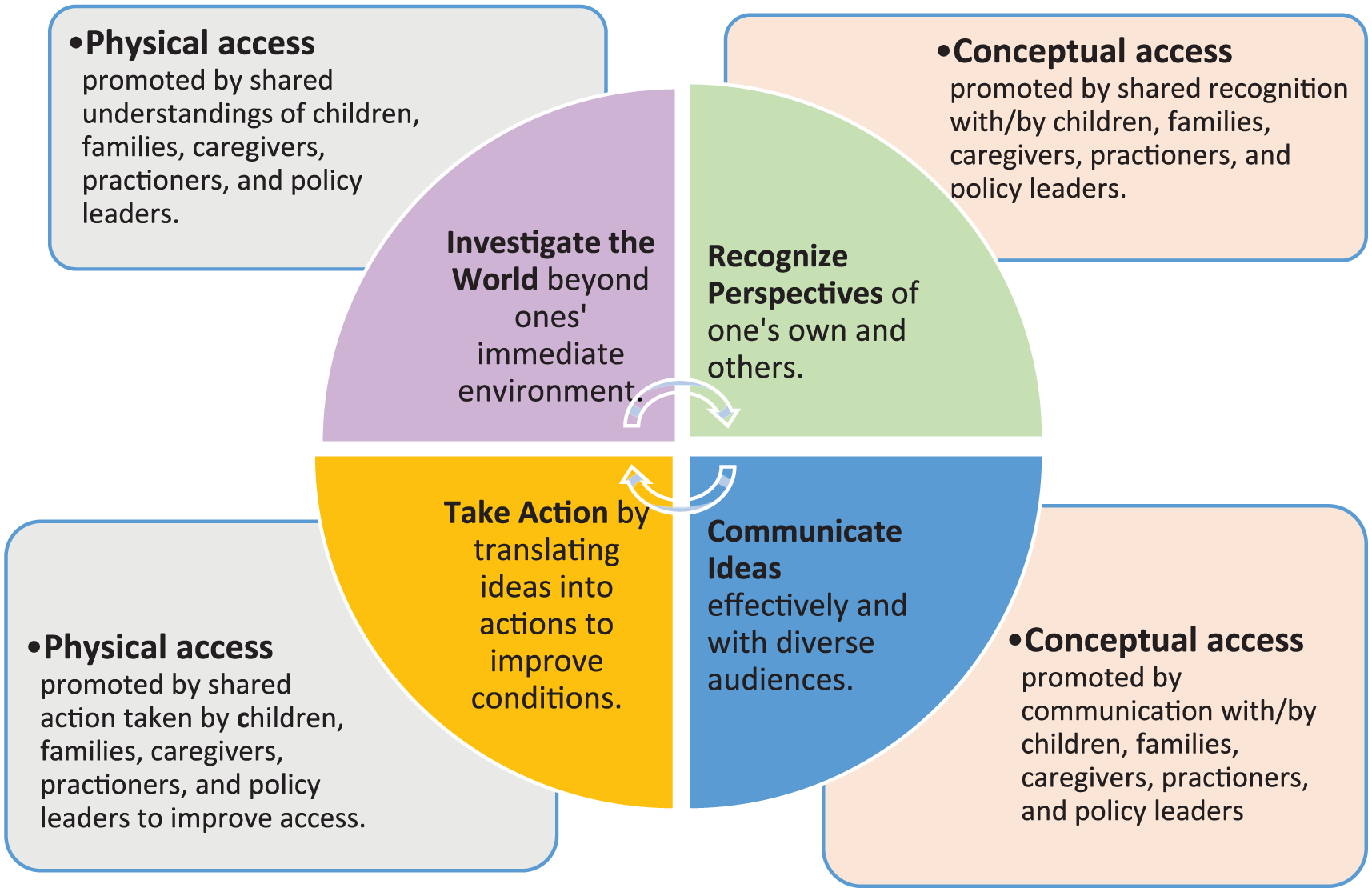
Model for global competence for inclusion through physical and conceptual access.
Critical Literacy
Key qualities of critical literacy include its potential for attentiveness to, and care for community-based social and political circumstances and conditions. Critical literacy supports GCED through active and necessary engagement in the relationship between oneself and their local-global context and arises from social and political conditions of their community (Mulcahy, 2011; Stevens & Bean, 2007; Vasquez, 2014). Critical literacy marks the use of language (tools) to exercise power, enhance life, and/or question sources of privilege and injustice (Comber, 2001). Critical literacy is similar to critical thinking in terms of textual analysis (e.g., how does the text work; what are the effects of the text; who produced the text, under what circumstances, and for what type of audience?). However, critical literacy has the potential to increase participants’ engagement by inquiry (e.g., “How does this affect me?” or “Where do I see evidence of this issue or problem in my community?”; Vasquez, 2014). Although critical literacy has only recently been considered in relation to meaningful understandings of media sources and messaging (media literacy), critical literacy as an inclusive educational approach is well supported (Sullivan, 2017). It is generally agreed that critical literacy, media literacy, and political literacy are interconnected, as they share features of positioning and perspective-taking, along with the critical discourse about the nature and intent of messages and intended audiences. This critical inquiry is thoroughly inclusive of the critical construct of disability and access, in terms of orientation through positioning of self and social environment.
Summary
Global competence and critical literacy are two innovative approaches to promoting GCED in inclusive childhood education that support individuals across the lifespan. Global competence education calls on teachers, caregivers, community members, and policy makers as well as students/children to promote bidirectional and shared understandings that support inclusion through access, addressing both conceptual (intercultural) and physical (environmental) dimensions. Critical literacy supports self-advocacy by questioning sources of power, place, norms, privilege, and injustice. These approaches feature shared understandings and appreciation for uniqueness to promote access at all levels in education and in societies for all children, including children with disabilities and their families.
Conclusion
Innovative childhood education practices that support inclusion are imperative for social justice education and for the progress of education to focus on meaningful human rights, relationships, and aspects of humanity such as creativity. These inclusive approaches are supported by critical disability conceptualizations and hold significant premise for the use in inclusive childhood education because they reframe disability toward understanding self and others within education and society. Critical and meaningful connections, approaches, and initiatives that have been implemented or not yet implemented have the potential to further support inclusion and access for children with disabilities and entail a broadened scope of education to include fundamental shifts that help to diminish conceptual and physical barriers to inclusive education. The policies reviewed are lacking in support of inclusive education that would address conceptual and physical barriers through such a sufficiently broadened view of education. In reviewing the procedural language of the international policies in support of inclusive education, one might question where is the enactment of meaningful change (e.g., global human rights, education initiatives, multidisciplinary approaches, creative arts)? Global competence, critical literacy, and global citizenship education assist and support the inclusion of children with disabilities in societies because they position all members as equals with the shared goal of understanding place, circumstance, and relationship between selves and environments. In this way, the scope of education could be broadened to include these fundamental shifts and improvements.
Footnotes
Declaration of Conflicting Interests
The author(s) declared no potential conflicts of interest with respect to the research, authorship, and/or publication of this article.
Funding
The author(s) received no financial support for the research, authorship, and/or publication of this article.
