




Abstract
Teacher motivation is a critical component of professional development (PD), which plays a central role in sustaining English as a Foreign Language (EFL) teachers’ professional standards. However, little research has examined how school-level factors foster teachers’ motivation for PD. This study investigates how a high school’s cultural environment influenced expert EFL teachers’ motivation for PD in China. Drawing on Self-Determination Theory (SDT), a qualitative case study was conducted in a Shanghai high school, using interviews, longitudinal observations, and document analysis. Findings indicate that the school’s research-oriented culture—characterized by a shared vision of teacher–student co-development, learning-centred leadership, promotion of innovation, institutional collaboration, and strong resource support—created conditions that satisfied teachers’ psychological needs for autonomy, competence, and relatedness. These cultural affordances facilitated the development of autonomous motivation for PD, though some tensions and pressures also emerged. The study concludes by discussing implications for cultivating positive school cultures that support teacher motivation and professional growth.
Plain Language Lummary
This study explores how school culture influences experienced English as a Foreign Language (EFL) teachers' motivation to improve their teaching skills. Professional development (PD) is important for teachers to maintain high standards, but little research has focused on how schools can encourage teachers to stay motivated. The study was conducted in a high school in Shanghai, China, and involved interviews, observations, and document analysis with three expert EFL teachers over time. The findings show that a school culture that supports both teacher and student research helps teachers develop a self-driven motivation for PD. The teachers in the study felt supported by their school and reported different types of motivation for improving their skills, as their needs for independence, competence, and connection were met. The study also identifies specific aspects of school culture that can encourage teachers to take charge of their own professional growth. These insights can help schools create environments that support teacher learning and development.
Keywords
Introduction
Despite the fundamental importance of professional development (PD) for English as Foreign Language (EFL) teachers’ maintenance of professional standards, it is common in research findings that EFL teachers lack strong motivation to participate in PD activities (Huang et al., 2019). Motivation can affect why people are willing to pursue an activity (Dörnyei & Ushioda, 2021). Therefore, many researchers emphasize the importance of sustaining teachers’ motivation for PD and conclude that teachers who possess strong intrinsic motivation are more inclined to make efforts to engage into teacher PD activities (Enthoven et al., 2023, Ma, 2022, X. Wang et al., 2024).
The significance of school context has been increasingly acknowledged in EFL teacher PD research (Chong et al., 2023, Sancar et al., 2021). Studies highlighted that environmental factors were crucial to teacher motivation (Acar & Erozan, 2024, Usher, 2021), that the school’s working context, such as school management and the examination-oriented system, played a central role in teacher PD (Schwarz-Franco & Hadar, 2024, Yuan et al., 2016), and that the school environment had the capacity to either impede or enhance teachers’ motivation for PD (Zhang et al., 2022). Therefore, in order to understand teachers’ motivation for PD, it is crucial to analyse the impact of their work environment (Dixit, 2022).
Although research consistently identifies context as a main influencing factor in teacher PD, studies examining how school culture can promote teacher PD in such a way that participants are optimally motivated towards PD are lacking (Admiraal et al., 2021). We have limited knowledge regarding the school cultural factors that influence teachers’ motivation for PD and the way how they motivate teachers to participate in teacher PD. By examining key concepts such as Self-Determination Theory (Ryan & Deci, 2002), school culture, and teacher motivation for PD, this study aimed to uncover insightful information to bridge the existing gap in the literature. It is hoped that these findings will provide insights into developing new approaches to shape effective work environments in schools and offer valuable perspectives for school policymakers, teachers, and researchers.
Literature Review
Teachers’ Motivation For PD
Broadly defined, teacher PD is “a term used to describe all the activities in which teachers engage during the course of a career which are designed to enhance their work” (Day & Sachs, 2004, p. 3). Since teacher PD is an ongoing and lifelong endeavour, teachers’ motivation for engaging in it significantly influences their choice to participate (Lan, 2022).
There is a notable lack of literature exploring teachers’ motivation for engaging in PD. A handful of studies, including J. Yang (2021) and Peng and Zhang (2024), have examined motivational factors related to teachers’ participation in PD and how these engagements influence changes in their teaching practices. Additionally, a few other studies, such as those by Admiraal et al. (2016) and Postholm (2018), have investigated how school contexts facilitate teachers in implementing changes in their teaching. Overall, research has indicated that teachers’ motivation to engage in PD are primarily driven by their ability to implement changes, their expertise, and the values they ascribe to the PD program (Thomson & Turner, 2015). Furthermore, autonomous motivation has been positively correlated with teacher learning outcomes, while controlled motivation has either shown negative associations or no effect on outcomes (Ryan & Deci, 2017; Yuan et al., 2016).
School Culture
The concept of school culture has attracted the attention of educational sociologists since the 1930s. However, it is quite challenging to define school culture and even harder to operationalize in research terms (Bell & Kent, 2010), just as Deal & Peterson (1999) stated that a universally accepted definition of school culture did not exist. In educational research, school culture is often defined, from an anthropological approach, as the group’s knowledge, beliefs, values, traditions, rituals, symbols, and language (Deal & Peterson, 2009).
Regarding school cultural elements, many scholars in educational research utilized Schein’s (1985) classification of cultural levels. Schein’s model consisted of three layers: assumptions, values and norms, and artifacts and practices, each differing in their visibility within organizations. Assumptions, the least tangible level of school culture, referred to taken-for-granted beliefs that school members share (Schein, 1985), which form the core of school culture. The second level consisted of values and norms. Values reflected what was conceived to be worthy of striving for in school (Maslowski, 2001), and were often translated into norms for collective and individual behaviour (Stolp & Smith, 1995). The third level was composed of artifacts and practices, which were visualized basic assumptions, values and behavioural norms of a school, such as school myths, symbols, customs, ceremonies, and rituals in school. It has been identified from previous studies that school culture was an important factor that might transform a school (Mercer & Dörnyei, 2020), facilitate or hinder student achievement (Vidal et al., 2024) and affect teacher PD (Louis & Lee, 2016).
School Cultural Factors Associated with Teachers’ Motivation For PD
In recent years, the dynamic interplay between individuals and their contexts has increasingly attracted the attention of researchers, as the development of an individual is increasingly seen as being dynamically shaped through discursive interactions among people within specific sociocultural environments (Dörnyei & Ushioda, 2021). Hence, social-contextual factors are deemed significant only to the extent that they are perceived through an individual’s lens, as individual motivation serves as the immediate impetus for human behaviour (Dörnyei & Ushioda, 2021).
Several investigations have indicated that the perceptions that teachers hold about workplace conditions in schools may potentially influence their motivation to engage in professional activities (Enthoven et al., 2023, Geijsel et al., 2009, Postholm, 2018), and that school culture might define what a ‘good’ teacher might be and do, and govern teachers to strive for a “quality teacher” (Sullivan et al., 2021). Zhang et al. (2021) investigated the influence of school-level factors on teacher PD. Similarly, Dickhäuser et al. (2021) identified some school cultural characteristics potentially associated with teachers’ motivation for PD, including social norms and values, leadership practices, and learning structures. Acar and Erozan (2024) further discovered that a poor general organizational atmosphere and unfavourable work attitudes among colleagues caused a decline in teacher motivation. McMillan et al. (2016) offered a broader perspective on the factors that stimulated and hindered teachers’ motivation for ongoing PD, categorizing them into three levels: personal, school-related, and systemic. They contended that factors at these levels could either bolster or impede both intrinsic and extrinsic forms of teachers’ motivation to engage in teacher learning.
These cultural conditions have been described as ranging from individualistic to collaborative (Hargreaves, 1994) or from restrictive to expansive (Fuller & Unwin, 2004). The frequently mentioned school cultural factors encompass the existence of a shared school culture, a supportive environment for teacher PD, teachers’ active participation in decision-making processes (Admiraal et al., 2016), and supportive interpersonal relationships (McMillan et al., 2016). For instance, Holzberger and Prestele (2021) reported the evaluation of schools’ collaboration by school principals and the staff. Watt et al. (2021) explored teachers’ perceptions of the pressure and support they received from their principals. These studies all acknowledged that context matters for teacher motivation for PD and that school cultural conditions can be controlled in order to improve teacher PD. However, how the workplace might support or hinder teacher motivation is not clear.
The Self-Determination Theory (SDT)
Self-Determination Theory (SDT) suggests that people are inclined to pursue personal development when they are in environments that foster autonomy, competence, and relatedness—three basic psychological needs (Deci & Ryan, 2000). Autonomy refers to the desire for self-governance in one’s experiences and behaviours, which is linked to a sense of volition, harmony, and wholeness. Competence pertains to the belief in one’s ability to perform effectively in significant life domains, fostering a belief in one’s potential for success and development. Relatedness involves the desire to feel connected and to belong (Ryan & Deci, 2017). These needs are considered essential for healthy personal growth (Ryan & Deci, 2002), prompting individuals to align their behaviours to enhance social integration (relatedness), comprehension of their environment (competence), and a cohesive sense of identity (autonomy). Interference with any of these needs can undermine motivation, leading individuals to sometimes seek fulfilment of these needs subconsciously (Bouwma-Gearhart, 2012). The fulfilment or obstruction of these psychological needs can result in varied developmental paths.
Meeting these psychological needs is vital for motivation, as they act as “inherent psychological nutrients necessary for continuous psychological growth, wholeness, and well-being” (Deci & Ryan, 2000, p. 229). Considering SDT’s focus on intrinsic motivation and internalization, it is well-positioned for educational applications, emphasizing the importance of interest, enjoyment, mastery, growth, and success, as well as the sense of belonging in a supportive and respectful setting (Ryan & Deci, 2020). Consequently, understanding teacher motivation, which can vary by context, can be significantly informed by SDT (Proudfoot, 2022).
Based on the review of existing studies, Schein (1985)’ classification of cultural levels, that is, assumptions, values, and artifacts, and three basic psychological needs of SDT (Deci & Ryan, 2000) were adopted as the theoretical framework of the current study. By exploring the way how school culture affects EFL teachers’ motivation for PD, this study seeks to understand the interaction between school culture and teacher motivation. The following two research questions were explored:
(1) What are the school cultural factors that influence expert EFL teachers’ motivation for PD?
(2) How do the school cultural factors motivate expert EFL teachers’ motivation for PD?
Research Methodology
Research Context
The present study was conducted at Riverside School (pseudonym), a municipal key high school located in downtown Shanghai, China. Established as one of the first experimental model high schools, it was designated by the Ministry of Education in 2007 as one of the nation’s 11 prestigious schools. The rationale for choosing the case school was based on the following considerations: First, teachers of the case school have won many honorary titles, and EFL teachers have made remarkable achievements in teacher PD. Second, Riverside School has formed a unique culture of cultivating the research competence of both students and teachers, produced many nationally recognized teachers, and achieved great success in teacher PD (Q. Yang & Sun, 2005). Third, with a history of more than 90 years, Riverside School has cultivated considerable talented graduates, who turned out to be elites in different walks of life, including famous politicians, scientists, educators, as well as writers and artists, and thus has been recognized as a cradle of senior talents.
The time when the author collected data, the school had 154 staff members, including eight special-grade teachers (teji jiaoshi), six full senior teachers, and 51 senior teachers. There were 22 classes and around 660 students in the case school. The English teaching and research group (TRG) consisted of 22 teachers, with one full senior and special-grade teacher and nine teachers with senior titles. The profiles of the teachers in English TRG are displayed in Table 1.
Profiles of Teachers in English TRG.

Participants
As this study aims to understand why Riverside School can achieve such success in teacher PD from the perspective of school culture, expert EFL teachers who had been awarded the honorary title of special-grade teachers were recruited. In China, special-grade teachers are awarded to expert teachers with outstanding achievements in basic education (J. Wang, 2017), so their stories can reveal how school culture facilitates teacher PD. Therefore, the three EFL teacher with the title of special-grade teachers in English TRG, with Chang, Wang and Yang as pseudonyms, were invited to participate in this study. The profiles of the participants are displayed in Table 2.
Profiles of the Participants.

Data Collection
Data collection lasted for about a year, from July 2021 to July 2022. After giving the participants the consent forms to fill in, the data were collected through interviews, documents and observations. The interviews were adopted as the primary data collection of this study to gain thick descriptions and personal accounts from participants. The purpose of interviews was to understand the participants’ professional history and the significant events in their work to explore the interaction between school culture and their PD. In order to develop the interview questions, the author first gathered background information about the case school and the three participating teachers, followed by observing several school activities with the approval of the school principal. The interview protocols were formulated according to the theoretical framework, that is, Schein’s classification of cultural levels and SDT, and the research question of the present study. The interview questions (see Supplemental Appendix) mainly focused on the process of EFL teachers’ PD, their perceived affordances from colleagues and the school, and their comments on their school culture, such as “Could you please briefly describe the important events in your PD?” and “What support did you receive from your colleagues or the school in your PD?”
All interviews were conducted in Chinese for convenience, recorded with the permission of the interviewees, and transcribed verbatim on a speech recognition platform (https://www.iflyrec.com). Then, the transcriptions were sent via WeChat to the three participants for member checking to ensure transcription accuracy. The total amount of the interview data was 40,338 words.
Documents were collected to trace the case school’ history and important events, which mainly included public records and personal documents concerning school culture and teacher PD. The documents assembled were: (a) reports (paper or electronic) on faculty and student activities of the case school, and (b) school regulations on teacher development, teaching activities, teacher research, and school culture. The resulting dataset consisted of three entries with 21,562 words in total.
The author observed school activities to explore its school culture and topics for interviews. The observed school activities included staff meetings, the Annual Research Conference, and English TRG meetings. School ceremonies, including school opening/graduation ceremonies, and school celebrations on Teachers’ Day, were also observed. In addition, the observed school rituals mainly referred to school communication rituals and classroom teaching rituals. The observation focused on how the school celebrated its important achievements, how the participants dealt with teaching and research, and how they interacted with colleagues and students. The author kept observation logs, which counted 10,831 words.
Data Analysis
The data analysis was conducted in Chinese for operational convenience. Selected excerpts were then translated into English by the author and cross-checked with the original interviewees for accuracy. Data analysis followed Braun and Clarke’s (2006) thematic analysis framework and involved multiple stages to ensure transparency and depth. First, all interview transcripts, observational notes, and documents were read repeatedly for familiarization. In the first-cycle coding, a deductive approach was applied, using the three basic psychological needs from SDT (autonomy, competence, relatedness) and Schein’s cultural layers (assumptions, values, artifacts) as sensitizing concepts. Segments of text that illustrated these concepts were coded accordingly.
Next, an inductive approach was integrated to identify codes and patterns emerging beyond the theoretical framework. For instance, codes such as “flexible timetable,”“peer support,” and “contest-driven recognition” emerged from the data rather than pre-set categories. These codes were then clustered into broader categories through iterative comparison (e.g., “institutional flexibility” grouped codes related to autonomy support).
Finally, themes were developed by linking these categories to the research questions and SDT constructs (e.g., “autonomy satisfaction through flexible structures,”“competence growth via external opportunities”). To illustrate, the code “mentorship outside school” was grouped under “external learning opportunities,” contributing to the theme of “competence satisfaction.” Throughout this process, the coding scheme was refined in consultation with two colleagues experienced in qualitative research, and two participants reviewed the coding of their own transcripts for accuracy (See Table 3).
Themes, Codes and Examples.
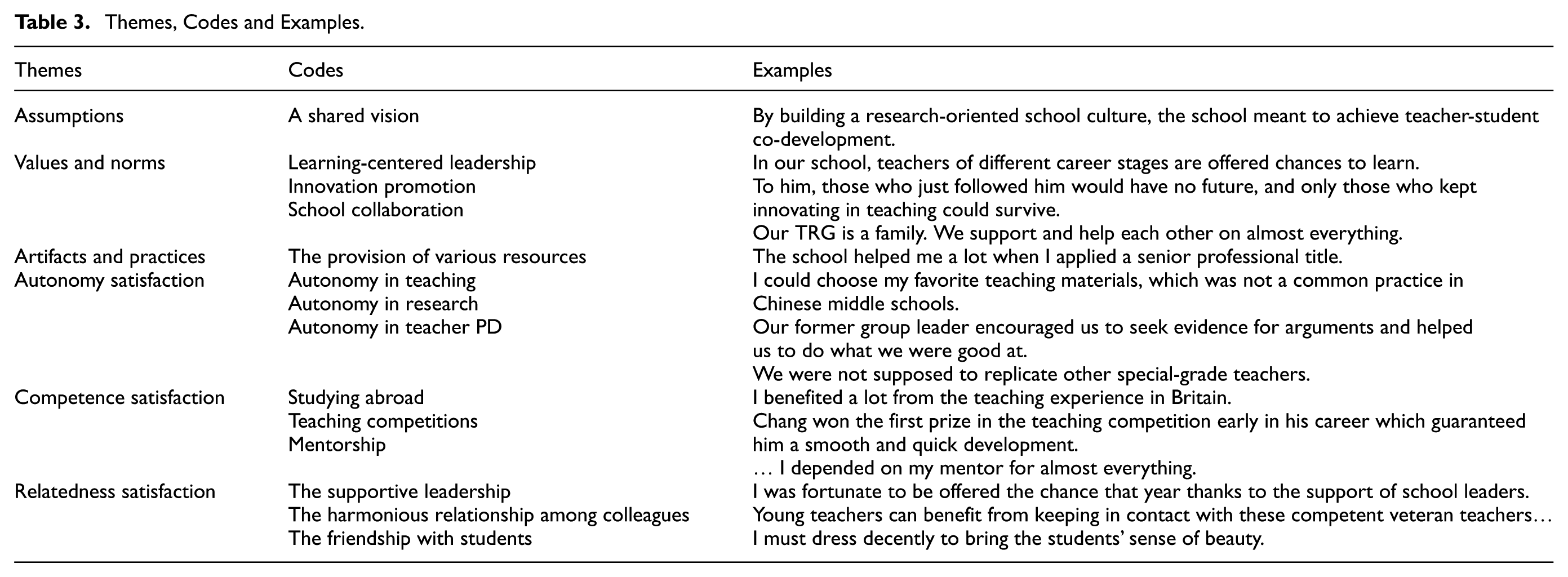
During the coding process, any uncertainty about interpreting particular excerpts was discussed with knowledgeable others. Two of the participants were invited to comment on the coding of their interview data, and both reported that the coding accurately described what they had reported in their interviews.
In addition to interviews, data from observations and documents were systematically analysed to triangulate the findings and strengthen the validity of interpretations. For example, observations of school rituals, staff meetings, and research activities provided contextual evidence of the research-oriented culture described by participants. Documentary evidence, such as school development plans and policy documents on teacher learning, was examined to confirm the alignment between institutional practices and participants’ narratives. These multiple sources allowed us to cross-check themes and ensure that interpretations were grounded in a range of evidence, thereby reducing over-reliance on self-reported data.
Results
In response to the first research question regarding school cultural factors related to expert EFL teachers’ PD motivation, this study revealed that shared vision, leadership, innovation, collaboration, and resources could contribute to teachers’ motivation for PD.
School Cultural Factors Conducive To Teachers’ Motivation For PD
The data analysis demonstrates that a research-oriented school culture prevails in the case school, which effectively fosters EFL teachers’ motivation for PD. This culture manifests across three levels, following Schein’s (1985) cultural framework (assumptions, values, and artefacts): at the assumption level through a shared vision of teacher- student co-development; at the values level through learning-centred leadership, innovation promotion, and institutional collaboration; and at the artifacts level through the provision of various resources.
Assumptions
Historical documents from Riverside School reveal three distinct phases in developing its shared vision of teacher-student co-development. The initial phase (1950s) involved comprehensive educational reforms modelled after the Soviet system. The second phase (1980s) emphasized teacher research capacity building. The current phase (2000s-present) centred on a research-oriented culture, creating “research-engaged students, teacher-researchers, and a knowledge-generating school community.”
Behind the long tradition of the case school is an overarching theme: the pursuit of teacher-student co-development. To achieve this purpose, research is adopted as a strategic nexus between teacher and student development, which aims at school improvement through cultivating both teachers’ and students’ research competencies. Field observation data revealed that the majority of school teachers strongly endorsed the research-oriented culture, perceiving it as both foundational to all institutional activities and beneficial to their professional practice. The shared vision of this reciprocal growth fosters EFL teachers’ active participation in teaching research, thereby facilitating their motivation for PD.
Values and Norms
The data analysis revealed that the case school exemplifies learning-centred leadership, an approach where school leaders foster a culture of continuous learning aligned with individual growth. Specifically, teacher PD is positioned as central to the school mission, which is supported by a structured teacher training program tailored to teachers’ individual developmental needs. Through systematic teacher PD planning, teachers at all career stages are offered learning opportunities. For example, the Youth League program is designed for new graduates from universities and the Junior Faculty Academic Salon is for young teachers with more than 5 years of teaching experiences. What’s more, opportunities to host workshops are offered to teachers over 35 who graduate from the Salon and show potential for further academic development. By offering tiered professional growth platforms, the school ensures that all teachers, regardless of career stage or specialization, can maximize their potential.
The research-oriented school culture of the case school promotes teaching and research innovation. This is particularly evident in the encouragement of cultivating individualized teaching styles. For instance, Chang developed a distinctive EFL teaching style characterized by being learner-connected, learner-engaged, and learner-focused (P-Chang-2020), significantly improving teaching efficiency. In her monograph, Wang described her teaching as “rich information, fast pace, and frequent practice” (P-Wang-P110-2017). Her classes were high engaging, by providing extensive student practice opportunities and emphasizing both linguistic competence and intercultural awareness. Post-observation student interviews corroborated these innovations, with learners reporting sustained motivation and engagement in English classes. All the participants attributed their success in teaching research to the research-oriented school culture, since the culture of innovation prevailed in all aspects of their school lives.
The case study identifies collaboration as another pivotal cultural factor fostering EFL teachers’ motivation for PD. Two primary types of collaboration emerged: teacher-student collaboration and intercollegiate collaboration. On one hand, students serve as a significant source of cooperation. The participants noted that they could challenge their assumptions and make pedagogical adjustments by taking students as partners in collaborative PD. Wang reported that answering students’ questions was challenging, which stimulated her learning. On one Junior Faculty Academic Salon the author observed, a mentor interpreted the research-oriented school culture to the young teachers,
In both teaching and research, we must prioritize solving students’ authentic learning problems, not merely conducting research for its own sake. (O-JFAS-20220509)
On the other hand, the collaboration among colleagues plays an important role in teacher daily practice, where expert teachers in a TRG exert a leading part in guiding professional growth and contributing to a supportive working climate. During my field study, two young teachers in English TRG succeeded in applying for senior titles. On a TRG faculty meeting, both of them thanked the help and support they received, describing the process as being “collectively propelled toward achievement” (O-FM-20220112)
Artifacts and Practices
The school’s material support for teacher PD is manifested through its thoughtfully designed infrastructure and resource allocation. Riverside School’s distinctive architectural design exemplifies this commitment, featuring three interconnected teaching buildings linked by open corridors to create a seamless learning ecosystem. The open and connected design of the three teaching buildings reinforces the importance of interpersonal relationships and connections among the school members. All the participants expressed their appreciation for the beauty of their school. The design also garnered international admiration from Danish visiting teachers (N-20141103) and Japanese high school delegations (N-20151111).
Effective teacher PD requires comprehensive institutional support encompassing human resources. The case school exemplifies this principle through two key dimensions of support: expert-guided professional growth and flexible scheduling for professional engagement. The case school has kept good relationships with experts from various fields, enabling targeted support for teachers’ career advancement. For instance, Yang greatly appreciated the school’s help in supporting his professional growth. He reported that the school invited many experts for guidance when he applied for a senior title. Chang also benefited a lot from expert mentoring when he was preparing for teaching contests.
Furthermore, all participants mentioned that they benefited greatly from the flexible scheduling policy in the case school. Yang thought that without a flexible schedule, he and Chang might not have been able to attend academic activities in Master Teacher Studio, which served as turning points in their careers. The freedom in schedule guarantees teachers more free time to develop their interests, which sets a foundation for their development.
In response to the second question regarding how school cultural factors motivated expert EFL teachers’ engagement in professional development, the data analysis showed that: (a) the autonomy in teaching, research, and teacher PD at the case school satisfied their autonomy needs, (b) opportunities for teacher learning satisfied their competence needs, and (c) the supportive leadership and harmonious relationship at school contributed to their relatedness satisfaction.
Autonomy Satisfaction
The participants’ autonomy needs were satisfied by the autonomy in teaching, research and teacher PD at the case school.
Autonomy in Teaching
The three participants reported great freedom in teaching, which reflected the innovation promotion culture in the case school. Wang regarded materials adaption in EFL teaching as an important means for her autonomy satisfaction. In China, middle school teachers could not decide on teaching materials, which were appointed by the local educational administrative. In the case school, the adoption of optional teaching materials was encouraged. In her teaching, Wang frequently adapted the articles in magazines such as Reader, which were more relevant to life, as supplementary materials. She remarked in a news report documenting her teaching achievements,
I like teaching because its value not only lies in nurturing talents for the country but also in the professional growth that teachers can enjoy. To me, being a teacher means lifelong learning to cope with challenges and meet the requirements of educational development. (P-Wang-20170524)
This statement reflects Wang’s strong sense of autonomy in shaping her teaching practice and professional identity. By adapting materials to better engage students, she exercised personal choice and creativity—conditions emphasized in SDT as essential for intrinsic motivation. This practice also mirrors the school’s research-oriented culture, which encourages individualized teaching approaches as part of professional growth.
Yang attributed his success in PD to the freedom in time arrangement, which demonstrated the artifacts level of school culture. Most Chinese high schools required their teachers to be present during work hours. Riverside School was an exception with the tradition of flexible timetable. Teachers were not asked to sit in their offices all through work hours. In addition, teachers were allowed to shift classes to another time when they attended academic activities. After comparing with his former classmates who worked in other schools, Yang commented,
The flexible timetable may not be appreciated by young teachers new to the school. However, after comparing with my former classmates working at other schools, I find it a great convenience, because I have more opportunities to participate in academic activities outside school. (I2-Yang-20211222)
Yang’s experience illustrates how structural affordances, such as flexible scheduling, satisfy his autonomy needs and enable participation in external academic communities. From an SDT perspective, this autonomy support fosters self-directed learning and long-term engagement in PD, reinforcing the significance of contextual conditions in internalizing extrinsic motivations.
Autonomy in Research
Apart from autonomy in teaching, the school fostered research autonomy among teachers, which was demonstrated in the equitable academic atmosphere and the individual academic interest. Therefore, a good habit of the faculty was that all academic arguments should be supported by evidence. Yang illustrated this with the example of the former English TRG leader,
Our former group leader encouraged us to seek evidence for arguments and helped us to do what we were good at. To him, those who just followed him would have no future, and only those who kept innovating in teaching could survive. This equitable and free academic atmosphere is really beneficial for young teachers’ growth. (I1-Yang-20211019)
This comment underscores the cultural value of innovation and intellectual freedom within the school, which not only supports autonomy but also enhances competence through critical inquiry and evidence-based practice. The emphasis on originality and scholarly rigor creates an environment aligned with SDT’s competence need, motivating teachers to sustain PD through meaningful engagement in research.
Autonomy in Teacher PD
To Chang, his autonomy needs were achieved by the autonomy in teacher PD at school. Speaking of the school’s cultural influence on his development, Chang thought high of the autonomy the school gave him in professional growth, as reflected in the school’s individualized PD plan for teachers. The school valued the diversity of teachers’ development by setting different training strategies for teachers of different types. For example, more opportunities for teaching contests or public classes were offered for teachers who were good at teaching. In contrast, teachers who excelled in research could get more chances to attend academic conferences or host research projects.
Chang had developed a model for his classroom teaching, that is, a learner-engaged, learner-focused, and learner-connected class. Chang introduced the characteristics of his teaching in his monograph,
English class involves the instantaneous generation, which means giving instant feedback on the student’s responses. Classroom teaching should be dynamic and flexible based on students’ learning instead of strictly sticking to the teaching plan. (P-Chang-P8-2020)
Thus, Chang had formed a unique teaching style thanks to the school’s encouragement of teacher autonomy in teaching and teacher development. He was not restricted to following common practices in EFL teaching but was encouraged to experiment his teaching ideas under the influence of the research-oriented school culture. He stated in the interview,
We were not supposed to replicate other special-grade teachers. Every teacher should have distinctive characteristics in both teaching and research. (I2-Chang-20220510)
Competence Satisfaction
The school satisfied teachers’ needs through offering them opportunities for teacher learning, namely, studying abroad, teaching competitions and mentorship.
Studying Abroad
As an EFL teacher, the experience of travelling to an English-speaking country could be incredibly beneficial. All the three participants reported benefits from their experiences abroad. In 1993, Wang worked as a Chinese teacher in an Australian high school, which significantly improved her linguistic competence and transformed her educational concepts. Through the difficulties her students encountered in learning Chinese, she realized the difficulties Chinese students might encounter in learning English and the significance of developing students’ critical thinking and problem-solving abilities. Similarly, Yang worked as a Chinese teacher in a British middle school for a year in 2001, which benefited him a lot. Meanwhile, Chang studied in Hong Kong in 2015 for his master degree and worked as a shadow teacher in the United States for 2 months, which led to his better understanding of conducting research in EFL teaching.
Teaching Competitions
Both Yang and Chang regarded their winning in municipal teaching competitions as critical in their professional growth, which significantly boosted their motivation for PD. In his early years of teaching, Yang won three first prizes in municipal teaching competitions in 2000, 2001, and 2005. These winnings were of great importance to Yang’s professional growth. Similarly, Chang won the first prize in the municipal teaching contest in 2008, which brought him more opportunities to get acquainted with the master teachers in Shanghai. Therefore, they were given more responsibilities in daily teaching by the school, teaching graduating classes for consecutive years.
Yang commented on Chang’s wining in teaching competitions: Chang has good English and holds himself to a high standard. His classes are in fast pace since he can organize very fluent communication in teaching. Chang won the first prize in the teaching competition early in his career which guaranteed him a smooth and quick development. (I1-Yang-20211019)
Mentorship
Mentorship both in and out of school played an important role in participants’ professional success. Chang reported the critical role his mentors played in the early stages of his career as mentors provided teaching instructions and professional guidance. He elaborated in the interview,
When I started teaching, there was no standardized teacher training like today, so I depended on my mentor for almost everything. (I1-Chang-20210910)
Chang kept a close relationship with his mentor, who assisted him in mapping out his career trajectory and meticulously preparing for each phase of his PD. For example, she instructed him on improving his teaching abilities during his apprenticeship and offered him the chance to study abroad after his winning in teaching competitions.
The out-of-school mentorship played even more important role in satisfying participants’ competence needs. Both Yang and Chang valued high the experience of joining the municipal Master Teacher Studio (MTS), which was a two-year workshop led by a team of elite teachers in Shanghai. Yang regarded it as the turning point of his PD, when he joined the MTS in 2008, since it not only broadened his horizons but, more importantly, offered impetus to his professional growth. He explained,
The learning experiences in MTS enabled me to develop a hazy plan for my PD, and then I succeeded in the professional promotion next year. (I1-Yang-20211019)
The competence satisfaction was realized by studying abroad, participating in teaching competitions and the mentorship. By so doing, their self-confidence and sense of self-efficacy were boosted and they were motivated to participate in teacher PD.
Relatedness Satisfaction
The supportive leadership and harmonious relationship with both colleagues and students contributed to participants’ relatedness satisfaction.
The Supportive Leadership
All the three participants benefited from the supportive school leadership, which was revealed in the opportunities they received for overseas study and professional learning in and out of school. Take Yang as an example. In 2008, Yang, with an intermediate professional title, was recommended by the school to attend the municipal MTS as an exception, as the MTS required a senior title. He appreciated the efforts the school leaders took in such doing because that chance dramatically changed his life by stimulating his motivation for professional growth.
Chang also attributed his success to the support of school leaders. He won the first prize in the quadrennial Shanghai Young and Middle-aged Teachers’ Teaching Awards in 2008. He commented in the interview,
It is not easy to obtain that chance because of the tough competition for the ticket. I was fortunate to be offered the chance that year thanks to the support of school leaders. (I2-Chang-20220510)
After winning the award, both Yang and Chang were promoted to the administrative posts, which further boosted their motivation for PD.
The Harmonious Relationship Among Colleagues
The help from colleagues contributed to their relatedness satisfaction and teacher PD. Wang attributed her PD success to the help of veteran teachers which guaranteed her transition from an inexperienced teacher to an expert EFL teacher. In the interview, Yang, who had just transferred from the case school to a new post in Shanghai Municipal Education Commission, showed his affection for the school where he had worked for 22 years. He repeatedly mentioned that he felt happy when he worked at Riverside School because it was a young-teacher-friendly school and there were many capable and helpful veteran teachers. He benefited from these close relationships, especially those with the master teachers, and regarded them as a resource for teacher learning.
Young teachers can benefit from keeping in contact with these competent veteran teachers who helped me grow up, especially at the beginning stage of my career. (I1-Yang-20211022)
The Friendship With Students
The close friendship with students served another motivator for the participants’ PD. Wang believed that teachers were models for students and should strive for excellence in classroom teaching, including personal dressing, language, and attitude. She explained in the news report about her accomplishments,
This respect starts from my dressing. I must dress decently to bring the students’ sense of beauty. (P-Wang-20170524)
Her love for teaching and respect for students won the trust and love of students. In the school annual evaluation of My Favourite Teachers by students, she had always been on the top of the list before her retirement.
Chang also kept a close relationship with students. The first interview with Chang was on Teacher’s Day. Several students came to Chang’s office to extend their greetings. Chang was amazed that the students brought his favourite lozenges and was moved by the meticulous care of the students. The episode showed their friendly relationship.
In Chang’s opinion, moral education was more important than book knowledge. His love for students also lied in his teaching philosophy that students were allowed to make mistakes because it was the nature of learning. However, he also reminded his students that “teachers do not expect students to keep making the same mistakes, because the reduced mistakes could indicate personal growth” (I1-Chang-20210910).
Discussion
This study reported the research-oriented school culture in the case school and how this school culture motivated the three expert EFL teachers to strive for teacher PD by satisfying their basic psychological needs of autonomy, competence, and relatedness.
A Positive School Culture Model For Teacher PD Motivation
This study indicates the significance of a shared vision for teacher PD motivation. A shared school vision is a characteristic of effective schools (Glickman et al., 2007), directs positive school change (Fullan, 2001), and ideally guides quality teacher PD (Tallerico, 2005). Consistent with Moraal et al. (2020), the current study suggests that a clear and explicit school vision could be related to a culture of mutual trust and joint work in which teachers carry out practical professionalization activities. Schools might contribute to increased teacher PD by harmonizing the values held by teachers with the school vision through leader behaviours, and explicit school expectations (Arifin et al., 2014). When the agreement between the school’s and teachers’ interests can be reached, teachers can have more intrinsic motivation towards realizing the school’s vision. In the sampled school, teacher and student development are valued, and teacher research advocacy suggests the way to achieve the goal. The explicit school expectations of teacher research drive teacher engagement in teaching experiments, resulting in teacher PD. In Riverside School, the research-oriented school vision, advocating the development of students, teachers, and the school by engaging in research, is specific and achievable. Furthermore, the inclusion of teacher development in school vision is transformative because school visions in most schools focus only on student learning, with teacher development being largely ignored. The emphasis on teacher development in the case school serves as an incentive to motivate teachers to engage in teacher research for student development and their PD.
This shared vision satisfies teachers’ need for relatedness by aligning individual goals with collective school objectives, and for autonomy by providing a clear but flexible framework within which teachers can act purposefully. Such alignment strengthens internalization of extrinsic expectations, facilitating the transition towards autonomous motivation as posited by SDT.
Consistent with previous literature on school leadership, this study reveals that school leaders could help to create a culture by bringing a cause to the attention of a group of people to significantly impact teachers’ PD motivation (Kulophas & Hallinger, 2020). In China, principals prioritize their managerial and political roles due to the school’s hierarchical structure and high power-distance culture (Liu et al., 2016). However, things are quite different in Riverside School since there is a tradition of valuing the critical role of teacher PD in student learning and school improvement. Learning-centred leadership primarily addresses teachers’ need for competence through structured growth opportunities and feedback, while also fostering relatedness through trust and collaborative planning. By creating an environment of respect and support, leadership practices help teachers experience volition and confidence—key prerequisites for integrated regulation under SDT.
The results of this study support the argument that curriculum innovation can be an effective way for teachers’ professional growth (Silver et al., 2019). Encouraging innovation nurtures autonomy by granting teachers the freedom to experiment and make pedagogical choices, while also reinforcing competence as they master new practices. This interplay demonstrates how cultural affordances can move teachers from controlled to autonomous forms of motivation. On the other hand, unsuccessful curriculum innovations might hinder teacher development, which is reported by Stolk et al. (2011), who found that teachers were only partially empowered to design a new unit. It indicates the critical role of a supportive school culture in teaching innovations and teacher development.
The finding is consistent with that of Evans et al. (2006), who argue that an expansive learning environment, where opportunities to participate in many different communities of practice are offered, enables teachers to engage in various groups and networks to collaborate with colleagues. Collaboration meets teachers’ relatedness needs by embedding them in professional communities, while peer feedback and co-learning enhance competence. These dual satisfactions create fertile ground for autonomous motivation, consistent with SDT’s emphasis on social-contextual supports. In order to create and sustain collaborative teacher learning, deliberate work is needed since not all collaborations are effective; some even block changes or inhibit advancement (Opfer & Pedder, 2011).
Material and human resources function as structural enablers of competence and autonomy, providing both the tools and flexibility needed for teachers to pursue meaningful PD. When such resources signal institutional trust, they also contribute to relatedness, reinforcing the motivational ecosystem. The current study also suggests that material culture constitutes an essential source for understanding the past of schools, which accords with the findings of Admiraal et al. (2021). In the case school, the achievements in school history constitute an essential aspect of positive school culture, which might increase teachers’ self-confidence in PD. Moreover, human resources serve as the foundation for shaping a positive school culture, which prove to be helpful for teacher PD motivation. The significance of human resources is also recognized in literature such as Firestone et al. (2005), who found that school differences in using human resources affected the planning of teacher PD. Therefore, schools should provide adequate resources to shape a school culture conducive to teacher PD.
This study’s findings have confirmed that teacher PD motivation cannot be understood without investigating the characteristics of the school context (Opfer & Pedder, 2011). To enunciate the intricate dynamics of how a positive school culture influences EFL teacher PD motivation, the following data-driven model presents characteristics of a positive school culture and its interactions with EFL teacher PD motivation (see Figure 1).

A positive school culture model for teacher PD motivation.
As demonstrated in Figure 1, a positive school culture consists of three systems: macrosystem, mesosystem, and microsystem. The macrosystem refers to a shared vision of teacher-student co-development, which indirectly influences EFL teacher PD motivation. The mesosystem, namely, learning-centred leadership, directly affects EFL teachers’ basic psychological needs and PD motivation and is guided by the shared vision in the macrosystem. The microsystem consists of three elements: innovation, collaboration, and resources, which have direct interaction with EFL teacher PD motivation and serve as ways of satisfying teachers’ basic psychological needs and leading to their autonomous motivation for PD. On the other hand, the improved teacher PD motivation makes teacher development a common language among EFL teachers, leading to a positive school culture.
Factors Influencing the Formulation of a Positive Culture
In light of the motivator for teacher PD, the results of this study suggest an association between positive school culture and teachers’ enhanced motivation for PD. While the findings indicate that certain cultural affordances—such as flexible scheduling, structured PD plans, and collaborative networks—coincided with teachers’ motivational development, the qualitative design does not allow us to conclusively establish causation. Instead, the evidence should be interpreted as illustrative of how participants perceived these cultural conditions as influential in their professional growth (Enthoven et al., 2023).
The three cases indicate that, during the initial teaching stage, external support provided by the school is vital for teachers (Lyu & Li, 2025), whether they have strong motivation for PD or not. Helping novice teachers recognize the significance of professional growth and offering them professional guidance can stimulate their PD motivation (Schwarz-Franco & Hadar, 2024). Therefore, support from authoritative figures, such as school leaders and capable mentors, in the initial teaching process will reduce the pressure on young teachers, shorten their adaptation period and enhance their confidence in PD.
The data of this study also show that school culture plays a crucial part in teachers’ sustaining motivation for PD from the perspective of associating the school values such as students’ holistic development and collective honour. In the case school, students’ innovative spirits and holistic development are valued instead of solely focusing on students’ grades, which is not a common practice in the exam-oriented culture. Therefore, implementing quality-oriented education and advocating joint participation in research by teachers and students at the case school contribute to the formation of sustaining motivation for teacher PD.
However, nurturing such motivation is a challenging endeavour. According to SDT, such motivation arises only in environments that fulfil individuals’ psychological needs for competence, relatedness, and autonomy in their endeavours (Deci et al., 2017). In simpler terms, to ignite teachers’ motivation for PD, it is crucial for them to be empowered by autonomous motivational regulations as outlined by SDT. This holds particular significance for EFL teachers in China, who are often burdened by the intense pressures of exam-oriented education (J. Yang, 2021).
Consistent with Tsui (2009), this study also found that the development of expert EFL teachers’ expertise has been characterized by constant engagement in experimentation and exploration to extends their competence. But the present study went further to explore what kind of school cultural affordances are critical for teacher PD motivation and showed the significance of a supportive environment for teacher development. This can partly answer the question of how to bridge the big gap between teachers’ needs and the contextual support raised by J. Yang (2021). The research-oriented school culture encourages teachers to engage in teaching experiments and guarantees teachers’ autonomy and competence satisfaction with external supports such as mentors and workshops. With basic psychological needs being satisfied, teachers exhibit more intrinsic motivation and internalize school cultural values, resulting in greater behavioural effectiveness and psychological well-being.
While this study highlights the positive affordances of a research-oriented school culture, it is important to acknowledge that such a culture may also create tensions. For instance, two participants reported feeling pressure to maintain their status through continual research output and competition success, which occasionally led to stress and reduced autonomy. Similarly, institutional expectations for innovation sometimes clashed with teachers’ personal teaching philosophies, creating moments of friction. These findings suggest that supportive cultural elements can coexist with structural constraints, and future research should explore how these tensions shape motivational processes over time. Furthermore, this study did not include strong negative cases or systematically examine structural barriers, which limits the ability to capture the full spectrum of experiences. Addressing these aspects in future studies could provide a more critical and comprehensive understanding of the school–motivation dynamic.
Beyond individual experiences, the school’s strong research-oriented culture—while largely supportive—may embed implicit norms that risk constraining autonomy. For example, the pervasive expectation that teachers engage in research could, over time, shift from an opportunity to an obligation, reducing the voluntary nature of professional development. This dynamic reflects what Hargreaves and Fullan (2012) describe as “performative professionalism,” where teachers feel compelled to align with institutional agendas to maintain credibility. Similarly, structured PD programs, despite their benefits, may inadvertently limit teachers’ agency when participation becomes mandatory or when teachers have little influence over content design. These insights indicate that even in highly supportive environments, cultural affordances and constraints coexist, and their interaction warrants closer examination.
Conclusion
This study investigated how a positive school culture motivated three expert EFL teachers to strive for PD by satisfying their basic needs of autonomy, competence, and relatedness. The current study contributes fresh perspectives to the existing literature by highlighting school cultural factors conducive to teachers’ motivation for PD. In doing so, it provides partial answers to the questions posed by scholars in the field of teacher PD, such as Admiraal et al. (2021) and Usher (2021), regarding the advantages of a positive school culture for teacher PD. Moreover, the findings enrich the theory of school culture (Deal & Peterson, 2009) by linking it to teacher PD motivation. Based on these results, it is recommended that schools should cultivate a positive school culture by means of teacher collaboration and offering opportunities for teacher learning to motivate teachers’ professional learning.
While these findings reflect an elite school context with robust resources and a strong research tradition, their application to less privileged or resource-limited schools warrants careful consideration. Replicating a research-oriented culture without equivalent structural support could impose undue pressure on teachers rather than empower them. For novice teachers or those working in schools with heavy workloads and limited institutional backing, expectations to engage in research and innovation may feel overwhelming. Therefore, adaptations are necessary: schools should foster micro-cultures of collaboration, prioritize peer-based mentoring, and introduce incremental innovation opportunities to balance institutional expectations with teachers’ psychological needs. Such approaches could help schools of varying profiles create motivational environments without replicating the potential stressors observed in high-performing settings.
This study has its limitations. Firstly, it used a limited number of cases to explore the school cultural effects on complex teacher PD motivation. As this study was based on three expert teachers from one elite school, its findings should be interpreted with caution. The study aimed to offer an in-depth exploration rather than broad generalization. To enhance the transferability of the findings, we provided thick descriptions of the research context, participants, and cultural characteristics of the case school, which enables readers to judge the relevance of the findings to their own contexts. Future research could involve multiple schools with diverse profiles to examine whether similar cultural factors operate across different contexts.
In addition to acknowledging the limited sample size and single elite school setting, it is important to note that these constraints influence the internal validity and applicability of the findings. While qualitative case studies prioritize rich, contextualized understanding over statistical generalization, the specific cultural and institutional characteristics of the case school may differ substantially from other schools. This situational uniqueness limits the direct transferability of findings to broader contexts without careful consideration of contextual similarities and differences. To mitigate this, detailed descriptions of the research context, participants, and cultural factors are provided to support readers’ informed judgments about applicability. Future research with larger, more diverse samples and multiple school settings would enhance the validity and generalizability of findings across educational contexts.
Secondly, the current research only focused on the positive factors within the case school’s culture that motivated EFL teachers’ PD, without delving into potential detrimental aspects of the school culture that might hinder such motivation. Future research could adopt a dual perspective—examining both facilitating and constraining factors—to provide a more comprehensive understanding.
Supplemental Material
sj-docx-1-sgo-10.1177_21582440251385400 – Supplemental material for Understanding Expert EFL Teachers’ Motivation for Professional Development: How School Culture Matters
Supplemental material, sj-docx-1-sgo-10.1177_21582440251385400 for Understanding Expert EFL Teachers’ Motivation for Professional Development: How School Culture Matters by Chenming Lyu in SAGE Open
Footnotes
Acknowledgements
The author is thankful to Shanghai Center for Research in English Language Education (SCRELE) for their support in conducting the study.
Ethical Considerations
This study did not perform research on humans or animals.
Author Contributions
Chenming Lyu is an associate professor at the School of Foreign Languages, Ludong University, Yantai, China. His research focuses on teacher learning, teacher professional development, and materials development. His publications have appeared in a number of international journals, including International Journal of Applied Linguistics, Innovation in Language Learning and Teaching, RELC Journal, and so on.

Funding
The authors disclosed receipt of the following financial support for the research, authorship, and/or publication of this article: Shanghai Center for Research in English Language Education (SCRELE).
Declaration of Conflicting Interests
The author declared no potential conflicts of interest with respect to the research, authorship, and/or publication of this article.
Data Availability Statement
Data sharing not applicable to this article as no datasets were generated or analyzed during the current study.
Supplemental Material
Supplemental material for this article is available online.
References
Supplementary Material
Please find the following supplemental material available below.
For Open Access articles published under a Creative Commons License, all supplemental material carries the same license as the article it is associated with.
For non-Open Access articles published, all supplemental material carries a non-exclusive license, and permission requests for re-use of supplemental material or any part of supplemental material shall be sent directly to the copyright owner as specified in the copyright notice associated with the article.
