



Abstract
Interest in the motivation for the choice of the teaching profession has been growing in the last few decades. Although the literature recognizes the importance of exploring non-academic factors that affect the quality of teaching and teachers’ well-being, studies exploring these factors within the context of the teaching career choice are rather underrepresented. The aim of this study was to explore the predictive value of personality traits, emotional competence, and life-satisfaction of prospective teachers in explaining prospective teachers’ motivation for the choice of the teaching profession. A total of 591 prospective teachers participated in this study. The data were analyzed by the hierarchical regression analyses, and the results indicated that almost all personality traits and the ability to regulate and manage emotions predicted the importance of intrinsic value and the social utility value of teaching, whereby neuroticism was a negative predictor of these motives. Also, life-satisfaction was predictive of the importance of both of these motives and the importance of the personal utility value of teaching.
Keywords
Introduction
The importance of teachers’ recruitment in the last few decades has become an issue that draws researchers’ and policymakers’ attention in many countries. The trend of declined interest in the teaching profession and the shortage of qualified and motivated teachers is related to the decline in this profession’s status which is observed worldwide (la Velle, 2019), and Croatia is not an exception to this trend (Schleicher, 2018). Hence, the growing number of studies interested in exploring young peoples’ motives to choose teaching as a career and enroll in initial teacher education programs is not surprising. The question of what motivates young people to choose to teach is important both from the perspective of the quality of initial teacher education and from the perspective of preservice teachers future teaching practices, relationship with students and their educational outcomes, teachers’ job motivation, self-efficacy, and well-being (Han & Yin, 2016; Klassen & Tze, 2014; Skaalvik & Skaalvik, 2018). Furthermore, the societal changes continuously affect teachers’ work in terms of demands and complexity, and the current pandemic additionally affected the complexity of the teaching profession and the need to adjust and properly respond to these challenges. In the light of these changes, exploring motivation for the teaching profession becomes even more important.
According to Corcoran and O’Flaherty (2016), personal characteristics should be considered in the prospective teachers’ recruitment process. At the same time, initial teacher education should also demonstrate a better understanding of pre-teaching characteristics that can affect teachers’ performance and students’ outcomes (Corcoran & Tormey, 2013). Hence, this study focuses on exploring the motivation to choose a teaching career concerning certain personal characteristics of prospective teachers, that is, their personality traits and emotional competence, but also broadens the current base of knowledge by including the life-satisfaction as a motivational drive related to professional choices. Namely, having in mind that prospective teachers should be well-prepared for various demands of their future profession, including mastering different social and emotional challenges in everyday interactions (Aldrup et al., 2020), the insight into certain personal correlates of motivation could contribute to addressing specific issues related to initial teacher education and developing certain skills prior to the employment. Further in the manuscript, the main constructs of the study will be presented. According to Corcoran and O’Flaherty (2016), personal characteristics should be considered in the prospective teachers’ recruitment process. At the same time, initial teacher education should also demonstrate a better understanding of pre-teaching characteristics that can affect teachers’ performance and students’ outcomes (Corcoran & Tormey, 2013). Hence, this study focuses on exploring the motivation to choose a teaching career concerning certain personal characteristics of prospective teachers, that is, their personality traits and emotional competence, but also broadens the current base of knowledge by including the life-satisfaction as a motivational drive related to professional choices. Namely, having in mind that prospective teachers should be well-prepared for various demands of their future profession, including mastering different social and emotional challenges in everyday interactions (Aldrup et al., 2020), the insight into certain personal correlates of motivation could contribute to addressing specific issues related to initial teacher education and developing certain skills prior to the employment. Therefore, this study could also have practical implications for planning specific interventions aimed at enhancing prospective teachers’ competences which are relevant for their future teaching practice and career. Further in the manuscript, the main constructs of the study will be presented.
Motivation for Teaching From the Perspective of the FIT-Choice Model
Studies related to motivation for teaching are numerous and vary in their theoretical and methodological background. However, Heinz (2015) indicated that the comparison of results obtained in different studies is somewhat difficult due to the lack of consistent theoretical and methodological frameworks in this field. The model that represented a certain shift in exploring motivation to choose the teaching profession was the FIT (Factors Influencing Teaching)-Choice model proposed by Watt and Richardson (2007). Derived from expectancy-value theory (Eccles, 2005), this model generally comprises motivational factors important for the choice of the teaching profession, perceptions of the teaching profession, satisfaction with this career choice, and the level of social dissuasion regarding this choice. On the level of motivational factors, the authors propose the intrinsic value of teaching, the social utility value of teaching, the personal utility value of teaching, perception of own teaching ability, prior teaching and learning experiences, social influences by significant others, as well as the motive of choosing teaching as a fallback career. The authors of the FIT-Choice model also proposed a validated instrument used in various educational contexts and countries and provided a valid framework enabling comparison of results obtained in different studies (Watt & Richardson, 2012; Watt et al., 2017).
FIT-Choice motivational factors in this study’s focus are the perceived value of the teaching profession in terms of intrinsic value, social utility value, and personal utility value of teaching. In line with the FIT-Choice model, the intrinsic value of teaching refers to the enjoyment in teaching and interest in teaching (which, in literature, can also be encountered under the term intrinsic motivation for teaching). The social utility value of teaching comprises the importance of certain aspects of the teaching profession, such as working with children/adolescents and participating in shaping their future, enhancing social equity, and making a social contribution (in some studies, referred to as altruistic motivation). Finally, the personal utility factor includes motives such as time for a family, secure job position, and job transferability (in some studies described as extrinsic motives). Previous studies have demonstrated that the intrinsic value and social utility value of teaching are mostly pronounced motives in various contexts (e.g., Glutsch & König, 2019; Htang, 2019; Wyatt -Smith et al., 2017), and some studies indicate that the personal utility value is somewhat more pronounced in developing societies (Yüce et al., 2013).
Studies exploring the importance of specific motives for the choice of teaching are focused either on its relation with subject/discipline and educational level or its relationship with some individual characteristics of prospective teachers. As already mentioned, this study is also focused on certain individual characteristics of prospective teachers, more specifically on their personality, emotional competence, and life-satisfaction as characteristics that could be related to their motivation to choose this profession. Namely, recent literature indicates the importance of affective-motivational resources for the teaching profession (Blömeke, 2017), and the studies exploring the contribution of individual characteristics in explaining the motivation for the choice of the teaching profession are still relatively scarce. The review of the present studies is provided in the following section.
Personality Traits and Emotional Competence as Correlates of Motivation to Teach
Previous studies indicate the important role of personality traits in vocational interests and job performance (Barrick & Mount, 2005, Berings et al., 2004). According to the five-factor model (John et al., 2008), these traits are extraversion (characterized by sociability, positive emotionality, and activity), agreeableness (characterized by altruism, trust, tender-mindedness, and modesty), conscientiousness (referring to planning, organizing, and structure), neuroticism (characterized by distressing and negative emotionality) and openness (which includes valuing novelty and diverse experiences and ideas).
Studies exploring the role of personality within the context of the teaching profession predominantly focus on in-service teachers’ job performance in terms of teachers’ efficacy and burnout. In their meta-analysis Kim et al. (2019) concluded that extraversion, agreeableness, emotional stability, and openness are positively related to teachers’ effectiveness, while extraversion, emotional stability, and conscientiousness are negatively related to teachers’ burnout. However, the role of personality is much less explored concerning the motivation for the teaching profession.
Several studies indicated that personality traits could also be of relevance for choosing the teaching career. In a study conducted by Jugović et al. (2012), the importance of the intrinsic value of teaching and the personal utility value of teaching was positively correlated with extraversion, agreeableness, conscientiousness, and openness while negatively correlated with neuroticism. Additionally, agreeableness, extraversion, and conscientiousness were positive predictors of the intrinsic value of teaching, while agreeableness, and conscientiousness were also positive predictors of the social utility value of teaching. In the same study, openness was a negative predictor of the personal utility value of teaching. Exploring prospective teachers’ fallback career motive (motivation to choose teaching as their second career choice), Tomšik and Gatial (2018) obtained that, apart from neuroticism which was a positive predictor, all other traits were negative predictors of the motive to choose teaching as a fallback career.
Keeping in mind the nature of the teaching profession, individuals who are more prone to positive emotionality, sociable, organized, and prosocially oriented are more likely to be motivated to choose this profession by the intrinsic and social utility values related to this specific career choice. This is also in line with Holland’s (1997) model of vocational interests, presuming that individuals who are interpersonally oriented are more inclined to choose a career that includes working with others and being motivated mainly through the intrinsic and the social utility value of the chosen career, and less by other motives such as job security.
The importance of personality in teacher job effectiveness also draws attention to the potential role of exploring factors besides the academic ones as determinants of motivation for the teaching profession. Within this context, emotional competence is undoubtedly one of the factors relevant to the teaching profession and meeting this complex profession’s demands. From the perspective of previously mentioned vocational interests, McLarnon et al. (2015) indicate that characteristics related to emotional functioning are also related to the preference to choose a profession that includes working with others.
Emotional competence is a construct derived from the construct of emotional intelligence as proposed by Salovey and Meyer (1990), and in the literature, this construct is sometimes referred to as socioemotional competence. As demonstrated in previous studies, personality traits and emotional competence are two related constructs, which is not surprising since personality traits also include certain aspects of emotional functioning. This aspect of emotional functioning related to personality traits combination is often referred to as a trait emotional intelligence, which differs from ability emotional intelligence that refers to emotional information processing (Alegre et al., 2019). Ability to respond to emotions and manage emotions is generally considered necessary for managing various relationships, including those within the professional context. Like personality, emotional competence can also be related to vocational choices (Emmerling & Cherniss, 2003; Santos et al., 2018), and, consequently, it is also related to job performance in various domains (Klassen & Tze, 2014). Furthermore, Urquijo et al. (2019) indicate that emotional competence predicts job satisfaction beyond personality.
Within the context of the teaching profession, Havik and Westergård (2019) point out that emotionally competent teachers are more likely to motivate and encourage students. Aldrup et al. (2020) especially emphasize the central role of teachers’ emotional regulation for students’ and teachers’ outcomes. Namely, the teaching job includes complex interactions with students (and colleagues) on an everyday basis, and these interactions include motivating and supporting students, resolving possible conflicts and appropriate communication, and building positive relationships with students. Hence, it is reasonable to assume that emotionally competent teachers will be more successful in responding to various professional demands of their profession. According to Mérida-López and Extremera (2017), the role of emotional competence is especially noticeable in emotionally demanding professions, which also points to the question of motivation for the teaching profession. The teaching profession is certainly emotionally demanding, and individuals who express a higher level of emotional competence are more likely to better adjust to this profession and display higher efficacy and less burnout.
Life-Satisfaction as a Motivational Antecedent of the Career Choice
Research on well-being generally characterizes this construct as either objective or subjective, whereby subjective well-being, which is a part of this study, refers to individual satisfaction with specific life-domains and global judgment of life-satisfaction (Diener et al., 1999). Life-satisfaction can be observed as the level of congruence (or discrepancy) between desired and actual life circumstances. Numerous studies imply the association between well-being and other aspects of psychological functioning and individual health (Pulido et al., 2020). Studies have also demonstrated that personality accounts for a significant proportion of variance in explaining life-satisfaction (Diener et al., 1999), although Lachmann et al. (2017) notice that these results are not very consistent. Studies have shown that life-satisfaction is also higher among individuals with higher emotional competence (Extremera & Rey, 2016). Also, Pena et al. (2012) obtained that teachers with higher emotional intelligence have a higher level of life-satisfaction and are more engaged in their profession. In a study conducted by Çevik (2017), life-satisfaction also predicted teachers’ job satisfaction
Important life-outcomes have been studied as a consequence of life-satisfaction whereby some studies were focused on describing the relationship itself, while the others were focused on potential underlying mechanisms of that relationship (Luhmann & Hennecke, 2017). However, according to the same authors, life-satisfaction has not gained enough attention and has often been overlooked in motivational studies, resulting in an insufficient understanding of its motivational role in terms of its motivational consequences.
Although the role of life-satisfaction as a motivational drive for different professional choices (including the choice of teaching career) is not much discussed in the literature, certain general findings can serve in attempts to approach and explore this topic. According to the literature, gain-oriented goals are those directed toward the desired state; hence, the achievement of the valued state could, among highly satisfied individuals, lead to a higher commitment to professional motivational goals. Similarly, within the context of professional choices, more satisfied individuals could express generally higher importance of various motives for their profession. Within the teaching profession, this would imply that they are more committed to their goals, thus expressing higher motivation for the selected profession. Having in mind that the teaching profession, according to Holland, reflects social vocational interests, it could be expected that the individuals with higher life-satisfaction are those who choose a profession that is in line with their characteristics and thus express more intrinsic and social motives in the case of the profession including working with others. In other words, individuals who are more committed to achieving the desired state in terms of professional choice are more likely to be committed to specific goals that lead to that state’s achievement. Within the context of choosing a teaching career, life-satisfaction can reflect their motivational reediness, which is described as the willingness to act to fulfil specific desires (Kruglanski et al., 2014), in this case, the desire to pursue a teaching career.
Drawing upon the previous literature, this study explores the relative contribution of personality traits, emotional competence, and life-satisfaction in explaining prospective teachers’ motivation to pursue a career in teaching. As already described, previous studies imply the contribution of emotional competence even when controlling for personality traits in professional choices; hence, this study aimed at exploring this assumption within the context of teaching profession choice. Additionally, the predictive role of life-satisfaction beyond the effects of personality traits and emotional competence is explored. Studies conducted within the broader field of motivation have demonstrated that life-satisfaction can play an important role in forming motivational and personal goals, implying its potential role in vocational motivation. However, there is a lack of studies exploring life-satisfaction combined with other individual antecedents of vocational motivation, including motivation to teach. Hence, this study’s approach is partially explorative and could contribute to understanding motivation to teach by expanding the current knowledge base on certain antecedents of motivation for the teaching profession.
According to the available literature, it is hypothesized that both personality traits and emotional competence contribute to the motivation to pursue a career in teaching. More specifically, it is expected that individuals with a higher level of extraversion, agreeableness, conscientiousness, and openness and a lower level of neuroticism would have higher ratings of the importance of intrinsic and social utility value of teaching. Further, it is also hypothesized that higher emotional competence will predict the higher importance of the aforementioned motives. In the case of the personal utility value, specific hypothesis was not formulated due to ambiguous results regarding the association between personality traits and different types of motivation (Hart et al., 2007). Finally, it is assumed that life-satisfaction will also be predictive of motivation to teach (beyond the effects of personality traits and emotional competence), whereby preservice teachers with higher life-satisfaction will have higher ratings of the importance of all examined motives for entering the teaching profession.
Methodology
Participants and Procedure
Participants in this study were 591 pre-service teachers - students of the initial preschool teacher education program (n = 108) and students of the primary teacher education program (n = 483) at the University of Zagreb, Croatia. The average age of participants was M = 20.92 (SD = 1.784). Participation in this study was anonymous and voluntary, and the study was conducted in line with the ethical standards prescribed by the University. Keeping in mind that most of the students enrolled in initial preschool and primary teacher education programs are females (about 96%), the information on participants’ gender was not collected to additionally grant male students’ anonymity. Upon obtaining participants’ consent, the questionnaire was administered during regular classes.
Instruments
Participants’ motivation for teaching career choice was assessed by the FIT (Factors Influencing Teaching)-Choice scale (Watt & Richardson, 2007). Similarly, as in other countries, Croatian validation of the scale has demonstrated good validity and replicability (for a detailed description, see Jugović et al., 2012). As already described in the Introduction, the FIT-Choice model comprises different motives and perceptions of the teaching important for this career choice. For the purposes of this study, participants’ ratings of the importance of intrinsic career value, social utility value, and personal utility value of teaching were used. The rating scale was from 1 (not at all) to 7 (extremely), and the total score on each subscale was calculated as an average of associated items. Reliabilities calculated as Cronbach’s alpha coefficients have been demonstrated to be very good, ranging from .81 to .91 (Table 1).
Reliabilities, Means, and Standard Deviations for Examined Variables (Personality Traits, Emotional Competence, Life-Satisfaction, and the FIT-Choice Factors).

Personality was explored by the Big Five Inventory (BFI, John et al., 2008), which assesses extraversion, agreeableness, conscientiousness, neuroticism, and openness to experience. This instrument consists of 44 items, and the rating scale was from 1 (strongly disagree) to 5 (strongly agree). The total score on each trait was calculated as an average of associated items. Replicability of the inventory was demonstrated in different countries, including Eastern European countries (Schmitt et al., 2007). Cronbach’s alpha coefficients ranged from .82 to .93 (Table 1).
Emotional Skills and Competence Questionnaire (ESCQ-45, Takšić, 2002) was used to assess participants’ emotional competence. This is a 45-item instrument derived from Mayer and Salovey’s model and measuring the ability to perceive and understand emotions, the ability to express and label emotions, and the ability to manage and regulate emotions. This instrument is also validated in international studies (Faria et al., 2006). The rating scale was from 1 (not at all) to 5 (completely), and the results on subscales were calculated as an average of associated items. Cronbach’s alpha coefficients were very good, ranging from .82 to .93 (Table 1).
Satisfaction with Life Scale (SLS, Diener et al., 1985) was used to examine participants’ judgments of their own life-satisfaction. This is a five-item scale, and ratings are given on a scale from 1 (strongly disagree) to 7 (strongly agree). The total score is calculated as a sum of all responses, and Cronbach’s alpha coefficient was .79 (Table 1).
Results
Collected data were analyzed with SPSS 23.0 (IBM software), and descriptive statistics and reliabilities for all variables are displayed in Table 1.
As results in Table 1 indicate, the importance of all three motives is shifted toward higher scale values, whereby the intrinsic value of teaching is rated highest, followed by social utility value, and by personal utility value of teaching. Ratings of emotional competence are also shifted toward higher values, which is understandable keeping in mind that individuals who choose a career in teaching probably perceive that they possess certain characteristics required for that profession. The same can apply to the ratings of their personality traits, whereby the highest-rated trait was agreeableness which is in line with results previously reported in the literature (Corcoran & O’Flaherty, 2016).
The effects of personality traits, emotional competence, and life-satisfaction on motivation for teaching were examined by hierarchical regression analyses. Variance Inflation Indexes ranged from 1.23 to 2.35, indicating that multicollinearity was not a limiting factor for the analysis (Hair et al., 2010). Results of regression analyses are presented in Table 2.
Results of Hierarchical Regression Analyses With Personality, Emotional Competence, and Life-Satisfaction as Predictors and Motives for the Choice of Teaching Profession as Criterion Variables.
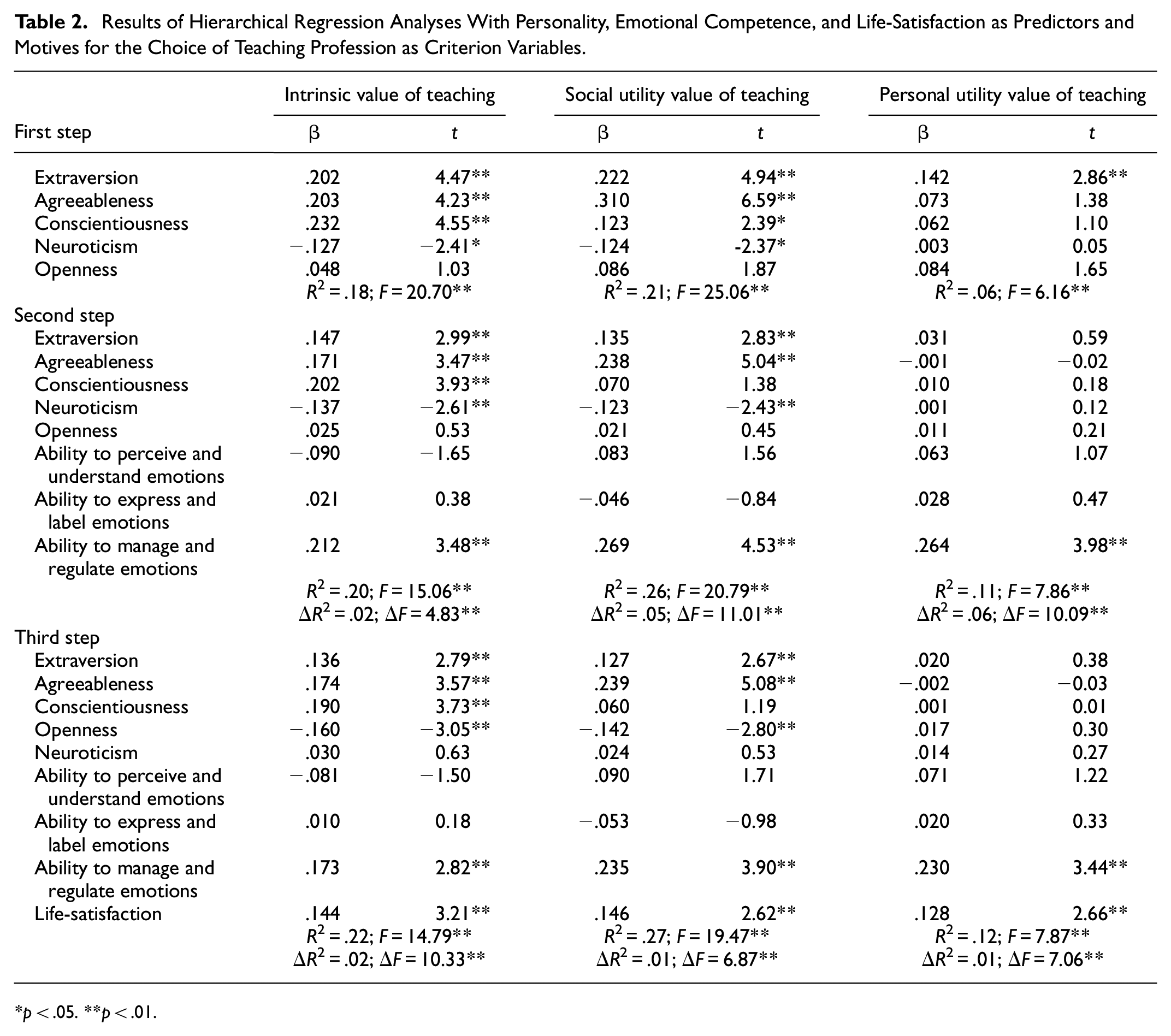
p < .05. **p < .01.
The regression analyses revealed that personality traits account for a significant amount of variance in explaining the intrinsic and the social utility value of teaching. Besides openness, all other personality traits were significant predictors of the importance of these motives for the teaching career choice. Extraversion and agreeableness were positive predictors, and neuroticism was a negative predictor of the intrinsic and the social utility value of teaching. Conscientiousness was also a positive predictor of the intrinsic utility value. In the second step of the analyses, emotional competence factors were included. The analyses revealed that the ability to manage and regulate emotions was an additional positive predictor of the intrinsic utility value and the social utility value of teaching. The third step of the analyses demonstrated that the life-satisfaction significantly (and positively) contributed to predicting the intrinsic utility value and the social utility value beyond the effects of personality and emotional competence. The personality traits did not predict personal utility value, and the only significant predictor of the importance of this motive for choosing a teaching career in the second step of the analysis was the ability to manage and regulate emotions, whereby in the third step, life-satisfaction also significantly contributed to predicting this motive’s importance.
Discussion
Results obtained in this study revealed some hypothesized and meaningful relationships between personality traits, emotional competence, and life-satisfaction within the context of the motivation for the teaching profession. Examined constructs significantly contributed to explaining the variance of the importance of the intrinsic value of teaching and the social utility value of teaching. More specifically, prospective teachers with higher results on extraversion and agreeableness rated the importance of these motives higher, while higher neuroticism was a negative predictor of these motives’ importance.
Obtained results are in line with some previous studies implying such associations. According to Berings et al. (2004), extraverted and agreeable individuals are more prone to choose careers that include working with others and are people-oriented, reflecting in the explored motive of the social utility value of teaching. This motive includes the desire to work with students, shape their future, and contribute to society. Hence, it seems that more extraverted and agreeable prospective teachers are more likely to be driven by the motive of working with students and making a difference in their lives and community in general. Besides, previous studies have also indicated that extraverted and open individuals are also more prone to choose an intrinsically motivating profession, which can also be related to results obtained in this study indicating that higher extraversion is predictive of higher importance of the intrinsic value of teaching motive. Keeping in mind that extraverted individuals are sociable and communicative, it is not surprising that these characteristics are related to motivation for the profession including constant interpersonal interactions. On the other hand, neuroticism was a negative predictor of both the intrinsic and the social utility value of teaching. These results indicated that prospective teachers who are more prone to negative emotionality are less driven to the teaching profession by intrinsic motives and a desire to work with others. This finding can be explained by previous findings, which imply that individuals characterized with higher neuroticism are inclined to work in predictable and stable surroundings with a predictable and stable everyday professional environment (Furnham et al., 2005), which is not the case in such a complex profession that includes many interpersonal interactions on an everyday basis. Accordingly, Tomšik and Gatial (2018) obtained that prospective teachers with a higher level of neuroticism are more likely to choose a teaching career as their second choice, implying that it is reasonable to expect that individuals with higher neuroticism could find less attractiveness in the profession that includes complex everyday interactions with others. Hence, the lower ratings of the importance of the intrinsic value and the social utility value of teaching among prospective teachers with a higher level of neuroticism are not surprising.
Openness was not a predictor of motives explored in this study. However, consciousness, on the other side, was a significant positive predictor of the intrinsic value of teaching, which is in line with the results obtained by Jugović et al. (2012), who also obtained that more conscientious preservice teachers (i.e., those who are organized, reliable, and perseverant) are also more intrinsically motivated for the teaching profession. Previous studies imply that conscientiousness is generally related to various aspects of occupational performance and job satisfaction (Wilmot & Ones, 2019), and these results also indicate the importance of this trait in explaining the motivation to teach. Results of this study also revealed that personality traits did not predict the personal utility value of teaching. Considering that some studies indicated the association of extraversion with intrinsic motives (Berings et al., 2004) and a more distinguished role of personality traits for intrinsic than for extrinsic motives (Jugović et al., 2012), the lack of this association regarding extrinsic motives encompassed within the personal utility value could be expected. Namely, it is possible that extraverted individuals may attribute more importance to intrinsically rewarding professions rather than those rewarding primarily in terms of income or job security. Regarding other personality traits, Hart et al. (2007) noticed the complexity of their association with different types of motivation, whereby personality traits can be associated with both intrinsic and extrinsic motivation. Furnham et al. (2005) also noticed that personality traits and work values do not comply with the intrinsic/extrinsic categories.
The results obtained in this study also revealed that emotional competence is predictive of motivation for the teaching profession beyond the effects of personality, which is in line with results obtained in the field of job satisfaction (Urquijo et al., 2019). More specifically, the ability to manage and regulate emotions was a positive predictor of all three explored motivations for the choice of the teaching profession. Prospective teachers who perceive themselves as more able to manage and regulate emotions rate all three motives for entering the teaching profession higher, which is similar to results obtained by Pavin Ivanec (2020). Ability to perceive and understand emotions, and the ability to express and label emotions were not predictors of explored motives. These results imply that emotional regulation, as an aspect of emotional competence, could have a central role in the context of the teaching profession. In support of this assumption, Aldrup et al. (2020) indicate that the awareness of own and other peoples’ emotions, although related to emotional regulation, is an insufficient prerequisites for coping with the complex interpersonal demand of the teaching profession. Thus, the ability to manage and regulate emotions seems to be crucial for this profession, and it was reasonable to assume the predictive role of this aspect of emotional competence in explaining the social utility value of teaching. Namely, prospective teachers who perceive themselves as more emotionally competent are more likely to be highly motivated by the intrinsic value and the social utility value of teaching, which encompasses working with others, including interpersonal emotional interactions. The ability to manage and regulate emotions was also predictive of the personal utility value of teaching. According to Pavin Ivanec (2020), it can be assumed that prospective teachers with higher emotional competence perceive themselves as more competent for the teaching profession in general and have overall higher ratings of different motives for this profession.
Finally, life-satisfaction predicted the importance of all three explored motives for the choice of the teaching career. Obtained results generally revealed that prospective teachers who express a higher level of life-satisfaction have higher ratings of intrinsic career value, social utility value, and personal utility value. These results could imply that individuals who are generally more satisfied with their lives are at the same time more satisfied with their career choice, which reflects in overall higher ratings of different motives for career choice. The lack of studies on this specific topic is already mentioned; however, according to starting (rather explorative) assumption, life-satisfaction could be a motivational drive that directs the individuals to fulfill their goals (Kruglanski et al., 2014). In line with this assumption, prospective teachers who express a higher level of life-satisfaction may be more devoted to pursuing their desire to teach, hence expressing higher importance of different motives that could lead them to their goal of becoming teachers and actualizing their vocational interests. Of course, this assumption would require additional and more elaborate exploration.
Conclusion
In line with the starting assumptions, the results of this study generally indicate that personality traits, emotional competence, and life-satisfaction have a predictive value in explaining certain motives for the choice of the teaching profession.
Obtained associations between explored personal characteristics and motivation for the teaching profession could offer a better understanding of the vocational choices of different individuals and could be helpful in planning vocational counseling programs.
In addition, previous studies imply that interventions aimed at factors related to personal characteristics might be useful in enhancing positive teaching and learning outcomes (Corcoran & Tormey, 2013). In this manner, results obtained in this study may also have practical implications regarding initial teacher education programs. Namely, it is possible that different personality types might imply the need for different approaches during preservice teacher education. Keeping in mind that the preferred personal characteristics of teachers include positive emotionality, organization, tolerance to frustration, planning and organization, and socioemotional competence, interventions aimed at their enhancement could be useful for preservice teachers’ future profession and academic success (Downey et al., 2014). Moreover, raising awareness (not only among prospective teachers but among their educators) of teachers’ individual characteristics as important determinants of teaching practice and students’ outcomes should also be included in prospective teachers’ education. This refers not only to the role of personality traits and socioemotional competence but also to the role of life-satisfaction as a motivational drive for career choice and a factor strongly related to later job satisfaction among in-service teachers (Marcionetti & Castelli, 2023). As already emphasized, personal characteristics explored in this study are relevant not only for the choice of the teaching profession but also for prospective teachers’ future teaching practices, including their relationship with students, job effectiveness and satisfaction, professional burnout, and well-being. In other words, they are crucial for successful coping with the increasing demands of the teaching profession.
Since only prospective preschool and classroom teachers participated in this study, caution in generalizing obtained results on other types of prospective teachers (e.g., subject teachers) is necessary. In addition, future similar studies should include not only different types of prospective teachers but also different types of in-service teachers to additionally inquire results obtained in this study and provide a broader basis for practical implications of the findings.
Footnotes
Declaration of Conflicting Interests
The author(s) declared no potential conflicts of interest with respect to the research, authorship, and/or publication of this article.
Funding
The author(s) received no financial support for the research, authorship, and/or publication of this article.
Ethical Approval
As stated in the manuscript, the study is conducted in line with ethical standards prescribed by the Ethical code of conduct of the University of Zagreb (specific approval number is not applicable).
