



Abstract
This study explores Saudi EFL learners’ perceptions, attitudes, and intentions regarding using ChatGPT as an AI-mediated tool for English language learning. Employing a mixed-methods design, 181 students completed a survey, and 4 participated in follow-up interviews to offer a more nuanced understanding of learner experiences. Quantitative findings reveal high perceived usefulness (M = 3.9), a generally pleasant user experience (M = 3.95), and a firm intention to continue using the tool (M = 3.7). Pearson correlation analysis confirmed significant positive relationships between perception and intention (r = .797, p < .001) and between attitude and intention (r = .733, p < .001), thereby reinforcing the explanatory power of the Technology Acceptance Model (TAM) in the Saudi EFL context. Qualitative findings add depth to the statistical trends, showcasing that Saudi EFL considered ChatGPT not merely a functional platform but an emotionally supportive and context-sensitive mediator in their academic language development. Students demonstrated critical agency, using the tool strategically for scaffolding, meaning-making, and managing learning anxiety while remaining vigilant about its limitations. Participants expressed concerns about over-reliance on AI, warning against diminished critical thinking, intellectual complacency, and the erosion of human interaction in education. Framed through the dual lenses of TAM and sociocultural theory, the study argues that learners do not passively adopt ChatGPT; instead, they negotiate its role as a complementary and temporary scaffold that enhances but does not replace human faculties and social learning environments. Thus, the study underscores the need for pedagogically grounded and ethically informed integration of AI into language education. These findings offer valuable implications for designing more balanced, culturally responsive, and learner-centered approaches to technology use in Saudi EFL classrooms.
Plain Language Summary
This study explores Saudi EFL learners’ perceptions, attitudes, and intentions regarding using ChatGPT as an AI-mediated tool for English language learning. Employing a mixed-methods design, 181 students completed a survey, and four participated in follow-up interviews to offer a more nuanced understanding of learner experiences. Quantitative findings reveal high perceived usefulness (M = 3.9), a generally pleasant user experience (M = 3.95), and a firm intention to continue using the tool (M = 3.7). Pearson correlation analysis confirmed significant positive relationships between perception and intention (r = .797, p < .001) and between attitude and intention (r = .733, p < .001), thereby reinforcing the explanatory power of the Technology Acceptance Model (TAM) in the Saudi EFL context. Qualitative findings add depth to the statistical trends, showcasing that Saudi EFL considered ChatGPT not merely a functional platform but an emotionally supportive and context-sensitive mediator in their academic language development. Students demonstrated critical agency, using the tool strategically for scaffolding, meaning-making, and managing learning anxiety while remaining vigilant about its limitations. Participants expressed concerns about over-reliance on AI, warning against diminished critical thinking, intellectual complacency, and the erosion of human interaction in education. Framed through the dual lenses of TAM and sociocultural theory, the study argues that learners do not passively adopt ChatGPT; instead, they negotiate its role as a complementary and temporary scaffold that enhances but does not replace human faculties and social learning environments. Thus, the study underscores the need for pedagogically grounded and ethically informed integration of AI into language education.
Keywords
Introduction
In the contemporary landscape of education, technology has become an integral and transformative force, reshaping traditional teaching methods and redefining the learning experience (Aljabr & Al-Ahdal, 2024; Rospigliosi, 2023). The ubiquitous presence of technology in classrooms and beyond has brought about significant transformations, fostering innovation, accessibility, autonomy, and engagement (Adeshola & Adepoju, 2023). Along these lines of thoughts, the emerging dynamics of the education and research paradigm explore the multifaceted role of technology in modern education, examining its impact on teaching approaches, student learning experiences, and the broader educational landscape (Tuomi, 2019).
Information is now not the prerogative of a few; rather, there is enhanced access to it like never before. Technology has increased equitable access to information, breaking geographical barriers and providing learners with knowledge (Alowedi & Al-Ahdal, 2023). The internet, digital libraries, and online resources empower students to explore diverse perspectives and deepen their understanding of various subjects. The democratization of information has levelled the playing field, ensuring that education is no longer confined to traditional brick-and-mortar institutions, nor is it merely a banking system where students are only receivers of knowledge (Oliver, 2008; Rospigliosi, 2022). Opportunities for personalized learning have become a reality with adaptive learning platforms and intelligent tutoring systems leveraging technology to cater to individuals with unique learning styles, foster agency, and adjust pacing (Taylor et al., 2021). With the ability to tailor content and assessments based on student performance, AI-mediated tools enable a personalized learning experience (Strzelecki, 2023). This individualization fosters a more inclusive and empowering educational environment, accommodating diverse learning needs, and maximizing student potential (Holmes et al., 2018). In today’s ever-fast-paced learning opportunities, AI-mediated platforms have transformed pedagogical practices (Benuyenah, 2023). These tools make lessons and course content more engaging and interactive to capture students’ attention and promote active participation and agency (Malik et al., 2023). In English language learning, for instance, AI-assisted tools contribute to immersive learning experiences, making complex concepts more accessible and stimulating students’ curiosity (Sviridova et al., 2023).
In the context of English as a foreign language (EFL), the capabilities of AI-generated text and the types of writing produced by applying AI functions—such as translating, co-thinking, editing, paraphrasing, revising, and text modification (Barrot, 2023)—demonstrate the great potential ChatGPT offers for EFL students. However, it also presents significant risks and challenges (Kolade et al., 2024). From this perspective, it is crucial to explore the experiences of university language students regarding their perceived usage of ChatGPT and the potential challenges of integrating it into their learning journey (Barrot, 2023; Strzelecki, 2023). The readiness of students to adopt technology in education is a dynamic, complex, and multifaceted process (Strzelecki, 2023), requiring a concerted effort from educational institutions, policymakers, and the broader community to address issues related to digital literacy, access, and attitudes (Wohlfart & Wagner, 2023).
The cultural characteristics of the Saudi educational context are more traditional teacher and often culture-based collective societies, with students being dependent and using others as a source of support (Alhammad, 2024; Alharthi, 2024). Nonetheless, there is a lack of research that examines the extent to which Saudi EFL students can use ChatGPT effectively, instead of a superficial evaluation of its utility. The mixed-methods design offers a context-sensitive and theoretically grounded account—drawing on the Technology Acceptance Model (TAM)—of learners’ perceptions, attitudes, and behaviors, with a view toward the future implications of AI tools in language learning. Specific attention is given to the sociocultural dimensions of local students’ identities (Lantolf & Thorne, 2006; Vygotsky, 1978) and the development of learner agency (Benson, 2013; Miller, 2012) within an AI-mediated environment that supports co-thinking and languaging in language learning (Swain & Lapkin, 2013).
Literature Review
Elbanna and Armstrong (2024) and Hutson et al. (2022) state that OpenAI’s ChatGPT, an advanced AI-driven language learning model, has gained distinction by surpassing 100 million users, which continues to grow rapidly. There is increasing interest in its adoption, particularly within higher education institutions. Using OpenAI’s ChatGPT has shown notable growth in domestic and international academic contexts. Selected studies exploring its educational application have been reviewed in this section, highlighting key findings and research trends related to its impact, learner attitudes, and user experiences. What follows are the global and local empirical findings on integrating AI tools in education and language learning contexts.
Global Perspectives on ChatGPT in Education
Recent concerns about AI replacing human intervention, particularly in education, have prompted researchers to explore AI tools like ChatGPT’s potential benefits and challenges. For example, Acosta-Enriquez et al. (2024) found that tool acceptance, frequency of use, and positive emotions influenced attitudes toward ChatGPT among adult learners. However, users also tended to verify information obtained from ChatGPT, indicating that reliance on human agency is critical over chatbot-generated content. Similarly, Abdaljaleel et al. (2024) identified demographic factors such as country of residence, age, university type, and academic performance as significant predictors of students’ attitudes toward ChatGPT usage. These studies show that learners are not unquestioningly accepting AI; their perceptions are mediated by emotional, demographic, and contextual variables, challenging the techno-optimistic tone of early adoption research.
Furthermore, Yu et al. (2024) highlighted ChatGPT’s dual role as both a practical tool and an emotional support system for students, noting concerns about content falsification and job displacement. In a more in-depth analysis of ChatGPT usability, Raman et al. (2023) utilized Rogers’ (2003) perceived theory of qualities to investigate ChatGPT adoption among 288 university students. The study identified five key characteristics, relative advantage, compatibility, ease of use, observability, and trialability, that significantly influenced adoption. Male students prioritized reliability, straightforward use, and visibility, while female students emphasized reliability, ease of use, comparative advantage, and feasibility tests. While this research advances adoption theory, it lacks engagement with pedagogical nuance, particularly around how AI tools intersect with literacy development and language learning practices.
Exploring agency, Agustini (2023) showcased ChatGPT’s role in fostering independence and agency among first-year college students in the Kurikulum Merdeka Belajar, particularly in English language learning. The study highlighted ChatGPT’s potential to provide individualized support, language practice opportunities, self-reflection, self-assessment, and instant feedback, promoting student autonomy and self-directed learning. However, such promising accounts often overlook learners’ critical awareness, ethical reservations, or institutional constraints.
Similarly, Haque et al. (2022) analyzed 10,732 tweets from early ChatGPT users, identifying positive sentiments related to entertainment, creativity, and software development. Concerns about ChatGPT’s impact on education were less prominent, though the study emphasized the importance of user sentiment in determining the success of new technologies. Expanding on this, Taecharungroj (2023) analyzed 233,914 English tweets using latent Dirichlet allocation (LDA) topic modeling, identifying three main themes: news, technology, and reactions, and five functional domains: creative writing, essay writing, prompt writing, code writing, and question answering. The findings underscored ChatGPT’s potential to influence technology and society positively and negatively, raising critical issues such as job evolution, artificial general intelligence, and ethical standards.
Collectively, these global studies highlight diverse uses of ChatGPT, but most lack specific inquiry into how AI functions within language learning ecosystems marked by exam-driven curricula and sociocultural sensitivities. At a broader level, Perkins (2023) examined the ethical implications of students using ChatGPT and other AI tools in formal exams. The study highlighted the potential contributions of large language models (LLMs) to teaching, human-AI collaboration, and automated writing evaluations. However, it also raised concerns about academic integrity, particularly the ability of AI tools to produce undetectable, original text. Perkins argued that institutional policies, rather than student use, are crucial in maintaining academic integrity in the face of advancements in the AI era. This concern is echoed in Germany, where Moldt et al. (2023) found that medical students lacked trust in ChatGPT due to data protection concerns, particularly in sensitive disciplines like medicine. These studies collectively signal growing ethical unease about AI tools. Nevertheless, few offer insight into how learners feel and navigate these tensions in EFL environments, where norms of authorship and originality are still evolving.
Local and Regional Perspectives
In Saudi Arabia, Alharthi (2024) surveyed 299 undergraduates across 3 private universities, where students’ English proficiency is considerably high and their exposure to tech-based learning tools is relatively frequent. The study revealed generally positive attitudes toward ChatGPT as a supportive, accessible, and user-friendly tool. Nonetheless, concerns about overreliance and its potential impact on students’ critical thinking and independent writing abilities were raised. Complementary studies by Alhammad (2024) and Masoudi (2024) also highlighted ChatGPT’s role in enhancing literature comprehension and writing proficiency, particularly by assisting with drafting and revision tasks. Building on this line of inquiry, Alotaibi et al. (2025) employed the Technology Acceptance Model (TAM) to examine Saudi EFL learners’ behavioral intentions. Their findings confirmed the importance of perceived usefulness, ease of use, and attitude in predicting ChatGPT adoption, especially for grammar assistance, vocabulary support, and idea generation. While valuable, this study primarily emphasized predictive factors and offered limited insights into sociocultural processes such as dialogic learning, cognitive development, and learner agency. Similarly, Ajlouni et al. (2023) reported that Jordanian learners appreciated ChatGPT for its scaffolding and feedback. However, concerns about text authenticity and anxiety during tool unavailability pointed to a growing dependence that may hinder learner confidence and agency.
Critically, these studies reflect regional receptiveness to ChatGPT’s pedagogical potential. However, most rely on descriptive data, with limited critical engagement in deeper issues related to learner identity, autonomy, or sustained interaction with the tool (e.g., Alharthi, 2024; Alhammad, 2024; Alotaibi et al., 2025; Haque et al., 2022; Masoudi, 2024). Furthermore, while many studies employ frameworks such as the Technology Acceptance Model (TAM), their application tends to be narrow, and integration with sociocultural perspectives remains largely absent. Notably, the intersection of TAM and sociocultural theory, particularly in understanding how learners engage with AI tools in culturally and linguistically diverse settings, has yet to be meaningfully explored. The present study moves beyond adoption of metrics to investigate how ChatGPT influences learner voice, engagement, and autonomy in EFL Saudi higher education. The following section sheds light on our proposed framework and how it can further enhance our perspective of language learning approaches and the TAM model.
Theoretical Framework
While the field of AI integration in education is rapidly evolving, existing research remains unexplored, especially in its limited incorporation of theoretical frameworks, underrepresentation of learner agency, and insufficient attention to sociocultural and contextual dynamics (Casal & Kessler, 2023; Zheng & Warschauer, 2016). To frame the investigation, this study adopts an integrated theoretical model that combines the Technology Acceptance Model (TAM; Davis, 1989), sociocultural theory (Lantolf & Thorne, 2006; Vygotsky, 1978), languaging concept (Swain & Lapkin, 2013), and learner agency (Benson, 2013; Miller, 2012; Van Lier, 2008). While TAM provides a foundational lens to examine perceived usefulness (PU), ease of use (PEU), and attitude (ATT) as predictors of behavioral intention (BI), it often overlooks the broader learning and educational context. Therefore, sociocultural theory complements TAM by viewing ChatGPT as a mediational instrument that enhances language development through interaction within the given and available Zone of Proximal Development (ZPD; Lantolf & Thorne, 2006; Mahn, 1999). In addition, the concept of languaging highlights how learners use ChatGPT to externalize, think out, and negotiate meaning during tasks such as brainstorming, paraphrasing, and revising (Swain & Lapkin, 2013). Moreover, the study emphasizes learner agency, as students demonstrate autonomy in initiating interactions, customizing responses, and adapting outputs to meet their learning goals (Casal & Kessler, 2023; Wang et al., 2025). This integrative framework offers a more nuanced, socially grounded understanding of ChatGPT use in EFL contexts, moving beyond a purely technological view. However, few studies have applied such a holistic lens, particularly within the Saudi EFL higher education context, making this investigation timely and necessary.
Research Questions
This study investigates the following questions:
What are the perceptions of Saudi higher education EFL learners toward the usefulness of ChatGPT in learning?
What are the attitudes of Saudi higher education EFL learners toward the use of ChatGPT technology as an interactive tool in language learning?
Do the Saudi higher education EFL learners intend to use the ChatGPT technology in language learning?
Methodology
Research Design
The study adopted the explanatory sequential research design by Creswell (2014), where quantitative and qualitative data were gathered in stages, processed separately, and then integrated to provide a more comprehensive understanding. Initially, quantitative data were collected and analyzed. Subsequently, these findings were reinforced and enriched through semi-structured qualitative interviews (Creswell & Plano Clark, 2007). The study was conducted at a public Saudi University during the winter academic year 2023.
Participant and Sampling
This study employed a convenience sampling method for the quantitative phase, as the researchers had access to the participants through their university teaching roles. A total of 181 Saudi English-major students (102 males and 79 females), aged between 20 and 22, were included. Their linguistic proficiency ranged from intermediate to high, and they possessed sufficient English and digital literacy to engage meaningfully with AI-based tools such as ChatGPT. To be included in the study, participants had to confirm that they had used ChatGPT for learning-related purposes. Those who answered “yes” continued to the questionnaire; those who selected “no” were automatically directed to exit. This ensured that only users of ChatGPT were part of the dataset.
To enhance contextual depth, a purposeful subsample of four participants (i.e., three males and a female) was selected from the larger survey pool for semi-structured interviews (see Table 1). These participants met the following inclusion criteria: (i) prior use of ChatGPT for educational purposes and (ii) willingness to engage in recorded interviews. While the number of interviewees was small, the qualitative component aimed not at generalization, but at revealing emotional, ethical, and pedagogical dimensions that may not emerge in surveys. It is well established through classroom interactions and coursework that these students had prior exposure to AI tools, including ChatGPT. AI-related topics were frequently discussed in their language learning and educational technology courses, and all had participated in online AI training sessions.
Interviewee Demographics.
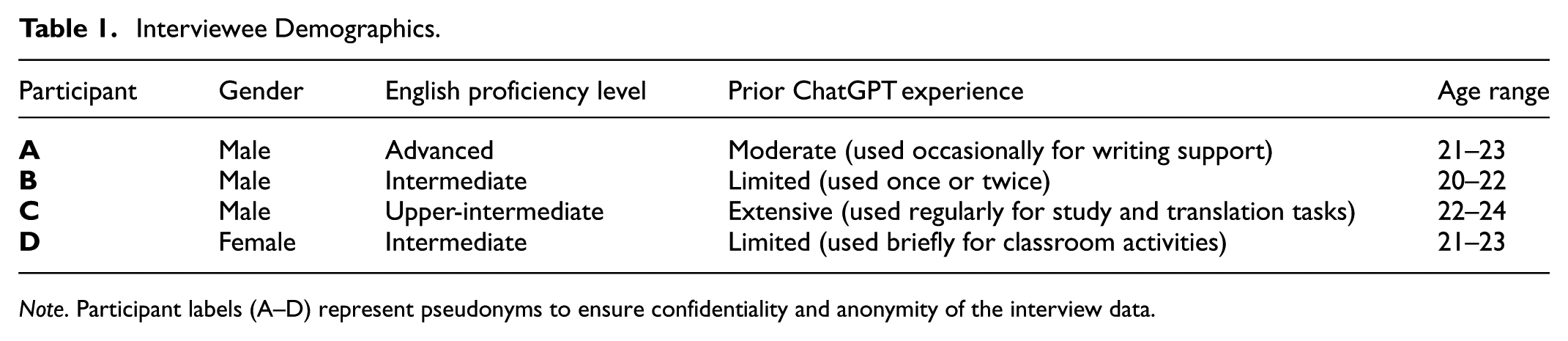
Note. Participant labels (A–D) represent pseudonyms to ensure confidentiality and anonymity of the interview data.
Instruments and Data Analysis
To collect quantitative data, we adopted a 12-item questionnaire from Ma et al. (2024) featuring a five-point Likert scale (ranging from strongly agree to strongly disagree). This item was chosen for its impartiality, alignment with our research goals, and accessibility for participants. Ethical approval was obtained, and all participants provided informed consent through signed forms. To maintain confidentiality, each participant in the interviews was assigned a pseudonym.
The questionnaire was divided into three sections: students’ perceptions (4 items), attitudes (4 items), and intentions (4 items) regarding ChatGPT use in higher education. It was uploaded to Google Forms and distributed to all 250 s-year EFL learners at the university. Participants were given 2 weeks to respond. Of the 250 invited, 181 students submitted completed questionnaires, yielding a response rate of 72.4%. Incomplete, inconsistent, or irrelevant responses were excluded from the final analysis. An exclusion question asking whether students had any awareness or use of ChatGPT (“yes” or “no”) ensured that only respondents with experience or knowledge of ChatGPT were included. To ensure construct validity, the items in the survey were reviewed by two experts in educational technology and applied linguistics (Creswell & Creswell, 2018).
To assess reliability, Cronbach’s Alpha was calculated for the three scales, revealing high internal consistency with alpha values above .85, indicating that the items within each scale consistently measured the same concept. A further test was then conducted to confirm the dependability of the scales (see Table 2; Tavakol & Dennick, 2011). Pearson correlation analysis was then performed to examine the relationships between perception, attitude, and intention. Subsequently, multiple regression analysis was conducted to test how well perception and attitude could predict intention. The reliability of each section was assessed using Cronbach’s alpha, yielding scores ranging from .76 to .81 for the perception, attitude, and intention scales, indicating strong internal consistency. Data were saved and analyzed using SPSS version 24.
Reliability Statistics.
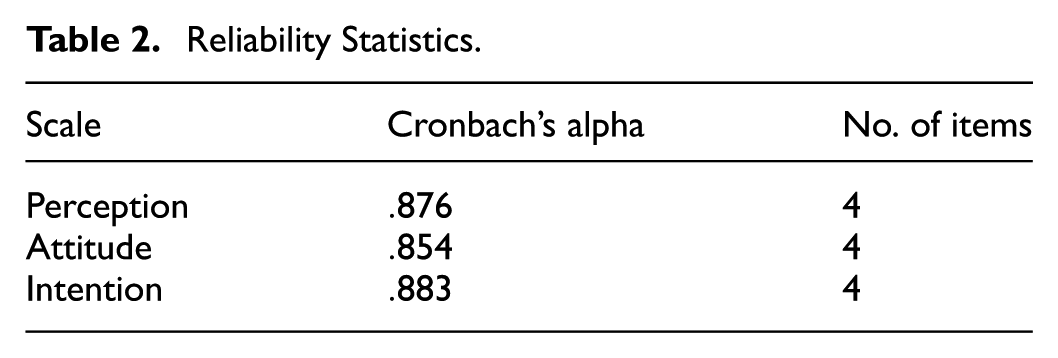
Table 1 shows the internal consistency of the survey scales using Cronbach’s Alpha. The results indicate that all three scales used in the study, which are Perception
Furthermore, the qualitative data were collected through face-to-face interviews, conducted bilingually in both English and Arabic, over 3 days. These interviews were audio-recorded, transcribed, and analyzed for emerging themes using a directed content analysis approach (Creswell & Plano Clark, 2007), guided by the Technology Acceptance Model (TAM) and the proposed framework. Although only four participants (see Table 1) were interviewed, this number was sufficient to provide meaningful thematic representation that addressed the research questions. Accessing students at the time of data collection was somewhat challenging due to their heavy course loads and limited availability. During the data analysis stage, we initially reviewed each case individually, then revisited and re-examined the key codes highlighted by participants in their narratives. This iterative process allowed for a deeper understanding of emerging patterns through both inductive and deductive reasoning (Terry et al., 2017). We conducted two rounds of coding to identify recurring themes, patterns, distinctions, and similarities in students’ experiences, with a particular focus on their perceptions, attitudes, and intended uses of ChatGPT in educational contexts. Given the bilingual nature of the data, all Arabic excerpts were translated into English and then back-translated by a bilingual expert to ensure linguistic and semantic accuracy and to minimize potential loss of meaning or researcher bias. Two researchers independently coded the data, and any discrepancies were discussed and resolved through consensus to enhance coding reliability and validity. While the small qualitative sample size limits the generalizability of the findings, it provided rich, in-depth insights into students’ lived experiences and nuanced attitudes toward ChatGPT in language learning. To further ensure the validity and trustworthiness of the analysis, a critical friend review of the coding process was conducted.
Research Findings
Numerical Representation of Students’ Perceptions, Attitudes, and Intentions Regarding AI Tools
Perceived Usefulness
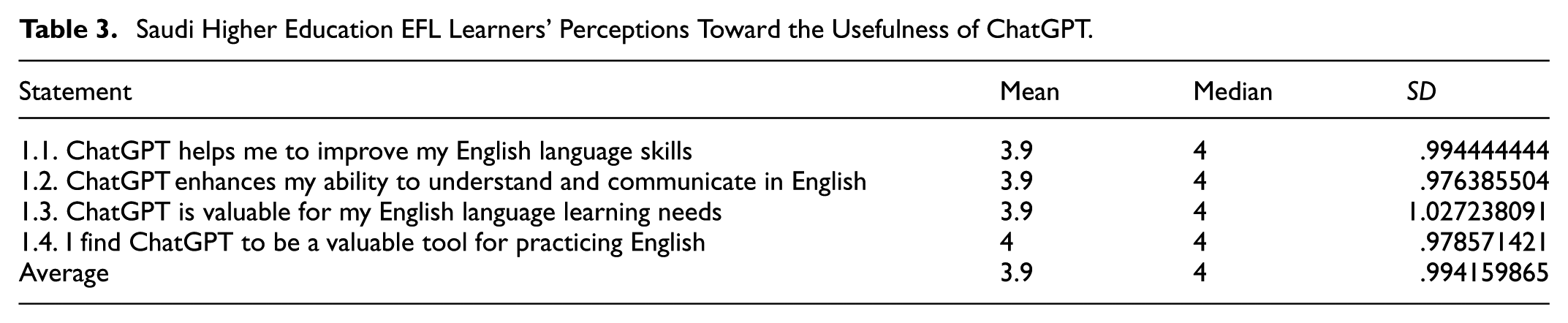
The data collected from the first section of the questionnaire revealed that the Saudi EFL learners perceive ChatGPT as highly useful for EFL learning, with an overall mean (M = 3.9), and the standard deviation (SD = .99) depicted that the responses are tightly constructed around the mean. A mean score for the first item (3.9) and (SD = .97) from the respondents’ perceptions of the tool in improving English skills indicates that they are sure that ChatGPT effectively enhances their language proficiency across skills. The mean and SD are repeated for the second item, which categorically names comprehension and communication as the skills improved with the tool, thus reinforcing the earlier result of positive perception of usefulness. ChatGPT also fulfils respondents’ English learning needs (M = 3.9), (SD = 1.02) as reflected in responses to item 3, and is highly perceived as helpful in practicing English (M = 4.0) and (SD = .97). Thus, on all four items that evaluated perceptions of usefulness of ChatGPT technology, the mean scores are in the high range, indicating positive perceptions for this factor. Moreover, the low standard deviations (ranging from .97 to 1.02) proved the high level of agreement toward the usefulness of ChatGPT. The median value of 4 further confirms the consensus among respondents that ChatGPT is a beneficial resource in their learning process.
Table 3 presents the Saudi EFL learners’ perception of ChatGPT’s usefulness in their learning process. The high mean scores (around 4) for all items reflect the higher response trend toward a strong positive perception of ChatGPT’s impact on their English language proficiency. Specifically, the median of 4.0 indicates the students’ stronger approval of the highly conclusive perception. Also, the low standard deviations (around .97–1.02) indicate that the responses have a low variability, which suggests that students agree on the tool’s effectiveness. This ensures the strength of reporting positive perceptions.
Saudi Higher Education EFL Learners’ Perceptions Toward the Usefulness of ChatGPT.
Students’ Attitudes Toward ChatGPT
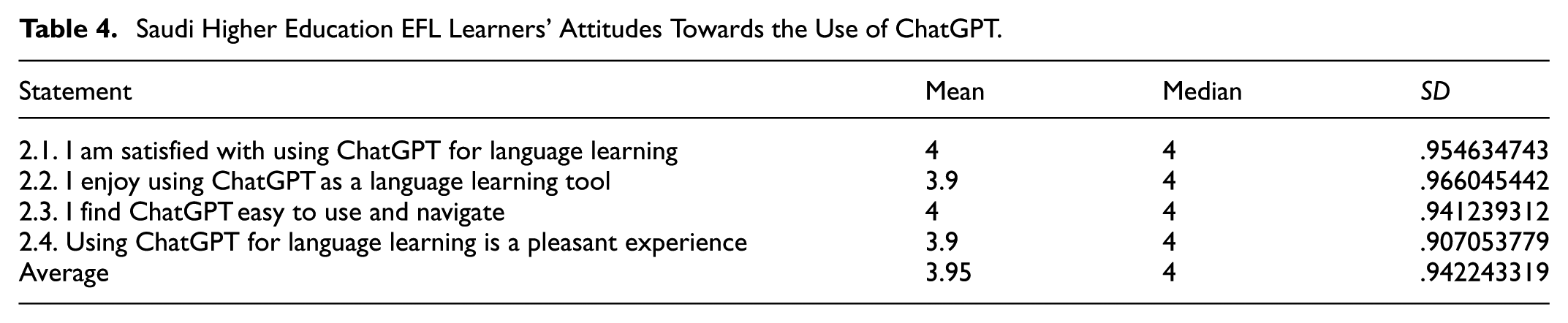
The survey items presented in Table 3 evaluated respondents’ attitudes, satisfaction, and enjoyment in the use of ChatGPT in language learning. Saudi EFL learners showed high attitudes toward using ChatGPT in learning, with an average mean score of 3.95 and a standard deviation of 0.94. The results for all four items indicate high mean values, and the SD reveals a strong relationship of the agreement. The values show that the respondents find using the technology in language learning convenient and enjoyable. Likely, the ease of use (M = 4.0, SD = .95) contributes to making the learning experience enjoyable; similarly, the mean score and SD for positive attitudes to technology use are also high at 4.0 and .94, respectively, supporting the earlier finding for positive attitudes. Therefore, the learners perceive ChatGPT as helpful and valuable for learning the language.
Table 4 showcases the students’ attitude towards using ChatGPT in language learning. The mean and median values around four illustrate the consistent positive attitude of participants. The standard deviation below 1 represents low variability among students’ responses, indicating that most responses are close. Thus, the student’s attitude toward ChatGPT is positive in their language learning process.
Saudi Higher Education EFL Learners’ Attitudes Towards the Use of ChatGPT.
Students’ Intentions to Use ChatGPT
Data in Table 5 shows that Saudi EFL learners intend to use ChatGPT in the future. The participants report an average mean score of 3.7 and an SD of 1.14 regarding their intention to use ChatGPT in their learning. This suggests that most students have a positive intention to continue using ChatGPT. The highest mean score, though marginally higher, was 3.9 and SD 1.11 for their intention to use ChatGPT in future learning situations. This reflects their overall satisfaction with the tool and desire to use it. However, the preference for ChatGPT over other tools was slightly lower, with a mean score of 3.6, and there is variability in SD = 1.20, indicating some students are neutral about it.
Saudi Higher Education EFL Learners’ Intention to Use ChatGPT.

Table 5 represents the Saudi higher education EFL learners’ intention of using ChatGPT in language learning, compared to perception, and the attitude, where the data variation is noted. The mean value is steadily below 4, reflecting the students’ relatively significant intentions to use ChatGPT in language learning. The standard deviation above 1 reveals the variability among the students’ responses, which suggests that the data sets are a bit spread out from the mean value. It is a minor spread out, and students’ intentions are high toward using ChatGPT in the language learning process.
Relationship Between Perception, Attitude, and Intention
Table 6 shows the Pearson correlation coefficients between Perception, Attitude, and Intention. The analysis revealed strong and statistically significant positive relationships between Perception and Intention (r = .797, p < .001) and between Attitude and Intention (r = .733, p < .001). These findings indicate that as perceptions or attitudes become more positive, participants are more likely to express stronger intentions to use AI tools.
Correlation Coefficient.

Correlation is significant at the .01 level (2-tailed).
The result in Table 5 presents the Parson correlation coefficients between Perception, Attitude, and Intention. The results show that there was a strong and statistically significant positive relationship between Perception and Intention
The scatter plots can also visualize this relationship. Figure 1, which displays Intention versus Perception, shows an upward trend of dots, which indicates a strong linear relationship: as perception scores increase from 1 to 5, intention scores also tend to increase—the clustering of points along an upward diagonal shows a strong positive correlation. Similarly, Figure 2, which shows Intention versus Attitude, also presents a clear positive trend, although the spread of the dots is slightly wider compared to Figure 1. This shows a somewhat lower correlation coefficient

Scatter plot of intention versus perception.

Scatter plot of intention versus attitude.
Table 7 shows a multiple regression analysis in which we examined how well Perception and Attitude predict Intention. The overall regression model is statistically significant,
Regression Analysis.

Note.
Looking at the individual predictors, perception has a significant positive effect on intention
In conclusion, Saudi EFL learners demonstrate positive perceptions and attitudes toward ChatGPT, reflecting clear intentions to continue using it for English language learning. The strong correlations between perception, attitude, and intention support the Technology Acceptance Model (TAM), where perceived usefulness is the primary and critical factor influencing use. From a sociocultural learning perspective, ChatGPT is a mediating tool that supports interactive, scaffolded learning, improving language development through social engagement. According to the statistical data above, learners perceive ChatGPT as useful, hold positive attitudes toward it as an interactive tool, and intend to use it in their language learning journey. These findings highlight ChatGPT’s potential as an effective, sustainable, and engaging educational technology in Saudi EFL contexts. This can also be practically applied to support dynamic interactions with AI and classroom discussions, scaffold language practice, and enhance skills such as writing, reading, and vocabulary in a sustainable manner.
Qualitative Findings
Perceptions of AI-Powered ChatGPT’s Usefulness
Participants largely perceived ChatGPT as an AI-powered tool of value to learners, which enables them to develop language skills; it makes available personalized aid promptly, when required, thus playing a subservient role of mediator agency for facilitating learning processes with due consistency as regards socio-cultural theory that emphasizes desired action as commanded through mediation. For example, Participant A emphasized:
ChatGPT is a useful tool for learning English since it is highly interactive… It helps with vocabulary, grammar, pronunciation, and guides me in writing. It elicits my language needs and supports my learning by breaking down complex tasks.
The quote highlights ChatGPT’s function of mediation externally (not from within the learner), which enables the learner to self-educate with engagement; the AI-generated tool catalyzes zones of proximal development (ZPD) through suitable/needed guidance to the learner community by way of providing learners with formidable tasks, which, of course, are related to language.
Moreover, participants described how ChatGPT mediates thinking and language learning by students as a participative function geared towards extending a supportive role and enabling the learners to structure knowledge together (Learner and AI-powered tool as partners) using an interactive interface. Student B noted:
I use ChatGPT extensively to discuss ideas and generate suggestions. It helps me articulate thoughts I might struggle with alone, making the learning process more interactive and reflective.
Several participants reflected on the dynamic nature of their interaction with ChatGPT, showcasing how the tool supports the generation of meanings and creates basic language-related knowledge; these two (meaning construct and language awareness) are the most important factors in language learning. For instance, Student C stated:
When interacting with ChatGPT, I am not just receiving answers; I am negotiating meaning, clarifying doubts, and reformulating ideas, which enrich my understanding.
However, perceptions were not universally positive. Participant D expressed reservations about the depth of scaffolding ChatGPT can provide:
While it offers help, it sometimes gives ready-made answers that do not encourage me to think critically or solve problems myself.
This critique reflects an awareness of the limitations of AI-language tools, particularly regarding their capacity for higher-level cognitive engagement. These narratives collectively illustrate how learners perceive ChatGPT as both a scaffolding device and a languaging resource that supports their autonomous language learning. This bridges learners’ perceptions of TAM, which extols the tool’s usefulness, with the sociocultural communication theory, which highlights significant limitations. The sociocultural context cannot be overlooked when applying TAM, as social values and cultural influences remain limiting factors in using AI-powered tools. Therefore, socially mediated learning emphasizes integrating social, and cultural dimensions in cognitive development and language interaction.
Attitudes Toward ChatGPT and Its Educational Role
Participants expressed generally positive attitudes toward ChatGPT, recognizing it as a powerful tool that makes available temporary support valuable for facilitating smart language learning, which aligns well with their learning goals. Many appreciated its diverse and multi-dimensional academic performance capabilities from helping with structural writing tasks to generating ideas and providing immediate feedback. Student B shared:
I use ChatGPT for formatting, proofreading, and brainstorming ideas. It feels like having a knowledgeable partner always available to support my writing process.
This indicates a favorable attitude towards the technology’s usability and role as an active, smart, and energetic catalytic AI-powered booster. It provides initial but temporary support for language production and promotes reflective learning. Similarly, Student D noted:
ChatGPT has helped me overcome obstacles when searching for information and organizing my thoughts, which makes learning less stressful.
However, the attitude toward ChatGPT was worrisome as the learners were apprehensive about its efficacy; students simultaneously expressed negativity as they were worried that over-dependence on and continued engagement with it could reduce their level of understanding, affecting their critical thinking ability, and could give a setback to the learning process with lesser application of mind and becoming just copy-cats. For example, Participant A reflected:
Although ChatGPT delivers quick outputs, I worry that depending on it might stop us from developing important skills like critical thinking and problem-solving skills that teachers help nurture through personalized guidance.
The narrative reflects an attitude that values experience with personal application of mind for learning language; if human effort to develop critical thinking and solving difficult situations is not used and temporary support of AI, with continuous dependence as sustained use will create, there is no doubt that language learning, without personal/human effort, real learning will not take place. The user’s mental faculties will not improve, and the degree of skill development will remain static. AI’s support must be withdrawn periodically to develop intensive and deep learning skills. Student C elaborated on this, noting:
While AI is useful, it cannot replace the nuanced feedback from a teacher who understands my learning history, strengths, and weaknesses. The teacher’s role in observing peer interactions and offering tailored advice is irreplaceable.
These reflections reveal learners’ level of criticality and knowledge that socio-cultural factors cannot be ignored while learning a language. Users of AI-generated tools emphasize the importance of the societal communication process and receiving evaluation in context, involving mores, practices, way of living amidst people, at a place, in a situation, objectives of interaction, etc., all conducive and unavoidable for language learning through mental faculty and skill development. The attitude thus encompasses a tension between AI’s role in language learning through its support in solving language learning related issues/problems and keeping intact both agency and cognition.
Furthermore, students’ attitudes revealed a mental condition treating ChatGPT as an AI-generated tool for learning. Users (student-learners) adopt it with self-stated caution, pointing to the need to use it responsibly and considering process-strategies involving active interaction and use. This awareness echoes considering learner-agency like no passive negotiator with socio-cultural dimensions for actively selecting technological applications in the language learning process in users’ learning environment. The sociocultural notion of learner agency is the active negotiation of technology use within their learning ecologies. For instance, Participant D stated:
I appreciate AI’s help but believe that if I let it do too much, it might weaken my ability to think independently and solve problems.
Overall, these attitudes underscore a need to strike a balance between (i) AI’s initial support for language learning and (ii) keeping in constant view the limitations and essential (unavoidable) aid of human mediation in learning. Such a balanced attitude is vital for integrating AI meaningfully into language education without compromising critical engagement and learner autonomy.
Intentions to Use ChatGPT
Participants articulated clear and deliberate intentions regarding their future use of ChatGPT, reflecting an intense motivation and a strong desire to establish an interactive and collaborative relationship with the tool. They expressed a commitment to mastering and integrating AI into their language learning process with confidence and consistency. Student C emphasized the importance of moderation:
I plan to use the AI tool sparingly, as over-reliance on it might undermine the core value of our existence—critical thinking and reflection.
Similarly, Student B expressed a thoughtful balance between efficiency and meaningful interaction:
Although ChatGPT can simplify and speed up tasks, it cannot fully replace the benefits of teacher interaction, who understands my unique strengths and weaknesses.
Participant D described an intentional workflow that preserves independent effort while leveraging AI support:
I intend to craft my work independently first, then use the tool as needed before submitting it for teacher feedback.
Participant A also highlighted using ChatGPT as a temporary support until skills and knowledge are developed to the desired/required extent; this dependency helps develop critical thinking as a joint endeavor and enables overcoming work-related problems accepted as challenges. He reflected,
I plan to use it when I need linguistic support, collaborative thinking, or when a task exceeds my current abilities, seeking further clarification and guidance.
The above responses to the queries reflect learners as cautious users who engage with ChatGPT as autonomous agents rather than passive recipients. Students assert their autonomy on their terms, without becoming unquestioning or uncritical followers. While users may temporarily rely on AI for support, they consciously strive to balance what the tool offers and the socio-cultural demands of communicative and interactive processes.
In conclusion, Saudi EFL learners view ChatGPT positively, recognizing it as a supportive, interactive, and context-sensitive tool for language learning. While learners appreciate its usefulness particularly in grammar, vocabulary, and meaning-making, they also express caution, emphasizing that ChatGPT cannot fully replace the human element. Overreliance, they warn, may stunt mental growth and undermine the development of critical thinking and independent learning skills. Their responses reflect an awareness of the need to maintain cognitive agency, viewing AI tools as temporary scaffolds rather than permanent substitutes. Through (TAM) lens, enriched by sociocultural theory, learners portray ChatGPT as a dynamic support system useful for planning sustained language development while ensuring that human judgment, learner autonomy, and cultural relevance remain central. They advocate for a balanced integration of AI with high-level cognitive engagement, resisting passive consumption and negotiating their interaction with the tool to preserve their active role in learning. In doing so, learners move beyond superficial acceptance and recognize ChatGPT as a dependable, temporary aid that complements rather than replaces human faculties.
Discussion
This study examined Saudi EFL students’ perceptions, attitudes, and intentions toward using ChatGPT in language learning. The findings indicate generally positive perceptions, with students viewing ChatGPT as a supportive and efficient tool, though concerns about over-reliance were also noted. The Technology Acceptance Model (TAM; Davis, 1989) helps explain these findings, particularly by highlighting how perceived usefulness and ease of use shape learners' attitudes and behavioral intentions. However, TAM alone cannot fully account for the sociocultural complexities involved in adopting AI tools for education. To address this gap, the study incorporates sociocultural theory (Vygotsky, 1978) and the concept of learner agency (Miller, 2012), recognizing that learners actively negotiate their use of technology through social, cultural, and contextual factors. These frameworks allowed for a more refined understanding of how ChatGPT functions not just as a tool, but as a mediator of interaction, identity, and meaning-making (Swain & Lapkin, 2013).
Additionally, participants widely perceive ChatGPT as an academically versatile tool, reflecting both enthusiasm for technological integration and a critical awareness of its limitations. As Students A and B demonstrated, participants perceive ChatGPT as a highly useful tool for various academic functions, including proofreading, collaborative thinking, rapid information retrieval, and essay writing assistance. Their widespread AI-mediated use highlights their tech-savviness and eagerness to incorporate technology into their education (Oliver, 2008; Rospigliosi, 2022). This perception aligns with previous research showing that digital-age learners are comfortable with technology from an early age (Acosta-Enriquez et al., 2024; Shin & Lee, 2021).
Furthermore, learners generally show no inhibition toward using technology, associating it with improved learning outcomes and considering tech tools as supportive spaces that scaffold their learning and foster learner agency (Agustini, 2023; Pavlik, 2023). Despite the general enthusiasm, learners do not adopt the technology uncritically. Participants expressed caution, perceiving potential drawbacks such as over-reliance on AI-generated content, which might undermine authentic learning and critical thinking (Raman et al., 2023). These concerns mirror findings from Barrot (2023) and Allehyani and Algamdi (2023), who stress the importance of teacher training to mitigate such risks. Over-reliance concerns include intellectual complacency and ethical issues like plagiarism, reflecting wider academic integrity debates in the AI era (Allehyani & Algamdi, 2023; Perkins, 2023). Participants also demonstrate awareness and agency by using ChatGPT strategically, such as drafting independently before AI assistance. This strategic use of ChatGPT reflects Vygotsky’s sociocultural emphasis on mediated learning, where learners exercise control over tools in ways that extend their cognitive development. By choosing when and how to engage AI assistance, students enact a form of learner agency that balances technological support with personal effort.
Furthermore, participants held predominantly positive attitudes toward ChatGPT, viewing it as a helpful and adaptable tool for language learning. Students A, C, and D expressed confidence in using ChatGPT for future language learning, emphasizing its ability to provide instant information and offer emotional support that reduces learning anxiety (Fathema et al., 2015; Liu & Ma, 2024; Scherer et al., 2019). This emotional support highlights ChatGPT’s dual role not only as a cognitive tool but also as one that helps learners stay motivated and emotionally engaged. Similar findings by Alhammad (2024) and Masoudi (2024) show that Saudi students continue using AI tools to support their understanding and boost confidence. Despite the overall positive outlook, some participants express mixed attitudes, questioning ChatGPT’s long-term effectiveness in improving language skills. This ambivalence resonates with Haque et al. (2022) and Bin-Hady et al. (2024), who observe that initial enthusiasm for technological innovations often coexists with concerns about potential impacts over time. Many students emphasized the need to keep human interaction central in the learning process, valuing teacher support, personal feedback, and social connection, echoing a more human-centered approach to education (Adeshola & Adepoju, 2023; Elbanna & Armstrong, 2024; Strzelecki, 2023). This balanced outlook reflects cautious optimism; students appreciate what ChatGPT offers but are aware of its limits and want to remain active, thoughtful learners (Yu et al., 2024).
Moreover, participants expressed clear intentions to use ChatGPT across a range of academic tasks, including writing, editing, and idea generation. This intention is echoed in prior research by Alhammad (2024) and Masoudi (2024), who found Saudi students aim to incorporate AI tools to enhance learning and comprehension sustainably. Their approach reflects active learner agency and critical digital literacy, exemplified by strategies such as independent drafting before AI-assisted revision. Although students exhibit strong intentions to continue using ChatGPT, they remain mindful of its limitations and emphasize the importance of balancing technological support with human educational elements (Rogers, 2003). This careful, reflective stance points to a more pragmatic and responsible approach to using AI in language learning, one that values both innovation and human-centered education.
Comparatively speaking, the study findings reveal similar sentiments to those of Agustini (2023) on a global scale, particularly in cultivating student agency and fostering positive attitudes toward using AI in English language learning. In some ways, the findings also expand on a local level what Alharthi (2024) reported regarding emotions and cultural considerations of AI as a facilitating tool in language learning. While the studies by Alharthi (2024), Ajlouni et al. (2023), and Alhammad (2024) trace the use of AI across Saudi universities and explore students’ perceptions and awareness in Jordan, our findings reflect only one context but with a greater focus on rich, detailed insights. Building on this perspective, Alotaibi et al. (2025) highlight that learners demonstrate keener exercise of agency and can engage in identity construction through languaging by using technology. They employ AI tools as mediating instruments situated socioculturally within the specific educational and cultural context of Saudi Arabia’s higher education system. This approach underscores how AI can be integrated thoughtfully within language learning, respecting both the sociocultural environment and the unique needs of Saudi learners. However, according to the study data, the very features that render ChatGPT “effective” in Saudi higher education, its speed, accessibility, and expansive content, may paradoxically constrain learner agency and meaningful languaging if not situated within pedagogical frameworks that prioritize critical engagement, identity negotiation, and socioculturally responsive practices.
All in all, the tension between AI’s benefits and risks calls for a reevaluation of EFL traditional teaching practices. Educators are encouraged to design learning environments that foster and sustain critical thinking, reflection, and creativity instead of relying on rote memorization or passive content delivery. By exploring students’ agency and languaging skills in real educational contexts, the data can reveal how learners actively negotiate meaning, mediate understanding, and co-construct knowledge while engaging with technology. This can expand TAM to better account for the dynamic, socially situated nature of technology use in learning, integrating cognitive, affective, and sociocultural dimensions. Consequently, such research can inform the design of more effective technology-based learning theories and pedagogies that emphasize learner empowerment, interaction, and critical engagement rather than passive adoption of tools (Kolade et al., 2024).
Conclusion and Implication
Overall, AI technologies like ChatGPT have the potential to enhance educational quality and adapt to future educational and personal needs. From the perspective of the Technology Acceptance Model (Davis, 1989), learners’ perceptions of usefulness and ease of use fundamentally shape their willingness to adopt such tools. With proper training and ethical implementation, AI technologies can unlock new educational opportunities and foster a more inclusive and democratic education system, moving beyond traditional teacher-dominant paradigms (Bin-Hady et al., 2024; Oliver, 2008). Teachers of English can incorporate AI-mediated tools in their daily courses for brainstorming, processing informational or intellectually demanding content, and for fostering students’ agency in language learning. However, sociocultural theory (Vygotsky, 1978) reminds us that effective integration requires understanding AI tools as socially mediated artifacts that learners actively appropriate within their cultural and educational contexts. This study highlights the importance of balancing technological integration with critical awareness and responsible use, ensuring that AI tools such as ChatGPT serve as supplements rather than substitutes for human-driven educational practices. While the readiness of learners and the technology’s ease of use suggest that ChatGPT could be a valuable educational tool, its potential drawbacks must be further explored—particularly in relation to class, gender, and access.
Findings suggest a promising potential for integrating ChatGPT into English language learning in Saudi Arabia, reflecting an emerging trend in instructional and scaffolding approaches as discussed in recent studies on the shift toward the AI era (Raman et al., 2023; Rospigliosi, 2023). At a macro level, institutions and policymakers should advocate for the responsible, ethical, and productive use of AI tools rather than imposing blanket prohibitions. Implementing explicit policies and developing alternative assessment strategies can help manage the disruptive consequences of excessive ChatGPT use. As our findings suggest, policymakers and administrators should recognize ChatGPT’s significant role as a resource, uphold academic integrity, and promote responsible use (Alowedi & Al-Ahdal, 2023).
Recommendations and Limitations
To support the integration of ChatGPT into EFL contexts, institutions should offer hands-on training for students to explore its features and use it effectively for feedback and sustainable learning. Seminars and online forums are also recommended to help instructors share best practices and allow students to discuss experiences and ethical concerns. Course designers should embed AI-supported tasks into curricula, and students should be encouraged to engage with ChatGPT as part of their ongoing learning. This study has some limitations. It relied on an online survey that may not fully represent the broader student population, and the interview sample was limited to four participants, possibly narrowing the range of perspectives. Moreover, as students only responded to survey and interview questions, these perspectives may reflect socially desirable attitudes rather than real behavior. Additionally, since ChatGPT and similar AI tools are continuously evolving, the findings may have limited long-term relevance. Future research should employ more representative and randomized sampling methods, consider longitudinal designs to capture dynamic perceptions and uses of AI tools in English education, and include experimental approaches to further unpack learners actual behavior.
Footnotes

Funding
The authors disclosed receipt of the following financial support for the research, authorship, and/or publication of this article: The authors extend the appreciation to the Deanship of Postgraduate Studies and Scientific Research at Majmaah University for funding this research work through the project number NO. R-2025-1946.
Declaration of Conflicting Interests
The authors declared no potential conflicts of interest with respect to the research, authorship, and/or publication of this article.
Data Availability Statement
Data sharing not applicable to this article as no datasets were generated or analyzed during the current study.