




Abstract
Live streaming in tourism has attracted the attention of many scholars and has been considered significant to the recovery of tourism industry. Despite the increasing scholarly attention that travel live streaming received, factors influencing viewers’ intention to watch travel live streaming have not received adequate academic exploration. This study aims to examine the influences of social distancing and lack of mobility on viewers’ intention to watch travel live streaming. The mediating role of loneliness and the moderating effect of gender were also examined. A survey of 399 live streaming watchers was conducted and a structural equation modeling approach was used to test our hypotheses. Results show that social distancing and lack of mobility positively increase consumer loneliness, which in turn enhances travel live streaming watching, and such effect is stronger for females.
Plain language summary
Watching live streams of travel experiences has become very popular, especially during times when people can’t easily travel themselves. This study looks at why people enjoy watching these travel live streams and focuses on two main reasons: social distancing and lack of mobility. Social distancing means staying away from others to avoid spreading illness, and lack of mobility refers to situations where people can’t move around freely, either because of health issues, lockdowns, or other restrictions. We surveyed 399 people who regularly watch travel live streams to understand their motivations better. We found that when people are socially distanced or can’t move around much, they often feel lonely. This feeling of loneliness makes them more likely to watch travel live streams as a way to feel connected and entertained. Interestingly, this effect is even stronger in women than in men. Our findings suggest that during times when people are isolated or stuck at home, watching travel live streams can be a comforting activity that helps reduce feelings of loneliness. This insight can be valuable for those in the tourism and entertainment industries looking to engage audiences during such times.
Introduction
The tourism industry has undergone significant transformations in recent years due to various global disruptions, including shifts in consumer behavior and technological advancements (Chon & Hao, 2024; Zheng, Wu, & Liao, 2023). While the COVID-19 pandemic did have a profound effect on the industry (Fotiadis et al., 2021; Gössling et al., 2021; Song et al., 2024; Yu et al., 2025; Zheng, Chen et al., 2023), the current landscape is shaped more by the recovery phase, evolving consumer preferences, and technological innovations that have reshaped how travelers interact with destinations (Ali, 2024; Asif & Fazel, 2024; Yao et al., 2024). One notable trend that emerged during the pandemic and continues to gain momentum is travel live streaming (Ganguly, 2024). This technology has enabled tourism businesses to reach global audiences and engage potential tourists in real-time, offering a dynamic and immersive experience that is not limited by geographical constraints (Chi et al., 2025). As tourism businesses recover and adapt to new consumer habits, understanding how viewers engage with travel live streaming remains a critical topic of research (Y. Chen et al., 2024; Deng et al., 2021; Z. Zhang et al., 2025; Y. Zhang & Prebensen, 2025).
The integration of live streaming into the tourism sector has proven to be a valuable tool for destination marketing, offering consumers a virtual glimpse into travel experiences (Chong et al., 2024; Hao et al., 2020; Yu et al., 2025). Recent studies suggest that live streaming allows for real-time interactions between streamers and viewers, fostering a sense of presence and immediacy that is highly valued by consumers (Deng et al., 2019; Dong et al., 2024; Lyu et al., 2024; K. Wang et al., 2024). Furthermore, this format has become a powerful sales tool, as viewers can be directly influenced by the content shared during live broadcasts, which helps to drive purchase intentions and engagement (H. C. Ko, 2024; K. Lin et al., 2022; H. Liu et al., 2024).
Despite the growing significance of travel live streaming, limited research explores the psychological factors influencing viewers’ intention to engage with such content, particularly in the post-pandemic era. Previous studies primarily focus on the impact of live streaming on tourism operators or its role during the pandemic (Deng et al., 2021; Hua et al., 2023; X. Liu et al., 2022), but there remains a significant research gap regarding the underlying motivations of viewers in today’s rapidly evolving tourism landscape. As mobility has resumed and travel restrictions have been lifted, new factors, such as shifts in consumer preferences, digital engagement, and the ongoing influence of social isolation, continue to shape the role of live streaming in tourism (Liao & Chen, 2024; Song et al., 2024).
This study aims to investigate the factors influencing consumers’ travel live streaming behaviors in the current context, with particular attention to the role of social distancing effects, lack of mobility, and their potential link to feelings of loneliness. Drawing on cognitive discrepancy theory, which suggests that mismatches between expected and actual social interactions can lead to feelings of loneliness (Burholt et al., 2017; Pittman & Reich, 2016; R. Yang et al., 2024), this research explores how these feelings might drive viewers to engage with travel live streams as a form of emotional compensation. Additionally, this study will examine the moderating role of gender in shaping these relationships (Gierveld, 1998; Yu, Teoh et al., 2024; Yu, Wang et al., 2024; Yu et al., 2025). Hence, the primary research questions guiding this study are:
The objectives of this study are to (1) identify the psychological drivers of travel live streaming consumption, (2) contribute to a deeper understanding of the evolving tourism consumer behavior, and (3) provide insights for tourism businesses on how to effectively leverage live streaming as part of their marketing strategy in a post-pandemic world.
Literature Review
Tourism in the Post-Pandemic Era
The COVID-19 pandemic caused widespread disruption in the global tourism industry, leading to severe declines in international travel and economic losses across various sectors (Arbulú et al., 2021; Lapointe, 2020). The pandemic prompted immediate changes in tourism operations, with many businesses temporarily suspending services or adapting to new models (Sigala, 2020). As countries began reopening, the focus shifted toward recovery, influenced by changing consumer behaviors and the acceleration of digital transformations in the tourism sector (Chon & Hao, 2024; Yao et al., 2024). The literature suggests that these shifts have led to a growing reliance on digital tourism experiences, especially live streaming, which offers innovative ways to engage consumers (Ganguly, 2024; Y. Zhang & Prebensen, 2025).
While the recovery trajectory is influenced by these shifts, research on post-pandemic tourism recovery is still evolving, especially in relation to how consumer engagement and decision-making have transformed. Recent studies emphasize that live streaming provides an immersive and interactive method to reach audiences, but further exploration into its role in bridging the gap between virtual and physical experiences is needed (H. C. Ko, 2024; K. Lin et al., 2022). Previous research has been instrumental in identifying these emerging trends, but more detailed analysis is necessary to understand the dynamics of live streaming in the post-pandemic tourism landscape, especially in relation to the psychological and emotional impact on viewers (Deng et al., 2021).
Social Distancing
Social distancing, initially implemented as a measure to limit the spread of the virus, has had far-reaching effects on consumer behaviors, particularly in the tourism sector. Studies have shown that social distancing contributed to increased feelings of isolation and loneliness, which have led many individuals to seek out digital alternatives, such as live streaming, to fulfill their social needs (Balkhi et al., 2020; X. Liu et al., 2020). Notably, the literature highlights that the psychological toll of prolonged isolation fostered a surge in virtual tourism, with live streaming acting as an emotional outlet for those deprived of physical travel opportunities (Scerbakov et al., 2022; Zheng, Chen et al., 2023; Yu et al., 2025).
However, a critical evaluation of existing research reveals that while social distancing is widely discussed, its psychological effects have not been fully examined in the context of live streaming tourism. Research should further investigate how virtual tourism can mitigate loneliness and whether these benefits are sustainable beyond the immediate pandemic context (Itani & Hollebeek, 2021; Lew et al., 2020). Furthermore, the literature lacks a comprehensive understanding of how different cultures respond to social distancing measures, which could affect the generalizability of findings in diverse global contexts.
Lack of Mobility
The lack of mobility during the pandemic has significantly altered consumer behaviors, with many opting for local or virtual travel experiences rather than long-distance trips (Bounie et al., 2020; Gössling et al., 2021; Zheng et al., 2025). This shift is attributed to fears surrounding disease transmission and government-imposed restrictions, which have restricted people’s willingness to travel (Cresswell, 2021; Yousaf, 2025).
Although social distancing and lack of mobility are interconnected, they represent distinct concepts. Social distancing is a physical intervention to reduce contact between individuals, while lack of mobility refers to the broader limitations on travel and movement imposed by the pandemic and lockdown measures (Cresswell, 2021; Hörcher et al., 2022; Koren & Pető, 2020). Despite their relationship, these constructs have different psychological implications, influencing consumer behaviors in distinct ways.
Travel Live Streaming
Travel live streaming has grown significantly in recent years, fueled by platforms like YouTube, Instagram, and TikTok. This form of real-time engagement allows content creators to share travel experiences with audiences, enabling a sense of connection even when physical travel is not possible (Deng et al., 2021). During the pandemic, live streaming became a critical tool for destination marketing and tourism engagement, helping businesses stay connected with consumers in a time of uncertainty (K. Lin et al., 2022; Qiu et al., 2021).
Recent studies underscore the role of live streaming in offering consumers a sense of presence and engagement with destinations, which has proven effective in maintaining interest in travel during the pandemic (Deng et al., 2019; Hua et al., 2023). However, there remains a gap in understanding the psychological drivers of engagement with live streaming content, particularly in the context of the pandemic (K. Lin et al., 2022; Lyu et al., 2024; Song et al., 2024).
Additionally, a critical evaluation of existing research reveals that while live streaming is widely discussed as a marketing tool, its psychological and emotional impacts have not been fully explored. Research should aim to integrate more robust theoretical perspectives, such as the Media Richness Theory, to understand how the medium’s capabilities influence consumer behavior (K. Lin et al., 2022). Furthermore, while live streaming’s effectiveness in tourism marketing is acknowledged, there is a need for more empirical studies on how it can sustain consumer engagement in the long term.
Research Hypothesis
Impact of Social Distancing on the Sense of Loneliness
Social distancing measures against the COVID-19 pandemic are found to have different psychological consequences (Benke et al., 2020). Among these consequences, loneliness has attracted the attention from many scholars. For example, Cudjoe and Kotwal (2020) find that before the pandemic, more than 40% of Americans experienced loneliness and the epidemic has worsened this situation. And Loades et al. (2020) discover that the sense of loneliness generated during the epidemic has a negative influence on the mental health of children and adolescents.
Since social distancing generates the sense of loneliness, scholars have conducted many studies and had different results. According to the research of de Jong-Gierveld (1987), social distancing will reduce the size of people’s social network, leading to the increase of loneliness. In addition, social distancing has a negative influence on the stability of social relationship and decrease the interaction between people, thereby facilitating the feeling of loneliness (Cornwell & Waite, 2009; Gründahl et al., 2022; Segrin & Passalacqua, 2010). Besides, social distancing decreases the social support that people perceive, which eventually contribute to the generation of loneliness (Nowakowska, 2020; Saltzman et al., 2020). Base on the cognitive discrepancy theory, the effects of social distancing further weakens individuals’ ability to achieve satisfactory social relationship, making them more vulnerable to negative emotion and then perceive loneliness (Faraji & Metz, 2021; Gierveld, 1998). Therefore, this study argues:
H1: Social distancing positively influences the sense of loneliness.
Impact of Lack of Mobility on the Sense of Loneliness
The lack of mobility caused by the COVID-19 pandemic has significant effects on people’s daily life in different aspects (Cresswell, 2021), which influences their psychological state and thus changes their behaviors. Previous research has found that people with limited access to mobility are morel likely to feel lonely (van Den Berg et al., 2016). And the reasons can be concluded as follows.
First, prior study has found that people who make more daily travels are less likely to feel lonely (McCarthy & Habib, 2018), for they have more opportunity to communicate and contact with others, which reduces the sense of loneliness (Maas et al., 2009). By contrary, people with less access to mobility become more susceptible to loneliness. Besides, the lack of mobility forces people to spend more time at home and thus become confined in a limited space (Bonaccorsi et al., 2020). In consequence, restriction in a limited space will exert psychological pressure on individuals and make them feel lonely (Stokols, 1972), even when the limited space is their home (Frantál et al., 2020). In addition, the lack of travel mobility increases the risk of social exclusion (Stanley et al., 2011), which is positively related to the generation of loneliness (Allen et al., 2020; Arnoso Martínez et al., 2022). According to the cognitive discrepancy theory, the lack of mobility also deteriorates the quality and quantity of individuals’ social network, which leads to the perception of loneliness (Burholt et al., 2017; Gierveld, 1998). Thus, we hypothesize:
H2: Lack of mobility positively influences the sense of loneliness.
Impact of Loneliness on Intention to Watch Travel Live Streaming
Prior studies have found that one of the major factors that motivate individuals’ internet usage is to relieve psychosocial problems such as depression and loneliness (J. Kim et al., 2009; Moody, 2001). Since live streaming service can ease viewers’ sense of loneliness (Goh et al., 2021; H. S. Kim & Kim, 2020; J. Kim & Kim, 2020), more and more people start to watch live streaming to mitigate their feelings of loneliness (J. Lin & Lu, 2017). According to previous research, the sense of loneliness is presumed to affect user’s intention to watch travel live streaming for the following reasons.
First, like other types of live streaming, travel live streaming enables viewers to interact synchronously with the broadcasters and other viewers, providing them with a sense of participation, intimacy, and gratification (Hsu et al., 2020). For instance, viewers can experience the destination and make comments when watching travel live streaming, which enables them to participate in the travel and interact with others (Deng, 2022). As a result, viewer’s feeling of social isolation is alleviated by the interaction, which in turn mitigates their sense of loneliness fundamentally (Canary & Spitzberg, 1993; W. H. Jones, 1981; Lee & Ishii-Kuntz, 1987). Besides, the participation in live streaming environment allows people to compensate for their lack of social support due to social distancing and thus reduces their loneliness (Hilvert-Bruce et al., 2018). In addition, research of J. Kim et al. (2018) shows that watching television establishes interactions among the co-viewers and thus decreases their sense of loneliness. Since interactivity is one of the basic features of live streaming, the feeling of loneliness can also facilitate intention to watch travel live streaming by the same mechanism (Goh et al., 2021).
In addition to the above, travel live streaming has its unique mechanism to decrease loneliness. Specifically, travel live streaming induces a sense of destination presence for the viewers, which allows them to vividly experience the tourist destination and feel that they are virtually being there (Deng et al., 2019; Liu 2022; H. Zhang et al., 2021; W. Zhang et al., 2021). Since the space constraint during the COVID-19 epidemic is one of the major factors that generates a feeling of loneliness for the individuals (Frantál et al., 2020), the sense of destination presence may provide the viewers with a sense of freedom and thus decrease their loneliness (McKenna-Plumley et al., 2021). In consequence, loneliness generated by the space constraint during the epidemic will motivate people to alleviate its influence by watching travel live streaming (Bonaccorsi et al., 2020; J. Kim et al., 2009). Hence, this paper proposes that:
H3: The sense of loneliness positively influences viewers’ intention to watch travel live streaming.
The Moderating Effects of Gender
Previous research has found that gender can influence the psychological outcomes of COVID-19 (Gebhard et al., 2020). For, example, the gender difference in the level of loneliness caused by social distancing has been discovered, in which female participants are more lonely than male participants (Hoffart et al., 2020). Research of Zamarripa et al. (2021) and Yan et al. (2021) also finds that during the pandemic, women reported higher stress levels than men. As for the reasons, the higher capacity for psychological recovery of men are supposed to explain their comparatively higher levels of psychological health during the epidemic (Ishiguro et al., 2019; Yan et al., 2021). Besides, women’s vulnerability to psychological distress caused by the pandemic can also strengthen the impact of social distancing and lack of mobility on loneliness (Bakshi et al., 2021; Brooks et al., 2020; Street & Dardis, 2018). In addition, the care-giving duties of women at home may also enhance the psychological effect of lack of mobility, since women have to stay at home for longer time due to the pandemic (Kisely et al., 2020; Perrin et al., 2015). Thus, this paper proposes that:
H4: Gender moderates the relationship between social distancing and loneliness, in which women will become more lonely due to social distancing.
H5: Gender moderates the relationship between lack of mobility and loneliness, in which women will become more lonely due to the lack of mobility.
Hence, this study focuses on the impact that social distancing and lack of mobility have on people’s feeling of loneliness, which in turn affects their intention to watch travel live streaming. In addition, gender is presumed to moderate the effect of social distancing and lack of mobility on loneliness. The theoretical model is shown in Figure 1.

Research model.
Research Methodology
Sample
Data were collected from Chinese live streaming viewers for two main reasons. First, China is one of the largest markets for live streaming, with a high growth rate (Guan et al., 2022). The Chinese live streaming industry also offers a diverse range of live streaming services, including e-sports, e-commerce, and showrooms (J. Lin & Lu, 2017), exposing viewers to various forms of live streaming, such as travel live streaming. Second, the implementation of social distancing policies in China was relatively systematic and stringent (Lewnard & Lo, 2020; Thunström et al., 2020), which allows a more focused study of the influence of social distancing on behaviors, especially in a wide scope. Given the context of the COVID-19 pandemic and its unique challenges in China, we chose to focus on Chinese viewers to understand the impact of social distancing on live streaming consumption, a significant area of interest for tourism recovery.
The survey was designed in the form of an online questionnaire, which was developed and distributed via a professional survey website (https://www.credamo.com/). Participants were invited randomly to participate. To ensure that participants were active live streaming viewers, two screening questions were used before the formal survey: the first asked, “Have you watched travel live streaming in the past two months?” Those who answered “no” were excluded from the survey. The second question was, “How often do you watch travel live streaming?” Participants who selected “Never” were excluded from the survey as well. The data collection process occurred over a 4-week period, from June 1 to June 30, 2024. A total of 430 participants completed the questionnaire. After removing invalid responses, 399 valid responses remained for hypothesis testing. Demographic details are provided in Table 1.
Demographic Statistics.

Measurement
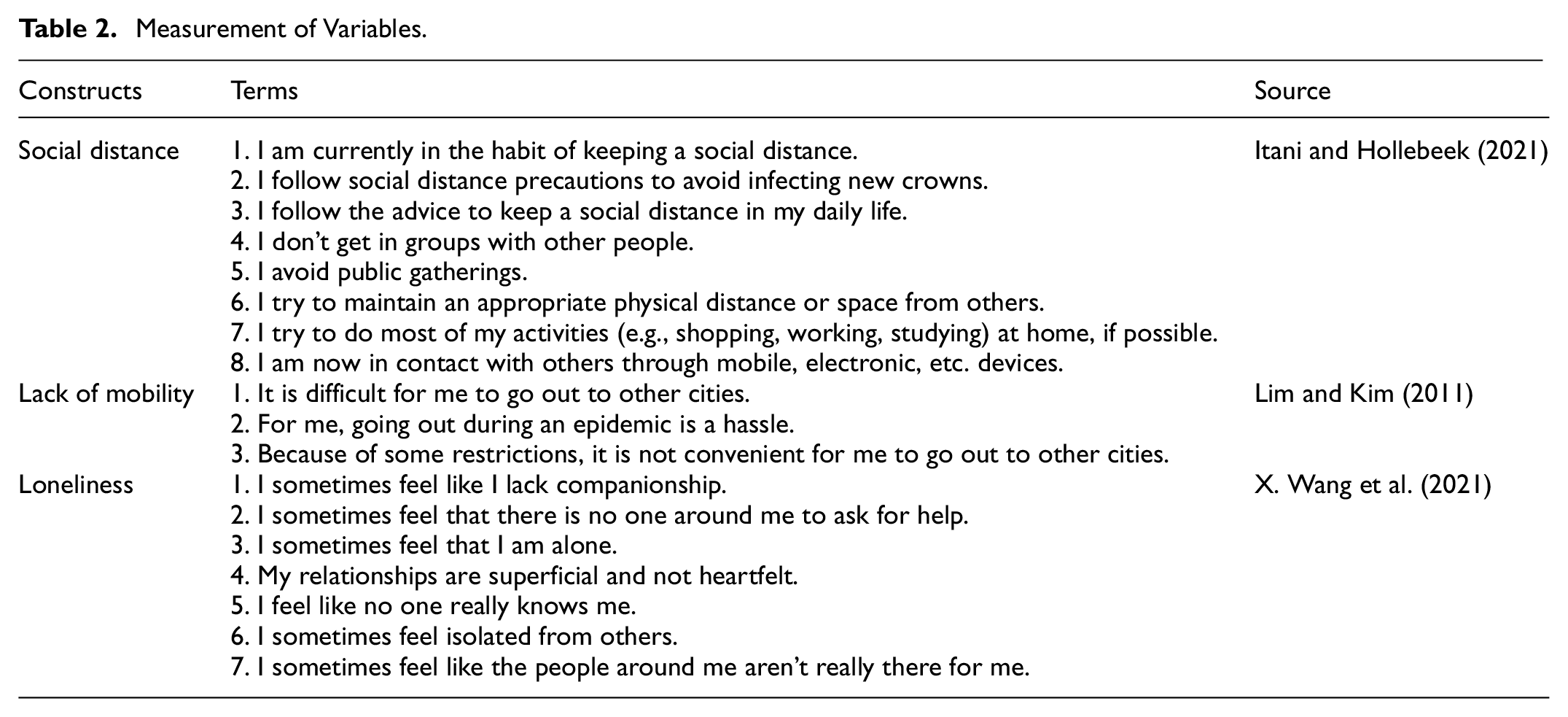
The constructs in the conceptual model were measured using previously established scales in Table 2. Specifically, the measure for social distancing was adapted from Itani and Hollebeek (2021). The measurement items for lack of mobility were based on Lim and Kim (2011). Loneliness was measured using items adapted from X. Wang et al. (2021). The intention to watch travel live streaming was measured using scales from H. Zhang et al. (2017). A seven-point Likert scale was used for all constructs, ranging from 1 (strongly disagree) to 7 (strongly agree). The seven-point scale was selected to strike a balance between precision and simplicity (Preston & Colman, 2000). Research has shown that a seven-point scale provides a greater range of response options, allowing for more nuanced responses from participants while remaining manageable for both respondents and researchers (Preston & Colman, 2000; Yu, Dai et al., 2024). Moreover, it is commonly used in social sciences research, which increases comparability with previous studies (Liao et al., 2025; C. Wang et al., 2023, 2024; Yu, Dai, & Wang, 2023).
Measurement of Variables.
Structural Equation Model
Using AMOS17.0 software as a tool, this study fits the data from 399 valid questionnaires obtained from the survey and the consumer viewing intention analysis model based on the anchor loneliness perspective into a structural equation model, and the main fit test indicators of the fit are as follows: the chi-square value of the free ratio in this study is 1.510, which is smaller than the ideal boundary value of 3. In addition, the RMSEA value of this study is 0.041, which is less than 0.08. The values of other important fitness indicators of this study, IFI (0.942), TLI (0.933), and CFI (0.947), are all greater than 0.9, indicating good fitness. Based on the e fitness indicators above, we can conclude that the structural equation model of this study fits well with the survey data.
Path Analysis
A structural model was estimated to test hypotheses. The model fit the data well [χ2 = 316.617, p < .001, RMSEA = 0.045, CFI = 0.955, NFI = 0.961, IFI = 0.948, GFI = 0.947]. In conducting the path analysis, we focus on the relationship between social distance, lack of mobility and loneliness, as well as the impact of loneliness on consumers’ willingness to watch. According to the results of structural equation modeling, we get the following estimates of the path coefficients (see Table 3): social distance ––> loneliness: the standardized regression coefficient is 0.244 (p < .01). lack of mobility ––> loneliness: the standardized regression coefficient is 0.453 (p < .001). Loneliness ––> Willingness to watch: the standardized regression coefficient is 0.812 (p < .001). Therefore, these results validate hypotheses H1, H2, and H3 that social distance positively affects loneliness, lack of mobility positively affects loneliness, and loneliness positively affects willingness to watch.
Hypothesis Testing.

p < .001. **p < .01.
Moderating Role of Gender
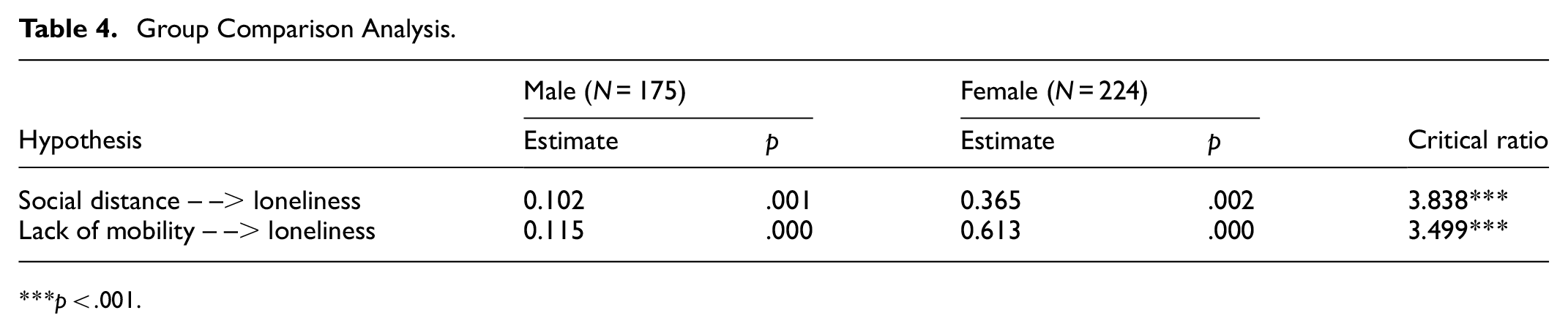
To further explore whether there is a moderating effect of gender on the effects of social distance modeling, we conducted a gender-based multi-cluster analysis. In this analysis, we compared the differences in path coefficients between the male and female cohorts. The analysis of variability was performed using the critical ratio of the parameter difference. Here are the critical ratios of the path coefficients of the two clusters (see Table 4): social distance ––> loneliness path coefficient critical ratio: 3.838; lack of mobility ––> loneliness path coefficient critical ratio: 3.499. The absolute value of the critical ratios of the path coefficients of the two clusters is less than 1.96 (the difference of the path coefficients of the two clusters is considered to be significant equal to 0, which means that the two path coefficients of the two clusters are considered to be not equal. That is, the path coefficients of “social distance” on the variable “loneliness” in the male group and “social distance” on the variable “loneliness” in the female group are not equal, and the path coefficients of “social distance” on the variable “loneliness” in the female group are not equal.
Group Comparison Analysis.
p < .001.
Discussion
The discussion section synthesizes the findings of this study, highlights the theoretical contributions to the existing literature, and provides practical implications for the live streaming industry. In this section, we address the key results and their significance, explain how they extend current research, and offer actionable insights for practitioners.
Conclusion
This study investigates the influence of social distancing and lack of mobility on viewers’ intention to watch travel live streaming during and after the COVID-19 pandemic. The results reveal that these two movement-related factors have a significant impact on viewers’ behavior, highlighting the crucial role of the pandemic in shaping online viewing habits. Additionally, loneliness was found to mediate the relationship between social distancing/lack of mobility and the intention to watch live streaming, underscoring the emotional and psychological effects of the pandemic on individuals. Furthermore, gender differences were found to moderate this relationship, with women experiencing greater loneliness than men and subsequently demonstrating a stronger intention to engage with travel live streaming content. By focusing on the dynamics of social distancing and movement restrictions during and after the pandemic, this study sheds light on the broader impacts of the pandemic crisis on consumer behavior in the context of digital platforms, particularly travel live streaming. The findings contribute to a deeper understanding of how socio-psychological factors, such as loneliness and mobility restrictions, shape the consumption of live streaming content.
Theoretical Contributions
This research makes several important theoretical contributions to the live streaming and tourism literature.
First, it extends existing knowledge by examining the specific influences of social distancing and lack of mobility on viewers’ intention to watch travel live streaming. Although prior studies have explored the role of live streaming in various sectors (Deng et al., 2021; K. Lin et al., 2022; H. Liu et al., 2024), the focus has largely been on the impact of live streaming on the behavior of viewers and tourism operators, without sufficiently addressing the factors that drive viewers’ intentions to engage with travel live streaming (Y. Chen et al., 2024; Chi et al., 2025; Z. Zhang et al., 2025). This study fills this gap by examining how external factors such as social distancing and mobility limitations during the pandemic directly impact viewers’ intentions, thus contributing to the live streaming literature from a new perspective.
Second, the study explores the mediating role of loneliness, which has not been extensively researched in the context of live streaming. While it has been acknowledged that live streaming may alleviate loneliness (Goh et al., 2021; Li & Cheng, 2023; Song et al., 2024), limited studies have investigated how loneliness itself influences viewers’ intentions to watch live streaming. Our findings indicate that loneliness plays a significant role in driving the intention to watch travel live streaming, contributing to a more nuanced understanding of the psychological factors underlying live streaming consumption. The study also suggests an interactive effect between loneliness and live streaming, which could be explored in future research.
Finally, the study uncovers the moderating role of gender in the relationship between movement-related factors (social distancing and lack of mobility) and loneliness. The results indicate that women are more likely to experience loneliness than men due to these pandemic-related factors, which in turn motivates them to seek emotional solace through travel live streaming. This finding adds to the growing body of literature on gender differences in consumer behavior, particularly during times of crisis (Yu et al., 2025). It offers new insights into how gender influences responses to social isolation and online content consumption, which could lead to further exploration of gendered experiences in digital media use.
Practical Implications
The practical implications of this study are particularly significant for the live streaming industry, especially for platforms offering travel-related content. Based on the findings, several actionable recommendations can be made to enhance user engagement and better address the emotional needs of viewers.
The study highlights the crucial role of loneliness in driving viewers’ intention to watch travel live streaming. To address this, live streaming platforms should focus on promoting emotional connection and fostering a sense of community among viewers. Interactive features, such as live chats, social sharing, and group discussions, can help reduce feelings of isolation by facilitating real-time interactions between viewers and content creators. These tools not only enable engagement but also build a social environment where viewers can share experiences and connect with one another, making the live streaming experience more emotionally fulfilling (H. Liu et al., 2024; Z. Zhang et al., 2025).
Moreover, since women experience greater loneliness during the pandemic, as revealed by our findings, it is important for travel live streaming platforms to consider tailoring content and experiences that specifically appeal to female viewers. Content creators could design travel experiences or narratives that resonate with the emotional needs and preferences of women, addressing concerns related to loneliness and social isolation. Additionally, providing more personalized engagement tools—such as women-focused travel shows or influencers who resonate with female audiences—could further enhance emotional connections. This gender-sensitive approach will make viewers feel more understood and supported during challenging times.
The pandemic has also underscored the need for adaptive strategies in digital content creation. Travel live streaming platforms should take into account the emotional states of viewers during crises, offering content that provides comfort and distraction (Ganguly, 2024; Miao et al., 2021). For example, virtual tours, cultural experiences, or relaxation-focused travel content could help alleviate stress and loneliness. By aligning content with the psychological needs of viewers, platforms can not only improve engagement but also boost overall viewer satisfaction. This adaptability will make live streaming platforms more relevant in the post-pandemic world, where viewers may continue to seek emotional connection and escapism.
Finally, platforms can leverage the insight that loneliness is a significant motivator for viewers to engage with travel live streaming content. Marketing campaigns could highlight the emotional benefits of live streaming, especially in the context of social distancing and restricted mobility (Chong et al., 2024; Lyu et al., 2024). Promotional content could focus on how live streaming allows viewers to escape isolation, offering them a sense of connection and belonging through shared travel experiences. By framing live streaming as a tool for emotional well-being, platforms can attract more viewers and create a stronger bond with their audience. These recommendations suggest that live streaming platforms should not only focus on the entertainment value of their content but also recognize the emotional and psychological needs of their viewers. By understanding and addressing these needs, platforms can create more meaningful and engaging experiences for their audiences.
Limitations and Future Research
This study provides valuable insights into the impact of the COVID-19 pandemic on the tourism industry, particularly through the role of live streaming. However, several limitations should be considered, which also provide opportunities for future research.
First, one of the key limitations of this study is that the sample was drawn solely from China. While China is a significant market for live streaming, future studies could broaden the scope by collecting data from different cultures and comparing the results. A cross-cultural approach, particularly comparing eastern and western cultures, could offer deeper insights into how cultural differences influence viewers’ engagement with travel live streaming and their emotional responses. This would help generalize the findings and provide a more global perspective on the phenomenon. Second, this study adopts a cross-sectional design, capturing data at a single point in time. While this design provides valuable insights, it limits the ability to establish causal relationships between the variables. Future research could benefit from using longitudinal or experimental designs, which would allow for a more robust examination of causality and help track changes in viewers’ behaviors and emotional states over time. This approach would also enable researchers to better capture the dynamic nature of relationships between factors such as loneliness, social distancing, and viewers’ intention to watch live streaming. Besides, the data in this study were based on self-reported responses from participants, which may introduce biases such as social desirability or recall bias. To strengthen the validity of the findings, future studies could incorporate objective measures or observational methods. For instance, analyzing actual viewing behavior through platform data or using physiological measures to assess emotional responses could provide a more comprehensive understanding of the factors driving viewers’ engagement with travel live streaming. Additionally, this study primarily examines gender as a moderating variable in the relationship between movement-related factors and loneliness. However, other demographic or psychological factors, such as age, technological proficiency, or personality traits, may also influence these relationships. Future research could explore a broader range of moderators to provide a more nuanced understanding of how various factors interact with viewers’ behaviors and emotional responses to live streaming content. Finally, while this study offers valuable insights into the impact of the COVID-19 pandemic, its findings are context-specific and may not fully capture the long-term trends in travel live streaming post-pandemic. Future research could examine how the long-term effects of the pandemic, or the return to normalcy, shape viewers’ intentions and behaviors. Additionally, researchers could explore how emerging trends, such as virtual reality travel experiences or hybrid travel models, may influence the future of live streaming in the tourism industry.
By addressing these limitations, future studies can provide a more comprehensive and global understanding of the role of live streaming in the tourism sector, contributing to both academic knowledge and practical strategies for the industry.
Footnotes

Ethical Considerations
Despite the absence of a specific approval number, the researcher obtained ethical approval from the Research Ethical Board of Nanning University, ensuring compliance with ethical standards. The study followed the guidelines established by the Declaration of Helsinki.
Consent to Participate
Due to the impact of the COVID-19 pandemic, the researcher obtained oral informed consent from all participants before the study. All participants were fully informed, understood the purpose of the study, voluntarily agreed to participate, and consented to the use of the data for publication.
Author Contributions
JL & KH: design of the work, data collection, analysis, interpretation, drafting the article, and final approval. TY & WG: data interpretation, drafting the article, and critical revision of the article. TY: interpretation, editing and formatting. All authors contributed to the article and approved the submitted version.
Funding
The author(s) disclosed receipt of the following financial support for the research, authorship, and/or publication of this article: This work was supported by 2024 Guangdong Education Science Planning Project (Special Project of Higher Education, Grant number: 2024GXJK449), 2024 Guangdong Province Higher Education Teaching Research and Reform Project (2024JXGG06), 2024 Higher Education Research Project under the “14th Five-Year Plan” by the Guangdong Society of Higher Education (Grant number: 24GQN27), and 2022 Guangzhou College of Commerce Annual University-Level Quality Engineering Construction Project (2022JXGG84).
Declaration of Conflicting Interests
The author(s) declared no potential conflicts of interest with respect to the research, authorship, and/or publication of this article.
Data Availability Statement
The original contributions presented in the study are included in the article/supplementary material, further inquiries can be directed to the corresponding author.