




Abstract
This study aims to portray the policy compliance landscape among Chinese citizens, focusing on their adherence to strict public health measures during the COVID-19 pandemic. Utilizing data from the 2021 Chinese General Social Survey, we employed ordinary least squares and ordered Logit models to explore factors influencing compliance with government epidemic prevention policies. Findings indicate that individuals with higher education levels, chronic illnesses, high trust in government, and strong sense of social responsibility tend to demonstrate higher policy compliance, while married individuals and those with high trust in the healthcare system exhibit lower policy compliance. Based on a dual framework of normative and calculative motivation, this study reveals multiple mechanisms underlying policy compliance. Under the normative pathway, trust, sense of responsibility, and education may promote internalized compliance through reinforcing policy identification, while married individuals may show weaker response due to family responsibilities. Under calculative motivation, those with higher education levels and poor health conditions may develop stronger protective motivation due to threat perception. In contrast, married individuals may prioritize household interests, reducing compliance. Meanwhile, high trust in the healthcare system may trigger a “trust paradox.”
Plain Language Summary
This study analyzed the factors influencing policy compliance among Chinese citizens and the potential mechanisms of these influencing factors. Provides the empirical evidence about the basic status of Chinese citizens’ compliance with stringent measures in public health crisis.
Introduction
Facing sudden public health crises, it is now a consensus in both academic and practical fields that governments should adopt proactive prevention and intervention measures. The outbreak of COVID-19 in early 2020 dealt an unprecedented blow to the mental well-being, economy, and social order of citizens worldwide. In response to this significant public health crisis, most countries formulated and implemented strict epidemic prevention policies. These measures aimed to regulate citizens’ daily activities, contain infection and mortality rates, and alleviate the pressure on healthcare systems and providers. Among the most common, relatively low-cost prevention measure is mask-wearing (Singhal et al., 2021). Similarly, other measures include maintaining social distancing and avoiding large gatherings (Al-Hasan et al., 2020). International experiences have verified that these policies effectively reduce the spread of the virus through respiratory droplets (Leung et al., 2020) and lower the incidence of COVID-19 (Fischer et al., 2021).
The effectiveness of proactive prevention and intervention measures hinges on their ability to genuinely shift citizen attitudes and foster policy-compliant behaviors, thereby interrupting transmission routes (Denford et al., 2021). Existing research has shown that proactive policy actions, combined with public cooperation, can indeed slow disease transmission (Anderson et al., 2020). The combined impact can maximize reductions in public crisis response costs and lessen the economic repercussions of the pandemic (Tao, 2020). Hence, discussing citizens’ policy compliance in the context of public crisis management is invaluable, offering insights to enhance citizen compliance, public policy effectiveness, and public crisis response capability.
However, a highly contentious issue is that these stringent measures require citizens to continuously adapt to new behavioral lifestyles. Often, these changes can intrude upon and disrupt public daily life, potentially leading to adverse outcomes such as domestic violence, mental health challenges, and unemployment (Brodeur et al., 2021). This might, in turn, culminate in citizens’ non-compliance with policies (Fukuyama, 2020). In other words, even if citizens agree that government guidelines are beneficial, they might choose non-compliance due to personal or societal reasons (Saey, 2020). For instance, in the U.S., despite many states advocating mask-wearing, numerous citizens still resist this notion (Kasting et al., 2020). Concurrently, existing research has found substantial variations in citizens’ willingness to comply and actual compliance levels across different contexts (Drury et al., 2020). Based on this, the study question of this paper is specific to the Chinese context, aiming to describe and analyze the overall policy compliance status of Chinese citizens. Thus, the question this paper seeks to answer is: In the actual context of China, what is the overall status of policy compliance among Chinese citizens?
The central theme of academic research on citizens’ compliance with stringent measures is to clarify which factors influence citizens’ policy compliance and how. Along these lines, there have been extensive studies on the topic. Some have focused on case analyses of policy compliance among citizens of individual nations (Galende et al., 2022; Salti et al., 2023) while others have undertaken cross-national comparative studies (Al-Hasan et al., 2020; Folayan et al., 2023). There are descriptive studies on the policy compliance behaviors of specific groups (Teferra et al., 2022; Vlutters, 2021), as well as research on the mechanisms by which certain variables influence compliance behavior (Kılıç et al., 2022; Mays et al., 2023). Many countries and regions have delved deeply into these themes. Interestingly, different studies often yield varying, sometimes even opposing, conclusions. For instance, some studies suggest that women tend to show higher compliance to protective measures compared to men (Dzerounian et al., 2022; Noone et al., 2021). However, other research indicates a higher association between women and non-compliant behaviors (Kabamba Nzaji et al., 2020). Similarly, while some research posits that citizens with higher education levels typically demonstrate higher compliance with various preventive measures (Gobeil-Lavoie et al., 2019), other studies offer the opposite conclusion. They suggest that those with lower education levels are more compliant, while the highly educated exhibit lower compliance (Roma et al., 2020). Furthermore, from an international perspective, the impact of international cooperation on public policy compliance can vary significantly. On one hand, effective cooperation may bolster public confidence in the governance capacity of the EU and its member states. On the other hand, delays and poor coordination among international organizations and national governments in the early stages of a crisis may erode trust in these institutions, ultimately diminishing individuals’ willingness to comply with public policies (Karačić Zanetti et al., 2023). Such discrepancies could arise from the unique cultural structures and influences shaping individual behaviors in different countries (Vora et al., 2019). Thus, study focusing on the policy compliance of citizens in a specific country holds valuable unique insights and data significance, offering policymakers information to guide citizen compliance through appropriate communication strategies.
To explain the influence of various factors on citizens’ policy compliance behavior, scholars have proposed numerous theoretical explanations, which can be primarily categorized into two core motivational pathways: normative motivation and calculative motivation. Normative motivation emphasizes the importance of individuals’ intrinsic values, social norms, and moral beliefs. This type of motivation is typically rooted in social norms, personal responsibility, and trust in governance institutions (Chen et al., 2024). For example, trust in government is widely regarded as a key normative motivation that prompts individuals to comply with policies, capable of stimulating public behavioral tendencies to voluntarily fulfill public rules by enhancing perceptions of policy legitimacy and moral obligation (Zhang et al., 2025).
In contrast, calculative motivation is based on cognitive processes, viewing individuals’ policy response behavior as the result of rational weighing of costs and benefits (Goren et al., 2022). This type of analysis emphasizes the assessment process individuals undertake to maximize benefits and minimize costs, typically viewed as a manifestation of economic motivation (Montoya et al., 2000; Simons-Morton et al., 2012). Following this analytical pathway, scholars have developed several specific analytical models, including but not limited to Protection Motivation Theory (Kuppusamy et al., 2022), Deterrence Theory (Kim et al., 2014), and Theory of Planned Behavior (Ajzen, 1985). Among these, Protection Motivation Theory focuses on how individuals’ perceptions of threats and coping mechanisms influence their behavior (Floyd et al., 2000); Deterrence Theory emphasizes that individuals’ willingness to comply with rules is based on their fear of negative punishment or perception of the likelihood of punishment (Akers, 1990); Theory of Planned Behavior indicates that attitudes, subjective norms, and perceived behavioral control are important predictors of compliance intention (Tran et al., 2025). Combining normative motivation and calculative motivation to construct an analytical framework helps comprehensively and systematically understand the multiple factors and psychological mechanisms influencing policy compliance among Chinese mainland citizens from both value-orientation and rational choice perspectives.
Currently, systematic research on policy compliance behavior among Chinese mainland citizens remains relatively limited in academia. Existing results mostly focus on survey analyses of specific regions or partial samples, with empirical research based on nationally sampled data being relatively scarce. Moreover, most existing studies focus on descriptive statistics of compliance levels, with less in-depth exploration of the multiple influencing mechanisms and internal logic behind policy compliance. Based on this, this paper takes Chinese mainland citizens’ policy compliance behavior in the context of the COVID-19 pandemic as its research object, and on the basis of clarifying the overall compliance status, further analyzes key influencing factors and their pathways of action. This paper uses normative motivation and calculative motivation as its theoretical framework, relying on data from the 2021 Chinese General Social Survey (CGSS), conducting systematic analysis from multiple dimensions including institutional trust, sense of responsibility, health status, and marital structure. The objectives of this study are as follows: Firstly, to understand the basic status of Chinese citizens’ compliance with stringent measures, providing empirical evidence for further deepening international comparisons in the future; Secondly, to explore the factors influencing policy compliance among Chinese citizens and to analyze the potential mechanisms of these influencing factors; Thirdly, to provide practical insights for China and other countries in addressing possible future public health crises.
Data and Methods
Data
The data used in this study are selected from the 2021 Chinese General Social Survey (CGSS). This survey is organized by the China Survey and Data Center of Renmin University of China, systematically describing and analyzing Chinese society through annual survey data, comprehensively collecting data at multiple levels including society, community, family, and individual. It is one of the representatives of China’s continuous social surveys, widely recognized for its completeness, authenticity, and reliability.
The CGSS 2021 annual data is the first complete survey data publicly released by CGSS during the COVID-19 pandemic, which specifically added relevant items on citizens’ attitudes and behavioral responses to the pandemic, effectively reflecting the actual conditions of Chinese society under the pandemic context. It is worth noting that 2021 was a critical period when China implemented strict pandemic control measures, and citizens’ compliance with government epidemic prevention measures was particularly prominent and typical, relatively concentratedly revealing citizens’ policy response characteristics during the high-pressure phase of the pandemic, thereby providing valuable empirical evidence for the research question. Therefore, selecting this year as the time window for observing “policy compliance in public health crises” has high practical and theoretical rationality.
CGSS 2021 covers urban and rural residents nationwide to ensure sample representativeness in demographic and social characteristics. During data processing, based on the variables required for research, we excluded missing values and incomplete samples, ultimately obtaining 1,374 valid observations for subsequent empirical analysis.
Measurement Methods
Dependent Variable
The dependent variable of this study is defined as the compliance of Chinese citizens with Chinese government epidemic prevention policies during COVID-19. Referring to existing research (Dzisi & Dei, 2020; Nivette et al., 2021), we selected “mask-wearing” as a proxy indicator for policy compliance behavior. The reasons are as follows: First, mask-wearing was a mandatory protective requirement universally promoted by the Chinese government nationwide during the COVID-19 pandemic, covering various public places with unified policy implementation, facilitating cross-group comparison and measurement; Second, compared to other prevention and control measures, mask-wearing behavior is more observable, with higher credibility of respondents’ self-reports and easier capture by empirical research. This data comes from responses to the following question in the 2021 CGSS questionnaire: “During the peak period of the pandemic, do you think our government has the right to require citizens to wear masks?” The response options include four levels: citizens who chose “definitely has the right” were assigned a value of 4; those who answered “possibly has the right” were assigned a value of 3; those who chose “possibly has no right” were assigned a value of 2; and those who answered “definitely has no right” were assigned a value of 1. Overall, this question not only measures respondents’ attitudes toward specific prevention and control requirements but also indirectly reveals their degree of identification with government authority and public health policies, thus effectively representing policy compliance behavior (Cheng et al., 2022; Lu et al., 2021).
Independent Variable
Combined with existing research (Drury et al., 2020; Hearne & Niño, 2022), this study aims to deeply explore the impact of various potential factors on citizens’ compliance with epidemic prevention policies. Potential influencing factors are divided into three dimensions: demographic characteristics, personal health status, and subjective perception. This classification not only relies on the 2021 CGSS dataset and is implemented through precise manual coding but also meets the need to explain citizens’ policy compliance from multiple perspectives.
First, the demographic characteristics dimension. Individual social structural attributes profoundly shape their policy compliance behavior (Bish & Michie, 2010; Drury et al., 2020). Selected specific variables include gender, education level, marital status, political affiliation, personal income, and Hukou status. It should be particularly noted that Hukou is a unique household registration system in China, which is both an identity registration and closely related to residence and social welfare (such as education, healthcare, and housing). Each Chinese citizen is classified into a specific Hukou type based on their place of birth or their parents’ registered residence, mainly divided into urban Hukou and rural Hukou. Overall, these factors not only affect the degree of risk exposure individuals face in crises but also determine their resource access and coping capabilities. Second, the personal health dimension. Individual physical and psychological health conditions affect individuals’ willingness to adopt protective behaviors (Byun et al., 2022). The research mainly focuses on factors such as depression level, health self-assessment, life happiness, and whether respondents themselves suffer from long-term health problems, aiming to explain how physical and psychological states affect individual policy compliance.
Third, the subjective perception dimension. Individual identification with policies depends not only on external constraints but is also influenced by their cognitive and emotional orientations (Siegrist & Bearth, 2021). This study focuses on indicators that can assess citizens’ social cognition and emotional responses, selecting perception of social fairness, socioeconomic status, fear assessment of COVID-19, sense of responsibility to society, sense of security about the environment, trust in government, and trust in the healthcare system, to depict citizens’ subjective judgments and emotional mobilization in crises. These perceptual factors play particularly key roles in shaping institutional trust and risk response behaviors (Seyd & Bu, 2022).
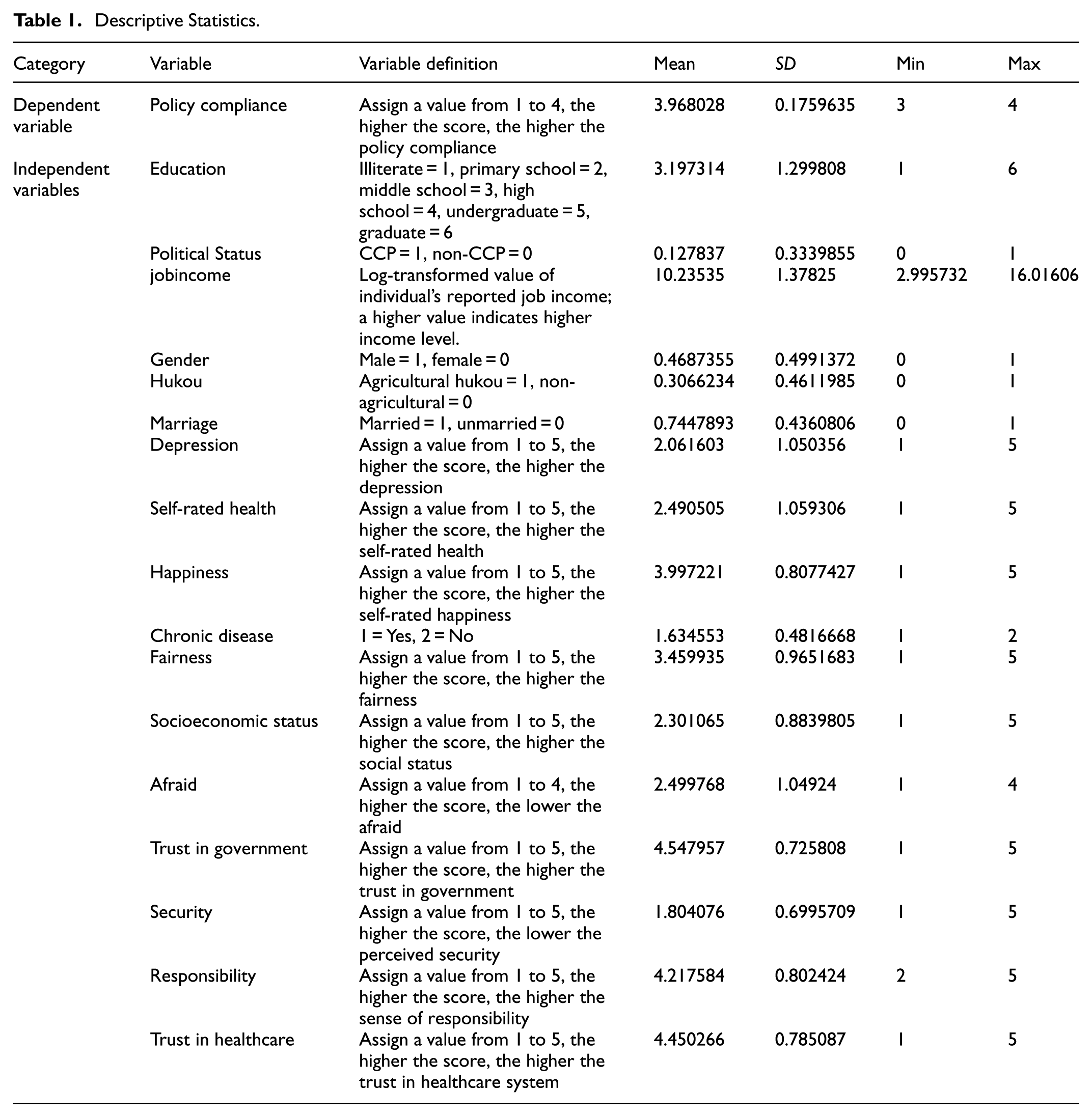
In summary, through the division of three dimensions, we not only empirically cover potential influencing factors at different levels but also construct a comprehensive analytical framework integrating social structure, health status, and subjective cognition, thereby providing deep insights for comprehensively understanding citizens’ policy compliance behavior in public health crises. Specific definitions and coding of each variable can be found in Table 1.
Descriptive Statistics.
Analysis Strategy
First, from a multi-dimensional perspective, on the basis of providing descriptive statistics and clear definitions of variables, we divide explanatory variables into three major dimensions: demographic characteristics, health status, and subjective perception. This division not only helps clarify the potential impact pathways of factors at different levels on policy compliance behavior but also better conforms to the multi-factor intertwining characteristics of public decision-making in real situations, laying the foundation for comprehensively and systematically revealing key driving factors.
Second, in model selection, we use cross-method verification. To ensure the robustness and scientific nature of results, we adopt both ordinary least squares (OLS) and ordered Logit models for cross-validation. On one hand, based on the research question, for the convenience of intuitive comparative observation, we use linear probability models (OLS) for estimation; on the other hand, given that the dependent variable is an ordered multi-categorical variable, we simultaneously adopt ordered Logit regression for fitting and report odds ratios to more rigorously capture the nonlinear effects of variables on policy compliance level changes. To further improve estimation efficiency and robustness, all regressions adopt robust standard errors. In terms of result presentation, we supplement with visual interpretation. In addition to traditional regression tables, we also utilize coefficient visualization charts to intuitively display the effect sizes and confidence intervals of each variable, enhancing the interpretability of results.
Results
Descriptive Statistics
First, regarding respondents’ compliance with epidemic prevention policies: For the epidemic prevention policy requiring citizens to wear masks when entering and leaving public places during COVID-19, the mean compliance score among respondents was 3.97. This data indicates that during the COVID-19 peak period, given that mask-wearing was the primary means of epidemic prevention, most respondents highly recognized and actually implemented this mask-wearing epidemic prevention policy.
Second, from the demographic characteristics perspective: In the sample, 46.9% were male, showing a relatively balanced gender ratio. Additionally, the average education level of respondents was 3.20, corresponding to “junior high school to high school” level. Regarding political affiliation, 12.8% of respondents were Chinese Communist Party members. In terms of marital status, 74.5% of respondents were married. Agricultural Hukou accounted for 30.7%. In terms of economic conditions, the mean job income of respondents was 10.24.
Third, from the personal health dimension: The mean depression level was 2.06, indicating that respondents generally had mild depressive symptoms. The mean self-rated health status was 2.49, showing that most respondents rated their health as fairly average. The mean life happiness was 3.99, indicating that respondents overall held high satisfaction with their life conditions. Regarding long-term health problems, approximately 63.5% of respondents suffered from chronic diseases.
Fourth, from the subjective perception dimension: Respondents generally felt a certain degree of social fairness, with a mean of 3.46. The mean self-rated socioeconomic status was 2.30. In terms of risk perception of COVID-19, the mean fear level was 2.50, and overall, respondents had moderate levels of fear toward the pandemic. Regarding trust and sense of security, respondents’ trust in government had a mean of 4.55, showing relatively high overall trust levels; trust in the healthcare system had a mean of 4.45, sense of security had a mean of 1.80, and sense of responsibility had a mean of 4.22.
Results
To deeply analyze the potential impact of each independent variable on citizens’ compliance with mask-wearing policies during the pandemic, the independent variables are subdivided into three major dimensions for detailed exploration: demographic characteristics, personal health status, and subjective perception. Table 2 reports the baseline regression results of factors influencing policy compliance. Model (1) uses ordinary least squares (OLS) estimation (reported with standardized coefficients), and Model (2) uses ordered Logit model estimation (reported with odds ratios OR) to test the robustness of relationships between explanatory variables and explained variables. The estimation results of both models are basically consistent in the significance and direction of key variables, indicating that the results of this study have good reliability. In addition, we supplemented visualization of regression results to facilitate readers’ more intuitive observation of regression results, as shown in Figure 1.
Baseline Regression Results.

, **, and *** indicate significance at the 10%, 5%, and 1% levels respectively.
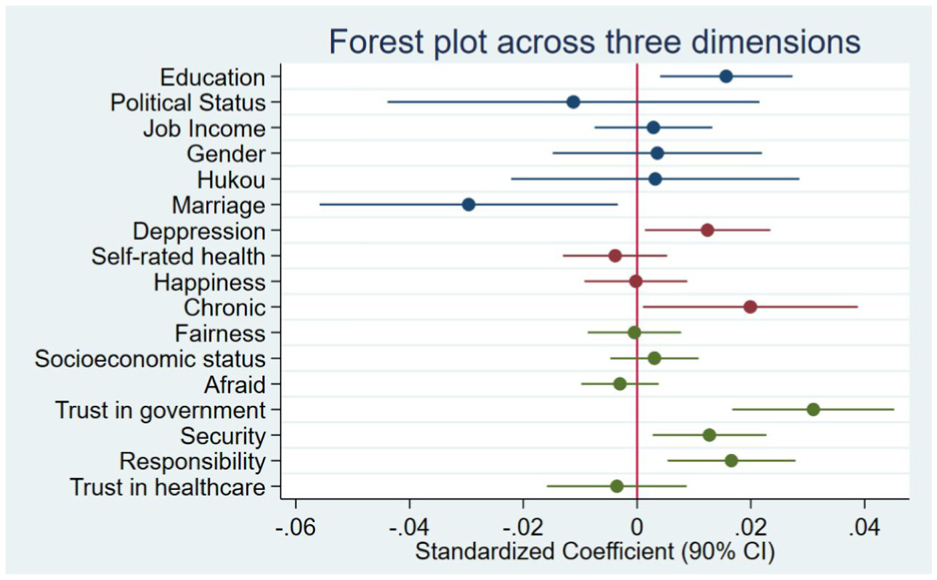
Forest plot.
First, at the demographic characteristics level, different factors under this dimension have varying impacts on policy compliance behavior. Education level is a positive factor for policy compliance. The coefficient of education level is significantly positive in both models, indicating that individuals with higher education levels have stronger ability to understand and accept public policies, thus demonstrating higher compliance. In contrast, marital status shows a stable negative impact. One possible explanation is that married groups often face more complex family decisions and heavier livelihood burdens, which may constitute constraints on their full compliance with policies under specific circumstances. Additionally, political affiliation, Hukou type, personal income, and gender all show no statistically significant effects, indicating that there are no systematic differences in policy compliance behavior among groups based on these basic social attributes.
Second, at the personal health level. Specifically, whether having long-term health problems is marginally significant in the model, which to some extent suggests that individuals with poor health conditions may be more inclined to comply with policies, especially health-related policies, due to more frequent interactions with healthcare systems and greater sensitivity to health risks. However, other variables including depression level, self-rated health, and happiness all have non-significant estimated coefficients. This indicates that there is no direct linear association between individuals’ emotional states and overall life satisfaction and their policy compliance behavior.
Third, at the subjective perception level. It is intuitively clear that institutional trust is the most core driving force, with trust in government having a significantly positive impact on policy compliance. For every one-unit increase in government trust, policy compliance significantly increases by an average of 0.045 levels, with an odds ratio OR = 1.139, indicating that a one-level increase in trust increases the odds of individuals being in a higher compliance level by 13.9%. This finding powerfully confirms that government credibility is the cornerstone of effective policy implementation. Personal sense of responsibility is also a key positive predictor. Responsibility is significantly positive, indicating that individuals who believe they bear greater responsibility for social welfare also have significantly stronger willingness to comply with public policies, highlighting the importance of civic spirit in public governance. However, trust in the healthcare system shows a significantly negative impact, meaning that individuals with lower trust in the healthcare system actually have higher policy compliance. One possible explanation is that individuals who hold skeptical or pessimistic attitudes toward the effectiveness of existing healthcare systems may more strictly comply with various protective policies due to stronger self-protection motivation and risk aversion psychology. Additionally, factors such as sense of social fairness, fear of the pandemic (Afraid), and sense of security do not show significant impacts.
In summary, the baseline regression results indicate that public policy compliance behavior is a complex phenomenon driven by multiple motivations. At the individual characteristics level, individuals’ education level is an important promoting factor. At the subjective cognition level, high trust in government and strong personal sense of responsibility are core mechanisms for motivating policy compliance. It is worth noting that distrust of specific institutions (such as the healthcare system) does not necessarily lead to confrontational behavior, but may instead transform into defensive compliance behavior due to risk perception. These findings provide empirical evidence for understanding public policy compliance.
This forest plot displays the standardized coefficients and confidence intervals across three dimensions.
Discussion
The research findings indicate that Chinese citizens with higher education levels and those who are unmarried demonstrate higher compliance with stringent measures. Additionally, citizens’ policy compliance behavior shows statistically significant associations with objective health indicators such as the presence of long-term health problems, as well as subjective perception factors including government trust, personal sense of responsibility, and trust in the healthcare system. This study provides empirical evidence for understanding citizens’ obedience to strict policies in crisis contexts and establishes a data foundation for subsequent cross-national comparative research. Next, this paper will systematically analyze the mechanisms of the aforementioned influencing factors from the dual theoretical perspectives of normative motivation and calculative motivation, revealing the behavioral logic of citizens in public crisis contexts.
Normative Motivation and Policy Compliance
From the perspective of normative motivation, individuals’ policy compliance behavior primarily stems from their intrinsic moral cognition and sense of social responsibility, which profoundly shape their attitudinal judgments and behavioral choices regarding strict policy measures. Within this theoretical framework, policy compliance is understood as a self-regulatory behavior based on value identification and social norms, rather than mere passive obedience to authority. On one hand, the analytical pathway of normative motivation helps reveal the key role of socio-psychological mechanisms such as trust, sense of responsibility, and social norms in shaping individual policy behavior, deepening the mechanistic understanding of “why compliance occurs”; on the other hand, this perspective also provides practical insights for public policy formulation and implementation—governments can trigger citizens’ internal identification through strengthening moral value guidance and cultivating public spirit, effectively achieving public policy objectives while reinforcing the legitimacy and sustainability of government governance.
Within the normative motivation framework, trust serves as a key psychological mechanism driving policy compliance. Research finds that the higher an individual’s trust in government, the stronger their willingness to comply with policies. This is consistent with numerous previous research conclusions (Chen et al., 2024; Saechang et al., 2021). Government trust is closely related to individuals’ sense of responsibility and moral identification (Jørgensen et al., 2021). For example, Smith et al. found that government trust is one of the strongest variables predicting citizens’ compliance with epidemic prevention measures, explaining it as trust building a social contract and sense of responsibility for rule compliance (Smith et al., 2021). The core mechanism linking government trust and policy compliance lies in trust transforming originally external policy requirements into individuals’ internal moral imperatives. Specifically, high levels of government trust strengthen citizens’ subjective perception of policy legitimacy, making them more inclined to view epidemic prevention measures as reasonable expectations from credible authorities, thus proactively responding to them; simultaneously, trust leads individuals to internalize rule compliance as appropriate behavior for “good citizens,” viewing policy compliance as an important manifestation of fulfilling civic responsibility and practicing social virtues, rather than simply a choice based on personal interests. Ultimately, this trust mechanism not only promotes deeper internalization of norms but also activates citizens’ concern for collective welfare, enhancing cooperative willingness and altruistic behavior, fostering more stable and sustained policy compliance behavior.
Similar to the trust mechanism, individuals’ sense of responsibility is also an important normative motivation variable driving policy compliance. Existing research indicates that personal sense of responsibility is one of the important factors for complying with policies within the normative framework (Hong & Xu, 2021). The core mechanism lies in the ability of a sense of responsibility to activate individuals’ internal moral norms, thereby driving them to be more obedient to government institutional guidance when facing policy requirements. Specifically, individuals with strong social responsibility often make behavioral decisions not based on utilitarian calculations of personal gains and losses, but from internalized identification with moral obligations. On one hand, they are highly sensitive to social risks that non-compliance behavior might bring and potential harm to others (Beckers, 2023); on the other hand, they view preventing such risks as their inescapable moral responsibility. This dual effect activates their personal norms, thus generating a strong sense of moral obligation, driving them to view policy compliance as a civic responsibility and moral mission that must be fulfilled. Therefore, the motivating effect of responsibility essentially embodies a “moralization” process: it successfully transforms public policy requirements from external rules into internal moral imperatives that individuals consciously practice, thereby achieving organic unity between policy objectives and individual values.
Education level is also an important contextual condition for normative motivation to take effect. Research finds that individuals with higher education levels show stronger policy compliance willingness, possibly explained by education’s socializing function. Education, especially higher education, is not merely a process of knowledge and skill transmission, but a systematic civic education mechanism (Sunshine Hillygus, 2005). First, higher education levels usually mean stronger cognitive abilities, making individuals more likely to understand the institutional logic behind complex policies and the necessity of collective action, thus more inclined to make rational judgments and responsible behaviors that align with overall social interests when facing policy choices. Second, education constructs and internalizes the social norm of “civic responsibility” through both explicit and implicit curricula, making individuals view compliance with public rules as a conscious moral obligation. Moreover, the educational process itself is a key pathway for trust generation and cultivation, and trust is precisely the psychological foundation for citizen cooperation and compliance (Putnam, 2000). Therefore, the positive correlation between education level and policy compliance essentially reflects the concentrated manifestation of civic identity, social responsibility awareness, and systematic cognitive abilities that individuals gradually construct during the educational process in the context of public crisis.
An intriguing finding is that married individuals tend to demonstrate comparatively lower levels of policy compliance willingness. The possible mechanism is that although family responsibility should be a positive normative force, in specific crisis contexts, it may also become a psychological motivation for resisting policy constraints and provide psychological justification for deviant behavior (Coleman, 1987). Marital status represents not simply a social role transformation, but an internalization of deep family responsibility norms. For married individuals, responsibilities such as caring for family and ensuring livelihood occupy a priority position in their moral cognitive structure, possessing extremely high practical urgency and moral weight. When public policies (such as comprehensive lockdowns, work stoppages) are perceived as direct or indirect threats to fulfilling family responsibilities, individuals may experience intense normative conflicts between “public responsibility” and “family responsibility” (Wright et al., 2020). In this context, married individuals showing lower compliance is not due to a lack of sense of responsibility, but rather to respond to a more urgent and direct family normative calling in their moral hierarchy, achieving internal consistency and psychological balance by reinterpreting “violation” behavior as a moral choice of family responsibility. This phenomenon reveals the tension and hierarchical differences within normative motivations, and also suggests that some behaviors seemingly contrary to policy requirements may actually stem from another type of normalized moral calling.
In summary, normative motivation holds significant importance in explaining policy compliance behavior. It reveals how variables such as trust, responsibility, education, and marriage promote or weaken individuals’ response to policies through mechanisms such as triggering moral obligations, reinforcing social norms, and internalizing institutional expectations. Understanding this mechanism helps policymakers transcend the simple opposition of punishment and incentives in crisis governance, paying more attention to shaping public values and constructing social identification, thereby achieving more robust and sustainable governance effects.
Calculative Motivation and Policy Compliance
In contrast to normative motivation’s emphasis on the intrinsic drive of moral obligations and social norms, calculative motivation views policy compliance as individuals’ strategic choice based on rational assessment. This perspective holds that individuals conduct cost-benefit analyses when facing policy requirements, with the core logic being the maximization of behavioral utility. The “benefits” here include not only economic interests but also non-material rewards such as health safety and risk avoidance. When individuals perceive that the expected benefits from compliance behavior exceed the expected costs they need to pay, they are more likely to make compliance choices; conversely, they may engage in avoidance or resistance behavior. Therefore, calculative motivation provides an explanatory pathway based on behavioral economics and health psychology, helping to explain the cognitive foundation and assessment mechanisms of compliance behavior, and further understanding why some health warnings can successfully persuade people to change behavior while others cannot. Particularly in public crisis contexts, the calculative motivation framework helps supplement explanations at the micro-psychological mechanism level, especially when individuals face high uncertainty and high risk assessment pressure, their policy response often depends not only on intrinsic beliefs but is also deeply influenced by subjective calculations of costs and benefits.
Research finds that individuals with higher education levels are more inclined to comply with strict policy measures. Compared to the explanatory pathway of normative motivation, the calculative motivation framework, especially Protection Motivation Theory, provides a more psychologically mechanistic explanatory perspective for understanding this phenomenon. According to Protection Motivation Theory, when individuals face potential health threats, their behavioral response typically depends on two core assessment processes: threat appraisal and coping appraisal. Groups with higher education levels usually possess stronger information acquisition and processing capabilities (Nutbeam, 2008), enabling them to more accurately understand the scientific basis behind policies and health risks, thereby forming more precise threat perception and firmer coping attitudes. Specifically, in threat appraisal, they more easily recognize the long-term consequences and severity of health threats, while also having higher sensitivity to their own susceptibility to infection; in coping appraisal, they are more inclined to believe in the effectiveness of protective measures (Kirkby et al., 2022), and can rationally weigh the relationship between short-term personal costs and long-term collective benefits. In summary, this group typically demonstrates higher perceived severity and susceptibility, stronger response efficacy and self-efficacy, and lower response costs. These assessment results collectively generate strong protection motivation, ultimately translating into higher policy compliance. Unlike normative motivation’s emphasis on value identification, the calculative pathway reveals how education promotes individuals to make more self-beneficial and altruistic behavioral choices by enhancing their assessment capabilities and behavioral control.
Marital status can similarly be explained under calculative motivation. Unlike single individuals who primarily focus on their own health risks, married individuals (especially those with children) must simultaneously consider overall family interests in their behavioral decision-making. In practical contexts, complying with strict policies may mean direct cost factors such as work interruption, income loss, and inability to fulfill caregiving responsibilities. Meanwhile, if the government fails to provide sufficient economic compensation or logistical support, such as lack of income replacement mechanisms during business closures or childcare support, the perceived benefits of compliance will be greatly diminished. Married individuals may reach the following conclusion through rational assessment: the expected benefits obtained from violating policies (such as maintaining family economic livelihood, caring for children) far exceed the expected health risks they face (such as personal infection), thus tending to make choices deviating from policies oriented by “family interest maximization” (Masarik et al., 2016). Unlike normative motivation’s emphasis on moral conflict and normative tension, calculative motivation focuses more on revealing how individuals conduct rational resource allocation and behavioral adjustment under multiple roles and interest pressures, helping to explain significant differences in policy implementation effects between different social roles, while also suggesting that policy design should pay more attention to the impact of family structure heterogeneity to enhance compliance levels and governance effectiveness.
The research also finds that individuals with chronic diseases demonstrate higher policy compliance, which is consistent with existing research results (Grantham et al., 2025). Based on the Protection Motivation analytical framework, at the threat appraisal level, chronic disease patients, due to their high awareness of their own health vulnerability, more easily recognize the serious consequences brought by COVID-19, generally believing they have higher infection possibility and more severe health damage consequences, thereby psychologically forming more severe threat perception (Gelgelu et al., 2022). At the coping appraisal level, this group similarly demonstrates strong response efficacy and self-efficacy. They typically believe that protective measures advocated by epidemic prevention policies (such as wearing masks, avoiding gatherings, frequent handwashing) have clear effects, and believe they have the capability to perform these behaviors (Aghajari & Hosseinzadeh, 2025). This combination of heightened threat perception and high coping efficacy generates a strong protection motivation, leading individuals with chronic conditions to exhibit greater voluntary policy compliance. This perhaps suggests that in formulating and advancing strict policies, attention should be paid to differences in behavioral motivation among groups with different health conditions.
Paradoxically, greater trust in the healthcare system was associated with lower levels of policy compliance, suggesting that institutional trust may not uniformly promote public adherence. According to the explanatory logic of normative motivation, trust should typically enhance individuals’ policy compliance, yet here we see results contrary to expectations. This phenomenon is not isolated; in fact, research in public administration and social psychology has revealed similar “trust paradoxes”—that excessively high institutional trust may sometimes actually weaken individuals’ cooperative behavior (Gunia et al., 2018; Pienta et al., 2016). Under the calculative motivation framework, this phenomenon can be attributed to risk reassessment triggered by “over-trust” (Gu et al., 2022). Specifically, individuals with high trust in the healthcare system tend to believe that even if infected, the robust medical system can provide adequate treatment, thereby substantially downgrading perceived severity. In other words, precisely due to high reliance on the healthcare system’s safety net capability, they view infection consequences as controllable, directly leading to a sharp decline in the expected costs of “non-compliance with policies.” Meanwhile, this trust may also weaken the response efficacy of policies themselves through a “substitution effect”: some individuals may think that since the healthcare system has high accessibility and response capability, the necessity of preventive behavior becomes less urgent. Ultimately, under recalculated cost-benefit analysis, non-compliance may instead become a more rational and acceptable choice. It should be emphasized that such behavior is neither irrational nor anti-intellectual; on the contrary, it is the result of individuals making utility-maximizing choices within their subjective information framework. This finding highlights the double-edged nature of trust as a governance resource: insufficient trust can foster resistance and non-compliance, while excessive trust may breed complacency or overreliance on institutions, thereby undermining individual initiative in policy adherence. Therefore, in crisis communication and policy promotion, governments should not only strive to establish institutional trust but also moderately manage public expectations, reasonably publicize the healthcare system’s own capabilities and capacity, prompting the public to form more rational and balanced risk perception, thereby optimizing the social response effects of policies.
Limitations
The limitations of this study are primarily manifested in two aspects. First, this research faces certain constraints regarding data timeliness. Given that the most recent publicly available version of the CGSS database is from 2021, the data primarily captures Chinese citizens’ policy compliance attitudes and behaviors during the intermediate development phase of the COVID-19 pandemic. Although public responses during this period possess significant research value and can provide solid empirical evidence for policy feedback during critical stages of pandemic control, as the pandemic situation and control policies evolved dynamically, public risk perception and compliance willingness may have correspondingly changed. Therefore, the findings of this study are more applicable to understanding citizen behavior under specific pandemic phases. Future research that can obtain longitudinal data covering the entire pandemic cycle would help reveal the dynamic evolutionary trajectory and influencing factors of public policy compliance in greater depth.
Second, regarding the scope of variable coverage, although this study attempts to describe citizens’ policy compliance with stringent measures from as many variable perspectives as possible, it remains constrained by the original questionnaire items and fails to include certain key factors that may significantly influence policy compliance. For instance, the public’s understanding of specific COVID-19 knowledge, exposure risk differences arising from occupational types, and the impact of social media use on information acquisition and attitude formation were all excluded from the analytical framework due to data limitations. Future research that can access richer and more detailed data will be able to further expand and deepen related studies, thereby revealing the mechanisms influencing policy compliance in a more comprehensive and multidimensional manner.
Conclusions
Effective policy compliance by citizens regarding strict measures is a crucial strategy for optimizing the public health policy system and enhancing the response capability to public health crises and even other types of public crises. Research from various countries indicates that the cultural structure of different nations and their influence on individual behavior will result in significant variations in policy compliance intentions and levels. Drawing on Chinese data, this study explores the overall patterns of policy compliance among mainland citizens during public health crises. By employing a combined framework of normative and calculative motivations, it provides an in-depth analysis of the determinants and mechanisms behind compliance behavior. Based on this objective, this study has achieved three marginal contributions. First, using nationally sampled survey data, it offers a comprehensive and multi-dimensional analysis of the factors influencing policy compliance among Chinese mainland citizens. Second, it summarizes existing theoretical models and integrates them to construct a composite theoretical framework, deeply and meticulously analyzing the mechanisms behind influencing factors. Third, informed by the empirical findings, the study proposes targeted policy recommendations, offering practical insights for China and other countries in preparing for future public health crises. Admittedly, this study has certain limitations, particularly concerning data validity and the scope of variable selection. These limitations open avenues for future research to enhance theoretical precision and empirical robustness in the study of policy compliance behavior.
Footnotes
Acknowledgements
None.

Ethical Considerations
This study uses secondary data from the publicly available China General Social Survey (CGSS). The CGSS data collection process was approved by the academic ethics committee at Sun Yat-sen University. All participants provided informed consent at the time of the original survey. The authors conducted no additional data collection involving human subjects.
Consent to Participate
This article does not contain any studies with human or animal participants, informed consent is not required.
Author Contributions
Tongzhou Lyu: Conceptualization, Formal analysis, Writing—review and editing, Writing—review and editing, Supervision, Funding acquisition.
Rongling Long: Methodology, Writing—original draft preparation, Writing—review and editing, Visualization.
Yongxin Zhao: Investigation, Writing—original draft preparation, Writing—review and editing.
Zhiyong Song: Validation, Writing—original draft preparation, Writing—review and editing.
Xin Ma: Investigation, Writing—original draft preparation.
Zhixiong Yang: Conceptualization, Formal analysis, Project administration.
Funding
The authors received no financial support for the research, authorship, and/or publication of this article.
Declaration of Conflicting Interests
The authors declared no potential conflicts of interest with respect to the research, authorship, and/or publication of this article.
Data Availability Statement
The data that support the findings of this study are available from the China General Social Survey (CGSS). Access to CGSS data requires registration and approval from the official CGSS website.