



Abstract
Due to the spread of the coronavirus disease 2019 (COVID-19), the use of protective measures (e.g., mask wearing and social distancing) has become an important public health concern. Despite being an effective and low-cost measure, mask wearing in the U.S. is a contentious issue. We investigated data coming from a natural experiment (n = 1,993) collected in a Midwestern state where survey questions about mask wearing and COVID-19 were presented in a random order. Primed respondents (n = 1,011), who answered COVID-19 related questions prior to the mask questions, indicated no differences in the efficacy of masks in stopping the spread of the virus compared to nonprimed respondents (n = 982). However, primed respondents who were not worried about getting sick were 37% less likely to believe in the efficacy of masks compared the nonprimed, nonworried respondents. Nonworried respondents represent a high-risk group who are likely not to wear a mask. Implications for the messages used in public health campaigns to elicit a change in behaviors are discussed.
As of October 2021, the coronavirus disease 2019 (COVID-19) had sickened approximately 235 million people and had claimed 4.8 million lives globally (World Health Organization, 2021). In the U.S. alone, within the same time frame, the Centers for Disease Control and Prevention (2021) reported approximately 700,000 COVID-19 related deaths. Although various studies have investigated how effective masks are in limiting the spread of COVID-19 (Freedman & Wilder-Smith, 2020; Peeples, 2020) and that wearing masks may reduce the severity of symptoms if infected (Gandhi & Rutherford, 2020) mask wearing in the U.S. continues to be a contentious topic (Haischer et al., 2020). Considering the inexpensive nature of masks and their potential benefits, increasing mask usage is a public health concern and is a low-cost, low-risk strategy to slow the spread of the virus.
Researchers have cited possible reasons why people may not wear masks such as masks being uncomfortable to wear, perceived to be dangerous to their health, or that masks are unnecessary because COVID-19 is not a serious threat (Darling et al., 2020). In the early stages of the pandemic prior to April 2020, some reports indicated a lack of evidence on the effectiveness of mask wearing (Tso & Cowling, 2020). In late February 2020, the U.S. Surgeon General urged people to stop buying masks and warned that the improper use could increase the risk of infection (Howard, 2020). However, the evidence base and the availability of masks has improved since then and masks, when used properly, can reduce the spread of the virus (Chodosh & Maldarelli, 2020; Chu et al., 2020).
However, given the mixed messages sent regarding the benefit of mask wearing, another possible reason why people may not wear masks is that they may feel that masks are not effective at stopping the spread of the virus (McKelvey, 2020). Tso and Cowling (2020) indicated that “the general public from areas where masks had not been worn in the local culture have already been primed strongly with the concept that masks are unnecessary and ineffective across all situations” (p. 3).
To investigate if perceptions of mask efficacy and mask wearing could be changed, we used data from a natural experiment. As part of standard survey procedures on a needs assessment survey related to COVID-19, two sets of questions were presented to avoid survey order effects and provide a counterbalancing of questions (Allen, 2017). The ordering of questions can be considered a form of priming (Lasorsa, 2003; Tourangeau & Rasinski, 1988).
In the online survey, priming involved having respondents answer a series of questions whether they personally knew of individuals who had been affected by COVID-19 (i.e., had gotten sick, died, experienced health issues) and how worried they were about getting infected. Afterward, respondents were asked about: (1) their attitudes toward the efficacy of mask wearing in stopping the spread of COVID-19 and (2) how often they wore a mask. In the nonprimed condition, respondents were first asked about mask wearing beliefs and behaviors and then afterward, the series of COVID-19 related questions were shown. The order of survey questions was randomly determined upon taking the electronic survey. Counter balancing or randomly varying the order of questions is a standard procedure in survey research to avoid possible contextual or order effects (Reddy et al., 2009).
Based on the natural experiment, we hypothesized that respondents primed about the risks of COVID-19 would be more positive about their attitudes and behavior about masks. Perceived risk is a central construct in many theories related to health behaviors (Brewer et al., 2004). We also hypothesized that worrying about getting infected would moderate feelings about mask wearing. Health behavior theories suggest that a high perceived risk of harm should encourage individuals to take protective action to reduce their risk (Weinstein, 1993).
Priming and Context Effects
Priming occurs when an individual is exposed to some stimuli (e.g., a set of words, instructions to reflect on, drawings) which can facilitate a host of responses, impressions, judgment, or actions (Molden, 2014). Priming operates by increasing recall or saliency of specific thoughts or relevant mental representations that may affect future perceptions, feelings, or actions (Tulving & Schacter, 1990). Research has shown that various behaviors or attitudes (e.g., hunger, eating) can be effectively activated unconsciously by using relevant external stimuli (e.g., food advertising) (Anderson & Bushman, 2002; Harris et al., 2009).
In survey research, the presence of context effects, or the way responses to prior questions affect responses to later questions, has long been established (McFarland, 1981; Schuman & Presser, 1981). Small variations in the order in which survey questions are presented can have an influence on respondent answers (Schwarz, 1999, 2007). Tourangeau and Rasinski (1988) stated that prior questions in an attitudinal survey can have a priming effect, and Lasorsa (2003) indicated that these context effects can constitute a form of priming in surveys.
Priming in surveys may operate because questions may stimulate certain memories, increasing cognitive accessibility, which then influences subsequent responses (Schwarz et al., 1991). For example, a traumatic stress survey might be subject to priming effects if questions about traumatic experiences (the prime) serve as a distressing reminder to respondents, affecting subsequent severity ratings of traumatic symptoms asked in the same survey (Reddy et al., 2009). Question order effects have been found in surveys covering a variety of areas such as crime and victimization experiences (Gibson et al., 1978), happiness and dating (Strack et al., 1988), and school bullying (Huang & Cornell, 2015).
The Current Study
For the current study, we had three hypotheses. We hypothesized that if respondents were primed of the harm that may result from COVID-19 (e.g., being reminded about individuals that they may personally know who have gotten sick or died) this would raise the salience of the dangers of the virus, possibly making respondents more receptive to the benefits of mask wearing (H1). Based on a nationally-representative sample in the U.S., individuals who perceived greater COVID-19 risks were more likely to adopt protective behaviors (e.g., hand washing, social distancing) (Bruine de Bruin & Bennett, 2020). In addition, how worried participants were about getting sick themselves may serve as a moderating factor. If respondents were primed and even a bit worried, then this may result in a greater appreciation for the protective benefits of masks (H2). On the other hand, if primed participants were not worried (e.g., they may not believe the virus is real), then respondents may completely discount the benefit of masks altogether (H3).
Methods
Study Sample
An online survey was administered from August 17, 2020 until September 18, 2020 using Qualtrics (Qualtrics, Provo, UT). Parents of school-aged children were invited to fill out the survey as part of a brief community needs assessment. Based on a request from county school district superintendents to understand the impact of COVID-19 on students and families, county officials funded the author team to conduct a comprehensive needs assessment focused on access to medical and mental health services, mental health needs, access to food and housing, access to childcare, and concerns related to schooling. The survey was distributed through school listservs to parents across six school districts within one county in a Midwestern state. Five of the six school districts were considered rural and one from a suburban setting. The survey was also sent out through social media platforms (i.e., Twitter and Facebook). The survey took approximately 5 minutes to complete. Within the window, a total of 2,049 individuals who took at least a minute to respond and had one or more children attending a K-12 school (including home schools) in the area. Of the respondents, 1,993 had complete data on the variables of interest (97.3% complete). The study was approved by the IRB of the University of Missouri.
Measures
Mask wearing beliefs and behaviors
Mask wearing beliefs of efficacy and behaviors were measured using two survey items. For attitude toward mask efficacy, participants were asked: “Do you believe that wearing a mask can help stop the spread of the virus?” with a yes (1) or no (0) response option. For mask usage, a survey question asked: “Do you wear a mask when you are in public?” Response options included: (1) No, never; (2) Yes, only if it is required; and (3) Yes, always.
Priming questions
As part of the priming block of questions, respondents were asked four COVID-19 related questions with yes (1) or no (0) response options. The questions were: (1) Have you or someone in your household tested positive for COVID-19? (2) Do you personally know anyone who has tested positive for COVID-19? (3) Do you personally know anyone who has died as a result of COVID-19? and (4) Do you personally know anyone who has suffered serious health problems as a result of COVID-19? Questions (1) and (2) were combined to indicate if the respondent knew of anyone (1 = yes) who had tested positive for COVID-19 or not (0 = no). The second priming focus was a question that asked “How worried are you that you or someone you know will contract COVID-19?” Response options included (1) not at all worried; (2) somewhat worried; (3) moderately worried; and (4) extremely worried.
Priming condition
Participants were randomly shown the priming questions before or after the mask beliefs and efficacy questions. Primed respondents were shown the priming questions before answering mask-related questions and nonprimed respondents were shown the priming questions after answering the mask-related questions.
Covariates
Respondents indicated if their children went to school in a rural district (77%), a suburban district (17%), a parochial/private school (5%), or home school (1%). As long as any child went to the suburban school district, the respondent was classified as a suburban respondent. Respondents were also asked about their race (e.g., White, Black, other) and ethnicity (i.e., Hispanic, non-Hispanic) with additional options to not respond or indicate that they preferred not to answer. Collapsing the categories resulted in 87% White, 7% non-White, and 7% of unknown race/ethnicity. An additional question was asked whether the participants had “access to a face covering (e.g., masks)?” with a yes/no response.
Statistical Analyses
All data management and statistical analyses were done using R 4.0 (R Core Team, 2020). As an initial step, descriptive statistics were compared between primed and nonprimed participants to check for covariate balance on all the variables. A cross table was then examined to understand basic patterns of mask wearing attitudes and behaviors. Overall, there was <3% missing data and list-wise deletion was used in the analyses.
We investigated three hypotheses with regard to belief in the efficacy of masks using a series of linear probability models (LPM). LPMs are appropriate even with binary outcomes when experimental studies are under consideration (Huang, 2019). All predictors were entered as dummy coded variables and coefficients can be interpreted as percentage point (pp) changes. To account for nonconstant variance, heteroscedasticity consistent standard errors were used (Long & Ervin, 2000). Regression diagnostics were performed and no outliers and no issues of multicollinearity were found. The first hypothesis investigated the main effect of the priming condition and the second and third hypotheses focused on the interaction effect of priming and worry.
Results
Descriptives and Cross Tables
Overall, 71% of respondents personally knew someone who had tested positive for COVID-19, 17% knew of someone who has had serious health concerns as a result of COVID-19, and 10% knew someone who died from COVID-19 (see Table 1). Nearly a third of the respondents (31%) were not at all worried whether they or someone they knew would test positive for COVID-19. Comparing the characteristics of primed (n = 1,011) and nonprime (n = 982) respondents indicated no statistically significant differences on all priming questions and covariates (all ps > .05) except for one question. Primed participants had slightly better access to masks (98.8%) compared to the nonprimed respondents (97.4%) reflecting a relatively small difference of 1.4%, χ2(1) = 4.9, p = .03.
Descriptive Statistics Comparing Primed and Nonprimed Respondents.

Note. All differences between primed and non-primed respondents were not statistically significant except for “Access to a mask” (p = .02).
Primed respondents were first shown the COVID-19 questions and then the mask questions. Nonprimed respondents were first shown the mask questions and then the COVID-19 questions.
On average, out of 1,993 respondents, 60% indicated that wearing a mask was effective at stopping the spread of COVID-19 and 97% wore a mask all the time or only when necessary (see Table 1). To investigate if the belief in mask efficacy was related to mask wearing behavior, we used a basic cross table with a χ2 test of independence (see Table 2). Differences were statistically significant, χ2(2) = 658, p < .001, and non-trivial.
Cross Table Comparing Mask Belief and Mask Wearing Behavior (n = 1,993).

Respondents indicated that if masks were effective at stopping the spread of the virus, only 0.2% would not wear a mask. In contrast, respondents who felt that masks were ineffective reported that 8.4% would not wear a mask. In other words, if respondents did not believe that masks were helpful, they were over 40 times more likely not to wear masks at all. In addition, 65% of those that believed in the efficacy of masks wore them all the time compared to only 8% of those who did not believe that masks were effective (see Table 2).
Does Priming Influence Beliefs in Mask Efficacy? Main Effects Model
We first tested a main effects model where we investigated if priming could predict whether participants felt that masks could stop the spread of COVID-19 or not (see Table 3, model 1). Results indicated that priming was not a statistically significant predictor (B = −.02, SE = .02, p = .31). Exhibiting some amount of worry for getting sick (compared to the reference group of not worried at all) was also associated with an increased likelihood of believing in the efficacy of masks (Bs = .38–.64, ps < .001).
Linear Probability Models Predicting Belief in the Efficacy of Masks (n = 1,993).

Note. Heteroscedasticity consistent standard errors within parentheses.
Suburban is the reference group.
White is the reference group.
Not at all worried is the reference group.
p < .05. **p < .01. ***p < .001. †p < .10.
Does Priming Influence Beliefs in Mask Efficacy? Moderation Model
Although the main effect for priming was not statistically significant, the model testing the moderation or interaction effect between priming and worry showed that priming was statistically significant (see Table 3, model 2). To probe where the differences were, simple slopes analyses (Hayes & Montoya, 2017) were conducted. Simple slopes analysis indicated that the only degree of worry that showed a meaningful difference with the priming effect was when respondents were not at all worried (who represented 31% of the sample). Respondents who were primed and not worried were approximately 7 pp less likely to report that masks could stop the spread of the virus compared to the nonprimed respondents who were not worried.
To illustrate the differences, we show graphically the belief in mask efficacy by priming status and degree of worry (see Figure 1). Our second hypothesis of priming and worry was not supported and Figure 1 shows that regardless of the degree of worry (whether somewhat, moderately, or extremely worried), the percentages believing in the efficacy of masks were close. Our third hypothesis though was supported as the differences in the “not at all” worried group was statistically significant (p = .03) with primed respondents reporting lower belief in mask efficacy (19.5%) compared to the nonprimed respondents (26.7%). Although seemingly small, the primed, nonworried group had differences that were lower by 37% compared to the nonprimed and nonworried group.
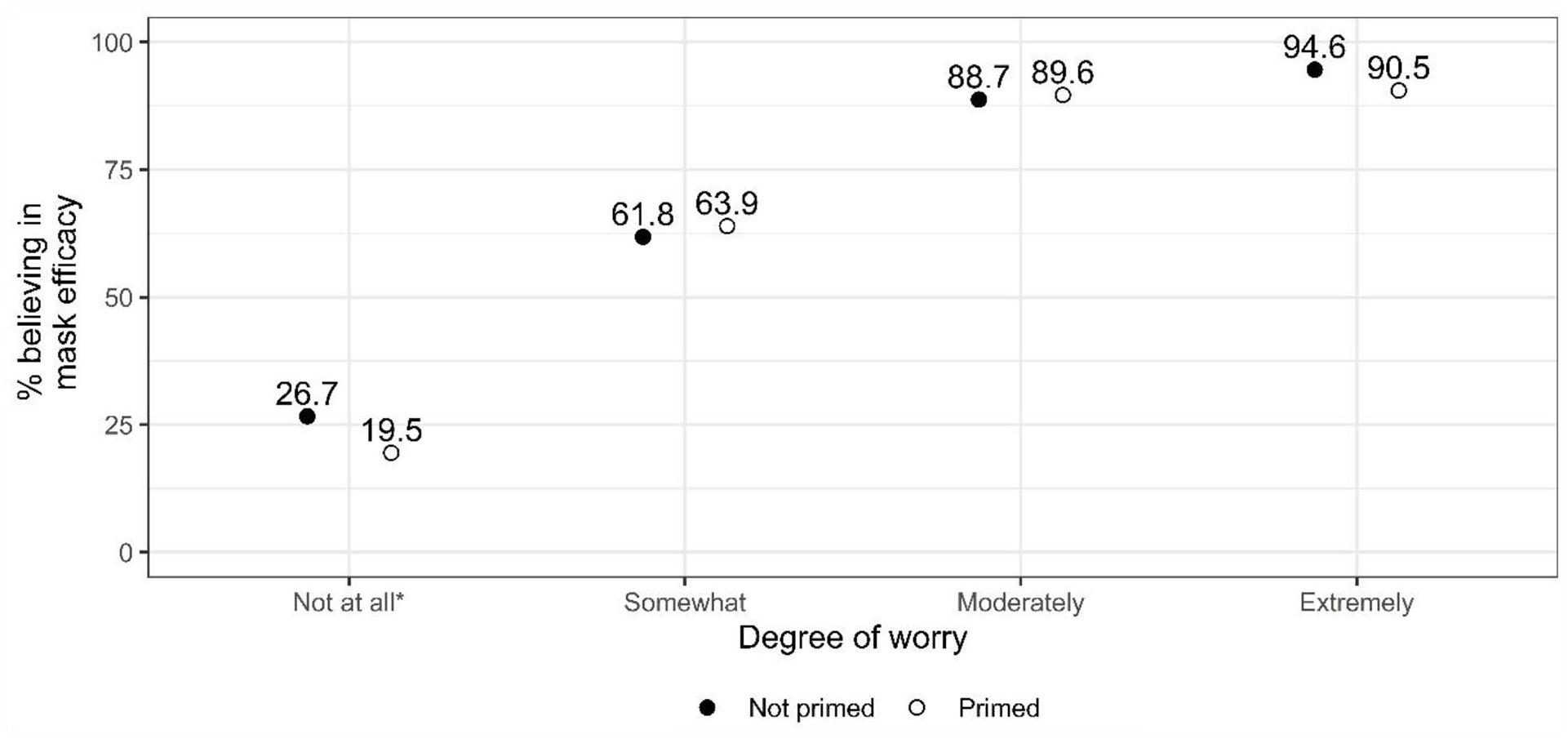
Percent reporting that masks can help stop the spread of the virus by priming status and degree of worry about getting infected (n = 1,993). Differences between primed and not primed respondents were not statistically significant except for *p < .05.
Discussion
The belief in mask efficacy as a preventative measure in stopping the spread of COVID-19 was strongly related to actual mask wearing behavior. Although a large majority of respondents in both the primed and nonprimed group reported wearing a mask in public (97%), differences were found based on how effective respondents perceived mask to be at stopping the spread of the virus.
Although we had hypothesized that the priming questions and greater worry would result in an increased sense of the efficacy of masks, that was not the case in our sample. However, the level of worry about getting infected had an interaction with priming status. Follow up analyses indicated that differences in mask efficacy and priming status were only present in the “not at all” worried group of respondents, who represent a high-risk population as these were the respondents who were most likely not to wear a mask at all.
Being reminded (or primed) about risks may be associated with beliefs about the need for protective behaviors (Weinstein, 1993). Put colloquially, we can envision instances where respondents may have thought, “I’m not worried about getting sick so masks really won’t help.” Respondents primed on the risks of COVID who were not worried about getting sick may be merely “doubling down” or reinforcing their view that masks do not work. For this particular group of non-worried individuals, the reminders of the risks of COVID may have an opposite effect.
Limitations
Several limitations should be considered when interpreting the results of this study. First, although we had conceptualized priming going in one direction, it is also possible that showing the mask questions first may have affected the perceived risks of COVID-19. For example, individuals who took precautions against getting sick may report lower perceived risks (Brewer et al., 2004). This, however, was not evident with our sample as there were no large differences in the level of worry in the primed and nonprimed groups. Second, although we had a large number of respondents, the survey was not designed to be nationally representative or weighted to be representative of a specific population. However, the goal of the study was to test specific hypotheses using a natural experiment involving the counterbalancing of questions. The balance on the covariates lends support to the successful randomization. Third, as the survey was meant to be nonintrusive, variables such as age and gender, which are factors related to mask wearing behaviors (Bruine de Bruin & Bennett, 2020) were not collected. For experiments though using random assignment, the lack of covariates does not change results but may slightly lower power to detect effects in specific subgroups (Murnane & Willett, 2011). Finally, the timing of the administration of the survey should be considered. At the time of survey administration, the COVID-19 vaccine was not yet available although mask wearing continues to be recommended even for fully vaccinated individuals, especially with the rise of the more contagious Delta variant of the virus (see https://www.cdc.gov/coronavirus/2019-ncov/variants/delta-variant.html).
Conclusion
If a lack of worry is associated with the belief in the inefficacy of masks, highlighting the risks of COVID-19 for a certain subpopulation (i.e., those not worried about getting infected) may be important. So much information, real or otherwise, has already been spread about the risks of the virus yet it is a challenge to reach certain subpopulations with messages that would lead to positive changes in their behavior. Perhaps, future focus groups with individuals who lack worry about contracting the virus could elicit ideas.
Another issue is that some individuals may believe that the virus is a hoax (Darling et al., 2020) or is not as bad even as the flu (evident in some of the comments of some survey respondents, which we did not analyze), despite the increasing death counts. Preventive measures are critical in dealing with the pandemic and even if a vaccine were developed (Bartsch et al., 2020) polling has shown that half to two thirds of Americans are unlikely to take the vaccine (Herships & Garcia, 2020). Considering that almost a third of respondents surveyed were not worried about getting sick, this may be a cause for concern as these respondents may not take the necessary precautions against getting sick or spreading the virus itself.
Public health media campaigns to change health behavior attitudes and behaviors can be effective; unfortunately, it is more challenging to alter health habits, like mask wearing, rather than isolated or episodic behaviors (e.g., vaccinations) (Wakefield et al., 2010). Study results indicated that priming respondents with health risk questions entrenched beliefs about mask ineffectiveness for those unworried about COVID consequences. Given that this group is at high risk for mask non-compliance, and thus, prime targets for public health campaigns, our findings suggest that media campaigns to promote mask wearing may have an iatrogenic effect if the campaign is paired with messages about health risk. Direct appeals or reference to ordinances related to mask wearing may be more influential for this subgroup of the population; such interventions would need to be evaluated to determine their impact. Consistent and targeted messages on the need to be vigilant about the risks of the virus is necessary though more persuasive messages are likely needed.
Footnotes
Declaration of Conflicting Interests
The author(s) declared no potential conflicts of interest with respect to the research, authorship, and/or publication of this article.
Funding
The author(s) disclosed receipt of the following financial support for the research, authorship, and/or publication of this article: The research here was supported in part by the Boone County Children’s Services Fund (BCCSF). Opinions expressed are those of the authors and do not represent the views of the BCCSF.
