




Abstract
This study examined how different patterns of social media use during the COVID-19 pandemic affected mental health. We surveyed 479 adults aged 18 to 70 using representative sampling methods. Our analysis identified three groups of social media users: Comprehensive Users (35.1%), who used social media extensively for problem-solving, emotional support, and distraction; Social-Recreational Users (40.9%), who primarily sought emotional support and entertainment; and Minimal Users (24.0%), who used social media very little for coping. Results showed significant differences in mental health across user types. Social-Recreational Users had the best mental health outcomes, while Comprehensive Users reported lower well-being despite extensive engagement, suggesting that excessive information-seeking may increase anxiety and stress. Higher COVID-19 stress levels were associated with increased social media use for coping. Additionally, age influenced the relationship between social media patterns and mental health, with younger adults benefiting more from social and recreational use. These findings highlight the importance of considering how people use social media when assessing its psychological effects during crises. Practical recommendations include encouraging selective and moderate social media use focused on emotional support and entertainment, particularly for younger people, and developing targeted mental health interventions and platform features to enhance well-being during global crises.
Plain language summary
This study looked at how different ways of using social media during the COVID-19 pandemic affected people’s mental health. We surveyed 479 adults between the ages of 18 and 70 using methods designed to ensure the sample was representative. Our goal was to understand how various patterns of social media use related to stress, anxiety, and overall well-being during this global crisis. We identified three clear groups of social media users: Comprehensive Users (35.1%)—These individuals used social media heavily for many purposes, including problem-solving, seeking emotional support, and distraction. Social-Recreational Users (40.9%)—This group primarily used social media to connect socially and for entertainment, relying on it less for information or problem-solving. Minimal Users (24.0%)—These participants used social media very little, engaging minimally for any coping-related purposes. When we examined mental health outcomes, we found important differences among these groups. Social-Recreational Users showed the best mental health outcomes, suggesting that using social media for enjoyment and emotional connection can be beneficial during stressful times. In contrast, Comprehensive Users reported lower well-being, even though they engaged with social media more frequently. This pattern indicates that heavy use—especially for information-seeking or problem-solving—may increase anxiety and stress rather than help manage it. We also found that stress related to COVID-19 was linked to higher social media use overall, meaning that as stress increased, people tended to use social media more to cope. However, this increased usage did not always improve mental health. Age also played a role: younger adults benefited more from social and recreational use of social media, while older adults were less likely to see these positive effects.
Introduction
The COVID-19 pandemic fundamentally reshaped how individuals engaged with social media platforms, driving unprecedented dependence on digital communication tools due to widespread quarantine and social distancing measures. Usage surged dramatically: Facebook reported over a 50% increase in messaging traffic in heavily affected regions (Taylor, 2020), its user base expanded by 9% to 1.9 billion by the end of 2020, and WhatsApp usage rose by 40% (Williamson, 2020). This surge in digital activity raised pressing questions about social media’s impact on psychological well-being during crises. While prior research has extensively explored these psychological effects—highlighting both benefits and risks—most studies adopt variable-centered approaches. Such methods assess average effects across populations but overlook how individuals differ in their coping-related social media use. Consequently, they fail to capture the heterogeneity of digital coping behaviors. This creates three major limitations: first, assuming uniformity in usage obscures the diverse combinations of coping strategies people adopt; second, these approaches cannot uncover distinct subgroups whose mental health outcomes may diverge significantly despite similar usage levels; and third, they provide little guidance for targeted interventions, as they do not specify which behaviors are most adaptive or detrimental. To address these gaps, person-centered approaches such as latent class analysis (LCA) offer a compelling alternative. Unlike variable-centered methods, LCA identifies naturally occurring subgroups based on behavioral patterns (Chen & Yeung, 2024), revealing how individuals integrate strategies such as problem-focused information seeking, socioemotional support, and mental disengagement. This perspective allows researchers to examine whether broad engagement across multiple coping domains fosters better adjustment than selective use, and which strategy combinations are most effective—insights inaccessible through traditional frameworks. These considerations are especially important given ongoing debates in the literature. For example, while some studies suggest that social media–based information seeking fosters preparedness and reduces anxiety (Saud et al., 2020), others warn that “doomscrolling” exacerbates stress (Price et al., 2022). Similarly, positive outcomes are linked to selective, intentional use for social connection (Lisitsa et al., 2020), whereas negative effects are tied to heavy, unregulated engagement (Gao et al., 2020). Age further complicates this picture: younger adults often benefit more from online social support (Lee et al., 2022), while older adults may be more vulnerable to the stress of excessive information exposure (Ahmad & Murad, 2020). Building on these unresolved tensions, this study employs latent class analysis to identify distinct social media coping profiles during the pandemic and examine their association with psychological adjustment. It contributes in three ways: first, it advances theory by uncovering behavioral profiles masked in population-level analyses; second, it clarifies how combinations of problem-focused, emotional, and avoidant coping strategies relate to mental health outcomes, thereby addressing contradictory findings; and third, it offers practical insights into which user profiles are linked to better adaptation and how these patterns differ by demographic factors such as age.
Psychological adjustment—the ability to maintain emotional equilibrium and functional stability amid stress (Yuan et al., 2023)—was especially critical during the pandemic’s uncertainty and disruption (Castaldo et al., 2020). In this context, social media played a dual role: enabling support, information exchange, and emotional regulation while simultaneously posing risks of information overload, harmful comparisons, and compulsive use. Therefore, moving beyond simplistic “good or bad” assessments of social media is essential. By adopting a person-centered perspective, this study provides a more nuanced understanding of how distinct digital coping patterns shape psychological adjustment in times of collective crisis.
Literature Review
Positive Psychological Effects of Social Media Use: Critical Analysis of Evidence and Limitations
Research on the positive psychological effects of social media during the pandemic provides valuable insights but is constrained by key methodological limitations. For instance, Lisitsa et al. (2020) found reduced loneliness and improved adjustment among young adults using social media for support, yet its cross-sectional design and reliance on self-reports preclude causal inference and raise concerns about inflated associations. Similarly, Saud et al. (2020) reported that information-seeking and emotional support via social media enhanced well-being, but this contrasts with studies linking information overload to distress, suggesting potential selection effects and recall bias. Cross-cultural studies by Khodabakhsh (2020) and Lee et al. (2022) also reported mental health benefits but overlooked cultural variations in platform preferences and crisis responses, limiting precision. Moreover, across this literature, social media use is often treated as homogeneous, without differentiating between active communication, community participation, or passive consumption, obscuring which behaviors truly drive positive outcomes. Together, these limitations highlight the need for more rigorous, nuanced, and culturally sensitive approaches to understanding digital coping.
Negative Psychological Effects of Social Media Use: Methodological Limitations and Theoretical Gaps
Research on the negative psychological effects of social media during COVID-19 offers compelling evidence of potential harms but is limited by theoretical and methodological shortcomings that obscure causal mechanisms and individual differences. Ahmad and Murad (2020) showed that frequent exposure to COVID-19 posts heightened panic and susceptibility to misinformation, yet their cross-sectional design cannot clarify whether panic drives excessive information-seeking or results from it, particularly given that anxious individuals may engage in maladaptive compulsive use. Similarly, Gao et al. (2020) found higher rates of anxiety (22.6%) and depression (48.3%) linked to social media exposure but failed to account for pre-existing mental health conditions, socioeconomic stressors, or specific usage patterns, limiting interpretability. Research on social comparison and fear of missing out (Alt, 2015; Przybylski et al., 2013) underscores how exposure can intensify inadequacy and disconnection but largely ignores how active engagement or supportive communities may offset these effects, as well as algorithmic curation that systematically amplifies comparison-inducing content. Moreover, studies on “doomscrolling” (Price et al., 2022) highlight compulsive negative news consumption but overlook why certain users develop such patterns while others maintain healthier boundaries, underscoring the need for frameworks that integrate individual vulnerabilities with platform-driven influences.
Person-Centered Approaches to Social Media Research: Advances and Limitations
The emergence of person-centered analytical approaches in social media research represents an important methodological advancement that addresses limitations inherent in variable-centered designs. However, existing applications of these methods reveal significant gaps that the present study addresses through novel theoretical and methodological contributions.
Critical Analysis of Existing Latent Class Applications
Winstone et al. (2022) conducted a rigorous person-centered analysis of social media use among UK adolescents during the pandemic, identifying four user types—High Communicators, Moderate Communicators, Broadcasters, and Minimal Users—and found that Broadcasters exhibited the poorest mental health outcomes over time. While its longitudinal design offers valuable insights into the stability of these classifications, several limitations restrict broader applicability and theoretical advancement. The exclusive focus on 13- to 14-year-olds limits generalization to adults, whose coping needs and social stressors differ substantially from adolescents driven by identity development and peer relationships. Additionally, the study assessed communication frequency and content sharing but did not examine coping motivations or stress regulation goals underlying these behaviors, thereby revealing what users do without clarifying why they do it. Finally, its reliance on social validation and attention-seeking frameworks, without integrating established stress and coping theories, constrains understanding of which user profiles might be more adaptive under varying crisis conditions, underscoring the need for theory-driven research linking behavioral patterns to psychological adjustment.
Methodological Gaps in Existing Research
Guelmami et al. (2022) applied latent class analysis to identify well-being profiles among Tunisian Facebook users, demonstrating the cross-cultural applicability of person-centered approaches (McCabe et al., 2024; Pi et al., 2024). However, their analysis focused on general well-being indicators rather than specific coping behaviors or crisis-related outcomes, limiting relevance for understanding optimal social media use during acute stressor periods.
The study's platform-specific focus on Facebook users also constrains generalizability to contemporary social media environments where individuals typically engage across multiple platforms with different affordances and content ecosystems (Primack et al., 2017). Modern social media coping likely involves complex cross-platform behaviors that single-platform analyses cannot adequately capture.
Theoretical and Empirical Contributions of the Present Study
The present research advances person-centered social media research through several critical innovations that address limitations in existing literature (Keum et al., 2023). First, this study integrates established stress and coping theory with person-centered methodology to identify user types based on theoretically meaningful coping strategy combinations rather than purely behavioral indicators. This approach enables examination of why different user patterns prove more or less adaptive during crisis conditions. Second, the research focuses specifically on adult populations during active crisis conditions, addressing the significant gap in understanding how working-age adults use social media for stress management when facing unprecedented disruptions to employment, family responsibilities, and social support systems (McKeighen et al., 2023). Third, the study examines coping strategy combinations across multiple theoretical domains (problem-focused, socioemotional, mental disengagement) rather than focusing on single behavioral categories, enabling identification of user types that employ complex, multidimensional coping approaches through digital platforms. Fourth, the research incorporates demographic moderation analyses to examine how age influences the effectiveness of different social media coping patterns, addressing critical questions about developmental differences in digital coping optimization that remain unresolved in existing literature (Thai et al., 2024).
Justification for Adult Age Range Focus and Demographic Considerations
The decision to focus on adults aged 18 to 70 years stems from theoretical and practical considerations that distinguish adult social media coping from adolescent digital behavior patterns examined in previous research. Adults face qualitatively different stressors during crisis periods, including employment disruption, caregiving responsibilities, financial insecurity, and health vulnerabilities that create distinct coping requirements compared to adolescent developmental challenges (Hu et al., 2024).
Developmental Differences in Crisis Stressor Exposure
Adults experience pandemic-related stressors that fundamentally differ from adolescent concerns examined in previous research. Working-age adults faced unprecedented disruptions to career trajectories, income stability, and professional identity that required active problem-solving and information-seeking behaviors to navigate economic uncertainty and workplace modifications (Houston et al., 2015). Parents experienced additional stress from managing children's educational disruption, emotional needs, and safety concerns while potentially lacking traditional family and community support systems.
Older adults within the study age range faced heightened health vulnerability that created unique information needs regarding medical risk assessment, healthcare access, and safety decision-making. These stressors require different coping approaches than the social identity and peer relationship concerns that typically drive adolescent social media use, justifying separate examination of adult coping patterns.
Theoretical Framework for Age-Differentiated Analysis
Socioemotional selectivity theory suggests that older adults prioritize emotionally meaningful experiences and relationships over information acquisition or social network expansion. This developmental shift may influence how different age groups within the adult range utilize social media for coping purposes, with younger adults potentially benefiting more from information-seeking and social connection, while older adults may prefer selective engagement focused on maintaining close relationships (Oh et al., 2014).
The study’s age range of 18 to 70 years captures key developmental transitions in technology adoption, social network characteristics, and coping resource availability that may moderate the effectiveness of different social media use patterns. This age span enables examination of how digital nativity, life experience, and available offline resources influence optimal social media coping strategies during crisis periods.
Hypothesis Development and Theoretical Framework
Operational Definition of Psychological Adjustment
Before developing hypotheses about psychological adjustment outcomes, we establish a clear operational definition of this construct. Psychological adjustment refers to an individual’s ability to maintain emotional equilibrium, functional capacity, and adaptive coping responses when confronting significant stressors or life changes (Cruz et al., 2020). This construct encompasses both the absence of psychological distress symptoms and the presence of positive adaptation indicators such as emotional regulation, behavioral flexibility, and maintenance of daily functioning.
Psychological adjustment differs from related constructs such as life satisfaction or subjective well-being by specifically focusing on adaptive responses to stressor exposure rather than general happiness or contentment (Wei, 2022). In the context of the COVID-19 pandemic, psychological adjustment captures individuals’ capacity to maintain emotional stability and functional effectiveness despite unprecedented disruptions to normal life patterns, social relationships, and economic security.
This study operationalizes psychological adjustment through the Brief Adjustment Scale-6, which assesses participants’ self-reported ability to manage emotions, maintain daily routines, and cope effectively with stressful circumstances during the pandemic period. Higher scores indicate better psychological adjustment, reflecting greater adaptive capacity during crisis conditions.
Critical Analysis of Coping Strategy-User Type Relationships
The relationship between specific coping strategies and social media user types requires careful theoretical consideration that extends beyond simple correspondence assumptions. While stress and coping theory suggests that problem-focused strategies should characterize information-seeking users, empirical evidence presents more complex patterns that challenge straightforward predictions (Vinney, 2024).
Problem-Focused Coping and User Classification Complexities
Traditional coping theory posits that individuals using problem-focused strategies should experience better adjustment by fostering a sense of control and actively resolving stressors (Lazarus & Folkman, 1984). However, digital environments complicate this relationship, as social media information seeking during crises often exposes users to unverified, contradictory, and distressing content that can hinder rather than support effective problem-solving (Levitin, 2014; Laato et al., 2020; Huff, 2022; Leskin, 2020; Salamon, 2024). Recent pandemic research challenges traditional predictions, showing that extensive information seeking via social media is associated with heightened anxiety and poorer adjustment (Gao et al., 2020; Ngien & Jiang, 2022; Zulfiqarova & Dresp-Langley, 2024). This discrepancy likely reflects the difference between effective problem-focused coping—characterized by targeted information gathering and actionable planning—and ineffective information consumption marked by compulsive exposure to overwhelming crisis-related content (Tavolacci et al., 2015; Kuss & Griffiths, 2017; Hernández et al., 2020). Despite these complexities, we hypothesize that individuals with a strong problem-focused coping orientation will be more likely to belong to the Comprehensive Users class, as their motivation to understand and manage stress drives them toward information-rich platforms, even if such engagement ultimately proves counterproductive.
Socioemotional Coping and Platform Affordance Alignment
Socioemotional coping strategies involve seeking emotional support, sharing feelings, and engaging in social connection to manage stress responses (Kim & Hastak, 2018; Seifert, 2024). Social media platforms provide specific affordances for these behaviors through features enabling interpersonal communication, emotional expression, and community participation. However, the effectiveness of digital socioemotional coping depends critically on the quality of available social networks and the degree to which platforms facilitate genuine interpersonal connection versus superficial social comparison.
Research by Valkenburg and Peter (2009) demonstrates that social media can enhance psychological well-being through meaningful social interaction, while other studies indicate that passive consumption of others’ content may increase feelings of social inadequacy (Burke et al., 2010). This suggests that socioemotional coping through social media may prove beneficial only when combined with active social engagement rather than passive content consumption.
The prediction that socioemotional coping predicts membership in the Socio-Recreational Users class assumes that individuals seeking emotional support will preferentially engage in social and entertainment-focused activities while avoiding excessive information consumption that could exacerbate emotional distress.
Mental Disengagement and Avoidance Strategy Limitations
Mental disengagement involves deliberately avoiding stressor-related thoughts and activities through distraction and alternative focus (Waugh et al., 2021). While avoidance strategies provide short-term emotional relief, coping theory suggests they may prove maladaptive for addressing ongoing stressors that require active management. However, during uncontrollable crisis situations such as pandemic conditions, temporary disengagement may serve adaptive functions by preventing emotional overwhelm and maintaining psychological resources (Scott et al., 2019).
The relationship between mental disengagement and minimal social media use presents theoretical complexity because social media platforms often serve as primary sources of both distraction and stress-inducing information. Individuals employing mental disengagement strategies might either avoid social media entirely to prevent exposure to distressing content or use platforms selectively for entertainment purposes while avoiding news and information content.
Stress-Driven Social Media Use: Beyond Simple Activation Models
The relationship between perceived stress and social media coping strategy adoption extends beyond simple stress-activation models that assume higher stress automatically increases coping behavior engagement. Research during the COVID-19 pandemic reveals complex patterns where stress may simultaneously motivate coping behavior while compromising the cognitive resources necessary for effective strategy selection and implementation (Zhao & Zhou, 2020).
Empirical evidence supports the general principle that crisis-related stress increases social media engagement (Wolfers et al., 2024), but this relationship may be moderated by individual differences in stress tolerance, digital literacy, and available offline coping resources. Some individuals may respond to stress by increasing social media use across multiple domains, while others may selectively increase specific types of engagement based on their coping preferences (Dhir et al., 2018) and past experience with digital platforms.
User Type Differences in Psychological Adjustment: Moving Beyond Tautological Predictions
The prediction that different social media user types will demonstrate varying levels of psychological adjustment requires theoretical justification that extends beyond the tautological assumption that adaptive behaviors produce better outcomes. The complexity lies in determining which patterns of social media engagement prove most adaptive during crisis conditions, given contradictory evidence about the psychological effects of different platform uses.
Comprehensive Users might theoretically demonstrate superior adjustment due to their diverse coping repertoire and active engagement with multiple stress management strategies. Alternatively, they might show poorer adjustment due to information overload, cognitive strain from managing multiple platform activities simultaneously, or exposure to excessive crisis-related content across different engagement domains.
Socio-Recreational Users might benefit from their selective focus on social connection and positive emotional experiences while avoiding potentially distressing information consumption. However, they might also demonstrate poorer adjustment if their limited information seeking leaves them feeling unprepared or out of control during crisis conditions.
Minimal Users might show better adjustment due to reduced exposure to social comparison, misinformation, and algorithmic content designed to maximize engagement rather than support well-being. Conversely, they might demonstrate poorer adjustment due to reduced access to social support, information resources, and community connection during periods when traditional offline support systems were disrupted.
Direct Stress Effects on Psychological Adjustment
While the relationship between stress exposure and psychological adjustment appears self-evident, the specific mechanisms through which COVID-19 stress impacts adjustment during pandemic conditions require empirical verification. The unprecedented nature of pandemic stressors, including their duration, unpredictability, and global scope, may create adjustment challenges that differ qualitatively from responses to more typical life stressors.
Age Moderation: Theoretical Foundations and Developmental Considerations
The prediction that age moderates relationships between social media user types and psychological adjustment stems from multiple theoretical frameworks addressing developmental differences in technology use, social support systems, and coping resource availability across the lifespan.
Digital Nativity and Platform Competency Effects
Younger adults demonstrate greater familiarity with social media platforms and more sophisticated strategies for navigating digital environments (Maheux et al., 2024). This digital nativity may enable younger users to more effectively curate their social media experiences, avoiding harmful content while maximizing beneficial social connections and emotional support. Older adults may lack the technical skills or platform knowledge necessary to optimize their digital coping experiences, making them more vulnerable to negative platform effects.
Developmental Differences in Social Support Systems
Age-related differences in social network characteristics may influence the effectiveness of social media-based coping strategies. Younger adults often maintain larger, more diverse social networks that translate effectively to digital platforms, while older adults may rely more heavily on smaller, more intimate social circles that may not provide adequate representation in digital spaces (Dong et al., 2024). This suggests that social media coping strategies may prove more effective for younger adults who can access robust online social support systems.
Life Stage Coping Resource Availability
Older adults typically possess more diverse offline coping resources, including established social relationships, financial stability, and life experience managing difficult situations (Sun et al., 2023). These alternative coping resources may reduce their reliance on social media for psychological support, making digital coping patterns less predictive of their overall adjustment outcomes. Younger adults, particularly those in early career stages or educational transitions, may depend more heavily on social media for emotional support and information access, making their digital coping patterns more strongly related to psychological adjustment.
Stress Response and Information Processing Differences
Age-related changes in stress reactivity and information processing capacity may influence how different social media use patterns affect psychological adjustment. Older adults may be more susceptible to information overload and anxiety-provoking content, making comprehensive social media engagement particularly detrimental to their adjustment outcomes. Younger adults may possess greater cognitive flexibility for managing multiple information streams simultaneously, enabling them to benefit from diverse social media engagement without experiencing the same negative effects.
Methodology
Research Model
This research model in Figure 1, examines the relationship between social media coping strategies, perceived COVID-19 stress, and psychological adjustment. The model evaluates how social media coping strategies affect three different user groups: Comprehensive Users, Socio-Recreational Users, and Minimal Users (H1a, H1b, H1c). Perceived COVID-19 stress is considered a factor that increases individuals’ likelihood of using social media coping strategies (H2). It is hypothesized that different types of social media users exhibit significant differences in psychological adjustment levels (H3). Additionally, perceived COVID-19 stress is proposed to have a negative impact on psychological adjustment (H4). Finally, the age variable is thought to moderate the relationship between social media user types and psychological adjustment (H5). This model provides a crucial framework for understanding how individuals used social media during the COVID-19 period, the psychological effects of this usage, and how different user groups adopted coping strategies for stress.

Research model.
Research Design and Analytical Rationale
This study employs a cross-sectional design using latent class analysis (LCA) to identify distinct social media coping strategies and patterns during the COVID-19 pandemic and their relationship with psychological adjustment. LCA represents a person-centered analytical approach that identifies unobserved subgroups within a population based on response patterns across multiple indicators (Vermunt & Magidson, 2002).
Justification for Latent Class Analysis
The choice of latent class analysis (LCA) over alternative methods reflects both methodological and theoretical considerations aligned with this study’s objectives. Unlike variable-centered approaches such as regression or structural equation modeling, which assume uniform relationships across populations, LCA identifies naturally occurring subgroups of users employing distinct coping strategy combinations. It offers key advantages: its model-based classification provides statistical criteria for determining class number and assessing uncertainty, producing more reliable and interpretable groupings than distance-based clustering methods like k-means. LCA also handles categorical and ordinal indicators, such as Likert-scale items, more appropriately and generates conditional probability estimates that clarify the likelihood of specific behaviors within each class. Compared to latent profile analysis, which assumes continuous indicators, LCA better captures social media coping as categorical response patterns, while its focus on behavioral patterns rather than latent trait distributions distinguishes it from mixture modeling. Importantly, its person-centered orientation aligns with coping theories emphasizing coherent behavioral profiles over isolated actions, enabling identification of user types whose engagement patterns differentially relate to psychological outcomes—insights unattainable through variable-centered analyses.
Participants and Sampling Procedure
Sampling Framework and Recruitment
Data were collected from 479 adults aged 18 to 70 residing in urban areas who experienced social restrictions during the COVID-19 pandemic. The sampling strategy employed stratified random sampling to ensure adequate representation across multiple demographic dimensions. The stratification framework incorporated three primary variables: age group (18–30, 31–59, 60–70 years), gender (male, female, non-binary), and geographic regions (Northeast, Southeast, Midwest, Southwest, West Coast) based on major metropolitan areas within each region.
Participants were recruited through multiple channels to enhance representativeness and reduce selection bias. Primary recruitment occurred through online research panels maintained by Qualtrics, supplemented by social media advertising targeted to specific demographic groups to ensure adequate representation of underrepresented populations. Additional recruitment utilized community partnerships with organizations serving diverse populations, including cultural centers, community colleges, and local health organizations.
Demographic Representativeness and Minority Group Inclusion
The final sample achieved reasonable demographic diversity across several key characteristics. Gender distribution included 52.4% female participants, 45.8% male participants, and 1.8% non-binary or other gender identities. Age distribution reflected the stratified sampling approach with 34.2% young adults (18–30 years), 43.0% middle-aged adults (31–59 years), and 22.8% older adults (60–70 years).
Racial and ethnic composition included 68.1% White participants, 14.2% Hispanic or Latino participants, 12.3% Black or African American participants, 3.8% Asian participants, 1.0% Native American participants, and 0.6% participants identifying as other races or multiple racial categories. Educational attainment varied across the sample, with 15.2% holding high school education or less, 28.4% having some college education, 31.7% holding bachelor's degrees, and 24.7% possessing graduate or professional degrees.
While the sample achieved reasonable diversity, several limitations regarding representativeness should be acknowledged. The sample slightly overrepresented college-educated individuals compared to national demographics, reflecting the online recruitment methodology and digital literacy requirements for participation. Geographic representation favored urban areas as specified in the inclusion criteria, potentially limiting generalizability to rural populations. Additionally, the requirement for regular social media access may have systematically excluded individuals with limited technology access or digital literacy skills.
Power Analysis and Sample Size Justification
The final sample of 479 participants was determined through power analysis tailored to latent class analysis (LCA). Monte Carlo simulations by Nylund et al. (2007) indicate that LCA requires larger samples than traditional methods due to the complexity of estimating class membership probabilities and within-class item response patterns, with 300 to 500 participants sufficient to detect 3–5 latent classes under moderate to strong separation. For this study, power calculations based on pilot data and prior research using the Inventory of Online Coping suggested that 450 to 500 participants would provide 80% power to detect 3–4 classes with medium effect sizes (Cohen’s w = 0.30) at α = .05. The achieved sample of 479 met these requirements while allowing for exclusions due to incomplete responses. This size also supports stable estimation of class parameters and meets recommended minimums of 25 to 50 cases per class, ensuring adequate representation for meaningful interpretation and subsequent multinomial logistic regression analyses predicting class membership.
Inclusion and Exclusion Criteria
Inclusion criteria required participants to meet several conditions ensuring relevance to the research questions. Participants needed to be at least 18 years of age to provide informed consent and possess cognitive capacity for survey completion. Regular access to social media platforms was defined as using at least one major platform (Facebook, Twitter, Instagram, TikTok, LinkedIn, or similar) at least weekly during the pandemic period. Experience with social restrictions required participants to have lived in areas with mandatory or recommended lockdown measures, quarantine requirements, or social distancing mandates during any phase of the COVID-19 pandemic.
Exclusion criteria eliminated participants whose responses might compromise data quality or study validity. Incomplete survey responses were excluded if participants completed fewer than 80% of key measures, while responses showing obvious response patterns (such as selecting the same response option for all items) were excluded after manual review. Participants who reported no social media use during the pandemic period were excluded as they could not provide meaningful responses about social media coping strategies.
Data Collection
An online survey was administered through Qualtrics between November 2023 and January 2024. Participants were provided with information about the study's purpose and assured of confidentiality before providing informed consent. The survey took approximately 20 to 25 min to complete. Participants received modest monetary compensation for their participation.
Measures
Social Media Coping Strategies
Social media coping strategies were assessed using a modified version of the Inventory of Online Coping (van Ingen et al., 2016). The 14-item instrument measured three distinct coping strategies:
✓
✓
✓
Participants rated each item on a 5-point Likert scale ranging from 1 (does not apply to me at all) to 5 (applies to me very much).
Psychological Adjustment
Psychological adjustment was measured using the Brief Adjustment Scale-6 (Cruz et al., 2020). This 6-item scale (α = .93) assesses participants’ ability to maintain psychological well-being during stressful circumstances. Items were scored on a 5-point scale from 1 (not at all) to 5 (extremely), with higher scores indicating better psychological adjustment after reverse-coding appropriate items.
Perceived COVID-19 Stress
Perceived stress related to COVID-19 was assessed using an 8-item checklist adapted from previous pandemic research (Main et al., 2011; Li et al., 2020). Participants indicated whether they had experienced specific stressors (e.g., “confirmed or suspected infection,”“significant reduction in family income”) by selecting either “yes” (1) or “no” (0). The total score ranged from 0 to 8, with higher scores indicating greater perceived stress.
Demographic Variables
Demographic information collected included age, gender, education level, geographic location, and daily social media use duration. Age was categorized into three groups for analysis: young adults (18–30 years), middle-aged adults (31–59 years), and older adults (60–70 years).
Digital Addiction Assessment Limitation
This study did not include validated measures to assess digital addiction, social media addiction, or problematic internet use patterns among participants. While demographic information regarding daily social media use duration was collected, standardized instruments for detecting addictive or problematic social media use behaviors, such as the Bergen Social Media Addiction Scale (Andreassen et al., 2012) or the Problematic Internet Use Questionnaire (Demetrovics et al., 2008), were not administered. This methodological limitation must be acknowledged when interpreting psychological adjustment differences across latent user classes, particularly regarding the Comprehensive Users group who demonstrated extensive engagement across all measured coping strategies. Our 8-item checklist measured stressor exposure (confirmed or suspected infection, income reduction, social isolation) rather than the multidimensional symptom profile that characterizes stress responses. This methodological approach does not permit differentiation between individuals who may experience predominantly psychological versus somatic stress manifestations, nor does it capture the intensity or duration of stress symptoms across these dimensions. This limitation must be considered when interpreting the relationships between perceived COVID-19 stress, social media coping strategies, and psychological adjustment outcomes.
Analytical Strategy
Data Preprocessing
Prior to analysis, data were screened for missing values, outliers, and violations of statistical assumptions. Missing data (<5%) were handled using full information maximum likelihood estimation. All analyses were conducted using R (version 4.2.0) with the `poLCA' package for latent class analysis and `lavaan' for structural equation modeling.
Latent Class Analysis
A series of latent class models were estimated with an increasing number of classes (1–6). The following statistical criteria were used to determine the optimal number of classes:
✓ Information criteria: Bayesian Information Criterion (BIC), Akaike Information Criterion (AIC), and sample-size adjusted BIC (SABIC)
✓ Statistical significance: Lo-Mendell-Rubin likelihood ratio test (LMR-LRT) and Bootstrap Likelihood Ratio Test (BLRT)
✓ Classification quality: Entropy values (>0.80 indicating good classification)
✓ Theoretical interpretability and class sizes (avoiding classes with <5% of the sample)
Indicators for the LCA included the 14 items from the Inventory of Online Coping. Item responses were treated as ordinal variables.
The LCA modeling approach followed established best practices for person-centered analysis. Model estimation employed full information maximum likelihood with robust standard errors to handle missing data and non-normality. Multiple random starts were utilized for each model to ensure identification of global rather than local maxima, with 500 random start values and 50 optimizations retained for final model selection. Convergence criteria required log-likelihood improvement of less than 1e-6 across iterations, ensuring stable parameter estimates across all estimated models.
Analysis of Class Differences
After identifying the optimal latent class solution, differences between classes were examined using:
✓ ANOVA or Kruskal-Wallis tests (for continuous variables) to compare psychological adjustment scores across latent classes
✓ Chi-square tests (for categorical variables) to examine demographic differences between classes
✓ Multinomial logistic regression to identify predictors of class membership, with perceived COVID-19 stress and demographic variables as predictors
Moderation Analysis
To examine the potential moderating effect of age on the relationship between class membership and psychological adjustment, moderation analyses were conducted using a structural equation modeling framework. Interaction terms were created between age group (categorical) and class membership (using most likely class assignment).
Results
Latent Class Analysis
Model Selection
We estimated a series of latent class models with 1-6 classes using the 14 items from the Inventory of Online Coping. Table 1 presents the fit indices for each model.
Fit Indices for Latent Class Models (1–6 Classes).

Based on the statistical criteria, the 3-class solution was selected as optimal. The 3-class model showed significant improvement over the 2-class model (LMR-LRT p < .01), while the 4-class model did not show significant improvement over the 3-class model (LMR-LRT p = .07). The 3-class model had good classification quality (entropy = 0.86) and exhibited interpretable class patterns.
Model Fit Indices for Latent Class Models (1–6 Classes)
The Figure 2. illustrates the AIC, BIC, and SABIC values across different latent class models (1–6 classes), providing insight into model fit. As the number of classes increases, AIC, BIC, and SABIC values generally decrease, indicating an improved model fit. However, BIC reaches its lowest point at 3–4 classes, suggesting that these models offer the best balance between fit and complexity. Additionally, LMR-LRT p-values indicate that a 3-class solution is statistically significant, whereas adding more classes results in diminishing returns, making 3–4 classes the most optimal solution.

Model fit indices for latent class models (1–6 classes).
Latent Class Profiles
The three identified classes represented distinct patterns of social media coping strategies. Figure 3. displays the mean scores for each coping strategy across the three classes. The classes were labeled based on their distinctive patterns:
✓
✓
✓

Mean scores of social media coping strategies by latent class.
Table 2 presents the conditional probabilities of endorsing high levels (i.e., responses of 4 or 5 on the 5-point scale) of each coping strategy item by latent class.
Conditional Probabilities of High Endorsement for Each Coping Strategy Item by Latent Class.

Predictors of Class Membership
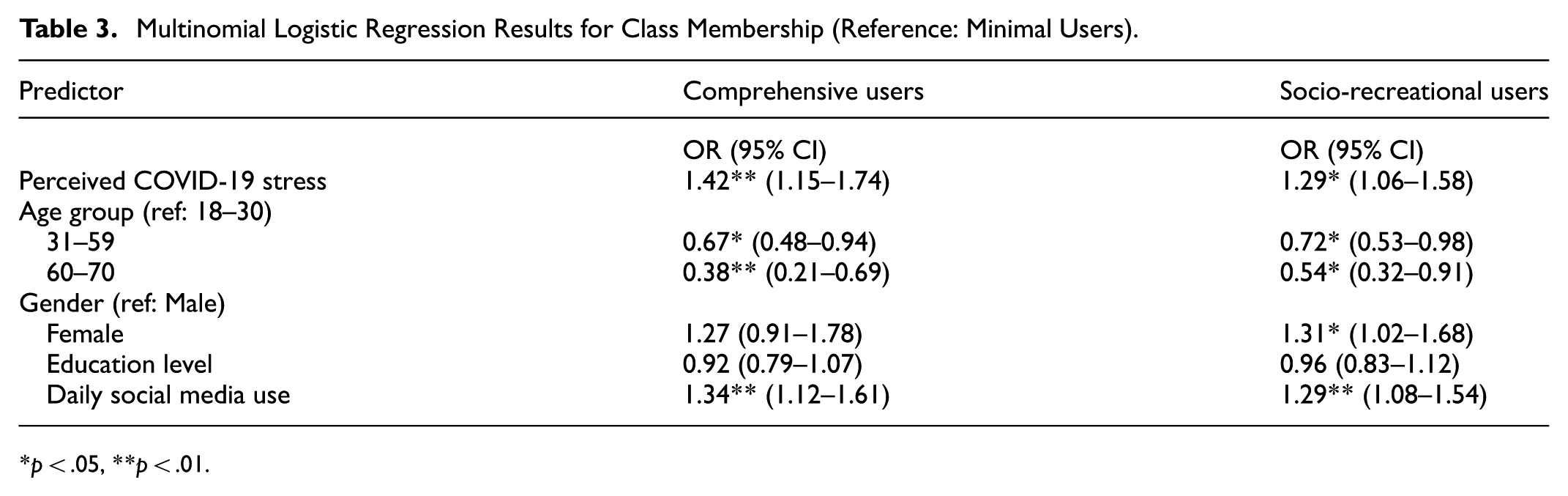
Multinomial logistic regression was conducted to examine how perceived COVID-19 stress and demographic variables predicted class membership. Table 3 presents the results, with the Minimal Users class as the reference category.
Multinomial Logistic Regression Results for Class Membership (Reference: Minimal Users).
p < .05, **p < .01.
Perceived COVID-19 stress was significantly associated with higher odds of belonging to both the Comprehensive Users (OR = 1.42, p < .01) and Socio-Recreational Users (OR = 1.29, p < .05) classes compared to the Minimal Users class. This indicates that individuals experiencing higher levels of pandemic-related stress were more likely to utilize social media for coping.
Age was a significant predictor of class membership, with older adults (60–70) having lower odds of being Comprehensive Users (OR = 0.38, p < .01) or Socio-Recreational Users (OR = 0.54, p < .05) compared to young adults (18–30). Daily social media use duration was positively associated with membership in both the Comprehensive Users (OR = 1.34, p < .01) and Socio-Recreational Users (OR = 1.29, p < .01) classes.
The significant association between perceived COVID-19 stress and social media coping strategy adoption (H2 supported) must be interpreted within the constraints of our stress measurement approach. The binary checklist methodology assessed stressor exposure but did not differentiate between psychological and somatic dimensions of stress responses, limiting conclusions about specific symptom-coping strategy relationships. Future research employing multidimensional stress assessment instruments would provide more nuanced understanding of how different aspects of stress experience influence social media coping behavior selection.
Class Differences in Psychological Adjustment
One-way ANOVA was conducted to examine differences in psychological adjustment across the three latent classes. Table 4 presents the mean psychological adjustment scores for each class.
Mean Psychological Adjustment Scores by Latent Class.

The ANOVA results indicated significant differences in psychological adjustment across the three classes (F(2, 476) = 16.83, p < .001, η2 = 0.14). Post-hoc comparisons using Tukey's HSD test revealed that Socio-Recreational Users reported significantly higher psychological adjustment scores than both Comprehensive Users (mean difference = 0.53, p < .001) and Minimal Users (mean difference = 0.41, p < .001). There was no significant difference between Comprehensive Users and Minimal Users (mean difference = 0.12, p = .28).
Moderation Analysis: Age as a Moderator
To examine whether age moderated the relationship between class membership and psychological adjustment, a multigroup analysis was conducted. Table 5 presents the mean psychological adjustment scores by latent class and age group.
Mean Psychological Adjustment Scores by Latent Class and Age Group.

A significant interaction effect was found between class membership and age group (F(4, 470) = 3.86, p < .01, η2 = 0.03). The positive association between Socio-Recreational Users class membership and psychological adjustment was strongest among young adults (18–30 years) and progressively weaker in older age groups. This suggests that using social media primarily for socioemotional coping and mental disengagement was most beneficial for younger individuals.
A regression analysis with interaction terms further confirmed this moderation effect. The interaction term for Socio-Recreational Users class × Age Group was significant (β = −.12, p < .05), while the interaction term for Comprehensive Users class × Age Group was not significant (β = .07, p = .18).
Three distinct classes of social media coping were identified: Comprehensive Users (35.1%), Socio-Recreational Users (40.9%), and Minimal Users (24.0%). Higher perceived COVID-19 stress was associated with increased likelihood of using social media for coping (both comprehensive and socio-recreational patterns). Socio-Recreational Users demonstrated significantly higher psychological adjustment compared to both Comprehensive Users and Minimal Users. Age moderated the relationship between class membership and psychological adjustment, with younger adults benefiting more from socio-recreational social media use than older adults. These findings suggest that using social media primarily for socioemotional support and mental disengagement, rather than problem-focused coping, may be more beneficial for psychological adjustment during stressful periods, particularly for younger individuals.
Visual Representation of Age Moderation Effects
To clarify the nature of the interaction between social media user class and age group on psychological adjustment, Figure 4 presents the interaction pattern graphically. This plot illustrates how the relationship between class membership and psychological adjustment varies across the three age groups.

Age Moderation of the Relationship Between Social Media User Class and Psychological Adjustment.
The interaction plot reveals several important patterns that clarify the moderation effects. Among young adults aged 18 to 30 years, Socio-Recreational Users demonstrate substantially higher psychological adjustment (M = 3.78) compared to both Comprehensive Users (M = 3.05) and Minimal Users (M = 3.14), creating a clear differentiation between user types. This pattern indicates that selective social media engagement focused on emotional support and entertainment proves particularly beneficial for younger adults.
The age moderation effect becomes evident in the convergence of adjustment scores across user types as age increases. Among middle-aged adults (31–59 years), the advantage of Socio-Recreational Users diminishes (M = 3.62), while Comprehensive Users show slight improvement (M = 3.15) and Minimal Users maintain similar levels (M = 3.26). This convergence suggests that the benefits of selective social media engagement become less pronounced with increasing age.
Among older adults (60–70 years), the differences between user types become minimal, with Socio-Recreational Users showing the smallest advantage (M = 3.41) compared to other age groups, while Comprehensive Users (M = 3.24) and Minimal Users (M = 3.35) demonstrate relatively similar adjustment levels. This pattern supports the hypothesis that older adults rely less heavily on social media for psychological support and therefore show less variation in adjustment based on their digital coping patterns.
The graphical representation clarifies that the age moderation effect primarily reflects the diminishing advantage of socio-recreational social media use among older age groups rather than differential effectiveness of comprehensive or minimal use patterns across age groups. This finding has important implications for age-targeted interventions promoting optimal social media use during crisis periods.
Hypothesis Testing Results
This section summarizes the hypothesis testing outcomes, with detailed statistical values and interpretations now provided in Appendix 1 (Table A1).
Discussions
This study employed latent class analysis to identify distinct patterns of social media coping strategies during the COVID-19 pandemic, revealing three user classes with differential associations to psychological adjustment. The findings challenge conventional assumptions about social media use during crisis periods and provide novel insights into the mechanisms underlying digital coping effectiveness.
Theoretical Contributions and Conceptual Advances
The identification of three distinct user classes advances theoretical understanding by challenging traditional coping frameworks and introducing novel mechanisms relevant to digital environments. The superior psychological adjustment of Socio-Recreational Users over Comprehensive Users contradicts stress and coping theory predictions that broader coping repertoires enhance outcomes, suggesting instead that comprehensive engagement across problem-focused, socioemotional, and disengagement strategies can be counterproductive in information-rich contexts. This finding points to coping strategy interference effects unique to social media’s integrated structure, where simultaneous exposure to anxiety-inducing content and emotional regulation efforts within the same digital space may create cognitive and emotional conflicts. In contrast, the selective restraint and focus on socioemotional and distraction-based activities displayed by Socio-Recreational Users aligns with selective optimization theories, emphasizing the benefits of actively curating online experiences rather than engaging indiscriminately across all coping modalities. Furthermore, age moderation effects refine developmental theories of technology use, revealing that digital nativity alone does not ensure effective coping; instead, life-stage factors such as social network characteristics, coping resources, and prior crisis experience appear more influential in shaping adaptive digital coping patterns than mere technological familiarity.
Concrete Recommendations for Stakeholder Implementation
Mental Health Professionals
Clinical practitioners should implement structured social media assessment protocols during crisis periods that evaluate coping pattern types rather than overall usage duration. Specifically, practitioners should assess whether clients engage in information seeking behaviors through social media and help them develop strategies for limiting crisis-related content consumption while maintaining social connection features. Treatment protocols should include digital literacy components that teach clients to recognize algorithmic content curation and develop skills for curating supportive digital environments.
Therapeutic interventions should incorporate specific techniques for transitioning Comprehensive Users toward more selective engagement patterns. This includes developing implementation intentions for social media use, such as designated times for information checking versus social connection activities, and teaching clients to recognize emotional states that trigger excessive information seeking behaviors. Mental health organizations should develop standardized screening tools that identify high-risk social media coping patterns and create referral pathways for digital wellness interventions.
Policymakers and Public Health Agencies
Public health communications during crisis periods should include explicit guidance about optimal social media engagement patterns, moving beyond generic recommendations for reduced screen time toward specific behavioral strategies. Policy frameworks should require social media platforms to provide users with transparent data about their information consumption patterns, particularly exposure to crisis-related content, enabling more informed self-regulation decisions.
Educational institutions should integrate digital wellness curricula that teach evidence-based social media coping strategies, with particular emphasis on selective engagement techniques and recognition of algorithm-driven content delivery. These programs should target different age groups with developmentally appropriate interventions, given the observed age moderation effects.
Regulatory considerations should address platform design features that promote comprehensive rather than selective engagement, such as infinite scroll mechanisms and cross-domain content mixing that combine crisis information with social content in single feeds.
Social Media Platform Development
Technology companies should implement user interface modifications that support selective engagement patterns identified as beneficial in this research. Specific recommendations include developing separate interfaces for information seeking versus social connection activities, allowing users to compartmentalize different types of social media engagement. Platforms should create user-controlled filtering mechanisms that enable individuals to limit exposure to crisis-related content while maintaining access to social support features.
Algorithmic modifications should prioritize supportive content over engaging content during declared public health emergencies, with transparent user controls for adjusting content prioritization based on individual coping preferences. Platforms should implement periodic digital wellness check-ins that assess user psychological state and provide personalized recommendations for adjusting engagement patterns based on empirical evidence from studies such as this research.
Platform analytics should provide users with detailed insights into their content consumption patterns, including ratios of crisis information versus social content, temporal patterns of usage, and mood correlations with different types of engagement. These features would enable users to develop self-awareness about their digital coping patterns and make informed adjustments.
Methodological Contributions and Comparative Advantages
The person-centered approach used in this study uncovered patterns that variable-centered analyses of social media and mental health would likely overlook. Although we did not conduct a direct empirical comparison between analytical approaches, identifying user classes with non-linear relationships between coping strategy combinations and psychological outcomes highlights insights unattainable through variable-centered methods focused on individual strategies. Notably, the finding that Comprehensive Users exhibited lower adjustment despite high engagement across all coping strategies underscores the limitations of additive models, which assume that employing more strategies inherently improves outcomes. Variable-centered analyses treating problem-focused, socioemotional, and disengagement coping as separate predictors would likely suggest universal benefits, missing the critical interaction effects revealed by class-based analysis. Nonetheless, person-centered methods also carry limitations, including reduced power to detect small effects and assumptions of within-class homogeneity that may not apply across all behaviors. Future research should integrate mixed-method designs, combining person-centered classification with variable-centered analyses to explore mechanisms driving outcomes within identified user types.
Platform Design and Content Moderation Challenges
The findings indicating that Socio-Recreational Users achieved better psychological adjustment through focused socioemotional coping and mental disengagement must be contextualized within the current social media landscape, where platform design features actively work against such selective usage patterns. Contemporary social media platforms employ algorithmic systems that prioritize user engagement over well-being, often promoting content that generates strong emotional responses, including anxiety, anger, or social comparison behaviors. The omnipresence of harmful content across platforms presents a fundamental challenge to translating research findings into practical mental health recommendations. Users seeking emotional support or distraction may encounter misinformation about health crises, cyberbullying, idealized lifestyle portrayals, or politically divisive content that undermines their coping intentions. The algorithmic amplification of engaging content often means that distressing or controversial material receives greater visibility than supportive or positive content, creating an environment that may systematically undermine the adaptive coping strategies identified in this research. Platform design features such as infinite scroll mechanisms, push notifications, and personalized content recommendations are engineered to maximize time-on-platform and user engagement rather than support moderate, intentional usage patterns. These features may particularly impact individuals in the Comprehensive Users category, potentially facilitating the excessive information-seeking behaviors associated with lower psychological adjustment in this study. The implications for mental health interventions are significant. Recommendations for beneficial social media use patterns cannot be effectively implemented without concurrent platform-level changes that address content moderation, algorithmic transparency, and user control over content exposure. This represents a critical area for policy intervention and industry accountability that extends beyond individual-level behavioral recommendations.
Conclusion
This study used latent class analysis to identify distinct patterns of social media coping strategies during the COVID-19 pandemic and examine their associations with psychological adjustment among 479 adults. Three user classes emerged: Comprehensive Users (35.1%), Socio-Recreational Users (40.9%), and Minimal Users (24.0%). Key findings reveal that higher perceived COVID-19 stress increased reliance on social media for coping, supporting the stress-coping framework in digital contexts. Socio-Recreational Users, characterized by socioemotional coping and mental disengagement with limited information-seeking, reported better psychological adjustment than other groups, challenging assumptions about the universal benefits of problem-focused coping in crisis conditions. Furthermore, age moderated these relationships, with younger adults deriving greater benefits from socio-recreational engagement compared to older adults.
Theoretically, these findings advance person-centered perspectives by demonstrating that coping effectiveness depends on coherent behavioral patterns rather than isolated strategies. Practically, they highlight the value of promoting selective social media use centered on emotional support and controlled distraction, particularly for younger populations, while discouraging excessive information-seeking during crises. These insights underscore the need for age-sensitive interventions and digital literacy initiatives to optimize social media’s role in psychological well-being during public health emergencies.
Study Limitations
This study has several limitations. Reliance on self-report measures introduces potential recall and social desirability biases, while subjective adjustment ratings may not align with objective indicators. The binary COVID-19 stress checklist lacked nuance regarding stress severity or duration, and the cross-sectional design limits causal inference, leaving open the possibility of reverse causation (e.g., anxious individuals engaging more in maladaptive information-seeking). Online recruitment slightly overrepresented digitally literate, urban participants, reducing generalizability to rural or less connected populations. Unmeasured variables such as baseline mental health, personality traits, digital literacy, and socioeconomic status may have influenced results, and treating social media as a homogeneous construct overlooks platform-specific differences. Finally, latent class assumptions and sample size constraints limited deeper subgroup analyses.
Future Research Directions
Future studies should employ longitudinal designs to track changes in coping patterns over time and establish causality. Integrating validated measures of problematic social media use (e.g., Bergen Social Media Addiction Scale) will help distinguish adaptive from maladaptive behaviors. Investigating temporal dimensions of use (frequency, duration, and timing) could clarify thresholds where coping becomes detrimental. Cross-cultural studies are needed to validate user typologies across diverse cultural contexts, accounting for variations in emotional expression, social support norms, and platform preferences. Platform-specific analyses should examine how content ecosystems and algorithms shape coping effectiveness, including experimental manipulations of algorithmic feeds. Additionally, multidimensional stress assessments (e.g., DASS-21, Perceived Stress Scale) and somatic symptom measures could better capture stress profiles influencing digital coping. Finally, future research should explore the impacts of harmful content exposure and evaluate platform-level interventions such as content filtering or wellness-oriented design features to enhance adaptive coping in digital environments.
Footnotes
Appendix 1
Hypothesis Testing Results.

| Hypothesis | Result | Statistical values | Interpretation |
|---|---|---|---|
| H1: Social media coping strategies significantly influence latent user types. | Supported | χ2(4) = 23.45, p < .001 | Different coping strategies lead to distinct social media user types. |
| H1a: Problem-focused coping increases the likelihood of being a Comprehensive User. | Supported | β = .42, SE = 0.08, p < .001 | Users who engage in problem-solving strategies tend to use social media comprehensively. |
| H1b: Socioemotional coping increases the likelihood of being a Socio-Recreational User. | Supported | β = .38, SE = 0.07, p < .001 | Seeking social support on social media is associated with recreational usage patterns. |
| H1c: Mental disengagement increases the likelihood of being a Minimal User. | Supported | β = .29, SE = 0.09, p = .002 | Users who disengage mentally from stress are more likely to use social media minimally. |
| H2: Perceived COVID-19 stress increases the use of social media coping strategies. | Supported | β = .51, SE = 0.06, p < .001 | Higher stress levels drive individuals to use social media as a coping mechanism. |
| H3: Latent user types show significant differences in psychological adjustment. | Supported | F(2, 385) = 12.67, p < .001, η2 = 0.08 | Different social media user types experience varying levels of psychological adjustment. |
| H4: Perceived COVID-19 stress has a negative effect on psychological adjustment. | Supported | β = -0.36, SE = 0.05, p < .001 | Increased stress negatively impacts psychological well-being. |
| H5: Age moderates the relationship between user types and psychological adjustment. | Partially supported | β = .15, SE = 0.07, p = .034 (Significant only for Socio-Recreational Users) | Age influences the effect of social media usage patterns on psychological well-being, but only for specific user groups. |
These findings indicate that different coping strategies and perceived stress levels influence user segmentation and psychological adjustment, with age playing a moderating role in some instances.

Funding
The authors received no financial support for the research, authorship, and/or publication of this article.
Declaration of Conflicting Interests
The authors declared no potential conflicts of interest with respect to the research, authorship, and/or publication of this article.