




Abstract
Organizations are increasingly incorporating gamification elements into their activities, but research regarding how this affects newcomers is limited. Successful integration of new employees contributes to optimal functioning in the workplace. However, gamification can be associated with mixed work-related impact. The present cross-sectional study evaluates the relationship between gamification and organizational socialization outcomes. The results of this study show that gamification plays a minimal role in the socialization process. Nevertheless, there are some weak relationships between gamification elements and socialization outcomes. Role clarity, social integration, task mastery, and organizational commitment were positively related to employees’ interactions with gamification elements. However, no tendencies were observed concerning job motivation, turnover intentions, or perceived organizational insider status. Challenges were the most related to socialization outcomes. It has also been observed that competition can have a relatively negative impact on organizational commitment. The study suggests practical value for managers regarding gamification usage.
Plain Language Summary
The purpose of this study was to evaluate the relationship between gamification and organizational socialization outcomes in the workplace. A cross-sectional study was conducted with 149 employees to gather data and insights. The findings of the study showed that gamification has a minimal impact on the socialization process of employees. There were weak relationships found between gamification elements and socialization outcomes such as role clarity, social integration, task mastery, and organizational commitment. However, no links were observed between gamification and job motivation, turnover intentions, or perceived organizational insider status. The study found that challenges were the most related to socialization outcomes while competition had a negative impact on organizational commitment. This study provides practical value for managers and HRM professionals regarding the usage of gamification in the workplace.
Introduction
New employee socialization is a crucial process for both the individual and the organization. When employees are newly hired, they often find themselves in an unfamiliar and stressful environment where uncertainty prevails. This context can have a wide range of consequences, with some individuals quickly adapting to existing work teams while others struggle to interact with already-formed groups. An employee who successfully adjusts to a new organization tends to work more efficiently, have positive attitudes toward their job, and stay with the organization for longer (Bauer et al., 2007). Thus, organizations have a vested interest in the successful adaptation of new employees.
However, newcomers’ socialization occurs in an ever-changing work context, and it is argued that assessing how organizational values and cultural norms are communicated through modern technologies and digital tools is essential (Ellis et al., 2015). In addition, new employees often end up in organizations that use various advanced approaches to increase motivation, commitment, job satisfaction, and other work-related outcomes. One such approach is gamification.
Gamification in the workplace can take many forms, such as gamified work tasks, tools, and human resource management processes. The growth of gamification in organizations is supported by the premise that it can increase employee motivation, engagement, and performance (Nah et al., 2019). However, while these aspects are fundamental to newcomers, there is a lack of scientific research on the relationship between gamification and the socialization process of new employees. Managers may use gamification to help newcomers adapt more easily and quickly to the new environment; however, without the proper knowledge of its use, the practice may lead to unfulfilled expectations or even backfire. Therefore, this study aims to investigate the relationship between gamification and organizational socialization outcomes, to determine whether gamification lives up to its expectations.
Literature Review
The Concept of Gamification and Its Effects in the Organizational Context
Gamification, a term first coined in the social media industry in 2008, describes the process of incorporating game design elements into non-gaming contexts (Deterding et al., 2011). The inspiration behind gamification comes from video games, which are known to entertain and engage users intensively for a long time. Based on this assumption, it was thought those game elements could be incorporated within non-gaming products and services to provide enjoyment and potentially increase consumer retention.
In their early attempts to conceptualize gamification, Huotari and Hamari (2012) described it as a process in which standard services are enriched with elements that can lead to a playful experience. They also argued that it is not accurate to explain gamification in terms of the use of game-specific elements alone, as not every game element creates a playful experience, and there is no fixed set of game elements. Instead, the essence of the concept of gamification should be goal-oriented, that is, creating playful experiences. Werbach (2014) takes a similar approach and argues that it is impossible to determine whether a system is gamified without considering the intentions of its creators or how the consumer perceives it. He proposes to define gamification as a process in which activities are transformed to be similar to a game.
Werbach and Hunter (2012) provided one of the first classifications of gamification elements, broken down into three tiers: dynamics, mechanics, and components. Dynamics refer to the basis of the activity being played, such as progress, narrative, obstacles, relationships, and emotions, that motivates users to take action. Mechanics are middle-level elements that encourage further involvement in gamified activities, such as challenges, collaboration, competition, resource gathering, feedback, and rewards. Finally, components are gameplay elements that directly represent the dynamics and mechanics of the game, such as badges, achievements, points, levels, leaderboards, avatars, tasks, and teams. It is essential to consider all three aspects and start from the upper tier when constructing gamification systems.
In the workplace, management often uses gamification to influence worker behavior broadly (Landers & Marin, 2021). Studies have shown that gamification can have positive effects on employee attitudes and behavior, such as increasing engagement (Girdauskienė et al., 2022), retention, and commitment to the organization (Hussain et al., 2018). In addition, gamified activities can also increase employee motivation (Cardador et al., 2016) and performance (Basit et al., 2021), as well as promote learning and the development of workplace social relationships (Stanculescu et al., 2016).
However, gamification in the workplace may not always lead to positive outcomes. It has been shown that it may negatively impact employee engagement and well-being, particularly if employees are not willing to participate in gamified activities (Hammedi et al., 2021). Additionally, gamification may include competitive elements that can lead to rivalry among employees, making new employees less likely to engage in idea generation within teams (Rink et al., 2013). In addition, some concerns about using game-like mechanics at work may violate ethical principles, such as exploiting employees through artificial motivation or using gamification as a surveillance tool, which creates privacy issues (Nyström, 2021). Finally, it is worth mentioning that gamification sometimes may face the consequences of the novelty effect (Koivisto & Hamari, 2014). Individuals tend to engage in gamified activities because they are new. This tendency fades away because people lose motivation over time if no changes are made in a gamified system.
Research on specific gamification elements has also yielded mixed results. For example, Costa et al. (2013) found that leaderboards were effective in promoting punctuality in regularly-scheduled meetings. On the other hand, other studies have suggested that making performance visible to others through leaderboards may have a detrimental effect on performance (Mollick & Rothbard, 2014).
Regardless of gamification’s positive or negative effects, its elements can be an inevitable part of the work environment in which new employees must work, adjust, and socialize.
Organizational Socialization
Organizational socialization, defined as the process through which a person adapts to a new work role in an organization (Wanberg, 2012), encompasses several aspects of an employee's integration into the workplace. It includes acquiring the knowledge, skills, attitudes, and behavior patterns required to fit into the new job, as well as forming initial impressions of the new environment and evaluating job compatibility with individual expectations and long-term goals. Furthermore, new employees assess how well the organization meets their needs and if it is a good fit for them.
There is still no consensus on the duration of the organizational socialization process. However, some argue that it can continue throughout a person's career (Katz, 1980). Therefore, it is reasonable to distinguish two types of organizational socialization outcomes: proximal and distal. The proximal outcomes of organizational socialization indicate whether a newcomer’s socialization process is advancing. This outcomes group is also called adjustment indicators and is considered to occur at the beginning of the socialization process. Bauer et al. (2007) distinguished three leading indicators of adjustment: role clarity, task mastery, and social acceptance. Role clarity describes a degree of understanding of a new work role (Ellis et al., 2015), task mastery shows a newcomer’s capability to perform assigned tasks with confidence, and social acceptance indicates the extent to which the newcomers perceive themselves integrated into the team (Kammeyer-Mueller & Wanberg, 2003). Distal organizational socialization outcomes indicate a newcomer’s behavioral (job performance, turnover) and attitudinal (organizational commitment, job satisfaction, turnover intentions) changes in the long run. Some authors summarize the outcomes of socialization by perceived organizational insider status (Stamper & Masterson, 2002), thus noting the individual’s self-awareness of when employees perceive themselves as an insider within a particular organization.
The socialization of new employees can differ in each workplace because organizations can apply varying formal and informal actions to influence newcomers’ adjustment. These efforts can include one-time employee orientation and complex socialization procedures integrated into human resource management processes, such as formalized training or mentoring programs. Therefore, work-related factors are significant when it comes to adjusting new employees. For example, newcomers may find socializing more difficult in a large workgroup due to their members feeling less attached to each other or less frequently participating in collective activities (Forsyth, 2019). Also, remote work can change new employees’ identification compared to co-located counterparts (Bailey et al., 2017), resulting in difficulties for the organization in managing the workforce.
Gamification, Organizational Socialization, and the Current Study
Gamification elements can assure precision and clarity of work assignments, instant feedback on completed job tasks, and support that is received from an engaged social community (Koivisto & Hamari, 2019). These characteristics can play a critical role in how well employees adjust to their new organization. However, gamification effects on organizational socialization were not studied in detail and were primarily related to new hires’ onboarding experiences. Studies have shown that new employees enjoy gamified onboarding applications (Heimburger et al., 2020) and report increased engagement and motivation from using such applications with game-like features (Bell et al., 2020). Gamification is also associated with better information retrieval after new employees’ orientation programs (Brull et al., 2017). Finally, onboarding with gamification can help organizations improve new hires’ engagement, performance, and retention while better aligning it with learning and development initiatives (Laurano, 2013). Building upon these findings, it has been underscored that gamefulness plays a substantial role, particularly in the context of gamified onboarding processes (Jedel & Palmquist, 2021). The assertion here is that merely incorporating game elements into an onboarding system is not sufficient to elevate user experiences or boost engagement among new employees. Rather, thoughtful integration of gamefulness into the system's design is imperative to truly enhance and enrich the onboarding process.
In the discourse on gamification and employee socialization, it is also essential to consider the implications of recent changes in the work environment. Following the COVID-19 pandemic, remote work has been widely adopted and is now recognized as a standard practice across a multitude of industries (Didion et al., 2022). This change in work patterns has fundamentally redefined the dynamics of employment and magnified the importance of well-structured employee socialization and onboarding procedures. As highlighted in recent studies, newcomers often grapple with accessing relevant information in digital contexts, displaying proactivity, and receiving timely feedback—elements crucial for understanding their fit within the organization and its broader context (Petrilli et al., 2022). The rise in remote work underscores the increased relevance of these issues, necessitating innovative and effective solutions. As a part of these efforts, gamification has garnered attention for its potential to facilitate engagement and learning in the remote workplace. Theoretical propositions have suggested that by integrating gamified applications with virtual reality, companies might immerse newcomers in simulated work scenarios, thereby potentially facilitating the development of critical job skills (Russo et al., 2023). Additionally, the introduction of gamified challenges could expedite learning and foster collaboration among new hires. However, these propositions underline the need for a deeper understanding of how gamification intersects with the employee socialization process and its outcomes.
Notably, this highlights a gap in the existing literature where there has been a lack of direct investigation into the effects of gamification on proximal socialization outcomes, such as task mastery and social integration. Girdauskienė et al. (2022) found that gamification had a low impact on the clarity of job roles compared to other employee engagement antecedents. However, the actual effect size was not investigated. Also, the literature overview showed that gamification is related to such distal organizational socialization outcomes as job satisfaction, organizational commitment, or turnover intentions. However, mentioned studies primarily rely on employees’ opinions and expert interviews, or they are experimental studies that do not consider the whole work context.
Furthermore, in these studies, questions are often formulated directly through the general concept of gamification. However, not all employees have the same perception of what counts as gamification and what does not. Koivisto and Hamari (2019) criticize previous gamification research, stating that most of it treated gaming elements as a whole, and further research should be related to the assessment of the effectiveness of individual elements. Organizations also apply different gamification elements in their activities, so they will likely have different impacts on employee socialization.
Lastly, analysis of gamification showed arguments that gamification elements determine gamification's content. Therefore, the actual manifestation of gamification and its consequences should depend directly on the nature, quantity, and interaction of included gamification elements, which is usually overlooked in scientific research.
This study aims to provide a more nuanced understanding of the effects of gamification on organizational socialization by examining the specific elements that organizations incorporate and how they relate to socialization outcomes. This goal will be achieved by fulfilling the following objectives: 1) analyzing how the interaction with gamification elements is related to socialization variables, 2) identifying how socialization outcomes differ based on the presence or absence of certain gamification elements, and 3) examining the predictive properties of gamification-related factors on socialization outcomes when controlling for other sociodemographic and work-related variables.
Methodology
Sample and Procedure
This study was organized by convenience sampling. The invitation to fill out the questionnaire was made public on various social media channels. The study was targeted only at employed people. The research followed all ethical requirements applicable to this type of research. Participants were given an informed consent form containing the study’s objectives, the possibility of voluntary withdrawal, the assurance of anonymity, and the purposes of the data use. It is important to note that there is no universally accepted definition of when socialization variables should manifest. In this preliminary investigation, the sample is not restricted to a specific duration of employment. Participants will subsequently be divided into two groups, based on their tenure within the organization, and analyzed to determine if any significant differences in socialization outcomes exist between these groups. Once established, these differences will be considered in subsequent data analysis.
A total of 161 responses were collected. Twelve responses (7.45%) were excluded from the study due to missing data. Further analysis was carried out on the responses of 129 women (86.58%) and 20 men (13.42%). Participants, on average, were 35.97 (SD = 11.27) years old. Almost two-thirds of the respondents had a university degree (N = 98; 65.77%), while the remaining had either a college degree (N = 21; 14.09%) or a high school education (N = 30; 20.13%).
Considering job-related variables, 45 subjects (30.20%) have not yet spent more than 1 year in their current job position, and 46 respondents (30.90%) indicated that they are currently working in a managerial position. Also, just over half of employees do not practice remote working to any extent (N = 91, 61.07%). The distribution of respondents by workgroup size was as follows: small-sized groups of 2 to 5 people (N = 62, 41.61%), medium-sized groups of 6 to 10 people (N = 33, 22.15%), large-sized groups of more than ten people (N = 44, 29.53%), individual work (N = 10, 6.71%).
Measures
Participants were asked to fill out a questionnaire composed of demographic variables, job-related variables (group size, job tenure, job role, and remote work), and variables measuring interactions with gamification elements and assessing the outcomes of organizational socialization—proximal (role clarity, social integration, task mastery) and distal (job satisfaction, organizational commitment (that is identification and internalization), turnover intentions, and perceived organizational insider status). The questionnaire was administered in Lithuanian.
A back-translation was applied if a particular measurement was unavailable in Lithuanian. Permission to use the instruments was granted by their authors.
Interactions With Gamification Elements in the Workplace
Three components were used to measure interactions with gamification elements in the workplace: the number of encountered gamification elements, the frequency of interaction with encountered gamification elements, and engagement with encountered gamification elements. First, participants were given descriptions of nine gamification elements: Points/Points system, Leaderboards, Badges/Trophies, Levels/System of levels, Avatar/Profile, Progress tracking/Progress bar, Chat channels/Clans/Guilds, Challenges, Competitions/Contests. For instance, Points/Point systems were defined as real or virtual points awarded for completing tasks or activities that can be utilized in specific ways, such as purchasing goods or services. Participants were then asked to indicate whether they had encountered any of these gamification elements in their workplace. If a particular gamification element was encountered, participants were asked to elaborate by answering two follow-up questions: how often they had encountered the element in their workplace (measured by a 5-point Likert scale; “1” = Rarely, “5” = Very often) and how actively they had engaged with the observed element (measured by a 5-point Likert scale; “1” = Not at all engaged, “5” = Very engaged). For further analysis, the total number of different gamification elements encountered by each participant was summed. Finally, the frequency of interaction with encountered gamification elements and engagement with encountered gamification elements were measured by separately averaging scores of the questions that represented each component. These latter components will be referred to as the Frequency of gamification interactions and Engagement in gamification.
Proximal Organizational Socialization Outcomes
A 6-item scale by Morrison (1993) was used to measure role clarity. Task mastery and social integration were assessed respectively by 6-item and 7-item scales (Morrison, 2002). A sample item for task mastery is “I rarely make mistakes when conducting my job assignments.”; for social integration, “My co-workers seem to accept me as one of them.” All these measures had to be evaluated on a 5-point Likert scale (“1” = Strongly disagree, “5” = Strongly agree). The items translated into Lithuanian had good internal consistency (Cronbach alpha .832, .750, and .848, respectively, for role clarity, task mastery, and social integration).
Distal Organizational Socialization Outcomes
Job satisfaction was measured by 4 items that assess the general understanding of one’s satisfaction with the job. The sample item is “Overall, I like my job.” Participants had to evaluate every item on a 5-point Likert scale (“1” = Strongly disagree, “5” = Strongly agree). This measurement was proved to be reliable (Cronbach α = .767).
Two components of organizational commitment were measured by O’Reilly and Chatman (1986) questionnaire. Identification, measured by 3 items, describes how an individual accepts influence from a group or organization to establish or maintain a relationship with them (Sample item “I am proud to tell others that I am a part of this organization.”). Five other items measured internalization—a form of commitment when an individual accepts influence from a group or organization because their values are aligned with the group or organization’s values (Sample item “If the values of this organization were different, I would not be as attached to this organization.”). The questionnaire items had to be evaluated on a 5-point Likert scale. The internal consistency was good (Internalization Cronbach α = .848, and Identification Cronbach α = .735).
Turnover intentions were measured by 3 items that assess general intentions to quit one’s job. A sample item is “I often think about quitting my current job.” Participants had to evaluate every item on a 5-point Likert scale (“1” = Strongly disagree, “5” = Strongly agree). The items’ internal consistency was considered good (Cronbach α = .859).
Lastly, to measure perceived organizational insider status, respondents were asked to rate themselves on a 10-point scale where they felt they were genuine members of their organization. Here, the lowest rating meant a newcomer, and the highest was a genuine member (or old-timer).
Data Analysis
The data were processed using SPSS 24.0 software. For the overall data reporting, descriptive statistics criteria were used (means, standard deviations, percentages of response rates). In addition, the reliability of the instruments was checked by measuring their internal consistency (Cronbach α).
To align our statistical methods with the research objectives, we utilized the Pearson correlation coefficient for the first objective, which measured the relationship between variables. For the second objective, assessing the differences in socialization outcomes based on the presence or absence of certain gamification elements, we employed either the Student t-test or univariate analysis of variance, depending on the specific case. Finally, addressing the third objective of examining the predictive properties of gamification-related factors on socialization outcomes, we used a linear regression analysis with a backward procedure. The normality of data was assessed by skewness and kurtosis indicators. The values obtained fell from −0.7 to 0.7, suggesting that the data distribution is normal.
Results
The main descriptive statistical parameters of the organizational socialization outcomes and their inter-correlations are presented in Table 1.
Descriptive Statistics (Mean, Standard Deviation, Minimum, and Maximum Values) and Inter-Correlations of Organizational Socialization Outcomes (N = 149).

Note. RC = role clarity; TM = task mastery; SI = social integration; ID = identification; INT = internalization; TI = turnover intentions; POIS = perceived organizational insider status.
Correlation is significant at the .01 level (two-tailed).
Correlation is significant at the .05 level (two-tailed).
A comparison of socialization outcomes by sociodemographic and job-related variables revealed that employees who practice partial or full remote working models had higher scores of identification, internalization, and job satisfaction and lower scores of turnover intentions (Table 2). Also, older employees had a more prominent feeling of being an organizational insider (r = 0.361, p < 001). The latter variable was the only one among all socialization outcomes that differentiated based on the duration of employment within the organization.
Intergroup Differences of Organizational Socialization Outcomes (N = 149).

Note. CI = 95% confidence interval of the difference; LI = lower interval; UI = upper interval.
The sample analysis showed that the most frequently occurring gamification element was Competitions/Contests with 46 participants (see Table 3). Chat channels/Clans/Guilds followed this with 44 participants. Eighty-one participants (54.4%) encountered at least one gamification element. On average, participants have encountered 1.42 (SD = 1.71) gamification elements in their workplace.
Frequency Distribution of Gamification Elements (N = 149).

To reach the first objective, the correlations between interaction with gamification elements and socialization outcomes were calculated (Table 4). The results showed that all interaction components were positively related to role clarity, social integration, identification, and internalization. Additionally, engagement in gamification was related to task mastery. However, despite the results, it is important to note that the correlations found were low.
Correlations Between Interaction With Gamification Elements Components and Organizational Socialization Outcomes (Pearson Correlation).
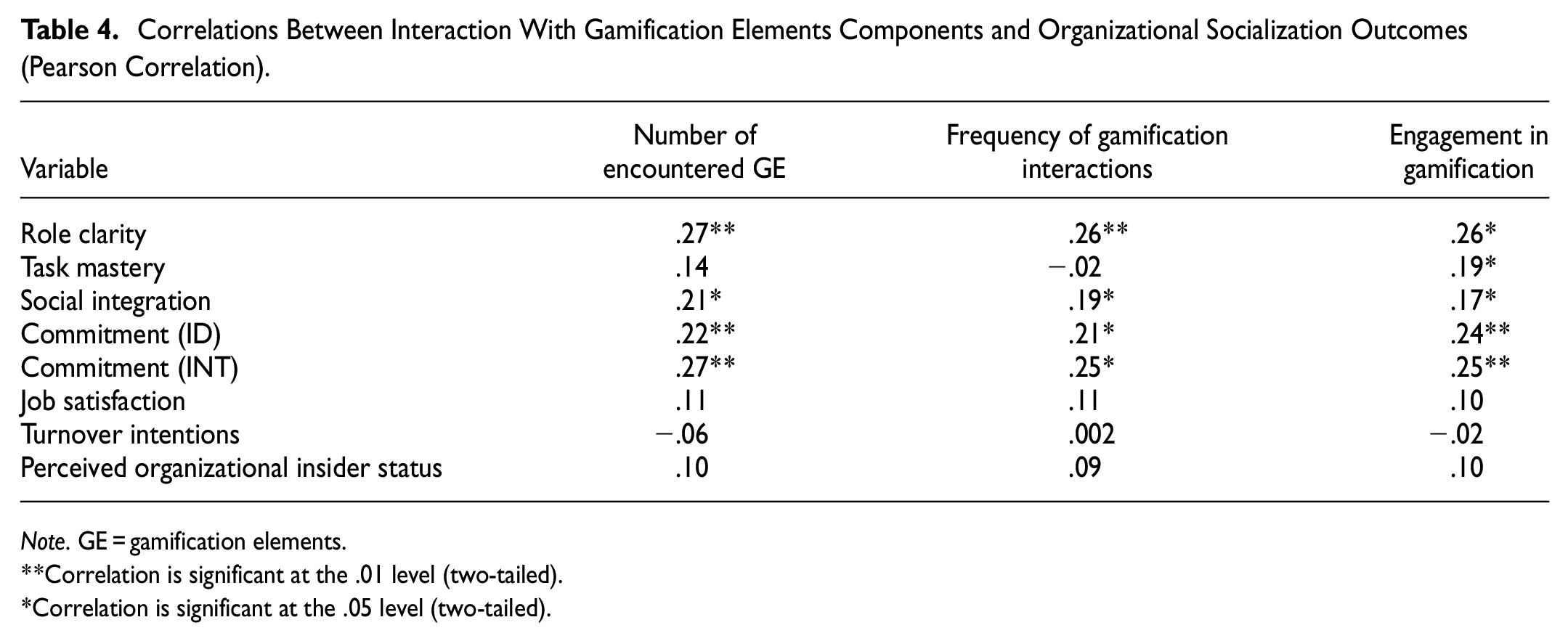
Note. GE = gamification elements.
Correlation is significant at the .01 level (two-tailed).
Correlation is significant at the .05 level (two-tailed).
The second objective was to compare if there were differences between organizational socialization outcomes of employees who encountered and did not encounter individual gamification elements. It could be seen that Challenges were most strongly related to organizational socialization outcomes, followed by Leaderboards, Points/Point systems, Progress tracking/Progress bars, and Chat channels/Clan/Guilds (overall results are presented in Table 5 and detailed in Table 6). The findings suggest that individual gamification elements were not associated with job satisfaction, turnover intentions, or perceived organizational insider status.
Comparison of the Outcomes of Organizational Socialization Between Employees Who Have Encountered and Have Not Encountered a Particular Gamification Element.

Note. Nd = not detected; RC = role clarity; TM = task mastery; SI = social integration; ID = identification; INT = internalization; TI = turnover intentions; POIS = perceived organizational insider status.
“+” indicates significant differences between groups that have encountered and not encountered a specific gamification element.
Intergroup Differences of Organizational Socialization Outcomes.

Note. CI = 95% confidence interval of the difference; LI = lower interval; UI = upper interval.
“+” indicates a group that encountered a specific gamification element in the workplace. Conversely.
“−” indicates a group that did not encounter a specific gamification element in the workplace.
The third goal was to analyze if gamification-related factors predict socialization outcomes. All previously determined statistically significant variables were included in the regression equations with the following coding: female—“0,” male—“1”; non-remote work—“0,” remote work—“1,” non-managerial position—“0,” managerial position—“1,” job tenure less than 1 year—“0,” more than 1 year—“1”; work groups were split into dummy variables, where “1” represent belonging to a specific group. Table 7 regression models for each socialization outcome. The most significant regression relationships were found within perceived organizational socialization status: respondents’ age, job tenure, and group size can explain 27.4% of perceptions about one’s organizational insider status. A variance of other socialization outcomes can be explained from 4 to 13% and is considered insufficient for further analysis. However, trends suggest that challenges at work help newcomers socialize, but interactions should be relatively frequent and engaging. Also, it is important to note that workplace competition may negatively affect employees’ socialization in the long run.
Regression Analysis of Organizational Socialization Outcomes.

Note. CI = 95% confidence interval for B; LB = lower bound; UB = upper bound.
Discussion
The current study investigated the relationship between gamification elements and organizational socialization outcomes. In designing the study, we focused on the extent to which employees themselves can observe encounters with gamification elements in their work environment and describe the characteristics of such interactions rather than analyzing employees’ general perception of gamification.
Overall results suggest that gamification elements are sometimes related to organizational socialization outcomes. However, established correlations and regression relationships can be considered low or insufficient. Therefore, this section discusses results more in a manner of possible tendencies. In an effort to facilitate a more comprehensive understanding of the results, an integrated analysis of the objectives will be undertaken.
Regarding adjustment indicators, role clarity was the most prominent variable related to gamification. This construct refers to employees’ understanding of their place in the organization and what is required of them. The results of this study suggest that gamification elements may contribute to this understanding. Role clarity was found to be higher among employees engaging with point systems, leaderboards, progress tracking, or challenges in the work environment. Higher role clarity is also associated with a generally higher number of gamification elements encountered in the workplace and more frequent and active interaction with them. Therefore, it can be implied that gamification can play a much more critical part in role clarity than was shown before (Girdauskienė et al., 2022). Moreover, the gamification effect was the same among newcomers and old-timers. These results might be explained by gamification’s ability to provide momentary feedback. In the context of information provision, gamification makes the evaluation of work performance visible, comparable, and immediate (Cardador et al., 2016). Thus, it becomes easier for employees to receive feedback on how they perform their duties, whether their performance differs from their colleagues, or if corrections are needed. The information provided by such a feedback loop could help new employees clarify their role in the workplace faster, which is crucial at the beginning of a new job.
The results also showed that task mastery and social integration are related to challenges and all interaction components with gamification elements. Social integration was also higher in a group that encountered leaderboards in their workplace. No studies have investigated a link between gamification and these adjustment indicators. Although, this resembles Stanculescu et al. (2016) findings which indicate opportunities to develop social relationships via gamification. According to Nah et al. (2019), gamification incorporates the principles of goal orientation and social connectivity, which respectively imply that goal setting contributes to higher engagement, competence development, and better job performance, while opportunities to interact with other employees increase social relatedness through collaboration and the pursuit of shared (team) goals. Following this study’s results, this might be true regarding the development of perception of one’s ability to perform job assignments and being a part of a workgroup. There were no differences between new employees and old-timers regarding social integration and task mastery, which might again show the potential significance of gamification in the adjustment process.
There was also a relationship found between gamification and organizational commitment. Identification and internalization positively correlated with all gamification components and were expressed more prominently in a group that encountered challenges in their workplaces. Internalization was also higher in groups that encountered leaderboards, challenges, and non-work-related chat channels or groups. These results are consistent with other research studies, for example, Hussain et al. (2018). This relationship was argued to be significant because of gamification capability to ensure loyalty through fun and engaging experiences. However, the findings of the current study should be interpreted with caution. Identification and internalization results were higher among managers as well as employees who practice remote work. Managers may have more responsibilities than their subordinates, which might be related to a greater sense of obligation to the organization. It can also be speculated that the opportunity to remote work can be perceived as a bonus or perk of the job, which also increases the willingness to be committed to the organization, especially if employees prefer such a work regime. It was already shown that the identification of remote workers differs from their co-located counterparts (Bailey et al., 2015).
Contrary to other studies (Eikelboom, 2016; Hussain et al., 2018), there was no relation found between gamification and turnover intentions or job satisfaction. Firstly, this study was designed differently from other studies where such relationships were found, and experimental design or the general concept of gamification was used. Secondly, gamification sometimes faces the consequence of novelty effect, meaning its effect might decrease over time, and gamification elements may be perceived as not fun and engaging. There is no information about how gamification elements were perceived by participants of this study during initial interactions. However, current interactions do not affect how employees are satisfied with their job and their intentions to quit. Lastly, results suggest that non-remotely working participants differ from those who practice the remote work model regarding turnover intentions and job satisfaction. There are reasons to believe that remote working opportunity interferes with gamification effects, but this is a matter for future research studies.
While conducting literature analysis, no studies were found linking gamification and perceived organizational insider status. The findings of this study suggest that these constructs are unrelated. It can be hypothesized that the perception of feeling like a genuine member of the organization is a complex construct that is more strongly influenced by other organizational factors than gamification. So far, the results indicate that perceived organizational insider status is more linked to a time working for an organization rather than interactions with gamification.
Finally, two gamification elements should be discussed in more detail, that is, challenges and competitions. The study’s findings suggest that challenges are the most significant element regarding employee socialization outcomes. Despite the low explanatory power of regression models, challenges were found to be a significant variable in role clarity, social integration, and task mastery. According to Nah et al. (2019), challenges create growth, learning, and development opportunities. The level of a challenge must be adapted to the employees—if it is too high, it can lead to anxiety or frustration; if it is too low, it can eventually lead to boredom and apathy. These findings lend some support to the notion that challenges can prove beneficial in the process of new employee onboarding (Russo et al., 2023). Therefore, it can be suggested that appropriately presented challenges to the newcomers may positively affect their adjustment process, unlike the competition. Even though the regression model explains a tiny proportion of data, it may be indicated that competition can negatively affect organizational commitment (namely, employee identification) in the long run. These results align with other research studies exploring the adverse effects of competition on newcomers (e.g., Rink et al., 2013).
This study contributes significantly to the existing literature on gamification and organizational socialization in several ways. Firstly, this study is one of the pioneering research that examines the relationship between gamification and organizational socialization outcomes, providing a deeper understanding of how gamification elements can impact the socialization process of employees within an organization. Secondly, this study examines the predictive power of gamification on organizational socialization outcomes, providing insights on how gamification can be used to influence the socialization process of employees. Finally, this study aims to examine the specific role of individual gamification elements in organizational socialization outcomes, shedding light on the unique contributions of different gamification elements to the socialization process. The results of this study can be used by organizations to better understand the potential impact of gamification on organizational socialization and to inform decisions on how to incorporate gamification elements in their workplace.
Future Research and Limitations
Given the disproportion between genders in this study, it would be beneficial to include a more significant number of males in future research to measure gamification’s effects in the workplace accurately. In addition, future research studies could explore a broader range of gamification elements. A limited number of the most popular gamification elements in the workplace were presented in this study. However, other potential elements could also be explored in-depth. Including a broader range of gamification elements would provide a more comprehensive understanding of the impact of gamification on employees’ socialization process. Moreover, future research could explore the effects of gamification on employees in different types of workplaces. This study did not focus on any particular sector, but gamification may have different effects across industries. Also, it would be beneficial to adopt a more focused scope, targeting employees within a single organization that actively utilizes gamification for purposes such as socialization and onboarding. This proposed approach would yield a more finely detailed understanding of gamification effects within the uniform context of one organization. Such focused investigations could provide insights into the intersection of gamification strategies with the distinctive organizational culture and operational flow of the company, and how they shape the socialization process in a tangible, everyday work setting. Finally, future research could examine the long-term effects of gamification on employee socialization. This study used a cross-sectional design, but there are indications that gamification could have different effects over time.
Practical Implications
Given the relatively low efficiency and potential risks of gamification, managers and HR professionals should carefully consider the appropriateness of gamification applications, that is, what goals and outcomes are to be achieved with it, what consequences it may cause, and other relevant factors before embarking on gamification-related activities. In addition, this concerns the organization’s expectations management, especially if gamification sometimes fails to deliver the intended results—for example, if it does not positively affect employees’ job satisfaction. It is, therefore, imperative to carry out a consistent monitoring process to observe whether gamification has the desired effect, how it is being received by employees, when the effect may be waning and whether gamification is leading to negative consequences.
Providing feedback helps new employees to clarify their job roles. The results of this study suggest that gamification elements could relatively strengthen this process. In addition, applying gamification elements could be beneficial for managers who are physically unable (due to the number of employees or lack of time) to pay enough attention to employees (Cardador et al., 2016). However, the question arises as to whether the feedback provided by gamification can completely replace the feedback provided by the manager. Gamification feedback is descriptive—for example, an employee might receive information about poor performance (low position on the leaderboard) but does not know the reasons for this evaluation (what was done poorly) or the course for further actions (how to improve one’s performance). Therefore, gamification feedback should always be followed by the manager’s or mentor’s feedback to ensure the best outcomes for the new employees.
Conclusion
The process of organizational socialization is a complex and multidimensional learning process that is influenced by various individual, group, and organizational factors. Therefore, it is not unexpected that the impact of gamification on this process may be limited. However, the relatively low correlation between gamification and organizational socialization outcomes does not mean that the potential impact of gamification should be disregarded. Specifically, our findings suggest that gamification may play a role in the adjustment process of newcomers, although the effect is not substantial.
Additionally, it is important to note that our findings indicate that there may be some negative consequences associated with the use of gamification in organizational socialization, particularly for newcomers. Therefore, organizations should take these potential adverse outcomes into consideration when incorporating gamification elements in their socialization efforts for newcomers.
In conclusion, while gamification may not be a “cure-all” solution for organizational socialization problems, it can be a useful tool when implemented in conjunction with other organizational efforts.
Footnotes
Declaration of Conflicting Interests
The author(s) declared no potential conflicts of interest with respect to the research, authorship, and/or publication of this article.
Funding
The author(s) received no financial support for the research, authorship, and/or publication of this article.

Data Availability Statement
Data sharing not applicable to this article as no datasets were generated or analyzed during the current study.