




Abstract
In an era of increasing environmental turbulence, organizational resilience has become a critical factor for surviving and recovering from crises. Although prior research has extensively explored the antecedents of organizational resilience, the mechanisms through which crisis leadership enhances organizational resilience, particularly through cognitive pathways and under varying levels of environmental turbulence, remain underexplored. Grounded in sensemaking theory, this study examines the mediating role of organizational sensemaking and the moderating effect of environmental turbulence in the relationship between crisis leadership and organizational resilience. Using multi-wave survey data from 482 Chinese enterprises, we empirically test the proposed hypotheses. The results indicate that: (1) crisis leadership has a significantly positive effect on organizational resilience; (2) organizational sensemaking partially mediates this relationship; and (3) environmental turbulence moderates both the direct effect of crisis leadership and its indirect effect (via organizational sensemaking) on organizational resilience. These findings advance theoretical understanding of the cognitive and contingency mechanisms that link crisis leadership to organizational resilience, while offering practical guidance for leaders to adapt their sensemaking strategies according to environmental turbulence levels. We acknowledge that the generalizability of the findings may be limited by the single-country (China) sampling frame.
Keywords
Introduction
In an era characterized by unprecedented volatility, uncertainty, complexity, and ambiguity (VUCA), contemporary organizations face escalating challenges as unexpected disruptions shift from episodic anomalies to systemic features of the global business landscape (Ouedraogo & Boyer, 2012). The COVID-19 pandemic epitomized this paradigm shift, inflicting structural shocks across the global economic system, while concurrent crises, such as climate-related disasters and geopolitical tensions, continue to impede worldwide economic recovery.
Within this context, traditional sources of competitive advantage, such as market positioning and technological innovation, have proven increasingly transient. In contrast, organizational resilience has emerged as a critical differentiator, enabling firms to (1) anticipate and absorb disruptions, (2) adapt to volatile conditions, and (3) transform adversities into strategic opportunities (Stoverink et al., 2020; Williams et al., 2017). Empirical studies demonstrate that resilient organizations exhibit both superior shock absorption capacity and faster recovery kinetics compared to their peers (DesJardine et al., 2019).
Originally rooted in ecological studies (Holling, 1973), resilience was defined as the capacity to maintain core functions amid external perturbations. Meyer’s (1982) seminal work on hospital responses to environmental jolts catalyzed its application to organizational studies. Contemporary scholarship conceptualizes organizational resilience as a dynamic process comprising three sequential phases: (1) threat anticipation through environmental scanning, (2) impact mitigation via resource reconfiguration, and (3) post-crisis institutional learning (Linnenluecke, 2017; Duchek, 2020). This tripartite framework gained prominence following the 2008 financial crisis (Hillmann, 2021).
The COVID-19 pandemic spurred a resurgence in organizational resilience research, revealing multiple mechanisms to enhance organizational resilience (Ozanne et al., 2022), such as implementing standardized management processes (Linnenluecke, 2017), adopting digital transformation strategies (Li et al., 2022), pursuing market expansion and governance improvements (Carmeli & Markman, 2011), and demonstrating strong corporate social responsibility (Lv et al., 2019). However, emerging critiques highlight a disproportionate focus on structural antecedents, which overlooks the pivotal role of agency factors, particularly leadership (Mao et al., 2024).
Crisis leadership has emerged as a distinct construct characterized by three key behavioral traits: (1) cognitive complexity in threat diagnosis (Boin et al., 2005), (2) decisional ambidexterity balancing short-term stabilization with long-term adaptation (Bundy et al., 2017), and (3) sensemaking to sustain collective efficacy (Wu et al., 2021). Wu et al. (2021) further conceptualize crisis leadership as a multidimensional competency encompassing proactive preparedness and adaptive response, which collectively facilitate organizational recovery and growth.
Despite these advances, two critical gaps persist in the literature. First, existing studies on organizational resilience disproportionately focus on public sector organizations (Mao et al., 2024), with particular overemphasis on either transformational (Valero et al., 2015) or entrepreneurial (Zhao et al., 2021) leadership styles. Second, although theoretical frameworks consistently posit a positive association between crisis leadership and organizational resilience (Zhuravsky, 2015), robust empirical evidence clarifying the underlying mechanisms and boundary conditions remains scarce.
To address these gaps, this study draws on sensemaking theory (Weick, 1988, 1993) to propose a novel mediated moderation framework. We hypothesize that crisis leadership fosters organizational resilience through the mediating mechanism of organizational sensemaking, with environmental turbulence serving as a moderating factor. Employing a multi-wave research design, we test the proposed hypotheses using data from 482 Chinese enterprises.
This study makes three key contributions to the literature. First, it empirically validates crisis leadership as a pivotal antecedent of organizational resilience, moving beyond descriptive analysis by establishing robust, empirically verifiable causal linkages. Second, it clarifies the mediating role of organizational sensemaking, the cognitive framework through which crisis leadership enhances organizational resilience, thereby elucidating the previously ambiguous mechanistic relationship between these constructs. Third, it identifies environmental turbulence as a critical boundary condition that not only necessitates effective crisis leadership but also moderates its impact, adding essential contextual precision to the theoretical framework.
Theoretical Analysis and Hypothesis Development
Crisis Leadership
A crisis is conventionally defined as an urgent, disruptive, and unexpected event that exposes organizations to significant risks, thereby necessitating prompt and decisive responses (Collins et al., 2023; James et al., 2011). Unlike routine operational challenges, crises impose severe temporal and resource constraints, often triggering defensive employee behaviors, such as withdrawal or avoidance, that undermine interpersonal dynamics and impede organizational coordination (Kahn et al., 2013). In such contexts, organizations must not only mitigate immediate threats but also proactively identify and capitalize on opportunities for transformation (Li & Zhu, 2021). This dual imperative demands a unique set of leadership behaviors, collectively termed “crisis leadership” (Garretsen et al., 2024; Nesse, 2024; Stoker et al., 2019).
Crisis leadership differs fundamentally from conventional leadership paradigms. For instance, while transformational leadership relies on charisma to align employees with organizational objectives (Bass & Riggio, 2006), and visionary leadership inspires through future-oriented narratives (Nanus, 1992), crisis leadership emphasizes learning from past failures to prevent their recurrence (Oktay, 2025). It focuses on cultivating crisis awareness and adaptive response capabilities by leveraging retrospective analyses of both successes and failures, thereby enhancing team or organizational resilience (Boin et al., 2005).
Through crisis leadership, leaders can effectively influence, motivate, and guide employees in reconstructing cognitive and behavioral patterns during crises, thereby facilitating the achievement of organizational goals (Bundy et al., 2017). Empirical studies further underscore its critical role in mitigating the adverse effects of crises and promoting organizational recovery (James et al., 2011). Specifically, crisis leadership enhances an organization’s ability to anticipate disruptions, mitigate their impacts, and even achieve growth amid adversity (Wu et al., 2021).
Effective crisis leadership is characterized by several key competencies: (1) early crisis identification, (2) rapid decision-making under information asymmetry, (3) strategic alignment of organizational actions, (4) fostering cohesion through clear communication, and (5) mobilizing collective efforts to overcome challenges (Boin et al., 2005). Given these capabilities, crisis leadership plays a more pivotal role in organizational crisis management than other leadership paradigms (Balasubramanian & Fernandes, 2022; Kim, 2021).
Crisis Leadership and Organizational Resilience
Organizational resilience is conceptualized as an organization’s capacity to (1) anticipate, absorb, and adapt to crisis-induced disruptions (Sajko et al., 2021) and (2) recover, rebound, and even thrive amid adversity (Kantur & Iseri-Say, 2015; Li & Zhu, 2021). Building upon this perspective, organizational resilience can be operationalized through three empirically established dimensions: (1) proactive adaptability, which reflects a deliberate capacity to adjust and recover from adversities (Williams et al., 2017); (2) developmental dynamism, encompassing the evolutionary progression of adaptive cognitions and behaviors (McCarthy et al., 2017); and (3) transformational potential, whereby organizations leverage crises as opportunities for growth, emerging stronger than before (Li & Zhu, 2021).
Extant research demonstrates that crisis leadership directly activates these organizational resilience mechanisms through theoretically salient pathways (Donthu & Gustafsson, 2020). First, leaders exhibiting crisis leadership can bolster organizational preparedness by scanning the external environment, assessing potential risks, and developing preemptive response strategies (Bundy et al., 2017). Second, leaders with crisis leadership capabilities are adept at identifying critical response points and subtle environmental signals, enabling them to implement holistic and adaptive strategies that transition the organization from crisis to stability (Boin et al., 2005). Third, crisis leadership emphasizes post-crisis learning and reflection, fostering positive organizational evolution and long-term resilience (Cui, 2014; James et al., 2011; Livingston, 2016). Therefore, we can propose the following hypothesis.
The Mediating Role of Organizational Sensemaking
Weick (1988) proposed that when confronted with environmental changes, organizational employees instinctively engage in sensemaking, a dynamic process through which they construct plausible interpretations by integrating prior knowledge and experience with emerging cues, establish new cognitive frameworks, and subsequently guide adaptive actions. Building on this, Daft and Weick (1984) conceptualized sensemaking as an iterative cycle of scanning, interpreting, and acting.
At the individual level, sensemaking is inherently cognitive and subjective, relying on personal heuristics and experiential knowledge to reduce ambiguity (Maitlis & Christianson, 2014). Employees interpret crises through idiosyncratic lenses, often prioritizing immediate survival or role-specific adjustments. In contrast, collective sensemaking is socially negotiated, involving shared dialogue, contested senses, and the alignment of mental models among members (Weick et al., 2005). This distinction is critical for organizational resilience, while individual sensemaking facilitates rapid, localized adaptations, collective sensemaking enables coordinated action and institutional memory (Weick, 1993; Maitlis & Christianson, 2014).
The sensemaking cycle begins with scanning, wherein actors identify salient external threats (e.g., market shifts) and internal resources (e.g., slack resources) that facilitate strategic adaptation. Interpreting involves synthesizing these inputs into coherent narratives, updating assumptions, and reconciling discrepancies (Brown et al., 2015). In this phase, collective sensemaking introduces interpretive checks, where divergent perspectives are debated to mitigate cognitive biases (Bundy et al., 2017). Finally, acting entails experimentation to counteract adverse trends. Empirical evidence suggests that effective sensemaking accelerates information processing and consensus-building across organizational tiers, thereby underpinning organizational resilience (Williams et al., 2017).
However, crises often overwhelm individual sensemaking capacities by disrupting habitual cognitive schemas (Weick, 1993). When employees struggle to attribute sense to latent threats, crisis leadership becomes pivotal (Gioia & Chittipeddi, 1991). Effective crisis leadership imposes structure on chaos by (1) framing ambiguous events as manageable challenges, (2) amplifying critical cues, and (3) orchestrating collective sensemaking through dialogue and symbolic actions (Maitlis & Sonenshein, 2010). For instance, by articulating a credible “transitional script”, leaders bridge individual and collective sensemaking, thereby fostering organizational resilience (Boin et al., 2005). Therefore, we can propose the following hypothesis.
Sensemaking is inherently context-dependent. In stable environments, cognitive frameworks remain relatively static, allowing automatic responses to suffice (Hardy & Costargent, 2017). Under ambiguous conditions, however, organizations and employees must actively scan for environmental cues to construct sense, thereby creating opportunities for sensemaking (Sheng, 2017). Empirical evidence from Weick (1993), illustrated by the Mann Gulch disaster, in which firefighters’ inability to reinterpret a rapidly changing wildfire led to fatal outcomes, underscore the necessity of dynamic sensemaking in crises.
This process enables organizations to develop more comprehensive, rational, and targeted interpretations of crises, thereby informing adaptive responses. By refining environmental interpretations, mitigating decision-making biases, and identifying emergent opportunities, sensemaking enhances organizational agility in turbulent contexts. For example, Maitlis & Christianson (2014) found that firms engaging in structured sensemaking during the 2008 financial crisis were better able to refine environmental interpretations, mitigate decision-making biases, and capitalize on emergent opportunities, ultimately strengthening organizational agility.
Organizational failures are frequently attributable to the collapse of sensemaking (Nowling & Seeger, 2020). For instance, during the 2014–2016 Flint water crisis in the United States, inadequate sensemaking by government agencies led to catastrophic mismanagement, exacerbating systemic pollution (Nowling & Seeger, 2020). In crises, organizational adaptability and recovery hinge on accurate crisis interpretation. Sensemaking facilitates the rapid internalization of external information, alleviates cognitive strain, integrates disparate perspectives, and reconstitutes existing knowledge to address emergent challenges (Zhang et al., 2023).
Furthermore, crisis leadership, by disseminating resilient beliefs, thoughts, and actions, mitigates employee ambiguity, fosters collective action, and strengthens organizational resilience (Baran & Scott, 2010). Longitudinal studies of large firms during the 2008 financial crisis indicate that leaders who institutionalized sensemaking practices (e.g., crisis debriefs, scenario planning) achieved higher employee retention and accelerated strategic adaptation (Bundy et al., 2017). Therefore, we can propose the following hypotheses.
The Moderating Effect of Environmental Turbulence
Environmental turbulence refers to the dynamic and unpredictable shifts in market conditions, technological advancements, and institutional frameworks that organizations encounter (Miller, 1987). Within the sensemaking paradigm (Weick et al., 2005), such turbulence creates interpretive voids, situations in which existing cognitive frameworks fail to explain environmental changes, thereby increasing the need for leadership-driven sensemaking. Crisis leadership addresses these voids through three key mechanisms: (1) structuring ambiguous information (Shang & Huang, 2010), (2) aligning collective interpretations (Gioia & Chittipeddi, 1991; Maitlis, 2005; Weick et al., 2005), and (3) framing adaptive responses (Kaplan, 2008).
Paradoxically, although environmental turbulence impedes predictive analysis, it amplifies the importance of crisis leadership by widening the disparity between ineffective and effective sensemaking processes (Maitlis & Christianson, 2014). Consequently, organizations with strong crisis leadership not only withstand disruptions but also leverage turbulence as a catalyst for innovation. Specifically, environmental turbulence enhances the relationship between crisis leadership and organizational resilience by increasing the costs of inaction. In high-turbulence environments, delayed or flawed sensemaking leads to severe resource misallocation, whereas effective crisis leadership enables rapid and accurate interpretations, thereby disproportionately strengthening organizational resilience (Gioia & Thomas, 1996). Therefore, we can propose the following hypothesis.
Furthermore, environmental turbulence exacerbates information fragmentation, compelling organizations to rely more heavily on leadership to construct shared senses (Weick, 1993). In such contexts, the role of crisis leadership as a sense-giver (Maitlis, 2005) becomes critical, particularly when exogenous uncertainty reduces the utility of historical data, making real-time interpretation essential. The mediated pathway via organizational sensemaking is inherently contingency-dependent, and environmental turbulence determines the extent to which interpretations translate into resilience-building actions (Cornelissen, 2012). Higher turbulence intensifies this mediation effect because organizational sensemaking becomes the primary mechanism for resource reconfiguration. Therefore, we can propose the following hypotheses.
As illustrated in Figure 1, the conceptual model positions crisis leadership as the independent variable, organizational resilience as the dependent variable, organizational sensemaking as the mediating variable, and environmental turbulence as the moderating variable.

Conceptual model.
Method
Data Collection
This study employed a cross-sectional design to collect data from firms in central China during 2022, coinciding with the final phase of the COVID-19 pandemic in the country. This period offered a unique opportunity to examine organizational resilience among Chinese firms under crisis conditions. The research instrument, originally developed in English, was carefully translated using parallel translation and back-translation procedures (Brislin, 1986). Any discrepancies were resolved through consensus discussions among three bilingual management scholars to ensure conceptual equivalence.
To mitigate potential common method bias (Podsakoff, 2003), a multi-wave data collection strategy was implemented via WeChat, a widely used instant messaging platform in China. The sampling frame targeted senior managers enrolled in MBA/EMBA programs at leading universities in Central China between May and June 2022. This sampling strategy offers several advantages for studying organizational resilience: (1) the region's economic structure closely mirrors China's national industrial composition; (2) it encompasses both traditional manufacturing bases and emerging service sectors, enhancing the generalizability of the findings; and (3) its moderate level of economic development reduces the extreme variances often observed in coastal or western regions.
Data collection was conducted in two temporally distinct phases with a one-month interval to minimize recall bias and assess temporal stability. Phase 1 measured crisis leadership constructs and demographic characteristics, while Phase 2 assessed organizational resilience, sensemaking processes, and perceptions of environmental turbulence. Participants were tracked through dedicated WeChat groups managed by research assistants. Response validity was verified via follow-up calls to a randomly selected 10% subsample. All questionnaires were administered anonymously, with participants informed of the study's purpose and data usage. All personal and organizational information was strictly protected.
From an initial pool of 670 responses, 482 complete and valid matched cases were retained after quality checks for straight-lining, missing patterns, and response consistency, yielding a valid response rate of 71.94%. The final sample comprised 48.4% private firms, 28.8% state-owned firms, and 22.8% firms with other ownership types. To assess common method bias, Harman’s (1967) single-factor test was conducted. The results showed that the first unrotated factor accounted for only 32.89% of the total variance, well below the 50% threshold, indicating that common method bias did not substantially affect the validity of the findings.
Measures
This study employed well-validated measurement scales, with all items rated on a 5-point Likert scale ranging from 1 (strongly disagree) to 5 (strongly agree).
Organizational Resilience (OR)
OR was measured using the 9-item scale developed by Kantur and Iseri-Say (2015), which assesses an organization’s ability to endure and adapt to adversities. A sample item is: “My company can stand firm and preserve its position.”
Organizational Sensemaking
Organizational Sensemaking (OS) was evaluated using a 14-item scale adapted from Akgün et al. (2012), capturing the organizational interpretation process. A representative items states: "This organization regularly holds interdepartmental meetings to analyze and respond to emerging market trends and developments."
Crisis Leadership
Crisis Leadership (CL) was measured using a 20-item instrument developed by Cui (2014), encompassing four key dimensions: (1) personal charm, (2) systems thinking, (3) contextual interaction, and (4) shared vision. An example item is: “The leader can take charge in a crisis and has the courage to assume responsibility.”
Although multidimensional, CL was modeled as a higher-order construct for theoretical and methodological consistency. The theoretical justification draws on prior studies suggesting that crisis leadership functions as an integrated capability, with its dimensions synergistically enhancing crisis management (Bundy et al., 2017; Morgeson et al., 2010). Methodologically, this aggregation improves parsimony, reduces respondent fatigue, and mitigates multicollinearity risks (Edwards, 2001). This approach aligns with conventions in leadership research for modeling higher-order constructs when dimensions demonstrate conceptual coherence and empirical correlation (Johnson et al., 2011).
Environmental Turbulence (ET)
ET was assessed using a 5-item scale developed by Miller & Friesen (1982), which has been widely validated in organizational research. A sample item reads: “Our company must adjust its marketing practices to keep pace with market and competitor changes.”
Control Variable
Two control variables, organization size (OZ) and firm nature (FN), were included to account for their potential influence on OS and OR. OZ was operationalized based on the number of employees, while FN was categorized as state-owned, private, or other.
Reliability and Validity Tests
The reliability of each scale was assessed using Cronbach's α coefficient. As presented in Table 1, all scales demonstrated excellent reliability, with Cronbach’s α values exceeding 0.8 (Nunnally, 1978).
Reliability Analysis.

To further evaluate the measurement model, we examined composite reliability (CR) and average variance extracted (AVE) for the four constructs: CL, OR, OS, and ET. Table 2 summarizes these psychometric properties. All constructs exhibited satisfactory convergent validity, with CR values above 0.7 (Fornell & Larcker, 1981) and AVE values greater than 0.5 (Hair et al., 2019). These results collectively confirm the robustness of the measurement instruments employed in this study.
Validity Analysis.

Factor Analysis
Table 3 presents the results of the Kaiser-Meyer-Olkin (KMO) measure and Bartlett’s test of sphericity. The KMO values for all constructs (CL, OR, OS, and ET) exceeded 0.7, indicating adequate sampling adequacy. Bartley’s test of sphericity was also statistically significant (p < 0.01), confirming that the data are suitable for factor analysis. These findings support the construct validity of the model and justify its use in subsequent confirmatory factor analysis (CFA).
KMO & Bartlett’s Test Results.

To further validate the measurement model and assess whether the observed variables effectively captured their respective latent constructs, we conducted confirmatory factor analysis (CFA). As presented in Table 4, although the single-factor, two-factor, and three-factor models exhibited inadequate fit indices, the four-factor model demonstrated significantly superior fit. These results confirm the robustness of the four-factor structure and provide empirical evidence that CL, OR, OS, and ET represent distinct constructs with satisfactory discriminant validity.
Confirmatory Factor Analysis Results.

Data Analysis and Results
Descriptive Statistical Analysis
Table 5 presents descriptive statistics for all study variables, including means, standard deviations, square roots of the average variance extracted (AVE), and inter-construct correlation coefficients. As anticipated, significant correlations were observed among CL, OR, OS, and ET. The measurement model demonstrated adequate discriminant validity, with the square roots of AVE for all constructs exceeding their respective correlation coefficients (Fornell & Larcker, 1981).
Descriptive Statistics and Correlation Analysis.

Note. N=482; Diagonal values in bold represent the square roots of AVE for each variable; ***p<0.001, **p<0.01.
Regression Analysis
Table 6 presents the results of the regression analysis. CL exhibits a significant positive effect on OR (M5, β=0.382, p<0.01), supporting H1. Similarly, CL also shows a significant positive impact on OS (M2, β=0.405, p<0.01), thereby validating H2. Subsequent analysis incorporating OS into the regression model reveals a positive association between OS and OR (M6, β=0.582, p<0.01), which supports H3. Notably, when both CL and OS are included in the model, the direct effect of CL on OR attenuates (M7, β=0.175<0.382, p<0.01) yet remains statistically significant, suggesting partial mediation by OS and supporting H4.
Regression Analysis.

Note. N = 482.
p < .001.
The examination of explained variance reveals meaningful insights. The ΔR2 values indicate substantial improvements, a 0.161 increase from M1 to M2 for OS, and a 0.143 increase from M4 to M5 for OR. These effect sizes not only confirm CL’s substantive explanatory power for both outcome variables but also exceed conventional thresholds for practical significance in organizational research (Aguinis et al., 2005).
Moderating Effect Test
To examine the moderating role of ET, we incorporated this variable into the regression model. As shown in Table 6, the interaction term between CL and ET exhibits a significant positive effect on OR (M8, β = 0.115, p < 0.01), indicating that ET positively moderates the relationship between CL and OR, thus supporting H5. Similarly, the interaction between CL and ET has a significant influence on OS (M3, β = 0.095, p < 0.01), suggesting that ET also enhances the effect of CL on OS, which supports H6.
Further analysis was conducted using Hayes’s (2012) PROCESS macro in SPSS. Interaction plots were constructed based on the mean value of ET plus or minus one standard deviation (Figures 2 and 3). The results revealed that the effects of CL on both OS and OR were significantly stronger under high ET conditions, reaffirming support for H5 and H6.
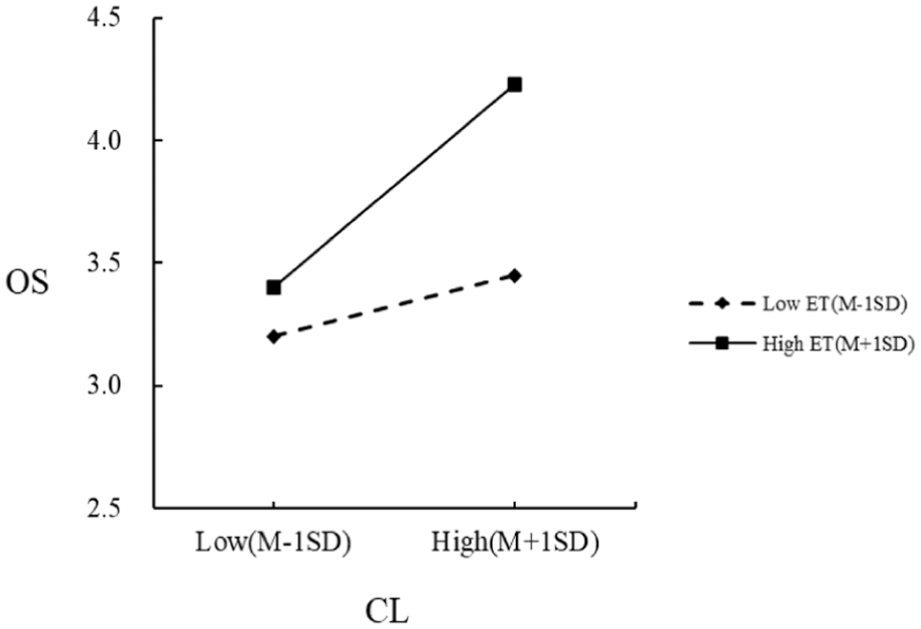
Moderating effect of ET on the relationship between CL and OS.
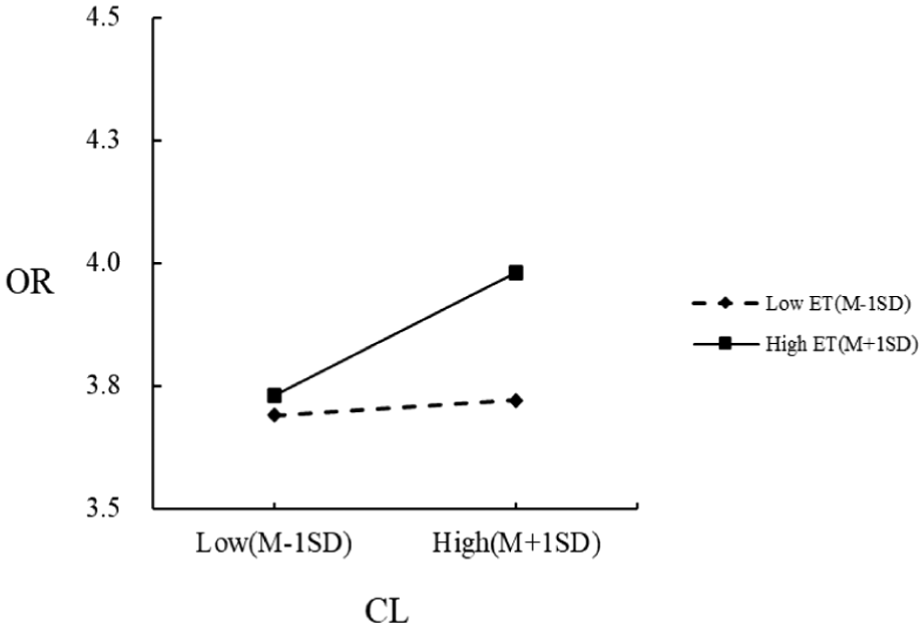
Moderating effect of ET on the relationship between CL and OR.
To examine moderated mediation, a bootstrap analysis was conducted to assess differences in indirect effects. As presented in Table 7, the 95% confidence intervals for both low ET ([0.037, 0.147]) and high ET ([0.120, 0.248]) exclude 0, indicating a significant mediating effect. Furthermore, the index of moderated mediation (0.063, 95% CI [0.013, 0.122]) suggests that ET strengthens the mediating role of OS in the CL-OR relationship. Therefore, H7 is supported.
Moderated Mediating Analysis.

Note. The difference reflects the contrast between high and low levels of environmental turbulence (ET).
Conclusions and Implications
Conclusions
In an era of escalating environmental turbulence, enhancing organizational resilience has emerged as a critical imperative in management research. Although the significance of this issue is widely acknowledged, systematic investigation into the role of crisis leadership in fostering organizational resilience remain limited. Grounded in sensemaking theory, this study explores the underlying mechanisms through which crisis leadership enhances organizational resilience, yielding three key insights.
First, crisis leadership serves as a pivotal driver of organizational resilience, enabling organizations and their members to adapt to environmental disruptions by swiftly identifying challenges and opportunities, making timely decisions, and taking swift action.
Second, crisis leadership strengthens organizational resilience through organizational sensemaking, which facilitates the interpretation of crises and the development of effective responses strategies. This process enhances the organization’s capacity to mitigate the adverse effects of crises.
Third, environmental turbulence acts as a catalyst, amplifying the impact of crisis leadership on both organizational sensemaking and organizational resilience. Specifically, heightened turbulence not only intensifies the direct influence of crisis leadership on organizational resilience but also fosters more robust sensemaking processes, thereby reinforcing its overall effect.
Theoretical Contributions
This study makes three key theoretical contributions to the literature on crisis leadership and organizational resilience.
First, it empirically examines the underexplored role of crisis leadership in fostering organizational resilience, a relationship previously overshadowed by an excessive focus on structural and technological determinants (Boin & van Eeten, 2013; Williams et al., 2017). While Lu and Xiang (2021) theorized this linkage, this quantitative analysis provides robust evidence that crisis leadership serves as a critical antecedent, addressing their call for empirical validation. However, this effect weakens when leaders confront resource exhaustion or institutionalized crisis responses (e.g., rigid pre-scripted protocols that limit adaptability), scenarios in which agency-based leadership may be rendered ineffective (Bundy et al., 2017).
Second, this study clarifies the mediating role of organizational sensemaking, resolving theoretical ambiguity regarding the mechanism through which crisis leadership enhances organizational resilience (Maitlis & Christianson, 2014). Building on Weick et al.’s (2005) seminal work, we demonstrate that crisis leadership not only directly strengthens organizational resilience but also indirectly facilitates it through organizational sensemaking. This mechanistic insight offers organizations a practical pathway to bolster adaptive capacities, provided employees share coherent epistemic frameworks. Conversely, in the absence of such frameworks, sensemaking mediation may prove ineffective (Cornelissen, 2012).
Third, the study confirms the moderating role of environmental turbulence, advancing a contingency-based perspective. Consistent with dynamic capability theory (Teece, 2007), our findings reveal that the influence of crisis leadership is most pronounced in turbulent environments, where it simultaneously activates organizational sensemaking and organizational resilience, whereas its impact diminishes under stable conditions. This delineates a critical boundary condition that leadership intervention may yield limited returns in chronically stable environments or hyper-turbulent contexts (e.g., war zones), where institutionalized routines or pervasive chaos constrain adaptive responses (Hannah et al., 2009).
Collectively, these contributions refine theoretical paradigms by addressing how (mediation), when (moderation), and why (direct effects) crisis leadership drives organizational resilience, fulfilling key gaps identified by Duchek (2020).
Practical Implications
This study offers several practical implications for leadership and organizational management during crises.
First, leaders with crisis leadership capabilities foster resilience at both individual and organizational levels, enabling proactive responses to disruptions (Boin et al., 2005). To navigate complex and dynamic environments, leaders must cultivate crisis awareness, strategic foresight, and decisiveness while continuously refining their leadership capabilities (Comfort, 2007).
Second, a thorough understanding of crises is fundamental for effective crisis response. Rational decision-making during crises depends on organizational sensemaking, which requires transparent communication, structured reflection, and evidence-based management practices (Maitlis & Christianson, 2014; Weick, 1995). Interactive communication enhances information dissemination and consensus-building, while continuous reflection supports strategic optimization and adaptive decision-making (Daft & Weick, 1984). These practices help establish a shared cognitive framework, promote a flexible work environment, and ultimately strengthen organizational resilience (Sutcliffe & Vogus, 2003).
Third, cultivating crisis leadership is a key strategy for mitigating systemic risks. Since organizations inevitably face adversities, leaders must not only identify opportunities but also take preemptive actions to guide organizational direction (Pearson & Clair, 1998). Moreover, they should inspire employees by articulating a compelling vision and reinforcing organizational values, thereby enhancing cohesion and facilitating effective crisis responses (Bass & Riggio, 2006; James et al., 2011).
Fourth, the applicability of these findings may vary between public and private sectors. In the public sector, crisis leadership often functions within rigid bureaucratic frameworks, requiring greater focus on stakeholder coordination and policy compliance (Ansell et al., 2010). In contrast, private-sector leaders may emphasize agility and innovation, leveraging competitive advantages to manage crises (Wenzel et al., 2020). Future research should explore these differences to develop sector-specific crisis leadership frameworks.
Limitations
This study has several limitations that should be acknowledged.
First, the reliance on questionnaire-based data may affect the reliability of the findings, as the relationship between crisis leadership and organizational resilience is inherently dynamic. Cross-sectional survey data from a single time period may fail to capture the evolving nature of this relationship. Future research could address this limitation by employing longitudinal or multi-wave designs to provide a more nuanced analysis.
Second, the generalizability of the findings is constrained by the limited representativeness of the sample, which was drawn exclusively from firms in central China. Expanding the scope of data collection through stratified or randomized sampling across diverse regions would enhance the external validity of future studies.
Third, while this study adopts a quantitative approach, organizational sensemaking is often explored through qualitative methods, such as case studies, which are better suited to elucidate the complexity of cognitive and behavioral processes in sensemaking. A mixed-methods design, integrating quantitative surveys with in-depth qualitative analyses, could offer a more comprehensive understanding of how organizations leverage sensemaking to foster resilience.
Footnotes

Ethical Considerations
The data in this study were collected through anonymous questionnaires. The disclosed responses will not expose participants to criminal or civil liability, harm their financial standing, employability, or reputation. Confidentiality is protected, and the research was conducted within an organizational context focusing on factors related to work or organizational effectiveness. There is no risk to participants' employment prospects, and confidentiality is safeguarded.
Consent for Publication
All the listed authors have carefully reviewed and approved this manuscript. We all agree to submit it to Sage Open for publication and are aware of and accept the journal’s publication policies.
Author Contributions
Hui Jing: Conceptualization, Methodology, Supervision, Validation, Writing–Reviewing and Editing. Rui Yang: Investigation, Data curation, Writing–Original draft preparation, Software, Visualization.
Funding
The authors received no financial support for the research, authorship, and/or publication of this article.
Declaration of Conflicting Interests
The authors declared no potential conflicts of interest with respect to the research, authorship, and/or publication of this article.
Data Availability Statement
The data are available upon reasonable request from the authors.