




Abstract
The current study addresses central aspects of the omnichannel fast fashion retailing consumer journey. How does Service Journey Quality (SJQ) as a multidimensional construct (including Seamlessness, Coherence, and Personalization) impact consumer thought and advocacy in fast fashion omnichannel retailing? Based on the Stimulus–Organism–Response (S-O-R) framework and Complexity Theory, this study aims to investigate the mediating effects of Customer Service Experience Consciousness (CSEC) and Trust in Retailer (TiR), as well as the moderating effect of Webrooming (WR). The study uses Partial Least Squares Structural Equation Modeling (PLS-SEM) and fuzzy-set Qualitative Comparative Analysis (fsQCA) to test linear and configurational relationships using a cross-sectional survey of 391 consumers of fast fashion in Pakistan. Findings indicate that all SJQ dimensions have a significant effect on improving CSEC and WoM with successive mediation via TiR. Nevertheless, WR fails to moderate the SJQ-CSEC relationship, indicating a contextual weakness in emerging economies. The results of the FsQCA confirm equifinality and configurational asymmetry because there are several sufficient pathways to high WoM. This research has a theoretical contribution to service design theory by re-conceptualizing SJQ as a journey-level stimulus and developing CSEC as a meta-cognitive construct. It also provides practical lessons to retailers who want to maximize omnichannel consumer experiences and consumer trust in disparate service environments.
Plain Language Summary
The research examines Service Journey Quality’s (SJQ) effects on customer conduct in fast fashion Omnichannel stores through Customer Service Experience Consciousness (CSEC) and Trust in Retailers (TiR) and Word of Mouth (WoM). SJQ produces substantial enhancement to both WoM and CSEC as CSEC functions as an intermediary variable between SJQ and TiR to create positive WoM. The practice of webrooming results in a minimal effect on the connection between Service Journey Quality and Customer Service Experience Consciousness in developing markets. An FsQCA approach analyzed different combinations that produce good and bad WoM results. The study involved 262 users from fast fashion omnichannel who participated in Partial Least Squares Structural Equation Modeling (PLS-SEM) data collection before testing reliability and validity. For better customer satisfaction and trust and advocacy development retailers should enhance service quality while integrating both online and offline service delivery. The study demonstrates how SJQ, CSEC, and TiR promote customer loyalty while indicating the need to study the impact of webrooming behavior on customers.
Keywords
Introduction
In the ever-changing world of fast fashion, Service Journey Quality (SJQ) is fast becoming a key distinguishing factor. A developmental discernment of journey-level composition across channels, SJQ is developed along three dimensions that are interlinked: Seamlessness, Coherence, and Personalization (Jaakkola & Terho, 2021; Natarajan & Veera Raghavan, 2025). The conceptualization of SJQ is a new area of literature that remains underexplored, particularly in terms of its effects on the customer journey. Customer loyalty (Gevano & Yuliati, 2023; Jaakkola & Terho, 2021), and Customer store identification and gratitude (Natarajan & Veera Raghavan, 2025), have been investigated in SJQ. Moreover, research has been conducted in various industries, including the pharmaceutical industry (Gevano & Yuliati, 2023), Banking (Jaakkola & Terho, 2021), and retailing (Natarajan & Veera Raghavan, 2025). Nevertheless, it is not well-developed and theorized in the field of fast fashion usage. The fast fashion consumer is, experientially speaking, the most frequent traveler of micro-journeys. Every instance is a test of how well the brand can perform not only in delivering the products, but also in delivering the intuitive, coherent, and ethical experience (Alexander, 2024). Advocacy is earned through one seamless interaction at a time, as the stakes for customer choices are high and loyalty is fleeting. Seamlessness ensures frictionless transitions—such as the cart that follows you seamlessly between mobile and desktop, and the flawless implementation of buy-online-pickup-in-store (BOPIS; Rodríguez-Torrico et al., 2023). Coherence, in its turn, is the promise of continuity. It is the confidence that the price you see on a website will not change at the cash register, and that the banner in your email matches the one in the store (Y. Liu et al., 2024). Moreover, personalization shows the right-time relevance. It is the push message that tells you when your size is back in stock, and the hyper-local inventory that shows you what is available within walking distance (Jaakkola & Terho, 2021).
In the fast fashion industry, where trends change rapidly and consumer expectations shift even more quickly, the service journey is no longer a linear process but a complex maze of touchpoints, promises, and perceptions (Mishra et al., 2025). Behind all this complexity lies a straightforward question: What causes a customer to trust, advocate for, or abandon a brand after a single interaction? To address this, the present study draws on the Stimulus–Organism–Response (S-O-R) model (Russell & Mehrabian, 1977), reconceptualizing Service Journey Quality (SJQ) as the stimulus that triggers the entire process. SJQ is not only a list of operational efficiencies, but a formative perception created by how well, holistically, and personally the journey progresses across channels. It is the cart that remains constant across devices, the price that stays the same at checkout, and the size warning that pops up at the right time. These are not luxuries—they are demands.
But the organismic level of the journey is the one that will result in loyalty or detraction, and the inner psychological circumstances in the light of which the journey will be filtered and interpreted. This paper operationalizes that layer with two constructs: Customer Service Experience Consciousness (CSEC) and Trust in Retailer (TiR). CSEC is not passive awareness; it is a meta-cognitive perspective through which consumers actively monitor, compare, and make sense of service episodes (Natarajan & Veera Raghavan, 2025; Osakwe & Chovancová, 2015). It highlights the inconsistencies more prominently, with broken promises becoming more salient and coherent experiences less memorable (Y. Liu et al., 2024). In fast fashion, where trips are small but numerous, this interpretive inspection becomes a potent force. Trust in Retailer (TiR), in turn, is a relational belief, which is a judgment of whether the brand is competent, honest, and benevolent (Bernarto et al., 2024). This trust is tenuous. It is not only constructed by the quality of the products, but also by the cross-channel consistency, delivery reliability, and the integrity of the return policy, all of which are crucial under the pressure of trend volatility and time constraints. TiR grows when the promises are fulfilled. Under high CSEC, trust is soon eroded, as evidenced by misalignment.
The result of this thinking and relationship is Word of Mouth (WoM), a currency of reputation that is faster than any advertising campaign. So, WoM is not just talk; it is social evidence. It can be an unboxing video, a review of the fit, and a rant about the delivery (Akram & Lavuri, 2024). It can multiply a brand's reach or destroy it in a day. Moreover, most importantly, WoM is influenced not only by the experience the customer gets, but by his/her interpretation of the experience, which is never interpreted or performed in a vacuum. Webrooming (WR) is the action of browsing the web and shopping at the store (Bharath et al., 2024). WR is introduced here as a boundary condition, a moderator that can either sharpen or distort the relationship between SJQ-CSEC. Theoretically, WR provides consumers with control and expectation-setting (Darmawan, 2024; Tan et al., 2024). In fragmented systems, however, a failure in the in-store reality to match the online promise can be unpleasant and give rise to expectancy disconfirmation (Wu & Chiang, 2023). WR is thus a two-sided sword, either augmenting the interpretive consciousness or disappointing it. This study is not merely a map of these relations, but challenges them. Such as, when does SJQ lead to trust? What should be scrutinized in Word of Mouth? Moreover, when does an otherwise researched journey fall under the burden of unmet expectations? In the process, it provides a critical perspective on how fast fashion retailers must change their service design—not only in terms of operational excellence, but also as a cognitive and relational experience that resides in the minds of customers.
Moreover, the fast fashion e-commerce environment in Pakistan, due to rapid e-commerce changes, disrupted journeys, fragmented experiences, and non-deliverance resulting from economic and infrastructure shortages, presents an opportunity to explore how service journeys can influence consumer cognition and Word-of-Mouth. This is evidenced by the research conducted by Asif (2025), which concluded that the market is not without friction. As it changes rapidly with the adoption of digital technologies, the emergence of mobile-first behavior, and a surge in social commerce, the market is not without friction. Fragile infrastructure, inconsistent last-mile logistics, and unpredictable in-store implementation render Service Journey Quality (SJQ) uneven and discernible. Meanwhile, WR behaviors, founded on price sensitivity and distrust, draw consumers’ interpretive attention to their journeys (Ellahi et al., 2024). Despite the growing experiential consciousness of journeys, when the institutional enforcement is low, ethically embedded cues will become a strategic source of distinction. The dynamics have rendered Pakistan a valuable lens through which Stimulus–Organism–Response (S-O-R) processes in new economies are understood. This study will answer the following three questions:
Section “Introduction” sets out the conceptual framework and literature review. In section “Methodology,” the methodology and analytical strategy are described. Section “Results” gives the empirical results. Theoretical and practical implications are discussed in section “Discussion,” while limitations and future research directions are outlined in final section.
Theoretical Underpinning and Gap Identification
This paper redefines Service Journey Quality (SJQ) as a dynamic and multidimensional concept- consisting of Seamlessness, Coherence, and Personalization- within the Stimulus–Organism–Response (S-O-R) framework. (Russell & Mehrabian, 1977) and in line with Complexity Theory (Byrne, 2002). Instead of viewing service quality as a channel-specific or transactional variable, SJQ is theorized as a dynamic coordination of micro-interactions within fragmented, fast-fashion omnichannel environments (Natarajan & Veera Raghavan, 2025). The change may be perceived as a transition to non-linear interdependencies, in which consumer experiences are built in adaptive, circular feedback loops. Customer Service Experience Consciousness (CSEC) and Trust in Retailer (TiR) are postulated to be organismic states that mediate cognitive-affective responses, which determine Word of Mouth (WoM). The application of Webrooming (WR) as a contextual modulator deals with the disconfirmation of expectations in complicated retail experiences that entail a change of channel (Wu & Chiang, 2023). The methodological contribution of the combination of PLS-SEM and FsQCA is that it provides the configurational theorization required in service research. It can also point to equifinal paths to WoM, for example, high SJQ and high CSEC or TiR; linear models can obscure that. Construct choice is a trade-off between theoretical parsimony and contextual relevance, as it measures the dynamics of service design in Pakistan’s fast fashion industry. Here, infrastructural fragmentation and growing interest in ethical practices have made service design a strategic priority for journey-level orchestration (Ashiq & Hussain, 2024; Nosrati et al., 2024). Table 1 provides a comprehensive conceptual theoretical mapping of the Stimulus-organism-response and complexity theory.
Conceptual Framework Mapping.

Literature Review
The Quality of the Service Journey in Fast Fashion Evolution
Service Journey Quality (SJQ), as a logistics-centric metric, has evolved into an omnichannel, fast fashion retailing multidimensional construct of seamlessness, coherence, and personalization (Jaakkola & Terho, 2021). Initially grounded in service blueprinting and channel integration, SJQ today embodies the perception of the consumer as a composed interaction between digital and physical touchpoints (Gevano & Yuliati, 2023). This trend has been rapidly accelerated by the post-pandemic shift in consumer expectations, where immediacy, consistency, and contextual relevance are no longer up for debate. Seamlessness implies smooth conversions, for example, cart continuity across stores, and proper BOPIS performance. Coherence implies consistency of messaging, prices, and policies (Y. Liu et al., 2024). Personalization, traditionally a high-touch industry, is becoming increasingly applicable to fast fashion by offering what is known as right-time relevance (André, 2024), such as size alerts, stock updates in specific locations, and customized delivery schemes.
Halvorsrud et al. (2024) emphasized that customer journeys are inherently complex, often involving multiple IT systems and encompassing touchpoints that are not visible to service providers. This is especially pronounced in fast fashion, where supply chain partners, logistics providers, and digital platforms alike collectively shape the customer experience. The authors emphasize that service quality should not be evaluated solely by internal process measures, but rather through the customer’s interpretative lens; this is why journey-level coherence and responsiveness are essential. Here, SJQ serves as a strategic resource in mitigating friction, aligning expectations, and fostering advocacy. Although SJQ is becoming increasingly topical, its application in fast fashion remains underrepresented to date (Gurnani & Gupta, 2024; Singh, 2024), especially in the emerging markets where infrastructural limitations and a disjointed service ecosystem make journey orchestration a complex task.
Word of Mouth
Word of mouth (WoM) is demarcated as the voluntary person-to-person communication about a retailer’s product, used as a gratification tool to convey one’s sentiment to others (Anderson, 1998; Huete-Alcocer, 2017). This is primarily in the context of customers advocating for the retailer’s brand through positive WoM. WoM marketing is a crucial tool in shaping buyer behavior across various industries. It is an informal communication channel in which consumers express their views regarding products, services, or brands, thereby having a considerable impact on the purchasing decisions of potential consumers (Akturan & Kuter, 2024; Haxhialushi & Panajoti, 2018). Past research has suggested that brand loyalty and corporate social responsibility have close connections with WOM (Rahmawati & Kustiawan, 2024; Sang, 2022). In another study, Meiske and Balqiah (2019) Showed that the powerful brand personality can serve as a good source of positive WOM that enforces customer loyalty and further improves the brand image. WOM has been observed to have a significant influence in a variety of sectors, including healthcare (Martin, 2017), banking (Choudhury, 2011), Insurance (Pourkiani et al., 2014), food, and beverage (Duong et al., 2025), and several others, which highlight its long-term role as a marketing strategy. Moreover, the online environment has also changed WOM to eWOM, where consumers can post their experiences on social media, thereby increasing the impact and reach of WOM (H. Liu et al., 2024).
In the world of online omnichannel shopping, the role of WoM has only grown. As customers continue to use multiple shopping platforms and channels, their experiences and reviews play a crucial role in shaping others’ attitudes towards online stores (Becker et al., 2024). The fact that reviews or recommendations can be widely spread within social media platforms means that positive WOM can lead to traffic and sales of brands, and negative feedback can effectively discourage potential customers (Mosavi & Gunawan, 2024; Tanuwijaya et al., 2023). In highly competitive markets, having an effective WoM strategy is a necessity that retailers should consider to build a higher level of customer trust and loyalty. The changes in WoM in the omnichannel setting demonstrate the importance of the brands focusing on customer satisfaction and engagement to derive the maximum benefit of this effective marketing instrument (Dong et al., 2023; Guerreiro & Pacheco, 2021). This article addresses this empirical gap by examining the role of SJQ on consumer advocacy and trust.
Customer Service Experience Consciousness and Word of Mouth
Customer Service Experience Consciousness (CSEC) is a meta-cognitive concept that refers to the intentional attention consumers devote to perceiving and interpreting service encounters and assessing their experience throughout their journey (Osakwe & Chovancová, 2015). In contrast to satisfaction or involvement, CSEC reflects interpretive depth, which involves how consumers compare their experiences with expectations and identify inconsistencies (Natarajan & Veera Raghavan, 2024). CSEC plays a crucial role in omnichannel fast fashion, where journeys are both fragmented and rapid in shaping relational evaluations and behavioral responses. In the fast fashion omnichannel context, the personalization, coherence, and seamlessness dimensions of the service journey are key drivers of the customer’s Consciousness of Service Experience (CSEC) in online shopping. This concept is not yet discussed in the literature and presents an appropriate gap. As Personalization increases consumer awareness by making brand experiences personal to the customer, it makes service experiences feel purposeful and emotionally engaging (André, 2024).
The consistency of digital and physical touchpoints builds trust and predictability, and consumers are increasingly critical of service consistency (Y. Liu et al., 2024). Seamlessness minimizes mental processing and friction, enabling consumers to focus on the experiential value rather than logistical bumps (Jain, 2025). The combination of these dimensions will lead to improved CSEC because consumers will be more conscious/sensitive to the quality of their service experiences, which will determine their satisfaction levels, loyalty, and repurchase behavior. In fast fashion, where satisfaction of emotions and speed are the primary factors, high CSEC is one of the determinants of brand differentiation.
Although a growing body of knowledge has been dedicated to the study of omnichannel service design, the mediating role of Customer Service Experience Consciousness (CSEC) in the development of Trust in Retailer has not been addressed, especially in the fast fashion environment, where the expectation of immediacy and experiential gratification is at the forefront of consumer demands. Although the significance of the seamlessness and coherence of the journey in the context of customer satisfaction and loyalty has been noted (Jaakkola & Terho, 2021), Little attention has been paid to how the dimensions of the quality of the journey stimulate the higher-level cognitive awareness of the service interactions, which leads to the development of trust. The suggested associations—H5a and H5b—highlight a critical theoretical gap: the lack of empirical confirmation of CSEC as a psychological process linking operational service quality (e.g., seamless transitions and consistent messaging) to relational outcomes, such as trust. Additionally, the repetition of H5c suggests a need to refine the concept and clarify its differentiation from overlapping constructs. Filling this gap is critical to the further development of service journey theory, as well as to assist retailers in creating omnichannel experiences that are emotionally evocative and cognitively stimulating, and that result in the development of lasting consumer trust.
According to empirical research, an increase in CSEC leads to higher levels of trust and advocacy actions (Kurt & Kırcova, 2023; Natarajan & Veera Raghavan, 2024). In this regard, Word of Mouth (WOM) emerges as reputational capital, determined by peer influence and the visibility of the purchase following the initial purchase (Beckers & Cant, 2024). Memorable, coherent, and responsive service experiences evoke behaviors leading to WoM not only to satisfaction but also drive brand endorsement (Fatma & Khan, 2024; Li et al., 2023). Additionally, the broken experiences reduce trust and advocacy (Alkallas, 2023). Interestingly, CSEC has received little empirical consideration in the fast fashion context, where consumers engage in speedy, low-involvement, high-frequency purchasing (Kurt & Kırcova, 2023; Natarajan & Veera Raghavan, 2024). This article argues that in developing economies, characterized by significant disparities in service delivery, CSEC serves as a crucial lens through which consumers comprehend and share their experiences.
Emerging Markets, Webrooming, and Contextual Moderation
In the omnichannel retail environment, researching products online before purchasing has become a practiced norm, known as Webrooming (WR), especially in emerging markets (Bharath et al., 2024). WR enhances consumer control and expectation-setting, while simultaneously amplifying the disconfirmation when the online promise fails to meet reality in-store. (Dastane et al., 2024; Yaqub et al., 2025). Speed and accuracy are key in fast fashion, and WR acts as a situational moderator of the SJQ-CSEC relationship, raising scrutiny, and interpretive involvement.
In uneven digital market ecosystems, such as Pakistan, where the integration of services is in its infancy, WR behaviors are not necessarily determined by choice (Yaqub et al., 2025). Customers use online mediums as a means of assurance for the availability of products, prices, and in-store conditions before deciding to visit the stores (Darmawan, 2024). It is this increased pre-purchase diligence that causes consumers to be more aware of inconsistencies, thereby increasing their awareness of the service experience. Despite its widespread impact, WR is undertheorized in the fast fashion literature, particularly in the context of emerging economies. This paper not only defines WR as a behavioral trend but also perceives it as a lens that shapes consumers’ perceptions of service quality and their relational judgments.
Complexity Perspective on Configurational Pathways to Word of Mouth
Whereas the traditional SEM methods are used to test linear relationships, Fuzzy Set Qualitative Comparative Analysis (FsQCA) can be used to identify causal configurations, which are combinations of conditions that simultaneously produce an outcome (Phung et al., 2020). Such a strategy is advantageous in the context of fast fashion, as asymmetrical interactions between service quality, awareness of the experience, trust, and channel behavior significantly influence consumer behavior. Using Complexity Theory (Manson, 2001), this article is based on the assumption that there are various, equifinal pathways to high Word of Mouth (WOM). As an example, high SJQ can result in WOM only in combination with high CSEC and trust, or when WR behavior balances out moderate SJQ. FsQCA can identify this subtle combination, where no single condition is necessary or sufficient on its own. This configurational logic complements the SEM results, revealing non-linear, context-specific mechanisms of consumer advocacy.
Methodology
Ethical Considerations
This study dealt with human subjects and followed the ethical principles of social science research. The study design was highly observational and non-invasive in nature to ensure that there was no possible risk of harm. There was no experimental manipulation, deception, or collection of sensitive personal data. The respondents were requested to fill in the structured questionnaire on their experience of their services in fast fashion retailing, and there was no expected psychological or physical danger. Any low-risk factors are outweighed by the possible benefits of this study to society and to participants. The work adds to the body of knowledge on consumer cognition and service design in emerging markets, providing insights that can be used to improve retail practice, enhance customer experience, and inform policy. On the side of the participants, this possibility to reflect on their service trips can assist them in being more conscious about their rights and demands as consumers. Informed consent was obtained before the data collection. The respondents were given a brief explanation of the purpose of the research, their right to withdraw at any time, and assurance of confidentiality and anonymity. No personal information was collected, and the response was stored in a secure location and analyzed in a group. The research was ethically approved by the institutional review board of the institution to which the author was attached.
The Research Design
The proposed study has employed a cross-sectional survey research design to investigate the effect of dimensions of Service Journey Quality (SJQ) Coherence (SJQCoh), Seamlessness (SJQSem), and Personalization (SJQPer) on Word of Mouth (WoM) mediated by Customer Service Experience Consciousness (CSEC) and Trust in Retailer (TiR), and moderated by Webrooming (WR). The preestablished measurement scales were adopted and adapted to study the relationships among the variables. The data was collected using a 5-point Likert scale (Wyatt & Meyers, 1987). The study was approved ethically by the institutional review board, and all participants signed informed consent forms. No manipulations or interventions were employed during the data collection process.
Profile of Respondents and Sampling Plan
The fast fashion consumers in Pakistan were recruited through a convenience sampling method, as it is an emerging market with increasing omnichannel retail business activity. The respondents were contacted through online tools (Google Forms, WhatsApp, email) and face-to-face recruitment. The minimum number of responses to the PLS-SEM was achieved (Subhaktiyasa, 2024), The sample size of 391 valid responses was relatively high, which increased statistical power and generalizability (Hair et al., 2019). Demographic analysis has revealed that the gender statistics consist of 49.8% males and 48.8% females, who are mainly aged 18 to 35 years (77.2%), with the majority holding bachelor’s and master’s degrees. Statistics show that most customers are capable of buying fast fashion apparel and can make conscious decisions (Table 2).
Items and Sources.
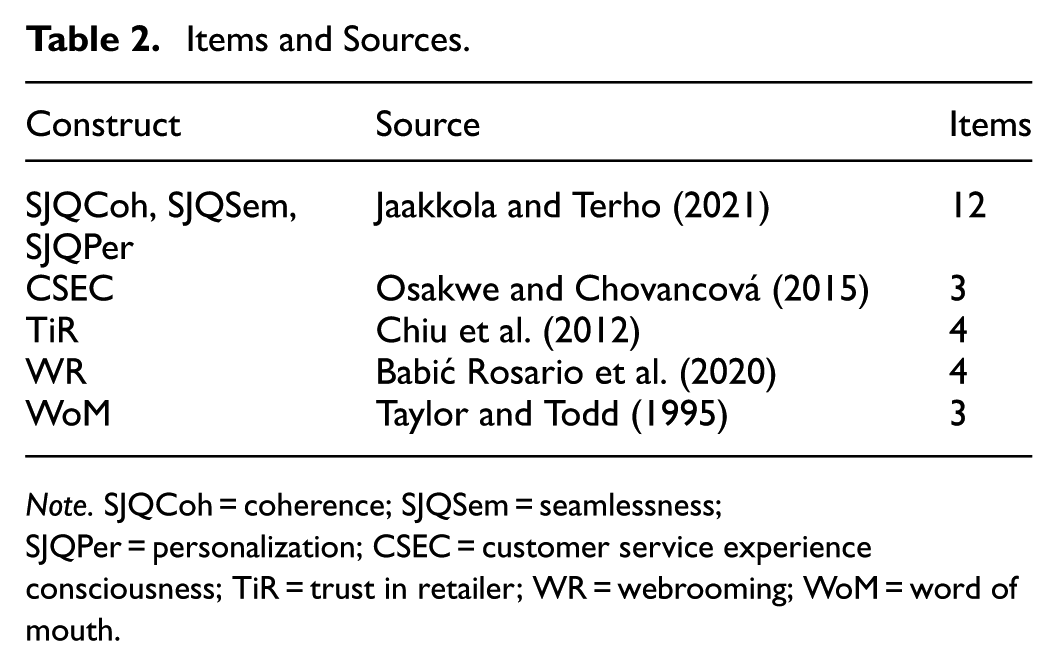
Note. SJQCoh = coherence; SJQSem = seamlessness; SJQPer = personalization; CSEC = customer service experience consciousness; TiR = trust in retailer; WR = webrooming; WoM = word of mouth.
Data and Bias Control
The data were collected in three lags, and attention checks and reverse-coded items were used to mitigate the common method bias, procedures and statistics remedies. It was also ensured that all indicators possessed VIF values lower than 3.3 and that normality within constructs was established by Cramer–von Mises tests (p < .00). Such procedures, in conjunction with good reliability scores (e.g., Composite Reliability > .89), are indications of the plausibility of the data.
Analytical Strategy
SmartPLS 4.0 was used to conduct the partial least squares structural equation modelling (PLS-SEM; Hair et al., 2019). This model was tested for reliability, and construct validity was assessed using Cronbach’s Alpha, Composite Reliability, AVE, Fornell–Larcker, and HTMT. In this, the Model fit: SRMR = .053 (saturated model, NFI = .88), Collinearity: All VIFs < 3.3. Additionally, the Structural Model analysis using bootstrapping (5,000 subsamples) revealed significant paths from SJQ to CSEC, then to TiR, and finally to WoM (Sarstedt et al., 2023). WR moderation was not supported (Figure 1).

Theoretical model.
Results
Descriptive Statistics
Table 3 presents the detailed descriptive statistics of the study variables.
Descriptive Statistics (N = 391).

Note. SJQCoh = coherence; SJQSem = seamlessness; SJQPer = personalization; CSEC = customer service experience consciousness; TiR = trust in retailer; WR = webrooming; WoM = word of mouth.
Discriminant Validity
Discriminant validity is shown through the Heterotrait–Monotrait ratio Matrix (HTMT) and the Fornell and Larcker Criterion depicted in Tables 4 and 5, respectively. Table 5 shows the HTMT values, which are below .90, indicating strong discriminant validity.
Heterotrait–Monotrait Ratio Matrix (HTMT; N = 391).

Note. SJQCoh = coherence; SJQSem = seamlessness; SJQPer = personalization; CSEC = customer service experience consciousness; TiR = trust in retailer; WR = webrooming; WoM = word of mouth.
Fornell and Larcker Criterion (N = 391).

Note. SJQCoh = coherence; SJQSem = seamlessness; SJQPer = personalization; CSEC = customer service experience consciousness; TiR = trust in retailer; WR = webrooming; WoM = word of mouth.
Table 5 presents the square root of average variance extracted on the diagonal and inter-construct correlations below the diagonal. In the Fornell and Larcker table, the values exceed the correlations, confirming the discriminant validity.
Reliability and Validity
In Table 6, the tested reliability and validity are shown through composite reliability, Cronbach’s Alpha, and AVE for each construct. The values confirm internal consistency and convergent validity.
Reliability and Validity (N = 391).

Note. SJQCoh = coherence; SJQSem = seamlessness; SJQPer = personalization; CSEC = customer service experience consciousness; TiR = trust in retailer; WR = webrooming; WoM = word of mouth.
In Table 7, the factor loadings for each construct and item are shown. They are within the acceptable range for PLS-SEM (Sarstedt et al., 2023).
Factor Loading (N = 391).

Note. SJQCoh = coherence; SJQSem = seamlessness; SJQPer = personalization; CSEC = customer service experience consciousness; TiR = trust in retailer; WR = webrooming; WoM = word of mouth.
Collinearity Statistics (VIF)
Table 8 reports the Variance Inflation Factor (VIF) values for each predictor in the structural model. All values are below the threshold of 5, indicating no multicollinearity problems.
Variance Inflation Factor (VIF; N = 391).

Note. SJQCoh = coherence; SJQSem = seamlessness; SJQPer = personalization; CSEC = customer service experience consciousness; TiR = trust in retailer; WR = webrooming; WoM = word of mouth.
Structural Equation Modeling
Structural equation modeling involves validating hypothesized relationships through path coefficients, t-values, p-values, and confidence intervals. Figure 2 below depicts the structural values of the relationships.

FsQCA pathways.
Direct Effects (Hypothesis Testing)
The direct effects are depicted through path coefficients, t-values, p-values, and upper and lower confidence intervals in Table 9, shown below. All the direct effects are statistically significant, meeting the thresholds (Haji-Othman et al., 2024). The interaction term is not supported (Figures 3 and 4).
Direct Effects (N = 391).
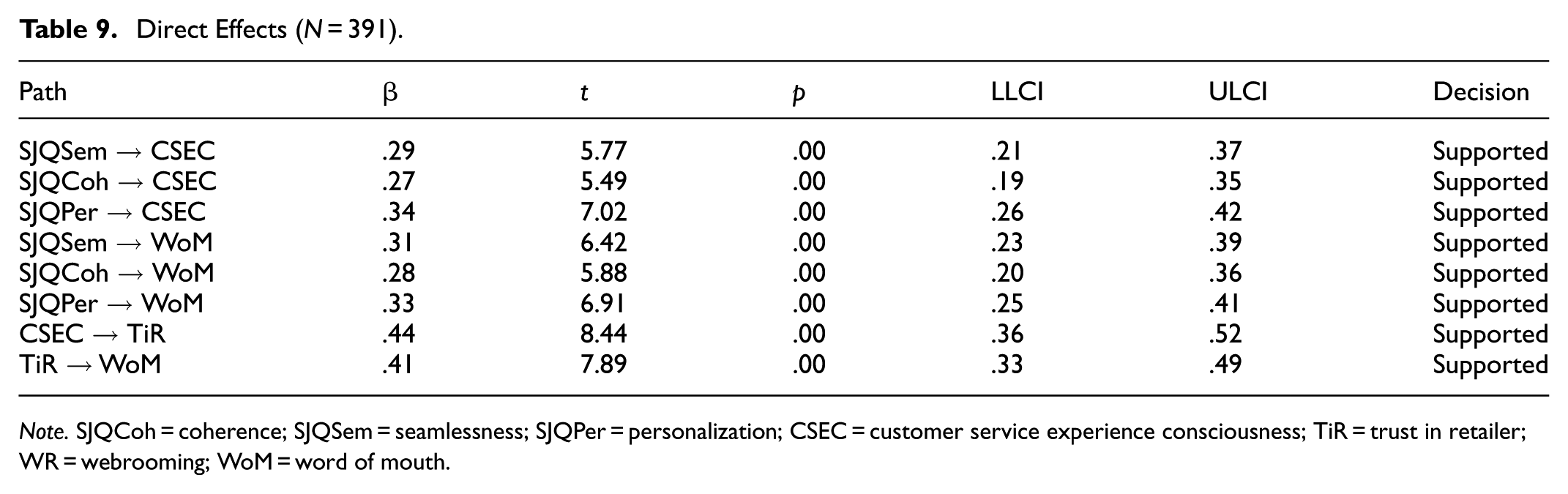
Note. SJQCoh = coherence; SJQSem = seamlessness; SJQPer = personalization; CSEC = customer service experience consciousness; TiR = trust in retailer; WR = webrooming; WoM = word of mouth.

Structural equation modelling (N = 391).

Flow chart of FsQCA.
Mediation
The mediation paths are significant, as indicated by the bootstrapped results in Table 10, given below.
Mediation Analysis (N = 391).

Note. SJQCoh = coherence; SJQSem = seamlessness; SJQPer = personalization; CSEC = customer service experience consciousness; WoM = word of mouth.
The values support the sequential mediation, and the p-value is significant for the relationships in Table 11 below.
Sequential Mediation (N = 391).

Note. SJQCoh = coherence; SJQSem = seamlessness; SJQPer = personalization; CSEC = customer service experience consciousness; TiR = trust in retailer; WoM = word of mouth.
Moderation
Webrooming does not moderate the relationship between the Service journey quality dimensions and the service experience consciousness of the customers. The p-value in Table 12 is not significant, indicating that the moderation is not effective.
Moderation (N = 391).

Note. SJQCoh = coherence; SJQSem = seamlessness; SJQPer = personalization; CSEC = customer service experience consciousness; WR = webrooming.
Predictive Analysis
The results of predictive analytics demonstrate higher explanatory and predictive power (Table 13) across all endogenous constructs. Customer Service Experience Consciousness (CSEC = .59), Trust in Retailer (TiR = .53), and Word of Mouth (WoM = .53) R-squared values indicate that the model explains a significant amount of variance. These relationships are further confirmed by the effect sizes of f2 that demonstrate a substantial effect (f2 = 1.15) of CSEC, a considerable effect (f2 = .47) of WoM, and a moderate effect (f2 = .12) of TiR according to the guidelines of Cohen (1988). Moreover, all constructs report Q2 values above the .35 threshold, indicating high predictive relevance. These findings support the strength of the structural model and its applicability in predicting consumer behavior in omnichannel fast fashion settings.
Predictive Analysis (N = 391).

Note: f2 values were derived from SmartPLS matrix outputs and interpreted using Cohen’s (1988) guidelines: .02 = small, .15 = medium, .35 = large. CSEC = customer service experience consciousness; TiR = trust in retailer; WoM = word of mouth.
Model Fit (PLS-SEM Analysis)
Table 14 presents key model fit indices for the model. SRMR values below .08 indicate an acceptable fit.
Model Fit Summary (N = 391).

FsQCA
Analytical Rationale
To supplement the linear findings of the PLS-SEM, the research used FsQCA to identify configurational routes to high and low Word of Mouth (WoM). In contrast to the regression-based models that presuppose symmetrical causality, FsQCA uses equifinal combinations of conditions, that is, the existence of multiple paths leading to the same outcome (Roy et al., 2025; Woodside, 2013). This methodology is especially applicable in the situation of omnichannel service, where the consumer behavior is defined by the asymmetric relations between the dimensions of service journey (Coherence, Personalization, Seamlessness), the state of mind (CSEC, TiR), as well as the channel behavior (WR).
Tolerances and Calibration
The direct method of three anchors was used in calibrating all constructs:
Full membership (1.0): 95th percentile.
Crossover point (0.5): Median.
Full non-membership (0.0): 5th percentile.
The transformation is used to transform Likert-scale data into fuzzy sets and perform the set-theoretic analysis.
Table 15 shows the meaning of the symbol used in the analysis and interpretation.
Symbol Definition.

Table 16 shows the Solution Coverage: .72 and Solution Consistency: .80. Such arrangements imply that not only one combination of CPS dimensions and cognitive states is possible to result in high WoM. An example of this is the high Coherence and Personalization, and a high CSEC, which is adequate, even without TiR or WR, as demonstrated by M1.
Sufficiency Configuration for High WoM (N = 391).
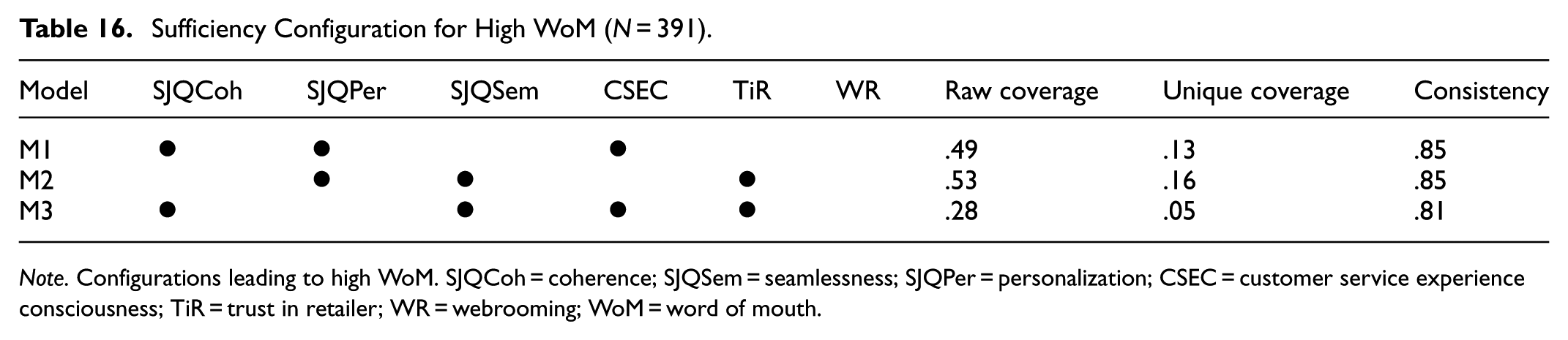
Note. Configurations leading to high WoM. SJQCoh = coherence; SJQSem = seamlessness; SJQPer = personalization; CSEC = customer service experience consciousness; TiR = trust in retailer; WR = webrooming; WoM = word of mouth.
Table 17 indicates the Coverage of the solution as .83 and the Consistency of the solution as .73. This arrangement implies that low WoM is the result of the lack of all of the main CPS dimensions and states of cognition. It justifies the relevance of orchestrating journeys and taking part in interpretive practices. Equifinality: There are many ways to gain high WoM (M1–M3), which is an indication that consumer-brand relations are intricate. Configurational asymmetry: The circumstances under which high WoM will occur are not actually the reverse of the circumstances under which low WoM will occur. Contextual sensitivity WR is not found in high-WoM arrangements, and this may suggest that it is either compensatory or contextual.
Sufficiency Configuration for Low WoM (N = 391).

Note. Configuration leading to low word of mouth. SJQCoh = coherence; SJQSem = seamlessness; SJQPer = personalization; CSEC = customer service experience consciousness; TiR = trust in retailer; WR = webrooming; WoM = word of mouth.
Discussion
Combining the Stimulus–Organism–Response (S-O-R) framework and the Complexity Theory improves the theoretical and empirical understanding of Service Journey Quality (SJQ) in omnichannel fast fashion retailing. The findings offer unique insights into the translation of multidimensional service orchestration, Seamlessness, Coherence, and Personalization into Customer Service Experience Consciousness (CSEC), Trust in Retailer (TiR), and the ultimate, Word of Mouth (WoM). This discussion is a critical reflection of supported and unsupported hypotheses, which are placed in the context of emergent market dynamics and the available literature. SJQ dimensions directly influenced WoM (H1a–H1c) and CSEC (H2a–H2c; .28–.34, p < .001), which explains SJQ as a powerful stimulus that induces consumer cognition and advocacy activation. The results of this study are consistent with those provided by Jaakkola and Terho (2021), who mention that the role of journey-level orchestration is central to the development of customer perception in various channels. The empirical robustness of Personalization (β = .34 to CSEC; β = .33 to WoM) demonstrates the increasing significance of right-time relevance in fast fashion, in line with André (2024), who emphasizes the role of contextual responsiveness as a key distinguishing factor. The mediation paths (H5a–H5c, H6a–H6c) proved to be acceptable, which means that CSEC and TiR may be regarded as organismic mediators of the effect of SJQ and WoM. This proves the S-O-R logic, which states that stimuli produce internal states and that it is the internal states that produce behavioral responses (Russell & Mehrabian, 1977). Notably, the influence of CSEC on TiR was significant (β = .44, t = 8.44), meaning that the positive role of meta-cognitive scrutiny in building trust is combined with Lyroni and Spais (2024), Osakwe and Chovancová (2015) also agreed about the significance of the depth of interpretation in establishing trust. The sequential mediation (SJQSem, SJQCoh, SJQPer, CSEC, TiR, WoM) is yet another indication of the cascading cognitive-relational mediating process, with the effects being significant (p < .00). This substantiates greatly the fact that trust is not purely transactional, but the outcome of a conscious evaluation of the offers of services at touchpoints (Bernarto et al., 2024; Marinao-Artigas et al., 2025). Contrarily, Webrooming (WR) was not a significant moderator of the relation between the SJQ dimensions and CSEC (H7a–H7c). The interaction variables were not significant (p > .15), indicating that WR may not enhance interpretive consciousness in the Pakistani fast fashion context. This finding is contrary to that of Bharath et al. (2024), Wu and Chiang (2023), who assume that WR is a boundary condition that can reinforce expectation-experience comparisons.
This deviation may be attributed to some contextual factors. The WR behavior in Pakistan is necessitated, chiefly, as opposed to preferences, due to infrastructural fragmentation and a lack of trust. (Ellahi et al., 2024; Yaqub et al., 2025). WR can thus be considered more of a compensation mechanism than a cognitive amplifier. This understanding necessitates the re-theorization of WR in new markets, where digital pre-purchase behavior may not translate into heightened service scrutiny. The FsQCA findings revealed numerous sufficient combinations of high WoM (M1–M3), confirming H8 and supporting the Complexity Theory assumption of equifinality (Byrne, 2002; Woodside, 2013). As an example, Model M1 revealed that high Coherence, Personalization, and CSEC alone were adequate to produce high WoM, even without TiR or WR. It implies that advocacy can be fueled purely through cognitive engagement, a result that complements the linear SEM findings and notes asymmetric causation. On the other hand, a low WoM setting (M1 in Table 17) revealed that the absence of all core conditions (SJQ dimensions, CSEC, TiR) leads to reputational detraction. This aligns with Alkallas (2023), Beckers and Cant (2024), who argue that negative service experiences erode trust and hinder advocacy. The non-linear character of consumer behavior in omnichannel systems is highlighted by the configurational asymmetry (the inverse of high-WoM conditions is not the reflection of low-WoM pathways).
Implications
Contextual Implication
The Pakistani fast fashion ecosystem is characterized by mobile-first adoption, social commerce, and logistical fragmentation, making it an ideal environment to test these mechanisms (Ashiq & Hussain, 2024; Asif & Fazel, 2024). The fact that CSEC and TiR play an essential role in mediating SJQ effects suggests that journey-level orchestration is crucial in volatile environments where service reliability is unstable. Furthermore, the absence of WR moderation means that digital pre-purchase behaviors might not always be related to increased cognitive engagement, particularly in the context of low institutional trust. This implies that the concept of eco-responsiveness can be incorporated into journey coherence and personalization, providing a differentiation strategy within emerging markets.
Practical Implications
The results provide practical knowledge to managers in the retail sector, service designers, and policy makers working in fast fashion and new market settings. To begin with, the high impact of SJQ dimensions, especially Coherence and Personalization, on trust and advocacy suggests that retailers should not focus on channel-by-channel optimization, but rather on journey-level consistency and relevance. Cross-channel consistency in messaging, pricing, and policy, as well as real-time personalization capabilities like size alerts and hyperlocal stock visibility, can go a long way in boosting consumer confidence and word-of-mouth. The relevance of these strategies is especially significant in fast fashion, where micro-journeys are the dominating factor and consumer expectations are incredibly unpredictable (Santos & Gonçalves, 2024). Second, the mediating role of CSEC highlights the need to design service experiences that prompt consumers to reflect. Journey summaries, feedback loops, and transparency cues will be features that can foster meta-cognitive engagement, leading to stronger relational bonds and increased perceived integrity. It is beneficial in markets with low institutional trust, where customers rely on self-monitoring to assess service reliability. Third, the insignificant moderating effect of WR implies that retailers need not be overly confident in digital pre-purchase behaviors as indicators of engagement. Instead, they should focus on reducing expectation-experience gaps and ensuring that online assertions are consistently fulfilled in-store. WR can also be applied as a risk-reduction measure; however, in service ecosystems characterized by fragmentation, its contribution to cognitive engagement appears to be minimal. Lastly, the use of hybrid analytical methods, that is, PLS-SEM and FsQCA, demonstrates the effectiveness of methodological pluralism in detecting both linear effects and configurational complexity. The approach also provides a more nuanced understanding of consumer behavior, offering practitioners powerful diagnostic tools for service design and strategic planning.
Theoretical Implications
The work makes several novel theoretical contributions to the field, promoting the development of knowledge on omnichannel service design and consumer cognition in fast fashion environments, particularly in the context of emerging economies. To begin with, the study refutes the episodic models of service quality by redefining service journey quality (SJQ) as a developmental multidimensional construct comprising Seamlessness, Coherence, and Personalization. In contrast to the previous literature isolating channel-specific experiences (Gevano & Yuliati, 2023; Singh, 2024), SJQ is framed as a journey-level orchestration, which reflects the fluidity and interdependence of touchpoints. The re-framing is consistent with the recent demand for holistic service design theories (Jaakkola & Terho, 2021) and a complementary extension of the stimulus–organism–response (S-O-R) framework because it is built on SJQ as a stimulus, which creates more profound cognitive and relational responses. Second, the concept of Customer Service Experience Consciousness (CSEC) as a meta-cognitive organismic state can be regarded as an essential theoretical innovation. The interpretive lens that CSEC offers, which mediates the translation of service stimuli into relational beliefs and advocacy, is more detailed than satisfaction alone or involvement alone. CSEC has become a critical cognitive amplifier in fast fashion, where consumers regularly interact with services of low involvement. This construct will also represent a gap in the current literature since consumer consciousness in high-frequency retail settings has not been theorized (Kurt & Kırcova, 2023).
Third, a fuzzy-set Qualitative Comparative Analysis (fsQCA) is used together with Partial Least Squares Structural Equation Modeling (PLS-SEM) to introduce configurational logic to service research. The fact that multiple sufficient pathways to high word-of-mouth (WoM) support the principle of equifinality (Dogra et al., 2023). In addition, it does not comply with the symmetry of the traditional linear models. This methodological pluralism promotes the asymmetric theorizing approach, where scholars acknowledge that consumer behavior cannot be defined by universal predictors but by complex and context-specific configurations. Lastly, the non-significance of webrooming (WR) as a moderator raises the question of a critical reconsideration of its theoretical role. Although WR was primarily theorized as a cognitive enhancer in omnichannel journeys (Bharath et al., 2024), this research paper suggests that in emerging markets, WR may not be reflective and may be based on necessity, lacking the depth of interpretation assumed in prior models. These understanding challenges academics to put digital behaviors in context instead of generalizing them globally.
Limitations and Future Research Directions
Despite its theoretical and empirical findings, the study has various limitations that may be explored in future studies. To begin with, the cross-sectional design will limit the ability to trace the temporal dynamics of consumer cognition and trust formation. Longitudinal studies are more likely to help understand how service journey quality (SJQ) affects Customer Service Experience Consciousness (CSEC) and Trust in Retailer (TiR) over time, particularly within the fast fashion setting, where consumer expectations are changing rapidly (Fatma & Khan, 2024). Second, the moderator, operationalization of Webrooming (WR), was not significant, which might be due to the context specificity of this construct in Pakistan. It indicates that WR motivations and cognitive depth ought to be investigated qualitatively using ethnography or diary-based research to reveal the subtleties of behavior (Yaqub et al., 2024). Third, the research exclusively focused on the consumers of fast fashion in Pakistan. It is therefore promoted to be undertaken in other economies as well to get the effects of different factors. Further comparative work in developing markets with varying degrees of digital maturity, such as Indonesia, Nigeria, or Brazil, can challenge the stability of the SJQ-CSEC-WoM mechanism and help identify how infrastructural and cultural factors moderate service journey judgments (Dastane et al., 2024). Such aspects will not only enhance the theoretical model, but they will render it more relevant to different omnichannel retailing ecosystems.
Conclusion
The article has provided contributions to the developing literature on omnichannel service design by conceptualizing Service Journey Quality (SJQ) as a multidimensional antecedent that affects consumer cognition and advocacy in the fast fashion retail industry. Using a combination of the Stimulus–Organism–Response (S-O-R) model and Complexity Theory, the research shows that the notion of Seamlessness, Coherence, and Personalization is not only a purposeful function, but also are strategic forces that contribute to Customer Service Experience Consciousness (CSEC), Trust in Retailer (TiR), and Word of Mouth (WoM). The empirical evidence in Pakistan—a setting characterized by infrastructural discontinuity and increased participation in the digital space—supports the role of journey-level orchestration in developing countries. Although the linear effects were highly supported, the configurational analysis indicated that there were a variety of equifinal pathways to high WoM, which suggests that asymmetric and context-sensitive theorizing is necessary. The insignificance of Webrooming (WR) as a moderator questions the current assumptions. It necessitates a reevaluation of digital pre-purchase behavior in markets where consumer agency is limited. All in all, the study provides a solid theoretical framework and methodological roadmap of consumer-brand relationships in fragmented omnichannel environments, which can be of interest to both scholarly research and business management.
Footnotes

Ethical Considerations
This study involved human participants and was conducted in accordance with ethical standards set by the Research Ethics Committee of the Faculty of Management and Social Sciences, Capital University of Technology and the APA Ethical Principles of Psychologists (Section 8.05). The institutional review board ethically approved the study of the author’s affiliated institution. All procedures were designed to minimize risk and participant protection. Ethical approval is included in this document.
Consent to Participate
Informed consent was obtained from all the participants before data collection. Participants were informed about the purpose of the study, their right to withdraw and the confidentiality of their responses. No personally identifiable information was collected, and all data was anonymized and securely stored.
Author Contributions
Naimah Khan: Conceptualization, Data collection, Cleaning and analysis, Interpretation, Review, and Editing. Shazia Faiz: Supervisor of the project.
Funding
The authors received no financial support for the research, authorship, and/or publication of this article.
Declaration of Conflicting Interests
The authors declared no potential conflicts of interest with respect to the research, authorship, and/or publication of this article.
Data Availability Statement
The research data concerns the data of the human participants and is confidential. However, the corresponding author will make the data available upon reasonable request.
Third-Party Language Aassistance
The authors have made use of the professional software Grammarly for professional language editing.