




Abstract
Despite regulations restricting tobacco marketing and a purported global industry strategy to transition to less harmful products, smoking rates in emerging markets remain high. A paradox that needs to be paid attention to is that even though businesses have committed to complying with tobacco restriction policies, cigarette sales, and smokers still increase. The purpose of this study is to examine the nexus between tobacco marketing exposure as the stimulus factor and individual processes, including emotional and rational aspects, in forming smokers’ purchase intentions. A deductive strategy based on positivist philosophy was used to construct the study model to describe the influencing of smokers’ buying intentions. Cross-sectional research involving 999 respondents in southern Vietnam was undertaken by randomly sending questionnaires via face-to-face survey in the café shops. Before evaluating the measurement and structural models, Cronbach’s alpha was used to analyze the reliability and validity of measurement scales using SPSS software. The SmartPLS program was then used to analyze the measurement and structural models and test the hypotheses using partial least squares structural equation modelling. The positive associations between tobacco marketing exposure and pleasure, arousal, and purchase intention were identified. Although dominance has negative impacts on both tobacco marketing exposure and marketing receptivity, attitudes toward tobacco marketing have positive impacts on both marketing receptivity and smokers’ purchase intentions. Based on these findings, the study not only makes a significant theoretical contribution but also provides a comprehensive view to provide practical implications to limit and reduce smoking prevalence.
Keywords
Introduction
Despite regulations restricting tobacco marketing and industry claims to support such regulation, as well as a purported global strategy to transition to less-harmful products, smoking rates in emerging markets remain high (Edwards et al., 2022; Hanh et al., 2024; Savell et al., 2014). In Vietnam, for example, 43.8% of men smoke, and the number of smokers has actually increased (Euromonitor International, 2022). Moreover, tobacco-related diseases currently account for approximately 40,000 global deaths annually, contributing to 25 distinct health diseases globally (WHO, 2023). The World Health Organization (WHO, 2023) estimates that the absence of robust tobacco control measures could see the mortality rate escalate to approximately 70,000 deaths per year by 2030, marking a significant increase of 57.1% from 2023 levels. Smokers’ research is therefore of paramount importance in the global endeavor to reduce smoking-related deaths. In the context of an emerging country, like Vietnam, a paradox that needs to be paid attention to is that even though businesses have committed to complying with tobacco restriction policies, cigarette sales and smokers still increase (T. B. Y. Tran et al., 2024). According to T. B. Y. Tran et al. (2024), intention to purchase, smoke, and seek information about cigarettes is significantly directly influenced by viewers’ emotional states and cigarette advertisements and promotion. Nevertheless, T. B. Y. Tran et al. (2024) did not mention the individual cognitive processes such as marketing receptivity or attitudes, while these factors were considered to be very crucial in forming behavioral intentions (Abzari et al., 2014). Hence, understanding smoking intention or purchase intention, alongside the implementation of anti-smoking regulations and bans, holds paramount importance in the global endeavor to reduce smoking prevalence, a particularly pertinent concern in Vietnam (Huong et al., 2017). Recognizing the critical role of reducing smoking prevalence as well as smoking harm (Greenland, 2019), the first aim of this study is to examine the formation mechanism of current smokers’ purchase intentions and provide insight into smokers’ behaviors and practical implications for policymakers in Vietnam.
Related to stimulus or environmental factors affecting current smokers’ purchase intentions, numerous studies indicated that marketing exposure had been shown to have an impact on smokers’ purchase intentions (Choi et al., 2021; Lee et al., 2020; O’Connor et al., 2017; Sharma et al., 2022; T. B. Y. Tran et al., 2024). Recent studies indicated that higher exposure to cigarette point-of-sale marketing was connected with a higher likelihood of purchase intention, thus shedding light on the association between marketing exposure and current smokers’ intention to purchase (Choi et al., 2021; Mantey et al., 2019; T. B. Y. Tran et al., 2024). Although these recent studies provided insight into smokers’ purchase intentions, they did not mention the nexus of stimulus factors and individual processes (e.g., smokers’ marketing receptivity, smokers’ emotional states, and attitudes towards tobacco marketing), especially emotional aspects (Choi et al., 2021; T. B. Y. Tran et al., 2024). In other words, there has been no research that provides a comprehensive and in-depth view of entire processes, from when individuals are exposed to tobacco advertising information to the individual cognitive and emotional processes, and the outcomes of these processes are the intentions or behaviors (T. B. Y. Tran et al., 2024). As a result, the second aim of this research is to investigate the nexus of stimulus factors (exposure to tobacco marketing), individuals’ processes (smokers’ marketing receptivity, emotional states, and attitudes towards tobacco marketing), and smokers’ purchase intentions.
On the other hand, most previous studies on tobacco have focused on examining factors that influence the intention to smoke or quit smoking while ignoring the causes leading to the intention to purchase cigarettes (Chen et al., 2021; Lareyre et al., 2021; Oh & Boo, 2023; Saleem et al., 2023). As mentioned, tobacco marketing exposure is one of the factors that has a direct impact on cigarette purchase intention and is influenced by cigarette manufacturers. Therefore, to reduce the prevalence of smoking and the negative consequences of tobacco, recognizing the influence of tobacco marketing on the intention to purchase cigarettes is seen as an essential foundation for developing interventions and regulations controlling tobacco advertising (T. B. Y. Tran et al., 2024). In line with this, Greenland et al. (2023) called for papers to conduct extensive studies on the detrimental consequences of harmful product promotion. Responding to this call, the last aim of this study is to provide a case study on the impact of exposure to tobacco advertising on current smokers’ cigarette purchase intention through emotional and rational aspects as well as providing practical implications to limit the harmful effects of tobacco on the community.
To better understand cigarette ordering intention, the stimulus–organism–response (S-O-R) framework has been applied by a few researchers and shown to be suitable for explaining consumer intention (T. B. Y. Tran et al., 2024). However, in this research approach, T. B. Y. Tran et al. (2024) only considered the processes from receiving stimuli to the temporary emotional states that lead to the intention to smoke and place an order, without considering the cognitive aspects of the smokers. To clarify the process of forming cigarette purchase intention, the research approach has been determined through the S-O-R conceptual framework to explain the process from receiving cigarette advertising information to emotional and rational aspects, in which, stimulus factors refer to exposure to tobacco marketing, organisms refer to emotional states (pleasure, arousal, and dominance), marketing receptivity, and attitudes toward tobacco marketing, and response refers to purchase intention. The uniqueness of this research approach is its success in demonstrating the entire process of forming the intention to order cigarettes through the process of receiving advertising information (stimulus), going through emotional stages, and then passing the cognitive process (marketing receptivity and attitudes toward tobacco marketing) to form the intention to order cigarettes.
The remainder of this research consists of five primary points. First, the theoretical framework and research hypotheses will be developed by synthesizing the available literature. The study approach will next be discussed, including data gathering and analysis techniques. The findings are also supplied and discussed in depth. The final portion pertains to the discussion of limitations and future research.
Literature Review
Exposure to Marketing and Receptivity, Purchase Intention of Current Smokers, S-O-R Framework in the Context of Purchase Intention, Emotional States, and Nature of Attitudes
Marketing exposure is defined as the scope and frequency of dissemination of marketing messages, according to research in BMC Public Health. How extensively and frequently a firm’s promotional communications reach its target audience is of great importance in ensuring its strategic visibility (Finlay et al., 2022). Studies have consistently shown that marketing exposure, such as product placements in movies and tobacco advertisements, as well as positive attitudes towards smoking, promotes smoking initiation and deters cessation efforts (Biener & Siegel, 2000; Braverman & Aarø, 2004; Choi & Forster, 2014; Dunbar et al., 2019; Feighery et al., 2004; Gilpin et al., 2007; Henriksen et al., 2008; Ling et al., 2009; Lovato et al., 2011; Pierce et al., 1998; Setodji et al., 2013; Siahpush et al., 2016; Thrasher, Jackson, et al., 2008; Thrasher, Rousu, et al., 2011; Weitzman & Lee, 2020). On the other hand, tobacco marketing receptivity indicates the degree to which exposure to tobacco marketing is favorably or unfavorably received by the smokers (Nguyen-Viet & Thanh Tran, 2024).
In terms of the purchase intention of current smokers, almost all previous studies identified the effects of exposure to tobacco advertising or messages on smokers’ purchase intentions (negative or positive effects; Lee et al., 2020; T. B. Y. Tran et al., 2024). A few studies indicated that demographic factors made a significant difference in smokers’ purchase intentions (Azagba et al., 2020; Hyland et al., 2006). Other studies mentioned that the purchase intention of current smokers was the result of the impacts of emotional and cognitive aspects (Liu et al., 2021; T. B. Y. Tran et al., 2024). Although Liu et al. (2021) investigated the role of emotional states and perceptions of tobacco harms in shaping e-cigarette purchase intentions, this study focused merely on the indirect effects of information on the dangers of e-cigarettes and smoking, not the effects of tobacco advertising information. On the other hand, T. B. Y. Tran et al. (2024) only examined the impact of cigarette advertising exposure on the intention to purchase, smoke, and seek information about cigarettes, while not considering individual cognitive factors prior to the formation of behavioral intention. Therefore, the above studies, having significant practical and theoretical contributions, are still limited in not providing a comprehensive model of cigarette purchase intention in the context of exposure to cigarette advertising. Based on these findings, a big theoretical gap related to cigarette purchase intention that previous studies have not considered is the impact of smoking marketing exposure on emotional (e.g., temporary emotions) and cognitive (e.g., reception of advertising information, or attitudes related to tobacco marketing) aspects of forming smokers’ purchase intentions.
Regarding the application of the S-O-R conceptual framework to explain human intentions and behavior, most previous research focuses on the fields of consumer behavior, education, and technology use (Behera & Dadra, 2023; Ghani et al., 2022; Huo et al., 2023; Kim et al., 2020; Zhang et al., 2021). These studies demonstrated the suitability of the S-O-R framework in providing insight into human intentions and behaviors in numerous sectors.
In the context of purchase intention, this model (S-O-R) conceptualizes the process from stimulus to response, with the organism’s internal state as the mediator (Dua, 2024; T. D. Tran et al., 2024; Vazquez et al., 2023). However, the framework broadly represents influencing factors without identifying the specific nature of the stimulus, organism and response; moreover, it rarely presents the direct relationship between stimulus and response (Prashar & Prashar, 2024). This noteworthy constraint should be considered carefully in certain research contexts (Ling et al., 2024; Minh et al., 2024). Despite the extensive literature on determinants of purchase intention and its behavioral implications (Dua, 2024; Ling et al., 2024; Minh et al., 2024; Prashar & Prashar, 2024; T. D. Tran et al., 2024; Vazquez et al., 2023), the use of the SOR framework in smokers’ purchase intention remains modest, except for studies of Liu et al. (2021) and T. B. Y. Tran et al. (2024). One of the few attempts is a study by T. B. Y. Tran et al. (2024), who utilized this framework to examine the causes of cigarette purchasing intentions. The study demonstrated the relevance of the SOR framework in explaining the process from exposure to unrestricted advertising information to individual emotional states and cigarette purchasing intention. However, the study did not allow the researchers to explore how smokers’ purchase intention is created if there is exposure to tobacco marketing exposure via individual emotional states, marketing receptivity, and attitudes towards tobacco marketing. In the present study, the author aims to examine behavioral theories relevant to each component of the S-O-R for a better explanation of smokers’ purchase intention, such as TPB related to attitudes toward tobacco marketing and smokers’ purchase intention.
Emotional states were regarded as unstable (transient) emotions and are considered in studies related to intentions and behavior in many fields such as behavioral economics, marketing, smoking, etc. (Beig & Khan, 2022; Greenland & McGoldrick, 2005; Jaeger et al., 2021; T. B. Y. Tran et al., 2024). In the context of smokers’ purchase intentions, Liu et al. (2021) recognized that emotional states (scared, angry, worried, happy, hopeful, and relieved) had a direct effect on cognitive factors (perceived relative harm of e-cigarettes) and intention to purchase e-cigarettes. In addition, T. B. Y. Tran et al. (2024) emphasized that pleasure, arousal, and dominance (PAD emotional states) had a direct impact on the intention to smoke and purchase cigarettes. However, studies examining the overall emotional and cognitive impact of cigarette ordering intentions remain modest.
Attitudes are regarded as covert dispositions or tendencies to express favor or disfavor toward a psychological phenomenon (Hanson, 2018). The object of the attitude can encompass any identifiable aspect of an individual’s environment, including behavioral phenomena (Kokolakis, 2017). Attitudes possess an evaluative quality, which involves assigning a subject a position on a single evaluative continuum relative to the object in question, where this continuum ranges from negative to positive and encompasses a neutral point (Fazio, 1995). The basic feature of an attitude, according to modern theorists and investigators, is its bipolar evaluative nature (Eagly & Chaiken, 1993; Fishbein & Ajzen, 2005; Krosnick et al., 2005, 2008; Petty et al., 1986). In the academic world, the concept of attitude has shifted. While some scholars define attitudes as subjective evaluations (Gawronski, 2007; Kruglanski & Stroebe, 2005), the majority of researchers associate attitudes with an underlying cause (Eagly & Chaiken, 2005) to represent a specific behavior of an individual. This widely recognized approach, when combining attitudes with underlying causes in the social and behavioral sciences, suggests that evaluative responses serve as markers of a hidden concept that needs to be explored.
Based on these arguments, the research approach was confirmed by employing the S-O-R framework to explain smokers’ purchase intentions, in which “stimulus factor” was regarded as exposure to tobacco marketing; “organism” referred to PAD emotional states, marketing receptivity, and attitudes toward tobacco marketing; and response referred to smokers’ purchase intentions. The extended TPB theory was applied to explain the smokers’ purchase intentions in conjunction with their attitudes towards tobacco marketing as a component of TPB. PAD emotional states and marketing receptivity were added to complete the extended TPB due to its criticisms such as ignoring individual processes, perceptions (personality and outcome expectations; Bandura, 2003; Miles, 2012), and emotional aspects, while emotional aspects were critical factors in the decision-making process (Bruch & Feinberg, 2017; T. B. Y. Tran et al., 2024).
According to this approach, the novelty and uniqueness of this research were identified based on three main contributions, such as academic, methodology, and practice. Unlike the multitude of TPB studies that focus solely on rational factors, this research demonstrates that marketing exposure—considered marketing stimuli—elicits significant emotional responses that are crucial in influencing rational factors (marketing receptivity and attitudes) and smokers’ purchase intention. The inclusion of emotions such as arousal, pleasure and dominance alongside cognitive factors, such as marketing receptivity and attitudes provides a more comprehensive understanding of smokers’ purchase intention. This innovative approach does not just apply to understanding the purchase intention of smokers in Vietnam but also holds potential relevance across various industries. The methodological contribution of this research lies in its pioneering approach to operationalizing an integrated model that combines the Stimulus–Organism–Response (SOR) framework with the Theory of Planned Behavior (TPB), specifically by incorporating emotional responses. This novel methodology not only explores the influence of temporary emotions—from pleasure to dominance—on smokers’ purchase intentions but also demonstrates how these emotions can systematically be included in the analysis. By intertwining emotional awareness with rational cognitive assessments such as marketing receptivity and attitudes, this research method offers a comprehensive model that elucidates the complex interplay between emotions and rational decision-making in shaping behavioral intentions.
Hypothesis Development
In order to clarify the direct and indirect effects of marketing exposure on smokers’ purchase intention via emotional states (pleasure, arousal, and dominance) and cognitive processes (marketing receptivity and attitudes), the hypotheses were formulated based on each cluster in the S-O-R model as follows: Tobacco marketing exposure and emotional states, tobacco marketing exposure and smokers’ purchase intention, emotional states and marketing receptivity, marketing receptivity and attitudes toward tobacco marketing, attitudes toward tobacco marketing and smokers’ purchase intention.
Other studies have found favorable associations between approach behavior and greater pleasure and arousal ratings in response to marketing stimuli, lending credence to the original PAD concept (Loureiro et al., 2019; Wen et al., 2022). However, the outcomes for dominance and approach behaviors have been inconsistent. For example, Jaeger et al. (2021) discovered dominance to be the least important PAD characteristic, whereas Wen et al. (2022) discovered it to be the biggest predictor of purchase intention. In addition, the relationship between the stimulus factors and the emotional response has been proven in several studies (Brakus et al., 2009; Khan, 2022; Lang et al., 1997; Lee & Labroo, 2004; Wedel & Pieters, 2007). According to Dijksterhuis and Aarts (2003), emotional responses to negative and taboo stimuli within the context of heterosexual relationships demonstrate that such stimuli can elicit negative emotional responses. Advertising stimuli that were easier to process and comprehend led to more positive emotional responses and higher evaluations of the advertised brands (Lee & Labroo, 2004). In conjunction with these arguments, the following hypotheses were proposed:
In addition, the impact of tobacco advertising or messaging on smokers’ purchasing intention (negative or positive effects) was also confirmed in previous studies (Lee et al., 2020; T. B. Y. Tran et al., 2024).
Related to the relationship between emotional states and receptivity, it was also mentioned in other topics such as green consumption, smoking cessation intentions, etc. According to Bailey et al. (2016), green advertising receptivity was the degree to which customers paid attention to, were favorable to, and reacted to advertising that employed green messages in the promotion of items or a firm itself. A higher level of receptivity to anti-smoking policies can increase negative emotional responses about smoking and its consequences, which, in turn, may positively influence cessation intention among current smokers (Fleischer et al., 2017; Yong et al., 2014). In addition, the removal of misleading terms on cigarette packaging led to increased negative emotional responses among smokers, such as anger or annoyance. These emotional responses were associated with increased intentions to quit smoking and reduced misperceptions about the harmfulness of cigarette products (Adkison et al., 2013; Yong et al., 2014). Based on these arguments, the following hypotheses were identified:
Regarding the nexus between marketing receptivity and attitudes toward purchase intention, the positive effect of receptivity on attitudes toward intention was demonstrated in previous studies (Ahmed et al., 2023; Tewari et al., 2022). Besides, Bailey et al. (2016) identified receptivity to green advertising as a key factor in influencing customer attitudes and purchase intentions through eco-friendly advertising and promotional strategies. Hence, the following hypothesis was proposed:
In relation to the association between attitudes towards purchase intention and purchase intention, numerous former scholars have proven the positive impact of attitudes towards purchase intention on purchase intention (Abzari et al., 2014; Nguyen et al., 2019; Puriwati & Tripopsakul, 2022; Rausch & Kopplin, 2021; Tewari et al., 2022). In addition, it is considered that the more favorable attitude toward a specific intention or behavior, the higher the possibilities of an individual performing that behavior (Ajzen, 1991). In alignment with these findings, the following hypothesis was proposed:
Based on the research approach and the above hypotheses, the research conceptual framework was identified (Figure 1).

The research conceptual framework related to smokers’ purchase intention.
Methods
Compliance with Ethical Standards
This study involved human participants recruited to complete a survey. Ethics approval was obtained from the relevant university ethics committee (Reference number anonymized for review) on 11 November 2021. All procedures performed in studies involving human participants were in accordance with the ethical standards of the institutional and/or national research committee and with the 1964 Helsinki declaration and its later amendments or comparable ethical standards. Informed Consent: Informed consent was obtained from all individual participants included in the study. Provided informed consent either online (by clicking the “Start survey” button) or in person (via a signed consent form) after reviewing the research information, and before starting interviews. The study posed minimal risk, as no identifying information was collected, participation was voluntary, and participants could skip the questions and withdraw at any time. Data were collected anonymously and stored securely in compliance with the university’s research ethics policy. The potential societal benefits—such as informing more effective tobacco control policies—outweigh the negligible risk to participants.
To assess a theory’s validity by comparing predictions to observed data, a deductive research technique based on positivist philosophy proved most effective (Gammelgaard, 2004). This part will offer three primary contents: data collection, measurement scales, and analytic processes.
Data Collection and Measurement Scales
As of 2023, Vietnam has approximately 18 million smokers, with nearly half of all adult males smoking regularly, while the prevalence among women remains substantially lower, at around 5% (Euromonitor International, 2023). Using convenience sampling method, the target respondents in this research are aimed at current smokers in Southern Vietnam. The “10 times rule” of sample size was applied in the PLS structural model based on the instructions of Hair et al. (2021). Almost all respondents are male (91.1%) and aged under 30 (62%). Regarding the educational level, most smokers have a high school education level or less, and 74.6% hold have a university degree (Table 1).
Respondents’ Demographic Profiles.

Note. N = 999 current smokers in Southern Vietnam. Data were collected by the author in 2023 using a convenience sampling method. Percentages are calculated from total valid responses.
Source. Author’s own survey data.
Regarding the measurement scales, the seven-point Linkert scales were employed and shown in Table 2. A detailed description of operational definitions and the measurement of the constructs of this study is given in subsequent sections. For a logical presentation of the measurement of variables, the subsequent sections present the constructs in an arrangement identified in the two theories, that is, Theory of Planned Behaviour (TPB) and PAD, integrated to develop the conceptual model (S.O.R model) of this study.
The Measurement of Variables and Reliability Test Results.

Analytic Procedures
Cronbach’s Alpha (α) was used to assess the reliability of initial measurement scales using the SPSS application, preventing common technique bias (refer to Table 2). To establish the scale’s dependability, Cronbach’s Alpha index must be above .6 (Hair et al., 2011). Besides, Kock and Lynn (2012) revealed that the model was free of typical technique bias when all VIF values from the entire collinearity test were equal to or under 3.3. This study investigated the VIF values, and all were less than 3.3, hence the prevalent technique bias was not a worry.
After assessing common technique bias, this study evaluated the measurement and structural models using the SmartPLS software. In terms of the evaluation of the measurement model, convergent validity, composite reliability, and discriminant validity have been examined using the criteria of Hair et al. (2021). Furthermore, the authors recommend using Partial Least Squares Structural Equation Modelling (PLS-SEM) to evaluate the structural model and to validate hypotheses since it relates to analyzing the intricate interactions between the various indirect and direct outcomes (Hair et al., 2021).
Results
Evaluating Measurement Model
As mentioned the reliability and validity of scales, Cronbach’s alpha and composite reliability should be above the criterion of .6 (Hair et al., 2011). According to the research results, the minimum values of Cronbach’s alpha and composite reliability were .762 and .863, respectively (Table 3). Hence, the reliability and validity of the scales were guaranteed.
Outer Loadings, Reliability and Convergent Validity.

Note. Model fit: standardized root mean square residual (SRMR) = .064. AVE = average variance extracted; CR = composite reliability.
Regarding the convergent validity, Hair et al. (2011) recommended that the outer loading values should be greater than 0.708 and the average variance extracted (AVE) should be greater than .5 in the exploratory study. Based on the results (Table 3), all values of outer loading were higher than .708 and AVE were higher than .5. Therefore, the convergent validity of the measurement model was assured. On the other hand, the model fit was recognized due to the Standardized Root Mean Square Residual (SRMR) = .064 < .08 (Hair et al., 2021).
In terms of the discriminant validity of the measurement model, the Fornell–Larcker criteria and the Heterotrait–Monotrait ratio (HTMT) were both applied. Henseler et al. (2015) suggested that the HTMT index should be less than .85. As a result, all values were less than .85, ensuring the measurement model’s discriminant validity (Table 4).
Heterotrait–Monotrait Ratio Results for Discriminant Validity.

Note. All HTMT values are below .85, confirming discriminant validity (Henseler et al., 2015).
Source. Author’s own analysis using SmartPLS 4.
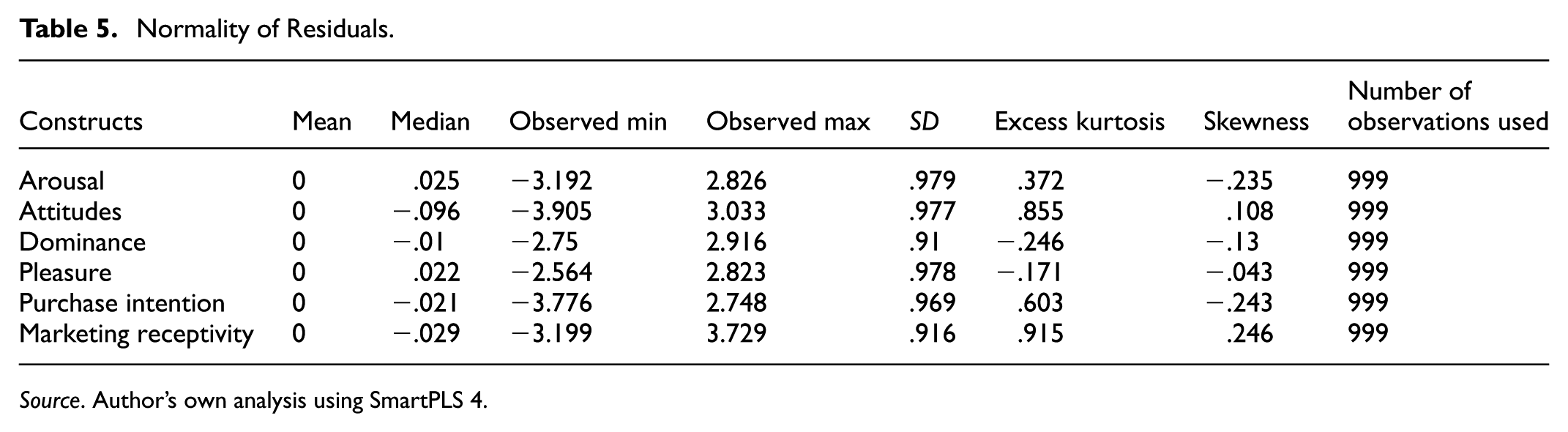
In terms of the normality of residuals, the results in Table 5 show that the mean values are all close to 0, and the standard deviation is close to 1; therefore, the residual distribution is approximately normal, and the assumption of normal distribution of the residuals is not violated.
Normality of Residuals.
Source. Author’s own analysis using SmartPLS 4.
Evaluating Structural Model
Figure 2 and Table 6 present the findings of hypothesis testing and structural coefficient paths. As expected, all direct nexuses between the components of the S-O-R framework were significant (p < .01). The positive effects of marketing exposure on pleasure (β = .207), arousal (β = .206), and purchase intention (β = .168) were significant and confirmed. In addition, the negative effect of marketing exposure on dominance was also identified (β = −.415). Hence, H1, H2, H3, and H4 were supported. Similarly, the positive impacts of pleasure on marketing receptivity (β = .220), arousal on marketing receptivity (β = .157), marketing receptivity on attitudes (β = .213), and attitudes on purchase intention (β = .182), as well as the negative effect of dominance on marketing receptivity (β = −.189), were significant and confirmed. As a result, H5, H6, H7, H8, and H9 were supported.

Results of structural paths.
Hypothesized Structural Paths (PLS-SEM Bootstrapping Results).

Note. Path coefficients (Estimate), standard deviation (SD), t-values, and p-values are based on 5,000 bootstrap subsamples. All hypothesized relationships are significant at p < .01 (two-tailed test).
Source. Author’s own analysis using SmartPLS 4.
SD = standard deviation; ns = not significant; AC = accepted; RJ = rejected; R2Pleasure = .043; R2Arousal = .042; R2Dominance = .172; R2Attitudes = .045; R2Rec = .161; R2Purchase intention = .060.
p < .01.
Discussion
Based on the results, this study provided a holistic conceptual model to explain the current smokers’ purchase intentions. The research findings also demonstrated the suitability of the S-O-R frameworks in expressing the mechanism of forming smokers’ purchase intentions. Regarding the direct associations of components in the S-O-R framework, tobacco marketing exposure has significant positive impacts on pleasure (β = .207, p < .01), arousal (β = .206, p < .01), and smokers’ purchase intentions (β = .168, p < .01). Similarly, pleasure and arousal are the emotional states that have significantly positive impacts on marketing receptivity (βPleasure→Marketing receptivity) = .220, p < .01; βArousal→Marketing receptivity = .157, p < .01). As expected, tobacco marketing exposure had a negative effect on dominance (β = −.415, p < .01) and dominance also had a negative effect on advertising receptivity (β = −.189, p < .01). At last, attitudes towards tobacco marketing have positive associations with both marketing receptivity (β = .213, p < .01) and smokers’ purchase intentions (β = .182, p < .01). Additionally, this study responded to the call for papers by T. B. Y. Tran et al. (2024) aimed to consider not only emotional aspects but also other factors such as rationality (marketing receptivity and attitudes towards tobacco marketing) while explaining the process of forming tobacco purchase intention.
In practice, Vietnam continues to face a high prevalence of smoking, with significant gender disparity. Smoking is prevalent among adult males, with a substantial portion being regular smokers, often using traditional tobacco products (Viet Nguyen et al., 2021). Smoking rates among adult females are also notable, and there are concerns about a growing trend of smoking among women. In Vietnamese society, smoking has traditionally been well accepted among men, considered a social activity enjoyed between colleagues and business partners (Dinh & van Teijlingen, 2019). Hence, the belief remains among many teenage boys that smoking is a demonstration of maturity and masculinity (Govender & Bhana, 2023). According to the positive effects of tobacco marketing exposure on pleasure (β = .207, p < .01) and arousal (β = .206, p < .01), the findings reveal a nuanced strategy for tobacco companies to enhance their advertising effectiveness. By focusing on creating advertisements that evoke feelings of enjoyment and excitement through specific imagery, narratives, or music, these companies can make their marketing more appealing and engaging. This approach not only aligns with consumer motivations and preferences, seeking emotional gratification, but also potentially leads to higher engagement rates and reinforces brand loyalty. Understanding the significant role of pleasure and arousal in consumer receptivity enables marketers to craft strategies that resonate deeply with the emotional states consumers desire, underlining the importance of emotional connectivity in marketing campaigns. However, these findings also raise critical public health concerns and necessitate stringent regulatory considerations. The ability of tobacco advertising to manipulate emotional responses, particularly pleasure and arousal, underscores the urgency for comprehensive policies aimed at curtailing the emotional appeals utilized in such marketing. This is pivotal in safeguarding vulnerable demographics from being disproportionately influenced by tactics that exploit emotional triggers to enhance receptivity towards tobacco products. From a broader perspective, the strategic use of emotional appeals by tobacco manufacturers presents ethical dilemmas, given the well-known health hazards associated with tobacco consumption. Consequently, this calls for a delicate balance between innovative marketing strategies and the imperative to protect public health, highlighting the essential role of regulatory bodies in monitoring and controlling the marketing practices of tobacco companies to mitigate the adverse health impacts of tobacco use. On the other hand, interests and ethics seem to be at odds in this situation. Both businesses and governments understand the harmful effects of tobacco, but they also bring economic benefits (cigarette sales from the business perspective and excise taxes from the government perspective).
The negative impact of dominance in tobacco marketing communications on marketing receptivity (β = −.189, p < .01) suggests that when consumers perceive marketing messages as too controlling or overpowering, it can lead to decreased receptivity and engagement. This observation implies that overly assertive advertising strategies may backfire, reducing the effectiveness of marketing efforts. From a regulatory standpoint, this insight supports the need for guidelines that limit aggressive marketing tactics, particularly in industries like tobacco, where there is a significant public health interest in reducing consumption. Policymakers could leverage these findings to develop regulations that discourage dominance in marketing, aiming to protect consumers from potentially manipulative advertising practices and contribute to public health objectives by moderating the influence of tobacco advertising.
The positive correlation between marketing receptivity to tobacco company activities and more favorable attitudes toward smoking (β = .213, p < .01), leading to higher purchase intentions (β = .182, p < .01), suggests that effective tobacco marketing can significantly influence consumer perceptions and behaviors. This inference highlights the power of marketing in shaping attitudes, suggesting that individuals exposed to and receptive to tobacco advertising are more likely to view smoking in a positive light and, consequently, show a greater likelihood of purchasing tobacco products. Such findings underscore the role of marketing in reinforcing the appeal of smoking, despite widespread awareness of its health risks. From a regulatory perspective, these insights advocate for stringent controls on tobacco marketing to mitigate its influence on public attitudes and behaviors. By implementing stricter advertising regulations, policymakers can aim to reduce the effectiveness of tobacco marketing in promoting smoking, especially among vulnerable populations such as the youth. This could include measures like banning advertising in certain media, restricting the use of promotional tactics that target younger audiences, and ensuring that marketing materials clearly communicate the health risks associated with smoking. Ultimately, such regulatory actions are crucial for public health efforts aimed at decreasing smoking rates and preventing tobacco-related diseases.
Another highlight of this research is the success in combining unstable emotions (PAD emotional states) and rational aspects (marketing receptivity and attitudes toward tobacco marketing) when explaining the purchase intention in the context of current smokers. The research findings pointed out the critical role of emotional aspects in explaining behavioral intention and were consistent with the findings of T. B. Y. Tran et al. (2024) and Bruch and Feinberg (2017), in which emotions could strengthen advertising acceptance or weaken marketing receptivity. In addition, the important role of marketing receptivity has been identified through its direct impact on smokers’ attitudes toward cigarette advertising when forming cigarette purchase intentions. It can be said that this research approach brings novelty in the context of cigarette purchase intentions and there has not been any previous research that has examined the process of forming smokers’ purchase intentions like this study. This study validated an integrated SOR-based model that explains the interrelationship between environmental stimuli, smokers’ organisms, attitudes and smokers’ purchase intentions, successfully expanding the TPB to cover both cognitive and emotional aspects of intention. The integration of PAD into the TPB not only elevates its theoretical robustness in capturing the complexities of smokers’ purchase intentions, but also aligns with Mehrabian and Russell (1974) conclusions about PAD emotional responses being appropriate for predicting approach-avoidance behaviors.
Former scholars have always strived to find an optimal theoretical model to explain human decisions through their intentions (Bruch & Feinberg, 2017); however, there are many debates and even conflicts about the factors to make the final decision (e.g., the roles of emotion and rationality). The question to consider is whether people can just rely on data analysis to make decisions and eliminate emotional elements-affective response, or if emotional considerations are the major drivers in decision-making. Based on this research results, the theoretical model in this study has proven that emotions (PAD emotional states) and reason (attitudes towards tobacco marketing) are two parallel elements; they completely complement each other and serve as the necessary bridge between the two. Besides, despite the fact that this model is not an optimal theoretical model to explain human decisions through their intentions (smokers’ purchase intentions), it contributes to improving and providing more research approaches to an optimal decision via the intention. On the other hand, most previous studies in the context of tobacco focused on the public health sector, such as smokers’ intentions to quit smoking or smoke (Chen et al., 2021; Lareyre et al., 2021; Oh & Boo, 2023; Saleem et al., 2023) while there have been limited marketing aspects. Hence, this is a typical study in the field of tobacco marketing and will bring significant theoretical and practical contributions in explaining in depth the factors that influence cigarette purchase intentions in both emotional and rational aspects.
In relation to the significant contribution of this research to the theoretical material in this field, practical implications were also proposed according to the direct effects of this research model:
Further limiting marketing appeal: Introduce stricter controls on the tone and aesthetic of tobacco marketing to ensure it does not employ tactics that are specifically designed to be pleasing or engaging in a manner that increases receptivity among current smokers.
Comprehensive ban on indirect advertising: Ensure that even indirect or subtle forms of marketing, which might not overtly promote tobacco but create a positive association with smoking, are prohibited.
Enhanced monitoring and enforcement: Strengthen the enforcement of existing marketing restrictions and closely monitor tobacco company practices to ensure compliance with regulations that aim to make tobacco marketing less appealing and dominant.
Public education campaigns: Amplify public health campaigns that counteract positive attitudes towards smoking, focusing on the health risks and social consequences of tobacco use to counterbalance any increased receptivity due to marketing.
These considerations would build on Vietnam’s existing tobacco control efforts, aiming to further reduce the influence of tobacco marketing on smoking behavior and ultimately decrease tobacco use among the population.
Conclusions
Along with the results, this study validated the significance of the research technique by clearly illustrating the process of creating smokers’ purchase intentions. The research outcomes satisfied the intended aims effectively. First, the study revealed the process by which existing smokers establish purchase intentions, as well as insights into smokers’ actions and practical consequences for Vietnamese policymakers. Second, the research has obviously explained the nexus of stimulus factors (exposure to tobacco marketing), individuals’ processes (smokers’ marketing receptivity, emotional states, and attitudes toward tobacco marketing), and smokers’ purchase intentions. Third, the study provided a unique and innovative approach to the tobacco sector and served as a basis for intervention measures to enhance regulations restricting tobacco advertising without limitation and reducing future smoking rates. Finally, the research findings indicate that when smokers are exposed to marketing that is pleasant and not overly dominant, their receptivity to tobacco advertising increases, subsequently improving their attitudes toward smoking and leading to higher cigarette purchase intentions. These insights call for concise regulatory considerations focused on the manner and content of tobacco marketing. Regulators should consider implementing strict guidelines that limit the appeal of marketing tactics used by tobacco companies, particularly those that are crafted to be pleasing without appearing dominant, to prevent the normalization or positive framing of smoking. Policies could include restrictions on the aesthetic and emotional appeal of advertisements, the contexts in which tobacco marketing is allowed, and the direct targeting of consumers through personalized marketing strategies. The goal of such regulations would be to minimize the impact of tobacco marketing on consumer attitudes and behaviors, ultimately aiming to reduce smoking prevalence and protect public health.
In addition to the significant contributions, several limitations have been recognized. First, some biases may be happened such as measurement errors, generalizability, etc. due to the cross-sectional study. Second, although this study focused on both emotional and rational aspects in explaining smokers’ purchase intentions, the level of rationality was low (receptivity and attitudes). Therefore, future studies may consider cigarette purchase intention in a different approach such as behavioral cognition instead of just stopping at low cognitive levels such as marketing receptivity and individual attitudes toward advertising information. To further clarify the mechanism of cigarette purchase intention formation, a model testing the cognitive process from low to high should be conducted in the future, for example low and high thinking ability in shaping the purchase intention. Will individuals with low and high recognition differ in their intention to order cigarettes, and will this lens allow them to easily accept tobacco advertising information. Finally, this study aims to study the case of smokers in Vietnam, and the sample size is a limitation, so it is necessary to expand the research to other regions in the world to perfect the current research model.
Footnotes

Ethical Considerations
This study involved human participants recruited to complete a survey. Ethics approval was obtained from the relevant university ethics committee (Reference number anonymized for review) on 11 November 2021. All procedures performed in studies involving human participants (for survey purposes) were in accordance with the ethical standards of the institutional and/or national research committee and with the 1964 Helsinki declaration and its later amendments or comparable ethical standards.
Consent to Participate
Informed consent was obtained from all individual participants included in the study. All participants provided informed consent either online (by clicking the “Start survey” button) or in person (via a signed consent form) after reviewing the research information. The study posed minimal risk, as no identifying information was collected, participation was voluntary, and participants could skip the questions and withdraw at any time. Data were collected anonymously and stored securely in compliance with the university’s research ethics policy. The potential societal benefits—such as informing more effective tobacco control policies—outweigh the negligible risk to participants.
Funding
The authors received no financial support for the research, authorship, and/or publication of this article.
Declaration of Conflicting Interests
The authors declared no potential conflicts of interest with respect to the research, authorship, and/or publication of this article.
Data Availability Statement
The data presented in this study are available on request from the corresponding author.