




Abstract
An unsustainable milk value chain can make consumers’ retention of preferences fragile, leading to a reduction in belief. One of the major ways of changing this belief is “belief revision” which accounts an interaction between a change in an individual’s preference with reference to its source and a belief expectancy and affects consumers’ behavioral intentions effectively. As there is little research on belief revision, the present study aims to investigate the impact of belief revision on purchase intention under an extended model for the theory of planned behavior. In doing so, the data were collected via a survey design regarding buying and drinking of liquid milk (LM) of the urban area. Principal component analysis and the binary logit model were the main research methods employed to analyze the data. The results of the study show that in a high level of belief expectancy, consumers’ behavioral belief revision and control belief have a negative effect, and the strength of behavioral belief has a positive significant effect on the purchase intention of LM. Moreover, among three social cognitive factors (attitude, subjective norm, perceived behavioral control [PBC]), only the PBC is associated positively and significantly with the purchase intention of LM, while no modal salient belief (beliefs, belief expectancies, belief values) affects the social cognitive factors. The study fundamentally adds to the literature, in that it first demonstrates the significance of belief revision in assessing the purchase intention.
Keywords
Introduction
In Western Europe, per capita milk consumption is more than 300 L/year, whereas it is only 30 L or less in some Asian countries, even though it is in South Asia where 23% of global milk is produced (IFCN Dairy Network, 2014). Currently, Asia is experiencing an increasing growth rate of milk consumption (Delgado, 2003), of which 46% of the total is liquid milk (LM) (Bhatia, 1984). With this growing consumption, consumers’ perceived values of LM have changed in light of food allergies and intolerances (Lanfranchi et al., 2017) and firms’ milk scandals (Qiana et al., 2011) mostly in supply chains. In response to market demand, supplying unhealthy products cannot make a good business sense while supporting the growth of unsustainable food value chains (Smith, 2008). Evidences show that consumers’ perceived values toward LM have changed for the unsustainable value chains (Chaity & Al Amin, 2019; Desk, 2016; Independent Online Desk, 2019; Star Report, 2019) and their lack of trust (Hoque, Alam, Hoque, & Alam, 2018; Nahid, 2018). Furthermore, within LM categories, commercially processed LM is less preferred to fresh or raw LM because of consumers’ lack of belief (Hoque, Alam, Hoque, & Alam, 2018); such belief is a psychological construct that allows consumers to change their perceived value toward trust and risk (McKnight et al., 2002). Again, trust is a key in the area of food security and food safety (Lobb & Lobb, 2004); thus, their perceived value of belief has become central and now provides opportunities for them to estimate their demand for LM.
This demand varies directly with family income (Stiebeling et al., 1941), with its price and availability (Radam et al., 2010), and with its quality (Handford et al., 2016). Being a functional food, milk has a positive effect on the cognitive behavior of consumers, as it is augmented with vitamin D (Reed, 2013). Given its nutritional value, consumers’ wish to drink more LM as fresh food over the processed milk. This cognitive demand provides an opportunity to suppliers to add contaminated milk, which is not sustainable, to the existing value chain (Hoque, Alam, Hoque, & Alam, 2018). The corollary of this unsustainable milk supply is that consumers’ retention of preferences for milk becomes fragile, leading to a reduction in loyalty, not only in terms of behavior, but also of commitment and belief (Clarke, 2001). In addition, most developing countries including Asian countries are not self-sufficient in the production of LM, and finding pure and safe LM from authentic sources is difficult for consumers (Chanda et al., 2013).
In response to the required amount of 15.04 million tons, Bangladesh, an emerging economy in Asia, produces only 8.08 million tons (Uddin, 2019). Currently, this economy is experiencing an apparent rising trend in the consumption of LM (Uddin et al., 2011). However, the per capita supply of fresh LM is scarce. Regrettably, this scarce amount is not safe to drink, meaning that there is a severe food security crisis (Hoque, Alam, Hoque, & Alam, 2018). For instance, almost all LM samples have been found to be contaminated, at least to a certain extent, with various additives such as water, cane sugar, powdered milk, starch, formalin, sodium bicarbonate, or fecal organisms (Chanda et al., 2013; Islam et al., 2018). In addition, marketers have been supplying adulterated milk, partly contributing to the deficiency in meeting excess demand. Therefore, it is unsurprising that consumers become confused and have less reason to believe that the LM they buy is safe for health (Hoque et al., 2018). Thus, most have tended to switch their preferences within milk categories (e.g., from commercially processed LM to farmers’ raw LM; Nahid, 2018). de Jongh and Liu (2006) found preference to be dynamic and to change over time, with changes caused by belief change. One of the major ways of changing belief is “belief revision” that accounts an interaction between a change in an individual’s preference for a particular object with reference to its source and a belief expectation of the same. Consequently, belief is widely used in social psychological research, which in turn determines the attitudes of consumers, as well as their preferences and intentions to purchase (Ivan & Penev, 2011). Therefore, this study focuses the interesting interaction between consumers’ belief and their preference dynamics that defines “belief revision,” and their influences on purchase intention.
The study by Bénabou and Tirole (2006) introduced the concept of collective belief, which focuses on individuals’ cognitive choices that arise naturally from psychological motives and economic rationality. Falk et al. (Armin et al., 2015) report that a key concept of economic rationality is consumers’ preference, which is associated with belief as psychological motivation. However, an unsafe and traditional LM value chain provides various challenges to dairy sector such as restoring consumers’ belief and trust and declining the belief revision. In addition, to assess this belief revision, belief is a key determinant that influences consumers’ preferences positively in buying LM (Hoque et al., 2018). However, consumers’ preferences are heterogeneous and fungible, and that these characteristics are also true for consumers in Bangladesh who choose to buy LM (Mila & Raha, 2013; Nahid, 2018; Shahnaz & Shimazaki, 2004). Studies show that the fungibility of preference and belief (de Jongh & Liu, 2006) and belief, preference, and purchase intention are linked to a wide range of existing literature in the social sciences (Chai, 2001). Therefore, we argue that multiplicative composites of consumers’ belief expectancy, their most recent (previous) preference, and the changes in current preference with reference to the previous preference for LM create a belief revision. Hope that this belief revision could influence consumers’ purchase intention and make a contribution to the related field of research.
To explain how consumers can predict purchase intention and deliberate behavior, the theory of planned behavior (TPB) has been widely employed in social science as a powerful tool. However, the TPB focuses on one-dimensional treatment of its construct disregarding the context of user dynamic decisions (Høie et al., 2010), thus making it difficult to identify the specific belief that affects the behavior of the consumer (Taylor, 1995). Therefore, scholars underline the importance of extending the TPB, focusing on the specific context of usage, to enhance the viability of the variations in usage behavior (Hsu & Huang, 2012). In doing so, researchers have included several constructs, such as self-identity processes (Shaw et al., 2000), the achievement of personal goals (Perugini & Bagozzi, 2001), descriptive norms (Høie et al., 2010), moral norms (Høie et al., 2010), anticipated emotions (Ajzen & Sheikh, 2013), perceived risk and benefit (Lee, 2013), uncertainty (Quintal et al., 2010), past behaviors (Lam & Hsu, 2006), user satisfaction (Baker & Crompton, 2000), technology readiness (Chen & Li, 2010), belief expectancy-value multiplicative score (Chan et al., 2015), emotional belief (De Pelsmaeker et al., 2017), to signify the predictive power of the TPB. The results demonstrate that the extended version of the TPB shows more concrete insight into behavior and behavioral intention.
Although the behavioral analyses have focused on the issues of consumers’ beliefs, belief revisions, their preferences, and so on, in the existing research on consumers’ affairs, less attention has focused on the belief revisions. Even, no study has used consumers’ belief and preference changes over the passage of time on purchase intention as a component in the modal set of beliefs, with the TPB as the framework to understand their behavioral intention. As little is known about this field, the related knowledge gap has motivated to consider the new construct of “belief revision” to provide a comprehensive explanation of intended behavior. Therefore, the objective of the research is to fill the knowledge gap and to help design effective dairy policy by investigating consumers’ beliefs, and belief revisions related to LM that influence their intention to purchase it. To attain the objective, the study introduces a new modal belief termed “belief revision” into the existing modal set of beliefs of the TPB and examines the impact of this modal set of beliefs on consumers’ purchasing intention, and on the social cognitive factors (attitude, subjective norm, perceived behavioral control) of LM. Subsequently, the study also examines the effect of the social cognitive factors on the purchase intention of LM based on the TPB, using a questionnaire survey. Exploratory factor analysis (EFA) and the binary logit model are the main research methods employed. Considering an emerging market in a conventional value chain, exploring consumers’ perceptions is crucial to estimating demand of LM. Hope the findings of the study regarding consumers’ beliefs, belief revisions, and their behavioral intentions help producers, marketers, and the government to formulate an efficacious dairy policy.
The structure of the study is as follows. The theoretical background and literature review are first presented, followed by a discussion of the data and the empirical model. The research results are then discussed, and the article ends with the concluding remarks and directions for further research.
Theoretical Background
The social cognitive theory (SCT) developed by Bandura (1986) posits that in a social context, people learn with a dynamic and reciprocal interaction. The salient feature of this theory is the focus on social influence and its prominence on both the external and internal social support. Accordingly, the SCT explains how individuals enact multiple human processes within social systems. Thus, the SCT emphasizes on learning processes where the interactions between social and cognitive factors of learning are the determinants of behavior.
In addition, to explain how consumers can predict behavioral intention and deliberate behavior, the TPB has been widely employed in social science as a powerful tool. In the TPB, some specific types of belief, such as behavioral, normative, and control belief (Ajzen, 1985; Hill et al., 1977), can help to predict the direct measures and to summarize an indirect estimation of attitude, subjective norms, and perceived behavioral control; these three types of beliefs are referred to as personal, social, and volitional belief, respectively. The TPB states that attitude, subjective norms, and perceived behavioral control are understood by such a set of beliefs. Furthermore, Ajzen (1985) developed an expectancy-value formulation with reference to the three “sets of belief.” In accordance with these three types of beliefs, the belief-revision construct is composed of a combination of the belief expectancy and revision value attached to it. In this study, the extended proposed model includes (a) belief strength, (b) belief values, (c) general belief (expectancy-value multiplicative score), and (d) belief revision, a new contribution to the indirect measures of the TPB. Belief revision is measured by the interaction effects of three variables, namely, belief expectancies, consumers’ previous (reference) choice, and changes in their preferences with reference to the previous choice.
Literature Review and Hypothesis Development
Consumers’ perceptions of highly commoditized product categories are particularly fungible (Steiner, 1993). In case of food products’ choice, personal preferences are dynamics, and the effect of consumers’ susceptibility is highly significant on the purchase intention of LM (Allen & Goddard, 2012). Again, LM is a utilitarian product, but is not commoditized in nature; however, paradoxically, it is fungible in value of preferences in Bangladeshi local markets (Nahid, 2018). This fungibility can occur due to unsustainable milk value chains, whereas the alternative agri-food chain literature focuses on “cutting out the middleman” in markets to change this unsustainable food chain (Smith, 2008). The U.K. Sustainable Development Commission (Defra, 2002) has pooled many different actors’ views to produce an internationally acceptable description of “sustainable food supply chains” that focused on the production of safe and healthy products, support economies, and communities; respect the limits of natural resources; environment; and ensure a perceive value of high social welfare of people involved in the food chain. This perceived value can be predicted from peoples’ intentions with a high level of accuracy (Ajzen, 1991). Therefore, in this study, consumers’ perceptions of LM have been forecasted alongside purchase intention.
To analyze a particular behavior, the TPB considers three kinds of belief, namely, behavioral, normative, and control, which affect consumers’ behavioral intention. These beliefs refer to consumers’ perceived positive or negative consequences of undertaking a particular behavior, which is treated as belief strengths or expectancies, and the subjective evaluations or values of these consequences. Jointly, these three beliefs enter into the memory, leading to the formation of positive or negative attitudes toward individual behavior. Therefore, the following set of hypotheses are proposed:
The inclusion of the “perceived value” construct in the extended theory of the TPB is fruitful (Al-Debei et al., 2013). Again, the concept “perceived value” can be described as consumers’ overall valuation of the utility of a product considering the costs and benefits (Zeithaml, 1988, p. 14). Furthermore, this description can be viewed from the economic theory of utility that trade off between an individual limited resources and achieving the maximum utility (Zeithaml, 1988). In addition, peoples’ perceived value and changing underlying beliefs influence intention (Fishbein & Ajzen, 1975; Sweeney et al., 1997). Based on these findings, the present study considered the following set of hypothesis:
Chan et al. (2015) measured expectancy-belief multiplicative composites and found a positive association between belief expectancies, belief values, and the expectancy-belief multiplicative composites with their corresponding social cognitive variables (attitude, normative belief, and perceived behavioral control). Moreover, the TPB confirms a relationship between social cognitive variables and behavioral intention. Ajzen (1985, 1991), expectancy-value formulations with respect to the three sets of beliefs, proposed three different types of beliefs (behavioral, normative, and control belief). For instance, behavioral belief strength (e.g., the perceived probability of behavioral outcomes) × outcome evaluation (e.g., the subjective evaluation of the expected outcomes) = behavioral belief (Chan et al., 2015). Similarly, the normative and control belief have been calculated. Therefore, based on these equations, the third set of hypotheses has been posited:
The SCT deals with human learning processes where an interaction of social and cognitive factors of learning is the driving force of behavior (Bandura, 1986). As a part of behavioral intention, if we prefer something, we believe that we do so, and vice versa (de Jongh & Liu, 2006). They added changes in preference, with reference to their sources, and entailed changes in the priority sequence, together with changes in an inverse belief. The results of these two cognitive changes in preference and belief, which is “belief revision” in this study, assumed that higher belief revision would bring about lower behavioral intention. Therefore, the fourth set of hypotheses of the study is:
Study by Nolan-Clark et al. (2011) found that nutritional knowledge leads to improve attitude toward dairy products. They added that normative beliefs are less amenable to change through nutrition knowledge than control and behavioral beliefs. Furthermore, based on the findings related to the connection between preference and belief by de Jongh and Liu (2006) and the links that the TPB has established between beliefs and the social cognitive factors (attitude, subjective norms, perceived behavioral control), it is logical to say that modal beliefs are associated with the social cognitive factors. In addition, in causal effect modeling, the direct, indirect, and total effects among latent variables, following the theory or the conceptual model, should be considered (Schreiber et al., 2006). Hence, the indirect effect indicates the influence of an explanatory variable on a response variable via a mediating variable (Baron & Kenny, 1986). Based on these outcomes, the following hypotheses are proposed:
The literature indicates that values and beliefs are generally better predictors of attitudes and acceptance than demographic characteristics (Lyndhurst, 2009). According to Fishbein and Ajzen (Ajzen & Albarracin, 2007), individuals’ attitudes are understood by their behavioral beliefs in certain actions and evaluation of the outcome of these actions. Overall attitude is estimated by aggregating the multiplication of behavioral belief and the evaluation of the outcome (Ajzen & Fishbein, 1980). Evidence also shows that belief can mediate the relationship between preference and intention (de Jongh & Liu, 2006), and that the effect of belief revision on behavioral intention can be negative. Thus, belief revision may be linked negatively to attitude, subjective norms, and perceived behavioral control. Consequently, the final hypotheses posited are as follows:
The article’s conceptual model, including these six sets of hypotheses, is presented in Figure 1.

Consumers’ beliefs underlying attitude, subjective norm, and perceived behavioral control, belief importance, and the purchase intention of liquid milk.
Method
Participants
Based on the increased urbanization (The World Bank, 2015) and the disposable income of consumers (Mila & Raha, 2013), the demand for functional foods is also increasing showing an emerging economy (Nahid, 2018). Furthermore, since the birth of the nation, the Chittagong city is playing a key role in keeping Bangladesh economy dynamic (Monir, 2017). The study reports that more than 92% of foreign trade are transported through the Port of Chittagong city (Monir, 2017). Perhaps, due to these reasons, the city Chittagong is called the “Gateway of Bangladesh” and our expectation is that knowing perceived value regarding LM from the consumer of this city could be interesting to Bangladeshi milk market segmentation. Therefore, the urban zone of Chittagong, Bangladesh, was the sample area for the study. Primary data were collected from the study area through the use of a structured questionnaire.
The respondents were the consumers who patronize supermarkets and wholesale areas. To form the sample, the judgmental sampling was conducted. In general, most food trade takes place in Bangladesh in unstructured wholesale markets which is called convenience stores and retail markets (Guadagnoli & Velicer, 1988) and in a few supermarkets. Therefore, two major wholesale areas in Chittagong (Riazuddin Bazar and Khatun Ganj), two leading retail areas (Chawk Bazar and Bahaddarhat), and two leading supermarkets (Swapno and Agora) located in two different areas were deemed to be representative of consumers. The criteria considered, when selecting the subject, only those that consume or have consumed LM. When people had finished their shopping, they were approached with the verbal consent at the gate of the shopping mall and/or market and asked to participate in the self-reporting survey. Respondents older than the age of 18 were chosen for the interview. Those who accepted the invitations were then recruited. Before asking people, the ethical standard of the survey contents was approved by the Dean Committee, University of Chittagong, Bangladesh. Finally, the sampling distribution of the six clusters was as follows: Riazuddin Bazar, 48; Khatun Ganj, 44; Chawk Bazar, 45; Bahaddarhat, 41; Swapno, 30; and Agora, 32.
Before the final version of the survey, a pretest survey was conducted on 10 consumers at Riazuddin Bazar and eight at the Agora supermarket in the same city. Based on their responses, the clarity of the questionnaire, the suitability of the participants, and the time required were improved. As major obstacles were not found, it was decided to keep the same settings for the final survey. A total of 243 individuals participated in the survey, which was carried out between February 10 and April 19, 2018. Among the 243 individuals, the three responses have canceled for the uselessness (as they gave insufficient demographics and socioeconomic information). For the strong intercorrelations, a sample size of 150 observations should be sufficient for reliable EFA (Guadagnoli & Velicer, 1988), whereas for confirmatory factor analysis (CFA), a minimum sample size of 100 is recommended (McDonald & Bollen, 2006). Sekaran and Bougie (2016) consider the appropriate size of a sample to be between 30 and 500, so minimum requirements were therefore satisfied.
Setup and Pretest
The questionnaire was constructed in accordance with the guidelines defined by Fishbein and Ajzen (Ajzen & Albarracin, 2007; Fishbein & Ajzen, 2010), who indicate that there is no standard questionnaire in relation to the TPB, but rather a standard construction procedure. First, a group of target respondents (20 frequent milk consumers and buyers) was selected to construct the questions on attitude, subjective norms, perceived behavioral control, and purchase intention, based on measurement of their salient beliefs. These respondents were selected at the University of Chittagong, Bangladesh. A set of open-ended questions was presented to the participants. The test was developed in the local language, Bengali. The following questions were asked:
“Why would you consider drinking or not drinking liquid milk?” 1 (advantages and disadvantages) (attitude)
“Is there anything else you associate with your own views about drinking or not drinking liquid milk?” (attitude)
“Are there any individuals or groups who would approve or disapprove if you drank liquid milk?” (subjective norm)
“Is there anything else you associate with other people’s views about drinking or not drinking liquid milk?” (subjective norm)
“What factors or circumstances would encourage you to, or prevent you from, drinking liquid milk?” (perceived behavioral control)
“Are there any other issues that come to mind when you think about drinking or not drinking liquid milk?” (perceived behavioral control)
Table 1 shows a list of the salient beliefs with their descriptive statistics for the major constructs in the questionnaire. The number of beliefs that is taken into account was limited to keep the final questionnaire manageable for the respondents. The major beliefs were selected based on the most common answers in the study. Seven, four, and six statements were considered for behavioral, normative, and control beliefs respectively.
Descriptive Statistics of Salient Beliefs Derived From the Elicitation Study.

Note. The beliefs constructs mentioned in the above table were weighted using a scale of 1 = “strongly disagree” to 7 = “strongly agree.” LM = liquid milk.
Measures and Final Questionnaire
The items for the questions included in the questionnaire were developed based on study elicitation. The questionnaire comprised three sections. Section “Introduction” consisted of consumers’ beliefs (behavioral belief, normative belief, and control belief), expectancies, and their outcome evaluations. Section “Theoretical Background” comprised perceptions of belief revision, the social cognitive variables, and purchase intention separately, whereas section “Literature Review and Hypothesis Development” included the demographic information of the respondents. The Likert-type scale was used to record the answers to the question format, which asked consumers to numerically rate whether they agreed or disagreed with a particular statement, for example, their behavioral belief with regard to LM. The responses on belief were weighted using a scale of 1 = “strongly disagree” to 7 = “strongly agree.” The highest level of agreement was indicated by 7, whereas a neutral or undecided position was indicated by 4.
Behavioral belief involved the interaction between behavioral belief strengths and their outcome evaluation, whereas belief strength covered three items, namely, beliefs regarding health awareness, perceived knowledge, and attitude to purchase intention. Opinion with regard to the health awareness factor was represented by statements such as “drinking LM is a part of a natural way of living,” and a “convenient way of meeting daily recommended intakes,” and that LM can be part of a healthy diet. Estimating the level of fat, and the possibility of distinguishing the differences in milk products, related to the factor of perceived knowledge; the notions that drinking LM is harmful and purchasing it is unbeneficial represented the attitude to purchase intention factor. To define behavioral belief strength, for instance, participants’ responses were established through statements such as “Drinking LM is a convenient way of meeting daily recommended intakes.” They were then asked to rate the statements such as “I think drinking LM in a convenient way of meeting daily recommended intakes from ‘bad’ to ‘good’ to represent their outcome evaluation.”
Normative belief covered belief strength and the motivation to comply. Hence, belief strength includes recommendations from family, friends, and doctors and the influence of TV commercials on drinking LM. To assess normative belief strength, the respondents’ opinions were established by asking them to rate statements such as “My doctor believes I should drink LM”; they were then given a supplementary statement to evaluate their motivation to comply by asking them to rate the notion “Influenced by my doctor’s desire, I want to drink LM” on a scale from “never” to “frequently.” Control belief included belief strength and belief power. The strengths of control belief covered the respondents’ beliefs in color, flavor, and food value; the comparison of prices with their claimed health benefits; and the willingness to pay a price premium. Hence, the participants were asked to indicate the extent to which they agreed with statements such as “According to me, LM is cheap in relation to its claimed health benefits.” Subsequently, they were asked to rate supplementary statements to calculate belief power, for example, “My positive values of LM’s price in relation to its health benefits would enable me to manage the purchase intention,” on a scale from 1 = “strongly disagree” to 7 = “strongly agree.”
The second section of the questionnaire included belief expectancy-value composite scores and belief revision. The belief expectancy-value construct included the belief strength of the weighted items and their outcome evaluation, which was termed the belief values. The study considered only respondents’ weighted items to form the constructs based on the factor loadings. This weighted belief expectancy value was measured by the multiplication of belief expectancies and belief values, which was termed belief (Ajzen, 1985; Chan et al., 2015). Belief revision was measured by the multiplicative composites of belief expectancies, consumers’ previous (reference) choice, and the current changes (if any) in their preferences with reference to the previous choice. In doing so, consumers were asked to indicate the best choice in a binary setting. For instance, “Up to one month ago, for me, the most appealing type of milk was (order is randomized): raw LM, or commercially processed LM.” The changes in the priority settings of the preferences were then measured by employing another statement, “Currently, compared to one month ago, I feel good drinking the following milk (order is randomized),” commercially processed LM or raw LM from the farms/their agents. Finally, the multiplicative scores of referred (previous) preference, current preference, and belief expectancies provide the belief-revision index.
Purchase intention incorporating consumers’ buying information was measured by statements such as “I intend to buy LM for a healthy lifestyle” (using a 7-point Likert-type scale, from 1 = “strongly disagree” to 7 = “strongly agree”) and “I have a positive attitude to buying LM” (again on a 7-point Likert-type scale, from 1 = “strongly disagree” to 7 = “strongly agree”). Section “Literature Review and Hypothesis Development” covered personal information, including age, income, education, gender, number of children, buying frequency, times of day of buying LM, together with one specific belief regarding neutrality based on a statement with a binary setting: “In order to fulfilment my needs, the way of getting protein by drinking any type of milk is more important to me than waiting for the most desired one” (0 = No; 1 = Yes). Eight statements concerning behavioral belief, four on normative belief, six on behavioral belief, and two regarding consumers’ perceptions of purchase intention were employed. Three EFAs were run and the results have considered Statements 7, 3, and 4 for behavioral, normative, and control belief, respectively (see Table 2). The negatively framed questions were recoded, with a higher score of consumers’ behavioral belief referring to higher levels of purchase intention. The mean values of the extracted factors from each variable were then measured to be employed as independent variables (IVs). Furthermore, the mean value of social cognitive factors of the TPB (attitude, subjective norm, perceived behavioral control) and purchase intention was accounted.
Outcome of EFA (Consumers’ Belief Scale).

Note. Extraction method: principal component analysis. EFA = Exploratory factor analysis; LM = liquid milk; KMO = Kaiser−Meyer−Olkin.
The Kaiser−Meyer−Olkin (KMO) test and Bartlett’s test of sphericity (BTS) were used to verify the factorability of the data (Pallant, 2007); the value of the KMO (in the first test) ranged from 0 to 1. For appropriate analysis, the value should be at least 0.50, with a BTS significant at p < .05 (Bechtold & Abdulai, 2014). The results of the EFA are shown in Table 2.
In the data set, the KMO values for behavioral belief, normative belief, control belief, and purchase intention were 0.68, 0.69, 0.52, and 0.50, respectively, indicating mediocre suites of data on behavioral belief and normative belief for factor analysis, where the minimum required score is 0.50. The KMO values of control belief and purchase intention are tolerable and meet the minimum criterion, thus showing sample adequacy. Hair et al. (Black & Anderson, 2014) recommend a score of >0.50 for loadings to demonstrate practical significance. From the EFA, a total of 14 items of indirect measures were extracted with values >0.50, showing that the constructs were practically significant (Table 2). Reliability was tested using Cronbach’s alpha, with the cut-off rate set at .60 (Black & Anderson, 2014). Cronbach’s alpha value for the perceived belief and intention constructs was either very close to 0.70 or >0.70 (Table 2). The cut-off rate of Cronbach’s alpha was set at .70 and all the questions met this criterion (Table 2). The results indicate a relatively good level of internal consistency for the constructs. Convergent validity was established by examining the t tests (p < .01) for factor loadings, and all were significant (Lambert et al., 2015). Discriminant validity was also established by using the confidence interval test (p < .05) of the mean score of the three belief constructs and purchase intention (O’Rourke & Hatcher, 2015). The average real factor loading score was >0.7. Factor loading scores higher than 0.6 plus zero cross-loading also ensured convergent and discriminant validity, respectively. Furthermore, more than one eigenvalue score indicates the contribution of the factor to the model and discriminant validity. Finally, the theories also support the validity of the constructs.
Two of the most popular methods, the variance inflation factor (VIF) and tolerance (TOL), were used to detect the occurrence of multicollinearity problems for the explanatory variables (Verbeek, 2007). A general rule of thumb is that a VIF of 10 or greater and a TOL of 0.10 or less may indicate the presence of multicollinearity. The test results suggest no multicollinearity problems in the data set. The EFA was used to determine an optimum number of dimensions, their mutual associations based on responses to particular items, and to form a pattern matrix. Based on this EFA pattern matrix, binary logistic regressions were used to justify the fitness of the model and to measure the cause and effect relationship between the factors. The normality of the data was also checked. The results show that the data set was negatively skewed. Therefore, the 7-point Likert-type-scaled observed variables were transferred into the binary scale. The binary regression models were then used to ascertain the determinants of consumer belief that had an effect on purchase intention. Finally, the Sobel tests were applied to test whether the social cognitive factors (e.g., attitude) mediated the relationship between belief and purchase intention (dependent variable [DV]).
Econometrics Model
The study employs logistic regression instead of structural equation modeling (SEM) as the main statistical tool as, unlike SEM, the logit model does not assume multivariate normality. In addition, as discussed in a popular book on PLS-SEM (Hair et al., 2014), skewed data are a problem. Furthermore, the logit model provides the estimated marginal effect that magnifies the significance of each explanatory variable. Prominent economists widely use the logit model, which is very popular in marketing and strategic management studies (Lowe & Parvar, 2004).
The ordered logit model is very helpful and appropriate in contexts where respondents are asked to choose between multiple categories that are ranked in order from 1 = “strongly disagree” to 7 = “strongly agree.” However, as skewed data pose a hindrance when the low-point scales lose their representatives in the sample, the multinomial variables need to be transformed into binomial ones, as suggested by Mehmetoglu (2009) and Prebensen and Xie (2017). Respondents who give scores of 5 or below are regarded as agreeing less, or having lower perceived value, whereas those who give scores above 5 are deemed to strongly agree or to have higher perceived value. However, Mehmetoglu (2009) and Williams and Soutar (2009) suggest that when respondents have general, positive perceived values regarding their experience, and when they give responses for reasons other than their own perception, such as ones based on political pressure, the resulting data might suffer from negative skewness. Therefore, a binomial logit model was deployed in this study along with estimation by R programming, as follows:

Hence, ∅ is a function of logistical cumulative distribution that takes values between 0 and 1 strictly for all real numbers z (Wooldridge, 2016). In addition, n = 1 is the number of response variables including one purchase intention and three social cognitive variables, where


Equation 3 signifies the natural logarithm of the odds that an observation will cover a category of response, namely 1 = “strongly agree” or 0 = “strongly disagree.” The model has predicted the value using the principle of maximum likelihood (Wooldridge, 2016). The marginal effects of the predictors on the response probability were calculated as follows:

The resulting empirical specification for Equation 3 is

Equation 5 is the first purchase intention (pi) equation. The literature indicates that purchase intention is affected not only by the perceived value, but also by consumers’ preference and the changes in preference with reference to a previous source. Perceived value is measured by multidimensional constructs consisting of belief strength (str), outcome evaluation (eva), belief value (bel), and belief-revision value (br). If the estimated parameters of exp, eva, and bel are positive and negative for br, and statistically significant at an acceptable level (normally 10%), we can conclude that H1, H2, H3, and H4 are true, meaning that consumers have a positive and direct effect on purchase intention from their expectations, evaluations, and beliefs, but have a negative and direct effect on purchase intention from their belief revision:
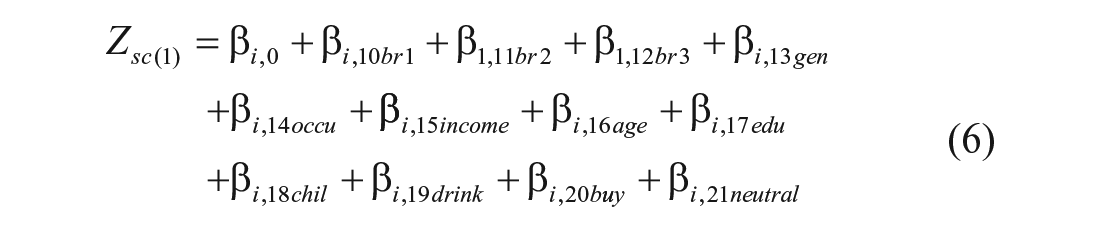
Equation 6 represents three social cognitive (sc) equations. Each perceived value is predicted by consumers’ belief revision (bri). Similarly, if the estimated parameters of br1, br2, and br3 are influential and statistically significant in Equation 6, we can conclude that belief revision creates social cognition and that H5 is partially true:

Equation 7 represents the second purchase intention (pi) equation. Each score is predicted by consumers’ attitude (att), subjective norm (sn), and perceived behavioral control (pbc). Similarly, if the estimated parameters of att, sn, and pbc are influential and statistically significant in Equation 7 we can conclude that social cognitive factors create purchase intention and H5 is partially true. H5 examines the indirect relationship between belief revision and behavioral intention via social cognitive factors. Thus, one separate Sobel equation was run to test H5 and to examine whether the equation can mediate Equations 6 and 7. Similarly, if the estimated parameters of val1, val2, and val3; str1, str2, and str3; and bel1, bel2, and bel3 are positive, and br1, br2, and br3 are negative and statistically significant in Equation 6, we can conclude that consumers create social cognition and that H6 is true.
Results
The participant demographics are presented in Table 3. The majority of the respondents were male (62%), 47% were aged between 21 and 30 years, and 45% were graduates. Only 8% of the respondents are homemakers, whereas the highest, say 40%, are jobholders. The average monthly income of 50% of the respondents was ≤BDT25,000 (US$1 = BDT84). Only 20% of the respondents had more than two children, and 52% had no children.
Descriptive Statistics of the Demographics, Socioeconomic Variables, and Consumers’ Choice Pattern.
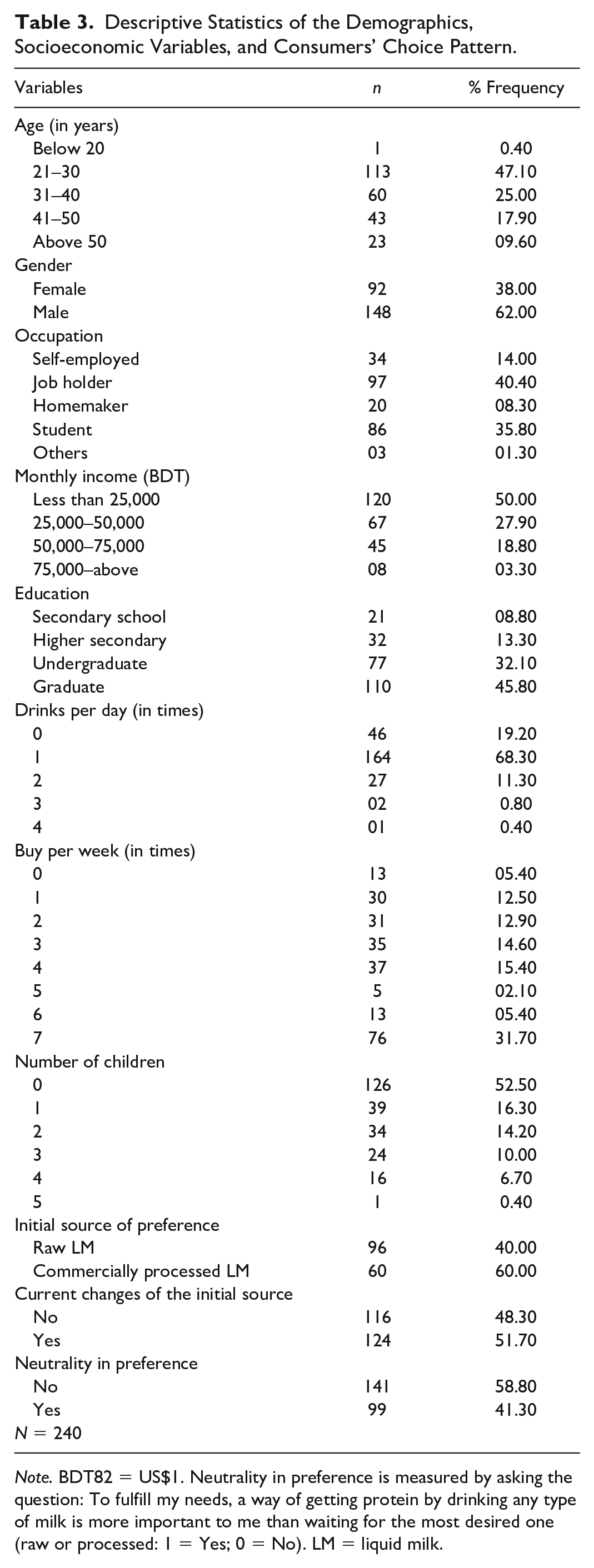
Note. BDT82 = US$1. Neutrality in preference is measured by asking the question: To fulfill my needs, a way of getting protein by drinking any type of milk is more important to me than waiting for the most desired one (raw or processed: 1 = Yes; 0 = No). LM = liquid milk.
On average, the participants drank LM almost once a day and bought milk about 4 times per week. The tendency to buy LM was higher than that of drinking. Initially, 60% of the total respondents preferred commercially processed LM. Currently, almost 52% of sampled consumers have switched their preferences from initial source (if it is raw LM) to an alternative source (commercially processed LM). The mean of neutrality in buying the form of LM is 0.41, indicating almost an average score. In addition to the descriptive statistics, binary logit regression was first run to examine whether any demographics or psychographics had effects on the purchase intention of LM. The results reveal that consumers’ neutrality “to fulfil my needs, way of getting protein by drinking any type of milk is more important to me than waiting for the most desired one” has a negative significant effect on the purchase intention of LM (b = −0.675, z = −2.083, p = .037). The odds of this consumer perceived value are 0.508, showing that the odds of neutrality in obtaining any type of LM are average in purchase intention. The other variables of gender, occupation, income, age, education, number of children, and frequency of drinking and buying have no significant effect on the purchase intention of LM.
Consumers’ belief values (numerical outcome evaluation) with regard to the LM in the Bangladeshi market are poor and their impact on the purchase intention of LM is negative except the control belief values. The differences between their expectation and their evaluation of LM in terms of attributes are high in normative and behavioral belief, respectively, but negative in control belief. A high positive difference indicates consumers’ poor evaluation, as they are not satisfied with the quality of LM. The study demonstrates the significance of addressing belief revision, social cognitive factors, and other general beliefs, which affect consumers’ purchase intention. Equation 3 illustrates the estimated parameters in the logit model, interpreted as the marginal effects of the observed explanatory variables on the logarithm of the odds of success. In this article, success refers to consumers’ degree of agreement and value toward their perceived belief. To address the importance of the explanatory variables, in the area of business studies, the marginal effects of the explanatory variables on the odds of success are normally reported. However, this study considers the direct effect of variables on the probability of success, as this is more viable and straightforward. Equation 4 is used to estimate the direct effect. Therefore, instead of reporting the estimated parameters, the marginal effect of the variables on success probability is reported in Table 4.
Estimated Results of the Marginal Effects on the Probability of Strongly Agreeing With Purchase Intentions.

Note. The numbers in parentheses are standard error.
= significant at the 10% level. ** = significant at the 5% level. *** = significant at the 1% level.
To ascertain whether belief revision, belief, and the social cognitive factors, for example, attitude, subjective norm, and perceived behavioral control, are important in consumer decision-making, the hypotheses presented in Figure 1 were tested. To test these, the study developed three regression models and ran three Sobel tests based on the outcome of EFA and the conceptual model (Figure 1). The first model explains the effects of a modal set of beliefs on purchase intention. The second model explains the effects of social cognitive variables on consumers’ purchase intention, and the last investigates the effects of a modal set of beliefs on the social cognitive factors. SPSS Version 25.00 was used for the factor analysis. The results of the hypotheses for the models are also presented in Table 4. The Sobel tests represent the direct and indirect effects of the DV and IV. Belief revision has a direct effect on purchase intention, as does general belief, and an indirect effect (through estimating the social cognitive factors, namely, attitude, subjective norm, and perceived behavioral control) on it. The total effect for milk value as “belief” is the summation of the direct and indirect effects on “purchase intention.”
In the purchase intention in Equation 1, it is found that behavioral belief strength, normative belief strength, and behavioral preference significantly influence consumers’ purchase intention. This finding suggests that belief strength (i.e., that intention transpires through the value created from expectation and the changes in preference) largely motivates purchase intention. Specifically, a single-unit increase in the scale of behavioral belief strength enhances the likelihood that consumers’ perceived behavioral intention will be influenced by as much as 44.9%. Similarly, a one-unit increase in consumers’ control belief (belief in the payment of a price premium and the assumption that price is low and belief in the perceived value of the importance of sensory perception) reduces the probability of perceived purchase intention drastically, by 101%. Furthermore, when the scale of behavioral belief preference increases by one unit, it reduces the probability of consumers’ perceived behavioral intention to purchase by 13.4%. Surprisingly, we find that consumers’ belief values (their outcome evaluations) are not statistically important.
In the purchase intention in Equation 2, it is found that only perceived behavioral control significantly influences consumers’ purchase intention. This result also suggests that perceived behavioral control (i.e., that intention transpires through the perceived behavioral control, that intention transpires through the perceived behavioral control created significantly from ease or difficulty of the consumers’ behavior, their confidence, and belief power in LM attributes) largely motivates purchase intention. Specifically, a one-unit increment in the scale of perceived behavioral control increases the probability of consumers’ perceived behavioral intention by 31.9%. This result also indicates that purchase intention does not transpire through the subjective norm (i.e., that intention transpires through the subjective norm created significantly from well-wishers’ thinking and consumers’ motivation to comply) and attitude (i.e., that intention transpires through consumers’ feelings about LM). In the three separate social cognitive equations, it is found that belief, belief strength, belief values, and belief revision have no significant influence on forming consumers’ attitude, their subjective norm, nor perceived behavioral control. Surprisingly, all three types of beliefs, namely, behavioral belief, normative belief, and control belief, have a negative impact on their attitude, subjective norm, and perceived behavioral control, respectively, although not at a statistically significant level.
In the second part, the mediating effect of attitude between belief revision and behavioral intention was measured and the results show that attitude can mediate the relationship between behavioral belief revision and consumers’ purchase intention, with z = 0.120 (0.001) and p = .000. In another mediating effect of the subjective norm between normative belief revision and behavioral intention, the results show that z = −0.563 (0.003) and p = −0.001, suggesting a statistically significant (at the 1% critical level) indirect effect of behavioral belief revision on purchase intention via subjective norm. Finally, the mediating effect of perceived behavioral control between control belief revision and behavioral intention shows a statistically significant positive influence. The results reveal that z = 1.484 (0.410) and p = .060, suggesting a value close to statistical significance. These results provide evidence to support in a trend, H5a, H5b, and H5c, that attitude, subjective norm, and perceived behavioral control can mediate the relationship between belief revision and purchase intention separately (Tables 5 and 6).
Results of Logit Modeling: Estimated Results of the Marginal Effects on the Probability.

Supported inversely.
Results of the Mediating Effect.

Note. Standard error in parentheses.
Discussion
The results support H1a, that the perception of behavioral belief strength (expectancies) increases consumers’ intention to purchase. The belief expectancies also influence users’ intention in the study by Chan et al. (2015). Apart from behavioral belief strength, normative and control belief strength do not have any significant marginal effect on the purchase intention of LM. The study done by Al-Debei et al. (2013) found that perceived behavioral control has no significant effect on users’ behaviors which is partly consistent with the result of this study. H2a, H2b, and H2c posited that the perception of belief value affects consumers’ intention to purchase, implying that the perception of the belief values of LM in Bangladesh does not influence significantly consumers’ intention to purchase. The outcome of the recent research is that consumers’ perceived value of the intrinsic and extrinsic cues of milk in the Bangladeshi market is too poor to facilitate any related behavior (Hoque, Xie, & Nazneen, 2018).
H3a and H3b suggested that greater perceived behavioral and normative beliefs (expectancy-belief multiplicative composites) will provide more purchase intention and are thus rejected: the perceived behavioral and normative beliefs of LM and their purchase intention are not significantly related in Bangladeshi local markets. However, H3c proposed that greater control belief (expectancy-belief multiplicative composites) will provide stronger purchase intention and is not rejected statistically, but is rejected theoretically: perceived consumers’ control belief leads to reduced purchase intention (a paradoxical outcome). This result is not consistent with the existing research including the study by Albino and Stephen (2015), indicating that the higher number of attributes facilitate belief strength and discourage belief power. In Bangladeshi local market, consumers’ belief power is relatively low, whereas belief strengths are high. Primarily, this control belief power could not be enabled to manage their purchase intention. Moreover, the milk scandals and negative scientific outcomes regarding LM impede consumer beliefs. As a result, people lose trust in LM, and at that crisis moment, their perceived knowledge alone is not sufficient to overcome the anxiety (Hoque, Alam, Hoque, & Alam, 2018). Thus, control belief negatively influences the purchase intention of LM.
H4a, H4b, and H4c posited that greater individual behavioral, normative, and control belief revision will reduce behavioral intention; in this case, the purchase intention. The results lead to H4a being accepted for behavioral belief revision and indicate that such revision has a negative and significant marginal effect on purchase intention, although this effect was not proven to be true for normative and control belief revision. Again, H5a, H5b, and H5c stated that behavioral belief revision, normative belief revision, and control belief revision have a significant indirect effect on purchase intention via social cognitive variables such as attitude, subjective norm, and perceived behavioral control and are therefore not rejected.
H6a, H6b, and H6c proposed that a higher perceived value of belief expectancy, belief values, and general belief helps to build stronger social cognitive factors such as attitude, subjective norm, and perceived behavioral control, but that belief revision does not. The results lead to H6a, and H6b being rejected, and indicate that belief, belief values, belief strength, and belief revision have no statistically significant effect on consumers’ attitude and subjective norm. On the contrary, H6c was accepted indicating that control belief, belief values, belief strength, and belief revision have statistically significant effect on perceived behavioral control. These results are in line with the study by Chan et al. (2015). The results also show that consumers’ belief has a negative, although not statistically significant, influence on the social cognitive variables. Similarly, normative belief revision only leads to an insignificant reduction in the subjective norm.
The results indicate that when the study considers only demographic and psychographic variables, “neutrality” has a negative significant influence on the purchase intention of LM. This finding indicates that being more flexible in choosing any type of milk to fulfill requirements will provide weaker purchase intention of LM. Surprisingly, gender, occupation, income, age, education, children, and frequency of drinking and buying are not statistically significant in the purchase intention of LM. This result is not in line with the findings of the studies by Hatirli et al. (2004), Radam et al. (2010), and Trung et al. (2014).
In general, consumers’ expectations in terms of the possible outcomes of drinking LM are high. On the contrary, the rate of fungibility in consumers’ previous choices is also high in terms of dissatisfaction, which leads to a decline in their level of belief. Thus, interaction between previous choices, changes in these choices, and their belief strength effect purchase intention negatively. In addition, respondents’ outcome evaluations, that is, their belief values and general belief with regard to behavioral, normative, and control belief, are poor and negative and are not significant. Among the 12 modal sets of belief, three items (from the belief construct) influence purchase intention significantly, indicating that consumers’ perceived belief is not enriched.
As per the TPB, the significant effects of the three social cognitive variables, attitude, subjective norm, and perceived behavioral control, on behavioral intention, are obvious. The results of the second purchase intention model show that attitude and subjective norm do not necessarily influence purchase intention, whereas perceived behavioral control has a positive and statistically significant effect on the purchase intention of LM. The analyses and results show that because of the low level of trust that milk is an unsafe functional food, consumers have a negative attitude, which cannot influence their purchase intention (Hoque, Alam, Hoque, & Alam, 2018). In addition, the sensory perceptions of ultrahigh-treated (UHT) LM are not able to mediate the relationship between product labels and consumer purchase intention, although this relationship is not true for pasteurized LM (Dubé et al., 2003).
The evidence shows that consumers’ perceptions and belief with regard to LM in Bangladesh are lower than average. Again, a reduced form of attitude to affective and cognitive bases means a loss of valued information (Hoque, Xie, & Nazneen, 2018). Consequently, the attitude toward LM cannot affect purchase intention. However, attitude can mediate the relationship between behavioral belief revision and purchase intention, and between behavioral belief and purchase intention. Similarly, subjective norm and perceived behavioral control together also mediate the relationship between belief and purchase intention, and between belief revision and purchase intention, respectively.
Implications for Theory and Practice
The main theoretical contribution of the article is that it conceptualizes and develops the modeling of a set of modal beliefs influencing consumers’ purchase intention of LM. In doing so, it has employed a survey design, taking into consideration the TPB, as this theory has established the relationship between belief, belief strength, belief values, and behavioral intention, and hence purchase intention. In addition, as the context of user dynamic decisions, a new modal element of dynamic belief, “belief revision,” has been added to the TPB and tested with an extensive survey design.
Many existing fresh food policies, based on direct controls, deal with nutrition, health benefits and risks, and quality control of growing, processing, and storing. However, in this study, consumers’ beliefs with regard to LM and the effects of these perceptions on their purchase intention have been examined with consumers, which can help to shape dairy policies and allow marketers to develop more creative solutions. The findings are useful for marketers of fresh food products, especially the sellers of milk, and the product managers of LM. The study also helps to fill the gap in the literature regarding how belief revision can reduce belief in LM during a food security crisis in an emerging market through its survey design.
In the results, a negative significant sign of consumers’ control belief in purchase intention indicates that they are not confident in sensory attributes such as taste, color, and flavor, which contribute to making LM purchase decisions. As the perceived values of milk attributes are not helpful in increasing belief power, marketers should be careful about both the intrinsic and extrinsic cues of LM. Hence, marketers should try to increase consumers’ belief values by ensuring food values in fresh milk, which may facilitate the performance of behavior and the perceived power of these factors in establishing a positive belief in LM. Although consumers use food labels, attributes of food products, as cues when forming their attitude regarding quality, in the unsustainable food value chains, consumers’ beliefs are not supportive to form their attitude, subjective norms, and perceived behavioral control toward LM. In addition, among the three direct measures (attitude, subjective norm, and perceived behavioral control), only perceived behavioral control leads consumers to having a positive LM purchase intention. This outcome demonstrates that consumers’ feelings, and the perceived injunctive and descriptive values of LM, do not affect the purchase intention, whereas the sensory attributes and price of milk and consumers’ capacity and autonomy in making decisions do. Therefore, a trade-off between indirect measures (the modal set of beliefs, namely, belief strength, belief values, general belief, and belief revision) and the direct measures (attitude, subjective norms, perceived behavioral control) is needed so that consumers’ value preference can influence the purchase intention of LM in a statistically significant manner.
Conclusion
The research has examined the influence of the perceptions of a modal set of beliefs and belief revision on consumers’ purchase intention for LM. To address the research question, six sets of hypotheses were generated and tested, and a questionnaire survey was conducted to collect the relevant data. The belief construct was formed and then regressed with binary logit regression to establish whether belief increased and belief revision decreased consumers’ purchase intention. The indirect effect was then measured to test whether perceived behavioral control can mediate the relationship between belief revision and purchase intention. The results provide the marginal effects of the predictors on the response probability, which show that consumers’ behavioral belief revision affects their purchase intention negatively. Again, consumers’ belief revision has a negative indirect effect on purchase intention through the subjective norms.
These findings implies that behavioral belief strength or expectancy and family, doctors, and friends recommendation to buy LM cannot influence purchase intention in belief revision. A high belief strength with the fungibility in choice provides a greater behavioral belief revision that leads to a reduction in the purchase intention of LM. Consumers’ health awareness, perceived knowledge, and their positive attitude together form their behavioral belief strength, which is the key to purchase intention. However, this belief strength does not work in belief revision. Furthermore, in belief revision, the customer retention to a particular kind of milk is not stable, which in turn results in a less belief and the ultimate result is a reduced purchase intention. Thus, marketers should concentrate on milk safety measures and maintain the quality of milk not only for a sustainable consumers’ retention but also for its involvement in a large series of derived products such as butter, cheese, yogurt, and ice cream.
Finally, it has been identified that belief revision and belief strength are the keys to LM belief. Thus, an increase in the attributes of LM will help to enhance food quality, which will meet consumers’ expectations and hence belief strength. Subsequently, a sustainable supply of LM with quality attributes will help to reduce customers’ fungibility of preferences, helping to increase purchase intention.
To elicit beliefs, asking a limited target respondent, and restrict a specific time limit in assessing the more appealing category of LM may challenge consumers’ freedom of choice and choice heterogeneity. For a relatively small sample size and the data collection from one city, the analysis of this study may be reproduced in other places; the relevance of this type of study may not be the same. Given the limitations of this contribution, future research should rely upon relatively a large and countrywide representative sample to avoid the problems connected to biased and self-selected samples. However, the study has employed judgmental cluster sampling in collecting the data, which is a systematic tool. Furthermore, the collected data were found valid and the scales developed to analyze the data also found reliable that suggests the results are useable. Future research should assess other developing economies in preference dynamics to verify the validity of the model established here. It would also be interesting to test why normative and control belief revision are not significant, and why consumers’ attitudes are unable to influence the purchase intention of LM in an emerging economy such as Bangladesh.
Footnotes
Appendix
Acknowledgements
The authors would like to thank the anonymous reviewers and the editors for their valued comments to the development of the article.
Author Contributions
M.Z.H. contributed to conceptualization, methodology, software, formal analysis, writing original draft preparation, and funding acquisition. M.A.H. contributed to validation, investigation, resources, data curation, writing review and editing visualization, supervision, project administration.
Declaration of Conflicting Interests
The author(s) declared no potential conflicts of interest with respect to the research, authorship, and/or publication of this article.
Funding
The author(s) disclosed receipt of the following financial support for the research, authorship, and/or publication of this article: The publication charges for this article have been funded by a grant from the publication fund of UiT—The Arctic University of Norway.
