




Abstract
This cross-sectional study involved 431healthcare employees working in public hospitals in Qatar. Using the big -five model, structural equation modeling was employed to examine the relationship between personality traits and total quality management practices (TQM). The findings showed that personality traits were positively associated with TQM practices, except for openness. Emotional stability and conscientiousness showed the strongest associations with TQM. Based on the results, public hospitals in Qatar could benefit from using personality tests in their recruitment and development processes by selecting individuals who have a suitable personality for quality management. This research contributes to a deeper understanding of how personality traits impact TQM application within hospital environments. Through recognition of predominant, beneficial personality dimensions associated with high-quality management strategies, hospitals can make targeted efforts to improve job performance of healthcare workers and, ultimately, patient care outcomes.
Introduction
Recently, the healthcare sector in Qatar has witnessed an outstanding transformation and expansion, characterized by rich investments in infrastructure, technology, and the recruitment of highly qualified and diverse healthcare human resources (Al-Kaabi et al., 2019). The effectiveness of healthcare personnel is a crucial element in ensuring the provision of healthcare services that are not only efficient but also effective and of high quality.
Beyond physical traits, individuals inherently have a set of psychological traits that set them apart from one another (Bazkiaei et al., 2020). These personality traits (PTs) denote enduring and distinctive patterns of thoughts, emotions, and behaviors that contribute to the singularity of each individual (Moor & Anderson, 2019). The five-factor model of personality (the Big Five) has emerged as one of the most widely used theoretical models to both define and assess PTs (Angelini, 2023). This model is commonly employed in areas such as psychology and organizational behavior research. It has been revealed to provide knowledge on individual differences developed across various cultural and demographic landscapes Widiger and Crego, 2019). The five-factor model of personality describes human personality as composed of five separate factors, which include openness, conscientiousness, extraversion, agreeableness, and emotional stability, called the Big Five (Robinson et al., 2020). While the model is influential, it is not exhaustive, and ongoing research continues to explore additional traits and alternative conceptualizations within the field (Ashton & Lee, 2007; DeYoung, 2015).
PTs serve as the psychological foundations that shape how people recognize and interact with their surroundings (Athota et al., 2020). Mammadov (2022) highlighted the importance of understanding these PTs when examining what drives human behavior, predicting responses, and seeing their impact in various aspects of life, such as relationships, work, and personal well-being. Additionally, tracking PTs plays an important role in therapy and counseling by improving the understanding of emotional and behavioral patterns (Noshili et al., 2022). In healthcare, PTs are vital for fostering effective interactions between patients and providers. Providers build patients’ trust and satisfaction by showing traits like compassion and empathy (Vize et al., 2023). Furthermore, PTs help establish individual communication styles, especially clear and open communication. This is essential for ensuring patients understand medical information and treatment plans (Afriyie, 2020). On the other hand, Molavynejad et al. (2019) emphasized that PTs help reduce the risk of healthcare professionals’ burnout by focusing on emotional stability that enables them to manage the empathic demands of their roles. Integrity is an essential aspect of healthcare; thus, PTs are considered a cornerstone in this regard, with an emphasis on professionalism and conscientiousness in the delivery of service (Suciu et al., 2021). In general, recognizing and understanding the importance of PTs is one of the cornerstones in creating a positive healthcare environment that results in improved patient satisfaction and enhances workforce resilience.
In a world characterized by the perpetually evolving anticipations of customers, the bedrock of distinction for organizations across various sectors remains firmly rooted in quality management (QM). Quality management is a comprehensive approach to ensuring that an organization's products, services, processes, and overall operations consistently meet or exceed established standards and expectations. At its core, QM involves systematic planning, implementation, monitoring, and continuous improvement to enhance efficiency, effectiveness, and customer satisfaction, according to Shaheen (2022). Within the healthcare domain, the principles of QM play a substantial role in supporting patient welfare and the delivery of high-quality care (Souza et al., 2022). QM includes a complete approach that is a key to organizational success. It emphasizes the importance of meeting customer needs, improving operational processes, and fostering a culture of ongoing improvement (Pambreni et al., 2019). As noted by Asagbra and Harris (2022), the effects of QM reach beyond the organization. They also affect the supply chain and impact external stakeholders. This impact is especially significant in sectors with strict regulatory compliance requirements, especially healthcare and pharmaceuticals.
Different studies have highlighted the important role of personal traits in various aspects of quality management across many organizations. Chen et al. (2023) examined the personal characteristics of auditors and found that these traits influence the relationship between professional skepticism and audit quality. They suggest that the combination of personal traits and effective professional skepticism plays a positive role in improving audit outcomes. In the context of total quality management in schools, Argyrios (2017) argued that understanding and identifying the personal traits of school principals is crucial for the success of educational quality management initiatives. These traits help motivate and encourage the ongoing development of the educational process.
Moreover, Lee et al. (2020) found that PTs, especially expressive ones, strongly influence organizational commitment to service quality in five-star hotels, as they are considered the main basis for shaping employee attitudes and behavior directed at competition based on quality and customer satisfaction. Faisal et al. (2022) revealed the role of low neuroticism and extraversion in supporting quality improvement initiatives, as they praised the role of motivated employees in the innovative process of quality-based business models. Waseem (2023) also stated that individuals with positive PTs, such as emotional stability and extroversion, tend to show low-stress behavior in the work environment and are able to adapt to different circumstances to provide more quality products and services than those with more negative PTs, such as neuroticism. Accordingly, PTs have a multiple impact on QM, as understanding individual differences is considered the cornerstone of building an organizational structure that supports creativity and achieving optimal strategic goals.
In Qatar's public hospitals, understanding how healthcare professionals’ PTs influence QM practice is very important. This setting is marked by cultural diversity, which complicates the interactions between PTs and QM. Identifying these interactions is crucial for developing targeted interventions, training programs, and management strategies that align with Qatar's healthcare environment.
Furthermore, public hospitals play a crucial role in providing healthcare to the community. Creating a positive work environment, promoting effective communication, and encouraging teamwork are essential. The role of PTs in shaping leadership styles within healthcare teams, and how these styles influence the application of QM practices, remains largely unexplored. This gap hinders the development of leadership models that align with the cultural and organizational characteristics of Qatar's public healthcare sector.
Although the overarching significance of QM in healthcare is widely acknowledged, a critical knowledge gap persists regarding the paths in which PTs contribute to or hinder effective QM practice within this context. The intricate nature of healthcare delivery, along with the variation of patient needs and the complex organizational structure of public hospitals, necessitates a more in-depth exploration of the influence of PTs on the efficacy of QM initiatives.
Theoretical Framework
Drawing on the Big Five personality model, this study explores how individual traits may support or hinder QM practices in Qatar’s public hospitals. Incorporating the person-organization fit concept highlights how alignment between individual traits and organizational environments affects employee effectiveness, particularly in structured, hierarchical healthcare settings (Kristof-Brown et al., 2005). Openness encourages innovation and continuous improvement, two pillars of TQM, as individuals high in openness are more inclined to embrace new procedures, technologies, and problem-solving approaches (Angelini, 2023) . However, evidence shows that in highly formalized and very structured environments, such as Qatar’s public sector, it’s influence may be limited or even non-significant, as protocol adherence often takes precedence over innovative tendencies (Kamal & Radhakrishnan, 2019; Widiger & Crego, 2019;). Conscientiousness aligns with the procedural and compliance aspects of TQM. Conscientious employees demonstrate diligence, responsibility, and attention to detail, which are critical for following standardized quality protocols and meeting accreditation benchmarks (Aburayya et al., 2020; Bazkiaei et al., 2020). From the perspective of person-organization fit, conscientious individuals are well suited to rule based systems like Qatar’s hospitals, where structured processes and centralized decision-making reinforce adherence to regulatory requirements. Extraversion is linked to effective teamwork and communication, which are essential for cross-functional collaboration in multicultural hospital teams. Extraverted individuals are more likely to take initiative in engaging with colleagues and patients, thus supporting TQM principles such as customer focus and employee involvement (Lee et al., 2020). Agreeableness promotes collaboration in diverse teams (Akinwale & Oluwafemi, 2022). In culturally diverse environments, agreeable employees facilitate intercultural cooperation, reduce workplace tensions, and enhance patient-centered care—all of which are fundamental to TQM success (Akinwale & Oluwafemi, 2022; Thielmann et al., 2020). Emotional stability helps with stress management and consistency under stressful healthcare conditions (Waseem, 2023). Emotionally stable staff are less prone to burnout and more capable of handling the pressures of continuous improvement cycles, thereby ensuring sustained quality performance (Molavynejad et al., 2019; Waseem, 2023). By linking these traits to TQM dimensions through the lens of organization fit in Qatar’s multicultural hospitals, the framework strengthens the study’s theoretical grounding and leads to the following hypotheses:
Materials and Methods
Design
Given the complexity of the relationship between PTs and QM in public hospitals in Qatar, a cross-sectional design was deemed appropriate to examine the association between the study variables. Additionally, the use of an explanatory design supports the identification of underlying mechanisms and potential pathways of these variables (Brutger et al., 2023), providing a foundation for future longitudinal or experimental research to test causal links.
Sample
The target population for this study consists of healthcare professionals working in the public healthcare sector in Qatar. This sector comprises 14 hospitals, all of which were included, according to Health Services Statistics 2022. The public sector was chosen as it serves most of the population under unified regulations, ensuring a consistent context for the study.
A stratified random sampling technique was used to select a representative research sample from each stratum of the population, as shown in Table 1 (Nguyen et al., 2021). The sample size was formed by 385 valid participants at least based on considerations of explanatory power, level of confidence, and expected effect size using Cochran’s formula. Following the recommended parameters (z = 1.96 for 95% confidence, p = .5 for maximum variability, and e = 0.05 for margin of error), the initial sample size was 384, which was rounded to 385, as recommended by Sarker and AL-Muaalemi (2022).
Stratified Random Sample Components.

Note. Data were obtained from the Annual Healthcare Statistics Report, 2022.
Criteria for participation in the study included (1) being a healthcare professional, (2) currently working in a public hospital in Qatar, and (3) being willing to voluntarily participate in the study. The exclusion criteria included (1) individuals on leave or (2) on temporary assignments. Based on these criteria, human resources departments in public hospitals in Qatar were contacted to obtain permission and facilitate access to 500 potential participants via various communication channels, including email, department announcements, and social media channels. The total number of responses received to invitations was 446 responses. The initial examination of the responses showed that 15 of them were incomplete, so they were excluded from the final sample. Therefore, the final study sample was composed of 431 participants from various hospital job roles which, constituted a response rate of 86.2% of the initial sample sent.
Study Instruments
An approval from the Institutional Review Board (IRB) and permissions from the study settings were obtained prior to data collection. A structured questionnaire was used as a primary tool to collect data related to the impact of PTs on QM in public hospitals in Qatar. The questionnaire was administered electronically through the Google Forms platform, in line with environmental responsibility and ease of access to the sample. The questionnaire was translated into Arabic to ensure a clear understanding of the items and avoid bias in responses according to the reverse translation guidelines recommended by Felices et al. (2023). Moreover, the data collection process continued from January 22 to March 16, 2024. The questionnaire used in the research is divided into four sections.
The first section was the consent form, which included the participant’s rights, the study’s aims, the eligibility criteria, and a checkbox indicating agreement to participate in the study. Only participants who checked the box were allowed to proceed. The second section was devoted to demographic data about the study sample. The third section included 23 items to measure the independent variable represented by PTs, according to the Big Five model (Agbaria & Mokh, 2022). These items were divided into five dimensions, as openness was measured by five items. Similarly, conscientiousness and extraversion were measured with five items each. However, agreeableness and emotional stability were measured with four items each. The fourth section contained 19 items to measure the dependent variable, which is QM, as stated by Pambreni et al. (2019). This variable consists of four dimensions, four items devoted to patient focus, and five items for each leadership support, employee engagement, and continuous improvement.
Analysis
The research data analysis plan included a set of statistical techniques and methods to verify the relationship between the study variables. Together, these techniques aim to address the study’s purpose and test its hypotheses. First, frequencies and percentages were extracted for the categorical variables used to determine the demographic characteristics of the sample. Moreover, descriptive statistics, including the mean and standard deviation, were used to determine the adoption level of the variables in public hospitals in Qatar. Furthermore, structural equation modeling (SEM), including confirmatory factor analysis (CFA), was used to verify the validity and reliability of the model used and confirm its goodness. Finally, path coefficients were extracted based on structural models to clarify the relationship between the study variables.
Results
Validity and Reliability
The study used a set of methods to evaluate the validity and reliability of the measurement model. Initially, the face validity was verified by presenting the study questionnaire in its initial form to several faculty members in Jordanian universities. This process is useful in determining the degree to which paragraphs belong to the target variables and verifying the good linguistic formulation to facilitate the reader’s understanding (Siraj et al., 2021). The arbitration committee’s suggestions were adopted, such as linguistic formulation and modification of some items to be clearer, to reach the questionnaire in its final form at the end of this stage. In addition to face validity, the statistical tests were conducted using confirmatory factor analysis (CFA) to verify the construct validity of the measurement model, whose results are listed in Table 2.
Result of Validity and Reliability Indicators.

Besides the convergent validity, the discriminant validity of the measurement model was verified using the comparisons approach indicated by Afthanorhan et al. (2021). According to this approach, validity is achieved when the values of maximum shared variance (MSV) are less than the values of AVE and when the square root of AVE for each construct is greater than its correlations with other constructs. Looking at the results in Table 2, it is clear that the values of MSV ranged between 0.186 and 0.351, which means that they are less than the values of AVE. Moreover, the square root of AVE values exceeded the threshold of 0.70 and were greater than the correlation values between the constructs. Hence, it could be said that the study’s measurement model met the requirements of discriminant validity. Regarding reliability, it was evaluated using Cronbach’s alpha (CA), which measures internal consistency, and McDonald’s omega (CR), which measures composite reliability. The values of Cronbach’s alpha coefficients were within the range (.822–.916) and similarly, the values of McDonald’s omega coefficients exceeded the minimum of .70. According to Surücü and Maslakci (2020) values of internal consistency and composite reliability that exceed the threshold of .70 are considered evidence that the measurement model has high reliability.
Sample Characteristics
Frequencies and percentages were used as main indicators to determine the characteristics of the study sample. These tests allow us to know the comprehensive picture of the target study population, delve deeper into addressing biases, if any, and take the necessary measures to address them before starting to test hypotheses. Table 3 shows the results derived from data on the demographic characteristics of the sample of 431 respondents.
Demographic Characteristics of the Research Sample.

Table 3 demonstrates the results of demographic characteristics analysis, showing the distribution of participants across various variables and categories. Regarding gender, the majority were 233 male participants (54.1%). Age groups were divided into three categories: 36.4% being less than 30 years, 51.3% being less than, and 12.3% being 40 years or older. For job roles, the majority of participants were administration staff (131 participants, 30.4%), followed by clinical staff (117 participants, 27.1%), and medical technology staff (111 participants, 25.8%). Job experience varied, with 41.3% of participants having between 5 and less than 10 years of experience, and 27.4% having between 10 and less than 15 years.
Descriptive Statistics of Personality Traits
Personality traits were treated as the independent variable in the study, which consists of five constructs that include openness, conscientiousness, extraversion, agreeableness, and emotional stability. The overall relative importance level of personal traits was extracted to answer the first study question, along with the ranks and the relative importance levels of each of its constructs based on the mean indicator. Table 4 presents the results of descriptive statistics for personal traits according to the point of view of employees in public hospitals in Qatar.
Results of Descriptive Statistics for Personality Trait Dimensions.
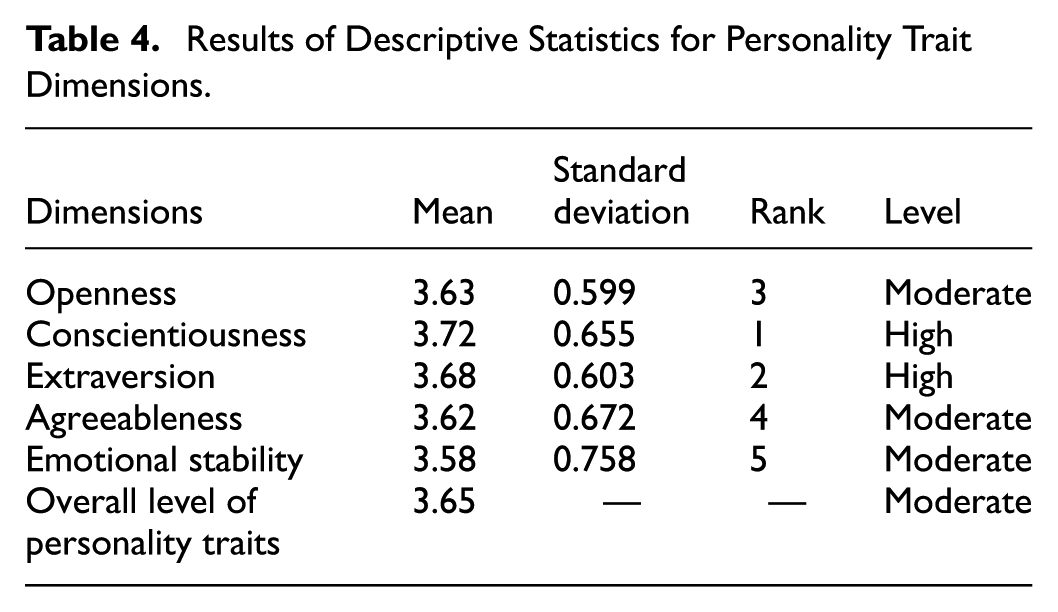
The results of Table 4 confirmed that the overall mean of personality traits of public hospital employees in Qatar was 3.65, which indicates a moderate relative importance level. Moreover, the dimensions of this variable showed variation between moderate and high levels. Conscientiousness was ranked first and last rank was for emotional stability.
Descriptive Statistics of Quality Management
Quality management was treated as the mediator variable in the study, which consists of four constructs that include customer focus, leadership support, employee engagement, and continuous improvement. The overall relative importance level of quality management was extracted to answer the second study question, along with the ranks and the relative importance levels of each of its constructs based on the mean indicator. Table 5 presents the results of descriptive statistics for quality management according to the point of view of employees in public hospitals in Qatar.
Results of Descriptive Statistics for Quality Management Dimensions.

The results of Table 5 confirmed that the overall mean of quality management of public hospital employees in Qatar was 3.54, which indicates a moderate relative importance level. Moreover, all dimensions of this variable showed moderate relative importance levels. Leadership support was ranked first and the last rank was for customer focus.
Testing the Study Hypotheses
The study’s main null hypothesis (H0) indicated “There is no statistically significant association between personality traits and quality management in public hospitals in Qatar.” This hypothesis was tested using the structural model shown in Figure 1.

SEM for the impact of PTs on QM.
Figure 1 displays the results of the evaluation of goodness-of-fit indicators for the model, which tests the impact of PTs on QM. The fit indices fall within acceptable thresholds, indicating that the structural model is appropriate and well-specified. Table 6 demonstrates the results of the path coefficients to examine the association between PTs and QM, consistent with the study’s main hypothesis.
Path Coefficients for the Impact of PTs on QM.

p < .05. **p < .01. ***p < .001.
Table 6 shows that personality traits have a significant positive association with quality management, explaining most of its variance. While this R2 value is unusually high for social science research, additional diagnostics supported the robustness of the model. Specifically, Harman’s single-factor test indicated that the first factor accounted for 25.15% of the variance, which is below the accepted 50 % threshold. On this basis, the results support rejecting the null main hypothesis and accepting that personality traits are linked to quality management in Qatar’s public hospitals. The association of each personality trait dimension is detailed in Figure 2.
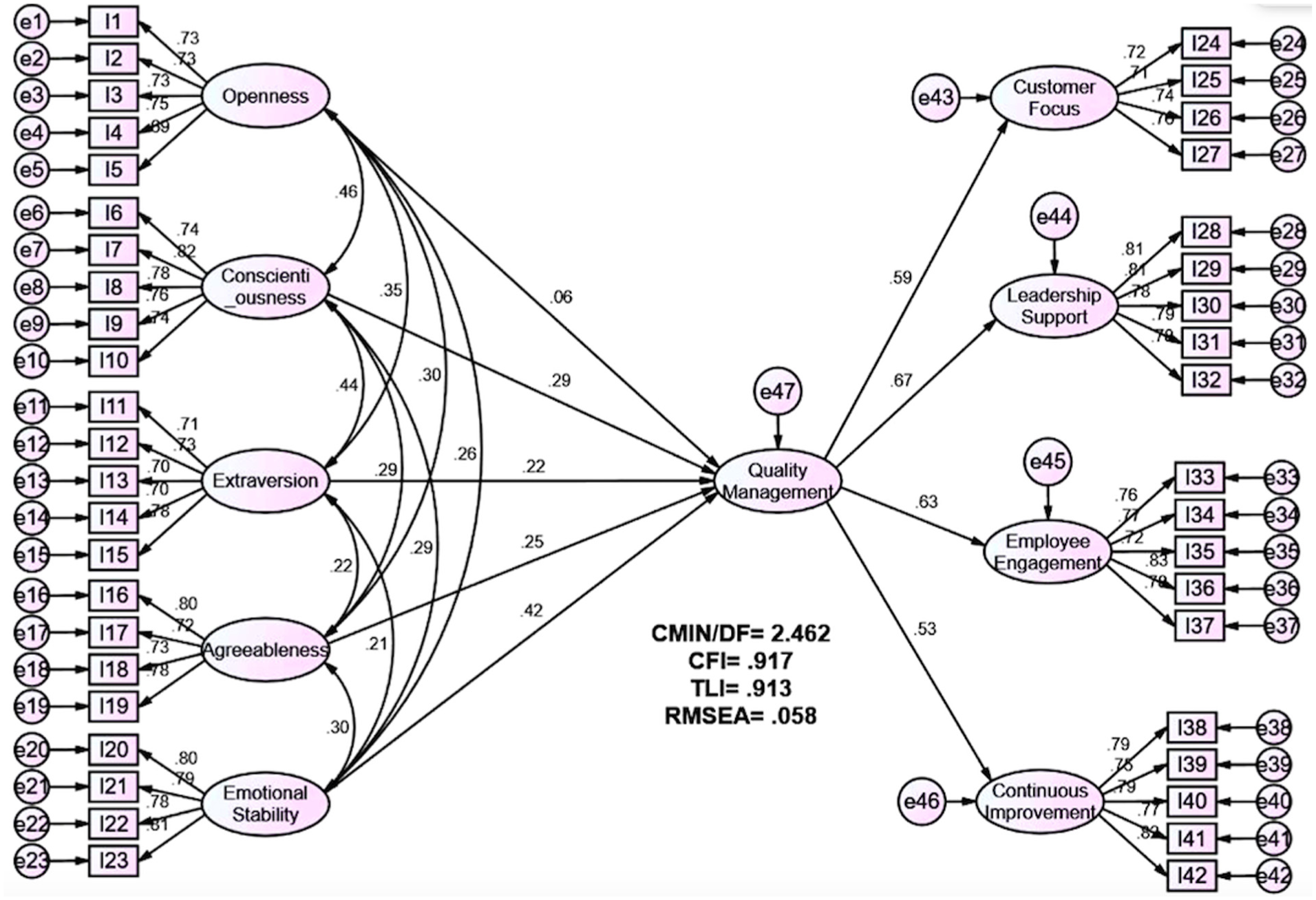
SEM for the impact of PTs’ dimensions on QM.
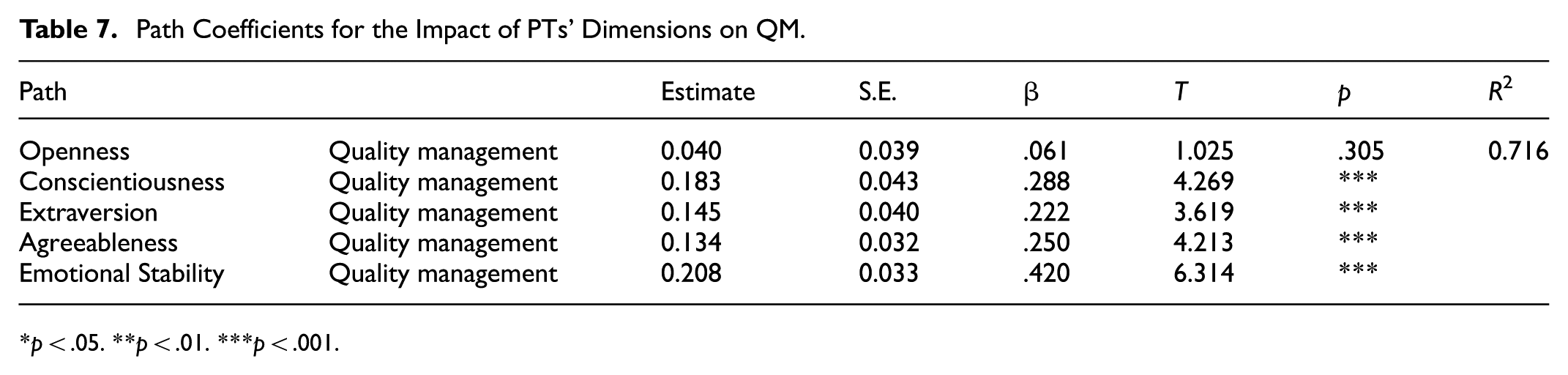
Figure 2 shows that the model testing the association of personality trait dimensions with quality management fits the data well, meeting all key goodness-of-fit criteria. Table 7 presents the path coefficients for these associations.
Path Coefficients for the Impact of PTs’ Dimensions on QM.
p < .05. **p < .01. ***p < .001.
Table 7 presents the path coefficients of personality traits, showing their association with quality management, with the model explaining 72% of its variance. Openness showed no significant association (T = 1.025, p > .05), supporting the first sub-null hypothesis. Conscientiousness (T = 4.269, p < .05, β = .288), extraversion (T = 3.619, p < .05, β = .222), agreeableness (T = 4.213, p < .05, β = .250), and emotional stability (T = 6.314, p < .05, β = .420) all had significant positive associations, rejecting their respective sub- null hypotheses, with emotional stability and conscientiousness exhibiting the strongest associations.
Discussion
The study's findings revealed that personality traits had a modest degree of relative importance among public hospital personnel in Qatar, which is similar to Argyrios (2017) and Chen et al. (2023). The results of these studies indicated that personality traits attained moderate levels of relative importance within the target population. However, several traits of this variable, conscientiousness and extraversion, had a high relative importance level (Abood, 2019; Angelini, 2023; Bazkiaei et al., 2020).
The different levels of personality traits could be justified by the fact that personality traits are influenced by contextual and organizational factors such as healthcare institutions’ prevailing culture and organizational behavior (Molavynejad et al., 2019). Qatar’s healthcare system, shaped by a diverse expatriate workforce and hierarchical structures, creates a unique setting. Multicultural teams increase the importance of traits like extraversion, agreeableness, openness, and emotional stability in promoting cooperation and dealing with cross-cultural dynamics (Mammadov, 2022). From a person- organization fit perspective, conscientious individuals may align better with the rule-based environments typical of public hospitals (Widiger & Crego, 2019). The system’s centralized decision-making may enhance the relevance of conscientiousness, which aligns with protocol adherence and structured processes.
The study's findings revealed that, while public hospital employees in Qatar recognize the importance of quality management and its aspects, the degree of relative relevance of quality management is modest, comparable with (Abdullah et al., 2021), Abbas (2020), and AlOmari (2021) who underlined the need for clear leadership commitment to quality improvement projects by providing resources and guidance and creating a supportive environment for employees.
The findings also showed that all personality traits, except for openness, have a statistically significant association with quality management practices at Qatar’s public hospitals, which aligns with prior studies (Argyrios, 2017; Lee et al., 2020). Emotional stability enables staff to handle pressure, detect quality concerns, and maintain standards (Kamal & Radhakrishnan, 2019) while also managing stress professionally and reinforcing a culture of safety and transparency (Cervone & Pervin, 2022). Conscientious personnel are more likely to follow established processes, track quality indicators, and comply with healthcare standards, demonstrating greater diligence in documentation and compliance, thereby supporting quality systems like ISO 9001 (Aburayya et al., 2020). High agreeableness promotes collaboration in quality initiatives and helps resolve conflict effectively (Thielmann et al., 2020). Agreeable individuals enhance teamwork and communication (Akinwale & Oluwafemi, 2022; Eysenck & Eysenck, 2013). Furthermore, extraverted staff are well-suited to motivating teams and interacting with auditors and clients (Canbay & Akman, 2023. Although openness is generally associated with creativity and innovation (Angelini, 2023), our results confirmed the theoretical expectation that its role may be limited in highly regulated and structured environments. In Qatar’s public hospitals, where adherence to established protocols is prioritized, opportunities to express innovative behavior are constrained, explaining the non-significant effect observed (Kamal & Radhakrishnan, 2019; Widiger & Crego, 2019). This alignment between theory and findings strengthens confidence in the contextualized framework developed for this study. Moreover, our findings contribute to the growing body of cross- cultural personality research by illustrating that the influence of openness is context dependent rather than universal (McCrae, 2001).
Study Implications
The cultural and organizational context of Qatar’s public hospitals, characterized by a highly multicultural workforce, plays a significant role in shaping how personality traits influence quality management (QM). For example, traits such as agreeableness and emotional stability may be particularly crucial in fostering cooperation and effective communication in diverse teams. To take advantage of this, hospitals could integrate personality assessments into recruitment and development processes to build teams with traits aligned with effective TQM. Additionally, targeted training programs can help enhance personality traits related to quality- oriented behavior. Fostering a culture of teamwork, open communication, and mutual respect is essential for enabling knowledge sharing and collaborative problem solving. Hospitals should also establish incentive and recognition systems that align with TQM goals, motivating staff to consistently prioritize quality in daily practice.
Study Limitations
The results of the current study contributed to identifying the relationship between personality traits and quality management practices in public hospitals in Qatar. However, it included research limitations that had to be disclosed to be addressed in future studies. While the cross-sectional design reveals associations between personality traits and TQM, it does not establish causality. While conscientiousness and emotional stability are associated with the adoption and effectiveness of TQM, it is also possible that TQM environments reinforce or shape these traits over time. In other words, consistent exposure to standardized procedures, accountability systems, and continuous improvement processes might encourage individuals to become more organized, detail-oriented, and disciplined over time. Therefore, findings should be interpreted cautiously. Additionally, the use of self-report measures may introduce response bias. Future studies should incorporate objective measures, such as observer ratings, in conjunction with self-report measures to enhance measurement validity. Further, the addition of a qualitative component could be another avenue for future research. A potential limitation of this study is also the risk of Common Method Bias (CMB), since all data was collected at one point in time and from a single source, exclusively from the public healthcare sector. To address this concern, Harman’s single-factor test was conducted, and the results indicated that no single factor accounted for the majority of the variance, suggesting that CMB is unlikely to have significantly biased the findings. Nevertheless, future research could further mitigate this risk by adopting longitudinal designs to establish temporal separation between variables and by conducting multisite studies that include private and other sectors.
Conclusion
In sum, the current study moved towards a more comprehensive understanding of the association between personality traits and total quality management practices. A significant association was found between personality traits and total quality management practices. Among the Big Five traits, emotional stability and conscientiousness were most strongly associated with the effectiveness of organizational quality management practices. These findings contribute to a deeper understanding of how psychological factors interact with healthcare management frameworks, particularly in culturally diverse and structured environments like Qatar. Practically, the results support the integration of personality assessments into human resource strategies to enhance team performance and quality improvement initiatives. Additionally, the study highlights the need for context-specific leadership and training programs that align personality strengths with organizational goals. Future research should build on these findings by using longitudinal or mixed-method designs to explore causal relationships and capture deeper contextual nuances. Ultimately, aligning personality traits with TQM objectives can serve as a strategic tool for improving patient outcomes and workforce resilience in public healthcare systems.
Footnotes
Acknowledgements
The authors would like to thank all employees who participated in this study. We are also thankful to the administration of included hospitals in Qatar and faculty of medicine in Jordan University of Science and Technology

Ethical Considerations
An approval from the Institutional Review Board (IRB) at the Jordan University of Science and Technology with the reference number (IRB:2023/827) and permissions from the study settings were obtained prior to data collection.
Consent to Participate
An online consent form was obtained from the participants before accessing the questionnaires.
Authors’ Contributions
R.A designed the work and planned the methodology and analysis. M. A collected the data and validate the work. Both authors assisted with drafting the manuscript. Both authors read and approved the final manuscript.
Funding
The authors received no financial support for the research, authorship, and/or publication of this article.
Declaration of Conflicting Interests
The authors declared no potential conflicts of interest with respect to the research, authorship, and/or publication of this article.
Data Availability Statement
The Data will be available upon a reasonable request from corresponding author Raya T. Albataineh by email (