




Abstract
This study examined the impact of personality traits on the knowledge sharing behavior of academicians in the public sector. The data were collected from 237 respondents using a questionnaire. The results showed that the personality trait openness to experience had a significant and positive impact on the knowledge sharing behavior and its sub-dimensions such as written contributions, organizational communication, personal interactions, and communities of practice. Furthermore, the personality traits extraversion and agreeableness positively predicted the knowledge sharing behavior for the dimensions of communities of practice and organizational communication, respectively. The results of this study would be helpful for the administrative staff of universities to develop programs to promote a knowledge sharing culture in universities and improve collaborative learning, research, organizational effectiveness, and performance. It would also be a worthy contribution to the existing literature as only a limited number of studies have addressed the role of personality traits in the knowledge sharing behaviors in the academic environment of a non-western country.
Introduction
Understanding the factors influencing individuals’ knowledge sharing behavior (KSB) has been of fundamental importance for knowledge management (KM) professionals. Knowledge sharing (KS) is considered an essential prerequisite for the success of all KM initiatives in modern organizations (Dutta et al., 2015; Lee & Al-Hawamdeh, 2002). It is recognized as one of the cornerstones of efficient and effective knowledge management (Yesil & Dereli, 2013). KS not only improves organizational learning, innovation, performance, and effectiveness but also provides a sustainable competitive advantage to organizations (Al-Alawi et al., 2007; Alavi & Leidner, 2001; Davenport & Prusak, 1998; Fullwood et al., 2019; Fullwood & Rowley, 2017; T. T. Kim et al., 2013; Nieves & Haller, 2014; Tseng & Lee, 2014; Yang, 2007; Yesil & Dereli, 2013; Yi, 2009). KS refers to the mutual exchange of knowledge and expertise within an organization which is done deliberately and voluntarily for not only personal gain but also for the organizational benefit (Fullwood & Rowley, 2017; Hislop, 2013; Van den Hooff & de Leeuw van Weenen, 2004; Yi, 2009).
Prior literature has indicated that knowledge sharing has been extensively investigated among professional and non-professional groups working in different environments worldwide. Researchers have investigated KS in medical practitioners (Razzaque et al., 2013), engineers (Zhen et al., 2011), managers (Tangaraja et al., 2015), accountants (Phang & Foong, 2010), IT personnel (Teh & Sun, 2012), employees of different industries (Yang, 2007; Tohidinia & Mosakhani, 2010; Zhang & Fai Ng, 2012), teachers (Bibi & Ali, 2017; Chen & Wang, 2011), and students (Isika et al., 2013; Rafique & Anwar, 2017, 2019). However, there is a dearth of studies investigating academic environments such as universities (Fullwood et al., 2013). In Pakistan, few studies have addressed knowledge sharing in the academic environment (Baig et al., 2014; Baig & Waheed, 2016; Farrukh et al., 2020; Shahid & Naveed, 2020).
Higher academic institutions are knowledge powerhouses that play a pivotal role in the sustainable socio-economic development of countries. They enable continuous learning, knowledge creation, and innovation. The knowledge emerging from these institutions is transferred to other organizations, both profitable and non-profitable, via research publications and training programs for the workforce. It is accomplished by developing linkages and collaboration with industries, business organizations, and socio-cultural enterprises (Farrukh et al., 2020; Shahid & Naveed, 2020; Ramachandran et al., 2009). Thus, these educational institutions have to adopt a proactive approach toward knowledge management strategies and effective management of their knowledge assets (Fullwood et al., 2013). However, this aspect of knowledge management has been generally neglected in most universities. It is especially true for those in developing countries such as Pakistan. There appears to be a very passive or inconsistent approach toward knowledge management initiatives in these universities (Farrukh et al., 2020). There is a need to investigate the policymakers’ lack of attention to knowledge management initiatives and optimization of their knowledge assets. Furthermore, there is also a need to examine academicians’ attitudes, actions, and behaviors related to knowledge management and knowledge-sharing in academic environments. KS is especially of substantial concern in academic institutions due to increasing faculty demands for sharing quality resources and expertise (S. Kim & Ju, 2008; Ramayah et al., 2014).
Problem Statement
Despite several research studies on knowledge sharing, it was noted that there was a relative lack of inquiries into the knowledge sharing behavior of academicians and the various factors that influence their KS behavior (Farrukh et al., 2020; Iqbal et al., 2020; Raza & Awang, 2020; Shahid & Naveed, 2020). Universities need to understand the inner working of their employees’ minds to help them reach their maximum potential for learning and research. In this regard, knowledge sharing by academicians can play an instrumental role in improving the quality of learning, teaching and research, ultimately enhancing university performance, ranking, and effectiveness. However, even though university employees need to be facilitated in sharing their knowledge, there is a need to identify the factors influencing their knowledge sharing behaviors. Personality is an important factor influencing an individual’s knowledge sharing behavior. Researchers have investigated its impact on the knowledge-sharing behaviors of professionals working in diverse environments (e.g., Lotfi et al., 2016; Pour & Taheri, 2019; Van Greunen et al., 2019). However, the context of academicians working in universities has lacked attention. Only a few recent studies examined the influence of personality traits on knowledge sharing in academia (Farrukh et al., 2020; Rahman et al., 2018; Van Greunen et al., 2019).
The study by Farrukh et al. (2020) empirically investigated how individual characteristics (e.g., Emotional intelligence, religiosity, and personality) influence knowledge sharing in academia. The limitation of this study was that it used a unidimensional scale (four-items) of knowledge sharing by Bock et al. (2005). In contrast, Rahman et al. (2018) focused only on tacit knowledge sharing. Van Greunen et al. (2019) have also investigated the influence of personality traits on knowledge sharing intention. None of these studies addressed the influence of personality traits on knowledge sharing behavior. Also, knowledge sharing needed to be considered a multi-dimensional construct so that a more comprehensive and robust understating and insights may be developed into knowledge sharing behavior and its sub-dimensions. Therefore, the present study is intended to fill this gap in the existing research and investigate the impact of personality traits on the knowledge sharing behavior (KSB) of academicians at the University of Sargodha, Punjab, Pakistan. This study should make a contribution to the body of research on knowledge sharing by considering the knowledge sharing behavior as a multi-dimensional construct from the perspective of the big five-factor model of personality, as no such study appeared in the academic context. This research specifically addressed the following research questions:
RQ1: What is the nature of the relationship between the personality traits and the knowledge sharing behavior of academicians?
RQ2: How do academicians’ personality traits impact their knowledge sharing behavior?
Literature Review and Hypotheses Development
Knowledge Sharing (KS)
Knowledge is meaningful information which is being internalized by the person consuming it. Nonaka (1994) divided knowledge into two dimensions; tacit and explicit knowledge. Tacit knowledge refers to personal knowledge comprising viewpoints, intuitions, and values gathered through experiences. In contrast, explicit knowledge is the codified knowledge found in books or documents as symbols, words, numbers, formulae, and photographs. In the organizational context, tacit, and explicit knowledge complement each other through social interactions. Employees also share a mix of tacit and explicit knowledge (Agyemang & Boateng, 2019; Farrukh et al., 2020; Nonaka & Takeuchi, 1995). KS is a dynamic activity in which people, groups and organizations spread, transmit and exchange knowledge, both tacit and explicit, through socialization. As a result, knowledge is internalized and externalized simultaneously at individual and organizational levels (Farrukh et al., 2020; Nonaka & Takeuchi, 1995). KS must be seen as an inherent organizational activity rather than a supplementary activity the knowledge workers carry out in everyday dialogues and daily operations and processes (Farrukh et al., 2020; Raza & Awang, 2020).
Knowledge Sharing Behavior (KSB)
KSB is an information exchange process among individuals to create new and valuable knowledge, learn new techniques, solve problems, and achieve sustainable innovation and organizational goals efficiently and effectively (Phong et al., 2018; Raza & Awang, 2020). There are several theories which predict the knowledge sharing behavior of individuals. Notably, those related to altruism (e.g., Obrenovic et al., 2020), emotional intelligence (e.g., Farrukh et al., 2020), interpersonal trust (e.g., Javaid et al., 2020; Rahman et al., 2018; Raza & Awang, 2020; Raza & Tariq, 2016; Simeonova, 2018), cultural diversity management (e.g., Raza & Awang, 2020), leader empowering behavior, religiosity (e.g., Farrukh et al., 2020), and self-efficacy, motivation (e.g., Rahman et al., 2018). Theories related to personality can potentially explain the knowledge sharing behavior of individuals. Researchers have examined the effects of personality traits on knowledge sharing among different professionals in different contexts (Farrukh et al., 2020; Iqbal et al., 2020; Lotfi et al., 2016; Matzler et al., 2011; Pour & Taheri, 2019; Van Greunen et al., 2019). This study intends to explain the academicians’ knowledge sharing behavior from the perspective of O. P. John’s (1990) big five-factor model of personality, extraversion, agreeableness, conscientiousness, neuroticism, and openness to experience. The discussions on these five personality traits related to knowledge sharing are as follows.
Personality Traits and Knowledge Sharing
Individuals engaged in sharing knowledge usually differ in their behaviors and personalities (Teh et al., 2011). The process of KS relies overwhelmingly on an individual’s willingness to share knowledge assets such as ideas, experiences, and lessons learned from work processes and personal interactions (Farrukh et al., 2020). Personality appears to influence the knowledge-sharing behaviors of individuals as it affects their cognition, motivation, and behavior (Agyemang & Boateng, 2019; Ryckman, 2004). Several personality dimensions have been highlighted in the existing literature on knowledge sharing. Although there has been no consensus on the conceptualization and measurement of an individual’s personality, many scholars have considered the big five personality factors (extraversion, agreeableness, conscientiousness, neuroticism, and openness to experience) as one of the most fundamental, widespread, stable, and robust taxonomy for the classification of personality traits observed within and across different organizational communities (Digman, 1990; Gupta, 2008; Peabody & Goldberg, 1989; Teh et al., 2011). Several studies have postulated that the big five personality factors could predict why some people share knowledge while others do not (Farrukh et al., 2020; Teh et al., 2011). The following paragraphs outline the big five personality characteristics separately, discuss their relationship with knowledge sharing, and develop research hypotheses based on the review of the related literature.
Extraversion
Individuals having extroverted personalities are sociable, assertive, talkative, energetic, enthusiastic, and optimistic (Besser & Shackelford, 2007; Cabrera et al., 2006; Farrukh et al., 2017; Rahman et al., 2018). Extroverts are emotionally optimistic and self-confident individuals and contribute to the overall team satisfaction (Agyemang & Boateng, 2019; Barrick et al., 1998; McCrae, 1996). It is, therefore, quite logical to expect them to be more inclined toward knowledge sharing. A recent study by Pour and Taheri (2019) also reported a statistically significant effect of extraversion on knowledge sharing behavior. Other scholars have also reported that an individual’s extraversion personality positively influences knowledge sharing behavior (Agyemang & Boateng, 2019; Lotfi et al., 2016; Rahman et al., 2018; Van Greunen et al., 2019). Therefore, it could be said that academicians with highly extroverted personalities would share more knowledge. Teh et al. (2011) have also reported a significant but positive relationship between extraversion and knowledge sharing behavior in the academic environments in Malaysia. Similarly, Farrukh et al. (2020) have also reported a positive association between extraversion and knowledge sharing in higher education institutions in Pakistan. It was, therefore, hypothesized that:
H1: Extraversion positively impacts knowledge sharing behavior.
Agreeableness
The agreeableness personality trait encompasses altruism, tolerance, generosity, and cooperation. An agreeable person has a mild temperament and is interpersonally pleasant with a harmonious nature (Barrick & Mount, 1991; Besser & Shackelford, 2007; Farrukh et al., 2017). People with highly agreeable personalities are supportive, helpful, and team players. They are also more inclined toward knowledge sharing than others (Agyemang & Boateng, 2019; Memon et al., 2016; Pour & Taheri, 2019; Rahman et al., 2018; Van Greunen et al., 2019). Therefore, academicians with high agreeableness in their personalities could be expected to fit in an intensive knowledge sharing environment such as teaching and research. Farrukh et al. (2020) have also reported a positive correlation between agreeableness and knowledge-sharing behavior among academic staff in Pakistani higher education institutions. The second research hypothesis was, therefore, developed based on the attributes of agreeableness in a personality as follows:
H2: Agreeableness positively impacts knowledge sharing behavior.
Conscientiousness
Individuals with the conscientiousness personality trait were persistent, well mannered, reliable, responsible, disciplined individuals, and high achievers (Barrick & Mount, 1991; Thoms et al., 1996). Very conscientious employees were also cooperative and cultivated interdependence and interpersonal relationships with others. These attributes have been identified as essential success factors for exchanging knowledge with one another (Teh et al., 2011), and employees with conscientiousness tend to help others while going beyond their responsibilities. Such employees were also expected to be more willing to share their knowledge (Gupta, 2008; Matzler et al., 2011; Lotfi et al., 2016). Memon et al. (2016) have also reported a positive correlation between conscientiousness and knowledge sharing behavior. Based on the existing literature and characteristics of conscientiousness, the third research hypothesis was formulated as follows:
H3: Conscientiousness positively impacts knowledge sharing behavior.
Neuroticism
Neuroticism has been linked to negative moods such as anxiety, worry, sadness, insecurity, instability, and nervousness (Benet-Martinez & John, 1998; Gupta, 2008; McCrae & John, 1992). Individuals with neurotic personalities usually lack emotional intelligence and stability. They also generally express a negative attitude toward people (Benet-Martinez & John, 1998; Lepine & Dyne, 2001). Therefore, people with low scores on neuroticism would be more likely to engage in knowledge sharing than others. Individuals with high emotional intelligence, self-efficacy, and low anxiety usually adopt knowledge sharing behaviors (Agyemang & Boateng, 2019; Lotfi et al., 2016). On the other hand, academicians with high scores on neuroticism would be reluctant to share their knowledge. Farrukh et al. (2020) have recently reported a negative association between neuroticism and knowledge sharing behavior of academic staff in higher education institutions in Pakistan. While on the other side, the studies of Rahman et al. (2018) and Van Greunen et al. (2019) reported Neuroticism as a positive predictor of knowledge sharing in higher education institutions in Bangladesh. Hence, it was hypothesized that:
H4: Neuroticism positively impacts knowledge sharing behavior.
Openness to Experience
It involves multiple characteristics and describes personality as imaginative, creative, curious, cultured, original, artistic, and broad-minded (Bozionelos, 2004; Digman, 1990; McCrae & John, 1992; Thoms et al., 1996). People with high openness to experience were more likely to share knowledge than other personalities. Some studies have also reported a significant impact of openness to experience on sharing their knowledge with others (Agyemang & Boateng, 2019; Farrukh et al., 2020; Lotfi et al., 2016; Matzler et al., 2011; Memon et al., 2016; Rahman et al., 2018; Van Greunen, 2019). However, no effect of openness to experience on online knowledge sharing was reported by Baig and Waheed (2016). Given the personality attributes attached to openness to experience, it was anticipated that the academicians with high scores on openness to experience would be more likely to share their knowledge. Therefore, it was hypothesized that:
H5: Openness to experience positively impacts knowledge sharing behavior.
Research Framework
Figure 1 presents the research framework based on the research hypotheses discussed above. It was formulated to understand the way personality traits affect the knowledge sharing behavior of individuals and its various sub-dimensions such as written contributions (WC), organizational communication (OC), personal interactions (PI), and communities of practice (CoP).
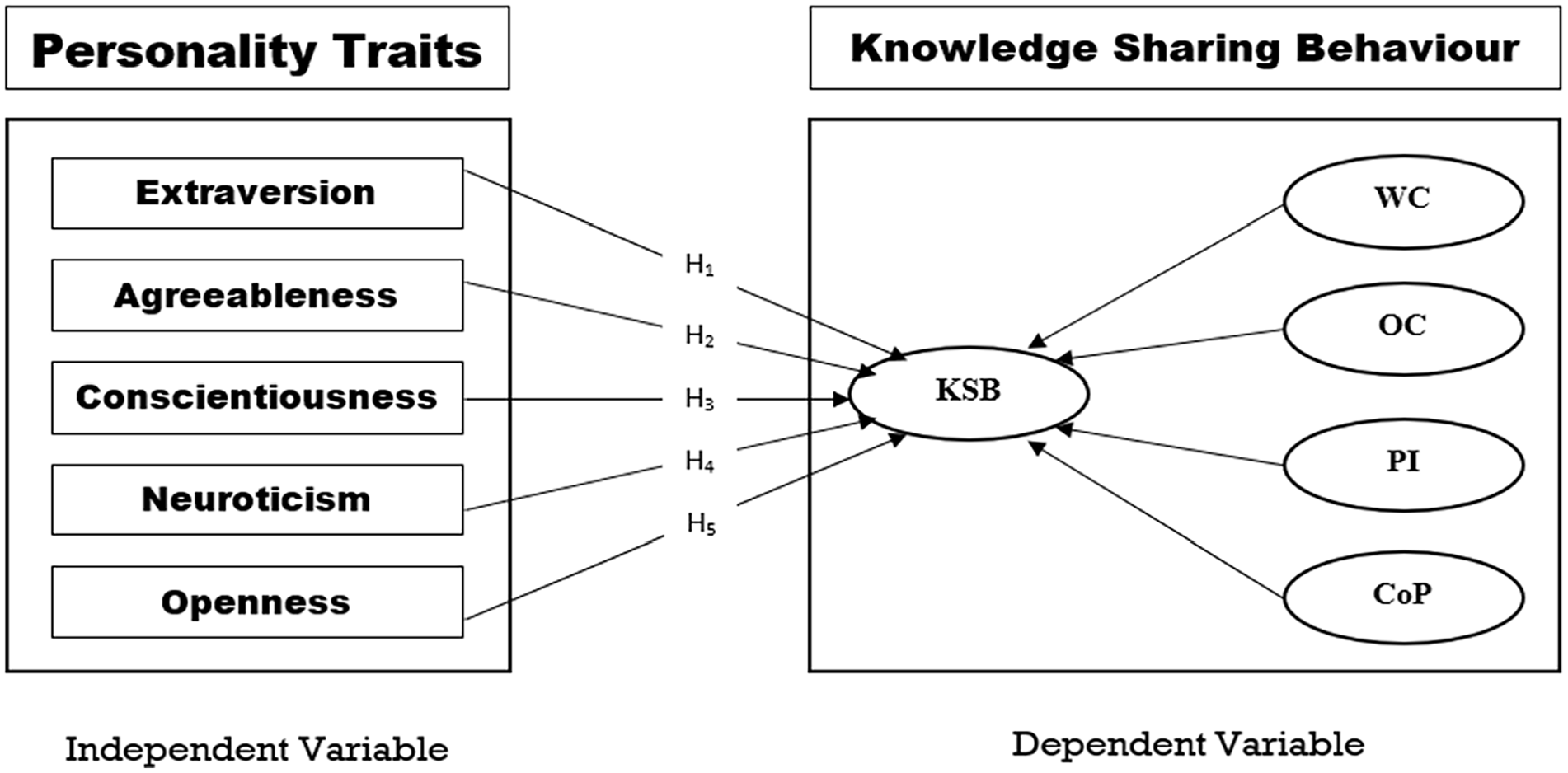
Research framework.
Methods and Procedures
The survey method was employed to investigate the impact of personality traits on the knowledge sharing behavior of academicians in this study. This method was considered adequate for systematically collecting data from a large and geographically dispersed population through a small sample (Gay & Airasian, 2003; Powell & Connaway, 2004). The questionnaire consisted of two scales; the big five personality (BFP) scale by O. P. John (1990) and the Knowledge Sharing Behavior Scale (KSBS) by Yi (2009). Additional personal and academic variables related to gender, age, social background, and qualification were also included in the questionnaire. The big five-factor model of personality is considered to be a comprehensive and robust framework for understanding personality and its traits (Digman, 1990; R. John et al., 2020). The selection of John’s BFP to measure personality traits was made due to its widespread usage and high reliability and validity reported in the existing literature on personality traits (e.g., Digman, 1990; Müller & Schwieren, 2020; Schermer et al., 2020; Teh et al., 2011).
BFP is a 38-item instrument comprised of five dimensions: (1) extraversion (seven items); (2) agreeableness (eight items); (3) conscientiousness (nine items); (4) neuroticism (seven items); and (5) openness to experience (seven items). BFP is a well-known reliable measure widely used to determine different personality traits observed within different organizational communities (Teh et al., 2011). The respondents were required to indicate how they felt by rating the degree of their feelings on a five-point scale (1 = Strongly disagree, 2 = Disagree, 3 = Neither agreed nor disagreed, 4 = Agreed, and 5 = Strongly agree).
The knowledge sharing behavior constructs items were adopted from the Knowledge Sharing Behavior Scale (KSBS) developed by Yi (2009). KSBS is a 28-item measure with four dimensions: (1) written contributions (five statements, CA = 0.458); (2) organizational communication (eight statements, CA = 0.905); (3) personal interactions (eight statements, CA = 0.723); and (4) communities of practice (seven statements, CA = 0.934). Each statement was measured on a five-point Likert scale (1 = never, 2 = rarely, 3 = sometime, 4 = often, and 5 = always). The use of KSBS has gained momentum since its development to measure knowledge sharing behaviors and has been applied successfully in varied contexts across different countries (Eaves, 2014; Kularajasingam et al., 2021; Ramayah et al., 2013, 2014; Shahid & Naveed, 2020). KSBS has also been considered to be a reliable and validated instrument for the assessment of knowledge sharing behavior in academia which has been reported to have adequate reliability at α > 70 (Kularajasingam et al., 2021; Ramayah et al., 2014; Shahid & Naveed, 2020).
The University of Sargodha was purposively selected as the research setting because it is one of Pakistan’s major public sector universities in Punjab, Pakistan. Furthermore, it is the only public sector university in the salt range and the fastest growing general category university in Punjab. This university has three campuses located in Sargodha, Mianwali, and Bakhar. All three have characteristics similar to other public sector universities. The faculty members serving at the selected university were considered the unit of analysis for this study. Approximately 700 faculty members, including the 279 PhDs working in 23 Departments at the selected university, were considered a sample for this study. The calculated sample size for this study was 258 based on a 95% confidence interval. The participants were selected through a convenient sampling process as a list of all the faculty members was unavailable for a random selection.
The researcher distributed a questionnaire with a covering letter in each department. One of the researchers personally visited each university department to self-administrate the survey questionnaire. The questionnaire was distributed to those faculty members available in each department during the researchers’ visit. The available faculty members were requested to complete the survey instrument within 1 or 2 weeks. The required duration to complete the survey was approximately 15 minutes. The respondents voluntarily participated in the survey and had the freedom to decline participation. They were also informed about research purpose and their contributions’ value. Furthermore, they were assured about the confidentiality and anonymity of survey data and its usage only for research purposes. The researchers revisited the university to collect the filled questionnaires. Some faculty members could not complete the survey questionnaire in the given time and were given an additional week for completion. A concerted effort was made to collect data from respondents of varied gender, age groups, qualifications, and social backgrounds.
The researchers received 253 completed questionnaires indicating a 90.3% response rate. These questionnaires were then screened for completeness and accuracy of information. This process excluded 16 cases due to incomplete information. The resultant 237 questionnaires were then analyzed using the SPSS for data analysis software. Initially, descriptive statistics such as frequencies and percentages were applied to describe the personal and academic variables of the respondents. Then the composite variables were developed by computing the means of the statements for each personality trait and the various dimensions of knowledge sharing behavior. Finally, inferential statistics such as Pearson correlation and multiple linear regression were applied to investigate the impact of personality traits on knowledge sharing behavior.
Results
Demographic Profile
Of the 237 survey participants, 132 were males (55.7%), and 105 were females (44.3%). The age of the respondents ranged from 23 to 66 years of age. The majority of the respondents were less than 40 years old (n = 189, 79.74%), followed by those who were 41 to 50 years (n = 36, 15.18 %) and 51 to 60 years old (n = 10, 4.21%). Only two respondents were older than 60 years of age (0.84 %). Most of the survey participants belonged to an urban background (n = 157, 66.2%). Only 80 were from rural backgrounds (33.8%). As far as qualifications are concerned, more than half of the respondents had completed postgraduate level of education (MS/M.Phil. degrees) (n = 124, 52.3%), followed by a doctoral degree (n = 69, 29.1 %). Only 44 participants had just undergraduate level of education (BS/MA/MSC degrees) (n = 44, 18.6 %). Most of the academicians had completed their postgraduate education (n = 193, 81.4%), which is quite encouraging in the context of a developing country.
RQ1: Correlation between personality traits and knowledge sharing behavior
Pearson correlation coefficient was calculated to check the relationship between personality traits and the knowledge sharing behavior of academicians. Table 1 outlines the results of the analysis. A statistically significant and positive correlation can be seen between the personality traits studied (extraversion, agreeableness, conscientiousness, neuroticism, and openness) and the overall knowledge sharing behavior along with all its sub-dimensions such as written contributions, organizational communication, personal interactions, and communities of practice, except for conscientiousness and organizational communication. Interestingly, the p-value (.057) for these two variables was very close to the alpha value (.05). In other words, the academicians’ personality traits and knowledge sharing behaviors were strongly correlated with one another, indicating that multiple linear regression could be calculated to determine the impact of personality traits on knowledge sharing behavior.
RQ2: Impact of personality traits on knowledge sharing behavior
Correlation Between Personality Traits and Knowledge Sharing Behavior (N = 237).
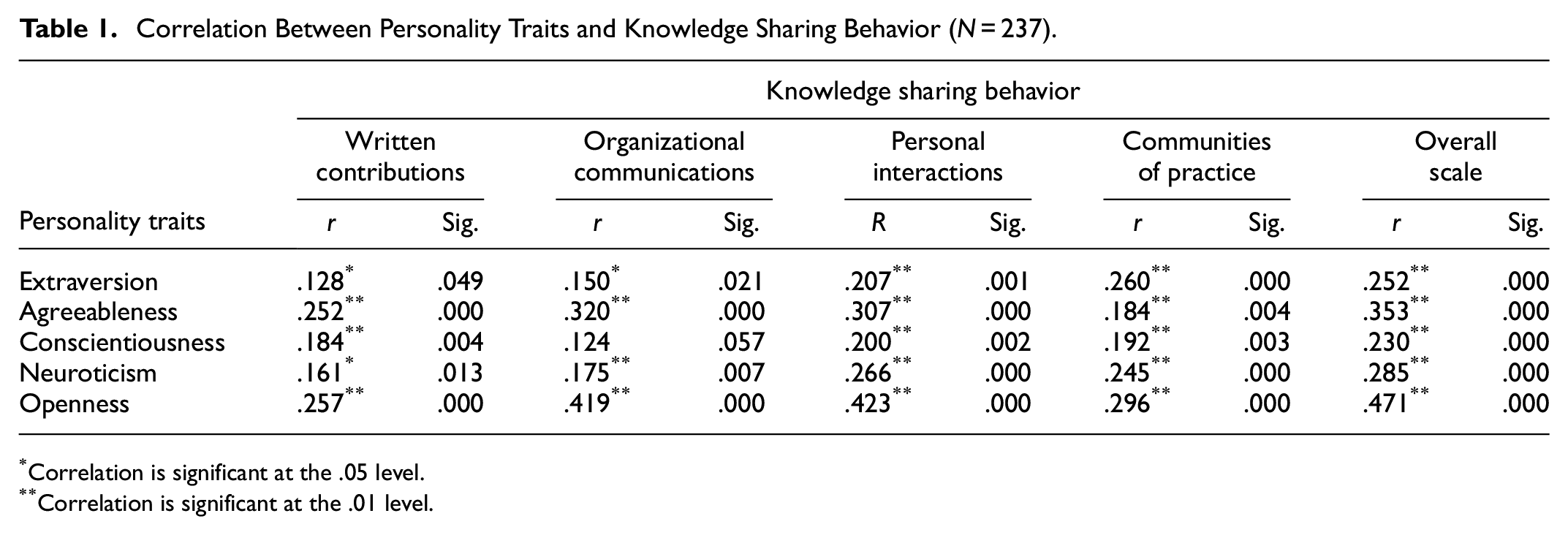
Correlation is significant at the .05 level.
Correlation is significant at the .01 level.
Impact of Personality Traits on the Written Contribution
Multiple linear regression was performed to determine the impact of personality traits (extraversion, agreeableness, conscientiousness, neuroticism, and openness) on the knowledge sharing behavior’s dimension of written contribution. A significant regression equation was found (F (5, 231) = 5.254, p < .000), with an R2 of .083. Table 2 reveals that the personality trait openness (β = .180, p = .009 < .05) was a statistically significant and positive predictor of written contributions. None of the other personality traits predicted the written contribution as p-values were greater than alpha at .05.
Impact of Personality Traits on the Written Contributions.

Dependent variable: written contributions.
Predictors: (constant), openness, conscientiousness, extraversion, neuroticism, agreeableness.
Impact of Personality Traits on Organizational Communication
Table 3 presents the results of a multiple linear regression performed to see the impact of different personality traits on the dimension of organizational communication of the knowledge sharing behavior. A significant regression equation was found (F (5, 231) = 11.900, p < .000), with an R2 of .488. These figures reveal a statistically significant and positive impact of agreeableness (β = .185, p = .012 < .05) and openness to experience (β = .349, p = .000 < .05) on organizational communications. It was not true for the other personality traits, such as extraversion, conscientiousness, and neuroticism.
Impact of Personality Traits on Organizational Communication.

Dependent variable: organizational communication.
Predictors: (constant), openness, conscientiousness, extraversion, neuroticism, and agreeableness.
Bold text indicates p < .05.
Impact of Personality Traits on Personal Interactions
Multiple linear regression was performed to identify the impact of different personality traits on the dimension of personal interactions. Table 4 shows a significant regression equation (F (5, 231) = 13.164, p < .000), with an R2 of .405. These figures also reveal openness to experience (β = .337, p = .000 < .05) as the positive predictor of personal interactions. However, personality traits such as extraversion, agreeableness, conscientiousness, and neuroticism do not appear to predict the knowledge sharing behavior for the dimension of personal interactions.
Impact of Personality Traits on Personal Interactions.

Dependent variable: personal interactions.
Predictors: (constant), openness, conscientiousness, extraversion, neuroticism, and agreeableness.
Impact of Personality Traits on Communities of Practice
Table 5 indicates a significant regression equation (F (5, 231) = 8.440, p < .000), with an R2 of .436 while predicting communities of practice on different personality traits. The figures in Table 5 show the statistically significant but positive impact of extraversion (β = .177, p = .008 < .05) and openness to experience (β = .220, p = .001 < .05) on knowledge sharing behavior for the dimension of communities of practice. However, the rest of the personality traits, such as agreeableness, conscientiousness, and neuroticism, do not appear to predict the knowledge sharing behavior for the dimension of personal interactions.
Impact of Personality Traits on Communities of Practice.

Dependent variable: communities of practice.
Predictors: (constant), openness, conscientiousness, extraversion, neuroticism, and agreeableness.
Impact of Personality Traits on Overall Knowledge Sharing Behavior
Multiple linear regression was performed to predict the impact of personality traits such as extraversion, agreeableness, conscientiousness, neuroticism, and openness on the overall knowledge sharing behavior. A significant regression equation was found (F (5, 231) = 17.866, p < .000), with an R2 of .479. The figures in Table 6 indicate that the personality trait openness to experience (β = .370, p = .000 < .05) was a statistically significant and positive predictor of the knowledge sharing behavior of the respondents. However, the personality traits such as extraversion (β = .075, p = .223 > .05), agreeableness (β = .103, p = .141 > .05), conscientiousness (β = .076, p = .221 > .05), and neuroticism (β = .078, p = .112 > .05) were not found to be statistically significant predictors of knowledge sharing behavior. In other words, academicians possessing the personality trait openness to experience would have a positively predicted knowledge sharing behavior compared to those with personality traits such as extraversion, agreeableness, conscientiousness, and neuroticism.
Impact of Personality Traits on the Overall Knowledge Sharing Behavior.
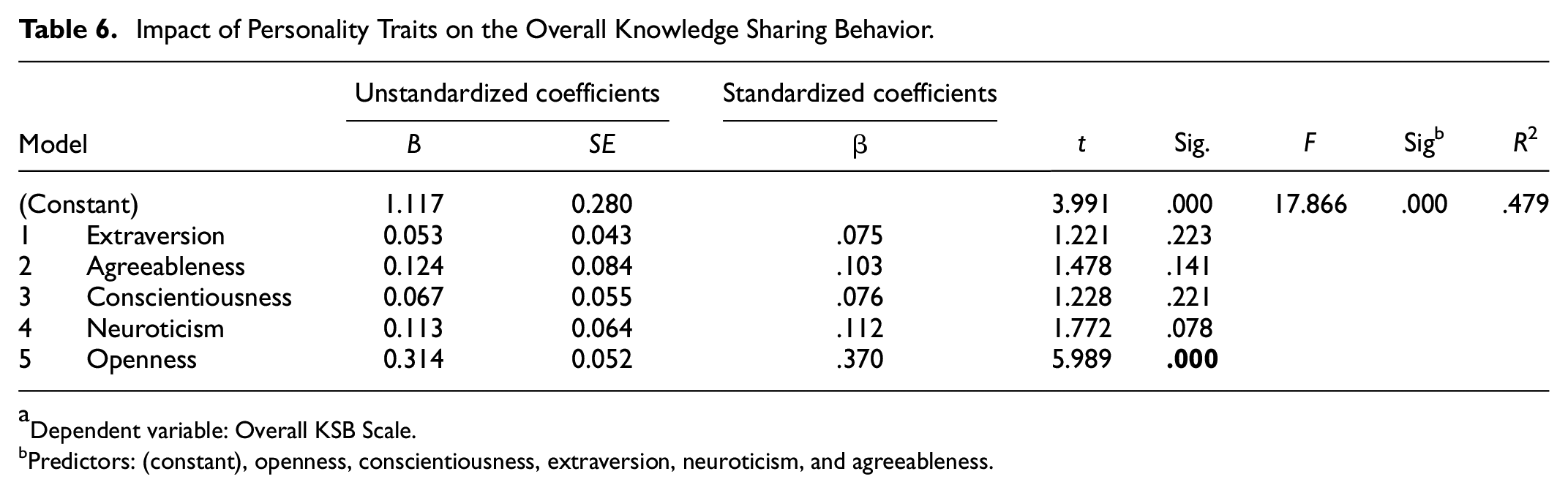
Dependent variable: Overall KSB Scale.
Predictors: (constant), openness, conscientiousness, extraversion, neuroticism, and agreeableness.
Summary of Results for Hypotheses Testing
Table 7 summarizes the results of the hypothesis testing based on the data analysis for the impact of personality traits on the overall knowledge sharing behavior and its sub-dimensions. The results indicate that the personality dimension “openness to experience” appeared to be a strong but positive predictor of knowledge sharing behavior in academicians. It influenced the overall knowledge sharing behavior and its sub-dimensions. Furthermore, the personality traits “extraversion” and “agreeableness” positively predicted the knowledge sharing behavior for the dimensions of communities of practice and organizational communication, respectively.
Summary of Results for Hypotheses Testing.
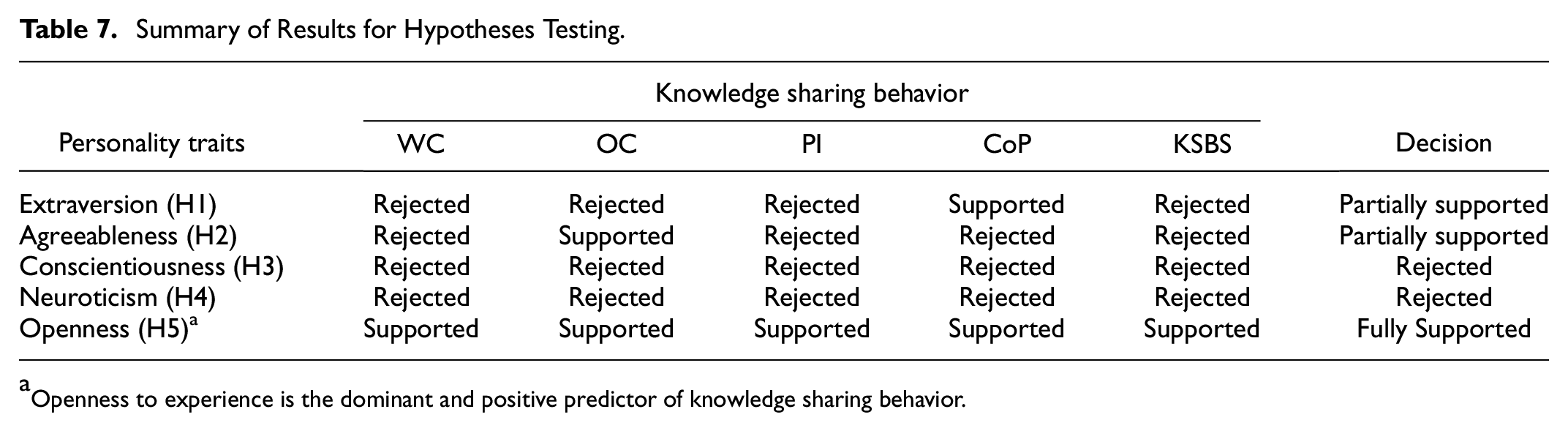
Openness to experience is the dominant and positive predictor of knowledge sharing behavior.
Discussion
This research investigated the impact of personality traits on the knowledge sharing behavior of academicians at the University of Sargodha, Pakistan. The results have indicated a statistically significant and positive correlation between personality traits and the overall knowledge sharing behavior along its various dimensions like written contributions, organizational communication, personal interactions, and communities of practice. The exception was conscientiousness and organizational communication. Interestingly, these two variables’p-values (.057) were very close to the alpha value (Table 1). These results partially align with Teh et al. (2011), who have also reported a positive relationship between extraversion, neuroticism, openness to experience, and knowledge sharing at Malaysian universities.
As for the impact of personality traits on the knowledge sharing behavior, openness to experience appeared as a significant and positive predictor of the overall knowledge sharing behavior and its sub-dimensions of written contributions, organizational communication, personal interactions, and communities of practice. It was expected as people with personality attributes such as imagination, creativity, curiosity, broadmindedness, and originality, and a cultured and artistic nature are more likely to share their knowledge. This finding aligns with Farrukh et al. (2020), who have reported that openness to experience was a positive predictor of knowledge sharing behavior with the largest effect size (0.38). Similar results have been reported by Lotfi et al. (2016). They found that the academic staff with high openness to experience were more likely to share their knowledge. This finding is also supported by Teh et al. (2011), who have reported a positive relationship between these two variables in the Malaysian academic environment. The results of several other studies have also reported a strong and significant impact of openness to experience on the knowledge sharing behavior of individuals (Agyemang & Boateng, 2019; Agyemang et al., 2016; Matzler et al., 2011; Memon et al., 2016). However, Baig and Waheed (2016) have reported that openness to experience did not affect KS in an online environment. The present study has revealed that the academicians who were curious, original, imaginative, and open-minded toward learning and research were more likely to share their knowledge with others than those who were not.
Although it seems logical that extraversion, agreeableness, conscientiousness, and neuroticism would influence the knowledge sharing behavior, this research does not support it. These personality traits were not found to be predictors of the knowledge sharing behavior of the academicians. These results were not anticipated but were partially aligned with Teh et al. (2011). They have reported no association of agreeableness and conscientiousness with knowledge sharing. These results also partially agree with Agyemang et al. (2016). They reported that the personality trait conscientiousness did not cause a significant change in the teachers’ knowledge sharing attitudes and behaviors.
On the other hand, Farrukh et al. (2020) have reported that the extraversion, agreeableness, and conscientiousness traits were positive knowledge sharing predictors with a medium effect size. This study also discovered a negative association of neuroticism with knowledge sharing among academic staff of higher education institutions in Pakistan, with the largest effect size (0.38). These results also contradicted the results of Agyemang and Boateng (2019) and Memon et al. (2016). They have reported that individuals with highly extroverted, agreeable, and conscientious personalities were more inclined to share their knowledge. However, the present research found that extraversion and agreeableness positively predicted knowledge sharing behavior for the dimensions of communities of practice and organizational communication, respectively. This finding partially supports the results of Esmaeelinezhad and Afrazeh (2018), who have reported a positive effect of agreeableness on the knowledge sharing behavior.
The finding concerning extraversion as a predictor of knowledge sharing disagrees with the results of Teh et al. (2011). They have reported a significant but positive relationship between extraversion and knowledge sharing behavior at Malaysian universities. This study’s results also do not support the proposition of Rahman et al. (2018) that the characteristics of extroverted personalities force individuals to share their knowledge. The impact of neuroticism on knowledge sharing, either positive or negative, has been reported in several studies (Agyemang & Boateng, 2019; Benet-Martinez & John, 1998; Farrukh et al., 2020; Lepine & Dyne, 2001). However, this study found that academicians with high scores on neuroticism were reluctant to engage in knowledge sharing. The results of a recent study by Farrukh et al. (2020) were also not supported by the findings of this study.
Implications for Theory and Practice
This study is a unique contribution to the body of research on knowledge sharing. It has examined the knowledge sharing behavior for both tacit and explicit knowledge as a multi-dimensional construct from the perspective of the big five-factor model of personality. No such study has appeared previously in the context of academicians, especially one conducted in a developing country such as Pakistan. Furthermore, the scope of the present study is more comprehensive and robust than before. It deals with the impact of the big five personality traits on the knowledge sharing behavior at a multi-dimensional level. It also provides insights into how each personality trait affects the knowledge sharing behavior and its various sub-dimensions in the academic setting. It provides valuable information that can help the academic leadership design policies and strategies for creating and promoting a knowledge sharing culture in higher education institutions. These micro-level empirical results could have potential implications for policymakers engaged in decision making regarding higher learning institutions and their hiring practices. The university administration should consider these results during faculty recruitment. Candidates with high levels of openness, extroversion, and agreeableness should be preferred. They would most likely aid in establishing a knowledge sharing culture in the university.
Limitations and Future Research Directions
The contributions and findings of the study should be considered given its limitations: (1) The results of this study cannot be generalized as the data for the study was collected from only one public sector university and do not represent all academicians in Pakistan. Future studies should address knowledge sharing in other universities in Pakistan and other developing countries in Asia and Africa. (2) The dispositional factor limits this study. This research only used the big five personality factor model to investigate the personality traits of academicians. Other traits of personality which might affect the holistic view of the impact of personality traits on knowledge sharing in an academic environment were ignored. Future investigations should incorporate other personality attributes to study their impact on knowledge sharing. (3)This study adopted a convenient sampling technique for recruiting participants due to the non-availability of a comprehensive list of academic staff and time constraints. It might have led to a sampling bias. Therefore, the results of this study must be interpreted carefully, keeping these limitations in mind. Future research should include research on knowledge sharing using qualitative research methods to cross-validate our findings. Further in-depth research is needed to learn how Pakistani academicians share their knowledge by investigating their personality traits and other factors considered important in knowledge sharing.
Conclusions
The results have indicated that the academicians with a higher level of openness to experience were more likely to share knowledge with others for all KSBS dimensions. In contrast, academicians with extraversion, agreeableness, conscientiousness, and neuroticism personality traits were less likely to do so. However, extroverts and agreeable academicians are more likely to share their knowledge in communities of practice and organizational communication, respectively. This research has contributed to the existing research by focusing on knowledge sharing among academicians using personality traits as a dispositional factor. Few studies have previously addressed KS in the context of academicians. This research has generated insights that might help the universities’ administrative staff develop programs that can help promote a knowledge sharing culture in universities. Furthermore, it would help them improve collaborative learning and research in universities and contribute to organizational innovation capability, international ranking, organizational performance, and effectiveness. Effective knowledge sharing behaviors cannot be forced but can be fostered through motivation and encouragement (Tan & Ramayah, 2014). The university administrations should design training programs to develop the personality trait “openness” among the academic staff to encourage knowledge exchange. Some socio-economic reward systems should be launched to motivate extroverted, agreeable, conscientious, or neurotic academicians to share their knowledge with others. These results would also help the human resource departments during the hiring process for university academic personnel.
Footnotes
Acknowledgements
The authors would like to acknowledge the support of Prince Sultan University for paying the Article Processing Charges (APC) of this publication.
Declaration of Conflicting Interests
The author(s) declared no potential conflicts of interest with respect to the research, authorship, and/or publication of this article.
Funding
The author(s) received no financial support for the research, authorship, and/or publication of this article.
