



Abstract
Leadership favoritism is often regarded as an “open secret” in the workplace, yet little is known about how employees who are not favored (i.e., observers) respond when they witness such behavior. To address this gap, the present study draws on Leader–Member Exchange Social Comparison (LMXSC) theory to examine observers’ attitudinal and behavioral responses to leadership favoritism. Based on survey data from 267 employees, the proposed hypotheses were tested using Structural Equation Modeling (SEM). The results indicate that leadership favoritism significantly increases observers’ perceived unfairness and decreases their perceived peer competence. Furthermore, perceived unfairness reduces observers’ role modeling practice behavior and increases negative gossip, whereas perceived peer competence enhances role modeling practice behavior and reduces negative gossip. This study contributes to the literature by expanding leadership favoritism research from the observer’s perspective and by identifying the mediating mechanisms of perceived unfairness and perceived peer competence, while practically highlighting that reducing favoritism, improving fairness perceptions, and fostering recognition of employees’ competence can improve workplace relationships and promote organizational performance.
Plain Language Summary
Leadership favoritism—when a supervisor treats certain employees better than others—is common in workplaces. However, the workplace environment is not isolated. When employees observe their leader showing favoritism towards other coworkers, how do they behave toward these favored colleagues? This was the main question investigated in our study. Drawing from Leader-Member Exchange Social Comparison (LMXSC) theory, we proposed hypotheses about how employees compare their treatment in the workplace with that of coworkers, and we collected data through questionnaires. Data analysis revealed that employees who observed leadership favoritism felt a sense of unfairness and reduced their perception of the favored coworkers’ competence. This perception led to two important outcomes. First, feelings of unfairness decreased the observers’ role-modeling proactive behavior—that is, they became less likely to learn from and emulate the favored coworkers’ positive actions. Second, observers were more likely to engage in negative gossip about the favored employees. However, when observers perceived their favored coworkers as competent, they were more inclined to engage in role-modelling proactive behaviors and less likely to spread negative gossip. Our findings suggest that organizations should work actively to reduce favoritism. Doing so could improve employee relationships and positively impact organizational performance.
Keywords
Introduction
Favoritism refers to the behavior of individuals or organizations that tend to prioritize their own groups when allocating work, contracts, or resources (Bramoullé & Goyal, 2016). It is a widespread phenomenon across different domains, such as regional favoritism among officials, where firms in regions once governed by certain officials engage in higher levels of tax avoidance than other firms within the same province (Chen et al., 2019); teacher favoritism, where teachers favor specific groups of students (Tsai, 2022); and parental favoritism, where there is a “more popular” child in family relationships (Suitor et al., 2009). In workplace settings, leaders also demonstrate favoritism by treating subordinates unequally, creating leader—member exchange relationships of varying quality (Sparrowe & Liden, 2005). Such favoritism may result in subordinates receiving different levels of support and recognition (Hsiung & Bolino, 2018). This study focuses on leadership favoritism in workplace contexts, exploring its consequences for employees and, more specifically, how observers perceive and behave toward their favored peers.
Leadership favoritism refers to employees’ perception that leaders show closer or more protective behavior toward certain employees in the work group (Hsiung & Bolino, 2018). Existing research has primarily focused on the antecedents of leader favoritism and subordinates’ direct reactions to such favoritism. From the leaders’ perspective, favoritism may stem from utilitarian motives that benefit the leader or from relational motives such as personal friendships (Palermo et al., 2019). From the perspective of employees, those who are not favored may perceive such behaviors as a violation of the psychological contract, which can subsequently lead to work withdrawal behaviors (Shamsudin et al., 2023) or turnover intentions (Arasli et al., 2019). In contrast, subordinates who receive preferential treatment may reciprocate with enhanced loyalty and greater work engagement (Chang & Cheng, 2018). However, revisiting the definition of leadership favoritism reveals that it involves three key subjects: the leader, the favored employee, and the observer (the employee who perceives but does not benefit from the favoritism). As a pervasive yet tacit phenomenon in workplace interactions (Chang & Cheng, 2018), leader favoritism raises a critical question: when observers notice that a leader favors certain employees, how do they evaluate those who are favored? Do they engage in constructive behaviors toward them, or resort to destructive ones?
Although leadership favoritism is pervasive in organizations, research from the observer’s perspective remains highly limited. To date, only one study has examined how observers respond to leadership favoritism, showing that this phenomenon indirectly influences workplace ostracism through envy (Mohd Shamsudin et al., 2024). However, how leadership favoritism shapes observers’ perceptions of their peers, and how these perceptions in turn affect workplace behaviors, remains underexplored. To address this gap, the present study focuses on two common peer-directed behaviors—negative gossip and role modeling practice behavior—as outcome variables of leadership favoritism.
This study makes three primary contributions. First, by examining leadership favoritism from the observer’s perspective, it extends the scope of leadership favoritism research beyond the leader–favored subordinate dyad to include third-party observers. Second, by introducing negative gossip and role modeling practice behavior as peer-directed outcome variables, it provides a more comprehensive account of observers’ behavioral responses. Third, it reveals the mediating roles of perceived unfairness and perceived peer competence and, drawing on leader—member exchange social comparison (LMXSC) theory, develops a theoretical model that offers a foundation for understanding how leadership favoritism shapes peer relationships within organizations.
Research Background and Hypotheses
Leadership Favoritism and LMXSC Theory
This study defines leadership favoritism as employees’ perception that their leaders provide more favorable treatment to other colleagues. Such perceptions of differential treatment arise when employees notice discrepancies in how leaders allocate resources, offer support, or provide protection. According to social comparison theory, individuals have a fundamental drive to evaluate their own opinions and abilities, and they tend to make such evaluations by comparing themselves with similar peers. When discrepancies in opinions or abilities are observed, individuals may develop a tendency either to adjust their own standing or to attempt to alter others’ standing, thereby narrowing the perceived gap (Festinger, 1954). In organizational settings, such comparisons often revolve around the quality of leader—member exchange (LMX; Yang et al., 2023), since leaders maintain differentiated relationships with individual members (Sparrowe & Liden, 1997).
Traditional LMX research has emphasized differences in dyadic exchange relationships, while overlooking the broader social context in which specific LMX relationships are embedded. In its subsequent development, Relative Leader—Member Exchange (RLMX) was introduced, focusing on the objective differences in the quality of exchange relationships between members and their leaders within a group (Sherony & Green, 2002). However, this perspective still neglects employees’ subjective perceptions when comparing the quality of such relationship (Vidyarthi et al., 2010). To address this gap, the present study employs LMXSC to explain employees’ subjective perceptions when comparing differences in the quality of leader—member relationships. Compared with LMX, LMXSC is grounded in social comparison using workgroup members as referent points, whereas LMX itself does not involve explicit referents (Vidyarthi et al., 2010). Compared with RLMX, LMXSC emphasizes employees’ subjective perceptions of LMX differentiation (Vidyarthi et al., 2010).
In this study, leadership favoritism is conceptualized as a specific manifestation of LMXSC, namely employees’ subjective perception that leaders provide more favorable treatment to other employees. This definition aligns with our operationalization, as the measurement items directly capture employees’ perceptions based on relative comparisons, rather than the objective differences in exchange quality. Prior research has shown that the effects of LMXSC on employee behavior can be either positive or negative. For instance, among individuals high in trait dominance, LMXSC may trigger hubristic pride, which in turn fosters social undermining (Korman et al., 2023). Conversely, LMXSC can also shape employees’ perceived obligations, psychological contracts, and self-esteem, thereby enhancing job performance and organizational citizenship behaviors (Yang et al., 2023; Zhang et al., 2025). Building on this perspective, the present study investigates how leadership favoritism influences observers’ perceived unfairness and perceived peer competence, and how these perceptions subsequently affect their engagement in negative gossip or role modeling practice behavior.
Perceived Unfairness
Perceived unfairness is defined as observers’ subjective feelings of unfairness, inequality, or bias originating from leaders (Shamsudin et al., 2023). Existing research has typically classified organizational justice into procedural justice, distributive justice, interpersonal justice, and informational justice (Shapoval, 2019). However, in the present study, given that unfairness is experienced subjectively, we argue that a unidimensional approach may be more appropriate. Specifically, observers are not required to distinguish among different types of perceived unfairness, but rather to evaluate their overall experience of unfair treatment (Cohen-Charash & Mueller, 2007).
In workplace settings, resources are inherently limited, and upward comparisons of LMX can carry potentially destructive consequences. When employees compare themselves with others, they may experience a sense of relative deprivation (Hsiung & Bolino, 2018). Members who are labeled as “favorites” may face hostility from observers, as they are perceived as a distinct group that threatens others’ personal interests and triggers feelings of insecurity (Vveinhardt & Bendaraviciene, 2022). When observers perceive that leaders are granting preferential treatment to other colleagues, they may interpret it as a deprivation of their own opportunities. Supporting this view, Tse et al. (2013) found that when leaders maintained higher-quality LMX with subordinate A compared to subordinate B, providing more support to subordinate B could undermine the relationship between A and B. Similarly, in a study of psychological withdrawal among hotel employees, Shamsudin et al. (2023) confirmed that leadership favoritism leads to employees’ perceived unfairness.
Prior studies in workplace settings have documented the negative consequences of perceived unfairness within organizations. For example, perceived unfairness may lead to interpersonal counterproductive work behaviors (Cohen-Charash & Mueller, 2007), shape employees’ cognitions, attitudes, and behaviors toward the workplace (Jordan et al., 2022), and reduce both job satisfaction and dignity at work (Sainz et al., 2023). According to social learning theory, individuals who experience unfair treatment may engage in aggressive behaviors, and such aggression can be directed toward any target perceived as appropriate (O’Leary-Kelly, 1996). In the context of the present study, compared with leaders, the favored coworkers are often more convenient and accessible targets of such aggression. Negative gossip refers to informal conversations about absent third parties. Although related to constructs such as “social undermining,” negative gossip places greater emphasis on the dissemination of information rather than on directly hindering others. When experiencing perceived unfairness, employees may feel that their social standing is threatened. Engaging in negative gossip about the favored coworker not only facilitates information exchange among observers but also allows them to benefit from impression management (Ni et al., 2024). Based on this reasoning, the present study proposes the following hypothesis:
According to the perspective of social information processing, when individuals form attitudes, they rely on social information, including past behaviors and others’ opinions (Salancik & Pfeffer, 1978). Moreover, individuals’ self-perceptions of the causes behind past behaviors, as part of the causal attribution process, also influence attitude formation (Salancik & Pfeffer, 1978). In the workplace, observers may attribute the superior performance of favored coworkers not to their actual competence but rather to leaders’ unfair practices—such as favoritism, protection, or preferential allocation of resources—thereby weakening their perceived peer competence. Similarly, just as perceived unfairness has been found to foster employee withdrawal behavior (Shamsudin et al., 2023), observers’ evaluations of their own opportunities for upward mobility may also be undermined by perceived unfairness. This reduced expectation of status change can, in turn, diminish their engagement in role modeling practice behavior. Based on this reasoning, we propose the following hypotheses:
Perceived Peer Competence
Does leadership favoritism exert only negative effects on observers’ perceptions? Prior research seems to provide evidence for an alternative assumption. According to social comparison theory, when individuals perceive ability differences after comparison, they may attempt to change either their own standing or that of others (Festinger, 1954). Upward comparisons increase observers’ motivation and hope, as individuals may seek information from the more advantaged peer in order to improve their own situation (Taylor & Lobel, 1989). From the perspective of signaling theory (Spence, 1973), when leaders consistently favor certain employees, it sends a signal to others, leading observers to infer that the favored employees are more influential or competent. Similarly, status construction theory (Ridgeway, 2014) argues that group members attribute higher status to individuals endorsed by authority figures. Accordingly, leadership favoritism can be regarded as a form of legitimacy evidence, which enhances observers’ perceived peer competence. Supporting this explanation, Lau and Liden (2008) found that coworkers within teams are more inclined to trust colleagues who are trusted by formal leaders.
Competence is one of the core dimensions of social cognition (Cuddy et al., 2008). It is an other-oriented perception that reflects an individual’s capability, proficiency, efficiency, and knowledge within a specific domain (Fiske et al., 2002). Through the mechanisms described above, individuals engage in self-regulation via social referencing, observing others either actively or passively (Bandura, 1991). This process enables them to make vicarious evaluations of behavior–outcome contingencies, thereby allowing them to model the behaviors of high performers in pursuit of similar outcomes (Ni et al., 2024). Perceiving peers as competent is akin to recognizing signals of excellence, which can enhance positive evaluations of those peers and foster subsequent behaviors on the part of observers (Ni et al., 2024). In the context of leadership favoritism, once observers perceive the favored employees as competent, they may view them as valuable referents for upward mobility and engage in role modeling practice behavior to improve their own standing. Prior research has also shown that role modeling primarily relies on perceptions of individual competence (Li et al., 2016). Supporting this notion, Ni et al. (2024) found that when employees observed peers’ voice behavior, it heightened their perceptions of peer competence, which in turn promoted role modeling. At the same time, perceiving competence also confers a sense of legitimacy on the favored peers—that is, recognition based on meritocracy (Fiske & Bai, 2020). This perception of deservedness reduces observers’ inclination to engage in aggressive behaviors, thereby decreasing negative gossip.
However, an alternative explanation may challenge the pathway through perceived peer competence. Observers may interpret leadership favoritism as a form of relational bias driven by personal ties (Palermo et al., 2019). In such cases, favoritism may fail to convey signals of peer competence and instead reinforce its negative effects. Thus, leadership favoritism may carry conflicting interpretations: it can be viewed either as a signal of competence or as evidence of unfairness. However, as this study focuses on the competence-signaling mechanism of leadership favoritism, we follow this line of reasoning in formulating our hypotheses. In line with the competence-based perspective, the present study proposes the following hypotheses:
In summary, this study proposes an integrative dual-pathway framework. Through the unfairness pathway, leadership favoritism increases observers’ perceived unfairness, which in turn fosters their engagement in negative gossip and subsequently reduces role modeling practice behavior. Through the competence pathway, favoritism functions as a signal that enhances observers’ perceived peer competence, thereby promoting role modeling practice behavior and inhibiting negative gossip. Accordingly, this study proposes the following mediation hypotheses:
The theoretical model of this study is presented in Figure 1.
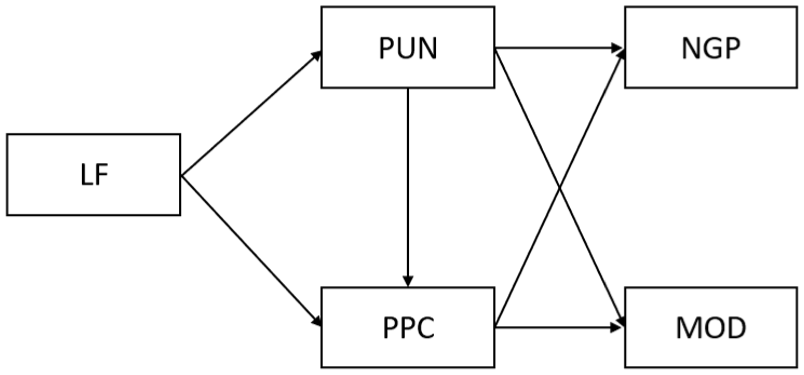
Theoretical model.
Research Design
Research Subjects and Survey Process
The questionnaire method is cost-effective and capable of yielding extensive information on individual attitudes and perceptions from a small sample (Mohd Shamsudin et al., 2024). To ensure that the sample size was sufficient, we conducted an a priori power analysis using G*Power (effect size f2 = .15, α = .05, power = 0.95, number of predictors = 7). The results indicated that a minimum sample size of 153 was required. Considering the efficiency of data collection, we adopted this method. To obtain a more diverse sample in terms of regional and organizational attributes, the questionnaire was distributed through a professional third-party platform, Credamo. Credamo, akin to Mturk, serves as a data collection platform primarily catering to researchers and institutions, boasting a sample pool exceeding 3 million and servicing over 3,000 universities. Before filling out the questionnaire, respondents were informed that the survey results would be kept strictly confidential, that the survey was anonymous, and that they could withdraw at any time. Respondents were then asked, “In your workplace, is there a phenomenon where a leader pays extra attention to a certain colleague?” If the respondent replied that there is not, the questionnaire would end.
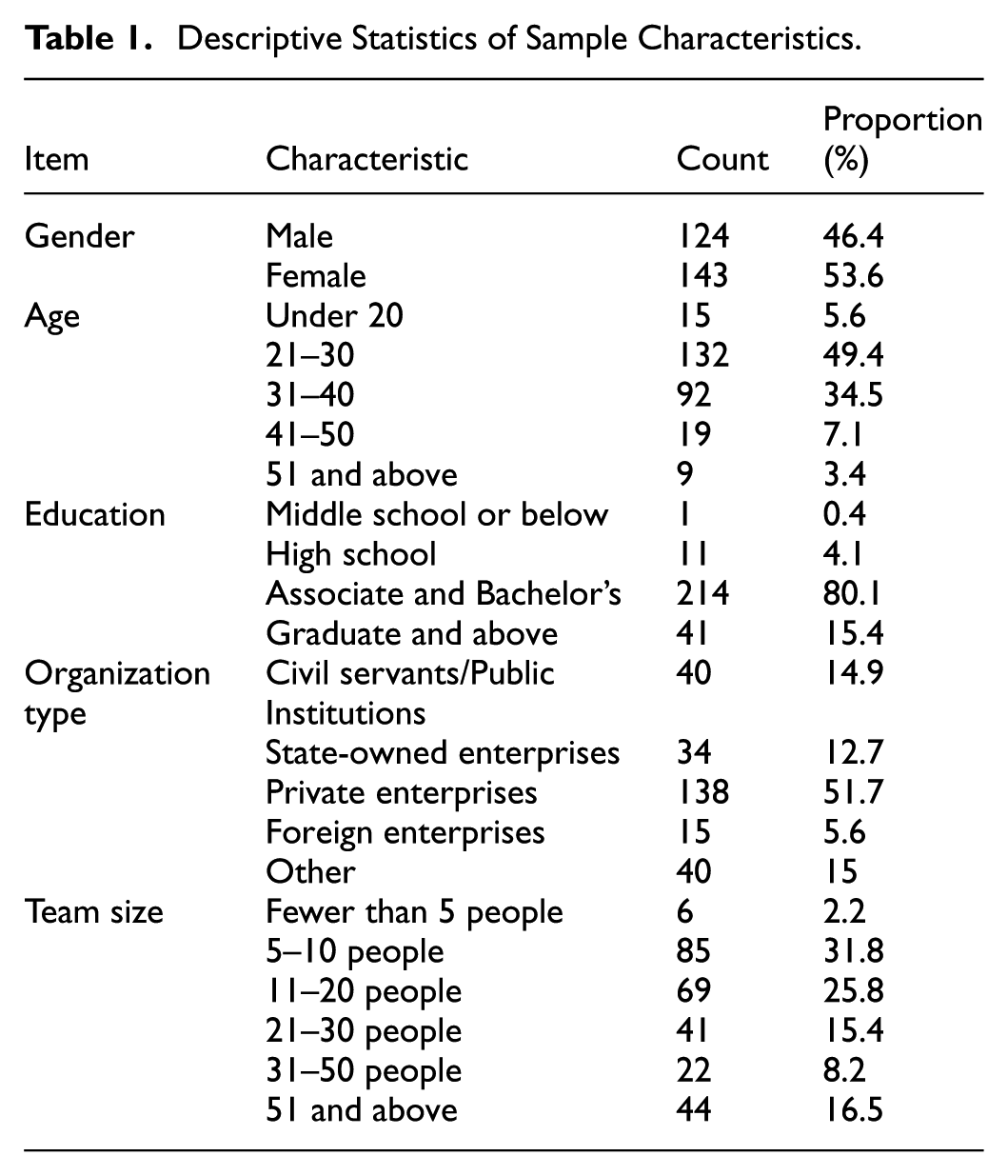
Questionnaires that failed the screening questions and attention tests were removed, and a total of 267 valid questionnaires were collected out of 451 distributed. Regarding gender distribution, the sample comprised 124 males (46.4%) and 143 females (53.6%). In terms of education level, the majority (80.1%) had college or undergraduate education. In terms of age, the sample was concentrated between 21 and 40 years old. As for the type of work units, private enterprises accounted for 51.7%, state-owned enterprises for 12.7%, and civil servants and public institutions for 14.9%. Team size was defined as the number of members working directly under the same leader within a work group. In the sample, most teams ranged in size from 5 to 30 members. The specific characteristics of the sample are shown in Table 1.
Descriptive Statistics of Sample Characteristics.
Measurement Tools
All scales used in this study were derived from the Self-Maturation Scale. A 7-point Likert scale was employed, where “1” denotes strongly disagree and “7” signifies strongly agree. The translation of the scales followed (Brislin, 1970) recommendations, adopting a combination of back-translation, bilingual techniques, and committee review. Specifically, the original scales were first translated from Chinese into English by a bilingual researcher specializing in organizational behavior. Subsequently, another bilingual researcher who was unaware of the research objectives conducted the back-translation. Finally, the research team compared and discussed the two translated versions with the original text to ensure both cultural and conceptual equivalence. For example, in the questionnaire, the phrase “the particular coworker favored by the leader” was replaced with “Coworker A” to minimize potential bias.
Leader favoritism: The scale for leader favoritism, developed by Hsiung and Bolino (2018), was utilized, comprising four items. One example item is: “My leader uses his personal power to protect certain subordinates to the detriment of the rest of the group.” The Cronbach’s alpha for the latent variable of leader favoritism was .891.
Perceived unfairness: Utilizing the scale developed by Cohen-Charash and Mueller (2007), which comprises three items, an example being “An impartial judge who knows the facts will agree: Colleague A should not succeed at work.” The Cronbach’s alpha for the latent variable perceived unfairness was .855.
Perceived peer competence: The scale developed by Fiske et al. (2002) was adopted, which includes four measurement items such as “I feel that Colleague A is competent.” The Cronbach’s alpha for the latent variable perceived peer competence was .881.
Negative gossip: The scale developed by Brady et al. (2017) was used, which includes five measurement items such as “I ask other colleagues if they have a negative impression of something Colleague A has done.” The Cronbach’s alpha for the latent variable negative gossip was .895.
Role modeling proactive behavior: The scale developed by Ni et al. (2024) was adopted, which includes two measurement items such as “I often learn from Colleague A how to proactively complete work tasks.” The Cronbach’s alpha for the latent variable role-modeling proactive behavior was .885.
Statistical Analysis
This study employed PLS-SEM for data analysis. PLS-SEM is a structural equation analysis technique based on principal components (Lohmoller, 1988), which is suitable for exploratory research with small sample sizes and complex models. It can also obtain robust estimates when the data is not normally distributed (Hair et al., 2012). This study focuses on the impact of leadership favoritism on observer behavior, which has been studied relatively little and is exploratory in nature. The model involves five latent variables, making PLS-SEM appropriate for analysis.
In addition to the main study variables, gender, age, education, team size, and organizational type were included as control variables in the structural equation model. These controls were specified as exogenous variables for perceived unfairness, perceived peer competence, negative gossip, and role modeling practice behavior.
Common Method Bias Test
Common method bias can stem from factors including the homogeneity of data sources and respondents’ social expectations. This study controlled for common method bias both procedurally and statistically. Procedurally, this study employed well-established measurement scales and followed Brislin’s (1970) recommendations for translation and back-translation. To reduce respondents’ social desirability bias, the survey emphasized anonymity and clarified that there were no right or wrong answers. In addition, the questionnaires were distributed in multiple small batches across different time points to minimize the bias associated with single-source and single-time data collection. Statistically, we conducted the Harman one-factor test. The test results showed that the first factor in the exploratory factor analysis explained 43.93% of the total variance, indicating that the common method bias test was passed (Podsakoff et al., 2003).
Measurement Model Test
Tests for reliability, validity, and multicollinearity were conducted, with the results detailed in Table 2. First, the results indicate that the Cronbach’s α values for each latent variable range from .855 to .895, all exceeding the .7 threshold. The composite reliability (C.R.) values range from .912 to .945, all surpassing the .8 threshold. The factor loadings of the items for each latent variable range from 0.730 to 0.951, all meeting the 0.7 criterion, indicating that the questionnaire has good reliability and internal consistency (Hair et al., 2011).Next, we examined the convergent and discriminant validity of the measurement model. The average variance extracted (AVE) for each latent variable spanned from 0.706 to 0.896, exceeding the 0.5 threshold, which indicates robust convergent validity of the measurement model (Janis, 1967). Discriminant validity was assessed using the HTMT criterion, with values ranging from 0.378 to 0.758, all below the threshold of 0.8, confirming that discriminant validity was achieved (see Table 3). Lastly, we tested for multicollinearity using VIF values, with the maximum VIF value being 3.068, close to 3, suggesting that multicollinearity was acceptable.
Reliability and Validity Test.

Results of the Discriminant Validity Test.
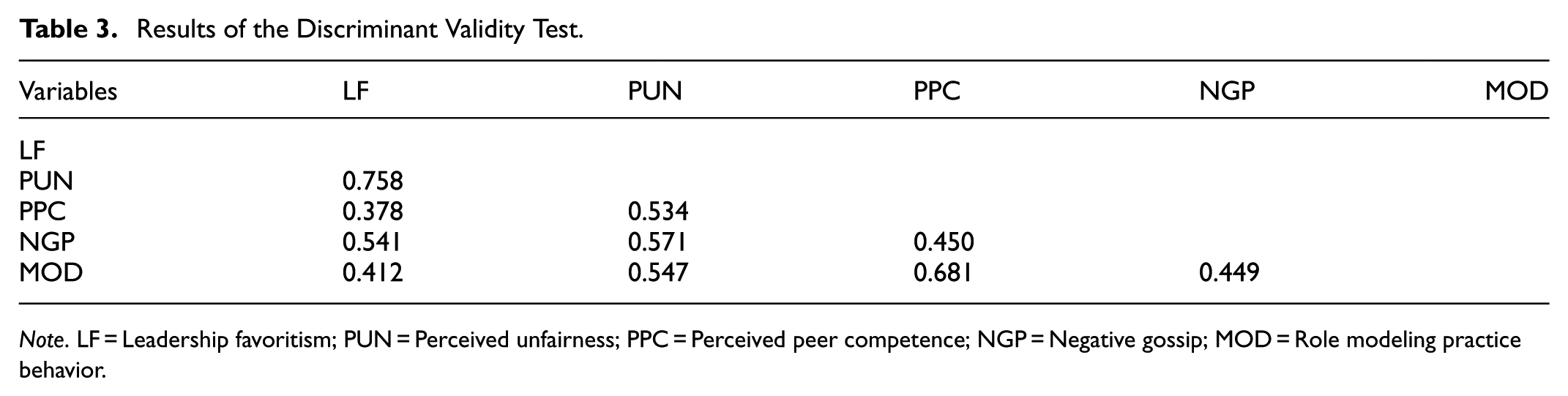
Note. LF = Leadership favoritism; PUN = Perceived unfairness; PPC = Perceived peer competence; NGP = Negative gossip; MOD = Role modeling practice behavior.
Structural Model Test
We employed bootstrapping with 5,000 resamples to test the path coefficients and verify the hypotheses. The results are presented in Table 4. Leadership favoritism had a significant positive effect on perceived unfairness (β = .675; p < .001), supporting Hypothesis 1. The effect of leadership favoritism on perceived peer competence was not significant and negative (β = –.035; p = .694), thus Hypothesis 5 was not supported. Perceived unfairness had a significant positive effect on negative gossip (β = .418; p < .001), supporting Hypothesis 2. It also had significant negative effects on perceived peer competence (β = –.459; p < .001) and role modeling practice behavior (β = –.265; p < .001), supporting Hypotheses 3 and 4. Moreover, perceived peer competence had a significant negative effect on negative gossip (β = –.207; p = .001), supporting Hypothesis 6, and a significant positive effect on role modeling practice behavior (β = .473; p < .001), supporting Hypothesis 7.
Results of Path Coefficient Testing.

Note. LF = Leadership favoritism; PUN = Perceived unfairness; PPC = Perceived peer competence; NGP = Negative gossip; MOD = Role modeling practice behavior.
Furthermore, we tested the mediating role of perceived unfairness, with the results presented in Table 5. Perceived unfairness mediated the relationships between leadership favoritism and negative gossip (β = .282; p < .001), role modeling practice behavior (β = –.179; p < .001), and perceived peer competence (β = –.309; p < .001), supporting Hypotheses 8, 9, and 10. Although the path analysis indicated that leadership favoritism did not have a significant effect on perceived peer competence, we nevertheless examined the mediating role of perceived peer competence. The results showed that perceived peer competence did not significantly mediate the relationship between leadership favoritism and negative gossip (β = .007; p = .713) or role modeling practice behavior (β = –.017; p = .697), thus Hypotheses 11 and 12 were not supported.
Mediating Effect of Perceived Unfairness.

Note. LF = Leadership favoritism; PUN = Perceived unfairness; PPC = Perceived peer competence; NGP = Negative gossip; MOD = Role modeling practice behavior.
Finally, to ensure the explanatory and predictive power of the model, we examined the relevant indicators. Smart PLS reported the model fit indices. The R2 values of the endogenous latent variables all reached acceptable levels: perceived unfairness R2 = .452, indicating moderate explanatory power; perceived peer competence R2 = .225, indicating low explanatory power but consistent with its role as a mediating variable; negative gossip R2 = .323, reflecting acceptable explanatory power; and role modeling practice behavior R2 = .426, indicating moderate explanatory power. The standardized root mean square residual (SRMR) was 0.049 (<0.1), suggesting that the model residuals were within an acceptable range and that the overall model fit was good. The Q2predict values of all endogenous latent variables were greater than zero (PUN = 0.434, MOD = 0.117, NGP = 0.209, PPC = 0.080), demonstrating that the sample possessed acceptable out-of-sample predictive validity.
Conclusion and Discussion
Discussion
This study, grounded in LMXSC theory, examined the effects of leadership favoritism on observers’ cognitions and subsequent behaviors, and employed bootstrapping to test the mediating effects. The results showed that leadership favoritism significantly increased observers’ perceived unfairness, which in turn weakened their role modeling practice behavior, enhanced their negative gossip about favored coworkers, and reduced their perceived peer competence. In contrast, perceived peer competence significantly promoted observers’ role modeling practice behavior and reduced their negative gossip, but leadership favoritism did not significantly alter observers’ perceptions of peer competence, and the corresponding indirect effects were not supported.
The findings of this study contribute to existing research in several ways. First, from a third-party perspective, this study reveals the impact of leadership favoritism on workplace social relationships. Prior research has largely focused on dyadic leader—member exchange, whereas this study demonstrates that even though observers’ perceptions and behaviors are relatively covert, they are sufficient to shape workplace social dynamics. Thus, the third-party perspective enriches our understanding of “implicit” social reactions in organizations. Second, this study highlights the critical role of perceived unfairness in linking leadership favoritism with negative gossip and role modeling practice behavior. Perceived unfairness has been shown to trigger employees’ psychological withdrawal (Shamsudin et al., 2023) and reduce job satisfaction and dignity at work (Sainz et al., 2023), but its antecedents remain underexplored. The present findings suggest that leadership favoritism evokes perceived unfairness among observers, echoing the results of Ni et al. (2024) in a study of hotel employees. Third, the results did not support the hypothesis that leadership favoritism enhances perceived peer competence. This may be attributable to cultural context. For instance, under cultural norms such as high power distance and collectivism, observers may be more inclined to interpret favoritism as unfairness rather than as evidence of competence (Cuddy et al., 2008). This cultural attribution offers a potential direction for future research to explore the boundary conditions of these effects. Finally, although leadership favoritism did not significantly affect perceived peer competence, we found that perceived competence itself promotes observers’ role modeling practice behavior and reduces their negative gossip about favored coworkers. This is consistent with the perspective of social information processing (Salancik & Pfeffer, 1978), which emphasizes the continuity of environmental cues and past choices. Perceived competence, as a form of self-perception derived from attributions about past favoritism, shapes observers’ behavioral responses.
Managerial Implications
This study offers several managerial implications for organizational practice. First, leadership favoritism triggers employees’ perceived unfairness, which subsequently reduces observers’ role modeling practice behavior, increases their negative gossip about favored coworkers, and diminishes their perceived peer competence. Therefore, we recommend that organizations incorporate “reducing favoritism” into management training modules and limit managerial discretion through structured performance evaluations and transparent promotion standards. Second, organizations may establish formal peer recognition mechanisms and quantifiable performance indicators, enabling high-performing employees to demonstrate their competence in tangible ways. Such practices can foster positive competence perceptions among others, encourage role modeling behaviors in the workplace, and reduce negative gossip toward peers. Finally, organizations should provide anonymous feedback and grievance channels to mitigate employees’ perceived unfairness stemming from favoritism.
Limitations and Future Directions
Despite its contributions, this study has several limitations that provide avenues for future research. First, we urge readers to interpret the findings with caution. Due to constraints in data availability, although we collected survey data from diverse regions and industries, the data were not collected at multiple time points. Future research could strengthen data collection by employing longitudinal designs. Second, this study did not systematically examine the influence of specific cultural norms and contextual factors on the relationship between favoritism and perceived competence. Future studies could explore boundary conditions under different contexts, such as high versus low power distance and collectivism. Third, while this study relied on survey data capturing employees’ perceptions of leadership favoritism in real workplace settings, it did not include experimental manipulations of “no favoritism” or “high versus low favoritism” conditions. Consequently, we were unable to compare observers’ reactions across different scenarios. Future research could adopt experimental designs to systematically assess observers’ responses to leadership favoritism.
Conclusion
This study found that leadership favoritism influences observers’ negative gossip and role modeling practice behavior through perceived unfairness. Perceived peer competence was shown to reduce negative gossip and enhance role modeling practice behavior, but it did not emerge as the primary mechanism through which leadership favoritism shapes observers’ behaviors. The results suggest that managers should reduce favoritism at both institutional and cultural levels, enhance the visibility of workplace information, and foster healthier and more constructive interactions within teams.
Footnotes

Ethical Considerations
This study has been evaluated and approved by the Research Ethics Committee of the University of Haripur. It has been conducted in accordance with the Declaration of Helsinki, with strict protection of participants’ privacy, respect for life, and adherence to human rights.
Consent to Participate
Informed consent was obtained prior to conducting the questionnaire. Participants read the instructions, and submission of the questionnaire indicated their informed consent.
Consent for Publication
Not applicable.
Author Contributions
Lin Qiaohua: Writing-original draft, Conceptualization, methodology, software; Zhao Ruitong: methodology, software, data curation; Afaq Amed: data curation; Hu haichen: Conceptualization, funding acquisition.
Funding
The authors disclosed receipt of the following financial support for the research, authorship, and/or publication of this article: This study was supported by the National Social Science Fund of China (Grant No. 23BGL115).
Declaration of Conflicting Interests
The authors declared no potential conflicts of interest with respect to the research, authorship, and/or publication of this article.
Data Availability Statement
To protect the privacy of the respondents, the original data is not publicly available but can be provided upon request. Please contact the corresponding author.