




Abstract
The fast expansion of the information technology industry has removed the limitations of time and location for Internet users. Individuals now use electronic word-of-mouth (eWOM) while engaging online, especially on community-focused platforms such as e-commerce websites (Shopee, Lazada, TikTok Shop, etc.). This research investigates how eWOM information influences customers’ purchase intentions on e-commerce platforms, using the Information Acceptance Model (IACM). Additionally, the research investigates how perceived risk moderates its impacts on the usefulness of information and its acceptance, as well as the connection between acceptance of information and the desire to buy. The proposed model was validated using partial least squares (PLS) via data from 339 respondents interested in eWOM information during online purchases on e-commerce websites in Vietnam. Based on the findings, the usefulness of information was positively impacted by factors such as its quality, credibility, information needs, and attitude towards information. The usefulness of information positively influenced its acceptance. Similarly, the acceptance and attitude towards information positively impacted purchasing intention. Perceived risk performed as a negative moderator in the association involving the usefulness of information and its acceptance, as well as in the link between information acceptance and purchase intention.
Keywords
Introduction
Most people utilize eWOM while interacting online, particularly on community-oriented websites like social media or e-commerce sites. Customers may simply express their thoughts and experiences with different products and services. Similarly, individuals may look for other people’s reviews of a product online and read about their experiences with it, regardless of whether they know the reviewer or not. The views and remarks may be found in many electronic formats, such as social media or e-commerce sites (Lerrthaitrakul & Panjakajornsak, 2014). Likewise, eWOM has evolved as a dominant and key driver of customer behavior in today’s society, which is characterized by its high level of digital connectivity (Chu & Kim, 2018). According to Chen et al. (2019), the introduction of eWOM and the broad proliferation of e-commerce sites have gradually shaped customers’ purchase intention, which denotes their propensity to acquire a product or service. According to Sheng and Kim (2019), a large number of firms have embraced Internet technology to develop online business channels. This approach has enabled these firms to provide items and services via the use of online transactions. E-commerce websites have evolved into major centers in the decision-making process of consumers, with online evaluations, suggestions, and experiences performing a crucial part in influencing consumers’ intentions to make a purchase (Abouzeid et al., 2023).
In this research, the e-commerce industry in Vietnam will be looked at because it is projected in 2023, Vietnam’s e-commerce business will reach a value of 20.5 billion USD, reflecting an increase 25% greater than that of 2022 (16.4 billion USD). This highlights the increasing importance of e-commerce in Vietnam’s internet-driven economy as it propels economic advancement and leads to the digital evolution of businesses (Vietnamplus, 2024). Within the domain of e-commerce, eWOM has significantly increased in significance as a means for consumers to do research before making a purchase (Abouzeid et al., 2023; Aini & Nugroho, 2021). Nevertheless, it’s hard to believe that all eWOM knowledge has an enormous influence on customers’ buying intentions. Because users come across a lot of information, they have to sort through it and decide what to use it for. Prior investigations have shown numerous researchers of eWOMs’ effect on e-commerce. For example, Ngarmwongnoi et al. (2020) investigate the impact of eWOM on consumer behavior. Srivastava and Sivaramakrishnan (2021) examined the effect of eWOM on client brand engagement among mobile phone and hotel booking website users who consulted online reviews prior to making a purchase or booking. Septiari (2018) examined eWOM as a mediator between website quality and trust. A study conducted by Nieto-García et al. (2017) investigates the impact of eWOM on the willingness of travelers to pay for lodging. Harris and Gupta (2008) examined the effect of eWOM on attitudes towards a suggested product and confidence in making a choice decision. The impact of eWOM valence on online retail purchases was investigated by Roy et al. (2017). Despite this, the relationship between eWOM and clients’ purchasing intentions remains incompletely understood (Erkan & Evans, 2016). Therefore, it is necessary to conduct ongoing research in order to comprehend the correlation between eWOM and customers’ buying intentions in e-commerce.
Another significant aspect that affects the purchasing intention of clients via the use of e-commerce sites is their risk perception. Perceived risk may act as an obstacle to consumers’ intention to purchase via e-commerce, while minimizing perceived risk can enhance customers’ intention to purchase through e-commerce sites (Ariffin et al., 2018). Previous research has explored how eWOM affects customers’ intent to buy on websites, but the effect of risk perception as a moderator in this relationship has not been investigated (Goel & Sharma, 2020; Kartika & Pandjaitan, 2023; Lin et al., 2013; Sağlam & Jarrar, 2021; Widodo & Salamah, 2023).
Furthermore, many researchers examined eWOM and its impact on customers’ intentions to make a purchase using IACM theory (e.g., Leong et al., 2022; Peres & Silva, 2021; Tjongirin et al., 2020; Torres et al., 2018; Yaseen & Jusoh, 2021). However, these studies mostly examined the effect of eWOM on clients’ intentions to purchase by adopting the IACM theory in general of social media (Yaseen & Jusoh, 2021), or social media within the hospitality sector (Peres & Silva, 2021), social media in bubble tea (Leong et al., 2022), or online sites (Tjongirin et al., 2020), or social networking (Torres et al., 2018); there is a scarce investigation of how this connection is moderated by perceived risk in e-commerce sites. Thus, to fill in the spaces, the research attempts to find out how eWOM information affects consumers’ purchasing intentions and examine how perceived risk moderates this relationship within the context of e-commerce sites, using the theoretical framework of IACM; specifically, the moderating effect of perceived risk on the associations between usefulness and acceptance of information, as well as acceptance and desire to buy.
Theoretical Background and Hypotheses Development
Theory of Information Acceptance Model (IACM) for Purchase Intention
The IACM was developed by Erkan and Evans (2016) to look at how eWOM affected consumers’ intentions to buy. This is an endeavor to create a stronger model that incorporates two key components. Firstly, the attributes of information are its quality, usefulness, and credibility, which impact its acceptance. The information adoption model (IAM) explains how these aspects affect adoption (Sussman & Siegal, 2003). However, despite its widespread application in eWOM, the IAM model solely concentrates on information attributes. The impact of information should not only be considered in terms of its characteristics but also in terms of consumer behavior (Ngarmwongnoi et al., 2020). The IACM model developed by Erkan and Evans (2016), which considers clients’ attitudes toward information, might be used for this assessment. Secondly, it combines aspects of the theory of reasoned action developed by Fishbein and Ajzen (1975), particularly about the recipient’s attitude towards the information, which reflects their traits. To be more precise, it delineates customer behavior regarding the information and its impact on the intention to make a purchase. Clients evaluate this information to ascertain its utility and impact on their intention to make a purchase (Erkan & Evans, 2016). Moreover, this model includes information needs as an attribute that describes the information receiver. It is considered a crucial element in determining how helpful information is viewed, thereby impacting its acceptance and the desire to purchase. To sum up, Erkan and Evans (2016) argued that customers actively seek eWOM information on various online platforms to assist in their decision-making process. After verifying the quality and reliability of the information, customers might build attitudes toward eWOM and information needs and estimate its utility, which in turn influences their willingness to accept the information and the desire to purchase.
EWOM
eWOM alludes to the continuous and interactive sharing regarding a product or service between potential, current, or former customers. This exchange takes place online, especially on websites that focus on community engagement, such as social networks, e-commerce platforms, and forums, and many people and groups can see it (Ismagilova et al., 2017). eWOM is of greater significance than advertisements, according to Goldsmith and Horowitz (2006), due to its lack of social biases found in convenience responses. They identify eight reasons why consumers utilize this information: to mitigate risk, to follow others’ behavior, to obtain lower prices, to access information effortlessly, by chance or without planning, for the sake of being trendy, due to offline influences like television, and for pre-purchase decision-making. eWOM helps consumers in making more informed purchasing choices (Bronner & de Hoog, 2011). Furthermore, research on eWOM focuses specifically on its impact on the intention to make a purchase. This has been highlighted in studies conducted by Tjongirin et al. (2020), Yaseen and Jusoh (2021), Peres and Silva (2021), Reddy et al. (2022), Leong et al. (2022), and Widodo and Salamah (2023).
Quality of eWOM Information
Information quality involves how well the provided information may influence consumers’ buying intentions (Ismagilova et al., 2020). Information quality pertains to the degree of persuasive power shown by the communication (Shashikala & Thilina, 2020). Information quality also indicates the level of efficiency in the message of an informative communication. It is the perceived value of the information generated by a user, as judged by other users (Yeap et al., 2014). Information quality is determined by its being up-to-date, precise, and comprehensive, which are the standards expected by information consumers (Kahn et al., 2002). When shoppers view the information as being of quality, they find it beneficial (Erkan & Evans, 2016). Besides, the information quality has demonstrated a positive link with its usefulness, which is affected by eWOM, and indirectly impacts the intention to make a purchase (Reddy et al., 2022). Furthermore, earlier research has shown that the information’s quality positively affects its usefulness (Peres & Silva, 2021; Torres et al., 2018). The theory of IACM disclosed that the information of eWOM is consumers’ information usefulness if the information of eWOM is quality. In light of the data that has been provided, the following hypothesis will be postulated:
H1: The quality of eWOM information is directly correlated with its usefulness on e-commerce sites.
Credibility of eWOM Information
Credibility of information is the perceived honesty and reliability of the information received by a person (McKnight & Kacmar, 2007). Credibility of information also refers to the degree of trustworthiness that is assigned to the source of the information (Wathen & Burkell, 2002). Credibility of information is a crucial variable in an individual’s persuasive strategy, representing the dependability and trustworthiness of the information source (Ismagilova et al., 2020). When it comes to creating personal trust, information that originates from highly reliable sources is regarded as useful since it makes it easier to transmit knowledge, which is the first step in the process of making the intention to purchase (Erkan & Evans, 2016). Furthermore, the internet context allows individuals to give their opinions on specific commodities or items while maintaining anonymity. Consumers value opinions more if they come from a highly reliable source (Teng et al., 2014). The credibility of information impacts information usefulness, as per IACM theory. Consequently, the following hypothesis will be suggested:
H2: Credibility of eWOM information is directly connected to its usefulness on e-commerce sites.
Needs of Information
Information needs stem from customer behavior about eWOM information (Erkan & Evans, 2016). Evaluations of the need for information have mostly focused on its role of being a stimulant of word-of-mouth participation (Sundaram et al., 1998). Subsequent research employed the concepts of information needs as a means of seeking guidance (Hennig-Thurau et al., 2004) and asking for views (Chu & Kim, 2011). Furthermore, buyers may search for comments, opinions, or facts about items on e-commerce sites before making online purchases (Leong et al., 2022; Peres & Silva, 2021). Additionally, clients have a greater likelihood to make online purchases if they actively engage with websites to get relevant information (Tjongirin et al., 2020). Regarding the IACM, the researchers discovered that the information usefulness was significantly affected by the consideration of eWOM information needs. Consequently, the following hypothesis was put forth.
H3: The information needs of eWOM are positively connected to its effectiveness on e-commerce platforms.
Attitude Toward Information
Attitude toward eWOM information refers to a consumer’s assessment, whether favorable or negative, about using eWOM information for online buying behavior (Ajzen, 1991). Erkan and Evans (2016) established a linkage between attitude toward information and its utility, as well as the link involving the information’s attitudes and the desire to buy on social media inside the IACM framework. Hence, the users’ attitude towards eWOM information may significantly impact the information usefulness and the purchasing intents of customers on e-commerce sites. Therefore, the following theories are put forward:
H4: There is a favorable correlation involving attitude towards eWOM information and its usefulness on e-commerce platforms.
H5: There is a favorable correlation involving attitude toward eWOM information and clients’ purchase intentions on e-commerce platforms.
Usefulness of eWOM Information
Information usefulness alludes to anyone’s understanding that making fresh knowledge will boost the way they perform (Cheung et al., 2008; Davis, 1989). Consumers actively look for and approve of information that they perceive as useful (Torres et al., 2018; Xue et al., 2018). On the e-commerce platform, users may express novel ideas and viewpoints on items or services. Individuals may have subjective impressions of the potential usefulness of these opinions in aiding their decision-making process while making a purchase. Therefore, people are more likely to embrace a viewpoint if they see ideas generated in a virtual environment as important. The information usefulness of eWOM on e-commerce sites may serve as a predictor for its acceptance (Cheung et al., 2008). Prior research regularly demonstrates that a beneficial impact on the acceptance of information is exerted by the utility of the information (Erkan & Evans, 2016; Leong et al., 2022; Torres et al., 2018). Taking into consideration the literature, the subsequent hypothesis is posited:
H6: There is a favorable correlation involving the acceptance of eWOM information and its usefulness on e-commerce sites.
Information Acceptance and Purchase Intention
Purchase intention, as defined by Meskaran et al. (2013), pertains to clients’s propensity to make transactions of products or offerings through the Internet within the domain of e-commerce. Information acceptance is the process of providing consumers with helpful information so they may participate and provide thoughts and ideas about their intended purchases (Hussain et al., 2017). Those who access the Internet and are inclined to utilize and accept information from eWOM are more inclined to intend to buy (Erkan & Evans, 2018). Numerous investigations have shown a favorable correlation between the acceptance of information and the desire to purchase on websites (Rahaman et al., 2022; Torres et al., 2018). Thus, considering the discourse on the correlation between accepting eWOM information and buying intent, the subsequent hypothesis is posited:
H7: Acceptance of eWOM information is favorably linked to customers’ intention to purchase on e-commerce sites.
The Moderating Effect of Perceived Risk
The concept of perceived risk, which Bauer (1960) formulated. He described it as the level of risk that a customer perceives while choosing or deciding throughout a purchase procedure. The idea of loss and uncertainty will be emphasized because of the purchase’s consequences. Perceived risk pertains to the degree to which clients perceive the likelihood of experiencing undesirable outcomes when performing transactions in the field of e-commerce (Amarullah et al., 2022). Perceived risk also is the possibility of loss that a consumer associates with online buying as opposed to offline purchasing (Othman, 2021; Yang et al., 2012). When it comes to online shopping, everything depends on how customers view the risks involved and the limitations that are in place. These include concerns about the protection of their confidential data, inconsistencies between the item’s descriptions that sellers demonstrate and the actual state of the item, and the shipment of items that fail to meet the expectations of customers (Liu et al., 2013). Moreover, Hussain et al. (2017) have shown that the information distributed by reviewers on forum comments of e-commerce websites is useful if individuals perceive it to lessen the risk. Cahyanaputra et al. (2022) demonstrated the perception of risk had a detrimental effect on the willingness to buy products online. Based on the research of Liao et al. (2021), it was determined that eWOM is influenced by the perception of risk. Thus, perceived risk is a significant factor that influences eWOM information and buying intention on e-commerce sites. Based on the literature above from earlier authors, this study puts up the following hypotheses:
H8a: The link involving information usefulness and acceptance of information is moderated by perceived risk on e-commerce sites.
H8b: The link involving acceptance of information and customers’ buying intention is moderated by perceived risk on e-commerce sites.
The framework of concepts proposed for the investigation is depicted in Figure 1, based on background theory and the formulation of hypotheses.

Research model.
Research Methodology
Sample and Data Gathering
A nonprobability sampling method was employed to gather data through an online survey. This approach is selected in marketing studies for the following rationales: The population size is undetermined, there is no established list of potential participants, and the process of gathering data is expedited and cost-effective (Kotler & Armstrong, 2018). Gather data by distributing a questionnaire link in November of 2023 to clients in Vietnam who are interested in eWOM information during their online transactions on e-commerce sites. Upon excluding the defective questions from the respondents as answering the same score on the measurement of constructs, 339 answers remained that were deemed appropriate for the analysis. Table 1 provides a summary of the attributes of the sample.
Attributes of the Sample.

As seen in Table 1, gender, of all the responders, 166 were male, and 173 were female. Regarding income levels measured in millions of VND per month, there are four distinct categories: those earning less than or equal to 4 (38.4%), those earning between 6 and less than 10 (21.5%), those earning between 11 and 15 (27.7%), and those earning more than 15 (12.4%). The survey’s participants were classified according to age as follows: 6.8% were under 18 years old, 61.1% were aged 18 to 25, 29.2% were aged 26 to 40, and 2.9% were above 40 years old. The respondents’ occupations may be categorized as follows: students (62.5%), office personnel (33.6%), housewives (1.2%), freelancers (2.4%), and others (0.3%). Regarding education, the percentages of individuals with a high school degree, a university degree, and a postgraduate degree are 7.1%, 91.4%, and 1.5%, respectively.
Measurement
In this investigation, the suggested research model consists of eight constructs. The scales for measuring have been adapted to suit the specific circumstances of the research, drawing upon the scales employed in prior research. Items for measurement: The quality of information sourced from Park et al. (2007) was carried out on five items. The credibility of information tailored by Erkan and Evans (2016) was assessed using four items. Both information needs and attitudes toward information were measured in four items tailored by Erkan and Evans (2016) and Tjongirin et al. (2020). Four items to measure information usefulness based on Erkan and Evans (2016) and Widodo and Salamah (2023). Four items to measure information acceptance are tailored by Erkan and Evans (2016), and Tjongirin et al. (2020). 4 items to measure perceived risk are outlined by Othman (2021). Lastly, four items of purchase intention were determined by Erkan and Evans (2016) and Tjongirin et al. (2020). All items employ a Likert scale consisting of 5 points: 1 denoting total disapproval and 5 denoting total consent. Table 2 demonstrates items for measurement.
Items for Measurement.

Empirical Findings
Partial least squares (PLS) were employed in this research to the validity of measurements as well as hypotheses testing. PLS employs a methodology that is centered on components for estimating the model. It is not excessively reliant on the size of the sample or the distribution of residuals (Chin, 1998). Furthermore, the objective of PLS is to optimize the predictive capability of the explained variables, not the goodness of fit (Gefen et al., 2011). Likewise, it incorporates measurement errors to estimate relationships between latent variables, resulting in more precise outcomes compared to regression analysis (Gefen et al., 2000).
Common Method Bias
The potential of common method bias (CMB) is a significant worry when it comes to self-reported surveys (Podsakoff et al., 2003). The cause and effect of the association between notions was determined by using Harman’s single-factor examination to assess the measuring process. Harman’s single-factor analysis is proposed as the predominant way for evaluating CMB in a study design that employs just one method (Malhotra et al., 2006). The analysis reveals that eight factors have been derived from a set of 41 items. The first factor constitutes 36.6% of the total variation, which is less than 50%. Therefore, CMB is not the concern of the present study (Podsakoff et al., 2003).
Validity of Measurements
Reliability is utilized to determine the measures’ consistency and dependability in accurately assessing the variables in this investigation. Measures for reliability utilizing Cronbach’s alpha (α) as well as the index of composite reliability (CR). Table 3 displays the range of the α, ranging from 0.807 to 0.915. Similarly, the range of the CR index fell between 0.847 and 0.916. It is worth noting that all of these values are beyond the acceptable benchmark of 0.7, as Hair et al. (2021) stated. The findings evidence a significant degree of reliability in the data.
Reliability of Concepts, AVE, and Loadings.

The two main components of a measurement’s validity evaluation, convergent validity, and discriminant validity, are acknowledged (Gefen et al., 2011). Using each item’s loadings and the average variance extracted (AVE), convergent validity estimates the accuracy of the items. According to Chin (1998), all constructs must have AVE values higher than 0.5, and the loadings for each item must be more than 0.7. However, items with loading scores higher than 0.5 are also considered acceptable (Hair et al., 2014). Table 3 exhibits that the AVEs of concepts varied between 0.649 and 0.777, and loadings for each item were above the suggested threshold of 0.50 [0.547–0.915]. These findings show the data has good convergent validity.
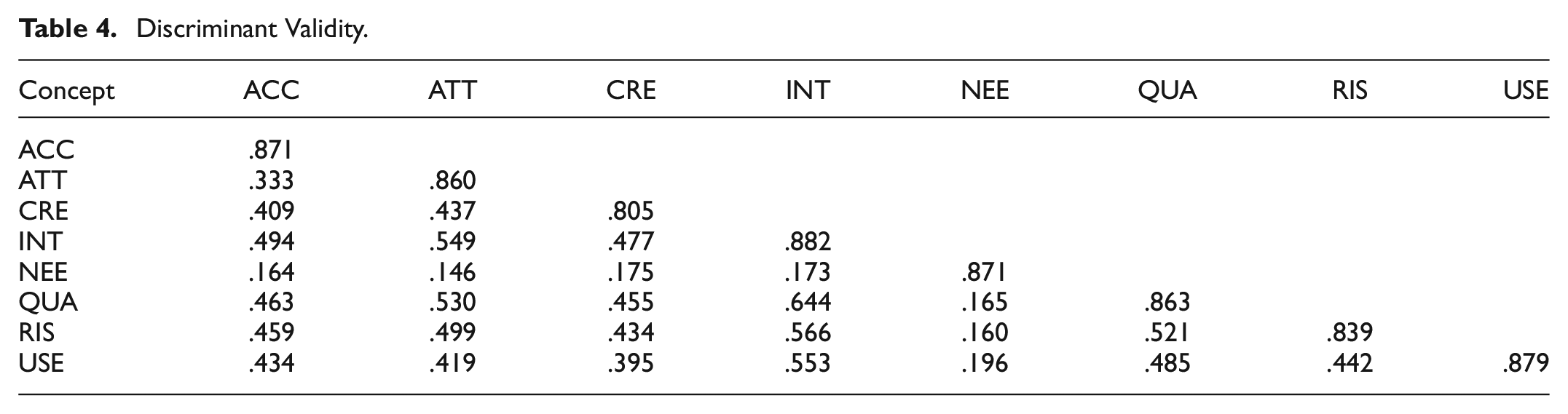
To establish a strong level of discriminant validity, the AVE’s square root must exceed 0.5 and surpass the interactions involving other concepts (Chin, 1998). The results in Table 4 highlighted AVE’s square root of every concept is considerably larger than that of the remaining concepts. This confirms providing evidence of discriminant validity for the measurement of each concept.
Discriminant Validity.
Hypothesis Testing
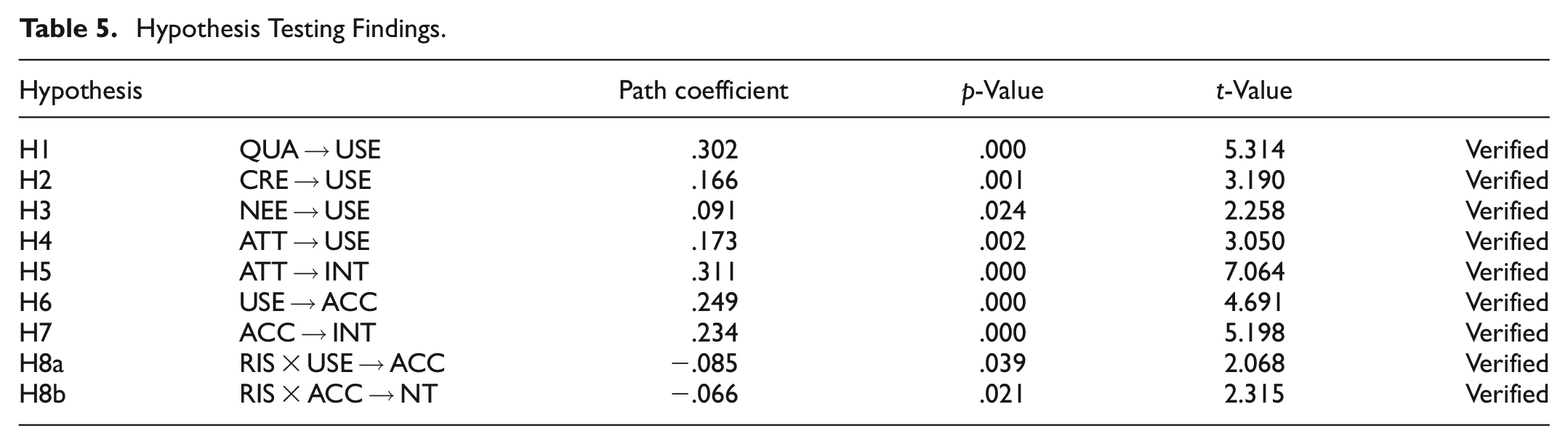
The path coefficients in Table 5 and Figure 2 demonstrate a robust and favorable correlation between information quality-QUA and its usefulness-USE (β = .302, p = .000), credibility of information-CRE (β = .166, p = .001), needs of information-NEE (β = .091, p = .024), and attitude toward information-ATT (β = .173, p = .002). The results validate the following hypotheses: H1, H2, H3, and H4. The path coefficients for ATT and purchase intention-INT (β = .311, p = .000), USE and information acceptance-ACC (β = .249, p = .000), and ACC and INT (β = .234, p = .000) were found to be significant and positive, validating the following hypotheses: H5, H6, and H7. Besides, the study revealed that perceived risk-RIS performs as a moderator between USE and ACC (β = −.085, p = .039), as well as between ACC and INT (β = −.066, p = .021), hence validating hypotheses H8a and H8b. These findings suggest that the RIS has a negative impact on the link between USE and ACC, as well as between ACC and INT.
Hypothesis Testing Findings.

Hypotheses testing results.
Discussion
The results disclosed a favorable connection involving the quality of information and its usefulness, aligning with the results of Torres et al. (2018). Higher information quality leads to increased information usefulness. Information’s impact on usefulness is crucial on e-commerce sites as customers are unable to see goods and must depend on information to make decisions (Tjongirin et al., 2020). Credibility for information was also positively correlated with its usefulness, which is verified by the findings of Erkan and Evans (2016). Hence, clients’ persuading depends on trustworthy information sent via eWOM on e-commerce sites. In the process of convincing a person, the transfer of knowledge takes place when information is gained via a trustworthy source and becomes a crucial part of the process (Erkan & Evans, 2016). Likewise, the information needs were shown to be positively connected with its usefulness, as demonstrated by the findings of Peres and Silva (2021). Greater information needs lead to increased usefulness of information. Information needs correspond to an individual’s need for information. Consumers actively look for information to address their concerns, particularly when it comes to product-related information on e-commerce sites (Savolainen, 2012).
Furthermore, the attitude towards information was demonstrated to have a positive correlation to its usefulness. Although Erkan and Evans (2016) argued that there exists no meaningful link between an individual’s attitude toward information and its usefulness. They suggested that individuals can see information shared by friends and acquaintances on social media as already being beneficial. This research, however, as analyzed above, revealed that attitude toward information was shown to have a positive link with its usefulness, which is in contrast to the results of Erkan and Evans (2016). The difference in the results may be explained by the differences in the study settings. The present investigation was carried out on the e-commerce platform in Vietnam, whereas Erkan and Evans (2016) did their study on the e-commerce platform in the UK. When individuals take an optimistic attitude toward information, the usefulness of that information increases. The reviews that consumers post on e-commerce websites, whether favorable or unfavorable, are crucial for customers to have access to throughout the buying process. This conclusion has been supported by research conducted in the past (Leong et al., 2022; Torres et al., 2018). Similarly, the study showed that consumers’ attitude toward information was positively correlated with customers’ purchase intention. A good attitude towards knowledge results in higher customer buying intention. This finding has been reinforced by the earlier study (Tjongirin et al., 2020).
The results revealed a positive association between the information’s usefulness and its acceptance, aligning with the findings of Torres et al. (2018). If customers find eWOM information on e-commerce websites helpful, they are likely to adopt it. The results also showed a favorable correlation between consumers’ acceptance of information and their purchase intention, aligning with the findings of Erkan and Evans (2016). The likelihood of a consumer developing the desire to make a purchase increases when the consumer is willing to accept information about e-commerce. Besides, the utility of eWOM information is in its provision of information and knowledge pertaining to the product. Customers generally agreed that consumer-generated eWOM, whether favorable or undesirable, is more advantageous than information produced by the brand (Ngarmwongnoi et al., 2020).
The findings revealed that consumers’ perceived risk negatively moderates the usefulness and acceptance of information. An increase in customers’ risk perception is linked to a decline in their perceived usefulness and acceptance of information on e-commerce platforms, as shown by the study findings. Moreover, the results demonstrated that consumers’ perceived risk negatively moderates the information acceptance and buying intention. The study demonstrates that an increase in consumers’ risk perception is associated with a decrease in their acceptance of information and intention to purchase and acceptance of information on e-commerce sites.
Contribution, Limitations, and Further Direction
Theoretical Contributions
eWOM information and its effect on buying intention on e-commerce platforms are the subject of this study, which potentially contributes to the current literature on the subject. The findings of this research also highlight how consumers’ perception of risk moderates the link between information usefulness and its acceptance, as well as the relationship involving information acceptance and buying intention. Several characteristics, including information quality, credibility, attitude toward information, information needs, utility of information, acceptance of information, perceived risk, and buying intention, were validated by the research, which proved the validity of the measurement of these factors. This research has contributed to the advancement of these measurements for potential future applications.
Additionally, previous studies have concentrated on examining the influence of eWOM on consumer behavior, client brand engagement among users of mobile phones and hotel booking websites, its role as a mediator between website quality and trust, the willingness of travelers to pay for accommodation, and its effect on online retail purchases. This study specifically focuses on eWOMs’ effect on the purchasing intentions of customers in e-commerce. Therefore, this work adds to the existing literature for future researchers in this research area.
Furthermore, previous research has only applied IACM theory in the setting of social media generally; this research is the pioneer in combining the IACM theory and consumers’ perceived risk in the relationship involving eWOM information and desire to buy on e-commerce sites. Specifically, how the link involving information utility and its acceptance, as well as the connection between acceptance of information and desire to buy, is moderated by customers’ perceived risk. As a result, this makes a major contribution to the research and the body of literature in this area.
Practical Contributions
The findings of this study provide several insights for marketers into the implications of eWOM on clients’ intentions to buy. Marketing professionals must recognize that consumers’ attitudes towards conventional advertising and WOM have changed, and they now significantly depend on eWOM to ascertain clients’ purchasing intentions (Ngarmwongnoi et al., 2020).
According to eWOM information in this study, factors influencing information usefulness include its quality, credibility, information needs, and attitudes toward information. It is, therefore, crucial that suppliers of goods on e-commerce platforms concentrate on enhancing these elements in their online reviews. Tracking internet reviews regularly might help them reach this objective. On their websites, the providers may set up online forums where customers may leave reviews and exchange ideas about their products and services. To create a favorable impression, the suppliers should actively examine data about their products. As a result, suppliers will have more authority over their internet ratings (Leong et al., 2022).
Moreover, the findings also the usefulness of information was a factor that contributed to its acceptance. Furthermore, acceptance of information had a predictor of purchase intention. Besides, attitude towards information impacted positively buying intention. Hence, vendors should ensure that the eWOM information provided is highly valuable to customers. To achieve this objective, businesses can implement a communication plan that encourages customers to share their feedback and judgment of purchased goods in a relaxed and unreserved manner. Moreover, vendors should actively communicate to potential buyers that the information shared on eWOM is objective and meets their product information needs. By doing so, they can effectively enhance the usefulness of information positively influence consumers’ acceptance of information, and finally lead to increased purchase intention.
Finally, the findings disclosed that consumers’ perceived risk moderates the relationship involving information usefulness and its acceptance, as well as the link involving acceptance of information and buying intentions. Therefore, to improve the effect of information usefulness on its acceptance, as well as to increase the influence of clients’ acceptance of information on their intention to make a purchase, and to decrease customers’ perceptions of the risks associated with shopping on e-commerce websites, vendors are required to provide clarity on certain matters. These include fulfilling their initial commitment to deliver the correct products, establishing a policy to safeguard personal information and payment details, and providing accurate information regarding concealed costs such as maintenance in case of resolving problems.
Limitations and Further Direction
The limitations of this study: The major focus of this research is to identify the effect that eWOM information on the buying intentions of clients who are shopping on e-commerce websites. In the future, research should be conducted to investigate the effect that eWOM information on buying intentions and actual behavior of consumers. In addition, the IACM theory is applied in this research to shed light on the effect that eWOM information has on clients’ intention to purchase on e-commerce platforms. Considering the use of alternative theories in the future to elucidate this relationship and comparing the findings with the IACM theory is something that should be considered.
Footnotes
Acknowledgements
The authors acknowledge the support of Industrial University of Ho Chi Minh City for this research.
Declaration of Conflicting Interests
The author declared no potential conflicts of interest with respect to the research, authorship, and/or publication of this article.
Funding
The author received no financial support for the research, authorship, and/or publication of this article.
Ethical Approval
Not applicable because animals or human subjects were not included in this study

Data Availability Statement
The data is private.