




Abstract
Fortnite is a predominantly social game with highly positive reviews, produced by Epic Games. Although it is known for its constant innovation, few studies have analyzed the digital interactions between the voice of the company and digital fan communities. This study thus analyzes digital texts generated by the Fortnite digital fan communities on social networks to examine the role of the producer and its marketing strategies in shaping digital conversations. To this end, a mixed methodology was adopted. First, we scraped 435,365 mentions (posts) of Fortnite in written form produced by digital fan communities. Second, we used visualization strategies to describe the evolution of mentions over time. Third, NVivo allowed for a conventional qualitative discourse analysis of mentions. The results showed that the industry maintains an asymmetric position relative to other users, influencing the direction of digital conversations about Fortnite based on marketing strategies. Conversation content focused on the game’s social dynamics and mechanics, representing the game’s external and internal dimensions, respectively. The study demonstrates the importance of digital conversations in analyzing gamers’ engagement with the community and the role of prominent users, including the voice of both fans and the industry gamers participating in social networks. The findings contribute to the understanding of gamers’ activities as consumers and offer practical insights for industry professionals, particularly game developers and community managers, interested in fostering user engagement and optimizing platform strategies. Additionally, we examine how less powerful participants exercise fan agency through everyday conversational practices (e.g., asking questions, offering peer support, and creative remixing), showing how bottom-up meaning-making coexists with top-down orchestration by the industry.
Plain Language Summary
Fortnite, developed by Epic Games, is a popular online game known for its constant updates, new features, and social elements that attract millions of gamers worldwide. While existing research has examined various aspects of Fortnite, limited attention has been given to how interactions between the company and its gamers—particularly through social media—shape the broader gaming experience. This study addresses this gap by exploring digital discussions about Fortnite on social media and how Epic Games’ marketing strategies influences these conversations. We also highlight the role of everyday fans with less visibility, whose questions, mutual help, and creative posts show how fan agency shapes community meaning from the bottom up. To investigate these relationships, we analyzed over 435,000 social media posts related to Fortnite collected from various digital communities. We analyzed how these posts changed over time, identifying trends in gamers’ conversations. For example, some discussions focused on the game’s new features or changes, while others focused on the game’s strategies or experiences. We also used a qualitative analysis software NVivo to analyze the content of these posts more deeply, allowing us to see the main themes and ideas gamers were discussing. Our findings reveal that Epic Games, the company behind Fortnite, plays a significant role in guiding these conversations using marketing strategies that encourage gamers to discuss specific aspects of the game, such as its social features or gameplay mechanics. Overall, this study offers insights into how digital conversations shape the Fortnite community. It shows how gamers enjoy the game and act as active participants in a larger conversation, influenced by their interests and the company’s marketing efforts. These insights help us see gamers as consumers deeply engaged in the community and the culture surrounding Fortnite.
Keywords
Introduction
Despite the growing relevance of platform-mediated interactions, few studies have analyzed how the interaction between gamers and the gaming industry shapes communicative strategies within digital platforms. However, gaming is a space where marketing narratives, user engagement, and cultural meaning are constantly negotiated. This study analyzes narratives in digital fan communities in which the video game Fortnite is shared and reconstructed through digital conversations in entertainment situations mediated by Epic Games, the game’s distributor. It also examines Epic Games’ role and marketing strategies in this creative and cultural industry. Moreover, it focuses on the mutual influence of messages from game distributors in Spain and Fortnite fans participating in social networks, mainly through Twitter posts and YouTube video comments. The analysis and data interpretation are enriched using fandom theory.
Within Fortnite, Epic Games combines the production of a free-to-play game with other monetized models. The company also collaborates with other entertainment companies, such as Disney or Lego (Epic Games, 2023b; The Walt Disney Company, 2024; Wildermuth & Pinera, 2025), sometimes including them in the game’s mechanics. Fortnite’s gaming mechanics are also intertwined with its social dimensions (Daniil, 2023): traits that facilitate interaction with gamers are overlaid with social and cultural features. Due to these characteristics, the game competes with social networks, including fans and the industry, especially among young people (Bloom, 2019; Holmes, 2019).
Fandom studies are particularly relevant to this research, both as a general framework and specifically for analyzing the practices of some participants who interact with the industry within the Fortnite-focused Twitter community. In a recent interview, Jenkins (2025) describes fandom as a form of “participatory culture,” where fans receive a text and co-construct it through collective and interpretive practices. In this context, he introduces his initiative aimed at exploring the key concepts that define fandom, which he elaborates on through a series of books “Frames of fandom,” currently being published. The authors seek to rethink fandoms, what they seek, why they matter, and how they shape the future of culture (Jenkins, 2025; Jenkins & Kozinets, 2024, 2025). This approach is relevant for analyzing video game communities, where gamers create narratives, generate content, and exert social influence within and outside the digital environment.
This study contributes to literature through three specific objectives.
(i) To analyze Epic Games’ presence within the Fortnite community to understand the evolution of its marketing strategies and its interactions with gamers and specific participants in Twitter conversations.
(ii) To examine gamers’ convergences and whether they prioritize the game’s social aspects or its mechanical aspects.
(iii) To identify and analyze privileged users (e.g., trendsetters or influencers) whose posts significantly influence followers to assess their ongoing influence on marketing strategies.
Aligned with objectives (ii) and (iii), we also examine how less powerful participants manifest fan agency in everyday conversational practices, thereby complementing our focus on industry influence and prominent users.
The study first presents a theoretical framework grounded in cultural and fan studies to explore these dynamics. Then, it applies this framework to a mixed-methods analysis of digital conversations about Fortnite.
Background
Epic Games as Cultural Industry and Narrative Architect
This study builds on established perspectives within the literature on cultural and creative industries. For example, Hesmondhalgh’s (2019) classic work analyzes the tensions between symbolic and commercial logic in cultural production. Previous analyses, such as that of González-Piñero (2017), examined the restructuring of the value chain in the video game industry, particularly in light of digital distribution and user participation. More recently, Ericsson et al. (2024) have explored how creative contributions drive innovation both within and beyond the cultural sector. These perspectives align with the broader framework outlined by Cunningham and Flew (2019), which emphasizes the hybrid economic, social, and cultural value produced by creative industries. These contributions provide a basis for analyzing video games such as Fortnite as part of a broader creative economy shaped by participatory dynamics and platform-driven innovation.
The distinction between cultural and creative industries is unclear; some refer to them as a singular industry (Lhermitte, 2015). In this study, we attribute both traits (cultural and creative) to Epic Games (Crecente, 2024). The company was created in 1991 and is typically associated with geometric games. In addition to Fortnite, it also distributes other games, such as the Rocket League on the Epic Games Store, a portal open to developers and gamers. Epic Games’ emphasis on live Fortnite events has contributed to reshaping perceptions of video games within the industry and digital fan communities. The company constantly innovates and adapts to the changing tastes and technologies of the video game market (Slashdev, 2023; Tomkinson, 2020).
Epic Games works with other companies and applications that offer gamer entertainment and promote creation, such as LEGO (Epic Games, 2022). Gamers or developers seek to create additional tools to facilitate the development of games and applications. Furthermore, the company is present on various Internet channels and generates marketing strategies to disseminate its products. In this context, it represents a cultural industry, which is defined here as a complex and multidimensional concept (Hesmondhalgh, 2019) related to the production of texts. Such industries arise through creative processes and contribute to social, economic, and cultural changes. These texts are produced and monetized through layered platform logic (Nieborg & Poell, 2018).
Cultural industries such as Epic Games exercise control over texts’ production and distribution. Regarding video games, the material dimensions of signs (Williams, 1976) can be highlighted from a dual perspective. On the one hand, the audiovisual product is associated with consoles or the hardware that enables gameplay. On the other hand, the cultural industry links its products and actions to monetization strategies. In this scenario, video games can be considered texts that undergo the process of converting cultural products into platform-driven commodities to be sold, bought, and exchanged (Cunningham & Flew, 2019). These perspectives align with Flew’s (2019) argument that creative industries operate at the intersection of symbolic and economic value, navigating between market logic and cultural meaning-making. The monetization of Fortnite cannot be separated from the interactions between Epic Games and gamers: these interactions occur in multiplatform contexts in which social networks are also present (Jungherr & Schlarb, 2022).
Cultural industries are sometimes contrasted with creative ones. The former emphasizes the collaboration of cultural production and various existing forms of commodification (private, quasi-public, and public). By contrast, creative industries highlight individual creativity, intellectual property, and profit (European Commission, 2022). The concept of creativity refers to, among other things, audiovisual productions, including video games, and is linked to culture and individual and collective values. The digital gaming industry can be explored globally by considering it a cultural and creative industry.
Epic Games operates not only as a content distributor for video games but also as a cultural architect that orchestrates narratives, emotions, and interactions across multiple platforms. As Hesmondhalgh (2019) argues, cultural industries are not limited to producing goods but contribute to generating symbolic systems that allow for the negotiation of meanings and even identities as gamers. In line with this perspective, Sidorenko Bautista et al. (2023) characterize Fortnite as a transmedia infrastructure that combines storytelling, brand development, and user-generated participation. Their findings suggest that concerts and seasonal content releases are commercial strategies and narrative devices designed to mobilize fan attention and engagement. In this vein, Epic Games emerges as both a content producer and a community builder, enabling environments in which pre-designed commercial structures influence gamers’ practices. Therefore, the role of Epic Games must be considered when analyzing how conversations around Fortnite are initiated, shaped, and sustained across different media platforms.
This study examines the power of industries and brands to produce, distribute, and facilitate the circulation of their products, considering that they are embedded in digital economies shaped by corporate logic (Dyer-Witheford & de Peuter, 2021). It is also important to further explore how digital platforms have transformed the gaming context, as previous research has shown how platform infrastructures mediate access, labor, and content distribution in cultural industries (Lobato, 2019). Games have increasingly been commodified beyond playing, illustrating how monetization strategies are embedded into gameplay experiences (Jungherr & Schlarb, 2022; Nieborg, 2021). In the cultural industry framework, analyzing online conversations and marketing strategies around video games is a possible path for exploring the voices of cultural industries and their interactions with gamers. Furthermore, to understand how these strategies play out in practice, examining how the Fortnite experience unfolds as a hybrid of gaming, social interaction, and commercial logic is essential. It leads us to consider participatory practices in digital conversations.
These considerations provide the foundation for analyzing how gamers engage with, reinterpret, and challenge the symbolic and economic structures embedded in Fortnite’s digital ecosystem.
Participatory Practices in Fortnite: Digital Conversations
The reasons for examining Fortnite are as follows. First, Fortnite continues to receive excellent reviews and maintains a large player base. For instance, IGN rates the game 9.6 out of 10 points and highlights various aspects that make it innovative, which are reinforced by continuous updates (Navani, 2023). Battle Royale relies on a free-build system, which differs from competitive multiplayer games. Up to 100 gamers drop onto a map to gather weapons and gear to become the last person or team standing (Golsin, 2021). As the game progresses, gamers collect resources and build structures to defend themselves and overcome opponents, adding a unique strategic element to the battle experience. Fortnite stands out for its aesthetic traits, construction elements (Cise, 2018), and third-person shooting, generating a hybrid gameplay experience.
Second, monetization is closely tied to the game’s dynamics, considering its content and the challenges of a global economy focused on microtransactions (Iqbal, 2024). Gamers can earn in-game currency during gameplay or purchase it using regular currency in stores or game shops (Ganti, 2020). The game is structured by seasons and has various themes related to everyday events, such as the seasons of the year or media phenomena, for example, the release of certain films (Machado-Pureza, 2024). In addition, Epic Games encourages engagement among external creators who are part of the Fortnite community.
Moreover, it creates codes to implement elements within the game, such as islands or skins. Epic Games distributes a portion of its profits among these creators through Creator Economy 2.0 (Epic Games, 2023a).
Third, Fortnite is an inherently social game, and gamers can interact with each other even across platforms (Gatchalian & Jecks, 2022). Accordingly, it has been referred to as a new social network (Schmidt, 2021). Gamers perceive Fortnite streamers as influencers (King & De La Hera, 2020), and it has become common practice for gamers to watch others playing it on YouTube or Twitch. Furthermore, gamers can spend time outside Fortnite battles chatting with friends, watching films or concerts, or going to art galleries (Brand Vision Insigths, 2023). Playing Fortnite offers an entertaining experience to most gamers. It is also connected to personal or collective situations linked to people’s well-being and involves interactions with meaningful content (Vorderer, 2021). Fortnite was released as a cooperative survival game in the Fortnite: Save World mode on July 25, 2017. Fortnite offers a diversified structure with multiple game modes, many operating independently. Moreover, it has remained on the market since its creation, generating significant profits (SportSkeeda, 2023). The game is popular among young people and teenagers for several reasons, including its vibrant graphics, cartoons, and the thrill of survival. Initially, it was differentiated from other online games by its free-to-play model, eliminating financial barriers and making it accessible to a broad audience (Brand Vision Insigths, 2023). In January 2023, based on weekly viewing hours, it ranked first among the Battle Royale games, alongside Call of Duty: Warzone (Clement, 2025).
From a cultural studies perspective, the gameplay experience is inseparable from its discursive and affective dimensions. As Pitroso (2024) suggests, digital fan communities operate within symbolic fields marked by digital capital and recognition, where conversation, visibility, and identity play a central role. These interactions—on Twitter, YouTube, or Twitch—represent more than simple exchanges: they serve as sites of meaning-making, where users co-construct narratives and negotiate their place in the gaming ecosystem. In this context, Fortnite, functions not only as a game but also as a platform for mediated sociality.
As an experience, the play presents different demands that emphasize its value as an object of study. Bowman (2021) notes that in the experience of play as entertainment, there are various cognitive, physical, emotional, and social demands and explores how these demands are present in gamers’ online conversations when they participate in social networks. Each platform offers different aspects of the experience; thus, this study focuses on conversations in Twitter and Facebook posts, YouTube video comments, and other digital resources.
Fan Agency, Identity, and the Power of Affective Engagement
Gamers make Fortnite the subject of their online conversations and share goals and values related to the game, forming a community (Kreissl et al., 2021). Epic Games is present in this community (Sandvoss, 2015). Studies on fandom have examined the relationships maintained in digital communities through conversations when fans or gamers become interpreters and creators of texts, the reception, creation, and distribution of which are guided by certain social conditions (Jenkins et al., 2013). Building on Jenkins’ concept of participatory culture (Jenkins, 2006; Jenkins & Kozinets, 2024, 2025) and further developed by scholars such as Duffett (2013) and Sandvoss (2015), fandom theory conceptualizes fans not as passive consumers but as active agents who interpret, remix, and circulate media content. In this study, fandom theory functions not merely as a background concept but as a guiding analytical lens for defining categories and interpreting how gamers shape meanings and social dynamics within the Fortnite community. Fans interpret texts from the perspectives of subjectivity and emotion (Duffett, 2013). Today, fandom can be understood as shaping social relations associated with a media presence in an industrialized society. This theoretical framework is a starting point for exploring digital conversations among gamers who interact with the industry’s voice (Consalvo, 2003; Lacasa, 2020).
Digital communities can serve various user motivations and needs, such as sharing information, seeking human interaction, and becoming a part of a collective experience (Marlatt, 2020). These activity frameworks have rules, expect certain behaviors, and are dynamic and two-dimensional. One dimension is internal and refers to the relationships that participants maintain, such as mutual support and interactive learning. The second is external and relates to the context that leads to community formation. When the industry’s presence becomes relevant, the extent to which gamers share goals and values with the company that produces the game and express them through conversations is called into question. The industry is interested in being present at the core of consumption, evoking passion and loyalty among gamers, and providing a model of emotional commitment, enjoyment, and product integration related to user identity (Sandvoss, 2015). Ryan et al. (2020) demonstrate a causal link between the company’s changes to its games and the culture of digital communities that emerge around them. Their study highlights how individuals engage in dialogue when influenced by their previous experiences with the game and how they contribute to improving it. Several authors have reported that Fortnite employs strategies that provide constant opportunities in the game based on gamers’ suggestions. It is discussed in the community, and consequently, the company continues to introduce the modifications suggested by gamers (Murty, 2023; Rajput, 2023). In these communities, users’ voices intermingle with those of Epic Games, updated through messages broadcast through Fortnite-related accounts and hashtags. Users contribute to forming communities by providing feedback to content creators, thus influencing game development (Sandvoss, 2015). Fortnite encourages such collaborations on its official portal through which it contacts content creators.
Fans are crucial in cultural creation, especially if we consider video games as text and designers as creators. The evolution of a game is closely linked to these creative processes, as developers actively listen to feedback from the community, which influences subsequent updates and changes. It is part of popular culture, which is driven by the interests and trends of the community, whose texts are interpreted by fans. Signs’ material dimension in video games testifies to how game elements (i.e., characters, objects, and environments) represent diverse cultural symbols and narratives. Fortnite’s use of recognized cultural symbols (e.g., Marvel characters and Star Wars elements) and their material representation within the game underscores its cultural perspective.
Companies also use the social immersion generated from fan community participation to achieve gamer loyalty (Linh Pham et al., 2023). Such immersion is fostered by socially beneficial experiences that allow gamers to connect and interact with others worldwide, which can, in turn, lead to the development of social capital and prosocial behaviors, including those related to friendship contexts or game-related exchanges that are not possible in offline contexts (Zhang & Frederick, 2018). Additionally, a gamer’s identity, defined by self-identification rather than the time spent playing, is significantly related to practices such as the intention to play and interact with other gamers (Yim et al., 2023). The social context supports online gaming, which is linked to a collective sentiment that leverages the brand to foster loyalty (Kort-Butler, 2021). This study adds to the literature through a conversation analysis of digital fan communities and an exploration of the roles played by different voices.
Fandom theory positions fans as active communities that interpret, remix, and produce cultural content rather than as passive consumers. In line with this perspective, we distinguish between powerful participants (e.g., official or highly prominent accounts) and less powerful participants whose posts may have limited reach but cumulatively shape meanings, norms, and visibility. We therefore consider fan agency not only in high-visibility interventions but also in everyday grassroots practices—asking questions, offering peer support, expressing preferences, or remixing creative content—that co-construct discourse in the digital community. This theoretical distinction provides the rationale for the research questions outlined below.
In summary, this study’s contributions are threefold. First, considering video games as texts and the industry as their creator, it identifies which texts are oriented toward marketing processes and the reactions generated by game users. Second, it explores game experiences through an analysis of conversations, considering the presence of social interactions and game mechanics, which can guide marketing strategies. Third, it explores the role of privileged users in the Fortnite community.
Drawing on this theoretical framework, the following analysis is structured around three interconnected axes. First, Epic Games is examined as a cultural and creative industry that influences community narratives through marketing strategies and content distribution. Second, gamer conversations are analyzed as expressions of participatory culture, emotional engagement, and social practices typical of fan communities. Third, the study investigates the role of prominent users whose voices blur the boundaries between grassroots fan discourse and official industry messaging.
Research Questions
Building on the above discussion, this study addresses the following research questions:
What role does Epic Games play in shaping conversations on social networks, particularly through its marketing strategies?
How does it develop the gaming experience of Fortnite gamers through conversations on social networks?
What is the contribution of the voices of influential users to Fortnite’s community (i.e., those who have the most significant impact) in order to understand their contributions?
How do less powerful participants exercise fan agency within Fortnite’s digital community, and through which conversational practices does that agency become visible?
The answers to these questions will add new knowledge to the scarce literature on gamers’ digital conversations on Fortnite and their relationships with Epic Games.
Materials and Methods
This study adopts a mixed-methods approach, integrating quantitative techniques (e.g., data scraping, visualization) and qualitative analysis (e.g., thematic grouping, discourse analysis). Rather than applying them separately, these methods were sequentially and iteratively combined, allowing insights from one phase (e.g., temporal peaks) to inform the qualitative interpretation of content. This integrated design reflects the evolving nature of gaming practices. Previously, gamers moved across computers or console screens using their controllers, mixing stories and rules (Juul, 2005). Most related studies have used quantitative or qualitative methodologies (Lacasa, 2013); however, today’s multiplatform gaming contexts, where dialogue also occurs on social networks, call for mixed methods (Åkerblad et al., 2021).
Using a mixed methodology (Younas et al., 2023) is challenging in analyzing online gaming. We aimed to seamlessly integrate quantitative and qualitative approaches using computer resources for data extraction and analysis. Figure 1 presents the analytical processes used, which are typically sequential but have the possibility of feedback: scraping, data visualization, and qualitative analysis.

Data extraction and analysis: Mixed methodology.
Scraping and Data Collection
First, data were obtained through scraping using various application programming interfaces in collaboration with Séntisis Intelligence (https://www.sentisis.com). Dahlke et al. (2023) note that these content collection efforts may be systematically biased when the entirety of the data cannot be captured retrospectively. Data mining using scraping combined with different analyses helps minimize specific problems related to data accuracy (Dahlke et al., 2023).
Data were collected from May 18 to July 5, 2021, by filtering text data obtained from Twitter, YouTube, Facebook, and other sources, such as news, blogs, and forums, using the Séntisis Intelligence software. The data collection period was justified by Fortnite’s success at the time and the need to fix specific dates with Séntisis Intelligence. Although limited in duration, this period included key marketing milestones—especially the launch of Season 7—which generated significant activity, making it particularly suitable for analyzing conversational peaks and platform strategies. In total, 71,526 unique users were included in the analysis. The messages delivered by these users, defined as “mentions,” were analyzed. To ensure the inclusion of relevant mentions, we used the keyword-based filtering configuration provided by the Séntisis Intelligence software. This configuration automatically includes only mentions that contain specific terms and handles associated with Fortnite (e.g., “Fortnite,”“@Fortnite_ES,”“FortniteSpain,” etc.) based on the platform’s predefined taxonomy for brand and topic monitoring. A total of 435,365 mentions were collected: 218,700 from YouTube (50%), 196,500 from Twitter (45%), 18,400 from Facebook (4%), and only 1,800 from other media outlets (0%). The extremely low number of mentions from Facebook, especially from media sources, reflects the platform’s policies and the limitations of the Séntisis Intelligence tool, which favors social platforms with more open APIs. Consequently, the analysis focused primarily on content from YouTube and Twitter, as these two platforms offered the most robust, varied, and analytically relevant data. Using this type of service and the policies of social networks represent significant difficulties when conducting scraping. Gender information was available for some mentions and indicated that there were more male users (8 contained specific keywords 7,454; 78%) than female ones (25,265; 22%).
Only publicly available posts were collected and analyzed in aggregate; no interaction with users occurred and no identifiable personal data were processed (see Ethics and Informed Consent Statement).
Defining Themes and Categories Through Data Visualization
In the second phase, we applied visualization techniques to the dataset using Tableau (Jackson & Stanke, 2021). Beyond descriptive purposes, visualization was an essential analytical tool for identifying temporal patterns, refining categories, and constructing coherent narratives. It also provided feedback to earlier phases, allowing us to reassess data quality and validate thematic groupings, thus contributing to the overall integration of quantitative and qualitative insights. For instance, they aid in contextualizing outliers (Ansoleaga, 2021), which are deviations in the data distribution that can be significant for discovering relevant dates in marketing campaigns.
First, the collected data were visualized, which allowed for a temporal analysis of the daily count of mentions. This analysis revealed the relationship between the number of mentions on specific days and Epic Game releases. Second, we clustered categorized mentions, semantically significant groupings (Åkerblad et al., 2021; Saldaña, 2021) defined by grouping relevant terms (patterns). We then grouped the categories into thematic clusters (Braun & Clarke, 2022; see Annex 1). This process involved inductive and deductive approaches, drawing from the theoretical framework and available data. Third, the visualization techniques allowed us to identify prominent users, such as Epic Games, based on their posts’ potential impact, number of followers, and reach. Reach was defined in terms of the potential access to the accumulated text.
Qualitative and Discourse Analysis
One of the advantages of scraping with the Séntisis Intelligence software is that mentions remain stored on the server and can be downloaded in whole or part for the analysis of specific examples. Figure 2 shows how the data were stored on the server (left image) and viewed from a global perspective to a more specific one, where mentions appear. Mentions were selectively downloaded and imported into NVivo 14 (left image of Figure 2) for discourse analysis.
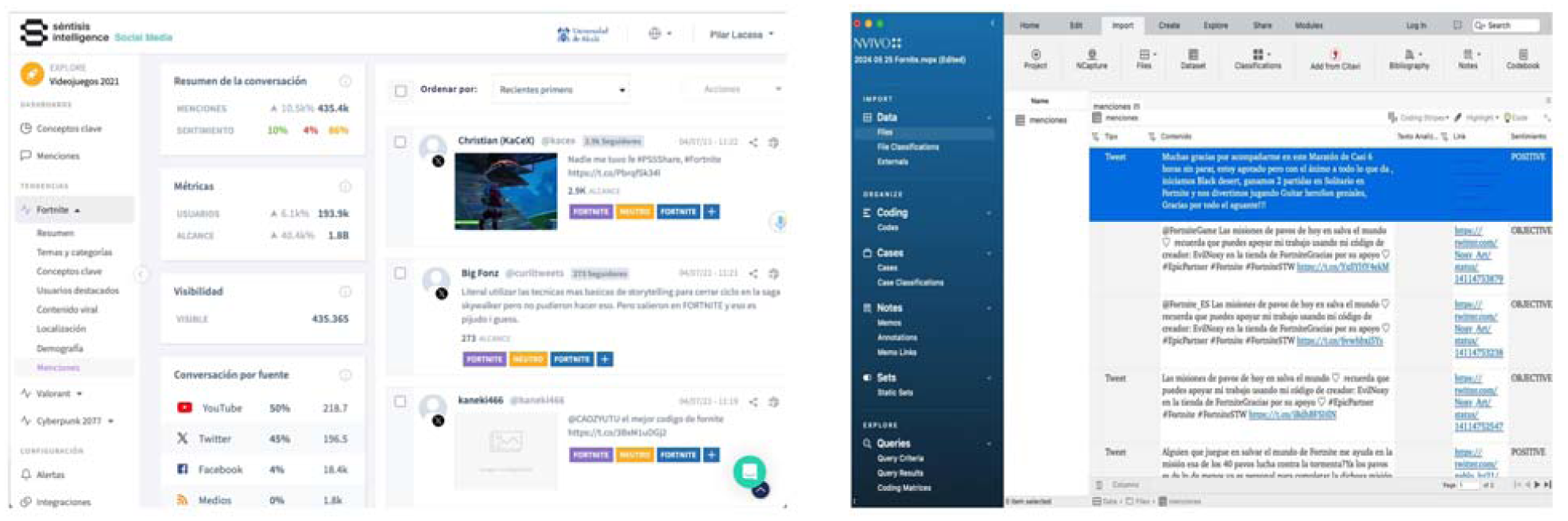
Séntisis Intelligence software interface.
The discourse analysis was conducted following Gee’s (2014) model, which comprehensively explains how language is used in social contexts. Gee (2014) specifies the dimensions of the discourse that need to be considered as follows: (1) the intertextuality in which meaning is constructed: the mentions had to be related to others, and different criteria could be considered to bring them closer to each other; (2) the relationship to practice: the text was related to game activities; (3) identity, for example, the messages issued by the industry as well as those of other participants, had to be identified as such, which is sometimes difficult in social networks; (4) the social relations that the senders have with each other; (5) the goals of the sender of the message, which are often related to the role they play in the community; (6) the connections that the senders have with other participants or the objects; and (7) what sign system is used (written text, multimodal discourses, etc.). This approach guided how we analyzed the discourse of prominent users, those whose messages were more relevant, by considering specific metrics. In short, our qualitative analysis, supported by discourse analysis, aimed to go beyond isolated categories and build coherent and meaningful interpretations from messages emitted by individuals in a social network (O’Halloran, 2023).
In this context, we operationalized fan agency among less powerful participants as grassroots conversational practices within our thematic schema: (a) personal reactions (e.g., questions, preferences), (b) community actions (e.g., assistance, teammates, friendships), and (c) expressive/creative acts (e.g., references to videos, sounds, images, creative mode). These categories, already part of our coding, allow us to interpret how less powerful participants assert agency and co-shape community discourse within the digital community.
Results
This section builds on the fandom theory discussed in section “Fan Agency, Identity, and the Power of Affective Engagement” to explore how users engage with industry narratives and actively participate in shaping them. The analysis is organized around three interconnected axes: industry influence, community conversation, and key users’ voices. This approach reflects the interplay between cultural industry strategies and participatory fan practices within the context of Fortnite.
Industry-Driven Narratives: Epic Games’ Influence
As discussed in the theoretical framework, Epic Games functions not only as a distributor of gaming content but also as a cultural architect that orchestrates engagement through planned releases and transmedia strategies (Hesmondhalgh, 2019; Sidorenko Bautista et al., 2023). This section analyzes how industry-driven peaks in online conversations reflect the company’s ability to structure narrative attention and emotional investment through scheduled events.
We examined the evolution of conversations over the data collection period, and the moments when conversations increased or decreased were evident. We aimed to determine whether the number of mentions during specific periods corresponded to industry strategies to boost the follower base. A significant number of mentions (30,879) were generated on June 8, 2021, coinciding with the launch of Fortnite’s Season 7. This peak illustrates how major scheduled events initiated by Epic Games directly stimulate conversation across platforms, acting as temporal anchors within the fan ecosystem (Figure 3).
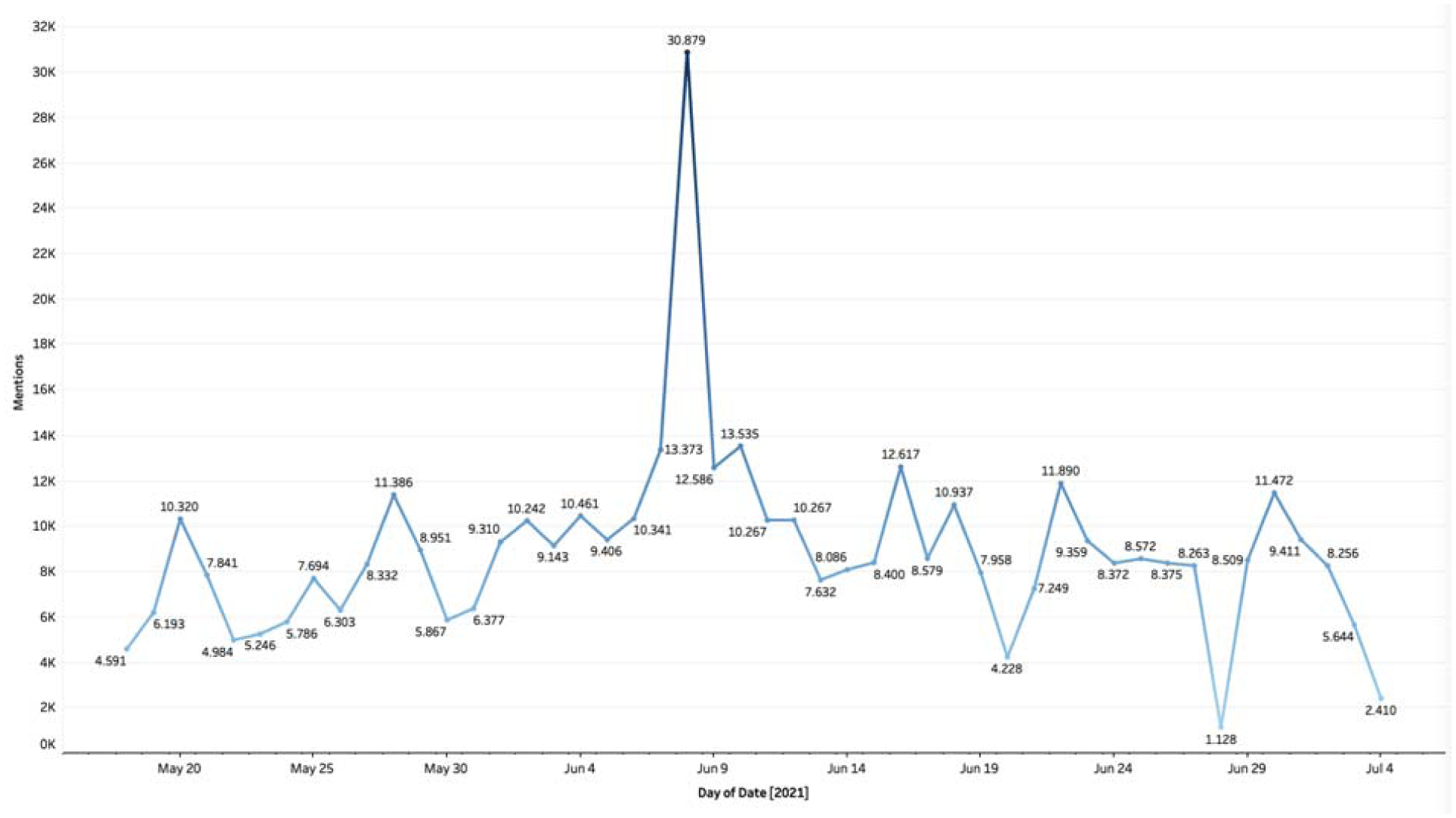
Timeline of mentions.
A significant number of mentions (30,879) were generated on June 8, 2021, which marked the beginning of Season 7. Other peaks included 10,320 messages on May 20, 4,228 on June 20, and 11,890 on June 22, 2021. Key moments coincided with the weekly release of new products in Fortnite (Figure 3). In addition to the official store, other platforms offer items for purchase on specific dates, although their availability changes over time (Bell, 2021; Duffy et al., 2019). These moments can be interpreted as orchestrated “cultural texts” (Hesmondhalgh, 2019), where content release is strategically designed to promote gameplay, mobilize fan discourse, and sustain relevance across platforms.
Digital gaming magazines and physical and online video game stores reported these significant dates. Epic Games created high expectations that users would spread its messaging, resulting in broad engagement across social media platforms. Transcript 1, a post from GameSpot published on June 7, contextualizes this surge in mentions. It reveals the strategic buildup of anticipation by Epic Games, including teasers of alien- and UFO-themed skins, references to Rick and Morty characters, and the release of the Season 7 trailer. These promotional elements contributed to heightened hype and emotional investment before the official launch on June 8.
Transcript 1. GameSpot. Season 7 Presentation. Fortnite Season 7: Start Time and Date, Skins, Theme. Fortnite Season 7 is almost here. Officially starting on June 8, we already have some insights into what to expect—the theme will revolve around aliens and UFOs … [Update: Fortnite Season 7 is live, introducing characters like Rick Sanchez from Rick and Morty, Superman, and more.] … The wait is almost over, as Epic will unveil the Fortnite story and battle pass trailers for Season 7 on June 7. (Pereira and Delaney, 2021)
Three crucial elements were mentioned. The first two refer to skins and characters: “aliens and UFOs.” These are collections of icons associated with the musical aspects of Fortnite Battle Royale that were introduced in Chapter 2 of Season 7. There is also a reference to potential skins based on “Rick and Morty” (Daugherty, 2021), a game acquired by Fortnite that features a wide range of merchandise. It illustrates how Fortnite is connected to other cultural productions and how it expands its marketing strategy. Finally, the text highlights that the game’s storyline will be unveiled during the Season 7 presentation.
The findings confirm Epic Games’ role as a narrative force in the Fortnite ecosystem, aligning with Dyer-Witheford and de Peuter’s (2021) concept of platform capitalism, in which the industry actively shapes the rhythm and focus of digital participation.
Participatory Culture in Action: Themes in Gamer Discourse
Participatory culture is evident not only through the efforts of the most visible actors but also in the daily actions of less influential participants, whose activities support and shape it. Building on fandom theory (Duffett, 2013; Jenkins et al., 2013), this section analyzes the thematic patterns emerging from gamer discourse to understand how fans engage with Fortnite both as gamers and as meaning-makers. Among the eight main themes identified in our analysis of 401,542 mentions, five were directly related to the social and personal dimensions of gameplay, accounting for 62.97% of the total mentions (252,837). This finding emphasizes Fortnite’s role not merely as a game, but as a social platform and a cultural artifact shaped by emotional engagement, community interaction, and expressive participation. Emotional reactions, references to other platforms, and expressions of creativity signal the participatory nature of digital communities. The strong presence of emotional categories supports Bowman’s (2021) view of gameplay as a cognitive and affective experience. Similarly, gamers’ use of visual, musical, and narrative elements suggests that Fortnite functions as a site of cultural remixing—consistent with Swalwell et al.’s (2017) view of fandom as a process of negotiating and preserving meaning through technology.
The analysis revealed the role played by Fortnite’s social context and its mechanics in shaping the surrounding discussions and how prominent users were involved in these conversations. Eight themes, encompassing 401,542 mentions, were identified. Five themes were related to the social and personal aspects of the game (252,837 mentions): personal reactions, references to social networks, monetization aspects, forms of expression, and community actions. The remaining three themes (148,705 mentions) focused on other game dimensions: mechanics, gaming platforms, and in-game objects and actions. Figure 4 shows the number of mentions in each theme and the corresponding categories.

Conversation content: Themes and categories related to the content of the conversations.
Themes, codes, and categories appear in Annex 1. The upper part of Figure 4 highlights the significance of each theme. Several themes were associated with personal and social components, including personal reactions (69,302 mentions), references to social networks (61,783), forms of expression (33,261), and monetization (58,471). Core mechanics had the highest number of mentions (95,727), followed by references to gaming platforms (34,800) and in-game objects or actions (18,178). We then examined the specific categories and number of mentions associated with each theme.
The category personal and social components of the game encompassed numerous themes:
Regarding personal reactions, most mentions (44,979) comprised questions, suggesting gamers engage in online conversations because of doubts or concerns. Other categories related to personal reactions, such as expressions of preference (8,510), “I like” (5,002), and rejection (5,519) or surprise (5,292), were also included as they reflected gamers’ attitudes toward the game.
Multiple references to social networks were made. Twitch (26,866) and YouTube (13,872) stood out, which is unsurprising considering that gamers often watch streams of others playing the game. References to Twitter (6,116) and Instagram (4,771) were less frequent.
Regarding monetization, references to the Fortnite store or other websites (25,988) offering downloadable accessories for the game were noteworthy. Gamers were concerned about the price (15,150) of these add-ons, which enhance gameplay by allowing faster progress or adding aesthetic aspects to avatars through skins or weapons.
The social dimensions of the game were related to gamers’expressive forms. Video references (19,578), sounds (3,141), and images (1,809) were also presented. Creativity (4,993), related to the Fortnite Creative Mode, was prominent and was encouraged by companies.
Conversations also included mentions of different aspects of the gamer community, such as friendships (8,107), assistance (7,066), and teammates (6,601). There were also a few references to adverse actions, such as “rat children” (794) or harassment (555).
Conversational content related to other components of the game was observed:
Many mentions related to the game’s mechanics. Fortnite is structured around seasons (24,669), which is significant considering that the highest number of mentions coincided with the release of Season 7. Game updates (17,308) and levels (12,844) were also mentioned, reflecting gamers’ experiences in Fortnite, although these aspects do not provide advantages for faster progression. Challenges (8,761) and maps (5,319), crucial in Fortnite, received fewer mentions.
Fortnite is associated with the emergence of platforms, which, in this context, are entities through which an online game is played. Significant references to PlayStation (20,109), also mentioned as PS4 (2,447), were made. This may be explained by the quality of graphics or gamers’ experience and age, as they may have been more accustomed to Sony products. The PlayStation experience differs from playing on a PC (5,328), requiring more technical skills.
Objects and actions of the game were also mentioned, with more references to weapons (9,615) than dancing (3,228), character protection (2,532), difficulties (1,911), or airplanes (792).
The preceding analysis reveals that while a majority of mentions (62.97%) relate to the personal and social dimensions of the game, the remaining 37.03% focus on its basic mechanics, platforms, and technical elements. This contrast shows Fortnite’s hybrid identity, functioning both as a platform for social expression and as a competitive game with structured rules and updates. Mentions of topics such as updates, levels, challenges, and gaming platforms indicate that gamers are engaged not only with the game’s social dimensions but also with its technical functionality. These findings align with the observations of Bowman (2021) and Vorderer (2021) on the cognitive and strategic demands of the game, reinforcing the idea that gameplay is not separate from the emotional and performative dimensions of fan participation.
We will now focus on the less powerful participants, who in this study refer to users who lack the visibility or influence of official accounts, brands, or major content creators, yet are an active part of the community. By focusing on their agency, our analysis reveals that this is primarily manifested in everyday conversational practices. Personal reactions—especially questions (44,979 mentions)—highlight bottom-up meaning-making processes and evaluative stances that guide the debate. Community-oriented actions, such as mutual aid (7,066) or friendship building (8,107), reveal dynamics of support and coordination that sustain community life beyond gaming sessions. Expressive or creative contributions, such as references to videos (19,578), also stand out, demonstrating how fans utilize the platform’s resources to produce and disseminate their meanings. Taken together, these practices reflect that less powerful participants exercise their agency by shaping shared meanings, supporting their peers, and selecting content, even when industry events mark the overall rhythm of the conversation.
In summary, these patterns suggest that gamers are active participants in a discursive space shaped by their experiences and the discursive control exercised by the company. The interactions between gameplay, creation, and expression confirm that Fortnite operates as a participatory ecosystem.
Fan Agency and Influence: Prominent Users as Cultural Intermediaries
The role of prominent users can be better understood from a perspective that considers fans as active agents (Consalvo, 2003; Sandvoss, 2015). These fans not only engage in community conversations but also interact with the industry, amplify certain narratives, and reflect the complex power of dynamics in gaming communities, especially those generated by commercial interests.
To better understand the role of Epic Games in the evolution of the conversation and users’ responses, we examined mentions on June 8. The data revealed prominent users, defined as participants whose contributions could significantly affect the community, who were participating in the conversation at that time. These users were identified based on their mentions’ potential reach and the number of views their contributions could receive. Table 1 presents data from Twitter, including the number of followers, tweets generated, and accumulated reach, which is the total number of potential views resulting from the volume of mentions.
Prominent Users on June 8, 2021, with the number of followers, mentions and accumulated reach.

Among the three most prominent accounts, the most notable was @TheGrefg, a content creator and owner of a communication company. This account has the highest number of followers (5 M) but has posted fewer tweets than the two accounts directly linked to Epic Games and Fortnite: @Fortnite_ES (1.6 M followers), the official Spanish account of @FortniteGame.
We explored the potential influence of this prominent user on the evolution of mentions over time. The frequency of mentions over time aligned more closely with the evolution of Epic Games’ messages than that of individual gamers. Figure 5 shows the evolution pattern of the mentions of two prominent users, @TheGrefg and @Fortnite_ES. Comparing Figure 5 with Figures 2 and 3, the overall pattern of the number of mentions generated is similar to that of the official game account (@Fortnite_ES). However, it differs from that of the most influential user (@TheGrefg).

Influence of prominent users on the evolution of the conversation.
We then examined the messages emitted by @TheGrefg and @Fortnite_ES and considered the content of their mentions based on the defined categories and themes. The categorization shown in Table 2 reinforces the previous observations from the analysis of the total mentions over time: The data revealed the most frequent categories for each user when considering the posts they made during the approximately 2-month data collection period.
Categories in the Conversations of Prominent Users from May 5 to July 18, 2021.

Six categories were common to both users. @TheGrefg introduced categories such as price, video, friendship, and surprise. Conversely, @Fortnite_ES used distinct categories such as stores, challenges, and weapons. These findings emphasize the role of gamers’ emotions and the monetization aspect, which is associated with elements related to game mechanics and the content generated by Epic Games. Mentions in the “store” category are used to encourage users to make purchases, whereas, for gamers, it might indicate concerns about pricing.
A discourse analysis of the mentions made by these prominent users was then conducted (see Transcripts 2 and 3). The selected tweets from @TheGrefg consisted of five posts published on June 8, whereas for @Fortnite_ES, the three most recent tweets from the same day were considered. To determine the meaning of each post, we highlighted the phrases we judged as most relevant. Categories assigned to each mention by the Séntisis Intelligence software were also included.
Transcript 2. @TheGrefg Mention 1. 08/06/21 – 20:58 Mention 2. 08/06/21 – 1:07 #NewVIDEO and the first one of the day! Categories: YouTube, battle pass, season, video Mention 3. 08/06/21 – 21:53 Nice stream! Victory to say goodbye to the Fortnite Season and enjoying Clash Royale. I’m going to finish setting up the new PC because there are 8 hr left for the live stream of the new Season and I’m like this - - -> Thank you for your support. 5M REACH 1 RESPONSES https://twitter.com/TheGrefg/status/1402048576876855296 Categories: Updates season, PC My first victory of Fortnite Season 7 and Clash Royale
  I’ve Been Awake for +24 hr https://www.twitch.tv/thegrefg 5 Reach 1 Response –Categories: season, twitch
 Reacting to Fortnite Season 7
  RT and a Battle Pass video is coming …https://www.youtube.com/watch?v=FHFqwpr-i_g&feature=youtu.behttps://t.co/MoxgFMZm7h 5 Reach 1 Response
In Transcript 2, @TheGrefg consistently speaks in the first person. Phrases like “my first victory” and “reacting” indicate a personal involvement and perspective (mentions 1 and 2), while the phrase “and I’m like this” reflects a specific and tangible reaction (mention 3).
@TheGrefg also emphasizes video content (mention 2), as evidenced by the inclusion of links. It highlights that Fortnite is not merely an isolated audiovisual experience; its meaning is derived from the various elements gamers utilize when communicating through social media. Recurrent references to the Twitch platform across the five analyzed posts reinforce this point.
Some expressions in the posts were related to the author’s emotions. For example, the statement “I’ve been awake for over 24 hr” (mention 19) reflects the excitement generated by the new season. Similar emotional involvement was observed in phrases such as “enjoying Clash Royale” (mention 3) and “there are 8 hr left for the live stream of the new season” (mention 3). These elements indicate the author’s deep emotional connection with different aspects of the game.
Transcript 3 is from the most prominent Fortnite-related account in Spain.
Transcript 3: @Fortnite_ES Mention 4. 08/06/21 – 22:49 The best times of the animated challenge challenged @BlendFreshon and @JotaPeGamesC in the Champions Coliseum! You could be our next champion. Stay tuned for the next challenge and compete with your best time to win V-Bucks! 慜 https://www.youtube.com/watch?v=7ud9Ko_Xpcc&feature=youtu.behttps://t.co/CkrhJYlGWW 1.6 M Reach 11 Responses 1.6 M Followers Categories: YouTube, level, challenge Mention 5. 08/06/21 – 21:25 We are aware of some issues affecting the use of bows in Creative and Save the World modes. https://t.co/bAEah1T7a1 1.6 M Reach 26 Responses 1.6 M Followers Categories: Game mode Mention 6. 08/06/21 – 20:57 Perversely elegant, obsessed with horror movies, and slightly unhinged. @guggimon, the bad boy from @superplastic, arrives in this season’s Battle Pass! The social media sensation is now available to unlock in the game! https://t.co/6uc8xGia5B 1.6 M Reach 19 Responses Categories: battle pass, social media, season
As Pitroso (2024) observes, the symbolic capital that fans contribute to community discourse is unevenly distributed. Influencers such as @TheGrefg possess discursive authority, which is evident in how community values are expressed, navigating between personal expression and the industry’s presence on the platform. The above analysis clarified the industry’s stance on game releases. First, the game presents challenges that gamers must confront. This message is conveyed clearly and aims to make gamers feel like champions through competition. The phrase “You could be our next champion” (mention 4) encapsulated this sentiment. Second, the industry is compelled to address issues that arise on release day, especially for those releases related to game modes (mention 5). From this perspective, social media platforms are essential communication channels for engaging gamers. Third, using a skin is a means of enhancing a game’s monetization. For instance, the “Guggimon” skin (mention 6), which originated from collaborating with an animated influencer boasting more than 2 million TikTok followers, highlights the industry’s strategy to incorporate popular culture into the game.
This dual role of fans as strategy generators and amplifiers of official messaging illustrates what Jenkins et al. (2013) define as the intertwined flow of influence in participatory cultures. In such context, industry and community do not operate independently but co-construct meaning and visibility through shared platforms.
At the same time, it is essential to note that the influence of prominent users does not exhaust the analysis of agency within the community. In contrast to these powerful voices, less powerful participants exercise grassroots agency that manifests itself in everyday practices—such as questions, mutual support, or creative contributions—which, although they may not achieve the same visibility as central actors, are essential for sustaining the conversation and shaping shared meanings. In this way, the participatory culture around Fortnite combines the concentrated visibility of a few with the cumulative strength of many, showing how agency is distributed across different levels of power.
In summary, the results highlight how the interaction among platform design, industry strategies, and user participation shapes the cultural and affective dimensions of digital fan communities. The following discussion reflects on the broader implications of these dynamics for understanding the role of cultural industries in shaping digital fan cultures.
Discussion
The findings of this study reaffirm the importance of fandom theory as a lens for understanding how users engage with, reinterpret, and circulate industry-driven content within participatory communities.
This study analyzed digital conversations around Fortnite to identify the role of cultural industries in interacting with gamers who participate in gaming communities through social networks. These interconnections support the marketing strategies of Epic Games, the cultural industry that distributes the game. This study demonstrates the importance of integrating scraping-based big data with discourse analysis to reveal both structural and emotional dimensions of online conversations—a mixed-methods approach that remains underutilized in fan and game studies.
We first explored the role of Epic Games and its marketing strategies. Considering the evolution of mentions, the data showed that the conversation context was conditioned by releases and events generated by Epic Games (Captain Random, 2023), with the number of mentions increasing based on the industry releases. These data must be understood according to the market economy that organizes conversations in the fandom community and is contextualized in the Epic Games business model (Bartolomei, 2022). As this occurs at the beginning of each season, messages increase when the season starts and continue on a staggered weekly basis. These strategies align with the concept of cultural industries as producers of symbolic meaning (Hesmondhalgh, 2019), demonstrating how industry logics shape not only gameplay but also the timing and content of gamer discourse.
Second, we analyzed the conversation content to determine the weight that personal and social dimensions acquire when playing Fortnite, as opposed to those related to its mechanics and the technological environment. We found that of 401,542 mentions, 252,837 (62.97%) referred to the personal and cultural aspects of the game. Most of the content pertained to the game’s social dimensions, with more than half of the categorized mentions involving themes such as personal experiences (Yim et al., 2023), references to communities (Jenkins et al., 2013), and social networks (Lacasa, 2020), and monetization (Ganti, 2020; Wohn & Freeman, 2020). In Fortnite fan communities, emotions and immersion are closely linked to other gamers and the industry (Sandvoss, 2015). The results reinforce that Fortnite can be considered a social network (Gatchalian & Jecks, 2022; Schmidt, 2021). However, the game’s mechanics stand out (Slashdev, 2023; Tomkinson, 2020), for example, the introduction of the map or the fact that it is structured by seasons in which innovations are gradually introduced; these contribute to attracting gamers’ attention. The game is positioned in a global and multiplatform context (Duffy et al., 2019; Poell et al., 2022), reminiscent of how streaming series are organized.
Furthermore, 37.03% of mentions referring to gameplay mechanics, platforms, and technical aspects—while smaller than the personal and social components—represent a significant portion of the discourse. These mentions reveal that gamers are highly attuned to game structure and innovation, highlighting the importance of new levels, seasonal updates, and challenges. These findings suggest that industry professionals should not underestimate the value gamers place on mechanics, which are perceived not only as gameplay features but as part of the evolving narrative architecture of the Fortnite experience. Another innovative aspect is that the game can be played on any console, facilitating interaction (Megarry, 2023). This hybrid engagement supports Bowman’s (2021) and Vorderer’s (2021) conceptualization of gameplay as a multidimensional experience—encompassing emotional, cognitive, and strategic elements—within a participatory framework (Swalwell et al., 2022).
Third, the conversation analysis allowed us to consider the importance of gamers’ participation in fan communities (Sandvoss, 2015), with gamers considering themselves part of a fandom with common goals and values (Duffett, 2013; Jenkins et al., 2013). In these communities, conversations help construct meanings related to the game (Consalvo, 2003; Lacasa, 2020). As cultural industries (Hesmondhalgh, 2019) are present in these communities, the fandom culture is transformed, with monetization processes arising and fandom culture being understood based on economic models (European Commission, 2022; Hesmondhalgh, 2019). However, this study shows that the relationships between gamers and the industry are not always symmetrical. The collaboration strategies established by Epic Games with other cultural industries (Wildermuth & Pinera, 2025) can contribute to increasing the number of fans and to the processes that facilitate loyalty to Fortnite or the company (Linh Pham et al., 2023). These strategies are associated with carefully controlling messaging according to the sequence of the game seasons.
It is important to emphasize prominent users’ participation and role in the gaming community in terms of the number of messages they send and their content. The analysis showed that the timeline of the number of messages sent by prominent gamers coincided with that of the industry, indicating their importance in conversations. There were also differences in the content of messages from prominent users, who could be viewed as influencers (King & De La Hera, 2020). For example, monetization is relevant for a user: When the company invites a user to make store purchases, the user focuses on price. In addition, analyzing the discourse of some posts indicated further differences between the industry and prominent users: Gamers speak in the first person and make their emotions explicit, whereas the company uses a more competitive approach, presenting a game with challenges and inviting gamers to overcome them. These findings could be expanded in future research that focuses on, for example, different types of gamers. It confirms Jenkins et al.’s (2013) idea of participatory cultures as layered systems where fan agency intersects with institutional influence in shaping meaning.
This study shows that certain events resonate in the community and favor user reactions. The analysis of the contributions of some prominent users demonstrated that Epic Games has a more potent role than that of many gamers in guiding conversations, even if the content of the messages differs. Understanding user goals can contribute to defining effective strategies in the industry. Thus, while gamers actively and emotionally contribute to shaping the Fortnite experience, Epic Games maintains a strategic asymmetry in message timing and content direction—ultimately guiding the broader community discourse. For developers and community managers, these findings underscore the need to foster authentic engagement while acknowledging the strategic role of fan voices. Recognizing gamers’ emotional investment and facilitating meaningful interaction could strengthen trust and sustain long-term participation.
Furthermore, considering the agency of the less powerful participants, it is evident in everyday conversational practices—such as asking questions, helping and coordinating with others, and reusing creative resources from the platform—that sustain the community and co-produce shared interpretations. Although industry releases and messages set the tempo of the conversation, meaning is woven from the bottom up. In short, asymmetry in timing coexists with distributed agency in the production of meaning, integrating top-down orchestration with bottom-up cultural work in the digital community.
Conclusions
This study highlights the importance of analyzing online conversations in cultural industries and implementing specific marketing strategies. The industry guides the conversation, which organizes its marketing strategies in a double direction. First, it appeals to the feelings of the gamers who are part of the community, instilling loyalty to Fortnite and Epic Games. Second, monetizing the elements related to game mechanics is also important. To this end, strategies are generated both from outside the conversation, increasing messages on the release of new seasons according to well-established schedules, and from inside the conversation, launching particular and differentiated messages from gamers and conveying their goals in a way that seems different from those of gamers. While it may be assumed that a higher number of mentions correlate with greater reach, our data reveal that reach is influenced by frequency and the nature of the account. For instance, although @TheGrefg had fewer mentions than @Fortnite_ES, the latter’s official account’s tweets achieved a broader cumulative reach. This suggests that institutional presence and alignment with platform strategy may be more influential than follower count alone in driving visibility and impact (see Table 1).
Theoretically, this study contributes to a deeper understanding of how digital fan cultures operate within the logic of platform capitalism and cultural industries (Hesmondhalgh, 2019; Jenkins et al., 2013). It shows that both emotional engagement and commercial structures shape participatory dynamics. Practically, the findings offer guidance for industry professionals. Developers and community managers should pay attention to emotional discourse and user-generated content, as these can be leveraged to enhance gamer experience and build brand loyalty. Moreover, analyzing conversation patterns can help identify emerging influencers and anticipate community responses to game updates or marketing campaigns.
This study has some limitations. First, analyses of scraped data should aim to sufficiently examine the meaning and intent of the messages from specific users. The messages obtained through scraping are decontextualized, and it is not always easy to determine the context in which they were delivered. Second, the data analyzed were over 2 months. Integrating big data analytics with other qualitative analyses is challenging, which is a limitation of the social science research on data mining. Integrating new categories from qualitative analyses into real-time data is, thus, preferable. Future research should extend the temporal scope and combine scraping with complementary methods—such as ethnographic observation or interviews—to offer deeper contextual insight into user-generated discourse.
The study’s results suggest directions for further research on marketing strategies. First, because Fortnite is a social game, it is important to continue exploring how this dimension can be integrated into game mechanics beyond aesthetics. Epic Games must be attentive to user mentions that indicate preferences that allude to such integration. Second, analyzing the sentiments in these conversations can reveal which aspects of the game generate the most significant user engagement. Finally, the extent to which the company’s chosen influencers contribute to increasing the loyalty of community followers should be investigated. These insights contribute to a broader understanding of platform capitalism’s operation through participatory cultures, transforming engagement into cultural expression and commercial value.
Footnotes
Appendix

| Categories | Codes |
|---|---|
| Social and personal context of the game | |
| Other components of the game | |
| Theme: Personal reactions | |
| Questions | Ask, don’t know, don’t know, ask, someone knows, amazed, amazed, I would like to know, ask, ask, ask, ask, ?, I don’t know, amazed, I’d like to know, I don’t know, where, when, why, what, how, what, how many, how much, who, in what, for when, even when, what happened |
| Preference | Favorite, unique, favorites, I love, hate, I like, I like, love, favorite, predilection, priority, priority, relevant, passion, privilege, weakness, preference, preferences, preferred, unique, unique, I love, adore, treasure |
| Rejection | I reject, cry, complain, shit, mistake, fatal, whore, I do not like, complaint, miarda, fuck, fuck, complaints, shit, miardas |
| Surprise | Surprise, surprised, amazed, amazed, amazed, curious, curious, surprising, amaze, awesome, impressed, impressed, amazing |
| I like | I like, great, good, wonderful, brutal, past, wonder, excellent, I like, beautiful, precious, precious, I love |
| Theme: Social media | |
| Twitch | Twitch, twitches, twitchlarouse |
| YouTube | YouTube, Youtubers, youtu.be, youtuber |
| Twitter, tweet, tweets, twit, tweet, tweets | |
| Canal | Channel, channels |
| IG, Insta, story, stories, Instagram, gram, gamers | |
| Social networks | Social networks, network, rrss, networks |
| Facebook, FB | |
| Internet | Connection, connected, internet, connection |
| Theme: Monetization | |
| Shop | Shop, buy, buy, gift, gift, gift, buy, buy, shopping, shops, gift, gifts, market, markets |
| Price | Expensive, cheap, money, invest, $, free, discount, price, cost, balance, pvp, sale, offer, offers, free, discounts, €, euro, euros, prices, fees, spend, spending, how much it costs, how much it costs, spend, spend, expense, dollar, dollars, amount, pesos |
| Battle pass | Battle pass, pass, battle pass, battle pass, battle pass |
| Turkey | Turkey, turkey, turkey, turkey |
| Theme: Expressive forms | |
| Video | Vídeo, video, vídeos, videos, clip, clips, streaming |
| Creativity | Create, creations, creators, creators, creators, creators, creatives, creators |
| Myths | #200Mitos, Fortnite, myths, myth, MitosFortnite, 200MITOSENFORTNITE, #200mitosfornite, mythical |
| Sound | Sound, music, sounds, listen, listen, song, sing, sounds, noise, music, song, songs |
| Image | Image, images, image, images |
| Theme: Community | |
| Friendship | Friends, colleague, friendship, friends, friend, friends, loyal, loyal, loyalty, colleagues, friend |
| Assistance | Help, search, search, help, support, support, contact, help, support, fix, help me, help me, help me, fix, fix, need, need |
| Teammates | Comrade, comrade, comrade, friend, friend, friend |
| Likes | Like, likes |
| Fandom | Fans, fan, fandom |
| Rat children | Rat Boys, Rat Boy, Rat Girls, Rat Girl, Rat, Rats, X, Challenges, Mission, WINTERROYALE |
| Harassment | Bulling, bullying, hate, injustice, harassment, harassing, harassing, harassing, mistreating, abuser, cyberbullying |
| Trap | Trap, cheat, cheat, tranpas, cheat, cheat, cheated, cheated, cheated |
| Theme: Game mechanics | |
| Season | Season, episode, seasons, seasons |
| Updates | Update, new, novelty, change, changed, package, patch, patch, updates, update, update, innovate, innovate, launch, launch, launch |
| Gameplay | Save the world, battle royal, battle royal, creative mode, playground, game mode, game mode, game mode, private games, official game, live, Creative, disco mode, duo, duo, duo, duos, solo, squad, squadron, squads, team fray, team fray, arena, trio, trio, trio, trio, battle lab, masterful party, mtl, limited time mode, spike, open field, shooting test, multiplayer, multi player, game modes, campal, mode: creative, airplane mode, stonks mode |
| Levels | Level, advance, advance, progress, progress, dead, kill, killed, survive, levels, time, lose, lost, lost, rose, rose, passed, passed, passed, level, levels, survival |
| Challenges | Challenge, missions, mission, challenge, challenges |
| Week | Week, week, weekend, weekend, weekend, weeks |
| Map | Map, map, chart, atlas, world map, planisphere, mapping, mapping, island, islands, territory, territories, maps |
| Team play | Team, teams, team, group, groups, set |
| Theme: Platforms | |
| PlayStation | Play, playstations, playstation, playstation4, playstations4, play5, playstation5, ps5, playstations5 |
| PC | Pcgaming, pc, computer, computer, computers, computers |
| Nintendo | Switch, Nintendo, nintendoswitch |
| Xbox | XBOX |
| PS4 | PS4 |
| Mobile | Smartphone, telefono, movil, telefono, smartphones, telefonos, telefonos, cell, celular, móviles, móviles |
| Theme: Objects and resources | |
| Weapons | Sword, rifle, revolver, tank, machine gun, missiles, shotgun, bow, ammunition, bomb, rifle, burst, bursts, dual, submachine gun, weapon, weapon, legendary, mythical, epic, spikes, gun, shotguns, rifles, futsil, machine guns, minigun, grenade launcher, grenade launcher, rocket launcher, legendary, mythical, epic, missile, grenade, grenade, bomb, bomb, suction launcher, explosive, explosives, revolver, zapotron, shotgun, crossbow |
| Dancing | Dance, dance, dance, dance, choreography, choreography, dance, rap, floss, dance, dance, flapper, dab, orange justice, snap, electro shuffle, Take the L, rawr, twist, Dance Moves, carlton, bell, flame, waterworks, Orange Justice, Mother Country, Disco fever, Floss, pop and lock, worm, boogie down |
| Character protection | Chest, backpack, bandages, shield, axe, protect, prevent, protected, protection, armor, defense, armor, armor, defenses, armor, shields, shields, plasma, straw, straws |
| Difficulties | Cube, polar, monster, brute, ice, monsters, zombies, meteorite, meteorites, villain, villains, bunker, bunker, lair, lair, mermaid, sirens, chopped floors, spacetime cracks, rune, runes, storm, storms, cracks, spacetime, spacetime |
| Airplanes | Aircraft, airplane, airplane, Storm Wing, air, air, air, smoke boat, aircraft, airplane, airplane, airplane, airplane, airplane, airplane, airplane, airplane |
Acknowledgements
We are grateful to the Universidad de Alcalá, The International University of La Rioja, the Spanish Ministry of Economy, Industry and Competitiveness (MINECO) and the Autonomous Community of Castilla La Mancha, who financed this research. We would also like to thank Editage ( ) for the English language editing.
Ethical Considerations
This study analyzed publicly available digital content (social media posts) and did not involve interaction with human participants or the collection of identifiable personal data. In accordance with Sage’s policy for studies involving humans and the APA Ethics Code §8.05, (section 8.05 of the APA Ethical Principles of Psychologists and Code of Conduct), formal ethics approval and informed consent were not required for this study type. The research was conducted in line with the Internet Research: Ethical Guidelines 3.0 (Franzke, Bechmann, Zimmer, Ess, & AoIR, 2020) and the Committee on Publication Ethics’ International Standards for Authorshttps://bit.ly/3QikswN. All data were analyzed in aggregate, and examples included are illustrative of public discourse.
Informed Consent
As above, informed consent was not sought for this study. In accordance with Sage's policy for studies involving humans and the APA Ethics Code §8.05, (section 8.05 of the APA Ethical Principles of Psychologists and Code of Conduct), formal ethics approval and informed consent were not required for this study type.
Author Contributions
All authors listed have made a substantial, direct, and intellectual contribution to the work and approved it for publication.
Funding
The authors disclosed receipt of the following financial support for the research, authorship, and/or publication of this article: This research has been carried out with funds from Junta de Comunidades de Castilla-La Mancha SBPLY/17/180501/000186; Ministerio de Asuntos Económicos y Transformación Digital, Gobierno de España MINECO, RTI2018-098916-B-I00; The International University of la Rioja, La Inteligencia Artificial desde TikTok: Fomentar un compromiso crítico entre jóvenes (T24-001-I).
Declaration of Conflicting Interests
The authors declared no potential conflicts of interest with respect to the research, authorship, and/or publication of this article.
Data Availability Statement
The original contributions presented in the study are included in the article/supplemental material, further inquiries can be directed to the corresponding author