



Abstract
In the Netherlands, the challenges of the multicultural society are high on the political agenda. At present 24.4% of the Dutch population has an immigration background of which 13.9% has a non-western migration background and almost 50% of all the people with a migration background are second-generation migrants born in the Netherlands. However, today’s Dutch multicultural society is associated with a complex range of challenges linked with cultural and religious diversity. This article investigates how news media in the Netherlands facilitated the making of the licitness of xenophobic rhetoric of the two main Dutch populist right-wing parties Partij voor de Vrijheid (PVV) and Forum voor Democratie (FvD) during the Provincial Elections in March 2019. I conclude that these rising political extremist movements dominate the immigration debate and are accountable for the making of the licit social resentment against particularly non-western immigrants.
Keywords
Introduction
This article investigates how mainstream popular news media and quality (serious) news media in the Netherlands report on this xenophobia and far-right wing rhetoric of the two main Dutch right nationalist parties Partij voor de Vrijheid (PVV) and Forum voor Democratie (FvD) during the Provincial Elections in March 2019. It also tests the assumption that populist news media are more sympathetic toward right wing anti-establishment rhetoric than the quality news media. Finally, I will outline the licit and illicit media frames in the public sphere and implications.
From the late 19th century through the 1960s the Dutch political and Governmental system was based on the so-called “Pillarization” (Verzuiling in Dutch), a segregated pluralistic system of political parties, socio-economic organizations (trade unions, education, hospitals, etc.), and national media (radio, TV, and print), which represented the mainstream religious (Catholics, Christians/Protestants) and ideological (Liberals and Socialists) pillars (Moerlie Missier & Vaagan, 2019, pp. 150, 151). In the Netherlands pillarization was also an effort by the Church to protect their sacred values against the ideas of early Enlightenment ideologies, and advocating a rational religion (Bax, 1990, p. 252; Frijhof, 1992, p. 293). Meanwhile, just like in many other more secular and enlightened European countries, religion has gone through what philosopher Charles Taylor calls “excarnation.” The religious life is no longer “enfleshed” and embodied in daily religious life, rather more lived in “the head” (Taylor, 2007). In the years following the “depillarization” Dutch society saw the emergence of new ethnic and religious communities from former colony Suriname and migrant workers from Turkey and Morocco. Recently, there have been extensive national debates in the media about the negative side of immigration, multiculturalism, and Islam as a growing religion in the country.
So let us first look at the demographic trends that possibly triggered xenophobia. In 2018, the largest religious group in the Netherlands was Roman Catholics, 24% of the Dutch population, followed by Protestants, 16%. Thus, the largest religious group in the Netherlands remains Christianity (CBS, 2017). Smaller religious groups are Muslim 5%, Hindu 0.6%, Buddhist 0.4%, Jewish 0.1%, and around 5% consider themselves belonging to a different denomination or religious group (Smeets, 2018). Even though the overwhelming majority of the Dutch are Western people who recently immigrated to the Netherlands, for some politicians, the beforementioned negative sentiment about non-western immigrants and asylum seekers offered an opportunity of quickly transforming people’s fears into a harmful mix of anger against immigrants.
The Netherlands is economically one of the most dynamic and successful countries in the world and has always been depending on (global) trade; at present it largely relies on globalization of markets (DNB, 2017). Transnational immigration and globalization occurred throughout the 20th century and continues today (Kivisto, 2001). One of the most significant effects of globalization is the international growth in mobility and migration (Anna-Kay Brown, 2018; Peter, 2008). Globalization and immigration are formative events which endure and as a result the Netherlands has rapidly become a diverse cultural and religious society.
This demographic change of population of other cultures resulted in the politics of multiculturalism in the 90s of the 20th century. Philosopher Charles Taylor (1997) argues in his essay “The politics of Recognition” that non-recognition of the identity of immigrants can cause harm to groups in the society. In the Netherlands recognition of the religion and cultures of immigrants is part of an ongoing sweeping conflict. Politicians and scientists have openly claimed that the Governments’ multiculturalism policy to integrate immigrants into the Dutch society has failed (van Reekum & Ruyvendak, 2012). In a nationwide survey Government agency Netherlands Institute for Social Research (SCP, 2019) cited that around 41% of the respondents, who claim the existence of an authentic Dutch identity, consider the polarization between groups in the society and the Islam as the most threatening factors for the Dutch identity and on average view Islamic traditions as little typical of the Dutch identity (SCP, 2019). With globalization and European integration advancing, this group of respondents is concerned about the disappearance of the Netherlands as an independent country and regards globalization and Europeanization as threatening (rather than reinforcing) developments for the Netherlands (SCP, 2019).
The increased criticism on the multicultural society led to old and new xenophobia. In a study on anti-Semitism and Islamophobia, Vellenga (2018) concluded that in the Netherlands incidents of anti-Semitism and Islamophobia have increased since 2000 and are related to the ongoing conflicts in the Middle East and affected the tolerance of the multi-ethnic Dutch society toward Muslims and Jews. However, Khair (2016) concludes in “Just Another Jihadi Jane” that the conflict between the western world and the Islam should not be framed as a “clash of civilizations,” but the result of relentless controversial western geopolitical policies in the Middle East and inevitable consequence of globalization and capitalism.
Undoubtedly the growing criticism on immigration and non-Western immigrants in the Netherlands, particularly Muslims, has been enhanced by a series of events, such as the attack on the Twin Towers in New York in 2001, followed by the assassination of the popular right-wing politician Pim Fortuyn in 2002. Fortuyn was the political leader of a former Dutch far-right party LPF and was assassinated during the national elections by a left-wing extremist. Two years later Dutch writer/filmmaker and Islam critic Theo van Gogh was brutally stabbed and assassinated in the streets of Amsterdam by a Muslim extremist of Moroccan origin. The accumulation of these events worsened the already fragile relationship between the non-western immigrants and the native Dutch (Moufakkir, 2014).
Van Reekum and Duyvendak (2012) argue that the heavily criticized Dutch multiculturalism policy and polarized cultural differences between the Dutch and the immigrants were also enhanced by a new notion of “Dutchness” and the question of a Dutch identity. Political parties claimed that it was illicit and politically incorrect for them to speak openly and frankly about immigrants and how to protect liberal Dutch values (van Reekum and Duyvendak, 2012). Brown (2018) stressed that the persisting difference between the rich Northern nations and poor Southern ones, increased immigration and ethnic diversity changed the attitude toward a multicultural society in the Netherlands and resulted in nationalism and hereafter extreme right-wing politics, xenophobia, stereotyping, and discrimination against non-Western immigrants.
Charles Taylor (1997) argued in his essay “The politics of Recognition” that the topic of multiculturalism is frequently discussed and criticized in the Western societies. This is often the “imposition some cultures experience over others and the superiority that powers this imposition.” Taylor (1997) claims that the Western liberal societies can be held responsible “because of their colonial past and marginalization” of cultural minorities in the society. It is against this background that the response from the majority “this is how we do things here” can be perceived as simple and cruel (Taylor, 1997).
The imposition Taylor (1997) refers to has been the feeding ground for far-right nationalist parties in the Netherlands and across Europe. The underprivileged cultural majority feel that they have been relegated to second-class citizens and are claiming that immigrants and foreigners are stealing jobs and threaten the traditional ways of life. Movements such as National Front in France, Alternative for Germany (AfD), and neo-Nazis of Golden Dawn in Greece are capitalizing on this discontentment. Both the Dutch Intelligence Service: Algemene Inlichtingen-en Veiligheidsdienst (AIVD, 2019) and the Anne Frank Foundation (AFF, 2018) conclude that the threat of right-wing extremism is on the rise too in the Netherlands and groups are using traditional and social media to spread their extremist ideas in Dutch society and politics.
Attacks around the world by violent extremists, particularly white supremacists, are no incidents. These extremists are particularly obsessed with the “purity” of the white European race and against ethnic mixing and often endorse France’s Renaud Camus’ conspiracy theory: Grand Remplacement. The essence of this conspiracy is that a global elite is secretly plotting to replace white Christians with non-white Muslims (Cassam, 2021, pp. 49, 91–93) During the 2015 European migrant crisis in neighboring Germany the political movement Pegida anticipated on the fear of the Islamization of Germany, growing criticism of Germany’s political elite and the existing media outlets (Dostal, 2015). Four years later (June 2019) a confirmed 45-year-old neo-Nazi admitted to the murder of German politician Walter Lübcke. He was a member of Chancellor Angela Merkel’s center-right Christian Democratic party and supported her controversial “wir schaffen das policy” to accept high numbers of refugees into Germany.
On the other side of the globe, white supremacists attacked two mosques and killed 49 people in Christchurch, New Zealand in March 2019. Two years earlier a shooter with anti-Muslim views killed six Muslims during evening prayers at a Quebec City Mosque in Canada. The shooter feared refugees would murder his family. After the attack in New Zealand the American president Donald Trump was asked by a reporter if he saw an increase globally in the threat of white nationalism, the US president responded on Twitter “I don’t really. I think it’s a small group of people that have very, very serious problems. I guess, if you look at what happened in New Zealand, perhaps that’s a case. I don’t know enough about it yet” (Twitter, 2019).
In a separate development, days after the attack in Christchurch a 37-year-old Turkish-born, Dutch citizen, was arrested in the city of Utrecht in the Netherlands after three people were randomly killed and five wounded in a shooting on a tram. According to various Dutch Police (Reuters News Agency, 2019) the shooter was allegedly a convicted criminal, drug dealer, and psychopath. Though the Police also did not rule out that the shooting was a terrorist attack, immediately after the news it became public that the shooter was a Muslim and born in Turkey and he was framed as a terrorist in the Dutch media (Reuters News Agency, 2019). During the trail of the shooter in June he declared that the insults toward Islam and Western intervention in Muslim countries were his motives for this attack in Utrecht (NOS, 2019). However, it remains to be seen whether the violent action of the shooter was based on a radicalized individual raising the banner of Jihad or a drugged psychopath.
Research by the AIVD (2019) suggests that white nationalism is a rising threat for minorities and immigrants in the Netherlands? The AIVD (2019) cited in its recent report an increase in comments and posts encouraging violence against Muslims and Jews. On the other hand, the agency also criticizes Muslims in its annual report by stressing that anti-democratic influences during Islam and Arabic classes in mosques are widespread. Almost all mosques offer classes in the Arabic language and Islamic theology (AIVD, 2019).
The agency said it is also worried about right-wing rhetoric effects on the Dutch political climate and the possible risk that individuals or small groups may become violent. The AIVD (2019) cited that these right-wing groups increasingly use social media networks to spread ideas. The service is also worried about the so-called “intellectual” right-wing extremism. It mentioned that the American alt-right movement wants to transfer its extremist ideas into Dutch society and Government (AIVD, 2019).
It is not only anti-Islam rhetoric that is growing in the Netherlands. By the end of World War II approximately 75% of the Dutch Jewish community had been massacred (CIDI, 2018). It was the far-reaching collaboration of the Dutch administrative authorities with the German Nazi’s and the inaction of the population that made the mass murder on the Dutch Jewish community possible (Melching, 2019). Though anti-Semitism is still a taboo in the Netherlands and in general the Dutch population condemn anti-Semitism, it never completely vanished in the Dutch post-war society. Many anti-Semitic incidents are occurring in the political arena on websites and social media networks. The influence of international actors and media is significant (Vellenga, 2018).
The figure of the Jewish Happy Merchant—and sometimes the Unhappy Merchant—is most commonly used in anti-Semitic memes. In the article a Dutch person “Roel” was cited on an anti-Semitic media network site: “As a regular visitor, I can say that I have also become anti-Semitic,” says Roel, an academic in his early 30s. I’m not even a racist (I have no message whatsoever about white supremacy), but really anti-Semitic. Especially toward American Jews’ (Kranenberg & Bahara, 2018). De Volkskrant had access to one FvD-Discord group and an FvD-Whatsapp group and concludes that anti-Semitism is not the main focus, and that some members are stronger anti-Semitic than others, the researchers say. Their involvement with FvD cannot be precisely determined either. However, the chat groups form a protected domain where members invite others based on their ideological relationship with FvD (Kranenberg & Bahara, 2018).
In general, the incidents against Jews are physical assaults, insults, threats, or “graffiti with anti-Semitic intentions” aimed at Jewish people on social media or physical targets, for example, kosher restaurants (AFF, 2018; CIDI, 2018). In February 2019 various media in the Netherlands covered how football supporters of the The Hague-based football club ADO Den Haag spread a trail of anti-Semitic symbols in the city of Amsterdam. The Stedelijk Museum, national gallery of modern art, was painted with a Swastika and the famous “Dokwerker” monument, erected to commemorate those who died during a strike against deportation of the Jews in World War II, was painted with green and yellow paint, the colors of ADO Den Haag. The anti-Semitic symbols were triggered by the rivalry with the Amsterdam football club Ajax, who refer to themselves as super Jews (various Dutch media reports, February 2019).
The Jewish community in the Netherlands is represented by The Center for Information and Documentation Israel (CIDI) which was founded in 1974 and is the Netherlands’ leading organization dedicated to combating antisemitism (CIDI, 2019). The Jews represent around 0.3% of the Dutch population (CIDI 2019). Last month the Dutch Government announced that it will invest over three million euros in the next 3 years in a national action program to combat anti-Semitism.
This action plan is gladly welcomed by Aron Vrieler, information officer and specialist in antisemitism at CIDI. The funds are necessary to combat ongoing anti-Semitic attitudes in the Netherlands. “Which is most of the time subtle, anonymous and nowadays through social media networks. Anti-Semitism is deeply rooted in the Netherlands and to some extent be tracked back on the so-called “blood libel”. The blood of innocent Christian children is supposedly necessary to prepare “matze” bread for the Jewish Passover meal. Another important ongoing influence is anti-Semitic conspiracy theory that claims Jews secretly control the Governments of Western states. This is globally used by far-right groups on social media to discredit Jews.” Both quality media and popular media are neither perceived as positive, nor negative by CIDI. However, anti-Semitism occurs, but mostly in non-mainstream media or in commentary sections and sometimes the Jewish community is being criticized in the media by adversaries of playing the Holocaust-card. “What also happens is the inaccurate way of reporting and not deliberately endorsing anti-Semitism. To give you a recent example, the national news outlet NOS published an article on global investor George Soros, criticizing him for using his funds for influencing politics in the Netherlands. He was also framed as the “Jew Soros” with global tentacles. After criticism by various watchdogs the NOS withdrew the article.”
Increasingly far-right Anti-Semitic movements are paving the way for new internet fora to express anti-Semitic thoughts. Most of the time anonymously (impersonation) but also trolling, expressing conspiracy theories and discrediting Jews in general. “Undoubtedly the Internet has become a new playing ground for far-right groups. We’ve witnessed a brutalization of discourse, which was catalyzed after the election of Donald Trump as president of the US. In that context, anti-Semitic hate speech has also increased. We’ve observed that Dutch anti-Semites participate in Dutch public discourse, but probably also a lot in international online forums, often focused on the American context. Having said this, our own ongoing monitoring shows that Dutch anti-Semitic groups are also difficult to trace because they communicate anonymously on social media networks and protected web communities. They anonymously share stereotypical Antisemitism and this can’t be controlled. They are forced to be anonymous because fortunately Antisemitism is illegal and illicit in the Netherlands.”
The two Dutch right-wing parties FvD en PVV are both not considered antisemitic by CIDI. “My feeling is that the pro-Israel position is widely supported in the PVV, but it has happened several times that local PVV politicians made anti-Semitic comments. Also, we have our doubts if the PVV-voters always support their party’s pro-Israel position. We therefore need to remain cautious and vigilant.”
Case Study: Right Wing PVV and FvD
Extremism and right-wing rhetoric are heavily debated topics in the public sphere, even the very definition of “extremism” is highly contested among scholars. In Berger’s (2018) case, extremism is defined by Tajfel and Tuners’ Social Identity Theory which specifies an in-group of people with shared values, race, history, and identity and an out-group seen as a threat to the existence of the in-group (p. 44). For Cassam (2021), extremism can only be understood by “studying the form it takes in different places and different times,” the methods adopted by extremists, their mindset, and extremist attitudes. The Dutch General Intelligence and Security Service (AIVD, 2019) considers extremism and xenophobia as hatred of foreign influences or cultures, and ultra-nationalism (AIVD, 2019). In the United States right-wing extremists can be militia movements that are conspiratorial, spread anti-government, and anti-globalization rhetoric (Parkin et al., 2021, pp. 3–4). Prior literature (Blee & Creasap, 2010), also considers US far-right extremism as movements that advocate white/Aryan supremacy.
In Europe right-wing extremists have the belief of a “pure” European ethnic race, anti-immigration views (Mudde, 2007), and challenge national immigration policies (Fennema, 1997). Far-right movements in Europe also have some overlapping characteristics with their US counterparts, such as adherence to: Strong state/authoritarianism, and nationalism. (Carter, 2018; Brown, 2018).
Populism often is associated with authoritarian politicians, propaganda, framing, and scapegoating minorities (Reinemann et al., 2016) and also has similarities with right-wing extremism. Mudde and Kaltwasser (2012) considers populism as “a thin-centred ideology that considers society to be ultimately separated into two homogeneous and antagonistic groups, “the pure people” versus “the corrupt elite,” and which argues that politics should be an expression of the general will of the people” (pp. 149, 150). Timo Lochoki stressed in The Rise of Populism in Western Europe (2017) that populist right-wing parties in Northern Europe, such as Netherlands, Sweden, Germany, and the United Kingdom—are successful because of the disastrous political communication of controversial issues by established political actors and thus paving the way for populist movements.
During the past decade, in the Dutch Parliament the right-wing rhetoric and anti-immigration voice has been embodied by PVV and more recently: FvD. Based on intensive pan- European media screening the European network organization United Against Racism (UAR, 2019a) has put PVV and FvD on the Index of Discriminatory Political Parties in Europe. PVV is considered a nationalist, right-wing populist political party, and FvD as a far-right, nationalist, neo-fascist party. UAR campaigns against nationalism, racism, fascism, and is in support of migrants, refugees, and minorities. The network is being supported by 560 NGO’s and advocacy groups across Europe (UAR, 2019b). These right-wing parties attract a tremendous amount of media coverage, and it is a well know mechanism that if reports in mainstream media on immigration-connected issues rise, the “vote intention” for anti-immigration parties increases (Boomgaarden & Vliegenthart, 2006; Walgrave & De Swert, 2004).
In general, the narrative and rhetoric of PVV and FvD boil down to the claim that the two parties are the embodiment of the “scapegoat mechanism” (Taylor, 2007): a junction of two developments. On the one hand they identify themselves as good and pure and on the other hand they draw a line to separate themselves from the bad and impure. Another common component to comprehend these two parties is through the ingroup and outgroup social identity theory (Billig et al., 1971).
An ingroup is a group of people who share the same values, history and identity. The outgroup is the other group of people who undermine the identity of the ingroup and are excluded by them. Both parties reiterate the inner Dutch group history with common values stemming from the Jewish-Christian tradition and the classic Athenian culture, while other narratives express hostile attitudes toward Dutch citizens with an immigration background and particularly Muslims who are framed as the outgroup which is toxic and harmful for Dutch culture and society. Islamophobia, the dread and distrust toward Muslims, has deep negative roots in Europe. The conflictual relationship started as early as the seventh century when Muslim armies conquered key cultural and religious sites, including the holy city of Jerusalem. Islam was perceived as a major threat for Christianity by the Catholic Church (Bakali, 2016).
When PVV entered for the first time in Dutch national Parliament—De Tweede Kamer—it made very clear that Islam should be considered an immense social and cultural threat for the Netherlands. The party immediately won 9 of the 150 parliamentary seats (Parlement.com, 2006). In the latest national elections in March 2017 the PVV won 20 seats and the FvD participated for the first time and secured 2 seats (Rijksoverheid, 2017). Meanwhile the anti-EU right-wing Eurosceptic Populist Party FvD with its charismatic leader Thierry Baudet has emerged as the big winner in the 2019 Provincial Elections in the Netherlands. Baudet’s FvD won the largest number of votes in all 12 Dutch provinces, and as a result it has 12 out of 75 seats in the Dutch Senate. News website De Correspondent researched Baudet’s relationship with Jean-Marie Le Pen, the founder of the Front National, father of Marine, and forever icon of the extreme right. Some 10 years ago Baudet started building a network in Paris and he visited several prominent people, including Le Pen, a Holocaust denier and an ethnic nationalist, who strives to preserve “the white race” (Kruk, 2019).
On the provincial election night Baudet addressed the Dutch on national television reiterating his right-wing rhetoric and distress on the decay of the so-called “boreal world.” This term was often practiced by Le Pen to emphasize the downfall of the white European “Arian” cultural heritage. Baudet claimed that the Dutch are part of the boreal world and that it should be protected against those who want to destroy it, naming the media, universities, and the Government as malicious elements undermining the boreal world. (Kleinpaste, 2019). In the founding speech of his political party in 2017, Baudet mentions an “autoimmune disease” that we would suffer in the West. He calls refugees and migrants “malicious, aggressive elements,” which are led into our social body in unheard of numbers (FvD, 2019).
Balint Josa, who in his capacity as program director of United Against Racism (UAR) was interviewed for this case study, stressed that both the PVV and FvD are considered far-right-wing parties. This outcome is based on media screening of videos, pictures, reports and interviews of the leadership in the media provided by the organizations in the network. “We have collected enough evidence to label them as right-wing parties.” The organization didn’t divide the media into quality and popular. It therefore cannot comment on whether populist news media are more sympathetic toward right-wing anti-establishment rhetoric than the quality news media.
Josa noted that that the PVV is opposed to immigration from Muslim countries but also from Eastern European countries. “It wants the Quran banned and mosques closed in the Netherlands. The strategy of PVV is based on pretending to protect certain minorities such us Jews and LGBTQ community, meanwhile it aggressively pursues an Islamophobic agenda. PVV-leader Geert Wilders has had contacts with the Islamophobic German movement Pegida.”
Josa argues that PVV’s admonition on protecting gays should be probed. “His international network of right-wing parties includes anti-Semitic movements. The point is that politically he can’t say that he is anti-Semitic because this immediately would lead to an electoral disaster. Anti-Semitism is just not accepted by the public at large in the Netherlands, whereas Xenophobia and Islamophobia are a better recipe for mediation of paranoia and anxiety in the society.”
Josa emphasizes that Thierry Baudet’s FvD is seen as a neo-fascist party. “One of the reasons to label them neo-fascist is that Baudet refers to the “boreal world”, just as French far-right groups do. This is an alternative to “Aryan”. Baudet also reiterates that the Western civilization is at an impending downfall, and full of self-hatred. “His contacts with nationalist and supporter of white supremacy Jared Taylor are a tangible proof of this flirt with alt-right groups.”
Though the Dutch have a worldwide reputation of having a tolerant and permissive society, it also used to be a global trading superpower with colonies and a violent history in the early modern period. In the 17th century the Dutch Government allowed trade in slaves with the American colonies in addition to trading merchandises (Emmer, 2003; Klein, 2010; Vanvugt 2016).
The arrival of immigrants and asylum seekers has reshaped the ethnic mix of the Netherlands, created syncretism and impacted the Dutch cultural pluralism. In this regard, the Netherlands also has been internationally praised for its consensus decision-making, the so-called “polder” system, which stimulated communities being open-minded toward immigrants and asylum seekers (Brown, 2018). However, the burgeoning far-right wing movements seem to have demystified the myth of the Dutch as a multicultural tolerant society. This thought was very much based on the absence of popular far-right political parties in the in the Netherlands compared to other European countries such as the Front National in France and Vlaams Blok in Flemish Belgium (De Jong, 2013; Otjes & Louwerse, 2015).
In a historical comparison, Alex de Jong suggests that the far-right wing movement in the Netherlands has advanced into one of the most popular in the European Union (EU). Geert Wilders, the founder of PVV, has surpassed the Danish far-right People’s Party in creating alliances with Front National and Vlaams Belang (De Jong, 2013). The PVV positions itself as a popular far-right political party for the ordinary Dutch people (PVV, 2019). In the party’s 2017, one-page, general elections manifest it emphasized that “millions of Dutch people have had enough of the Islamization of our country.”
It also claims that the Dutch had “enough of mass immigration and asylum, terror, violence and insecurity” and it reiterates its nationalistic agenda where the elites are blamed for betraying the people by stressing “instead of financing the entire world and people, we want to spend the money on ordinary Dutch people” (PVV, 2019).
The largest groups of Muslims in the Netherlands are from Morocco and Turkey (CBS, 2018b). Islam represents around 5% of the Dutch population and is the third faith of the country after Roman-Catholics and Protestants (Smeets, 2018). According to the AFF discrimination against Muslims is growing, including verbal and/or physical attacks on Muslims. The increase of incidents is probably due to terrorist attacks in Western Europe and the arrival of Islamic asylum seekers from Syria (AFF, 2018).
Many Muslims in the Netherlands feel represented by the new political party: Denk. It is the first multicultural party in Western Europe with three members in the national parliament and city councilors in various cities in the Netherlands. Denk’s electoral success is mainly due to exceptionally high support among voters with a Turkish or Moroccan background.
In the 2018 parliamentary elections voters with a Turkish background delivered the party more than 50% of the votes, while in the country’s capital Amsterdam almost three-quarters of all Turkish voters chose Denk (Vermeulen & Kranendonk, 2018). Firstly, Denk benefited from the electoral success of PVV and its relentless anti-immigration and anti-Islam rhetoric. Secondly, the party was helped by the right-wing-shift of mainstream left-wing parties in Parliament, including progressive parties such as the Labor party (PvdA; Van Heerden et al., 2014).
Historically immigrants (including Turkish and Morrocan-Dutch voters) have been more likely to cast ballots for the Labor Party: PvdA. However, the demographics of the 2014 Dutch parliamentary elections showed that this is no longer the case (Vermeulen et al., 2014). Denk also mobilized first time voters, especially the lower-educated, youngsters, and women. It therefore can be concluded that Denk has a political emancipating effect on its supporters (Vermeulen & Kranendonk, 2018).
Tunahan Kuzu is member of the Dutch Parliament and the political leader of Denk. He hopes that the fracture in the society caused by the emphasis on difference, rather than on similarity, which has led to populism and new xenophobia, can be healed and multiculturalism restored.
I don’t blame the people for voting on Wilders’ PVV or more recently on Baudet’s FvD. The political establishment is particularly to blame for the troubled status quo. They accommodate and evoke right-wing rhetoric by ongoing criticizing of the multicultural society, marginalizing cultural minorities and catering people’s fear of refugees, mass immigration and the Islam. The recent SCP research in which 41% of the Dutch are quoted to say that polarization between groups in the society and the Islam are the most threatening factors for the Dutch identity is a clear proof of ethnocentrism and new xenophobia. This does not surprise me because over the last ten years we have seen that crimes against Muslims and attacks on Mosques increased.
Kuzu particularly questions the objectivity of popular news media and also holds them responsible for the ongoing polarization in the society. “The Netherlands is a diverse society, and we have a mutual obligation to find solutions to connect to each other again. However, the popular media are enhancing a difference between a white Dutch culture and identity on the one hand and that of immigrants on the other. The heated discussion of the appearance and color of Zwarte Piet (Black Peet) is a good example of the polarization. Another case is the way Islam is framed as a synonym for Jihad and terrorism. This has led to frames in the popular media of the Islam as a religion that innates violence and thus Muslim-bashing has become licit in these news outlets. This is a tragic development because the majority of the Muslims in this country are against the radical Islam and we as a party are against any form of terrorism or violence. My feeling is that the populist news media are indeed more sympathetic toward right wing anti-establishment rhetoric. The quality media for sure contribute to a more serious public discourse. However, between the lines and often in columns we also can see traces and hints of the right-wing rhetoric.”
Kuzu tags both PVV and FvD as radical right populist parties. “They both combine strong anti-immigrant and anti-establishment rhetoric and benefit most from current threat-to-native people sentiment. Baudet is spinned as educated, articulate and eloquent, but in fact his message is not much different than that of Wilders. I also think that the explicit statement of both parties to support Israel can be questioned. They are very much aware of the fact that as a right-wing party in the Netherlands criticizing Jews or the state Israel will not align with voters.”
Media Frames and Immigration
As stated by Jürgen Habermas (2015), the general public is the bearer of public opinion and publicity is a condition for constructing opinions and critical analysis. This notion of the public sphere entered European culture in the 18th century. In the age of Enlightenment, citizens got liberated from the Ancien Régime of the nobility and clergy. Media as a common space, in the 18th century the print media, became the vehicle for the resistance against the ruling class (Habermas, 2015).
Though the public opinion became manifest in coffee houses, salons, and in Parliament, the public sphere still relied on the elite: the print capitalism. The public sphere was a modification of the social imaginary, a new kind of self-consciousness, one critical to the creation of modern society. It empowers the society to come to a common mind without the mediation of the political sphere (Taylor, 2007). However, in the 19th and 20th centuries the public sphere came under more pressure due to the increased power of the state and capital. For example, freedom of speech was curtailed in new totalitarian states such as Hitler’s Germany and Stalin’s Soviet Union (Habermas, 2015).
Thus, in the Western world news media are traditionally seen as the gatekeepers in the democratic process: they mediate for politicians, represent the public and are a reliable source of information (Peters & Witschge, 2016). Until the early seventies the media in the Netherlands were dominated by four religious and ideological “pillars”: The Catholics, Protestants, Social-Democrats, and Liberal-Conservatives (Moerlie Missier & Vaagan, 2019).
The Dutch news media were divided into separate lines of media businesses; TV channels; book publishers; film companies, magazine publishers, newspaper publishers, and radio stations. After the disentanglement of the pillarization in the Netherlands by the end of the 60’s, political journalism emancipated and burgeoned, introducing revealing weekly newspapers, critical current affairs sections, assertive editorials, all new for that time (Brants, 2000). At present day, they have left their traditional print business model, expanded their portfolio, shifted to digital distribution, downsized news desks, introduced multi-skilled reporters and are now working with cross-media platforms (Van Wijk et al., 2018). Meanwhile, the transmission of culture and tradition through the media and the migration of people from non-Western countries has generated a new cultural arena, which through its complexity and diversity has resulted in negative communication flows, ethnic tensions, and social conflicts in the modern world (Thompson, 1995).
The old media establishment has collapsed (Eastland, 2005). Digitization may have changed the media landscape and the news production process, but journalists are still committed to the values and principles of the company they work for and when reporting they make choices on how to frame people and organizations. Entman (2007) defines framing as the process of omitting several fundamentals of perceived reality and accumulating a story that emphasizes connections among them to endorse a certain understanding. Advanced frames in general have four purposes: problem definition, causal analysis, moral judgment, and remedy promotion (Entman, 2007).
As a result, the framed message the public receive from journalists is selected and filtered in advance and therefore as a rule discloses an incomplete part of reality. In this process the actual framing becomes manifest as mental constructions that influence the way the public perceive reality. In other words, the power of framing is that our cognition can be influenced by how information is framed. In the media, journalists are framing information by selecting and emphasizing some aspects from the public’s perceived reality (Hallahan, 1999). The framing works through priming the publics perceptions and interpretation by raising certain thoughts and ideas which inspire targeted publics to think, feel, and decide in a certain manner (Entman, 2007). By priming reporters can give a frame a strong emotional charge and change the meaning of content both cognitively and affectively in the perception of the audience.
The framing of immigrants is not a new phenomenon. According to Lakoff and Ferguson (2006) linguistic framing shaped the immigration debate in the US, for example, undocumented immigrants, guest workers, temporary workers, etc. Recent coverage of minorities and immigration issues in Dutch media contained predominately a negative connotation. The Islam was often framed a threat to Western society and lifestyles, oppressing women and preventing their emancipation. In the Dutch “multicultural frame” immigrants were encircled as not wanting to assimilate into the Dutch society (Bos et al., 2016). In the past year positive frames occasionally occurred in the media when the benefits of a diverse society and diversity were stressed (Roggeband & Vliegenthart, 2007). Negative media attention on immigrants leads to less tolerance and affects the public’s attitude toward minority groups (Bos et al., 2016). In terms of media portrayal of foreign persons, recent research shows that non-Western ethnic minorities are underrepresented and are given insignificant roles, particularly on television (Moerlie Missier & Vaagan, 2019).
Framing and priming are not the only cognitive biases practiced in the political arena to influence the audience’s thinking. The other tactic often practiced by PVV and FvD is that of declinism. Elchardus (2017) argues that declinism is practiced by populist parties around the globe. They often claim that the society is in decline by romanticizing the past, enhancing people’s feelings that the feared outgroup and “political establishment” are responsible for the decline and destruction of the country’s valued traditions. Declinism is frequently enhanced by “the losers of modernization or globalization” theory, which gives lower-skilled socio-economically vulnerable people in the society the feeling that globalization and the knowledge economy are the cause of unemployment when jobs are outsourced to low-wage development countries. This feeling results into “xenophobia, sympathy for populism, and other attitudes” (Elchardus, 2017).
Geert Wilders’ PVV is very explicit on declinism as assumed by the party on their website: “We made this unique and beautiful country ourselves. . . . “We are the only nation in the world that lives on land that it largely created itself. This is a great achievement. We created our own country and explored the world. We sailed the world, founded New York and discovered Australia. Sometimes it seems like we’ve all forgotten that. Forgetting what we are capable of” . . . “Our values are not based on the Islam but the Judeo-Christian and Humanist tradition. We have the right and the freedom to determine how we want to live, and never to surrender” . . . “It’s time for action: Our public funds should only be allocated to the Dutch! Not a single penny to Africa, Turkey, Greece or Brussels. . .” (PVV, 2020).
Thierry Baudet’s FvD is also clear on the cause of declinism on the party’s website and suggests a dystopian society with an explicit enemy outgroup: . . . “The arrival of large groups of (Islamic) immigrants has put a number of achievements and core values of our society under pressure. The political establishment has ignored this problem for the past 30 years - now it has gotten completely out of hand”. . . Three major issues dominate politics in all Western countries: ongoing immigration, European unification and far-reaching climate plans. These projects cost us our prosperity, they take away our identity, they erode our democracy and sovereignty”. . . Forum for Democracy was established to combat these projects. We want to restore sovereignty, stop climate hysteria and curb immigration”. . .”We want to rediscover our identity and strengthen our democracy. We believe in our movement and in our country. Thierry Baudet shows exactly that in his new book, Politics of Common Mind”. . . (FvD, 2020)
Quantitative Content Analysis
This quantitative part focuses on how right-wing rhetoric by PVV and FVD are covered in the print and digital news media in the Netherlands. By means of a manual content analysis, starting the 6th of March, 2 weeks before the Dutch provincial elections and ending on the 20th of March, I analyze the right-wing rhetoric of the two parties and test if they use inflammatory language and stigmatize groups in society.
This paper intends to compare the volume of rhetoric of and the support for FvD and PVV in the 6 most read news outlets (Bakker & Scholten (2009) in the Netherlands. The news outlets which are given the qualification “quality” include more important political, public affairs news items, whereas the popular outlets have more entertainment and lifestyle focused items and feature stories (Bakker & Scholten, 2009).
Both popular news media and populist parties have a similar negative attitude toward the elite, an aggressive approach toward the establishment and address the fears of the common people, whereas quality newspapers are in general more inclined to support the established political elite (Mazzoleni et al., 2003, p. 8).
In a comparative study between right-wing populism and the popular press in Britain and the Netherlands Tjitske Akkerman’s findings (Akkerman, 2011) indicated that “there is no ground for the idea that Dutch popular newspapers are more sympathetic toward populist parties than quality newspapers.” However, the focus of this research project was the PVV and the Telegraaf, and the British National Party and The Sun (Akkerman, 2011).
The quality newspapers (print and online editions) in this research include: De Volkskrant (VK.NL) and NRC Handelsblad (NRC.nl) and Trouw (Trouw.nl). Popular Newspapers and sites are: De Telegraaf (Telegraaf.nl) and Algemeen Dagblad (AD.nl); NU.NL The latter news platform NU.NL is included in the research because in 2016 it was considered the most valuable news site in the Netherlands: an average message on the site is worth €885 (Coosto, 2016). The types of articles being analyzed are: news stories; feature and Opinions (columns, editorials, opinions articles, and letters from readers).
In total 317 articles were analyzed that appeared both in print and/or online. Between March 6 and 20—2,423 articles appeared on the two parties or their leaders on Dutch news websites (Webnews, Nexis Uni, 2019). Hence 13% of the total number of articles published in that period has been analyzed and 100% of the articles in the selected media. The selection of articles is based on historical interest, current interest, market share, and the two desired media types (popular vs. quality). However, there may be an internal validity threat regarding the data analysis procedure, related to the interpretation of variables, for example, expressing someone’s opinion or interpretation of events. There is also a possibility of threats to external validity, namely that the results cannot be generalized for all media outlets and are only valid for the before mentioned research dates. However, given the various profiles of the selected media, some flexibility on assumptions and interpretations is possible.
Coding of Key Variables
The relevant data have been collected from the electronic data source “LexisNexis Academic” until March 31, 2019 and after that with “Nexis Uni” using the key words: PVV OR Partij voor de Vrijheid OR Wilders OR FvD OR Forum voor Democratie OR Baudet. Nu.nl as a website cannot be selected by “Nexis Uni,” therefore the news articles were selected in “Webnews Dutch” with the query: “Door NU.nl” in combination with the abovementioned key words.
To analyze the volume of rhetoric and attention articles were selected referring to PVV or FvD; The content of the selected articles (news, column, feature, news) were coded as follows:
Pos1_Fos: Positive/defensive/supportive frame on the party’s “Freedom of Speech” right. Example: “Wilders and Baudet are also critical of the press, but they do understand what freedom of the press means.” (NRC Handelsblad, 7.3.2019) Pos2_ Pos: Positive/defensive/supportive frame on the party’s politics and policymaking. Example: “Baudet wants to be the politician who definitely delivers.” (Algemeen Dagblad, 6.3.2019) Pos3_Sym: Positive/defensive/supportive and sympathetic fame on party in general or its leader. Example: “Trouw, NRC and de Volkskrant suggested in articles that Wilders and Baudet harbor the same inhumane ideas as the murderer in, Christchurch New Zealand; so they had to be held partly responsible for the murders.” (De Telegraaf, 20.3.2019) Neg1_Xen: Negative/critical/stigmatizing frame on the party being Xenophobic. Example: "FvD gave the established parties a heavy blow on the nose this Wednesday. A combination of unspoken xenophobia, climate skepticism and a drifting Nexit stance seems to be the key to electoral success.”(De Volkskrant, 15.3.2019) Neg2_Hat: Negative/critical/stigmatizing frame on the party spreading hatred against foreign culture/influence. Example: “In the run-up to this election, Baudet was spared critical questions about his dinner with an American notorious racist in 2017, his misogyny and the xenophobic remarks about homeopathic dilution.” (De Volkskrant, 15.3.2019) Neg3_Un: Negative/critical/stigmatizing frame on the party being an extreme right-wing/populist party. Example: “FvD leader Thierry Baudet made a direct link between immigration policy and the attack in Utrecht by a Turkish man” (De Volkskrant, 19.3.2019) Neg4_Isl: Negative/critical/stigmatizing frame on the party being Islamophobic (against the Islam as a religion and Muslims in general). Example: “It has given the Islamophobia and anti-Semitism and extra dimension. It is alarming that these kinds of ideas are regularly circulated uncritically and often deliberately on social media (especially on Twitter) by politicians and sympathizers of the PVV and FvD.” (NRC Handelsblad, 16.3.2019) Neg5_Ae: Negative/critical/stigmatizing frame on the party being against the elite, ruling parties, E.U, and in favor or a Nexit, a possible withdrawal of the Netherlands from the E.U. Example: “How can you vote for a party that embraces a Nexit through a binding referendum, as suggested by PVV (Wilders) and FvD (Baudet)?” (De Telegraaf, 12.3.2019) Neutral: A neutral statement, neither positive nor negative. Example: “Parties see plenty of opportunities for cooperation until it comes to Islam.” (De Volkskrant, 20.3.2019)
Results
To test the hypotheses and answer the research question a univariate analysis of variance was conducted, with focus on the impact of the various frames of PVV and FvD in the selected popular and quality news media. The diagrams of PVV (Figure 1) show that the negative frames (Neg1_Xen; Neg2_Hat; Neg3_Un; Neg4_Isl; Neg5_Ae) in the quality media are significantly stronger than in the popular media. The diagrams also reveal that the popular media are also slightly more supportive (Pos1_Fos; Pos2_ Pos; Pos3_Sym) and neutral.

Framing of PVV in quality media versus popular media in the Netherlands.
Figure 1 also illustrates that in both the quality and popular media the PVV is framed as a Xenophobic political group (Neg1_Xen, quality media 43.2% and popular media 32.3%). Though the results show that the popular media are slightly more supportive, they still run negative stories on the party which is being framed as Islamophobic (Neg4_Isl) and against the ruling elite (Neg5_Ae). Column 6 in Figure 1 shows that Trouw carried most negative stories (Frame Neg1_Xen, 23 out of 32) of all the quality media, whereas of the popular media AD displayed most stories with a negative frame (Neg 1_Xen, 12 out of 23).
The diagrams of FvD (figure 2) reveal that the negative frames (Neg1_Xen; Neg2_Hat; Neg3_Un; Neg4_Isl; Neg5_Ae) in the quality media are also significantly stronger than in the popular media. The popular media are in general more neutral, and the most negative frame is Neg5_Ae. Whereas the FvD is being framed as being an extreme right-wing/populist party (Neg3_Un) in the quality media, in the popular media the movement is being framed as against the elite/ruling parties/EU, and in favor of a Nexit (Neg3_Ae, 14 out of 32). Column 7 in Figure 2 shows that De Volkskrant carried most negative stories (Frame Neg3_Un, 23 out of 32) of all the quality media, whereas of the popular media, column 8, Figure 2, AD displayed most stories with a negative frame (Neg5_Ae, 11 out of 31).

Framing of FVD in quality media versus popular media in the Netherlands.
Discussion and Conclusion
This study illustrates how the narrative of immigration has been hijacked by the far-right movements PVV and PvF. It also shows some insights in the role that Dutch right-wing movements played and how they have polarized and politicized the immigration-related issues since the mid-1980s. The far-right have used the imposition of the underprivileged and traditional progressive voters to address immigration problems, marginalize minorities, and labeling them as the malicious outgroup. Meanwhile in order to keep constituency and to realign with angry voters the political mainstream parties have responded to the right-wing politics and anti-immigration sentiment by adopting the criticism that the values of immigrants cannot be reconciled with the Dutch and declared that the multicultural society has failed.
Figure 3 shows that the anti-Semitic narrative is not accepted in the public sphere and remains in protected online-communities. However, this research also illustrates that right-wing extremism remain a serious threat. Despite the tragedy in the 1940s violence against Jews has not evaporated in the Netherlands. The renewed vitriol among the politicization of immigration issues and demographic shifts in the Netherlands have resulted in that Islamophobia, xenophobia, and the anti-immigration sentiment have quietly become more licit in the public sphere. The negative immigration narrative and the divide between natives and immigrants are enhanced by the popular media. PVV and FvD dominate the immigration debate and are accountable for the making of the licit social resentment against immigrants by over emphasizing Dutch tradition. PVV is framed by far as the most Islamophobic party with their relentless “Islamicization of the Dutch” campaign in the media, stressing that Islam should be considered as distinct from the Dutch culture and identity. The sentiment is not without success. In the recent nationwide survey by Dutch Government agency SCP 41% of the respondents considers the Islam as the most threatening factor for the Dutch identity (SCP, 2019).
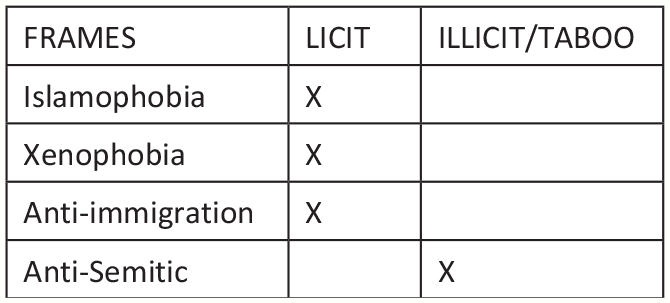
Licit and illicit frames in the public sphere.
The media frame of FvD as being an extreme right-wing/populist party can be justified. With the classic Vox populi, vox Dei (voice of the people, is the voice of God) rhetoric and declinism frames Baudet is trying to promote the Dutch as the appropriate cultural historic ethnic ingroup. Baudet culturalized the immigration debate by referring to the downfall of the white European “boreal” cultural heritage and polarized by calling refugees “malicious, aggressive elements” (FvD, 2019).
In the popular media FvD is being framed as against the elite/ruling parties/EU, and in favor of a Nexit. Though the Nexit does not dominate the public debate, in the before mentioned SCP survey Europeanization is considered a threatening development for the Netherlands (CSP, 2019).
The CSP findings indicate that the Dutch perceive “intolerance and discrimination as things that people would prefer to see disappear from society” (CSP, 2019). These conclusions support the notion of the Netherlands as a tolerant secular society in which believing and non-believing, and the emancipation of women and gays are accepted (Moerlie Missier, 2010). Therefore, policymakers should more actively combat discrimination of immigrants and curtail the ethno-cultural distance. Some elements of the multicultural discourse are positive, for instance on the deep disagreement on Zwarte Piet. This character is a white person wearing a black face, curly hair, and helps St. Nicolas to bring presents to Children on the evening of the 5th of December in the Netherlands. Dutch celebrities increasingly criticized the character on Twitter and people in general are also openly speaking out that the tradition is painful for Dutch citizens with a slavery history (Dulith et al., 2020).
Against the background of ongoing human mobility Dutch politicians and policymakers should consider what Canadian philosopher Taylor (1997) calls turn to “politics of recognition.” Guard the core values that the Dutch share stemming from the Christian tradition and Enlightenment, such as liberty, freedom of speech, and equality, while at the same time prevent the building of inaccessible ethic and religious pillars, nevertheless recognize the identities of immigrants with equal dignity and not misrecognize them as having only one cultural or religious identity. The Dutch populist politicians who may resent the ongoing hybridization of culture and argue that non-western immigration may have dissolved the traditional way of life, may be fighting an uphill battle. It is more likely that the destiny of the western world has been already determined by the ongoing transformative impact of communication technology, globalization of communication in the 20th century, and global capitalism.
Finally, in this digital age the internet plays a crucial role in the dissemination of news stories that cannot be controlled by media organizations. It is hard to predict how news, tweet, or post will unfold. However, to counteract the ongoing right-wing rhetoric on internet and in the media news organizations should acknowledge the urgency for a deeper dive into the immigrants’ background and involve them in news stories and ask for their ethical perspective on events.
Meanwhile, the general elections of March 2021 showed that voters are susceptible to the predatory behavior of anti-immigrant preachers Wilders and Baudet and their inflammatory rhetoric in the media. Further study is needed to understand why well educated, rational people in an economically successful nation, with an advanced social security, and health care system such as the Netherlands are receptive to extremist messages and thoughts that can escalate into violence.
Footnotes
Declaration of Conflicting Interests
The author declared no potential conflicts of interest with respect to the research, authorship, and/or publication of this article.
Funding
The author(s) disclosed receipt of the following financial support for the research, authorship, and/or publication of this article: Work on this article was made possible by contributing, as an external PhD candidate, to Rik Peels‘ project EXTREME (Extreme Beliefs: The Epistemology and Ethics of Fundamentalism), which has received funding from the European Research Council (ERC) under the European Union‘s Horizon 2020 research and innovation program (Grant agreement No. 851613) and from the Vrije Universiteit Amsterdam, the Netherlands.
