



Abstract
Social media has become an important tool for universities to implement strategies to promote, position and differentiate their brand identity, to establish and foster the communicative relationship with their stakeholders. This study explores the interactivity strategy developed in digital communication by 70 leading universities from Europe, the United States and Latin America. A specific quantitative methodology was designed to analyze the universities’ social media publications (90,241). The general communicative approach and the communication resources applied were studied through quantitative content analysis. Results show that the universities have an informational approach in their publications on social networks, with little differences among regions and platforms. Expositive and interactive resources are being used in a broad, integrated manner although there are some differences in each region and social network. Thus, the universities opt for a monological interactivity strategy in their digital institutional communication, with little differences between social networks. They are changing toward a model that continues to prioritize dissemination of information, but it is evolving toward more combination of various communication resources that make content more attractive to their publics. This research provides insights into interactivity strategies used by universities on social networks to develop effective digital communication strategies for enhancing engagement with publics.
Plain language summary
This paper examines how universities use digital communication to promote and differentiate their brand identities and build relationships with stakeholders. Specifically, the study analyzes the interactivity strategies employed by leading universities from Europe, the United States, and Latin America on their social media communication. Using quantitative content analysis, the study found that universities use social media to provide information, with few differences among regions and platforms. Although there are some regional and social network variations, universities rely on a monological interactivity strategy in their digital institutional communication. However, universities are shifting toward a more integrated approach that combines various communication resources to create more engaging content for their publics. This research seeks to contribute to the field of digital institutional communication by providing insights for academics, practitioners and decision-makers in developing effective digital communication strategies that enhance engagement and foster relationships with publics.
Introduction
The use of digital technologies has transformed the way universities communicate with their publics, making it more essential than ever to understand the impact and effectiveness of their institutional communication strategies. With the rise of the Internet and social media, universities are forced to adapt to the new social and sectoral context and to develop communication strategies that enhance their institutional positioning (Kisiolek et al., 2020). Thus, universities integrate multiple institutional communication techniques, instruments and supports (offline and online) to communicate with their audiences (Cronin, 2016; Kisiolek et al., 2020; Rutter et al., 2017).
In this context, social networks have emerged as crucial communication channels for universities, enabling them to create a university community (Bélanger et al., 2014; Brech et al., 2017; Peruta & Shields, 2016), to implement strategies to promote their brand identity (Davies, 2020; Royo-Vela & Hünermund, 2016; Zadeh & Sharda, 2022), and to build and develop a solid, distinctive, differential reputation (Fähnrich et al., 2020; Lee & Merle, 2018). Several studies (Almansa-Martinez et al., 2013; Taylor & Kent, 2014; Zerfass et al., 2019) demonstrate the importance of these networks in providing enhanced flexibility, customization and time-saving in the relationship between institutions and their stakeholders. For this reason, universities seek to promote the development of interactive communication strategies with their audiences (Marino & Lo Presti, 2018; Stsiampkouskaya et al., 2021).
The growing importanc1e of institutional communication in universities has given rise to scientific research on the issue. Oliveira et al. (2022) carried out an extensive bibliometric review and pointed out that the analysis of digital communication tools is one of the most studied issues of institutional communication in universities. On the other hand, another review of the literature (with a temporal analysis over 30 years) on universities’ digital communication (Zeler et al., 2023) pointed out that the interactivity strategy developed by institutions with their followers is a still an understudied topic. Far from conducting studies on their interactivity strategies on social networks, the research has focused on recognizing the main communication resources and contents. But the analysis of the different aspects in isolation does not allow studying the strategies developed by universities on their social networks. Moreover, this review also indicates that most of the work investigates a single social network (Fähnrich et al., 2020; Kimmons et al., 2017; Peruta & Shields, 2016) and focuses on small samples of universities (Alonso-Flores et al., 2020) and countries (Eger et al., 2020). Therefore, there is a need for further research on interactivity strategies on social networks in universities, with a broader scope and focus on more comprehensive samples.
Digital platforms acquired a predominant role in educational centers as institutional communication instruments (Cancelo Sanmartín & Almansa Martínez, 2013). Numerous authors point out that they are increasingly built into the universities’ communication strategies (Bélanger et al., 2014; Brech et al., 2017; Peruta & Shields, 2016) to create and disseminate their activities (Mogaji & Yoon, 2019), to raise their profile and institutional prospects (Lee & Merle, 2018; Royo-Vela & Hünermund, 2016), and to conduct a fluid dialogue with their stakeholders (Almansa-Martinez et al., 2013; Eger et al., 2020; Marino & Lo Presti, 2018).
This work aims to study the level of interactivity achieved in the digital institutional communication of 70 leading universities from Europe, the United States and Latin America. To do so, we shall analyze the general approach of their publications, the communication resources they apply, and the relationship between them, to assess the strategy or general guideline of interactivity that the universities develop in their social networks.
Theoretical Framework
According to Kent and Taylor (2021), organizations must create an active listening and participation-oriented space on social networks to enable a dialogical commitment. Interactivity is the framework on which relationships between an organization and its stakeholders through the Internet are built (Kent & Taylor, 2002). It is the cornerstone on which dialogic communication stands (Guillory & Sundar, 2014), as it is employed by organizations to establish an appropriate engagement with their stakeholders (Capriotti & Zeler, 2020; Taylor & Kent, 2014). In other words, interactivity entails actively fostering a continuous exchange of messages between organizations and their stakeholders, applying dialogic communication approaches and using digital tools that enable communicative reciprocity (Capriotti & Pardo Kuklinski, 2012).
However, having a profile on social media and posting content does not ensure interaction with target stakeholders. Studies show that organizations are missing the opportunities provided by social media to interact, converse with, help and assist users (Capriotti et al., 2019; Hudson et al., 2016; Park et al., 2021; Sundstrom & Levenshus, 2017; Wissen, 2017). Universities must properly manage two key aspects of their digital institutional communication to achieve an active relationship with their stakeholders: the general approach defined for their publications and the communication resources to be used. Both these factors will help to determine the degree of interactivity of the communicative activity implemented by the universities that will encourage interaction with their stakeholders to a greater or lesser degree.
Concerning the general approach, effective relationships on social networks are not only achieved by promoting informative content but are mainly achieved if the content stimulates interaction with users (Guzmán Duque & Del Moral Pérez, 2014; Kang & Norton, 2006; Kisiolek et al., 2020). Thus, sharing content interactively addressed as messages that foster interaction and dialogue are required to inspire better engagement with stakeholders (Capriotti & Zeler, 2020). Many studies have identified two main approaches to interactivity based on the interaction tools (Capriotti et al., 2016) On the one hand we have the informational approach, the tools and resources of which are mainly unidirectional and the degree of interactivity is low. And on the other, the conversational approach in which the tools and resources are mostly bidirectional and the degree of interactivity is high. While the main objective of the informational approach is to disseminate information to influence the company’s image that its stakeholders may have, the conversational approach basically seeks to establish and build relationships by enabling dialogue and interaction between the organization and its stakeholders (Capriotti & Zeler, 2020). Research findings show that use of the Internet as a communication tool is increasing, but the focus is on dissemination of information (Ji et al., 2016). Despite this, research on institutional communication in universities reveals a certain disparity. While some studies detect a commitment to a more conversational approach (Guzmán Duque & Del Moral Pérez, 2014), others find that the universities underestimate the potential of digital communication and use the networks for merely informative purposes (Kang & Norton, 2006; Kimmons et al., 2017).
Consequently, the first key aspect to investigate is whether universities take a merely informational or more conversational approach in their digital institutional communication. Therefore, the first research question (RQ1) is: What type of general approach do the universities display on their social networks?
Besides this, social networks provide functions with significant leverage when it comes to communication resources for the creation of content to connect with users (Fähnrich et al., 2020; Gómez Calderón & Paniagua Rojano, 2014; Stsiampkouskaya et al., 2021), among which a series of effective information resources for reciprocal communication (i.e., texts, images, links, hashtags, emoticons, video, audio, etc.) are especially noteworthy. Capriotti et al. (2019) suggest that social networks facilitate information exchange by combining several available resources. Thus, two main types of resources can be identified: expositive and interactive. Expositive resources are essentially unidirectional and facilitate the mere dissemination of information (i.e., images, emojis, video, audio, etc.). Interactive resources are essentially bidirectional and foster information exchange and widely allude to users’ participation (i.e., links, hashtags, questionnaires, etc.). Of the resources available on social networks, images and texts are the most frequently used by organizations to share content (Brubaker & Wilson, 2018), while the use of expositive resources is twice as high as that of interactive resources (Capriotti et al., 2016). This trend is also detected in studies on universities’ digital institutional communication (Brech et al., 2017; Cancelo Sanmartín & Almansa Martínez, 2013; Ebrahim & Seo, 2019; Gómez Calderón & Paniagua Rojano, 2014; Peruta & Shields, 2016).
Thus, the second key aspect is to ascertain whether the universities implement more expositive or interactive resources in their digital institutional communication. Therefore, the second research question (RQ2) is: What types of resources are the universities applying on their social networks?
Finally, the creation of content with a general approach that elicits action by users (i.e., opinion, participation or collaboration) and the use of certain communication resources will influence the orientation of the universities’ digital communication strategy. Universities should encourage interaction with their stakeholders and interactive approaches and resources to facilitate the communication process and thus reach the stakeholders and achieve the desired impact (Guzmán Duque & Del Moral Pérez, 2014; Kang & Norton, 2006; Kisiolek et al., 2020).
Then, the statistical analysis will enable assessing the possible association between the general approach and the communication resources to answer the third research question (RQ3): What relationship can be established between the general approach and the communicative resources depending on the regions and the social networks?
Methodology
The content analysis technique was applied to the universities’ social media publications to answer the above research questions because it enables the researchers to dissect the messages, identify certain aspects of the content of a text and quantify the frequency with which they occur (Gheyle & Thomas, 2017).
To obtain a significant sample with a wide range of international institutions, the universities were selected based on their position in the most prestigious international rankings: the ARWU Ranking of World Universities, the Times Higher Education Rankings and the QS World University Rankings (2020 edition, the last published before data collection). The following geographic areas were selected: The United States (for the number and importance of universities in the rankings and for their geographical dimension), Europe (an international benchmark) and Latin America (for its highly-developed university sector).
The institutions from the United States and Europe included in the sample were selected from the top 100 entities in said rankings. Those from Latin America were selected according to their overall position in the global and regional rankings, in spite of not being ranked in the top 100. In the case of Latin America and Europe, geographic diversity was prioritized to include as many different countries as possible. A total of 70 universities was obtained: 20 from the United States, 25 from Europe and 25 from Latin America (see Appendix 1).
The three most widely-used social networks in the university digital institutional communication field were selected from among the currently most popular sites (Kemp, 2022): Facebook (the network with the most active users in the world), Twitter (one of the most popular among users seeking information) and LinkedIn (the fifth most active and the one that specializes in professional networking). The profiles of the universities were identified by consulting their official websites.
The study was conducted during 2021. Three months in the first semester (13 weeks—91 days) and 3 months in the second semester (13 weeks—92 days) were chosen. The study lasted for a total of 26 weeks (183 days) to ensure an intensive survey of information from all the selected universities.
To obtain reliable data on the volume and intensity of the universities’ communication activity, the analysis sample included all items (own and shared) that the universities posted on their official profiles on social networks during the term of the study. A total of 90,241 posts: 53,446 on Twitter, 27,356 on Facebook and 9,439 on LinkedIn.
The analysis categories were “general communication approach” and “communicative resources”. These categories were developed and tested in preliminary studies (Capriotti et al., 2019).
The general communication approach category analyzes the general communication approach implemented by institutions on their profiles (RQ1) from the identification of textual or visual elements intended to elicit opinions or actions that establish the way content is designed and presented and thus encourage dissemination of information or interaction to a greater of lesser extent. Two broad types of general approach were defined to do so (Capriotti et al., 2016). The informational approach creates and presents content from a merely informative, descriptive, and expositional perspective and fosters unidirectional communication. To illustrate the informational approach, one could cite Yale University’s tweet “Yale Center for British Art exhibit stakes out space for women artists. [LINK] @YaleBritishArt” (@Yale, March 29, 2021, 7:56 p.m.) or Columbia University’s tweet “Officially white coated [EMOJI] Congratulations to the Class of 2026 at @ColumbiaPS for beginning their journey as medical students! #WelcomeHomeColumbia | [LINK]” (@Columbia, August 22, 2022, 8:10 p.m.). The conversational approach prioritizes the creation and dissemination of content that encourages interchange of information and conversation, facilitating bidirectional communication even more and clearly including “call to action” components (invites participation and sharing, providing an opinion, answering questions, etc.). Following the previous examples, the conversational approach could be illustrated based on the following tweets: “Marking the one-year anniversary of the pandemic, Yale University Chaplain Sharon Kugler offers this prayer about grief, loss, the promise of hope & the comforts of connection in a time of isolation. We invite you to take a few minutes to listen & reflect [LINK]” (@Yale, March 21, 2021, 11:22 a.m.) and “Take part in @Columbia_Biz’s 17th African Economic Forum this March 22–26! Listen to our distinguished guests speak on the theme, ‘Africa on the Move: Charting a Path Forward in the Wake of a Global Crisis.’ [LINK]” (@Columbia, March 19, 2021, 2:52 p.m.).
The communicative resources category examines the tools available on posts that drive dissemination of information or interaction with the users on social networks (RQ2). Two main types of resources were defined: expositive and interactive (Capriotti et al., 2019). The expositive resources, which foster a more unidirectional communication, are in turn divided into three types: “textual” (composed of the plain text in the posts: the most basic kind of informational resource); “graphic” (composed of fixed images, photos, and emojis: the resources that enable dissemination of information in a mainly monological manner) and “audiovisual” (videos, audios, and gifs: expositive resources that generate greater engagement and require a period of attention from users). The expositive resources could be exemplified by citing The University of Chicago’s tweet “As the temperatures drop and fall comes to a close, we’re sharing some of our favorite campus fall photos from the #UChicago community. [EMOJI][IMAGE]” (@UChicago, November 24, 2020, 4:41 p.m.), in which mainly textual and graphic resources are used in the message. The interactive resources that proactively foster interchange of information and elicit users’ participation and engagement, are also divided into three types: “referential” (mentions and hashtags that enable the connection of the post to other subjects and topics), “hypertextual” (links that enable the post to be linked to other information) and “participatory” resources (surveys, questions and other components that enable users to express an opinion or assessment). The interactive resources can be exemplified by citing the tweet from Princeton University “Join #PrincetonU faculty members [@usertag and @usertag] at #ForwardFest on March 18 as they discuss their interdisciplinary work at the Princeton Bioengineering Initiative. [EMOJI] Set a reminder to watch on YouTube: [LINK]” (@Princeton, March 15, 2021, 3:15 p.m.) where referential, hypertextual and participatory resources are used in the content.
A bivariate correlation analysis (Spearman’s Rho) was conducted between the number of publications and the average level of resources used by type of approach by universities on social networks to find out if there were statistically significant differences between the general approach and the resources by region and/or social network (RQ3). Subsequently, to ascertain the joint effect of the three main categorical variables (region, level of focus and social networks) on the resource level variable, resorting to a univariate general linear model (two-way ANOVA) was deemed appropriate. The aim of this test is to determine the existence of statistically significant differences in the distribution of the populations under study, the existing interaction between social networks concerning the level of resources, and to find out where the effect of interaction between social networks occurs.
The information was compiled and assessed through the platform and the big-data and information capture and management system of NoticiasPeru (www.noticiasperu.pe). A team of 3 people (1 supervisor and 2 technicians) was set up to search for and collect posts and another 3-person team (1 supervisor and 2 analysts) for the initial data extraction.
The two analysts performed a test on a sample of 300 posts using a random sample from all 3 social networks to assess the reliability of the aforesaid method. This sample is highly satisfactory to properly evaluate the concordance and reliability between two analysts (Lombard et al., 2002). As a basis for statistical analysis with a confidence interval of 95%, the percentage calculation of concordance between the two analysts was established from 2 × 2 contingency tables. Cohen’s kappa coefficient (κ) was also calculated to assess the reliability of the categorical variables (McHugh, 2012). The measurement ranges proposed by Landis and Koch (1977) were used to interpret the results. A high level of agreement was obtained under the tool’s criteria and therefore we can conclude that the measurement is valid: 91% of agreement was obtained for the general approach (Kappa value of .82) and 96% for resources (Kappa value .93).
After logging the data in an Excel template, it was transferred to the IBM SPPS Statistics 25 program for statistical processing and to make the results available to the researchers.
Results
The 70 universities posted a total of 90,241 items. By region, Latin America posted 43,943 (48.7%), the United States 24,759 (27.4%) and Europe, 21,539 (23.9%). By social networks, Twitter disseminated 59.2% of all the posts, Facebook 30.3% and LinkedIn 10.5%.
Types of General Communication Approach of Universities in Their Social Networks
Broadly speaking, the universities opted for a decidedly informational approach (90.8%) in their publications on social networks (Table 1). The difference between geographical areas is quite significant: 12.1% of the Latin American institutions opt for a conversational approach, almost 50% more than the European entities (8.7%) and almost triple that of the North American centers (4.4 %).
Types of General Communication Approach.

The universities follow a very similar pattern to the general results on Twitter and the informational focus is even more evident in all three regions (a logical outcome on an eminently informative platform). The results on Facebook are similar to the general outcome. However, a significant increase in the conversational approach can be observed in Europe (14.1%) and the United States (7.5%), where this approach scores more than twice that of the general average. And although universities are also opting for an informational approach on LinkedIn, all regions take a more conversational approach compared to the general average, especially Latin America with an outstanding 18.6%, almost double the European figure (10.7%) and triple that of the United States (6.6%).
Types of Communicative Resources Applied by Universities in Their Social Networks
The results show that expositive and interactive resources are being used in a broad, integrated manner although there are very significant differences between the different types of resources employed in each region (Table 2). Text is the most common expositive resource (82.8%) and just over half the posts employ visual aids (52.5%) compared to a very low percentage of audiovisual means (8.8%). Of the interactive resources, more than two thirds use hypertextual mechanisms (67.1%) and somewhat fewer employ referential systems (60%) while participatory techniques are practically non-existent (0.7%).
Types of Communicative Resources.
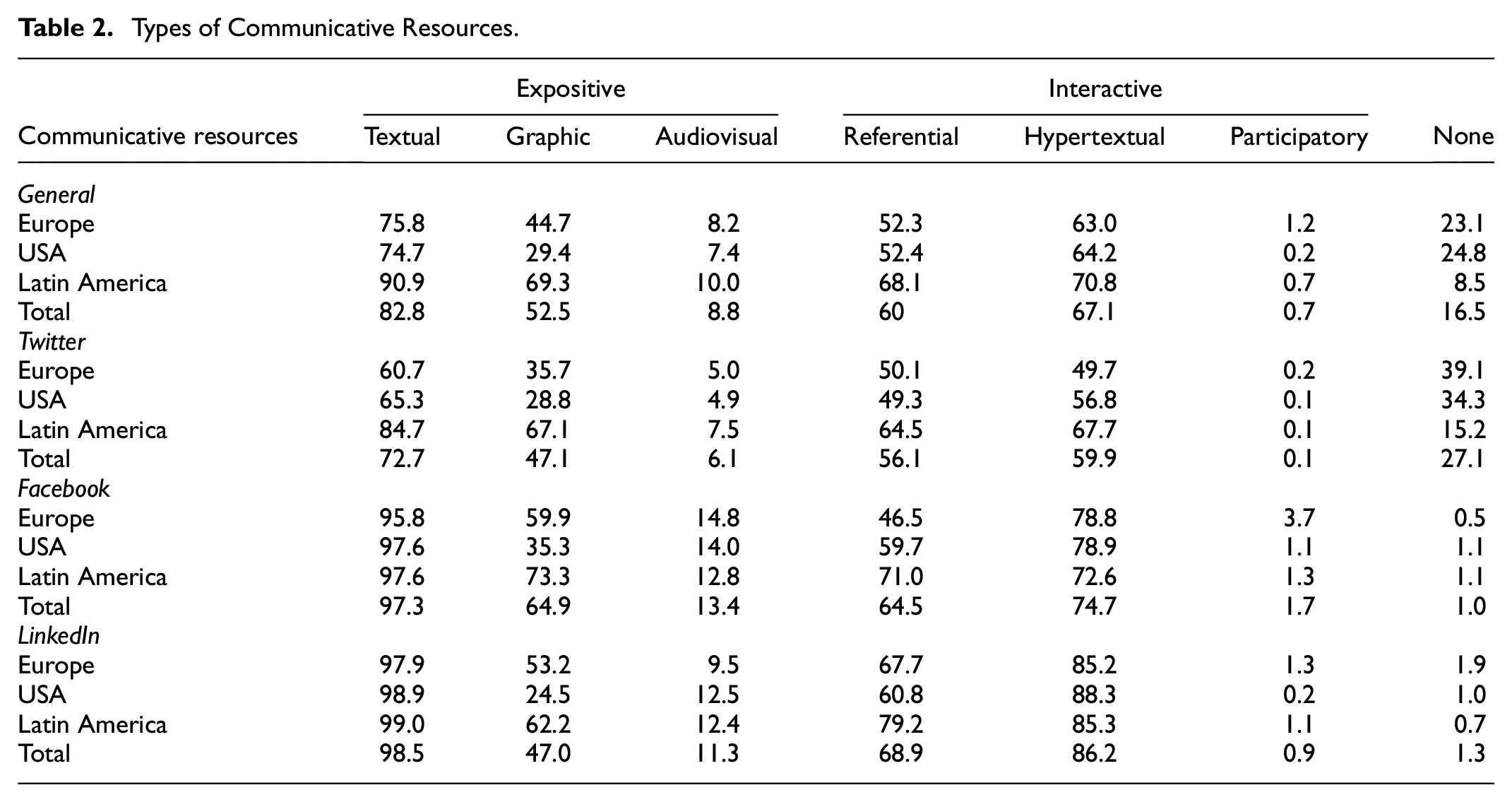
By geographical area, more than 90% of the material posted by Latin American universities employ a variety of communicative resources compared to a quarter of the European and North American institutions (23.1% and 24.8% respectively) that do not use any communicative resources at all.
With certain minor differences, the results by social network do not depart from the general line. Fewer resources are used on Twitter and are confined to basically expositive means (text and graphics). This entails a more balanced combination of expositive and interactive resources. Unlike the other two social networks, 27% of the posts are shared tweets that do not employ any communicative resources whatsoever. In line with the other parameters by geographic area, Latin America’s use of all the resources is noteworthy. However, the European (39.1%) and North American universities (34.3%) share twice as many posts from other users as their Latin American counterparts (15.2%).
The results are broadly similar on Facebook and LinkedIn. With respect to expositive resources, practically all the content uses plain text (more than 95%) while use of audiovisual resources exceeds the average (between 10% and 15%) and graphic resources are used more on Facebook (64.9%) than on LinkedIn (47%). Hypertextual and referential resources predominate in the interactive field, although in both cases it is LinkedIn that stands out by a narrow margin. The presence of participatory resources is negligible. Similar trends can be observed in the regional aspect, although here the United States uses considerably fewer graphic resources: around half those of used in Europe and less than a third compared to Latin America. Furthermore, European institutions stand alone in their use of participatory resources even though the proportion is merely symbolic (less than 4% of the posts).
The statistical treatment returns an average of 2.72 resources with a standard deviation of 1.405 and a median of 3 (Table 3). The statistical independence test reveals that the universities are uniformly represented in the six categories and that both variables (region / level of resources) are statistically associated, although to a low to moderate extent (contingency coefficient .267). We observe that 35.1% of the posts are characterized by hybrid behavior (expositive/interactive). The level of resources is concentrated at the interactive pole (moderately/very interactive) in 34.3% of the cases led by Latin America (44.9%) mainly on Facebook (38.7%). The expositive pole (moderately/very expositive) represents 15% and is especially prevalent in the United States (17.6%), mainly on Facebook (19.5%) and LinkedIn (19.7%). And these resources are inactive in 16.5% of the universities (24.8% in the United States and 23.1% in Europe), mostly on Twitter (27.1%).
Communicative Resources Distribution by Region and Social Network.

Relationship Between the General Approach and Resources
Due to the differences observed in terms of the volume of publications posted by the universities, we consider it appropriate to ascertain whether there is a relationship between the number of posts and the average number of resources employed. Spearman’s Rho test reveals that, in general terms, higher production is not associated with a higher level of resource use. However, the analysis by type of social network and approach level shows a positive and significant (although low-moderate) correlation at bilateral .01 level when universities use Facebook and LinkedIn (in the latter case only with the conversational approach) (Table 4).
Spearman’s Rho Bivariate Correlation Analysis (Number of Posts and Level of Resources).
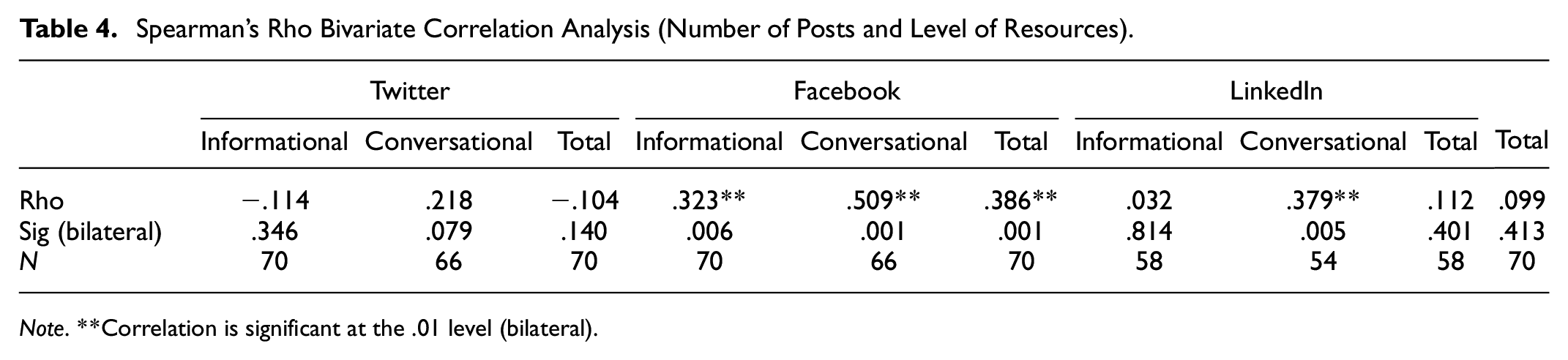
Note. **Correlation is significant at the .01 level (bilateral).
The resource level variable does not meet the normality criterion (Kolmogorov-Smirnov test, df = 90,241; sig. .000) nor the homogeneity of variance (Levene test, df1 = 8/df2 = 90,232; sig. .000), for which reason it was decided to conduct a non-parametric analysis. Subsequently, to ascertain the combined effect of the three main categorical variables (region, approach level and social networks) on the level of resources, it was deemed appropriate to employ a Friedman two-way ANOVA analysis by ranks and then to conduct the Kruskal-Wallis H test to observe intragroup differences. The two-way ANOVA test (Table 5) rejects the nullity hypothesis (sig .000) at a significance level of .05 between the three variables under study both at the general level and between regions while observing statistically significant differences between the type of approach and social network concerning the level of resources.
ANOVA by Ranks for Related Samples: Region, Approach, Social Networks, and Level of Resources.
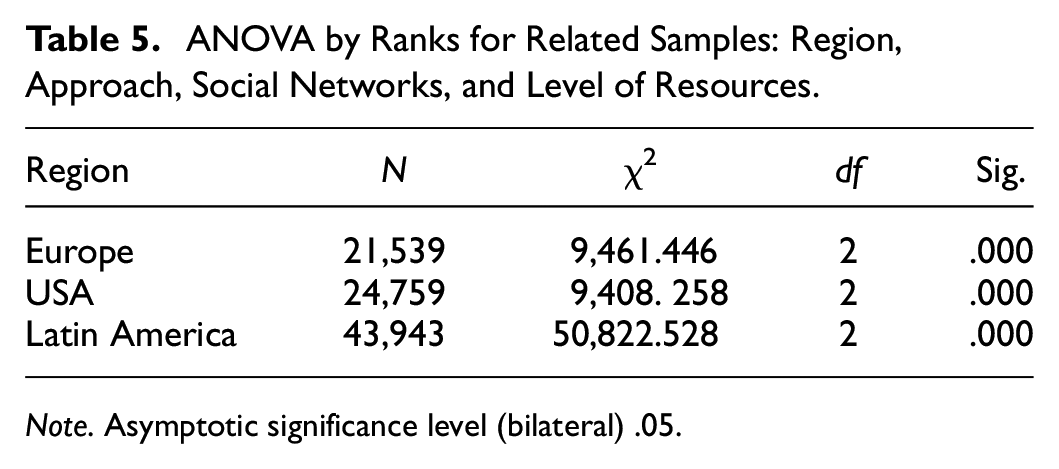
Note. Asymptotic significance level (bilateral) .05.
The intragroup analysis by Kruskal-Wallis H test (one-way ANOVA on ranks) (Table 6) reveals the existence of statistically significant differences between regions and social networks in general terms with respect to the level of resources used by the universities depending on the type of approach (informational and conversational). A higher level of resources can be observed among universities that adopt more conversational positions. Then, the more conversational the posts, the more resources involved.
Intragroup Analysis by Kruskal-Wallis H Test (One-Way ANOVA on Ranks) of Level of Resources.

By region, the effect observed in Europe at the general level is repeated here, meaning that LinkedIn is once again the social network that uses the highest level of resources. Universities with a conversational approach display different behavior than those with a purely informational approach and apply a higher level of resources in all their social networks. In the comparison between pairs of social networks, the post hoc test reveals identical behavior on Twitter and LinkedIn (sig .384) in the conversational approach.
The behavior observed in the United States differs from that of the other two regions in that the highest level of resources is channeled through Facebook and LinkedIn. However, Twitter is the network with the highest level of resources in the conversational approach. The post hoc test shows identical behavior between Facebook and LinkedIn in the informational approach (sig .306) and above all in the conversational (sig .838).
No notable differences are observed in Latin America concerning general behavior and LinkedIn, followed by Facebook, is once more the network with the highest level of resources used. The differences in the level of resources between social networks, however, are attenuated. The post hoc test indicates the identical behavior of Twitter and LinkedIn (sig .437) in the conversational approach.
Discussion
The results indicate that the vast majority of universities are committed to an informational approach on the three social networks (RQ1 and RQ3). The United States region has the highest proportion of universities that adopt the informational approach while Latin American entities tend to create and disseminate publications with a more conversational approach. Despite the fact that content with a conversational orientation fosters interaction (Guzmán Duque & Del Moral Pérez, 2014; Kang & Norton, 2006; Kisiolek et al., 2020) and encourages greater engagement with stakeholders (Capriotti & Zeler, 2020), the universities mostly disseminate their content in an informational and unidirectional manner. These results are similar to those found in other studies that suggest that universities underestimate the digital potential and continue to emit communication of a merely informative nature (Kang & Norton, 2006; Kimmons et al., 2017).
This study also demonstrates that expositive and interactive resources are widely used, often in combination (RQ2 and RQ3). These results show a certain degree of divergence from some previous studies applied to companies (Capriotti et al., 2016) and universities (Brech et al., 2017; Cancelo Sanmartín & Almansa Martínez, 2013; Ebrahim & Seo, 2019) that suggest that use of expositive resources is much greater than the use of interactive resources. The most widely used are expositive resources (mainly textual and, to a lesser extent, graphic), but universities are also widely committed to including interactive resources (especially hypertextual and referential). Like other studies (Brech et al., 2017; Capriotti et al., 2016; Ebrahim & Seo, 2019; Peruta & Shields, 2016), we found that audiovisual resources are rarely used on the three social networks.
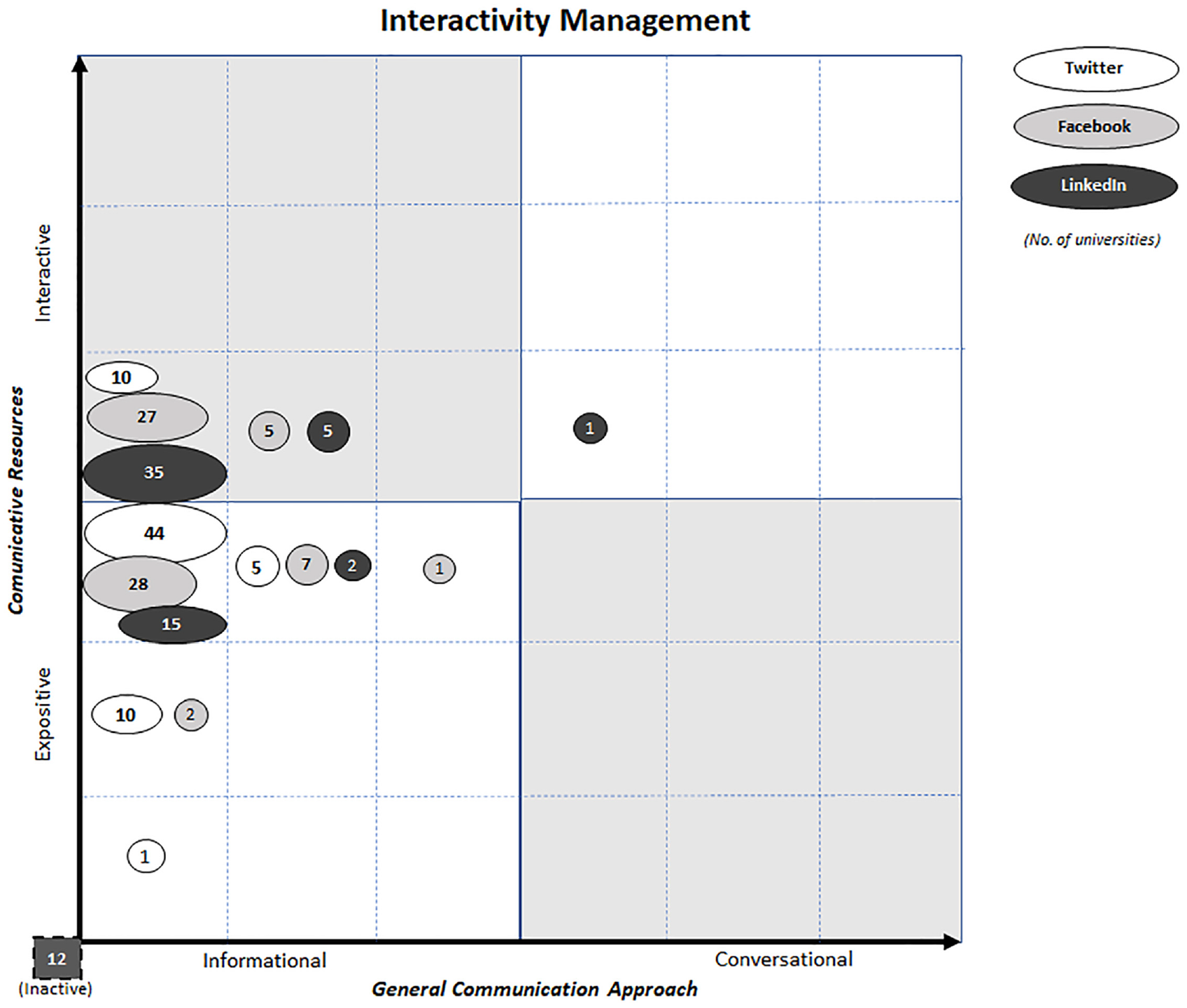
These two general trends are similarly evident (with certain nuances) in the different geographical areas and social networks (Figure 1).
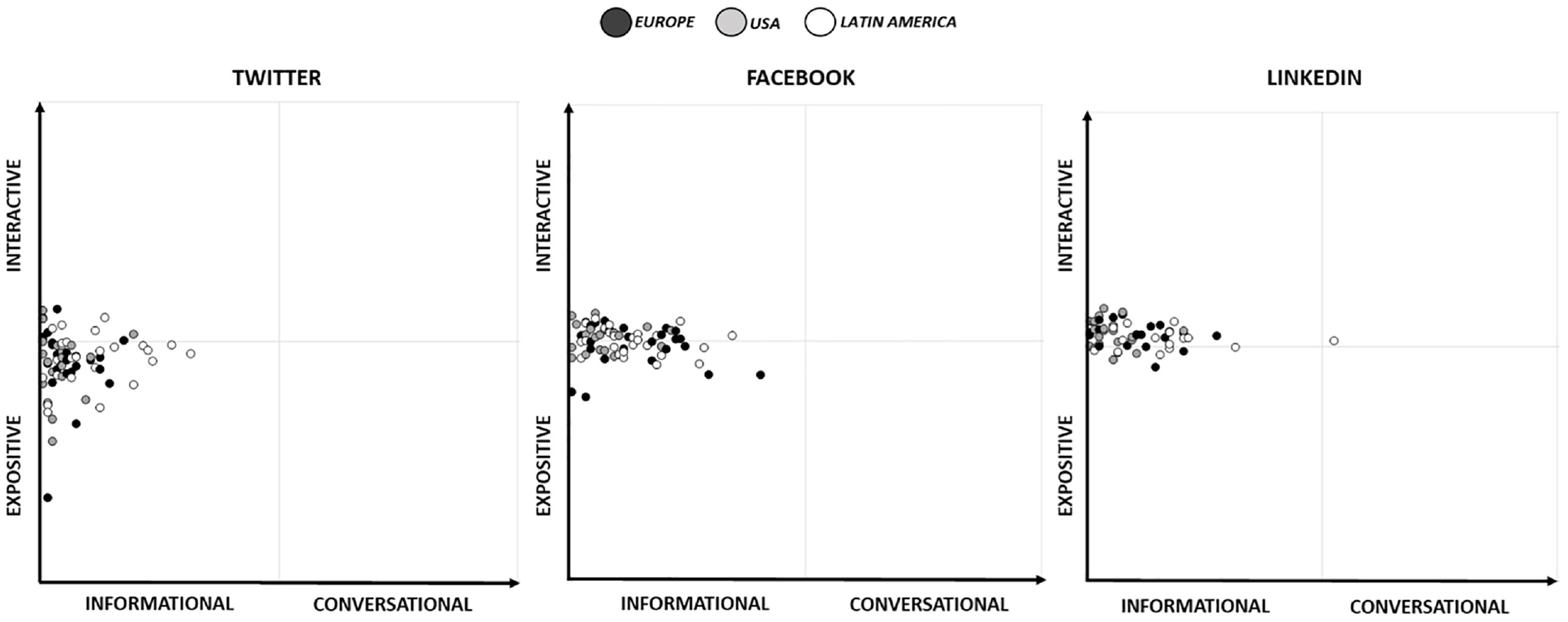
Dispersion matrix. Interactivity strategies by region and social network.
These results enable us to infer that universities are changing their management of social networks toward a model that, while it continues to prioritize dissemination of information (informational approach), it is evolving toward more widespread use and combination of various other communication resources (expositive + interactive) that make content more attractive and encourage interaction with their stakeholders (Figure 2).
Main interactivity strategies by social network.
Nevertheless, universities should encourage interaction with their stakeholders (Guzmán Duque & Del Moral Pérez, 2014; Kang & Norton, 2006; Kisiolek et al., 2020) by engendering a more conversational approach to their content and a wider application of interactive resources since this would facilitate the connection between the universities and their stakeholders and promote dialogue between them.
Conclusions
The present study has examined the level of interactivity achieved by 70 leading universities from Europe, the United States, and Latin America in their digital institutional communication. Through analyzing the general approach and communication resources utilized by these universities, we have evaluated their interactivity strategy in social media presence. Therefore, this study provides valuable insights for communication practitioners seeking to develop effective interactivity strategies for their social networks, which could facilitate the connection between universities and their stakeholders and promote meaningful dialogue between them.
− To increase interaction with followers, universities should adopt a more conversational approach to their content, incorporating dialogic elements such as call-to-action expressions, etc. in their posts.
− Universities can motivate followers to interact with them by using posts that combine informational and interactive resources.
− Universities should incorporate more audiovisual resources as they imply a higher level of engagement by followers, although they are expositive resources.
− To encourage user participation, universities should incorporate a wide range of interactive and participatory resources in their posts, such as interactive charts, questions, surveys, and more.
Finally, this article aims to contribute to the development of a general model for assessing the degree of interactivity of organizations on social networks for use by other researchers and thus help to enhance the knowledge base in this field. It could also be used by professionals to measure and improve their communication activity on social platforms. On the other hand, the research analyses one sector and a certain type of institution (universities) on specific social networks (Facebook, Twitter, and LinkedIn). Besides this, other aspects that may influence or be relevant to interaction are not studied or taken into account in this work, such as the level of activity developed in profiles (Jadrić & Kovačević, 2018) or the types of content (Fähnrich et al., 2020; Peruta & Shields, 2016). So, in future research, it would be critical to apply it to other types of entities and platforms to test and adjust its variables and magnitudes and confirm or disprove the validity of the model. Furthermore, would be necessary to analyze and integrate other types of dimensions that could influence the interaction between an organization and its publics, which allows for obtaining a holistic or integral vision of the management of communication in social networks.
Footnotes
Appendix
Sample of Universities.

| Europe | The United States | Latin America |
|---|---|---|
| University of Oxford | Harvard University | Universidad de Buenos Aires |
| University of Cambridge | Stanford University | Universidad Nacional de Córdoba |
| University College London | MIT (Massachusetts Institute of Technology) | Universidad Nacional de La Plata |
| Imperial College London | Princeton University | Universidad Austral |
| University of Edinburgh | Columbia University | Universidad de Sao Paulo |
| University of Manchester | California Institute of Technology (Caltech) | Universidad de Campinas |
| King’s College London | University of Chicago | Universidad Federal de Río de Janeiro |
| University of Bristol | Yale University | Universidad Federal de Minas Gerais |
| London School of Economics and PS | John Hopkins University | Universidad Católica de Río de Janeiro |
| University of Warwick | University of Pennsylvania | Universidad Católica de Río Grande Sul |
| Sorbonne University | University of Michigan—Ann Arbor | Universidad de Chile |
| Paris Science et Lettres—PSL | University of North Carolina—Chapel Hill | Pontificia Universidad Católica de Chile |
| Paris Saclay | University of California—Berkeley | Universidad de Concepción |
| Heidelberg University | University of Washington—Seattle | Universidad de Santiago de Chile |
| University of Munich (LMU) | Purdue University—West Lafayette | Universidad Nacional de Colombia |
| Technical University of Munich | University of Illinois—Urbana Champaign | Universidad de Antioquia |
| Swiss Federal Institute of Technology Zurich | University of Texas—Austin | Pontificia Universidad Javeriana |
| University of Zurich | University of Wisconsin—Madison | Universidad de Los Andes (Colombia) |
| Swiss Federal Institute of Technology Lausanne | University of Maryland—College Park | Universidad Nacional Autónoma de México |
| Utrecht University | University of Minnesota—Twin Cities | Universidad Autónoma Metropolitana |
| University of Amsterdam | Benemérita Universidad Autónoma Puebla | |
| Karolinska Institute | TEC de Monterrey | |
| University of Oslo | Universidad Nacional Mayor de San Marcos | |
| University of Helsinki | Universidad San Francisco de Quito | |
| University of Copenhagen | Universidad de la República |
Declaration of Conflicting Interests
The author(s) declared no potential conflicts of interest with respect to the research, authorship, and/or publication of this article.
Funding
The author(s) disclosed receipt of the following financial support for the research, authorship, and/or publication of this article: This article is part of the competitive R&D&I project on “La Comunicación Institucional Digital 2.0 de las Universidades” (PID2019-106053GB-I00), funded by the Spanish Ministry of Science and Innovation.

Data Availability Statement
Data sharing not applicable to this article as no datasets were generated or analyzed during the current study.