




Abstract
The present study’s aim was to examine whether interindividual differences in levels of expertise influence the aesthetic processing of materials. In particular, we elucidated experts’ conceptual structure of the aesthetics of different materials using a free list task and compared it to recent non-expert data. To this end, we asked 401 architects, designers, and interior designers to list adjectives that could be used to describe the aesthetics of materials. The experts listed a large number of sensorial as well as aesthetically evaluative terms. As measured in a supplementary study, a slight majority of the listed terms had a neutral valence, followed by a large proportion of positive terms. The term beautiful, frequently the preeminent term in aesthetics, was by no means one of the most relevant terms in both studies. The results suggest that the conceptual structure of the aesthetics of materials is multifaceted and expressive, and, to some extent, influenced by expertise. Furthermore, the findings indicate that concepts underlying materials aesthetics differ from other domains.
Introduction
Albeit with varying relevance, materials are part of every human’s life. We live not only in a material world, but also in a “world of materials” (Ashby & Johnson, 2014, p. 3). They undergo a journey (Marschallek & Jacobsen, 2020; Wilkes et al., 2016) during which material scientists and chemists, fashion and product designers, architects, and users come into contact with them (Wilkes et al., 2016). Consequently, the domain of materials can be considered as an interdisciplinary research topic that is interesting to investigate from the point of view of several stakeholders, including a psychological perspective.
The psychology of aesthetics deals with aspects of, for instance, visual, plastic, performing, and fine arts, but it is also concerned with the beauty of natural settings and everyday objects (e.g., Jacobsen, 2010b). As materials provide not only technical functionality but additionally create product personality (Ashby & Johnson, 2014), they also have an aesthetic dimension. Some experts “use materials to tell a story” (Ashby & Johnson, 2014, p. 7) and to produce a materials experience (Karana et al., 2014) for the user.
In general, aesthetic processing may be defined as a “sensation-based evaluation of an entity with respect to the . . . conceptual system, primarily the beauty dimension” (Jacobsen, 2006, p. 158). It can be divided into receptive, central, and productive subprocesses (Höfel & Jacobsen, 2007). Whereas the latter involves overt behavior, the others involve perceiving an entity and processes such as thinking about and deciding on its aesthetic value. As materials users we may constantly be engaged in receptive and central subprocesses of aesthetic appreciation: Through our senses, we perceive them and decide on their aesthetic value, for instance, their beauty. Following Fechner’s (1876) aesthetics from below, the preeminence of this beauty dimension in aesthetics has been demonstrated in international and German studies, in which individuals were asked to list terms that could be used to describe the aesthetics of different domains (see Table S1 for an overview). Beautiful turned out the primary term for the conceptual structures of the aesthetics of objects (Jacobsen et al., 2004), music (Giannouli et al., 2021; Istók et al., 2009), various visual stimuli (Augustin et al., 2012) and visual arts (Giannouli et al., 2021), literature (Giannouli et al., 2021; Knoop et al., 2016), and tattoos (Weiler & Jacobsen, 2021). Yet, measured on the usage of the term beautiful, a recent study discovered a rather subordinate role of this concept for materials (Marschallek et al., 2021). The authors asked 2,452 German non-experts (students and participants from a broader cross-section of the population) to list adjectives that could be used to describe the aesthetics of different materials. Based on an external classification (Marschallek & Jacobsen, 2020), these were: ceramics, glass, leather, metal, paper, plastic, stone, textiles, wood, and materials in general (see Supplemental Material S1 for the original German terms). Beautiful was by no means one of the most frequently listed terms. Instead, the results showed a clear primacy of sensorial, neutrally valenced, descriptive terms, among which the adjectives smooth, hard, rough, and soft were the most relevant.
Various perspectives may be adopted to analyze the realm of aesthetic processing (Jacobsen, 2006). For example, not only do cultures seem to differ about what is beautiful, but even within a culture, individuals can disagree (Istók et al., 2009; Jacobsen, 2010a). For example, the preference for symmetry is highly modulated by expertise (Leder et al., 2019). Several frameworks/models point to the importance of the beholder for aesthetics in general, such as Jacobsen’s (2006) framework for an interdisciplinary psychology of aesthetics, as well as for materials in particular, such as Karana and Hekkert’s (2008) model of the meanings of materials and Zuo et al.’s (2004) material representation matrix. Thus, there is a need to examine how interindividual differences, such as expertise, influence the aesthetic processing of materials.
Overall, expertise must be understood as temporally stable outstanding performance in a particular domain (Ericsson & Smith, 1991). Experts differ from non-experts in many aspects (for collected works, see Chi et al., 1988; Ericsson et al., 2006). For example, not only do they have a greater amount of domain-specific knowledge (e.g., Ericsson et al., 1993), but it also shows representational differences, including organization, depth, consolidation, and integration (e.g., Chi, 2006; Ericsson & Charness, 1994). Experts have a highly interrelated, more structured (e.g., Glaser, 1994), hierarchical knowledge (e.g., Johnson & Mervis, 1997), and a greater chunk size in short-term memory (e.g., Chase & Simon, 1973a, 1973b). This is also reflected in their processes of problem solving (e.g., Chi et al., 1981; Novick, 1988).
Aims of the Present Study
Although they do not necessarily reflect experts’ skills (Chi, 2006), language-based methods provide insight into the knowledge systems of people with a common linguistic background, that is, into their long-term memory representations of conceptual structures and their organization of the semantic field (e.g., Fehr & Russell, 1984; Kuehnast et al., 2014; Nelson et al., 2004; Santos et al., 2011). When communicating their perceptions as well as their evaluations of entities, beholders project their experience onto the space of available verbal concepts and choose those that are most representative. Designers, for example, most likely learn how to verbally express their impressions and thus acquire a broad vocabulary (Karana et al., 2008b). It seems reasonable to assume that this also applies to other material experts—indeed, Marschallek et al. (2021) have already identified the potential influence of expertise on the aesthetics of various materials as an important research desideratum.
In a series of five studies on design expertise, Karana et al. (2008b; for an overview see Karana, 2009) collected descriptive terms for wood, plastics, ceramics, glass, and metal from subjects with varying levels of design expertise. These were presented either in words, through samples or products. They also collected descriptions from other related sources (e.g., magazines). The authors classified all of the terms into seven descriptive categories: use, manufacturing process, technical, sensorial, expressive/semantic, associative, and emotional descriptions. The majority were classified as expressive/semantic, that is, “qualities that a specific material expresses” (Karana, 2009, p. 47), followed by sensorial descriptions, that is, “terms making reference to interactions between materials and users through the five senses” (Karana, 2009, p. 45). Non-designers were found to be “less expressive and capable in verbalizing their feelings about artifacts” (Karana, 2009, p. 42). However, no detailed differences between the groups were reported.
Through five in-depth interviews with architects, Wastiels et al. (2007) investigated the vocabulary used to discuss materials during the design and selection process. The architects described the different characteristics of materials in terms of five primary domains: physical behavior, experience, function/use, context/environment, and manufacturing process. The majority of the terms were said to describe the physical behavior of materials, which was further divided into geometric aspects, that is, size, shape, and volume, and physical attributes (technical and sensorial aspects), for example, color, texture, and temperature. However, architects were not compared with non-architects.
Turning to music, Istók et al.’s (2009) study revealed that the aesthetic responses are generally based on a common conceptual space but can be partially modified by levels of musical expertise: Differences in the naming frequencies for certain terms were found. Most surprisingly, non-experts produced more adjectives describing specific aspects of music, for example, melody and rhythm, as well as relating to mood (regulation). The same holds for tattoo aesthetics (Weiler & Jacobsen, 2021): Based on the primarily descriptive terms listed by the experts, for example, realistic or harmonious, the authors concluded that expertise modifies the conceptual structure and, in this regard, differentiates it from non-experts.
In the present study, we investigated the potential influence of expertise on the aesthetics of materials. Specifically, based on previous results, current knowledge, and assumptions, we addressed the following research questions:
Research Question 1: What is the conceptual structure of experts’ aesthetics of materials, and what is its content?
Research Question 2: Do this conceptual structure and content differ from those of non-experts, and is it valid to assume that the conceptual structure and content of experts’ aesthetics of materials may be influenced by their material expertise?
Following Marschallek et al. (2021), the conceptual structure of the aesthetics of materials in general as well as of different subcategories were of interest. This enabled a systematic comparison with non-experts. Furthermore, we assumed that these 10 (sub)categories form essential components of the regular work of several material experts.
To construct a comprehensive list of all relevant terms, we deemed it necessary to include material experts from various domains. As we intended to collect data from individuals with an overall expertise regarding all studied materials, we recruited experts from three different disciplines: architecture, design, or interior design. We anticipated that (1) all three come into contact with a variety of materials on a daily basis, (2) which would potentially lead to a variety of (aesthetic) experiences. Therefore, we assumed them to differ from non-experts in terms of their knowledge-based professional designation and in their experience with the aesthetic subprocesses. These three occupational groups create aesthetic expressions, namely, entities that incorporate materials. Thus, whereas non-experts may engage in receptive and central aesthetic subprocesses, these experts additionally engage in productive subprocesses as part of their profession. Through this materials-related work they likely have a more specific and deepened understanding than non-experts, which likely results in differing conceptual structures and aesthetic appreciations of materials. Because a comparison of the results obtained from the three disciplines revealed great similarities (see Supplemental Material S2 and Figures S1 and S2), we report the results for the entire sample in what follows.
Experts’ Conceptual Structure
Method
Participants
Participants were recruited by contacting professional associations, forums, and organizations, as well as companies and individuals whose contact information was openly available. To increase the size of our sample, we included German, Austrian, and Swiss residents.
A final sample of 401 individuals (200 women, 198 men, and 3 diverse) were considered for the analyses. The mean reported age was 47.9 years (SD = 11.8, ranging from 23 years to 100 years; one participant did not report an age). Most of the participants (n = 374) indicated that German was their only native language. A university diploma was the highest educational attainment by the majority of the individuals (n = 278), and almost all were employed at the time of the study (n = 390). About half also considered themselves experts in the field of materials (n = 199). Therefore, we regarded the sample as having a generally high level of education and specific expertise in materials. For additional information on the three subsamples, see Supplemental Material S3.
An additional 107 participants were excluded from further analysis either because they belonged to another profession or due to nonserious respondent behavior (n = 1), that is, no terms were listed. The study received ethics approval from the university where the research was conducted, and it was performed in accordance with the declaration of Helsinki. All participants gave their informed consent prior to data collection, which was carried out anonymously.
Materials and procedure
The procedure was equivalent to the one used in Marschallek et al. (2021). Due to pragmatic reasons regarding feasibility, however, the present study was conducted online. In order to avoid a confounding of associations between the different materials, each participant was randomly assigned to only one of the categories. The number of final participants per category varied between 33 and 45. The wording of instructions was taken from the non-experts’ study and read as follows: “Please write down terms that could be used to describe the aesthetics of . . . as a material. Please use adjectives only. You now have 2 minutes.” (for the original German instructions, see Supplemental Material S1). The instructions were adapted according to the specific material category (in the case of materials in general, the phrase as material was omitted from the instructions).
As in Marschallek et al.’s (2021) study, the instructions were presented to the participants aurally as well as visually. The aural version was presented via an audio recording of a female voice. After the instructions were presented, the participants were asked to type their adjectives. The instructions were presented visually throughout the task. After 2 minutes, the page was automatically closed and answers to questions about demographic data, including gender, age, mother tongue, education, current occupation, and whether they considered themselves experts on materials, were requested. There was no time limit for answering these questions. Participants had the opportunity to withdraw at any time. Finally, the authors’ contact information was provided in case there were any comments or questions.
Data analyses
To preprocess the data for analyses, all spelling mistakes were corrected. Neologisms and foreign words were not excluded, since those terms form part of the conceptual structure. All analyses used the original German adjectives, that is, the terms displayed in all figures and tables are English translations of the original data (see Table S2). Translations were made separately by the authors after data analysis and discussed afterwards. Subsequently, a studied expert was consulted for a revision. Finally, terms were matched with Marschallek et al.’s (2021) translations.
To reduce variability that might be due to idiosyncratic uses, only adjectives mentioned by at least 15% of the participants in a particular category were retained for further analysis. Relative frequency, weighted by the sample size for the respective category, and the cognitive salience index (CSI; Sutrop, 2001) were calculated for each term. Words listed twice by the same participant were not considered for further analysis. CSI values range between 0 and 1, with higher values indicating higher salience. Next, each term’s general frequency of occurrence in the German language was determined. As a metric, we used the relative frequency per million wordforms (pMW) given on COSMAS II (https://cosmas2.ids-mannheim.de/cosmas2-web/), an online portal of the Leibniz-Institut für Deutsche Sprache (Leibniz Institute for the German Language). To determine emotional valences, we began with ratings from Hager and Hasselhorn (1994), similar to Marschallek et al. (2021). However, ratings were available for only 52% of the terms listed by the participants in our study. Therefore, we collected ratings from 75 additional individuals (25 women, 48 men, and 2 diverse) through an online survey. These participants were students (n = 45) or employees at the university where the research was conducted. The mean age of the sample was 29.07 years (SD = 9.40, ranging from 20 to 60 years). The listed adjectives were rated on a 7-point bipolar scale with anchors −3 = negative, 0 = neutral, and 3 = positive. Mean ratings less than or equal to −1 were considered negative, and those greater than or equal to 1 were considered positive (cf. Hager & Hasselhorn, 1994).
Subsequently, only terms mentioned by at least 20% of the participants in at least one of the categories were considered. To compare the 10 categories, we calculated their Ružička similarities (Deza & Deza, 2013; Podani et al., 2013; Ružička, 1958; Warrens, 2016). The resulting matrix was then fed into a hierarchical cluster analysis (HCA; see Figure S3) as well as into a classical multidimensional scaling procedure (MDS; Gower, 1966; see Figure S4). Additionally, based on the co-occurrence of all terms that appeared on any of the participants’ lists, we computed a dissimilarity matrix using the Jaccard Index (Real & Vargas, 1996) to investigate the general semantic field for the aesthetics of materials. This matrix was also fed into an HCA and a nonmetric MDS procedure.
Results
Sample statistics
Overall, the participants produced 3,505 entries, including terms listed twice by the same participant, corresponding to 835 valid words. The number of answers per participant ranged between 1 and 27 (M = 8.74, SD = 4.09). A comparison of the number of entries for each of the 10 categories showed a significant effect of the categories’ specificity, Welch’s F(9, 156.63) = 5.23, p < .001.The mean number of entries for materials in general was larger than the mean numbers for all others, except for stone and textiles (these comparisons were based on the Games-Howell post-hoc test using an α level of .05; for details see Table S3). Leather had the smallest mean number of entries.
Results for the various material categories
Retaining only terms produced by at least 15% of the participants in at least one of the categories, 50 terms remained for the following analyses. The results obtained for the different categories are depicted in Figure S5.
With a relative frequency of 38.2%, smooth turned out to be the most frequently listed adjective across all categories, followed by hard, rough, and soft (27.4%, 25.7%, and 25.4%, respectively). None of the 50 terms was mentioned by at least 15% of the participants in all categories. The highest frequency for smooth was in the category plastic (57.6%), whereas the highest frequency for its opposite, rough, was in materials in general (59.5%). The highest frequency for hard was in stone (60.0%), whereas the highest frequency for its opposite, soft, was in textiles (67.4%).
As measured by the CSI, materials in general were characterized by a variety of terms, for example, rough, smooth, soft, warm, and hard. For the category ceramics, the term smooth ranked particularly high, followed by glossy, hard, and rough. For glass, the terms transparent, clear, smooth, hard, and see-through were most salient. For the category leather, soft was the highest ranked term, followed by natural, smooth, rough, and warm. Metal was characterized as cold, hard, glossy, smooth, and cool. The most important terms for paper were smooth, light, white, rough, and fine, and the highest ranking terms for plastic were smooth, artificial, malleable, glossy, and light. For stone, the most important terms were hard, cold, rough, natural, and smooth, and for textiles, the most important terms were soft, flowing, velvety, rough, and haptic. Finally, the highest ranking terms for wood were warm, natural, rough, and soft.
Beautiful was mentioned by more than 15% of the participants in only the category materials in general, with an overall relative frequency of 7.5%. On the other hand, the opposite term, ugly, was not mentioned by at least 15% of the participants in any category.
The terms’ word frequency counts in the general German language (see Table S2, Column 5) did not correlate with their frequency of appearance in the present study (see Table S2, Column 2), rs = .04, p = .77. Thus, it can be assumed that there is no confound or contamination by non-relevant language production processes.
The results of the additional valence rating study for the 50 terms (see Table S2, Column 4) indicated that 44% (n = 22) were positive, only 4% (n = 2) were negative, and 52% (n = 26) were neutral. The percentages based on Hager and Hasselhorn (1994) were 38.5%, 11.5%, and 50.0%, respectively (see Table S2, Column 3). In our additional valence rating study, beautiful scored highest (M = 2.13, SD = 1.10), followed by pleasant (M = 2.01, SD = 0.92) and elegant (M = 1.88, SD = 1.09). Porous (M = −1.16, SD = 1.21) and artificial (M = −1.05, SD = 1.11) were rated as most negative. Overall, the quantities of emotionally valenced and neutral terms in the additional study were close to equal: 48% were emotionally valenced, with the great majority being positively valenced terms.
Comparison of the various material categories
After applying the 20% cut off, 31 terms remained for the analyses that follow. The Ružička similarities for the 10 categories ranged between .07 and .48, with the lowest similarity between wood and glass and the largest between metal and ceramics as well as between metal and stone (see Table 1). Overall, materials in general proved to be most similar to most of the other categories, and glass the least.
Descriptive Statistics of the Categories.
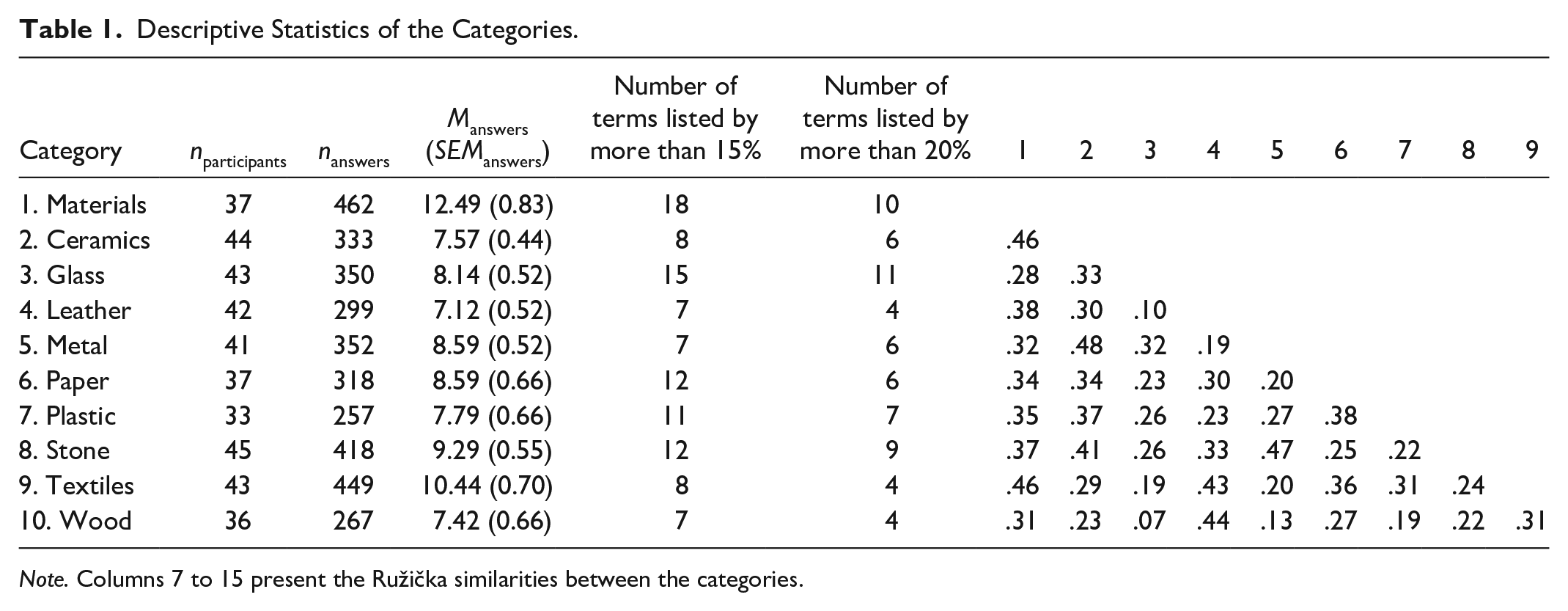
Note. Columns 7 to 15 present the Ružička similarities between the categories.
Glass and wood showed little similarity. Whereas glass was most frequently associated with the qualities transparent, smooth, see-through, cold, clear, cool, and fragile, wood was characterized by the terms warm, natural, rough, soft, beautiful, and pleasant (see Figure 1). Two pairs of categories tied for the greatest similarity. One of these was the categories metal and ceramics: Both were frequently associated with smooth, glossy, and hard. Unsurprisingly, while metal was often described as stable, ceramics were described by its opposite, fragile. The other pair was metal and stone: Both were frequently associated with the core terms hard and smooth, as well as with cold and cool.

Relative frequencies plotted for terms mentioned by at least 20% of the participants in a single category, ordered by overall relative frequency in the total sample. The bars indicate whether the terms were listed by fewer than 15% (light gray), 15% to 20% (gray), or more than 20% (black) in the individual categories.
Overall mapping
We augmented the results for the individual materials with an overall conceptual map. We calculated a dissimilarity matrix based on the co-occurrences of the terms, using the Jaccard Index (Real & Vargas, 1996). This matrix was then fed into an HCA (see Figure S6) and an MDS procedure (see Figure 2). Further, based on the MDS coordinates for the terms and their relative frequencies, we calculated points that represent the localization of the 10 categories and plotted them as vector arrows in the MDS plot.

Multidimensional scaling solution. The categories are marked with different colors, and their locations in the multidimensional space are indicated by the continuous vector arrows. The listed terms are coded by color, indicating the category in which they had the highest relative frequency, and varying font size, showing their overall relative frequency. The location of the terms is indicated by dots; in the interest of readability, some word labels were moved in this figure, as indicated by dashed lines.
In the HCA, 11 low-level clusters emerged, and these mainly appeared to be related to the specific natures of the 10 materials (see Figures 2 and S6). Further, they exhibit semantically similar words, such as translucent and transparent, antonyms, such as matte and glossy, and words with an overall high relative frequency, that is, rough, smooth, soft, warm, and natural.
Similarly, the MDS mainly revealed material-specific characteristics. Additionally, the horizontal dimension of the MDS plot partly distinguishes between terms referring to sensorial qualities at one end and terms referring to expressive/semantic aspects at the other. The vertical dimension partially differentiates between adjectives describing visual qualities and those describing haptic qualities in greater detail. However, this may be due to the material-specific characteristics. Glass, for example, is mainly characterized by visual qualities, whereas stone and metal are especially characterized by haptic qualities.
Discussion
The mean number of entries for materials in general was larger than for most of the other categories. Rather than depicting a specific material, the term material includes all of the other categories used in this study and even more. That is, participants were free to write down terms for several categories. In our study, we examined the perspective of experts working with a multitude of materials in various domains. Due to their broad expertise, it is reasonable to assume that the participants considered all of the materials they come into contact with on a daily basis, in their work and/or their private life.
Overall, the participants produced a large number of terms that at first glance seem to be rather descriptive, for example, smooth, hard, rough, and soft. Yet, in addition, aesthetically evaluative terms, or—to use Karana et al.’s (2008b) phrase—expressive/semantic qualities, for example, modern, elegant, and pleasant, also showed a substantial frequency of occurrence. We discuss each of these individually.
Adjectives denoting sensorial qualities of materials can be interpreted as descriptive rather than evaluative. Ashby and Johnson (2014, p. 3) point out that materials “give substance to everything we see and touch,” thus highlighting the importance of the visual and haptic sense. The adjectives that were the most frequently produced across all categories in the present study also predominantly refer to haptic or visual qualities, or both. Both senses already have a prominent role in human perception of all kinds of (aesthetic) entities. They are much discussed in the literature, and can be dated as far back as 400 B.C. in the writings by Aristotle (approximately 350 B.C.E./2017). Some authors particularly highlight the importance of the visual sense for the expert disciplines in question: Architecture is seen as a visually oriented discipline, and designers also use a number of visual representation techniques (Wastiels et al., 2013). Wastiels et al. (2013) also suggest vision to be by far the dominant sense when architecture students assess materials. Irrespective of a potential hierarchy, the visual and haptic senses are the most dominant modalities in appraisals of materials (Karana, 2009; Schifferstein & Wastiels, 2014).
The opposite pairs smooth–rough and hard–soft were the most frequently mentioned adjectives across all categories. In tactile perception, roughness and hardness are viewed as the most important sensations for the assessment of surface structures and haptics (Howes et al., 2014). Roughness, in particular, is seen as one of the most important parameters of textured surfaces (Bergmann Tiest & Kappers, 2007; Hollins et al., 1993; Picard et al., 2003). As it is such an essential surface property, both the visual and the haptic system must be able to perceive it (Bergmann Tiest & Kappers, 2007). Surprisingly, the terms that were mentioned by at least 15% of the participants in a category did not include words that describe experiences other than vision or touch. However, in the literature, an increased importance of the olfactory sense in the overall experience of materials has also been mentioned (Karana, 2009).
Unsurprisingly, a larger number of evaluative rather than descriptive adjectives have been produced in the previous studies (Augustin et al., 2012; Istók et al., 2009; Knoop et al., 2016). In particular, emotion-related adjectives with a clear tendency toward a positivity bias were listed. Interestingly, the present results also award materials an aesthetically evaluative character. Even though the term beautiful was not one of the most relevant terms, the experts mentioned a variety of other expressive/semantic characteristics (see Figures 1 and 2), for example, elegant, modern, and pleasant. Beautiful was mentioned by at least 15% in the category materials in general. The experts work with a variety of materials on a daily basis, so to them, they “are not simply numbers on a data sheet” (Ashby & Johnson, 2014, p. 4). This may imply that materials are a beautiful means to “express their imagination and desire to make objects of delight as well as of utility” (Ashby & Johnson, 2014, p. 3) in the first place. And this, in turn, may be the reason why the word ugly, in contrast, was not mentioned by at least 15% of the participants in any category. Materials themselves are not inherently ugly, but rather, the products that incorporate them may be, for example, due to a breach of the principle of Materialgerechtigkeit (material justice). In addition, only a marginally different result was found for materials in relation to the positivity bias: A slight majority of the terms were emotionally neutrally valenced (52%), while among the remaining terms, participants showed a clear tendency to produce more positive than negative terms (44% and 4%, respectively).
Importantly, the frequency of the adjectives produced did not correlate with general word frequencies in the German language. Thus, the frequency of use of these adjectives in the general language cannot account for the results.
Further, an HCA and an MDS showed the diversity and complexity of the characteristics that experts associate with materials. These results reveal (1) not only common words for the various materials, as seen by the variety of cross-material terms, but (2) also material-specific words, which reflect the specific characteristics. Terms such as smooth and rough are of great relevance for a variety, whereas others are clearly prototypical for specific materials, such as flowing for textiles.
Comparison of Experts and Non-Experts
Data
To determine potential differences between experts and non-experts, we conducted analyses that included the results of the present study and the earlier results published in Marschallek et al. (2021). Overall, data from 2,853 participants were considered for the analyses (nnon-experts = 2,452).
Data Analyses and Results
Across all material categories, experts produced 3,505 terms, corresponding to 835 valid words, with the number of answers per participant ranging between 1 and 27. Non-experts produced 18,308 terms, corresponding to 2,270 distinct valid words, and the number of answers per participant ranged between 1 and 25. There was a significant difference between the mean number of valid entries for the two groups: Experts (M = 8.74, SD = 4.09) produced a larger mean number of valid entries than non-experts (M = 7.47, SD = 3.87), t(523.79) = 5.83, p < .001. A further analysis of the ranking of the mean number of entries for the individual categories in the two groups revealed different patterns, rs = .43, p = .22. Whereas in the expert group, the greatest number of mean entries was produced for materials in general and the smallest for leather, non-experts produced the greatest number for stone and the smallest for plastic.
Subsequently, we conducted analyses of all adjectives named by more than 15% of the participants in at least one category in one of the groups, which resulted in a total of 61 adjectives to be considered (see Table S4). Although word valences of the terms produced by the experts and the terms produced by the non-experts were obtained in separate studies, a Mann-Whitney U test and an α level of .05 indicated no significant differences for 38 of the 40 terms in both valence rating studies (for more details see Table S5). Only transparent and cool showed significant differences; however, there was no change in their emotional valence. In the expert group, 50 of the 61 adjectives were named by more than 15%. Among these, 44% were positive, 4% negative, and 52% neutral (n = 22, 2, and 26, respectively). In the non-expert group, 34 of the 61 adjectives were named by more than 15%. Among these, 29.41% were positive, 2.94% negative, and 67.65% neutral (n = 10, 1, and 23, respectively). A chi-square test did not show a significant difference in the frequency distribution of emotionally valenced and neutral items between the groups, χ²(2) = 2.04, p = .36.
To check the similarity between the entries of both groups, we calculated the Ružička similarities for the individual categories between them (see Table 2). The category metal was the most similar, and wood (experts) and glass (non-experts) the least similar. Overall, the same categories were most similar between the two groups in most cases. We then used the results to carry out an HCA (see Figure 3a). The results of the HCA show two clearly separated clusters, one of which comprises ceramics, metal, stone, and glass, with the other comprising the remaining six categories. Both clusters can be further divided into multiple subclusters, which depict inter-group similarities with respect to the identical materials. However, one exception stands out: The non-experts’ categories wood, materials in general, and leather cluster with the experts’ category materials in general, whereas the experts’ categories leather and wood are grouped together. Further, an MDS of the Ružička similarities for the individual categories (see Figure 3b) largely mirrors the results of the cluster analysis, inter alia, plotting identical materials together. Interpretation of the two dimensions of the MDS solution does not seem straightforward. Furthermore, a Procrustes analysis (Jackson, 1995; Peres-Neto & Jackson, 2001) of the MDS solutions for the two groups yielded a significant correlation between the MDS ordinations (sum of squares m2 = 0.16, r = .91, p < .001, 9999 permutations; see Figure 3c). Similarly, the Mantel correlation (Mantel, 1967; Schneider & Borlund, 2007) of the Ružička matrices also confirmed similarity between the two groups (Mantel statistic r = .68, p = .001 and 999 permutations).
Ružička Similarities Between the Two Groups.


Visualizations of comparisons of experts (dark colored) and non-experts (bright colored and capitalized). (a) Cluster analysis dendrogram. (b) Multidimensional scaling solution. (c) Procrustes analysis of the multidimensional scaling solutions; errors are indicated by the colored arrows. d) Multidimensional scaling solution for significant predictors in the regression analyses; the groups are marked with different colors, and their locations in the multidimensional space are indicated by the continuous vector arrows; adjectives are coded by color indicating the group in which they were more likely to occur.
To determine whether expertise explained the choice of certain adjectives, we conducted logistic regression analyses for the 61 adjectives named by at least 15% of the participants in a category. Here, the individual adjectives served as the dependent variable and expertise was defined as the predictor. Table 3 lists the 36 adjectives that turned out to be significant predictors in the regression analysis models. The majority of the terms (n = 23; 63.89%) were produced by experts rather than non-experts. Subsequently, we calculated the Jaccard matrix for these adjectives and fed it to an MDS, plotting experts and non-experts as an environmental variable based on the relative frequencies in the groups (see Figure 3d). The MDS likewise revealed expertise-related and material-related characteristics.
Regression Analysis Summary Using Expertise as the Criterion.

Note. Only those adjectives (15% cutoff) for which significant logistic regression models were found (α level of .05) are listed. The adjectives are listed in the order of the overall model evaluation (Nagelkerke R2).
Discussion
Our aim was to compare the conceptual structures of material experts and non-experts of the aesthetics of materials. Comparative analyses revealed similarities as well as differences.
The experts produced a higher mean number of terms than the non-experts. Unlike non-experts, architects and (interior) designers interact with all kinds of materials not only in their private lives, but also on a professional basis. All of the experience that they acquire presumably leads to distinct knowledge about the entire spectrum of various materials comprising various dimensions (Ashby & Johnson, 2014), for example, technical aspects, usability, and environmental factors. Whereas consumers buy objects because they like or love them (Ashby & Johnson, 2014), experts are responsible for the satisfaction of these hedonic needs. Therefore, when communicating their perceptions as well as evaluations of materials, experts are able to project their experience onto a potentially larger space of verbal concepts.
Additionally, the mean numbers of terms for the individual categories in the two groups showed different patterns. First, the experts produced the largest mean number of entries for materials in general, followed by textiles, while the non-experts produced the largest mean number of entries for stone, followed by materials in general. As mentioned above, individuals were given free rein for their thoughts and could produce material-independent terms. As experts deal with a variety of materials, a larger, more detailed, and deeper knowledge system for any material that can be brought forth for this category can be expected. A similar pattern has been shown for the aesthetics of literature: In Knoop et al.’s (2016) study, non-expert participants produced the largest mean number of entries for specific reference categories. In Marschallek et al. (2021), the participants might have produced the largest number of mean entries for stone due to its versatile use in everyday life. Not only is stone used in the exterior architecture of all kinds of buildings; it is also of great relevance in interior design.
Second, the experts produced the smallest mean number of entries for leather, while the non-expert group produced the smallest mean number of entries for plastic. Marschallek and Jacobsen (2020) argued that leather could also be classified as belonging to the category textiles. Additionally, bearing in mind that experts produced a large mean number of entries for textiles, it may be that they do not recognize leather as an independent category and therefore have few words describing its aesthetics. In addition, the investigated experts, especially architects, presumably do not work with leather as regularly as with the other materials. It may be useful to consult other expert groups working with it on a daily basis. Regarding the non-experts, for whom plastic had the smallest mean number of entries, some authors claim that plastics initially had a rather negative reputation amongst beholders, for example, they were seen as cheap, of low quality and inauthentic (Sparke, 1990), and clearly unsustainable. Because the main conceptualization of aesthetics is beauty (e.g., Jacobsen, 2006), and the results of both of the valence rating studies showed that the term beautiful denotes a strong positive value, appraising plastic in an aesthetic frame might have led to a sort of cognitive dissonance. This eventually resulted in fewer terms being generated. Experts, on the other hand, operate with plastics on a professional basis and may focus on the advantages of this material. Plastics have not only the greatest diversity of transparency (e.g., Ashby & Johnson, 2014), but also a “chameleon-like behavior” (Ashby & Johnson, 2014, p. 90) that leads plastic to be one of the most versatile materials and encourages designers—and possibly other experts—to create innovations with it (Karana, 2009).
Even though there was no significant difference, the relatively large number of emotionally valenced items produced by the experts should be mentioned. As noted earlier, materials go through a journey (Marschallek & Jacobsen, 2020; Wilkes et al., 2016) in which experts play a prominent role. They participate in the productive subprocesses of aesthetic processing: They create an outcome, a product. Materials are not just the starting point for this, they are a necessary ingredient. It can thus be assumed that experts, who know about the relevance of materials, have an additional connection that is not shared by non-experts. Non-experts are users or beholders of the product, and judge whether they like it, they want to buy it, etc., without considering its other dimensions, such as its technical attributes. That is, in contrast to experts, non-experts see materials as simply a “number on a data sheet” (Ashby & Johnson, 2014, p. 4).
The HCA and MDS visualizations showed great similarity between both groups. The HCA showed two initial separated clusters: The first comprises ceramics, metal, stone, and glass, and the second comprises the remaining six categories. Prima facie, the first cluster entails materials based on mineral raw materials and the second, except for plastic, materials based on animal and vegetable raw materials (Marschallek & Jacobsen, 2020). What’s more, the two clusters differentiate between tactile warmth and tactile softness (Ashby & Johnson, 2014, p. 85): “Ceramics, stone, and metals are cold and hard; so is glass.” Both clusters can be further divided into multiple subclusters, mainly grouping together experts and non-experts with respect to the identical material categories, although leather and wood showed greater similarity within the same group than with the same category in the other group. The strong similarity between the two materials might be due to the distinctive reference to their origin, that is, nature. The term natural was mentioned for wood in both groups and by the experts additionally for leather. Non-experts, however, did not mention the term with a frequency of at least 15% for any category; smooth, rough, soft, and brown were the only terms mentioned by at least 15% of the non-experts in both categories. A potential explanation might be the prevalence, inter alia for reasons of animal welfare and financial aspects, of imitation leather.
The non-expert categories further showed great similarity to materials in general for both groups. This may be because wood and leather are both incorporated in many different products, for example, furniture, vehicles, or even clothing. They can also be manipulated in many ways; they can have a rough or a soft surface structure, and a black, brown, bright, or dark color. Even though the non-experts mentioned a few expressive/semantic qualities, for example, beautiful for wood, there are important differences between experts and non-experts in their frequencies of use and their specific uses of the terms for wood and leather. As previously mentioned, the consumer and the material meet near the end of the material’s journey (Marschallek & Jacobsen, 2020; Wilkes et al., 2016). Consumers do not interact with the material itself, but rather with the product that incorporates it. What they perceive are the results of various production processes. Besides sensorial qualities, expressive/semantic qualities such as precious, living, and sustainable are of great importance for experts, who potentially cherish wood’s natural and traditional character, its potential associations with craftsmanship (Ashby & Johnson, 2014), its ecological value, and its potential for individuality due to visual imperfections (Ashby & Johnson, 2003).
Logistic regression analyses and an MDS revealed that expertise explained the choice of 36 adjectives. The majority of the terms produced were either (1) the names of colors or color-related words, for example, black, brown, colorful, and dark or (2) terms describing the shape and/or form of materials, for example, round, edged, and cornered. Colors are said to be a prevalent visual aspect, since every processed visual entity contains color information (Elliott & Maier, 2007; Wastiels et al., 2012). Not only are they said to be the most researched visual aspect (Wastiels et al., 2012), but they are even valued as the “most efficient dimension of discrimination” (Arnheim, 1974, p. 330), which is also true for materials (Wastiels et al., 2012). Research results have indicated that colors are clues for material recognition and that missing colors have a detrimental effect on performance (Yoonessi & Zaidi, 2010); they may even be misleading for material identification (Zaidi, 2011). Colors are of major importance for overall impressions of materials and products (Karana et al., 2008a). The field of study called color psychology (for a critical review see Whitfield & Whiltshire, 1990), highlights the colors’ meaningful attributes such as warmth, that is, attributes that are generally discussed as aesthetic effects (Specker at al., 2020). It has also been argued that specific textures and temperatures of materials, that is, qualities experienced through touch, can be associated with them (Silvennoinen et al., 2015). Some authors note, however, that the context of colors may affect their meaning (e.g., Crozier, 1996; Hanss et al., 2012; Whitfield & Slatter, 1978; Whitfield & Whiltshire, 1990; Won & Westland, 2017). Furthermore, for visual artworks, it was recently shown that their aesthetic effects are not in general universally shared, but depend, among other things, on the focal image: Agreement between participants was higher when they rated artworks as a whole rather than rating their individual elements (Specker et al., 2020). In the present study, for example, brown and black were most frequently mentioned for leather, which is achieved through a tanning process. White was most frequently mentioned for paper, which is a material mostly made of wood that does not appear white in its natural form. The highest frequency for gray was in the category stone, which also appears in a great variety of colors. It is reasonable to assume that experts have specific knowledge about materials and their original, sometimes diverse, appearances. Thus, it can be speculated that the predominance of colors in the non-expert group should be traced to reasons of familiarity, that is, individuals use them as clues for material recognition and/or discrimination rather than drawing on a more meaningful association.
Turning to the second group of terms, form is regarded as one of the most important aspects of a product for its appraisal (Karana et al., 2008b). As with colors, materials do not have a specific form or shape per se. The architect Sullivan (1896) coined the design principle “form follows function,” highlighting its dependency on a previously given desideratum. Ashby and Johnson (2014) later adapted this phrase, saying that “form follows material.” In either case, there are determining factors for the form/shape that need to be considered in the design process. Experts know about the different functions materials and products need to fulfill and which materials can be processed into which forms/shapes. Consumers or beholders in general are mainly in contact with materials via products (Karana et al., 2008a). It may be speculated that non-experts base their associations on familiarity. That is, individuals might have produced terms describing the shape of a product they use on a regular basis that incorporates the respective material. Cornered, edged, and round had their highest frequency of use for the category stone. This material is probably of major importance in construction. While the term round may depict a rather natural appearance, cornered and edged presumably describe stone’s manifestation as buildings, walls, kitchen counters, etc.
Interestingly, the term beautiful is the only expressive/semantic quality that was produced by non-experts rather than experts. The concept of beauty has a long-standing tradition in aesthetics, and can be traced back to Fechner’s (1876) works. Yet, as highlighted in Jacobsen’s (2006) framework, domain specificity must be considered. Studies investigating the conceptual structure of various domains could already show that the concept of beauty has differing importance. Particularly for music, a diminished prevalence of beauty could be shown (Jacobsen & Beudt, 2017). The present study’s results highlight that although beauty can indeed be seen as a main concept for aesthetics in general, it may be of limited relevance for materials and even less relevant for experts, since it may be too general (Augustin et al., 2012). Instead, the unique features for appraising the domain in question could be shown.
General Discussion
Key Results
Following up on Marschallek et al. (2021), we expanded the insights into the conceptual structure of the aesthetics of various materials by investigating experts’ word usage. Specifically, we addressed two research questions: (1) What is the conceptual structure of experts’ aesthetics of materials, and what is its content? (2) Do this structure and conceptual content differ from those of non-experts, and is it valid to assume that the conceptual structure and content of experts’ aesthetics of materials may be influenced by their material expertise?
Research Question 1
The conceptual content and structure of experts’ aesthetics of various materials is diverse and complex. On the one hand, it is composed of at first rather descriptive terms; that is, adjectives that predominantly refer to haptic or visual qualities, or both. On the other hand, it also contains aesthetically evaluative, or—to use Karana et al.’s (2008b) term—expressive/semantic qualities. A slight majority of the generated words had a neutral valence. However, the participants produced more positive than negative terms, leading us to assume that the aesthetics of materials has rather positive connotations. Importantly, the experts’ production of the adjectives was not confounded by general word frequency in the German language. Further, visualizations from an HCA and an MDS revealed material generality as well as specificity. Whereas several of the adjectives can be used to describe the aesthetics of various materials, for example, smooth and rough, others appear to be a rather unique feature of specific materials, for example, flowing in the case of textiles.
Research Question 2
Overall, differences between the non-experts and experts were relatively small: Experts listed a large number of (1) aesthetically evaluative and (2) positive terms, and (3) the term beautiful less frequently overall. These results revealed essential insights into the mental structures of both groups.
At the beginning of this paper, we defined aesthetic processing as a “sensation-based evaluation of an entity with respect to the . . . conceptual system, primarily the beauty dimension” (Jacobsen, 2006, p. 158). In both studies, sensorial attributes were shown to have major importance. As other authors have stated, it is possible to see, touch, hear, smell, and even taste the world (Schifferstein & Wastiels, 2014). In line with previous findings and assumptions regarding materials and product experiences (e.g., Fenko et al., 2008; Karana, 2009; Karana et al., 2008b; Karana & Hekkert, 2010; Nefs, 2008; Schifferstein & Spence, 2008), sensorial qualities, that is, visual and haptic information, were especially mentioned. However, the experts also listed a large number of other attributes, for example, aesthetically evaluative terms. Apparently, experts are able to appraise the material and the product as two different entities. It may be speculated that experts take a holistic approach to materials and consider their entire journey (Marschallek & Jacobsen, 2020; Wilkes et al., 2016). They come into contact with materials at an earlier point in time than do non-experts. They know where the journey starts and where it should end, that is, the specific product. In between, they participate directly in the design processes. Materials do not usually have form/shape per se, and neither do they generally have the prototypical colors of the end products with which consumers interact. Experts decide on products’ form/shape, color, and so forth. Architects—and potentially other experts —think in terms of the material experience (Wastiels et al., 2007). Non-experts, on the other hand, experience the final product, the “creations of the artists” (Kászonyi, 1982, p. 190).
Limitations and Future Research
Some limitations of this study call for further research.
First, it is important to note that both studies were conducted in German, with samples that included Austrian, German, and Swiss residents. However, verbal descriptions may, inter alia, depend on individuals’ cultural backgrounds, and the value of materials may also, at least partially, differ between various cultures (Karana & Hekkert, 2010; Ljungberg & Edwards, 2003). Investigated materials are based on an external classification (Marschallek & Jacobsen, 2020), which is available in German and English. A translation into other languages would enable systematic comparisons with people of different linguistic or cultural backgrounds.
Second, situational variables can affect how objects are aesthetically processed (e.g., Jacobsen, 2006)—that is, the combination of a given time and place activates mentally stored scripts or schemata. Different aspects could be considered, for example, collecting all data in the same experimental setup, or measuring the individuals’ emotional states (Konečni, 1979). Additionally, technology and industry develop over time (Rognoli et al., 2015). Individuals growing up today will inevitably appraise the same materials differently than individuals growing up at another time. The time domain could also be considered with respect to the aging processes of materials. Natural and anthropogenic changes may lead to differences in aesthetic appraisals. Objects made of wood, for example, have an increasing value when they are old (Ashby & Johnson, 2003) and acquire “additional character with time” (Ashby & Johnson, 2014, p. 89).
Third, participants were instructed to produce adjectives only. However, other answer formats are possible. Yet, this restriction enabled a systematic comparison between experts and non-experts, as well as with other domains (see Table S1).
Fourth, due to pragmatic reasons of availability, the valence ratings of the terms in each study were based on additional studies that did not control for expertise. Therefore, any conclusions must be drawn under the assumption that the emotional valence is not influenced by expertise.
Fifth, the sample size of the experts was limited. In order to draw reliable conclusions, we analyzed the expert groups together, applying rather strict cutoff procedures. Many of the terms listed did not pass these procedures, so that analyzed terms by no means represent the entire variance of the conceptual content and structure of experts’ aesthetics of materials. A replication study with a larger sample would be desirable.
Sixth, along with the previous point, it would be interesting to analyze the occupational groups separately and consult further experts, for example, engineers. Different levels of expertise (e.g., years of professional experience) could also be considered. Using a bottom-up approach collecting free-listing data does not inherently control for participants’ previous (materials) exposure, experiences, and preferences or personal taste, which ultimately also vary between cultures (Karana & Hekkert, 2010; Krippendorff & Butter, 1984). Yet it has been shown, for example, that professional designers produce a greater number of verbal descriptions for products whose material selection process they were actively involved in (Karana et al., 2008b), and the authors argued that this finding was due to the personal experiences those designers had with the respective products. In our study, personal experiences and the like are limited to the professional designation. Importantly, the differences between experts and non-experts were relatively small. It may be assumed that the conceptual structure of the materials aesthetics is a robust construct and only party modified by expertise. However, we cannot rule out that the three occupational groups vary in terms of their objective and subjective expertise. Cross (2004), for example, suggests design expertise to differ from other expertise. We awarded expertise to all three based on their materials-related work leading to a more specific and deeper understanding compared to participants in Marschallek et al. (2021). Choosing a less conservative method possibly leads to greater differences between both groups.
Lastly, evaluative responses to entities also may depend on the referential object, that is, the content (Jacobsen, 2006). As formulated by Osgood et al. (1957) and adapted by other authors (e.g., Ertel, 1965a, 1965b), meaning is a relational concept. Evaluations of colors, for example, can vary with the levels of category formation, or internal representations (Whitfield, 1984). Regarding materials, it has been shown, for example, that using samples as stimuli, participants provided descriptive items that were not mentioned when describing materials presented only with words (Karana et al., 2008b). The aim of the present study was to obtain an impression of the entire realm of aesthetic processing by comparing material experts and non-experts. To this end, contextual restrictions regarding the object of interest were intended to be as minimal as possible. Therefore, the materials were presented in words alone in order to minimize potential primes. However, it seems safe to assume that some individuals in the present study consciously or unconsciously retrieved stored information and perceptions regarding specific objects/products rather than of the material per se. For example, the experts might have been influenced by their experiences with the specific materials they work with on a daily basis. Due to the small differences between both groups, it may be assumed that the terms that were produced reflect the conceptual structure of the aesthetics of materials independently of the domain of their eventual use. Whether the conceptual structures will differ when a referential object is presented must be left as an open question. Use of a differential scaling method (Ertel, 1965a, 1965b; Osgood et al., 1957) or presenting materials in way other than through words alone could throw light on this question (for a review of experiential characterization studies, see Veelaert et al., 2020).
Conclusion
Overall, the results of the present study demonstrate that material experts’ conceptual structure of the aesthetics of materials is diversified and rich, comprising sensorial, neutrally valenced descriptive items as well as emotionally valenced, aesthetically evaluative expressive/semantic terms. Comparisons with non-experts’ data also suggest that although both groups share the same conceptual structure, especially descriptive, sensorial qualities, the conceptual associations and aesthetic experiences are influenced by expertise. Moreover, the term beautiful was by no means one of the most relevant terms in both samples, and based on the present results, of even less relevance for experts. As the beauty concept does not have primacy in this domain, measured on the usage of the term beautiful, the aesthetics of materials differs from the conceptual representations underlying most other domains.
Supplemental Material
sj-docx-1-sgo-10.1177_21582440221096130 – Supplemental material for Smooth and Hard or Beautiful and Elegant? Experts’ Conceptual Structure of the Aesthetics of Materials
Supplemental material, sj-docx-1-sgo-10.1177_21582440221096130 for Smooth and Hard or Beautiful and Elegant? Experts’ Conceptual Structure of the Aesthetics of Materials by Barbara E. Marschallek and Thomas Jacobsen in SAGE Open
Footnotes
Acknowledgements
We gratefully acknowledge Larissa Katz for helping in the data collection and for entering the data. We are very grateful to Merrie Bergmann for copy editing the manuscript and Katharina Harrenga for her services revising the English translations.
Declaration of Conflicting Interests
The author(s) declared no potential conflicts of interest with respect to the research, authorship, and/or publication of this article.
Funding
The author(s) received no financial support for the research, authorship, and/or publication of this article.
Ethical Approval
The study received ethics approval from the Ethics Committee of Psychology of the Faculty of Humanities and Social Sciences of the Helmut Schmidt University/University of the Federal Armed Forces Hamburg, and it was performed in accordance with the declaration of Helsinki.

Supplemental Material
Supplemental material for this article is available online.
References
Supplementary Material
Please find the following supplemental material available below.
For Open Access articles published under a Creative Commons License, all supplemental material carries the same license as the article it is associated with.
For non-Open Access articles published, all supplemental material carries a non-exclusive license, and permission requests for re-use of supplemental material or any part of supplemental material shall be sent directly to the copyright owner as specified in the copyright notice associated with the article.
