




Abstract
Mobile gamified learning is entering a high-speed development stage due to the increasingly in-depth integration of information technology education. Rising numbers of learners are turning to gamified learning applications as an essential tool in their learning process, especially in foreign language learning. Using the Push-Pull-Mooring (PPM) model, this study aimed to investigate Chinese English as a Foreign Language (EFL) learners’ switching intention from traditional vocabulary learning methods to gamified English vocabulary applications (GEVA). The researchers employed a three-step sampling method to collect 639 valid samples from full-time students at three universities in Hubei Province, which consisted of 321 males and 318 females, with an average age of 23.4 years (SD = 3.62), and all participants were non-English majors. Partial Least Squares Structural Equation Modeling (PLS-SEM) was employed to test all hypotheses. The finding revealed that push effects (learning inconvenience and dissatisfaction), pull effects (learning autonomy, perceived usefulness, and perceived enjoyment), and mooring effects (switching costs and habits) can significantly influence Chinese EFL learners’ switching intention. Besides, mooring effects can significantly moderate the relationship between push effects and switching intention. This study could help educators and educational administrators develop better instructional methods and provide students with a more enjoyable and lively learning environment. Furthermore, APP developers and providers can also gain new insights and optimize their apps according to the preferences of Chinese EFL learners.
Plain Language Summary
Due to the rapid development of information technology and its application in education, many schools are focusing on the impact of mobile gamified learning on student learning both inside and outside the classroom. Chinese EFL learners are displaying an emerging trend toward changing their approaches to vocabulary acquisition. Specifically, they are inclined to employ electronic devices and engage with gamified English vocabulary applications (GEVA) as tools to enhance their learning experiences. In their transition from their previous English vocabulary learning methods to GEVA, many elements can impact their decision-making. Previous research has examined the acceptance or continuous usage of GEVA through the Technology Acceptance Model and the Unified Theory of Acceptance and Use of Technology. However, an apparent lack of studies has employed the Push-Pull-Mooring model to analyze learners’ intentions to switch from their previous learning methods to GEVA. Therefore, this study employs the Push-Pull-Mooring model to examine the impact of push effects (learning inconvenience and dissatisfaction), pull effects (learning autonomy, perceived usefulness, and perceived enjoyment), and mooring effects (switching costs and habits) on Chinese EFL learners’ switching intentions to GEVA. The researchers employed a three-step sampling method to collect 639 valid samples from full-time students at three universities in Hubei Province. PLS_SEM was employed to test all hypotheses. The findings revealed that push, pull, and mooring effects all significantly influenced switching intentions and that mooring effects also significantly moderated the relationship between push effects and switching intentions. This study will provide new insights for educators, GEVA developers and providers, and policymakers, which will, in turn, contribute to the optimization of GEVA and the advancement of English vocabulary proficiency among Chinese EFL learners.
Keywords
Introduction
China has made significant efforts to enhance the prominence of English language instruction in both K-12 and higher education, with the aim of preserving its advantageous position in global communication and competition (Bolton & Graddol, 2012). In pursuing higher education, Chinese students must successfully pass the college entrance examinations and graduate entrance examinations, including English as a major subject (Y. Jin et al., 2017). “Without grammar, very little can be conveyed; without vocabulary, nothing can be conveyed” (Wilkins, 1972). Although most contemporary Chinese university students have been learning English since elementary school, they still often continue to encounter challenges, particularly in vocabulary learning (Wu & Tarc, 2024). Numerous hindrances contribute to the limited proficiency of Chinese learners in English vocabulary, such as cultural differences (Rao, 2006), learning strategies (Gu & Johnson, 1996), and language environment (Peng & Fu, 2021). Many students in China still use paper-based vocabulary lists and books for word memorization (Gan et al., 2004; Ma & Kelly, 2009). With the ongoing advancement of pedagogical theories and technological innovations, an increasing number of Chinese students are embracing more effective and acceptable strategies for English vocabulary learning.
Mobile devices, such as smartphones and tablets, are revolutionizing education by providing learners and educators with innovative tools and resources (Keengwe & Bhargava, 2014). Within the field of language learning, mobile devices are also progressively popular among language learners owing to their conveniences, flexibility, accessibility, and the integration of gamified and interactive features (Naveed et al., 2023; Shortt et al., 2023; Yu et al., 2023). Gamified English vocabulary applications (GEVA) employ a range of game-like features and interactive features, including challenges, awards, and progress tracking, to enhance learners’ engagement, motivation, and the learning of English vocabulary (Chen et al., 2019; K. Zhang & Yu, 2022). In the Chinese application market, many GEVAs are available for learners to download and use, such as Baicizhan, Duolingo, Hujiang Fun Vocabulary, and Shanbei Words (Yang, 2022).
Numerous studies have demonstrated that GEVA could provide many benefits for EFL learners, such as creating an engaging learning environment (Hellín et al., 2023), enhancing vocabulary retention (Waluyo & Leal, 2021), and promoting learner autonomy (Kam & Umar, 2024). Several studies have addressed language learners’ dissatisfaction with traditional vocabulary learning methods, highlighting the inconveniences associated with conventional tools such as vocabulary books and dictionaries (Halamish & Elias, 2022; Lim et al., 2021). However, most Chinese EFL students have ingrained traditional vocabulary learning methods into their study habits since childhood. These entrenched habits pose a barrier to switching, as learners may resist adopting unfamiliar techniques, such as GEVA. Also, most GEVAs require learners to make recurring payments and demand a certain amount of time and effort to become proficient. Chinese university students, who often have busy class schedules and unstable incomes, face significant switching costs as they transition from traditional vocabulary learning methods to GEVA. These resistances emphasize the importance of incorporating habits and switching costs into our study, as it could offer some new insights into the factors influencing learners’ switching intentions.
By incorporating positive and negative forces (push and pull factors) and barriers (mooring factors), the Push-Pull-Mooring (PPM) model frequently explains the factors that impact users’ switching intentions during migration. In language learning, it is common for learners to switch from one learning method to another, especially with the rapid growth of the internet and new technologies, and the PPM model can provide a systematic framework for analyzing such switching behavior. However, the Online Real-life English Learning Platform (Chen & Keng, 2018) and ChatGPT (Annamalai, 2024) are among the few PPM-based studies conducted for language learning and development. Most previous research has examined GEVA’s acceptance or continuous usage through the Technology Acceptance Model (TAM) and the Unified Theory of Acceptance and Use of Technology (UTAUT). This PPM model-based study examines three key facets influencing learners’ switching intentions, including the attraction of GEVA (learning autonomy, perceived usefulness, and perceived enjoyment), the user’s disfavor of traditional vocabulary learning methods (dissatisfaction and learning inconvenience), and personal and contextual factors (switching costs and habits). Utilizing the PPM model enables stakeholders to comprehend Chinese EFL learners’ switching behaviors better, thereby facilitating the development of more effective language learning and teaching strategies to advance the promotion and implementation of GEVA, ultimately enhancing the vocabulary learning experience and efficacy.
Literature Review
Gamified English Vocabulary Applications (GEVA)
Gamification refers to incorporating game features and functions into non-game contexts (Seaborn & Fels, 2015). Incorporating gamification features into mobile vocabulary applications is crucial, as vocabulary learning is inherently complex and tedious (Chen & Zhao, 2022). Gamification in vocabulary learning facilitates vocabulary memorization for learners and provides an interactive and stimulating learning environment that enhances memory retention and learner motivation (Ishaq et al., 2021; K. Zhang & Yu, 2022). Integrating gamified features in English vocabulary learning not only enhances language learners’ interest and motivation but also fosters the development of advantageous learning habits (K. Zhang & Yu, 2022). A study conducted by Panmei and Waluyo (2023) has demonstrated that including various gamification elements in vocabulary learning can significantly enhance the efficacy of English language learning.
Gamified English Vocabulary Applications (GEVA) is a type of mobile learning designed to leverage mobile devices’ convenience to make vocabulary learning more engaging and effective (Chen et al., 2019; Liu, 2024). However, GEVA focuses specifically on English vocabulary learning through a gamified design compared to online or mobile learning (Gao & Pan, 2023). This design incorporates elements such as point systems, leaderboards, rewards, and challenges, all aimed at boosting learner engagement and motivation via gamified mechanics. GEVA’s interactive features and competitive mechanisms foster a pleasurable and inspiring learning environment for language learners, enhancing learning continuity and autonomy (Chen & Zhao, 2022). In contrast, online or mobile learning encompasses broader knowledge areas beyond language learning, primarily focusing on content delivery and improving teaching efficiency.
GEVA presents an innovative and effective option for vocabulary learning in contemporary educational settings. Despite this, many Chinese students still rely on traditional vocabulary learning methods, such as rote memorization, dictionaries, and writing practice (X. Zhang & Reynolds, 2023; Zhu et al., 2023). These methods often involve mechanical repetition and extensive practice, leading to monotonous learning experiences and a loss of interest in vocabulary learning (Gu & Johnson, 1996). In contrast, GEVA incorporates gamification elements and a variety of multimedia resources, including audio, video, and interactive activities, to enhance sensory engagement and aid learners in better memorizing and comprehending vocabulary (Chen et al., 2019).
While GEVA provides substantial benefits for language learners in learning vocabulary, it also has many drawbacks. Gamified learning may lead learners to focus more on earning points and rewards than actual language learning, hence diminishing the efficiency of vocabulary learning (Dehghanzadeh et al., 2021; Govender & Arnedo-Moreno, 2021). The game mechanics of some language learning apps are too difficult and not intuitive, which might lead to frustration and reduced motivation and engagement. Furthermore, for Chinese students who are used to traditional learning, adapting to GEVA would likely be a challenging endeavor that may take a lot of time and effort (Y. Q. Jin et al., 2021). Also, learners who rely heavily on technology might reduce their traditional learning habits, such as reading or writing, which are not conducive to long-term language learning.
GEVA integrates various forms of multimedia, such as videos, songs, and interactive activities, to make memorizing English vocabulary more enjoyable (Dehghanzadeh et al., 2021). Gamification tools, such as challenges, point systems, rankings, and awards, are essential strategies employed by GEVA that enhance the effectiveness and attractiveness of vocabulary learning for EFL learners (Gao & Pan, 2023; S. Zhang & Hasim, 2023). Formal integration of GEVA within university English Classroom settings has yet to be achieved in China. Instead, these applications are embraced by numerous Chinese EFL learners as supplementary tools for independent language learning, particularly in expanding English vocabulary (Chen & Zhao, 2022).
GEVA, such as Duolingo, BaiCiZhan, and Hujiang Fun Vocabulary, have been well-known to Chinese university students and employed in their daily English vocabulary learning (Gao & Pan, 2023). Duolingo, a popular and widely adopted language-learning platform, has also gained considerable user attraction and loyalty in China. Duolingo employs gamification elements, such as leaderboards, daily challenges, rewards and badges, and immersive storytelling, to actively engage EFL learners, fostering consistent and participatory application utilization for comprehensive learning, including vocabulary learning (John et al., 2023). Besides, there are many GEVA designed for Chinese EFL learners, such as BaiCiZhan and Hujiang Fun Vocabulary, which integrate various gamification elements, including leaderboards, competitive frameworks, instructional videos, and interactive learning modules (R. Li et al., 2019).
Push-Pull-Mooring (PPM) Framework
According to Lee (1966), the beginnings of the Push-Pull-Mooring (PPM) can be attributed to the “Laws of Migration,” first presented in 1885. Since then, this framework has gained popularity and is widely used to analyze human migration behaviors (Moon, 1995). Initially applied predominantly within human geographic migration, the PPM model has subsequently extended its utility to encompass various manifestations of human behavior across diverse academic disciplines (Fang & Li, 2022; Lenz et al., 2023; X. Wang et al., 2021). The PPM model was developed based on the push-pull model to explain the migration trends of people traveling from one location to another during a particular period (Lewis, 2021). While offering a valuable framework for explaining diverse human migration behaviors, the push-pull model still requires acknowledgment of its limitations, necessitating a more comprehensive understanding of individuals’ migration patterns by considering factors beyond the push and pull effects (Hsieh et al., 2012). Moon (1995) contributed significantly to the push-pull model by including mooring effects and developing it into its new form known as the Push-Pull-Mooring (PPM) framework. Currently, the PPM model is attracting considerable interest among scholars across various fields as an approach to explaining various aspects of human migrating behaviors (Kang et al., 2021).
Numerous investigations have employed or extended the PPM model and confirmed its applicability within the domain of education, encompassing mobile learning (Lisana, 2023), online learning platforms (Chen & Keng, 2018; Xu et al., 2021), Massive Open Online Courses (Kang et al., 2021), telelearning (Lin et al., 2021), and smart classrooms (Zhu et al., 2023). However, there is a scarcity of research utilizing the PPM model in language learning, specifically vocabulary learning. This research adapted the PPM model by integrating factors from traditional research. Given the limited application of the PPM model in foreign language learning, particularly vocabulary learning, this study needs to draw upon a broader array of research from related fields. Specifically, the researchers referenced a diverse range of studies, including but not limited to mobile learning (Lisana, 2023), real-person English learning platforms (Chen & Keng, 2018; Zhu et al., 2023), massive open online courses (Kang et al., 2021), social network-based learning platforms (Liao et al., 2019), and mobile instant messaging applications (Sun et al., 2017). As a result, the researchers identified learning inconvenience (LIC) and dissatisfaction (DSAT) as push factors, perceived usefulness (PU), learning autonomy (LA), and perceived enjoyment (PE) as pull factors, and switching costs (SC) and habits (HA) as mooring factors to form a new PPM framework for analyzing learners’ switching intentions, as illustrated in Figure 1.

Research model.
Push Effects
Push effects refer to negative factors driving individuals to leave their initial or original places of residence (Bogue, 1969). The push effects involve several adverse circumstances that motivate people to leave their original residence, such as economic hardship, political instability, environmental degradation, and natural disasters (Bogue, 1969). In the IT field, push effects are the negative factors compelling users to transition from the IT service they are currently using to new IT services (Xu et al., 2021). Inspired by the works of Lisana (2023), Chen and Keng (2018), and Sun et al. (2017), this study identifies learning inconvenience (LIC) and dissatisfaction (DSAT) as push factors driving learners away from traditional vocabulary learning methods.
Learning convenience refers to the capacity of a learner to engage in learning activities without time or spatial constraints (Lin et al., 2021). The absence of learning convenience could hinder learners’ efficiency, decrease motivation, and impede flexibility in language learning (Lisana, 2023). Convenience has often been an essential factor influencing the user adoption of a new method or system, whereas learning convenience has also frequently appeared in previous research regarding learning systems or apps (Chen & Keng, 2018; Jebarajakirthy & Shankar, 2021). Gamified applications enable learners to study English vocabulary on various mobile devices at any time and place (Yu, 2023). Chinese EFL learners prefer using mobile devices over carrying bulky vocabulary books or dictionaries (Chiu & Liu, 2013). Therefore, referring to previous PPM-related studies on mobile learning (Lisana, 2023) and online learning platforms (Chen & Keng, 2018; Lin et al., 2021), the researchers used “learning inconvenience (LIC)” as a push effect to make the concept more straightforward, as most learners were disappointed with the convenience of traditional vocabulary learning methods.
Satisfaction is frequently conceptualized as a comprehensive evaluation conducted by learners to assess their overall learning experience and the quality of services and facilities available (Pham et al., 2019). While many Chinese students have to spend a lot of time learning vocabulary, their vocabulary skills are still limited, which leads to dissatisfaction with their previous vocabulary learning method (Gan et al., 2004). Previous research has shown that satisfaction with a specific application or learning method maintains learning motivation and enhances learning persistence (Davidson & Candy, 2016). As a push factor that keeps individuals away from their original place or system, satisfaction is generally renamed as “low satisfaction” (Jung et al., 2017) or “dissatisfaction” (I.-C. Chang et al., 2014; Chi et al., 2021; Sun et al., 2017) in PPM-related studies. In this study, the researchers used “dissatisfaction” (DSAT) as a factor driving the push effect. In most PPM studies, satisfaction (or dissatisfaction) has been shown to significantly impact learners’ switching intentions to use online learning platforms (Xu et al., 2021), mobile instant message applications (Sun et al., 2017), and the airline industry (Jung et al., 2017).
Pull Effects
Pull effects refer to positive factors that attract people to new locations (Bogue, 1969). The pull effects encompass several favorable factors that attract individuals to new destinations, such as job opportunities, increasing salaries, political stability, and educational advancements (Bogue, 1969). In the IT field, the pull effect refers to the positive factors that attract users to use new IT services (Xu et al., 2021). Building upon the works of Lisana (2023), Chen and Keng (2018), Kang et al. (2021), as well as Lin et al. (2021), the present study identified learning autonomy (LA), perceived usefulness (PU), and perceived enjoyment (PE) as the pull factors that attract learners to engage with GEVA.
Learning autonomy (LA) is an essential concept in the language learning process, referring to the ability of learners to be independent, self-directed, and responsible for their own learning (Ozer & Yukselir, 2023). According to Pramana (2018), learning autonomy (LA) refers to the capacity of learners to exercise self-discipline and self-management in pursuing their learning goals. In this study, LA refers to the self-management and active participation of Chinese EFL learners in learning English vocabulary via GEVA. Learning autonomy is crucial to language learners’ acceptance or continued use of mobile learning (He & Li, 2023). Integrating gamified features and incentive mechanisms in GEVA enhances the LA of EFL learners, leading to increased engagement and active participation in learning English vocabulary (Yu, 2023). Lisana’s (2023) research on PPM chose LA as a pull factor attracting learners to m-learning and demonstrated that LA can significantly impact switching intention.
Perceived usefulness (PU) is a crucial construct used in TAM to predict user acceptance of technology. PU refers to the degree to which users believe a specific system can enhance their work performance (Davis, 1989). While PU is most frequently associated with the TAM, it is also considered a critical factor within the pull effect in PPM studies. In this study, PU as a pull factor refers to the extent to which Chinese EFL learners believe using GEVA will enhance their English vocabulary skills. If learners perceive GEVA as valuable and beneficial, they are more likely to engage with these apps frequently. For most Chinese university students, the need to efficiently improve their English skills to cope with university English exams makes them pay great attention to the usefulness of GEVA. Numerous studies have demonstrated the success of GEVA in enhancing the motivation and efficiency of EFL learners (Chen et al., 2019; Dehghanzadeh et al., 2021). Furthermore, PU has been shown to significantly impact users’ switching intentions across numerous studies, including online learning (Chen & Keng, 2018), MOOCs (Kang et al., 2021), and smart classrooms (Zhu et al., 2023).
Perceived enjoyment (PE) refers to the extent to which users perceive a system or technology as enjoyable, regardless of any performance implications (Venkatesh, 2000). In the present study, PE as a factor contributing to the pull effect denotes the extent to which Chinese EFL learners recognize GEVA as enjoyable and pleasurable. PE can significantly enhance a learner’s intrinsic motivation, thereby making the learning process more engaging and enjoyable (David & Weinstein, 2024). The importance of enjoyment in language learning is seen in its significant contribution to enhancing learners’ engagement and motivation, eventually improving their language proficiency (H. Zhang et al., 2020). GEVA uses gamification features and incentive systems, enhancing the enjoyment and engagement of learners throughout the vocabulary learning process (Yu, 2023). As a pull factor, PE is frequently found in PPM-related research and has been proven to significantly influence switching intentions across various settings, including mobile learning (Lisana, 2023), mobile payments (Handarkho & Harjoseputro, 2020), personal cloud storage services (Cheng et al., 2019), and AR/VR services (S. Kim et al., 2020).
Mooring Effects
Many intervening obstacles exist between the push and pull effects, including physical distance, moving costs, and legal restrictions (Jung et al., 2017). Personal characteristics, such as life cycle, lifestyle choices, and personal preferences, also influence human migration patterns (T.-K. Kim et al., 2005). The mooring effect is the combined impact of personal and social factors influencing migratory behaviors (Moon, 1995). Mooring effects refer to intrapersonal, interpersonal, and cultural factors that may encourage or discourage people from migrating to new locations (Chen et al., 2020). In the field of IT, the mooring effect refers to personal or contextual factors that influence users to switch to new IT services (Xu et al., 2021). Drawing from the works of Chen and Keng (2018), Xu et al. (2021), and Chen et al. (2022), the present study identifies “switching cost (SC)” and “habits (HA)” as the personal and contextual factors (mooring effects) that encourage or hinder Chinese EFL learners switching from traditional vocabulary learning methods to GEVA.
Switching costs (SC) are the expenses incurred by a user when switching to a new technology or system (Sun et al., 2017). SC is frequently considered critical in mooring effects in PPM modeling-related studies. In this study, SC refers to costs (money, time, and effort) that Chinese EFL learners must pay when they switch to using GEVA. If individuals realize that the SC is high during migration, their intention to switch decreases (H. H. Chang et al., 2017). The SC is extremely crucial to Chinese students’ switching intentions because they lack a steady income and depend heavily on their parents when paying for their education, which includes GEVA. Beyond financial considerations, using GEVA requires a substantial investment of time and effort, especially in the initial stages. Chinese students face busy university schedules, needing to balance not only English studies but also various demanding major courses. The significant impact of SC on switching intention has been recognized by numerous studies associated with PPM, including those focused on English learning platforms (Chen et al., 2019), MOOCs (Kang et al., 2021), and online learning (Lin et al., 2021).
Habits (HA) refer to the reluctance to switch to a new service because of the inertia associated with the prior service (L. Wang et al., 2019). In this research, HA refers to the reluctance of Chinese EFL learners to adopt GEVA due to their dependence on traditional English vocabulary learning. HA can be seen as an inherent human inclination characterized by automatic behavior patterns and cognitive processes that often manifest in the subconscious mind (van der Weiden et al., 2020). Many Chinese EFL university students have been exposed to traditional vocabulary learning methods (such as vocabulary lists and dictionaries) since childhood. When they switch to GEVA, they need to adapt to a new interface and learning mode, which can cause feelings of resistance and anxiety. Habits (HA) were found to significantly influence learners’ switching intention from their original learning style to a new one in Lin et al.’s (2021) study of online learning and Chen and Keng’s (2018) study of an online real-life English learning platform.
Research Methodology
Sampling
This study included a sample of 639 full-time non-English major university students from three prestigious universities in Hubei Province, China. The researchers utilized a three-stage sampling procedure, including judgmental, stratified, and snowball sampling. Before initiating the data collection, the researchers gathered the necessary information on the total number of full-time students enrolled in each of the three universities by contacting the school staff and visiting the official websites of these universities. Judgmental sampling ensured that only full-time non-English major students from the three universities with at least 1 year of experience using GEVA participated, making the sample representative and consistent with the research objectives. Stratified sampling ensures that the sample size drawn matches the proportion of full-time students at each university, which in turn prevents over- or under-representation of specific universities. In the final stage, the researchers employed snowball sampling by enlisting 12 full-time students from the three universities to distribute the questionnaires among their peers, which enhanced the efficiency of data collection and the diversity of the participant pool.
All participants have signed the informed consent form accompanying the online questionnaire. The study was conducted anonymously, and upon completion of the questionnaire, each participant received snacks valued at approximately 5 RMB as a token of appreciation. Also, the researchers guaranteed that all questionnaire items would be free of sensitive information and that neither the participants’ personal information nor opinions would be made public. This dataset has no missing values since the researchers designed the online questionnaire to allow submission only when all items were answered. To ensure data quality, responses that demonstrated characteristics of low-quality input, such as very short response times or uniform answers across the entire scale, were excluded from the dataset. Finally, a total of 900 questionnaires were distributed, of which 639 were deemed valid, for a validity rate of 71%.
The average age of participants was 23.4 years (SD = 3.62), with a nearly even distribution of gender: 321 (50.23%) male and 318 (49.77%) female. Among these participants, 321 (50.23%) were male, while 318 (49.77%) were female. 501 (78.40%) were enrolled as full-time bachelor’s degree students, 90 (14.10%) were pursuing a master’s degree, and 48 (7.50%) were pursuing a doctoral degree. All participants were required to have a minimum of 1 year of experience using GEVA to ensure the representativeness of the data collected in this study. 114 participants (17.84%) stated they had 1 to 2 years of experience using GEVA; 180 participants (28.17%) had 2 to 3 years of experience; 183 participants (28.64%) had 3 to 5 years of experience; and 162 participants (25.35%) had more than 5 years of experience.
Research Instruments
This study employed a quantitative research approach, adapting a questionnaire previously developed by scholars as the research instrument, with all scale items assessed using a five-point Likert scale. To enhance the contextual relevance of the questionnaire employed in this study, the researchers adapted previous survey instruments developed based on PPM model-related studies. The items measuring LIC, LA, and PE were adapted from Lisana’s (2023) study on mobile learning. For LA and PE, the researchers changed “mobile learning” to “gamified English vocabulary applications” for all the items and kept the rest the same. In Lisana’s (2023) study, although learning convenience was also a push factor, the item was related to “Mobile Learning,” which describes the convenience that mobile learning provides learners. In this study, LIC refers to the inconvenience of the traditional English vocabulary learning method, so this study changed the term “mobile learning” to “traditional English vocabulary learning” and reversed the data collected. The items measuring PU, SC, HA, and SI were adapted from Chen and Keng’s (2018) study on online real-person English learning platforms, and the researchers changed “online real-person English learning” to “gamified English vocabulary learning” and kept the rest of the content unchanged. The items in the DSAT were adapted from Sun et al.’s (2017) research on mobile instant messaging apps by substituting the phrase “my incumbent MIM” in the original questionnaire with “traditional English vocabulary learning.” All other items’ content remained unchanged. The researchers conducted a pre-test and collected 40 questionnaires from three universities. The researcher analyzed the reliability of the pre-test by employing SPSS 24 software. The analysis revealed that Cronbach’s alpha for three items within factors (LIC, DSAT, and HA) did not meet the required criteria. Consequently, the researchers eliminated these three items from the questionnaire.
Since this study was conducted in the People’s Republic of China (PRC) and focused on university students, the researchers translated the entire questionnaire into Chinese to facilitate the participants’ understanding of each item. Therefore, the researcher contacted a professional translation agency to translate the questionnaire from English to Chinese, and subsequently, another translation agency re-translated the Chinese version back into English. Through the comparison of the three questionnaire versions, the researchers verified the Chinese questionnaire’s precise assessment of each item and dimension, therefore selecting it for use in this study.
Data Analysis
The push-pull mooring (PPM) model possesses an important role in the study of human migratory behavior, as highlighted by Bansal et al. (2005). However, the PPM framework lacks clarification about the specific factors included under the push, pull, and mooring effects (H. H. Chang et al., 2017). Given the diverse and context-specific nature of push, pull, and mooring effects, it is impossible to illustrate all potential factors (Lee, 1966). Therefore, identifying the most important and relevant factors according to the specific research context is crucial for PPM-related research, allowing us to provide a more focused and meaningful analysis. Hence, the framework used in this research is considered more inclined to be an exploratory model. According to Afthanorhan et al. (2020), PLS-SEM is considered more appropriate for exploratory research and modeling than covariance-based structural equation modeling (CB-SEM). According to Crocetta et al. (2021) and Hair et al. (2013), PLS-SEM is considered to be more advantageous than CB-SEM when analyzing higher-order models as well as complex models. Therefore, the researcher decided to assess the research model and hypotheses using PLS-SEM. In addition, SPSS 24 and SmartPLS 4.1 served as the primary statistical software for this research.
Results
Measurement Model
Non-normal data often lead to biased estimates of statistical coefficients and inflate standard errors, making it necessary to test for normality before formal data analysis (Bishara & Hittner, 2015). According to George (2011), the data set nearly follows a normal distribution if the kurtosis and skewness are between −2 and +2. The skewness and kurtosis of all the items in this study were between −2 and +2. Thus, the distribution of data in this study was tending toward normality.
Reliability refers to the extent to which a measurement instrument generates the same results upon repeated trials under consistent conditions (Kimberlin & Winterstein, 2008). Eisinga et al. (2013) stated that Cronbach’s alpha is frequently used to evaluate the reliability and internal consistency of a set of scales or test items. Cronbach’s alpha values over .7 are deemed acceptable and signify satisfactory reliability and internal consistency within the data set (Taber, 2018). As shown in Table 1, the Cronbach’s alpha of each dimension in the study ranged from .831 to .902, indicating that all the constructs had sufficient reliability and internal consistency. Composite reliability (CR), also known as construct reliability, is closely akin to Cronbach’s alpha and serves as an indicator of the internal consistency of latent constructs in SEM studies (Netemeyer et al., 2003). Dijkstra and Henseler (2015) stated that composite reliabilities, which include roh_A and roh_C, are considered acceptable if they exceed .7. As shown in Table 1, the rho_A values reported in this research range from .832 to .903, while the rho_C values range from .887 to .932. These results indicate that the study shows good reliability and internal consistency. Although CR is primarily an indicator of reliability, it also serves as a reflection of convergent validity in SEM studies (Cheung et al., 2024).
Reliability and Convergent Validity.

Convergent validity refers to the degree to which measures of the same construct are correlated, hence demonstrating their coherence and effectiveness in capturing the construct (Bollen, 1989). In SEM studies, Fornell and Larcker (1981) proposed that convergent validity can be ensured if factor loadings, average variance extracted (AVE), and constitutive reliability (CR) simultaneously satisfy the specified metrics. Factor loadings must be significant and exceed 0.7 to be deemed acceptable, as they indicate the correlation coefficient measuring the relationship between observed variables and constructs (Hair et al., 2013; Tavakol & Wetzel, 2020). As shown in Table 1, all items in the study showed significant standardized factor loadings ranging from 0.780 to 0.904, indicating satisfactory results for the factor loadings. Furthermore, in order to ensure sufficient convergent validity, it is necessary for the average variance extracted (AVE) to exceed 0.5, as suggested by Fornell and Larcker (1981). As shown in Table 1, the AVE values of this study ranged from 0.664 to 0.806. These results suggest that the study has enough convergent validity.
Discriminant validity ensures that different constructs are distinct, as evidenced by low correlations between constructs (Henseler et al., 2015). Fornell and Larcker (1981) stated that discriminant validity can be established when the square root of the AVE for each construct is greater than the correlation coefficients between that construct and any other construct in the model. As shown in Table 2, the square root of the AVE for each dimension of the study was greater than the correlation coefficient with the other dimensions; thus, the discriminant validity of the study was established.
Fornell-Larcker Criterion.

Note. The bold faced diagonal entries denote the square root of the AVE for each construct.
The variance inflation factor (VIF) was examined using two complementary approaches. First, conventional collinearity VIFs were obtained directly from SmartPLS for the inner model to assess multicollinearity relevant to model estimation; these VIFs ranged from 1.618 to 2.815, indicating no severe multicollinearity (Diamantopoulos & Siguaw, 2006). Second, following Kock (2015), we conducted a full-collinearity assessment to detect potential common-method bias (CMB). We exported latent variable scores from SmartPLS and, for each latent variable, regressed it on all remaining latent variables in SPSS. For each regression, we computed the full-collinearity variance inflation factor (VIF). According to Kock (2015), VIF values greater than 3.3 indicate potential pathological collinearity and possible presence of common-method bias. In this research, full-collinearity VIFs were examined for each latent variable model and ranged from 1.243 to 3.214 (all < 3.3). These values indicate that common-method variance is unlikely to have materially affected the study’s findings.
Structural Model
Once the measurement model’s reliability and validity have been established, the next step involves analyzing the structural model of the study to test the research hypotheses (Hair et al., 2013). The researcher used the SmartPLS 4.1 software to run the percentile bootstrap technique, which included iteratively resampling the study’s data for a total of 5,000 repetitions (Hair Jr et al., 2017). Figure 2 shows the result after bootstrapping.
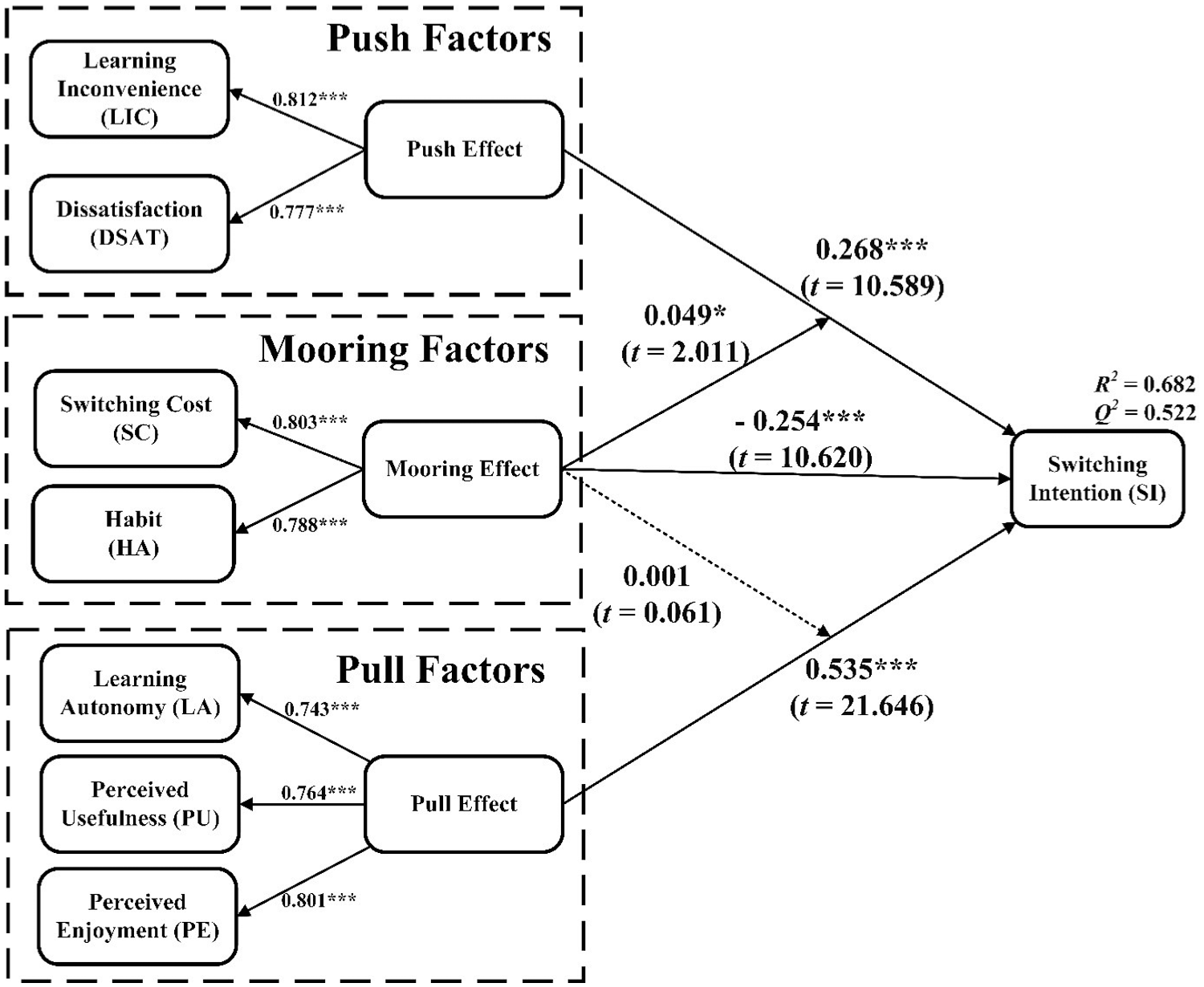
PLS results.
The hypothesis testing for this study is shown in Table 3. The findings indicate that push effects significantly impacted switching intention (β = .268, t = 10.589, p < .001); thus, H1 was supported. Pull effects significantly impacted switching intention (β = .535, t = 21.646, p < .001); thus, H2 was supported. Mooring effects significantly impacted switching intention (β = −.254, t = 10.620, p < .001); thus, H3 was also supported. The results also revealed that mooring effects significantly impacted the relationship between push effects and switching intention (β = .049, t = 2.011, p < .05); thus, H4 was supported. However, Mooring effects did not significantly impact the relationship between pull effects and switching intention (β = .001, t = 0.061, p > .05); thus, H5 was rejected.
Hypothesis Testing.

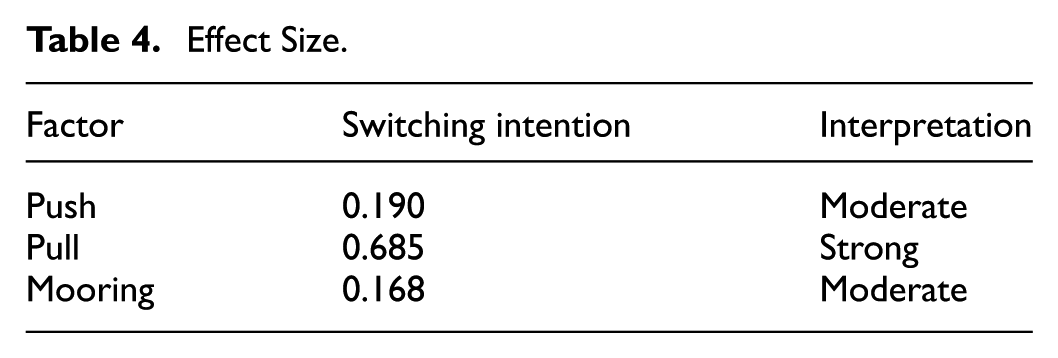
In SEM studies, endogenous variables refer to variables that are influenced by other variables within the model. Endogenous variables are often treated as the research’s primary purpose or dependent variable, contingent upon other variables (Bollen, 1989). In contrast, exogenous variables refer to variables in SEM studies that are not influenced by other variables within the model. Exogenous variables act as independent variables or predictors that contribute to explaining variation in endogenous variables (Bollen, 2012). The coefficient of determination, also known as R-square, is a statistical measure that quantifies the proportion of endogenous variable variation that can be explained by exogenous variables (Hair et al., 2013). According to Figure 2, the total impact of the push, pull, and mooring effects accounts for 68.2% of the variance in switching intentions (R2 = .682). Q-square (Q2) is frequently employed to predict the relevance of a model, and when the Q2 value is greater than zero, the model is deemed capable of predicting relevance. Based on the findings in Figure 2, where the Q2 for switching intention is 0.522, surpassing the threshold of 0, the model exhibits a good predictive capacity for relevance. The effect size (F-square) is used to indicate the change in the R-square of the endogenous variable when an exogenous variable is removed from the model. According to (Cohen, 2013), an F2 value larger than 0.02 is regarded as weak, a value greater than 0.15 is regarded as moderate, and a value greater than 0.35 is regarded as strong. Table 4 demonstrates the effect sizes of the three exogenous variables of the study, where push effects have a moderate effect value (F2 = 0.190), pull effects have a strong effect value (F2 = 0.685), and mooring effects have a moderate effect value (F2 = 0.168).
Effect Size.
Discussion and Implications
Discussion
The present study used the PPM model to explain Chinese EFL learners’ intention to switch from the traditional vocabulary learning method to GEVA, considering the different characteristics of the two learning methods (push and pull effects) and personal and contextual factors (mooring effects). The findings suggest that all four other hypotheses have been supported, except that mooring effects do not moderate the relationship between pull effects and switching intention.
According to the findings, push effects were able to significantly influence Chinese EFL learners’ switching intention, which is consistent with numerous previous studies, including online learning (Lin et al., 2021), online real-person English learning platforms (Chen & Keng, 2018), smartphones (Guo et al., 2021), and MOOCs (Kang et al., 2021). This underscores the importance of considering learners’ perceptions of traditional vocabulary learning methods when examining EFL learners’ switching intentions. Many Chinese EFL learners still use traditional vocabulary learning tools like vocabulary books, handwritten notebooks, and printed dictionaries. However, these traditional tools often require learners to search for vocabulary manually, which can be a time-consuming and labor-intensive process (Y. Li et al., 2024). Insufficient learning convenience can motivate Chinese EFL learners to transition from traditional vocabulary learning methods, favoring GEVA, which corresponds with previous research studies (Chen & Keng, 2018; Lin et al., 2021; Lisana, 2023). Also, these traditional tools often lack interactive elements, which further reduces learner engagement and motivation (Lin & Lin, 2019). Traditional vocabulary learning methods do not provide learners with immediate mistake correction and progress monitoring. Learners often struggle to recognize how well they have mastered vocabulary, which not only hinders learning efficiency but also heightens their sense of dissatisfaction with the learning process. The inherent time-consuming nature, tediousness, and inefficiency of traditional English vocabulary learning lead to dissatisfaction among Chinese EFL learners, prompting them to seek an alternative method for vocabulary learning. Therefore, dissatisfaction with their vocabulary learning method also led them to switch to utilizing GEVA, consistent with previous research (Sun et al., 2017; Widodo et al., 2019).
Based on the findings, pull effects can significantly influence Chinese EFL learners’ switching intention, which is consistent with many previous studies, including mobile learning (Y. Q. Jin et al., 2021), online services (Hsieh et al., 2012), the airline industry (Jung et al., 2017), and MOOCs (Kang et al., 2021). GEVA integrates features such as personalized study plans and timely reminders to enhance student learning autonomy (Liu, 2024). The interactive learning environment, diverse resources, and immediate feedback and assessment provided by GEVA facilitate the development of autonomous learners (Lisana, 2023; O’Byrne et al., 2008). Moreover, GEVA could enable Chinese EFL learners to take control of their learning process, fostering learning autonomy and promoting a more efficient and personalized vocabulary learning method. Digital learning tools that offer a high degree of learning autonomy, such as GEVA, can effectively address the needs of contemporary Chinese EFL learners, which is consistent with Lisana’s study (2023). Chinese EFL learners often encounter considerable vocabulary learning tasks throughout their university studies, especially in preparation for examinations or prospective careers. As a result, Chinese EFL learners pay really close attention to whether a particular learning method can improve their vocabulary efficiency. If learners see GEVA as effective in aiding their vocabulary learning, they are more likely to use them, which is consistent with numerous studies (Chen & Keng, 2018; Wang & Shin, 2022). GEVA offers a more effective way of vocabulary learning, enabling learners to master large amounts of vocabulary within a short period through timely learning feedback, personalized learning strategies, and diverse learning resources (Dehghanzadeh et al., 2021; Yu, 2023). As a result, many Chinese EFL learners have benefited from the high efficiency of GEVA, which continues to attract learners transitioning from traditional vocabulary learning methods. As a form of gamified learning, it is crucial for GEVA to provide learners with an enjoyable experience in the vocabulary learning process, as this is key to maintaining learning engagement and enhancing learning outcomes. GEVA incorporates challenges, rewards, and progress tracking to enhance the enjoyment of vocabulary learning while integrating game-like features into the learning process to support learner retention and engagement, thereby fostering enhanced learning outcomes (Liu, 2024). Chinese EFL learners frequently experience an overwhelming feeling of being inundated by the substantial English vocabulary they must study, together with the anxiety caused by exam preparation. GEVA could provide a solution through amusing learning activities and diverse learning materials that facilitate relaxation and enjoyment in language learning (Dehghanzadeh et al., 2021). Therefore, Chinese EFL learners’ perceptions of the extent to which GEVA offers an enjoyable learning environment significantly influence their intention to use it, which is aligned with previous studies (Birgin et al., 2010; Lisana, 2023; Nugroho & Wang, 2023).
The findings also indicate that mooring effects significantly impacted Chinese EFL learners’ intention to switch to GEVA, which aligns with previous research on various topics such as online learning (Lin et al., 2021), smartphones (Guo et al., 2021), and airline industry (Jung et al., 2017). In most PPM models, SC has often been identified as a crucial factor in mooring effects. Transitioning from traditional vocabulary learning methods to GEVA requires a significant investment of time and effort to become familiar with its interface, operation, and functionality (Luo, 2023). Moreover, not all learners possess great technological adaptability, and transitioning to GEVA could bring technical challenges to them. Although GEVA offers greater interaction and convenience than traditional vocabulary learning methods, it often incurs subscription fees or application purchase costs (Xu et al., 2021). Chinese university students may refrain from using GEVA, regardless of their effectiveness or enjoyment, if the required time, effort, or financial commitment exceeds their tolerance limit. The study’s results indicated that the higher the SC of using GEVA as perceived by Chinese EFL learners, the lower their intention to use these applications, which is consistent with previous research in various fields (Chen & Keng, 2018; Lin et al., 2021; Xu et al., 2021). As learners become accustomed to a specific learning method, they develop a feeling of familiarity and ease, which leads to a reluctance to try novel methods (Hsu & Ou Yang, 2013). Many Chinese students keep sticking with traditional vocabulary learning methods because they have been accustomed to using them for a long time. Chinese EFL learners have a strong familiarity with and dependence on traditional vocabulary learning methods, resulting in resistance when introduced to new learning tools. Besides, traditional vocabulary learning methods may carry emotional significance for learners. For example, some Chinese EFL learners may feel more comfortable and focused when memorizing words using handwritten notes or a paper dictionary. The findings suggest that if Chinese EFL learners are already accustomed to learning English vocabulary using the traditional way, they are less likely to try new GEVA, which is consistent with the literature in various fields (Chen & Keng, 2018; Y. Q. Jin et al., 2021).
Besides, mooring effects could significantly moderate the relationship between the push effect and switching intention, which is consistent with prior research (Chen & Keng, 2018; Kang et al., 2021). Interestingly, the mooring effects (SC and HA), which inhibited Chinese EFL learners’ switching intentions, were found to positively moderate the impact of push effects on switching intention. Although the moderating effect is not strong, it is still worth noting. It implies that when learners experience strong dissatisfaction or frustration with traditional vocabulary learning methods, they are more likely to take the initiative to overcome resistance and adopt more adaptive learning approaches, such as GEVA. Chinese EFL learners’ reliance on traditional vocabulary learning methods creates a cognitive dissonance with their growing dissatisfaction with these methods. To alleviate this psychological dissonance, learners are more inclined to make changes such as seeking more efficient and modern vocabulary learning tools such as GEVA. However, mooring effects cannot significantly moderate the relationship between the pull effect and switching intention, in line with findings from several previous studies (Hsieh et al., 2012; Y. Q. Jin et al., 2021; Kang et al., 2021). It illustrates that the pull effect itself can drive learners’ switching intentions and does not depend on the influence of the mooring effect. This is consistent with the findings that the pull effect as the benefits provided by GEVA to Chinese EFL learners has a higher impact on switching intention than the pull and mooring effects. GEVA’s advantages, including interactivity, enjoyment, personalized learning, and timely feedback, are highly effective in attracting Chinese EFL learners. These characteristics sufficiently motivate Chinese EFL learners to make the change despite their reliance on traditional methods and worries over the switching cost.
Theoretical Implications
This study extended the utilization of the PPM model within the technology adoption and vocabulary learning field, thereby establishing a theoretical basis for subsequent related research. Despite the widespread application of the PPM model in numerous studies regarding human migratory behavior, there is an absence of defined factors corresponding to each effect of the model (Cheng et al., 2019). Based on previous related literature, this research model has been established specifically for GEVA. The finding points out the most significant push effects (LC), pull effects (PU), and mooring effects (SC) that drive the adoption of GEVA usage. Therefore, this work contributes a foundation for future PPM research on language learning to investigate possible factors that may affect learners’ switching intentions.
Compared to studies based on some well-established models (such as TAM, UTAUT, and TPB), this PPM model’s study simultaneously considers the characteristics of traditional vocabulary learning method (push factors) and GEVA (pull factors), as well as contextual and personal factors (mooring factors). According to the results, the shortcomings of traditional vocabulary learning methods and learners’ personal and contextual factors are also crucial in influencing learners’ switching intentions. Also, it is found that the pull effect on switching intention is significant and remains unmoderated by mooring factors, which indicates that GEVA’s attractiveness to learners is crucial for migration and can independently drive changes. In particular, the finding that mooring factors can positively moderate the relationship between push factors and switching intentions also needs to be emphasized. The discovery of the conflict in learners’ cognitive dissonance based on a combination of reliance and dissatisfaction with traditional vocabulary learning methods may provide some new insights for future research. Hence, this research makes a valuable contribution to developing the PPM model and offers possible insights for future researchers.
Practical Implications
Tertiary educators can actively incorporate GEVA into their language instruction, demonstrating to students its features, such as personalized study plans, progress tracking, and interactive challenges, while clarifying how these features fit with course objectives, such as facilitating the preview or review of unit vocabulary. Utilizing GEVA’s data analytics tools to track students’ vocabulary learning data (such as mastery levels and frequent errors) in real-time is also a valuable approach. Educators can use GEVA to identify difficulties students encounter in vocabulary learning. For instance, for vocabulary that students find challenging to master through self-study, they can design targeted, interactive classroom activities (e.g., group competitions, situational application exercises) to enhance instructional precision further.
To address challenges in traditional vocabulary learning, such as time-consuming manual word lookup, the absence of prompt feedback, and inadequate interactivity, educators can design instructional activities that leverage the advantages of GEVA. Educators should take advantage of GEVA’s multimedia resources (e.g., audio, video, and animations) to enhance classroom input, replacing their sole reliance on paper-based word lists. Furthermore, they can generate classroom activities or post-class assignments utilizing GEVA’s real-time error correction and reward systems (including badges and leaderboards) to enhance students’ motivation for autonomous practice. Lastly, educators need to thoroughly explore the pedagogical value of features such as the “challenge mechanism” and “progress tracking function” in GEVA, and systematically transform them into interactive classroom group activities to overcome the limitations of traditional vocabulary learning through mechanical repetition. In language classroom activities, educators can pre-design vocabulary challenge tasks of varying levels (such as basic word meaning discrimination, contextual application gap-filling, and thematic vocabulary association) within GEVA, by curriculum-based vocabulary difficulty gradients, and organize time-limited, group-based challenge activities. During the activity, GEVA’s real-time progress monitoring feature enables each group to visibly assess their performance relative to others, thereby enhancing goal orientation and fostering a sense of healthy competition. Furthermore, educators can take advantage of GEVA’s “check-in mechanism” to develop collaborative goals for language learners. For example, they could require groups to jointly complete a designated thematic vocabulary module (e.g., high-frequency vocabulary in academic texts, essential vocabulary for everyday communication) within a week and synchronize the daily check-in data of each group using GEVA’s shared progress dashboard. This gamified design transforms individual learning into a collective task, diminishes students’ resistance to rote memorization, and fosters an interactive and collaborative learning environment through intra-group collaboration and inter-group communication. Through the in-depth integration of gamified elements with traditional classroom tasks, educators can not only effectively alleviate the sense of tediousness experienced by learners during vocabulary learning but also enhance students’ classroom engagement and vocabulary application competence through collaboration and competition.
Considering students’ long-term reliance on traditional vocabulary learning methods and the associated switching costs to GEVA (comprising time costs for adapting to new interfaces and operational procedures, effort costs for learning the logic of the new tool, and financial costs for subscription fees for certain GEVAs), educators must actively promote a “traditional methods + GEVA” blended learning model, to ensure a seamless adaptation via a step-by-step transition. During the early stages of student engagement with GEVA, educators can integrate GEVA as a supplement to traditional classroom instruction, striving to align the gamified content of GEVA with classroom material, thereby enabling students to recognize the value of the new tool within the familiar framework of traditional instruction. For students facing financial constraints (unable to afford subscription fees), educators can proactively collaborate with school administrators to secure bulk free trial access or discounted offers for GEVA through collective negotiation, thereby alleviating their financial burdens. For students struggling to adapt to the technology (e.g., unfamiliar with the APP’s operation), organizing a technical orientation workshop is advisable to swiftly acclimate them to the use of GEVA. This approach mitigates their resistance stemming from technological barriers and facilitates the gradual development of a habit and trust in utilizing GEVA.
Last but not least, educators’ proficiency in GEVA as well as the accessibility of pedagogical support are essential for the effective integration of this tool into the classroom. University administrators can incorporate GEVA-related support into faculty development systems and design specialized training programs for teachers. For instance, faculty proficient in GEVA can be invited to analyze how they integrate GEVA into their teaching practices, thereby addressing the dilemma that many teachers face in combining GEVA with their existing teaching methods. Of course, educators themselves, as the direct interface between GEVA and language classroom teaching, should take on the dual role of GEVA “user” and “facilitator.” In daily teaching practice, educators should identify areas for improvement and existing pain points in adapting the GEVA tool, systematically articulate learners’ core needs for optimizing GEVA’s functions, and proactively provide feedback to GEVA developers. This can drive GEVA to more precisely align with the actual scenarios of language classroom teaching in its iterative development.
Limitations and Future Research
This study focuses only on the vocabulary learning of Chinese EFL learners. However, it is crucial to recognize that the factors influencing learners’ intention to switch to a new learning method may differ in China’s unique cultural and educational setting compared to other countries. Therefore, future research can build upon the framework of this study to conduct a more comprehensive investigation in other countries. The cross-sectional design of this study, which captures data at only one point in time, does not sufficiently address the dynamic nature of learners’ switching intentions. Future studies could consider a longitudinal design to track the progression of learners’ perceptions and decision-making during their interactions with GEVA. Many Chinese EFL learners possess a strong familiarity with and reliance on traditional vocabulary learning methods, and the benefits provided by GEVA are unlikely to persuade them to quit using these traditional tools. Future research could apply an experimental approach to explore how the advantages of GEVA can serve as a valuable complement to traditional vocabulary learning methods. By integrating GEVA with traditional tools, learners can benefit from its interactivity and flexibility while preserving their established learning habits.
Footnotes
Acknowledgements
We would like to thank the 12 university students from three universities in Hubei Province who contributed to distributing the questionnaire.

Ethical Considerations
The study was approved by the Institutional Review Board of Assumption University (No. 15/2023).
Consent to Participate
Informed consent was obtained from all participants involved in the study.
Funding
The authors received no financial support for the research, authorship, and/or publication of this article.
Declaration of Conflicting Interests
The authors declared no potential conflicts of interest with respect to the research, authorship, and/or publication of this article.
Data Availability Statement
Due to several participants being under the age of 18, the researchers will not publicize the dataset. However, this dataset can be made available upon reasonable request.